
FORAGE FISH

DO YOU KNOW THEM?
By: Dr. Álida Ortiz SotomayorNOAA Fisheries defines forage fish as “small schooling species that serve as prey for larger commercially and recreationally important fish, as well as for marine mammals and seabirds. Anchovies, herring, chub mackerel, and sardines are some common forage fish”.
SOME OF THE MOST COMMON FORAGE FISH SPECIES IN THE CARIBBEAN


Forage fish are a fundamental part of marine food webs. They feed on plankton and convert energy from lower trophic levels into food for larger fish, marine mammals, and seabirds

MAY 2021
In the Caribbean Fishery Management Council (CFMC)'s bulletin you will find announcements, facts about marine species, and valuable information on fishing and regulations that rule this activity in Puerto Rico and the US Virgin Islands.
Ballyhoo (Hemiramphus brasiliensis) are nearshore surface-swimming species that form dense schools, often in association with each other
Scaled Herring (Harengula jaguana) is a gregarious species inhabiting the neritic environment and commonly schools around mangrove shorelines, seagrass beds, and surf zones.
Red Ear Herring (Harengula humeralis) is a gregarious species inhabiting the neritic environment and commonly schools around mangrove shorelines and seagrass beds
Photos: Fish Base
Human beings use forage fish for a variety of purposes, too. Ninety percent of the forage fish catch in the World is used to produce fishmeal or fish oil for use in agriculture, aquaculture, pet food, and other industries Forage fish also serve as bait or attractant for larger commercially and recreationally important fish
They are a critical part of the marine food webs, thus the need to monitor them, due to their connections with other species that are under management regimes. Recognizing the challenge and the overwhelming number of forage species, the research on those species or species indicators is a good practice utilized in many regions, to strengthen the Ecosystem Based Management approach
OTHER COMMON FORAGE FISH SPECIES IN THE CARIBBEAN


CFMC UPDATES
Threadfin Herring (Opisthonema oglinum), commonly found forming dense schools in the upper 3m of the water column; feeding primarily by filtering copepods from the water column, shrimps and prawns, small finfish and benthos including copepods, crabs, worms, sponges and tunicates and detritus
White Mullet (Mugil curema), found in sandy coasts and littoral pools, brackish lagoons and estuaries , sometimes found in rivers and on coral reefs Adults frequently form schools and are omnivorous, feeding on benthic algae and seagrass
Yellowfin Mojarra (Gerres cinereus), moves between fresh, salt and brackish waters They inhabit shallow coastal waters in open sandy and surf areas, seagrass meadows, mangrove channels, and coral reefs
Striped Mojarra (Eugerres plumieri), inhabits shallow coastal waters and commonly occur in brackish waters, often swimming a considerable distance into freshwaters They are found mostly over mud bottoms in mangrove-lined creeks and lagoons
GLOSSARY
Ecosystem Based Management
Integrated management approach that recognizes the full array of interactions within an ecosystem, including humans, rather than considering single issues, species, or ecosystem services in isolation. Also considers economic, ecological, social, and political aspects within the management strategies.
Marine food web Interconnections among all the food chains that belong to an ecological community, in this case, the sea.

CFMC UPDATES
LeGore, S. 2007. Bait Fisheries Serving the Marine Recreational Fisheries of Puerto Rico Report to DNER, Marine Resources Division. 130pgs Lenfest Forage Fish Task Force http://www.oceanconservationscience.org/foragefish/ NOAA Fisheries https://www.fisheries.noaa.gov/permit/forage-species MORE INFORMATION Blue Runner (Caranx crysus) is a schooling fish that lives inshore and offshore up to the insular drop off and feed on smaller fishes and invertebrates Juveniles are commonly found associated to floating debris or Sargassum weed patches
Successful Virtual PEPCO!
The Commercial Fishers Education Program (PEPCO, in Spanish) virtual workshops were held during five consecutive Wednesdays, from February 17 to March 17. Fortyfive fishers completed the series of workshops, where they got information about: licenses and requirements for commercial fishing, local and federal closures, local and federal regulations, ecosystem-based fishery management, lionfish,


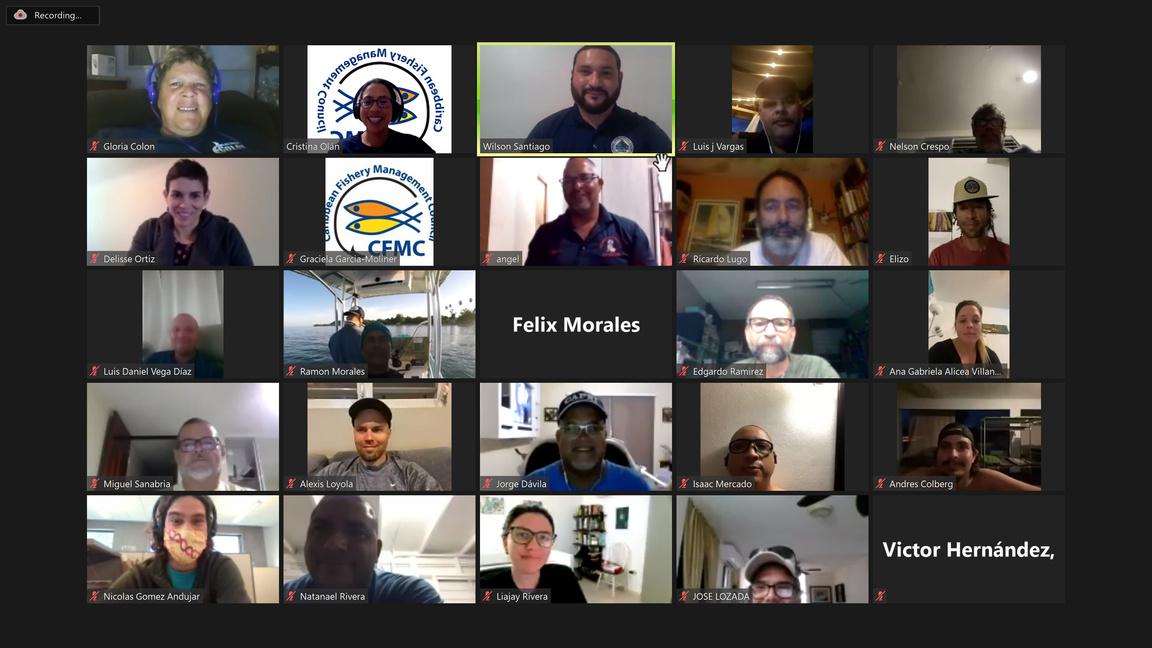

importance of sharks in the coral reef, coral diseases in Puerto Rico, among others. PEPCO is sponsored by: Department of Natural and Environmental Resources, Caribbean Fishery Management Council, The Nature Conservancy, and Conservación Conciencia. Are you interested in PEPCO? Send an email to wilson.santiago.cfmc@gmail.com
CFMC UPDATES
Queen snapper
(Etelis oculatus)
It is bright red on its upper and lower sides. The size averages at about 21 inches and weighs about 3 to 5 pounds. It has silvery sides and a deeply forked red tail that continues to lengthen as the fish grows. The species lives and is caught at depths of about 300 to 1,500 ft

SEDAR26-DW-01.
CFMC UPDATES
More information: Bryan, M D , del Mar Lopez, M , and Tokotch, B (2011), A review of the life history characteristics of silk snapper, queen snapper, and redtail parrotfish
Thanks to Nelson Crespo, PR DAP Chair, for the information provided.
Photo by: Okeanos Explorer 2015
She is known as Carmen from Costa or as the owner of Sun Spot at the Mayagüez Mall Carmen Rivera is a recreational fisher and current President of the Puerto Rico Sportfishing Association.

Carmen grew up surrounded by family members that enjoyed fishing, starting with her mom, who loved shore fishing. Therefore, fishing was always for her a family matter and a reason to share with her loved ones.

She became seriously involved in sportfishing thanks to the advertising and selling of Costa sunglasses. Carmen attended a lot of fishing tournaments to advertise and sell her sunglasses and, step by step, she became fully involved in sportfishing and supporting the organization of fishing tournaments.

CFMC UPDATES
Simultaneously, the business continued growing and, after being the manager for 11 years, she had the opportunity to buy the store. Sun Spot is one of the oldest kiosks in the Mayagüez Mall and still prevails and is visited by many persons daily.

“I began to work in the kiosk just after 20 days of giving birth. I did not have a car. Other people gave me rides from Lajas to the Mayagüez Mall,” Carmen said. She has been working in the store for 39 years; first as a salesperson, then as manager, and finally, as owner
Her leadership and managerial skills opened her a route to preside over the Puerto Rico Sportfishing Association, a position that she has held since 2014. Fishers such as Jorge Rivera, Richard Alonso, Carlos Morales, Elvin “Vinchy” Camacho y Waldemar Ramos are part of the persons that supported Carmen in her process of becoming involved in sportfishing. Carmen is always in good company in the Association. She works along with a board consisting of people from all around Puerto Rico.
“This gives me peace of mind. A member of the board is always present in any event,” Carmen recognizes.
CFMC UPDATES
As president she has been focused on ensuring that the Association is present in the fishing tournaments and clubs in Puerto Rico. Currently, the Association has over 300 members. Carmen is very happy with this growth and gives credit for it to the fishers and their families for all the support and good job done.
“You work all around the Island We have 9 clubs that belong to the Association. Each area is a whole different world. Each club has its specific species,” explained Carmen while recognizing that she is continuously learning
Th d her to become a member of the Puerto Rico District Advisory Panel in the Caribbean Fishery Management Council. Carmen values this opportunity and emphasizes the importance of commercial and recreational fishers becoming engaged in decision and public policy making.
At sea, her favorite species to catch are the mahi mahi and the marlin. For Carmen, mahi mahi fishing is very active and the adrenaline that produces is “the best”.
“Fishing is the best therapy in the world. These 8 hours on the high seas change my life. To feel this freedom changed my life,” Carmen ensures.

CFMC UPDATES
Carmen values the opportunity that fishing offers to the families to stay together. Her daughters have joined her fishing and her grandsons don’t miss an event with their Grandma.
“Fishing is a wholesome activity and is good for the youth. The moments spent fishing become a family day.”
Just like many other organizations and sectors, the pandemic affected recreational fishers and the Association, too. At present, the Association is planning activities that will be celebrated as soon as it is safe to bring together big groups of persons.
Carmen envisions to keep working for the PR Sportfishing Association and, together with the board of directors and the rest of the members, continue planning fishing events that involve family, provide learning experiences to the youth, and offer more opportunities for women to become involved in sportfishing.
*The CFMC acknowledges Carmen Rivera for the interview and the information and images provided

CFMC UPDATES
Mutton snapper (Lutjanus analis) and Lane snapper (Lutjanus synagris) have seasonal closures in federal waters / Economic Exclusive Zone (9-200 nautical miles (nm) for PR; 3-200 nm for USVI) and in USVI local waters (0-3 nm). Closures begin on April 1st and extend through June 30. In Puerto Rico local waters, seasonal closure for the mutton snapper ended in May 31. The lane snapper does not have a seasonal closure in PR local waters Do not fish, transport, sell, buy or consume these species during the closed season! More information: https://caribbeanfmc.com/calendars/closed-seasons


CFMC UPDATES Mutton snapper Lutjanus analis Lane snapper Lutjanus synagris L O O K F O R U S w w w . c a r i b b e a n f m c . c o m Ilustrations by: Sea Grant PR