Framework Action 4 under the St. Croix and St. Thomas and St. John Fishery Management Plans:
Modification of Spiny Lobster Management Reference Points Based on SEDAR 91 Stock Assessments
Briefing Book Version April 2026
Abbreviations and Acronyms Used in this Document
ABC acceptable biological catch
ACL annual catch limit
CEA cumulative effects analysis
CFMC (Council); Caribbean Fishery Management Council
DNER Department of Natural and Environmental Resources (Puerto Rico)
DPNR Department of Planning and Natural Resources (United States Virgin Islands)
DPS distinct population segment
EA environmental assessment
EEZ exclusive economic zone
FMP fishery management plan
MFMT maximum fishing mortality threshold
MSA (Magnuson-Stevens Act); Magnuson-Stevens Fishery Conservation and Management Act
MSST minimum stock size threshold
MSY maximum sustainable yield
NEPA National Environmental Policy Act
NMFS National Marine Fisheries Service
OFL overfishing limit
SEDAR Southeast Data, Assessment, and Review (stock assessment)
SEFSC Southeast Fisheries Science Center
SSC Scientific and Statistical Committee
USVI United States Virgin Islands
List of Tables
Table 1.1. Management reference points from SEDAR 91 Caribbean Spiny Lobster stock assessments for each island/island group........................................................................................ 6
Table 1.2. Overfishing limit and acceptable biological catch values for spiny lobster for each island/island group. Values are in pounds whole weight. 6
Table 2.1. Overfishing limit, acceptable biological catch, and annual catch limit for spiny lobster in St. Croix under the Action 1 alternatives. All values are in pounds whole weight................... 8
Table 2.2. Overfishing limit, acceptable biological catch, and annual catch limit for spiny lobster in St. Thomas/St. John under the Action 1 alternatives. All values are in pounds whole weight. ....................................................................................................................................................... 10
Table 3.1. Annual Spiny Lobster Landings, Revenues, and Prices in St. Croix, 2012–2024. 16
Table 3.2. Trip Activity Taken by Lobster Harvesters in St. Croix, 2020–2024......................... 17
Table 3.3. Annual Fishing Activity, Landings, and Revenue Metrics for Lobster Fishers in St. Croix, 2020–2024.................................................................................................................... 18
Table 3.4. Summary of Trip‑Level Landings and Revenues for the St. Croix Lobster Fleet, 2020–2024. 18
Table 3.5. Composition of Jointly Caught Landings and Revenues for Spiny Lobster Trips in St. Croix, 2020–2024. ........................................................................................................................ 19
Table 3.6. Summary of Non‑Lobster Fishing Activity by Lobster Fishers in St. Croix, 2020–2024............................................................................................................................................... 19
Table 3.7. Average Trip Revenues from Lobster and jointly-caught Species by Fishing Area, St. Croix (2020–2024). 20
Table 3.8. Fisher Participation and Lobster Revenue Dependence in St. Croix, 2020–2024...... 21
Table 3.9. Annual Spiny Lobster Landings, Revenues, and Prices in St. Thomas and St. John 2012–2024..................................................................................................................................... 22
Table 3.10. Trip Activity Taken by Lobster Harvesters in St. Thomas and St. John, 2020–2024. 23
Table 3.11. Annual Fishing Activity, Landings, and Revenue Metrics for Lobster Fishers in St. Thomas and St. John, 2020–2024................................................................................................. 23
Table 3.12. Summary of Trip‑Level Landings and Revenues for the St. Thomas and St. John Lobster Fleet, 2020–2024............................................................................................................. 24
Table 3.13. Composition of Jointly Caught Landings and Revenues for Spiny Lobster Trips in St. Thomas and St. John, 2020–2024. 25
of Contents
Table 3.14. Summary of Non‑Lobster Fishing Activity by Lobster Fishers in St. Thomas and St. John, 2020–2024...........................................................................................................................
Table 3.15. Average Trip Revenues from Lobster and Jointly-caught Species by Fishing Area in St. Thomas and St. John, 2020–2024.
Table 3.16. Fisher Participation and Lobster Revenue Dependence in St. Thomas and St. John, 2020–2024.....................................................................................................................................
Table
Table 4.2. Summary of benefits to the biological environment.
Table 4.3. Comparison of Annual Catch Limits and Potential Revenue for St. Croix Spiny Lobster..........................................................................................................................................
Table 4.4. Comparison of Annual Catch Limits and Potential Revenue for St. Thomas and St. John Spiny Lobster.
List of Figures
Figure 1.1. U.S. Caribbean exclusive economic zone with boundaries between the Puerto Rico, St. Croix, and St. Thomas/St. John management areas (dashed line) and the federal and state (i.e., territorial) jurisdictions (blue lines)................................................................................................ 8
Framework Action 4 to USVI
Table of Contents
Chapter 1. Introduction
1.1 What Action is Proposed?
Framework Action 4 updates the status determination criteria (SDC) and other management reference points for spiny lobster (Panulirus argus) under the St. Croix Fishery Management Plan (FMP) and the St. Thomas and St. John FMP. These updates are consistent with the Southeast Data, Assessment, and Review 91 (SEDAR 91) spiny lobster stock assessments and recommendations from the Caribbean Fishery Management Council’s (Council) Scientific and Statistical Committee (SSC).
The SDC are metrics used to determine if a stock or stock complex is experiencing overfishing or is overfished. Under Framework 4, the SDC to be updated include the maximum fishing mortality threshold (MFMT), the minimum stock size threshold (MSST), and the overfishing limit (OFL). Other spiny lobster management reference points to be updated under Framework Action 4 include the maximum sustainable yield (MSY), or MSY proxy, acceptable biological catch (ABC), optimum yield (OY), and annual catch limit (ACL). See Appendix A for a description of each reference point.
A draft version of Framework Action 4 is available on the Council website.
1.2 Why is the Council Considering Action?
The Council is considering updating management reference points (Tables 1.1 and 1.2) to incorporate information from the most recent stock assessments for spiny lobster, which are considered best scientific information available for the St. Croix and St. Thomas/St. John spiny lobster stocks.
The SEDAR 91 spiny lobster stock assessments were completed in 2025, using data inputs through 2023. The Council’s SSC reviewed the SEDAR 91 assessment reports at its September 2025 meeting, and determined that the stock assessments are useful for providing management advice and developing fishing level recommendations. The SSC recommended ABCs for spiny lobster for St. Croix and St. Thomas/St. John that were derived from the projected OFLs using a sigma value (i.e., an estimate of scientific uncertainty) of 0.5, and the Council’s risk of overfishing value (P*) of 0.45. At the December 2025 Council meeting, the Council accepted the SSC’s spiny lobster ABC recommendations for St. Croix and St. Thomas/St. John and requested staff begin development of a framework action to update the ACLs for spiny lobster under each FMP.
Table 1.1. Management reference points from SEDAR 91 Caribbean Spiny Lobster stock assessments for each island/island group.
Management reference point
Maximum sustainable yield proxy (pounds whole weight)
Maximum fishing mortality threshold (FSPR30%)
Minimum stock size threshold in thousands of eggs (0.75* Spawning Stock Biomass [SSB]MFMT)
Table 1.2. Overfishing limit and acceptable biological catch values for spiny lobster for each island/island group. Values are in pounds whole weight. Constant-catch
* Note that the OFL and ABC values are larger than the MSY proxy included in Table 1.1. This is because the SSB estimate for 2023 is considerably larger than the SSB associated with the MSY proxy (BMSY). When biomass is greater than BMSY, a larger temporary catch is possible without causing overfishing.
Following the SSC review of the SEDAR 91 assessments, the St. Croix and St. Thomas/St. John spiny lobster stocks remain classified as Tier 3 stocks under the Council’s ABC control rule: data limited but with an accepted assessment. Framework Amendment 1 to the St. Croix and St. Thomas/St. John FMPs describes the criteria for determining when a Tier 3 stock is overfished or undergoing overfishing. If the ABC control rule tier remains the same following an accepted stock assessment, the National Marine Fisheries Service prepares a stock status determination memorandum, if needed, to update the overfished and overfishing status for the stock consistent with the assessment without waiting for an amendment and implementing regulations.1 NMFS will determine that a stock is undergoing overfishing if (1) the fishing mortality (F) exceeds the MFMT in years with a stock assessment, or (2) if the most recent year of available landings is
1 Because status determinations must be based on the SDC in the FMP per the Magnuson-Stevens Fishery Conservation and Management Act, NMFS does not use these new criteria for official stock status determinations until they are adopted in an FMP. Adopting new SDC can result in delays in updating stock status determinations because amending an FMP can be a lengthy process. Several Councils have adopted flexible overfishing and overfished SDC in their FMPs that enable more timely stock status determinations in such situations. Flexible Status Determination Criteria Examples and their Application White Paper
greater than the current OFL in non-assessment years. In non-assessment years the current OFL may or may not be the same OFL value that was in effect during the year the landings were reported.
1.3 Statement of Purpose and Need
The purpose of Framework Action 4 is to update status determination criteria and management reference points for spiny lobster under the St. Croix FMP and the St. Thomas/St. John FMP to ensure management is consistent with the most recent spiny lobster stock assessments and recommendations from the Council’s SSC.
The need for Framework Action 4 is to ensure that management measures for spiny lobster are based on the best scientific information available to prevent overfishing and achieve optimum yield, in accordance with the requirements of the Magnuson-Stevens Fishery Conservation and Management Act.
1.4 Where Will the Action Have an Effect?
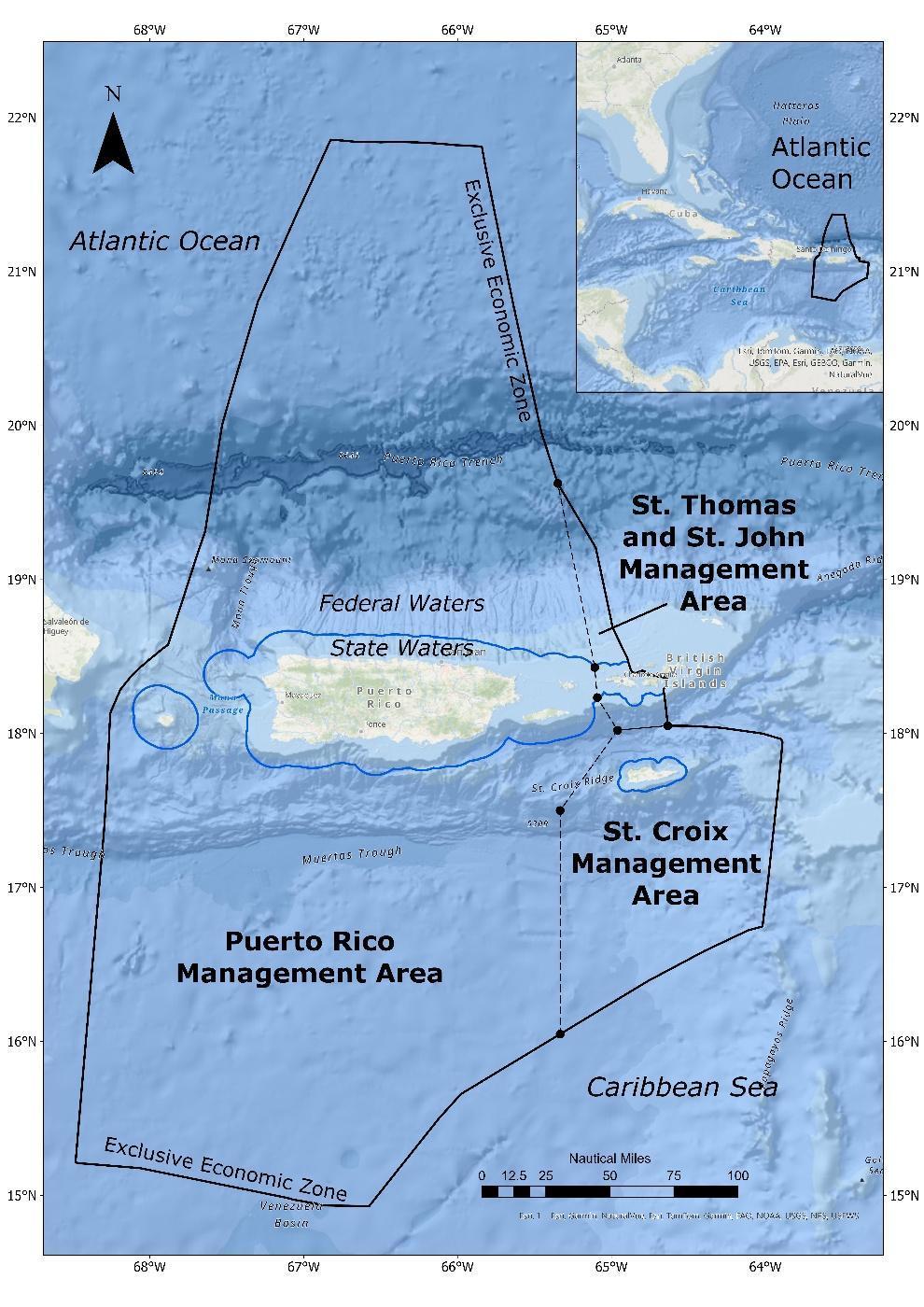
The Council is responsible for managing fishery resources, including spiny lobster, in federal waters in the U.S. Caribbean region (Figure 1.1). Federal waters around St. Croix and around St. Thomas/St. John range 3-200 nautical miles (6-370 kilometers) from the shore of the respective U.S. Virgin Islands (USVI) island/island group to the outer boundary of the U.S. Caribbean exclusive economic zone.
Figure 1.1. U.S. Caribbean exclusive economic zone with boundaries between the Puerto Rico, St. Croix, and St. Thomas/St. John management areas (dashed line) and the federal and state (i.e., territorial) jurisdictions (blue lines).
1.5 History of Federal Fisheries Management
The St. Croix and St. Thomas/St. John FMPs updated several management elements, including: the list of federally-managed species (sorting them into stocks or stock complexes); management reference points for managed stocks/stock complexes; accountability measures (AM); descriptions of essential fish habitat for managed species; and a list of available framework procedures. The FMPs retained some management measures established under the previous U.S. Caribbean-wide FMPs (Reef Fish FMP of Puerto Rico and the USVI, Spiny Lobster FMP of Puerto Rico and the USVI, Queen Conch FMP of Puerto Rico and the USVI, and Corals and Reef Associated Plants and Invertebrates FMP of Puerto Rico and the USVI) that were applicable to the respective island management area (e.g., seasonal and area closures, minimum size limits, recreational bag limits).
St. Croix FMP (CFMC 2019a) and St. Thomas/St. John FMP (CFMC 2019b)
The FMPs were effective on October 13, 2022 (87 FR 56204). For spiny lobster, each FMP:
● Prohibited harvest of egg-bearing females and required fishermen to land spiny lobster intact;
● Prohibited harvest with spear and hook gear and with a gillnet or trammel net;
● Included descriptions for spiny lobster trap identification, construction specifications, and tending restrictions;
● Specified a minimum size limit of 3.5 inches (8.9 centimeters) carapace length;
● Specified a recreational bag limit of 3 spiny lobsters per person/day, not to exceed 10 spiny lobsters per vessel/day, whichever is less;
● Included import restrictions;
● Included a four-tiered ABC Control Rule used to define management reference points;
● Specified sustainable yield level (an OFL proxy), ABC, and ACL for spiny lobster;
● Described the AMs and closure provision for spiny lobster; and
● Described the essential fish habitat for spiny lobster.
Framework Amendment 1 (CFMC 2022)
Framework Amendment 1 to the St. Croix and St. Thomas/St. John FMPs, effective on April 15, 2023 (88 FR 16194), updated management reference points for spiny lobster based on the 2019 SEDAR 57 spiny lobster stock assessments (SEDAR 57 Stock Assessment Report) and application of the Council’s ABC Control Rule. Framework Amendment 1 specified the OFLs and ABCs for each FMP, and set the spiny lobster ACLs equal to 0.95 of the ABCs for years
2021-2023. For years 2024 and later, Framework Amendment 1 specified more conservative OFL, ABC and ACL values. Framework Amendment 1 also revised the process for triggering an AM to compare the average of the most recent three years of spiny lobster landings to the average ACLs in place during those years.
Framework Amendment 2 (CFMC 2023)
Framework Amendment 2 to the St. Croix and St. Thomas and St. John FMPs, effective on May 30, 2024 (89 FR 34168), updated the OFL, ABC, and ACL for spiny lobster under each FMP for years 2024 and later based on best scientific information available from the 2022 Update Assessment to the 2019 SEDAR 57 spiny lobster stock assessments.
Framework Action 4 to USVI FMPs Table of Contents
Chapter 2. Proposed Actions
and Alternatives
Framework procedures included in the St. Croix Fishery Management Plan (FMP) and the St. Thomas/St. John FMP allow the Caribbean Fishery Management Council (Council) to modify management measures through a framework action when a new stock assessment indicates changes should be made to management reference points and status determination criteria (SDC).
Framework Action 4 would adopt management reference points that are consistent with the Southeast Data, Assessment, and Review (SEDAR) 91 spiny lobster stock assessments, specified in Table 1.1. Through Framework Action 4 the Council would also update the overfishing limit (OFL), acceptable biological catch (ABC), and annual catch limit (ACL) for spiny lobster in St. Croix (Action 1) and St. Thomas/St. John (Action 2).
2.1 Action 1: Update the St. Croix Spiny Lobster OFL, ABC, and ACL
Alternative 1. No Action. Retain the current St. Croix spiny lobster OFL, ABC, and ACL values (Table 2.1). The ACL is set equal to 95% of the recommended ABC and equals 137,254 pounds (lbs).
Alternative 2. Update the St. Croix spiny lobster OFL and ABC values and set the ACL equal to the recommended ABC (Table 2.1). The ACL would equal 186,063 lbs.
Alternative 3. Update the St. Croix spiny lobster OFL and ABC values and set the ACL equal to 95% of the recommended ABC (Table 2.1). The ACL would equal 176,760 lbs.
Alternative 4. Update the St. Croix spiny lobster OFL and ABC values and set the ACL equal to 90% of the recommended ABC (Table 2.1). The ACL would equal 167,457 lbs.
Table 2.1. Overfishing limit, acceptable biological catch, and annual catch limit for spiny lobster in St. Croix under the Action 1 alternatives. All values are in pounds whole weight.
and Alternatives
Discussion
Alternative 1 would retain the spiny lobster OFL, ABC, and ACL for St. Croix set under Framework Amendment 2 (CFMC 2023), which was based on the 2022 Update Assessment to SEDAR 57. Alternative 1 would not be consistent with the most recent stock assessment for spiny lobster. The Magnuson-Stevens Fishery Conservation and Management Act (MagnusonStevens Act) National Standard 1 states that “conservation and management measures shall be based upon the best scientific information available” (16 U.S.C. 1851(a)(2)). Alternative 1 would be inconsistent with the requirements of the Magnuson-Stevens Act because it is not based on the best scientific information available.
Alternative 2, Alternative 3, and Alternative 4 would update the OFL and ABC for spiny lobster for St. Croix consistent with the SEDAR 91 stock assessment, and would set the ACL at or below the ABC recommended by the Council’s Scientific and Statistical Committee (SSC) using varying degrees of management uncertainty.2 Management uncertainty refers to uncertainty in the ability of managers to constrain catch to the ACL, and the uncertainty in quantifying the true catch amounts. Alternatives 2-4 would be based upon the best scientific information available and consistent with the requirements of the Magnuson-Stevens Act.
Alternative 2 would set the ACL equal to the ABC, and would reflect no management uncertainty. No management uncertainty means that managers believe the reported landings accurately represent the actual catch for the stock, with little to no variation expected between reported landings and actual catch each year. When there is some uncertainty in the reported landings, managers may set the ACL lower than the ABC to buffer the impacts of any estimation errors or inaccuracies. The greater the buffer between the ACL and ABC, the less risk there is of exceeding catch targets and overfishing the stock. Alternative 3 would set the ACL at 95% of the ABC and Alternative 4 would set the ACL at 90% of the ABC, which reflects a higher level of management uncertainty than Alternative 3.
The ACLs under Alternatives 2-4 are greater than the ACL under Alternative 1 (137,254 lbs). Of the three proposed alternatives, Alternative 2 would allow for the largest annual catch of spiny lobster (186,063 lbs), followed by Alternative 3 (176,760 lbs), then Alternative 4 (167,457 lbs). Alternative 4 would have the largest buffer between the ACL and the ABC, lowering the risk of overfishing, but potentially triggering an accountability measure3 more frequently if catch exceeds the ACL. Annual commercial landings of spiny lobster in St. Croix have been less than 100,000 lbs since ACLs were implemented in 2012, which is below both the current and proposed ACLs (Table 2.1).
2 Sources of management uncertainty include late reporting, misreporting, or underreporting of catch amounts, as well as lack of sufficient in-season management, including in-season closure authority.
3 Accountability measures are management controls put in place to prevent catch limits from being exceeded, and to correct or mitigate overages if they occur
Alternatives
2.2 Action 2: Update the St. Thomas and St. John Spiny Lobster OFL, ABC, and ACL
Alternative 1. No Action. Retain the current St. Thomas/St. John spiny lobster OFL, ABC, and ACL values (Table 2.2). The ACL is set equal to 95% of the recommended ABC and equals 133,207 lbs.
Alternative 2. Update the St. Thomas/St. John spiny lobster OFL and ABC values and set the ACL equal to the recommended ABC (Table 2.2). The ACL would equal 132,964 lbs.
Alternative 3. Update the St. Thomas/St. John spiny lobster OFL and ABC values and set the ACL equal to 95% of the recommended ABC (Table 2.2). The ACL would equal 126,316 lbs.
Alternative 4. Update the St. Thomas/St. John spiny lobster OFL and ABC values and set the ACL equal to 90% of the recommended ABC (Table 2.1). The ACL would equal 119,668 lbs.
Table 2.2. Overfishing limit, acceptable biological catch, and annual catch limit for spiny lobster in St. Thomas/St. John under the Action 1 alternatives. All values are in pounds whole weight.
Discussion
Alternative 1 would retain the spiny lobster OFL, ABC, and ACL for St. Thomas/St. John set under Framework Amendment 2, which was based on the 2022 Update Assessment to SEDAR 57. Alternative 1 would not be consistent with the most recent stock assessment for spiny lobster. The Magnuson-Stevens Act National Standard 2 states that “conservation and management measures shall be based upon the best scientific information available” (16 U.S.C. 1851(a)(2)) Additionally, the ACL under Alternative 1 is greater than the ABC recommended by the SSC that is based on the SEDAR 91 assessment. The Magnuson-Stevens Act states that “each Council shall . . . develop annual catch limits for each of its managed fisheries that may not exceed the fishing level recommendations of its scientific and statistical committee” (16 U.S.C. 1852(h)(6)). Alternative 1 would not be consistent with the Magnuson-Stevens Act mandate to base conservation and management measures on the best scientific information
available and would retain an ACL that is higher than the most recent ABC recommended by the Council’s SSC.
Alternative 2, Alternative 3, and Alternative 4 would update the OFL and ABC for spiny lobster for St. Thomas/St. John consistent with the SEDAR 91 stock assessment, and would set the ACL at or below the ABC recommended by the SSC using varying degrees of management uncertainty.4 Management uncertainty refers to uncertainty in the ability of managers to constrain catch to the ACL, and the uncertainty in quantifying the true catch amounts. Alternatives 2-4 would be based upon the best scientific information available and consistent with the requirements of the Magnuson-Stevens Act.
Alternative 2 would set the ACL equal to the ABC, and would reflect no management uncertainty. No management uncertainty means that managers believe the reported landings accurately represent the actual catch for the stock, with little to no variation expected between reported landings and actual catch each year. When there is some uncertainty in the reported landings, managers may set the ACL lower than the ABC to buffer the impacts of any estimation errors or inaccuracies. The greater the buffer between the ACL and ABC, the less risk there is of exceeding catch targets and overfishing the stock. Alternative 3 would set the ACL at 95% of the ABC and Alternative 4 would set the ACL at 90% of the ABC, which reflects a higher level of management uncertainty than Alternative 3
The ACLs under Alternatives 2-4 are less than the ACL under Alternative 1 (133,207 lbs). Of the three proposed alternatives, Alternative 2 would allow for the largest annual catch of spiny lobster (132,964 lbs), followed by Alternative 3 (126,316 lbs), then Alternative 4 (119,668 lbs). Alternative 4 would have the largest buffer between the ACL and the ABC, lowering the risk of overfishing, but potentially triggering an accountability measure5 more frequently if catch exceeds the ACL. Annual commercial landings of spiny lobster in St. Thomas/St. John have averaged around 100,000 lbs since ACLs were implemented in 2012, which is below both the current and proposed ACLs (Table 2.2).
4 Sources of management uncertainty include late reporting, misreporting, or underreporting of catch amounts, as well as lack of sufficient in-season management, including in-season closure authority.
5 Accountability measures are management controls put in place to prevent catch limits from being exceeded, and to correct or mitigate overages if they occur
Framework Action 4 to USVI FMPs Chapter 2. Actions and Alternatives Spiny Lobster ACLs
Chapter 3. Affected Environment
This section describes the environment and resources in federal waters around St. Croix and St. Thomas/St. John that would be affected by the proposed actions. Information on the physical, biological/ecological, economic, social, and administrative environments of the U.S. Virgin Islands (USVI) are described in detail in the St. Croix Fishery Management Plan (FMP) (CFMC 2019a) and the St. Thomas/St. John FMP (CFMC 2019b), in Framework Amendment 1 (CFMC 2022) and Framework Amendment 2 (CFMC 2023), which are incorporated herein by reference and summarized below.
3.1 Description of the Physical Environment
The U.S. Caribbean exclusive economic zone (EEZ) covers approximately 75,687 mi2 (196,029 km2), which, for management purposes, is divided into the Puerto Rico, St. Croix, and St. Thomas/St. John management areas (see Figure 1.1).
3.1.1
St. Croix
Federal waters around St. Croix extend 3 - 200 nautical miles (6 – 370 km) from the shoreline, covering approximately 9,216 mi2 (23,870 km2). St. Croix is located about 46 mi (74 km) south of St. Thomas/St. John and lies on a different geological platform than Puerto Rico, St. Thomas, and St. John.
For St. Croix, the following areas are managed with seasonal closures that are applicable to spiny lobster:
● Red Hind Spawning Aggregation Area (Lang Bank) - closed December 1 through the last day of February, each year, to all fishing, including spiny lobster; and
● Mutton Snapper Spawning Aggregation Area - closed March 1 through June 30, each year, to all fishing, including spiny lobster.
3.1.2 St. Thomas and St. John
Federal waters around St. Thomas/St. John extend 3 - 200 nautical miles (6 – 370 km) from the shoreline, covering approximately 1,103 mi2 (2,856 km2).
For St. Thomas/St. John, the following areas are managed with year-round or seasonal closures that are applicable to spiny lobster:
● Hind Bank Marine Conservation District - closed year-round to all fishing, including spiny lobster; and
● Grammanik Bank - closed February 1 through April 30, each year, to all fishing, including spiny lobster.
3.1.3 Essential Fish Habitat (EFH)
EFH is defined in the Magnuson-Stevens Fishery Conservation and Management Act (Magnuson-Stevens Act) as “those waters and substrates necessary to fish for spawning, breeding, feeding, or growth to maturity” (16 U.S. C. 1802(10)).
In St. Croix and St. Thomas/St. John, EFH for spiny lobster consists of all waters from mean high water to the outer boundary of the U.S. Caribbean EEZ (i.e., habitats used by phyllosome larvae) and seagrass, benthic algae, mangrove, coral, and live/hard bottom substrates from mean high water to 100 fathoms depth (habitats used by other life stages).
3.2 Description of the Biological and Ecological Environments
The waters off St. Croix, St. Thomas, and St. John, U.S. Virgin Islands are home to a diverse population of fish and invertebrates, managed under an island-based approach in the U.S. Caribbean EEZ. Both the St. Croix FMP and the St. Thomas/St. John FMP include numerous species, including reef fish like snappers and groupers, along with commercially important pelagic and invertebrate species such as dolphinfish, wahoo, and spiny lobster. These species live in the shelf and slope waters around the islands, utilizing a variety of habitats. The reefdwelling species in particular rely on the reef environment for protection and food.
3.2.1 Spiny Lobster Life History
The Caribbean spiny lobster, Panulirus argus (hereafter referred to as spiny lobster), occurs in the Western Central and South Atlantic Ocean, including the Caribbean Sea and the Gulf of America (Gulf), ranging from North Carolina in the north to Brazil in the south. Spiny lobster occur from the extreme shallows of the littoral fringe to depths exceeding 328 feet (100 meters) (Kanciruk 1980; Munro 1974). In the U.S. Caribbean, the distribution of spiny lobster extends to the edge of the shelf, which is described as the 100-fathom contour (183 m) (CFMC 1981).
3.2.2 Status of the Spiny Lobster Stocks
The Southeast Data, Assessment, and Review (SEDAR) process is a partnership managed by the Caribbean, Gulf, and South Atlantic Fishery Management Councils, NMFS, and the Atlantic and Gulf States Marine Fisheries Commissions. The main goals of the SEDAR process are to: (1) improve the quality and reliability of fishery stock assessments, (2) increase transparency and public participation, and (3) ensure that assessments are rigorously reviewed by independent scientists. The process includes three workshops: (1) the Data Workshop, during which fishing
and species data are gathered and checked, (2) the Assessment Workshop, during which models are created based on the provided data to estimate the size and health of the population, and (3) the Review Workshop, during which independent experts review the input data, assessment methods, and assessment products. The finished assessment, including all workshop reports and supporting documentation, is forwarded to the Council’s Scientific and Statistical Committee (SSC). The SSC considers whether the assessment represents the best available science and develops related fishing level recommendations (i.e., acceptable biological catch [ABC]).
The SEDAR 91 assessments for spiny lobster in St. Croix and St. Thomas/St. John management areas were completed in fall of 2025, and used the same status determination criteria (i.e., minimum stock size threshold [MSST] and maximum fishing mortality threshold [MFMT]) that were used in the SEDAR 57 assessment (SEDAR 57 2019). The SEDAR 91 stock assessments found that both the St. Croix spiny lobster stock and the St. Thomas/St. John spiny lobster stock were not undergoing overfishing (i.e., current fishing mortality is below MFMT) and were not considered overfished (i.e., current spawning output is above MSST).
3.2.3 Bycatch
Fisheries and gear types that are noted for producing large amounts of bycatch (e.g., trawling) are essentially absent from the U.S. Caribbean. Thus, bycatch is not a significant issue in St. Croix and St. Thomas/St. John, compared to other regions. SEDAR 91 concluded that discard mortality of spiny lobster from the commercial fleet was minimal and represented a very minor source of mortality due to fishing. Fishery statistics of recreational spiny lobster removals are not available.
The actions in Framework Action 4 are not expected to significantly increase or decrease the magnitude of bycatch or bycatch mortality in the St. Croix and St. Thomas/St. John fisheries that target spiny lobster. Additionally, since fishermen in the U.S. Caribbean region traditionally utilize most resources harvested, and the amount of bycatch from the fisheries targeting spiny lobster are minimal and are not expected to change under this action, little to no affect to mammals or birds through the impacts of lobster bycatch would be expected from the proposed actions.
3.2.4
Protected Species
Within the U.S. Caribbean, some species and their habitats are protected under the Marine Mammal Protection Act, the Endangered Species Act (ESA), or both. A summary of these two laws and more information is available on the National Marine Fisheries Service (NMFS) Office of Protected Resources website.6
The NMFS completed a biological opinion on September 21, 2020, evaluating the impacts of the Puerto Rico, St. Croix, and St. Thomas/St. John fisheries on ESA-listed species that occur in the U.S. Caribbean region (NMFS 2020; see Appendix B). In the biological opinion, NMFS determined that the authorization of the fisheries conducted under each island FMP is not likely to adversely affect sperm, sei, and fin whales; the Northwest Atlantic DPS of loggerhead sea turtle and leatherback sea turtle; giant manta rays; or critical habitat of green, hawksbill, and leatherback sea turtles. The biological opinion also determined that the authorization of the island-based fisheries is not likely to jeopardize the continued existence of the North Atlantic DPS of green sea turtle, South Atlantic DPS of green sea turtle, hawksbill sea turtle, Nassau grouper, oceanic whitetip shark, Central and Southwest Atlantic DPS of scalloped hammerhead shark, Acropora coral (i.e., elkhorn and staghorn coral), rough cactus coral, pillar coral, lobed star coral, mountainous star coral, and boulder star coral, or result in the destruction or adverse modification of designated Acropora critical habitat.
ESA designated critical habitat for the green sea turtle, hawksbill sea turtle, leatherback sea turtle, and Acropora corals also occur within the Council’s jurisdiction. Critical habitat for green and hawksbill sea turtles occurs entirely within Puerto Rico territorial waters, and over 99% of the critical habitat for leatherback sea turtles around St. Croix occurs within USVI territorial waters. Designated critical habitat of Acropora corals in Puerto Rico and the USVI extend from the mean low water line seaward to the 98 foot (30 meter) depth contour (73 FR 72209), the majority of which occurs in territorial waters.
ESA consultations were reinitiated to address newly designated critical habitat for six distinct population segments (DPS) of green sea turtle (88 FR 46572; July 19, 2023), five threatened Caribbean coral species (88 FR 54026; August 9, 2023), and Nassau grouper (89 FR 126; January 2,2024) and for the listing of queen conch as threatened (89 FR 11208; February 14, 2024) as they occur in the action areas described under the Puerto Rico, St. Croix, and St. Thomas/St. John FMPs and may be affected by the fisheries. Those consultations are ongoing.
The actions contained in Framework Action 4 are not anticipated to change the operation of the St. Croix or St. Thomas/St. John fisheries in a manner that would cause effects to ESA-listed species or critical habitat that were not considered in the 2020 biological opinion.
3.2.5
Changing Environmental Conditions
Environmental changes can affect spiny lobster populations as the coral reef ecosystems in which they reside shift due to increases in water temperatures and extreme weather events (e.g., hurricanes). These shifts associated with changing environmental conditions can also affect the food chain that the spiny lobsters rely on. Additionally, the extended larval phase of spiny lobsters makes them particularly vulnerable to these changing conditions, specifically the
warming of surface temperatures.7 Ross and Behringer (2019) found that in addition to affecting the survival and size at metamorphosis of spiny lobsters, especially post-larval and juvenile lobsters, changes in ocean temperature and salinity also altered the spiny lobsters ability to identify chemosensory cues, such as selecting suitable shelters, which may result in decreased survivorship due to impaired behaviors.
3.3 Description of the Economic Environment
3.3.1
St. Croix Fishery
The Crucian spiny lobster fishery is a small‑scale, multispecies system dominated by dive‑based harvest methods, with trap gear contributing less than 10% of total landings. In St. Croix, its connection to tourism is part of a broader, more diversified fishing strategy. Although the lobster fishery expanded in the 1960s to meet rising hotel demand, many contemporary Crucian fishers now prioritize species such as queen conch. Lobster often functions as a secondary target, becoming more important when conch seasons close or when market demand shifts (Agar et al, 2024).
Long‑term spiny lobster landings from 2012–2024 show a pronounced downward trajectory, falling from a peak of 87,073 pounds in 2012 to substantially lower levels in later years (Table 3.1). This decline accelerated following the 2017 hurricane season. In 2017, Hurricane Maria caused extensive damage to fishing gear, vessels, and coastal infrastructure, resulting in the lowest recorded annual landings of 10,970 pounds in 2018 during the 2012-2024 time series. Damage to non‑fishing infrastructure also limited economic activity and delayed the re‑establishment of market channels. Landings increased in subsequent years but remained below earlier baselines. The onset of the COVID‑19 pandemic in 2020 introduced additional disruptions. Reductions in tourism activity, labor availability, and market demand corresponded with lower lobster landings during 2020–2021. Because price data were incomplete in several years and required interpolation, these revenue values should be interpreted cautiously.
Table 3.1. Annual Spiny Lobster Landings, Revenues, and Prices in St. Croix, 2012–2024.
aValues and prices are deflated using the 2024 BEA Implicit Price Deflator (GDP Deflator by Year). Because prices were not collected consistently across years or species and in several years were unavailable altogether they are less reliable indicators of economic conditions. In years with no reported price information, values were interpolated to maintain continuity in the time series, and these estimates should not be regarded as observed prices.
Fishing activity among St. Croix lobster harvesters showed noticeable year‑to‑year shifts from 2020 through 2024. Lobster-directed trips generally made up about half of all fleet activity, ranging from a low of 46% in 2020 to a high of 53% in both 2021 and 2024. Total trips increased sharply in 2021 and 2023, driven by rises in both lobster and non‑lobster effort, before easing slightly in 2024 (Table 3.2).
Table 3.2. Trip Activity Taken by Lobster Harvesters in St. Croix, 2020–2024.
Landings and revenues followed a similar pattern: lobster landings peaked in 2021, while non‑lobster landings were highest in 2022. Revenues from lobster trips were strongest in 2021 and 2023, whereas non‑lobster revenue was highest in 2020 and 2022. Adjusted to 2024 dollars, data for Table 3.3 show that economic performance fluctuated across the period, reflecting changes in effort, catch composition, and the variability of reported prices.
Table 3.3. Annual Fishing Activity, Landings, and Revenue Metrics for Lobster Fishers in St. Croix, 2020–2024.
Table 3.4. Summary of Trip‑Level Landings and Revenues for the St. Croix Lobster Fleet, 2020–2024.
aReal values are calculated using the 2024 BEA
Deflator. Because ex‑vessel price data were inconsistently collected across years and absent in some years revenues for those missing years rely on interpolated
to maintain continuity in the time series.
About 30 fishers participate in the Crucian lobster fishery. These individuals maintain diversified operational strategies, alternating between lobster‑directed trips and trips targeting other species. In 2024, the fleet conducted 896 lobster‑yielding trips and 693 non‑lobster trips (Table 3.4 and Table 3.5). Between 2020 and 2024, the primary species landed jointly with lobster were stoplight parrotfish and queen conch, providing context for the role of lobster within multispecies operations. On mixed‑species trips, lobster accounted for 22–44% of total landings and 27–54% of total revenue (Table 3.5).
Table 3.5. Composition of Jointly Caught Landings and Revenues for Spiny Lobster Trips in St. Croix, 2020–2024.
aReal values are calculated using the 2024 BEA GDP Deflator. Because ex‑vessel price data were inconsistently collected across years and absent in some years revenues for those missing years rely on interpolated proxy prices to maintain continuity in the time series.
Non‑lobster fishing trips remain an important source of income for lobster fishers. Queen conch generated the highest non‑lobster revenue, supplemented by parrotfishes, dolphinfish, and deeper‑water species such as silk snapper. Non‑lobster landings ranged from approximately 60,000 to 96,000 pounds annually, with 51–70% harvested in territorial waters (Table 3.6).
Table 3.6. Summary of Non‑Lobster Fishing Activity by Lobster Fishers in St. Croix, 2020–2024.
aReal values are calculated using the 2024 BEA GDP Deflator. Because ex‑vessel price data were inconsistently collected across years and absent in some years revenues for those missing years rely on interpolated proxy prices to maintain continuity in the time series.
Spatial patterns provide additional information on fleet behavior. Fishing activity declined and contracted toward territorial waters during the 2020-2024 period. Although average revenues per trip remained higher in federal waters, the difference narrowed by 2024 (Table 3.7).
Table 3.7. Average Trip Revenues from Lobster and jointly-caught Species by Fishing Area, St. Croix (2020–2024).
Participation ranged from 26 to 32 fishers annually. At the individual level, economic dependence on lobster varied substantially. Mean dependence increased to 33% in 2023 before declining to 27% in 2024 (Table 3.8). Individual dependence ranged from minimal reliance on lobster to near‑complete reliance, reflecting heterogeneous strategies within the fleet.
Table 3.8. Fisher Participation and Lobster Revenue Dependence in St. Croix, 2020–2024.
3.3.2 St. Thomas and St. John Fishery
The St. Thomas and St. John spiny lobster fishery is a small‑scale, multispecies trap-based fishery. About 90% of harvested lobster is caught with lobster traps, with the remainder mostly taken in fish traps. In both islands, spiny lobster landings are closely tied to the tourism cycle. Demand rises sharply during the high tourist season from November through April, when visitors from the continental United States and elsewhere escape colder climates and frequent local hotels and restaurants. Production, however, reaches its lowest point during the peak hurricane season (July to September), which coincides with the departure of most tourists and the temporary closure of many restaurants (Agar et al., 2024). Because the local fleet operates on a market‑based model that avoids freezing to preserve taste and quality, fishers adjust their catch volumes to match these seasonal shifts in demand.
Local lobster production consistently exceeds import volumes into the Territory. From 2020 to 2024, St. Thomas and St. John landed between 94,000 and 125,000 lbs annually, while St. Croix contributed an additional 22,000 to 44,000 lbs per year. All locally harvested lobster is consumed within the Territory, and although inter‑island trade occurs primarily transfers from St. Croix to St. Thomas and St. John the volume of this movement is unknown. During this same five‑year period, imports averaged roughly 7,500 lbs per year, though this average is heavily influenced by an exceptional spike in 2024, when imports exceeded 35,000 lbs.
Table 3.9 shows that annual spiny lobster landings in St. Thomas and St. John display pronounced variability between 2012 and 2024, with two clear periods of decline followed by recovery linked to major environmental and global disruptions. Total production reached an early peak of 121,697 lbs in 2016, but the 2017 hurricane season caused an immediate 24% drop in landings. In 2017, Hurricane Irma left residents without power, water, or shelter for months,
severely constraining fishing activity. This contraction continued into 2018, when landings fell to a series low of 86,731 lbs.
A second disruption occurred in 2020 due to the COVID‑19 pandemic, which reduced fishing activity and market demand. Following the pandemic‑related dip, landings rose again from 2022 onward, reaching new highs in 2023 and 2024. Because price information was incomplete in several years, interpolated values limit the interpretive strength of price trends.
Table 3.9. Annual Spiny Lobster Landings, Revenues, and Prices in St. Thomas and St. John 2012–2024.
aValues and prices are deflated using the 2024 BEA Implicit Price Deflator (GDP Deflator by Year). Because prices were not collected consistently across years or species and in several years were unavailable altogether they are less reliable indicators of economic conditions. In years with no reported price information, values were interpolated to maintain continuity in the time series, and these estimates should not be regarded as observed prices.
Tables 3.10 and 3.11 summarize the recent annual fishing activity and economic performance for lobster fishers from 2020 through 2024, with current conditions taken into account throughout the analysis. Lobster fishers in St. Thomas and St. John are not solely dependent on the lobster fishery. From 2020 to 2024, trips targeting lobster made up roughly 65–68% of the fleet’s annual activity, with the remaining 32–35% focused on other species (Table 3.10).
Table 3.10. Trip Activity Taken by Lobster Harvesters in St. Thomas and St. John, 2020–2024.
Landings from lobster trips consistently dominated overall harvests, exceeding non‑lobster landings by a wide margin each year typically more than double, and in some years nearly triple, the volume of non‑lobster landings. Because price data were inconsistently collected across years, real revenue estimates rely partly on interpolated values and should be interpreted with caution.
Table 3.11. Annual Fishing Activity, Landings, and Revenue Metrics for Lobster Fishers in St. Thomas and St. John, 2020–2024.
aReal values are calculated using the 2024 BEA GDP Deflator. Because ex‑vessel price data were inconsistently collected across years and absent in some years revenues for those missing years rely on interpolated proxy prices to maintain continuity in the time series.
Trip‑level indicators offer a closer look at how individual lobster fishing operations adapted to the pandemic disruption (Table 3.12). For the St. Thomas and St. John lobster fleet, these indicators show clear shifts from 2020 through 2024, with changes in landings and revenues closely reflecting the impacts of the COVID‑19 pandemic and the subsequent rebound (Table
3.12). Mean lobster landings per trip were relatively low in 2020 and 2021, when pandemic‑related constraints affected both fishing activity and market demand. Mean total landings per trip also declined in 2021 before beginning to recover. From 2022 onward, both mean lobster landings and mean total landings per trip increased steadily, reaching their highest levels in 2023 and 2024. Revenues per trip followed a similar trajectory: mean lobster and total revenues were lowest during 2020–2021, but rose consistently from 2022 through 2024, mirroring the improvements in landings and overall market conditions.
Table 3.12. Summary of Trip‑Level Landings and Revenues for the St. Thomas and St. John Lobster Fleet, 2020–2024.
aReal values are calculated using the 2024 BEA GDP Deflator. Because ex‑vessel price data were inconsistently collected across years and absent in some years revenues for those missing years rely on interpolated proxy prices to maintain continuity in the time series.
Because lobster fishing occurs within a multispecies context, it is also important to examine the composition of jointly caught landings and revenues. Jointly caught landings and revenues show that lobster consistently accounted for a substantial share of total catch value on mixed‑species trips (Table 3.13). The lobster proportion or share of total landings increased from 44% in 2020 to a peak of 62% in 2023, before moderating slightly in 2024 Similarly, the lobster share of total revenues rose from 50% in 2020 to 70% in 2023, reflecting both higher landings and relative value. Species commonly landed jointly with lobster included queen triggerfish (Ole Wife), red hind, gray angelfish, white grunt, doctorfish, scrawled cowfish, blue striped grunt, stoplight parrotfish, French angelfish, and hogfish.
Table 3.13. Composition of Jointly Caught Landings and Revenues for Spiny Lobster Trips in St. Thomas and St. John, 2020–2024.
aReal values are calculated using the 2024 BEA GDP Deflator. Because ex‑vessel price data were inconsistently collected across years and absent in some years revenues for those missing years rely on interpolated proxy prices to maintain continuity in the time series.
Understanding the broader multispecies strategy requires considering the year‑round non‑lobster fishing activity of lobster fishers (Table 3.14). Non‑lobster fishing remains an important component of fisher income. Annual non‑lobster landings ranged from 84,403 to 97,922 lbs between 2020 and 2024, with 28–43% harvested in territorial waters. On trips where no lobster was caught, the most frequently landed species included queen triggerfish (Ole wife), red hind, yellowtail snapper, blue runner, dolphinfish, whelks, gray angelfish, white grunt, yellowfin tuna, and blue striped grunt. These figures highlight the reliance on a diverse set of species to buffer income against fluctuations in lobster availability and market conditions.
Table 3.14. Summary of Non‑Lobster Fishing Activity by Lobster Fishers in St. Thomas and St. John, 2020–2024.
aReal values are calculated using the 2024 BEA GDP Deflator. Because ex‑vessel price data were inconsistently collected across years and absent in some years revenues for those missing years rely on interpolated proxy prices to maintain continuity in the time series.
Spatial patterns in trip revenues further illustrate how fishers adjust effort across territorial and federal waters (Table 3.15). Spatial patterns indicate a gradual reduction in offshore activity. For jointly-caught species and total revenues, federal water trips continued to generate higher average revenues than territorial water trips. Total revenue per trip in federal water decreased from $2,480 in 2020 to $2,385 in 2024, while territorial water revenues increased from $1,181 to $1,347 over the same period.
Table 3.15. Average Trip Revenues from Lobster and Jointly-caught Species by Fishing Area in St. Thomas and St. John, 2020–2024.
The combined patterns of lobster and non‑lobster activity shape how reliant individual fishers are on lobster revenue Fisher‑level dependence on lobster revenue remained variable between 2020 and 2024, with mean dependence ranging from 36% to 45% and individual values spanning from less than 1% to 100% (Table 3.16). This wide distribution reflects the diverse strategies fishers use to balance lobster harvests with other species, allowing them to adapt to seasonal shifts, environmental conditions, and market disruptions.
Participation ranged from 30 to 42 fishers annually, indicating a relatively stable but modestly sized fleet. The persistence of fishers with both very low and very high dependence underscores the importance of lobster as both a primary target species and a flexible component of broader multispecies portfolios.
Table 3.16. Fisher Participation and Lobster Revenue Dependence in St. Thomas and St. John, 2020–2024.
3.4 Description of the Social Environment
This section describes the social environment associated with the spiny lobster fishery in the USVI, including St. Croix and St. Thomas/St. John.
3.4.1 Historical and Cultural
Context
Marine resource use in the USVI extends back approximately 2,500–3,000 years to Indigenous populations migrating from northern South America. Archaeological and ethno-historical evidence documents sustained reef fishing, shellfish harvesting, and nearshore marine exploitation through pre-Columbian societies, colonial plantation economies, emancipation, and into the modern territorial period.
Caribbean spiny lobster has historically functioned as both a subsistence resource and a socially embedded food shared through social networks (kinship, communal, occupational and familial).
Prior to large-scale tourism development in the mid-to-late twentieth century, lobster had limited formal commercial value and was frequently distributed within households and among community members.
With the growth of tourism-based economies in the USVI, lobster transitioned into a high-value commercial species serving restaurants and resorts. Despite this commercialization, lobster retains strong cultural significance and remains embedded in social exchange networks, food security practices, and intergenerational knowledge transmission.
Oral histories conducted with multigenerational fishing families document lobster’s longstanding role in household food security. Prior to widespread refrigeration, lobster was frequently
harvested for immediate household consumption. To further explain this, we consider a 2024 oral history interview with the daughter of a well-known fisherman and fishing family. She stated that when she was growing up, even though they were poor and never had the luxury of certain activities such as eating out, they did always have food both from the sea and from their farm/house-gardens. She said that they may not have had a lot of money but they always had something to eat and interestingly in many cases it was lobster and conch, two species easily accessible inshore and targeted by her father and uncles on the evenings and weekends (Stoffle 2025, NOAA Voices Oral History Archives).
During the recent hurricane and COVID-19 pandemic, distribution patterns temporarily mirrored historical subsistence models, demonstrating adaptive capacity within fishing communities. Fishers were deemed essential workers and were responsible for providing fresh local seafood to community residents struggling with economic and health concerns (Stoffle 2025, NOAA Voices Oral History Archives).
3.4.2
Recent Environmental and Socioeconomic Perturbations
The USVI social environment is highly linked to coastal and marine systems. Key vulnerabilities include: (1) hurricane exposure and infrastructure susceptibility, (2) coral reef degradation and fisheries productivity shifts, (3) sea-level rise affecting low-lying communities and waterfront infrastructure, and (4) increases in water temperatures.
Recent major disturbances affecting the social environment of the lobster fishery include Hurricanes Irma and Maria (2017) and the COVID-19 pandemic (2020–2022). Hurricane impacts included vessel loss, marina damage, gear destruction, fuel shortages, and tourism collapse. The pandemic similarly disrupted demand from restaurants and resorts, leading to short-term contraction of commercial markets.
Adaptive capacity varies across fishing sectors. Households dependent on small-scale fishing or informal marine employment may experience greater sensitivity to environmental changes or ecological decline, while tourism-linked enterprises are vulnerable to global economic and environmental disruptions. Oral histories in the USVI document the development of adaptive strategies for dealing with natural and social perturbations, often couched on their reliance on social capital and developed social networks that allows for resource sharing and culturally appropriate methods for overcoming a diverse set of social and natural forces. Following the recent disruptions (e.g., the 2017 hurricanes and COVID-19 pandemic), fishermen adapted by redirecting catch toward local consumption and informal distribution networks, demonstrating the fishery’s role as a resilience resource.
More recently and ongoing, significant Sargassum influxes (building since 2008 and reaching all time high levels in 2024–2025) have created emerging challenges. Fishermen report gear fouling, navigational congestion, diver safety concerns, and increased maintenance costs. While
not yet resulting in regulatory closures, these environmental conditions represent growing uncertainty within the social-ecological system.
3.4.3 Fishery Overview and Community Dependence
National Standard 8 requires that managers take into account the importance of fishery resources to fishing communities. This is accomplished by utilizing the best scientific information in order to provide for the sustained participation of those communities and minimize adverse economic impacts on those communities. Following this directive, over the last 23 years social scientists and economists from the NMFS have engaged in socio-economic research to identify the importance and historical and contemporary connection of USVI communities to fisheries and local marine resources. Research findings led to two important decisions regarding the USVI fisheries. First, that St. Croix and St. Thomas/St. John should each be designated as a fishing community (Stoffle et al. 2009, 2011) and, second, that due to the difference between the fisheries, each island area should be managed separately based on variability in community engagement and dependence on specific marine resources. At its 136th meeting in December 2010, the Council voted to designate the USVI as “Fishing Communities” under the MagnusonStevens Act, recognizing their shared values, beliefs, and practices while also identifying unique attributes in each fishery sector, justifying the need for island-based management.
Framework Amendment 2 includes graphical representations for each district of fisher engagement levels and reliance on commercial/artisanal fisheries to identify areas where spiny lobster is of local importance and where prospective regulatory effects would most likely be experienced. (see Figures 3.5.4 and 3.5.5). These figures represent the most recent commercial/artisanal fishing engagement and reliance indicators for the USVI and were not updated under this action.
The St. Croix and St. Thomas/St. John lobster fisheries support commercial8 and recreational9 fishers. Pre-arranged sales agreements between commercial fishers and restaurants and resorts have become more common since the COVID-19 pandemic, reducing waste and aligning harvest effort with demand. Traditional dockside and roadside sales also persist, reflecting longstanding relationships between fishermen and repeat customers. Lobster is regularly sold to locals, especially if a specific event or ceremony is being held. This too is usually preordered to ensure that both fisher and client are on the same page with regard to quantity and size. Some commercial fishers retain a portion of their catch for subsistence purposes (e.g., household consumption).
8 Commercial fishing is defined at 50 CFR 622.2 as any fishing or fishing activities which result in the harvest of any marine or freshwater organisms, one or more of which (or parts thereof) is sold, traded, or bartered.
9 Recreational fishing is defined at 50 CFR 622.2 as fishing or fishing activities which result in the harvest of fish, none of which (or parts thereof) is sold, traded, or bartered.
Recreational and commercial fishers who retain a portion of their catch for subsistence purposes commonly target inshore reefs using snorkel or shallow diving gear. Harvest frequently coincides with family gatherings, holidays, and social events, reinforcing cultural continuity. For purposes of this action, recreational and subsistence participants are treated jointly because lobster harvest is a retention fishery targeted primarily for consumption.
Ancillary businesses include seafood dealers, restaurants, hotels, dive shops, fuel providers, and marine supply vendors. For example, dive shops play an important supporting role by providing tank refills and equipment maintenance services for commercial as well as recreational divers. The spiny lobster fisheries contribute to income diversification, household provisioning, and tourism-based economic activity across both island districts.
3.4.4 St. Croix
Location and Population
St. Croix is the largest of the U.S. Virgin Islands, located in the Caribbean Sea approximately 40 miles south of St. Thomas and St. John. The island measures 82 square miles and includes diverse marine habitats such as coral reefs, seagrass beds, and mangroves that support subsistence, commercial, and recreational fisheries.
St. Croix is home to 41,004 residents (2020 Census), making it the most populated island in the USVI (U.S. Census Bureau 2020). Fishing households comprise a small but culturally significant portion of the population. Fishers include commercial license holders, part-time operators, subsistence fishers, and charter captains. Family and kinship networks structure much of the community’s engagement with marine resources, with fishing knowledge transmitted across generations.
Commercial Harvest Practices
As described in Stoffle et al. (2009), improved roads and facilities allow fishermen to use a variety of locations around the island based on their ability to trailer their boats. Using multiple launching/landing sites suggests a conscious adaptation of fishing practices, with the selected fishing location often a result of careful deliberation of market pressure/demand, weather and safety.
St. Croix fishermen use three primary locations where they launch and land their boats: Altoona Lagoon on the north coast, which accounted for 57% of the total spiny lobster landings from 2020-2024; Molasses Dock (aka Krauss Lagoon) on the south coast, which accounted for 16%; and Frederiksted on the west coast, which accounted for 11%.
In St. Croix, commercial harvesters primarily target lobster using SCUBA and freediving on shallow reef habitats (see Table 3.3 for the number of commercial fishers reporting lobster in St.
Croix). Some fishermen combine SCUBA with trap deployment targeting strategies, selectively removing legal-sized lobster from a trap and working other traps until they reach a predetermined quantity or run out of air. This hybrid method increases efficiency but also requires frequent surfacing and tank usage, increasing operational costs.
Reports from fishermen indicate increasing conflict associated with unauthorized removal of lobster from privately set traps. These conflicts generate economic losses, gear damage, and strain within the fishing community. Some fishermen have confronted one another on land and offered to teach the illegal fishermen the strategy for building their own traps. This has been met with varying degrees of success. The illegal fishing is said to disrupt pre-established arrangements by undercutting prices. Fishermen understand the problematic nature of enforcement due to limited individuals who are stretched to cover many land and sea based issues. However, fishermen report that increased efforts to curb illegal fishing would stabilize markets and relationships.
3.4.5 St. Thomas and St. John
Location and Population
St. Thomas is one of the three principal islands of the USVI, an unincorporated territory of the United States located in the eastern Caribbean. The territorial capital, Charlotte Amalie in St. Thomas serves as the administrative, commercial, and transportation hub of the USVI. Its deep-water harbor and strategic location in the Lesser Antilles have historically positioned the island as a center for trade, maritime commerce, and cruise tourism. This geographic centrality strongly shapes the island’s contemporary social and economic organization.
St. Thomas, has a total land area of approximately 31 square miles, 13 miles in length and 4 miles in width. It is the second-largest island in the USVI after St. Croix and the most densely populated of the three main islands. St. Thomas has a population of approximately 40,000–45,000 residents (recent estimates fluctuate due to migration and post-disaster displacement). The social fabric reflects an Afro-Caribbean population with deep historical roots tied to Danish colonialism, plantation slavery, and emancipation in 1848. These roots were further shaped by subsequent U.S. governance from 1917 to the present. The region has also seen significant migration from other Caribbean and European nations, particularly from those of French descent, as well as people from Puerto Rico, the Dominican Republic, and the Eastern Caribbean islands. This migration contributes significantly to the area's cultural and linguistic diversity. Additionally, there is a smaller but influential population of continental U.S. expatriates and seasonal residents. This group is primarily concentrated in the tourism, real estate, and recreational marine industries.
Outmigration especially of younger residents seeking education and employment opportunities in the mainland United States remains a persistent demographic dynamic, affecting labor force composition and community continuity.
St. John is the smallest of the three principal islands of the USVI, yet it possesses one of the most distinct demographic profiles in the territory. With a population of approximately 4,000–4,500 residents (fluctuating seasonally), St. John is characterized by low population density, high land conservation coverage, and a dual structure of long-standing Crucian/West Indian families and in-migrating mainland U.S. residents.
A defining demographic turning point occurred in 1956 with the establishment of Virgin Islands National Park, which today encompasses roughly 60% of the island’s land area. Federal land acquisition limited large-scale development and permanently reshaped settlement patterns, concentrating residential communities in Cruz Bay, Coral Bay, and several smaller inland neighborhoods.
St. John accounts for less than 5% of the total USVI population. Settlement is clustered primarily in Cruz Bay, Coral Bay (smaller, more residential and historically fishing-oriented community) and scattered hillside and coastal residential areas Seasonal variation is pronounced. During peak tourist months (December–April), the island’s population can increase significantly due to short-term visitors and part-time residents. This seasonal fluctuation affects housing markets, labor demand, and public services.
Commercial Harvest Practices
As described in Stoffle et al. (2011), many fishermen in St. Thomas prefer to keep their boats in areas close to where they live, using the same launching and landing sites and continuing longterm, established relationships with the local businesses (services) in the area. Currently, there are eight marinas located on St. Thomas, four on the south side and four on the east side, and 11 designated mooring and anchoring areas.10 The majority of the total spiny lobster landings for 2020-2024 were reported from Benner Bay (55%) and Red Hook (24%) areas, both on the east side of St. Thomas.
In contrast to St. Croix, the St. Thomas/St. John lobster fishery primarily utilizes trap-based harvest methods (see Table 3.11 for the number of commercial fishers reporting lobster in St. Thomas/St. John). A smaller portion of lobster is caught incidentally in fish pots. Trap fishing supports consistent supply to high-end restaurants and resorts serving U.S. mainland and international tourists.
The USVI spiny lobster fishery is deeply embedded within cultural traditions, local food systems, and tourism-driven economies. Oral histories and long-term engagement by social science researchers with the local fishermen of the USVI has demonstrated that lobster, which was once deemed a non-market value species, is currently one of the most economically important species in the region and still plays an important role in each island districts’ fishery today.
3.5 Description of the Administrative Environment
3.5.1
Federal Fishery Management
The Magnuson-Stevens Act (16 U.S.C. 1801 et seq.) claims sovereign rights and exclusive fishery management authority over most fishery resources within the U.S. Caribbean EEZ, an area extending from the seaward boundary of each coastal state to 200 nautical miles from shore, as well as authority over U.S. anadromous species and continental shelf resources that occur beyond the EEZ.
The Council is responsible for the conservation and management of fishery stocks within federal waters surrounding St. Croix and St. Thomas/St. John. The Council consists of seven voting members: four members nominated by the Governors of Puerto Rico and the USVI and appointed by the Secretary of Commerce (Secretary), at least one of whom is appointed from each state (i.e., territory); the principal officials with marine fishery management responsibility for Puerto Rico and the USVI designated by their Governors; and NMFS’ Southeast Region Regional Administrator. Regional councils are responsible for preparing, monitoring, and revising management plans for fisheries needing management within their jurisdiction. The Secretary is responsible for promulgating regulations to implement proposed plans and amendments after ensuring that management measures are consistent with the MagnusonStevens Act and with other applicable laws (Appendix C). In most cases, the Secretary has delegated this authority to NMFS.
The public is involved in the fishery management process through participation at public meetings, on advisory panels and through council meetings that, with few exceptions for discussing personnel matters, are open to the public. The regulatory process is in accordance with the Administrative Procedure Act, in the form of “notice and comment” rulemaking, which provides extensive opportunity for public scrutiny and comment, and requires consideration of and response to those comments.
3.5.2
U.S. Virgin Islands Fisheries Management
The purpose of state representation at the Council level is to ensure state participation in federal fishery management decision-making and to promote the development of compatible regulations in state and federal waters. State governments have the authority to manage their respective fisheries including enforcement of fishing regulations, and exercises legislative and regulatory authority over their states’ natural resources through discrete administrative units. Although each state agency is the primary administrative body with respect to the state’s natural resources, all states cooperate with numerous state and federal regulatory agencies when managing marine resources.
The USVI’s Department of Planning and Natural Resources is responsible for the conservation and management of USVI fisheries and enforcement of boating and fishing regulations in state waters (0-3 nautical miles from shore) and the Division of Fish and Wildlife (DFW) is responsible for data collection pertaining to the fisheries of the USVI. The DFW monitors commercial and recreational fisheries and provides recommendations to the DPNR Commissioner on matters relating to fisheries management. Rules and regulations for the USVI fisheries are codified in the Virgin Islands Code, primarily within Title 48 Chapter 12.
Chapter 4. Environmental Effects
This framework action includes the same alternatives for updating the overfishing limit (OFL), acceptable biological catch (ABC), and annual catch limit (ACL) values for spiny lobster under the St. Croix Fishery Management Plan (FMP) and the St. Thomas/St. John FMP. To reduce repetition within this chapter, the environmental effects are discussed for each alternative, then by island where applicable.
Summary of Management Alternatives
St. Croix (Action 1) and St. Thomas/St. John (Action 2)
Alternative 1. No Action. Retain the current spiny lobster OFL, ABC, and ACL values.
Alternative 2. Update the spiny lobster OFL and ABC values and set the ACL equal to the recommended ABC.
Alternative 3. Update the spiny lobster OFL and ABC values and set the ACL equal to 0.95 of the recommended ABC.
Alternative 4. Update the spiny lobster OFL and ABC values and set the ACL equal to 0.90 of the recommended ABC.
4.1 Effects on the Physical Environment
Effects on the physical environment generally occur from fishing effort associated with interactions between fishing gear (e.g., spiny lobster traps) and the bottom substrate or from anchoring.
Through this action, the Caribbean Fishery Management Council (Council) would revise the OFL, ABC, and ACL for spiny lobster in federal waters around St. Croix and St. Thomas/St. John based on the SEDAR 91 spiny lobster stock assessments and recommendations from its Scientific and Statistical Committee (SSC). The analysis below assumes that (1) harvest would be constrained to the ACLs and (2) the amount of harvest (i.e., weight in pounds) correlates to interactions between fishing gear and anchors and the bottom.
Alternative 1 (No Action) would retain the OFL, ABC, and ACL for spiny lobster established under the 2022 update to the previous spiny lobster stock assessments (SEDAR 57). No effects on the physical environment would be expected as the catch levels would not change (no changes in fishing effort from the baseline), thus current interactions with the substrate from gear and anchors would not change. Alternative 2, Alternative 3, and Alternative 4 would update the OFL and ABC values based on the most recent spiny lobster stock assessments (SEDAR 91),
and would set ACL values based on an increasing degree of management uncertainty (i.e., the ACLs would decrease as the buffer increases).
For St. Croix, the ACL under Alternative 2 would increase by 48,809 pounds (lbs) from the ACL under Alternative 1, and would be 9,303 lbs greater than the ACL under Alternative 3 and 18,606 lbs greater than the ACL under Alternative 4. Therefore, Alternative 2 would be expected to provide the least benefits to the physical environment under the assumption that an increase in ACL translates to increased bottom-impacting gear use. For St. Thomas/St. John, the ACL under Alternative 2 would be 243 lbs less than the baseline ACL, and 6,648 lbs greater than the ACL under Alternative 3 and 13,296 lbs greater than the ACL under Alternative 4. For St. Thomas/St. John, Alternative 1 would be expected to provide the least benefits to the physical environment, followed in order by Alternative 2, then Alternative 3, and lastly Alternative 4.
Table 4.1. Summary of benefits to the physical environment.
St. Croix
St. Thomas/St. John Alternative 4 Alternative 3 Alternative 2 Alternative 1
Under the analysis above, which assumes lower ACLs result in greater physical benefits through reduced effort, those benefits could be lessened if fishermen continue to harvest other species using the same gear types, or shift effort into state waters where ACLs are not applicable. For St. Croix, the effects to the physical environment from this action are expected to be minimal even though the ACLs are increasing due to the primary methods used to harvest spiny lobster (i.e., diving) and because landings of spiny lobster in St. Croix continue to be at levels well below the current and proposed ACLs. For St. Thomas/St. John, the proposed ACLs are less than the current ACL for spiny lobster, and so physical effects are not expected to increase as a result of this action.
4.2 Effects on the Biological/Ecological Environment
Management actions that affect the biological and ecological environment mostly relate to the impacts of fishing on a species’ population size, life history, and the role of the species within its habitat. Removal of the species from the population through fishing reduces the overall population size if total harvest is not maintained at sustainable levels. Indirect impacts of these alternatives on the biological environment would depend on the corresponding reduction or increase in the level of fishing as a result of each alternative. Fishing gear types have different
(1) selectivity patterns that are used to target and capture organisms by size and species, (2) number of discards, which are often sublegal sized individuals or species caught during seasonal closures, and (3) mortality rates associated with releasing the species.
As described in Chapter 3, spiny lobster are targeted by commercial and recreational fishermen. The majority of harvest in St. Croix occurs through diving methods and in St. Thomas/St. John via trap gear. For both islands, the SEDAR 91 stock assessments assume that the mortality of discarded lobster was minimal to none. Thus, the analysis below assumes that (1) harvest would be constrained to the ACLs and (2) the amount of harvest correlates to pressure on the population (e.g., changing ACLs changes the amount of fish that can be removed from the population).
Alternative 1 would not change harvest levels and thus would not result in effects to the spiny lobster populations around St. Croix or St. Thomas/St. John. Alternative 2, Alternative 3, and Alternative 4 would specify the same OFL and ABC values, which would increase above the baseline OFL and ABC values for St. Croix and decrease from the baseline values for St. Thomas/St. John. The SEDAR 91 assessment models created an understanding of the productivity of the spiny lobster stocks based on landings and length input data and produced OFL and ABC values that are designed to keep each stock most productive. The SEDAR 91 assessments are considered best scientific information available (BSIA). Setting management reference points consistent with BSIA ensures that federally managed stocks are harvested sustainably while protecting reproductive capacity and maintaining effective ecological contributions. Additionally, for St. Thomas, the ACL under Alternative 1 (133,207 lbs) would be greater than the ABC recommended by the SSC that is based on SEDAR 91 (132,964 lbs), which violates the statutory mandate specified by the Magnuson-Stevens Fishery Conservation and Management Act.
For St. Croix, the ACL under Alternative 2 would be 48,809 lbs greater than the ACL under Alternative 1, 9,303 lbs greater than the ACL under Alternative 3, and 18,606 lbs greater than the ACL under Alternative 4. For St. Thomas/St. John, the ACL under Alternative 2 would be 243 lbs less than the baseline ACL, 6,648 lbs greater than the ACL under Alternative 3, and 13,296 lbs greater than the ACL under Alternative 4.
Any increases in ACLs under the proposed alternatives from the current level (i.e., Alternative 1), as seen for the alternatives proposed for St. Croix, would be expected to have short-term negative effects to the biological/ecological environment through increased removals, but longterm positive effects through the enhanced management to the updated maximum sustainable yield (i.e., fishing to levels that are based on the best scientific information). Conversely, decreases in harvest levels under the proposed alternatives from the current level, as seen for the alternatives proposed for St. Thomas/St. John, would be expected to have short-term positive
effects to the biological/ecological environment through decreased removals, and long-term positive effects through the enhanced management to the updated maximum sustainable yield.
Table 4.2. Summary of benefits to the biological environment.
St. Croix
St. Thomas/St. John
1
4
2
2
1
Any biological/ecological effects from this action are not expected to be significant because the overall operation of the St. Croix or St. Thomas/St. John fisheries that target spiny lobster is not expected to change (i.e., fishermen are not likely to increase fishing effort or change their fishing methods). For this same reason, no additional impacts to Endangered Species Act-listed species or designated critical habitat, or other non-targeted species, are anticipated as a result of this action.
4.3 Effects on the Economic Environment
Management actions that alter existing fishery conditions generate a range of economic effects, which can be understood in terms of their direct and indirect impacts on sectors that depend on marine resources. When managers implement measures that deviate from the status quo, the most immediate consequences fall on commercial fishermen, recreational fishermen, and others who benefit from healthy and sustainable fisheries.
Direct effects occur within the fishing sectors themselves. For commercial fishermen, these effects typically appear as changes in harvest levels such as shifts in catch per trip that translate into changes in revenues and profitability. For recreational fishermen, direct effects are reflected in changes in catch rates, which can influence angler satisfaction and, over time, affect overall fishing effort, including the number of trips taken.
Indirect effects arise as these primary changes ripple through the broader economy. Adjustments in commercial or recreational activity influence supporting industries such as bait and tackle suppliers, marinas, charter operations, and wholesale or retail businesses that depend on fishing‑related demand. These secondary impacts result not from the management action itself, but from the behavioral and economic responses of the directly affected sectors. Indirect effects can also stem from changes in the resource or stock for example, increased biomass resulting from greater protection which may lead to future changes in catch levels, profits, and angler satisfaction.
Action 1: Update St. Croix Spiny Lobster Reference Points
The St. Croix spiny lobster fishery has shown moderate fluctuations in annual landings over the past five years, but harvest levels remain far below the status quo ACL, indicating that current fleet capacity operates with a substantial buffer. Landings ranged from 22,312 lbs in 2020 to 43,733 lbs in 2023, with 36,407 lbs in 2024, only slightly above the five‑year average of 34,402 lbs Relative to the no‑action ACL of 137,254 lbs, recent landings represent roughly 16–32% of the allowable harvest. Even under the highest‑yield year in this period, the fleet utilized less than one‑third of the available ACL, underscoring that current capacity remains well below the thresholds established under all action alternatives.
Alternative 1 (No Action) maintains the current ACL of 137,254 lbs. Because no regulatory change is implemented, this alternative produces no direct economic effects. The fleet would continue operating under the same harvest limit and management structure already in place, and no new compliance costs or administrative adjustments would be required. However, the indirect economic effects of Alternative 1 could be important over the long term. By retaining an ACL that does not incorporate the updated biomass estimates from SEDAR 91, the fishery remains constrained below the stock’s actual productive capacity. This creates unrealized latent capacity, limiting the theoretical harvest and revenue that could be sustainably realized.
The recent five-year average landings (approximately 34,092 lbs) are only a quarter of the current ACL, highlighting the fleet's significant underutilization of the limit. While this means the ACL is not binding in the short term, it also underscores that the no action alternative provides less room for future growth or recovery of the fleet relatives to Alternatives 2-4. As fishing effort increases or as new entrants join the fishery, the outdated ACL could become restrictive sooner than expected. The indirect effect of continuing to rely on outdated scientific information is therefore a persistent loss of future opportunity for the fleet and the broader St. Croix fishing economy. Under Alternative 1, the theoretical potential annual revenue is approximately $1.51 million, which serves as the baseline for evaluating the economic gains associated with the action alternatives. Table 4.3 summarizes the differences in ACLs and potential revenues across alternatives.
Table 4.3. Comparison of Annual Catch Limits and Potential Revenue for St. Croix Spiny Lobster.
3 (ACL=ABC x 0.95)
4 (ACL=ABC x 0.90)
aA proxy price of $11/lb is applied due to gaps in available price data, which prevent the development of a reliable price series for estimating economic impacts of ACL changes. Revenue values shown represent upper‑bound theoretical estimates, assuming the fleet fully harvests the ACL
Alternative 2 introduces a change to the regulatory ceiling; however, because current landings are well below the ACL, no immediate direct change in realized revenue is expected. This expansion of allowable harvest directly increases the potential revenue available to the fleet, raising the theoretical annual revenue to roughly $2.05 million an increase of $536,899 relative to the no‑action alternative. The contrast between this ACL and the recent 5‑year average landings of approximately 34,092 lbs underscores that the fleet is currently operating far below even the no action ACL. In practical terms, the direct economic benefits of Alternative 2 are largely forward‑looking: it creates space for the fleet to grow, modernize, or recover without immediately encountering a binding harvest limit. The indirect effects, however, reflect the absence of a buffer. By setting the ACL equal to the ABC, Alternative 2 provides no margin for management uncertainty such as late reporting, unreported harvest, or unexpected environmental variability. While this alternative maximizes short‑term economic opportunity, it indirectly increases the risk of future management instability.
Alternative 3 produces a more moderate potential direct economic effect by setting the ACL at 176,760 lbs, incorporating a 5% buffer below the ABC. This still represents a significant increase over the no action alternative, with potential annual revenue estimated at $1.94 million an increase of $434,566 relative to Alternative 1 As with Alternative 2, the 5‑year average landings of 34,092 lbs indicate that the fleet is unlikely to reach this ACL in the near term. The direct effect of Alternative 3 is therefore similar in nature: it provides economic breathing room rather than an immediately binding harvest opportunity. The indirect effects of Alternative 3 reflect the trade‑off inherent in applying a buffer. On one hand, the buffer reduces the risk of overages and overfishing and helps stabilize long‑term harvest levels, providing a precautionary benefit that supports stock resilience and reduces the likelihood of disruptive management actions. On the other hand, the buffer introduces a modest level of regulatory drag by intentionally leaving some potential harvest unutilized. This is the economic cost of precaution: a small, predictable reduction in potential revenue in exchange for greater long‑term stability.
Alternative 4 has the most conservative potential direct economic effect among the action alternatives, setting the ACL at 167,457 lbs, which yields a potential annual revenue of approximately $1.84 million. This represents a potential increase of $332,233 relative to the no action alternative, but is lower than the revenue potential under Alternatives 2 and 3.
Again, when compared to the 5‑year average landings of 34,092 lbs, the ACL under Alternative 4 remains far above current harvest levels. The direct economic effect is therefore not an immediate constraint but rather a more cautious expansion of allowable harvest. The indirect effects of Alternative 4 are the strongest in terms of precaution. By applying a 10% buffer, this alternative provides the greatest protection against management uncertainty and environmental shocks. This reduces the likelihood of future overages and emergency management actions, offering long‑term stability for both the stock and the fishery. However, the indirect economic cost is the highest level of regulatory drag among the action alternatives, as more potential harvest is intentionally left in the water to safeguard the resource.
Across the four alternatives, the pattern is straightforward. Alternative 1 produces no direct economic change but carries meaningful indirect costs because it relies on outdated science and perpetuates regulatory drag. Alternative 2 delivers the strongest potential direct economic gains by maximizing the ACL, yet its lack of a buffer introduces indirect risks tied to management uncertainty. Alternative 3 strikes a middle ground, offering solid potential direct benefits while also generating indirect advantages through a modest precautionary buffer. Alternative 4 provides the greatest indirect protection for the stock but yields the smallest direct potential economic gain among the action alternatives.
Action 2: Update St. Thomas and St. John Spiny Lobster Reference Points
The St. Thomas and St. John spiny lobster fishery landing volumes sit very close to the proposed ACLs, and recent data highlight how tight this relationship has become. In 2024, lobster landings reached 125,177 lbs well above the 5‑year average of 109,814 lbs indicating that the fleet has expanded its productive capacity in recent years. Because the proposed ACLs lie only slightly above, or in some cases below, this recent performance, the direct economic effects of the action alternatives are more immediate and potentially more constraining than those observed in St. Croix.
Alternative 1 (No Action) maintains the ACL at 133,207 lbs, which remains above both the 2024 landings (125,177 lbs) and the 5‑year average (109,814 lbs). Directly, this means no change to the economic environment: the fleet continues to operate with the greatest possible flexibility, and no short‑term contraction in harvest opportunity occurs. Indirectly, however, the no action alternative carries the familiar risks associated with outdated scientific information. Without incorporating the updated SEDAR 91 assessment, the fishery remains vulnerable to a future “regulatory shock” if the stock is later found to be less productive than assumed. Such a
correction could require a sudden, steep ACL reduction, destabilizing income and market continuity for St. Thomas and St. John fishers.
The absence of a buffer also leaves the fishery more exposed to environmental shocks such as hurricanes that can temporarily depress stock abundance or disrupt fishing effort. If such an event coincides with high landings, the risk of triggering accountability measures (AM) increases, compounding the economic disruption. Table 4.4 summarizes the differences in ACLs and potential revenues across alternatives.
Table 4.4. Comparison of Annual Catch Limits and Potential Revenue for St. Thomas and St. John Spiny Lobster.
aA proxy price of $11/lb is applied due to gaps in available price data, which prevent the development of a reliable price series for estimating economic impacts of ACL changes. Revenue values shown represent upper‑bound theoretical estimates, assuming the fleet fully harvests the ACL.
Alternative 2 sets the ACL at 132,964 lbs, a level that is almost equal to the status quo. Direct economic effects are minimal: the ACL remains 7,787 lbs above 2024 landings and 23,150 lbs above the 5‑year average, meaning the fleet retains a modest operational buffer. The indirect effects, however, shift meaningfully. By adopting the new scientific advice but declining to apply a buffer to account for any management uncertainty, Alternative 2 creates a smaller margin between allowable harvest (i.e., the ACL at 132,964 lbs) and the overfishing limit (OFL at 150,768 lbs) If the upward landings trend observed between 2023 and 2024 continues, the likelihood of triggering an AM closure increases This represents a direct economic loss in the form of a truncated season length and an indirect loss via market displacement. Such closures could interrupt the flow of fresh lobster to local restaurants and hotels, creating ripple effects throughout the tourism‑dependent supply chain.
Alternative 3 applies a 5% buffer and sets the ACL at 126,316 lbs. Relative to the Alternative 1 ACL of 133,207 lbs, this represents a reduction of 6,891 lbs, which corresponds to an upper‑bound potential revenue loss of approximately $75,801 if the fleet were able to fully harvest the status‑quo ACL. However, because 2024 landings were 125,177 lbs, Alternative 3
is 1,139 lbs more than recent performance and 16,502 lbs more than the five‑year average (Table 4.4). Under these conditions, the ACL would not constrain landings if 2024 landing levels persist, meaning no immediate direct economic effects would occur. The revenue reduction only materializes if effort or catch levels increase enough for the fleet to attempt to harvest above recent levels. Indirectly, Alternative 3 provides a balanced approach. The 5% buffer supports long‑term stock stability, while the ACL remains high enough to avoid imposing unnecessary regulatory constraints on the fleet. Because the ACL is nearly equal to 2024 landings, this alternative also signals that the fishery may be approaching its maximum sustainable economic capacity under updated scientific guidance. This may encourage some fishers to diversify into other species to reduce the risk of a closure. The buffer also provides protection against environmental shocks such as hurricanes, storm‑driven habitat damage, or temporary declines in catchability helping ensure that a single anomalous year does not trigger an AM closure that would disrupt the local supply chain.
Alternative 4 (90% of ABC) sets the ACL at 119,668 lbs, making it the only alternative that falls below the 2024 landings level. Directly, this represents an immediate contraction of the fishery: allowable harvest is reduced by 5,509 lbs relative to 2024 landings, corresponding to an estimated revenue loss of approximately $60,599. Relative to the status‑quo ACL under Alternative 1 (133,207 lbs), Alternative 4 reduces the theoretical harvest opportunity by 13,539 lbs, which translates into an upper‑bound revenue loss of $148,929 if the fleet were able to fully utilize the current ACL. This larger figure reflects the maximum potential forgone revenue, not the expected short‑term impact.
Indirectly, Alternative 4 imposes the greatest degree of regulatory constraint among the four options. Although the ACL remains above the five‑year average, the recent upward trend in landings suggests that this alternative would likely trigger AM closures. Such closures would disrupt the local fresh lobster market, forcing restaurants and vendors to rely more heavily on imported frozen product. The smaller ACL also leaves limited capacity to absorb environmental or economic shocks such as hurricanes, habitat damage, or temporary declines in catchability which increases the likelihood of repeated AM closures and compounds economic instability for the fleet and supply chain.
Across the four alternatives, the pattern for St. Thomas and St. John is clear. Alternative 1 produces no direct economic change but carries indirect risks because it relies on outdated science and leaves the fishery exposed to regulatory shocks and hurricane‑driven variability. Alternative 2 maintains similar opportunities to harvest spiny lobster as the status quo, but lacks a buffer between the ABC and ACL heightens the chance fishing closer to the OFL if landings rise or environmental conditions shift. Alternative 3 offers a balanced approach, with modest direct reductions offset by indirect benefits from a precautionary buffer that helps absorb management uncertainty and storm impacts. Alternative 4 provides the strongest indirect
protection to the species but imposes the most restrictive direct economic effect, increasing the likelihood of future AM-based closures and pressure on the local fresh‑market supply chain.
4.4 Effects on the Social Environment
This sub-section analyzes the potential social effects of the proposed management action, which are defined as those that positively and/or negatively affect fishers through an increase or loss in fishing opportunity. Examples of social effects associated with proposed regulatory changes include, but are not limited to: (a) access to seafood for consumption by individuals, families, and communities; (b) access to seafood for customary or traditional uses such as extended family settings or community celebrations; (c) the ability to practice one’s profession or hobby on the ocean; (d) the ability to learn and share traditional or local knowledge related to fishing; and (e) the ability to develop and maintain relationships within social networks of fishery participants. Positive and negative social effects potentially associated with the actions described in this action are most likely to occur in island areas where residents are most extensively engaged in harvest of spiny lobster, as discussed in Section 3.4.
For both St. Croix and St. Thomas/St. John, Alternative 1 would not change the current management measures and would thereby retain the current OFLs, ABCs, and ACLs for spiny lobster (see Tables 2.1 and 2.2). As such, management of the spiny lobster stocks would not be based on the best available scientific information (i.e., SEDAR 91). Maintaining the status quo harvest levels would have limited to no social effects in the near-term, but would not provide the social benefits associated with up-to-date scientific information.
In general, setting a higher ACL could result in more fishing opportunities, increasing the social benefits associated with income and trip satisfaction. Additionally, setting higher ACLs could lower the chance of triggering an AM-based closure. The AM-based closures, if applicable, would be expected to increase the negative social effects to commercial and recreational fishers through reduced fishing opportunities.
For St. Croix, Alternatives 2-4 would result in an increase in the spiny lobster ACL. Based on recent landings data, spiny lobster landings in St. Croix are less than half of their current ACL and thus the increased ACLs would have no impact on the fishery, as long as fishing effort and efficiency remains the same. Currently, some St. Croix fishers are taking advantage of demand from St. Thomas and filling orders for lobster that are not met by St. Thomas fishermen. The ACL increase could create an expansion of the island to island export market, which may encourage more St. Croix fishers to target lobster in order to accommodate the St Thomas demand.
For St. Thomas fishers, recent landings data suggest that fishermen are catching lobster at or near the current ACL, meaning a decrease in ACL would limit their ability to maintain or increase effort, which would decrease total revenue potential for the lobster fishery participants. In
addition, it may increase the demand to transport lobster from St. Croix, thus potentially increasing effort and revenue for the St. Croix fishers. A decrease in the ACL potentially forces implementation of a future closure in federal waters, which reduces their ability to utilize more area to target lobster because fishing for lobster would be restricted to territorial waters during a closure. A decrease in the ACL may lead to less revenue and not allow fishers to meet the demand from the service and tourism industries.
For St. Thomas/St. John, Alternative 2 would set an ACL that is 243 lbs less than the current ACL of 133,207 lbs. A reduction in the lobster ACL would have a negative impact that would be more focused on the relationship between local fishers and management than economics. The 243-lb reduction could be an approximate loss of revenue of $2,500 to $3,500 to the fishers (see Table 4.4) This would create concern for the fishers who perceive the lobster fishery to be healthy and would potentially place fishers in opposition of management over a perceived unnecessary management action.
The short term impact of a closure could impact where fishing pressure is physically displaced from federal waters to territorial waters. This could create an increase in competition for space and species. It could also create a period of time where inshore lobster are increasingly impacted by fishing effort in order to accommodate the continued demand of the service industry and tourism demand, especially if the closures occur during the high season for tourism. This might lead to increased reliance on imports from internal and external regional sources.
For St. Thomas/St. John, Alternative 3 would set an ACL that is 6,891 lbs less than the current ACL, and 1,139 lbs greater than the landings of spiny lobster reported in 2024. If fishers desire to land more lobster than they have in recent years, the ACL reduction under Alternative 3 could negatively impact the fishery and disproportionately impact certain fishing enterprises. The potential loss of $68,000 to $85,000 (see Table 4.4) in revenue could negatively impact individuals and households and also trigger future a AM-based closure in federal waters that would be implemented earlier in the year and last longer (as compared to Alternative 2). Depending on the time of year for closure implementation, fishers would be negatively impacted due to their inability to utilize federal waters to provide lobster to the service and tourism industries. From a spatial standpoint, it would place more pressure on limited inshore/territorial waters and potentially create user or fishing sector conflict based on displacement and competition in limited space. There is a financial cost associated with removing and relocating gear from federal waters to territorial areas or placing new gear in these inshore areas related to both the increased price of materials and fuel in addition to the wear and tear on the vessel and motor.
For St. Thomas/St. John, Alternative 4 would be the largest reduction to the ACL of the proposed alternatives. The economic loss would impact the fishery as a whole and the subsequent AM-based closures to commercial fishing in federal waters would potentially
increase pressure on territorial fishing for lobster and increase the potential for spatial conflicts. The AM-based closure would likely start earlier in the calendar year and last longer, which could impact lobster fishing during the high season for tourism. This impact could force fishermen to shift fishing pressure in spatially-limited territorial waters and potentially rely on lobster from St. Croix and perhaps imports from outside of the U.S. Caribbean region (from both U.S. and Latin American countries). The cost of moving traps to territorial waters during an AM-based closure would also be an added cost associated with the closure. In addition, if this alternative is selected, the relationship between fishermen and managers/scientists would likely be strained due to the fact that the fishermen perceive the fishery to be healthy with no rationale for a decrease in landings in federal waters.
4.5 Effects on the Administrative Environment
Updating management reference points including the OFLs, ABCs, and ACLs does not typically result in substantial effects on the administrative environment. Alternative 1 is not expected to impact the administrative environment because it would not change the current management reference points. Alternative 2, Alternative 3, and Alternative 4 would equally result in a short-term increased burden on the administrative environment through the need to take administrative action to specify new OFLs, ABCs, and ACLs, the required rulemaking to implement this management change, and through additional outreach efforts to notify stakeholders of the changes to harvest levels. Once the changes to catch levels are implemented, the type of regulations needed to manage the fisheries that target spiny lobster would remain unchanged, regardless of the harvest levels set. For St. Thomas/St. John, the lower ACLs under Alternatives 2-4 could result in the AM being triggered and applied more frequently, which would impose more of an administrative burden in the event that occurred.
4.6 Cumulative Effects Analysis (CEA)
Cumulative effects are those effects that result from incremental impacts of a proposed action when added to other past, present, and reasonably foreseeable future actions, regardless of which agency (federal or non-federal) or person undertakes such actions. Cumulative effects can result from individually minor but collectively significant actions that take place over a period of time. The cumulative effects analysis in this framework action uses the following five criteria.
1. The area in which the effects of the proposed action would occur – The affected area of this proposed action encompasses the state (i.e., territorial) and federal waters of the U.S. Caribbean and includes the communities of St. Croix, St. Thomas, and St. John that fish for spiny lobster. For more information about the area in which the effects of this proposed action will occur, please see Chapter 3, Affected Environment, which describes these resources as well as other relevant features of the human environment.
2. The impacts that are expected in the area affected by the proposed action – The proposed action would update management reference points for spiny lobster, including ACLs, under the St. Croix FMP and the St. Thomas/St. John FMP based on the 2025 Southeast Data, Assessment, and Review (SEDAR) 91 spiny lobster stock assessments. The environmental consequences of the proposed action are analyzed in Sections 4.1 - 4.5. Overall, this action is not expected to have significant beneficial or adverse cumulative effects on the physical, biological/ecological, social, or economic environments (Sections 4.1-4.4), because the action is not expected to alter how the spiny lobster fisheries in St. Croix or St. Thomas/St. John as a whole operate. Additionally, updating management reference points is generally not expected to substantially affect the administrative environment (Section 4.5), because once the changes are implemented, the type of regulations needed to manage the fisheries that target spiny lobster would remain unchanged.
For St. Croix, little to no effects to the physical, biological, economic, or social (Sections 4.14.4) environments are expected from the ACL increases under the proposed alternatives because recent landings of spiny lobster have been well below both the baseline and the proposed ACLs (See Table 3.1), and fishing effort will likely remain at these levels Although recent landings of spiny lobster in St. Thomas/St. John have increased (See Table 3.9), they are still less than the current ACL (137,254 lbs) and the ACL for two of the three proposed alternatives. Minimal effects to the biological/ecological (positive) and socio-economic (negative) environments could occur if the more restrictive ACL is selected (Alternative 4) and if future landings continue at or increase above the 2024 level.
Generally updating management reference points to reflect the best scientific information available (i.e., an accepted stock assessment) would provide long-term biological, ecological, economic, and social benefits. These updates prevent overfishing while achieving optimum yield, providing long-term use of the resource. Although adjustments may cause short-term negative economic and social effects, the multi-species aspect of the St. Croix and St. Thomas/St. John fisheries allows fishers to mitigate the effects by shifting effort to other species or into territorial waters.
3. Other past, present and reasonably foreseeable future actions that have or are expected to have impacts in the affected area
Other fishery related actions –When the St. Croix and St. Thomas/St. John FMPs were implemented in 2022, spiny lobster management relied on measures such as size limits, recreational bag limits, and reference points specified using Tier 4 (data limited with no accepted assessment) of the ABC control rule. Since then, Framework Amendments 1 and 2, implemented in 2023 and 2024, respectively, updated the management reference points for spiny lobster using Tier 3 of the ABC control rule. While still considered to be data limited, Tier 3 relies on an accepted stock assessment (e.g., SEDAR 57 and the SEDAR 57 update).
The Council is developing an action to revise the list of stocks managed under the FMPs, removing those that are no longer in need of conservation and management or reclassifying some as ecosystem component species. It is too early in the process to know if spiny lobster in St. Croix or St. Thomas/St. John would fall into either of those categories. If the spiny lobster stocks remain managed under the FMPs, then no impacts would be expected. If either stock is removed or reclassified, then the impacts are unknown at this time.
NMFS and the Council are participating in SEDAR 103, which aims to develop and apply alternate assessment methods for species managed under the Puerto Rico, St. Croix, and St. Thomas/St. John FMPs. A Development Workshop is scheduled for August 2026, and will be followed by a series of application webinars (November 2026 through March 2027) and a Review Workshop (Spring 2027). Again, it is not known at this time if the results of this SEDAR would be applicable to spiny lobster, but it is possible that enhanced stock assessment methods could benefit management of lobster under each FMP.
Non-fishery related actions – Actions affecting the St. Croix and St. Thomas/St. John fisheries have been described in previous cumulative effect analyses (CFMC 2019a, b; CFMC 2022; CFMC 2023). Important events include impacts from the 2017 hurricane season, and the COVID‑19 pandemic in 2020, as described in Section 3.3.
4. The impacts or expected impacts from these other actions – The cumulative effects analysis (CEA) in the framework amendments found that setting management reference points based on best scientific information available would be expected to provide increased long-term benefits through the increased conservation of the stocks, and would have minimal-to-no negative effects. The effects of these previous actions and this action would be expected to be positive in the long-term, as they ultimately act to maintain the spiny lobster stocks at a level that would allow the maximum benefits in yield and increased fishing opportunities to be achieved. Minimal short-term negative impacts on the social and economic environments could occur if future AM-based closures are implemented relative to any decreases in the spiny lobster ACLs. Negative impacts would be expected from future tropical events, or other events that reduce tourism (e.g., Sargassum inundation), but the magnitude or frequency of those events are difficult to predict.
5. The overall impact that can be expected if the individual impacts are allowed to accumulate – Cumulative effects resulting from the revision of spiny lobster management reference points, in combination with other past, present, and reasonably foreseeable future actions, would be expected to be minimal in each island-management area. Some minor shortterm negative effects to the social and economic environments could result from the decrease in ACLs (St. Thomas/St. John only) and any increase in associated AM closures, although long-
term positive effects would be expected through the increased conservation and continued access to the spiny lobster stocks.
No significant overall impacts to the biological/ecological environment, to protected species occurring within that environment, to the habitats constituting and supporting that environment, or to the dependent socio-economic environment would be expected from the cumulative past, present, or reasonably foreseeable future actions as they are not expected to affect current fishing practices (i.e., U.S. Caribbean fisheries would continue to target multiple species using multiple gear types). Similarly, no significant cumulative effects are expected to result from reasonably foreseeable future actions that may be taken in combination with this action.
Chapter 5. Regulatory Impact Review (To Be Developed)
Chapter 6. Regulatory Flexibility Act Analysis (To Be Developed)
Chapter 7. List of Preparers
List of personnel that assisted with development of the Framework Action 4 and Environmental Assessment.
Table 7.1. List of interdisciplinary plan team (IPT) members and other contributors.
Framework Action 4 to USVI FMPs Chapter 7. List of Preparers
Chapter 8. List of Agencies, Organizations, and Persons
Consulted
Department of Commerce Office of General Counsel
National Marine Fisheries Service Office of General Counsel Southeast Region
National Marine Fisheries Service Southeast Regional Office
National Marine Fisheries Service Southeast Fisheries Science Center
National Marine Fisheries Service Silver Spring Office
National Marine Fisheries Service Office of Law Enforcement Southeast Division
United States Coast Guard
United States Department of the Interior
U.S. Virgin Islands Department of Planning and Natural Resources
Chapter 9. References
Abel, J.R., and R. Dietz. 2014. The causes and consequences of Puerto Rico’s declining population. Current Issues in Economics and Finance. Volume 20, Number 4. https://www.newyorkfed.org/medialibrary/media/research/current_issues/ci20-4.pdf
Agar, J.J., and M. Shivlani. 2016. Socio-economic study of the hook and line fishery in the Commonwealth of Puerto Rico (2014). Marine Fisheries Review. 78(3-4): 12-21.
Agar, J.J., M. Shivlani, and D. Matos-Caraballo. 2020. The aftermath of Hurricane María on Puerto Rican small-scale fisheries. Coastal Management. Volume 48, Number 5, pp. 378-397. https://www.tandfonline.com/doi/full/10.1080/08920753.2020.1795967
Agar, J.J., M. Shivlani, and D. Solis. 2017. The Commercial Trap Fishery in the Commonwealth of Puerto Rico: an Economic, Social, and Technological Profile. North American Journal of Fisheries Management. Vol. 37(4):778-788. https://doi.org/10.1080/02755947.2017.1317678
Agar, J., B. Stoffle, M. Shivlani, D. Matos-Caraballo, A. Mastitski, and F. Martin. 2022. Oneyear COVID-19 Pandemic Impacts on U.S. Caribbean Small-Scale Fisheries with a note on the Puerto Rican earthquake swarm of 2020 and 2021. NOAA Tech. Memo. NMFS-759, 34 p. https://repository.library.noaa.gov/view/noaa/47711
Agar, J., M. Karnauskas, K. Furman, M. McPherson, and M. Shivlani. 2024. Summary of Participatory Modeling Workshops to Understand Ecological, Social and Economic Dimensions of the U.S. Virgin Islands Lobster Fishery. SEDAR91-DW-01. SEDAR, North Charleston, SC. 17 pp.
CFMC (Caribbean Fishery Management Council). 1981. Fishery management plan, final environmental impact statement, and regulatory impact review for the spiny lobster fishery of Puerto Rico and the U.S. Virgin Islands. Caribbean Fishery Management Council, San Juan, Puerto Rico. https://repository.library.noaa.gov/view/noaa/18383
CFMC (Caribbean Fishery Management Council). 2004. Final environmental impact statement for the generic essential fish habitat amendment to: Spiny lobster Fishery Management Plan (FMP), Queen Conch FMP, Reef Fish FMP, and Coral FMP for the U.S. Caribbean, Vols. I and II. Caribbean Fishery Management Council, San Juan, Puerto Rico. https://www.caribbeanfmc.com/fishery-management/2-uncategorised/173-feis-to-the-efh
CFMC (Caribbean Fishery Management Council). 2005. Comprehensive amendment to the fishery management plans (FMPs) of the U.S. Caribbean to address required provisions of the
Magnuson-Stevens Fishery Conservation and Management Act (Sustainable Fisheries Act Amendment). Caribbean Fishery Management Council, San Juan, Puerto Rico. 533 pp + Appendices. https://repository.library.noaa.gov/view/noaa/18269
CFMC (Caribbean Fishery Management Council). 2019a. Comprehensive Fishery Management Plan for the St. Croix Exclusive Economic Zone, Environmental Assessment, Regulatory Impact Review, and Fishery Impact Statement. Caribbean Fishery Management Council, San Juan, Puerto Rico. 509 pp. https://repository.library.noaa.gov/view/noaa/45275
CFMC (Caribbean Fishery Management Council). 2019b. Comprehensive Fishery Management Plan for the St. Thomas/St. John Exclusive Economic Zone, Environmental Assessment, Regulatory Impact Review, and Fishery Impact Statement. Caribbean Fishery Management Council, San Juan, Puerto Rico. 507 pp. https://repository.library.noaa.gov/view/noaa/45276
CFMC (Caribbean Fishery Management Council). 2022. Framework Amendment 1 to the Fishery Management Plans for Puerto Rico, St. Thomas/St. John, and St. Croix: Modification of Spiny Lobster Management Reference Points Based on SEDAR 57 Stock Assessments Including Environmental Assessment, Regulatory Impact Review, and Regulatory Flexibility Act Analysis. Caribbean Fishery Management Council, San Juan, Puerto Rico. 139 pp. https://repository.library.noaa.gov/view/noaa/49328
CFMC (Caribbean Fishery Management Council). 2023. Framework Amendment 2 to the Puerto Rico, St. Croix, and St. Thomas and St. John Fishery Management Plans: Updates to the Spiny Lobster Overfishing Limit, Acceptable Biological Catch, and Annual Catch Limit Including Environmental Assessment, Regulatory Impact Review, and Regulatory Flexibility Act Analysis. Caribbean Fishery Management Council, San Juan, Puerto Rico. 135 pp. https://repository.library.noaa.gov/view/noaa/66837
de France, S.D., W.F. Keegan, and L.A. Newsom. 1996. The archaeobotanical, bone isotope, and zooarchaeological records from Caribbean sites in comparative perspective. In Case Studies in Environmental Archaeology, pp. 289–304. Ed. by E. J. Reitz, L. A. Newsom, and S. J. Scudder. Plenum Press. New York.
Die, D., and A. Morris (2004). Update of commercial landings of Spiny Lobster in Puerto Rico 1983-2003. SEDAR 8-DW-11. David Die and Alexis Morris: CUFER/CIMAS, RSMAS, University of Miami. https://sedarweb.org/documents/s8dw11-the-commercial-lobster-fisheryon-puerto-rico-and-us-virgin-islands/
Duany, J. 2002. The Puerto Rican nation on the move: identities on the island and in the United States. The University of North Carolina Press, Chapel Hill.
Feliciano, C. 1958. The Lobster Fishery of Puerto Rico. Puerto Rico Department of Agriculture and Commerce. San Juan. https://aquadocs.org/bitstream/handle/1834/27852/gcfi_1030.pdf?sequence=1&isAllowed=y
Fiedler, R.H. and N.D. Jarvis. 1932. Fisheries of the Virgin Islands of the United States. U.S. Dept. Comm., Bur. Fish. Invest. Rpt. No. 14. 32 pp.
Hospital J., and K. Leong. 2021. Community participation in Hawaiʻi fisheries. NOAA Technical Memorandum NMFS-PIFSC-119. 89 pp. https://repository.library.noaa.gov/view/noaa/30731
Impact Assessment. 2006. Community Profiles and Socioeconomic Evaluation of Marine Conservation Districts: St. Thomas and St. John, U.S. Virgin Islands. Glazier, E.W., and M. Jepson (authors). Prepared for the U.S. Department of Commerce, NOAA Fisheries, Southeast Fisheries Science Center under Contract WC133F-03-SE-1150. Miami.
Inigo, F. 1952. A preliminary report on a survey of the commercial fisheries of Puerto Rico. Rp. Div. Fish and Wildl. Dept. Agric. and Comm. P. R. (Mimeo): 1-8. https://aquadocs.org/bitstream/handle/1834/27852/gcfi_10-30.pdf?sequence=1&isAllowed=y
Jarvis, N.D. 1932. The Fisheries of Puerto Rico. U.S. Department of Commerce, Bureau of Fisheries, Investigational Report. No. 13:1-41.
Jepson, M. and L.L. Colburn. 2013. Development of social indicators of fishing community vulnerability and resilience in the U.S. Southeast and Northeast Regions. U.S. Dept. of Commerce, NOAA Technical Memorandum NMFS-F/SPO-129, 64 p. https://repository.library.noaa.gov/view/noaa/4438
Jacob, S., P. Weeks, B. Blount, and M. Jepson. 2013. Development and evaluation of social indicators of vulnerability and resiliency for fishing communities in the Gulf of Mexico. Marine Policy 37:86-95. https://www.sciencedirect.com/science/article/abs/pii/S0308597X12000759
Kanciruk, P. 1980. Ecology of juvenile and adult Palinuridae (spiny lobsters). Pages 59-96 In: J. S. Cobb and B. F. Phillips, eds. The Biology and Management of Lobsters, Vol. II, Ecology and management. Academic Press, New York. 390 pp.
Kojis, B.L. 2004. Census of the Marine Commercial Fishers of the U.S. Virgin Islands. Caribbean Fishery Management Council, San Juan, PR. 87 pp.
Kojis, B.L. and N.J. Quinn. 2011. Census of the Marine Commercial Fishers of the U.S. Virgin Islands. Final Report submitted to NOAA/NMFS/SEFSC, Miami, Florida. 137 pp.
Kojis, B., N. Quinn, and J. Agar. 2017. Census of Licensed Fishers of the U.S. Virgin Islands (2016). NOAA Technical Memorandum NMFS-SEFSC-715, 160 pp. https://repository.library.noaa.gov/view/noaa/16210
Matos-Caraballo, D. 2001. Overview of the spiny lobster, Panulirus argus, commercial fishery in Puerto Rico during 1992-1998. Proceedings of the Gulf and Caribbean Fisheries Institute, 52:194-203.
Matos-Caraballo, D., and J. Agar. 2011. Census of Active Commercial Fishermen in Puerto Rico: 2008. Department of Natural and Environmental Resources, Final Report to the National Marine Fisheries Service, NOAA. 39 pp.
Matos-Caraballo, D., M. Ricaurte-Chica, J. Leon, and L.A. Rivera. 2019. Portrait of the Spiny Lobster (Panulirus argus) Fishery in Puerto Rico during 1998 – 2013. SEDAR57-RD-21. July. Presented at the Proceedings of the 68th Gulf and Caribbean Fisheries Institute November 9 - 13, 2015. Panama City, Panama. https://sedarweb.org/documents/sedar-57-rd-21-portrait-of-thespiny-lobster-panulirus-argus-fishery-in-puerto-rico-during-1998-2013/
Mattox, N.T. 1952. A preliminary report on the biology and economics of the spiny lobster (Panulirus argus). Proceedings of the Gulf and Caribbean Fisheries Institute 4:69-70.
Munro, J.L. 1974. The biology, ecology, exploitation and management of Caribbean reef fishes. Scientific Rep. ODA/UWI Fish. Ecol. Res. Proj., 1969-73. Pt. V. 1. The biology, ecology, and bionomics of Caribbean reef fishes: VI. Crustaceans (spiny lobsters and crabs). Univ. W. Indies 2:<101. Dep. Res. Rep. No. 3. Kingston, Jamaica, 57 pp.
Napolitano, M.F., R.J. Dinapoli, J.H. Stone, M.J. Levin, N.P. Jew, J.T. O’Conner, and S.M. Fitzpatrick. 2019. Reevaluating human colonization of the Caribbean using chronometric hygiene and Bayesian modeling. Sci. Adv. Vol. 5, Issue 12. https://www.science.org/doi/10.1126/sciadv.aar7806
Consultation on the authorization and management of the Puerto Rico fishery under the Puerto Rico Fishery Management Plan (FMP), the St. Thomas/St. John fishery under the St. Thomas/St. John FMP, and the St. Croix fishery under the St. Croix FMP (SERO-2019-04047).
Pestle W.J., E.M. Perez, and D. Koski-Karell. 2023. Reconsidering the lives of the earliest Puerto Ricans: Mortuary Archaeology and bioarchaeology of the Ortiz site. PLoS ONE 18(4): e0284291. https://doi.org/10.1371/journal.pone.0284291
Ramos, R.R. 2010. Rethinking Puerto Rican Precolonial History. The University of Alabama Press. Tuscaloosa.
Reichard, R. 2020. Why Young Diasporicans Have Decided to Repatriate Puerto Rico. Remezcla. October 7, 2020. https://remezcla.com/features/culture/young-diasporicans-decidedrepatriate-puerto-rico/
Rodriguez, R.R., M.R. Lopez, and W.J. Pestle. 2023. Revision of the cultural chronology of precolonial Puerto Rico: A Bayesian approach. PLoS ONE 18(2): e0282052. https://journals.plos.org/plosone/article?id=10.1371/journal.pone.0282052
Ross, E. and D. Behringer. 2019. Changes in temperature, pH, and salinity affect the sheltering responses of Caribbean spiny lobsters to chemosensory cues. Sci Rep 9, 4375. https://doi.org/10.1038/s41598-019-40832-y
Rouse, I. 1992. The Tainos: Rise and Decline of the People Who Greeted Columbus. Yale University Press, New Haven, CT. 213 pp.
SEDAR (SouthEast Data, Assessment, and Review) 57. 2019. Stock Assessment Report U.S. Caribbean Spiny Lobster Southeast Data, Assessment, and Review. North Charleston, South Carolina. https://sedarweb.org/sedar-57
Spanier, E., K.L. Lavalli, J.S. Goldstein, J.C. Groeneveld, G.L. Jordaan, C.M. Jones, B.F. Phillips, M.L. Bianchini, R.D. Kibler, D. Díaz, S. Mallol, R. Goñi, G.I. van Der Meeren, A-L. Agnalt, D.C. Behringer, W.F. Keegan, and A. Jeffs. 2015. A concise review of lobster utilization by worldwide human populations from prehistory to the modern era. ICES Journal of Marine Science. https://academic.oup.com/icesjms/article/72/suppl_1/i7/620442
Stoffle, B., J.R. Waters, S. Abbott-Jamieson, S. Kelley, D. Grasso, J. Freibaum, S. Koestner, N. O’Meara, S. Davis, M. Stekedee, and J. Agar. 2009. Can an island be a fishing community: an examination of St. Croix and its fisheries. U.S. Department of Commerce, National Oceanic and Atmospheric Administration, National Marine Fisheries Service, Southeast Fisheries Science Center. NOAA Technical Memorandum NMFS-SEFSC-593. Silver Spring. https://repository.library.noaa.gov/view/noaa/551
Stoffle, B., J. Contillo, C. Grace, and D. Snodgrass. 2011. The Socio-economic Importance of Fishing in St. Thomas, USVI: An Examination of Fishing Community Designation. NOAA Technical Memorandum NMFS-SEFSC-623. Silver Spring. https://repository.library.noaa.gov/view/noaa/8630
Swingle, W.E., A.E. Dammann, and J.A. Yntema. 1970. Survey of the Commercial Fishery of the Virgin Islands of the United States. Proc. Gulf Carib Fish. Inst. 22:110-121.
U.S. Census Bureau. 2023. Table S1701 – Poverty Status in the Past 12 Months. Puerto Rico. https://data.census.gov/profile/Puerto_Rico?g=040XX00US72
U.S. Census Bureau. 2022. 2020 Island Areas Censuses: U.S. Virgin Islands. census.gov/data/tables/2020/dec/2020-us-virgin-islands.html
U.S. Census Bureau. 2021. Census Population and Housing Unit Counts for the U.S. Virgin Islands. https://www.census.gov/newsroom/press-releases/2021/2020-census-us-virginislands.html
U.S. Census Bureau. 2020. Puerto Rico: 2020 Census. https://www.census.gov/library/stories/state-by-state/puerto-rico-population-change-betweencensus-decade.html
Valdés-Pizzini, M., J.J. Agar, K. Kitner, C. García-Quijano, M. Tust, and F. Forrestal. 2010. Cruzan Fisheries: A rapid assessment of the historical, social, cultural and economic processes that shaped coastal communities’ dependence and engagement in fishing in the island of St. Croix, U.S. Virgin Islands. NOAA Series on U.S. Caribbean Fishing Communities. NOAA Technical Memorandum NMFS-SEFSC-597, 144 p. https://www.fisheries.noaa.gov/inport/item/69956
Vega, J.E. 1990. The Archaeology of Coastal Change, Puerto Rico. A dissertation presented to the graduate school of the University of Florida in partial fulfillment of the requirements for the degree of doctor of philosophy at the University of Florida. Gainesville. https://ufdcimages.uflib.ufl.edu/AA/00/02/64/92/00001/archaeologyofcoa00vega.pdf
Virgin Islands Consortium. 2021. USVI Populations Drops a Stunning 18.1 Percent to 87,146 From 106,405. October 28. https://viconsortium.com/vi-top_stories/virgin-islands-usvipopulation-drops-a-stunning-18-1-percent-to-87146-from-106405
Appendix A. Status Determination Criteria and Definitions
Maximum Sustainable Yield (MSY) – The largest long-term average catch or yield that can be taken from a stock or stock complex under prevailing ecological, environmental conditions and fishing technology characteristics (e.g., gear characteristics) and the distribution of catch among fleets.
Minimum Stock Size Threshold (MSST) – The biomass level below which the capacity of the stock to produce MSY on a continuing basis has been jeopardized. A stock or stock complex is considered overfished when its biomass has declined below MSST.
Maximum Fishing Mortality Threshold (MFMT) – The level of fishing mortality (F), on an annual basis, above which overfishing is occurring. The MFMT or reasonable proxy may be expressed either as a single number (a fishing mortality rate or F value), or as a function of spawning biomass or other measure of reproductive potential.
Overfishing occurs whenever a stock or stock complex is subjected to a level of fishing mortality or total catch that jeopardizes the capacity of a stock or stock complex to produce MSY on a continuing basis.
Overfishing Limit (OFL) – The annual amount of catch that corresponds to the estimate of MFMT applied to a stock or stock complex’s abundance and is expressed in terms of numbers or weight of fish.
Acceptable Biological Catch (ABC) – The catch level recommended by a Council’s Scientific and Statistical Committee and set at or below the OFL to account for scientific uncertainty.
Annual Catch Limit (ACL) – The limit of total annual catch for a stock or stock complex that serves as the basis for invoking accountability measures. The ACL cannot exceed the ABC.
Optimum Yield (OY) – The amount of fish that provides the greatest overall benefit to the Nation, particularly with respect to food production and recreational opportunities, and taking into account the protection of marine ecosystems.
Appendix B. Endangered Species Act Species in the U.S. Caribbean
Table B.1. Status and NMFS’ determination of each ESA-listed species or distinct population segment (DPS) that may occur in the U.S. Caribbean region.
Common Name
Sei whale
Sperm whale
Fin whale
Species Name Status Determination
Balaenoptera borealis Endangered NLAA
Physeter macrocephalus Endangered NLAA
Balaenoptera physalus Endangered NLAA
Green sea turtle North Atlantic DPS Chelonia mydas Threatened NLJ
Green sea turtle South Atlantic DPS
Hawksbill sea turtle
Leatherback sea turtle
Loggerhead sea turtle Northwest Atlantic DPS
Elkhorn coral
Staghorn coral
Rough cactus coral
Pillar coral
Lobed star coral
Mountainous star coral
Boulder star coral
Scalloped hammerhead shark (Central and Southwest Atlantic DPS)
Nassau grouper
Oceanic whitetip shark
Giant Manta Ray
Chelonia mydas Threatened NLJ
Eretmochelys imbricata Endangered NLJ
Dermochelys coriacea Endangered NLAA
Caretta caretta Threatened NLAA
Acropora palmata Threatened NLJ
Acropora cervicornis Threatened NLJ
Mycetophyllia ferox Threatened NLJ
Dendrogyra cylindrus Endangered NLJ
Orbicella annularis Threatened NLJ
Orbicella faveolata Threatened NLJ
Orbicella franksi Threatened NLJ
Sphyrna lewini Threatened NLJ
Epinephelus striatus Threatened NLJ
Carcharhinus longimanus Threatened NLJ
Manta birostris Threatened NLAA
NLAA = not likely to adversely affect NLJ = not likely to jeopardize the continued existence
Framework Action 4 to USVI FMPs
Appendix C. Other Applicable Laws
The Magnuson-Stevens Fishery Conservation and Management Act (Magnuson-Stevens Act) (16 U.S.C. 1801 et seq.) provides the authority for fishery management in federal waters of the exclusive economic zone. However, fishery management decision-making is also affected by a number of other federal statutes designed to protect the biological and human components of U.S. fisheries, as well as the ecosystems that support those fisheries. Major laws affecting federal fishery management decision-making are summarized below.
Administrative Procedure Act (APA)
All federal rulemaking is governed under the provisions of the APA (5 U.S.C. Subchapter II), which establishes a “notice and comment” procedure to enable public participation in the rulemaking process. Under the APA, the National Marine Fisheries Service (NMFS) is required to publish notification of proposed rules in the Federal Register and to solicit, consider and respond to public comment on those rules before they are finalized. The APA also establishes a 30-day waiting period from the time a final rule is published until it takes effect, which may be waived when good cause exists to do so.
The proposed rule associated with this framework action will include a request for public comment, and if approved, upon publication of the final rule, there will most likely be a 30-day wait period before the regulations are effective in compliance with the APA.
Coastal Zone Management Act (CZMA)
The CZMA of 1972 (16 U.S.C. 1451 et seq.) encourages state and federal cooperation in the development of plans that manage the use of natural coastal habitats, as well as the fish and wildlife those habitats support. When proposing an action determined to directly affect coastal resources managed under an approved coastal zone management program, NMFS is required to provide the relevant State agency with a determination that the proposed action is consistent with the enforceable policies of the approved program to the maximum extent practicable at least 90 days before taking final action. NMFS may presume State agency concurrence if the State agency’s response is not received within 60 days from receipt of the agency’s consistency determination and supporting information as required by 15 C.F.R. §930.41(a).
Upon submission to the Secretary of Commerce, NMFS will determine if this framework action is consistent with the U.S. Virgin Islands (USVI) Coastal Zone Management program, to the maximum extent possible. Their determination will then be submitted to the responsible agencies under Section 307 of the CZMA administering approved Coastal Zone Management programs.
Information Quality Act (IQA)
The IQA (Public Law 106-443) effective October 1, 2002, requires the government to set standards for the quality of scientific information and statistics used and disseminated by federal agencies. Information includes any communication or representation of knowledge such as facts or data, in any medium or form, including textual, numerical, cartographic, narrative, or audiovisual forms (includes web dissemination, but not hyperlinks to information that others disseminate; does not include clearly stated opinions).
Specifically, the IQA directs the Office of Management and Budget (OMB) to issue governmentwide guidelines that “provide policy and procedural guidance to federal agencies for ensuring and maximizing the quality, objectivity, utility, and integrity of information disseminated by federal agencies.” Such guidelines have been issued, directing all federal agencies to create and disseminate agency-specific standards to: (1) ensure information quality and develop a predissemination review process; (2) establish administrative mechanisms allowing affected persons to seek and obtain correction of information; and (3) report periodically to OMB on the number and nature of complaints received.
Scientific information and data are key components of fishery management plans (FMP) and amendments and the use of best available information is the second national standard under the Magnuson-Stevens Act. To be consistent with the IQA, FMPs and amendments must be based on the best information available. They should also properly reference all supporting materials and data, and be reviewed by technically competent individuals. With respect to original data generated for FMPs and amendments, it is important to ensure that the data are collected according to documented procedures or in a manner that reflects standard practices accepted by the relevant scientific and technical communities. Data will also undergo quality control prior to being used by the agency and a pre-dissemination review.
Endangered Species Act (ESA)
The ESA of 1973 (16 U.S.C. Section 1531 et seq.) requires that federal agencies must ensure actions they authorize, fund, or carry out are not likely to jeopardize the continued existence of threatened or endangered species or destroy or adversely modify the habitat designated as critical habitat (habitat essential to the species’ conservation). The ESA requires NMFS to consult with the appropriate administrative agency (itself for most marine species, and the U.S. Fish and Wildlife Service for all remaining species) when proposing an action that may affect threatened or endangered species or critical habitat. Consultations are necessary to determine the potential impacts of the proposed action. They conclude informally when proposed actions may affect but are “not likely to adversely affect” threatened or endangered species or designated critical habitat. Formal consultations, resulting in a biological opinion, are required when proposed actions may affect and are “likely to adversely affect” threatened or endangered species or designated critical habitat.
NMFS completed a biological opinion on September 21, 2020, evaluating the impacts of the Puerto Rico, St. Croix, and St. Thomas/St. John fisheries on ESA-listed species. Refer to Section 3.2.3 for additional information.
Marine Mammal Protection Act (MMPA)
The MMPA established a moratorium, with certain exceptions, on the taking of marine mammals in U.S. waters and by U.S. citizens on the high seas. It also prohibits the importing of marine mammals and marine mammal products into the United States. Under the MMPA, the Secretary of Commerce (authority delegated to NMFS) is responsible for the conservation and management of cetaceans and pinnipeds (other than walruses). The Secretary of the Interior is responsible for walruses, sea otters, polar bears, manatees, and dugongs.
In 1994, Congress amended the MMPA, to govern the taking of marine mammals incidental to commercial fishing operations. The MMPA requires a commercial fishery to be placed in one of three categories, based on the relative frequency of incidental serious injuries and mortalities of marine mammals. Category I designates fisheries with frequent serious injuries and mortalities incidental to commercial fishing; Category II designates fisheries with occasional serious injuries and mortalities; Category III designates fisheries with a remote likelihood or no known serious injuries or mortalities. To legally fish in a Category I and/or II fishery, a fisherman must obtain a marine mammal authorization certificate by registering with the Marine Mammal Authorization Program (50 CFR 229.4) and accommodate an observer if requested (50 CFR 229.7(c)) and they must comply with any applicable take reduction plans.
NMFS has determined that fishing activities conducted under the St. Croix and St. Thomas/St. John FMPs will have no adverse impact on marine mammals. In the 2023 List of Fisheries published by NMFS, all gear types used to harvest spiny lobster (e.g., trap/pot, dive, hand/mechanical collection) in the St. Croix and St. Thomas/St. John fisheries are considered Category III (87 FR 55348). This classification indicates the annual mortality and serious injury of a marine mammal stock resulting from any fishery is less than or equal to one percent of the maximum number of animals, not including natural mortalities, that may be removed from a marine mammal stock, while allowing that stock to reach or maintain its optimum sustainable population. This framework action does not change the list of authorized gear types in these fisheries and as such would not alter this determination.
Paperwork Reduction Act (PRA)
The PRA of 1995 (44 U.S.C. 3501 et seq.) regulates the collection of public information by federal agencies to ensure that the public is not overburdened with information requests, that the federal government’s information collection procedures are efficient, and that federal agencies adhere to appropriate rules governing the confidentiality of such information. The PRA requires NMFS to obtain approval from the Office of Management and Budget before requesting most
types of fishery information from the public. This action does not contain a collection-ofinformation requirement for purposes of the PRA.
Small Business Act
The Small Business Act of 1953, as amended, Section 8(a), 15 U.S.C. 634(b)(6), 636(j), 637(a) and (d); Public Laws 95-507 and 99-661, Section 1207; and Public Laws 100-656 and 101-37 are administered by the Small Business Administration. The objectives of the act are to foster business ownership by individuals who are both socially and economically disadvantaged; and to promote the competitive viability of such firms by providing business development assistance including, but not limited to, management and technical assistance, access to capital and other forms of financial assistance, business training and counseling, and access to sole source and limited competition federal contract opportunities, to help the firms to achieve competitive viability. Because most businesses associated with fishing are considered small businesses, NMFS, in implementing regulations, must assess how those regulations will affect small businesses.
Essential Fish Habitat (EFH)
The Magnuson-Stevens Act includes EFH requirements, and as such, each existing and new FMPs must describe and identify EFH for the fishery, minimize to the extent practicable adverse effects on that EFH caused by fishing, and identify other actions to encourage the conservation and enhancement of that EFH.
The areas affected by the proposed action have been identified as EFH for managed species, as described under the St. Croix and St. Thomas/St. John FMPs. As specified in the MagnusonStevens Act, EFH consultation is required for federal actions, which may adversely affect EFH. Any required consultation requirements will be completed prior to implementation of any new management measures.
National Environmental Policy Act (NEPA)
The NEPA of 1969 (42 U.S.C. 4321 et seq.) requires federal agencies to consider the environmental and social consequences of proposed major actions, as well as alternatives to those actions, and to provide this information for public consideration and comment before selecting a final course of action. This document contains an Environmental Assessment to satisfy the NEPA requirements.
Executive Orders
E.O. 12630: Takings
The Executive Order on Government Actions and Interference with Constitutionally Protected Property Rights, which became effective March 18, 1988, requires that each federal agency prepare a Takings Implication Assessment for any of its administrative, regulatory, and legislative policies and actions that affect, or may affect, the use of any real or personal property. Clearance of a regulatory action must include a takings statement and, if appropriate, a Takings Implication Assessment. The NOAA Office of General Counsel will determine whether a Takings Implication Assessment is necessary for this action.
E.O. 12866: Regulatory Planning and Review
Executive Order 12866, signed in 1993, requires federal agencies to assess the costs and benefits of their proposed regulations, including distributional impacts, and to select alternatives that maximize net benefits to society. To comply with E.O. 12866, NMFS prepares a Regulatory Impact Review (RIR) for all fishery regulatory actions that either implement a new fishery management plan or significantly amend an existing plan. RIRs provide a comprehensive analysis of the costs and benefits to society associated with proposed regulatory actions, the problems and policy objectives prompting the regulatory proposals, and the major alternatives that could be used to solve the problems. The reviews also serve as the basis for the agency’s determinations as to whether proposed regulations are a “significant regulatory action” under the criteria provided in E.O. 12866 and whether proposed regulations will have a significant economic impact on a substantial number of small entities in compliance with the Regulatory Flexibility Act.
NMFS has preliminarily determined that the proposed action would not have a significant economic impact on a substantial number of small entities.
E.O. 12962: Recreational Fisheries
This Executive Order requires federal agencies, in cooperation with states and tribes, to improve the quantity, function, sustainable productivity, and distribution of U.S. aquatic resources for increased recreational fishing opportunities through a variety of methods including, but not limited to, developing joint partnerships; promoting the restoration of recreational fishing areas that are limited by water quality and habitat degradation; fostering sound aquatic conservation and restoration endeavors; and evaluating the effects of federally-funded, permitted, or authorized actions on aquatic systems and recreational fisheries, and documenting those effects. Additionally, it establishes a seven-member National Recreational Fisheries Coordination Council responsible for, among other things, ensuring that social and economic values of healthy aquatic systems that support recreational fisheries are considered by federal agencies in the course of their actions, sharing the latest resource information and management technologies,
and reducing duplicative and cost-inefficient programs among federal agencies involved in conserving or managing recreational fisheries. The Council also is responsible for developing, in cooperation with federal agencies, states and tribes, a Recreational Fishery Resource Conservation Plan, to include a five-year agenda. Finally, the Order requires NMFS and the U.S. Fish and Wildlife Service to develop a joint agency policy for administering the ESA.
E.O. 13089: Coral Reef Protection
The Executive Order on Coral Reef Protection (June 11, 1998) requires federal agencies whose actions may affect U.S. coral reef ecosystems to identify those actions, utilize their programs and authorities to protect and enhance the conditions of such ecosystems; and, to the extent permitted by law, ensure that actions they authorize, fund or carry out not degrade the condition of that ecosystem. By definition, a U.S. coral reef ecosystem means those species, habitats, and other national resources associated with coral reefs in all maritime areas and zones subject to the jurisdiction or control of the United States (e.g., federal, state, territorial, or commonwealth waters).
The Comprehensive Amendment to the Fishery Management Plans (FMP) of the U.S. Caribbean (CFMC 2005) designated habitats of particular concern in Puerto Rico and St. Croix for managed corals and established management measures to minimize, to the extent practicable, adverse effects caused by fishing on those habitats. There are no implications to coral reefs by the actions proposed in this action.
E.O. 13132: Federalism
The Executive Order on Federalism requires agencies, when formulating and implementing policies, to be guided by the fundamental Federalism principles. The Order serves to guarantee the division of governmental responsibilities between the national government and the states that was intended by the framers of the Constitution. Federalism is rooted in the belief that issues not national in scope or significance are most appropriately addressed by the level of government closest to the people. This Order is relevant to FMPs and amendments given the overlapping authorities of NMFS, the states, and local authorities in managing coastal resources, including fisheries, and the need for a clear definition of responsibilities. It is important to recognize those components of the ecosystem over which fishery managers have no direct control and to develop strategies to address them in conjunction with appropriate international, state, tribal, and local entities.
No federalism issues have been identified relative to the action proposed in this framework action.
E.O. 13112: Invasive Species
This Executive Order requires agencies to use their authority to prevent introduction of invasive species, respond to and control invasions in a cost effective and environmentally sound manner, and to provide for restoration of native species and habitat conditions in ecosystems that have been invaded. Further, agencies shall not authorize, fund, or carry out actions that are likely to cause or promote the introduction or spread of invasive species in the U.S. or elsewhere unless a determination is made that the benefits of such actions clearly outweigh the potential harm; and that all feasible and prudent measures to minimize the risk of harm will be taken in conjunction with the actions.
This action will not introduce, authorize, fund, or carry out actions that are likely to cause or promote the introduction or spread of invasive species in the U.S. or elsewhere.
E.O. 13158: Marine Protected Areas (MPA)
Executive Order 13158 (May 26, 2000) requires federal agencies to consider whether their proposed action(s) will affect any area of the marine environment that has been reserved by federal, state, territorial, tribal, or local laws or regulations to provide lasting protection for part or all of the natural or cultural resource within the protected area.
This action will not affect any MPAs in federal waters off St. Croix or St. Thomas/St. John.