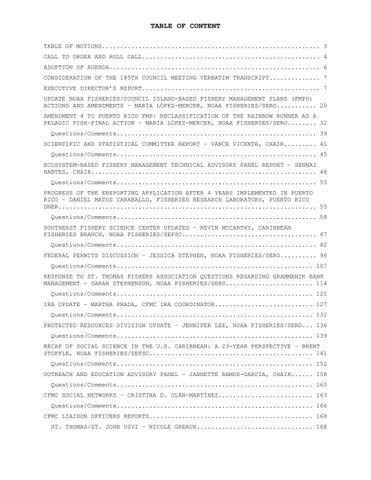
TABLE OF CONTENT TABLE OF MOTIONS............................................................ 3 CALL TO ORDER AND ROLL CALL................................................. 4 ADOPTION OF AGENDA.......................................................... 6 CONSIDERATION OF THE 185TH COUNCIL MEETING VERBATIM TRANSCRIPT.............. 7 EXECUTIVE DIRECTOR’S REPORT................................................. 7 UPDATE NOAA FISHERIES/COUNCIL ISLAND-BASED FISHERY MANAGEMENT PLANS (FMPS) ACTIONS AND AMENDMENTS – MARÍA LÓPEZ-MERCER, NOAA FISHERIES/SERO........... 20 AMENDMENT 4 TO PUERTO RICO FMP: RECLASSIFICATION OF THE RAINBOW RUNNER AS A PELAGIC FISH–FINAL ACTION – MARÍA LÓPEZ-MERCER, NOAA FISHERIES/SERO........ 32 Questions/Comments....................................................... 39 SCIENTIFIC AND STATISTICAL COMMITTEE REPORT – VANCE VICENTE, CHAIR......... 41 Questions/Comments....................................................... 45 ECOSYSTEM-BASED FISHERY MANAGEMENT TECHNICAL ADVISORY PANEL REPORT – SENNAI HABTES, CHAIR.............................................................. 48 Questions/Comments....................................................... 53 PROGRESS OF THE EREPORTING APPLICATION AFTER 4 YEARS IMPLEMENTED IN PUERTO RICO – DANIEL MATOS CARABALLO, FISHERIES RESEARCH LABORATORY, PUERTO RICO DNER....................................................................... 55 Questions/Comments....................................................... 58 SOUTHEAST FISHERY SCIENCE CENTER UPDATES – KEVIN MCCARTHY, CARIBBEAN FISHERIES BRANCH, NOAA FISHERIES/SEFSC..................................... 67 Questions/Comments....................................................... 82 FEDERAL PERMITS DISCUSSION – JESSICA STEPHEN, NOAA FISHERIES/SERO.......... 96 Questions/Comments...................................................... 107 RESPONSE TO ST. THOMAS FISHERS ASSOCIATION QUESTIONS REGARDING GRAMMANIK BANK MANAGEMENT – SARAH STEPHENSON, NOAA FISHERIES/SERO........................ 114 Questions/Comments...................................................... 121 IRA UPDATE – MARTHA PRADA, CFMC IRA COORDINATOR........................... 127 Questions/Comments...................................................... 132 PROTECTED RESOURCES DIVISION UPDATE – JENNIFER LEE, NOAA FISHERIES/SERO... 136 Questions/Comments...................................................... 139 RECAP OF SOCIAL SCIENCE IN THE U.S. CARIBBEAN: A 23-YEAR PERSPECTIVE – BRENT STOFFLE, NOAA FISHERIES/SEFSC............................................. 141 Questions/Comments...................................................... 152 OUTREACH AND EDUCATION ADVISORY PANEL — JANNETTE RAMOS-GARCÍA, CHAIR...... 158 Questions/Comments...................................................... 160 CFMC SOCIAL NETWORKS – CRISTINA D. OLÁN-MARTÍNEZ.......................... 163 Questions/Comments...................................................... 166 CFMC LIAISON OFFICERS REPORTS............................................. 168 ST. THOMAS/ST. JOHN USVI – NICOLE GREAUX................................ 168
Questions/Comments.................................................... 170 PUERTO RICO – WILSON SANTIAGO........................................... 171 Questions/Comments.................................................... 174 SARGASSUM SEASON UPDATE – JULIO MORELL/LORAINE MARTELL, CARICOOS, INC..... 175 Questions/Comments...................................................... 179 WORDS FROM EUGENIO PIÑEIRO SOLER – DIRECTOR OF NOAA FISHERIES............. 182 Questions/Comments...................................................... 182 DISTRICT ADVISORY PANEL REPORTS........................................... 184 ST. THOMAS, U.S.V.I. – JULIAN MAGRAS, CHAIR............................. 184 ST. CROIX, U.S.V.I.
– GERSON MARTÍNEZ, CHAIR........................... 185
PUERTO RICO – NELSON CRESPO, CHAIR...................................... 186 Questions/Comments.................................................... 188 ENFORCEMENT REPORTS....................................................... 189 PUERTO RICO DNER........................................................ 189 Questions/Comments.................................................... 190 U.S. COAST GUARD........................................................ 191 Questions/Comments.................................................... 192 NOAA FISHERIES OFFICE OF LAW ENFORCEMENT................................ 193 Questions/Comments.................................................... 196 ECOSYSTEM RISK ASSESSMENT – LEIGH FLETCHER, BIOIMPACT INC................. 199 Questions/Comments...................................................... 210 SEA GRANT PROGRAM UPDATE – RUPERTO CHAPARRO, DIRECTOR/RENÉ F. ESTEVES, ASSOCIATE DIRECTOR, PUERTO RICO SEA GRANT................................. 216 Questions/Comments...................................................... 221 OTHER BUSINESS............................................................ 223 ADVISORY BODIES MEMBERSHIPS............................................... 224 DAP SAINT THOMAS/SAINT JOHN............................................. 224 DAP SAINT CROIX......................................................... 226 DAP PUERTO RICO......................................................... 228 OTHER BUSINESS – CONT..................................................... 229 PUBLIC COMMENTS AND NEXT MEETINGS......................................... 232
2
1 2 3 4 5 6 7 8 9 10 11
TABLE OF MOTIONS PAGE 40: The Council moves to approve Amendment 4 to the Puerto Rico Fishery Management Plan: Reclassification of the rainbow runner as a pelagic fish and submit the amendment to the Secretary of Commerce for review. The Council allows staff to make editorial, non-substantive changes to Amendment 4 and give the Council Chair the authority to deem any modifications made to the amendment and regulations as necessary and appropriate for implementing Amendment 4. The motion carried on page 40.
3
1 2 3 4 5 6 7 8 9 10 11 12 13 14 15 16 17 18 19 20 21 22 23 24 25 26 27 28 29 30 31 32 33 34 35 36 37 38 39 40 41 42 43 44 45 46 47 48
CARIBBEAN FISHERY MANAGEMENT COUNCIL 186th REGULAR COUNCIL MEETING HYBRID MEETING THE BUCCANEER RESORT SAINT CROIX, U.S. VIRGIN ISLANDS APRIL 22-23, 2025 The Caribbean Fishery Management Council convened at The Buccaneer Resort in Saint Croix, U.S. Virgin Islands on Tuesday morning, April 22, 2025, and was called to order at 9:00 A.M. by the Council man Carlos Farchette. CALL TO ORDER AND ROLL CALL CARLOS FARCHETTE: Okay. So, good morning, everyone. I want to welcome everyone to the 186th Caribbean Fishery Management Council Meeting, getting held on Saint Croix at the Buccaneer Hotel. It's 09:00, April 22nd. We'll start with roll call. I'm going to start on my left with Angie. MARÍA DE LOS A. IRIZARRY: CRISTINA D. OLÁN-MARTÍNEZ: Olán, Council Staff. LIAJAY RIVERA GARCÍA: García, Council staff.
María Irizarry, Council Staff. Good morning. Buenos días. Cristina
Good morning. Buenos días. Liajay Rivera
GRACIELA GARCÍA-MOLINER: Buenos días. Graciela García-Moliner, Council staff. MARÍA LÓPEZ-MERCER: Good morning. María López, NOAA Fisheries, Southeast Regional Office. RICARDO LÓPEZ-ORTIZ: Hola a todos. Puerto Rico DNR, Ricardo LópezOrtiz. VANESSA RAMÍREZ:
Good morning. Vanessa Ramírez, Vice-Chair.
CARLOS FARCHETTE:
Carlos Farchette, Chair.
MIGUEL A. ROLÓN:
Miguel Rolón, Council staff.
DIANA T. MARTINO:
Diana Martino, Council staff.
4
1 2 3 4 5 6 7 8 9 10 11 12 13 14 15 16 17 18 19 20 21 22 23 24 25 26 27 28 29 30 31 32 33 34 35 36 37 38 39 40 41 42 43 44 45 46 47 48
ANDREW STRELCHECK: Fisheries.
Andy Strelcheck, Regional Administrator, NOAA
KATHERINE M. ZAMBONI: JAMES R. KREGLO: KAYLA ISHIDA: Juan.
Kate Zamboni, Office of General Counsel.
James Kreglo, Council Member, U.S.V.I.
Kayla Ishida, United States Coast Guard, Sector San
VANCE VICENTE: Committee.
Good morning. Vance Vicente, Chair of the SSC
JANNETTE RAMOS-GARCÍA: Good morning, everyone. Jannette RamosGarcía, Outreach and Education Panel Chair. NELSON CRESPO:
Buenos días. Nelson Crespo, DAP Chair Puerto Rico.
JULIAN MAGRAS: Good morning, everyone. Julia Magras, DAP of Saint Thomas/Saint John. GERSON MARTÍNEZ: Saint Croix.
Good morning, all. Gerson Martínez, DAP Chair of
NICOLE GREAUX: Good morning. Nicole Greaux, CFMC Liaison, Saint Thomas/Saint John. WILSON G. SANTIAGO SOLER: Rico Fisheries Liaison. MARTHA C. PRADA:
Good morning. Wilson Santiago, Puerto
Good morning. Martha Prada, IRA coordinator.
LEIGH KELLETT FLETCHER:
Good morning. Leigh Fletcher BioImpact.
DANIEL MATOS CARABALLO: Good morning. Daniel Matos Caraballo, Puerto Rico Department of Natural and Environmental Resources. CARLOS FARCHETTE:
I know we have some people online.
CRISTINA D. OLÁN-MARTÍNEZ: Yes. In Zoom we have Sarah Stephenson, John, Kevin McCarthy, Jesús Rivera-Hernández, Heather Blough, Eva M. Collazo, Jessica Stephen, Mich Walsh, Itsamari. CARLOS FARCHETTE:
And Roberto Sabater.
CRISTINA D. OLÁN-MARTÍNEZ: CARLOS FARCHETTE:
And Roberto Sabater.
A little housekeeping here. There's a lunch 5
1 2 3 4 5 6 7 8 9 10 11 12 13 14 15 16 17 18 19 20 21 22 23 24 25 26 27 28 29 30 31 32 33 34 35 36 37 38 39 40 41 42 43 44 45 46 47 48
menu going around. They're going to pick it up at 10:00, so if you can please fill it out and give it to someone in the back. They'll be picking them up at 10:00 AM to make sure that lunch is on time. Next, have the adoption of agenda. We do have some changes. Graciela? ADOPTION OF AGENDA GRACIELA GARCÍA-MOLINER: Thank you, Mr. Chair. So, you do have a couple of changes. One is that the Sea Grant presentation, scheduled for today, will pass during the second day under other business. So, we were requesting to see if the progress of eReporting could be moved to the morning session. That would give us a little bit more time for the presentation on the Saint Thomas Fisher's Association letter. And that's what I have in my notes. CARLOS FARCHETTE:
Miguel?
MIGUEL A. ROLÓN: We also got a request from Mr. Eugenio Piñeiro to address the Council on the second day, the 23rd, at 01:30PM. CARLOS FARCHETTE: Okay. Before I forget, we have a letter from the commissioner. He would not be able to attend, but he has a letter of proxy for Sennai Habtes sit in his stead. GRACIELA GARCÍA-MOLINER: Mr. Chair, one more thing, Dr. Sennai Habtes is going to be a little bit late. He hopes to be here for his presentation at 11:00. CARLOS FARCHETTE: Thank you. Any other changes to the agenda? Hearing none, we need a motion to accept the agenda as corrected or updated. MIGUEL A. ROLÓN:
As amended.
VANESSA RAMÍREZ: Vanessa Ramírez, for the record. Motion to adopt the agenda as corrected. JAMES R. KREGLO:
I second.
MIGUEL A. ROLÓN:
For the record, it's amended, not corrected.
CARLOS FARCHETTE: Okay. So, agenda amended. So, any nays or abstentions? Everybody-- hearing none, everybody say, “aye.” GROUP:
Aye.
6
1 2 3 4 5 6 7 8 9 10 11 12 13 14 15 16 17 18 19 20 21 22 23 24 25 26 27 28 29 30 31 32 33 34 35 36 37 38 39 40 41 42 43 44 45 46 47 48
CONSIDERATION OF THE 185TH COUNCIL MEETING VERBATIM TRANSCRIPT CARLOS FARCHETTE:
Motion carries.
Next on the agenda is the consideration of the 185th Council meeting verbatim transcriptions. I do have a couple questions on the-that I saw in the minutes, but I'm going to leave that for other business for tomorrow to discuss. GRACIELA GARCÍA-MOLINER: MIGUEL A. ROLÓN: any--
But you need--
Si, but we need to know now whether anybody has
CARLOS FARCHETTE: Oh, yeah. Yeah. Yeah. I'm waiting to see if anybody has any corrections or additions to the transcriptions. Motion to approve the minutes as submitted. VANESSA RAMÍREZ: as submitted. CARLOS FARCHETTE:
Vanessa Ramírez, for the record. Motion to adopt Need a second.
RICARDO LÓPEZ-ORTIZ: CARLOS FARCHETTE: say, “aye.” GROUP:
Ricardo López, second.
Okay. Any nays or abstentions? All in favor
Aye.
CARLOS FARCHETTE: Motion carries. Next is the executive director's report. Yeah. Roberto, sorry about that, but I needed your yay or nay on the -ROBERTO SABATER:
Aye. Yeah. EXECUTIVE DIRECTOR’S REPORT
CARLOS FARCHETTE:
Okay. So, Executive Directors report.
MIGUEL A. ROLÓN: Thank you, Mr. Chairman. Thinking about the time, I will compress what I want to say. Just to give you a status on the fundings for the Councils, 2025 will be a challenge year because, as you know, we are mostly at the same level that we were before, maybe 5% more on all the Councils. That means that we have to make adjustments to the Council’s way of operating during 2025. María de los Angeles, Angie, and myself, we have identified places where we can save some money and stay within the schedule that we 7
1 2 3 4 5 6 7 8 9 10 11 12 13 14 15 16 17 18 19 20 21 22 23 24 25 26 27 28 29 30 31 32 33 34 35 36 37 38 39 40 41 42 43 44 45 46 47
have. The fixed cost of the Council is around $130,000 a month without any meetings. If we have meetings that goes up by a little bit. With the money that we have so far, that would be enough for the end of May, probably June, unless we receive the rest of the funding by 2030-- I mean, September 30th, 2025. The last quarter of the Council is the first quarter of the National Marine Fisheries Service funding, federal money funding, so we are expecting to receive monies, enough, to finish the year. If we don't receive any more fundings before June 30th, then we will not have money to operate having meetings. So, the Executive Director and the Chair will monitor the situation to allocate the fundings as needed for the Council activities. That means that all the other Council meetings, SSC, DAPs and everything will be virtual until further notice. You know that the August meeting is virtual, but the main meeting with the CCC in New Bedford will be attended by two staff members and two Chairs. That has been budgeted for already. The monies that were allocated for the fiftyyear celebration had been stopped by all the eight Councils until further notice because some issues are relevant to the budget situation that we have. The other part of the fundings that you are all aware is the IRA. The Inflation Reduction Act provided money for the Councils, the National Marine Fisheries Service and other areas in the federal government. Good news, most of the proposal that we submitted were approved. We want to scare people once in a while. The thing is that, remember, we hired Dr. Martha Prada and she's going to give us a report, a detailed report of where we are regarding the IRA funds. One of the latest approvals was the one for the U.S. Virgin Islands. There was a proposal prepared by Dr. Sennai Habtes, and it has been approved. Now, we are working with some details regarding the contract that we have to issue for the U.S. Virgin Islands to start this project. The other part of my report, as you all have seen in the news, President Trump has signed several Executive Orders that touch on fisheries operations. We are talking about the one that calls for a rule that for every new rule you have get rid of 10. In the case of fisheries that’s just a little bit tricky, how to do it. Dr. Andy Strelcheck will address that in a few moments. They also have one that requires all the Councils, National Marine Fisheries Service to review the fisheries regulations, the way we 8
1 2 3 4 5 6 7 8 9 10 11 12 13 14 15 16 17 18 19 20 21 22 23 24 25 26 27 28 29 30 31 32 33 34 35 36 37 38 39 40 41 42 43 44 45 46 47
prepare the management plans and everything. We have 180 days to prepare the documentation for that. We have to wait. All the Council have to wait until we have guidance because this is brand new, April 17th, guidance from the National Marine Fisheries Service to proceed. But, at this time, we want to let you know that the Councils, from now on, we're going to be working on this Executive Order and probably by the August meeting, we'll have some news for you to look at and consider. The main point of the Executive Order is to review the way that we regulate the fisheries and see where we can open the fisheries, how can we-- for the betterment of the fisheries. They call it Make the United States Fisheries Great Again. This is not new. It started when President Trump was on his first term, the time that he was president. Now it's an Executive Order. The other two, one touches the monuments. As you know, they opened the monuments in The Pacific for fishing. They have a whole presentation. I assume you can see it in YouTube. Last one, not the last one, but another one touches ESA. And there are discussions about any implication of an ESA. So, Mr. Chairman, I believe that the fishers also have a letter that they want to present, just to read it for the record. They have been working on this Executive Order for some time now, especially the Fisherman Association of Saint Thomas/Saint John. Dr. Andy Strelcheck, also, can tell us about the ten-one rule. You will have this information at this meeting. But remember, these Executive Orders are brand new. We have to wait until we get the guidance from National Marine Fisheries Service on how to proceed. Especially the one that give us 180 days, that means that by December this year, we have to have a document that will address the mandates on that Executive Order. Thank you, Mr. Chairman. JAMES R. KREGLO:
Andy?
ANDREW STRELCHECK: Yeah. Thanks, Chair. Appreciate Miguel kind of teed this up nicely with regard to the conversation. Executive Order 14192 is the one that talks about unleashing prosperity through deregulatory action. There was obviously a lot of initial confusion because that's the one that proposes for every oneregulatory action you have to then implement 10-deregulatory actions. So, as Miguel indicated, have received additional guidance. The 9
1 2 3 4 5 6 7 8 9 10 11 12 13 14 15 16 17 18 19 20 21 22 23 24 25 26 27 28 29 30 31 32 33 34 35 36 37 38 39 40 41 42 43 44 45 46 47 48
good news is that the 10 for one provision only pertains to what are considered significant regulatory actions. And those significant actions have an annual effect on the economy of greater than a hundred million dollars. They create an inconsistency or interfere with an action taken by another agency. They materially alter budgetary impacts of grants and entitlements and other factors where they create novel legal issues. So, for the most part, the fishery service and the Councils implement very few significant regulatory actions. So, we won't be in an environment where for a regulatory action, we have to create 10 deregulatory actions. However, what will relate to the work that the Council is doing, the fishery service is doing is there is essentially a provision that requires that actions have a total cost that's less than zero. Right? So, if we're going to implement a regulatory action that has a negative cost on stakeholders or agency industry, then we have to offset that and actually have deregulatory actions that are greater than the amount that we're imposing with regulatory actions. So that's the process that I think is evolving and that we're setting up with the fishery service and that will likely be discussed at the Council Coordination Committee Meeting coming up in the near future. But that'll really be the key, looking at the cost of implementing regulations, the cost of, obviously, deregulating actions, and how that balance sheet kind of adds up over time. There will be, I think, guidance that is forthcoming for our FY '26 budget year, and we'll kind of be put into, I forgot what they were calling it, but essentially identifying kind of agencies total incremental costs that we can implement. So, we'll have more guidance coming forward. So, let me stop there because I do want to talk about the Restoring American Competitiveness EO, see if there's any questions. CARLOS FARCHETTE:
Anyone have questions for Andy?
ANDREW STRELCHECK: So, as Miguel said, there are numerous Executive Orders. So, the other one that was just recently issued was the Restoring American Seafood Competitiveness. That one was issued on April 17th. As Miguel said, we are awaiting additional guidance on that implementation, but there's several provisions, obviously, that pertain to the Council, as Miguel indicated, and that the Secretary of Commerce will request the Fishery Management Councils within a 180 days of the order to provide the Secretary of Commerce with updates to recommendations pursuant to a previous Executive Order that reduces burdens on the domestic fishing 10
1 2 3 4 5 6 7 8 9 10 11 12 13 14 15 16 17 18 19 20 21 22 23 24 25 26 27 28 29 30 31 32 33 34 35 36 37 38 39 40 41 42 43 44 45 46 47 48
industry. And so, back in May of 2020, there was an Executive Order that you would have responded to. So, they're wanting first updates on kind of where we're at with any sort of deregulatory work that pertain to that. And then, obviously, there's some additional things that they're looking for soliciting public comments, including from fishing industry members, marine scientists, others with regard to deregulation or regulatory actions that could be essentially removed. So, that'll be a process that we'll be setting up. And then, they also want us as an agency to focus on less expensive, more reliable technologies for collecting data and doing cooperative research as well as exemptive fishing permits. So, that'll be another focus of this Executive Order. And there's a number of other requirements in it, but those are some of the highlights that I thought were most relevant to the Council. So, happy to entertain any questions on that as well. CARLOS FARCHETTE: Julian?
Any questions for Andy on that? None. You good?
JULIAN MAGRAS: Julian Magras, for the record. I'm to read a letter from the Saint Thomas Fisherman's Association, which was signed by our Vice President, Joshua Quetel and the letter is addressed to Mr. Carlos Farchette, Chairman of the Caribbean Fishery Management Council. “Dear Chair and members of the Caribbean Fishery Management Council, on behalf of the Fisherman's Association, I'm writing to respectfully request that the Council postpone any agenda items or actions that may have relevance to the President's, Donald J. Trump's, Executive Order titled Promoting American Seafood Competitiveness issued on April 17th, 2025. This Executive Order outlines several specific and time-sensitive directives to be carried out by the Regional Fishery Management Councils, the Secretary of Commerce, the Secretary of Health and Human Services, and the National Marine Fisheries Service. These directives involve a comprehensive review of fishery regulations and practices in order to enhance the competitiveness of American seafood, reduce the burdens on fishing industry, and promote sustainable fisheries. Given the potential implications of this Executive Order on fisheries management throughout the U.S. Caribbean, we believe that proceeding with any Council action, regulatory or otherwise, that may intersect with the Order could be premature and 11
1 2 3 4 5 6 7 8 9 10 11 12 13 14 15 16 17 18 19 20 21 22 23 24 25 26 27 28 29 30 31 32 33 34 35 36 37 38 39 40 41 42 43 44 45 46 47 48
potentially inconsistent with forthcoming federal guidance or requirements. Accordingly, we respectfully request that the Caribbean Fishery Management postpone any such relevant agenda items until full and clear guidance is issued until stakeholders, including our association, have a proper opportunity to review, interpret, and provide informed input on how the Executive Order will impact local fisheries and communities. We appreciate your attention to this matter and your continued commitment to inclusive and transparent fisheries management signed by Joshua Quetel, Vice President of the Saint Thomas Fisherman's Association.” CARLOS FARCHETTE:
Any comments on Julian's, STFA letter? Vanessa?
VANESSA RAMÍREZ: Thank you, Chair. Vanessa Ramírez, for the record. Thank you, Julian, for bringing this letter from the fishermen. I think that, as Andy says, we need more advice on these orders. So, I will suggest or ask to the staff for any concern or any help that you can give us to address this on timeline. Thanks. CARLOS FARCHETTE:
Miguel?
MIGUEL A. ROLÓN: I guess that the letter goes hand-in-hand with what's been presented today by Dr. Andy Strelcheck. We are not going include anything in the agenda until we have the proper guidance from the National Marine Fisheries Service on any of these issues and that include participation of the public. We need to have the scoping meetings, public hearings, etcetera. So, the fishing industry will have ample opportunity-- and recreational fisheries --to participate in the discussion before any of this document is submitted to the Secretary for consideration. So, the next step is for the eight Councils to wait for the guidance from the National Marine Fisheries Service, from NOAA Fisheries to continue working. And then, it is expected that once we receive the guidance, the Council will work and the staff, with the appropriate documentation. Very important is that we need to provide ample opportunity for the public to participate, especially people who are going to be impacted positively or negative by any of these Executive Orders. Thank you, Julian. We’ll make sure that the participation of the fisheries is guaranteed through this process.
12
1 2 3 4 5 6 7 8 9 10 11 12 13 14 15 16 17 18 19 20 21 22 23 24 25 26 27 28 29 30 31 32 33 34 35 36 37 38 39 40 41 42 43 44 45 46 47 48
CARLOS FARCHETTE:
Andy?
ANDREW STRELCHECK: Yeah. No. I appreciate the Saint Thomas Fisherman's Association letter, I think timing wise, this works really well for the Council. Right? Because you have an August Council meeting kind of right in the middle of that 180-day time frame. We're going to solicit public comment at the Secretary of Commerce level, right, for public input, but that doesn't prevent you from also soliciting public comment and gathering feedback from industry groups along the way. So, all of this, I think, sets up well then to get that feedback by August so that any sort of response and reaction going forward thereafter would be in time for that 180-day timeline. CARLOS FARCHETTE:
Any more comments? Gerson.
GERSON MARTÍNEZ: Good morning, all. Gerson Martínez, for the record. My letter is going to come in soon. My wife is typing it as I speak, I have a handwritten one. I would like to read it for the record. Due to the fact that we have the ability to redo, I believe in protecting our resource, but some protective areas do blanket closures. In my letter, I will explain, don't believe that we should open the shallow water reefs to any fishing activity, but to the north of Buck Island National Monument, we had a very important FAD that created jobs and created the ability to bring into the market the pelagics, mahi, Tuna and wahoo. I will ask this Council to consider reopening that north drop-off, which is very important for our line fishermen. Also, I would like to add that our conch fishery is in jeopardy because of the new-- Well, I don't know. Miguel is shaking his head. --due to overfishing around the world, and we have done our homework here in Saint Croix, the Virgin Islands, to overprotect this resource, establishing longer seasonal closures and also bag limits. So, I will ask that we be considered being exempt, if that closure comes into effect someday because of our excessive protection to the conch resource. That would be all. Thank you. My letter will be coming in soon. CARLOS FARCHETTE: the EOs? Crespo?
Thank you, Gerson. Okay. Any more comments on
NELSON CRESPO: Thank you, Mr. Chair. I want to read a letter coming from the Conch Legal Fishing Association and other 13
1 2 3 4 5 6 7 8 9 10 11 12 13 14 15 16 17 18 19 20 21 22 23 24 25 26 27 28 29 30 31 32 33 34 35 36 37 38 39 40 41 42 43 44 45 46 47 48
independent fishers. “I am going to focus on section four, especially on the topic of modernizing data collection and analytical practice, and I will soon send a more comprehensive letter on this Executive Law. We all know that Puerto Rico and the rest of the American Caribbean are considered a data poor sector. Without taking away the merit from the federal agencies and Puerto Rico DNER, the results have not been as expected. This is an easy choice moment for Puerto Rico DNER. Are we going to fix the data tragedy or are we are going to keep on lying to the rest of the nation and telling them that everything is alright when they all know we are lying? We need a more creative, simple, mechanical model to capture elusive data that doesn't want to get caught as our friend Bill Arnold suggests to us during informal conversations. For how long will you give us a seminar of excuses for its falling model. We don't deserve this. We are Americans disenfranchised by the political system, yes, but nevertheless Americans. We can comply with President Trump's Executive Order, and we don't have the need to raise the catch level. Fish have always been there. Just by searching social media, we can see that there's a different truth than what is being reported of our island. Here, we all know that catches on our island can be five times more than what is reported. We better get to work today. Let's do with the voodoo data and start a new regime of real data models, trustworthy data reporting. This is what we need. Now it's up to us to work as a team to improve this and other existing issues and be facilitators for the commercial fishing in the American Caribbean. Let’s facilitate and not try and regulate everything ad nauseam in the industry that has never been understood, will never be understood and will never be manage properly if it seats in failing models. Also, talking about open center areas. I'm really concerned about the Bajo de Sico. It should have never been removed, the management plan, that have through this moment. And also, it's time to modify the Tourmaline Management Plan and at least open the water column because there's a huge area when the Wahoo season comes, and all the fishermen want to get those wahoos. This doesn't affect what is protected in the bottom. And also, have to maintain the Snapper Unit 1 Management Plan as is. Thank you.” 14
1 2 3 4 5 6 7 8 9 10 11 12 13 14 15 16 17 18 19 20 21 22 23 24 25 26 27 28 29 30 31 32 33 34 35 36 37 38 39 40 41 42 43 44 45 46 47 48
CARLOS FARCHETTE:
Thank you, Crespo.
VANESSA RAMÍREZ: Thank you, Mr. Chair. Vanessa Ramírez, for the record. I want to thank Nelson for bringing this letter. You give the exact points that we have and the issues that we have been working with the data collection and also managing areas that we have in the West Side of the coast of Puerto Rico. So, thank you for that and I hope that this could address it and give some leadership for the staff to start working with Puerto Rico FMPs. Thanks. CARLOS FARCHETTE:
Julian?
JULIAN MAGRAS: Julian Magras, for the record. So, great presentation there from my counterparts. And, you know, similar to what our letter speaks about and listening to the Executive Order that came from our President, the Council, here before us, have been overregulating on the fishers. We can take one item, and we have three different rules protecting that one set of species. I think stuff like that is what needs to be revisited. I don't think that we need to have three regulations on one individual group of fish. You have a catch limit. You have a seasonal closure. You have a size limit. You know, stuff like that is what they're looking at as being over regulated. I think we spend so much time and so much money throughout the entire process, not the Council, I'm talking about the entire process. So, much money is wasted for scientists to go there and just beat the species to death. I think that's where they're trying to curtail some of this overspending, I call it overspending and come up with a more simpler way of managing the fishery. The fishermen have always been the one to take the beating at the end of the day. Right now, NOAA, all of its employees are walking on pins and needles because they don't know if they're going to have a job before the end of the day. Well, that's how the fishermen have felt for the last 25 years that have been sitting in this room or in any room in meetings. We don't know if we're going to be able to catch a fish the next day, which God has provided for us to catch every day. So now the whole world is upside down because it falls on a different set of people, and what they're asking, they're not telling you that you can't have a job, they're asking you to do your job differently and more effectively and look at our fishers throughout the entire world. We are the U.S. We are the United States, and we should not have 15
1 2 3 4 5 6 7 8 9 10 11 12 13 14 15 16 17 18 19 20 21 22 23 24 25 26 27 28 29 30 31 32 33 34 35 36 37 38 39 40 41 42 43 44 45 46 47 48
to be importing so much different product when we can harvest it right here. What the fishers have been seeing, right here in the Virgin Islands and Puerto Rico, is that every time a rule is put in place, you go to the supermarket a couple months after, here's a box coming from Nicaragua. They know the rules. Let's use a yellowtail snapper as a perfect example. 12 inches tip of the tail to the head. Whole fish are being shipped in by the cases. We're seeing it in every one of our big stores, Cost.U.Less, PriceSmart, Plaza Extra in the islands. Conch the same thing and they know the regulations. The regulations are written on the box. So, what that tells me is there is people out there that are part of the process of regulating so they could import the stuff from these countries, and they get a kickback under the table. That's what the fishers have been seeing more and more. It just has become more evident that it's there in our face. So, I you know, I'm asking, like we said, we're going to try to do our homework and come up with a list of things that we would like to bring before the Council and the SSC, and we can discuss and, you know, see what we can do and what we can’t do. But at the end of the day, we have got to try to make things a little bit more productive and a little bit easier. So, that's my comment for right now. I’ll try not to talk too much today. CARLOS FARCHETTE: Thank you, Julian. Any more comments before I move forward, Miguel? ROBERTO SABATER:
I have a comment.
MIGUEL A. ROLÓN:
Not a comment but-- wait. ¿Ese es Roberto?
ROBERTO SABATER:
Si.
MIGUEL A. ROLÓN:
Go ahead, Roberto. I yield to you.
ROBERTO SABATER: I think this Executive Order is a great opportunity for the Council to get away with murder and reinvent ourselves if we have to. To look inside of what we've been doing lately and for so long that maybe we have fallen into our own personal trap, and maybe this thing opens up a way for us to look at ourselves inside and being able to check our balances, our nonbalances, and provide a better Council for the future. I went into the statistics, and really, 80% of the fish that is consumed in the United States is imported. It comes from mostly Chile and Canada. So, I think maybe we should be doing something different. Maybe. I don't know.
16
1 2 3 4 5 6 7 8 9 10 11 12 13 14 15 16 17 18 19 20 21 22 23 24 25 26 27 28 29 30 31 32 33 34 35 36 37 38 39 40 41 42 43 44 45 46 47 48
I know that, probably, over there, they don't have the regulations we have. One of these days, they're going to run out, but we have to really check ourselves, are we doing it right? Or are we doing it wrong? Or how are we going to do it? Thank you. CARLOS FARCHETTE:
Thank you, Sabater. Miguel?
MIGUEL A. ROLÓN: Just to let everybody know that I told Cristina to publish Executive Orders in our web page because until we get some specific guidance, we will not be able to work on reactions to the Executive Orders. As a word of caution, if you read the Executive Order, it doesn't mean that we're going to change everything. So, what we are going to do at this time is just wait until we get this guidance and see what we can do. I agree with Roberto that this Executive Order will look into how we operate from the top to the bottom everywhere to improve the condition of the fishing industry of the United States. And nobody can quarrel with that one. So, Mr. Chairman, I believe that we are going to have that information of-- Actually, I distributed the Executive Order to everybody. I also want to thank the three top Chairs for the intervention today, because this is the way we are going to be operating. Also, the Order calls for consultations with the public, thoroughly. So, if you don't have the Executive Order, please let me know, we will send you a copy to the DAP members or to whomever. I talked to Julian briefly, during breakfast, and I believe that you have all the documents and everything that you have. But if you need anything from us at all, let us know. I will wait for Gerson's letter so we can put all the letters into our minutes for the next meeting. Yeah. Thank you, Mr. Chairman. CARLOS FARCHETTE: Andy?
Okay. Thank you. Moving on, we're to go to--
ANDREW STRELCHECK: Just a couple of questions for Miguel with regard to budget. I've talked to Carrie Simmons as well. They're in a very similar financial situation. So, our hope is that you would be allocated the remainder of your budget sometime in May, but I've been told that you'll get 30-day allocations of funding, if that doesn't happen where you would get the full budget for the remainder of the year. You mentioned obviously holding virtual meetings until further notice. Has the decision been made about 17
1 2 3 4 5 6 7 8 9 10 11 12 13 14 15 16 17 18 19 20 21 22 23 24 25 26 27 28 29 30 31 32 33 34 35 36 37 38 39 40 41 42 43 44 45 46 47 48
the August meeting? Are you going to wait to see kind of how the funding plays out before you decide whether to go virtual for the August meeting? MIGUEL A. ROLÓN: In the case of the August meeting, we decided last year to have a virtual meeting because of the hurricanes. That was the only reason. Now we have another reason. Thank you for that because we have two versions. One that they're going to give us the money for the end of the year. And the other one that they only have authority to give us the money until September 30th because that’s the end of the continuous resolution. So, we are expecting the first one to be the case. If that happens, the next in person meeting will be in Saint Thomas/Saint John in December. But if we need to have any other meeting and we receive the money, we can do that. The other thing that I was going mention to the members here is that we can change any meeting for any valid reason. So, if we need to move away from August, maybe after or before, we can do that with the money that we have. The other Councils, they decided to have only virtual meetings. To give you an idea, we have five committees. One Council has 14 committees, and they meet every month. They have a large area that they have to cover. So, they are stopping from having in-person meetings at this time because they don't have the money to operate that way. The other issue that is happening is, as you all know, the cost of hotels, airfares and everything has increased way beyond the increase of the budgets and allocations that we have. So, all of this is playing at this time. But all the Councils, we are going to discuss that at the main meeting. Before that, we are going to discuss it amongst ourselves to make sure. But what you heard from Carrie is a reality for everybody at this time. CARLOS FARCHETTE:
Okay.
CRISTINA D. OLÁN-MARTÍNEZ: We have in the chat, Ricardo, and he said, “I have comments regarding the Order. Will we have an opportunity?” Ricardo Lugo. Mhmm. RICARDO LUGO:
Can I speak?
MIGUEL A. ROLÓN:
Yes. Do you have a comment or a questions?
18
1 2 3 4 5 6 7 8 9 10 11 12 13 14 15 16 17 18 19 20 21 22 23 24 25 26 27 28 29 30 31 32 33 34 35 36 37 38 39 40 41 42 43 44 45 46 47
RICARDO LUGO: No. I have a comment, and the comment is regarding the Order, because the Order not only covers fishing as addressed here, but it also covers aquaculture too. This is something that someway, somehow has to be addressed as part of the response and the data to be collected. Especially, when I heard Roberto, you know, many of the fish are coming from Chile and other Central American Countries are not only necessarily from fishing, but they have aquaculture beef farms, and they're exporting farm fish to the U.S. So, that is something that we will have to address in the Order. I don't know specifically, right now it's under the Department of Agriculture, how we are going to incorporate the aquaculture portion into our response on the data collected. That is only my comment. MIGUEL A. ROLÓN: Thank you, Ricardo. Just for the information of everybody, remember that the aquaculture is something that involves the States also. So, not only do we have the federal government working, but the States. That's a good comment. But the process to discuss the implementation of these Executive Orders is still a little bit in the future. Because as we speak now, the National Marine Fisheries Service is working on the guidance to implement these Executive Orders. The most important part is that we need to make sure that the public is involved through this process. Somebody called me the other day and said, “Miguel, what is going to happen?” And I said, “I don't know. But don't hold your breath on everything that you think is going to happen.” Because he wants me to convey to you that he has some ideas about opening a lot of places, changing regulations, etcetera. He also wanted to know whether the federal government can force Puerto Rico to implement some regulations. I said, “Well, that's for other people above my pay rate because Council members that belong to the government of Puerto Rico, they represent the government of Puerto Rico and the Virgin Islands. But Puerto Rico and the U.S. Virgin Islands have their own authority. They pursue management of the fisheries based on the local government's regulations as well as the federal.” Just to let you know that some people are thinking about the whole thing. Aquaculture and imports for Puerto Rico and the United States. The thing is that we import 80 to 90% of what we eat. The reason for that is that we eat a lot. In the case of Puerto Rico, I made a study a long time ago, in '75 when I thought that we could help 19
1 2 3 4 5 6 7 8 9 10 11 12 13 14 15 16 17 18 19
fisheries. At that time, we found that 90% of the fish that was consumed in Puerto Rico was imported, but we can only compete with 12% because all the other species were not in the tropics, like, for example the salmon, etcetera.
20 21 22 23 24 25 26 27 28
MARÍA LÓPEZ-MERCER: Good morning. This is María López with NOAA Fisheries SERO Caribbean branch from the Sustainable Fisheries Division. I'm going to be presenting, as I usually do, at the beginning of each one of the meetings, a summary of the actions that the Council and NMFS are working with. Also, we're going to be talking about the projects that have been set as priorities for 2025 and the plans the Council has discussed to do with those and for consideration for moving forward or making decisions later. Next slide.,
29 30 31 32 33 34 35 36 37 38 39 40 41 42 43 44 45
Okay. So, this slide, we are showing the actions that we have been currently working with. And so, the first three actions are Amendment 2 to all the island-based FMPs is the trawl, net gear, and descending devices. As you may recall, this amendment submitted last year. It was submitted by the Council for approval by the Secretary of Commerce. It all went through, and NMFS worked on the regulations. There was where the proposed regulations were published for a comment period for both the amendment and the proposed regulations. When that ended, NMFS prepared the final rule. That final rule, right now, is pending approval and publication.
So, the point is, Mr. Chairman, there's a lot of work ahead of us, a lot of consideration, but the quicker that we receive guidance from NMFS, the better. We have to work from the get-go with the fishing community, commercial and recreational, to make sure that we do the right thing, at least that we submit the right recommendations. Thank you. CARLOS FARCHETTE: Thank you, Miguel. Right. Next on the agenda is the Update on Actions and Amendment to the Island-Based Fishery Management Plan. María? UPDATE NOAA FISHERIES/COUNCIL ISLAND-BASED FISHERY MANAGEMENT PLANS (FMPS) ACTIONS AND AMENDMENTS – MARÍA LÓPEZ-MERCER, NOAA FISHERIES/SERO
For this amendment, the proposed regulations were also proposing that the implementation of the descending device requirement to be ready for use, if needed, in a fishing vessel be delayed until they could give the Council more opportunity to continue working in the outreach and education for the fishermen to know how to use 20
1 2 3 4 5 6 7 8 9 10 11 12 13 14 15 16 17 18 19 20 21 22 23 24 25 26 27 28 29 30 31 32 33 34 35 36 37 38 39 40 41 42 43 44 45 46 47 48
it and to obtain the appropriate tools to either create their own descending devices or that they could obtain the descending devices that the Council has available for their use. So, as I said, right now, this final rule is pending approval and publication. We want to thank everybody that has already been using descending devices and learning how to use it and teaching other colleagues, other fishermen, to use the descending devices even if this is not a requirement that has been implemented, because, as you all know, this is something that is good for the sustainability of our fisheries, to ensure that the fish that you return to the water, has an opportunity to survive. So, the next action that we have is Amendment 3 to all the islandbased FMPs. This is the management measures for dolphin and wahoo. This is another one that the Council approved to submit it to the Secretary of Commerce for approval. There was a proposed rule that was published and a notice of availability of the amendment. There were periods for comments. When that closed, NMFS prepared the final rule, right now it is pending approval and publication. I want to remind everybody that the final rule contains the responses to the comments that were submitted. Right now, as I said, that final rule is pending approval and publication, and we will let you know any updates on those rules. The third one is the Framework Action 3to the Puerto Rico FMP, and this is based on the results of the SEDAR 80 queen triggerfish that would modify management reference points for the triggerfish stock complex in Puerto Rico based on the stock assessment. This one was also approved for submission by the Council last year, and there was a proposed rule, and a comment period that was open. When that closed, NMFS prepared a final rule. That final rule is also pending approval and publication. So, for these three final rules, NOAA Fisheries will ensure that we keep the Council updated on the progress on these final rules. So, the other one that the Council worked with, and this was in December 2024, was Framework 3 to the U.S. Virgin Islands FMPs. This is also a modification of the management reference point for the queen triggerfish for Saint Croix and for Saint Thomas/Saint John based on the stock assessment that was conducted on the queen triggerfish. This one, during January and February, the staff, the IPT finalized the action, and then the Council submitted it to for approval by the Secretary of Commerce in March. So, this is an action that the Council had already take final action and approved it. However, there were some things that we needed to finish. If you recall from the motion, it gives authority to the Council Chair to approve those changes. 21
1 2 3 4 5 6 7 8 9 10 11 12 13 14 15 16 17 18 19 20 21 22 23 24 25 26 27 28 29 30 31 32 33 34 35 36 37 38 39 40 41 42 43 44 45 46 47 48
So, those were submitted to the Council Chair, and they were submitted in March. Right now, staff is developing the proposed rule. And then, when that proposed rule approved and ready for publication, then, as usual, we will communicate that to the Council and constituents through the Fishery Bulletins. So, the other action that we have today-- we have one action to take an action on --is the amendment to the Puerto Rico FMP, the reclassification of the rainbow runner as the pelagic species. As you may recall, during the last Council meeting in December 2024, we gave a presentation to the Council where we discussed what the action included, which is basically reclassifying the rainbow runner from a reef fish to a pelagic fish. The Council has seen this presentation several times. However, the staff needed to make some adjustments to the documents, so that's why, although it was scheduled to take final action in December, it was not done, and we requested if the Council would review the document at this meeting so that they can take final action. So, we will be giving a presentation, after this one, with the information for the rainbow runner, so you can all make a decision if you want to take final action on this one. If you do decide to take final action, then there is a codified text that will be in the regulations that you will need to review. Then after that, the plan is after the Council submits the document, then this is the phase where the Council process stops there, and then NOAA Fisheries takes over to prepare the regulations. However, just remember that the public participation continues and the Council participation continues once a proposed rule and that amendment is published because there's an open comment periods that are available for both, the amendments and the regulations. So, give me a moment here. I need to adjust my microphone. Thank you for that. Okay. So, the next slide is going to be the projects that the Council set for priorities for 2025 on the December 2024, Council meeting. So, if you can go-- okay. Perfect. Is there feedback? Okay. So, these are actions. The first action that we're going to be presenting is the Federal Permits Management. This is a presentation that will be given by Dr. Jessica Stephen from NOAA Fisheries. As you all recall, there was a first presentation in December 2023, and the Council wanted to receive additional 22
1 2 3 4 5 6 7 8 9 10 11 12 13 14 15 16 17 18 19 20 21 22 23 24 25 26 27 28 29 30 31 32 33 34 35 36 37 38 39 40 41 42 43 44 45 46 47 48
information, obviously, on the permits, how the permits were going to or could be developed because there was an interest to develop a federal permit for certain species in Caribbean waters. Right? So, at that point, the Council did not have a clear idea of where they wanted to move forward to, and that was understandable because there was a lot of information about how the federal permit process goes and that the Council did not have. That's why NOAA Fisheries prepared this presentation that we're going to be getting today by Dr. Jessica Stephens. This presentation will focus on the background information that the Council should know, starting with the phases of permit planning, an idea, what would be an idea, vision, research and planning, implementation, evaluation. And also, what are the differences between the different types of permits, like open access, moratorium, limited access permits, what are the MSA requirements? These are all background information that is very important for everybody to know, because if there is a decision later on to move forward with a permit or whatever form that takes, then we think that this is very important for them to know so we can start thinking about how something will look like. And then the presentation would also walk through an example of creating a commercial federal permit program just as an example so you know how the process would be. So, for this action, the logical next step will be to scope, to continue gathering information from fishermen, from the DAPs, from the general public. I want to remind everyone that this is envisioned as a long-term action. This something that there's a lot to learn before the Council may decide to move forward or not. So, I just wanted to make that clear. And, also, the idea is, with this presentation and through all the scoping, that the Council can provide guidance to staff in what would be the purpose and the need for an action just like this. As I said, the presentation will be given today. And then potentially, if, you know, continues information gathering throughout the year. And I mentioned in here the DAPs, because the DAPs at the last Council meeting and the one before, they were very interested in getting or obtaining information from, like, the same presentation and be able to ask questions. The idea at that time was that we will have this presentation today and then have the DAPs meet and discuss what they learned today and be able to have an opportunity to have questions. So, if the Council is interested to pursue that, the DAP meetings, later, this will be one of the topics that could be discussed. Okay. So, the next item that we will be discussing today, that 23
1 2 3 4 5 6 7 8 9 10 11 12 13 14 15 16 17 18 19 20 21 22 23 24 25 26 27 28 29 30 31 32 33 34 35 36 37 38 39 40 41 42 43 44 45 46 47 48
staff will be bringing to the Council for their discussion is the response to the Saint Thomas Fisherman’s Association questions regarding Grammanik Bank Management. The Council will-- Sarah Stephenson is going to go through the document. The document is included in the briefing book. It's like a white paper answers to the questions that the Saint Thomas Fisherman’s Association had on this topic. Then, you know, from that, the Council will provide guidance on how they want to move forward, whatever form that takes. Okay, so the next topics that we have included in here are topics that we brought during the December meeting. These are things that the Council considered as priorities for 2025 or 2026. So, one of the things that needed to be done and that was brought to the Council attention is the status of species with prohibited harvest. So, this is species that, when the island-based FMPs were created, these are species that the ACLs were set at zero. We're talking about corals, sea cucumbers, sea urchins, and other fish, for example, parrotfish, nassau, goliath. These are species that have an ACL of zero. However, the SYL, the sustainable yield level was not set. That's something that needs to be set because the SYL will tell us information for determination of the status in terms of an overfish status for the species. So, Sarah gave a little presentation, a short presentation about that. It was something that we were requesting the Council to consider tasking the SSC to look into the numerical SYLs based on the information, specifying numerical SYLs or the Council to base on information available for each stock and the Council to consider whether these stocks or stock complexes should be moved to an ecosystem component species. So, what we are requesting the Council is last time we talked about having this action be perhaps set in 2026 based on the timing, because there were other things that needed to be done. However, the staff would like to request if this could be considered as a 2025 priority because some of the topics that were discussed that we were going to be taking care of during the year, which is the SEDAR, the results from the SEDAR 84 and the SEDAR for the spiny lobster may not be ready in time with recommendations until the end of the year. So, that means that the staff will not be able to start working on amendments on anything like that related to those topics during 2025. So, that opens the possibility to work with other actions. That doesn't mean that we're going to be taking final action or anything. It's just giving staff the guidance to start working on changes that need to be done. For example, to comply with the requirements of the MSA that we have to have status determination for those. 24
1 2 3 4 5 6 7 8 9 10 11 12 13 14 15 16 17 18 19 20 21 22 23 24 25 26 27 28 29 30 31 32 33 34 35 36 37 38 39 40 41 42 43 44 45 46 47 48
Anyways, we also wanted to take this opportunity to review the species to determine the need of for conservation and management. Right? So, this and other things that staff will be doing through the year that has been tasked by the Council to start working on, will give an opportunity for reviewing what information is available for the species to determine if those species should we continue fisheries management of those species. And for that, we, the Caribbean branch of the Sustainable Fisheries Division in SERO already started creating a matrix of information of all the species that we're currently managing. This is something that we have been working with for a while. This is not something new, right? Because it's important for us to be able, if we are going to have actions that are intended to modify the management reference points, then we think that as part of that effort, we should also be reviewing what information we have available for the species, what is the need for management, what is the management that is currently done, for example, in the states, etcetera. So, we're putting all that information together and we will bring that to the Council so that the Council can, at least for this action, for the status prohibited species, review that and then may task the SSC to look it into that. Okay. So, the other action that the Council wanted to take is actions to take when pelagic's AMs are triggered. As you all know, pelagic species are new to management. They were added to management in the island-based FMP, which became effective on 2022. At that time, the Council set an ACT, with the ACL and then if the accountability measures were triggered and needed to be implemented, that accountability measure is not like in the other species like reef fish and spinal lobster which will close the fishery. The decision was to then have the Council review the overages and make a decision as to what would be the next step. Right? During the last Council meeting, the Council wanted to task the SSC to look into that. So, staff will prepare a document, put together a document or prepare materials to provide to the SSC so that when SSC meets, they can take a look at that and may be able to provide some recommendations to the Council, then the Council can discuss those recommendations and other things that they would like to discuss to see how we're going to move forward with the pelagic species. So, the idea for that is, you know, we will be working on preparing the document, the background information, provide that to the SSC, and then when the Council decides that the SSC needs to meet, then 25
1 2 3 4 5 6 7 8 9 10 11 12 13 14 15 16 17 18 19 20 21 22 23 24 25 26 27 28 29 30 31 32 33 34 35 36 37 38 39 40 41 42 43 44 45 46 47 48
they will have that ready. The next action that the Council discuss is a revision of accountability measures for spiny lobster. This is an action that we will request the Council to schedule for discussion for the August meeting. This is something that we also brought during the December 2024 as a priority. This is because, in Puerto Rico-this action is mostly for Puerto Rico. It's because, you know, the ACL continues to be exceeded, and the Council wanted to evaluate if there was an accountability measure. Right now, it's closing the federal waters to all fishing if the accountability measure needs to be implemented. However, we all know that most of the harvest of spiny lobster occurs in states water. So, the Council wanted to look different measures that can be taken through an accountability measure that would provide more flexibility on how to deal with an exceedance of the ACL. And this will also take into consideration that there is a SEDAR process schedule for this year that is already ongoing, that is looking into assessing the species as well. So, all of that is related. However, again, we will be preparing materials, to present to the Council at the August meeting, either like a white paper and an options paper, which, again doesn't mean that that's how you need to move forward, but it will provide some ideas on how this could be modified. And then if you decide, you can task your SSC if you want them to look into that, of course. Also, remembering that these actions are needed to prevent overfishing of the species. So, that's why the Council wanted to entertain this. So, the request will be to bring this to the August meeting so they can observe that. Mr. Chair, I think you have a question or a comment. CARLOS FARCHETTE:
Julian?
JULIAN MAGRAS: Julia Magras, for the record. So, once again, we're talking here about more regulations again. As it pertains to the lobster for Puerto Rico, I have put it on a record at the last three meetings. The SSC, when setting the annual catch limit for that species, determined at that meeting that they were setting the annual catch limit lower than what the original models called for, and they were setting it there with the intentions of revisiting it if it's overrun. It was overrun twice; the Puerto Rican fisherman take two closures on that species. And up to this day, it still has not been revisited. We did the Tier process. That meeting took place-- That was the 26
1 2 3 4 5 6 7 8 9 10 11 12 13 14 15 16 17 18 19 20 21 22 23 24 25 26 27 28 29 30 31 32 33 34 35 36 37 38 39 40 41 42 43 44 45 46 47 48
last meeting that took place at the Council office. The SSC used to meet in the Council office. It was said, and it's on the record. You guys need to go back and look at the minutes and from there you would see that the original number, and I could be wrong, was 769,000 pounds. We toned it down from that, and we set it at whatever the number is right now. We need to go back to those meeting minutes and revisit the lobsters of Puerto Rico. Revisit the process that was done. Here, we are talking about, “oh, well, we need more accountability measures, more is harvested in state waters than in federal waters.” We're not doing our job. Who is taking the penalizing here again at a fisherman? You're going to end up closing the lobster fishery down altogether for Puerto Rico, and it's not needed. There's a reason why we are overrunning is because the annual catch limit is set to low. It would not be continuing. It's not because there's more fishermen, there's more of this, more of that. It's the same set of guys or even less fishermen harvesting. It's because the stock is healthy. And when we, and I say we because I'm part of the process, set the limits, we know we were setting it wrong. And we put it on a record back at that meeting that, “remember what we said here today, we will revisit,” but we still have not revisited and they have taken two closures and headed towards a third closure. So, I'm putting it on a record again. Before any more regulations are set to the Puerto Rican lobsters, we need to go back and look at the data that was provided back then and reassess, are we actually setting a limit that is needed? Same thing with the dolphin and the wahoo. We made a decision, we're going to set the annual catch limit on dolphin and wahoo, which is not needed. It's not needed. What's needed is the size limits because it's a species that is passing through. It's a migratory species that just channels through and makes the whole run of the world. But this is exactly what the Executive Order is talking about. We have different managements for the same species, and we continue to add more management now because there's an overrun of the dolphin and wahoo because they finally came through. The fishermen caught. We want to set a closure on it to regroup the loss of the overrun. That's wrong. It was said right here in this meeting. We say it in all the meetings; it's not everything we need to beat to death. And this is why the association wrote the letter that it wrote. 27
1 2 3 4 5 6 7 8 9 10 11 12 13 14 15 16 17 18 19 20 21 22 23 24 25 26 27 28 29 30 31 32 33 34 35 36 37 38 39 40 41 42 43 44 45 46 47 48
This is the opportunity for us to take each one of the managements that are in place right now and say, “do we actually need to have three different types of management on one species?” This is the problem that we are having. We are really, really tired of the over regulations of our fishery. And all that happens when you overregulate the fisheries is that our markets are being flooded by imports. That is killing us. When we, the fishers, should be under commerce, which we are still making money, but we can't harvest because we went over the limit that was set, and the limit that was set was incorrect. Thank you. CARLOS FARCHETTE:
Yeah. I have Andy and then a chat.
ANDREW STRELCHECK: Yeah. I appreciate the comments. I'm going to respectfully disagree with some of them in that we do have a SEDAR 91 spiny lobster assessment coming up. Right? That is our opportunity to get the best available science and determine what the catch level will be. And based on the requirements of the Magnuson Act, we will look at that. The SSC will review it. They'll provide their recommendations to us, and we'll update our catch limits based on that for spiny lobster, right, for Puerto Rico, hopefully, Saint Thomas, Saint John, Saint Croix. With that said, we, the fishery service, have seen that this accountability measure is not functioning well. And we've talked to our colleagues at Puerto Rico DNER, and they don't believe there's a problem with lobster. Right? And so, we've had those conversations. So, we think there's a need to change that accountability measure to something that is more workable, that looks at the science, that looks at the data, that looks at other options, that doesn't just require federal waters to be closed because we know that that's a limiting factor in terms of harvest because most of it occurs in state waters. Right? So, this is an opportunity, in my view, maybe not deregulatory, but to change the regulation in a way that better works for both managers and the industry members going forward. And so that's really our goal with that action coming back to you in August to just start to present some options to see what's available. And I think it leads in nicely then to that stock assessment report and whatever the annual catch limit increases will come in December and thereafter. CARLOS FARCHETTE:
On chat?
CRISTINA D. OLÁN-MARTÍNEZ:
Kevin McCarthy.
28
1 2 3 4 5 6 7 8 9 10 11 12 13 14 15 16 17 18 19 20 21 22 23 24 25 26 27 28 29 30 31 32 33 34 35 36 37 38 39 40 41 42 43 44 45 46 47 48
KEVIN MCCARTHY: I'll just pass. CARLOS FARCHETTE:
Thank you. I think Andy covered my points, so Okay. Thank you, Kevin.
MARÍA LÓPEZ-MERCER: Okay. Thank you. So, continuing with the other topic that the Council discussed, it was that there's some species that when the ACLs were set, for example, for the U.S. Virgin Islands, we talked about there being a need to revise the catch limits for species that have enhanced reporting. This is when the ACL is being monitored every year for overages. These are species that will, and have in the past couple of years, gone over the ACL, not because there was an increase in actual landings, but because there was enhanced reporting for this species. Therefore, NMFS determined that there's not a need to implement accountability measures or closures on those species because it is due to enhanced reporting. This is something, as you heard in the December meeting, that will continue to happen until the ACLs are revised, right? We also talked to the December meeting that is just not for this species that will have enhanced reporting that has a need for catch limits, which are a requirement under the MSA, to be revised. It is also for other species. I think we all agree that there's a need to look into what information is available and determine, first of all, like I said earlier, the status of the species. Let's look at what is the need for conservation of management on some of the species, and through that process, also see what information is available, if data is available, what else can be used to revise those catch limits, not just for those species, but also for other species. So, at least for the catch limits for species with enhanced reports, and which, again, it's going to continue happening, the Council considered that that should be taken care of in 2026 based on the information, and again, because there were other things like, for example, the SEDARS that were happening. However, staff will ask the Council to consider this, just looking into that for those revisions in 2025 and start that process. So, the Caribbean branch and sustainable fisheries, we have already started putting together a matrix of information for those species. What is the information that it's available? Remember the catch limit, the island-based FMP came into place in 2022, but it was a process that took a couple of years and we want to see what information is now available that is more at the species level. For example, for groupers in the U.S. Virgin Islands, for hogfish, etcetera which are species that before they were all reported as 29
1 2 3 4 5 6 7 8 9 10 11 12 13 14 15 16 17 18 19 20 21 22 23 24 25 26 27 28 29 30 31 32 33 34 35 36 37 38 39 40 41 42 43 44 45 46 47 48
an aggregate, like a category like groupers or triggerfish, etcetera. Then after, I believe in 2012, there were changes in the catch report forms, and then they started to report in the species. So, with the idea that that will provide us with better information, and if that is better information, then it should be used to revise those catch limits instead. But anyway, staff has already started that process and putting together that matrix, and we would like to present that to the Council at some point so they can see what information is in there and see if there's some decisions. And again, looking into the need for conservation of management of many of the species. So, can you go to the next slide? Okay. So, this last slide is talking about 2025 ACL monitoring. NMFS every year conducts an ACL monitoring for all the species. NMFS has been able to do it already for U.S. Virgin Islands because the landings were available. It's still pending for Puerto Rico because the landings are not ready yet, in terms of, remember, there are landings that come from the catch report forms, and also landings from eReporting, so staff is working on that. And then, once those landings are ready to be used, then that monitoring will occur. However, for 2025, there's no overages for Saint Croix. And then, for Saint Thomas and Saint John, as I mentioned earlier, the usual groupers and the hogfish, they went over the ACL. And again, it was determined because it was because of enhanced reporting. So, there was no need to implement any accountability measures, and that ties to the topic I was just mentioning about revising those ACLs for those species. So, this is a proof that that's something that will continue to happen. So, SEDAR 84 is the yellowtail snapper in Puerto Rico and Saint Thomas/Saint John, and spotlight parrotfish in Saint Croix. There's going to be a review workshop in July, and then Kevin, the Science Center will provide more information about that during their participation. And then, once they have outcomes from those, which is kind of expected to be later into the year, then they will convene the to go through that and then discuss. And then SEDAR 91 is spiny lobster for Puerto Rico, Saint Thomas/Saint John and Saint Croix. There is a review workshop in August 2025, and then plans to perhaps present to the SSC, be ready to present to the SSC for discussion later in the year, perhaps before the December meeting. So, that's something that Kevin will be discussing. And remember, you know, the SSC discusses and provides recommendations to the Council on the ABC. 30
1 2 3 4 5 6 7 8 9 10 11 12 13 14 15 16 17 18 19 20 21 22 23 24 25 26 27 28 29 30 31 32 33 34 35 36 37 38 39 40 41 42 43 44 45 46
So, because those are not, as I mentioned earlier, those are not going to be ready until the end of the year, that means that staff is not going to be working with any amendments or anything that may come from that, based on, you know, what the Council wants to do with the recommendations. And so, we may be able to, you know, based on what the Council wants to move forward with during the rest of the year, right, based on the conversations that we had earlier, then staff would be available to work on other things that we mentioned before. And the last thing I want to mention that was brought at the December meeting is the U.S. Virgin Islands compatibility of regulations with the EEZ. That's something that DPNR was wanting the Council to bring back to the table. There's no action that has been done from the Council’s side at this point, but the idea is to have a working group from DPNR, Council, and NOAA Fisheries that can sit down and look to see if there's a need to do compatible regulations and what are those. This is mostly a DPNR led action that the Council will be updated on once there's more information. So, that's all I have for this. I would say that if the Council, like what we did in December meeting, if at the end of tomorrow they want to revisit anything that was here, to provide more guidance to staff at the end of the meeting, they're certainly welcome to do so. Thank you. CARLOS FARCHETTE: Thank you, María. Before we go on a break, any questions for María? Alright. Hearing none, we'll take quick break. About fifteen minutes. (Whereupon, a brief recess was taken.) CARLOS FARCHETTE: Alrighty. We're going to get back to the agenda since we're-- Okay. We have a couple of introductions for some people that just came on board. I know Sennai has arrived and then we have a new member from the DPNR. They have a legal counsel whom I would like him to introduce himself. KYLE W. BEIGHLE: Good morning, everybody. Kyle Beighle, legal counsel with DPNR Fish and Wildlife Division. Excited to be here. Look forward to working with you all. DINORAH CHACIN:
Good morning. I'm just mainly here to listen. I'm 31
1 2 3 4 5 6 7 8 9 10 11 12 13 14 15
Dinorah Chacin. I'm the U.S.V.I. Fisheries Liaison so happy to be here.
16 17 18 19 20 21 22 23 24 25 26 27 28 29 30 31 32 33 34 35 36 37 38 39 40 41 42 43 44 45 46 47 48
CRISTINA D. OLÁN-MARTÍNEZ: Pues vamos a decirlo en español, ¿ verdad? Que las personas que estén en línea que necesiten hacer algún comentario en español, pueden hacerlo y acá lo traducimos. Gracias.
CARLOS FARCHETTE:
Sennai?
SENNAI HABTES: Sennai Habtes, Bureau Chief of Fisheries, Division of Fish and Wildlife, designee for Commissioner Jean-Pierre Oriol, DPNR. CARLOS FARCHETTE: Thanks, Sennai. Alrighty. And then, I was also told to make a comment. If there is anyone online that want to make a comment in Spanish we will translate it here on our side. So, feel free to make any comments online that are in Spanish, and we will take care of it on our side.
CARLOS FARCHETTE:
Thank you, Cristina.
Alright. Continuing with the agenda. Amendment 4 to Puerto Rico FMP. AMENDMENT 4 TO PUERTO RICO FMP: RECLASSIFICATION OF THE RAINBOW RUNNER AS A PELAGIC FISH–FINAL ACTION – MARÍA LÓPEZ-MERCER, NOAA FISHERIES/SERO MARÍA LÓPEZ-MERCER: Thank you, Mr. Chairman. Cristina, if can put the amendment for presentation. Okay. Good morning, everybody. This is María López with Sustainable Fisheries Division Caribbean branch of the Southeast Regional Office of NMFS, and I'm going to be presenting on Amendment 4 to the Puerto Rico FMP, reclassification of the rainbow runner as a pelagic species. Next slide. Okay. This is an action that we have been discussing for a while. As I mentioned earlier, it was scheduled for final action during the past Council meeting. However, staff needed to make some adjustment to the document, and the document revised has been provided in the briefing book for the Council as well as the codified text if the Council would like to take final action. This is an action that was requested by the Puerto Rico DAP and the Council task staff to look into it, prepare an amendment to reclassify the species under rainbow runner, which is a pelagic 32
1 2 3 4 5 6 7 8 9 10 11 12 13 14 15 16 17 18 19 20 21 22 23 24 25 26 27 28 29 30 31 32 33 34 35 36 37 38 39 40 41 42 43 44 45
species, the new species under the Puerto Rico FMP. It had been included under the reef fish component along with other jack species, and as such, being a part of the reef fish component, the species is subject to management measures that apply to the reef fish, such as seasonal closures, for example, the Bajo De Sico seasonal closure, which, during the closure time, the harvest of reef fish, harvest or possession of reef fish is not allowed, and also recreational bag limits that apply to reef fish among others. And we'll discuss that later. So, the rainbow runner is primarily a pelagic fish of the jack's family, and it's widespread to the tropical waters and inhabits both coastal and offshore areas. It's an important species for recreational fishing. Typical fishing techniques include using poppers, trolling, light bait, and jigs. That’s just some information on the species. So, this species is currently managed with a commercial and a recreational ACL, a reef fish-specific accountability measure, and an aggregate reef fish recreational bag limit. And as I mentioned earlier, regulations applicable to reef fish, such as the Bajo De Sico seasonal closure that goes from October 1 to March 31 each year, that provision currently applies to the rainbow runner as the status quo. Next slide. Other important information is that the rainbow runner is not listed, currently, on the Puerto Rico commercial catch report form. So, that means that the information that is received on landings, commercial landings of the species is limited. It can be added as an ad in. So, they have to include them within the broader listed category of the jacks or writing rainbow runner and its landings on the form. There's a similar issue with eReporting for this species. Fishermen who land rainbow runner have to search for rainbow runner in the list of other species in the app or include its landings under the broader category of jacks. However, during the past Council meeting, we also discussed, the Council discussed, requesting DNER, if they were able to include the species as a direct entry in the commercial catch report form and in the eReporting. DNER, correct me if I'm wrong, but you guys were going to go look into that. The idea with that is, you know, so that better landings information can be collected because this is one of those species that is currently managed under the Puerto Rico FMP. So, with that said, it is expected that reported commercial landings of the
33
1 2 3 4 5 6 7 8 9 10 11 12 13 14 15 16 17 18 19 20 21 22 23 24 25 26 27 28 29 30 31 32 33 34 35 36 37 38 39 40 41 42 43 44 45 46 47 48
species do not necessarily represent all the catch, and that reported commercial landings of jacks include catch of rainbow runner as well as other species. And this is all noted in the amendment that you have in your briefing book. So, this is something that can change in the future if that species is directly added to the catch report forms. Okay, so next slide. So, the objective of this action is to ensure that rainbow runner is managed in accordance with its life history characteristics and fishing patterns, which are consistent with Council management of pelagic species. So, this action, it's basically reclassifying the rainbow runner, which is species named elagatis bipinnulata, from the Puerto Rico Reef Fish Group to the Puerto Rico Pelagic Fish Group through Amendment 4 to the Puerto Rico FMP. So, what are the outcomes from taking this action? That means that regulations that apply to reef fish, such as the recreational bag limit, the Bajo Del Sico seasonal area closure applicable to reef fish, and the reef fish-specific AMs would not apply to the species any longer. That means that specific regulations that apply to pelagic fish would be applicable to rainbow runner. And those, regulations are the annual catch target that is set only for pelagic species. Remember, pelagic species are new to management, so we're still in the process of determining how to best manage this species in terms of what actions to take if the annual targets or the annual catch limits are exceeded. So, that annual catch target was set at 90% of the current ACL for the species. As reclassification for the species to the pelagic group, then that means that the pelagic fish specific AM will be applicable. Okay? So, in other words, anything that applies to a reef fish category that I mentioned before will not be applicable to the species any longer if this reclassification is done. Next slide. So, in this action the Council decided that they wanted to establish an ACT for rainbow runner because of the classification as a pelagic fish, because that is the management for pelagic species that was decided in the island-based FMP. So, that's what would happen. So, the pelagic species, as I mentioned, are mentioned with an ACT set at 90% of the ACL for each sector. Establishing an ACT in addition to the ACL is a precautionary management measure to address uncertainty in the management of pelagic species. And that uncertainty comes because this is a new species for management and we don't have, like, extensive history of landings for each species. 34
1 2 3 4 5 6 7 8 9 10 11 12 13 14 15 16 17 18 19 20 21 22 23 24 25 26 27 28 29 30 31 32 33 34 35 36 37 38 39 40 41 42 43 44 45 46 47 48
So, the ACL continues to be the same, at this time, right? That doesn't mean that we cannot revise it, and that was one of the things that the Council was talking about. With better information, with newer information, the Council would like to, eventually, revise the ACLs for this species, and this was one of the recommendations from the SSC last year when they reviewed this. The ACL continues to be, this is not changing the ACL, I make that clear. It's going to continue to be the 913 pounds, and recreational 8,091. Then from that, the reduction, 10% or 90% of the ACL will be that proposed ACT. For the commercials, it's 822 pounds, and for recreational 7,282. So that will be the new ACT, and then that means that if that ACT is exceeded, right? It's a precautionary measure, then that will trigger that AM. And then, the AM says that if corrective action is needed, NMFS could apply management measures, such as a trip limit, and these are just examples, trip limit, a closure, or anything else that would help protect the long-term sustainability of the resource. Right? And that right now, as you all know, this is something that the Council would like to make a decision as to what that corrective action is, and that's why the Council will be looking into this year. But right now, this is the AM that applies to pelagics, and I'm going to read it. It says, “The AM for pelagic fish compares the sector-specific ACT to available sector-specific landings. If landings for one sector are not available, then the ACT for the sector with available landings is the applicable ACT for the stock. If the AM is triggered, then NMFS in consultation with the Council will determine appropriate corrective action.” “If the exceedance is the result of enhanced and improved data collection and monitoring, NMFS and the Council may determine that no corrective action is needed. If corrective action is needed, NMFS could apply management measures, such as a closure or trip limit” that's an example, “which would help protect the long-term sustainability of the resource.” So, we know from a testimony of the Council meeting, and this all included in your document, rainbow runner is an incidentally caught species in federal waters around Puerto Rico. Commercially, it's not really a high priority species. And while leaving the species classified as a reef fish could provide protection to the species through the reef fish AM, a reduction in the fishing season will not apply to federal waters, unless, you know, obviously the Puerto Rico state governments agree to similarly close their waters to all harvest, which is not something that would happen if this is 35
1 2 3 4 5 6 7 8 9 10 11 12 13 14 15 16 17 18 19 20 21 22 23 24 25 26 27 28 29 30 31 32 33 34 35 36 37 38 39 40 41 42 43 44 45 46 47 48
moved to pelagics. Go to the next slide, please. Sorry for that. So, another thing that would change, as I mentioned earlier, is that the Bajo De Sico seasonal area closure restrictions for reef fish harvest would not apply any longer to rainbow runner. This is all included in the amendment. This is a summary. Commercial and recreational fishermen could legally fish for rainbow runner in the Bajo Sico management area during the seasonal area closure, as is currently the case with other pelagic species and non-managed species. So, that's what would happen once these regulations are implemented. The proposed action is not expected to change how rainbow runner is currently fished, and the landings are expected to continue to be constrained by the applicable ACL and corresponding ACT as part of the analysis that was done in the document. The last thing that would happen is that the rainbow runner would be remove from the reef fish recreational bag limits. Removing the species from any protection afforded by the aggregate bag limit could result in an increased rate of catch of the species by the recreational sector, though they will still be constrained to the recreational ACL. Although, as you all know, in the absence of recreational landings, the commercial ACT and ACL will be applicable for the species. And this is because we currently don't have recreational landings and monitoring of recreational sector, but work is being done in that respect. However, it is expected that if a rainbow runner is removed from the recreational bag limit, that recreational fishermen would continue to catch a similar amount of rainbow runner as they did before the species was federally managed, which is less than one fish per day. And this is all part of the analysis that is included in the document, and that is the analysis that supports the decision for the Council to move the species from the reef fish category to the pelagic group category. Okay, next slide, please. This is a summary. This presentation is shorter because if you recall during the December 2024 meeting, we gave a longer and more thorough presentation to the Council. So, I'm basically just providing a summary at this point. But if there are any questions, I would be happy to answer those. So, in summary, removing reef fish specific management restrictions for the species by reclassifying it as a pelagic fish is not expected to result in an increased fishing effort based on the analysis and discussion in Amendment 4. Rainbow Runner behaves as a pelagic species and has been historically targeted as a 36
1 2 3 4 5 6 7 8 9 10 11 12 13 14 15 16 17 18 19 20 21 22 23 24 25 26 27 28 29 30 31 32 33 34 35 36 37 38 39 40 41 42 43 44 45 46 47 48
pelagic species with both commercial and recreational catches being infrequent and variable. This is not expected to change based on this reclassification. Landings will continue to be constrained by the applicable ACL and the corresponding ACT. If the AM is triggered, then NMFS in consultation with the Council will determine appropriate corrective action. A fishing season reduction could result, but it is not the applied action like it is for the reef fish AM. The Council could revisit the ACL and ACT for the rainbow runner to address any future changes in effort, for example, changes in market demand or changes in reporting, etcetera. And I wanted to include in here that including the rainbow runner as a direct entry in both the CCR form and eReporting app could enhance the information available for revisiting the ACLs for the species. Okay. So, last slide, please. So, this is the action items and next steps. April 2025, this is this meeting. The Council reviews the draft amendment and the codified text and may take final action. Next, if the Council takes final action, then the Council submits the amendment to NMFS for approval, which means once the document is ready and/or cleaned, ready to go. I mean, if there are any changes, they are usually very minor and editorial, the staff will notify the Council Chair what those changes are. And then, the Council formally submits the amendment to NMFS for approval, and then NMFS starts developing the proposed rule. This is an amendment, so there's also going to be a notice of availability of the amendment. So, there's two opportunities for comment. The proposed rule is published. And then, after the comment period closes, which is usually sixty days for the amendment and thirty days for comments on the proposed rule, then NMFS will develop the final rule. If there are any comments, those comments are addressed during the final rule, and then that is published. And thirty days after the final rule closes, the amendment becomes effective. So, that is the plan, right, for this action. And then, the next thing we wanted to present is the codified text for-- Cristina's going to put in the screen the codified text for this action. Graciela is going to go through that. The codified text is basically the changes that go in our regulations, and those changes are-- will be changed. What is currently in the reef fish for this particular species, what is in the reef fish section of the Puerto Rico FMP. This is an amendment only for the Puerto Rico FMP because the species is not a species managed under any of the U.S. Virgin 37
1 2 3 4 5 6 7 8 9 10 11 12 13 14 15 16 17 18 19 20 21 22 23 24 25 26 27 28 29 30 31 32 33 34 35 36 37 38 39 40 41 42 43 44 45 46 47 48
Islands management plans. So, these changes would make the management of the species consistent with management for pelagic species. Graciela, go ahead. GRACIELA GARCÍA-MOLINER: text in ISSUU?
Thank you. So, you do have the codified
MIGUEL A. ROLÓN: No, Graciela, just-- Can you tell us what the codified text is? Just for the record. ¿Nos puedes decir que es el codified text? Antes de que empieces. GRACIELA GARCÍA-MOLINER: you, Kate.
So, the codified-- sorry, I defer to
KATHERINE M. ZAMBONI: Do you want me to answer that, sir? Okay, Kate Zamboni, for the record. The codified text is basically the words that we would submit to the Federal Register and then ultimately the changes that would be made in the code of federal regulations. So, what we're trying to show to you is exactly how, what María described, changing the way the species is managed from a reef fish to a pelagic fish, what changes would be made to the words that are currently in the code of federal regulations. GRACIELA GARCÍA-MOLINER: So, you do have the version in the ISSUU that you can read off of but this will be specifically for 50 CFR Part 622, Fisheries of the Caribbean, Gulf of Mexico and South Atlantic. The changes basically follow what María just presented. So, specifically for Table 1, which are the pelagic species that you have already in place. It includes now the rainbow runner to the fish definition of pelagics. So, there is the jacks. You can follow also the comments by Scott Sanford who prepared the codified text for us. Then in Table 3, which is the one for reef fish, we'll be eliminating rainbow runner from Table 3 in the code. So, you would have-- can you go up a little bit more? The other jacks are left behind. So, originally it said rainbow runner in that table so it's not there anymore. And can we keep going down to 622.440? Okay. This one will remove rainbow runner from the reef fish commercial and recreational for the ACLs, and it will establish the new ACT for the rainbow runner. There is no change in the ACLs for rainbow runner. So, it's removed in this table from reef fish. Can you go up to the jacks so that they can see it? So, it's not there anymore. Can we go down, please? To the next page. And the next. And go down to page-- the page where it says-- keep going. 38
1 2 3 4 5 6 7 8 9 10 11 12 13 14 15 16 17 18 19 20 21 22 23 24 25 26 27 28 29 30 31 32 33 34 35 36 37 38 39 40 41 42 43 44 45 46 47 48
Should have given you the page number, but I forgot. Okay. Keep going. One more page. One more. So, it's included in that definition. Okay. It's broken in a different place than mine. Okay. So, go up a little bit where he says pelagic fish. ACLs. Right there. So, if you read that paragraph that includes the ACLs and ACTs for the now moved into the pelagics rainbow runner. Now go back to the stock complex. Down. Next page. Okay. So, right there. Okay. So, because it's added to the pelagics, you look at number three-- go up a little bit more. Two, three. There! Jack's rainbow runner. So, that's the ACL for rainbow runner for the commercial harvest. And below it, on a little (ii), it's the commercial ACT that María mentioned and the (iii) is the recreational ACL, and the next one is the recreational ACT. So, this is new. This has changed from the original code. Let's go to the next paragraph. So, because of these changes, there is going to be a reordering or designation in the forthcoming paragraphs. They will be reading differently from what we had before. It doesn't add anything, it just rearranges the way that it's implemented. If you go down to number (8) a page down. Okay. So, the pelagic fish AM application, the current pelagic AM will now also apply to the rainbow runner, in addition to the other defined pelagic species. And I think that covers every change that you've reported on and this is what goes along with FMP amendment. MARÍA LÓPEZ-MERCER: Thank you, Graciela. Thank you, Graciela, for reading the codified text. That codified text was prepared by NOAA Fisheries for a regulation branch. And this is, as we mentioned, this is what would change in the 50 CFR part 622 under the Puerto Rico FMP. That concludes the presentation. So next is up to the Council to discuss how they want to move forward. And if they want to move forward, then they can prepare a motion based on what they want to do. We'll be here to assist if needed. Questions/Comments
39
1 2 3 4 5 6 7 8 9 10 11 12 13 14 15 16 17 18 19 20 21 22 23 24 25 26 27 28 29 30 31 32 33 34 35 36 37 38 39 40 41 42 43 44 45 46 47 48
CARLOS FARCHETTE:
Miguel?
MIGUEL A. ROLÓN: This is just to finish the process that was started some time ago. Most of the discussion that we had here is already in the minutes, etcetera. At this time, what the staff is presenting to you is the product, the outcome of all those discussions. At this time, what we need to hear from the Council is if you agree with the codified text. Do agree that this is the intention that we have? And then a motion to approve it, with amendments, if you need to have amendment or just without amendments. CARLOS FARCHETTE:
Vanessa?
VANESSA RAMÍREZ: Thank you, Mr. Chair. Vanessa Ramírez, for the record. We have been discussing this since December and now with the presentation that María brought to us I think we should move on with this and present a motion. MARÍA LÓPEZ-MERCER: Mr. Chair, based on what Vanessa just said they wanted to move forward. We have some suggestions for the Council that we can provide as a motion, and then you can adjust how you see fit. So, can you-- okay. Thank you very much. VANESSA RAMÍREZ: it first. CARLOS FARCHETTE:
Yes, just give me one minute please. Let me read Sennai, you have a comment?
SENNAI HABTES: Yeah, before we make the motion, I just wanted to ask a question to DRNA regarding reporting just so we make sure we have like a timeline or idea because that will then change how we view it and what we have to do. So, I was going to ask Ricardo if he had an idea if rainbow runner was included in either of the reporting formats already, electronic or paper. And for which ones it is not, what they thought is the feasibility of getting it included in terms of a timeline. CARLOS FARCHETTE:
Ricardo?
RICARDO LÓPEZ-ORTIZ: Ricardo López, for the record. Yes. We have the rainbow runner already included eReporting in the application as a separate species. We will do the same in paper. Even though, we have a blank in the paper that the fisherman can put the name of the species that he is reporting a part of all the other that have their names and the pictures. But we will include it on paper too very soon. Probably, in the next printing in next printing batch. 40
1 2 3 4 5 6 7 8 9 10 11 12 13 14 15 16 17 18 19 20 21 22 23 24 25 26 27 28 29 30 31 32 33 34 35 36 37 38 39 40 41 42 43 44 45 46 47 48
CARLOS FARCHETTE: So, I got a quick question. This is really for Puerto Rico FMP. Right? Not? Okay. Strictly that. Alright. Okay. So, we need a second for the motion. Vanessa is moving the motion. We need a second. JAMES R. KREGLO:
second.
CARLOS FARCHETTE: Okay. So, the motion reads, “The Council moves to approve Amendment 4 to the Puerto Rico Fishery Management Plan: Reclassification of the rainbow runner as a pelagic fish and submit the amendment to the Secretary of Commerce for review. The Council allows staff to make editorial, non-substantive changes to Amendment 4 and give the Council Chair the authority to deem any modifications made to the amendment and regulations as necessary and appropriate for implementing Amendment 4.” Any, discussion? Okay. We'll take it to a vote. Okay. It'll be a roll call vote. I'm going to start on my right with Kreglo. JAMES R. KREGLO:
Yes.
ANDREW STRELCHECK: VANESSA RAMÍREZ:
Yes. Yes.
RICARDO LÓPEZ-ORTIZ: SENNAI HABTES:
Yes.
Yes.
ROBERTO SABATER:
Yes.
CARLOS FARCHETTE: carries.
Okay. Thank you. Carlos Farchette, yes. Motion
So next on the agenda is the SSC report. Vance? SCIENTIFIC AND STATISTICAL COMMITTEE REPORT – VANCE VICENTE, CHAIR VANCE VICENTE: Yes. Thank you and good morning, to all. Sennai, I'm glad you made it because I don't have that much to say. Anyhow, again, good morning. Thanks for the invitation. In summary, the SSC during 2025 has performed some jobs, indirectly, because we did not hold a meeting in 2025. So, for the record, the SSC of the Caribbean Fishery Management Council did not hold a formal meeting in 2025. That does not mean that we did 41
1 2 3 4 5 6 7 8 9 10 11 12 13 14 15 16 17 18 19 20 21 22 23 24 25 26 27 28 29 30 31 32 33 34 35 36 37 38 39 40 41 42 43 44 45 46 47 48
not exchange information and ask questions and answer questions among the group. Anyhow, going back to the last meeting, the 185th Caribbean Fishery Management Council meeting, the SSC was charged with the following task. One, Miguel, stated very clearly that the Council cannot submit a proposal and that all the money that the Council gets has to go through the grants office, but the members of the Council and the members of the SSC can make proposals. So, I would like to propose that in our next meeting, whenever it is in 2025, we would like to follow-up on this subject, like for example, select the proposal topics, which species, which type of habitats and ecosystems are going to be involved in the proposals. And, again, reiterating this should be included in our next SSC meeting. Then Andy made a motion, Andrew Strelcheck. He says, “Okay. I will make a motion to request the SSC to review the pelagic and spiny lobster ACL overages at their next meeting,” and it was second by Sennai. So, again, this topic should be included in the next SSC 2025 meeting agenda. In addition, we were reminded, when I say “we,” I mean the SSC, that we are involved with the SEDAR process. Once the SEDAR process is completed, it goes to the SSC and the SSC meets and brings recommendations to the Council, and then the Council decides to take action on the results of this stock assessment. So, that means that there are amendments that are going to be prepared. The next, after SEDAR, just for the record, during 2025 the SSC participated in several activities. One, we participated in the Caribbean Seminar Series, which was conducted, performed in March 18th, 2025 with very interesting presentations. It was a double feature. One presentation was given by Aaron Pilnick of the University of Florida presenting the topic Unraveling the Ecological Consequences of the 2022 Diadema Mass Mortality Events. This was a very significant presentation because he demonstrated how the effect of this keystone species where, we may say, affects essential fish habitats. Okay. So, just for the record. The second presentation was given by Tom Wijers from Wageningen University & Research, presenting Restoring Caribbean Reef's One Spine at a Time, The Culture and Rearing of the Lung Spine Sea Urchin diadema antillarum. Anyhow, this topic, again, brought up the importance of several species which are listed under the island FMP of Puerto Rico and the Virgin Islands. There are no specific management measures proposed for this ecosystem species. I mean, 42
1 2 3 4 5 6 7 8 9 10 11 12 13 14 15 16 17 18 19 20 21 22 23 24 25 26 27 28 29 30 31 32 33 34 35 36 37 38 39 40 41 42 43 44 45 46 47 48
these species modify the ecosystem, their primary production, the biological diversity, and they need to be looked at more carefully. Anyhow, that's it. The other activity that we were involved was on the follow-up discussion of the national SCSA outcomes. This was conducted in March 20th, 2025, which, as I explained in the last meeting, the topic was applying ABC control rules in a changing environment. Here, Graciela took most of the weight like usual. So, she was very effective in this discussion. Third, we were asked, the SSC, Chelsea Harms-Tuohy from Isla Mar a scientific organization on the West Coast of Puerto Rico. She informed that she had been contracted by the Caribbean Fishery Management Council to conduct the Caribbean Climate Vulnerability Assessment, alias CBA, for priority Council managed species. So, we discussed among several members of the SSC and of course with Graciela, and we had the different opinions. The list was provided to us, and some species were proposed to be added. Maybe Graciela can expand on this a little bit more. I was stressing the importance of including epibenthic invertebrates, okay, corals, sponges, which keep a record of climate change by the different proportion of oxygen-18, oxygen16 isotope ratios. You can tell what was the temperatures and with other isotopes, you can go back several hundred years and determine what were the climate conditions then. So, I suggested that at least hard scleractinia corals, as well as sclerosponge, which are sponges that grow very slowly, and also keep a record sometimes for over a thousand years of what were the climatic conditions then. Then Richard jumped on me and said, “Nah, I don’t want to know about corals. You know, we need species that have been listed by the Council.” And so, I said, “Okay. Well, maybe I can back up on this.” Whichever way, this needs to be discussed again as a topic in the next SSC meeting. And, okay, then also Michelle Schärer, who is a member of the SSC, she wants us to discuss, in the next meeting, the permit application to conduct the studies in Saint Croix regarding the nassau groupers. So, anyhow, these are topics that I think we should discuss in the next meeting, but I'm open for suggestion. Don't look at me like that, Miguel. I didn't say anything wrong. Maybe Graciela wants to expand a little bit on this proposed topic. GRACIELA GARCÍA-MOLINER: For every SSC meeting-- thank you, Vance. --we do an agenda that we submit to the SSC members to see if they need to include anything. They were already preparing for the 43
1 2 3 4 5 6 7 8 9 10 11 12 13 14 15 16 17 18 19 20 21 22 23 24 25 26 27 28 29 30 31 32 33 34 35 36 37 38 39 40 41 42 43 44 45 46 47 48
national SSC meeting, which has been postponed. That's too bad because when all of the SSC members or representatives of the SSC members from all the Councils get together, we can feed from the information that they provide and what they do and use in other Councils. We are very much interested in things like the flexibility on how to do stock assessment for tropics. We're interested in the use of socioeconomic information for stock assessment probably some environmental issues that need to be addressed when we're looking at the vulnerability of these species to changes in the environment. So, we do have a list. We're missing a couple of topics. SEDAR 84, it's coming online in July. So, that should be the review. SSC members participate on that as well as the observers from the industry. And SEDAR 91, is apparently happening during the last week of August in Charleston, South Carolina, we think. There are uncertainties because of budget issues and the possibility of finding hotels that would host the meetings for a reasonable price. So, we are working on that. So, most likely the SSC meeting will have a virtual meeting, and we have to decide on the date depending on the list of actions that the Council wants to proceed with, immediately. Miguel and I have talked about that and most likely it would result in a virtual meeting. We also have the SSC online for when the EBFM TAP has information to provide to the SSC that they would like the SSC to comment, or make suggestions, or agree with, or disagree with what the TAP is doing. So, that's also coming online. That's another topic that we have. So, the SSC has already been participating not only in the CVAs for most species, but there is also another project that will be looking at modeling red hind and lobster. So, they will also be pulled into that discussion. They will probably come in as a stakeholder interest group, or something like that, but that's forthcoming. That's still not happening. I think that that's all I have. Thank you, Mr. Chair. Thank you. Vance. VANCE VICENTE: Thank you, Graciela. I have comment which I already mentioned before and it's regarding the virtual meetings. I mean, when the SSC gets together, it's very important to be in direct contact with the fishers. Sometimes I am a little bit not satisfied 44
1 2 3 4 5 6 7 8 9 10 11 12 13 14 15 16 17 18 19 20 21 22 23 24 25 26 27 28 29 30 31 32 33 34 35 36 37 38 39 40 41 42 43 44 45 46 47 48
with having a non-person meeting. I was looking at this, but then Miguel put out a figure, I didn't know that we were so expensive. Jesús. Between 60 and 80 thousand dollars every time we meet. God this-- well, it makes me feel valuable, actually. But I was thinking, Miguel, that maybe one thing that we can do, I think six of our 11 SSC members are local. They are in Puerto Rico. So, maybe those can get together in your office, in your conference room, and then from there, we can contact the allochthonous individuals. I don't know. That will save some money. I don't know whether it’s enough, but those that can't-- and actually I'm personally willing to pay my own trip, I don't care about per diem or nothing, to be there. Questions/Comments MIGUEL A. ROLÓN: VANCE VICENTE:
Well, you live in San Juan, you can.
I know. Yeah, but you still pay me. You know?
MIGUEL A. ROLÓN:
Jesús. No. But ser--
VANCE VICENTE: Anyhow, that's something I wanted to put up and see what's your opinion is. MIGUEL A. ROLÓN: No. No. Vance, seriously, that’s one of the avenues that we are pursuing, because the budgetary constraint is one thing, but our responsibility is another. And we have to meet them as best we can. So, this is something that Graciela and I were talking about, about those possibilities. But I have to get my other part of the budget before we make any decision. So, once we have that, then we can say, “okay,” because the importance of the SSC and the DAPs. That's why this Council has the DAP's Chairs sitting in every Council meeting. So, that's a good idea that we should pursue. I will let you know, as Chair of the SSC, when we receive the money, we can do that and we won't pay even for your ticket. VANCE VICENTE:
Thank you, Miguel.
CARLOS FARCHETTE:
Andy and then Julian.
ANDREW STRELCHECK: Yeah. Thanks, Vance, for the update on the SSC. I agree with you. I think in-person interaction is of utmost importance if we can afford to do so. I was also going suggest a hybrid approach if that's something that's affordable to the 45
1 2 3 4 5 6 7 8 9 10 11 12 13 14 15 16 17 18 19 20 21 22 23 24 25 26 27 28 29 30 31 32 33 34 35 36 37 38 39 40 41 42 43 44 45 46 47 48
Council going forward. A few things. Vance, you mentioned obviously the pelagic and spiny lobster accountability measures. I agree. I think that's something that's timely for the SSC discussion. We have the SEDARs that are coming up. So, I was going to ask Graciela, I guess, from a timing standpoint, it seems like the SSC maybe would meet sometime after those SEDARs, just to kind of make it as efficient as possible. Is that what you're thinking of in terms of timing? GRACIELA GARCÍA-MOLINER: Well, the SEDAR '84 meets the week of July 15th. And usually, the CIs and Vance who will Chair that, they have to prepare the final review of the process. So, that would be yellowtail snapper for Saint Thomas and Puerto Rico and parrotfish for Saint Croix. That usually takes probably between a month and three months. I think Kevin is online, but that's the earliest that they would have, you know, the report coming out. That's what the SSC reviews in order to recommend to the Council if there needs to be a change in the ABC for those species. ANDREW STRELCHECK: Okay, thank you for that timing. So, maybe what I was thinking won't work, I feel like it's going be important that we talk about the accountability measures, kind of bring back a document to the Council first and then go to the SSC thereafter. And then as María mentioned earlier this morning about the sustainable yield levels for various species and possibly starting to go down the road of kind of evaluating species in need of conservation and management, that might be as well some information we'd want to at least start preparing for the SCC to react to even if it's early in the process and add that as well as an agenda topic. But it would have to come after that August Council meeting. GRACIELA GARCÍA-MOLINER: Thank you for that. The spiny lobster SEDAR will take place August 24th. So, then that puts us into most likely the October, November, December range. It's up to the Council to provide us with the specific recommendations on what topics you want because we can have separate meetings and that could be done. ANDREW STRELCHECK: It sounded like we may need two separate SSC meetings. One, to kind of handle some of the Council topics before us after we meet in August, and another is a follow on for the SEDAR assessments. CARLOS FARCHETTE:
Miguel?
46
1 2 3 4 5 6 7 8 9 10 11 12 13 14 15 16 17 18 19 20 21 22 23 24 25 26 27 28 29 30 31 32 33 34 35 36 37 38 39 40 41 42 43 44 45 46 47 48
MIGUEL A. ROLÓN: We budgeted for two meetings. Now that we're talking about having the hybrid meeting, it's a doable thing that we could do. We can put priority into it. And then Graciela and Vance should meet and go over the agenda and the topics and the schedule as you want to discuss it. CARLOS FARCHETTE:
Okay. I have Julian and then Kevin.
JULIAN MAGRAS: Yeah. I just was commenting on what Vance said. That was a good idea. If we could, you know, meet at the Council office. You know, we don't have to-- if you want to bring, like, say, Gerson and myself as DAP people, we can stay at a very cheap hotel. You don't have to stay at a fancy hotel. We don't have a problem staying on a double tree or something or whatever is cheap, whatever, a Hampton or whatever. But just, I agree with him. In in-person meetings you accomplish a lot more because of when you have a bathroom break, when you have a lunch break, you're able to interact with the individuals and accomplish things that you don't normally accomplish in the rooms. You know, you bring back a different mindset sometimes. So, it's just something I'm saying. CARLOS FARCHETTE:
Kevin?
KEVIN MCCARTHY: Yep. Thank you. So, couple of comments on Vance's presentation. First of all, thanks for the update, Vance. And also, thanks for the shout out to our seminar series. I really appreciate it. As far as SSC meetings go, I'll have more to say about this in my presentation this afternoon. However, what I would remind the Council, as well as the SSC Chair, that we're going to have six stock assessments to review this year. I don't think that's doable in a normal SSC meeting. That's a lot. Also, as Graciela pointed out, I don't believe the CIE review document will be completed before the August SSC meeting. So, we could talk more about this later this afternoon when I present some things, but I think it would be very difficult in a single, say, November meeting to thoroughly review all of those assessments. I could be wrong about that, but that's a big lift, right? Because we're going to have three spiny lobster assessments, two yellowtail snapper assessment, and one stoplight parrotfish assessment. So, that's up heavy lift. So, something to think about in planning SSC meetings. We won't have all the information. We'll have completed our work from the Science Center perspective, but the review body, the Center for Independent Experts, the CIE review, will not be 47
1 2 3 4 5 6 7 8 9 10 11 12 13 14 15 16 17 18 19 20 21 22 23 24 25 26 27 28 29 30 31 32 33 34 35 36 37 38 39 40 41 42 43 44 45 46 47 48
completed, or at least the documentation won't be completed for the SSC's benefit. They won't be able to see those. It's unlikely they'll have time to review that before August if the documentation's even available by then, as Graciela pointed out. So, something to think about in terms of the fall SSC calendar. It might be helpful to have another meeting in there, whether that's virtual, in-person, obviously that's a Council budget decision. But just a couple of things to think about in terms of the stock assessments. Thanks very much. CARLOS FARCHETTE:
Thank you, Kevin. Vanessa.
VANESSA RAMÍREZ: Okay. Thank you, Chair. Just a comment for the record. I have seen all the situation that Vance is presenting here, as Julian says, I think that we should put a special attention on this, because our work in this table depends on the best advice that we can have from the SSC and the DAPS. So, if it's possible to have those meetings, as they suggest, in the Council office, and we can work on that with the budget that is assigned for the-- I know we are low on that, but if they are able, and as Julian says, they have their best to put that budget low to have that meeting, I think we should put a date or something for that before our August meeting because if not, everything is going to be just stopped because we don't have the best advice possible to take decisions in this table. Thanks. CARLOS FARCHETTE: VANCE VICENTE:
Vance, are you done? Okay.
For the record, I'm done.
CARLOS FARCHETTE: So now we have Sennai with the Ecosystem-Based Fishery Management Technical Advisory Report. ECOSYSTEM-BASED FISHERY MANAGEMENT TECHNICAL ADVISORY PANEL REPORT – SENNAI HABTES, CHAIR SENNAI HABTES: Thank you, Mr. Chair. Sennai Habtes, Bureau Fisheries Chief, V.I. DPNR, Division of Fish and Wildlife. Apologies everyone for my tardiness this morning. My flight got bumped back a little late. But I'm here now, and I will try and, move this along as best I can. EBFM TAP has been dutifully working towards developing an FEP. I have some updates to provide you based on the individual working groups and where they've been going. A lot, however, from the work that we'll be doing, we'll be presented to you in other presentations today or tomorrow. So, I will just provide you with 48
1 2 3 4 5 6 7 8 9 10 11 12 13 14 15 16 17 18 19 20 21 22 23 24 25 26 27 28 29 30 31 32 33 34 35 36 37 38 39 40 41 42 43 44 45 46 47 48
an indication of the things that are being done, and I will leave those details to the other presenters that will be coming up later. If you have questions on the things that I briefly go over, I will ask that you hold those until they come from the individual presenters. However, that should not disparage you from asking me things that would lead into a longer conversation, on things that we need to make decisions on. Next slide. As always, I'm giving you a brief background on the history of the EBFM TAP. The purpose is to assist the Council in the development, collection, evaluation, and peer review of the statistical, biological, economic, social, and other scientific information relevant to the Council's development of the FEP, which is the Fisheries Ecosystem Plan and its amendments. This is made up fishers, scientists, outreach and education persons engaged in ecosystems research, or those that are knowledgeable or interested in the conservation and management of ecosystems and manage fisheries under the Council's purview. We provide expert scientific and technical advice to the Council through the SSC and aid the Council in identifying resources available for the development of plans, primarily the FEP. And the objectives are to provide ongoing scientific advice on ecosystemsbased fishery management for fishery management decisions, including recommendations for habitat, status, social and economic impacts, management measures in ecosystem-based impact stressors and sustainability of fishing practices. I know you guys get tired of hearing this every time I present, but I think it is important to remind you of what we are doing in the EBFM TAP so you understand why we're doing it and the things that we are trying to do. So, I'm going to continue with a couple of the things that we've already decided on. We have the mission, which you guys should know. The main purpose at present is developing the FEP to promote ecosystem-based approaches to ensure healthy, resilient, and productive marine ecosystems and the resources dependent upon those ecosystems within the context of the unique biological, ecological, economic, social, and cultural characteristics of those fishery resources and the communities dependent upon them. It took a lot of time coming up with this comprehensive mission that should incorporate all of the aspects that came to us from the Council. This framework promotes the following goals. I will not go through those again, they're there listed. You can look at them. If you have questions on them or you have recommendations on them, feel free to email me either during the meeting or come talk to me at 49
1 2 3 4 5 6 7 8 9 10 11 12 13 14 15 16 17 18 19 20 21 22 23 24 25 26 27 28 29 30 31 32 33 34 35 36 37 38 39 40 41 42 43 44 45 46 47 48
the meeting. This should be on ISSUU eventually. You can-- it's there now. Thank you, Cristina. So, if you have questions on those recommendations for us to review the next time, we have a meeting, please come talk to me. Next slide. In our last EBFM TAP meeting, we updated the strategic and operational objectives, adding the ones in blue, which are ensuring ecosystem essential species are considered in management. This is considered an operational objective. Reduce and monitor marine diseases, which is another operational, which should be part of the reduction of degradation aspects. Support tourism opportunities to promote healthy fisheries and habitat. Develop education and outreach opportunities to support sustainable fisheries and habitat. And then, the last operational objective that we added was ensuring data collection incorporates sources from all sectors, commercial, recreational, for-hire to inform management decisions in the U.S. Caribbean for operational objectives. This is the framework that we're working on for developing the FEP. All right? We're doing that through a set of five different working groups. What I will do now is provide you updates on what those working groups are working on. Next slide. The first working group was the conceptual models melding working group. You guys should be aware that this is work that was done by J.J. Cruz-Motta, Tarsila Seara, and Stacey Williams under a grant provided to them by Lenfest. This was to develop stakeholder driven conceptual models to support the EBFM in the U.S. Caribbean. That grant has completed, as well as the work from that working group, which resulted in a report that summarizes the major threats, the important aspects for indicators from stakeholders, as well as how those can work in the framework of an ecosystems-based fisheries management approach through the FEP. That information is now being digested through that working group and added into sections of the FEP for development. So, the current work for that working group is focused on reviewing the draft FEP that we have and including this information. I've posted some of the main discussion posts that were found in that report, which are the analysis emphasize the importance of participating methods and co-production of knowledge to better understand factors affecting the region's fisheries. The identification of similar elements and relationships among different conceptual models provides a compelling method for prioritization to guide fisheries policy and management actions. We currently see its uses in the FEP process to include: providing conceptualization of the fisheries ecosystem from the perspective of key stakeholders; 50
1 2 3 4 5 6 7 8 9 10 11 12 13 14 15 16 17 18 19 20 21 22 23 24 25 26 27 28 29 30 31 32 33 34 35 36 37 38 39 40 41 42 43 44 45 46 47 48
using ecosystem elements with high agreement to guide strategic objectives; and then using those elements and threats to the ecosystem in the development of a risk assessment framework, which I will get to later. Identify data gaps and guide the development of future research priority documents and allocation of funds; and create a baseline for future iterations and monitoring efforts while ensuring continuous engagement and representation, right? This is finding a process that works to meet all of these. It has to be iterative, and it has to be developed and agreed upon by the Council. That is what is taking a while to develop this. The FEP is the plan by which we do this. So, finding a way that incorporates all of these things that I'm talking about in a single document and a framework that can be used for us to do so, is highly important. Alright. Next slide. The next working group is the ecosystem indicators working group. This is taking a lot of work that's been done by Mandy Karnauskas and Carissa Gervasi that were developing the ecosystem status report for the U.S. Caribbean through the integrated eco-assessment team. They presented at our last meeting. That ecosystem status report is in a draft phase that's almost finalized. We're taking indicators from that as well as the indicators presented from the conceptual models working group and the indicators identified as necessary for the risk assessment framework. This current working group is identifying and looking at all of those and putting them into the draft FEP plan as we speak. We coordinate on that and their work developed to identify the suite of ESR indicators, conceptual [inaudible] quantitative indicators, and a process by which we can prioritize the indicators. So, they're in the process of drafting that and working to develop that. Next slide. A lot of that is informed by the Risk Assessment Working Group. We had a contractor, Leigh Fletcher, who will be presenting her work on the Risk Assessment Framework that she developed. That was in coordination with the Risk Assessment Working Group that was led by Tauna Rankin. Tauna had found funding through her division within NOAA and provided funding for the contractor to develop what I think is very comprehensive and really feasible risk assessment framework that is highly useful for ecosystems-based fisheries management, but a lot of other management decisions that we need to make here in the U.S. Caribbean. And we hope to, you know, develop that into something that can be used for the FEP for us going forward. Next slide.
51
1 2 3 4 5 6 7 8 9 10 11 12 13 14 15 16 17 18 19 20 21 22 23 24 25 26 27 28 29 30 31 32 33 34 35 36 37 38 39 40 41 42 43 44 45 46 47 48
The next working group is the Multi-Species Modeling Roadmap. You may remember this as the data. I've already forgotten what it was because we're only calling it the Multi-species Modeling Roadmap now, but it used to be the data hub one. That the purpose for that one was developing data management and coordination policies and infrastructure necessary to create operational ecosystems-based fisheries management in the U.S. Caribbean. What we've realized is part of that data management is really identifying the right types of modeling approaches that can be used, and developing the right type of structure by which we can do that. To fund that, we've been working with Martha Prada, and the Council to get possible funding, which would help us develop a community of practice working group hub that will provide a lasting way that we can all interact and continue working on these things and develop ecosystems based modeling and multispecies modeling approaches from all the disparate groups that are working on this. You know, there are a lot of different working groups right now that are focused on it, and there are a couple of us like myself or María or Kevin or Tauna that sit on all of them, and it's getting a little difficult to move everything across a lot of different platforms so that we can all continue to keep pushing this process forward. So, this working group right now is the one that is still meeting. We've had two, meetings, one in December 12th and one in January. We're likely to have another later in the spring or early summer. The purpose is to develop a first draft of a multispecies framework table which would identify the most appropriate, or the possible multispecies modeling approaches that can be used given our species and given our data. Use the updated ESR indicator list based on the FEP list from both the ESR and the multispecies modeling work to use that to develop a model that has the right data approaches and find the best types of multispecies modeling that can be used here. A corollary aspect of this is the Southeast Fisheries Sciences Caribbean Branch Strategic Planning Toolbox Working Group, which I sit on, as does Kevin, and Kevin will talk about this later, I won't steal his thunder, but we're recommending that there be a procedural workshop, to provide U.S. Caribbean alternative management approaches. My hope is that if the proposal that I put in is funded, it is to develop a data management hub as well as set up three in-person meetings that would fund people to come and develop the roadmap, start working on the multispecies modeling, and develop the data infrastructure system that we need to actually do this. Alright. Almost there, guys. We're coming down the hill now. Next slide.
52
1 2 3 4 5 6 7 8 9 10 11 12 13 14 15 16 17 18 19 20 21 22 23 24 25 26 27 28 29 30 31 32 33 34 35 36 37 38 39 40 41 42 43 44 45 46 47 48
Alright. So, the last working group was the drafting FEP. All members are constantly working on this through the online version of the draft. We had a technical writer that was funded by Pew Charitable Trust. She completed a draft with the first four chapters, July of 2023. We've since revised that structure to include a couple of other chapters and more information. The format of it, I believe, that we've ended up with, are the ones that are sitting on the screen right now. And we still have two more chapters that we need to add in, including a revision of the information from the indicators and the conceptual model because both of those reports are finished. Next slide. So, the red is stuff that we've done. We've finished the revised draft to goals and objectives. We've done the conceptual models. We've melded them. We've created the risk assessment framework, thanks to Leigh's very diligent and hard work. And we've finished the report from the conceptual models, thanks to J.J. and Tarsila's hard work. Next slide. We have the strategic objectives that we completed in our last EBFM TAP meeting last year, and we've also added the operational objectives that we then will present to the SSC once we've completed a draft of the FEP. What we have left to do is the draft management strategy and a development of performance measures and create an iterative feedback mechanism that allows adaptive management of the EBFM. Those are the things that we're trying to draft right now in developing the FEP. Our hope is to have a draft completed by November if we get funding for another technical writer to help us do this, because all of us have day jobs and drafting a document like this is likely impossible for any one of us to do. And then finally, hopefully, it to the SSC and then finally the FEP later this year. Right now, it says December of 2025. My guess is we'll likely have to push that into the spring of 2026. But that's what I've got. Happy to answer any questions if you guys have any. CARLOS FARCHETTE:
Questions for Sennai? Andy? Questions/Comments
ANDREW STRELCHECK: Maybe not a question. First thank you, Sennai. This is a great reminder, as well as a monumental effort right now that you're going through. So, I think, to me, as you're kind of sitting through the presentation, the key is section four, which is the tools for the Council, and how that ultimately is going to 53
1 2 3 4 5 6 7 8 9 10 11 12 13 14 15 16 17 18 19 20 21 22 23 24 25 26 27 28 29 30 31 32 33 34 35 36 37 38 39 40 41 42 43 44 45 46 47 48
get integrated into management decision making around this table or that informs management decision making before it even makes it to this table. So, you said, I think, August is kind of the timing for when you think that will be available and a presentation or something like that, following that, would be really beneficial, I think, to really understand for these Council members, myself, what we could ultimately use as tools for management. Just curious your thoughts on that. SENNAI HABTES: Yeah, thanks, Andy. I think that's a great question. I think the risk assessment framework that Leigh has developed, I think, has a lot of those tools that we were planning. She, thankfully, went and, I think, outside of just the normal single issue risk assessment framework, developed a larger framework that would be really useful for us to use in the EBFM context. And I think she'll present a little bit about that tomorrow, and I think that'll give you an idea of the direction we're heading with it. For us, taking that information and providing it in the context of FEP is what I think we're going do in the working groups based on the specific indicators that are going to be available to us from ESR conceptual model. So, it's both using that framework from the risk assessment to identify a structure for the Council through the SSC to make these decisions, but then also understanding that there is more information that is going to be needed, right? So, there are going to be some of these indicators that we don't have but we desperately need, and how do we get there? And so that is what we're trying to develop now through the multispecies modeling roadmap. So, I think we have half of the work done through the risk assessment framework. The other half is saying, here's the data available now. Here's the data we're going to need, and here's the pathway that we get there. And trying to do that within a realistic context given, you know, the situation, I think, we find ourselves in with U.S. Caribbean fisheries management right now. I think is really important. So, that's the hard part, and that's what we're trying to develop. CARLOS FARCHETTE: Any more comments or questions for Sennai? Alright. Hearing none, I think we'll break for lunch. MIGUEL A. ROLÓN:
You want to start at 01:30?
So, yeah, we're go ahead and break for lunch, and the people online will be back at 01:30. Okay. (Whereupon, the meeting recessed for lunch on April 22, 2025.) 54
1 2 3 4 5 6 7 8 9 10 11 12 13 14 15 16 17 18 19 20 21 22 23 24 25 26 27 28 29 30 31 32 33 34 35 36 37 38 39 40 41 42 43 44 45 46 47
- - APRIL 22, 2025 TUESDAY AFTERNOON SESSION - - CARLOS FARCHETTE: We're going to get started again. You can all grab your seats. Next on the agenda, have Daniel Matos Caraballo with the progress of eReporting Applications After Four Years in Puerto Rico Fishery Research Lab. PROGRESS OF THE EREPORTING APPLICATION AFTER 4 YEARS IMPLEMENTED IN PUERTO RICO – DANIEL MATOS CARABALLO, FISHERIES RESEARCH LABORATORY, PUERTO RICO DNER DANIEL MATOS CARABALLO: Good afternoon, everyone. Let's do a little review of how the electronic application is working to report the trip tickets for the commercial landings in Puerto Rico. Let's see this progress report of the reporting application for years after the implementation. Next slide, please. Okay. So, we started in the year 2017 to establish this program. We received the help of the Nature Conservancy and NOAA Fisheries. They worked in collaboration with the DNER Commercial Fisheries Statistics Program. And then, we started to work on this electronic trip ticket. We would like to have a smartphone application to help the commercial fishers report the landings data. Next slide. Finally, the first process was slow in part because of Hurricane María, but finally, in the year 2020, the application was ready. If you remember, in March 15th of the year 2020, Puerto Rico started a lockdown because of the pandemic of COVID-19, so the Commercial Fisheries Statistics Program personnel continued to work from home, online. We received the data by mail. We distributed it very carefully and we continued to do the data entry, but then Ricardo López talked with the secretary of DNER at that time, Rafael Machargo Maldonado. Mr. Machargo loved the application, so he wrote Administrative Order 2020-3 establishing the use of eReporting. So, on this day we started, officially, to receive some data via eReporting. Next slide, please. So, on the left, you see a picture of the paper trip ticket. So, everything’s there. It has 42 species and we ask information about depth, fishing places, where they are landing, also, the fishing 55
1 2 3 4 5 6 7 8 9 10 11 12 13 14 15 16 17 18 19 20 21 22 23 24 25 26 27 28 29 30 31 32 33 34 35 36 37 38 39 40 41 42 43 44 45 46 47 48
side of where they catch. All this information was moved to eReporting. On the right you'll see some pictures of how the application looks. There are many, many screens but the fishers love that. Next slide, please. So, at the end of the year 2020, what do we have? The CCL is the paper ticket. The eReporting is the electronic trip ticket, the application. So, we received 800,000 pounds of landings in the paper trip ticket, and we received 271,000 pounds in the application. We received a report of 15,430 fishing trips in the paper trip and 5,159 trips in the application. How many fishers reported in both tickets? Well, in the paper trip ticket, we had 755 commercial fishers and, for the first year, 406 commercial fishers used the application. What happened after that? Next slide. Well, during the year 2021, after the lockdown and all the danger that came with the pandemic of COVID-19, what did we do? Well, personnel from eReporting or ShellCatch Company came to Puerto Rico. Also, personnel from the Nature Conservancy, personnel from DNER Commercial Fisheries Statistics Program, all came to develop and coordinate many, many meetings around Puerto Rico. In the next slide, we see a picture of one of those meetings. So, we received 20, 25 fishers. Some places received 30 fishers. They all got information about the application. The personnel from TNC, personnel from eReporting and personnel for the Commercial Fisheries Statistics Program, they talked, one by one, with every fisher that was in the meeting and they helped install the application in their phones. They also explained how it works. These meetings were very good, and the use of the application increased. Next slide, please. In this slide, you will see the commercial landings reported in pounds via CCL, this is the blue columns. The eReporting is in the pale orange color. You can see the year 2020 and then you see how for the year 2021 people who use the application duplicated. And in the year 2023, they were close to 600,000 pounds reported. And in the year 2024, you see also popular it was. Probably 35 or 40% of the commercial landings have been reported via the electronic trip ticket. Next slide, please. For the same period, from 2020 to 2023, you see the number of trips reported. Again, the blue line is the paper trip tickets, and the pale orange line is the electronic trip tickets. You can see the same increase. So, right now, over 9,000 or 10,000 trips came from the eReporting trip ticket. Next slide, 56
1 2 3 4 5 6 7 8 9 10 11 12 13 14 15 16 17 18 19 20 21 22 23 24 25 26 27 28 29 30 31 32 33 34 35 36 37 38 39 40 41 42 43 44 45 46 47 48
please. This is the most interesting because for the same period from 2020 to 2023, you can see the number of fishers that are using the paper ticket or the electronic trip ticket. It's very interesting how the number of users of the paper trip ticket decreased and the number of the people reporting in the application increased. I would like to share some information. María Del Mar helped me with some very good questions. I would like to share the questions she asked me and the answers I gave. María Del Mar asked me, “Why are there so many fishers that do not use eReporting?” There are many answers for that. Most of them do not know how to use a smartphone. Others don't feel comfortable using it. A few numbers of fishers continue to use trip tickets, the paper trip tickets, although they are able to use the application because they have some resistance to change. Another good question, María Del Mar, asked me was “How many deficiencies or issues have the commercial fishers with the eReporting data entry?” The answer for that is many fish trappers they have this complaint about the program and, because they catch six, eight or 10 species per trip, they have, for every single species, they have to write depth of the catch, the fishing area, the fishing gear, the fishing location. They understand that they have to repeat the same information many times. So, this is the biggest complaint we have. Because of that, some of the fish trappers, move from the electronic ticket to the paper ticket, so we are working with the eReporting personnel to make some changes in that. Another very good question by María Del Mar was, “Which group of commercial fishers use more eReporting?” We checked the data and 25% of the landings in the application from the scuba divers. They fish mostly conch and lobster. 19% of the landings reported via eReporting were the bottom-line fishers, the deepwater snapper fishers. It's not a surprise to see that only 8% of the trap fishers are using. So, we need to improve that. Next slide, please. So, at this point, what are the challenges and the needs we have? Well, I think everyone in this meeting has the same problem. We need recurring funds to continue. The money-- we need more money, but everyone here has the same problem. So, DNER and NOAA Fisheries must work together to keep eReporting running. Let me tell you something. ShellCatch, the company that worked with eReporting, did not receive a cent for two years. So, we need to improve that. They are working for free. Hopefully that will 57
1 2 3 4 5 6 7 8 9 10 11 12 13 14 15 16 17 18 19 20 21 22 23 24 25 26 27 28 29 30 31 32 33 34 35 36 37 38 39 40 41 42 43 44 45 46 47 48
change soon. Also, NOAA Fisheries is working to merge the eReporting database to the CCL or paper trip ticket database. These tasks have been worked for the last two years. I have to be honest with you; I thought that was an easy task. I can't understand why it takes so long. But then I started to have some meetings with the people who are doing the merge, and I discover it's very, very complicated. So, it's not easy. The people working with that, from NOAA, they are very close, very close to finishing this merge, but we need to complete that. Three, eReporting must continue to improve yearly as new fishery needs arise, new pieces of information arise. We have to continue to work with that. Number four, DNER must continue to promote and educate more commercial fishers in using eRporting. Of course, we would love to stop the use of paper trip tickets and keep that one, but first, we need to have the assurance that we have the money to continue with this very important tool. One more slide. Okay, we hope to continue improving the eReporting tool and hope to continue to improve the data collection. If any of you have any questions, I will be glad to hear, if I know the answer, I will do. Questions/Comments CARLOS FARCHETTE:
Miguel?
MIGUEL A. ROLÓN: Thank you, Daniel, for the presentation. What is the status of the port samplers that you used to have around the island? Is that still working? Do you plan to improve it? DANIEL MATOS CARABALLO:
Yes. Yes. Yes.
MIGUEL A. ROLÓN: And then, the second one. What is the difference in cost? I mean, with the eReporting versus the data collection using paper tickets. DANIEL MATOS CARABALLO: Well, first question. The port samplers continue to collect biostatistical data. Also, every single report we receive, the port samplers have to edit, check, and confirm. So, we avoid errors, and we avoid any false data coming to us. So, they continue to work in that way with the landings. They continue to work until now. We have Luis Anibal Rivera and Jesús León. They are the full time or the regular person for DNER. They both have been working for forty years. We are glad to have them with us. Also, we have three additional port samplers. They are contractors. We receive some money from NOAA Fisheries. We are very grateful 58
1 2 3 4 5 6 7 8 9 10 11 12 13 14 15 16 17 18 19 20 21 22 23 24 25 26 27 28 29 30 31 32 33 34 35 36 37 38 39 40 41 42 43 44 45 46 47 48
for that. And we have Wilson, who is here, working with us and also working with the Council. And we have Marie Angeline León. And we have Juan Lugo. They collect data and also help with the data entry of paper trip tickets. They help us with that. And the last question you made was “what's the different in cost? I don't know, Miguel. I have to-- I’ll take that as a homework. I have to see the difference. But we will have more time to collect data. That's for sure. And also, they collect data for the correction factor. But I have to do this homework. MIGUEL A. ROLÓN: If may, Mr. Chairman. The correction factor, do you still use that? DANIEL MATOS CARABALLO: We continue to collect the data. We stopped the final analysis because we are working on merging the trip ticket data and the electronic trip ticket data. We are working on that to continue using the correction factor. MIGUEL A. ROLÓN:
Thank you, Daniel.
DANIEL MATOS CARABALLO: CARLOS FARCHETTE:
Oh, you're very welcome.
Julian?
JULIAN MAGRAS: Yeah. Julian Magras, for the record. So, I like the idea of the e-ticket system. I know it's a preliminary process that you're doing right now. But my question or my concern is, has any validation been completed on the e-tickets that you have received? In other words, so I turn in my report today. Has anyone now gone and actually do a, let's say, a port sample off of that same catch to see if the two of them are validated it, if they are matching somewhat close or not. DANIEL MATOS CARABALLO:
Yeah.
JULIAN MAGRAS: Because I think that would be the key to it being accepted as a database that can be used in management, the validation process. DANIEL MATOS CARABALLO: Yeah. Thank you very much, Julian, for your question. And yes, we do the validation. I don't use the word validation when I answer the question to Miguel, but yes. The samplers, they edit every single piece of information that we receive and it is validated. Nothing comes to the database before the process of the validation. The port samplers try to know the fishers and see if everything is fine. If we don't know the fishers, we call them and then we try to see them during-- well, 59
1 2 3 4 5 6 7 8 9 10 11 12 13 14 15 16 17 18 19 20 21 22 23 24 25 26 27 28 29 30 31 32 33 34 35 36 37 38 39 40 41 42 43 44 45 46 47 48
we say to the person, “well, if you're going to fish, call us. We want to be there when you come to shore and landing to see that.” So, we try to do that. We try to validate every single piece of information. JULIAN MAGRAS: Yes. So, so just a follow-up. So, what I'm saying is I went out and got a hundred pounds of blue fish today. I reported out in my e-ticket that I got a hundred pounds of blue fish. What I'm saying is when I land that hundred pounds of blue fish, has there been any port samples there to validate that what I'm reporting, that hundred pounds, is actually correct for that trip? I understand the part where they go in and make sure that the tickets are filled out properly. But my thing is, I'm reporting what I say I caught, but has there been like a pop up where they actually check to see if that's what was caught? So, it's like a check and balance. I hope I'm not making this confusing, but-DANIEL MATOS CARABALLO: No. We're not able to do that for every single landing because-- but we, at least, we try to know who is the fisherman and what is their catch and the port sampler with their experience know. Sometimes they see, “oh, Mr. Juan del Pueblo, he reported 2,000 pounds of lobster.” We call him, “sir, you caught 2,000 pounds, is that correct?” He says, “No, no. It's 200 pounds.” Something like that we try to catch it in the process, and we try to meet everyone to reduce bad data in the process. Wilson would also like to say something. Come, come. Come here. MIGUEL A. ROLÓN:
Wait. Wait. Espérate antes de que él hable.
There are two things that we're talking about here, and we should not mix them. One is a validation by the port sampler and the other is the validation by the program. When we started the program, actually, we did it with the University of Miami, that's where the correction factor came to be. The correction factor was only used for Puerto Rico, not for the information that we sent to the Miami lab because it was too subjective. The way they did it was, during the same period that the poor AMs were reporting, we hired a guy that nobody knew who he was or who she was. That person would sit at the same port for fifteen days, collecting every information, “Hey, how much you got there,” and everything. Then we compare that with the report by the port sampler. That's how we found the escapement. That's why we covered the correction factor.
60
1 2 3 4 5 6 7 8 9 10 11 12 13 14 15 16 17 18 19 20 21 22 23 24 25 26 27 28 29 30 31 32 33 34 35 36 37 38 39 40 41 42 43 44 45 46 47 48
The problem with the correction factor is when we lost that ability because of the money, it became almost political and in a bad way. For example, when I was there, the Secretary of Agriculture said, “Well, the fishery increased by 3%.” And they called me, “You have to show that 3% of the fishery increased because the secretary said that.” They did it twice. So, I went to someone. They told me that they were going to be fired. But anyway, I said it and then they finally understood that without the system of validation that we implemented, it was very difficult to implement. The other thing is that, for some time, we lost the port samplers. It was very difficult for the fisherman to come back. The other thing is every time we have a problem the fishermen stop sending us information and that was an issue. So, the question actually is for Wilson and for Daniel, do we still have those challenges? And then, are there some plans in the future or near future to correct those issues? DANIEL MATOS CARABALLO: Well, we continue to collect the correction factor with the port samplers. So, they know they are working for us, but the port samplers visit the landing area and collect the data and we compare that. CARLOS FARCHETTE:
Wilson?
WILSON G. SANTIAGO SOLER: Yeah. Mr. Chair, thank you. Wilson Santiago, for the record. Puerto Rico Fisheries Liaison for the Council and DNER but also a contractor for the Statistical Commercial Program for DNER. So, I'm the person that worked directly with the eReporting app, the trip ticket. So, for Julian question, yes. All the data is validated. First of all, the data in the eReporting app that the fishers report we sit down, each day, to check one by one. To add to the other question and to add to what Daniel was saying, we port samples recover the effort data and the trip interview program. So, all this data goes directly to the Science Center. Another thing. The correction factor, too, right now, is directly in the CCL, Caribbean Commercial Landings Program. So, we, port samplers, when we do correction factor, when we do trip interviews, it goes directly to the Science Center already. So, all those data are validated with the data that the fishers report in paper and in the app. DANIEL MATOS CARABALLO:
Thank you, Wilson. 61
1 2 3 4 5 6 7 8 9 10 11 12 13 14 15 16 17 18 19 20 21 22 23 24 25 26 27 28 29 30 31 32 33 34 35 36 37 38 39 40 41 42 43 44 45 46 47 48
CARLOS FARCHETTE: Any more questions for Daniel. Is this in season reporting? Are they reporting at sea, or when they come home, they logon and report? DANIEL MATOS CARABALLO:
Excuse me? What was question?
CARLOS FARCHETTE: When they report, do they report at sea when they're out there or they come home and then they report? DANIEL MATOS CARABALLO: If they have internet signal they can do on the boat, but maybe or probably they do it when they land because then they weight the fish and they know what they caught. But they're able to do that. But mostly they do it when they are on the fishing landing center, the fishing village, where they have the balance to weight and everything like that. CARLOS FARCHETTE:
María?
MARÍA LÓPEZ-MERCER: Thank you, Daniel, and thank you for answering my questions. It's María-ROBERTO SABATER:
I have a question.
CARLOS FARCHETTE:
We're coming to you, Sabater.
MARÍA LÓPEZ-MERCER:
Do you want Roberto to go ahead.
CARLOS FARCHETTE:
Okay. Go ahead. Go ahead, Sabater.
ROBERTO SABATER: Okay. Sorry for the interruption. Is there any possibility, probability, or whatever that this will be applied to the recreational area of fishing? DANIEL MATOS CARABALLO:
Ricardo, would you like to answer that?
We are working on that. We would love to do that. We tried to find the money. We propose that to the secretary. We talked with other people and, yes, we would love to do that, but again, we need funds. ROBERTO SABATER: I have a group of people, fishermen around 20 to 25 that are willing to be the guinea pigs or something like that to get the application started. DANIEL MATOS CARABALLO: project-- but we can't.
Yeah. Even if we try to start pilot
62
1 2 3 4 5 6 7 8 9 10 11 12 13 14 15 16 17 18 19 20 21 22 23 24 25 26 27 28 29 30 31 32 33 34 35 36 37 38 39 40 41 42 43 44 45 46 47 48
CARLOS FARCHETTE:
Wilson?
WILSON G. SANTIAGO SOLER: Yes.
Yes. Yes. Thank you, Sabater, for that.
And, yes, we have been working on that. But I can tell you that for the recreational sector, it's going to be very difficult for us as a government agency to get the data from the fishers to make them report it in an app. Why? Commercial fishers have to report by law. By law, if not, when they renew their license, they get a fine. But we don't have a recreational license. We have never had that. So, in my experience, yes, the commercial fishers report in the app or in the paper, but they have to do it. And I know some recreational fishers that are that are willing to do it, you know, very responsible guys. All of them are responsible, but because it's not by law for them to report it, it's going to be very difficult, but we are working in depth. MIGUEL A. ROLÓN: Carlos? We've been discussing this in Puerto Rico for twenty years. I was part of the group. We spent $3,000,000 one-time, 3,000,000 another, and we're still in the same position. The legislator-ROBERTO SABATER:
I couldn't hear what the person was saying.
MIGUEL A. ROLÓN: Sorry. Thing is that this is a key problem now because as know there's a push to get that information. I told you that Graciela and I discussed that many times. The one solution or not one solution, but one possibility was to establish a project for a sampling of the data that is collected by the recreational fishers. At the time, the cost of that was about half a million dollar. If I ask Daniel for half a million dollar now, he would kill me. But that's really what happened at that time. We also have some experts, some people that work, like Todd Gedamke, who developed a sampling program that can be applied to recreational and commercial. Is that something that you still have in the books that you can use if the monies are available? DANIEL MATOS CARABALLO: Sure, sure. And it was very interesting that Todd Gedamke did a very good job and was very similar to our results. So, we are very glad for that. But yeah, what Todd did was great. CARLOS FARCHETTE:
Sennai?
63
1 2 3 4 5 6 7 8 9 10 11 12 13 14 15 16 17 18 19 20 21 22 23 24 25 26 27 28 29 30 31 32 33 34 35 36 37 38 39 40 41 42 43 44 45 46 47 48
DANIEL MATOS CARABALLO:
María?
MARÍA LÓPEZ-MERCER: Honestly, I forgot.
Andy, had a comment as a Council member.
ANDREW STRELCHECK: you?
Sennai, you want to go and then I'll go after
SENNAI HABTES: Okay. Sure. So, it's more of a comment than a question. We've gone through this process in the U.S.V.I., but it started with rules and regulations, right? So, we had to institute a recreational fishing license through new updates to our Virgin Islands rules and regs. That included costs for the recreational licenses and a mandate for reporting for the for-hire sectors. We then had to find funding to initially get a contractor to develop the site, but there are enterprise existing companies that do this for other states. Right? And going with one of them tends to be a good option because you're linked into all of the other data reporting in existing systems that is required to work with like NOAA or the NSAR exemption. So, if you are going down the roads for trying to get recreational licenses, you really do want to have a planned-out process. You know, we're happy to help anytime you guys have any questions. The second comment is the recreational port sampling program is ongoing both in Puerto Rico and in the U.S.V.I. But like that funding is very dedicated collecting data from Creole samples or socioeconomic surveys. We're limited in the amount of money because the amount of money we get for those programs are never enough to do the actual sampling. So, trying to identify other ways of using that is just impossible. So, we have to be realistic, and we also have to be very clear about what can be collected, and prioritize the data sets that we think are the most important and put the funding towards that, because we're not doing that currently. CARLOS FARCHETTE:
Andy?
ANDREW STRELCHECK: Yeah. Question and then maybe a suggestion. With regard to the correction factors, so you said several times you're collecting that data and I assume you're collecting correction factors for both papers based reporting and electronic reporting kind of separately. But because of the database is merging and issues there, we haven't been able to apply those correction factors at this point. Is that correct? DANIEL MATOS CARABALLO: We collect the correction factor no matter if they report via paper or via electronic. We stopped to do the 64
1 2 3 4 5 6 7 8 9 10 11 12 13 14 15 16 17 18 19 20 21 22 23 24 25 26 27 28 29 30 31 32 33 34 35 36 37 38 39 40 41 42 43 44 45 46 47 48
analysis because we have to separate databases, and we are trying to put everything together and then compare what we observe with what we have. That's why it has been stopped for now. It's just a pause. ANDREW STRELCHECK: Okay. And my understanding is now we're using kind of an average correcting factor from historical data as a stop gap until we can actually use those more detailed correction factors. DANIEL MATOS CARABALLO:
That's right.
ANDREW STRELCHECK: I guess my suggestion, I appreciate Sennai's comments, I've dealt with electronic reporting throughout a lot of my career. I've seen several different approaches, one of which is just we're changing from paper to electronic reporting, and you need to get on board, right? And I'm not suggesting that that's the approach you take, but have you considered maybe phasing out paper-based reporting over time? Or if not, maybe looking at the data. Obviously not all fishers are created equal, looking at the ones that are landing the most fish and seeing if you can't get more of those fishers on board to electronically report because what we often find is obviously, like what Miguel was getting at, it is a cost savings to not only the fisher for reporting faster, less of a burden, but also the government because you have less errors, less issues with the data, and it comes into your database more seamlessly. Just a suggestion in terms of improving the eReporting. DANIEL MATOS CARABALLO: CARLOS FARCHETTE:
Thank you so much. Very good suggestion.
María?
MARÍA LÓPEZ-MERCER: Thank you. I remember now. And it's related to what Andy was mentioning. First, thank you taking the time to do that and answer my questions. My question to you was, you mentioned that the hesitation for the trap fishermen to provide data to the eReporting is because of the complications of actually entering the data, especially when you are fishing for multiple species. Is it possible for that to be fixed? Because I know that you said that you added the rainbow runner, for example, that staff and the Council suggested to be added, and I was wondering if that could be something that could be fixed in the short term, understanding that there are limitations in funding, etcetera. DANIEL MATOS CARABALLO:
Yeah. Thank you, María. And yes, it's 65
1 2 3 4 5 6 7 8 9 10 11 12 13 14 15 16 17 18 19 20 21 22 23 24 25 26 27 28 29 30 31 32 33 34 35 36 37 38 39 40 41 42 43 44 45 46 47 48
possible to fix, and we are working on that. Hopefully, soon we'll fix that and the trappers will go back to the electronic trip ticket system. CARLOS FARCHETTE:
Wilson?
WILSON G. SANTIAGO SOLER: Yes. I just wanted to add to what Daniel said. Yes. Continuously, since 2020, the app has been updated, maybe once a month. ShellCatch personnel is very responsive. Whatever issue in the app or whatever we need to change, recommendation from the fishers, recommendation from ourselves, ShellCatch personnel responds within, like, ten minutes. They fix the problem. So, if it's something that they have to do an update on, you know, in the app where they have to send it to the Play Store or the iStore, if it's something like that, it's a little more complicated, but it can be done. So, for fixing this problem with the trap fishers and the net fishers, specifically, they will need a new version. Right now, this morning, I was writing with Daniel and Ricardo and we were making the recommendation to the ShellCatch personnel. So, it has to be, I don't know, I'm not a programmer, you know, but it has to be very simple just to merge the information that you put in one species just merged to the other one. So, hopefully, that is going to be soon. CARLOS FARCHETTE:
Ricardo?
RICARDO LÓPEZ-ORTIZ: Hello. Ricardo López, for the record. At the end of the last year, we were talking with Kevin McCarthy about this problem of having recreational fishers and commercial fishers in the same application if possible. We were talking about money, we were talking about different strategies, but then things went hold. Hopefully, we can start that conversation again. Kevin, I think he's here listening to us. So, we have been working on that. Especially, in the part of the strategy to build this, to arrange this application in order to get the recreational fishers at least into a pilot project. Maybe starting with the charters, and that's why Roberto Sabater was talking about that. So, he was included in that conversation. Also, Helena and Wilson will be, soon, working again in picking up the thing about recreational fishers. And we have a new director of recreational fishers in DNR. Her name is María De Lourdes Olmeda. One thing that I would like to do with her is to invite her to these meetings, so she can provide us more information about what 66
1 2 3 4 5 6 7 8 9 10 11 12 13 14 15 16 17 18 19 20 21 22 23 24 25 26 27 28 29 30 31 32 33 34 35 36 37 38 39 40 41 42 43 44 45 46 47 48
they are doing with the recreational fishers and what they need in order move on the application. Those are my words. CARLOS FARCHETTE: Okay. Any more comments or suggestions for Daniel? Anyone? Thank you, Daniel. DANIEL MATOS CARABALLO:
Thank you, everyone.
CARLOS FARCHETTE: So, moving on, there's Kevin McCarthy, Southeast Fisheries Science Center. SOUTHEAST FISHERY SCIENCE CENTER UPDATES – KEVIN MCCARTHY, CARIBBEAN FISHERIES BRANCH, NOAA FISHERIES/SEFSC KEVIN MCCARTHY: Hi, everybody. Can I share my screen? I'll just run the presentation from here. CRISTINA D. OLÁN-MARTÍNEZ: you a co-host.
Yes. You can share your screen. I made
KEVIN MCCARTHY: Great. Thank you. I'm going to put this in presentation mode. How's that? Can you see the presentation, or do you see the other-CRISTINA D. OLÁN-MARTÍNEZ:
Yes. We're seeing it.
KEVIN MCCARTHY: Okay. Terrific. Well, good afternoon, everyone. I wish I could be there with you, but we'll see how it goes from Miami. I've got a lot of stuff to cover. Hopefully, you won't regret giving me a whole hour to present. So, I'll try and keep it moving along. A lot of the conversation that we've been having so far today, I'm going to touch on some of those issues in this presentation. I have a few things that I'd like the Council to make some decisions on. But I think the way to maybe handle that is I'll get through the presentation, and then we'll go back to those items. There's a few of them, and I'll let you know as it goes. A lot of this is update, but some of it does require some input from the Council if you would be so kind. So, to start, these folks that you see listed here, this is the team at the Caribbean Fisheries Branch of the Southeast Fisheries Science Center. I happen to be in Miami, but not all of these folks are. We've got people spread out quite literally across the country. What you'll see here is sort of an equal spread between people who are at CIMAS. That is the Cooperative Institute for Marine and Atmospheric Studies at the University of Miami. And 67
1 2 3 4 5 6 7 8 9 10 11 12 13 14 15 16 17 18 19 20 21 22 23 24 25 26 27 28 29 30 31 32 33 34 35 36 37 38 39 40 41 42 43 44 45 46 47 48
then the other half of the of the team are federal employees. So, the SEFSC Caribbean Fisheries Branch. Thus far, all of these folks are still with us. No one has taken an early retirement. No one has-- everybody here-- Well, let me back up. No one here was in probationary status, and all of those folks were let go. Although Matt Damiano was close. So, fortunately, he got in under the wire by about a week. So, we still have Matt with us, which is terrific, and it's great to have everybody else still on the team right now. We'll see how things go moving forward. I should say, and, hopefully, she's not-- I don't think she'll get mad me for saying this. We have lost some other folks at the Science Center, quite a few. I think to date, it's something along the lines of 45. Now some of those were vacant positions, about 15 of them. And then there is the early retirement and sort of the buyout positions or people who are who will be leaving by the end of the month. So, it there will be an impact. In particular, some of the support staff, the people who do budgeting, that kind of stuff. A lot of those folks have moved on. That's going to make it tough. Some people who do some of the surveys down in the Caribbean, they have moved on, so we're going to be scrambling to keep those things moving. One that hits very close to home for me, is Shannon Cass-Calay. She has elected to take early retirement. So, that's my immediate boss. I have to say that she was a champion of establishing a Caribbean Fisheries Branch. She has been a champion of the work that is going on down there. So, her electing to move on is a big hit for us. But we still have this team intact, at least for the time being, and I'm very excited about that. So, just to go over some of the stuff that you'll be seeing in this presentation, I'm going to give you an update on the stock assessments that are ongoing. I want to give you a check-in on how the strategic planning work is going. They'll then go through a bunch of the collaborative projects we're doing with partners in the region, meaning you all. Data and analytical improvements update will follow that, and I'll be talking about the correction factors we just brought up, some information about outliers in some of the datasets, and the CCL form history we're reviewing. So, I'll talk about those things. I'll talk a little bit about alternative assessment methods that we're exploring at the Science Center. Everybody's interested in looking at new ways to analyze the data and provide management advice, and that's clear to us at the Science Center and has been 68
1 2 3 4 5 6 7 8 9 10 11 12 13 14 15 16 17 18 19 20 21 22 23 24 25 26 27 28 29 30 31 32 33 34 35 36 37 38 39 40 41 42 43 44 45 46 47 48
for a number of years. So, we have had a number of initiatives underway for a while. And then, there's going to be some changes to the SEDAR process that are on the horizon. So, I want to talk about those. Where you see asterisks, that is where I'd like to get input from the Council. So, let's review very quickly. So, this is the team of the Caribbean Fisheries Branch. I'll be talking to you about-I don't know if you could see are you able to see my cursor if I move it around? Yes? No? Maybe? CARLOS FARCHETTE:
Yes.
KEVIN MCCARTHY: Okay. Terrific. So, I've already mentioned we'll talk about strategic planning, data collection, data analysis, and stock assessments. So, let's start with the stock assessment updates. As you know, we're in the middle of SEDAR 84. That's yellowtail snapper and stoplight parrotfish. The assessment workshop reports are nearing completion. They will go out to the panel for review in phases. So, the first one, April 28th, will be when we send the Saint Croix stoplight parrotfish assessment report out to the panel. Then on May 12th will be Saint Thomas/Saint John yellowtail snapper and May 26th will be Puerto Rico Yellowtail snapper. Those all get reviewed by the panel. They come back to the Science Center. We make the final revisions and then it goes to SEDAR. From SEDAR it will go out to the CIE and SSC review panel, who will hold a review workshop July 15th through the 18th. Following that, the CIE and SSC panel puts out their own report. So, the way the timing is working out this round, as Graciela mentioned earlier, I don't think there's time to go from that workshop, get the report done, and have an August SSC meeting that can really review these assessments. So, we'll come back to this issue at the end, but I'm going to ask for an additional SSC meeting. It can be virtual. I know money's a problem. It is for everybody. Always has been and might be a little more difficult this year even. So, that's why I have down at the bottom here this additional session of the SSC. We'll have to think about timing for that. SEDAR 91, spiny lobster across all the islands. The final assessment workshop webinar is scheduled for this Friday. So, if you all can join, it's a public meeting. Please do. The assessment workshop reports are scheduled to go out to the panel on May 26. We've still got, after this final webinar, we've got some work to 69
1 2 3 4 5 6 7 8 9 10 11 12 13 14 15 16 17 18 19 20 21 22 23 24 25 26 27 28 29 30 31 32 33 34 35 36 37 38 39 40 41 42 43 44 45 46 47 48
do to get those reports together. The review workshop, again, that's a CIE/SSC combination. And for those of you who don't know, CIE is Center for Independent Experts. So, these are outside scientists with expertise in stock assessment and data analysis, and they sit in as independent observers and provide reviews of the work that's been done. Anyway, that's scheduled for August 26th through the 29th. Then the assessment, presumably will have enough time by November to receive those reports from that review workshop so that the SSC could review them in time to be presented to the Council, to you all, in December. Moving right along. Strategic planning update. This is really, you know, we've sort of gone from strategic planning to doing and you'll see that right here. So, what we were set out to do with the strategic planning was to collaboratively identify data improvement strategies and that will enhance stock assessment and fishery management advice in the region. We ended up identifying 53, what we're calling short term-- and by short term, that doesn't mean that it takes years; it may take a year or two, sometimes less --but 53 projects. We held two planning workshops. One was for the Science Center itself where we came up with 39 projects. And then many of you participated in the regional workshop that we held where there were 14 projects or working groups that were identified. So, thus far, we've completed 37 of those 53. Ten are currently in progress, and six remain to be started. There are many more that we can come up with at this point, but those 53 original ones are what we're what we're working on. This work has been published, in the sense that there are reports from the groups who have completed their work, but we plan on putting those together as tech memos. There's a manuscript for publication in preparation. Future steps will continue to work on these projects. And the deliverables, in addition to those tech memos and manuscripts, is we want to have all of that information accessible online that's in, preparation. That's in progress. This work has really guided what the Caribbean Fishery Branch does. It's allowed us to coordinate better to optimize our limited resources. We've strengthened, I think, our working relationship with all of you in the region. We've operationalized some data processes. We really have, when we you see this last item here, open science principles, what that means is that the work and the results are accessible to all. And that's what we're getting at when we're talking about publishing and when we're talking about 70
1 2 3 4 5 6 7 8 9 10 11 12 13 14 15 16 17 18 19 20 21 22 23 24 25 26 27 28 29 30 31 32 33 34 35 36 37 38 39 40 41 42 43 44 45 46 47 48
making things available online. So, let's talk about some of the collaborative projects with you all. We've touched on some of these already. So, we've got two ongoing port sampling projects. One is in support of Grisel Rodríguez and her work with the recreational sampling in Puerto Rico. The port sampling is underway. It began last year, and it's ongoing. We're focused on vessels and vessel interviews. The shorebased kinds of recreational fishing are for us to tackle in the future. We are talking with MREP to make sure that we are collecting the data in ways that will meet their standards so that we can get this kind of survey certified and perhaps finagle a little money out of MREP, particularly for the shore-based work. In the Virgin Islands, the port sampling is also happening. This is a collaboration with Sennai and his team at the Division of Fish and Wildlife. And one of the main things that they're doing right now is field testing electronic measuring systems, and this works really well. It uses AI to get a measurement of the fish where they also get a weight at the same time, and it can identify the fish. Right now-- or identify the species, rather. Right now, we're up to, I think we can do around 30 different species, and this was work that was done with some other contractors. It began through fishery information system funding a couple of years ago, and it's really coming along very well. We can even get the carapace length of lobsters, and that can be done at sea on a boat, if we rig up the cameras properly. Some more projects. We've got a fishery independent lobster trap survey. That's being done in cooperation with Puerto Rico commercial fishers, and that is run through a local scientific consulting firm. We're in the second year of sampling right now, and the idea is to build an index of recruitment. So, in other words, how many animals are going to, next year, grow into the fishery? So, they'll be of legal size after the next molt, after two molts. And can we use that to predict how we might change the ACL based upon these recruit signals? So that's something we've been working on for a couple years now. It's ongoing. We've also been collecting life history samples in Puerto Rico for a number of years now. Those samples, when they're collected, are going to either the Panama City Lab, of the of the Center or to, USC, Aiken, where we've been working with, Virginia Shervette and her students. That collaboration is going quite well, I think. There are also some fisheries independent reef fish surveys. So, there's a deepwater snapper survey. This is a hook and line and 71
1 2 3 4 5 6 7 8 9 10 11 12 13 14 15 16 17 18 19 20 21 22 23 24 25 26 27 28 29 30 31 32 33 34 35 36 37 38 39 40 41 42 43 44 45
video survey. It's run, also, in collaboration with Puerto Rico commercial fishers and with a scientific consulting firm to keep everything organized down on the island. We've got, I believe they did two years of surveys in Puerto Rico where the depth range for the survey was between 50 and 450 meters. We're able to secure some additional funding for the last two years, and the survey now runs from 20 meters to 450 meters. The nice thing about that is not so much that we're now outside the range of deepwater snapper, but that survey now overlaps with the diver survey, the NCRMP or sometimes called RVC diver survey. And I'll talk a little bit more about that. But basically, what we have in the U.S. Caribbean now is survey coverage, at least for reef fish, from the shoreline to 450-meters depth, and that is terrific progress. Speaking of that diver survey, this is conducted every two years, across all the islands. Their depth of operation is 0 to 30 meters, which is about a hundred feet. Some years, they go to 50 meters, but that is really funding dependent. But, pretty consistently, every two years, they can do 0 to 30 meters in their survey. The important thing about this survey is thus far, we're working on these other surveys, but thus far, it is the only long-term fishery independent survey that has supplied indices of abundance for stock assessment. And that information is useful for a lot of other things. Not just a stock assessment, but there's size composition information in there, and that's the size composition of the fish in the water, not the fish that are at the dock that are caught by the fishery. So, it's a different look at the size composition of the animals. And they're scheduled to sample again this year. So, I mentioned that we've got this hook and line survey and also a video survey and this diver survey. But what we need is some calibration across those surveys. What does it mean when you have a certain abundance measure that a diver has observed versus a hook and line? And what we want to do is get them on a common currency, and if we can do that, now we have a true way to look at abundance of animals down to 450 meters from the shoreline. And that is scheduled to begin this year, but it's a tough year for funding. So, we'll see if that funding actually comes through. So, these are projects that have begun and can continue if we get continued funding. So, one of the things that is not quite as glamorous as going out on the water and collecting, you know, 72
1 2 3 4 5 6 7 8 9 10 11 12 13 14 15 16 17 18 19 20 21 22 23 24 25 26 27 28 29 30 31 32 33 34 35 36 37 38 39 40 41 42 43 44 45 46
observations, but one of the things that we need for those surveys is classification of the benthic habitat. So, we've supplied support for some scientists at CIMAS to take some of this multibeam sonar data and look at depth and substrate complexity and substrate hardness. What we can use that for is designing additional surveys for, you know, where do go to sample certain kinds of fish? Well, it depends on the habitat. We all know that. But what is the habitat? And that's and that's what these maps are getting at. And it turns out that the Caribbean has some of the best maps at least in the Southeast and maybe throughout the country, but certainly for the Southeast, the maps are better than the Gulf. The maps were more complete. They're not better. They're more complete, and more complete than in The Atlantic. We also have given all of these different kinds of projects and really need to a to integrate and coordinate those projects so that we're not spending money inefficiently and, you know, duplicating effort. So, we've got a research associate, I think, that we can hire. The hiring announcement went out, and then things became a little less certain with the funding. So, we'll see if that funding comes through, but we're really anxious to have that research associate. I've talked about this before. We need somebody, one, who's bilingual and, two, who lives in the region. I don't care if they're in Puerto Rico or the Virgin Islands, but I'd like them to be based out of there. And they'll be hired through, CIMAS, through the Cooperative Institute. One of the other things we have going that involves, again, artificial intelligence is to improve fishery independent queen conch surveys. One of the tricky things with conch, right, is they occur in aggregation. So, it just presents you with what is sort of a two-stage sampling design problem. First, you have to find where the aggregations are, and then you need to survey the aggregation. Well, it costs a lot of money to put a bunch of divers in the water looking around for conch. So, if you have a boat, you can drive around towing a camera array, you only need two people out there and a computer. The idea is that this AI will say that's a conch, that's a rock. And when you start to see enough conch, now you know you're in an aggregation. You can either send the divers out or you change your search pattern, and your camera counts those conchs within the aggregation. So, this is a contract that went into place across the street at the University of Miami, and they are already field testing a prototype camera system that was field tested last week, 73
1 2 3 4 5 6 7 8 9 10 11 12 13 14 15 16 17 18 19 20 21 22 23 24 25 26 27 28 29 30 31 32 33 34 35 36 37 38 39 40 41 42 43 44 45 46 47 48
I think, here in Biscayne Bay, but we need to make sure that it can swim. So, that's where we're at with that one, but it's great progress thus far. They only got the money in in January, I think, and they've already got a prototype. So, I'm pretty excited about that. Two projects that you received an update on in December, which was the pilot stakeholder survey, which is basically asking the question, what are the priorities of fishery stakeholders regarding fishery management? In other words, what do you all want from management? And does a recreational fisher want the same thing as a commercial fisher? Does a diver want the same thing as a trap fisher? Does a dive shop owner even know that we manage fisheries? So, we're trying to cut across lots of stakeholder groups. This will inform a management strategy evaluation because the way we manage can depend on what people prioritize for management. So, for example, maybe you want to have a management strategy that allows you to catch the same amount for years at a time. You don't want there to be volatility in the amount of catch, say. That's one way, you may not want that, but that's one way you might want to do that, and we can get at that with management strategy evaluations and understanding what the fishers and other stakeholders want out of fishery management. So, we've got a proposal submitted. We think it's funded, but, again, this year is a tough year, so we're not sure if that money is actually going to come through. If it does, we hope to begin this work in the fall. And then, we had the pilot pelagic species data collection where for-hire fishers were interviewed, and the catch recorded in Saint Thomas. And right now, that is still undergoing some data analysis. There was a summer sampling event and then one in the winter in December. So, we're still working on those data. What we'd like to do is extend that Puerto Rico lobster recruits survey, the one with the traps, into the U.S. Virgin Islands. Again, this is contingent upon funding. We don't know if it's going to come through. We want to extend the reef fish hook and line survey from Puerto Rico into the Virgin Islands. This is the one that goes from 20 meters to 450 meters. That will overlap with the existing diver survey in the Virgin Islands as well. And then we want to get funding for a University of the Virgin Islands student to develop a methodology to use remote sensing, for example, satellite photos, but it could be radar. It could be standing up on a hill with a telescope to estimate total fishing effort. And that will pair nicely with port sampling.
74
1 2 3 4 5 6 7 8 9 10 11 12 13 14 15 16 17 18 19 20 21 22 23 24 25 26 27 28 29 30 31 32 33 34 35 36 37 38 39 40 41 42 43 44 45 46 47 48
So, moving right along to some of the data and analytical improvements. So, this is the data triage process. You've seen this in the past. The way we did it was very stepwise. We went in and said, “Alright. We want to we want to look at the indicator species,” for example, “of those indicator species, which ones have size comp information.” If it was a “no” for a particular species, we stopped we didn't look at that species anymore. If it was a “yes,” were there landings? If it was “yes,” where's the life history data? If there was a “no” anywhere along that chain, we stopped looking at this at that species. So that got us down to a handful of species that had all the data needed for sort of a classic traditional stock assessment, like you're like we're doing through the SEDAR process. However, that's limiting. So, the new approach is to look at, “Okay. Is there size comp data?” “Great.” “Are there commercial landings?” “Maybe, maybe not.” “But let's keep looking. Is there life history data?” “Yes, or no?” “Are there recreational landings? Are there indices of abundance or abundance data that we can create indices with?” Either fishery dependent, that's the FD, what is down here at the bottom, or fishery independent FI. Because there are things you can do with different collections of these kinds of data. If you have size comp data and you have life history data, there are analyses you can do. You don't have to have all the landings. You don't necessarily have to have an index of abundance. All those are great if you can get them, but there are things you can do if you don't have them. So, we're currently working on this. This will come into play for some of the some of the things we'll talk about in a few minutes. And the only thing that would be excluded is if there is a species group that has an indicator species, but the species in question is not the indicator. We don't need to look at those. We only need to look at the indicators in groups that have indicator species. That may be a little confusing, but if you've got a question about that, I'll I'm happy to address it and maybe explain it a little more clearly. So, we've also got the Trip Interview Program or TIP. This is where we get the size composition data from the landings. We're trying to modernize those data and the data processes, the way we analyze those data. We want to improve the data accuracy, the quality control, the kinds of analyses that we use. That is something we're doing here at the Science Center and great progress has been made. These kinds of things are less glamorous than going out on the boat. It's not what many people think about when they say, you 75
1 2 3 4 5 6 7 8 9 10 11 12 13 14 15 16 17 18 19 20 21 22 23 24 25 26 27 28 29 30 31 32 33 34 35 36 37 38 39 40 41 42 43 44 45 46 47 48
know, “I really want to be a marine scientist,” because everybody wants to go on the boat and go diving and all of that. But this is really the bread and butter of what we do. So, it's really important work. The size composition data in particular are really important for the kinds of assessment work that we do. Whether or not it's a full-blown SEDAR kind of assessment or some other data limited assessment, size composition data is really good stuff to have for understanding what's going on with population dynamics. We also do some exploratory data provisioning and understanding how that might work for WECAFC. For those of you who are unfamiliar with WECAFC is the Western Central Atlantic Fisheries Commission. So, this is an international commission that is trying to collect data from not only across the Caribbean, but I think, basically, from Brazil up to, well, up the East Coast of the Mainland United States. So, we're working on that. That is struggle because there are a lot of datasets that we could use to report to WECAFC and we're trying to wrangle all of those. Then, some other things that have implications. The next few things have implications for the ACLs in the Caribbean and how they're set. So, we discovered a lot of things, with the SEDAR 91 data workshop. And so, we've come up with this sort of collaborative work between Puerto Rico DRNA and the Science Center, that came directly out of the SEDAR 91 data workshop. First thing, in particular, is data outliers. So, looking at individual trips and the amount of landings they reported, and were there things that were just sort of out of whack? And it turns out there were. There were a couple of trips that had things reported like 18,000 pounds of lobster. That seems unlikely. And so, when working with DRNA staff, we found some data entry errors, you know, the data either was key punched in one way or somehow in the transmittal of the data from the paper to the database, it went from 180 pounds to 18,000. That has implications for the ACL and monitoring of the ACL. Because remember, that's just what's reported, and then a correction factor is applied so it gets even bigger and that's erroneous. So, of 10 trips between 2023 and also 2022, we're looking at 27,000 pounds, almost 28,000 pounds of erroneous data, and that gets blown up by those correction factors. So, we want to do some more work there. We've talked about the correction factors. They have implications, of course, for the ACLs. And, again, I think Andy got into this a little bit. We're using, right now, because of a number of reasons with merging datasets between the electronic reported data and the paper forms. We're trying to work out those problems. But right now, we have to use an average of the correction factors from 2014 76
1 2 3 4 5 6 7 8 9 10 11 12 13 14 15 16 17 18 19 20 21 22 23 24 25 26 27 28 29 30 31 32 33 34 35 36 37 38 39 40 41 42 43 44 45 46 47 48
to 2019, and that's what's used for estimating the landings beginning in 2020 and up to the present day. This is Puerto Rico only. But we found a number of issues through the SEDAR 91 data workshop that we're trying to address. Again, it's in collaboration with the RNA. Another thing that has ACL implications is what species were on the CCL forms or the CCRs, as they're sometimes called. What species were on the forms over time. Because when we rely on fishers to write-in, and they can. They can write-in, “Here's a species I caught. It's not on the form. I'm going to write it in, and these are the pounds.” You're never sure how complete that is. And so that could lead to some very low ACLs based upon the average landings over some benchmark years. So, we're looking at that right now. And if you look, especially in in the Virgin Islands, there were numerous form changes prior to about February. But then, again, in 2011, there was a big change in the forms, 2016 and 2019, and those all have implications for ACLs and ACL monitoring. So, what I'm going to recommend is that we have a systematic review of trip level landings for outliers. Not just for spiny lobster, not just for a handful of recent years, and not just one island or the other, but across the board. We've been focusing on Puerto Rico and Puerto Rico's spiny lobster, but I think this is a bigger task than that, because of the ACL implications. We need also a systematic review of the commercial landings' correction factors. We identified a couple of issues that have been resolved, but we haven't looked at all years and we haven't looked at all the available data. So, we need to continue that work. We need to resolve database incompatibilities. This is the electronic reporting in the paper forms, so that we can then stop with using the averages of the correction factors but calculate them individually by year and coast for the most recent years. And we need a systematic review of the catch reports of the logbook forms. Determine what species are missing from the forms and when and what effect did that have on setting ACLs. We've got a lot of species that have ACLs in the hundreds or a few thousand pounds. Is that because of the way the forms were written? Some of those species weren't on there, or is it because they truly don't catch a lot of those species? We don't know until we do this analysis. And so, what I'm going to suggest, this is what I'd like some Council input on, is, once we have assembled all this information, that we take this to the SSC and the SSC consider the ACLs in light of these analyses. So, we can come back to that because I still 77
1 2 3 4 5 6 7 8 9 10 11 12 13 14 15 16 17 18 19 20 21 22 23 24 25 26 27 28 29 30 31 32 33 34 35 36 37 38 39 40 41 42 43 44 45 46 47 48
have a bit to go through, but just sort keep this in your back pocket, that I think that we'd need to think about timelines and that sort of thing and who's going to do what, but keep this in mind, and we'll come back to it at the end. So, we're all concerned about the SEDAR process and the data demands that it requires. Many people are looking at alternatives to this sort of very complex single species stock assessment, including the Science Center. So, here's a few things that we're doing. We're working with a scientist at the University of Miami. We are looking at length-based risk assessment. So, this is a data limited approach. We're doing that in parallel with SEDAR 84. So, the nice thing is we've got a full-blown stock assessment that is the SEDAR product. Now what answers do we get when we do a data limited approach? How do they compare? Similarly, there's something that's called the stock assessment continuum tool, which allows you to do exploratory analysis and we're doing that in parallel with SEDAR 91 were you can implement several kinds of standard data limited assessment methods, and that's what we're doing. So, now we've got the full-blown SEDAR 91 assessment. What do you get when you compare that with some of these data limited approaches? And finally, we've got management strategy evaluation. That's this last bit, the MSE. And we're doing that complimentary to the SEDAR 84 stock assessment. We want to test management options against stakeholder objectives and also look at long term uncertainty. These results are going to be presented in our May Caribbean seminar. So, I look forward to seeing some of you there. And that brings me to what we're going to do with SEDAR in 2025 and 2026. I think it's been generally agreed that we don't want to do another single species stock assessment. So, in talking with SEDAR, initially, we thought we could fit in a workshop in November, but it turns out we need a bit more time than that due to some limitations with SEDAR being able to contract things so that we can, you know, have a place to hold this meeting. So, we're looking at March or April of next year. And what we want to do is review and recommend options for alternative approaches to providing scientific advice to managers. Those approaches are likely to differ among species or species groups, so it's not going to be a one size fits all. So, the great work that J.J. Cruz is doing has a place. The work of some of these data limited approaches have a place. There are lots of folks thinking about this problem and trying to come up with solutions, and so we want to get them all at the table. We want them to bring 78
1 2 3 4 5 6 7 8 9 10 11 12 13 14 15 16 17 18 19 20 21 22 23 24 25 26 27 28 29 30 31 32 33 34 35 36 37 38 39 40 41 42 43 44 45 46 47 48
what they've got, the kinds of work they've been doing, and consider in light of the available data, so this goes back to the data triage, given the available data, what kind of solutions can we come up with? And, again, it may differ depending upon the species. So, my recommendation would be-- we have as part of our strategic planning working groups what we're calling the toolbox group. This is a group that's looking for this very kind of solutions, and I think that group could be the organizing committee for this workshop. We need to have Council staff participating. So, I'm going to ask you all if you are willing to give some of your staff's time to help with this project. We need to prepare terms of reference, and I've got those to show you, at least a draft and a statement of work. We need to work on that. I also think we should consider including some folks from the Pacific Islands. They have the very similar kinds of challenges in terms of data, in terms of lots of different species. And they've taken some, you know, they're certainly doing stock assessments. They've taken a different approach than us. However, they've gone from looking at species groups, and they're now working their way towards single species stock assessments. Whereas, we're sort of going maybe in the other direction, so it'd really interesting to learn from their experience. So, these are the terms of reference. I apologize for this. These are the ToRs that were written up as a draft by the toolbox work group. What SEDAR needs from you all is, yes or no. You're okay with these, or, no, you're not okay with these and they need to be revised. There's two pages of these. So, I'll read through them. We can come back to them. So, the first term of reference is to review and discuss alternative approaches to single species assessments as outlined in the literature or as applied to other data limited regions and explore novel ecosystem-based fishery management approaches that have not yet been applied or published. Review where ecosystembased fishery management approaches have been successfully applied in other regions. The second one, review data availability in the U.S. Caribbean and determine what types of alternative methods may be feasible for implementation. The third, provide research recommendations to advance development and implementation of methods; i.e., tools that are alternative or complementary to conventional stock assessment. There's more. The next one is providing guidance on processes for developing management advice that will meet legal mandates when 79
1 2 3 4 5 6 7 8 9 10 11 12 13 14 15 16 17 18 19 20 21 22 23 24 25 26 27 28 29 30 31 32 33 34 35 36 37 38 39 40 41 42 43 44 45 46 47 48
using tools that are alternative to or complimentary to conventional stock assessment. Next, provide recommendations on methods that could be most easily applied in the U.S. Caribbean in the present scenario or under future improved data collection scenarios. And then finally, prepare a SEDAR procedures document addressing recommendations that will be used to guide future SEDAR assessments. So, we can come back to these to get your, yes or no, or recommend changes. And if you think that this is a document that needs to be reviewed by your SSC, we can talk about how we could get that done. Okay. So, let's review some proposed SEDAR changes. And these, I think, came out of the last SEDAR steering committee or maybe the one before that. So, we all recognize that we'd want to make stock assessments or at least management advice, whatever form it takes, to be more timely, and we want to increase throughput of that fishery management advice. We also recognize that resources are not increasing and are likely to decrease, and more efficient assessment processes are required. And we also know that the duration of SEDAR projects has been increasing and increasing substantially. So, the recommended change coming out of the steering committee was that the Science Center will take responsibility for the assessment modeling component of the SEDAR process. And I'll talk a little bit more about what that means exactly. But, again, why do we want to do that? Well, it turns out that the webinars, the assessment webinars are not terribly effective. They're inefficient. They often do not produce the kind of useful and consistent scientific advice that are needed by the assessment leads to move forward with the stock assessments, at least in a well-informed way. So, we don't gain a lot of technical insights during those webinars. It's a logistical workload that could be better spent on doing the actual modeling. It's not terribly efficient or useful way to engage stakeholders. Right? And it's difficult to find times when everyone who's on the panel can actually attend. So, the proposal is that when we're doing a stock assessment, we need to think about does it need to be incorporated in the SEDAR process. And those assessments that need to be in the SEDAR process would be those that have sufficient new information to require external participation or review. If that is not the case, then the Science Center would take responsibility for the assessment. If it is within the SEDAR process, the Science Center would take 80
1 2 3 4 5 6 7 8 9 10 11 12 13 14 15 16 17 18 19 20 21 22 23 24 25 26 27 28 29 30 31 32 33 34 35 36 37 38 39 40 41 42 43 44 45 46 47 48
responsibility for the assessment component of the SEDAR process, the data and the review components. So, the data workshop, the review workshop would still go on. They would remain unchanged. That would not be a Science Center process. That would be a SEDAR process. So, the specific components of the assessment process would be negotiated between the Science Center, Council staff, input from the SSC, input from you all as the Council. You could elect to prepare a statement of work, have the SSC draft one, have the Science Center draft one. In the past, typically, I draft it. You all approve it or have me change it. We could continue with that. You could also communicate verbally. “Here's what we want to see. We need to hit these various requirements for a stock assessment.” So, at the bottom, for any of these, no matter how we proceed with the process, whether it's entirely within the Science Center or it's a somewhat amended SEDAR process where the modeling component is done within the Science Center, but the data workshop and the review workshop remain, whatever that process we're going through, you all would establish a technical team of people with diverse scientific expertise and/or fishing expertise, and that's appropriate for the analyses to be reviewed in the species being assessed. So, in other words, we want to have lobster fishers when we're talking about lobster. We want to have yellowtail fishers when we're talking about yellowtail, and we want to have the scientific expertise who can provide some guidance on the analyses that need to be done. Additional consideration should be given to the ability of whoever is being named to the technical team. We want to make sure they'll be able to attend whatever meetings we need to set up, and they can participate in those meetings and discussions. So, these would be meetings that would be called as necessary, and they would be meetings that don't need to be noticed in the federal register. So, we could have them more frequently. We could have them on as a needed basis, you know, to get updates on the work that's going on in the Science Center. But that would be a role for the Council to put together those technical teams depending upon the species or species groups being assessed. So, we're changing things up. How do we keep the process transparent? Well, for one thing, the data workshop is a public meeting anybody can attend. And you, as the Council would still name people to go to the data workshop. If there's not a data workshop, if we've decided, “well, we don't need one. We've done this species a couple of times. There's not a lot of new information. We can get right into supplying the data and then not 81
1 2 3 4 5 6 7 8 9 10 11 12 13 14 15 16 17 18 19 20 21 22 23 24 25 26 27 28 29 30 31 32 33 34 35 36 37 38 39 40 41 42 43 44 45 46 47 48
have to use a data workshop.” We can hold the data webinar, if you all want to do that. There are also options for people to be involved through the SSC meetings and during the public comment opportunities there. The review workshop is will still be a public meeting. We do want to have technical input from the SSC. So, the SSC would be involved in the process. We can supply, we, the Science Center can provide progress reports, and, again, there's that technical team, and we'd seek input from that technical team as needed, and the technical team could ask for updates. So, we wouldn't be completely behind closed doors. We just want to have an efficient system. So, these are the topics we talked about, or I talked, and, hopefully, some of you listened. So, we need to think about for SEDAR 84 and 91. Do we do we need another, SSC meeting? Because six stock assessments to go over, in a single meeting in November, is going to be tough. Remember, there's a separate assessment for each for each island. I'd like to get your thoughts on a notion of looking more broadly at the correction factors, the data outliers, and the CCL form histories. And then we need to look at those terms of reference for the SEDAR workshop that will be looking at alternative assessment methods. So, I'm going to take a breath. And does anybody have any questions before we go back to those items? Questions/Comments CARLOS FARCHETTE:
Yeah. Have a Julian.
KEVIN MCCARTHY: Yeah. I can't see anybody. So, yeah. Again, whoever's leading the meeting-CARLOS FARCHETTE: Julian. JULIAN MAGRAS:
This is Julian Magras for the record, Kevin.
KEVIN MCCARTHY:
Yep.
JULIAN MAGRAS: Great presentation, but I'm watching how we are fine tuning the whole process for SEDAR and seeing what'd the best to work out. But you know what the fishers would like to see in there is how some way you can incorporate some compensation for the fishers because we spend the most time in the SEDAR process, and we don't get paid $1. Everyone else that attend these meetings are being paid. The fishers do not get paid for their time.
82
1 2 3 4 5 6 7 8 9 10 11 12 13 14 15 16 17 18 19 20 21 22 23 24 25 26 27 28 29 30 31 32 33 34 35 36 37 38 39 40 41 42 43 44 45 46 47 48
We don't get a stipend. We get paid to travel, to come to the meetings. But every time we attend one of these meetings, we have to lose a day fishing. So, that's why you haven't seen me on many of the last recent meetings because I can't afford to do it anymore. I'm still going to be part of the process, but, you know, somewhere along the line, just like the Council found way to give us compensation for being at these meetings-I know there's a budget shortfall right now, but if you don't request it, you can't get it. I heard attending other meetings is something that's being talked about even to pay the fishers who attend MREP to try to get some kind of stipend so that program could keep going. And, you know, I would really like, with the powers that be, it might not be you, but someone might be listening on how we can be compensated for us to continue being part of the process. Right now, it's Nelson, Gerson, myself. We can't even get the other fishers to get involved because they're saying “We can't continue to take time off and we're not getting compensated.” So, you know, we know how important and how valuable our information that's given through the process is, but, you know, we continue losing time. I'm here, at this meeting; my boat doesn't move. I'm the captain, so my mates, they don't make nothing while I'm here, but I'm here. So, we have got to try to do something. Thank you. KEVIN MCCARTHY: Right. So, I hear what you're saying, Julian, and I appreciate the difficulty. I mean, it's not unique here. We hear some of this from, you know, from fishers in the gulf, from fishers in the Atlantic. So, the way that SEDAR works, is that they are the ones paying for your travel. So, if this was to come to pass, it would have to be made at a much higher level than me. That's for sure. However, I will say-- I'm just going to go back up here. You know, this notion of changes in the way SEDAR operates reduces the number of meetings in the process. You know? Unless someone is named to that technical team, and even then, that would not be days of meetings. That would be updates or asking specific questions. You know? So, we would want fishers on there to be able to say, “Hey. How does, this particular thing work?” You know? So, like, we could ask, "how often are you moving your traps around? How often are you fishing your trap?” You know, very specific fishing kinds of questions. Whereas we'd ask the scientists or the statisticians on that panel for a specific scientific or statistical questions. 83
1 2 3 4 5 6 7 8 9 10 11 12 13 14 15 16 17 18 19 20 21 22 23 24 25 26 27 28 29 30 31 32 33 34 35 36 37 38 39 40 41 42 43 44 45 46 47
So, that's going to reduce the number of meetings. Now the data workshop, would not change. And in terms of getting compensation, again, that is way above my pay grade. But, yeah, you're right. If you don't ask for it, it's not just going to fall out of sky. Any other questions? CARLOS FARCHETTE:
Miguel?
MIGUEL A. ROLÓN: Yeah, Kevin. Thank you for the presentation. It's kind of too much information to absorb at one point. And I would like to go back to the things that you need for the Council to decide today. For example, terms of reference. Personally, I believe that the people who work on this are, really, smarter than me. But it would be a matter of looking at your presentation and those terms of reference and then ask the Council whether you have any modifications or you would like to adopt them as presented today. So, we can go by one, the things that you need for the Council to make a decision on. KEVIN MCCARTHY: Okay. I'm going to start up at the top here, which was the SEDAR. So, we probably don't need to do this today, but I think that because of the timing of the process and the Council SSC meeting dates, everything's going to come to them as scheduled right now in December. And I think looking at six stock assessments is too much for an SSC meeting. So, we could talk about this more in August, but my recommendation would be to have an SSC meeting in October. It can be virtual. And another one in December, that too could be virtual. I mean, it's up to you all. I don't know what else they have to discuss. And I know Vance is a proponent of having in-person, but I don't want to bust the budget either. But I think we need to have one in October to go over SEDAR 84 and another one in November to go over SEDAR 91. And those all could then be presented to the Council. Maybe. Maybe six assessments are too much for the Council to handle on a single meeting. So, perhaps this needs to be, you know, considered and a decision made in August. I don't think we need a decision now, but I do think it's a lot to present to you all. And you're right, Miguel. I appreciate that there was a ton of stuff here. Part of that is for you all to know that the things are really starting to move along. We're starting to get a lot of things done. It took us a few years of being a branch to really get established, but now 84
1 2 3 4 5 6 7 8 9 10 11 12 13 14 15 16 17 18 19 20 21 22 23 24 25 26 27 28 29 30 31 32 33 34 35 36 37 38 39 40 41 42 43 44 45 46 47 48
we've got a lot of things going on. By the same token, I don't want to overwhelm you all with a bunch of stock assessments in a single meeting. So, I'm open to suggestion for how we might approach that. Maybe that's something that we talk about with Council staff and have a solution by the next meeting in August. Or at least a recommendation. MIGUEL A. ROLÓN: Yeah. I like that approach. And, also, we have to be mindful of the budget. I just received a note that they are going to cut 27% of the total NOAA budget with the [inaudible], and that will affect everybody and his brother this year and next year. In the case of the SSC, we were approved only one meeting, and we were hopeful with that. So, we're going to split that one meeting into two, probably virtual. But Angie, Carlos, and I have to go through the budget and make sure that we have enough. I need to cut in some other areas because this is important for the Council at this time. I believe that this is a priority that you mentioned before. So, let's then say that, if the Council approved this approach, then the next step will be how do we implement that using the budget that we have and the people of the SSC that we have. I need to hear from the Council. CARLOS FARCHETTE:
Andy?
ANDREW STRELCHECK: Yeah. Thanks, Kevin, for the presentation. We talked earlier today about multiple SSC meetings. And so, I think this actually kind of aligns well if the budget allows it, right? Because we would be able to maybe attach to that first SSC meeting some of the Council business and the second one would probably be solely dedicate to SEDAR 91. With that said, Kevin, you mentioned October and then I think November. Is there any way to have an earlier SSC meeting than October? Or is that just when you think the reports and everything will be ready and that's probably the most optimistic timeframe to complete that October SSC. KEVIN MCCARTHY: So, I think-- I mean, it's possible we could go September. I'm just not clear on how long it will take the CIE to get their report out. Right? So, their review for SEDAR 84 is in, I think, the middle of-- well, there it is. July 15 through 18. So, if they've got-- I'm just making up numbers, and I don't know 85
1 2 3 4 5 6 7 8 9 10 11 12 13 14 15 16 17 18 19 20 21 22 23 24 25 26 27 28 29 30 31 32 33 34 35 36 37 38 39 40 41 42 43 44 45 46 47 48
what the answer is. I don't know if anyone from SEDAR is on the call, but let's say they have six weeks to get the report out, and maybe it's shorter than that. Now you're looking at the end August. So, for that to get to the SSC and give them time, you know, maybe the September we could do it. If they only need a month to get the CIE report out, then that would shift the possible date forward by a few weeks. JULIE NEER: So, Kevin, this is Julie from SEDAR. Just a quick question to clarify, make sure I understand what you're saying. Are you talking about when the summary report will be done from the review panel or when the individual CIE reports will be due? Because those are two different things. KEVIN MCCARTHY: Okay. Explain to me the difference. JULIE NEER: So, at the review workshop that is composed of CIE reviewers as well as SSC people appointed to review, they will produce a summary report of that panel's discussions, documentations, and thoughts on the assessment. That piece is part of the SEDAR final stock assessment report. In addition, the individual CIE reviewers that are part of that group, write individual CIE reports that they send to the CIE for review, then to NMFS for review, and then they are released. That is not part of SEDAR. We have no control over how long that process takes. We only have control over the part that SEDAR does with the review workshop proper. And so, what that means is that we should have, looking at this workshop, we should have the CIE report done in mid-August to late August, the summary report of the review workshop. The individual CIE reports will come in at some point later. We usually make those available to the SSC for their consideration, but they're not always available when the SSC reviews the assessment. KEVIN MCCARTHY: Okay. And do we have an idea, like, what is typical for that turnaround time, or it's all over the map? JULIE NEER: It is, unfortunately, all over the map. They are supposed to turn in their reports-- These individual CIEs have to turn in their reports usually three or four weeks after the review workshop, which they usually do, but then there's a steering committee at the CIE that has to review those reports, deem them okay, then they send them to the agency who is the client, so to speak, and then the agency reviews those reports and says they're okay, and then they're released. 86
1 2 3 4 5 6 7 8 9 10 11 12 13 14 15 16 17 18 19 20 21 22 23 24 25 26 27 28 29 30 31 32 33 34 35 36 37 38 39 40 41 42 43 44 45 46 47 48
So, it has taken as little as six weeks and as long as four months, which is why they're not part of the SEDAR report anymore because it made our wrapping stuff up and scheduling impossible. CARLOS FARCHETTE:
Andy?
ANDREW STRELCHECK: Yeah. And so, I guess just to try to wrap this up, I mean, think we all agree that we need to defer to the Executive Director and evaluate the budget. My suggestion for trying to have an SSC meeting possibly in September is to cover it under this year's fiscal year budget, which may be better and more optimistic than next year's budget. I don't know if that makes-it probably doesn't make a difference for you, right, because you can carry over those funds. But for us, it would make a difference by splitting the years. CARLOS FARCHETTE:
Miguel? Well, Sennai?
SENNAI HABTES: Thanks. Sennai Habtes, for the record. As we linger over these budgeting issues, the forecasting doesn't look good. I think, really, what we need to do is identify ways that we can streamline processes like Kevin is mentioning, but also find ways to better engage through the existing processes that we have, right? We have DAP meetings. Can we provide some moderate resources towards them where one of the scientists that's engaged either through the SSC or in the SEDAR process can present information to them during their meetings and get feedback from the fishers, right, that can then be presented back at the SSC meeting or during the SEDAR process. Because right now what we're doing is we have a lot of people coming at a lot of different meetings and it all goes back into the SEDAR and it's a lot of the same people at a lot of the different working groups. I think what we as a Council probably need to do is sit down and identify a better process for engaging the groups of stakeholders that we need information from and really find ways that we can, you know, double up on things as best as we can. Because we're not, I mean, let's face it, we're not going to have the funds to do the number of in-person meetings we need to do. We're just not, you know? And that's a fact going forward. So, how do we find ways to get the things that we need to get out of existing structures that we have? Or do we need to come up with new structures? Do we need to provide better online resources that help people review things in a timely manner so that they can provide the input that we need when we do have, you know, these in-person meetings so that it doesn't take as long to get that 87
1 2 3 4 5 6 7 8 9 10 11 12 13 14 15 16 17 18 19 20 21 22 23 24 25 26 27 28 29 30 31 32 33 34 35 36 37 38 39 40 41 42 43 44 45 46 47
feedback and iterate into the process, you know? MIGUEL A. ROLÓN: Mr. Chairman, along the lines of what he just mentioned, that's more or less what I was thinking. What we need to do is to know the priority from the Council so we can address those issues with the SSC, with the monies that we have. Today, this morning we were talking about a lot of things that we can throw at the SSC, but we need to really focus on what we really need. That's why I liked Kevin's presentation because he's focused on what we really need and what we can do. So, in the case of the SSC my proposal is that Graciela, Vance, Carlos, and I have to sit down and look at the priorities of the Council regarding the SSC. And by the way, are planning to have three DAP meetings-- I mean, the three DAPs will meet in one meeting, and it would be virtual. I've been talking to the three Chairs, Julian and Gerson and Nelson, about the best use of that time. The idea being to talk about permits, but the more that we talk about the issues, I believe that we need to put together an agenda as efficient as possible, so that the time that they will spend on that meeting will be well spent. Also, we will have information from them to the Council about the issues that we discuss here. We don't pretend to have all the issues discussed during one meeting nor that they will give all the information because that would be impossible. But at least we will be able to have those priorities, discuss it and come back to you with ideas, issues, and things that they can tell us that will be able to help the Council with what we need to do. The discussion here about the timing, it would be impossible. Julie said, you know, how to pinpoint the exact date that they are going to have the CIE report. But let's say that we have the SSC and they can wait. Let's say that we have a September meeting and another one in November. So, Graciela and I, have to sit down, look at the items that we want to discuss at that meeting that will be in response to what we have here. Because I hate to meet the SSC with the budget that we have and come out with more questions than answers. Really. Anyway, we need to hear from the Council. Do think the idea that was presented by Kevin and talked about by Andy will be the way to go? That we plan to have this meeting? Probably it will be a hybrid meeting, but at least one meeting that will address the key issues that you have been discussing. We need to get the input from the SSC. 88
1 2 3 4 5 6 7 8 9 10 11 12 13 14 15 16 17 18 19 20 21 22 23 24 25 26 27 28 29 30 31 32 33 34 35 36 37 38 39 40 41 42 43 44 45 46 47 48
CARLOS FARCHETTE:
Vanessa?
VANESSA RAMÍREZ: Thank you, Mr. Chair. Vanessa Ramírez, for the record. Thank you, Kevin, for all the information that you presented today. I think I will suggest to the other Council members to think about all the proposed slides that you put in here for the recommendations that you do, and that we move with that because we know that we are short on time, but we need this information as soon as possible. And of course, if you already made and put the information in the slides and we have that in our briefing book, we're supposed to know how to move now. Thanks. CARLOS FARCHETTE: comments. Miguel.
So, we all agree with that? I'm not hearing any
MIGUEL A. ROLÓN: Then we agreed to have a September meeting. It will be fine tuning. We will focus on the issues that are relevant to the Council, so we present that to the SSC. If we need another meeting, as Kevin suggested, we can have one before the December meeting. And in that time, with the budget that we have. VANESSA RAMÍREZ:
Yes, Miguel.
MIGUEL A. ROLÓN:
Okay. Thank you.
Then, Kevin, you also mentioned that the Council had to go over the ToRs. Did you present that? KEVIN MCCARTHY: Yes. So, so we've got that to look at. So, this is hopefully less problematic. So, I mentioned all of those kinds of data reviews that have an impact on the ACLs. What I'm asking for here is some time at a future SSC meeting so that between the Science Center and the SSC, we can develop a strategy for getting this work done. And at that stage of the game, we may have some insights on the ACLs as they now exist. I'm talking mainly of those species that have very low ACLs or they're chronically, you know, exceeding the ACLs, and we have to ask whether or not that's better reporting. I want to resolve all of that, systematically. So, we don't have that. So, we're not constantly revisiting those questions. So, that's really just a time at the next SSC meeting to talk through these issues with them and develop a strategy for how we can move forward to address those things because I need the SSC on board with whatever approach we're going take. So, that's really just time at the next SSC meeting to chat with them for a while. 89
1 2 3 4 5 6 7 8 9 10 11 12 13 14 15 16 17 18 19 20 21 22 23 24 25 26 27 28 29 30 31 32 33 34 35 36 37 38 39 40 41 42 43 44 45 46 47 48
MIGUEL A. ROLÓN: Okay. This is one thing that is mostly direct in relation to Puerto Rico data collection system. And probably we don't need the whole SSC to go over it. Maybe you can pick some of the people at the SSC that can help, members from the Regional Office. I mean, not the Regional Office, but the Southeast Fisheries Science Center and of course Puerto Rico. Because this is not the first time that we discussed this. KEVIN MCCARTHY:
Sure.
MIGUEL A. ROLÓN: We tried to do this in 1975 when I was there, and we are still discussing it. But I believe that this is, to me, personally, this is the right approach because we have all the elements that we need to discuss. And this is something related to what Julian mentioned before that we had to revisit these issues. But at least from my point of view, what you have here is a roadmap and also, we’ll provide you some information that once it's, let's say, blessed by the SSC, that will be the scientific recommendation for the Council to consider. And of course, there will be a lot of recommendations to the local government, and they have to tell us whether they can do it or not. Because many of these things, actually, the whole staff of the data collection program is in this room, except for two. Daniel, Ricardo and Wilson are the key elements here to discuss this issue here. So, what do you need from the Council at time, Kevin, regarding this one? KEVIN MCCARTHY: So, on this one, I just need some time at the next SSC meeting to show them what it is we're doing and sort of the strategy and get their input and develop some timelines and when we're going to get all this work done. I would say, though, that this one here, the commercial catch logbooks or reports, that is very much a Virgin Island's issue as well. Of course, the correction factors are unique to Puerto Rico. The review of the landing's outliers may, I mean, we should do that for all islands as well. So, I think that there's a Virgin Islands component that's equally important. GRACIELA GARCÍA-MOLINER: Kevin, you mentioned in one of the slides the information on the benthic habitats around the islands that we probably have larger cover than anyone else. In the logbooks or catch reports, fishers make reference to specific areas, 2.5 by 2.5 areas, etcetera. We've been looking at a heat map trying to 90
1 2 3 4 5 6 7 8 9 10 11 12 13 14 15 16 17 18 19 20 21 22 23 24 25 26 27 28 29 30 31 32 33 34 35 36 37 38 39 40 41 42 43 44 45 46 47 48
figure out where most of the species are concentrated in because there is that diversity of habitat and there is that those areas that are very specific for certain species. Are we including in the systematic review of trip level landings and the review of commercial catch logbooks, the revision of all of the data that they have provided since 2011, 2012 that includes that very specific, well, that fairly specific fishing areas for many of these species. KEVIN MCCARTHY: I Mean, it wasn't part of this because I think we were looking at things that specifically impacted ACLs and ACL monitoring. I think that's a project that's worthwhile, but I think it's separate from what I'm proposing here. I don't have a problem doing it. I think it would be beneficial to everybody. But this was looking at those components of the data that if we get them cleaned up, we'll be able to better track ACLs. We'll be more accurately track where we are relative to ACLs when we take out erroneous data, we get the correction factors reviewed thoroughly. Especially, looking at the logbook forms and what's been on the logbook form. And that will really address those species that exceed the ACL because of better reporting. You know, if they weren't on the forms back when we set the ACLs, then we're going to run into that problem all the time. Especially, if the if those species names are now on the forms. Yeah. Go ahead. MIGUEL A. ROLÓN: Yeah. Don't start mixing things again because we end up with a lot of things that we cannot deal with at this time. Right now, for the SSC we have the first slide, one topic that we are going to discuss, and this one. KEVIN MCCARTHY:
Mhmm.
MIGUEL A. ROLÓN: That will be a one-day SSC meeting if we go over it very quick. One morning, one afternoon. And still, we won't be able to touch every issue that we have here. Do you think that for this slide, we need to address something else along the lines that you are discussing or we can leave it for another time? KEVIN MCCARTHY: I think, all I need is, for the next SSC meeting, two hours. Because with the SSC, of course, we'll get in a lot more of the details and things, but two hours at their next meeting so that we can come up with a plan for how to address the issues on this slide. CARLOS FARCHETTE:
Andy and Sennai?
91
1 2 3 4 5 6 7 8 9 10 11 12 13 14 15 16 17 18 19 20 21 22 23 24 25 26 27 28 29 30 31 32 33 34 35 36 37 38 39 40 41 42 43 44 45 46 47 48
ANDREW STRELCHECK: Yes, I'm supportive of Kevin and team talking about this with the SSC. I'm getting a little concerned with how much may be come before the SSC. But keep in mind when María went through her presentation this morning about priorities, this is one of the things that's going to be before us to decide where we want to put this on the prioritization list with regard to updating these catch limits based on the improvements in scientific data. And so, I think, ultimately, we need to take that into consideration and decide when the most appropriate time is to have that conversation with the SSC given our workload and prioritization process. But agree, I think this would be a good topic to have sooner rather than later if the SSC has the time to discuss it. SENNAI HABTES: So, Kevin, I don't want to ask you guys to do a lot of like unnecessary work, but I do remember, like, in past SEDAR meetings, we have identified specific recommendations that we provide to your researchers on some of these issues. I was just wondering if it might be useful to have a summary document that gives those to the SSC prior to the meeting that can help kind of structure and give us, you know, a defined way of talking about it when that time comes in the meeting. It might save some time. KEVIN MCCARTHY: Right. Yeah. I don't want to just spring this on them. I'd want to provide some background for, you know, these issues were specifically noted at the SEDAR 91 data workshop. Working with Daniel and Wilson, we've addressed some of them, but those were specific to lobster, and now we're suggesting that we do a more systematic approach. And so that's, you know, that's where we've landed. I would want to give the background to the SSC and talk about these issues in a document that we can provide to them ahead of the meeting so they're not walking in cold. CARLOS FARCHETTE:
Alright. Are you done, Kevin?
KEVIN MCCARTHY: If I've got my time with the SSC at the next meeting, the last thing, and I hate to do this last, but this is something that's time sensitive. If we're going to do this workshop, to look at alternative approaches to providing management advice, we've got to have terms of reference, and we need to have them soon. And so, these are the proposed terms of reference, this one and that one. If we wait until August, I think we're I think we're already behind schedule.
92
1 2 3 4 5 6 7 8 9 10 11 12 13 14 15 16 17 18 19 20 21 22 23 24 25 26 27 28 29 30 31 32 33 34 35 36 37 38 39 40 41 42 43 44 45 46 47 48
JULIE NEER:
No! Kevin?
KEVIN MCCARTHY:
Yep.
JULIE NEER: This is Julie. Honestly, I actually think we should wait till August to approve these because the full planning team has not seen these yet. KEVIN MCCARTHY:
Okay.
JULIE NEER: I Like to think we need a little bit more detail and flesh out a few of these things to make sure that we get what we need out of this workshop. These are great starting points, but I think we need some bullets underneath them. KEVIN MCCARTHY: Alright. Well, if the SEDAR coordinator is telling me we can wait until August, I'm happy to do that. JULIE NEER: Yes. If they approve moving forward-- it would be great to have the Council sign off on this approach for the next SEDAR. That would be great. And then we will make it happen and come back to you guys in August with further details. CARLOS FARCHETTE:
Okay. I have Andy and then Graciela.
ANDREW STRELCHECK: So, I'll just voice my support for the approach. Since we're not approving these terms of reference and that they're going to be looked at by the broader team. A couple of things that I would suggest, with the first terms of reference, it gives me pause when we say things like “novel” and “have not yet been applied or published.” I'd want to soften that some. I think it's fine to explore novel things and things that maybe haven't been applied or published, but I don't think we call it out as something that we're jumping out to try to set a new bar on. Two, I think there has to be some more conversation with Graciela and Miguel and the Caribbean Council team with regard to outcomes of this integrating with management and making sure that there's that clear nexus between the SEDAR outcomes in terms of reference and, ultimately, how this plugs into management. And I recognize that's not necessarily something that would be accomplished during the workshop, but I want to be thinking about the outcome as we, obviously, work through the workshop. And then the third, which goes to your comments later in the presentation, Kevin, in terms of staffing losses, impacts to the 93
1 2 3 4 5 6 7 8 9 10 11 12 13 14 15 16 17 18 19 20 21 22 23 24 25 26 27 28 29 30 31 32 33 34 35 36 37 38 39 40 41 42 43 44 45 46 47 48
Science Center with regard to the research and data enterprise, I think a theme needs to be also looking at ways that we can simplify the assessment approaches or procedures for Caribbean Fisheries, actually all of our fisheries going forward. Just to offer those as some suggestions as the team continues to work through these terms of reference. CARLOS FARCHETTE:
Graciela, and then I have hand up.
GRACIELA GARCÍA-MOLINER: So, a couple of questions. One, one of the things that we had talked about at the last SEDAR, specifically data workshop, was the use of multispecies stock assessments. Is that covered within that ecosystem-based approach? That's one. And the second one had to do with the idea of including social and economic factors data that has been collected recently, that it's part of the conceptual models of the Lenfest work of the fishery ecosystem plan to include that in these approaches. So, they will not be novel. I mean, people have used them in other areas, but to do multispecies, include the social and economic data that needs to be looked at, and then, how to be thinking in terms of the flexibility of applying this information instead of ACLs? KEVIN MCCARTHY: So, I think that certainly the multispecies, that's one of the reasons why I recommended someone from the Pacific Islands, because that has been the approach they have taken in the past and now are moving towards single species. So, the opposite direction we're sort of going. Other than that, yeah, I think everything's on the table. Everything's fair game. I would say that what we need for this steering committee, I'm going to call it, for setting up this workshop is someone from the Council staff. So, the Council does need to be okay with that. And then socioeconomic, how do we manage instead of ACLs? You know, I think all of those things are points for discussion. What I would want is, when people come to this workshop, with the work they've done, we need a very clear guidance on how this is going to inform management. Not a bunch of hand waving, not a bunch of, you know, “Somebody else has done this someplace else, but I don't know exactly how.” And a lot of fuzzy language. We need very specific ways of how we can implement this stuff. Right? What can it do? And I'm thinking specifically of the Tier 4 species, which is about 95% of all the species that are managed. Right? Only a handful have had an assessment that's resulted in management advice. So, what do we do with those Tier 4s, and how can some of these other ways of analyzing those data or providing advice, how can they tackle the Tier 4s? And now, one size is not going to fit 94
1 2 3 4 5 6 7 8 9 10 11 12 13 14 15 16 17 18 19 20 21 22 23 24 25 26 27 28 29 30 31 32 33 34 35 36 37 38 39 40 41 42 43 44 45 46 47
all. Right? It's not going to be that we have one method that can work for every species. So, there's a lot of work to do, and we're going to, probably, end up with multiple ways of going about getting at those Tier 4 species. But if we could move that bar, if we could get some of those better informed for an ACL or, however we manage, then we've achieved a lot with this. And that's how I envision the goal of this working group and this workshop to be. To let's get better management advice for those Tier 4s, which were just set by expert opinion and not informed by a lot more than that. Because I used to be on the SSC when that happened and we went through a hundred plus species in three days and just came up with ACLs. So, I don't know if that answered the question, Graciela, but I'm wide open. And this steering committee needs will be the ones that set the terms of reference, and they'll be the ones that come up with the statement of work as to exactly what we're going to get done or what we're going to attempt to get done. So, all that stuff's still on the table. CARLOS FARCHETTE: You're good. Okay. KEVIN MCCARTHY:
Cristina, somebody still has a hand up? No.
That's me.
CARLOS FARCHETTE: done, Kevin?
Right. So, we're take a quick break. Are you
KEVIN MCCARTHY: If you'll give me somebody from the-- If you're okay with someone from the Council staff serving on that committee, and then we'll handle these terms of reference like Julie was mentioning for August. We'll be all set. CARLOS FARCHETTE:
Okay.
KEVIN MCCARTHY: I don't need a name. I just need to make sure you're okay with somebody from the staff participating in that committee that's to organize this workshop. CARLOS FARCHETTE:
You got it. It's done.
KEVIN MCCARTHY: Thank you. Thanks, everybody. Sorry I went so long, but you should have never told me I had an hour. [laughter] CARLOS FARCHETTE: minutes.
Okay. We'll take a quick break. About ten
95
1 2 3 4 5 6 7 8 9 10 11 12 13 14 15 16 17 18 19 20 21 22 23 24 25 26 27 28 29 30 31 32 33 34 35 36 37 38 39 40 41 42 43 44 45 46 47 48
(Whereupon, a brief recess was taken.) CARLOS FARCHETTE: We're going to start again. Okay. We're going to get started again. Everybody, take your seats. You snooze; you lose. We are back. So next on the agenda is federal permits. So, who's Jessica? JESSICA STEPHEN:
Can you guys hear me okay?
CARLOS FARCHETTE:
Yes.
JESSICA STEPHEN:
Alright. Great. Thank you.
I'm going to talk to you today about permits. CRISTINA D. OLÁN-MARTÍNEZ: share your screen instead? JESSICA STEPHEN:
Jessica, excuse me. Do you want to
Whichever is easier.
CRISTINA D. OLÁN-MARTÍNEZ:
Okay. Thanks.
FEDERAL PERMITS DISCUSSION – JESSICA STEPHEN, NOAA FISHERIES/SERO JESSICA STEPHEN: Alright. Thank you. So, today, we're going to pick up the topic of having permits in management. I think I spoke to you all about a year ago at this point. So, just a little reminder about who I am. I work as a Branch Chief in our Data Collection Analysis Branch, and I'm highly involved with our permit system and how we utilize permits within management. So, this presentation is going to kind of go through some of the aspects of what a permit could look like in the Caribbean and how we would use it towards management. So, you can move to the next slide. So, what I want to emphasize here is that we are in the early stages of considering what a permit could look like within the Caribbean. When you think about how you visualize conception of a project, you have the idea, you build a vision, then you end up doing the research planning. And finally, you implement and then evaluate what you're doing within your implementation and then move forward to kind of continuously improve the cycle as you go. So,
at
this
point,
I
want
to 96
emphasize
the
value
of
the
1 2 3 4 5 6 7 8 9 10 11 12 13 14 15 16 17 18 19 20 21 22 23 24 25 26 27 28 29 30 31 32 33 34 35 36 37 38 39 40 41 42 43 44 45 46 47 48
collaboration and we're at the point where we're moving from the idea to the vision stage. And if you want to go fast, typically, you go alone. We want to make sure that we build anything that has collaboration. So, if we want to go far with this, we want to work together as we're moving forward. So go ahead to the next slide. So, before I get into the example, I want to do a little bit of a refresher since it's been a while since I talked to you about federal permits. So, when we're thinking about federal permits, they typically apply within federal waters. Anyone can obtain a federal fishing permit, and that does include people as well as businesses such as companies, corporations, or LLCs. When we are looking at businesses, the businesses do need to be 75% owned by U.S. residents. When we're thinking about how permits work, most permits start in what we call an open access permit. That means that anyone can get the permit as long as they meet the requirements from the permit. There are many times when a permit moves to what we call a moratorium phase, and this is where we do not allow any new entrants past what already had permits, and we're evaluating whether the fishery can handle any additional effort within it. So, again, the existing permit holders will need to be able to meet the participation or catch thresholds. There are times when a moratorium could move back to an open access permit if that moratorium is not considered warranted. Or if it is, it typically moves to what we call a limited access permit. In that limited access permit, no new permits are created. So, in order to obtain a permit, you must get one from another permit holder. And there's a variety of different ways this can go. What we've done in the Southeast has been traditionally buying it from another permit holder, but we are also exploring other ways in which it could go into a permit pool. Oftentimes, with the limited access permit, they're trying to decrease effort, and so we have terminations of permits that go away for good, which slowly over time would decrease the number of permits or effort allowed within that fishery. Typically, a limited access permit will not move back to moratorium or an open access permit. Next slide. So here, I want to give you an idea of what the time frames can be between moving between an open access to moratorium to a limited access permit. So, I picked three of the different permits that we have in the Gulf of Mexico. You can see between the open access and the moratorium it's anywhere between two to five years has been used in these examples. But moving from that moratorium to 97
1 2 3 4 5 6 7 8 9 10 11 12 13 14 15 16 17 18 19 20 21 22 23 24 25 26 27 28 29 30 31 32 33 34 35 36 37 38 39 40 41 42 43 44 45 46 47 48
limited access, typically has a longer time range. Here, we see anywhere between ten to thirteen years. Some of the reasons for this is you want to see what the effect is at limiting under the moratorium and determine whether that full limited access is actually warranted. About limited access permits, they are specified within the Magnuson-Stevens Act, and there are certain requirements for them. The term limited access can mean that a system limits the participation in a fishery to those who are satisfying, in particular, eligibility criteria or requirements within the fishery management plan. One of the key things to know is that limited access systems may be established to achieve optimum yield. That is generally the guiding principle that starts a permit for moving from open access to limited access. Next slide. When a Council or NOAA Fisheries are taking into consideration whether to move to a limited access system, there are some key questions that they need to be able to answer and capture the history of. And those would include, what is the present participation within the fishery? What has been the historical fishing practice? And if it has a historic dependency on that fishery. How do the economics of the fishery impact it? Is there a capability of fishing vessels to move to another fishery to engage in, particularly under the limited access system where they may not have as much opportunity to get into it? What is the cultural or social framework relevant to that fishery, and how would it affect the fishing community to move to a limited access system? And then there's a fair and equitable distribution. There are also other considerations that could be considered moving forward. And you can see from these questions why limited access permits are often start as an open access permit because that's what allows you to get some of the information that would be driving the questions of whether it should be moved to a limited access. Any movement to a limited access permit would be required through a fishery management plan and need to be approved by fisheries. Next slide. And then, just a few more background information before we get into the heart of the presentation. Under the Magnuson-Stevens Act, it does have definitions of commercial fishing and recreational fishing. I want to point out that commercial fishing is defined as when the fish that have been harvested are intended to enter into commerce through sale, barter, or trade. Recreational fishing, on other hand, is considered for sport or pleasure. And there are oftentimes when people can interact under both the 98
1 2 3 4 5 6 7 8 9 10 11 12 13 14 15 16 17 18 19 20 21 22 23 24 25 26 27 28 29 30 31 32 33 34 35 36 37 38 39 40 41 42 43 44 45 46 47 48
commercial and the recreational fishing sectors. So, within the purpose for data collection for us under Magnuson, you want to make sure that you are standardizing the requirements for information. Typically, that's information on the vessel registration. We also require that fish processors, dealers, or other first purchasers of fish are able to submit information to meet the goals of the fishery management plan. And, of course, when possible, we would like to integrate information and avoid duplication of information collected. And then finally, we want to make sure that all information collected remains confidential according to Magnuson-Stevens's confidentiality rules. Alright. Next slide. So, now we're going to kind of get into the heart of what this presentation is about. So, over the next couple slides, I'm going to walk you through what an example would be of creating a commercial federal permit, and I'm going to highlight where the different decision points are. I want to stress that these decisions are not the decisions the Council has to make in putting through any federal permit. It's just showing you one pathway and showing what the thoughts and considerations could be when walking through them. Let's go on to the next slide. If everyone remembers from, I think it a year ago when I did a permit presentation, I talked about different types of permit decisions and basically group them into six categories that you see here. For this presentation, I'm going to walk you through each of these different categories in the different aspects that are contained within them. So, the first one we're going to start with is permit access. Next slide. It's a little bit of a busy slide, so I'm going to take some time to go through it. So, for this example, we're going to recommend what I consider a commercial two permit system. That means that there is a permit for the fishing or harvesting as well as a permit for the buyer of the permit. And remember that commercial harvest under Magnuson is that it is entering into commerce through trade, or barter, or sale, and that's why we're setting up the two system. The permit holder for the fishing permit is typically someone like an operator or a captain or owner of a vessel, someone doing the actual fishing. Whereas the buyer permit could include, a fish dealer, a restaurant, a fishing association. We want to be a little bit broad in our concept thinking here to make sure that we're applying this correctly to the way fisheries and common business models happen within the Caribbean. Both of the permits in and of 99
1 2 3 4 5 6 7 8 9 10 11 12 13 14 15 16 17 18 19 20 21 22 23 24 25 26 27 28 29 30 31 32 33 34 35 36 37 38 39 40 41 42 43 44 45 46 47 48
themselves do supply information to the agency for management. It gives you a level of effort in general, but there's additional information that can be gained that'd be very useful for management based on reporting requirements for each of those permits. So, for reporting requirements, we would also look at logbooks for fishing permits. These are things that people are mostly experienced with, the trip, the effort, and the catch information. The buyer report would contain information on what vessel or fishermen they bought from, the species, the amount of pounds, and then the price per species. What's really good about this twopermit system is it provides a validation already about the catch. You have the independent logbook submission and then the validation of the dealer report that is combined together to help ensure validation of the information. So, that can be used in conjunction with port samplers or other type of on the shore on the dock validation as well. And what's really good is that having this validation system helps to make the data stronger for use within management or stock assessments. In addition, by having both of these types of information, if disaster hits, this provides valuable economic and social data that can be used for disaster recoveries. So, for example, during a hurricane after a disaster has been declared, we have typically been able to use some of the logbook information in other regions to help provide information during those disaster declarations that helps the industry. Alright. Next slide. So, one of the things I want to be careful about when considering this presentation was looking at the way fishermen operate within the Caribbean and trying to make sure that we're adjusting for that with the concept of the permits. So, what I did here is I reached out to a couple of folks, and I tried to capture what is considered the common business models that occur within the Caribbean. And I did a couple little icons so it can make it an infographic a little bit easier to understand. So, typically, we have the fisher. This would be for the fishing permit, but that fisher might be selling the fish to a restaurant. It might be selling it to a fishing association or a fish house. So, there's multiple types of buyers that could be out there. The fisherman himself could also be a buyer. So, what we described in this little infographic on the left-hand side, you would see the different scenarios where it's a single fisherman selling to a single type of buyer, whether it's the fish house, the restaurant, or a fishing association. But we also know that a fisherman may sell to many fish houses or to a variety 100
1 2 3 4 5 6 7 8 9 10 11 12 13 14 15 16 17 18 19 20 21 22 23 24 25 26 27 28 29 30 31 32 33 34 35 36 37 38 39 40 41 42 43 44 45 46 47 48
different types of buyers. And those are the two grass on the upper right-hand side. And then finally, there are some more complicated scenarios that could occur where a fisherman might also be the buyer. So, he might be submitting both the logbook and the buyer report, and then he's able to sell directly to the public. And then the final scenario that we wanted to consider was when a fish house hired a fisher in order to go catch the fish and then return that specifically to that fish house. So, all the catch would go back to the person who, in essence, sponsored the fishing trip. Next slide. So, taking that information that I had, I wanted to kind of break it up into ways that we could refer back to when we're thinking about concepts. So, the first table on the left-hand side is just what permits do you need to do for what activity and what would you have to report? So, if you wanted to fish, you needed a fishing permit, and you would have to turn in a fishing report or a logbook. If you wanted to buy fish, you would need a type of buyer permit and then submit a buyer report. So, how does that work with some of the different scenarios I described before? And that's what the next set of tables are with the infographics in it. So, in the first one, we have a fisherman who's simply selling to a fish house. The fisherman requires the fishing permit and the report. And because of the restriction under Magnuson, he can only sell to a buyer with a permit. So, it's going into commerce, and we have someone who's eligible to receive that with the buyer permit. That fisherman does not have to submit any buyer report. That would be the onus would be on the buyer. The same scenario works for if he's selling to a fishing association or a restaurant. Apologies. I have one thing wrong in this slide. That third, sell down that should also say could only go to a buyer with a permit. But let's also take the example from a restaurant's point of view. If a restaurant is buying directly from a fisherman, they would potentially need to have a buyer permit and submit a buyer report. If that restaurant did not wish to do so, they could then buy from a fishing house or fishing association that first purchased the fish. Or if the fisherman was willing, the fisherman could be both the buyer as well as the harvester and then sell the fish to the restaurant. And so, the point here is that we want to kind of consider the different ways in which the businesses operate and make sure we had enough leniency that we were working with in those ways. Alright. Next slide. So, that's covered the permit access, and what we'll go on to next is the purpose and need. Next slide. 101
1 2 3 4 5 6 7 8 9 10 11 12 13 14 15 16 17 18 19 20 21 22 23 24 25 26 27 28 29 30 31 32 33 34 35 36 37 38 39 40 41 42 43 44 45 46 47 48
So, what we did here is worked up an intent for a purpose and need that would follow similar to what you would see in an amendment. And we did take a look at some of the other fisheries that out there, in particularly the Caribbean small boat fishery and looked at their purpose and need. So, in this example, the need would be to improve the U.S. Caribbean catch and fishing effort data, make sure that we are tailoring management strategies to that region, and to get a further understanding of the fishery to improve our capability to monitor the commercial fishery. The purpose would be to enact management measures that correspond with the traditional operations of a small boat fishing fleet in the U.S. Caribbean to provide NOAA Fisheries with improved capability to monitor and sustainably manage those fisheries. When you're thinking about going out for a purpose and need, there's probably a couple of scoping questions that you might want to ask as you're leaning towards what would be the specific in purpose and need for any permit. And some of those questions could be, how many fishermen are already harvesting that species are complex? Where do they tend to sell their catch? How often do they fish within that species are complex and what quantity is landed? Do they fish in other complexes or for other species? What's the value of the fishery that you intend to put a permit on? And do you anticipate participation changing or has it changed in the past? Alright. Next slide. So, the next one we're going to go to is the idea of permit scope. Next slide. So, permit scope's a little bit of a difficult concept to try and put together. And so, what I wanted to explain is that when we're thinking of the scope, that means what does the permit encompass? What are the things that are being limited or being applied to within it? So, when I think of the permit scope, I think about is a permit for a particular sector, for a particular gear, for a particular species or complex, or a fishing area. Those are all different things that would be embedded within the concept of the permit scope. And so, for here, what it is, I mocked out a couple of different scopes that would be for this two-permit system. So, for the federal fishing permit, it would be applying only to the commercial sector. That means that all of the catch must be sold, traded, or bartered. It would be only valid for fishing in sales within the Caribbean. One of the things that we picked up from the HMS is, potentially, we would want to have a permit that 102
1 2 3 4 5 6 7 8 9 10 11 12 13 14 15 16 17 18 19 20 21 22 23 24 25 26 27 28 29 30 31 32 33 34 35 36 37 38 39 40 41 42 43 44 45 46 47 48
could not be held in combination with certain other federal commercial permits. And so, for this example, I just picked the deepwater snapper complex because we've spoken about it at meetings before. And, therefore, because that's the species, the permit could not be held in combination with any other commercial snapper permits. So, that would include snapper permits for the South Atlantic or Gulf of Mexico. And then the fishing area would be within the EEZ with the fishing gear of the buoy gear type. Because of the traditional scope of the fisheries, we would want to limit the vessel length restriction, particularly to probably traditional side vessels that are used within the Caribbean. And at this point in time, we weren't considering any retention or size limits for the fishing permit. For the buyer permit, it's a little bit less of a scope in general. That's the person who would buy the commercial fish that would come off the boat. And in this, again, we just happen to use the deepwater snapper complex as an example. It would be the person who would first receive that catch. And if you were looking at an area, we could do something such as limited to the Puerto Rico FMP. And, again, I want to stress this is not an example specifically for that. I just wanted to use a fishery that would kind of have some idea of how it's used and a little bit more complex and just a kind of a shadow fishery or a thought of a fishery. Next slide. The next concept we're going to talk about is the permit unit. Next slide. So, the permit unit is what does that permit apply to? And this is of a particular interest within the fishing permit. So, the fishing permit, we have seen applied to vessels, to a person, or to a combination of a vessel and entity together, or vessel and person or vessel and business. So, when you're considering what you want to apply the permit unit to, the FMP should consider, again, that purpose and needs. Think about the questions you're asking. Think about the way traditional fisheries have worked. These should definitely be a topic that's scoped out when you're interacting with the fishing industry to determine what would be the best objective for the permit unit. So, for the buyer permit, this is more simplistic. Typically, we would say it'd be any person or business. Again, they would have to still hit Magnuson of being a business with 75% ownership. By having a kind of broader scope to the buyer unit, it allows the fishing associations, the restaurants, or an individual person or 103
1 2 3 4 5 6 7 8 9 10 11 12 13 14 15 16 17 18 19 20 21 22 23 24 25 26 27 28 29 30 31 32 33 34 35 36 37 38 39 40 41 42 43 44 45 46 47 48
a buyer in order to be able to obtain that permit and then receive the commercially harvested fish. In this example, what we decided to choose were the unit for the fishing permit was just the operator, the person operating the vessel. So, what that means is when you start collecting permits and logbooks, you have history of what the landings were. That history would go with the operator. The operator would be the responsible party regardless of what vessel they use. And typically, because we do need to know information about the vessel in their application for their fishing permit, we might require them to list the different vessels they anticipate using. Next slide. Alright. So, the next two categories I'm cover together, and that's the permit eligibility and the permit limitations, and I'll cover those over the next few slides. Next slide. So, when we're thinking about permit eligibility, we want to think about who could get a fishing permit. Typically, we will use a type of permit application that someone will fill out information in order to apply. Again, under National Standard 4, anyone would be eligible. As an example, I use the fee that regional office currently has for a fishing application, and that's $25. Keep in mind that if more permits are put into the Caribbean, that one application could be used for more than one type of permit. What type of information do we collect on that permit application? So, we do collect information that identifies the individual, such as name, birth date, social security number, and demographics. And that's in order so that we can fulfill information for our social science section of the amendments. We also gather information about where we can contact them, address and phone number and email, and then information about the vessel that they wish to use. So, that would be the state registration or U.S. Coast Guard if they're registered that way. Who is the owner of the vessel? What are some of the characteristics about the vessel? Particularly vessel length since that would be one of the defining criteria in who could obtain a permit. Permits are typically good for within one year and I wouldn't see any need to change that at this point. But the permit renewal could be dependent on ensuring that the reporting compliance occurs. So, that means that they're submitting their logbooks, and the logbooks are accurate. And those are the types of information we're looking to make sure that we're gathering the correct information to use in management. And then, there could be limitations that we might instill for the permit. So, for an example, it might be that the permit holder 104
1 2 3 4 5 6 7 8 9 10 11 12 13 14 15 16 17 18 19 20 21 22 23 24 25 26 27 28 29 30 31 32 33 34 35 36 37 38 39 40 41 42 43 44 45 46 47 48
must be on the vessel in order to use that permit. For example, we'd said the vessel size, so this permit would be only valid on vessels less than 45 feet. And, of course, the permit limitations would be that you have completed the application and the fee in order to receive your permit. A lot of times, we also have a requirement to have the permit onboard the vessel. Alright. And next slide. So, let's go through the same kind of thought process thinking about a buyer permit. Once again, the buyer permit would have a person or a or a fishing association that would apply for the permit. Again, I put in the fee that we use right now at SERO. It doesn't mean that these are the fees that we have to keep, but, currently, a buyer permit goes for $50 and it's very specific to a fishery management plan in which one you're using to go with the fishing permits. Similarly, the permit application information has similar identifying information and contact information. One of the things we might want to consider is where do you expect to receive the fish at? So, for a restaurant, they would list the restaurant. A fishing association might list a certain dock or area where they would receive things, say, likewise for a buyer or dealer. Once again, the permit renewal would be contingent upon reporting compliance that the reports are submitted and accurate and that they are abiding by only buying commercial fishing for that permit, for the species in that permit, from someone who holds a commercial fishing permit. And the limitations here are a little bit less stringent. It would be completion of the permit application and fee. And there might be other permit limitations you might determine through scoping and gathering information from the industry. Next slide. So, I want to give an example of the types of information that would be required on the report for both the fishing permit and the buyer permit. Under the fishing permit, we would have information relating to that permit, vessel information, who was the operator. And then for the actual logbook, what we tend to do is group information in a way that you don't have to repeat information when you're doing it. So, the first level of information would be trip information. Where were you fishing? When were you fishing? What area were you fishing? Next comes the effort information. What types of number of fishers, of gear or hooks, relating to effort. And then finally, underneath that would be the catch information. This would be all the species that you caught. So, we would have both landed and discarded. And there's always a potential to add discard condition if that's of 105
1 2 3 4 5 6 7 8 9 10 11 12 13 14 15 16 17 18 19 20 21 22 23 24 25 26 27 28 29 30 31 32 33 34 35 36 37 38 39 40 41 42 43 44 45 46 47 48
concern within that fishery. On the buyer permit, the information we would require on that buyer report would be, who the buyer is, the location where they bought the fish, information of who they bought the fish from. So, either that fishing permit number, the operator, vessel, potentially a logbook number so we can match the two reports together. The number of species landed both in pounds and number and then what we consider the commercial ex-vessel price per species. That's typically a price per pound for that species. Alright. Next slide. And one thing I wanted to touch on, towards the end of this presentation here is what is considered MSA confidentiality. And so, I want to put it in a little bit plain language rather than reading the language within the act. Typically, data submitted by a fisherman to the secretary of state fishery management agency or commission cannot be disclosed without the request or falling under certain exemptions. And those exemptions are what you've expect to see. So, it'd federal employees that are working with the data. Sometimes we work with state or commission employees that are subject to a confidentiality agreement and therefore can see that confidential information. A court order is also another way for someone to gain access. It would need a very specific reason. If a fisherman gives us written authorization to share it, we can. And then finally, information that might be needed in support of homeland and national security activities is an exemption to the confidentiality. Otherwise, when we're sharing the data, we follow what we call the rule of three. That means there really used to be used needs to be at least three submissions or entities necessary for us to share that data. We aggregate up so that you can't tell individual business information. Information that we share cannot directly or indirectly disclose the identity or business of any one individual person. And we do aggregate it so that we can share that information. We don't do this simply by stripping off identifiers. We actually aggregate and show the averages or summation values over a time period or a spatial area. Alright. Next slide. So, the next steps that I want the Council to consider is thinking about directed scoping. What type of scoping would be required before we can begin working on amendment? What questions do you have about this presentation that can help lead towards that scoping? I would consider using small in-person focus groups. I know that's a little bit difficult now with the way the budget has 106
1 2 3 4 5 6 7 8 9 10 11 12 13 14 15 16 17 18 19 20 21 22 23 24 25 26 27 28 29 30 31 32 33 34 35 36 37 38 39 40 41 42 43 44 45 46 47 48
come out, and potentially there are other ways you can do those smaller focus groups to gather information. Is there particularly qualitative information about the fishery that we would need to gather? How many fish would be in the complex that you're thinking about or is it an individual species? How many fishermen are dependent upon that species or complex? Where are those different fishermen located? And then the last is to think about unintended consequences of a permit requirement. If you have a permit requirement and someone doesn't want to obtain the permit or doesn't meet those eligibility requirements, would they shift effort to another fishery or another species or complex? How would new participants join into the fishery once a permit is in place? And what could be the potential economic impact of a permit requirement? And I believe that is all I have. You can do the next slide, which I think is just my question slide. And I'm willing to take any questions anyone has. Questions/Comments CARLOS FARCHETTE:
Nelson?
NELSON CRESPO: Thank you, Mr. Chair. Thank you for your presentation. So, I'm curious because in Puerto Rico, we have, right, now a deepwater snapper permit for state waters. How are the federal agencies going to monitor the permits for the fishers who are going to develop this fishing in federal waters? JESSICA STEPHEN: Yeah. So, that's a great question. When we're thinking about kind of enforcement, obviously, the breadth of law enforcement ability to do on what our enforcement is probably not as great as we would like within it. Some of the ways you could solve that is by having at dock enforcement, where you're looking for that permit and try and identify where someone said they were fishing. Granted with species that cross state to federal boundaries, that does become a little bit more difficult. And the other would be for NOAA Fisheries in the state to interact together and work together to come up to a solution so that we are ensuring that we're enforcing what permit is applicable in what waters. In other regions, I think sometimes the state has said in order to fish state waters, you also need a federal permit. That may not always be the case or an avenue we want to go down. That would be a question I would want to scope out as we go through the permits to make sure that we're not creating loopholes for people to get through. 107
1 2 3 4 5 6 7 8 9 10 11 12 13 14 15 16 17 18 19 20 21 22 23 24 25 26 27 28 29 30 31 32 33 34 35 36 37 38 39 40 41 42 43 44 45 46 47 48
CARLOS FARCHETTE:
Any more questions for Jessica? Andy?
ANDREW STRELCHECK: Yes, so not a question. First, thank you, Jessica, for an excellent presentation. I know there's been a lot of kind of stop and start conversations with permits in the Caribbean for quite some time. So, Jessica's obviously given you a very high-level overview of all of the ways that a permit may or may not be used, right, or considered. Permits are frequently used in the South Atlantic and Gulf of Mexico for a variety of purposes, including improvements in data collection, limiting fishing effort, all the things that Jessica talked about. So, I guess really what we're looking for as a next step is, is there an appetite to pursue permitting in the Caribbean? And if so, for kind of what purpose or even if we don't know what purpose at this point, you know, taking the next step of going out to scoping and getting some feedback and input from fishermen. As Nelson, you know, rightly noted, right, there's a lot of challenges with permitting in terms of enforceability. I know that's one of the reasons why Puerto Rico DNR made some changes to their snapper permit already. And so, we want to be very thoughtful and careful if we are going work towards standing up a permit system that we give kind of consideration upfront to what that true purpose and need would be for that permit going forward. The last thing I'll note and then certainly turn it back for Council input is with the new Executive Order with regard to deregulatory work, right, one of the questions I've asked is, you know, are these things that we as an agency should be talking to the Council about not pursuing, right? Kind of stopping from this get go because this is a regulation, these are regulatory requirements. And at the end of day, no, this is Council decision, right? Council business. You ultimately can decide, you know, how you want to proceed, but it might be a decision later in the process where this would be deemed obviously a regulation and something that we would have to consider based on what talked about earlier this morning with regard to cost of implementation, the burden on the industry. But it's certainly under your purview to proceed now if you'd like to. So, I’ll open it up for other thoughts in terms of whether there's even appetite interest to pursue a permit at this time. CARLOS FARCHETTE:
Vanessa?
VANESSA RAMÍREZ:
Thank you, Mr. Chair. Vanessa Ramírez, for the 108
1 2 3 4 5 6 7 8 9 10 11 12 13 14 15 16 17 18 19 20 21 22 23 24 25 26 27 28 29 30 31 32 33 34 35 36 37 38 39 40 41 42 43 44 45 46 47 48
record. I will put these comments on the table first. Of course, as we know, we have the small Caribbean fishing boat, but how many of our fishermen really get that permit? First, we know that the language is something that is always on that. The applications are in English. Most of our fishermen do not have the ability to read or complete that application. Also, now that they change for it to be applied on the Internet, some of them also can't do it. So, if we make the exercise of how many fishermen are right now fishing out in the state waters and have that permit and we compare that with trying to put another permit, maybe, as Nelson says, we won’t have enough enforcement either. What’s the reason of why we want more permits or more regulations if we will not be able to have that enforcement, not only in waters, also in land for the buyers and for the dealers. That's something that we have been working on for a long time, and we know that not even the state nor the federal government have enough enforcement for that. I don't think that this is the time to continue with the permits, at least for now. I will suggest making more scoping on this. As a representative of the Commercial Fisherman Association, one of the biggest areas of fishing in the West Side of Puerto Rico, we have the biggest platform out there. But from my knowledge, only have five commercial fishermen that get a federal permit. So, I don't think that we should put this as a priority right now. Thanks. CARLOS FARCHETTE:
Anym-- Graciela?
GRACIELA GARCÍA-MOLINER: Jessica, I have a question regarding the Small Caribbean Fishing Vessel Permit. So, for the people that have that, how easily can they also get any other kind of permit? If we were going to start backwards, instead of, you know, putting a permit out for deepwater snappers or whatever, let's start with the ones that already have the permit and work it backwards. Does that make any sense? Because they've already gone through the application process. They're already in the system. They probably fish for many other species. So, maybe we should investigate that permit and what other species they are harvesting, because they are also probably part of the deepwater snapper fishery, probably part of the reef fish fishery and the lobster fishery.
109
1 2 3 4 5 6 7 8 9 10 11 12 13 14 15 16 17 18 19 20 21 22 23 24 25 26 27 28 29 30 31 32 33 34 35 36 37 38 39 40 41 42 43 44 45 46 47 48
JESSICA STEPHEN: So yeah. So, because that permit's already within the SERO permit system, the way, if you want to kind of work from that and to expand it, I would suggest then that you do the permit in the same manner as applying to the entity and vessel, not just an operator. If they already have a permit application within our permit system, it only costs $10 more, currently, to add another permit to that. So, that same application could be applied to multiple different permits if you want to expand past the Caribbean small boat permit. And I believe we currently have around, over the years, between 50 to a hundred people applying for the Caribbean Small Boat Permit. It has seemed to increase in recent years, but I'd need to double check those numbers, before I consider that official. CARLOS FARCHETTE:
Miguel?
MIGUEL A. ROLÓN: We want to know what is the pleasure of the Council regarding permits, following Vanessa's suggestion. The other thing is you have to first determine why you need a permit. We've been talking about this question for a long time. Also, with a new Executive Order, as we said before, we need to wait until the guidance comes in. As Andy said, at this time, it is the Councils prerogative to have a permit or not. Doesn't mean that it would be approved at the end of the process because the Secretary may have another directive, no more payments, period. That's it. But the Council needs to decide to do we have a need for a permit? Usually, a permit is to count numbers and the number of fishers. So, you can have a sampling that is representative of the fishery. To preclude people to go into a fishery that you don't want them to go, to establish limited entries, etcetera. So, you need to first decide why you need a permit and then start to put together something that will give you some information as to why you need a permit. CARLOS FARCHETTE: So, Andy. Yeah. I just want to-- I think I saw in the slide that the permits can go not for fishing only, but for gear also. So, you can have a permit just for gear? Yeah. Alright. Okay. I just want to clarify that because we do have a limited entry in trap fishery in state water. That's not been approved in EEZ yet. And I'm just wondering if maybe we should be thinking about that in the future, a permit system for that. I'm not really sure yet.
110
1 2 3 4 5 6 7 8 9 10 11 12 13 14 15 16 17 18 19 20 21 22 23 24 25 26 27 28 29 30 31 32 33 34 35 36 37 38 39 40 41 42 43 44 45 46 47 48
Andy? ANDREW STRELCHECK: Yeah. So, I mean, we've talked about a number of reasons. Maybe why not a permit, right? So, agree with Vanessa, right? There are certainly some challenges that we'd have to think through in terms of requiring a permit and some of the hurdles we'd have to overcome, translation being one of those, obviously enforceability being another. I feel like right now we don't really have a good purpose of why we're wanting to pursue a permit. With that said, spend a lot of time around this table as well talking about ways to improve data collection. So, everyone wants better data, and the permitting can oftentimes lead to better data because you're tying the permitting to better data collection, so it's kind a double-edged sword. But I feel like until the Council has kind of a stronger purpose and need and really has kind of thought through some of the challenges like Vanessa and others have mentioned, that we probably shouldn't consider this a priority for now. GRACIELA GARCÍA-MOLINER: So, another question. So, the government of Puerto Rico, the DNER has a permitting system in place for lobster, conch, some other species, etcetera. Maybe, after what Kevin was saying about looking at all the data that we have already available to see how that fits into, you know, people who are fishing with a permit and providing information, people who are fishing without a permit and not providing information. This kind of input into analysis of the data, it's extremely important because if you're already regulating your fishers with a permit, we need to know how they are complying with that permit. And that's not an increase in enforcement, but it's an increase in in analysis power. So, you know, you would have to sit down and dig through it and see how that works out. So, we already have that in place. We've been also talking about compatibility of regulations. That's another thing to bring up. MIGUEL A. ROLÓN: Not to extend the discussion, but we also need to make a decision between commercial fishing license and a permit. They are not the same thing. The statisticians and the people that have been discussing this-- Puerto Rico has both. They have a commercial fishing license and we also have a permit. The reason why we did not adopt the license system of Puerto Rico is because they discriminate about resident or non-residents and the federal government told us, you cannot do that. In order for us to adopt the local license of Puerto Rico as the federal license, you have to overcome that hurdle. At that time, 111
1 2 3 4 5 6 7 8 9 10 11 12 13 14 15 16 17 18 19 20 21 22 23 24 25 26 27 28 29 30 31 32 33 34 35 36 37 38 39 40 41 42 43 44 45 46 47 48
the government of Puerto Rico told us, “No, we want to keep it the way it is now.” That was when Roy Crabtree was the Regional Administrator. Since that time, we have been talking about this issue. So, Mr. Chairman, are we going to follow then what Vanessa and Andy are saying and table this for a while or pursue it a little bit further? CARLOS FARCHETTE: Yeah. Well, I just wanted a little clarity here because when it comes to the buyer permit, I think I got a little confused there. Is this like the tuna permit that if you have a tuna permit, you have got to have a dealer's permit to sell the catch? Or is that hand in hand? Or is it like mandate? Or can you just have a permit to fish, and you can just sell to anybody without a dealer's permit? DELISSE M. ORTIZ: This is Delisse from HMS. I can answer that question. Yes, it's similar. So, for example, for the Atlantic Tunas General Category or Atlantic Tuna Swordfish, you have to sell your product to a federally permitted dealer, and there's different types of dealers’ permit. We have a tuna dealer permit or a swordfish dealer permit or a shark dealer permit. So, depending on what product you're buying, you have to have each of those dealer permits. In the case of the commercial Caribbean small boat permit, that is the only commercial HMS permit that doesn't have that requirement. Folks who have that permit are both the fisherman and the dealer. And they submit the reports to the territories, like, you know, state fishermen would do. SENNAI HABTES: So, like Miguel, I don't want to prolong the discussion too long. I think, you know, we got an answer in that, like, a lot of this data is already being collected at the territorial level. There's also a lot of stuff going in place to address a lot of the data limitations; that was the original reasoning for looking at this possible permit. Both an increase in port sampling that's designed at the territorial level and then a recreational licensing system, at least, currently, that we're developing for the U.S.V.I. with Puerto Rico with plans to try and implement as well. They will allow for increased data collection from the for-hire recreational sectors that are targeting the fish that are mostly in the EEZ, which are mostly HMS species. I think what we really have to do is identify what would be the benefit in developing this. One of the benefits may be, and I don't know this, but if there are additional resources that can come from the federal government in developing these current systems by creating a licensing system, 112
1 2 3 4 5 6 7 8 9 10 11 12 13 14 15 16 17 18 19 20 21 22 23 24 25 26 27 28 29 30 31 32 33 34 35 36 37 38 39 40 41 42 43 44 45 46 47 48
then that would be useful, right? If we can-- I think the problem becomes is if we create too many systems that the fishermen need to use, right? It has taken a long time to get them at the level for developing, you know, consistent catch reporting through our CCR system, as well as being available to do the port sampling system. There is a reason why there isn't a logbook requirement for the Caribbean small boat permit. There is a reason why there isn't a dealer requirement for the small boat permit. And so, if we're developing another federal system, rather than trying to expand the territorial systems that we've already developed to do this, I believe that it will create more of a headache and take away from the resources that we desperately need. However, if there is counterpoint to that, that I am unaware of, please, somebody, I think they should talk about that now. CARLOS FARCHETTE:
Crespo?
NELSON CRESPO: Thank you, Mr. Chair. I remember at the beginning when we started talking about the federal permits, it was because we had a lot of people developing the deepwater snapper fisheries in federal water. But the reality, the small boat permit for tuna, right now, some guys have it, some guys don't. They sell the tuna to everyone due to lack of enforcement. They don't care. And I start, you know, driving in my mind if it's worse to establish another federal permit. I would love to have a federal permit for the deepwater snapper fishery, but, to be honest with you, if this cannot be monitored, because we don't have the enforcement, it's going to turn academic. That is the reality, and that is the truth. And now with this Executive Order and everybody knows that NOAA is cutting funds from everywhere, I don't see that we are going to have a good group of informant agency in a short time. CARLOS FARCHETTE: Any other input? So, so far, I'm hearing that nobody's interested in following through with the permits for now. Is that what I'm gathering? Okay. So, I would need a motion to table the federal permit system. Do I need it? ANDREW STRELCHECK: Have we made a motion to move forward with the permit? No. We don't need a table it. No. KATHERINE M. ZAMBONI:
Right. Yeah. If there's no motion, you just 113
1 2 3 4 5 6 7 8 9 10 11 12 13 14 15 16 17 18 19 20 21 22 23 24 25 26 27 28 29 30 31 32 33 34 35 36 37 38 39 40 41 42 43 44 45 46 47 48
move on for lack of a motion. CARLOS FARCHETTE: Okay. We’ll do that. Next on the agenda is a response to the Saint Thomas Fisher Association Questions Regarding Grammanik Bank Management. That'd be Sarah Stephenson. SARAH P. STEPHENSON: CARLOS FARCHETTE:
Hello. Can you hear me okay?
Yeah.
SARAH P. STEPHENSON:
Okay. Cristina, can I drive it, please?
CRISTINA D. OLÁN-MARTÍNEZ: co-host.
Yes. Yes. You can. Let me make you a
VANESSA RAMÍREZ: I'm sorry just for the record. Thank you, Jessica, for all your effort and the presentation. SARAH P. STEPHENSON:
Can you see my screen with the cover page?
CRISTINA D. OLÁN-MARTÍNEZ:
Yes.
RESPONSE TO ST. THOMAS FISHERS ASSOCIATION QUESTIONS REGARDING GRAMMANIK BANK MANAGEMENT – SARAH STEPHENSON, NOAA FISHERIES/SERO SARAH P. STEPHENSON: Okay. Thank you, everybody. I know it is the end of the day. This isn't a very long document, so I'm just going to get right to it. At the December meeting, Mr. Magras reminded us that there was this list of questions that the Saint Thomas Fisherman's Association had put together in response to the Nemeth et al. paper and presentation that was received at a previous Council meeting. So, this is just us going through and trying to answer as best we could those questions that they had put together. So, I'm just going to go right through them. Number one, what was the total landings recorded from the area referred to as the alleyway? And so just to set the stage, we define the alleyway in this document as the area that's between our Grammanik Bank management area and the Hind Bank Marine Conservation District. So, it's kind of, if you can see my cursor spinning around, it's this oval here. So, that's figure one. So, first of all, that's where we're setting this stage. And then just a quick background information. So, before July of 2021, the Saint Thomas and Saint John commercial catch report forms 114
1 2 3 4 5 6 7 8 9 10 11 12 13 14 15 16 17 18 19 20 21 22 23 24 25 26 27 28 29 30 31 32 33 34 35 36 37 38 39 40 41 42 43 44 45 46 47 48
included boxes or zones for commercial fishermen to report the areas where they fished. And you can see that in figure two on the left-hand side, the TNW, TNE, TSE, and TSW. So, there was four zones to report all fishing. The Hind Bank, it's a little hard to see. Sorry about that. The Hind Bank, MCD, and the Grammanik Bank are outlined in green there, and the Hind Bank is completely in zone TSW. Grammanik Bank straddles TSW and TSE, and the alleyway area would have been, also, probably in TSW. CRISTINA D. OLÁN-MARTÍNEZ: SARAH P. STEPHENSON:
Yes.
CRISTINA D. OLÁN-MARTÍNEZ: close-up of the text? SARAH P. STEPHENSON:
Can you make it bigger? Can you do a
Yes. Sorry. Is that better?
CRISTINA D. OLÁN-MARTÍNEZ: SARAH P. STEPHENSON:
Excuse me, Sarah.
Way better. Thank you.
Okay. Sorry about that.
So, after July of 2011, the commercial catch report forms started using a 2.5-square mile grid, and, that, you can see in the image figure number three on the right-hand side. And so, each little two-by-two square mile has a letter numerical code. And so, now, after that day, the fishers started reporting by multiple zones. So, you went from four zones to lots. For this analysis to answer these questions where we're really just concerned about that alleyway area, we looked at cells O19 and O20. We only looked at years 2014 to 2022 because the other data that we had included confidential landings for that alleyway area, so we're just using those years. And then, we are working with regional partners to try to develop a GIS shapefile that has the management areas as well as these two-by-two zones perfectly. We don't have that yet or at least SERO didn't have it at the time this document was prepared. And so, to show you the analysis zones, Grammanik Bank is probably on this slant here at the bottom of O19 and O20, and then the MCD is going to be closer to cells O16 through O18. So, we really just kind of pulled out all the landings that had that were in O19 and O20, and we looked at that. So, that's what I'm going to-- pretty much all of the data that we discuss in this document is going to be for those two cells. For the 2014 to the 2022 period, there was a little over 3,000,000 115
1 2 3 4 5 6 7 8 9 10 11 12 13 14 15 16 17 18 19 20 21 22 23 24 25 26 27 28 29 30 31 32 33 34 35 36 37 38 39 40 41 42 43 44 45 46 47
total pounds reported by commercial fishermen for everywhere, all areas, all zones, and approximately 92,000 of that or 2.9% were reported from the alleyway area from those two cells. I'll show you a table in a minute that has that breakdown. During that same period, almost all of that poundage caught in the alleyway area was reported using trap gear. So, about 90.7%, 84,000 pounds in the alleyway, using trap gear. Just to give you an idea, the average number of cells that was reported during that time, was about 144. So, we are looking at two cells out of 144 for this, what is that, eight-year period. For that same period, a substantial portion were recorded in January, February, and March. So, here's the percentage of that breakdown of the total landings reported in the alleyway area. About 18, almost 20% were reported in January, and then another almost 20% in February and March. The top species that were reported in that area during this time included queen triggerfish at 20.7% of the 92,000 pounds, red hind, spiny lobster, yellowtail snapper, white grunt, and gray angelfish. So, you can see the percentages start decreasing. There were a lot more, but we didn't really include anything that was really below, about 4%. So, of the 84,000 pounds that were reported with trap gear, approximately 2% of those were the seasonal groupers. So, just to remind you, these five groupers have a seasonal closure that starts February 1st and goes through April 30th, and so you're not allowed to catch those species in federal waters during that time. So, it does show that, you know, not a lot were reported during that time. So, there's high compliance, it looks like, from the landings. And then this is just the table that shows breakdown by year. The total sum during-- this is all-- oh, sorry. The column, the second column is the universe of fishers during that time period and all the landings that were reported. So, you can see down here that the total number matches that just 3,000,000 pounds. That's for all zones. And then if you look at just the alleyway, just those two cells, the number reduces to nine fishers, tops, and you can see those 92,000 pounds of landings. And then if you even reduce it or filter it more to trap gear, you know, an average of four fishers fishing trap gear in that area at the 84,000 pounds. So, this is just kind of your summary table. And this is reported from the Science Center commercial landings, and it was accessed back in January this year. The next question the fisherman had was how many fishers recorded landings from the alleyway area? So, you can see here in this table 116
1 2 3 4 5 6 7 8 9 10 11 12 13 14 15 16 17 18 19 20 21 22 23 24 25 26 27 28 29 30 31 32 33 34 35 36 37 38 39 40 41 42 43 44 45 46 47 48
for that 2014 to 2022 period, it ranged from five to nine with an average of 7.1 or seven fishermen. And then during that same period, the number of fishermen using trap gear range from three to five with an average of four fishermen. The next question was how many traps were recorded in the alleyway area and what month of the year? And then just again, a little bit of background. There was a fish trap reduction program for U.S.V.I. commercial fishermen, which became effective in August of 2017. So, under that program, the maximum number of fish traps that each commercial fisherman, in the Saint Thomas/Saint John District, can possess is 250. So, shortly after the program was implemented, we also had the two hurricanes, the bad year of which Hurricane Irma passed directly over Saint Thomas and Saint John, and so a lot of those commercial trap gear were lost. So, for this document then to answer this question, we refined the years, and we're really only looking at now 2019 to 2022. So, trying to get after that trap reduction was implemented and the hurricanes. So, to answer the question, from the landings data, the total number of fish traps deployed in the alleyway area for the four-month period, meaning, January through-- I'm sorry. Four years. I said months. Four-year period. So, '19 to '22 is four years. It ranged between 0 and 685. There were a larger number of traps deployed in January through March, an average of 417 traps. Commercial fishermen place traps in the alleyway where the groupers are spawning when they're spawning, sorry, December through March, because other fish that they target, for example, queen triggerfish, move into the area to eat the grouper eggs, and that's personal communication with Mr. Magras. So, that kind of explains why we have a larger number of traps, deployed during that year. And then if you remember back to the landings, a larger number of landings during those three months. During the four-year period, fish traps were present in the alleyway area every month from January through June. In the second half of the year, or July through December, the number of fish traps present in the alleyway area was less consistent, and there were no traps reported in 11 of the 24 months during, so six months times four years is 24 months. So, out of those, 11 of those months had no traps reported in that area. And, again, based on personal communication, the number of traps deployed in the area kind of varies depending on the availability of the species that they're fishing for. The next question was what data is there to substantiate that 117
1 2 3 4 5 6 7 8 9 10 11 12 13 14 15 16 17 18 19 20 21 22 23 24 25 26 27 28 29 30 31 32 33 34 35 36 37 38 39 40 41 42 43 44 45 46 47 48
nassau grouper solely traveled to and from the closed areas during the spawning season via the alleyway. Just a quick, over this 2014 to 2022 period, a small amount of nassau grouper was reported on the catch forms as caught and discarded. However, none of those incidental catches were recorded in the alleyway. So, none occurred in Cells 19 or 20. Landings of grouper species that are subject to the seasonal closure. So, red, black, tiger, yellowfin, and a yellowedge reported in the alleyway area between 2014 and 2022 with fish trap gear were approximately a thousand pounds, nearly all of which were reported during the open season. So, again, that shows high compliance with seasonal closure. As shown back in table one, the total amount of commercial landings reported during the time period was about 84,000 pounds. So, the seasonal groupers comprise a small percentage of the species caught in this area with this type of gear. At the 169th Council meeting in June of 2020, staff from the University of Virgin Islands presented research results on the abundance of nassau grouper observed at Grammanik Bank over a 70year period. And I've put here the link to the presentation if you'd like to go back and look at it. During those dive surveys, the number of nassau grouper per dive increased from less than 40 in 2004 to over 500 per dive in 2020. A steady increase over the seventeen-year period that highlights the effectiveness of management measures and fisher compliance with those measures. I did kind of grab notes from the transcript, so a lot of this is directly from that presentation. The presentation included a map with acoustic receiver locations and movements of tagged nassau grouper. The grouper spent most of the time inside Grammanik Bank, but in between spawning events and during the day, they would occasionally migrate towards the Hind Bank MCD, which was four kilometers away, using a corridor along the southern edge to go back and forth between the two management areas. And then additionally, at the December 2023 Council meeting, Dr. Nemeth with the University of Virgin Islands presented again on the status of nassau grouper in the U.S.V.I. highlighting results from the Territorial Coral Reef Monitoring Program and the 2023 telemetry study that was just published. So, from those, acoustic tagging studies have shown connectivity between the two management areas. Nemeth et al. also reported that nassau and yellowfin grouper used two of the three fifty-meter parallel reefs that run East/West between Grammanik Bank and the Hind Bank MCD. The yellowfin grouper mostly used the reef farthest from the shelf edge, while the nassau used the reef that was 118
1 2 3 4 5 6 7 8 9 10 11 12 13 14 15 16 17 18 19 20 21 22 23 24 25 26 27 28 29 30 31 32 33 34 35 36 37 38 39 40 41 42 43 44 45 46 47 48
approximately 300 to 500 meters north of the shelf edge. The reef running along the shelf edge was not used by any tagged fish that they observed. And then the two species, nassau and yellowfin, spent an average of 75% and 44% of their time, respectively, within the Grammanik Bank closure. So, nassau, 75% in the closure, and then yellowfin, 44% of their time in the closure. Another study by Rowell et al. found that from 2007 to 2012, 64% of nassau and 76% of yellowfin migrated from Grammanik to the Hind Bank MCD. And I have a figure taken directly from that manuscript. I'll show you in a moment. The Nemeth et al. study further highlighted the pathways that nassau grouper used between Grammanik and the historic nassau spawning site in the MCD during the spawning season. And, again, I pulled a figure directly from that manuscript that I'll show you. The pathways indicate a wide use of areas outside the spawning aggregation site, which is in Grammanik Bank. And then several of these pathways can be observed in the alleyway area between Grammanik Bank and Hind Bank. They were probably looking at a broader region than our cells O19 and O20, but it's the same area that we're discussing. Nemeth et al. calculated that nassau grouper was located in Grammanik Bank about 65% of the time during the spawning season. The remaining time the fish were actively migrating to and from the spawning sites, staging areas, and temporary resident sites. So, the next is the figure that Rowell et al. included, and it shows the migration pathways of yellowfin grouper, which is this white arrowed line between the two management areas, and then nassau grouper, which is the black arrowed line. So, again, the shelf edge, the yellowfin used the pathway, the corridor farthest from the shelf edge, and you can see here nassau grouper is slightly closer to the shelf edge. And I guess they didn't observe any fish using the one closest to the shelf edge. The black circles represent the location of receivers, and then the white triangles represent the passive acoustic recorders. And then they do have the percentage of time that they observe the fish. So, yellowfin was near this one 76% of the time, and nassau grouper, 64%. So, that all came directly from that paper highlighting the migration of these two species between these two management areas. And then, here's the figure from the Nemeth et al. 2023, which illustrates similarly the pathways used by tagged nassau grouper 119
1 2 3 4 5 6 7 8 9 10 11 12 13 14 15 16 17 18 19 20 21 22 23 24 25 26 27 28 29 30 31 32 33 34 35 36 37 38 39 40 41 42 43 44 45 46 47 48
between the Grammanik Bank, which is the smaller gray box and the Hind Bank MCD. And then the red cells kind of indicate the receiver locations and the size of the circle is how much they actually recorded. So, those two papers highlight very well the research that's shown that these species do migrate to and from these two management areas using the alleyway. The next question was a little bit of a recommendation as well. Recommendation to increase funding for outreach and supplies focusing on increasing survival rates of incidental capture. So, basically how to deflate a swim bladder. From Dr. Nemeth's presentation that he gave at the 2023 Council meeting, he did have a slide toward the end, which kind of highlighted outreach campaigns that were done previously to try to get at some of this. And so, what they actually distributed in their science kits, you know, included a hypodermic needle for venting air in the bladder. The presentation also included a summary of those outreach campaigns. So, if you were kind of curious, you could go look at it as I put the link here to go view the presentation. In the Virgin Islands, Commercial Trap Fishermen have little bycatch, meaning almost everything that is caught is kept. Some exceptions would include the prohibited species, undersized individuals managed with a minimum size limit, any oversized individuals not marketable, and then out of season fish. So most commercial trap fishermen in Saint Thomas and Saint John use venting tools when necessary, and this is from personal communication with Mr. Magras again, when those fish are showing signs of barotrauma. And then currently, just as an aside, the bycatch information that's included on the U.S.V.I. commercial report forms don't include the disposition of the fish, it just asks, how many fish were discarded. NMFS and the Council have proposed requiring a descending device be on board commercial or recreational fishing vessels when fishing for reef fish in all three of our FMPs, and this is in Amendment 2. Rulemaking to implement this requirement began in 2024 with the proposed rule and is expected to become effective sometime either late 2025 or early 2026. And the January 2025 issue of the Council's newsletter, and I've put the link there for you to read it in English or Spanish, includes a description of the new descending device requirement and helpful information for fishers, including photos and links to help them acquire it or build it themselves. And then, this is the last question. Have there been any new spawning aggregations discovered inside or outside of the existing 120
1 2 3 4 5 6 7 8 9 10 11 12 13 14 15 16 17 18 19 20 21 22 23 24 25 26 27 28 29 30 31 32 33 34 35 36 37 38 39 40 41 42 43 44 45 46 47 48
closed areas? If yes, have they been studied? And, again, Dr. Nemeth provided in his December presentation, no new spawning sites for nassau grouper have been found. They also have not seen more than a dozen nassau grouper during the spawning season in the historic spawning site, which is inside the Hind Bank MCD, but there is anecdotal information on nassau spawning aggregation that might be at the drop north of Saint Thomas, which would need to be evaluated. It currently has not been. And then, researchers with the University of Virgin Islands have discovered additional spawning aggregation sites for other species in both the Hind Bank MCD and Grammanik Bank. This is personal communication with Dr. Nemeth, some of which are included in published studies, which I've listed. So, mutton snapper, dog snapper, cubera were in the Biggs and Nemeth paper. Tiger grouper, red hind were in-- I'm going to butcher that name, so I'm not even going to try it. Hogfish and bermuda chub were in a Nemeth and Kadison paper. Those were all in Grammanik Bank. Then, they also found sites for tiger grouper and schoolmaster in the Hind Bank MCD. So, all of those papers, are included in the references section with hyperlinks if you wanted to go read them. And I believe that is the end. Just in case no one had seen it, I did include as an appendix the letter that the Saint Thomas Fisherman's Association sent into the Council. And with that, I will take any questions. Questions/Comments CARLOS FARCHETTE:
Any questions for Sarah? Julian?
JULIAN MAGRAS: Thank you, Sarah. Good presentation. I know we collaborated on this back in January up in the office. I have a couple more questions, you know, which at some point could be answered, especially as it pertains to the acoustic devices that are being used. It seems like the acoustic devices are only placed in a certain area, and that's the alleyway, the Grammanik Bank, and actually where the hind is spawning. I would like to know, and I don't know Graciela or someone, you know, east of the bank, north of the bank, you know, it's impossible that fish only come from one direction when we have so much shelf to the east of these spawning sites. So, the fish are traveling, you know, looking from the results that came out of this, it clearly shows that the numbers are increasing. So, if the fishers were actually making an impact in disturbing these species 121
1 2 3 4 5 6 7 8 9 10 11 12 13 14 15 16 17 18 19 20 21 22 23 24 25 26 27 28 29 30 31 32 33 34 35 36 37 38 39 40 41 42 43 44 45 46 47 48
from doing what they were supposed to do, the numbers wouldn't be increasing. The numbers would be decreasing or staying on a stable number, but the number is going up and going up and going up. And, you know, another question is, has someone else besides Rick Nemeth and his team from the University of the Virgin Islands studied the Hind Bank. It's a 14 square mile closure. And I know from my experience from little boy growing up, there's several spawning sites within, but we only look at the original sites that were given to them. I was one of them that gave Rick the coordinates to the nassau bank inside of the MCD. And, you know, none of the other sites are being looked at inside of the MCD. It's 14 square miles. And, you know, I think a real assessment needs to be done of what's going on inside of it, but not by the same group of people. We have already given them millions and millions and millions of dollars. We need to get a different evaluation from someone else. It's just like we were talking earlier about the eReporting. What's the check and balance of it being the fishers are actually reporting correctly? Well, this is a check and balance. Is Rick and his team actually giving us all the information that we need to know? So, we throw millions of dollars at one group of people to continue doing the studies, but we don't have a check and balance to say, “Oh, well, wait. The original nassau spawning aggregation is overflowing, and that's why the nassau groupers has decided to go to” my Grammanik Bank that I used to fish in back the 1990s and spawned there. So, you know, we need to, at some point, challenge some of these reports that come out by doing another assessment some way, somehow. Thank you. But good it was good collaborating. It made the process a lot easier, and thank you, Sarah. GRACIELA GARCÍA-MOLINER: I don't have an answer for you right now. But we have been looking into the old reports from the MCD. And I was just telling María that there was work that was done here using an AUV and actually identifying fish, etcetera. But the MCD was originally closed under the Coral FMP as, you know, the need for that coral to be protected. I don't remember if you were in those meetings at the time, but it was, “don't go South of Saint John, go South of Saint Thomas.” So, we are bringing out all the information from the old reports. Some of them we still have in papers, so I have to give them to Sara so that she can include them in the references. It has been 122
1 2 3 4 5 6 7 8 9 10 11 12 13 14 15 16 17 18 19 20 21 22 23 24 25 26 27 28 29 30 31 32 33 34 35 36 37 38 39 40 41 42 43 44 45 46 47 48
an incredible exercise to answer your questions. And one thing that we didn't look at, but answering your question about if you interfere with the fish at the time, yes, they are increasing and you are actively fishing the area from what you just saw. It is that, you know, you're targeting other species other than nassau grouper. The compliance there, at least from the information that is in the reports, it's very high. Now, we just asked Sennai about your price per pound for queen trigger, red hind, all of them. So, just using $10 a pound, just round it off for that because it's easier for me to calculate. You know, from what you are looking in the reports that amounts to anywhere between $500,000 to over a million dollars. For that period of time, the amounts of landing that were reported. If you use the lower figures, then we're still over $500,000 that the fishers that are fishing that area will not be part of their income if that area is closed. So, we haven't gotten to that stage yet because this was just the beginning in order to answer the questions that you had. JULIAN MAGRAS: Just piggyback on what she just said and then she can continue if she got more information. Another thing that we didn't also include, because we're waiting to see what the next steps are going to be, is if you take these fishers that are fishing in this area and displace them, guess what's going to happen? They're going where the other fishers are fishing. Now we only have, I think it's like six, seven of us, actually, I think it's down to four of us alone that are fishing in that area. And we fish there for those four months, then we move out. And if we had to go fishing where other fishers are, now we're putting hardships on them also. So, not only that, but we're also putting more fishing pressure in another area which eventually can cause problems. So, I think how we as a small group of fishers in the Saint Thomas/Saint John District, how we fish is we try not to overcrowd each other in areas. We know, “Well, we got this group of guys that are fishing in this area.” And we try to stagger it out where we figure it's given the fishery a balance. You think we're crazy, but that's what we do. You know, it's only 42 trap fishers, and right now, really trap fishers, I think, it's about 20, if 20. That are really trap fishing. So, the numbers are decreasing quickly. The number of trap fishers, fishers period, in the Virgin Islands in Saint Thomas/Saint John is decreasing quickly. A lot of the guys are getting older. They're getting out. They 123
1 2 3 4 5 6 7 8 9 10 11 12 13 14 15 16 17 18 19 20 21 22 23 24 25 26 27 28 29 30 31 32 33 34 35 36 37 38 39 40 41 42 43 44 45 46 47 48
can't get no helpers. Fishers are fishing with fishers. So, I think the unique system that we have in place right now is what is helping us to keep our fishery healthy along with the MCD, you know, which is a 14 square mile closure which produces every species inside of it. So, that spills out and actually stocks back our fishery. You know, I received a call on Saturday when I was in Saint John selling fish, and I was asked from Washington, Julian, do you want us to open up the MCD? I told Miguel about this earlier. I said, “No. No. No. I don't want no MCD open up. I would never want that MCD open up,” because I know what it's doing to the rest of the fishery. It's protecting the rest of the fishery. It overspills. It's continuing to stock. And that was one-- at first, when it happened, the first five years were very difficult for the fishers. But now the fishers have seen the fruits, we would call it, of that closure. So, you know, when we're doing management, that's why I say sometimes, you know, answering these questions and then adding in to, like, how he just talked about the cost. Me and Sarah did discuss about the cost, and I was supposed to get back to her with that, but I didn't. But I'm glad you mentioned it. And doing stuff like this, get to see the broader picture and discussing what's actually going on. Thank you. GRACIELA GARCÍA-MOLINER: So, we will work on gathering the information that we have on paper and bringing it to today's digital world. The other thing is that this is what I was asking Kevin about, this geographical information that we have, where the fishing occurs, what kind of fishing occurs, that can give us an indication of what habitat you have in there because if you're trapping you're not putting them on corals because you'll lose them up, mess it up, etcetera. Again, we're working on all that data that has been collected since 2011, 2012 for those smaller grids, which I think is extremely valuable, and we'll continue to provide you with that information. JULIAN MAGRAS: Just one quick follow-up. So, when she talked about, when Sarah talked about getting the Grammanik Bank and the MCD on the grids, that's going to be so much more useful to get that on those maps. Because right now, it's like a guesstimation. So, we have the coordinates. Every fisher has every coordinate of where every trap has been set. I have mine with about ten years of data. So, I can go back, and I make notes. Oh, well, this is a nice area to go this time of the year. But once we could, like, line some of that up with adding the Banks, then we can better 124
1 2 3 4 5 6 7 8 9 10 11 12 13 14 15 16 17 18 19 20 21 22 23 24 25 26 27 28 29 30 31 32 33 34 35 36 37 38 39 40 41 42 43 44 45 46 47 48
identify the squares that we are using. Right now, it's a guess. Unless you go on Google maps and plug it in to see exactly which square its falling in. So, that's going in the right direction, to include some more of that stuff. Thank you. GRACIELA GARCÍA-MOLINER: So, we have been working on that, you know, separating that area, that polygon where you can actually fish and done your fishing separate from the MCD and the Grammanik, we are working on some kind of, you know, figures so that we can provide you with that information. But we can request, you know, if you want to work with us on specifically looking at the coordinates that you have, I'm sure that Sarah would be more than happy, and Liajay, to work with you. CARLOS FARCHETTE: Okay. Thank you everybody. We have a public comment period. Seems like we have nobody. So, we're on recess until tomorrow morning at 09:00. MIGUEL A. ROLÓN: Yeah. I’d like to thank you, Mr. Chairman. We had in the agenda a closed session, but after discussing it with the three Chairs and members of the Council, the only item that we had at that time was the membership of the three DAPs. All the other committees that we have, advisory committees, are full until 2026, ‘27. So, tomorrow when we get into the agenda item that discusses the advisory body membership, we will be able then to provide the names, the people that are going to be suggested by each one of the Chairs. CARLOS FARCHETTE: 9:00.
Okay. Thank you. We're on recess until tomorrow
(Whereupon, the meeting recessed for the day on April 22, 2025.) - - APRIL 23, 2025 WEDNESDAY MORNING SESSION - - CARLOS FARCHETTE: a minute. Okay.
Okay. Good morning. We're going to start about
Good morning, everyone. Welcome to the second day of the Caribbean 125
1 2 3 4 5 6 7 8 9 10 11 12 13 14 15 16 17 18 19 20 21 22 23 24 25 26 27 28 29 30 31 32 33 34 35 36 37 38 39 40 41 42 43 44 45 46 47 48
Fishery Management Council. We're start with a roll call. I'll start with, Martha Prada. MARTHA C. PRADA:
Good morning. Martha Prada, IRA coordinator.
CRISTINA D. OLÁN-MARTÍNEZ: Staff. LIAJAY RIVERA GARCÍA: Staff.
Buenos días. Liajay Rivera García, Council
GRACIELA GARCÍA-MOLINER: MARÍA LÓPEZ-MERCER: Regional Office.
Buenos días. Cristina Olán, Council
Graciela García-Moliner, Council Staff.
María
López,
NOAA
Fisheries,
Southeast
SENNAI HABTES: Sennai Habtes, designee for Commissioner JeanPierre Oriol, Virgin Islands’ Department of Planning and Natural Resources, also EBFM TAP Chair. RICARDO LÓPEZ-ORTIZ:
Ricardo López, Puerto Rico DNR.
VANESSA RAMÍREZ:
Good morning. Vanessa Ramírez, Vice Chair.
CARLOS FARCHETTE:
Carlos Farchette, Council Chair.
MIGUEL A. ROLÓN:
Miguel Rolón, Council Staff.
DIANA T. MARTINO:
Diana Martino, Council staff.
ANDREW STRELCHECK:
Andy Strelcheck, NOAA Fisheries.
KATHERINE M. ZAMBONI: Counsel. JAMES R. KREGLO:
Kate Zamboni, NOAA’s Office of General
James Kreglo, Council Member.
KAYLA ISHIDA:
Lieutenant Kayla Ishida, United States Coast Guard.
VANCE VICENTE:
Vance Vicente, SSC Chair. Good morning.
JANNETTE RAMOS-GARCÍA: Good Jannette Ramos-García, Outreach and Education Advisory Panel Chair. NELSON CRESPO: Puerto Rico.
Good morning, everyone. Nelson Crespo, DAP Chair,
JULIAN MAGRAS:
Morning, everyone. Julian Magras, DAP Chair, Saint 126
1 2 3 4 5 6 7 8 9 10 11 12 13 14 15 16 17 18 19 20 21 22 23 24 25 26 27 28 29 30 31 32 33 34 35 36 37 38 39 40 41 42 43 44 45 46 47 48
Thomas/Saint John. GERSON MARTÍNEZ: Good morning, all. Gerson Martínez, Saint Croix DAP Chair, sexiest fisherman on the island. [laughter] NICOLE GREAUX: Good morning. Nicole Greaux, Fisheries Liaison, Saint Thomas/Saint John. KYLE W. BEIGHLE: Good morning. Kyle Beighle, Legal Counsel of Fish and Wildlife. DANIEL MATOS CARABALLO: Daniel Matos Caraballo, Puerto Rico Department of Natural and Environmental Resources. MARÍA DE LOS A. IRIZARRY: Staff.
Good morning. María Irizarry, Council
WILSON G. SANTIAGO SOLER: Rico Fisheries liaison.
Good morning. Wilson Santiago, Puerto
DINORAH CHACIN: Good morning. Dinorah Chacin with NOAA Fisheries Habitat Conservation Division. CARLOS FARCHETTE:
Okay. And online?
ROBERTO SABATER:
Roberto Sabater, Council Member.
CRISTINA D. OLÁN-MARTÍNEZ: Alida Ortiz Sotomayor, Brent Stoffel, Ricardo Lugo, Miguel Borges, Eva M. Collazo, Anne Kersting, Sarah Stephenson, Daniel Olive, Jesús Rivera Hernández. Could you please confirm online, Brent or Roberto, that you are here? Well, that you hear us? ROBERTO SABATER:
Yes. I am here. I can see you.
CRISTINA D. OLÁN-MARTÍNEZ:
Okay. Thanks.
CARLOS FARCHETTE: Okay. Thank you. So, first up on the agenda, we have the IRA coordinator, Martha Prada, with an IRA update. IRA UPDATE – MARTHA PRADA, CFMC IRA COORDINATOR MARTHA C. PRADA: Good morning and thank you for the opportunity to present an update about the progress of the IRA initiative that the Caribbean Management Council is developing. This is a process that actually started back in November 2023. And we have been able to secure a lot of collaboration within the islands and outside with NOAA Fisheries. We are grateful for that. Next. 127
1 2 3 4 5 6 7 8 9 10 11 12 13 14 15 16 17 18 19 20 21 22 23 24 25 26 27 28 29 30 31 32 33 34 35 36 37 38 39 40 41 42 43 44 45 46 47 48
Right now, the Council is developing six projects. Those projects are highlighted here; each one with their principal investigator but behind that principal investigator there is actually a very broad specialist team working with them. So, the objectives, the subjects, the topics, the goals are comprehensive and, in a way, integrated. It goes from educational point of view towards collecting information and conducting analysis on vulnerability assessments and it integrates aspects species on the recovery plan and ecosystem-based management approaches to fisheries and so on. So, these are the people and these are the projects. If you see those orange squares, it's for a reason. Next. Okay. On a general basis, back when we started this initiative, it was under the panorama that perhaps each Council throughout the Nation was going to be awarded, approximately, $3,000,000 to conduct these initiatives. Basically, we are very close to that amount. These projects are distributed, as you see in this table. The four squares that are highlighted in my first slide indicates those initiatives that were able to get an additional fundings that NOAA made available to the Councils. We submitted a proposal, that proposal focuses on what these initiatives were most needed of those additional funding. So, the proposals that have double numbers are the ones that were awarded. The green color amount indicates the final amount. The Council has already secured direct contracts with all of them, with the exception of the locals here, DPNR, which is actually in the process of being finalized. That was the last initiative that was submitted and approved by NOAA. Next. So far, the contracts actually started back in September 2024, with the exception of my role as the coordinator which started back in January of that year. So, really, it's been like five months, four months of implementation and we have been able to advance in all of the processes. Right now, on the technical aspects, we can estimate that close to a 20% compare with objectives or goals stated in the proposal as well as the financial, the payment. So, everything on those proposals is working as expected. Not everything is so easy but the troubles we have had along the 128
1 2 3 4 5 6 7 8 9 10 11 12 13 14 15 16 17 18 19 20 21 22 23 24 25 26 27 28 29 30 31 32 33 34 35 36 37 38 39 40 41 42 43 44 45 46 47 48
way, we’ve been to come up with a strategy to overcome those limitations. Next. I'm going to provide a very short description of what those achievements have been so far initiating with the educational proposal. So, the educational proposal goal is to get inputs from the fishing and school teaching communities about how extreme events impact their life and what adaptation activities can be developed in response to the challenges. As of right now, a majority of the fishing villages have been visited, preliminary, to make observations on how their fishing infrastructure, on the coastal area, and also to get preliminary perceptions of how fishers consider those events on their daily lives. Interestingly, many fishers don't directly relate their struggles with environmental changes. It appears to them that pollution parameters and some economic factors are driving their challenges more than other environmental challenges. However, maybe there is a lack of integration of everything on analysis, and we are in the process of getting that information. So, far the proposal has established a strong team that is working with that. The storybook, which is one of the main goals of this proposal, is underway. So, I can say that within different objectives this project is moving quite good. Next. This is another interesting project. This project is dealing the dolphinfish. It is trying to get field information with satellite tags on different individuals. The proposal stated that there will be ten satellite tags around Puerto Rico, ten satellite tags around the U.S. Virgin Islands and 10 satellite tags dropped in the Mid Atlantic Bay region trying to track the movements of these individuals. So far from those are you see that in all of the regions the satellite tags have been dropped and there has not been quite a large set of individuals but the representation is quite nice. In addition to the satellite tags, regular plastic tags are also being put on a lot of individuals to complement that information. But the proposal is not just looking at species movement but also other kind of information that is fishery related and fishery independent and how to combine patterns exhibited from the movement of the fish with the information that we have, environmental and fishing from commercial landings and from recreational landings. Next. As an example of this, the preliminary reports, for instance, 129
1 2 3 4 5 6 7 8 9 10 11 12 13 14 15 16 17 18 19 20 21 22 23 24 25 26 27 28 29 30 31 32 33 34 35 36 37 38 39 40 41 42 43 44 45 46 47 48
illustrates here the FAD information on Puerto Rico, and you see more than 50% is comprised by dolphinfish. So, this is a very important species and like this kind of analysis, there is also analysis in relation with sargassum in different areas of the Caribbean in relation with other drifters that is being managed by NOAA, different programs of NOAA, landings throughout the region on the species. So, at the end, there will be a really interesting kind of result trying to understand how these processes actually impact their species distribution and the abundance part of the species. Next. We have a project that was mentioned by Vance at the beginning of this meeting. It is about the collection of information that is published or unpublished in the scientific literature or [gray?] literature and is related to how we can assess the vulnerability of the different species from these extreme events, mostly from the environmental parameters. And so, right now, the project is advancing in compiling information and in trying to choose from around 200 managed species by different Councils, particularly the Caribbean one, focus on the most important one that preliminarily 20 of them have been preselected. We are in the process of finalizing the selection where those analysis will be conducted in-depth. The majority of the time that is being spent, right now, on this initiative, is on planning and trying to get as much information to integrate the different initiatives going on throughout the region and outside the region. Trying to combine and get support, scientific support from other experts throughout the U. S. Next. We have this initiative that is dealing with collecting information with fishers, in particular from the Southwest portion in Puerto Rico on nassau grouper and queen conch. So, the idea is to provide information for the recovery plans that are already developed and will be important for this Council. That information relates how the distribution patterns of juveniles of these two species can be impacted on different purpose through different factors like the recruitment rates, the habitat quality, and the abundance. And so far, the team has been able acquire the scientific equipment that will be put in the field. It's also meeting with the fishers to agree on a protocol on how these surveys will be conducted. This protocol is also happening in coordination with the NOAA’s Southeast Fisheries Science Center through Dr. Jennifer, who is also leading other field activities in this area. So, everything is kind of integrated and combined.
130
1 2 3 4 5 6 7 8 9 10 11 12 13 14 15 16 17 18 19 20 21 22 23 24 25 26 27 28 29 30 31 32 33 34 35 36 37 38 39 40 41 42 43 44 45 46 47 48
Right now, the project was able analyze one of the factors, the abundance of Sargassum area in coastal areas where satellite imagery, maybe, has a lot of mistakes because it's a complex issue to just be resolved through satellite. So, right now, they have a preliminary map trying to choose what priority areas may be surveyed. So, it's advancing with the people, the experts, the imagery and with acquiring equipment. This other project is advancing quite fast. It's about planning scenarios, in particular for two species, the spiny lobster and the red hind. So, one invertebrate and one fish. Both of them very important commercial and ecological species. And so, the team has not only held the first workshop with experts trying collect information on what kind of dimensions and what kind parameters they should be considering while dealing with their modeling. Right now, there have been three dimensions that have been identified and six factors that for each dimension will be analyzed. Now, they are in the phase of compiling scientific information and doing the modeling with different climate change models and different kind of environmental information as well as collecting literature. So, if you have any additional information on, let's say, spiny lobster or red hind, please let me know so I can pass it along. In this slide, for instance, this is the kind of data. They are not just using fishing information but they are also analyzing changes in the rain, changes in the infrastructure, the ports and everything. So, everything from terrestrial, coastal and marine issues are being combined in this kind of modeling, trying to generate the better planning scenarios. The project contemplates eight different steps. We are now in the third one. Next. Finally, our new proposal that is now our project, this is the one that will be conducted locally, in the Virgin Islands under their leadership. The project has these components. They are preliminary trying to finalize some activities that the EBFM TAP initiated, like, several years ago. So, through this project we will be able to finalize the fishery ecosystem plan, which is trying to get the final draft, pass it and get it going through formal adoption once it's concluded. But most importantly, it is the development of an interactive digital platform. It's expected to get information, centralized information on one site on different aspects. It is meant for data management and regulations that actually exist at different levels, state level, U.S. Caribbean level, the National level, and maybe further than that. 131
1 2 3 4 5 6 7 8 9 10 11 12 13 14 15 16 17 18 19 20 21 22 23 24 25 26 27 28 29 30 31 32 33 34 35 36 37 38 39 40 41 42 43 44 45 46 47 48
So, it is very exciting to find out that this platform will soon be ready and available for all of us to facilitate our work and our analysis. The project will also establish the creation, or not just creation but strengthening, perhaps, of the EBFM TAP working group that will be conducting and securing the future work of this initiative and is looking at finding ways to extend the three-year project into longer term initiative. So, like, analyzing different alternatives, funding, collaborations and so on that will make that situation possible. And of course, all of the projects that are being conducted through the NOAA IRA initiative have a component on education and provision of information. So, in the near future, the Council web page will start producing not just bulletins, but perhaps additional information on how these projects and initiatives are moving on. Thank you. If you have any questions. Questions/Comments CARLOS FARCHETTE: Vanessa?
Thank
you,
Martha.
Question
from
Martha?
VANESSA RAMÍREZ: Thank you, Mr. Chair. Vanessa Ramírez, for the record. I just want to thank you, Martha, for your excellent presentation. And of course, you have our support for anything that has to do with education for our fisheries. MARTHA C. PRADA:
Thank you, Vanessa. I won't forget that.
CARLOS FARCHETTE:
Andy and then Vance.
ANDREW STRELCHECK: Yeah, Martha, thank you for the presentation. Great to see the progress already being made. I know you've worked hard to update some proposals and work with the fishery service. On the fourth proposal, which focused on queen conch and nassau grouper, where you mentioned, I think, working with Jennifer Doerr from the Southeast Fishery Science Center. Are you working with anyone on nassau grouper from either the Southeast Regional Office or Science Center at this point on that project? MARTHA C. PRADA: That I am aware, no. But I maybe need to consult with them because I do not have all the details of this project. But if you can recommend someone specifically for that, it will be highly appreciated. 132
1 2 3 4 5 6 7 8 9 10 11 12 13 14 15 16 17 18 19 20 21 22 23 24 25 26 27 28 29 30 31 32 33 34 35 36 37 38 39 40 41 42 43 44 45 46 47 48
ANDREW STRELCHECK: I would recommend them reaching out to Dr. Nick Farmer. He works in my office. MARTHA C. PRADA:
Okay. Thank you.
CARLOS FARCHETTE:
Vance?
VANCE VICENTE: No question. I want to congratulate you for your work, your effort, and your presentation. I hope that you can follow-up on this extremely important facet of fisheries. So, thank you. Bye. MARTHA C. PRADA: Thank you, Vance. I just wanted to finalize saying that we have been receiving a lot of support from the community, from the experts, from the university guys, from everyone. So, thank you to all of them. CARLOS FARCHETTE:
Miguel?
MIGUEL A. ROLÓN: Thank you, Martha. Martha is going to provide a report update at each Council meeting regarding the IRA proposals and now our IRA projects. The last one, I want to recognize Dr. Sennai Habtes because this came out of his brain. He put all this together. And now the Department of Planning and Natural Resources of the Virgin Islands and the Division are working together so that they can develop a contract. Because given that the government is involved, they have to have a special procedure. This have been approved, in principle, by the people in Washington. Martha is following this with them. So, in the near future, we will present that to them, the tool that we are going to use for engaging in this project, specifically, for the U.S. Virgin Islands. As you have seen the project is not only for the Virgin Islands, but also spread out to the U.S. Caribbean. The importance of this project is that it will give us some of the needed tools that we have to follow-up with ecosystem fishery management plans that we hope will be approved in the near future. Martha, what will be the next steps with the project? Just a follow-up. Do we have, aside from the contract that we discussed before, what is expected for the projects? Do they have any challenges that they have to overcome, or is everything is going smoothly so far with the many people working on the projects. MARTHA C. PRADA: We have been having some challenges, but they are not too difficult to overcome. I can say, for instance, that 133
1 2 3 4 5 6 7 8 9 10 11 12 13 14 15 16 17 18 19 20 21 22 23 24 25 26 27 28 29 30 31 32 33 34 35 36 37 38 39 40 41 42 43 44 45 46 47 48
many activities are going on and so, for example, having the inperson workshops requires a lot of planning because we are trying to go where the users are. Are they convenient places? Is there a convenient time? Maybe we don't have a lot of funding to go to the, almost, 200 fishing villages between here and there, in Puerto Rico. But we are slowly creating agreements. Also, on that project, the good contact and communication with the educational secretary and the departments at the state level. This education and outreach can be integrated more formally in the future, and so we are doing the first steps. So, that challenge is becoming like a good and new initiative that perhaps can be a follow-up in the future. Other topics can be like through the hurricane season, we don't know yet how those can impact and delay a little bit of the projects, but that has to be analyzed in time. MIGUEL A. ROLÓN: Also, from previous conversation, for the education, the first part with Alida’s project, you have a person in U.S. Virgin Islands that will assist. Can you just mention that for the record? MARTHA C. PRADA: Yes. What is very nice from this project is that they're able to slowly secure participation from different stakeholders at the local level, at the community level. So, a coordination within those different stakeholders per island is a critical issue. So, since this proposal was initially, mostly, focused on to be developed in Puerto Rico and now with the additional funds we are expanding the goals in the U.S. Virgin Islands, new liaison people for this project and a new community participation is being expected. So, local knowledge and understandings and situations can be specifically addressed in those workshops. And so, it remains to be seen how challenges from those can emerge in the future. But right now, the challenges that have emerged, there has always been a strategy to follow-up. MIGUEL A. ROLÓN: Thank you. That's an excellent job that you're doing. I want to take Mr. Chairman a point here to recognize Kelly Denit and the group in Washington. They have been instrumental in putting all this together. You know, the IRA funds have been challenged to the point that we have a very small window to put all this together. Otherwise, we would lose the money. So, Kelly Denit, Morgan, and Derek, and other people that are in Washington, they have coordinated everything 134
1 2 3 4 5 6 7 8 9 10 11 12 13 14 15 16 17 18 19 20 21 22 23 24 25 26 27 28 29 30 31 32 33 34 35 36 37 38 39 40 41 42 43 44 45 46 47 48
with every one of the eight Councils and Dr. Prada is now communication with them all the time to make sure that we follow the steps needed for the completion of the projects. These projects will go all way until 2028. That's for three years. They came out of the $20,000,000 assigned to the Councils. Excuse me? 2027. Yeah. But 2028 is the last year that we are going to submit the reports. You have to include that for the record also. In the case of the basic funding, we have a goals year. The fifth year is without money, but it's for us to provide the reports so that we don't have to have to request an extension, no cost extensions. Thank you, Mr. Chairman, and thank you, Dr. Martha Prada. We will continue working on this. There will be some presentations at the main meeting with the CCCs, and they would touch on the IRA funds. We were allocated $3,000,000 We were able to secure 2.6, round number 2.7, and those $300,000 will go back to the big pot. But apparently, those monies that were not allocated will be lost at this time. So, thank you again, Martha. I think that we will see you in the next meeting with another update. CARLOS FARCHETTE:
Vance?
VANCE VICENTE: Just one more comment. Something that might be useful to develop is a timetable where you list the principal components of this very complex project, you know, where are you now and then by when you will have completed each of the proposed tasks, something I don't want to put more pressure on you, but that's something that I think is going be useful. And again, thank you. MARTHA C. PRADA: I didn't present, but we actually have that. It's a little bit complex because it will require a large amount of details for each proposal on each project. But for me to be able coordinate and plan and to see if the projects are moving or not and know where I should put some pressure based on that. VANCE VICENTE:
Okay. Thank you.
MIGUEL A. ROLÓN: And just for the record, thank you, Vance. Martha didn't include this because as she says, it's kind of complex. But there's one thing, if you don't meet the requirement, you are in danger of losing the money. That's what we have been told all along. 135
1 2 3 4 5 6 7 8 9 10 11 12 13 14 15 16 17 18 19 20 21 22 23 24 25 26 27 28 29 30 31 32 33 34 35 36 37 38 39 40 41 42 43 44 45 46 47 48
So, the all the PIs know this, so they are right on the dot. If they don't meet a special time, they will have to have a hell of an excuse of why not, so that we can support it towards it. But so far, everybody is in the same boat, same page, and everything is going smoothly. Some of these projects may encounter activities that are beyond their control, like a hurricane. But we don't know yet whether that will be enough for us to have an extension of project performance period. One thing, though, that all these projects are here, and we mentioned that before, none of these projects will have continued funding. It has to be three years, two and half years or whatever. That's it. This is the product. This is what happened. However, they will have recommendations for future actions in case of the government, federal government, local governments would like to pursue it. And of course, the Council. Especially, in outreach and education we want to enhance the activities that we have for our outreach and education. Remember, we engage the fishers all the time. So, all these projects have a component that will engage the fisher. So, from ground up, we will be able then to continue these projects. Thank you, Mr. Chairman. CARLOS FARCHETTE: Thank you. I'm kind of glad to hear about nassau grouper because I get a lot of information on the street from the divers on Saint Croix that seems like the nassau grouper has exploded around Saint Croix. Especially, on the South Shore. And I think, I might be mistaken, but Vance mentioned yesterday about maybe considering assessment of the nassau grouper. I think the rebuilding or recovery has proven to be working. Thanks. Anything else from Martha? Thank you, Martha. CARLOS FARCHETTE: JENNIFER LEE:
Jennifer Lee, Protected Resource Division.
Good morning. Can you hear me okay?
CARLOS FARCHETTE:
Yes.
PROTECTED RESOURCES DIVISION UPDATE – JENNIFER LEE, NOAA FISHERIES/SERO JENNIFER LEE: good meeting.
Great. Alright. Yes. I hope you have been having a
I had the pleasure of listening in a while yesterday. And today, 136
1 2 3 4 5 6 7 8 9 10 11 12 13 14 15 16 17 18 19 20 21 22 23 24 25 26 27 28 29 30 31 32 33 34 35 36 37 38 39 40 41 42 43 44 45 46 47 48
I am here virtually just to present a brief update on some of the protected resources actions that I've been keeping you in the loop on. So, next slide. In particular, I'm just going to provide some quick status updates on some U.S. Caribbean related ESA rulemaking Section 7 consultation actions and species recovery actions. Next slide. So, the big update, we did reclassify pillar coral from threatened to endanger under the Endangered Species Act. This is the first coral in The U.S. jurisdiction to be listed as endangered. The presentation does have links in there, and they are also really easily available on our website. And that rule did go into effect on March 21. So, what this means when you switch from threaten to endanger, it just means our take prohibitions now do apply. I did put them on the slide there so you can read what it means to take, to harass, harm, pursue, hunt, shoot, wound, kill, trap, capture, collect, or attempt to engage in any such contact. So, conduct. So, those take prohibitions now apply and then any research or restoration activities that may cause take of pillar corals will now need an Endangered Species Act Section 10(a)(1)(A) permit, which is issued by NOAA Fisheries. And again, there's link there, and I have that easy on our website. I'm not sure if in the PDF you have access to links, if not, I'll just make sure to follow-up. Alright. Next slide. And this is just a reminder. We do have a couple of other rule making actions that are not completed yet. We have rules pending for an oceanic whitetip shark 4(d) rule, which was published back on May 14th, 2024. And we also, back in 2023, had a green sea turtle critical habitat proposed rule. So, I'll just keep updating you as you meet and let you know if anything changes. But for now, those are just, pending actions. Next slide. Here I just wanted update you on our biological opinion. We are amending the opinion to add nassau grouper critical habitat, five coral critical habitats, and then the queen conch listing analyses. We'll also be updating the opinion to change the status over from threatened to endanger and address our incidental take statement. And so, there, in the current opinion, because take was not prohibited, it's not authorized, so we'll amend the biop to now authorize what we expected. We do have our lead biologist that was working on that amendment retiring April 3, so that activity is still, of course, moving forward, just going to be a little slower. I think at the last 137
1 2 3 4 5 6 7 8 9 10 11 12 13 14 15 16 17 18 19 20 21 22 23 24 25 26 27 28 29 30 31 32 33 34 35 36 37 38 39 40 41 42 43 44 45 46 47 48
Council meeting I did share that we expected to have a first draft this spring. That's going to be delayed. We do have available related information. If you just want to better understand in the meantime some of the potential impacts and learn a little bit more about various critical habitats and queen conch, there's a link there to the species frameworks that we have available online. Next slide. So then, in terms of queen conch recovery updates, we have progress moving forward with respect to working on engaging our partners nationally and internationally. NMFS staff travel to the V.I. to learn about the queen conch fishery, population status, and connectivity, and local trade dynamics. Information gathered from that trip will be used to help inform our understanding of population dynamics of queen conch in the Virgin Islands and ultimately inform some of our strategies for recovery. We, at the last meeting, mentioned we are going to hold some additional virtual workshops. Right now, those are on hold. We are working to finalize, the workshop report for the workshops that we did hold, and we actually sent that off to the Library Congress for review. And as far as development on the recovery plan, we don't really have any new progress to report there. So just a future step. Next slide. And so just to give you an idea of some of the things that we are working on related to queen conch recovery updates. A lot of our priorities right now are focusing on large scale consultation guidance for Army Corps of Engineers. We have some really big Section 7 consultations going on. We have the Port Everglades deepening project. Our South Atlantic Regional Biological Opinion has been reinitiated, as well as our Jacksonville Biological Opinion has also been reinitiated. Those are big army corps dredging regional biological opinions. We do have a lot going on. Right now, there is a focus outside of your area for the major consultations we have working on, but I know that still interests you. So, just wanted to share that. Next slide. Okay. And then as far as recovery updates for other species, nothing really to share for nassau grouper, although we're looking forward to working with you as you think about Grammanik Bank and the IRA project. I know that my colleague, Ori, has been involved in the advisory capacity a little bit and sounds like we'll have more coordination moving forward. Oceanic Whitetip Shark, we did just recently publish a five-year 138
1 2 3 4 5 6 7 8 9 10 11 12 13 14 15 16 17 18 19 20 21 22 23 24 25 26 27 28 29 30 31 32 33 34 35 36 37 38 39 40 41 42 43 44 45 46 47 48
review that was done on March 27th. No big news there. Just concluded there was no change to the listing status. That is a good source of information. If you're didn't Oceanic Whitetip Sharks and want to see what we know about them, it's a good place to go. And then, giant manta ray, we do have a final recovery plan that's being developed, and we did have a draft plan out, back at the end of last year. So, that's still moving forward, and then, we're also working on a five-year review. And, again, that was announcement that we were working on that was published last fall. And the timing of the final giant manta ray plan and review, we don't really have a good sense of how long it'll be before those documents are out. But again, I'll make sure to keep updating you. And I think that's really it. The only other thing that I would mention, circling back to the island's biological opinion that we have, Sustainable Fisheries and Protected Resources along with the Science Center is working to implement terms and conditions and reporting that is in that biological opinion. We are working to assemble data to report on through 2024. And then, we're developing a new website that will focus on minimizing turtle and fish take and mortality through outreach and education. Just collaborating on resources for best management practices and handling and release guidelines. I'm just sharing that with you in case you get a reach out from me or one of my colleagues. We're just working to keep that biological opinion up to date. And that's really it. Just a quick update. Questions/Comments CARLOS FARCHETTE: Thank you, Jennifer. Any questions, comments for Jennifer? Yes. Commissioner. JEAN-PIERRE L. ORIOL: Morning, everyone. Jean-Pierre Oriol, for the record. So, Jen, I was just curious, can you just back to the queen conch issue, can you provide a little bit more as to what NERS is looking at for under the 4(d) rule right now, or are you guys actually reviewing that right now? JENNIFER LEE: Right now, we are not actively working on a queen conch 4(d) rule. So, we are focusing on collecting information that down the road could be used for a 4(d) rule. But at this point, our real focus is, one, the Section 7 consultations. Anytime a species is listed, we have to review those federal actions, making sure that they're not making things worse off for the species. So, a big focus right now is helping our action agencies 139
1 2 3 4 5 6 7 8 9 10 11 12 13 14 15 16 17 18 19 20 21 22 23 24 25 26 27 28 29 30 31 32 33 34 35 36 37 38 39 40 41 42 43 44 45 46 47 48
work through that process, because it's new for them with this particular species. And so, our species recovery coordinator, Ori, is working on providing guidance and guidelines, and that's why I referenced some of those big consultations that were going on that were not in your area but still relevant to queen conch. So, that that's really the primary focus right now. And, you know, we'll continue to collect information, and move towards other goals. JEAN-PIERRE L. ORIOL: Thanks. Because the reason why I asked that question is because the last time, at least the last time I had a conversation with Ori on this, again, we were really focusing on the data that led to the listing, which was the amount of landings that are taking place in the United States being purchased but not coming from the U.S. Caribbean. And so, the U.S. Caribbean is wanting to see whether or not there would be some type of action that either limits or puts restrictions, because most of the take is not happening under Puerto Rico or the U.S.V.I. waters. So, we wanted to stress that is being taken into consideration. I guess my follow-up, or I don't know who might have the answer if anybody does, is whether or not the recent tariffs that have been imposed all over these countries, if there's been any kind of tariff that would be placed on any of the countries that are exporting all of these queen conch products into the States as well. JENNIFER LEE: I don't have an answer for that at this time. As far as your comments on the importance of working on this issue, I can just say that, yeah, nothing has changed in terms of our collection of information and all the conversations that you've had around this issue. I just don't have a next step for you at this time. JEAN-PIERRE L. ORIOL: CARLOS FARCHETTE:
Okay. Thank you.
Okay. Any more questions for-- Vance?
VANCE VICENTE: Yes. Thank you, Commissioner. Regarding the import of queen conch from other areas, I was quite impressed by going to a very public supermercado Econo and finding hundreds of boxes of frozen conch from Nicaragua. Okay? And I said, “I thought there were some restrictions regarding importing conch, whether within the veda, within the prohibition season or not.” So, that's a good point that we need to address. Second, if I may, Mr. Chairman, regarding the pillar coral. The 140
1 2 3 4 5 6 7 8 9 10 11 12 13 14 15 16 17 18 19 20 21 22 23 24 25 26 27 28 29 30 31 32 33 34 35 36 37 38 39 40 41 42 43 44 45 46 47 48
dendrogyra cylindrus, you know, being listed now as a danger, and not as threatened anymore, one way to find out what's the status of this coral is using the fishermen or the fisher ladies, fishers in general, which are all over the place examining different habitats, and they can provide information of what the status is. I and other specialists look at very specific areas. In my case, well, these are submarine cables. But the fishers are all over the place looking at habitats, and they may even find associations of different species of fish with dendrogyra because dendrogyra is a very peculiar species. It has these very long pillars, and the fishers can very easily identify it from the diplorias and the other 60 species of corals that we have. So, that's one way to generate information as to what the status is of pillar corals in Puerto Rico and the U.S. Virgin Islands. And in addition, we know that conch is associated, all species, well, not all species. The strombus pugilis is different, but the milk conch and the queen conch are strongly associated with a specific type of habitat, and that is different species of seagrass habitat, halophila, thalassia, halodule and others. But at the same time, you know, we are developing-- there's a new type of seagrass bed being formed in the Caribbean, that's from an invasive species, halophila stipulacea and recently, there are studies being conducted in the Virgin Islands, specifically in Saint Thomas, studying the association of a reef fish settlement on these new types of habitats. And that's all. Sorry for taking so much time. Thank you. CARLOS FARCHETTE: Thank you, Vance. Any more comments or questions for Jennifer? Hearing none. Thank you, Jennifer. JENNIFER LEE:
Thank you.
CARLOS FARCHETTE: Next on the agenda is Brent Stoffle. Recap on Social Sciences in the U.S. Caribbean. RECAP OF SOCIAL SCIENCE IN THE U.S. CARIBBEAN: A 23-YEAR PERSPECTIVE – BRENT STOFFLE, NOAA FISHERIES/SEFSC BRENT STOFFLE: Good morning, everyone. Let me make sure my copresenter, Suzana, is there and has a voice. She was having an audio issue. Suzana, do you want to try and chime in? SUZANA BLAKE:
Yes. Can you guys hear me?
BRENT STOFFLE:
I got you.
141
1 2 3 4 5 6 7 8 9 10 11 12 13 14 15 16 17 18 19 20 21 22 23 24 25 26 27 28 29 30 31 32 33 34 35 36 37 38 39 40 41 42 43 44 45 46 47
CRISTINA D. OLÁN-MARTÍNEZ:
Yes.
SUZANA BLAKE:
Perfect. Thank you.
BRENT STOFFLE:
Great. Fantastic.
SUZANA BLAKE:
And I assume you can see the presentation too.
MIGUEL A. ROLÓN:
Yes.
BRENT STOFFLE: So, anyway, we'd like to thank you, for inviting us to present. This is a little bit of a different presentation than what was on the books. This is going to be an update of our oral histories project. Perhaps next meeting, we can provide the twenty-two-year update on social science that was a little bit more involved, with a little bit more scrutiny needing to be done before we presented it. And so, what we thought we would do is provide you with an update on the oral histories project and talk a little bit about some of our movement for the future. Again, we'd like to thank everybody. Especially, we would like to thank, Jannette and, Wilson in Puerto Rico for their assistance in bringing people together to conduct these oral histories. And Nicole and, Saint Thomas, who was invaluable in getting folks together and helping to put people on board with understanding why we were doing this. Of course, many of these things can't be done without the assistance of people like Julian, who is a 22 yearlong partner in this effort of collaboration. And, of course, without his assistance, we certainly wouldn't move forward. So, we'd like to thank all of those folks. Today, we're going to look at these oral histories a little bit and talk about them in terms of a couple of different topics. We're going to look at the importance, the methodology, its context in fisheries. We'll provide the project update, look at its significance, and then discuss moving forward. So, oral histories, just to give you a little bit of background, can go back thousands of years, some as far back as 10 to 40,000 years. Many indigenous cultures worldwide have preserved knowledge, genealogies, and historical events through storytelling, songs, and rituals passed down through generations. Some of the oldest oral traditions include, globally, we have the Australian Aboriginal Dreamtime stories that have been linked to geological events that go back over 10,000 years. We have indigenous North American or traditions that have many tribes that have oral histories that describe ancient migration and 142
1 2 3 4 5 6 7 8 9 10 11 12 13 14 15 16 17 18 19 20 21 22 23 24 25 26 27 28 29 30 31 32 33 34 35 36 37 38 39 40 41 42 43 44 45 46 47 48
environmental changes. We have Hawaiian and Polynesian chants that preserve genealogies and navigational knowledge from thousands of years of seafaring. We have African griot traditions. These are West African griot storytellers that have preserved histories of entire kingdoms for centuries, often stretching back over a thousand years. And we have the Hindu Vedic oral tradition. The vedas are some of the oldest known scriptures dating back to about 1,500 BC, and they were preserved orally for generations before they were ever written down. So, there's a long history of these globally, and they are remarkably resilient and in some cases are corroborated by archaeological and scientific evidence. Next slide. Oral histories are a sound social science methodology because they provide rich firsthand accounts of lived experiences, specifically with groups and individuals that are impacted or related to the research topic. Here's a list that highlights why they are valuable in social science. Because oral histories rely on a memory and personal perspective, they require careful methodological considerations, such as corroborating information, acknowledging subjectivity, and ethical considerations in preserving and sharing narratives. However, when conducted rigorously, histories are a powerful and valid tool for understanding human experiences. Here are eight important rationales for oral history. I would suggest that the preservation of knowledge, collaboration with other kinds of data, and flexibility in the manner in which it is conducted, and the empowerment of participants are the key components of how and why we selected this method in our research with U.S. Caribbean residents. The flexibility of the methodology allowed us to conduct some of these interviews virtually, which is advantageous for reports audio and video in addition to making, transcription easy. It also makes it easier to create a digital archive, especially useful for the NOAA voices database. It is also advantageous from an economic perspective and that we are often faced, as we are right now, with financial and travel limitations and being able to conduct oral histories in this manner can be a way to overcome these limitations. However, one needs to have a strong relationship with the interviewees or a credible presence. For information that they share is often guarded and special and sometimes very personal. This is not information that is easily accessible. For this reason, in-person, face-to-face is always the best strategy. However, if the conditions are right, the use of virtual interviews can help overcome some of our limitations due to time and financial barriers. Next slide.
143
1 2 3 4 5 6 7 8 9 10 11 12 13 14 15 16 17 18 19 20 21 22 23 24 25 26 27 28 29 30 31 32 33 34 35 36 37 38 39 40 41 42 43 44 45 46 47 48
With a collection of over 2,600 oral histories from across the United States and its territories, NOAA Voices documents the experiences, values, and cultural perspectives of individuals and communities affected by environmental change, severe weather, and local ecological shifts. The archive includes testimonies from scientists, fishers, disaster survivors, and coastal residents. These qualitative narratives complement quantitative data by offering rich contextualized perspectives on environmental change, human adaptation, and policy impacts. A key aspect of the archives mission is ensuring the inclusion of all voices in the NOAA historical context. Through partnerships with universities, museums, and community organizations, NOAA Voices expands its collection to document diverse populations, particularly from individuals experiencing environmental or economic vulnerabilities. The database is an interactive tool that allows individuals to query by theme or other types of variables, such as geographic area or types of fisheries. So, if you were to go into that database and say, “provide me all of the oral histories from the U.S. Caribbean,” it would bring you up all of those. If you wanted to use a variable such as, “impact of hurricanes,” you could use that as your variable, and it would bring up all of all of the oral histories that discuss impacts of hurricanes, and that would not just be the U.S. Caribbean, but throughout all 2,600. So, you have this as a tool that you can use based upon the variable that you'd like to study, and it will do that search for you and bring you links to those oral histories, which you'll then be able to either read or listen to. There are other oral histories that have been done in the past that are not in Voices database. We know now that Puerto Rico has a strong oral histories program there, and we would like to maybe, perhaps, collaborate with them to perhaps have some of those oral histories included in the Voices database if not already included. It would perhaps be a good idea for these databases to join together for the more that we have, the better data that we have to use and looking at things like longitudinal analysis of change or the impact on things like disasters. Next slide. So, let's put oral histories in the context of fishery management. As NOAA social scientists, we are required to provide information on a number of different topics. Some things are more general, and other things are quite specific. We have a list of National Standards that relates to how we manage the fisheries under the Magnuson-Stevens Act. What we see here is a list of the most relevant to social science data and analysis of socioeconomic impacts. In my experience, the standards that really stand out for 144
1 2 3 4 5 6 7 8 9 10 11 12 13 14 15 16 17 18 19 20 21 22 23 24 25 26 27 28 29 30 31 32 33 34 35 36 37 38 39 40 41 42 43 44 45 46 47 48
us as NOAA social scientists are National Standards 1, 8, and 10, but all are important. In addition to the Magnuson-Stevens Act, we have the Regulatory Flexibility Act and the National Environmental Protection Act, which also requires that we provide analysis of impacts on small businesses and more generally the human environment. These analyses can focus on micro or macro level impacts, from an impact on a type of fishery such as commercial trap fishermen in Saint Thomas, to an impact on a fishery as a whole. For example, the for-hire recreational fishery from Blue Marlin in the U.S. Caribbean. Oral histories can help us to understand the context of an impact on a fishery as well as the historical and contemporary sociocultural and socioeconomic relationship between that fishery and the coastal communities. It can also help in ascertaining the magnitude of regulatory impact or the behavioral changes associated with perturbations that disrupt food security and economic stability. And now I'm going to turn it over to Suzana to talk about, specifically, about some of the findings from our ongoing project. SUZANA BLAKE: Thank you, Brent. And for those of you who don't know me, I am anthropologist working with the University of Miami. A lot of my work is in collaboration with social science research group at the Science Center in Miami. For me, this is a new project in the sense that this is the first time I have been involved with a U.S. Caribbean data collection process. It's a very exciting project, and I've enjoyed working on this so far. So, I am going to talk a little bit about what we've done so far and some of the preliminary findings. And I'm going to stress these are preliminary because the data analysis is not complete at this point. So, for those of you who don't know, this oral history initiative was started last year in 2024. We were aiming to understand a little bit better what are the socioeconomic aspects of fishing in the U.S. Caribbean region. As part of this effort, we've collected, at this point, 40 interviews. This includes nine interviews in Saint Thomas and 31 on the West Coast of Puerto Rico as well as in Vieques and Culebra. We have plans underway for additional interviews in Saint Croix and the East Coast of Puerto Rico. However, they're not finalized, I would say. So, the primary purpose of this data collection, as I said, was to 145
1 2 3 4 5 6 7 8 9 10 11 12 13 14 15 16 17 18 19 20 21 22 23 24 25 26 27 28 29 30 31 32 33 34 35 36 37 38 39 40 41 42 43 44 45 46 47 48
document and interpret the lived experiences of fishermen and fisherwomen in this region as it relates to ecological and cultural as well as socioeconomic changes in fisheries. We asked about perceived changes in species abundance, the habitat quality, as well as the areas of cultural and economic importance in the region. We spoke with a wide range of knowledge holders from commercial and recreational fishermen, subsistence fishermen, and for-hire operators. We also spoke with government employees and others that are involved in the marine and terrestrial fisheries resources. So, several consistent themes emerged in these oral histories at this point. Fisherfolk in general talked about shifts in fishing practices and technology used. They described how gear, techniques, and target species have evolved in response to changes in species availability, particularly the need to go further offshore to fish as the traditional fishing grounds have moved in response to warming wars. This is the most sided cause across islands. But a key theme that emerged across all these interviews is the personal accounts of how natural disasters, like hurricanes, have impacted their lives, but also the fishing infrastructure and the ecosystems. So, one recurring issue was the loss of fishing associations infrastructures, especially in the mainland, Puerto Rico. And several cases, this loss has made it difficult to renew the permits, the building permits for these fishing associations. This has led to a loss in markets that has been crucial, or a crucial pressure, I should say. This is compounded by coastal development. The collapse of local markets in some cases has led some fishermen exiting the profession. So, all of this is connected with environmental pressures including environmental pressures, including environmental coastal erosion. I have some pictures here. In the corner right it shows how close the bar is to the actual buildings. In terms of environmental pressure, I have a picture here showing snails that one SCUBA diver has commented that they cover the Southern Western Coast of Puerto Rico in-shore waters, and he talks about how these are typical in South Africa. Now, this is not something that we've further looked into. These are just interesting facts that come up in these interviews. Other things that fishermen-- one other important aspect about natural disasters is how these fishing associations or the fishing community in general plays such a crucial role in the resilience of the community in general. They talk about how, during hurricanes, and especially with increasing pressures from loss of 146
1 2 3 4 5 6 7 8 9 10 11 12 13 14 15 16 17 18 19 20 21 22 23 24 25 26 27 28 29 30 31 32 33 34 35 36 37 38 39 40 41 42 43 44 45 46 47 48
power and electricity, fishing associations or just fishermen in general can provide refrigeration for critical medicine needed in the community. And this comes on top of the fact that sometimes they provide food security in times of distress. So, I just wanted to mention that because it's a very interesting connection and finding, I would say. Oral historians also talked about the economic challenges of fishing. They are concerned about the viability and sustainability of the fishing. They voice frustration with certain closures or limits that are not aligned with the actual reproductive cycles or species behavior they are familiar with. Especially, on the islands of Vieques and Culebra, people have showed us traditional practices of fishing. You can see here in the picture, and actually in the previous slide on the top corner, I couldn't remember this morning, but this is a device designed locally in Culebra to fish for octopus. And here you see other elements of artisanal fishing that we were proudly presented with, I would say. But there's concern that due to pressures, a lot of these traditions are lost. The new generation will opt, because of the difficulty of fishing, they will opt for more advanced fishing practices or advanced technologies, or they would opt for targeting certain species using scuba diving. And that in turn leads to concern about the sustainability of fishing in general. Other things that they talk about, their ambivalence about the regulations and things like that, on one hand, they appreciate protection of the fishing environment. On the other hand, they highlight certain frictions and the lack of cooperation as a key issue. Then several interviews have addressed the role of women or the increasing role of women, especially in the aftermath of disasters, but in general, as innovators and as key points of transmitting traditional knowledge in communities. And, like I briefly mentioned, the impact of tourism and coastal development is impacting access to fishing grounds and is impacting the quality of the water in the coastal areas in these regions. So, one of the clearest messages we received was about changes in species abundance and habitat health. Across the region, fishermen have noticed these declines in groupers, snappers, and conch. And again, they connect these declines with brief degradation, sedimentation, and runoff. They also talked, in parts, about shifting spawning periods and locations. Sometimes this information could potentially complement some of the scientific monitoring that is needed for this region.
147
1 2 3 4 5 6 7 8 9 10 11 12 13 14 15 16 17 18 19 20 21 22 23 24 25 26 27 28 29 30 31 32 33 34 35 36 37 38 39 40 41 42 43 44 45 46 47 48
And to summarize, some of the common challenges across the regions we've interviewed so far, the key was decline in fish population due to overfishing, habitat degradation and increased coastal development, the market instability, including they talk about fluctuation in prices and competition from non-local buyers. The decline in traditional fishing knowledge and practices, and I want to mention here very briefly, interesting accounts about, especially on the West Coast Of Puerto Rico, about how it is increasingly difficult to use local knowledge to fish, because the weather patterns are not as predictable as they used to be, also because they notice a disappearance or random appearance, I guess, of certain species of birds and baitfish that they used to rely on to fish in the past. So, it's not only that there's a loss in traditional fishing practices because of more efficient technologies, because older fishermen are exiting the industry, but there's also this increased difficulty in using their knowledge because of a change in weather and climate patterns. In terms of location specific challenges that were noted, I would say that on the West Coast of Puerto Rico, the impact of storms on fishing infrastructure was the key issue that I would highlight. In Saint Thomas, it seems that there's a heavy emphasis on climate change impacts and habitat loss from pollution and runoff. And in Vieques and Culebra, the strongest narratives are around the military legacy and their impacts on the marine environment. So, they talk about areas that are used to beam with life that now are depleted, areas that have still issues related to unexploded ordnances that pose a risk to fishermen and things like that. Also, in Vieques, it was interesting to hear a lot of accounts on how it seems that there's a wave of development that further affects the nearshore water quality. So that was very present in the mind of the fishermen I interviewed, the fisherfolk, because they were women as well. Anyway, so when I was preparing this presentation and shared in our local office, there were a few questions about, well, how can we use this information in stock assessment? And I would say we didn't collect this information specifically targeting a certain stock assessment. That is a possibility. There were some mentions today and yesterday about that. But this kind of information, the way it is now and the way we collect it now, could still inform more multispecies and ecosystem type of approaches to understanding the marine environment with an emphasis on how fishing communities experience transitions and changes and just in general, the quality of fishing. And one note here that is not fully explored yet because I still 148
1 2 3 4 5 6 7 8 9 10 11 12 13 14 15 16 17 18 19 20 21 22 23 24 25 26 27 28 29 30 31 32 33 34 35 36 37 38 39 40 41 42 43 44 45 46 47 48
need to do data analysis, but there seems to be a disconnect. Sometimes, yes, they talk about decrease in fish abundance, but they also talk about the fact that the fish is there, but we cannot fish for it. And that makes me think about other barriers that fishing community and fisherfolk have that need to be explored and understood in order allow this industry to continue to thrive or thrive, to say so. And now, I will leave it at that. I'm happy to explore possibilities of thinking about how this information could inform some of the current efforts, including understanding historical baseline for stock decline, or the spatial distribution of habitat use, or effort trends and gear shifts and things like that. I will pass it back to Brent who going to talk about how oral histories in general build relationships. Thank you. BRENT STOFFLE: Thank you, Suzana. So, as we talk about building rapport and building relationships with local communities and how oral histories as a methodology assist us in that, I'd like to think about sort of the past in fisheries management where fishermen, and I heard this many times, especially back in the middle 2000s, that the fisheries research often felt very onesided for local fishermen. They felt that there was very little feedback until a new regulation was proposed or implemented. They felt oftentimes scientists said, “Come. I'm coming to measure your fish. I'm coming to document your catch. I'm coming to ask you about your costs.” But, well, there's this phrase in North Carolina, and I think it adheres to pretty much a lot of local fishing communities, is that people just become clam lipped, which means that they become tight with the words that they share, with the knowledge that they share. And that is because of the perception that every time the government comes, or scientists come with the opportunity to conduct research that when local folks open their mouths to discuss things or to share information, they felt that the follow-up was new regulations and being excluded or restricted from fishing practices. And so, I think that some of this with oral histories and with continued collaborative work and building people into the process early can assist this, in terms of the policy process, building it in early, in the early stages, makes for a better acceptance of regulatory change and the way that it's implemented. Next slide. So, we interviewed Red Bailey as one of the people. And we'll use this as sort of an idea of this collaboration. You know, Red didn't 149
1 2 3 4 5 6 7 8 9 10 11 12 13 14 15 16 17 18 19 20 21 22 23 24 25 26 27 28 29 30 31 32 33 34 35 36 37 38 39 40 41 42 43 44 45 46 47 48
have to speak with us. It wasn't his responsibility to go out searching for someone to hear him. But when his time came, he was extraordinarily happy that someone cared enough to listen. Red isn't some ordinary fisherman. He has fished in the Caribbean waters for more than fifty years and in some of the biggest tournaments. He runs arguably one of the most successful charter businesses on Saint Thomas, and his reputation is solid among fishermen as it is among researchers and policymakers. He is, I believe, still part of the local FAC and has participated in the Caribbean Council over the years. Yet in all of his years, no one asked him his story. By conducting an oral history with him, not only did we gain knowledge of his fifty plus years of experience, but we solidified a relationship for future management needs. We were also able to incorporate this knowledge into the policy process, be it understanding the impacts or providing context for current behaviors and changes as they're related to adapting to social and environmental perturbations. And when I talk about these perturbations, some of the most recent ones, the most drastic ones are, of course, socially, the COVID pandemic and, environmentally, the hurricanes, especially María and Irma. When I asked Nicole how Red felt the interview went, she really hit home, and it wasn't what Red had said, it was what his wife had said. She said “When I spoke to her, I asked her how the interview went, and she said he was so happy. Happier than he has been in a long time.” He said that he has been sitting here for years waiting for someone to ask him about his story and what he knows. He said it made him feel so good that someone cared. Someone who has a reason to listen to him and can use what he said to help the people and the fishermen of Saint Thomas. That's the main reason why oral histories are so important. They can connect us on so many different levels. Next slide. So, let's look at, a little bit of the future research and, you know, Suzanne already sorts of mentioned a little bit about stock assessment. Now, we're not at that point, yet, where these oral histories and the social data is built in in the preliminary assessments, but we kind of believe that the longitudinal perspective, the information regarding perturbations on fishing and fish stocks, and ground truths in the quantitative data, those kinds of things can be incredibly useful as people discuss things like time series. They look for anomalies in the fish catch statistics and contextualize some of the things that are happening with regards to seasonality, changes in fishing behavior, and 150
1 2 3 4 5 6 7 8 9 10 11 12 13 14 15 16 17 18 19 20 21 22 23 24 25 26 27 28 29 30 31 32 33 34 35 36 37 38 39 40 41 42 43 44 45 46 47 48
marketing practices. I think these things are important when we talk about stock assessments. How does this inform us about ecosystem-based management? Well, it really incorporates, oftentimes, you know, I don't think that there was one person, in Saint Thomas, that I interviewed in Saint Thomas, that didn't have at least four generations of knowledge behind their discussion. And so, what we're incorporating here is not only their own experiences and their own perspectives, but we're incorporating the knowledge of those four generations that come before. I think that that's important when we talk about ecosystems, because we're talking about environmental changes that are happening sometimes rapidly and some things that have occurred over time. And people have adapted their behaviors or fishing practices to incorporate or to adjust to those changes. So, what impact does this have on the amendment development? Well, initially, it will provide updated information on the cumulative impacts. You know, if we look at a single species management as we still do right now, we can contextualize that single species management in with other things like the other species that are targeted, seasonal rounds, annual rounds, and then other types of regulatory actions that impact the fisheries. In addition, it provides updated information on the description of the fishery, which are sections that go and are developed in the amendment. So, what do the current administrative changes, meaning, changes in government, what does this do for NOAA social science in Caribbean fisheries management? Well, right now, we're not really sure what the future holds. We're going to sit and wait, but I can promise you one thing, that our commitment to providing the best service that we can for the people of the U.S. Caribbean is strong. And I think there's great support from everyone in NOAA to make sure that we collaborate and work together. And I find, working, with the folks that are sitting in that room a real pleasure and benefit for the process. Like I said, we're going to continue, hopefully, the oral histories in Puerto Rico and in Saint Croix. The intent was for all of those to be done, and so we're going to continue to strive to accomplish that goal. In addition, the near future, next month, I'm working with a couple of folks in the room there on a sargassum workshop. Our obligation is that this is looking at sargassum from all different levels, from legal, political, jurisdictional, health, economic impact, fisheries related, and what we're looking at is the human dimensions of sargassum. So, if any of you there and would like to be involved in that, please get in contact with me.
151
1 2 3 4 5 6 7 8 9 10 11 12 13 14 15 16 17 18 19 20 21 22 23 24 25 26 27 28 29 30 31 32 33 34 35 36 37 38 39 40 41 42 43 44 45 46 47 48
We're going to be having a virtual workshop May 19th through the 21st. Currently, right now, we have Nelson and Jannette working with us, and Wilson, and they've been incredibly useful in helping us to understand the local perspective as the way sargassum has impacted coastal communities, and, you know, local industries, tourist industry. So, I don't want to take up too much more of your time. I’ll leave time for questions if there are any. But to say that the work continues, and we will promise to continue to strive to do our very best, under the conditions that we're faced with, to make sure that we collaborate and work with the people of the U.S. Caribbean. Thank you. Questions/Comments CARLOS FARCHETTE:
Thank you, Brent. Vance?
VANCE VICENTE: Hey, Brent and Suzana. Thanks a lot for such a great presentation. I only have one question. I'm looking back in history, the older I get, and I recall that the U.S. Fish Hawk, which was the first research vessel of the U.S. Commission, they gathered marine information including fisheries between 1880 and 1922. I happen to have one their encyclopedic report called the U.S. Fish Hawk Expedition of 1898 in which they provide the species that were being fish in Puerto Rico with the most excellent color plates that have ever been produced of reef fish. In addition to that, I went back a little bit further back. In 1864, there was, Placide Duchassaing de Fontbressin and Michelotti, which they made the first collection of Vieques and Saint Thomas. And they also have fisheries information. I wonder whether you know about that, or did you include it, or is it outside the scope of your work? But again, for your presentation. BRENT STOFFLE: No. Thank you for that and thank you for the update on that information. That is certainly something that would be incredibly interesting to look at. It wasn't a part of our, I would say, our focus of the oral histories, because that's already historically documented. But I would gather that four generations of fishing probably go back to some of those time frames. And so that's the kind of thing that we can kind of tap on where we're getting the story about four generations of fishing and things that used to be targeted or continually targeted or have faded out the techniques and the strategies. That's the kind of thing where we can take these different forms of data and collaborate them and bring some use to understanding past and present methodologies for fishing. 152
1 2 3 4 5 6 7 8 9 10 11 12 13 14 15 16 17 18 19 20 21 22 23 24 25 26 27 28 29 30 31 32 33 34 35 36 37 38 39 40 41 42 43 44 45 46 47 48
VANCE VICENTE:
Thank you. Thank you very much.
CARLOS FARCHETTE:
Thank you. Any more questions for Brent?
CRISTINA D. OLÁN-MARTÍNEZ: Kevin McCarthy. CARLOS FARCHETTE:
Mr. Chair, you have a hand raised from
Kevin?
KEVIN MCCARTHY: Thank you. Suzana and Brent, really nice job. So, one of the things that comes to mind when you talk about having, you know, multiple generations of oral history and a thing that's come up as a problematic in some of the recent work that we've done is, when do fisheries start? Right? So, when is species x? when does that become a targeted species? Or when does that, you know, or even incidentally, but especially targeting. You know? So, one of the things we hear about is, you know, if you go back far enough, you know, lobsters weren't caught for human consumption. They were used as animal feed, for example, or they were used as bait or something like that. So, when do things start and how did it ramp up? So, if you're doing the kinds of stock assessments that we have been doing, or even if we come up with some alternative, it's really nice to know the history of exploitation. Right? So, if somebody can say, “You know what? My great grandfather didn't fish for these things, but my grandfather did.” You know? Or it all started after World War II or some other change where-- You know, we talk about a thing called catchability, meaning, how does some factor other than your own skill and the abundance of fish in the water, how does that impact your ability to catch fish? So, one thing might be, you know, engines and boats became cheaper after World War II with all the surplus stuff. Things like that are really nice to have when we're looking at sort of the timeline of a fishery. But, anyway, thanks for the presentation. Really good stuff. BRENT STOFFLE: Thanks, Kevin. I think that's a great point. In fact, I kind of laughed when you talked about lobster. I can remember the very first time I flew to Saint Croix, I was sitting next to a lovely lady, you know, one of the ways you always get to know people is you talk about food. Right? We were sitting there talking, and I was asking her about what's good to eat on the island and this and that, because it was my first visit. And we got to talking about the lobster there, and she said, “I can 153
1 2 3 4 5 6 7 8 9 10 11 12 13 14 15 16 17 18 19 20 21 22 23 24 25 26 27 28 29 30 31 32 33 34 35 36 37 38 39 40 41 42 43 44 45 46 47 48
remember when I was a girl and my grandfather fished that you didn't sell lobster. You just gave it away. Like, the kids got it because it wasn't something, it wasn't a marketable thing.” You know, fish was important, but, you know, lobster was like, “Ah, here. Take it.” You know? And she told me about the stories of sucking the legs and eating the antennas as, like, the most fun thing for our kid to do. So, you're right. You can put it into a time series where you can actually trace that back, “Well, how old was her grandparents when this was happening? How young was she?” and you can get access to some of that kind of data. And I'm sure there's quite a few people sitting in that room right now that remember sucking lobster legs as a kid. SUZANA BLAKE: Yeah. I just wanted to thank, Kevin. This these are the kind of things that are very important as we continue to understand and explore and analyze this data. I will say from the top of my head, there definitely are accounts of historic timelines. Like Brent mentioned, there's several discussions on when a certain species became important and how that is linked, particularly, with the shift from fishing and selling locally to accessing a broader audience, I would say. I will definitely look for that information in the data and all of that. That's why I emphasize continuous discussion with fishery biologists is key as we want to explore this data to the best of our ability. That's all. BRENT STOFFLE: Yeah. I’m just building on that. I would agree a 100% with what Suzana saying. When you have those kinds of questions, and that's for anybody in the room, when we come down to do that kind of thing, if there are certain issues that you want some longitudinal exposure to, that's the kind of stuff where we talk about the scientific collaboration, not just the collaboration with the locals. If we work across disciplines, this is a great way for us to assist in answering maybe some of the questions that you might have. And so, you know, it's great to not only work internally with each other, but externally with the local folks. CARLOS FARCHETTE:
I have a hand raised.
CRISTINA D. OLÁN-MARTÍNEZ: KEVIN MCCARTHY:
Kevin McCarthy.
Thank you. Yeah. So, Suzana, just to follow-up 154
1 2 3 4 5 6 7 8 9 10 11 12 13 14 15 16 17 18 19 20 21 22 23 24 25 26 27 28 29 30 31 32 33 34 35 36 37 38 39 40 41 42 43 44 45 46 47 48
and Brent, also. I think that's great. You're absolutely speaking my language about collaboration, especially among people who are, you know, sort of together in the Science Center. So why don't we, in the not-too-distant future, have a chat, get some of the assessment biologists on my team in that conversation? Well, the whole group, really, I don't need to be exclusive to the folks who do assessments. But we'll get everybody together and talk about the kinds of information that would be really beneficial. There's going to be a couple of really top items, and so maybe a handful of questions added to what you normally are asking people might really make a big difference. So, that'd be great. Thanks. BRENT STOFFLE: Yeah. Kevin, we'd be more than happy to do that. It's great to have that multidisciplinary approach. CARLOS FARCHETTE: Any more questions for Brent? I think I have Wils-- Oh, Sennai? SENNAI HABTES: Hey. Morning, Brent. Good to see you again and thank you so much for all the work in this effort. I think collecting this oral history information from the fishers is hugely important and can really aid in both scientific management of the species, but also a broader cultural understanding of the importance of fisheries to the U.S. Caribbean. So, I applaud you on your efforts. I'd also like to ask, have you looked at maybe expanding the coordination with some of the groups in the U.S.V.I. and Puerto Rico that do sociological research to provide training opportunities, say, for students or other researchers that may be doing this kind of work but have not worked in the fisheries, right? So, like at U.S.V.I. there's the Eastern Caribbean Center. They've done sociological work to try and work with farmers, but have never really integrated well with the fisheries community. I think providing tools and opportunities and collaborating with those groups so we can have this ongoing in the territory, would be really great. You know? Not that, like, the work that you're doing isn't really important, but, like, I worry that it's going to be, like, you know, one time every five years as opposed to building a group of people that can be doing this continuously, because a lot of the fishers with this knowledge, honestly, they're not going to be around that much longer, you know? And who knows if their children are going to be listening to their 155
1 2 3 4 5 6 7 8 9 10 11 12 13 14 15 16 17 18 19 20 21 22 23 24 25 26 27 28 29 30 31 32 33 34 35 36 37 38 39 40 41 42 43 44 45 46 47 48
stories as intently as, like, you know, you do when you come down and speak with them. BRENT STOFFLE: Sennai, that's a-- you hit it out of the park there. One of the things that we were doing, it was also a part of our actionable solutions to improve our service, was to engage the local liaisons in the process, so that they could learn and perhaps then in the future be doing the interviews themselves. It wouldn't have to be us once every five years, but it could be a continued effort. And so, Wilson and Jannette had the opportunity to work with Suzana and experience them. Not that they don't already have experience doing it, but I also work with Nicole. I would have great confidence, with a little bit more practice, I think all would be able to engage in it with great productivity and efficiency. I think that that's a fantastic idea. I also super encourage the notion of U.S.V.I. and, getting the students involved. This is something that happens here quite a bit. I think that, I've often wanted to create, whether I be an adjunct or whatever, to teach a social methods course there at the U.S.V.I. virtually or assist somebody teaching that, so that we can actually train, even the biologists who are working there, into how do you talk to fishermen, how do you talk to people, how do you access other kinds of data. I would be very much excited about the proposition for free to teach a course on social methods, including the use of oral histories. I think you're exactly right. And that was part of our old movement that we can't mention the name, from a couple years ago, this last year, but is to get more and more folks involved at the ground level. And I continue to think that that actionable solution is a very positive step forward for both NOAA and for research in the in the U.S. Caribbean. CARLOS FARCHETTE: break.
I got Wilson, and then we have got to take a
WILSON G. SANTIAGO SOLER: Yes. Thank you, Mr. Chair. Wilson Santiago for the record. I just want to thank Suzana and Brent for these oral interviews. I just wanted to add in my experience helping them. I had never heard other history of a fisher from two, three generations back. I did it in Vieques and Culebra. And hearing them all their story of fight and the positives that they have right now, regarding all the things that have happened to all the generations back, it was very grateful. 156
1 2 3 4 5 6 7 8 9 10 11 12 13 14 15 16 17 18 19 20 21 22 23 24 25 26 27 28 29 30 31 32 33 34 35 36 37 38 39 40 41 42 43 44 45 46 47
The other thing is that these two people, Brent and Suzana, they come very prepared. They're professionals in what they do. And one of the best things that happens here in Puerto Rico is that Suzana talks very good Spanish. You know? And she connects very good with the fishers. So, thank you, and I hope this continues to all the other parts of the island, and that will be all. Thank you. SUZANA BLAKE: Thanks, Wilson. Just a note on that. I would not have been able to do any of my work without Wilson and Janette. That's just the truth. And that just emphasizes the fact that we need them, and people like them to do this work and continue this work. But, yeah, thanks, Wilson. It was a pleasure, and I hope I can go back. CARLOS FARCHETTE: Okay. Thank you, Brent. Thank you, Suzana. We're taking a quick break in about fifteen minutes. We have to be back on at exactly 10:45. BRENT STOFFLE:
Hey, Carlos?
CARLOS FARCHETTE:
Yes.
BRENT STOFFLE: How come you can cook conch for other people and not for me? [laughter] CARLOS FARCHETTE:
I'm not going there. We'll see you soon.
(Whereupon, a brief recess was taken.) CARLOS FARCHETTE: Yeah. We're going to get started again. So, next on the agenda is Outreach an education panel with Jannette Ramos, Chair. CRISTINA D. OLÁN-MARTÍNEZ: ALIDA ORTIZ SOTOMAYOR:
Yes, I'm here.
CRISTINA D. OLÁN-MARTÍNEZ: ALIDA ORTIZ SOTOMAYOR:
Alida, do you hear us?
Muy bien. Okay. We are ready.
It's me first or Jannette first?
JANNETTE RAMOS-GARCÍA: No. You first, Alida. And also, the people are around, they are not-CRISTINA D. OLÁN-MARTÍNEZ:
Ya comenzamos. We’ve started. Gracias.
157
1 2 3 4 5 6 7 8 9 10 11 12 13 14 15 16 17 18 19 20 21 22 23 24 25 26 27 28 29 30 31 32 33 34 35 36 37 38 39 40 41 42 43 44 45 46 47 48
OUTREACH AND EDUCATION ADVISORY PANEL — JANNETTE RAMOS-GARCÍA, CHAIR ALIDA ORTIZ SOTOMAYOR: Okay. Good morning, everyone. I'm very happy to be here. I am still taking care of many of the health conditions that I'm going through, but I'm still alive. I'm working. So, it's great to see you all. I'm very happy to learn about the way Jannette has taken all the outreach and education advisory projects and everything that has to be done in the Council, and I'm always here to help her. So, Jannette, I'm glad to hear you. JANNETTE RAMOS-GARCÍA: I'm also glad to hear you and to see you again. It's a pleasure, believe me. It's very difficult to fill your shoes, Alida, but I'm trying. Well, good morning, everyone. I'm here, today, to share the recent efforts of the Outreach and Education Advisory Panel from late 2024 through 2025. So, much is happening right now around us. We have storms, politics, and big changes. But through it all, our purpose stays strong to stand with our coastal communities, support sustainable fishing, and protect the ocean that gives us life. Cristina, next slide. Back in December, I had the privilege of taking part in an agroecological fair hosted by VisitRico were I joined six commercial fishers from our region. VisitRico is and has been making great strides in highlighting lesser-known species and educating the public about their value as part of a healthy and sustainable food system, and I'm working along with them. The fishers who participated in that experience were publicly recognized for their commitment to these efforts. One of them was Nelson Crespo, president of the DAP, and he has been especially active in promoting sustainable fishing and community outreach with me. And I appreciate his help. Cristina, next slide, please. Also, this year, I participated in gathering in Cabo Rojo Center. No, that's not the-- That's the third one. That's the gathering with VisitRico. That's the second one. Something happened. Well, this is the next one. Earlier this year, I participated in a gathering in Cabo Rojo Center and Community Engagement in Climate Research. The event held under the theme Puerto Rico for the Climate, explored ways everyday citizens can contribute with the scientific effort related to extreme weather, because now we can't use the words, you know what? Where? Which one? 158
1 2 3 4 5 6 7 8 9 10 11 12 13 14 15 16 17 18 19 20 21 22 23 24 25 26 27 28 29 30 31 32 33 34 35 36 37 38 39 40 41 42 43 44 45 46 47 48
It was a space for exchanging ideas and several concrete proposals were shared to help reach the gap between researchers and the people directly experiencing climate impacts in our coastal and rural communities. It was a great effort. There was a lot of people around, also people that are not in science, but are regular people who wants to know and have more knowledge in this event. Next one, Cristina. I've continued participating in the MREP Planning Unit Team meetings, and I'm excited to share that we are currently organizing a small expo that will take place during the June 2025 MREP session. The focus of this expo will be underutilized fish species, and I'll be co-presenting alongside chef Lorraine Arroyo. Why Chef Lorraine Arroyo? Because she was one of the chefs that took part of the continuing education course that we offered thanks to Caribbean Management Council, Puerto Rico Sea Grant program and also the UPR in Mayagüez. In that course, we offered chefs the opportunity to cook several kinds species, underutilized species. We had vaquita, which is a kind of tuna, and several others. We only spent, on those species, for 18 chefs, $126. They were-- you don’t expect it to be only that money. They thought that it was, like, $600 for all the fish that we used there. And they used the whole fish. Nothing was going to the waste because they learned to use every part of the fish. It's going to be a great opportunity for MREP to connect fishery science with the culinary world and promote local sustainable options. Next one, Cristina. What's next for the Outreach Education Advisory Panel? Next one. Well, one of the projects we are especially proud of is a calendar we are going to create to celebrate the lives and legacy of fishing families across the U.S. Virgin Islands, and Puerto Rico. The goal is to highlight the resilience, the deep-rooted traditions, and the vital role they continue to play in our coastal communities and food system. It's a tribute to the people who generation after generation have built a way of life around the sea. Also, have the privilege of working since October 2024 on the IRA project led by Dr. Alida Ortiz and Dr. Martha Prada. And last but not least, I just want to take a moment, like Wilson did, to thank Brent and Suzana for giving us the chance to work with them. It was such a great experience, not only because I got to work alongside two amazing social scientists, but also because it gave me a new way to connect with our fishing community. I've 159
1 2 3 4 5 6 7 8 9 10 11 12 13 14 15 16 17 18 19 20 21 22 23 24 25 26 27 28 29 30 31 32 33 34 35 36 37 38 39 40 41 42 43 44 45 46 47 48
been working with the fishing community for, like, fifteen years, but it was a new experience, and it was great. As we continue honoring and supporting-In the calendar we are highlighting, four families from Saint Croix. We already have them. Also, four families from Saint Thomas. And in Saint Croix, Gerson is helping me. In Saint Thomas, I have Nicole Greaux, which I already spoke to, and she's helping. And also, four families from around Puerto Rico. I want to highlight different zones from the island, not only from the West or-- No, from all the coasts of Puerto Rico. And now, Cristina, the other one. Thank you. Questions? Questions/Comments CARLOS FARCHETTE:
We have Vanessa.
VANESSA RAMÍREZ: Vanessa Ramírez, for the record. I just want to make comment to thank Alida and Jannette and all the outreach group because I know the hard work that you have been doing with our commercial fisheries, especially in the West Side where I am. We know that it's not easy to work with us, but we really enjoy being able to collaborate with all the things that you are doing. The activities, and all your support, especially when we run away or call at last minute that we need materials and all that, and the importance that all our new generations or fishermen get the compromise to continue collaborating with the Council and all the areas. Thanks. JANNETTE RAMOS-GARCÍA: Thanks. And Vanessa, I could say the same for you. Well, that's all? CARLOS FARCHETTE:
Graciela?
GRACIELA GARCÍA-MOLINER Two questions. Who's in the picture? JANNETTE RAMOS-GARCÍA: Oh, that's Jaime Creitoff. He's a fisherman from Boqueron, Cabo Rojo, Puerto Rico. GRACIELA GARCÍA-MOLINER: And the second question is, do we have any plans of letting the recreational fishers know that the regulations that we have in place, like the seasonal closures, the seasonally closed areas, etcetera, actually apply to them also? JANNETTE RAMOS-GARCÍA: Yes. We had a meeting in Rincón about two or three months ago, and we began that work. I'm also talking to 160
1 2 3 4 5 6 7 8 9 10 11 12 13 14 15 16 17 18 19 20 21 22 23 24 25 26 27 28 29 30 31 32 33 34 35 36 37 38 39 40 41 42 43 44 45 46 47 48
Yamitza and Grisel and with Wilson, and I hope to follow that project. MIGUEL A. ROLÓN: And also, if I may Mr. Chairman, Helena Antoun is also working in that area. JANNETTE RAMOS-GARCÍA:
Yes. I spoke to her as well.
MIGUEL A. ROLÓN: But they will do their own thing and cover the workshops, and they will be coordinated with them. CARLOS FARCHETTE:
I have a chat and then Wilson.
CRISTINA D. OLÁN-MARTÍNEZ: Refik Orhun. “Thank you for the presentation. Do you have a list of this secondary species that people consume?” JANNETTE RAMOS-GARCÍA:
I'm sorry.
CRISTINA D. OLÁN-MARTÍNEZ: The question is, “Do you have a list of this secondary species that people consume?” JANNETTE RAMOS-GARCÍA:
Yes. I have the list.
MIGUEL A. ROLÓN: Yeah. But now that you know that they have the list, how will the public be able to read that list? JANNETTE RAMOS-GARCÍA:
I don't have it in here.
MIGUEL A. ROLÓN: No. No. No. What is the mechanism you are giving? So, you may use the I the web page. JANNETTE RAMOS-GARCÍA: Oh! You can use the page. You can write to me, and I will send it if someone needs it. I can send it to Cristina, she can-MIGUEL A. ROLÓN: Yeah. Cristina and you can later talk it over and see if you can put it in the web page. The other thing that Diana is saying is that this is one of those things that we would like to have a bulletin that we can send to the people. JANNETTE RAMOS-GARCÍA: That was the second thing I was going to ask, if maybe Cristina can-MIGUEL A. ROLÓN: Yeah. Both of you will work on the bulletin. And remember, many other fishers tell me that “The digital bulletin is 161
1 2 3 4 5 6 7 8 9 10 11 12 13 14 15 16 17 18 19 20 21 22 23 24 25 26 27 28 29 30 31 32 33 34 35 36 37 38 39 40 41 42 43 44 45 46 47 48
okay, but I would like to have a paper so I can stick in the wall of the association.” JANNETTE RAMOS-GARCÍA: working at last.
Let me tell you. The Sea Grant press is
MIGUEL A. ROLÓN: The Sea Grant is going to disappear next year, so don't talk about Sea Grant. JANNETTE RAMOS-GARCÍA: use it.
But we have the press, right now. We can
MIGUEL A. ROLÓN: Yeah. I know. But the thing is that those two request by the fishers, the OEAP can be responsive to them. So, we will have the bulletin, and we will have a place in the web page where we can include that information. So, I think Cedric also mentioned to me, several years ago, but he still has the same idea, that there are many species that he uses in his restaurant that are underutilized. He also wanted to see if there was a possibility to include, you know, recipes, things that he uses, like we have done before under different projects, and he suggested to put it in the web page too. So just the record, that's one of the recommendations that he made. JANNETTE RAMOS-GARCÍA: I have the recipes that the chefs did in continuing education course, and we can use them. MIGUEL A. ROLÓN: Yeah. Okay. And thank you, Jannette, for filling the big shoes after Alida. CARLOS FARCHETTE:
Wilson?
WILSON G. SANTIAGO SOLER: Yeah. Thank you, Mr. Chair. Just to add to the answer for Graciela. Yes. Helena and me, we are working with the recreational area. In my report that I’ll do later I’ll be talking about this. But we are reforming what the educational program is for recreational fishers. So, yes, we are attending that sector. In my case, as a liaison, I always give them educational materials. They have participated in my workshops, the descending device workshops. They always have questions. And via the WhatsApp broadcast list as well, they always ask me question. And very, very interesting is that recreational fishers from Puerto Rico and the states that are living right now in Puerto Rico, we are 162
1 2 3 4 5 6 7 8 9 10 11 12 13 14 15 16 17 18 19 20 21 22 23 24 25 26 27 28 29 30 31 32 33 34 35 36 37 38 39 40 41 42 43 44 45 46 47 48
attending that area. So, for Jannette and Refik, the list of the underutilized species. If you want, you can talk with Daniel Matos, or we can work together, and I can make you a list, so we can make you a list of the of the reported second, or third category of species. Thank you, Mr. Chair. JANNETTE RAMOS-GARCÍA: Thank you, Wilson. I appreciate your support. I also have to tell that chef Lorraine, her father is a fisherman, and her grandmother has a book of recipes that she-How do you-- Yes. Thank you. That's why I select her for the MREP expo. CARLOS FARCHETTE:
Diana?
DIANA T. MARTINO: I was telling Miguel that there's also the species that are included in recipe book that we made, and that recipe book is already up in the web page and ISSUU. CARLOS FARCHETTE: Okay. Any more questions for Jannette? Glad to hear when Graciela brought up the point about recreational fishery. Because, you know, I spent a lot of time out there talking to people and the recreational sector believes that those rules are only for the commercial sector. So, that's a good point. Thanks. Anything else for Jannette? Okay. We have Cristina with Social Network. CFMC SOCIAL NETWORKS – CRISTINA D. OLÁN-MARTÍNEZ CRISTINA D. OLÁN-MARTÍNEZ: Buenos días. Good morning and thank you for letting me present something about what we have been doing with social media and the web page. My name is Cristina Olán. I am the social media network coordinator for the CFMC. I will give you some updates and some highlights, but feel free at the end to ask any questions regarding the social media, webpage, or another thing that we have been doing in coordination with our liaisons and people that are collaborating with the Council as well. As always, I present the numbers just to let you know how many followers we have in each of our platforms. In Facebook we have over 7,000, in Instagram, over 2,000. We have X, LinkedIn, Threads, and YouTube also. Now, for example, we are live on YouTube too. We have a new platform in BlueSky. We just opened it this year, so 163
1 2 3 4 5 6 7 8 9 10 11 12 13 14 15 16 17 18 19 20 21 22 23 24 25 26 27 28 29 30 31 32 33 34 35 36 37 38 39 40 41 42 43 44 45 46 47 48
feel free also to follow us in BlueSky. And also, we have a new web page, and I want, now, to stop sharing my presentation and share for a moment our new web page. So, what we did was, like, working along with WebSoft, we created, like, a new format, cleaner and easier to follow and find information. We have, of course, information about the Council and the panels, the calendar for the meetings, how to contact us, the meeting regulations, also the Fishery Management Plans, as you can see, it is divided by Puerto Rico, Saint Croix, Saint Thomas/Saint John. In the near future, are going have the section for Puerto Rico in Spanish too. And for each section, for example, we have a summary of the purpose and need of each plan and also the information on the actions and amendments that are under development or those that are already implemented. Here I want to thank a lot the people of NOAA Fisheries, especially Sarah and María who guided me a lot in this section. Also, to Graciela, Liajay and Kiara who gave me a lot of input on ideas on how to put this information in the web page. Also, there were a lot, a lot of links in the old web page. What we decided was just to have the links of the main agencies so people can find the NOAA links, the other Fishery Management Councils, other agencies that are related to our topics, and also local agencies, links to weather information, and also, of course, Big Fish that we have been collaborating with this regional initiative and FishBase because people like to know the names of the fish in the region. In the case of the reports, for example, we move the reports to ISSUU. So, if you go to stacks in ISSUU, you will find the reports that were in the webpage. We continue to have the CFMC ArcGIS Online and we reduced the amount of information on enforcement contacts just to the main one, the NOAA OLE, el cuerpo de vigilantes del DRNA de Puerto Rico and the DPNR. And of course, we have all the information about our social media platforms, including the LinkTree. In the LinkTree, you can easily find all the links to the social media, a section for the Salvapeje or descending device in English. All the resources that are related to descending device, Big Fish Initiative, resources that could be very helpful to fishers like MerosPR, for example, to report groupers. And also, for every meeting, we keep this so people can find easily the resources for the meeting, like just right now.
164
1 2 3 4 5 6 7 8 9 10 11 12 13 14 15 16 17 18 19 20 21 22 23 24 25 26 27 28 29 30 31 32 33 34 35 36 37 38 39 40 41 42 43 44 45 46 47 48
I'm going to continue my presentation now. As always, we include in our social media any seasonal closures, local and federal meetings and workshops, outreach and educational activities, marine species, content that we share from other agencies and collaborators, collaborative content, also followers' requests-- sometimes people write to us on the DM or the email, or just a WhatsApp, for example, and we do content in response to what people request --funding opportunities from different federal agencies, our bulletins, and also the Big Fish Initiative. We continue receiving request of information, through the inbox and the DM on Facebook and Instagram. As we mentioned, have ISSUU which is a platform that allows us to provide documents, books, and different information that people can easily read, share, download there. It has multiple uses and purposes, and as I always mentioned it is good but not perfect because we have a lot of people that still need printed information, printed documents. Now I'm sharing some of the images of the CFMC monthly bulletin. I want to share those two, the January and February issues. The one from February, I want to give a lot thanks to Michelle Schärer. We focused on the topic of groupers. The one that was published in January is about the descending device on Salvapeje. I want to thank the whole team who helped me put together all this information, María, Sarah, Jannette, Wilson, Nicole, Miguel, Diana. As always, published CFMC Updates and Noticias del CFMC English and Spanish. So, thank you very much for all the support in this process. This one, the January issue, we also printed it, and it has been used in the workshops that Wilson is coordinating, the Salvapeje and also in MerosPR too. So, again, we have been doing the PEPCO and the Salvapeje workshop, we have noticed the need for printed information, printed documents for our audiences. Those are some others that I kept because I wasn't able to present them in the other meetings, so I kept some of the slides. I'm showing some of the bulletins, the newsletters that were published last year. And I want to share those two because we have been strongly collaborating also with MREP. Salvapeje. Those are some examples of the announcements that we publish in our social media of our workshops. PEPCO. PEPER, which is for recreational fishers. Also, we always share request for comments from NOAA Fisheries. As I mentioned, have LinkTree. Also, have been using a lot of WhatsApp. Wilson has a broadcast list through which he sends the information from the Council that I share with him. Weekly, I 165
1 2 3 4 5 6 7 8 9 10 11 12 13 14 15 16 17 18 19 20 21 22 23 24 25 26 27 28 29 30 31 32 33 34 35 36 37 38 39 40 41 42 43 44 45 46 47 48
prepare information in English and Spanish, and he sends the information through WhatsApp. Also, Gerson made me an administrator in his chat, and I'm sharing the information through the Saint Croix Fisherman chat in WhatsApp. Nicole is sending information as well. Email. We have increased the amount of contacts that we have in email. Kiara Matías, she has been working on the master list of contacts in the Council. And every time that we have a workshop, for example, PEPCO or Salvapeje, what we are doing now is that we are not only doing it on paper, but we do it electronically. So, every time that we have a workshop, we have this information, and we send it to Kiara. Now, we are adding more contacts to our emails, so every time that we have an announcement we have more people that can receive the information through their emails. Big Fish initiative. We continue sharing content that Big Fish is producing. This is the HUB from the initiative. I also want to mention that I have been collaborating with MREP in the U.S.V.I., now. This is new to me. I'm very thankful for being part of the MREP planning team in the U.S.V.I., Puerto Rico steering committee, and also in the PUT. That is the Presentation Unit Team. Also, in PEPCO with Wilson, in Salvapeje with Wilson and Nelson, MerosPR, always in festivals and workshop. And with Puerto Rico's Sea Grant we formalized a collaboration. We were sharing content in a very spontaneous way, now, we have clear that anytime that we have things that is common with our topics, we can share and do collaborative content. We are in social media. Again, this is a QR code to our LinkTree. Thank you for giving me the time to present. I didn't include a lot of pictures or many other things, but please feel free to ask me any questions if you want to. Gracias. Y si hay alguien en español en el zoom, también, por favor, pueden hacer la pregunta en español y la respondo en español. Questions/Comments CARLOS FARCHETTE:
Thank you, question for Cristina? Miguel?
MIGUEL A. ROLÓN: Not a question, just for the record. The Salvapeje or the one for the descending devices. Although we don't have the regulation in place and maybe-- well, we don’t have the regulation in place. We agree to continue the outreach and education for this one. There are many fishers who are already interested in using it on a voluntary basis. Jannette and Cristina 166
1 2 3 4 5 6 7 8 9 10 11 12 13 14 15 16 17 18 19 20 21 22 23 24 25 26 27 28 29 30 31 32 33 34 35 36 37 38 39 40 41 42 43 44 45 46 47 48
have been working together with fishers both in the U.S. Virgin Islands and Puerto Rico. Liaison officers, also, we have some of the descending device's equipment that was sent to us, well, actually it was provided to us by Russel Dunn through an addition to our grant. The interest is there. Without regulations or with regulations, it seems that the fishers are more interested in protecting the fish, throwing them back in a way that they will be able to survive. The chances of survival are higher. Just for the record, that's something that is positive to mention. So, thank you a lot, Cristina, for all your work. CARLOS FARCHETTE:
María?
MARÍA LÓPEZ-MERCER: Thank you. This is María López, NOAA Fisheries SERO. I want to say that one of the things that came out from the December 2024 meeting was for staff to work with the OEAP to summarize new actions and amendments, contribute plain language summary for flyers, meet with the liaisons to ensure that descending device questions were addressed or that we could discuss to ensure that the information that they have was good information, you know, coming from the amendments, etcetera, what we were doing, so that information can be provided to the fishers that they were already assisting. I want to thank the liaisons because we were able to meet and it was a really, really super productive discussion. It also helped me a lot to understand which fishers, in terms of sectors, have some more questions about the descending devices and how can we better assist the different sectors. So, thank you to Nicole and thank you to Wilson. And for the other things, we work with the panel, and we work with Cristina to go through the actions that we were doing and revising, reviewing and preparing materials, assisting Cristina prepare the materials because she had everything already pretty much done. So, it has been a pleasure. Thank you for giving NOAA Fisheries the opportunity to work with you and for your availability. I know that I we can call you anytime that we have any questions, and you know that you can call us at any time as well. So excellent work. We are super, super happy with the Council page. I think it looks amazing, and I think you guys are going to be very happy that it's very accessible. It's very easy to use. There's really good information, so thank you for that. CARLOS FARCHETTE:
Anything else for Cristina?
167
1 2 3 4 5 6 7 8 9 10 11 12 13 14 15 16 17 18 19 20 21 22 23 24 25 26 27 28 29 30 31 32 33 34 35 36 37 38 39 40 41 42 43 44 45 46 47 48
VANCE VICENTE: Thank you, Cristina, again for being everywhere. Don't know if it's to take too much time, but there's, I think it's the second or third underwater photograph that you use, which shows up the first and only hardcore listed as endanger. It’s just so the fishers would take a look at it. Is it too hard to go back? It's an underwater picture. Back. Yeah. Well, yeah, you have to go. I'm sorry for taking time. CRISTINA D. OLÁN-MARTÍNEZ: VANCE VICENTE:
This picture is from Edwin Hernández.
No. But that's not the one. No. It's before that.
CRISTINA D. OLÁN-MARTÍNEZ:
This is the first one.
VANCE VICENTE: ¿No aparece? Don't worry. I'll show the fishers in a picture. Don't worry. CARLOS FARCHETTE: Okay. Right. Moving on to the Liaison officer's report, Nicole Greaux. CFMC LIAISON OFFICERS REPORTS ST. THOMAS/ST. JOHN USVI – NICOLE GREAUX NICOLE GREAUX: Good morning. I am Nicole Greaux, the Fisheries Liaison for Saint Thomas and Saint John. I do not have a presentation. Unfortunately, I made an egregious error in not listening to my Chief of Fisheries and downloading my presentation to Teams and I had a mishap with my computer. So, because of that, I don't have my presentation. So, over the past few months, we have been working on the educational outreach for descending devices, focusing on that mostly. I have had a chance to do two educational outreach projects at the Afternoon on the Green in March and then a Dolphin and Wahoo Fishing Tournament, last month. These allowed me the opportunity to speak with not only recreational fishers, but also some commercial charter fishers as well. And instead of calling it, Salvapeje or save the fish, we are calling it Assist the Fish. A lot of the anglers and the fishermen did let me know that by utilizing the descending devices, we are not necessarily saving the fish from making it back down to the bottom, after it has barotrauma, but we are just kind helping it get along the way a little bit quicker than it normally would, which was a really good way to look at how I was promoting the usage of the descending devices. That definitely helped me adjust the context when I'm speaking with Fishers about utilizing the descending devices. 168
1 2 3 4 5 6 7 8 9 10 11 12 13 14 15 16 17 18 19 20 21 22 23 24 25 26 27 28 29 30 31 32 33 34 35 36 37 38 39 40 41 42 43 44 45 46 47 48
We received a video from Cristina, that I have done a voiceover in English simply because I realized that a lot of the fishermen that I was showing the video to were having difficulties even after I turned the volume down with listening in Spanish, but then looking at the subtitles in English. For some reason, it was difficult for them to, look at the video and listen to Marcos in Spanish, but then being able to see the words in English. So, even after I asked them to take the volume off while they're watching the video, that still seemed to pose a problem. At our fishing tournament, had a guest fisherman that was there from Puerto Rico, Antonio, I think his name is. He was featured in the video. Cristina? CRISTINA D. OLÁN-MARTÍNEZ:
Anthony Elizo.
NICOLE GREAUX: Yeah. So, Anthony Elizo was in attendance at the one fishing tournament that we had, and he helped me to explain the descending devices to some of the fishers that were there participating in the fishing tournament. I kind of had a chance to do a mini workshop then and there, and I'm really happy that he was able to attend. So, another thing that we've been doing, as the outreach and education is also letting fishers, the new line fishers know that they do have to comply with the federal regulations and telling them and getting them interested in reading about the Island-Based Fishery Management Plan. Several of the new fishers were not aware of the Island-Based Fishery Management Plan. So, in May, the 19th I believe, we are going to be holding a workshop not only on the descending devices, but also letting fishers become more familiar with the IBFMPs. That is going to be publicized within the next week, so that we can have a pretty good attendance of not only our new line fishers, but hopefully some of our commercial fishers will be in attendance as well to answer questions on a peer basis. As I said earlier, I don't have a presentation, but I did have some pretty amazing photos of the people that attended. We unfortunately are losing one of our largest fishing tournaments in the Saint Thomas/Saint John District this year, the Northside Sports Fishing Tournament, which takes place in July and is an amazing opportunity for us to speak to fishers from all different sectors, is not being held this year. So, I'm losing one of my outreach things to get information available across the board to fishers of all different categories, and I'm pretty sad about that. Hopefully, we will have a chance to have the Northside Sports 169
1 2 3 4 5 6 7 8 9 10 11 12 13 14 15 16 17 18 19 20 21 22 23 24 25 26 27 28 29 30 31 32 33 34 35 36 37 38 39 40 41 42 43 44 45 46 47 48
Fishing Tournament next year, or maybe one of our other associations, like the Committee for the Betterment of Carnage or the Saint Thomas Fishers Association, will be able to pull off and hold a fishing tournament of that magnitude. I do want to say thank you very much to Cristina and also to Jannette for keeping me included in what the outreach and education program and panel is doing. Wilson has been an invaluable resource whenever I'm having issues or trouble with how to get the message across. So, I do want to say thank you very much to my Puerto Rico counterpart and thank you to the Council for allowing me the opportunity to bring forth the federal regulations to our fishers in Saint Thomas and Saint John. That's all. Thank you. Questions/Comments CARLOS FARCHETTE:
Thank you, Nicole. Questions? Kreglo.
JAMES R. KREGLO: Yeah. Okay. Nicole, you don't need all the audio/visual aids and all that. You always give a great presentation no matter what. I Have a question about the May 19th workshop. Where's that being held? NICOLE GREAUX:
That's going to be at the Gamefish Club.
JAMES R. KREGLO: NICOLE GREAUX: there-- Oh.
Okay.
And then depending on what we get for an audience
That is going to be held at the Gamefish Club. And then depending on what we do there, we're going to look for moving it closer to some place in town. I do have a chance to do a workshop or get space at the U.V.I. in the business classes down there. So, that's another area, but that's going to take place later on, maybe, in July. Yep. CARLOS FARCHETTE:
Any further-- Vance?
VANCE VICENTE: Yeah. Nicole, thank you for your presentation. Despite having no slides, it was excellent. Thanks for your work. One question, what were the factors that contributed to the 170
1 2 3 4 5 6 7 8 9 10 11 12 13 14 15 16 17 18 19 20 21 22 23 24 25 26 27 28 29 30 31 32 33 34 35 36 37 38 39 40 41 42 43 44 45 46 47 48
cancellation of the fishing tournament? NICOLE GREAUX: So, we're thinking that it's probably due to monetary constraints and then also some in house personal issues with the sports tournament. Yeah, thank you. CARLOS FARCHETTE: Okay. Thank you, Nicole. Now, I have Wilson Santiago, Puerto Rico. PUERTO RICO – WILSON SANTIAGO WILSON G. SANTIAGO SOLER: Wilson Santiago, Puerto Rico Fisheries Liaison. I just want to start by saying hi to Alida. Alida, it's good to see you and hear you again. I don't know if you're still connected, but hi. As a liaison, my participation and orientation that we have been giving to the fishers. So, weekly, we are working directly with the fishes and fishing communities, both sectors. So, every day, I am attending calls from fishers giving questions and answer, and I'm, like I said in one of my comments earlier, I have been receiving a lot of calls from people from the states that are living in Puerto Rico now. So, there are very few in the agency, like DNER, that cannot speak Spanish, or they don't know how to speak English. So, they passed my contact to them, and we are working with them, with that community. So, with recreational and commercial fishers. We continue collaborating with Cristina Olán and the CFMC, with information about the Puerto Rico State Waters for the CFMC webpage and the Fish App or whatever is needed regarding the state regulations or questions that I can answer. If I don't know it, I just find the person that can assist with that concern. We have been in virtual meeting regarding water security. We had a meeting with Jannette, Vanessa, and Cristina, I don't remember who else. That was because of a problem that happens in the Puerto Real area. Right, Vanessa? So, we meet virtually, talk about security in the water for divers. So, I think last night, Cristina, you posted a-CRISTINA D. OLÁN-MARTÍNEZ:
On Monday.
WILSON G. SANTIAGO SOLER:
On Monday. Yeah.
CRISTINA D. OLÁN-MARTÍNEZ: On Monday we started repeating again the information that we already have regarding water safety.
171
1 2 3 4 5 6 7 8 9 10 11 12 13 14 15 16 17 18 19 20 21 22 23 24 25 26 27 28 29 30 31 32 33 34 35 36 37 38 39 40 41 42 43 44 45 46 47 48
WILSON G. SANTIAGO SOLER: Yeah. So, we posted that on social medias and in the broad WhatsApp broadcast list. For those of you who don't know, I have a WhatsApp broadcast list. It's a list that where you receive messages and they are directly from me. It is not a chat. They don't see any phone number for any person. It keeps it confidential. All the information that—Cristina, every week, she's she calls me every Monday, and we talk about what we're going to do for that week. So, thank you, Cristina. I have been visiting Fishing Villages around the island with Jannette Ramos, the OEAP Chair. Monthly or every two weeks we are, like, visiting fishers from all around the island. So, we visit them, ask them about any of their concerns. I have learned, in my experience, with communicating with the fishers, you don't have to ask them anything. With a conversation, you can know a lot of their concerns and everything. So, Jannette and I do that very good. So, during Brent’s presentation he spoke about the Sargassum Human Dimension virtual workshop with NOAA personnel. With Brent Stoffle I've been connecting, like, every Monday, with Nelson and Jannette too. We are working in a virtual workshop which is going to be held in, I don't know if it's in May or-- May, right? So, we’ve been telling them about the concerns and everything that the fishing communities have about the Sargassum. So, we're working in that. Next slide, Cristina. So, outreach and education participation. I have been working on the descending devices workshop. I'm going to talk, with the next slide, a bit more about the descending devices workshops. Educational workshop for commercial fishers, that the PEPCO. We held one in Luquillo this year, and we have another coordinated during the end of May, in Cataño. That’s on the North. We have been delivering Council’s educational materials to fishers around the island. We have the Council’s educational and informative table at various events. There are three events listed there, but this Friday, I'm going to another one and I have, like, three or four more listed until July. So, in the educational tables we are always giving information from the Council regarding the state, ecosystem-based management, the MPAs, and everything regarding federal regulations. So, we are collaborating with the MREP workshop as well, in the Puerto Rico steering committee, and the planning team. This year MREP workshop is going to be held in the Northwest, in Aguadilla, from the 11th to June 14th. So, we are in the planning team choosing all the participants. Thirty, thirty-two, maybe thirty-five participants, from both sectors, are going to participate this 172
1 2 3 4 5 6 7 8 9 10 11 12 13 14 15 16 17 18 19 20 21 22 23 24 25 26 27 28 29 30 31 32 33 34 35 36 37 38 39 40 41 42 43 44 45 46 47 48
year. Like I said in my first slide, our weekly post on the WhatsApp broadcast list. Again, thanks Cristina for everything. So, I'm always sharing information when DNER [inaudible] from the coral reef area. All the information that anyone has that they need to take to the fishing communities, I always tell them to send it to me so I can send it. That list has grown since the descending device workshop. Right now, I do not have the exact number, but it maybe has 700 fishers, something like-CRISTINA D. OLÁN-MARTÍNEZ:
You have over 700 fishers.
WILSON G. SANTIAGO SOLER:
Yeah. A number like that. Yeah.
I have like four different broadcast lists. You can only have, like, 250 people in one, so we continue adding more. Next page. So, for the descending device workshop, yes, the Council, like Miguel said, the Council provides the liaisons with the descending devices system. So, this year we started in Mayagüez on the West Side, then on the South, with two in Villa Pesquera with commercial fishers. So, future locations that are already coordinated May 2nd, May 13th, and May 5th in Guayama, in both, Club Náutico for the from recreational fishers and Villa Pesquera in Pozuelo for commercial fishers. And on the fifth it will be at the Villa Pesquera in Naguabo. Those other locations are still pending for coordination, but it will happen. They are very interested. The fisher is very interested. They're calling me. When they see the promo of the other workshops, they just call me. I'm making the list of who soliciting me to bring the workshop to their area. So, we and María, we have very good feedback from both sectors, recreational and commercial. I want to thank you for the meeting that we had and the presentation too. So, regarding the descending device workshop, Cristina Olán, as the Council staff, she helped me a lot, and I want to give special attention to Nelson Crespo, DAP Chair, because you're going to see in the photos that Cristina is going to upload now that Nelson Crespo did the presentation for the descending devices and how they can make it. I don't know if you are going to talk about this, Nelson, but-- okay. They make, if you've seen the photos, in the photo that’s in the middle and left side, there are couple of descending devices that Nelson with only one or two bucks made in his house. He even made a descending device with a hanger. So, fishers are very happy when they hear him say, you know, that with anything they have in the house, it can be done. So, that was from 173
1 2 3 4 5 6 7 8 9 10 11 12 13 14 15 16 17 18 19 20 21 22 23 24 25 26 27 28 29 30 31 32 33 34 35 36 37 38 39 40 41 42 43 44 45 46 47 48
Mayagüez, from Ponce. Look at the smile. Very happy fisher receiving the descending device, the Salvapeje. That was the group from Mayagüez. Those are commercial and recreational, that was the group of Ponce. The total of participant in both workshops, was like, maybe 60 or 70. Right? CRISTINA D. OLÁN-MARTÍNEZ: CARLOS FARCHETTE:
60-something.
60-something. Yeah. Yeah.
So, we are continuing giving those workshops, as I said, and also the educational program for commercial fishers. And like I said, ‘tamo activos. Yeah. So, like I said in my comments to Graciela, we are reforming the educational program for recreational fishers. So, probably, this next month, we're going to be-- Helena Antoun held a meeting with other partners from DNER on other recreational personal interests so we can all work together. You know? The wheel is already invented, so why not make it all work like a manager community or educational communities. So, next slide. This is the end of my presentation. My contact is over there. So, thank you. Questions/Comments CARLOS FARCHETTE:
Thank you, Wilson. Crespo?
NELSON CRESPO: Thank you, Mr. Chair. I have to say thank you, Wilson, and this Council for the invitation to participate in those workshops. It's a rewarding experience that encouraged me to use the creativity to build the descending devices at a low cost. And the beauty of this is that when we interact with the fishers, we share more ideas on how to build it. And, you know, we pass a good time. We are learning from each other. The thing is that everyone is interested in using it in the field and that is good, you know, for the fisher and for the resource. Thank you, Wilson, for the invitation. WILSON G. SANTIAGO SOLER: Thank you, Nelson. To add something to that, yes, we have heard from the different sectors, commercial, recreational, divers-- the divers don't have to use it, but sometimes we are multispecies, multiyear fisheries. So, the divers, the cala, the hand line, hook and line, the traps fishers too. They have been very interested in the device. So, thank you, Nelson.
174
1 2 3 4 5 6 7 8 9 10 11 12 13 14 15 16 17 18 19 20 21 22 23 24 25 26 27 28 29 30 31 32 33 34 35 36 37 38 39 40 41 42 43 44 45 46 47 48
CARLOS FARCHETTE:
Thank you. Julian?
JULIAN MAGRAS: Hey. Julian Magras, for the record. Okay. So, from speaking with Nelson and Wilson over the last couple days, I heard about their presentations and the great reception that they got from everyone that attended the workshops. I also heard that Nelson was able to teach the fishers how they could make their own descending devices from stuff that they have around their house that can cost them as little as $2 and he has a presentation on that. So, what I'm requesting for the V.I., if possible, at some point, if the both of you can come over and do that same presentation to the fishers in collaboration with Nicole Greaux to do that presentation to all the fishers, both recreational, commercial, and the new guys, everyone. So, see what wheels you guys can spin and if that would be possible to come over and do that for our guys. Thank you. JAMES R. KREGLO: CARLOS FARCHETTE: have Saint Croix.
I'll second that. Okay. Thank you. Thank you, Wilson. We don't
We don't have anything for Saint Croix, right, Sennai? Okay. So, next, we have Julio Morell and Loraine Martell for CariCOOS with a Sargassum Season Update. SARGASSUM SEASON UPDATE – JULIO MORELL/LORAINE MARTELL, CARICOOS, INC. LORAINE MARTELL-BONET:
Hello. Okay. Let me share my screen.
Okay. Thank you for inviting us to be here in this meeting. I'm glad to see familiar faces in here. My name is Loraine Martel. I am a research associate in CariCOOS, and I am going to be presenting on our efforts on monitoring and forecasting sargassum inundation events and what to expect for the following month. So, our sargassum monitoring program includes a series of data intensive analysis designed to leverage existing technologies towards improvements in sargassum inundation forecasting and the characterization of associated sargassum impacts. We have three objectives, which include a weekly monitoring of sargassum biomass influx in term of the magnitude and the spatial temporal variability, in terms of the La Parguera Marine Reserve Basin, and at the key scales within La Parguera. Our second objective is to 175
1 2 3 4 5 6 7 8 9 10 11 12 13 14 15 16 17 18 19 20 21 22 23 24 25 26 27 28 29 30 31 32 33 34 35 36 37 38 39 40 41 42 43 44 45 46 47
look at the biogeochemical impacts of these sargassum events. And with the data that we collect along with other available tools we have, we have developed and validated Sargassum coastal inundation forecasting products to support coastal managers and marine activities. So, here, I am presenting a map of Puerto Rico, where on the left side is the map of La Parguera Marine Reserve, which is located in the Southwest region of Puerto Rico. The blue pins represent the sargassum traps that we have. We have 12 traps within the basin. And for six of those stations, we also collect biogeochemical data. So, we collect discrete seawater samples for pH, total salinity, dissolve inorganic carbon, and dissolve oxygen, as well as salinity and temperature measurement. So, right now I am showing you our time series of the estimated sargassum with biomass per meter of coast as an average of those 12 traps that are within the basin. Right now, are starting our fifth year of this time and this data shows that we have seasonality and variability throughout the years, where in 2024 we saw the lowest sargassum biomass. So, this year, we have documented the arrival of sargassum in February, with a significant influx observed just two weeks ago, which is that last spike on the plot. So, we expect to see more sargassum arrivals according to the sargassum watch system. So, this data that we collect on biomass and biogeochemical parameters are used for the development of the forecast model and the biogeochemical impact model. And it's an ongoing effort to collect this data to continue validating those models. And so, on the right corner, there's a picture of the sargassum traps that we have here in La Parguera. So, the evolution of the sargassum forecasting products. We started with version one, which was or is a tracking tool. It's a visual model for particle tracking using AmSeas, and this is a qualitative approach for tracking sargassum patches. However, this tool has its limitations because it does not reach shore, and it doesn't provide information on the amount of biomass to be expected at landfall. Version two is driven by surface current of AmSeas forecast as well and uses the maximum chlorophyll index to better track the sargassum patches by representing the distribution of sargassum mat and its density. I want you to really see the movies that I have on the presentation. So, the different colors represent the sargassum patch density. Right? And this is version two. 176
1 2 3 4 5 6 7 8 9 10 11 12 13 14 15 16 17 18 19 20 21 22 23 24 25 26 27 28 29 30 31 32 33 34 35 36 37 38 39 40 41 42 43 44 45
So, for this version, we have validated the model. On the left side at the bottom, it’s a map of La Parguera with the sargassum traps. And so, since this forecast project uses AmSeas, and the limitation is that it doesn't reach shore, we use the outer traps of La Parguera. So, the outer reef traps to validate this model. And so, on the top of the map, we see the plot for that validation where the red bars are the modeled sargassum, and the stars are the recorded biomass in La Parguera. And so, it gave us a reasonable validation for this model. So, this forecast product is available at CariCOOS.org. This is a regional sargassum coastal inundation forecast in terms of biomass in kilograms per meter of shoreline per week, and it is based on the AmSeas model. And this tool support costal managers and marine related activities. Version three, which is currently operational, it uses FVCOM Currents Model from CariCOOS and provides a three- and half-day forecast. So, this one is also initialized with MCI. It's not restricted by the resolution like the one before because it represents both the coastline and the bathymetry. And so, in these movies, you can see how the particles get into the coast, unlike the other one that I showed you. So, it can forecast the landfall at a specific coastal site. And it is a tool for rapid response to extreme beaching events. This, like I mentioned, is currently operational. It operates daily, and it runs after the FVCOM Hydrodynamic model. And we expect to have this product available on our webpage by next month. Version four, we are working on it. Currently, Dr. Haibo is collaborating for the development of version four. It's also based on FVCOM, and it will allow the inclusion of very high-resolution domains for La Parguera and Saint Croix. In La Parguera, we will use this forecast model for the development of the biogeochemical impact forecast because it has improvements in the near shore currents and the particle capacity to be accumulated in the emergent kits and the coast. And for Saint Croix, it will help with the management of the water and power authorities, the water intake desalination plan. Sargassum traps were installed near the WAPA station for validation of this model in Saint Croix. And so, this version will help to predict the landfall of sargassum on sensitive marine ecosystem and near shore critical infrastructure. This should be operational in the upcoming weeks, and we expect to have it available by the May. 177
1 2 3 4 5 6 7 8 9 10 11 12 13 14 15 16 17 18 19 20 21 22 23 24 25 26 27 28 29 30 31 32 33 34 35 36 37 38 39 40 41 42 43 44 45 46 47
So, as part of our monitoring efforts on the biogeochemical impacts of sargassum inundation events, the quantified sargassum biomass is converted into carbon influx within the basin. So, endogenous sources of particulate organic carbon for La Parguera includes seagrasses and mangrove litterfall. When compared to sargassum, these estimates suggest that sargassum contributes to about a 20% increase in carbon within La Parguera. When we did that for a nearshore Mangrove Bay, we saw that this carbon influx increases by over 100%. In this near shore bay, Mangrove Bay, the dissolved oxygen-- So here, I am presenting, at this station, Monsio José, which is a nearshore mangrove station that we have. It works as a big natural trap for sargassum. So, I am presenting the time series for that station for the sargassum biomass and the dissolved oxygen. So, we see that the dissolved oxygen levels are influenced by the influx of sargassum, showing a consistent decline during the sargassum season each year. So, around 20% of the observations, we saw that the dissolved oxygen was below two milligrams per liter. So, this is affecting the mangrove biota there. So, here I am showing you pH in green and aragonite saturation state in pink. And so, we see that this station is also experiencing acidification. In 2021, we see a major drop on pH of about one pH unit. We also see that about 30% of the observations, the aragonite saturation state was below two, which means dissolution. We have conducted a biological study. It was conducted by Dr. Otero, from the Department of Marine Science from the UPR in Mayagüez and these results are from sol plankton and indicate that there is a decrease in holoplankton and meroplankton biomass linked to sargassum events and low oxygen levels at Monsio José. So, I am showing you the two stations. MJ1 is the one that I showed the oxygen and pH and aragonite levels. Varadero is another station that we have, but in both stations, there is a decline of plankton biomass. As part of the biogeochemical model efforts, we are gathering high temporal resolution data from HOBO's data loggers for their assessment of hypoxia events at three stations. These stations are from the outer keys, middle key, and the near shore station that we have. We are exploring physical drivers that modeled dissolve oxygen, and we have found that for these two stations, which are Media Luna is the outer key, Enrique is the mid-shelf key, two drivers that modeled the dissolved oxygen variability there are wind speed and tides. 178
1 2 3 4 5 6 7 8 9 10 11 12 13 14 15 16 17 18 19 20 21 22 23 24 25 26 27 28 29 30 31 32 33 34 35 36 37 38 39 40 41 42 43 44 45 46 47 48
However, tides and wind speed do not fully modulate a dissolved oxygen at Monsio José where the bottom sediments are highly organic, unlike the other stations which have coral rubble and low sargassum entrapment. So, we need to account for carbon inputs from the mangrove at this station and from the sargassum that arrives there. So, the remineralization rate may be the most important driver of hypoxia there. On the right graph here-- so we collect four sediments weekly as well to and measure the carbon on the sediments. And so, we see, for example, the sargassum season between 2021 and 2022. We see that about eight months, we continue to have sargassum at the bottom decomposing. Maybe that's-- well, that's an important parameter for our biogeochemical forecasting model. So, we are working on improving that model, and we expect to have it by the end of summer. This model can be applied to other locations that are being impacted by sargassum inundation. And that's all I have. Questions/Comments CARLOS FARCHETTE: Thank you, Loraine. Any questions for Loraine on Sargassum? Vance. VANCE VICENTE: Yeah. Thanks again for your presentation. Very hard work that CariCOOS people have been doing. I hope that you don't get a budget cut or not a significant one, but it's going to hurt. LORAINE MARTELL-BONET:
We hope not.
VANCE VICENTE: It's going to hurt. But anyhow. Back to your presentations. One thing that-- can you hear me okay? LORAINE MARTELL-BONET:
Yeah.
VANCE VICENTE: Yeah. This is Vance Vicente. Something that would be very useful in the graphs that you presented, especially with the water quality parameters, it will be nice to have a bar that shows which are the water quality standards for SB waters. For example, you know, dissolved oxygen shall not exceed, shall not contain less than five milligrams. It would be nice to see how the oxygen concentration varies. If it varies significantly, you know, below the water quality standard for dissolved oxygen, the same thing with the pH. If it goes outside the range between 7.3 and 8.5 and turbidity that it doesn't exceed the 10 NTUs, nephelometric 179
1 2 3 4 5 6 7 8 9 10 11 12 13 14 15 16 17 18 19 20 21 22 23 24 25 26 27 28 29 30 31 32 33 34 35 36 37 38 39 40 41 42 43 44 45 46 47 48
units. It will be nice for management purposes to see how much natural violations are occurring out there with regards to water quality standards. That's just my comment, and thanks again for your presentation. LORAINE MARTELL-BONET: CARLOS FARCHETTE:
Thank you for the suggestion.
Yeah. I have Ricardo and then Graciela.
RICARDO LÓPEZ-ORTIZ:
Graciela. You can go first. Sure. Okay.
Loraine, thanks for that presentation. I have only one question. I will provide it in Spanish and in English. In Spanish is, pudiste observar mortalidad o emigración sobre todo de las especies más sésiles en los lugares de muestreo. Did you manage to observe sessile animals or organism migrating from or dying, with a lot of mortality, from those places that you managed to sample. LORAINE MARTELL-BONET: Okay. Espero acordarme lo que digo en español para decirlo en inglés. Honestamente, yo estoy empezando este año a hacer estos muestreos. Así que, ahora, verdad, para mí, es que voy a comenzar a hacer estas observaciones. Pero sí, mis compañeros me han compartido que, en efecto, la Estación de Monsio José, que es la estación costera, cuando llegan estos arribazones de sargazo, pues sí se ven las raíces de rizófora, que no hay, ¿verdad? No hay organismos, no hay peces, los peces no hay, y, sí, han visto peces muertos y cassiopeas también. Y cuando acaba el season, por ejemplo, cuando empecé a hacer estos muestreos, y había peces en Monsio José, ellos se ponían contentos, como, “Mira, llegaron los peces de nuevo.” Así que, si, en esa estación en particular si se ve ese efecto en la llegada de sargazo. Okay. Now in English. So, I recently started doing these field observations, so I don't have personal observations, but my coworkers, they have shared that in the past, during the sargassum arrivals, they have seen plain rhizophore roots and that there are no fish at this nearshore station. They have seen dead fish and upside-down jellyfish floating. RICARDO LÓPEZ-ORTIZ: CARLOS FARCHETTE:
Muchas gracias.
Thank you. Graciela?
GRACIELA GARCÍA-MOLINER: That was my question, but I have another one. Are you guys looking at the movement of the dissolved oxygen lens away from the area where you have the stations? Because that would definitely impact certain fish species, and you can have fish mortalities associated with that dissolved oxygen, lowly 180
1 2 3 4 5 6 7 8 9 10 11 12 13 14 15 16 17 18 19 20 21 22 23 24 25 26 27 28 29 30 31 32 33 34 35 36 37 38 39 40 41 42 43 44 45 46 47
dissolved oxygen as it moves away from the reef. LORAINE MARTELL-BONET: What do mean by, like, if we take the DO measurements near the traps? GRACIELA GARCÍA-MOLINER: Right. Do you have stations that go away from the coast and from the reef to see how far that dissolved oxygen lens goes? LORAINE MARTELL-BONET: Yeah. So, we have traps and stations within La Parguera. So, we have that gradient of the outer keys, mid keys, and the nearshore stations or coastal stations. So, we can see, like, the variability on the sargassum. Right? So, for example, two weeks ago, we got sargassum at the outer traps, but not on the inshore traps. So, we see that variability of sargassum as well as the biogeochemical impact and variability, partial temporal variability for the chemical parameters. Does that answer your question? GRACIELA GARCÍA-MOLINER: Si. Actually, it answers it more than I expected because you're following it inshore also. So, thank you. LORAINE MARTELL-BONET: Okay. CARLOS FARCHETTE: Okay. Thank you. We have to break for lunch. Lunch is here, and we must be back by 01:30 because we have the assistant RA coming to make a speech online from DC. So, promptly at 01:30. Thank you. I do have mortality on sargassum video if you want to see it here. (Whereupon, the meeting recessed for lunch on April 23, 2025.) - - APRIL 23, 2025 WEDNESDAY AFTERNOON SESSION - - CARLOS FARCHETTE: Okay. Alright. Good afternoon, everybody. We're back from lunch, and we have the assistant RA, Eugenio Piñeiro, will give some words to the Council. Good afternoon, Mr. Piñeiro. Welcome, the floor is yours.
181
1 2 3 4 5 6 7 8 9 10 11 12 13 14 15 16 17 18 19 20 21 22 23 24 25 26 27 28 29 30 31 32 33 34 35 36 37 38 39 40 41 42 43 44 45 46 47
WORDS FROM EUGENIO PIÑEIRO SOLER – DIRECTOR OF NOAA FISHERIES EUGENIO PIÑEIRO SOLER: Good afternoon, Carlos, and thank you very much, and good afternoon to my dear Caribbean Council friends and family. I’ve been looking forward to this occasion for a long time. It's great to be with you, Miguel Rolón and his crew. I hope Dr. Vicente is here, Nelson Crespo, Julian Magras, all the fishermen, all the staff. You can see I started thirty years ago with Miguel Rolón and his office and his staff, and here I am, the assistant administrator for NOAA. I'm also the acting secretary for NOAA NMFS, and I'm very proud that my origins came from you, with you guys. So, I'm looking forward to being with you for little while here and watch your deliberations. Also, my regards to Andy and the SERO staff. Thank you. Questions/Comments CARLOS FARCHETTE: Okay. Anybody has any questions for Señor Eugenio Piñeiro Soler? Nelson? NELSON CRESPO: Thank you, Mr. Chair. I'm deeply pleased that a Puerto Rican and even more a person that I can call a great friend reached such a high position, and I'm sure that the American Caribbean will have a great ally within you. I wish you much success in this new challenge, Genio. We are really happy with your nomination. EUGENIO PIÑEIRO SOLER: Thank you. Thank you for your kind words, Nelson. I'm determined to be a factor in helping not only the Caribbean Council, but all the Councils. I'm a very Council oriented person. This new administration has plans for everything that should go to towards the fishermen and regulation and anglers too and all the stakeholders. And we're a line to-- well, for me the Council is the first line. This is where science and fishermen get together, and this is the reality of fisheries and fisheries management. I am aware of the data issues in the Caribbean. Without good data there cannot be good management, but I trust that with our SERO team and our partners in the Caribbean, we can overcome this hurdle. And I'm here to assist you in any way I can. You have a friend here. Thank you. CARLOS FARCHETTE:
Thank you. Julian? 182
1 2 3 4 5 6 7 8 9 10 11 12 13 14 15 16 17 18 19 20 21 22 23 24 25 26 27 28 29 30 31 32 33 34 35 36 37 38 39 40 41 42 43 44 45 46 47 48
JULIAN MAGRAS: Hey. Julian Magras, for the record. Genio, congratulations, you know. I've known you for a very, very long time. The man that saved my life in Ponce with a spider bite. I'll never forget that, but as you said earlier, you know, it's so good to see one of our own that came from the bottom, and you reached to where you're at today. I congratulate you in where you're sitting. I know you're going to be a very useful resource that can help the Caribbean Fishery Management Council and the fishers in getting things done that need to get done, getting it done in the right way. So, I look forward to working with you and your team, and congratulations. EUGENIO PIÑEIRO SOLER: Thank you, Julian. Julian, you are not only a friend, but you're also a brother. I really appreciate those kind words, and you can be sure that I'm going to do everything I can to help you guys in this new task that I that I'm with. Please extend my regards to the fisheries communities, most commercial and recreational anglers in the U.S. Virgin Islands, Saint Thomas, Saint Croix, and to my fellow friends in in Puerto Rico. Thank you. Thank you, Julian, for your kind words. I did really appreciate your words. Thank you. CARLOS FARCHETTE:
Miguel.
MIGUEL A. ROLÓN: Genio, espero que no se te haya olvidado el español. So, we are very proud that you are sitting there. Remember that you have friends here; I know how difficult it is because you are in between the top and the bottom of everything that we do in fisheries. But rest assured that whenever you need to call us, whenever you need to consult with us, just drop us a note. Me uno a las palabras de los compañeros, especialmente de Nelson que te conoce desde que eras chiquito. So, we are really proud. You have a friend in the Caribbean. Don't forget about that. Thank you, a lot, Genio. EUGENIO PIÑEIRO SOLER: Thank you, Miguel. Thank you. And I have many friends and many brothers there. So, yeah, I appreciate your kind words. Thank you. Muchas gracias. CARLOS FARCHETTE:
Vanessa.
183
1 2 3 4 5 6 7 8 9 10 11 12 13 14 15 16 17 18 19 20 21 22 23 24 25 26 27 28 29 30 31 32 33 34 35 36 37 38 39 40 41 42 43 44 45 46 47 48
VANESSA RAMÍREZ: Thank you, Mr. Chair. Genio, I just have to say that I'm really happy that you are there right now. And I know that our friend Elliot is very proud of you. I am the little one in the stable, but I’ve known you for a long time. I know that we're going to have a nice representation over there. In the name of all of our commercial fishermen and all the years that you give to us we really appreciate you and congratulations on your nomination. EUGENIO PIÑEIRO SOLER: Thank you, Vanessa. Please use this opportunity to relay to all the fishers in the West Side of the island, that you have been involved with for all your life, that I'm here for them, that nothing has changed. I’m still the same. Thank you, Vanessa. CARLOS FARCHETTE:
Anyone else for-- Vance?
VANCE VICENTE: Genio, saludos. Habla Vance Vicente. Un abrazo y gracias por haber echo tantas cosas buenas por Puerto Rico; por tu país. Y haces falta. Bueno me alegra el verte. Bye. EUGENIO PIÑEIRO SOLER: Thank you, Vance. Thank you, Vance. Thank you for your words and looking forward to work with you for many years ahead and to help in any way I can assist the Caribbean Council and all the Councils that are here. But in particular the Caribbean Council where I know you guys work very hard. Thank you, Vance. CARLOS FARCHETTE: Okay. Anyone else? Okay. congratulations. Looking forward to working with you.
Genio,
EUGENIO PIÑEIRO SOLER: Thank you, Carlitos. Good luck. Good luck in your meeting, guys. Take care now. CARLOS FARCHETTE: Rico DNER.
Okay. Next, we have enforcement reports. Puerto
Wait. Wait. Sorry about that. District Advisory Panel. So, we got Julian for the DAP. DISTRICT ADVISORY PANEL REPORTS ST. THOMAS, U.S.V.I. – JULIAN MAGRAS, CHAIR JULIAN MAGRAS: Julian Magras, for the record. DAP Chair, Saint Thomas/Saint John. I don't have a report because there was really not a whole lot going on over the last year, but I was able to attend the MREP workshop in the Southeast in January of this year. 184
1 2 3 4 5 6 7 8 9 10 11 12 13 14 15 16 17 18 19 20 21 22 23 24 25 26 27 28 29 30 31 32 33 34 35 36 37 38 39 40 41 42 43 44 45 46 47 48
I was invited. I also am member of the National Steering Committee meeting for MREP. So, I am able to attend any of the workshops, and I went to the Southeast workshop to experience how it is done there. And I must say it was a great experience. A great experience similar to what we had done in Saint Croix last year in May. You know, you watch these fishers and other agencies come in to learn the process of what's actually taking place in the fisheries. And the team that was put together to present to these fishers was amazing. And, you know, I want to highlight a couple individuals who really spent a lot of time working that whole week with the fishers. Two of them are Andy Strelcheck and Clay Porch. They did a lot of presentations. On the last day, you know, they spent over two hours sitting down in the front of the room in a chair. They had a panel, but the two of them took each one of those fishers' questions and answered them thoroughly and made the fishers feel comfortable. At the end, the fishers were asked, “well, would you be involved?” At the beginning, they said “no.” At the end, we had fishers who had already signed up to advisory committees, already signed up to attend meetings, asking for all the information and when the next meeting in their specific area was, it was amazing. That's why MREP is so important. I'm really hoping with the voice of all the different fishers that are involved in MREP throughout all of the U.S. that they can get the message across to the people that need to know we need to keep this program alive. I think it's the key to fisheries. I think it's the key to the managers working with the fishers. It's the most amazing thing that I'm a part of, and, you know, I'm so happy to be a part of it and to see the time and energy that people put out. You know, they don't exclude anybody's questions or comments. They listen and they work with it. So, that's my report for today. I just wanted to say thank you for all the people who are involved and all of what they do to make it happen. JAMES R. KREGLO:
Thank you, Julian. Gerson.
ST. CROIX, U.S.V.I.
– GERSON MARTÍNEZ, CHAIR
GERSON MARTÍNEZ: Gerson Martínez, for the record. At this time, I don't have any report, but I want to add that since all the decision makers and our government person are here, I have a couple issues that I want to bring up to the director, I mean, Commissioner Oriel and our Dr. Sennai concerning issues with sharks 185
1 2 3 4 5 6 7 8 9 10 11 12 13 14 15 16 17 18 19 20 21 22 23 24 25 26 27 28 29 30 31 32 33 34 35 36 37 38 39 40 41 42 43 44 45
coming around our shorelines. We have been seeing sharks up to six inches of water in the shoreline, a hammerhead to be specific. And just last week, Easter Monday, we had another encounter where a fisherman saved the life of two tourists that came over in a sailboat, and they were swimming to the sailboat. And the fisherman saw a tiger surrounding, going in circles around them, and literally went and took them out of the water. We asked our leaders here that signs be put up, just warning the public that it's not safe for them to be in the water unless they are probably knee deep. I don't want to make the public be uncomfortable, but I rather know that there's danger in the shoreline because my grandchild can be in water and a shark can come up to the shoreline and go with him, than being naive about something and losing a family member. So, I asked that something be done towards that. That will be all I have to say this afternoon. We didn't have any meetings. I thank you all for having us here today, I thank all my fellow companions for bringing-- especially Julian. I admire him. He is a-- I think he can run for governor, and we will vote for him because this guy always has so much input. I don't sit down and wonder where this guy gets so much information, because, sometimes, I see myself so little around him, but I admire him, and he gives me the courage to continue coming to this meeting and speaking on behalf of our fisherman. I thank you for this. Thanks CARLOS FARCHETTE:
Thank you, Gerson. Nelson?
PUERTO RICO – NELSON CRESPO, CHAIR NELSON CRESPO: Thank you, Mr. Chair. I don't have any official report, but on February 11th I had the opportunity to attend a meeting with fishers and charter boat operators in Rincon. The meeting was successful despite the fact that most of the fishermen who attended the meeting were a commercial and only two charters operator were there. I think the meeting should have been held after 6PM because, in that moment, we're in the high peak season of tourists in Rincon, and most of the charter operator are booked. Among the most important points of the meeting, in my opinion, are the following. There is a great confusion among the charter community and the DNER about the requirements for a permit of charter boat operation. It's unclear whether they need a permit or 186
1 2 3 4 5 6 7 8 9 10 11 12 13 14 15 16 17 18 19 20 21 22 23 24 25 26 27 28 29 30 31 32 33 34 35 36 37 38 39 40 41 42 43 44 45 46
a certification from the Department of Tourism to operate. At one point, it was stated that they only need to comply with the DNER requirements, but in some cases, DNR rangers try to give them a fine if they don't comply with the tourist requirements. It's evident that there is no clear communication within agencies involving this matter, and this need to be addressed promptly. There are a large number of charter boats operator without the required permits, and even more, they are unaware of the requirements and law. I think it is necessary to develop an intense education campaign, perhaps to create a special section detail on PEPCO or PEPER or create a special education program for the charter boat operators and also the DNR rangers regarding this matter. Also, the commercial sector claims that illegal fishing sales by charter boat operators are affecting their ability to sell their catch. In my opinion, charter boat operators are conducting a commercial activity even if they are taking clients for recreational fishing and should be able to sell their catch and submit a catch report for each trip as required by commercial fishermen. Also, you know, this is a contradiction because most commercial fishers buy the bait for the commercial fishing charters, and I know a few commercial fishermen that buy their catch to resell it. This is an activity that has always occurred, and I don't think it's a real problem at the moment. The issue was raised that it is necessary for the DNER enforcement to be equal for all sectors. Unfortunately, they only focus on commercial fishermen and almost never intervene with charter boat operation. I think there is only a language barrier that maybe is present because the official doesn’t know how to speak, you know, fluid English, and they prefer to let go of the charters because most of them are American people that only speak English, and they don't want to have that intervention. That's my opinion. Another topic that is coming up is the high increase in deepwater fishermen for Unit 2, since fishing was opened to all commercial fishermen. One [inaudible] brought up the issue, this issue had been raised at the Council meeting the first time this decision was presented by the DNER. Fishermen feared that this fishery would fall in danger at some moment. I know at this moment, this fishery is really healthy, but we have to maintain an eye on that, because the pressure that is getting right now, especially for Snapper Unit 2-- and I am special as Snapper Unit 2 fisherman, I know what I'm talking about --is huge. And that sometimes scares me. 187
1 2 3 4 5 6 7 8 9 10 11 12 13 14 15 16 17 18 19 20 21 22 23 24 25 26 27 28 29 30 31 32 33 34 35 36 37 38 39 40 41 42 43 44 45 46 47 48
So, I recommend this Council to maintain an eye on that and see the numbers that are coming up when the new reports come out. That's all I got. Thank you. Questions/Comments CARLOS FARCHETTE:
Thank you, Nelson. Miguel?
MIGUEL A. ROLÓN: Just to take the opportunity now that the three Chairs are here. I discussed it with Gerson, and I believe that they mentioned it to Julian. We are going to have a virtual meeting of all the three DAPs. It will be Chaired by Julian. Yeah, you didn’t know that, uh? They elected you unanimously. But in order to make the meeting effective, it's a virtual meeting, I will be joining efforts with the three Chairs so we can put together an agenda and a schedule of events because there are certain things that we discuss here. Now that the permit will be postpone for further discussion until further notice, we can then address issues related to the Executive Orders once we have the guidance for the National Marine Fisheries Services and other issues that are important that have been mentioned here. So, Mr. Chairman, the three Chairs and I will discuss this in the near future. Once we have the agenda prepared, we will share it with you and the other Council members, so we will know that this is going to happen. And then the Gulf of Mexico Fishery Management Council sent us a note for the record, and I want Diana to mention it. It's a minor thing, but it's not at the same time. DIANA T. MARTINO: Yeah. I received a call from Emily Muehlstein, and we talked for a little while and she told me that the Gulf Council already has a new name. It's the Gulf Council. She encouraged everybody to enter the page because they changed their logo and also, I mean, they have nice things for you guys to see. MIGUEL A. ROLÓN: Thank you, Diana. It's funny, but it's not at same time. This is a happy meeting between two laws and one Executive Order. So, we welcome the new name and for the record, that's what they wanted us to convey to you today. Thank you, Mr. Chairman. CARLOS FARCHETTE:
Okay. Thank you. Okay, next on the agenda. I 188
1 2 3 4 5 6 7 8 9 10 11 12 13 14 15 16 17 18 19 20 21 22 23 24 25 26 27 28 29 30 31 32 33 34 35 36 37 38 39 40 41 42 43 44 45 46
want to say something about what Crespo mentioned on the deepwater snapper in Puerto Rico because I go there quite often and I agree. It is a huge fishery, and I believe it needs some serious attention to manage it. I would recommend you listen to Nelson. Enforcement reports. We have DNER Puerto Rico. ENFORCEMENT REPORTS PUERTO RICO DNER RICARDO LÓPEZ-ORTIZ: Good afternoon, Council and all the public attending today. My name is Ricardo López. I will be presenting the report of law enforcement from the Puerto Rico Department of Natural and Environmental Resources, the DNER rangers. As you can see right now in the presentation, there are movies of two interventions, both of them in the Exclusive Economic Zone. One of them specifically in Bajo De Sico. That report came from DNER Ranger Edwin Rodríguez, who was the previous commissioner from the DNR Corps. And the report was provided by Yamiré PérezRomán, who is a DNR Ranger in charge of working in maritime zones and in the ocean. Next, please. Okay. Yeah. As in previous reports, you can see in the bullets, different bullets, what they have been doing in terms of activities and interventions. You can see that there are different laws, but the ones that are of more concern to us are those in the green rectangle. For example, the law 278, Puerto Rico Fisheries Law. They had five cases during this season. For Regulation 7949, which is the Regulation on Fisheries they also have five cases. We can compare this data with previous reports in the next slide, please. As you can see there, we have different seasons, different years. It's more or less the same. We can see that most of the interventions are in the Puerto Rico Water Navigation and Safety Law. And very few of them are in Puerto Rico Fisheries Law or Fishery’s Regulation. Now we have, I believe, two new vessels that we can see on the next slide please. Maybe the next one. But on this one, you can see evidence of an intervention with a queen conch. It was done in Puerto Real, Cabo Rojo. All those queen conchs went to the Fisheries Research Lab to be researched by the biologists. On the picture on the right, you can see bags full of queen conch, but also you can see three engines. Those are three new engines for one of the new boats that the DNR rangers have, which are used to 189
1 2 3 4 5 6 7 8 9 10 11 12 13 14 15 16 17 18 19 20 21 22 23 24 25 26 27 28 29 30 31 32 33 34 35 36 37 38 39 40 41 42 43 44 45 46 47 48
go to the EEZ. Next, please. In this other slide, you can see also some activities and interventions, many of them with commercial fishers. None of those in the pictures, have any illegal activity involved, but they were there, and they checked for safety and for fishes and any kind of activity that the fisherman was doing in that zone. There you can also see the new boat with those three new engines. I believe we have two of those. And you can also see at the bottom of the picture, a description of the price, of the cost of those boats that they are using now. Next, please. They not only intervene with fishermen and illegal activities, but they also helped the different organisms in the ocean that may need help. In this case, that manatee was tangled in a rope. It was then released during the month of Valentines, and then he engaged another boat, that happened during this season. That was Tuque. Tuque was a very well-known manatee. He was released in Ceiba when he was young. Now, we can see he is not that young anymore. Let's to the next one. Okay. There you can have the different emails and telephone numbers of the colleagues that provided the information. If you have any questions, I'm here. Questions/Comments CARLOS FARCHETTE:
Thank you. Questions for Ricardo? Graciela?
GRACIELA GARCÍA-MOLINER: Ricardo, thank you for that. Did you get the poundage of the queen conch and the exact location where it was harvested? And what's the disposition of that conch once youRICARDO LÓPEZ-ORTIZ: I don't have that information at this moment, but I can get it for you very soon, probably for today. CARLOS FARCHETTE:
So those were juvenile conch, right?
RICARDO LÓPEZ-ORTIZ: Well, one of the problems was that the person didn't have a permit or license for that. That was the main problem. Yeah. GRACIELA GARCÍA-MOLINER: But also, you know, if we have that information from the illegal side of the fishing, it's also undersized from what I saw in the picture. So, it would be, you know, very good to have that information. Thank you. 190
1 2 3 4 5 6 7 8 9 10 11 12 13 14 15 16 17 18 19 20 21 22 23 24 25 26 27 28 29 30 31 32 33 34 35 36 37 38 39 40 41 42 43 44 45 46 47 48
RICARDO LÓPEZ-ORTIZ:
Alright. Thanks to you.
CARLOS FARCHETTE: Any more questions for Ricardo? Hearing none, thank you, Ricardo. We have DPNR? Okay. We have the U.S. Coast Guard. U.S. COAST GUARD KAYLA ISHIDA: Good afternoon, everyone. This is, Lieutenant Kayla Ishida from sector San Juan. So, I just took over as a living marine resource, so happy to be a part of this team. And looking forward to collaborating. So, I just want to highlight one of the multi-agency operations that we conducted in February 28th of this year. So, this was the first fisheries focused operation that sector San Juan has done in a couple of years, or at least since the last three years that people have been here for. So, we're really excited to get this initiative off the ground. We were able to encompass Coast Guard, FURA, DNER, and NOAA OLE on the operation. So, we're really excited to have a joint unified presence out on the West Coast of Puerto Rico. So, the focus was to ensure compliance and the closures of the three closed areas on the West Side of Puerto Rico. From that, we use a Coast Guard thirty-three-foot vessel, which you can see on the top left of or bottom left picture of the slide. We also had the DNER vessel. That was deployed with the NOAA OLE agent and then a Fura boat as well with a Coast Guard boarding officer on board. From the operation, we were able to board eight vessels, and we found two significant violations. The first was the fishing within a closed area, and there were 10 spiny lobsters on board. The second was a commercial fishing vessel, which had 2 spiny lobsters on board one hogfish, which was fished in the closed area. In addition to the surface assets, we also had air assets. So, we had a coast guard helicopter and then also a DNER, Cessna to provide overflights and provide targeting so that we were able to op optimize the amount of time that we had on scene with the assets. So, again, just want to highlight that we want to do more of these operations where it's not just Coast Guard out there. It's not just DNER. It's not just FURA out there. We're able to do a unified approach where we're showing presence, not just on the West Coast, but hopefully moving across to Saint Thomas and the U.S. Virgin Islands as well. 191
1 2 3 4 5 6 7 8 9 10 11 12 13 14 15 16 17 18 19 20 21 22 23 24 25 26 27 28 29 30 31 32 33 34 35 36 37 38 39 40 41 42 43 44 45 46 47 48
And then on the right, we have a boarding done by the Coast Guard Cutter, Joseph Napier. So, that's our fast response cutters. That's our 154-foot vessels. So, they were out doing their normal law enforcement patrol when they encountered a fishing vessel. They conducted a boarding on a 22-foot commercial vessel, which was actively fishing in the closed area. They had 25 silk snappers on board, and this case has also been assumed by NOAA. So, I just want to highlight again that on the left, you have an example of something that we're specifically targeting fisheries operations, and on the right is a coincidental fisheries boarding that we're doing. Again, we're not just doing fisheries. We're doing law enforcement. We're doing alien interdiction operations as well, but the idea is that we can be multifaceted so that when we have an asset out, whether it's on the West Side of Puerto Rico or in the Virgin Islands, that we're able pivot on both sides. Moving forward, I'd like to propose that we do more operations for enforcement for the Coast Guard. Granted that we do have limited resources, but, again, I think if we get creative in working with our partners with DNER, working with NOAA OLE, we can be more effective in the region. And that's all I have from the Coast pending any questions. Questions/Comments CARLOS FARCHETTE: Vanessa?
Thank you. Questions for the Coast Guard?
VANESSA RAMÍREZ: Thank you, Mr. Chair. Vanessa Ramírez for the record. Thank you for the presentation. I just wanted to make comment for the record. We had a situation this Saturday in our bay in Puerto Real with an intervention with a fisherman, a commercial fisherman that was escorted to the port, and it became a big issue because at the beginning it was being handled by the Coast Guard. And then FURA came as well. At the beginning, they were alleging that they were throwing out drugs. Then they found out that they were just cleaning the conch. Once they were in the port, K-9 units also came and around 15 agents with a lot of excessive boats, the helicopter. Everyone was up in that port, just to find out that they only had queen conch, they had their license, everything was legal, but the Coast Guard doesn't know that in Puerto Rico they land without the shell. So, they were arguing that they were supposed to have the shells. So that's a point of conflict and has been for a long time. So, I hope the DNER can take notes on that and can put together the 192
1 2 3 4 5 6 7 8 9 10 11 12 13 14 15 16 17 18 19 20 21 22 23 24 25 26 27 28 29 30 31 32 33 34 35 36 37 38 39 40 41 42 43 44 45 46 47 48
information, the orientation so that when this kind of thing-especially, because in the West Side, we have the areas that are federal zones inside of state waters, --happens, everything is clear and this situation doesn't happen again. KAYLA ISHIDA: Yes. Thank you. So, we're actually doing some more training this upcoming week. And I think that's one thing that we need improve upon, the understanding between the federal regulations and then the local state regulations. We're getting better at that, but I understand that was a big conflict. So, we'll make sure that we clarify that with our boarding officers moving forward. CARLOS FARCHETTE: Thank you. Anything else for the Coast Guard? I want to personally thank you for the collaboration on fisheries out there with the Coast Guard and the local authorities. It's really helpful. Thank you. Vance? VANCE VICENTE: Real quickly. I use fishers to do my research. Okay? And the fact that they have a scientist on board, you know, they feel that they can be a little bit relaxed regarding life vests and stuff like that. So, we were stopped by the Coast Guard. I said, what the hell is happening? Well, they didn't have the right number of life vest. I had bought new ones and didn't take them. So, it's important that the fishers are aware that they have to have all the licenses in place and life vests. Okay? You know, it was embarrassing. Anyhow, that's it. CARLOS FARCHETTE: Okay. Thank you, Coast Guard. I have NOAA Fisheries OLE. Are they online? MATTHEW WALIA:
I am. Can you hear me?
CARLOS FARCHETTE:
Yes.
NOAA FISHERIES OFFICE OF LAW ENFORCEMENT MATTHEW WALIA: I appreciate it, Mr. Chair. I'm Matt Walia with NOAA OLE, the compliance liaison. I'm give our brief here. And I also want to note, if questions come up, our agent in Puerto Rico, Miguel Borges, is also online as well. So, both of us are available if there's any comments or questions. But if you go on the next slide, I want to just give you an overview of pretty much since January of some of the activities we've had in the region. I think this is great. This should look very familiar. You just saw this in Coast Guard and a picture in Puerto Rico's report as well. 193
1 2 3 4 5 6 7 8 9 10 11 12 13 14 15 16 17 18 19 20 21 22 23 24 25 26 27 28 29 30 31 32 33 34 35 36 37 38 39 40 41 42 43 44 45 46 47 48
You can go back. It shouldn't be doing that on the slides. Hopefully, it'll stay there. But, yeah, what I wanted to highlight-CRISTINA D. OLÁN-MARTÍNEZ: Excuse me. Could you send us the power point, or you can share your screen? MATTHEW WALIA: Yeah. Give me-- sorry. Give me one moment. I'll quick pull it up here. I can share it if that's easier. If you allow me to share my screen, I can pull it up. CRISTINA D. OLÁN-MARTÍNEZ: very much. MATTHEW WALIA:
Yes. You're a co-host now. Thank you
Alright. Can you see that okay?
CRISTINA D. OLÁN-MARTÍNEZ:
Yes. We see your screen.
MATTHEW WALIA: Alright. Apologies. That was sent over, it should have been good. But, yeah, what I want to highlight here is, so this should look familiar. Like I said, you just heard from Coast Guard, and this is great. You know, there's a similar theme between all law enforcement on this, and this is great cooperation of what our priorities are. We want to patrol the closed areas, make sure folks are keeping what's allowable, not getting in there and fishing when they can’t. So, this was a recent patrol back in February that Miguel Borges worked a lot with, and he's got a great relationship with Coast Guard helping them train over at sector as well as working with the rangers as well getting out. So, he was able to get out on patrol. He was on the DNER vessel that you just saw. He was with the rangers. Coast Guard also had their boat out there, as well, you heard, with the air assets, and they made these cases with the hogfish, with the lobster. He was on one that they made a case with those conchs you see in the right picture as well and then got called over by Coast Guard for assistance with the picture in the middle with the lobster and hogfish in octopus. So, all that was in Abrir la Sierra, is where those were actually found in, on the Western side. So, those are open and pending right now. We're waiting to see where it is, but that's all civil right now at this point. As far as civil penalties, there is a question about what happens 194
1 2 3 4 5 6 7 8 9 10 11 12 13 14 15 16 17 18 19 20 21 22 23 24 25 26 27 28 29 30 31 32 33 34 35 36 37 38 39 40 41 42 43 44 45 46
to it, I think, on the state side, but on our side, these are open right now working, and there's usually some result of a civil penalty at the end. Next slide. Oh, sorry. I forgot. I'm sharing my screen. Sorry. Alright. So, on this one, you just saw too. This is from the cutter, and this is just to reiterate our working relationship that we have with our partners, and this is how we're successful no matter where we are. This was with the Coast Guard Cutter. They referred this catch of the snapper over to us. They ended up escorting this vessel into port. The captain at the time thought he was on the edge of the closure. This was an Abrir la Sierra as well. He was not. We were able document very clearly where this boat was and where the fishing activity took place. So that one's also currently open and working on as well. And over to your side here, we are in U.S.V.I. So, as many of you are aware, we did lose our agent transferred over. Alex Guerrero did leave a little while ago. We have not been able to backfill. When can we? That is up in air just like a lot of other positions right now, so I can't give any timeline of when and if we can get another officer stationed in U.S.V.I. But we do try to get over as resources allow to make a presence. I will note that top one I have there, Alex still gets a lot of calls from his local contacts. So, he is getting calls of, “Hey. Can I bring in conch from B.V.I. over? Can I do this? Can I do that?” He's still filling those calls and giving a lot of compliance assistance to local fishers in the area, which is great. A lot of the activity we see comes over on the ferries, and he's getting that calls as well to make sure that people are bringing in their personal consumption. If they need CITES permits, they can get their CITES permits and work with fish and wildlife as well on that. And the other activity I want to note that Special Agent Borges was able to go is we had a joint patrol near the border of B.V.I. and U.S.V.I., and you see that was with Coast Guard and with CBP that we worked with. We've had reports in the past of folks trying to bring over the personal consumption of illegal conch, and even sea turtle meat. So, that's why we were out there. And what we do on these joint patrols is we're all out there working together. We each have our agency's jurisdiction that we're responsible for. So, we're able to multiply that force and go look for multiple things at the same time and accomplish all our missions working together with-195
1 2 3 4 5 6 7 8 9 10 11 12 13 14 15 16 17 18 19 20 21 22 23 24 25 26 27 28 29 30 31 32 33 34 35 36 37 38 39 40 41 42 43 44 45 46 47
(Part of Mr. recording.)
Walia’s
CARLOS FARCHETTE:
comments
are
inaudible
on
the
audio
I think you got frozen.
MATTHEW WALIA: --enclosures for all the groupers. Grammanik Bank is still closed, and then you have the mutton lanes for them to spawn which is still closed through June. The main idea is just knowing your boundaries. You know, some of those cases I first showed you in the beginning, the captain thought he was good. They didn't think they're in the closed area. During the interviews, they said they knew there was a closed area nearby but did not think we were in there. Hopefully, you can hear me. I’ve just seen a message that I was frozen, but please speak up if you can hear me or if I need to reiterate anything. CARLOS FARCHETTE:
No. We got you.
MATTHEW WALIA: Okay. Last slide. Just, well, just want to reiterate our hotline. Please, you know, reach out, contact us. You have Miguel's number as well as on the Caribbean side. I saw Cristina, you put that on there, so you have local contacts. You have our main number. Please don't hesitate to reach out if you need anything. And like I said, Miguel's on here as well. If there's any questions or if I froze, I missed anything, please let me know. But that's what I have, Mr. Chair. Thanks for the time. Questions/Comments CARLOS FARCHETTE:
Thank you. Any questions for-- Julian?
JULIAN MAGRAS: Yeah. Julian Magras, for the record. So, I have a question. Maybe you can help me out. Custom and Border Patrol stopped a vessel in U.S.V.I. territorial waters a few weeks back, a Puerto Rican vessel. And they were pulling fish traps illegally by hand, but they didn't know what to do. And I'm wondering if you guys work together or who can I get? I have the officer's name and everything. Who has the video and all the information? I got the boat number and everything and want to know how it can be dealt with. Because number one, they didn't have a U.S.V.I. license. Number two, they're pulling one of my commercial fisher's traps. So, lucky the commercial fisher didn't pull up on them, but we 196
1 2 3 4 5 6 7 8 9 10 11 12 13 14 15 16 17 18 19 20 21 22 23 24 25 26 27 28 29 30 31 32 33 34 35 36 37 38 39 40 41 42 43 44 45 46 47 48
want to know how we can proceed to get this dealt with since they actually have the videos and everything. And then another issue, when we had that long period of calm weather a couple weeks ago, we had several boats, from Puerto Rico also, that were fishing inside the MCD. And one of our fishers came from the West. One came from the north boundary lines, and when they saw them, they ran away. But I just want to throw out there. Like, the weather is so flat again today that we're happening to see a lot more activity inside of the MCD. So, if you want me to call you directly to speak about the issues I can, but I just need some guidance. MATTHEW WALIA: Thank you. Yeah. No. No. I appreciate that, Julian. I would say to the second point you brought up, continue to report that in. If you can get that out to the local folks, but you even heard Coast Guard speak to it. Right? We can only respond to what we can as our resources allow, and sometimes that's not always real time. But if it's actionable intelligence, we can work on, maybe there's a pattern. If we know something's there, we can plan for something in the future. Or like you said, if the weather's laying down, we can get something going ahead of time to address that. As far as your specifics with other agencies, unfortunately, that does happen. Just, that's not some folks' wheelhouse that they're aware of what those regulations are. That just comes down to us having better open lines of communication and training. I'd say a perfect example of that is a lot of work that we do at NOAA Office Law Enforcement involves seafood imports at the ports. So, we're looking to make sure folks are bringing in import and exports properly to protect domestic seafood security. But CBP folks may not know that. They're looking for contraband and other stuff. They could, you know, they're not aware of restrictions when it comes to seafood. We've developed those working relationships at a lot of ports in our area that they now know to call us. They're giving us a heads up. That would be a similar scenario that you just brought up. So please let's connect offline afterwards, and I can always get with Miguel as well, and we can get that with you once you're free after the meeting. CARLOS FARCHETTE:
Coast Guard.
197
1 2 3 4 5 6 7 8 9 10 11 12 13 14 15 16 17 18 19 20 21 22 23 24 25 26 27 28 29 30 31 32 33 34 35 36 37 38 39 40 41 42 43 44 45 46 47 48
KAYLA ISHIDA: Lieutenant Ishida, for the record. For the MCD area, I think, like, what he was mentioning, if there's a pattern or behavior that they're going out there and they're fishing within the MCD, we have the Boat Forces Unit in Saint Thomas that we would be able to deploy to the area and do some enforcement presence. So, I think the more that we communicate and the more we establish those trends, the more we can provide some targeted enforcement operations in the area. JULIAN MAGRAS: So, who would I call if I'm seeing that? Like, today, I'm seeing it. Who would I call? I can go to the VHF and call it in? KAYLA ISHIDA: No. So, I'll give you a phone number for our sector San Juan Command Center. So, that's, like, our operational node for everything, all the missions that we do in Puerto Rico and U.S.V.I. And they'll forward that over to the appropriate office, either me or the law enforcement duty officer for that. CARLOS FARCHETTE:
Graciela?
GRACIELA GARCÍA-MOLINER: So, I would ask the same thing for the Lang Bank area because we had two incidents of illegal fishing at the Lang Bank Spawning Aggregation site in March. And we called it in and everything else, we need more help in terms of actually-because it's a very small area. And, you know, we're trying to figure out how well the aggregation is doing and, you know, they're fishing there. So, the one that's coming up, I think is the mutton snapper. So, that's Southwest of Saint Croix. So, you know, we would like to have a phone number to call it in and see if we can start working here in Saint Croix. Thanks. MATTHEW WALIA: And I would just say really quick, we have our 800 number I put up. Right? So that may not be real time in that scenario, but report it in. If we get enough reports, we can show there's a need for that resource. We can try to act in the future on it. So please utilize that 800 number as well. KAYLA ISHIDA: So, maybe I can work with Cristina to put that, sector San Juan Command Center number on the website. That way it's available for everyone to call in any reports of people fishing in the federally closed waters. And just to note on the Lang Bank, that one's a little bit more challenging for Coast Guard presence just because our small boat assets are in Saint Thomas. So, getting all the way down there is a strain based on weather and then operating parameters. But if we have a faster spots cutter in the area, we can definitely have them do some enforcement in the area. 198
1 2 3 4 5 6 7 8 9 10 11 12 13 14 15 16 17 18 19 20 21 22 23 24 25 26 27 28 29 30 31 32 33 34 35 36 37 38 39 40 41 42 43 44 45 46 47 48
GRACIELA GARCÍA-MOLINER: So, we had a little chat about getting the dates and the specific moons for the different spawning area sites. So, if we provide that information to the enforcement agents, that would be better. Because it's not really the whole month. You know? They're very specific on the moons that they that they spawn. So, we'll continue working on this. Thanks. CARLOS FARCHETTE: Okay. Full moon is a keyword. Okay. Any more question-- Graciela? GRACIELA GARCÍA-MOLINER: So, for Miguel Borges, because I did have his old phone number, so he's provided us with his new phone number, (727) 295-5925. Thank you, Miguel. MIGUEL BORGES: Yes. Thank you, Graciela, and everybody there. Hi. Miguel Borges, for the record. NOAA OLE That phone number is mine. So, 24/7. That's the same number that Cristina had on her slide and on the Caribbean Council page. So, the 1-800 number that Matt put up and this 727, which is mine, those are two good numbers to call to report anything. In regard to Julian's comments, I think that for those cases, the best assets that we have there are like Kayla said from the Coast Guard, that Guard station in Saint Thomas would be the fastest response. I do have a lot of communication and good relationship with the customs and border protection marine unit there in Saint Thomas. I know they have, like, five new agents that might not be aware of all the regulations, but I did go there just a few months ago and did some training with them. So, hopefully, I can continue that and write them with more information on when they do encounter these fishery cases. They have the knowledge on what to do and who to refer them to. So, that's all for me. Thank you. CARLOS FARCHETTE: Okay. Thank you. Any more questions for law enforcement? No. Okay. Moving on. We have Ecosystem Risk Assessment by Leigh Fletcher. How do I pronounce your first name? Leigh. Okay. ECOSYSTEM RISK ASSESSMENT – LEIGH FLETCHER, BIOIMPACT INC. LEIGH KELLETT FLETCHER:
All right. We're going to do it this way. 199
1 2 3 4 5 6 7 8 9 10 11 12 13 14 15 16 17 18 19 20 21 22 23 24 25 26 27 28 29 30 31 32 33 34 35 36 37 38 39 40 41 42 43 44 45 46 47 48
My name is Leigh Fletcher, and I work with BioImpact. We provide environmental consulting to public agencies and private companies in the U.S.V.I. and Puerto Rico. As Sennai indicated yesterday, BioImpact was retained to work with the EBFM TAP on the risk assessment framework a little over a year ago, and our work was funded by a NOAA grant. I want to step back and just kind of talk about a basic definition of risk. Risk is a word we use in everyday conversation. We talk about someone doing something risky or we say that there's a risk that this or that bad thing might happen. We make decisions on how to act, in part, by deciding if the likely outcome of our actions is going to be what we want. For instance, if I was going to go on a hike, I might choose not to go on that hike if I saw dark clouds on the horizon because the clouds would signal rain. Risk management is the process of assessing the risk, making a decision on how to act based on how we understand the risk. Oh, could you go to the next slide? I'm sorry, Cristina. Next before that one. Yeah. They were good. Okay. So, you know, we would decide how to act based on the risk that we think how it would affect our ability to reach our goal, and then we would take steps, if we could, to mitigate the risks so we can just achieve our goal even if there is risk. So, going back to my example, clouds are a signal of risk of bad weather. I use that signal and I have a decision to make. Will I take a long hike and just hope it doesn't rain? Will I cancel my hike because I really don't want to get wet and get caught in storm? Or will I take a step to mitigate my risk and either take a shorter hike based on the weather report that says that the rain's going to come later in the day, or will I delay my hike and take it tomorrow because the weather report says the weather will be better tomorrow? In that example, my example is simple. It's one decision, one risk. But risk management gets infinitely more complicated when there are multiple risks and multiple goals you're trying to achieve. In the National Marine Fisheries EBFM policy, risk is defined, as is up on the screen, as the probability and potential impact of events or actions that could negatively affect the health, productivity, and resilience of marine ecosystems, their associated fisheries, and the communities that rely on fishing for their livelihoods and sustenance. That sentence summarizes numerous risks, the events or actions, that affect diverse goals of fisheries management. 200
1 2 3 4 5 6 7 8 9 10 11 12 13 14 15 16 17 18 19 20 21 22 23 24 25 26 27 28 29 30 31 32 33 34 35 36 37 38 39 40 41 42 43 44 45 46 47
For the Council, the risk we're talking about when we talk about risk assessment is the risk that events, actions, or conditions exist which would prevent the Council from successfully meeting the 22 strategic objectives that are contained in your strategic plan. In my graphic behind the blue box, which I made playing with AI, I've previewed what some of the ecological risks are. Coral reefs decline due to bleaching events, natural disasters, sargassum inundation, changes in fish populations. We'll talk more about what risks the framework considers a little bit later. Could you go to the next slide? So why a risk assessment framework? The risk assessment framework has been designed to be part of the fishery ecosystem plan under development by the EBFM TAP. Generally, the development of the fishery ecosystem plan is following the FEP loop developed by Lenfest. So, the risk assessment framework has been developed as part of step two, and its purpose is to analyze risks to meeting strategic objectives. It also integrates parts of step three, which relate to identifying and selecting management strategies. The risk assessment framework is a tool the Council can utilize to assess how likely it is that recent changes in socioeconomic or ecological conditions will have an impact on the outcome or effectiveness of Council management decisions. The higher the risk score, the more likely that ecosystem biological and or fisher community response to management actions will deviate from historical responses to similar policies or will otherwise be influenced by changing conditions. Considering the level of risk enables the Council to consider whether management action needs to be adjusted to account for this uncertainty. Could you go to the next slide? So, this is a busy slide with a flow chart. Some people love them. Some people hate them. So, how does it do it? Basically, the risk assessment framework takes the work the Council has already done in defining its strategic objectives, identifying ecosystem threats, and organizes that information in a way so that existing relevant sets can be used to evaluate whether the threats identified are going to derail the Council’s efforts at meeting its strategic objectives. This flowchart describes kind of how that was developed. And then my next slide's following this will go into a little more detail about each step. But if you start with the box on the far left at the top, to develop the framework, we started with the strategic objectives the Council had identified. And if you look now to the next box 201
1 2 3 4 5 6 7 8 9 10 11 12 13 14 15 16 17 18 19 20 21 22 23 24 25 26 27 28 29 30 31 32 33 34 35 36 37 38 39 40 41 42 43 44 45 46 47 48
below it, it says we looked at the stakeholder conceptual model to see what threats were identified in that conceptual model and what ecosystem drivers they affected. Those threats were also confirmed in peer-reviewed literature. And just to remind everyone, the conceptual model that I'm talking about is the model that Tarsila Seara and J.J. Cruz-Motta and Stacy Williams worked on under the Lenfest grant where you had 29 stakeholder groups come together to identify ecosystem threats and drivers. If you continue down the blue arrows, the third box describes the next step, which is to classify those risks and identify what data indicators were available to monitor the impact of those threats. Risks were signed into four categories and for each identified risk, a data driven indicator was selected to measure change in risk over time. Because the ecosystem status report was also developed in part based on the threats and drivers identified in the conceptual model, the data for many of those indicators was already being summarized in the ecosystem status report. For the indicators that were not already tracked in the ecosystem status report, we worked with Mandy and Chrissa to identify datasets that could be added to the ecosystem status report. And as a result, most of those datasets were incorporated in the January draft of the ecosystem status reports. By using the same datasets as are included in the ecosystem status report, it means that the risk scores can be updated as datasets are updated in the ESR. That means that the double-- that's why there's a double ended arrow in silver right there, because it's going to be an iterative process. The indicators are informed by the datasets, and the datasets inform the indicators. Going back to the blue arrows, the next box summarizes the next step, which was to identify thresholds of change that would indicate increasing, decreasing, or no change in the risk being evaluated by the indicator. For each indicator, what is being evaluated is whether over time the risk is likely to have a greater or lesser impact on the outcome of management decisions. The ESR calculates trend metrics summarizing change over time in the data for each ESR indicator. For those indicators, we're able to use the summary of change in data for the most recent five-year period to establish those thresholds. The next step was to develop a tool that would make all this information usable. To do that, a one-page scorecard was designed. It organizes indicators by categories and allows each risk to be scored based on the thresholds. Each line of the scorecard relates to a separate risk organized by category, and each line also contains a quick statement of how to score it. There are lines to 202
1 2 3 4 5 6 7 8 9 10 11 12 13 14 15 16 17 18 19 20 21 22 23 24 25 26 27 28 29 30 31 32 33 34 35 36 37 38 39 40 41 42 43 44 45 46 47
calculate risk category scores and an aggregate risk score. The scorecard gives you four risk scores by category and one overall risk score. The overall risk score is based on the categorical risk adjusted for risk associated with data gaps and datasets used to score the indicators. Next, in the development, we tested the scorecard by completing a pilot scorecard based on the January draft of the ESR. So that was our test, was to see if we filled it out, would seem like it gave us reasonable results, and luckily, it did. So, now we are at the last part of the flow chart, which shows alternative pathways for utilizing these risk scores in management decision making. The risk assessment framework provides a literature-based analysis of the relationships between strategic objectives, risk categories, and globally used fisheries management tools that could be used to manage or mitigate identified risks. That information can be used either on an ad hoc basis or in a structured decision-making framework. The risk assessment framework outlines examples and potential workflows for both potential uses for consideration by counsel later. Okay. Next slide, please. As I described in the flowchart, the risk assessment framework is really a cumulative tool that is built on the prior work of the Council, the SSC, and the EBFM TAP. To identify strategic objectives, the information in the Island-Based Fishery Management Plans and the 2022 to 2026 strategic plan was used. In the risk assessment framework, the analysis is organized around the 22 strategic objectives in the strategic plan. The primary source to identify threats, risks to achieving those objectives, I used the 29-stakeholder group conceptual models, and the consensus stakeholder model of the ecosystem developed as part of the grant from Lenfest. And I want to say right now, I'm very appreciative of time that Tarsila Seara and J.J. Cruz-Motta spent in helping me understand how that model was created and what the implications of that model were. Because I was able to then incorporate the threats and drivers that the majority of stakeholder groups identified as primary threats and drivers into the frisk framework. Using the stakeholder consensus model to identify them, it incorporates the local expertise of all the stakeholders who participated in the conceptual modeling process. I then screened those threats and drivers against ecosystem threats and drivers identified in literature. All of the threats in the conceptual model were validated in the wider literature about ecosystem risk, confirming that the stakeholders are very aware of the threats and drivers to the ecosystem. The literature also 203
1 2 3 4 5 6 7 8 9 10 11 12 13 14 15 16 17 18 19 20 21 22 23 24 25 26 27 28 29 30 31 32 33 34 35 36 37 38 39 40 41 42 43 44 45 46
identified additional connections between the identified threats and ecosystem drivers, which was helpful in defining risk relationships for purposes of categorizing the risk. As many of you are aware, the Council has been considering different alternatives for risk assessment for quite a while. As part of the development process, I reviewed the records related to the prior framework that was considered by EBFM TAP and the SSC and tried to avoid the concerns raised by that framework, which primarily was that it was overly reliant on expert opinion to score risk. Most, if not all, risk assessment frameworks developed for data limited systems do rely on expert opinions. So, therefore, I conducted a literature review that went beyond fisheries management risk assessment and looked at other types of risk assessment to see if there was a model that would work for the Council. I looked at business and financial risk management, environmental contamination risk management using EPA models, and all of those models used expert opinion in the absence of clear quantitative data. In February, I was at the World Fisheries Congress, and I listened to a presentation on the development of something called the ecosystem threat index, which used a systems-based data driven approach to evaluate risk. I thought the categories of risk used in that index aligned well with the threats we had identified in the conceptual model. The ETAI, however, was based on indicators that use information from a trophic ecosystem model, which is something we don't have here in the U.S. Caribbean. So, the index itself wasn't a workable framework for us. However, the structure of that framework informed the categories I used on the scorecard and how the indicators were sorted into categories. As I said earlier, the ESR has been in parallel development with the fishery ecosystem plan, and the indicators being tracked in the ESR were chosen based, in part, on information of the threats and drivers in the conceptual model plus expert opinion. So, to ground the risk assessment framework and data, when possible, utilize the data sets that were tracked in the ESR so that there would be alignment. Because the ESR is planned to be updated on a going forward basis with new data, the ESR also ensures that the risk scorecard can be recalculated using datasets that become updated every time there's an ESR update, giving the Council continual access to a data driven risk score. Next slide.
204
1 2 3 4 5 6 7 8 9 10 11 12 13 14 15 16 17 18 19 20 21 22 23 24 25 26 27 28 29 30 31 32 33 34 35 36 37 38 39 40 41 42 43 44 45 46 47 48
As I said, the threats in the stakeholder consensus model, which represented the threats of at least four different stakeholder groups, became the working list of risks to consider for the framework. On the left-hand side of this slide is the list of the primary threats that are identified in the consensus conceptual model. To begin identifying indicators, I grouped those threats based on what they related to, and that's what you see on the other side. I also looked at the ecosystem drivers and the identified relationships between threats and drivers in the conceptual model. I don't know if you remember, but in the conceptual model, there are red and green arrows, and they point in different directions depending on which way the energy is kind of flowing between those drivers and threats. In the conceptual model, these are considered important drivers and/or receivers in the U.S. fishery ecosystem. Biological function, commercial fishing, recreational fishing, coral reefs, runoff, tourism, education and outreach, marine diseases, disturbances, coastal development, local culture and religious traditions, water quality, marine habitat, mangroves, and seagrass. Using those factors, the indicators were identified and sorted into four categories. During this process, it became apparent that for some risks, additional work was going to be needed to create the indicators that best represent the threat driver relationship identified in the conceptual model. Okay. Next slide, please. So, this is a conceptual view of the scorecard. I'm not putting the scorecard up on the screen. You saw a preview of it on Sennai’s slide yesterday, but I wanted to talk conceptually about the categories of risk more than focus on the details of any particular indicator for this presentation. There are four categories of risk displayed in the scorecard, ecosystem level function, distortive pressure sensitivity, socioeconomic sensitivity, and coral reef habitat sensitivity. The first category, ecosystem level function, measures risks associated with change in biological function in the overall ecosystem. The category distortive pressure sensitivity measures risks associated with human induced changes to the marine ecosystem ranging from direct human impacts like tourism to indirect impacts associated with anthropocentrically induced climate change. The third category, socioeconomic sensitivity, measures risks from changes in human population and economy that affect the fisher community. And the fourth category measures risk associated with changes in the condition of coral reef habitat. Each category of risk affects the ability of the Council to achieve its goals and objectives for different reasons. 205
1 2 3 4 5 6 7 8 9 10 11 12 13 14 15 16 17 18 19 20 21 22 23 24 25 26 27 28 29 30 31 32 33 34 35 36 37 38 39 40 41 42 43 44 45 46 47 48
Changes in biological function and coral reef habitat impact goals and objectives related to the management of fishery resources, stock assessments, and sustainable fishing. Socioeconomic and distorted pressure risks impact the goals and objectives related to maintaining a viable fishing industry, promoting participation and communication with stakeholders, and ensuring well-being of the fisher community. The indicators used in each category are described in chapter two of the framework document. Each indicator description explains what data is being used, how to score the indicator, and why the indicator was selected to measure the risk for a particular threat or driver relationship. 19 indicators are usable based on existing available data. There are four additional indicators described in the framework and listed in the scorecard as future indicators. These indicators would add dimension to the framework and then more comprehensively capture the threats and drivers associated with the risk categories. At present, however, either there's insufficient information to calculate a score or more work needs to be completed to develop the metric. The additional work required for each is more fully described in chapter five of the framework. So, looking at the slide, the category in green is ecosystem level function indicators. These are indicators of macro level change over time in the marine ecosystem. These indicators will offer some insight into the overall function of the system at a generalized level to provide context for the more fine-grained insights provided by indicators in the other three categories. The ecosystem level function risk score will increase the likelihood that synergistic, additive, and antagonistic effects between multiple threats and drivers are captured in the framework because those types of effects would be reflected in measures of change occurring across the ecosystem level even if they aren't reflected by changes in discrete indicators measuring change associated with a single threat driver interaction. Indicators in this category have actually not been finalized. Choosing and developing ecosystem level function indicators requires additional work to select the metrics that are most appropriate. During the development of the framework process we workshopped, EBFM TAP workshopped potential indicators for this category, but ultimately decided that input from SSC and others would be required to choose the best indicators of ecosystem level function. Indicators considered during the workshop were cumulative biomass curves, several indices of ecosystem overfishing, length-based indicators of overfishing, several different biodiversity indices, 206
1 2 3 4 5 6 7 8 9 10 11 12 13 14 15 16 17 18 19 20 21 22 23 24 25 26 27 28 29 30 31 32 33 34 35 36 37 38 39 40 41 42 43 44 45 46 47 48
and several biomass measures. These are also described in chapter five along with a summary of kind of the pros and cons that were raised during the discussion of each potential in indicator. Until the ecosystem level function indicators are selected, a score adjustment of 0.25 points in the aggregate risk score to account for the risk that there are synergistic, additive or antagonist effects among the other threats and drivers will be added to the aggregate score. The next category is distortive pressure sensitivity, and there are 12 total indicators, and one future indicator included in this category. Three indicators relate to changes in commercial landings of conch, fin fish, and lobster. Another three indicators relate to changes in tourism, measuring changes in visits by air, hotel, and cruise to those territories. Two indicators relate to water quality, enterococcus bacterial counts in the near shore waters and turbidity measured by satellite. Other indicators include recreational landings, sea surface temperature, sargassum inundation, and changes in other ocean economy uses. The future indicator relates to measuring changes in coastal development over time using a landscape development density index. The steps for developing that indicator are described in chapter five of the framework. All of these distorted pressure sensitivity indicators are designed to assess the risk that human induced changes to the marine ecosystem and coastal environment are disrupting its equilibrium or otherwise impairing marine ecosystem function. And therefore, management actions related to marine function might have unexpected results. The goals and objectives of the Council relate not only to ecological resiliency of the marine ecosystem, but also to the socioeconomic resiliency of fishers in the wider community. The socioeconomic sensitivity indicators are designed to assess the risk that changes in the structure or economy of the human community are impacting the well-being of the fisher community and or the marine ecosystem, and therefore, the ability of the Council to meet its strategic objectives and goals related to socioeconomic, well-being. Using the ESR and other available data, risk associated with socioeconomic changes is measured using five indicators. Three of the indicators are calculated using currently available data. Those are population change, unemployment rate, and disaster declaration rate. Two of the indicators cannot be calculated until a sufficient time series of data is constructed and are specific to indices of fishing community vulnerability. The ESR maps and scores commercial fishing engagement and fishing reliance by 207
1 2 3 4 5 6 7 8 9 10 11 12 13 14 15 16 17 18 19 20 21 22 23 24 25 26 27 28 29 30 31 32 33 34 35 36 37 38 39 40 41 42 43 44 45 46 47 48
community for the period of 2016 to 2020. When additional maps are developed for subsequent periods, comparing the maps, it will be possible to track change over time, and that will be used to measure whether risk is increasing, decreasing, or staying consistent. The fourth category is reef ecosystem sensitivity, or resiliency indicators and are designed to reflect that the risk that changes in the coral reef ecosystem will affect commercial fishery resources in the U.S. Caribbean and, therefore, the ability of the Council to meet his strategic objectives related specifically to coral reef habitat and sustainable fisheries. There are four indicators and one future indicator in this category. The four indicators are average monthly degree heating weeks, percent coral cover, fish density, and number of threatened and endangered species in the reef ecosystem. The future indicator is the number of invasive species in the U.S. Caribbean. So, I as I said earlier, chapter two of the framework document describes in detail each indicator and what why it was chosen and the basis for scoring that indicator. We can go to the next slide, I think. So, you know, basically, what I just covered is what's on the risk assessment scorecard, and that is the tool that quantifies relative risk that four different types of pressures, the systemic pressure, distortive, extractive, or additions to the system, socioeconomic stress, and habitat changes will influence the outcomes of management activity. Based on the stakeholder consensus conceptual model, it provides a snapshot of risk based on available data tabulated in the ESR and in other public sources. The scores are calculated for each island where data is available, recognizing that the pressures experienced are unique in each jurisdiction. From a management perspective, the lower the risk, the more predictable outcomes for management activities are likely to be. But translating a risk score into actual management decision making requires some additional steps. Going back to my simple example about hiking, choosing between three available alternatives, canceling the hike, shortening the hike, or delaying the hike, each uses a different tool or mechanism to respond to the risk of bad weather. So, to use the information from the scorecard, the Council needs to determine what management actions will respond to the identified risks and which management techniques could mitigate those risks. In the risk assessment framework, the tools to assist the Council in this step are in chapter three of the document. Chapter three contains tables that analyze the relationships between the risk 208
1 2 3 4 5 6 7 8 9 10 11 12 13 14 15 16 17 18 19 20 21 22 23 24 25 26 27 28 29 30 31 32 33 34 35 36 37 38 39 40 41 42 43 44 45 46 47 48
categories and the Council's strategic objectives, identifying which categories of risk are most likely influence the outcome of management actions related to each objective. Another table summarizes the relationship of a variety of fisheries management tools identified in literature to risk categories on the scorecard, and a heat map summarizes the strength of each identified tool as a mechanism for advancing each of the Council's strategic objectives. Taken together, the Council can use this information to incorporate risk assessment into decision making. There are multiple ways this Council could incorporate this information. Chapter three outlines two possible pathways, an ad hoc consideration of information and also a structured decision-making process using some additional decision tools that explicitly utilize risk scoring to evaluate management options. Chapter three contains examples and hypothetical case studies showing both processes. This slide kind recaps the contact of the framework document. Chapter one contains the scorecard and the instructions for filling it out. Chapter two describes each indicator on the scorecard, why it was chosen, what the data source is, and the rationale behind the scoring. Chapter three is all about incorporating risk scores into decision making and explicitly connects decision making processes to achieving strategic objectives. Chapter four gives additional background information about the selection process for risk indicator scoring, which is basically what told you about today. Chapter five contains information on possible indicators to include in the ecosystem level function category and information on how to develop each of the future indicators that are listed on the scorecard in each category. Appendix A is a scorecard from the pilot risk assessment completed using the January draft of the ESR. Appendix B is the background information and scoring rationale for all the management tools included in chapter three. And appendix C is kind of for the good of the order, brief summaries of some innovative management programs in other Caribbean jurisdictions that are designed to respond to some of the same risks that were identified in the conceptual model. Next slide, please. So, what happens next? As Sennai said yesterday, this risk assessment framework was developed, you know, under the auspices of the EBFM TAP using a NOAA grant. It's part of the continued work on developing the fishery ecosystem plan. The EBFM TAP will be evaluating the risk assessment document, refining the framework as needed to incorporate it into the fishery ecosystem plan. Other future work is needed as described in chapter five. While the 209
1 2 3 4 5 6 7 8 9 10 11 12 13 14 15 16 17 18 19 20 21 22 23 24 25 26 27 28 29 30 31 32 33 34 35 36 37 38 39 40 41 42 43 44 45 46 47 48
scorecard functions as it is, selecting ecosystem function indicators and making the future indicators operational will strengthen its ability to assess risk over time. I really, I want to close by saying thank you to everyone who reviewed and commented on the presentations I did over the last year on indicators and the use of risk management during the development process. The risk assessment framework could not have been developed without the input from the EBFM TAP and from Council staff, including Liajay and Graciela, multiple phone calls and messages and meetings to talk about it. Their input and expertise definitely guided the design and refinement of the framework. I also want to specifically thank Tauna Rankin, Tarsila Seara, Sennai, Orian, J.J., Kevin McCarthy, Dr. Jason Link at NOAA, Mandy, and Carissa who worked on the ESR, because all of them gave generously to their time to help with the development, selection and review of the indicators and understanding the conceptual model, the ESR, and the strategic plan of the Council. So, that is my brief summary of what is in the risk assessment framework. Questions/Comments CARLOS FARCHETTE:
Thank you, Leigh. We have someone on chat.
CRISTINA D. OLÁN-MARTÍNEZ: Michelle Schärer. “Thank you, Leigh, for putting all this information together. Question. Were seagrass and mangrove habitats also considered in the coral reef ecosystem sensitivity since these are critical to productive fisheries and under direct risk from impacts related to anthropogenic coastal disturbances?” LEIGH KELLETT FLETCHER: So, yes, mangroves and seagrass were considered. They're not listed as a specific habitat category under the coral reef, but the impacts of impacts to seagrass and mangroves affect several of the other indicators in the disabortive pressure and are part of the scoring. CARLOS FARCHETTE:
Vance?
VANCE VICENTE: Yes. Thank you for your presentation. Regarding the incorporation of integrating mangrove habitats, seagrass habitats, etcetera. You can just use coral reef and coral reef associated habitats, and that's it. That would include it. I have another-- I have a question, maybe. Every time I get exposed 210
1 2 3 4 5 6 7 8 9 10 11 12 13 14 15 16 17 18 19 20 21 22 23 24 25 26 27 28 29 30 31 32 33 34 35 36 37 38 39 40 41 42 43 44 45 46 47 48
to these ecosystem-based analysis and studies and risk assessment. You know? I really appreciate and admire the way that all these different components of the ecosystem-based approach have been put together. You've done an excellent job, and our friend here, Sennai, and J.J. and all the group that has put together. I may ask you something that-- can you give me-- what kind of hypothetical, at this stage, answer or recommendation in a sentence or two sentences do you foresee in providing the Council, which needs this information to make management decisions that right now there's so many components involved, interactive, some additives, some synergistic, and everything? Have you thought about, you know, foreseeing something solid, centrifuged, like looking at the precipitate that you will tell the Council based on our analysis, even at this stage, you may change your mind, that the Council says, “you know, this is going to be useful” because right now it's very intellectual, very conceptual, very abstract. No, really. So, do you foresee any kind of recommendation you can give to the Council and that they will assimilate? LEIGH KELLETT FLETCHER: Yes. So, the risk framework document that has five chapters is very, very utilizable. Like the first chapter is literally a one-page scorecard that you could fill out using the scorecard, right now, based on the data that's in the draft ESR and calculate a score. So, today, could-In fact, I did it in the pilot risk assessment. It's done for using the January draft. Here's the score. So, there's a threshold risk score that I calculated for each island based on that. They are all right at the threshold of increasing risk on the aggregate. Okay? And in some of the categories, they're at the very high end of consistent risk. What pushes them over into increasing risk is the data gaps. And so, because we account for the potential risk associated with not knowing some things, so for instance, in the Puerto Rico in the Puerto Rico analysis, there is some bacterial water quality data that's just missing. So, you can't calculate that particular indicator for Puerto Rico. So, the way the risk assessment framework works, it adjusts the score ups 0.25 to account for the fact that we don't know if bacterial water quality risk is increasing. Now we can make some assumptions, but we don't know. My direction was to build something that could be used entirely on data that's available to us now. Right? So that's how you calculate the scores. So, then once you have those scores, that's when you 211
1 2 3 4 5 6 7 8 9 10 11 12 13 14 15 16 17 18 19 20 21 22 23 24 25 26 27 28 29 30 31 32 33 34 35 36 37 38 39 40 41 42 43 44 45 46 47 48
get to chapter three, it's like, okay, well, what does a slightly increasing risk mean? Well, that's what chapter three is about. Chapter three is about how you take that score and you associate the risks with which risks are most likely to affect which strategic objectives. You have 22 of them. So, some risk, like the strategic objective, I can't remember the number, but the one that's about coral reef habitat, clearly, the category of risk related to coral reef habitat, all of that risk category, any increasing risk in that category is going to make it harder to achieve your objectives about strategic. Right? VANCE VICENTE: Well, maybe just correct you on something. Regarding bacteriological studies, especially pathogenic bacteria, coliforms. There are monitoring stations in Puerto Rico. LEIGH KELLETT FLETCHER: VANCE VICENTE:
Correct. So, let me clarify my statement.
So, there is that data.
LEIGH KELLETT FLETCHER: Okay. No. Let me clarify my statement. There is that data. It's in StoreNet. For the years 2016 to 2018, Puerto Rico did not upload the data. Now, I understand there are other sources for that data. But, again, what we're trying to do is define a definable, useful data set that is reliable and can be returned to over and over again to get the information. And that current data set right now is missing two years of data. So, there's no way to calculate the risk score using that data set. The importance of this is not-- there is no way we are ever going to know. In the global picture of things, there's too much information. At some point, you pick, and you say, this is a reliable enough indicator. That's what's in chapter two, a discussion for each indicator and each data source. Why did think it's enough? And why did I choose that particular one? And it's always a balance between what data is available and what data best fits the risk and trying to put those two things together. So, that that's how it works. But I agree with you. There is lots of data on bacteriological. It's just-VANCE VICENTE: Yes. But even that, you can use, there are designated water quality standards for Puerto Rico and the U.S. Virgin Islands, which are very similar, especially for coliform. LEIGH KELLETT FLETCHER:
Yes. 212
1 2 3 4 5 6 7 8 9 10 11 12 13 14 15 16 17 18 19 20 21 22 23 24 25 26 27 28 29 30 31 32 33 34 35 36 37 38 39 40 41 42 43 44 45 46 47 48
VANCE VICENTE: For example, you cannot exceed x number of bacteria per unit scale because it would prevent the usage of those waters by divers, swimmers. LEIGH KELLETT FLETCHER: Correct. And those are the standards that are used in the indicator. That's what I'm saying to you. VANCE VICENTE:
Okay. Good.
LEIGH KELLETT FLETCHER: VANCE VICENTE:
You see what I'm saying?
Okay.
LEIGH KELLETT FLETCHER: So, yes. You're using other standards that are reliable standards that are quantified in data that's available to calculate a risk score. It's kind of a-- and that's not to say that there's not another set of data, but these are the data sources that we picked as being the most reliable for the purpose that we need in this particular risk assessment. Does that make sense? VANCE VICENTE: Yes. Okay. One more thing. I mean, there is, almost, a weekly monitoring on the North Coast, especially by the San Juan Bay Estuary Program run by the EPA and they keep a record. LEIGH KELLETT FLETCHER:
Yes.
VANCE VICENTE: And they advise people not to dive, not to come into direct contact. For recreation and all that LEIGH KELLETT FLETCHER:
That's right.
VANCE VICENTE: So, there may be, you know, enough information, but maybe what it needs to be doing is to evaluate to see what weight you are going to give to that. And that I understand. I won't take more of your time. It is an excellent work. I feel-LEIGH KELLETT FLETCHER: No. But you raise a good point and let me say this. This thing is designed to be adaptive. If you, at some point, find a better data source that, as the Council looks at it, says, “hey, this is more reliable. This has got more information. We'd like to switch our data source.” Then if that new data source gets incorporated in the ESR, it'll be very easy to use. Even if it's not in the ESR, then you could choose to use it and calculate a trend over a five-year window using that new data source and be able to achieve the same goal. 213
1 2 3 4 5 6 7 8 9 10 11 12 13 14 15 16 17 18 19 20 21 22 23 24 25 26 27 28 29 30 31 32 33 34 35 36 37 38 39 40 41 42 43 44 45 46 47 48
So, the idea is that this risk assessment would be adaptive over time to allow you to use best available data as it becomes available. Because we all know watching the sargassum presentation today, sargassum data collection is changing. You know, in three or four years, there may be a better dataset. You know, so the idea was this was built, so it's kind of plug and play in that way so that you can continue to make it as useful as possible as you make decisions. VANCE VICENTE: No. I admire your work and appreciate it. It's been very educational. I still have to do more reading and trying to get all this model together, all the components, and see how they can be analyzed in such a way that it's going to be useful for the Council to make fishery management decision. Okay? So, I'll stop here. CARLOS FARCHETTE:
Graciela?
GRACIELA GARCÍA-MOLINER: So, thank you, Leigh. This is the beginning of what you're going to be seeing regarding the risk assessment. It has to go to the EBFM TAP, and then it has to go to the SSC for their input. I wanted to make sure that some of the conceptual models were included from the DAPs that were part of these 29 stakeholders. So, we passed along the information to that group of Lenfest that was working on the conceptual models. And the ESR still has to be presented to the EBFM TAP and to the SSC and to the Council. So, these are all small pieces of the puzzle to complete the fishery ecosystem plan. And this is something that you'll see, it's workable. It's a good tool. One of the things that it identifies is the data gaps. Where are we missing information that it's critical for the ecosystem function? That's going to be extremely helpful, most likely for other agencies because we don't have control over those, but it points to where the information is lacking. I think we have one question, if it's possible, if not. BRENT STOFFLE: Thanks very much. That was very interesting. I just I have actually two questions. The first one is, in your discussion of the socioeconomic risk and impacts, it seems to me like from a methodological standpoint that that's essentially what a social impact assessment is, something that's done under NEPA, under the EA. Is that the type of method you would use to incorporate into this larger EBFM framework? 214
1 2 3 4 5 6 7 8 9 10 11 12 13 14 15 16 17 18 19 20 21 22 23 24 25 26 27 28 29 30 31 32 33 34 35 36 37 38 39 40 41 42 43 44 45 46 47 48
LEIGH KELLETT FLETCHER: It could be. Right now, we're using NOAA's social vulnerability index. NOAA has created the tool that is on NOAA's website, as using the two sub-indicators in that can be calculated based on available data. But you're absolutely right that there are other ways and other sources of data. It's really a question of finding the available data sets that are, again, repeatable and easily accessible. BRENT STOFFLE: Right. That's great. And then let me ask a second question really quick. You mentioned sargassum, and I'm working on this workshop that's coming up next month. And the one thing I'm learning about sargassum is that sargassum has positives and negatives associated with it. If you are dealing with sargassum in, let's say, an inundation of sargassum for a number of years, but for the for-hire and recreational fisheries, it has positives for the pelagics and its negatives for the set gear. How do you build that in where the same variable has competing responses from two segments of the fishery? LEIGH KELLETT FLETCHER: It's built into the scoring, so that scoring, you know, it's scored, you know, either as increasing, decreasing, or consistent risk. But in the framework, it actually discusses all the factors that went into defining whether an increase in sargassum is an increasing risk or an increase in sargassum is a decreasing risk. So, because in some cases, an increase in an indicator is actually representative of decreasing risk and vice versa. In the case of sargassum the kind of the weight of the information that was available about the impacts, pushed it toward increasing sargassum being more of a negative than a positive because it has nearshore effects and it has impacts on fisher's equipment and it has impacts on shoreline and other kind of living for the fishing community because they live close to the shore, many of them, and have to deal with the smell and all of those kind of things. So, all of that tilted it toward being increasing sargassum being an increasing risk. But you're absolutely right. The other uses for it, the fact that it's considered essential fish habitat when it's offshore, all of those factors were also considered in how you kind of calculate that score and in my rationale. And that's why going through this review process through EBFM and through SSC, you know, some of that scoring may ultimately get changed. You know, basically, the scoring that is in this represents the scoring that came out of 215
1 2 3 4 5 6 7 8 9 10 11 12 13 14 15 16 17 18 19 20 21 22 23 24 25 26 27 28 29 30 31 32 33 34 35 36 37 38 39 40 41 42 43 44 45 46 47 48
the workshops we did over the last year, but that isn't the final say on, you know, the expert opinion of this group as to what things get scored which way. BRENT STOFFLE: Okay. Because, yeah-- so, basically, what you're saying is you sort of aggregate those numbers, and then you get your score, even though in one section of the industry, it may be positive, the overall score in itself identifies based upon its EBFM scoring as potentially a negative impact? LEIGH KELLETT FLETCHER: BRENT STOFFLE:
Correct.
Okay. I see.
CARLOS FARCHETTE: Alright. Thank you, Leigh. We're take a quick ten-minute break and finish up the afternoon. (Whereupon, a brief recess was taken.) CARLOS FARCHETTE: We're going to start again. Okay. So, next on the agenda is the advisory body membership. Alright. So, we'll do Sea Grant. CRISTINA D. OLÁN-MARTÍNEZ: RENÉ ESTEVES AMADOR:
René?
Amazing. ¿Empiezo?
CRISTINA D. OLÁN-MARTÍNEZ:
Si.
SEA GRANT PROGRAM UPDATE – RUPERTO CHAPARRO, DIRECTOR/RENÉ F. ESTEVES, ASSOCIATE DIRECTOR, PUERTO RICO SEA GRANT RENÉ ESTEVES AMADOR: Good afternoon, everybody. My name is René Estevez. I'm the Marine Outreach Program Director, Research Coordinator, and as Associate Director for Puerto Rico Sea Grant. And today, I'm going to give you a quick update on what we are up to in this new four-year cycle, which started in 2024. Next slide. So, what do we do? There's a quick review for those two that do not know Sea Grant. So, we are NOAA funded product based in University of Puerto Rico, Mayagüez, dedicated to changing behavior through scientific based knowledge so that users of the marine and coastal environment make better decisions and promote a sustainable economy. We do this through three major components with which is marine outreach, research education, and those are tied together by a communication team that puts together the publications that each of the three components require to do their work. Next slide. 216
1 2 3 4 5 6 7 8 9 10 11 12 13 14 15 16 17 18 19 20 21 22 23 24 25 26 27 28 29 30 31 32 33 34 35 36 37 38 39 40 41 42 43 44 45 46 47 48
How do we work? The key to our success is that we engage directly with the community, and we serve as that bridge between the communities of users and the academia. This bridge is ideally a two-way street in which once we engage with the community, we understand what the needs are, we bring those back to the academia, and we fund research, applied research that helps to solve some of those issues. Then the research conclusions and findings we translate into everyday language so that everybody is able to understand and use this information in the way they relate to our coastal and marine resources. Next slide. Where do we work? We work in Puerto Rico and the U.S. Virgin Islands through a sub-award to the University of Virgin Islands. And it's been pretty challenging the last couple cycles for very known reasons, mainly regarding Puerto Rico's government financial status, and more recently, you know, cuts in government and federal funding. Next slide. So how do we propose to deal with this scenario? We've come up with the idea of using long standing trusted partners, and funding undergraduate and graduate students to work on projects under their tutelage, that align with our mission and with our strategic plan. Next slide. So, now I'm going to go over a list of current projects of extension program, then I'm going to mention some recently concluded research and some currently funded research that that's going on right now. So, under the tutelage of Robert Mayer, we have a number of grad students helping out in developing restoration of sand dunes and mangrove systems in the North Coast of Puerto Rico to mitigate coastal erosion and inundation in underserved communities in the North Coast. Next slide. Under the tutelage of Dr. Miguel Canals, which is the leader of the board of the Tres Palmas Marine Reserve, we found a couple of graduate students that would help with the creation of the update of the management plan for the Tres Palmas Marine Reserve, which is an example of how communities can take leadership of the management of the resources and a co-management agreement with the state agency. So, one of the environmental economists at the University of Puerto Rico Dr. Ivonne Díaz is guiding students on the creation of the Local Environmental Justice Atlas, which will be supported by, ideally, by a map, an interactive map where you can then click on locations where these conflicts have led to judicial action and so 217
1 2 3 4 5 6 7 8 9 10 11 12 13 14 15 16 17 18 19 20 21 22 23 24 25 26 27 28 29 30 31 32 33 34 35 36 37 38 39 40 41 42 43 44 45 46 47 48
that everybody has a reference of what's going on around the island regarding the issue of environmental justice. Next slide. We plan to do a second take on a project that was originally done in 1997 to document the impact of surfing tourism on the Rincon municipality, hopefully, to serve as a as a model for other areas around our region. Next slide. After very tough, many sweat and tears, we've been able to install Fish Aggregating Devices on the West Coast of Puerto Rico, and we'll be documenting the impact it has on the local recreational fishing efforts and economic activity. Next slide. As a continuation of a project that is very dear to us, because it's one of those examples where our work actually saves lives. We trained 15 fishermen in Cabo Rojo, 16 fishermen in Vieques, in safe diving techniques as to minimize the decompression sickness cases that reached the decompression chamber, hyperbaric chamber in San Juan, Puerto Rico. The next step in this project is to train two local fishermen into being instructors themselves so that the communities have this resource for the future. In our outreach model, there is no better way of transferring this information and knowledge than for somebody from inside the community to do that. Next slide. As you've probably heard, a number of times, led by Jannette Ramos, who's there with you guys. She's done great work on educating not only consumers, but also local chefs into the preparation and the selection of under-appreciated fish species in our waters for a very vital gastronomic experience. What we hope to do is to release some of the pressures on the typical species that are always sought after by the consumers and that most of them have seasonal closures and to offer alternatives during these times for both local fishermen and local businesses. Next slide. Under the tutelage of Miguel del Pozo, there's a couple of students that are going around the island redefining or recapturing what local names are given, known common names are given to local species, what techniques are used to capture them, and what groups are focused on targeting and what species they focus on targeting. Ideally, this will be beneficial to local management. Next slide. Led by Lillian Ramírez, we focus on the capacity building of first responders. Those can be community leaders; they can be government workers, agencies, through formal training in collaboration with the University of Hawaii NDPTC program and how to prepare and respond to extreme climate events. Next slide.
218
1 2 3 4 5 6 7 8 9 10 11 12 13 14 15 16 17 18 19 20 21 22 23 24 25 26 27 28 29 30 31 32 33 34 35 36 37 38 39 40 41 42 43 44 45 46 47 48
As a consequence of Hurricane María and several other storms, the oldest private owned business in the region, which is the Cabo Rojo Salt Flats, lost a bridge in their coladeras and the restoration project, in collaboration with Fish and Wildlife Protector de Cuenca, we're leading the outreach effort in keeping the community informed and involved in what's being done at the Salt Flats to restore the capacity to hold the water and, eventually, let the sun do its work and keep producing salt, which, guess what, it brings a lot of wildlife, specifically birds, migratory birds to the area. Next slide. So, again, led by Lillian Ramírez, we'll make an assessment of what needs and gaps are there for us to develop new tools and workshops for communities first responders, like emergency manager personnel, for upcoming extreme events. Next slide. And then, led by the Graduate School of Public Planning, we've funded a number of graduate students to work directly with communities and the issues of collective participatory approaches and just equitable governance. This is related to issues that are associated to short term rentals, displacement of communities, and the way public planning can address these issues. Next slide. So, for the last three decades, the group that has kept the statistics on drowning in Puerto Rico, awful to say that we rank among the highest, if not the highest jurisdiction in terms of per capita drownings per year. So, led by Ruperto Chaparro, who some of you may know, there'd be a number of approaches and efforts to convince local government to establish a formal force of open water lifeguard services to be placed on public beaches. This study is directed documented public opinion with regards to paying an additional 1% tax per night per room night to fund these efforts. Next slide. So, our partners at the Virgin Islands, University of Virgin Islands, they're called Virgin Island Marine Advisory Services or VIMAS. They do some great work led by Howard Forbes Jr., in Saint Thomas. Some of the ongoing work includes the Ocean Explorer summer programs, you know, the work just for educators and training teachers, coastal cleanups, you know, just advisory services, general advisory services, and the STEM education research practice, summer teacher training workshop. Next slide. Some recently concluded research projects include sargassum observation and development decision making tools; development of rapid, portable automatic fecal bacterial biosensors; response, feedback and adaptive management of tropical coastal wetlands to rising sea level and intensify hurricanes; rapid on-site detection 219
1 2 3 4 5 6 7 8 9 10 11 12 13 14 15 16 17 18 19 20 21 22 23 24 25 26 27 28 29 30 31 32 33 34 35 36 37 38 39 40 41 42 43 44 45 46 47 48
of fecal indicating bacterial for coastal water quality monitoring; rapid environmental assessment using the microg-AMBI and foram-AMBI as high impact/low cost bioindicators tools in tropical estuarine/lagoon environments; response of tarpon to catch-and-release angling in Puerto Rico; and then the impacts of the alien seagrass, halophila stipulacea; and tracking a nursery site for tiger sharks in the U.S. Virgin Islands. These projects have recently been concluded, and their publications are available for those who are interested in learning more about them. We are particularly proud of the rapid on-site detection of fecal indicating bacteria for coastal water quality monitoring project led by Dr. Pedro Resto of University of Mayagüez. Basically, what he was able to do was to follow the established EPA protocol for detecting fecal bacteria by fitting into a buoy and using machine learning to decrease the time from twelve hours to four hours in which you can detect whether the levels of fecal bacteria are over established limits. Next slide. So currently funded projects include Protectores de Cuencas Inc., Watershed-to-Reef Connectivity in the West Coast of Puerto Rico, Río Guanajibo. The Ocean Foundation will be using sargassum, carbonization of sargassum to better soil quality. Dr. Manuel Valdéz-Pizzini, will be doing a tour around the island to assess the Villas Pesqueras, the fishing villages, and document the current issues affecting them. Dr. Stacey Williams will be cultivating all the seaweed to support her ongoing restoration work of sea urchins and crabs. Dr. Legare, Bryan, will continue that work in the tiger shark nursery area in the U.S. Virgin Islands. Next slide. So, new and ongoing initiatives. We recently had a chat with local fishing charter businesses in the West Coast of Puerto Rico where official Miguel Borges joined us. The group from DNER joined us there too. Coast Guard was present, as well. Basically, educating about what can and what can’t you do as a fishing charter business with regards to catching fish and selling fish, both, based on federal and local regulations. We're really keen on educating and keeping informed the community about queen conch changes to regulations based on their recent listing. We believe strongly in implementing and directing resources to strengthening commercial fishermen organizations and expanding this co-management experiment in Tres Palmas, you know, and Rincon to see how it fits in other areas of Puerto Rico. Next slide. Here, I show some of our publications. We have our educational guides produced by our educational component, which is actually 220
1 2 3 4 5 6 7 8 9 10 11 12 13 14 15 16 17 18 19 20 21 22 23 24 25 26 27 28 29 30 31 32 33 34 35 36 37 38 39 40 41 42 43 44 45 46 47 48
pretty amazing. They've been translated. They're available physically and virtually. What we do is that we offer training for teachers and then offer the resources for them to use these educational materials in their classroom. We have our ‘Marejada’ magazine, and we have our ‘Fuete y Verguilla’ magazine directly to fishers, to commercial fishers. And with this, I conclude my presentation. I know it is almost 04:00. You've been listening to people today and yesterday. I want to thank the Council for always being there for us throughout the beginning and recent history of Sea Grant. I've been able to witness what very positive and strong collaboration and partnerships can be developed based on our island culture, and I'm very proud of being part of it. Thank you so much. If anybody has any questions, I'll be happy to answer them. Questions/Comments CARLOS FARCHETTE:
Thank you. Miguel, and then Graciela.
MIGUEL A. ROLÓN: Thank you, René for an excellent presentation. I really have a question that is kind of interesting. I actually received a note that came back from OMB calling for the termination of the Sea Grant program at the national level. Everything that we have seen here that is germane to what we do, that is important to this area not only to the U.S. Caribbean, but the entire United States, will disappear. We're talking about 2026, starting October 1st. Is there anything that the Council can do, aside from more support, to endorse the continuation of the Sea Grant program? Is this something that you already have information about? RENÉ ESTEVES AMADOR: Yes. This is not the first time that we've been zeroed out by the appreciation budget. The strategy moving forward is to share a letter for our partners to sign, and then we'll include that signed letter to another letter directed at our resident commissioner in Washington so that when he has the opportunity, he can express how important Puerto Rico Sea Grant program is to Puerto Rico and the U.S. Virgin Islands. You can, individually, write and communicate how important Sea Grant is for your community and for your program directly to the resident commissioner or to your elected official in the Virgin Islands who sits at Washington DC. And then, it's just a matter of having enough voices join that call so that elected officials feel 221
1 2 3 4 5 6 7 8 9 10 11 12 13 14 15 16 17 18 19 20 21 22 23 24 25 26 27 28 29 30 31 32 33 34 35 36 37 38 39 40 41 42 43 44 45 46 47 48
the pressure and understand that how important and how effective is the investment in Sea Grant programs? MIGUEL A. ROLÓN: Okay. Thank you for that answer. In case of the Council. The Council as such cannot intervene, but we have a lot of people around the table that they can do so in their private capacity. Because, of all the Councils, the Caribbean Council has been working with the Sea Grant program since the get go. Since the first project that Alida put together. And when Manali became the director, we worked hand in hand for the betterment of the education, science, and fishery management of this area. So, I cannot say enough about the importance of keeping the Sea Grant program around here. But, anyway, Mr. Chairman-RENÉ ESTEVES AMADOR: I agree with you. I, humbly, accept and appreciate that we are standing on your shoulders. Thanks to all the great work you've done for the past forty some years, we now have the capacity to reach that many more people. I've been with Sea Grant for the last eight years. It's amazing how gratifying it is for me to engage with my communities since I just bring information. No scientific based knowledge, and that trust was already there because of the work you did before us. Thank you, CARLOS FARCHETTE:
Kate?
KATHERINE M. ZAMBONI: Thank you, Mr. Chair. Kate Zamboni, Office of General Counsel. I just want to say for the record, and I think Miguel alluded to this, that the Council would be prevented from using appropriated funds for the purposes of lobbying any decision makers, but what people do in their personal capacity is beyond the scope of my legal advice. RENÉ ESTEVES AMADOR: CARLOS FARCHETTE:
Understood.
Graciela, you still wanted?
GRACIELA GARCÍA-MOLINER: Thank you, René. I had a question regarding the queen conch project that you have ongoing. Can you expand a little bit on that one? RENÉ ESTEVES AMADOR: It's basically we're using our ‘Fuete y Verguilla’ magazine to keep the commercial fishermen community aware of how they can participate in the decision-making process. You know? Since, for example, when the queen conch was listed, only biological arguments were accepted. But in the next stage, we understand that it's Magnuson-Stevens. So, you know, social, 222
1 2 3 4 5 6 7 8 9 10 11 12 13 14 15 16 17 18 19 20 21 22 23 24 25 26 27 28 29 30 31 32 33 34 35 36 37 38 39 40 41 42 43 44 45 46 47 48
economic, historical, cultural arguments are allowed. Basically, that's the central idea of our engagement with this specific topic. CARLOS FARCHETTE: Okay. Thank you. Any more questions for Sea Grant? Hearing none, we have Andy with some priorities. OTHER BUSINESS ANDREW STRELCHECK: Are you ready? Right. Thanks, Carlos. Before we wrapped up the meeting, just wanted to circle back to what María presented early yesterday in terms of priorities. Miguel, you talked about August likely going be a virtual meeting, maybe a hybrid meeting. We had talked through having the pelagic accountability measures and the spiny lobster accountability measures discussed by the Council. My team's also preparing to bring back the sustainable yield levels for those three species. I think it'll be beneficial to start having a conversation, or at least discuss the process for species in need of conservation and management as we look to update some of the catch limits. So, I just wanted to get confirmation that those were the key priorities for discussion in August. And then after that, I a brief discussion as well about the Grammanik Bank alleyway that we talked about earlier. So, the Council's agreeable to those priorities for August? Is the Council agreeable to those priorities for August? I just want to confirm. CARLOS FARCHETTE:
Yes. Yes.
ANDREW STRELCHECK: Okay. So, then with the alleyway discussion, we really didn't kind wrap up and reach a conclusion yesterday. I was hearing obviously kind interest in more research. I've talked a little bit with Sennai on the side about maybe some opportunities so we could work with the fishermen to understand, you know, the fishing activity better in that area. So, at this time, I would not recommend that be at least a priority for the Council until more data or information is collected, but wanted obviously see if others agreed with that or if you felt like it was something you wanted to continue to move forward with consideration. CARLOS FARCHETTE: We agree.
Did anybody have anything to say on that? Yeah.
MIGUEL A. ROLÓN: Now that Andy has spoken to the Regional Administrator, that means that these will be the top priorities for the August meeting. There will be a today meeting. Doesn't 223
1 2 3 4 5 6 7 8 9 10 11 12 13 14 15 16 17 18 19 20 21 22 23 24 25 26 27 28 29 30 31 32 33 34 35 36 37 38 39 40 41 42 43 44 45 46 47 48
mean that that will be the only thing that we are going to discuss. But with this guidance, then the staff will work toward the preparation of the agenda and document, etcetera, that we need for that meeting. CARLOS FARCHETTE:
Yes. Andy?
ANDREW STRELCHECK: Yeah. Thank you for that, Miguel. I guess the other thing that I would suggest and happy to work with you and your team on the agenda, but if we are going to do a virtual meeting, obviously, you know how tiring those can be to be online all day for two days straight, and that we may want to consider pulling back at least on some of the information, presentations, things that maybe are not requiring an immediate decision before us, and provide at least some additional breaks in between kind of doing business. So just a suggestion at this point. MIGUEL A. ROLÓN: Yeah. So, as a matter of fact, that's the other thing I was going to mention. The CCC in October will also be a virtual meeting, and we discuss exactly the same thing. So, we are going to have two afternoons rather than two full days for the meeting, and we are going to concentrate on the top topics. I believe that that's along the lines of what you're thinking now. So, yeah, we'll do that. The reason why we have the virtual meeting in August, and the decision made by the Council was because of the hurricane season. NOAA is still predicting the hurricanes without the sharpie, and they're saying that this year, we're going to have stronger hurricanes and more frequent. But the other thing is the budget, but if between here and August, I have a better understanding of the situation. I personally prefer, minimum, hybrid meetings, because what we discuss sometime on the coffee break, or during lunch is, sometimes, more important for the future of the Council, the discussions that we have there, especially with the action agencies. So, we'll do our best to see if we can get the money to have at least the same type of meeting that we had today. If not, then it will be a virtual meeting, and we will accommodate the time, make sure that it will be the most effective, less tiresome for the people participating on the meeting. CARLOS FARCHETTE: Okay. Alright. Okay. Next on the agenda is Advisory Body Membership. Julian? ADVISORY BODIES MEMBERSHIPS DAP SAINT THOMAS/SAINT JOHN JULIAN MAGRAS:
Julian Magras, for the record. So, of my 12 224
1 2 3 4 5 6 7 8 9 10 11 12 13 14 15 16 17 18 19 20 21 22 23 24 25 26 27 28 29 30 31 32 33 34 35 36 37 38 39 40 41 42 43 44 45 46 47 48
members, I have three members on my committee that will no longer be sitting. That's Daryl Bryan Sr., Collin Butler, and Christy Berry. So, I spoke with some of my other fishers to get replacements, and I was able to come up with three replacement names. And as it pertains to Daryl Bryan, his son junior, Daryl Bryan Jr., has agreed join the District Advisory Panel if approved. He was at the MREP training last year in May here in Saint Croix, and he took it very well. He actually runs the business that his dad created, and he's one of our young fishers. I think it's a great opportunity for us to give him the chance to sit on his first committee. So, that's one. One of my other replacement names is Louis A. Blanchard, Tony. He's an ex-Council member. And, when he came off of the Council few years back, at that time, he was offered to go on to the committee because that's one of the rules is they can go straight on to the committee. And at that time, he said he wanted a break. But now he has agreed that he's ready to be involved. He's still involved; we communicate every day. Now, he's ready to come back on board and be part of the whole scenario. So that's my second replacement. My third replacement is Corey Pugh, and he is the owner of Neptune Fishing. He's also the owner Ocean Safari's. He's also a member of the steering MREP committee for Saint Thomas/Saint John. And I think that with his ties to the whole charter industry, knowing all the guys on Saint Thomas and all the fishers in Saint John also, that he would be able to represent. And being that he is also the treasurer for the Game Fish Club. So, he has the whole broad picture of the entire fleet that does pelagics, and charter industry. So, I think he would be a great replacement. He'll be replacing Collin Butler who sat in that position as the representative for the industry before. So, I hear by ask if those three members can be the three replacements for the three people that are coming off of my existing board. MIGUEL A. ROLÓN: JULIAN MAGRAS:
Julian, if I may. What is the last name of Corey? Corey Pugh.
MIGUEL A. ROLÓN: replacing Collin.
And he will be-- No. Todavía no. He will be
So, Mr. Chairman, as before, we need a motion to appoint these three members. Taking note that the other members that he mentioned, we will send in the letter of thank you. 225
1 2 3 4 5 6 7 8 9 10 11 12 13 14 15 16 17 18 19 20 21 22 23 24 25 26 27 28 29 30 31 32 33 34 35 36 37 38 39 40 41 42 43 44 45 46 47 48
Mira, atiendan esta vaina y después hablan de lo otro. Que mucho chavan, contra. [laughter] So, Daryl Bryan Sr. and Mr. Butler and Ms. Berry we will send them a letter thanking them for the participation of the advisory bodies. And then we need a motion to then appoint Mr. Daryl Bryan Jr., Louis Blanchard, and Corey Pugh to the DAP Saint Thomas/Saint John. Go ahead. SENNAI HABTES: Yes. Sennai Habtes, for the record. I move that we accept the appointments as recommended by DAP Chair, Julian Magras, and that would be, Tony Blanchard, Daryl Bryan Jr., and Corey Pugh to be the new members on the Saint Thomas/Saint John DAP. CARLOS FARCHETTE:
I need a second.
VANESSA RAMÍREZ:
Vanessa Ramírez, second.
CARLOS FARCHETTE: Any discussion? Hearing none, we'll take it to a vote. All in favor say “aye.” GROUP:
Aye.
CARLOS FARCHETTE: Any nays? Any abstentions? Hearing none. Motion carries. Wait, Sabater? CRISTINA D. OLÁN-MARTÍNEZ: ROBERTO SABATER:
Aye.
CARLOS FARCHETTE:
Gerson.
Roberto?
DAP SAINT CROIX GERSON MARTÍNEZ: Gerson Martinez, for the record. I have two nominees. I have Daniel Santiago Colón. He is a commercial fisherman in the diving industry. Graciela has his contact information and his email. I recommend him to replace Michelle Pugh. Carlos, can you tell me who is the other person we are replacing? I don't have that information. I'm couldn’t open that email. CARLOS FARCHETTE:
Replacing Michelle Pugh--
GERSON MARTÍNEZ:
With Daniel Santiago. Yeah.
226
1 2 3 4 5 6 7 8 9 10 11 12 13 14 15 16 17 18 19 20 21 22 23 24 25 26 27 28 29 30 31 32 33 34 35 36 37 38 39 40 41 42 43 44 45 46 47 48
CARLOS FARCHETTE:
Yeah. Daniel.
GERSON MARTÍNEZ:
For the diving industry.
CARLOS FARCHETTE:
I think he's replacing Bobby Thomas.
GERSON MARTÍNEZ:
Bobby?
CARLOS FARCHETTE:
Yeah. Okay.
GERSON MARTÍNEZ: replaced. Okay.
So,
it's
Bobby
and
Michelle
Pugh
getting
I also have Nicholas Charles. His occupation is line fishing for pelagic and also diving for lobsters. Diana has his contact information and his emails. So, Nicholas Charles and Daniel Santiago Colón. MIGUEL A. ROLÓN: So, Gerson, then those two people that you mentioned will no longer be members of the DAP, and then you're suggesting appointing the-GERSON MARTÍNEZ: I'm suggesting appointing Daniel Santiago and Nicholas Charles in replacement of Michelle Pugh and Robert Thomas. MIGUEL A. ROLÓN:
Pero explícale.
DIANA T. MARTINO: No. We have three openings. Michelle Pugh is still in here, and we had three openings. You gave me two names. I filled out those names on those two spaces. Now we have one more open seat, and if Michelle Pugh is no longer going to be part of the group, of the DAP, then you have two seats. GERSON MARTÍNEZ: My question, and I want Mr. Chair to confirm, is she going out? Or-CARLOS FARCHETTE: Yeah. Michelle sold her business; she's no longer going to be part of the Fisheries Advisory Committee or the DAP. However, whoever took over her charter diving business, we have not met him. She's going to bring him to one of our meetings to see if he's willing to come into the FAC. And if he does, we'll ask him about the DAP. GERSON MARTÍNEZ:
As of now, I don't have a third person.
DIANA T. MARTINO: So, Carlos, just to make it clear, now we have the open seat for Michelle Pugh, and the open seat that we had before. Those two. 227
1 2 3 4 5 6 7 8 9 10 11 12 13 14 15 16 17 18 19 20 21 22 23 24 25 26 27 28 29 30 31 32 33 34 35 36 37 38 39 40 41 42 43 44 45 46 47 48
MIGUEL A. ROLÓN:
¿No tienes más ninguno?
DIANA T. MARTINO: No. The only other open seats we have is for the ex-officio member, which is not really to be filled out. So, we are clear that we only have two spaces open for the DAP of Saint Croix. CARLOS FARCHETTE: Okay. Those will be Santiago Colón, Danny Boy, and the other guy that Gerson just mentioned. So, I need a motion. VANESSA RAMÍREZ: Yes. To present the motion to accept Daniel Santiago and Nicholas Charles for the position of the DAP of Saint Croix. SENNAI HABTES:
Sennai Habtes, for the record. Second.
CARLOS FARCHETTE: “aye.” GROUP:
Any discussion? Hearing none, all in favor say
Aye.
CARLOS FARCHETTE: carries. Crespo?
Any nays? Any abstentions? Hearing none, motion DAP PUERTO RICO
NELSON CRESPO:
At this time, we don't have any open position.
DIANA T. MARTINO: NELSON CRESPO: Miguel Ortiz.
You have one open position for Puerto Rico.
I thought we filled it on the last meeting with
DIANA T. MARTINO: I'll tell you in a moment because I believe we already have him, and we have another position open. MIGUEL A. ROLÓN: No. What happened was the confusion because of the ex-officio. I’ll take that one, but you're correct, Nelson. DIANA T. MARTINO:
You're right, it’s the ex-officio one.
MIGUEL A. ROLÓN: So, the thing that we have the ex- officio one. You remember that the Pew Charitable Trust had a position at each one of the DAPs, but they're no longer operating in the Caribbean. I have been informed that they are not going operate in the Caribbean for the future. So, we have an option, reduce the number of the DAPs, we have one NGO, or leave that open and see if there 228
1 2 3 4 5 6 7 8 9 10 11 12 13 14 15 16 17 18 19 20 21 22 23 24 25 26 27 28 29 30 31 32 33 34 35 36 37 38 39 40 41 42 43 44 45 46 47 48
is an NGO that would like to participate. We don't pay those representatives the same way that we don't pay the local government representative, or the Coast Guard. So, at this time, we just wanted to know whether the Council wanted to keep that open for the future. You don't have to discuss it here, or you just keep it vacant. The other option is to eliminate that position altogether and only have one NGO as member of the DAPs. NELSON CRESPO: Thank you, Mr. Chair. I would love if it's possible to have back the Coast Guard like an ex-officio member at the DAP Panel or any other enforcement agency that would be willing to attend our meetings. MIGUEL A. ROLÓN: Yeah. The Coast Guard is an ex-officio. You cannot kick them out. The problem is-- yeah. We have to be careful with that. The problem is that because of the budgetary constraint, they have not been able to send anybody. But the last time that we had a conversation with the representative from the Coast Guard, he said that if you have an issue with enforcement that is present, yeah, we will send somebody. Make sure that the Coast Guard position is understood that we get the information from the fisher so we can take action. And that's why we have that there. So far, we have not identified an issue like that, but the Coast Guard told me that if we identified an agenda, yes, they will be willing to participate in person or virtual to the meeting. CARLOS FARCHETTE: When it comes to the NGO, I would like to keep that at least open. I think that they're an important stakeholder, so I suggest we keep it open for now until-- to see if somebody's interested, not eliminated. MIGUEL A. ROLÓN: So, with that, we conclude that part, Mr. Chairman. The other adversity bodies are okay. We have them. All the terms will expire next year or the year after. So, we are okay with the SSC, the TAP, and the Outreach and Education Panel. And that's it. OTHER BUSINESS – CONT. CARLOS FARCHETTE: Okay. So, other business. I have couple of things. In the December meeting, Sennai was discussing about the EEJ plan development, and there was supposed to be a meeting of the minds with Graciela, Sennai, I believe, Science Center and Miguel, and I don't know if that ever happened. MIGUEL A. ROLÓN:
Jesús. Trump already eliminated the whole thing; 229
1 2 3 4 5 6 7 8 9 10 11 12 13 14 15 16 17 18 19 20 21 22 23 24 25 26 27 28 29 30 31 32 33 34 35 36 37 38 39 40 41 42 43 44 45 46 47 48
we're didn’t even get to talk about it. [laughter] I'm serious about it. I was intervened by NOAA, by some friendly auditor, and they told me that, “it's a big no no.” That all the plans and everything has been scratched. CARLOS FARCHETTE:
Andy?
ANDREW STRELCHECK: Yeah. Based on the change in administrations, this was a priority under the Biden administration. We've been advised to rescind all of our equity environmental justice plans. So, that's why it's no longer a topic of discussion or priority for the Council, unfortunately. CARLOS FARCHETTE:
Thank you. Jannette?
JANNETTE RAMOS-GARCÍA: Yes. Cristina, will you please? It's briefly. I want to talk about ‘Is That Fish Edible’ continuing education for chefs that took place on June of the last year? After the course, one chef, his name is Joe W. Padilla Castro, won the war paella day cup 2024 at the Valencia Marina in Spain with his paella, ‘El Susurro Del Pez León Caribeño.’ His dish was inspired by the knowledge he gained during the days that we had the course. That's the chef. Those are part of the dishes that they were created. And, also, we have a workshop on creating jewelry with lionfish spines with Gloria Albino. She's an artisan from Cabo Rojo. Cristina, next slide, please. It took place in Blanca Colbert Public Library in Cabo Rojo in July. These are part of the person that were there. And these are the creations and the accomplishments. Thank you. CARLOS FARCHETTE:
Thank you, Jannette.
So, the last thing I had we're discussing, Gerson and I, about the funding issues that the Council is having and some cost saving measures, and we agreed, well, Saint Croix, I don't know about the Saint Thomas District, we agreed that we won't mind if we hold our meetings in Puerto Rico instead of all three islands in different stages. Although, we would like to give everybody a chance. But until funding is stabilized, it's cheaper to just move three or four people to Puerto Rico than to move the staff and all that equipment that costs a lot of money to ship to Saint Croix and Saint Thomas. So, it was just a suggestion from, Gerson and myself. It is up to the Council. JAMES R. KREGLO:
Oh, I'd definitely agree with that. If we could 230
1 2 3 4 5 6 7 8 9 10 11 12 13 14 15 16 17 18 19 20 21 22 23 24 25 26 27 28 29 30 31 32 33 34 35 36 37 38 39 40 41 42 43 44 45 46 47 48
save money and have it in Puerto Rico, let's save the money and-MIGUEL A. ROLÓN: Yeah. We have to be careful about saving money and the duties that you have with the industry and the people. Actually, I have an email opposing that by an official from the U.S. Virgin Islands government saying that we were thinking about discriminating against the U.S. Virgin Island fishers and industry by doing that. So, I'd rather save money by not sending people to meetings that doesn't-- Well, meetings. Other meetings. Than sacrificing the meetings in Saint Thomas, Saint Croix and here. In the case of Saint Croix this hotel probably will be out of our pocket in the future because it's quite expensive. Diana and I are looking for other places to have the meeting, but there are only two other places besides buying houses and cruises. We have the Divina Arena Hotel that we used to have meetings there, and it's a little bit cheaper. And the other one is the Carambola. But the Carambola-Yeah. Roy Crabtree had to go all the way to the Little Hill to make a call to the Regional Office. He said, “Miguel, can you have a meeting some of the place? I'm trying to go up the hill to make a phone call.” So, the point is that Diana and I will come back, after we talk about it in the next year meeting, if we all survive this, and we will keep the meetings in Saint Croix, Saint Thomas, and Puerto Rico as much as possible. There will be hybrid meetings, so not everybody needs to travel. Right now, we have Roberto because of healthy issues. He had to stay there, but he has been instrumental participating in a meeting, voting, and everything, and is it's something to do. But, anyway, that's my two things about it. Because oh, okay. We have a budget crunch and everything. But what happen if we lose the people after we have, in a couple of year, two hundred weeks from now, we have more money and we need to go back and talk to people. It's difficult. The Council system was created with the principle of having the people that were going to be impacted by regulations involved in the beginning in the discussion that will impact their livelihood. That's something that should be keeping in mind. But, anyway, Carlos and I will make sure, with Angie, that we get the best bank for the buck, you know, with the monies that we have and the things that we have. But at least now we have some alternative with the suggestion that Carlos and I will work. 231
1 2 3 4 5 6 7 8 9 10 11 12 13 14 15 16 17 18 19 20 21 22 23 24 25 26 27 28 29 30 31 32 33 34 35 36 37 38 39 40 41 42 43 44 45 46 47 48
Now that I'm still talking, I want to say something else with a photograph. Ponle el número para que Jannette no se confunda con los slides. [laughter] Anyway, what I was going to say that we want to-- oh, there we are. We want to thank our Chairman, and his better half, his wife, for what they did yesterday evening. Carlos is not a chef. He's not a cook. He calls himself a chook. He's in between. So, they invited us, and they prepared all the food. The only thing they said was not included was the beverages, the sodas, and all that. Vanessa took care of the bar. We have an excellent time. Actually, I had the chance to talk to Kate and other people. It's very different when you sit here as an official person than sitting there and talking to other people as friends. You learn a lot from each other. You respect the people more when you get this type of activity. So, Mr. Chairman, thank you very much on behalf of everybody that participated, and give my big, big thank you to Nora for everything that you did yesterday. CARLOS FARCHETTE: Thanks. I will. All I ask, if we hold a meeting in Buccaneer again, change these chairs. My god. They're killing my spine. So, anything else? PUBLIC COMMENTS AND NEXT MEETINGS CARLOS FARCHETTE: Public comment. Alright. Anybody online for public comment? No. Next meeting will be held in August 12th and August 13th. '13, '14? Yes. MIGUEL A. ROLÓN: The meeting approved at the December meeting is August 12th and 13th. And it will be, at this time, it will be virtual, but as we just discussed, if we are able to get the money, it will be a hybrid meeting similar to the one that we have these two days. CARLOS FARCHETTE: Okay. Everybody have safe travels, and this meeting is adjourned. (Whereupon, the meeting adjourned on April 23, 2025.) 232