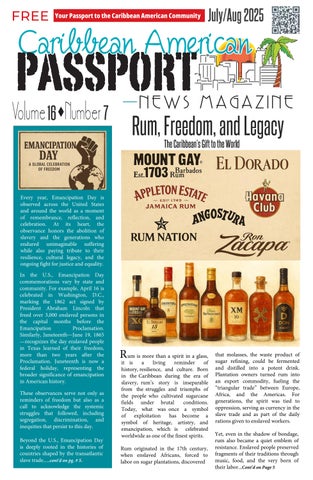
FREE Your Passport to the Caribbean American Community July/Aug 2025
16
7
Rum, Freedom, and Legacy The Caribbean’s Gift to the World
Every year, Emancipation Day is observed across the United States and around the world as a moment of remembrance, reflection, and celebration. At its heart, the observance honors the abolition of slavery and the generations who endured unimaginable suffering while also paying tribute to their resilience, cultural legacy, and the ongoing fight for justice and equality. In the U.S., Emancipation Day commemorations vary by state and community. For example, April 16 is celebrated in Washington, D.C., marking the 1862 act signed by President Abraham Lincoln that freed over 3,000 enslaved persons in the capital months before the Emancipation Proclamation. Similarly, Juneteenth—June 19, 1865 —recognizes the day enslaved people in Texas learned of their freedom, more than two years after the Proclamation. Juneteenth is now a federal holiday, representing the broader significance of emancipation in American history. These observances serve not only as reminders of freedom but also as a call to acknowledge the systemic struggles that followed, including segregation, discrimination, and inequities that persist to this day. Beyond the U.S., Emancipation Day is deeply rooted in the histories of countries shaped by the transatlantic slave trade.....cont'd on pg. # 5.
molasses, the waste product of R um is more than a spirit in a glass, that sugar refining, could be fermented it is a living reminder of history, resilience, and culture. Born in the Caribbean during the era of slavery, rum’s story is inseparable from the struggles and triumphs of the people who cultivated sugarcane fields under brutal conditions. Today, what was once a symbol of exploitation has become a symbol of heritage, artistry, and emancipation, which is celebrated worldwide as one of the finest spirits.
Rum originated in the 17th century, when enslaved Africans, forced to labor on sugar plantations, discovered
and distilled into a potent drink. Plantation owners turned rum into an export commodity, fueling the “triangular trade” between Europe, Africa, and the Americas. For generations, the spirit was tied to oppression, serving as currency in the slave trade and as part of the daily rations given to enslaved workers.
Yet, even in the shadow of bondage, rum also became a quiet emblem of resistance. Enslaved people preserved fragments of their traditions through music, food, and the very born of their labor...Cont'd on Page 5