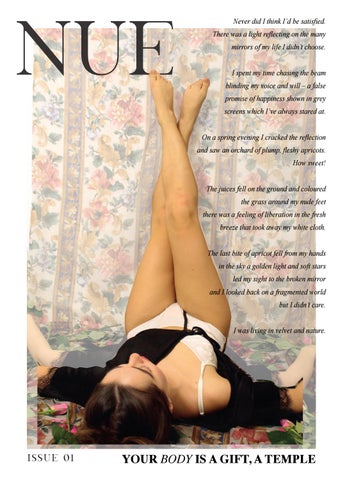
NUE
Never did I think I’d be satisfied. There was a light reflecting on the many mirrors of my life I didn’t choose. I spent my time chasing the beam blinding my voice and will – a false promise of happiness shown in grey screens which I’ve always stared at. On a spring evening I cracked the reflection and saw an orchard of plump, fleshy apricots. How sweet! The juices fell on the ground and coloured the grass around my nude feet there was a feeling of liberation in the fresh breeze that took away my white cloth. The last bite of apricot fell from my hands in the sky a golden light and soft stars led my sight to the broken mirror and I looked back on a fragmented world but I didn’t care. I was living in velvet and nature.
ISSUE 01
ISSUE 01
YOUR BODY IS A GIFT, A TEMPLE
Welcome
The human body is undeniably the most captivating, empowering and natural sentient form to grace the sphere in which we subside.
MEET THE TEAM
Abstract, illusionist, undefinable, boundless, art. These are just some of the ways we define our bodies, this is what we are capable of in our own skin. The naked body has been a permanent fixture in the art world and allows us to visually explore the energies and messages that forms convey. However, as art has evolved, the way we perceive our bodies has changed. The artist’s depiction has changed as art has become a way of exploring the fault of our bodies, instead of welcoming the boundless beauty of each unique form. We want to show you art where bodies are worshipped in all forms of beauty and grace. Where artists represent the true proportions of bodies, and glorify what is rarely seen in today’s world. In this first issue of NUE, there are interviews with Cardiff based figures that advocate and radiate self-love and acceptance through the mediums of photography and life modelling. We have also explored the conversation surrounding the necessity of claiming back ownership of your body in the era of the #MeToo movement. We believe, too, that fashion is a form of self-expression and can be used as a tool to battle against societal expectations. We want the women and non-binary folk that read our publication to see themselves reflected in our pages and to find comfort in knowing that we are on their side in the drive for widespread body positivity and confidence. Here at NUE, we believe that our name represents what we want to express and praise; the beauty found in the nude form.
- CONTENTS 03. The body politic 04. NUE found confidence 06. Oliver gone Wilde 07. Exploring iconic fashion through history 08. NUE recommends
02 NUE
POET
THE BODY POLITIC Make a move: towards positive perceptions of our bodies Here at NUE we want change. And change is happening. Social media has birthed several empowering movements allowing us to express our bodily autonomy. However, we have a long way to go. We feel these movements are vital to the progression of how we see our bodies. We must continue to be involved in these movements and champion voices that are marginalised. Let us take control of our own bodies.
Me Too
The “Me Too” movement was founded in 2006 to help survivors of sexual violence find paths to healing, especially black girls. Their tagline is “you are not alone” and the movement aims to support survivors and end sexual violence. In October 2017, following the Harvey Weinstein sexual allegations the hashtag #metoo went viral. Having over 200,000 uses on Twitter in the first 24 hours, 4.7m Facebook users posted the phrase in the same time period. Central to the movement is a cry for bodily autonomy and an end to the exploitation of the human form for sexual gain. Highlighting just how far we have left to go.
Free the Nipple
This movement dates back to 2007 when Kelli Roman posted a breastfeeding image on Facebook which was removed. In 2012 Lina Esco made a film that protested the nudity laws in NYC and released teasers on Facebook with the hashtag #freethenipple. Despite the attention that the movement has, very little has happened in the way of legislative change. This inherent sexualisation of the female form pervades the issue of rape culture and teaches women to be embarrassed of their bodies. These issues highlight the way female bodies are shamed in ways the male form never is and show why the body positivity movement is so vital to social progression.
Orangetheworld
This is a campaign started by UN Women to mark the 25th anniversary of the Beijing Declaration and Platform for Activism. It consists of 16 days of activism against gender-based violence, running from 25 November - 10 December 2019. The tagline for the campaign is “Generation Equality Stands Against Rape” and urges people to open a discussion about consent as 1 in 3 women worldwide have experienced some form of sexual violence. The UN wants people to use the colour orange and the hashtags #orangetheworld and #generationequality to spread the message and facilitate conversations.
03 NUE
NUE found confidence Ray is a LGBTQ+ activist who finds
W
solace in life modelling
hen we consider the body positivity For Ray, seeing themselves reflected in the art movement and its recent rise, perhaps produced by attendees of the Cardiff Life Model life modelling is not the first source of Collective was a turning point. Here they saw their inspiration that comes to mind. Over the past few body in a different light and it instilled in them a years, the movement has centred largely around the newfound confidence. celebration of the body on social platforms. Ray recalls a time that they took part in a life However, the essence of the movement can be found modelling session at lunchtime and how for one far beyond the pages of Instagram and Twitter. In fact, of the very first times, they finally felt comfortable it exists in abundance in the life modelling and drawing eating in front of other people. They thought, sessions of Cardiff and South Wales says Ray Thomas, “What a long way I’ve come!” 21, a regular life model who also In identifying as non-binary, happens to identify as non-binary. Ray has found that the body Ray got involved with life “Sometimes I want to positivity movement itself has modelling back in February 2017 as not always catered to bodies such change aspects of my as theirs. More often than not a way to make some extra money body, but I still love during their first year at Cardiff the movement is dominated by and accept it as it is” discussions led by and centring University. As time went on, Ray found themselves falling in love around white, cisgendered (those with the act of life modelling and who identify as the same sex they the beneficial impact it had on their perception of were assigned at birth) women. Many a time Ray themselves and their body. In particular, Ray discovered has felt sidelined as someone that exists outside of that life modelling classes provided them with a safe the ‘usual’ parameters. Yet, life modelling as a nonspace where they could consider their nonconformity. binary person has always come naturally to them. “When I first began life modelling, I was actually “Usually, a lot of people presume that I wouldn’t just looking for some kind of employment that wasn’t be comfortable being a life model because they a strict routine like I’d experienced before coming to assume that there are parts of my body that I’d like university,” Ray says. to change,” Ray says. At first, they never expected to end up quite as However, putting themselves on display by engaged with their new part-time job as they are now life modelling has been an essential part of Ray’s and certainly never anticipated that it could lead to journey towards finding acceptance in their finding such comfort and positivity in their own skin. nonconformity. Ray ends, “I think it’s important “I had never been particularly confident about for me not to hide my body away.” my body, even though I’ve often been perceived as objectively quite thin. When I started life modelling I was presenting in a more feminine manner,” says Ray.
Shifting perceptions
Yet despite feeling perceived in a way that is often considered socially acceptable (appearing thin and archetypally feminine), Ray struggled to feel confident and positive with regards to their own body, right up until they truly threw themselves into life modelling. “The thing about the collective I work for is that the artists in the room are just glad that you’re there. There is no sense of objectification or expectation. No one there cares what you look like and we have models of all shapes and sizes at the Cardiff Life Model Collective,” Ray expressed to us. The first time Ray ever modelled, they were racked with nerves. They reflected, “I wondered what I’d signed myself up for but as soon as I started, it all felt very anti-climatic. I didn’t worry that anyone was staring at me, thinking about what my body looked like and at the end of the session, I got to see beautiful art that people had made featuring me.”
Merely a Muse Elizabeth Siddal wanted to capture art, instead art captured her The beauty of Elizabeth Siddal is in our minds even though we are unsure of her true identity. She is the kind of woman that springs to mind when we think of paintings. That’s because she is in many works of art created by the pre-Raphaelite Brotherhood: Ophelia by John Everett Millais (1851 - 52), Beata Beatrix by Dante Gabriel Rossetti (1870) and The Lady of Shalott by John William Waterhouse (1888). Posing for their art, her beauty and grace tainted by a twist of darkness. She was a Beata Beatrix in real life, but only in the eyes of the audience and of the artist that loved her and painted her the most, Dante Gabriel Rossetti. Her love with Rossetti was doomed from the start, yet she sat in front of his canvas for hours, sitting in soft colours and flowers. She was living in a world he had created for her, made to fit the hazy outline he had drawn of her, like Dante’s Beatrice. She laid in cold baths for art and love’s sake, all the while dreaming of a different world where she could express her own art; one that was not overshadowed by the talent of her lover. So, her sadness intensified and she ran away from him, he chased her everywhere through love letters. Elizabeth’s art, like herself, fell sick and she eventually went back to Oxford to be with Dante during her last days. On her deathbed, Elizabeth was skinnier, paler, and her hair was bright red. pre-Raphaelite painter Ford Madox Brown notes in his diary that she looked “thinner and more deathlike and more beautiful and more raged than ever… A real artist, a woman without parallel for many a long year.” Ultimately, Elizabeth embraced the hazy outline her lover had drawn of her, as she ascended into Beatrice’s Paradise: she is a myth and her humanity is forgotten.
Left Image - David Roach Right Image - Senne
05 NUE
OLIVER GONE WILDE We interviewed Cardiff based photographer, Oliver Smith, who crafted a series of beautifully vulnerable, personal portraits of himself, titled, The Ballad of Silent Men Voicing his discontent with the unjust arrest of Oscar Wilde (who was imprisoned for ‘gross indecency with men’) Oliver, who also identifies as gay, has expressed his personal experiences with body positivity, vulnerability and the importance of confidence in modern-day society through exposing the beauty of his own body
Looking back at the process, how do you feel? After exhibiting the pictures, I feel extremely empowered and proud for taking what I see as a giant step for myself. By creating this body of work, it has improved the way I view myself and the way I see myself in a vulnerable setting. It has shone a light on parts of myself that I took for granted.
What are you aiming to present in your work?
IMAGE: OLIVERSMITH-
What approach have you taken in your work? I’ve taken an emotional and poetic approach in regards to my studio self-portraits that evoke the notions of freedom, the fluidity I have within my life and how lucky I am to be a gay man in the day and age that I am living in.
Why is it important to feature yourself? It was important that I emphasised that expression of vulnerability, by partially hiding my identity so to embody the theatrical nature of Wilde and become closer to him.
What was it like being the subject of your own project? It was rather daunting and I definitely felt a sense of vulnerability while I was creating the pictures. As I became more comfortable with the idea, I let myself become freer and was able to let my guard down by the end of the shoot.
The body of work is my direct reaction to the unjust arrest of Oscar Wilde, and the anger I feel towards the treatment towards LGBTQ+ individuals throughout history and today.
What are your views on modern-day body positivity? Today, people don’t have the chance to be free and expressive. There will always be somebody that shames them. Ultimately, It’s your body and you should do with it as you you please.
Do you think there is power in expressing yourself through art? There is most definitely power in expressing yourself through art and using an artistic medium to help you do it, it is incredibly empowering and satisfying. The thought, to some, might be daunting, however, I really would encourage it. The payoff from being brave and transparent is unbelievably rewarding.
“The sensual movement of my nude body strengthens the idea of Wilde never having the ability to be this free, he was shunned for who he was and I’m able to be true to who I am.”
06 NUE
E XPL O RIN G IC O N IC FA SH I ON
throughout history
Dress has a way of liberating and confining the body. Here at NUE we want to explore the ways fashioned garments through history have allowed us to be true to ourselves
T
he human body has been adorned by clothing for millennia, evolving alongside fashion throughout the centuries. Arguably, the past century has been the most turbulent in terms of developments to free the body from oppression, as trends and fashionable ‘ideals’ have both liberated and confined it. In the sixteenth-century, the corset was a tightly laced, rigid bodice that sought to change the shape of the female body to create the illusion of heightened femininity. Between 1880 - 1920, corsets were the ultimate must-have and the silhouette that the corset created was and for some, still remains the epitome of femininity. The uncorseted body was a source of anxiety, and those who did not wear one were often tarnished with labels such as prostitute, dress reformer or feminist. But times began to change as women pursued independence, nonconformity and freedom. Women were able to exercise their liberation through their stylistic endeavours. Fashion has always advocated for new social waves, in particular the iconic miniskirt. Mary Quant brought the miniskirt to life. The mini became a new garment for people to experiment with - to help establish freedom. The miniskirt quickly became a staple for feminists in the Sixties, especially in London, where the first samples designed by Mary Quant
were showcased in her shop Bazaar on King’s Road and were nearly all sold out. The miniskirt became such an It-garment as it broke the rules and created new, fun ones. Paired with coloured, thick tights, knee-high boots and the birth control pill in hand, it shook conservative values and gave women the sexual freedom they had been pioneering for. Rebecca Arnold, professor of dress and textiles at the Courtauld Institute of Art said, “It was a sign of a new attitude for those who wore it. It symbolised that times were changing and women were active and visible.” UN Women’s new campaign #orangetheworld (read more on page 03) highlights the implications of how we may choose to dress our bodies in 2019. In their powerful social media campaign, they state that a mini skirt is not consent. Once, the miniskirt was an icon of sexual liberation. Now the miniskirt has become a source of anxiety, a part of the victim-blaming culture. A woman must be conscious of her outfit choices to make sure she does not appear to be ‘asking for it.' Unfortunately, we have a long way to go before the female body is truly liberated from fashionable constraints and ideals. We must surround ourselves with positivity, wear what makes us feel comfortable and embrace our figures, skin and features, all which make us unique. No matter the clothes women choose to wear, their bodies are their own.
07 NUE
NUE RECOMMENDS Send us a message on Instagram @nue.magazine, if you We have hand-selected
wish to share your experiences from any of these
a range of events
events; or use the hashtag #NUEmyway to share
and activities that
what you’ve enjoyed from this issue.
you may enjoy. We Women’s Trauma Sensitive Yoga
hope that they will inspire you to make
Aimed towards survivors of violence but is open to all. Sessions aim to reconnect the mind and body to find inner calm. Yoga has been shown to help people heal from trauma.
positive changes with the way that you feel about your body and
☼ Friday 10.30-11.30am > Women’s Centre, Moira Terrace, Cardiff £: free @cardiffwomensaid
being.
Women’s Self-Defence An eight week course beginning on 15 January 2020. A combination of traditional self-defence moves with Krav Maga help women, giving them the confidence to defend themselves. ☼ Wednesday 8 - 9.30pm > Reebok Crossfit, Colchester Ave., Cardiff £ 60 @defenceacademycardiff
Flow & Feast Strengthen and restore your body through yoga practise. The day centres around the ethos of relaxation and the physical and mental benefits this can have. ☼ 19 January 10 - 12.30pm > DEPOT, Dumballs Rd., Cardiff £ 30 @ yoganicuk
She Talks Body Positivity
UPCOMING EVENT: Cardiff Life Models @cardifflifemodels Models promote acceptance and appreciation of all human forms through art. All the while inspiring others to feel comfortable in their own skin. Tuesday 6 - 8pm and Sunday 12.30 - 2.30pm | £10 per session
Part of a series called ‘She Talks’, the event consists of talks from inspirational women who have struggled with body confidence. Speakers include Catherine Quinlan, Zoe John and Katie Victoria Hulland. ☼ 23 January 7 - 10pm > Kin + Ilk, High St. Arcade, Cardiff £ 15 @letzshare
If interested, head to Little Man Coffee Co., Bridge St., Cardiff
Follow us on Instagram: Nue.Magazine
Email us: nuemagazine@hotmail.co,uk