NEWS & EVENTS
RESEARCH NEWS
MYHEARTMYSTORY
September 2026
www.myheart.org.uk
SUPPORT FOR YOUNG PEOPLE DIAGNOSED WITH POTENTIALLY LIFE -THREATENING HEART CONDITIONS
NEWSLETTER
IN THIS ISSUE
News & Latest Updates myheart Meetings myheart mystory CRY Research
@myheart_UK
myheartnetwork
Registered Charity No: 1050845
INSIDE THIS ISSUE 03 A NOTE FROM THE MYHEART COORDINATOR
04 MYHEART NEWS
•”The Psychological impact of Inherited Cardiac Conditions in Young People” by Dr Vicky Kelly (pg. 4)
•Vital Beats (pg. 9) •Credible Meds (pg. 9) •CRY Events (pg. 11) •Volunteering (pg. 14)
11 Heart of London Bridges Walk
16 myheart mystory 33 FUNDRAISING BY MYHEART MEMBERS
38 CRY RESEARCH
•CRY Medical Conference (pg. 38) •Dr Marwaha: Solving the Grey Zone – Differentiating Athlete’s Heart from early DCM (pg. 40)
48 MYHEART MEETINGS 50 MYHEART RESOURCES 48 myheart meeting
2
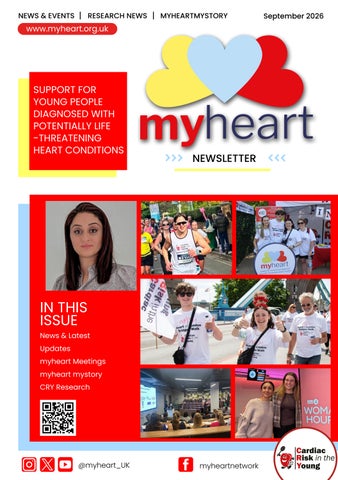
On the cover (from left to right): 1) Dr Saran Marwaha, page 40. 2) myheart member Harry Trowbridge, page 16. 3 & 4) myheart members at the CRY Heart of London Bridges Walk, page 11. 5) CRY Medical Conference, page 38. 6) myheart member Kaitlin Lawrence at the Woman’s Hour studio, page 8.
A NOTE FROM THE MYHEART COORDINTOR Throughout the year, myheart continued to offer support to young people who have been diagnosed with a cardiac condition by holding support meetings, sharing new research updates, articles from CRY Cardiologists, and personal stories by myheart members. Feedback from myheart members is vital for us and helps improve our support services. Based on that feedback, we have added a research section to the website where we post updates from CRY Research Fellows - this issue includes videos from the CRY Medical Conference 2025. We received feedback about how impactful it is to read or watch stories of others who have been diagnosed with a cardiac condition. Peer-to-peer support and shared experiences can help people to feel less alone. This newsletter includes personal stories shared by some of our members in 2025, alongside fundraising stories as members
Welcome to the myheart newsletter for 2026 which is a round-up of myheart news and events from 2025. aim to set up screenings in their local areas, and raise awareness of cardiac conditions in young people. Even in times of adversity, they are an inspiration to others. Within this newsletter you will also find information about myheart meetings and how you can volunteer at CRY events. myheart is now providing support to over 1,000 individuals diagnosed with a cardiac condition. We would like to extend our thanks to all of you for your continued support - whether through fundraising, sharing social media posts, sharing your stories, volunteering at CRY events, or writing to your local MP. As the coordinator of CRY’s support group, it is my endeavour to get you all the news and event stories relating to members accurately. Please do not hesitate to contact me, Kanika, if you find anything amiss or if you have any views to improve our support network: myheart@c-r-y.org.uk or 01737 363222.
Head Office: Unit 1140B The Axis Centre Cleeve Road Leatherhead KT22 7RD
3
MYHEART NEWS
News from CRY, raising awareness, campaigns, Credible Meds and volunteering
The Psychological impact of Inherited Cardiac Conditions in Young People Dr Vicky Kelly is a Consultant Clinical Psychologist and Service Lead for the Barts Heart and Thorax Centre Psychological Services at St Bartholomew’s Hospital. She set up this service in 2017, after working in paediatric cardiac psychology services at Great Ormond Street Hospital from 2009. Prior to this she worked in Paediatric Palliative Care, Cystic Fibrosis, Diabetes, and Child and Adolescent Mental Health Services.
Dr Vicky Kelly
Dr Kelly’s research interests include anxiety, decision making around cardiac devices, and patient and family experience of invasive treatment; she is also interested in developing support structures for staff working in acute physical health settings and enjoys collaborating with patients, families, and staff to develop 4
the provision of psychologically informed healthcare. Inherited cardiac conditions present unique psychosocial challenges for young people and their families (Caleshu et al., 2016). Diagnosis can occur against the distressing backdrop of a sudden death in the family, meaning patients must grapple with a new diagnosis at the same time as grieving for a loved one. Or it can happen suddenly and traumatically, in the context of an out of hospital cardiac arrest, leaving a family reeling with shock whilst experiencing on-going trauma and having to come to terms with a new life-long condition. It can also bring about the need for screening and genetic testing, as other family members might be affected, which can lead to additional worry and guilt for all affected (Potterton et al., 2024). Many patients might experience no (or mild) symptoms, yet suddenly find themselves plunged into having conversations about preventing the risk of sudden cardiac death by withdrawing from competitive sports and
intense exercise, needing to take new medication, or having an implantable cardioverter defibrillator (ICD) inserted (Priori at al., 2013). And all of this is usually happening at a time when the focus for the young person concerned is on having fun with friends and not thinking too far into the future. This can inevitably, and completely understandably, lead to a sort of “checking out” or avoidance of any conversation related to the heart, which can result in increased anxiety from the family and medical systems that surround the young person. To understand the psychological impact of these challenges, it is helpful to consider the developmental context. Late adolescence and young adulthood represent a significant developmental phase in our lives. According to Havighurst (1973), young adults are tasked with the daunting job of achieving autonomy and independence, establishing their identity, establishing emotional maturity, and starting to plan in terms of career choices, relationships, and considering parenthood. No easy task, and I would hazard a guess that most of us in our forties and beyond can still not say we have achieved all those things! Discovering they have a cardiac condition can force young people to be more dependent on others (e.g. parents and family) at a time when they want to be testing out their independence. It can also bring about more uncertainty
about what a cardiac condition means for their identity in amongst other questions that they might already be having about their gender identity, ethnicity, and sexual identity to name but a few. From a cognitive perspective, the pre-frontal “brakes” are not yet fully developed and risk taking and pleasure-seeking behaviours are a big part of most people’s late teens and twenties. Having a cardiac condition increases the harm some of these behaviours might cause to physical health. For example, the heightened risks of experimenting with drugs and alcohol, which can lead to increased feelings of isolation at a time when partying the night away feels like the norm for most of their peer group. Other executive functions including planning, organisation and the maturity of judgment may not fully develop until the mid-thirties. This can make complex decisions about medication, whether to have an ICD, and even just turning up to clinic appointments more of a challenge for this age group. But that’s just what we know from clinical experience and the literature, what do the experts, i.e. the patients, say about all of this? Imran is a 27-year-old man and has kindly agreed to coauthor this article with me by letting me interview him about his experiences as a patient with Hypertrophic Cardiomyopathy (HCM). 5
By way of introduction, can you tell us a bit about you and your cardiac condition please? What is it and when did you first get diagnosed? I have Hypertrophic Cardiomyopathy (HCM) which is a genetic heart condition that causes the walls of the heart to thicken and effectively reduces its ability to pump blood efficiently around the body. I was diagnosed with this condition in 2013 when I was 15 years old. And what can you remember about that time? It was quite a pivotal moment in my life, not only due to the medical changes, but the whole uncertainty with everything…it was a very surreal mixture of different feelings. I felt completely adrift with my thoughts, and I felt a lot of confusion from just trying to process everything. I didn’t know what the diagnosis meant for me, what kind of changes I would have to make, how would it impact me for the future, and what it meant for the people around me. I didn’t really have time to consider any of that. Yes, it sounds like it was, understandably, a very overwhelming time. How would you describe the psychological impact of having an inherited heart condition, particularly on young people? Ultimately, it differs for different 6
people. I can’t speak for others, but I can give my insights. The most challenging psychological hurdle that I had to face (which I am still dealing with now) is just coming to terms with it and managing my expectations. I think that was the most difficult thing. As well as that, for me personally, I didn’t want to speak to anyone about this condition, there was a stigma around it, I kept things to myself. And how did that affect you, keeping things to yourself? It added to the feelings of isolation. I didn’t want to speak to anyone else because I didn’t want to burden them with what I was going through, but that meant I had to deal with that all by myself. Thinking about it now, that felt quite tough, especially to have to deal with that on your own at that age (15 years) with all the emotional weight of it. With a thing like a heart condition, it’s not something you can see, it’s all on the inside. This makes it harder to convey, and people don’t really see everything that’s going on for you mentally and physically. And what skills, approaches and ideas have you been able to draw upon to manage this impact? I don’t think I managed it particularly well in the beginning! My coping mechanism was to just forget about it. I didn’t know how to process everything, nor did I want to talk to anyone about it, so I thought “I will just forget about it
as best as I can”. And to an extent it worked a bit with some of the psychological aspects because I wasn’t actively thinking about it, but I don’t think it was the best approach… More recently I have had some psychological therapy and that was one of the biggest factors that helped me manage the condition, because it was just a space to reflect on everything and talk about things openly without being judged. And it helped me process things which I never had the opportunity to do before, in all honesty. And I think that’s helped me embrace all of this and think about what it really means. It sounds like it gave you that space, whereas before it felt too overwhelming. And are there other things that you did that helped? I think I have always tried to maintain a positive outlook on life. It gives you that hope and drive to overcome things. Yes, absolutely maintaining hope and a positive outlook sound like they are very helpful for you. And following on from the psychology sessions I had, it led me to have more open conversations with the people around me, which I hadn’t done before, and that kind of led me to building a good support network around me. Now I know I have people who I can reach out to if I am having difficult periods
and that has made me feel less isolated compared to before. That is such lovely learning you are describing about the importance of reaching out. And it’s interesting because nothing has changed with what you are dealing with, but it sounds like you have more resources to draw on now. What would you say now to young people who have just been diagnosed with an inherited heart condition? The first thing I would say is it is honestly ok to feel whatever you might be feeing. You won’t have all the answers and don’t expect yourself to have all the answers. It’s a process of acceptance with no specific timeframe. Take your time, reach out to people. Try not to feel isolated. Is there anything you would do differently? I wish I had opened up more to those around me. I worried I was being a burden, but I probably wouldn’t have been, and I think that would have really helped me at the time, to work things through and help cope with everything. Because you have got to appreciate that you’re taking all that in and juggling life at the same time. It’s a lot. Yes, there are so many changes happening at that age. And how can teams and charitable 7
organisations help more? I think that there are some very helpful organisations out there but in terms of improvements, I found you must really go out and seek out information for yourself. That can feel overwhelming. Maybe the information sharing/signposting information could be better structured or more accessible. Maybe there needs to be more specific support, tailored for young people. Yes, navigating the support out there can be very challenging. Maybe it would be better for the idea of support to be introduced as standard at the point of diagnosis?
For example, for cardiac teams to provide some sort of support structures that go hand in hand with your treatment journey, such as meeting support services at specific time points in your medical journey. Yes, I think that would be helpful. I would like to take this opportunity to thank Imran for taking the time to contribute to this article and for articulating his experience of being diagnosed with HCM as a young person. He has provided useful insights into the types of understandable psychological responses that young people might expect to experience and ideas about how to help with them.
Kaitlin Lawrence on BBC Woman’s Hour When Kaitlin Lawrence was just 22 years old, her life changed in an instant. While playing netball for Surrey Storm in the Super League, Kaitlin collapsed on court. What followed was a diagnosis she never expected: arrhythmogenic cardiomyopathy (ACM), a genetic heart condition she didn’t know she had. This meant giving up her dream of playing professionally for Scotland—a devastating blow for any young athlete. But Kaitlin didn’t stop there. She turned her experience into action, successfully campaigning for cardiac screening to be 8
Anita Rani, Kaitlin Lawrence and Gabby Logan at the Woman’s Hour studio
introduced in the Netball Super League next season. Kaitlin shared her story with Anita, offering hope and raising awareness for others living with inherited heart conditions. Listen to the full interview on BBC Sounds.
Vital Beat
“Vital Beat has created a unique and specialized protection and comfort solution for people with medical devices such as an ICD, EV-ICD or S-ICD. Wearing the Vital Beat shirt and protection shields will allow you to safely and comfortably enjoy your sports, hobbies and work. “The Vital Beat solutions are available for all ages. The youngest users are just twoyears-old, and the eldest are well into their nineties! If you have any special needs or requests, please let us know and together we will create a solution for you.
“CRY and Vital Beat met in 2024 during the cardiology convention in London. Impressed by each other’s goals we decided to collaborate. Vital Beat is giving a €40 (approx. £35) discount on selected items for CRY’s myheart members.” To avail the discount, myheart members can contact us at myheart@c-r-y.org.uk. Join myheart by filling the form on the myheart website if you are not a member already.
Update from CredibleMeds CRY has received a number of updates from CredibleMeds throughout the year. Members with cardiac conditions may like to consider registering with CredibleMeds to be kept up to date with any changes to the
QT drugs to avoid list: https:// crediblemeds.org/everyone 9
MedicAlert in partnership with myheart It is recommended that anyone with a hidden medical condition carries a form of identification detailing their condition and any medication they are on. This could be in the form of a card placed somewhere visible in your wallet/ purse, or an identification jewelry, help such as a MedicAlert ID. MedicAlert is the UK’s first and only medical ID charity, trusted by healthcare professionals and members for more than 60 years. myheart members can receive 15% off MedicAlert IDs using the code CRY15. MedicAlert provides a life-saving medical ID membership service for just £41 per year. Every medical ID displays the globally recognised MedicAlert emblem and is linked to a member’s secure digital medical record. Registered nurses review each record to ensure it is accurate and up to date. In an emergency, first responders can quickly access vital medical information, including medical conditions, allergies, medications, 10
emergency contacts and important health documents through MedicAlert’s 24/7 emergency line, which supports more than 100 languages. MedicAlert believes everyone deserves to live with confidence, independence, dignity and peace of mind. The charity works closely with healthcare professionals, emergency services and leading health organisations to ensure essential medical information is available whenever it is needed most. Through these trusted partnerships, MedicAlert helps protect its members every day, providing reassurance to individuals and their loved ones while supporting safer, faster and more informed emergency care. With trust in every ID, MedicAlert provides confidence in every moment. To learn more, visit: www.medicalert.org.uk or call 01908 951045.
CRY Heart of London Bridges Walk 2026
On Sunday 22nd June 2025, 1,079 CRY supporters of all ages and from different parts of the country took part in the annual CRY Heart of London Bridges Walk. This is in addition to the two supporters who registered to take part in My Walk For CRY, to walk and raise awareness in their local community. This year marked the 30th year of CRY as a charity and the 19th year of the walk. The day is an opportunity for people to connect with friends, other families with similar experiences, while raising awareness of CRY’s ongoing work to help reduce the incidence of young sudden cardiac death. It was incredibly moving to see supporters coming together, wearing their personalised CRY T-shirts and holding CRY branded flags as they walked in support of
a family member or friend or to raise awareness of CRY’s work. In addition to those walking in memory of a young person or in support of someone with a diagnosis, there were many groups and individuals who took part to support CRY as a charity and our aim to save young lives. Beginning the walk in Southwark Park, supporters gathered in front of the bandstand as CRY consultant cardiologist Professor Sanjay Sharma thanked participants. CRY Chief Executive Dr Steven Cox spoke next, thanking CRY Patron Andy Scott for leading our walk, and the incredible volunteers, sponsors, vendors, and staff who made the day possible. 11
Speaking of CRY, Steve continued: “What has always made CRY unique is that this is your movement. This is a movement which is made up of thousands of stories, personal legacies and acts of remembrance that have raised awareness within every corner of the UK. School campaigns, community events, social media appeals, charity runs, cake sales, concerts and walks like today. Each of these is part of something much bigger […]
“CRY began many years ago because one person took a stand. It continues because of you, your courage, your determination and your refusal not to give up. Because of you, young lives are being saved. Thank you for your support and your belief in what we can achieve together.” Following the speeches, a oneminute silence was observed in a collective moment of reflection. At 11am walkers set off on the scenic 6.5-mile route along the Thames, that took them across Tower Bridge, around the historic Tower of London, over Millenium Bridge and along Bankside, before returning to the finish at Southwark Park. With scavenger hunts in hand, our young participants set off along the route, keeping an eye out for a range of features along the walk, including Sam Wanamaker’s blue plaque, a large cat statue
12
sitting on top of the Thames wall, and a striking mural depicting Saint Olave. One young explorer who successfully completed the scavenger hunt received a family hamper donated by Denise, the Community Champion from Tesco Leatherhead Superstore – featuring a teddy bear, chocolates and a bottle of prosecco (for the adults to enjoy later!). At the finish line, walkers were presented with a choice of a CRY medal, pin badge or keyring, before enjoying the CRY Family Picnic. Supporters were invited to relax and recharge with a selection of delicious food and drinks available in Southwark Park. We would like to extend our thanks to the following: Brat Bros, Chocolate Balloons, Eat Argentina, Freewheelin’, Golden Happy Chippy Van, Howe & Co Fish and Chips, and Smokin’ Bean Coffee Truck for providing such excellent nourishment for the event. As it was a particularly hot day, families relaxed at our picnic tables beneath the trees, where they connected with one another and enjoyed the jazz performances delivered by Stephen Pierre and a group of musicians from UMAT. Thank you to Jo Parker, who led a range of fun children’s activities throughout the afternoon, including lively parachute games, bubbles and creative arts and crafts that kept our younger participants happily entertained.
We are so grateful to Stephen Pierre, UMAT and Jo for donating their time to CRY. We would like to extend our gratitude to all the amazing volunteers who helped make the day such a success. Whether you were marshalling along the walk route, taking photos or handing out water to keep everyone hydrated, your support was invaluable. Your efforts made the day run smoothly and created a welcoming and safe atmosphere for everyone involved. We would like to extend our thanks to our amazing team of volunteers. Your assistance is what makes events like this possible! CRY’s volunteers were: Alison Button; Dan Button; Cara Brookes; Krizstina Cserhalmi; Julie and Michael Essex; Sheila Foster; Jonny Gilman; Lindsey Gilman; Vada Green; Katie Harris; Kelvin Holt; Jo and Nick Hudson; Sai Jampana; David Jewell; Emma Jordan; Liz and Martin Kerwood; Mathew McCarthy; Rikesh Mistry; Vijay Mohan; Cyril Molony; Jo and Jonny Parker: Pete and Sue Robinson; Ellen Scott; Dean Sharpe; Vikram Shee; Jos Sizer; Alison Stevens; Omolade Taiwo; Dai Taylor; Gillian Walker; Paul Ward; Fiona and Lucy Wasdell-Bowyer; Ash WasdellLane; Marion and Matt Wilson; Rebecca Zouvani. Thank you to our event sponsors: Chubb, ServiceMaster Clean and Tesco Superstore Leatherhead. 13
Volunteering for CRY We are so grateful to our supporters who offer up their time. From being an official CRY ‘cheerer’ at a mass participation event, helping to marshal the route at the CRY Heart of London Bridges Walk, holding an awareness stall, sharing our key messages on social media, to volunteering at a UK festival – there are lots of opportunities to get involved by volunteering! Our aim is to make sure you have a rewarding experience volunteering with CRY and have the opportunity to meet new challenges, develop your skills, gain a great sense of achievement, and contribute towards CRY’s aim of saving young lives. You have complete flexibility in deciding how much time you would like to give, with
14
opportunities ranging from regular involvement to one-off tasks that fit around your schedule. Volunteering can also enhance your CV, as employers value individuals who take initiative and make a difference. Additionally, it provides the chance to meet new people and connect with others who share common ground from all walks of life. You can get involved in a wide variety of CRY events, from major events such as the Great North Run and the London Marathon to our own CRY-organised activities, including the CRY Heart of London Bridges Walk and the CRY Heart of Durham Walk. Providing your help on-site is a great way to experience the energy and excitement of these fast-paced, busy events. There are plenty of different roles to take on, all offering a fun, enjoyable day out,
initiative and creative thinking are important, as well as genuine enthusiasm for CRY and its events. Additionally, you should be able to work cooperatively as part of a team or independently, depending on the task.
and however much time you are able to give is very much appreciated. Your support is vital in helping to make our events possible and successful.
CRY is always looking for massage therapists to volunteer at the London Marathon and Great North Run. We welcome anyone who is in the process of completing a course that includes massage, as well as those who are already fully qualified. We can provide massage beds and oil, as well as a CRY T-shirt, so you would just need to bring yourself.
We are unable to take volunteers at our screening events, however if you are a cardiac physiologist and would be interested in joining the CRY team, please email your CV to ecg@c-r-y.org.uk We are pleased to be supported by a diverse group of people and operate an equal opportunities policy. All we ask is that our volunteers have an understanding of the sensitive nature of CRY’s work, as many supporters and volunteers are bereaved or connected to bereaved families. You should be able to uphold and represent CRY’s name and reputation positively, remain flexible and proactive, and be comfortable volunteering outdoors, if needed. Strong
To become an events volunteer, visit www.c-r-y.org.uk/ cry-volunteers/ and complete the form or scan the QR code. For more information, please email: volunteering@c-r-y.org.uk or call 01737 363 222. 15
myheart mystory
stories from members of the myheart network
‘Everyone should have a choice to get screened’ by Harry Trowbridge
In April 2019, at just 15 years old and in my GCSE year, my life took an unexpected turn. I started experiencing a series of unexplained symptoms that left both me and the doctors puzzled. The symptoms, which seemed random and unrelated, included skin lesions on my legs and feet, severe muscle pain in my lower limbs, and at times, an inability to walk. Initially misdiagnosed with tendinitis by physiotherapists, I spent three months persistently pushing my GP for answers as new symptoms emerged. Eventually, I was referred for what I called an “MOT”—a comprehensive series of tests during a hospital admission. The turning point came when a doctor wheeled an echocardiogram into my room. At the time, I had no idea how 16
much my life was about to change or how often I would see the cardiologist in the coming months. She would turn out to be an incredible, caring, and supportive doctor, who would be an integral part of the extensive medical team that would care for me. Within half an hour, she delivered life-altering news: I had a congenital heart defect called coarctation of the aorta. On top of that, the coarctation was classified as severe, and I was also diagnosed with hypertension. It was a shocking revelation, especially since I had always been fit, active, and healthy. Coarctations are typically diagnosed at birth, so discovering this at 15 was incredibly rare and to this day still puzzles doctors. Initially, the plan was to treat the coarctation with a straightforward stent procedure. However, specialists in Southampton were concerned about my unexplained symptoms, which didn’t align with the way a typical coarctation presents. More blood tests and scans followed, leading to a critical discovery: the coarctation had been harbouring a life-threatening infection called infective endocarditis. This infection was responsible for causing microembolisms throughout my body, explaining
the rashes, spots, and pain I’d been experiencing. To combat the infection, I was placed on a daily course of IV antibiotics, requiring hospital visits every day for a month. Despite this aggressive treatment, the infection persisted, and new symptoms continued to emerge. With no other options, the decision was made to proceed with openheart surgery to repair the aorta and remove the infected tissue. From the moment antibiotics were deemed ineffective to undergoing surgery, everything moved incredibly quickly. Within a few days of receiving this news, we drove down to Southampton, where the specialist congenital heart surgeons were based. We had a rather surreal meeting with the surgeon, who explained what needed to be done, the associated risks, and all the details of my admission. Despite being in a daze and not fully appreciating the severity of how unwell I was, it was a profoundly terrifying experience for both me and my family. Thankfully, the 7 hours of surgery was successful. I spent time recovering in intensive care and a congenital heart ward, where I was the oldest patient by about 15 years! Though my blood pressure remained challenging to control, which extended my hospital stay, I was eventually able to go home. This positive outcome is thanks to the amazing team of doctors, nurses, and physiotherapists
who supported me every step of the way. Once home, a dedicated team of community nurses continued to care for me, administering daily IV antibiotics for several weeks, marking the start of my long road to recovery. Fast forward six years, I am grateful to say I’m living a healthy and active life. I still take blood pressure medication and undergo annual cardiac reviews, where my treatment is adjusted as needed. Despite these ongoing challenges, I recently completed my first halfmarathon, raising over £1,500 for Cardiac Risk in the Young. Reflecting on this journey, I often find myself thinking about how ironically fortunate I was to develop a rather nasty infection. Without it, my coarctation might never have been discovered, potentially leading to a fatal event later in life. It’s still puzzling as to how symptoms like hypertension and a heart murmur, which likely presented for a significant part of my life, went unnoticed despite numerous health checkups and past operations. The reality is, many children and young adults aren’t as lucky as I was, and for them, these life-threatening conditions can remain undetected, sometimes until it’s too late. This experience has fuelled my passion for raising awareness about the importance of early detection and heart screening. Simple tools like ECGs and echocardiograms 17
can identify heart conditions that might otherwise go unnoticed, and I firmly believe that everyone, especially children, should have access to these life-saving tests. By advocating for greater access to cardiac screening, I hope to prevent others from facing the same risks I did
‘Coming across CRY has been the best thing ever after such an overwhelming period’ by Kaitlin Lawrence
My name is Kaitlin Lawrence – I was an elite netball athlete, playing in the Scotland international senior squad for the past 3 seasons, training with the Scottish Commonwealth Games squad and World Cup squad in 2022 and 2023. I was a squad player for Surrey Storm, an ex-professional team in the Netball Superleague (NSL – the professional league in the UK) and was playing for The Downs Netball Club in Premier League 1. I had just come off a very successful four years playing for the University of Exeter 1st Netball Team and captaining them for seasons 18
2021/22 and 2022/23. I was training and/or playing netball six days a week at university and never had any health issues or any reason to believe there was an underlying issue. In October 2023 I collapsed whilst playing netball, completely out of the blue. After an ECG and MRI, I was told I had myocarditis and was allowed to return to play. I was fitted with an implantable loop recorder to monitor any further cardiac activity, and the team did a genetic test for research – I thought nothing of it. I returned to full netball training and playing in January 2024 and returned to Scotland to train in an international elite environment. I had no further issues and we all believed it was a one-off unfortunate event. In August 2024 I was trialling for the new professional netball league with London Pulse and without knowing, I suffered a severe ventricular arrhythmia, with my heart going to 294 bpm. The cardiology unit at Royal Surrey County Hospital called me, I was admitted to CCU and two days after competing at one of the highest levels in netball, I was told I can never play netball, or any sport, at even close to that level again. I was diagnosed with arrhythmogenic cardiomyopathy (ARVC), pkp2 gene positive. We have no family history of this condition so naturally this has
been a complete shock, and it has been extremely tough to deal with such a big change in my life, after playing netball at elite level for years with no issues. I am now under Professor Behr at St George’s and recently have been fitted with an ICD for preventative measures. I have been told that I will be allowed to play netball recreationally but can never return to high level due to the severe consequences this could have. Coming across CRY has been the best thing after such an overwhelming period. I have been able to listen to different cardiologists discuss my condition and been in touch with others who experience my condition. I have received advice from others who have had defibrillators fitted which has really helped me understand the important of the device and give me peace of mind in understanding my condition. I know now how lucky I am to be in the position that my condition has been found, and I can be monitored.
‘The second chance at life has made me appreciate how delicate life really is’ by Emma Green In 2019, my Dad passed away suddenly and unexpectedly from a cardiac arrest although he had no known heart condition. He was the kindest person who would do anything for anyone and
was always there for me. Losing my Dad was a very emotionally painful experience but he will forever live on in my head and my heart.
A couple of years after his passing in 2021, I experienced my first collapse, suddenly in my first week of college. However, doctors at the time said that the cause of this was age related and the grief of losing my Dad. After this episode, I continued to collapse on average once every six months until last year, when I had my cardiac arrest and was air lifted to Basildon Hospital. The week spent in hospital was one of the most challenging of my life due to the unknown. My life went from being active 5 days a week playing football and doing kickboxing to, without warning, laying in a hospital bed losing hope and not knowing what my future held, or if I even had a future. Whilst in hospital, I was diagnosed with Long QT Syndrome, a rare genetic heart condition that I had never heard of. Very few people are affected by my type of Long QT Syndrome and like the minority of people who also suffer with 19
this, I have learned to adapt and live with this condition, making the most of the path that I have been given. We have learnt that this genetic variant has affected many generations in my family with my Dad, Nan, great aunt, and great nan all passing away in their 30s and 40s which was, at the time of their passings, described as a cardiac arrest with no known cause. After my diagnosis, I had surgery to have an ICD implanted, which has been life-changing for me. Knowing that the device will intervene and restore my heart’s rhythm if it detects a dangerous arrythmia has given me more confidence. It provides reassurance that, should my medication fail to manage my heart rhythm, the ICD is there to protect me and potentially save my life in the future. Although I was very insecure about my scar and the outline of the ICD being on show, I have recently come to love and appreciate the imperfection as it makes me who I am and shows what I have overcome. Due to the lack of oxygen during my cardiac arrest, I have little memory of my time in hospital which was frightening for my family, as I did not even recognise my own mum, and sometimes I still suffer with some short term memory issues which can be very frustrating for me as I used to have a photographic memory and would go through exams with no difficulty remembering what I had 20
learnt weeks prior. In hospital I was given a blood test for a genetic test to confirm the type of Long QT syndrome that I have which is the KCNH2 variant. This genetic testing has been extremely important to my family as it has meant that my siblings have had confirmation on whether they have the gene or not, resulting in, if they did have this gene, early diagnosis and medication so that they do not need to suffer a cardiac arrest to begin the process of controlling this condition. I am very grateful to this testing as it has helped save the lives of my family and future family members. I would like to take this time to thank Dr Dungu and Amy, a specialist cardiac nurse, as they have been extremely helpful in my recovery. They have given me the hope that I needed to get through this very challenging time. After a difficult journey in my recovery, I can now say that I am slowly returning back to normal and couldn’t be happier with my life, I am currently going to university to study Primary Education with my end goal being a primary school teacher in the future and have recently started returning to exercise. This second chance at life has made me appreciate how delicate life really is and how you need to make every second count. Making sure that instead of putting things off and telling myself ‘I’ll do that
tomorrow’, I do it in the moment because tomorrow isn’t promised.
‘Never the Same Man’ by Richard Moore
“Ask how I’m doing, do the pills go down ok? Some days I’ll say I’m fine, just to make you go away. If I open my eyes, what will I see?” I opened my eyes and tried to focus. I saw curtains surrounding me and the bright white sheets of the bed. I realised the ‘beep…… beep……beep’ was coming from a cluster of medical equipment to my right. I saw leads, wires and screens all around me. A cannula in my arm, a taste of dried blood in my mouth. The realisation sunk in. “I’m in hospital, but why? What’s going on? Why am I here?” April 2022 I was nearing the end of the Blackpool Marathon. The last few miles had been hard. I’d had what I thought was a stitch for some time. I kept going, sometimes walking,
and sometimes running. Little did I know that I was probably experiencing a heart attack. My wife and two sons were watching from the finish line as they saw someone fall to the ground. They did not know at that time, it was me having a Cardiac Arrest. A guardian angel was watching over me that day. A fellow runner, who had recently undergone CPR training, stopped to offer help. She, and others, including the ambulance service who arrived with a defibrillator, saved my life that day. “Stabbed through the heart but still stumbling forward, Got to make it home, broken and tortured. Out went the light, the blowing of a fuse. Down went the runner, should have seen the clues.” David Moore, Richard’s dad. – “You never expect to get a phone call telling you that your son, who should be running the Blackpool Marathon, is on the ground and paramedics are trying to save his life.” After a few days in Blackpool Victoria Hospital where I had a stent fitted, I was sent home with a huge carrier bag of pills. That was really when my life changed 21
forever.
their feelings in a similar manner.
Prior to this event I was probably the fittest I had ever been, 40 years old with no previous serious medical history. I was determined then to rebuild my body and my life, so as soon as I was given the medical all-clear, I returned to the gym, gradually increasing my training schedule. Gingerly I started running again and now 3 years on I have recently completed the Liverpool Half Marathon.
The thought grew and so now we have a book published that includes not only 16 poems by myself but other thoughts and contributions by those around me who have experienced the ripples created by this traumatic event.
A chance encounter led to me setting up The Southport Saviours Foundation, a charity aimed at providing accessible defibrillators and CPR training in the local community. Through a series of fundraising events, we have supplied to date 38 external defibrillators. Sorting my head out was a different story though. Initially I was reluctant to accept counselling, but so glad that eventually I changed my mind. Somewhere out of this mess poetry appeared. For me it was just a way of sorting and clearing the million thoughts that occupied my head. The words just poured out of me and down onto paper. When I showed others some of what I had written the response was amazing. Some said, “This needs to be published”. Even my counsellor was so impressed she asked if she could share it with others. Maybe this could help others to express 22
Lynn Moore, Richard’s mum. – “I never said to Richard at any time ‘I’ve had weeks of crying’. I don’t think Richard even knew the effect it had on me. Crying at work, crying coming back from work.” Emma Moore, Richard’s wife – “…. don’t stop running. This could have happened walking or doing anything, and it’s not necessarily running’s fault..…..it’s not something that will affect your life in terms of doing exercise, going for a drink, going on holiday……having a life. It was really scary to go running again after……and now I will never run without a phone.” The trauma and the ripple effect on those around is not in any way particular to cardiac arrest. I hope therefore that this book will help and resonate with many others who have experience of any similar traumatic event. Get the full story at neverthesameman.co.uk
‘My life changed without warning’ By Rebecca Travis
Last year I was 25 years old, healthy, fit, and with no family history of heart disease when my life changed without warning.
over CPR. The ambulance arrived within 15 minutes and shocked me twice to restart my heart. I was rushed to hospital, where I woke up confused, scared, and overwhelmed. I spent four days in hospital, one in ICU and three in a general ward. Extensive tests were run, but no cause was found, and no device was implanted at the time. I was released with no answers, no diagnosis, and no support network nearby.
Since 2023, I had been living in Seoul, South Korea, with my partner and our pet. I loved my job, my life, and staying active. When my gym membership ended, I decided to take up running. It felt good to see my endurance improve, and I could comfortably run for 30 minutes. Most of my runs were solo, but on June 29th, 2023, my partner joined me.
Being away from home made everything harder. I had no family in Korea, and my employer pressured me to return to work almost immediately. After just three weeks off, I had to leave my job. My mental health plummeted. I was sleep-deprived, grieving the loss of my independence, my health, and my career-all while unable to return home or fully understand what had happened to me.
After our usual 30-minute run, I suddenly told him I couldn’t run anymore and then I collapsed. My heart had gone into ventricular fibrillation, triggering a sudden cardiac arrest.
Eventually, I returned to the UK and reunited with my family. Followup testing again showed no abnormalities, but as a precaution, I was fitted with a subcutaneous ICD (S-ICD).
Luckily, my partner caught me as I fell. Although panicked, he had Army training and immediately started CPR. We were in a busy park by the Han River, and people nearby quickly called emergency services. After five minutes, an off-duty nurse took
I want to share my story to help raise awareness that cardiac arrest can happen to anyone. Even young, fit people with no warning signs or family history. I also want to help highlight the importance of CPR. I wouldn’t be alive today if my partner hadn’t 23
known how to respond, or if strangers hadn’t acted so quickly. CRY was a particular lifeline for my mental health. When I wasn’t given answers, I searched for them and the CRY website help offer clarity on why I might be feeling a certain way and what is expected to happen for someone like me. And it specifically made me realise how lucky I really was! This experience changed me forever. Now, I’m determined to turn it into something meaningful by fundraising, advocating, and helping others understand that these tragedies can strike anyone, anywhere, at any time, and that awareness and action truly save lives.
‘Getting diagnosed with a heart condition at 26 whilst pregnant’ by Lucia Savcenko
It all began in October 2021; at the time I was healthy and had no idea what was coming. Growing up I had experienced dizziness and had been known to faint, but I had never been concerned. I had put it all down to other things like 24
feeling too hot or anxious. It all changed one evening when I was at my cousin’s house for dinner. I was talking with everyone and felt fine but all of a sudden, I started feeling unwell and everything went black. A few minutes later I regained consciousness to find out I’d had a seizure. I was taken to hospital and after several hours I was discharged. It took nearly a year for them to complete a few neurological tests, and I was told there was nothing more they could do but to come back if I had another seizure. I had no answer. In June 2024, when I was 26, I became pregnant. When I was around 8 weeks pregnant, I was on the tube in London and again experienced that strange feeling and lost consciousness. I awoke to about 20 strangers panicking around me telling me I’d had a seizure. I was again taken to hospital; they completed an ultrasound to check my baby and that was it. They told me there was nothing else they could do and that I had probably just fainted due to the heat. Thankfully I was under consultant care for my pregnancy so told my consultant about what had happened and my history. He wondered if there was another explanation so requested that I have a 24-hour tape to monitor my heart activity. When I was 23 weeks pregnant, I finally got my appointment and completed the monitoring. I handed it back in, thinking nothing of it. Within 3 hours I was called by
my hospital and asked to come in. I spent a week in hospital being monitored. They noticed several pauses of my heart during this time. They said that if I was 30 years older, they would immediately fit me with a pacemaker. I felt worried that they felt I needed it but wouldn’t give me one purely on my age. I was also extremely concerned about what this may mean for my pregnancy and giving birth. They told me that they would make sure I was monitored during my birth but that was all they could do. Fortunately, they were liaising with Barts for advice who in the end did not agree with their plan and asked that I be transferred over to them. Once I was there, they told me that I did need a pacemaker and that they needed to complete the procedure before I developed any further within my pregnancy. I was frightened but knew I needed to do the best thing for me and my baby. I was lucky to have very kind anaesthetists who supported me through the procedure, especially as I could not have any sedation due to being pregnant. It was a tough recovery period, but I now feel better than I ever have and have a beautiful 6-month baby boy. I will forever be grateful to my consultant for pushing for that 24-hour tape when others had put it down to just fainting.
‘My life has changed forever but it will not define me!’ by Nick Cassidy
29th May 2025 will always be known to me as the day that changed my life forever. Prior to this date I was your normal 28-year-old who loved sport and keeping fit. I had played football for over 20 years within an academy as a child and then both professionally and semiprofessional in later years. Football had essentially been my whole life. This drastically changed however on the 29th of May. After completing the Great North Run in 2024 for the first time, I caught the bug and was desperate to do it again. 2025 however, with a little more personal reason due to aiming to raise money for a cancer charity following my Dad receiving a recent diagnosis. I had been training, alongside starting preparations to return to football for the new season and therefore took myself out, as I had done hundreds of times before in my life, for a run. It was on the run that I suffered a 25
cardiac arrest. I was found lying on the ground by a passerby walking his dog who began CPR and called 999. On arrival the paramedic crew confirmed I had no pulse and was not breathing and shocked my heart with a defibrillator. The shock regained my heart rhythm however I remained unconscious and was rushed to hospital. At hospital, the decision was made to place me into a coma to try and control the situation. I will never forget hearing my family explain the emotions they felt when they were taken into the family room at the hospital and told staff were unsure if I was going to pull through and if I did what consequences the cardiac arrest could have on me. Whilst in a coma, further tests were carried out as to why this could have happened. It was during these ECG’s and Ultrasounds that it was confirmed I actually had undiagnosed Hypertrophic Cardiomyopathy. After 2 days, I was woken from my coma where I then spent a further 2 weeks in hospital, fitted with a Subcutaneous ICD and left to try and understand why this happened to me and what this condition was. I could not for the life of me understand how I had gone through my whole life of playing sport without this being detected in any way and what the consequences were going to be. I am now writing this 17 weeks post cardiac arrest and navigating a new way of life. I have made a full 26
physical recovery and other than some memory loss, I am back to normal. I have had to retire from playing competitive football due to the condition and defibrillator, however that has not stopped me finding a new purpose in football, by now coaching the team I used to play for. I have turned my eye to focus on other sports I love such as golf and have even started to run again. I have also received incredible support from my workplace who have gone above and beyond to support and reintegrate me back into full time work. I wasn’t sure about sharing my story, but I always believed that because I played football, it defined my life. This has made me realise that is not the case, but possibly even more importantly, this incident and condition may have changed my life forever, but it will certainly not define my life moving forward either. I hope that people reading this will realise these things can truly happen to anyone, anywhere, anytime. Therefore, awareness of every aspect, whether that is screening or diagnosis or dealing with the aftermath of a cardiac arrest, it can be managed and there are people who can help.
‘My family’s story’ by Ben Aldred’s mother, Donna Aldred So, I am sitting on a sun lounger in Gran Canaria soaking up the
December sun while my husband & 2 sons play golf & I realise that I now understand what it feels like to be ‘truly blessed’.
Our family story revolves around our eldest son Ben, who suffered an out of hospital cardiac arrest in October 2022 whilst visiting family in Perth, Australia. Ben was on his way to play 6 months of cricket at the Darren Lehman Cricket Academy in Adelaide & had decided to have 10 days with our family before the start date. He was at the very peak of fitness & had just completed a season of premiership cricket with Bexley CC who had just been crowned National Champions after a nail biting final at Lords. He had just completed his A Levels & secured a deferred place at Loughborough University…. life could not have been going better for him. My husband was in Singapore on a business trip & myself & youngest son Jack were having a lazy Sunday morning breakfast when we took the call from my husband’s uncle that would
change all of our lives forever. Andrew explained that he, Jackie & Ben had been having a leisurely Sunday afternoon walk along a coastal path when Ben had just collapsed & started turning blue. He couldn’t tell us much, just that Ben was in resus at their local hospital & that he had stopped breathing for a significant period of time. We later learned that when Ben had collapsed, Andrew had started CPR almost immediately, drawing on his first aid training as a parent at the local surf club, & this had undoubtedly saved Ben’s life. He kept that up for 15 minutes, breaking Ben’s sternum & several ribs while Jackie swung into action calling the ambulance & racing to meet them at the end of the coastal path. The stars aligned that day & three ambulance crews were having a coffee break nearby so turned up quickly & they took over with a defibrillator. They had to shock Ben 4 times, the last one being in the ambulance en-route to the hospital, before they restarted his heart and he was put into an induced coma once stabilised. Meanwhile, Dan had managed to get the last flight of the day out of Singapore & was by his bed within 6 hours. For nearly 72hrs Ben remained in a coma & the hospital ran every heart related test known to man 27
before making the decision to bring him round. He had either Dan, Andrew, Jackie or his cousins Lily & Evie by his bed at all times whilst Jack & I FaceTimed him from the UK. We took the decision not to risk flying & being out of contact until we knew what the situation was & whilst being apart as a family was heart breaking, we were in constant touch with everyone & the nurses caring for Ben were just incredible. Before bringing Ben round I had a lengthy talk with one of the nurses about how Ben would be, as obviously Dr Google had warned of possible neurological & physical issues as a result of Ben having been without a heartbeat or oxygen for roughly 20 minutes, and as a parent you make all sorts of pacts & promises. I even got up & measured our hallway one night to source slim wheelchairs in case he never walked again….as long as we got him back, we knew that we would overcome anything! Meanwhile, I had somehow contracted covid, so was unable to fly until all clear & Jack, who was my absolute rock during the first week, returned to school while we waited. Jack was adamant that Ben would be absolutely fine & somehow remained the most positive of us all, despite his world having gone from celebration to devastation in the space of a week, having passed his driving test a few days before Ben’s cardiac arrest. He 28
took on the role of my carer & buffer against the outside world while we dealt with all things medical coming in from Perth. When Ben came round, he was confused & frightened, but he could walk & talk, and amazingly, all of his organs were functioning well. He had short term memory loss & thought he hadn’t made it to Australia but was in an English hospital & he couldn’t understand why Jack & I were FaceTiming rather than being with him. With a clear Covid test, Jack & I tried desperately to get flights to Oz which was proving difficult with various sporting events going on, (ironically the T20 Cricket World Cup being one of them), & it took nearly a week for us to secure flights. Ben continued to undergo tests, including a stress test where he ran for 5kms with the results of an elite sportsman, & the reason for his cardiac arrest remained a mystery. A mild pro-lapsed mitral valve was detected in his left ventricle, but this is apparently a common condition which does not usually cause cardiac arrest. However, Ben had been clubbing the night before his collapse & had drunk several vodkas with an energy drink mixer. Because Ben had never drunk energy drinks or much caffeine before, one theory was that the
energy drink had over stimulated his heart which was already working at full capacity due to his fitness & it simply ‘overloaded’. A decision was made to implant a sub-cutaneous ICD (defibrillator) under Ben’s armpit to safeguard against any further arrests & he sailed through the operation, recovering quickly. Ben spent 10 days in Joondalup Hospital in Perth & then he & I remained in Perth for a further 2 months while he attended outpatient appointments, returned to some light fitness training & built his strength back up. Saying goodbye to Dan & Jack was heartbreaking but Jack was part way through his A levels & Dan needed to return to work. Ben was sore, quite weak & absolutely distraught about missing out on attending the cricket academy in Adelaide but he was adamant that he would return to playing cricket in April, which we were not so sure about, especially as he is a wicket keeper/batsman! He also had difficulty in reading & retaining information for a few months which apparently can be normal after the body has gone through such a trauma. Nonetheless, although Dan & I were sceptical, I spent hours searching up protective sportswear for people with pacemakers or ICDs & came across Thadeo & a company
called Vital Beat. This amazing company in the Netherlands makes custom fit ‘skins’ for cricketers, motor cyclists, hikers etc &, after a few consultations via zoom, he had produced what are effectively 2 shock absorbers which would enable Ben to play cricket again (if given the all clear). Dan & Jack flew back to Oz in December & we spent an amazing Christmas & new year with family & friends before coming home & starting another stage of Ben’s recovery which I think was probably the hardest…normal life. Fast forward 2 years & Ben has astonished us all. He returned to playing premiership cricket 6 months after his cardiac arrest & secured a job at his old school helping in the PE department while he waited to take up his deferred uni place. He is currently in his 2nd year at Loughborough University & is part of the ‘performance’ cricket squad where he trains daily in preparation for the season & we have celebrated many positive appointments at Barts Hospital where he continues to amaze the professionals! Luckily his ability to retain information returned & whilst he still has a blank spanning a week around his cardiac arrest, he has not suffered any long term neurological or physical issues. He now has an annual check-up 29
& his defibrillator feeds weekly reports in to his cardiology team. Other than a daily low dose tablet (ramipril), his life continues as normal (without caffeine & energy drinks), other than being able to use an induction hob or be ‘wanded’ by security or airport personnel!
volunteers, raising an astonishing £20,000 by the end of the week.
Ben also made the decision 6 months after his cardiac arrest that he wanted to raise enough funds to screen his fellow cricketers with not only an ECG but also an echocardiogram. It turns out that he also has a mild annular disjunction on the outside of his left ventricle, which is a slightly rarer condition, but again manageable, & this could have been picked up with an echocardiogram screening.
We have also had some incredible people raise funds for Ben’s fund including Cathy Palmer who did a skydive (crazy woman), & Charlie Owen who ran a charity half marathon (also pretty crazy)!
We spoke to Steve Cox, the CEO of CRY, and he arranged for us to have access to a unique screening programme whereby we can offer 24 sports people a day both an ECG & an echocardiogram followed up by a consultation with a cardiologist. After a few family conferences, we decided that our first fund raising event would be a static bike ride where we kept the wheels turning for 24hrs a day, 7 days a week during Bexley Cricket Club’s amazing Cricket Week. We set up a JustGiving page & created a myheart Fund in Ben’s name & were overwhelmed with the response in both donations & 30
We have since had another 24/7 bike ride in 2024 plus held our first CRYket Dinner & Dance which was a huge success raising £10,000 on the night & we will be repeating both events in 2025!
By January 2025 we will have screened 100 sporty youngsters aged between 16.5yrs & 35yrs with 6 abnormalities having been detected so far (2 of which were fairly serious & would not have been picked up by an ECG alone). Ben’s mental strength has been incredible, although he has obviously had various ‘wobbles’ over the last 2 years which he has had to work through. What happened to Ben changed us all in many ways and as his mum I have had to work hard not to smother both sons (with varying success levels), but I don’t think I will ever lose the daily worry about ‘unseen’ or unimagined dangers!!! However, we have also readjusted how we view life as a whole, particularly family life, & more than ever we encourage each other to live life to the full every day.
CRY have been amazing over the last 2 years in helping us to fundraise & put together our screenings & the support that we have received from friends & family, particularly our Kent wide cricket family, has been absolutely overwhelming. Our hope is to continue raising funds for screenings as well as awareness plus Ben is keen to become more involved with raising awareness personally and one of his top priorities is to spread awareness of the importance of learning CPR. If Andrew had not battled through 15 gruelling minutes of CPR in the Australian heat our family’s story would have been a very different & unimaginable one.
‘Did Data Save Me?’ By Sam Morgan
lived for years with a seemingly irrational fear that my heart or something serious might happen, so always respected my health and well-being. I was never without a wearable tech that monitored my heart rate and recovery and became somewhat obsessed by data on myself. A month after the marathon in April I contracted Covid, suffering with mild symptoms. I sensibly took a couple of weeks rest before returning to sport. In the coming months I saw subtle changes in my data. My heart rate was higher than my effort suggested, then my recovery seemed to be taking longer. I had no symptoms but given my fear I took my concerns to the Dr. I’d already been told I was fit and healthy and this reflected in a low resting heart rate around 40bpm. The Dr said all seemed fine and may be mild long covid and was about to let me go after a quick listen to my heart. “There’s a small whooshing sound” she said, “probably again because you’re fit but let’s refer you for a Holter monitor and Echo to be sure.”
I’m 46 years old and in April I ran my 5th Marathon distance having been in love with running, cycling, strength training and racket sports all my life. I never felt comfortable pushing to my absolute limits and
I was fortunate to have private cover with work and decided I could not wait 22 weeks for these tests. A week later they were done. I received a call on holiday in Lake Como on a boat crossing, it was here I was told I had a Mitral valve leak and of all the ratings 31
mine was severe. “At your age, we should operate”
in intensive care where I believed I was slipping away.
I was also told my heart was stopping every night for a few seconds. I had no idea if the two were linked.
I have a few more tests to confirm all is now good and can’t wait to get back to exercise and grasp life with all the energy and joy it deserves.
My world changed in an instant; I had a week to try and stay present with my family whilst holding onto the immense fear of the unknown path ahead. I spent weeks battling with fear and anxiety around the operation and what might be happening over night with my heart. Every feeling in my chest was magnified, I struggled to sleep, and I couldn’t face any exercise. Fortunately, it all moved quickly and a month after my holiday I was in for an operation. It was a repair by keyhole and was a success. I was told I’d lived all my life with extra chords on the valve stopping it from closing and I was told my proactive actions probably saved me from something much worse happening. Intensive care post op was tough, full of drugs and wires and tubes. I struggled to cope with mental and physical pain and fear remained, including one moment when I believed I was dying. Now 6 weeks on I have a lot of work to do on the trauma of an irrational fear becoming a reality and then of the difficulties I faced 32
If you would like to read more stories from myheart members’ experiences, or would like to contribute your story to the myheart website or this magazine, please visit: www.myheart.org.uk/myheartmembers-stories/
Fundraising by myheart members ‘The rhythm of her heart’ by Gem O’Reilly
I chose the title ‘The Rhythm of her Heart’ because that was the first song I wrote when I was diagnosed with my heart condition, Long QT Syndrome, at 16 years old. Being a teenager and diagnosed with a life-threatening heart condition is not something one can process easily. I used music to process the shock, fear and anxiety I suddenly felt. Fast forward 14 years and as a 30-year-old woman I am by no means rid of the fear of cardiac arrest, it centres my every day. When I take my beta blocker, when I’m prescribed a new medication, when I run. But the difference is I’ve learnt to process it through living the best life I possibly can, and I would say keeping fit and running has formed a key part of that. The thing is, I know I am incredibly lucky to live with the knowledge
of my condition, so I can lead the healthiest life I can. But many families don’t have that chance and devastatingly have catastrophic outcomes. Cardiac Risk in the Young is working to prevent these outcomes, by raising awareness about heart conditions like mine and screening for undiagnosed ones. Twelve apparently fit and healthy young people die every week in the UK due to undiagnosed heart conditions and if my run could go a small way to lowering that statistic, it would mean the world. What I would say though is, Long QT Syndrome hasn’t ruined my life, it’s changed the way I think about life. It’s allowed me to treasure today and squeeze the absolutely lemon out of what life can offer. Tomorrow isn’t guaranteed for any of us, and so gratitude certainly forms the foundation of my daily routine now. I encourage you to do the same and appreciate the little things this beautiful life can offer. I’m raising money in aid of Cardiac Risk in the Young, and every donation will help those who are at risk of cardiac arrest or complications, or families who sadly didn’t know their relatives had cardiac problems. The money from this run of mine will help towards screening for 33
undiagnosed heart conditions and research for those who may be at risk. Please join me in making that difference to those who really need it.
done.
Ben’s Big Daft Run
I’ll be running the Snowdon trail marathon with some close friends and my brother (who also had the same procedure 3 years ago) to raise money for Cardiac Risk in the Young.
Last year (2024) I was diagnosed with a heart arrythmia that required two procedures to fix over the course of about 10 months. Prior to this I was fit and healthy and had never had any real signs that I had any issues with my heart. Needless to say, this really sucked. The procedures were catheter ablations which means that a probe is inserted through a vein in your thigh and up into your heart and the tissue that is causing the electrical fault is burnt away so it can’t “Short Circuit” and interfere with the heart rhythm anymore. This did not go smoothly. On average it takes 11 seconds to correct an Arrythmia in this way. Over the two operations I had, 29 minutes of “burning” had to be 34
Thankfully, I seem to have made a full recovery and am back to being active, fatter and slower than I was before, but enjoying every minute of it.
For those of you who know about these things or want to know more, I was suffering from very frequent bouts of Super Ventricular Tachycardia and Atrial Tachycardia. Two or three times a day for this entire time and was on drugs to help control my heart rhythm for this period which also had the effect of altering my mood and ability to feel anything. I wouldn’t wish the uncertainty and anxiety that comes from waiting to find out what’s wrong with your heart on anyone. I was diagnosed with one of the “safest” arrythmias (i.e. lowest risk of clotting, heart failure or stroke) and it very nearly broke me. The work CRY does can help prevent anyone having to deal with this as well as, more importantly, helping to prevent families lose children to diagnosable issues and preventable deaths in the future. CRY is sadly, mostly funded by memorial funds for young athletes who pass away from undiagnosed
heart conditions. So positive fundraising efforts go a long way to show the families that people care about preventing others having to go through their pain.
Lagan Valley AC raise vital funds for CRY
In June 2025, 17-year-old, Scott Owen, presented a cheque for £2,000 as he shared his personal story about the benefits of heart screening in young people Lagan Valley AC has gone the extra mile, literally and figuratively, by raising £2,000 for the life-saving charity Cardiac Risk in the Young. Over a number of years, Lagan Valley AC has used its annual intra-club cross-country series of races as a platform to raise funds for charity, this year choosing to support CRY and its vital work in preventing sudden cardiac deaths in young people. “We are absolutely thrilled with the result,” said endurance coach, Jim McKeown. “This cause is so close to our hearts, with one of
my athletes Scott Owen, having benefitted tremendously from the CRY screening programme and, as such, it’s been amazing to see so many of our athletes, young and old, coming together to support it.” In October 2023, local lad Scott (then, aged 15) attended a cardiac screening session delivered by the expert team at Cardiac Risk in the Young (CRY) – organised and championed by long-term CRYsupporter, Collette Fitzgerald. Scott – a Club and Provincial level mid-distance runner – was asymptomatic when he came along to have his heart tested at Randalstown GAA (along with around 100 other young people that day). CRY’s team uses an ECG (electrocardiogram) – a noninvasive, gold-standard diagnostic tool to capture a tracing of the heart’s rhythm, which can indicate an underlying heart issue that requires further investigations. CRY can also provide an Echocardiogram (ultrasound) on the same day, to ascertain any structural issues, to further confirm concerns about an abnormal rhythm, or to provide reassurance. However, as a result of Scott’s initial assessment with CRY and the tests carried out during his screening – he was diagnosed with a potentially serious condition called Wolff-Parkinson Whyte (WPW) syndrome, which can lead to sudden cardiac arrest (particularly in young athletes) if left unmonitored or untreated. 35
Following further investigations to confirm Scott’s diagnosis, he underwent ablation therapy at a paediatric cardiology unit in Dublin in March 2024 – which successfully corrected his condition and, just a few weeks later he’d returned to exercise and now, Scott is back to training and competing at a high level with his teammates at Lagan Valley AC. But Scott’s story could have been so very different had his ‘hidden’ heart condition not been identified. As such, his athletics club were keen to ‘give back’ to the charity that potentially saved his life and were thrilled when Collette – who’d organised the event that led to Scott’s diagnosis – agreed to collect the cheque on behalf of CRY. Scott’s mum, Gail, comments; “As a family, we were delighted when the Club chose to support CRY this year as part of their annual fundraiser, and I just want to reiterate how grateful we are for the screening programme and the opportunity to help raise awareness” CRY works to raise awareness of young sudden cardiac deaths, funds local cardiac screening clinics for young people, and provides bereavement support for affected families. It’s estimated that at least 12 young people die each week in the UK from undiagnosed heart conditions – and in 80% of cases, 36
there will have been no warning signs or symptoms, which is why proactive screening is so vitally important. CRY now tests around 30,000 young people every year across the UK and research shows that one in 300 people whose hearts have been screened by CRY will be diagnosed with a potentially fatal condition. “Supporting CRY has been an incredibly rewarding experience for us,” said Jim, who helped to organise the fundraising activities. “We’ve seen first-hand the difference that raising awareness and funding screenings can make.” Collette also expressed her gratitude for the club’s efforts, adding: “We are so grateful for the incredible support from Lagan Valley AC. The money raised will help to support ongoing cardiac screening and research, as well as helping to save lives and supporting families affected by sudden cardiac deaths.” Lagan Valley AC has been delighted to shine a light on the charity and raise further awareness and look forward to having some of our young athletes attend future CRY screening programmes.
Ben Aldred’s myheart Fund Events and updates in 2025
food, supplied by Lee Trailor & his staff from ‘Bite Me’, fun and games hosted by our good friend David Pask who also ran the auction and then we danced the night away! The event raised an incredible £15,070.38, which will enable us to fully screen a further 24 young sports men & women and we have already booked in our 3rd Dinner Dance for April 2026!
We are one of the lucky families as our son, Ben Aldred, survived his cardiac arrest which happened on 2nd October 2022 in Australia thanks to CPR, the swift use of a defibrillator and amazing care at Joondalup Hospital, Perth. Six months after his cardiac arrest, Ben decided to set up his myheart Fund to try and raise enough funds to initially screen his fellow team-mates and we kicked off the fundraising with a charity static bike ride where we kept the wheels turning for 7 days, 24hrs a day in July 2023. The response to our first event was incredible and we vowed to repeat the bike ride in July 2024, plus in March 2024 we held our first CRYket Dinner & Dance. Our 2 main fundraising events in 2025 have been a 2nd CRYket Dinner & Dance which we held at Sidcup RFC along with our 3rd year of riding the static bike for 7 days! Our Dinner and Dance was a huge success where we welcomed 140 guests for an evening of delicious
Our static bike ride once again took place in July 2025 during Bexley CC’s fabulous Cricket Week, and we were as ever overwhelmed with the response and enthusiasm for the event. The 30 minute cycling slots were booked up quickly, often in large chunks by groups of friends or local businesses and despite some very uncomfortable bike seats this year, coupled with some pretty miserable weather, it was a fun week! Alongside raising funds for the screenings, we also took the decision to campaign for a defibrillator to be installed outside the cricket club & padel courts, and amazingly Adra Services Ltd., who were one of the companies who supported us during the week with a full day of cycling, donated enough funds for this to happen. As well as our Dinner & Dance and Static Bike Ride we have also had some generous donations this year with a standout one being from ORR Mackintosh Foundation 37
Ltd who donated £10,000 to CRY via Sharegift on behalf of Ben’s fund and this was shared between Ben’s fund and the main fund for CRY, which continues to do such incredible work in cardiac research and support for individuals and families. To date we have screened 98 individuals, and our next screening will be held on 10th January 2026. As a family we will continue to support CRY and raise funds and we feel incredibly blessed that 3 years on from his cardiac arrest, Ben continues to live a full and sporting life as he enters his 3rd year at university.
Some myheart members who are raising funds for CRY choose to set up their own dedicated ‘myheart fund’ which allows us to keep an ongoing record for them of any donations we receive. Donations made to a myheart fund support all of CRY’s key aims of raising awareness, support for those who are affected, screening for young people and medical research. However it is also possible for us to ‘ringfence’ a myheart fund towards the specific aim of supporting medical research or bringing a CRY screening event to the local community. For more information about CRY’s myheart funds visit www.myheart. org.uk/myheart-funds or contact Kanika at myheart@c-r-y.org.uk.
CRY RESEARCH
Latest research, medical conferences and interviews with cardiologists and doctors
CRY Cardiology Conference 2025 The CRY Cardiology Conference is an annual event that attracts speakers and delegates from around the world, including many of the leading experts in sports cardiology and the diagnosis of sudden cardiac death in the young. 38
The conference brings together specialists in sports cardiology, inherited cardiac conditions, and sudden cardiac death in young people to present contemporary topics, research, and developments in their respective fields. It provides a valuable opportunity for healthcare
professionals involved in the care of athletes and young individuals to gain up to date knowledge on the effects of athletic training, as well as the diagnosis and management of inherited cardiac conditions.
interest to myheart members, the playlist below also contains presentations that discuss cardiac pathology and the causes of sudden cardiac death in young people. Thank you to our speakers:
Visit www.c-r-y.org.uk/crycardiology-conference/ to see the full playlist of videos from the conference Please note that while some videos may be of particular
Professor Michael Papadakis; Professor Sanjay Sharma; Professor Domenico Corrado; Professor Aneil Malhotra; Professor Juan Kaski; Dr Peter Swoboda; Dr Mark Abela; Dr Silvia Castelletti; Dr Sabiha Gati; Dr Sarandeep Marwaha; Dr Saad Fyyaz; Dr Raghav Bhatia; Dr Gherardo Finocchiaro; Dr Dimitra Antonakaki; Dr Nirmitha Jayaratne; Dr Mihnea Casian; Dr Tristan Ramcharan; Dr Eleni Nakou; Dr Emmanuel Androulakis; Dr Hamish MacLaughlan; and Dr Daniel Tardo.
39
CRY Research - Dr Marwaha: Solving the Grey Zone – Differentiating Athlete’s Heart from early DCM What happens next when a CRYfunded Research Fellow reaches the end of their 3-year tenure and returns to complete their clinical training, taking further steps on the path towards Cardiology Consultant? Where – and how – does research fit into this inevitably busy and pressured schedule? Well, as we’ve learnt from the previous interviews with many of CRY’s former Fellows, ongoing research, teaching, mentoring and presenting at UK and international conferences are all hugely important elements of career development, and something which members of CRY’s ‘research family’ remain deeply committed to, for many months and years after the end of their initial Research Fellowship (taken under the supervision of Professors Sanjay Sharma and Michael Papadakis). CRY spoke to Consultant Cardiologist, Dr Saran Marwaha for this latest interview, to tell us more about the portfolio of research she was involved in during her CRY Fellowship (which ran from 2020-2023); Dr Saran Marwaha 40
her recent PhD submission (“Differentiating the Athlete’s Heart from Dilated Cardiomyopathy”); her role as Senior Lecturer, a tutor and mentor on the prestigious MSc Sports Cardiology Course (pioneered by CRY’s very own, Prof Papadakis at City St George’s); as well as learning more about her current and ongoing research projects and the future ‘roll out’ and practical application of her key findings. And of course, as with all the conversations featured in this series, it was a wonderful opportunity to hear yet more positive reflections about the role of a CRY Research Fellow as well as Saran’s own personal experience of working with CRY’s screening team and the privilege of meeting so many CRY families and supporters across the UK. Firstly Dr Marwaha, huge congratulations on both the submission of your PhD and your recent appointment as a Consultant Cardiologist at Kings College Hospital NHS Foundation Trust. You’ve also received recent recognition for your presentations at the European Association of Preventative Cardiology Conference (EAPC) 2025. So, can you explain in simple terms the potential impact of your research
findings, to date? “Thanks so much – and yes, it’s certainly been a busy and exciting start to the year! In, essence the main purpose of my PhD was to differentiate between cases of dilated cardiomyopathy (DCM) and the so-called “athletes’ heart”, particularly looking at grey zones which have borderline features of the two (where we may see, in certain athletes, in which the signs and symptoms are mimicking one another). My aim was to develop a clear, evidence-based algorithm, utilising a series of tests to help clinicians more confidently determine whether an athlete is “heart healthy” or displaying early features of DCM. “I was also delighted to have had the opportunity to present on this subject (which was, in essence, the final outcome of my thesis) at the European Association of Preventative Cardiology, earlier this year. “Due to the depth and length of my thesis – and the fact the athletes in my cohort [an impressive 182 individuals, sourced via CRY screenings and referrals to St Georges] went through so many rigorous tests and questionnaires – I was able to gather a LOT of hugely valuable data, leading to my ultimate goal of creating an algorithm that other clinicians could use to help them investigate their ‘grey zone’ athletes.
“It’s also important to flag up here that the athletes involved were not all ‘elite athletes’- in fact, many were recreational or club level sportsmen and women recruited from the general population referrals but still deemed ‘athletic’ by the amount and intensity of physical activity they regularly took part in, making this research feel inclusive and relevant to a large sector of society. “In terms of the key methodology, the overall cohort was divided into three groups: one cohort already had DCM diagnosis and were being monitored at St George’s or the Royal Brompton; another cohort of athletes were my control (i.e. they didn’t have any overt cardiac issues) and the third group in the study were those who’d been referred / screened but the referring clinician didn’t know which category they fell in to, therefore placing them in the “the grey zone”. “In analysing the overlaps, we asked, the next thing I needed to consider was: 1. Is there an underlying condition that is perhaps being masked? 2. Are they safe to carry on exercising in the same way? 3. How often do they – and perhaps even family members – need to be monitored? Dr Marwaha continues; “I’m thrilled to report that we’re now at the 41
stage where we have developed the final algorithm – and currently Professor Sharma and I are working on the supporting manuscript, which we’ll aim to publish soon. And (slightly beyond the remit of my original thesis!), I aim to create an application from this initial algorithm, with the aim of allowing clinicians to feed through test results, with automated outcomes – a truly practical roll-out and application of my PhD! “My next steps will most likely be seeking further grants and funding – perhaps from the Imaging industry – to develop and test the potential of the algorithm, alongside furthering other key findings from my thesis. It would obviously be amazing to have my own Research Fellow one day too, helping to explore the key
elements ‘falling out’ of the original CRY-funded research project! “In the context of looking to the future, I’d like to think that we could see clinicians around the world using this resource. “But the first stage will need to be trialling it on the group of athletes we’re already working with and who we know well (and of course, this could all be expediated by funding and interest from software companies too!)” Reflecting on your experience of working with CRY’s screening team, can we take a moment to summarise the current outcomes from your thesis and CRY-funded Research Fellowship? “Of course, here’s a topline list of the research abstracts and papers I’ve authored and presented since starting my Fellowship with CRY in 2020 (I really was able to extrapolate a huge amount from one, very big thesis!): 1. The utility of CPET (cardiopulmonary exercise testing) amongst male and female athletes to differentiate between athletic enlarged Left Ventricle (LV) and DCM
Dr Marwaha taking part in an exercise test
42
2. The impact of performance enhancing drug use in athletes on resting LV, systolic function and contractile reserve. Later this year, a similar paper looking at the alcohol consumption of both elite athletes and recreational
sports men and women and how this may affect their hearts ‘pump function’ will be presented at conference
resting left ventricular ejection fraction 7. Future presentation in this year’s
3. Submaximal in addition to peak stress echocardiogram to differentiate athletes, dilated LV and early DCM 4. The utility of CMR (cardiac MRI) imaging to differentiate athletes LV and early DCM 5. Fibrosis patterns and arrhythmia risk in athletes with dilated left ventricles 6. Validation and refinement of a non-invasive algorithm for differentiating physiological left ventricular enlargement and dilated cardiomyopathy in athletes with an enlarged and low
Dr Marwaha performing an echocardiogram
Dr Marwaha and colleagues at St. George’s
43
upcoming ESC is the lifetime consumption of alcohol on myocardial reserve in athletes’ heart.
recognise that I need to be at the top of my game. In order to educate others, I have to keep educating and re-learning myself!
Following your research fellowship with CRY, you returned to a clinical role – but can you tell us how important it is for you to stay involved with research projects and to continue attending and presenting at major research conferences?
“In turn, by continuing to still be involved in research it will keep me at the forefront of clinical practice.”
“I must admit, that despite the very busy role as a Consultant Cardiologist, I’ve totally caught the “research bug”! Once you’ve been so invested in an area of study and spent so much time and love immersed in a project, you start to see the potential clinical benefits emerging – producing data that could really make a difference to clinical practice.
“My research background and area of expertise and interest is Imaging, and there really are so many potential avenues and ‘unknowns’ yet to explore, relating to inherited heart conditions and sports cardiology – particularly with rapidly emerging technologies such as AI. ECG and Echocardiograms are absolutely the initial basic [but highly effective] screening diagnostics – but advanced imaging is the future in terms of taking the testing of athletes’ hearts to the next level.
“When you reach this point, I think it’s really hard to walk away and not to stay involved in the research world! I also truly believe that to be a great researcher, you have to be doing at least some clinical work. And to be a great clinician, you must have a good understanding of current research and remain involved in some capacity. “The same can be said for teaching and mentoring others. Through my work on the prestigious MSc Sports Cardiology course at St George’s, University of London [as a Module Lead, alongside a number of other former CRY Research Fellows] I 44
Can you talk us through the next steps in your future research projects and explain what are you aiming to achieve?
“Inherited heart conditions however is possibly an aspect of medicine which is a bit behind other areas when it comes to the utilisation of advanced ‘technology’ – but it is our role as clinicians to keep on testing, exploring and pushing the boundaries on its potential capabilities and, whilst it is still at a relatively early stage, the possibilities are huge! “It really is an exciting time in healthcare and cardiology, and I
believe the pace of change and advancements will feed into the development of mine – and other – diagnostic algorithms.” Why did you first decide to apply for a CRY Research Fellowship? And what have been your highlights and key learnings from your own personal experience? “I clearly recall saying to one of my supervisors when I was in training, that I would only ever do a PhD if it was something I was really passionate about. I wouldn’t – and couldn’t – just do it for the sake of it ‘looking good on a CV’. “When I saw the CRY recruitment ad for its Research Fellowship, I instantly knew it was something I wanted to do – coupled with the fact that it has the charitable aspect and the involvement with families [affected by inherited cardiac conditions] really appealed to me. “I’ve also always had a huge interest in sports – and it’s important to point out, in the traditional training of cardiology, there is very little focus on sports cardiology (which is of course a key element of the CRY Research Fellowship). “If you want to learn about sports cardiology and inherited cardiac conditions – you need to seek additional training elsewhere. So, I absolutely jumped at the chance to apply to CRY as I was drawn to CRY’s mission-driven approach
and the opportunity to combine clinical practice, community impact, and pioneering research. It also goes without saying Professor Sanjay Sharma ‘the face of CRY’ – inspired my application given his reputation in inherited conditions, sports cardiology and his excellence in academia. “Following my appointment, from day one of joining the team, I was overwhelmed by the camaraderie, expertise and ‘good will’ of the CRY Screening team. It was clear to me what a rewarding and valuable experience it was going to be. “There were many positive and memorable moments whilst I was ‘out on the road’ with the CRY screening team and there’s no doubt that, during this time, I identified many young, asymptomatic individuals who attended a CRY screening session with abnormal ECGs that needed further investigations. In some cases, the condition was obvious to me from the initial ECG reading – but it was very much my role and responsibility to explain everything calmly as I began the referral process for the young individuals. “I quickly learnt that being supportive and reassuring was a vital part of the job – some of these people were very young and simply not expecting anything to be wrong. Some were young athletes…some were even due to compete the day after a screen and were very anxious of their 45
tests.
heating or phone signal!
“I even had a few individuals faint in the consulting room from being so anxious– again highlighting the importance of clearly explaining that there was nothing to be scared of and that screening is designed to protect young people and prevent potential tragedy. It’s always better to know – and that once we know what we’re dealing with, strategies, further tests and if required appropriate treatment and monitoring can be put in place to ensure a young person is able to continue enjoying a sporty and active life – but, safely!
“What could we do but huddle around the open fire in our accommodation, chat to one another to keep our spirits up (send out the trusty Screening Manager to look for supplies in the local supermarket, in the dark!) and plan what on earth we were going to do the following day. We had 100 young people signed up to have their hearts screened, after all!
“Furthermore, I was always so overwhelmed by the commitment of all the incredible CRY families I met, who I knew had been through such distress but were doing amazing things in spite of their own devastating grief. Without exception, they’d all worked so hard to raise the funds for each and every one of those 100 screening slots, and they were always rightly determined that none would go to waste – personally contacting / calling everyone on the wait list, in the case of any ‘no shows’ “One ‘anecdote’ I don’t think I’ll ever forget throughout the rest of my career was a weekend in the South West of England when, at the end of a busy day of testing 100 hearts, there was a total power blackout across the entire town! And, for the next 12 hours – we had literally no lights, electricity, 46
“When I think back, that could have been an uncomfortable, stressful and worrying situation. But again, testament to the amazing team spirit of CRY – and of course our local CRY family – we got through it with a smile and a wholly positive attitude. And, by the next morning, the power came back on….and we powered through all 100 heart screens without further interruption! Finally, do you have any further thoughts and insight you’d like to share with CRY’s ‘community’ about the positive impact of a CRY Research Fellowship? “I’m always keen to impress on families and CRY supporters that their hard work and devotion will never be wasted – we have produced SO much data (nationally and internationally), which has inevitably led to better understanding of the causes of these cardiac conditions in young people; how to better identify and diagnose individuals as
well as inspiring other research projects and wider collaborations. There’s no doubt in my mind that international researchers really want to work with – and learn from – the UK, and likewise we want to work with them!
supporters (in terms of raising awareness and funds) is helping to pave the way for a future where we’ll one day be able to effectively prevent these tragedies in young people.”
“We’ve already seen so much impact and change from our CRY-funded research projects and outcomes – there’s a real ripple effect. For example, sports cardiology is now featured in the ESC (European Society of Cardiology) guidelines – that was not the case 20 years ago. In fact, before CRY was set up in 1995, there was barely any awareness or much known about young sudden cardiac death. “Quite simply, everything that’s been achieved to date by CRY
Dr Marwaha at the TCS London Marathon
Professor Sanjay Sharma; Dr Raghav Bhatia; Professor Aneil Malhotra (centre left-right) and Dr Marwaha (far right) with collegues at the TCS London Marathon
47
NATIONAL MYHEART MEETINGS
myheart holds two meetings a year for young people aged 1835 who have been diagnosed with a heart condition
Anybody between the ages of 18-35* can come along to a myheart meeting if they have been offered or already have an ICD, have suffered a cardiac arrest, or have been diagnosed with an inherited cardiac condition. We hope that members can gain support through meetings by talking to others in a similar situation. Those young people that come to the meeting usually find them very helpful. It does not matter how long ago you first received your diagnosis or whether you are undergoing any sort of treatment at the moment. Meetings are free and give members an opportunity to discuss their experiences and concerns in an informal but supportive environment. CRY will also cover reasonable travelling expenses on submission of receipts after the face-to-face event. Unfortunately, CRY is unable to refund any other expenses, such as accommodation if you stay in London to attend the event. We endeavour to hold one virtual (autumn) and one face-to-face (spring) meeting per year.
You can follow myheart for meeting annoucements, updates and a wide variety of content on our social media platforms: @myheart_UK
48
/myheartnetwork
*We reserve some places for those aged between 35-39
myheart members with Dr Raghav Bhatia and myheart coordinator Kanika Bhateja
‘In-person’ myheart meeting: March 25, 2025
Online myheart meeting: October 18, 2025
A myheart members’ meeting was held on Saturday, 25th March 2025. There was a Q and A session with cardiologist Dr Raghav Bhatia in response to queries and concerns that members had relating to their heart condition.
A myheart members’ video meeting was held on Saturday, 18th October 2025. There was a Q and A session with cardiologist, Dr Raghav Bhatia. In this session, members asked questions about their condition, the exercise/s they can do and any other cardiac concerns they had with regards to their current circumstances.
For more information about myheart meetings, including upcoming dates, please visit: www.myheart.org.uk/meetings 49
MYHEART RESOURCES
We have a range of resources that you might find helpful, from literature to member meetings
ENEWSLETTERS We send out regular enewsletters to members and update them about the latest myheart developments. You can subscribe to our enews here: www.myheart. org.uk/services
50
MEETINGS
FACEBOOK GROUP
myheart typically holds two meetings a year in a central location for young people, between 18 and 35 years old*, who have suddenly been diagnosed with a potentially threatening heart condition. Anybody between the ages of 18 and 35 can come to the meeting if they have been offered, or already have an ICD; have suffered a cardiac arrest; or were diagnosed with an inherited cardiac disease. Members can gain support through meetings by talking to others in a similar situation.
myheart has a Facebook group where members can connect with other people who have been diagnosed with a cardiac condition often ‘out of the blue’. Many people who contact CRY/ myheart want to talk to others who are in similar circumstances to themselves. The group is a private community for members of the myheart network to share their feelings and experiences with others who have suffered a cardiac arrest; have an inherited cardiac condition; have a congenital
*We reserve some places for those aged between 35-39
condition; or found out that they have a cardiac condition after a sudden cardiac death in the family, and want to be part of a support network for one another.
You can read the booklet online at: www.myheart.org.uk/ literature/
To join the myheart network and find out more about the private Facebook group, please visit: www.myheart.org.uk/joinmyheart
Featuring videos sent in by members to help others, the myheart YouTube channel includes member videos sharing their experiences of being diagnosed or undergoing certain tests and procedures.
CARDIAC CONDITIONS IN THE YOUNG: FROM ARVC TO WPW This booklet provides medical information for young people who have been diagnosed with a cardiac condition or have been referred to a cardiologist for further tests, as well as their family and relatives. @myheart_UK
MYHEART YOUTUBE
The channel also has playlists of frequently asked questions submitted by members, which are answered by Professor Michael Papadakis. You can visit the channel at: www. youtube.com/myheart_uk If you have more questions that aren’t covered on our YouTube channel, please visit our FAQ’s or get in touch: www.myheart.org.uk/faqs/
/myheartnetwork
51
HOW TO GET INVOLVED
This is your newsletter - we would like to include your stories and photos. If you have been diagnosed with a cardiac condition and would like to share your story, thoughts and experiences with others, please send in your story to: myheart@c-r-y.org.uk or scan the QR code
Have you been diagnosed with a heart condition when you thought you were fit and healthy? We understand that being young and suddenly finding that you need to be treated for a heart condition is not easy. CRY’s myheart network provides personalised help, support and information to individuals who have been diagnosed with a potentially life-threatening cardiac condition. myheart offers: • Medical and research information about different cardiac conditions, tests and treatments. • Personal stories/videos from other young people who have
been diagnosed with a cardiac condition. • Videos from our cardiologists answering frequently asked questions. • Meetings for people ages 18-35 who have had a cardiac arrest; have been diagnosed with an inherited cardiac condition; have an ICD; or have been offered and ICD. • A private Facebook group for anyone over the age of 18 who has been diagnosed with an inherited cardiac condition.
How to join myheart Email: myheart@c-r-y.org.uk
Telephone: 01737 363222
Online: www.myheart.org.uk
No part of this publication may be reproduced, stored in a retrieval system or transmitted in any form or by any means; electoric; mechanical; photocopying; recoding or otherwise, without prior permission of Cardiac Risk in the Young (CRY). CRY welcomes all content for the newsletter but reserves the right to edit when necessary and to withhold publication. Any opinion or statment by the author of any article or letter published does not necessarily represent the opinion of Cardiac Risk in the Young (CRY). Articles pertaining to health-related topics are for information only. Readers should obtain advice from their own practitioner before attempting to diagnose or administer any medication. Mention of any products or procedures should not be considered an endorsement for said product or procedure.