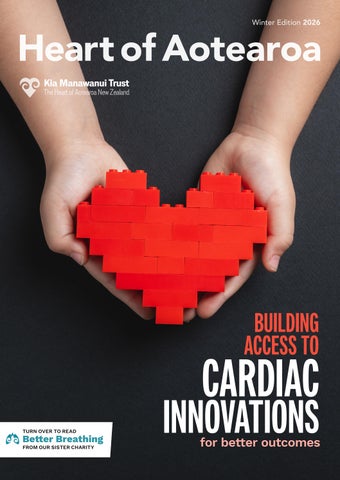
Winter Edition 2026
Heart of Aotearoa
BUILDING ACCESS TO
CARDIAC
TURN OVER TO READ
Better Breathing FROM OUR SISTER CHARITY
INNOVATIONS
for better outcomes
Contents
HE AR T OF AOTE AROA WINTER 2026
03 Letitia's message 04 Impella: the world’s smallest heart pump saving lives 08 What dirty air does to the heart 11 Immunisations and heart health 12 Let's talk about cholesterol
Our Team Chief Executive Letitia Harding Research and Education Manager – Cardiac Health Dr. Lina Goldstein Individual Giving Executive Michaela Tahere Grants & Fundraising Executive Hannah Aslett PR & Comms Marketing Manager Chloe Bradwell Digital Marketing Specialist Sam Treseder Digital Content & Marketing Advisor Jared McOnie Digital Content Co-ordinator Cat Mercer Community Educator Manager Sharon Pihema Corporate Sponsorship & Engagement Advisor Paul Aschenberger Office Administrator Lola Sachkova Medical Director Dr. Andrew Chatfield
You can also read this magazine online. Just head to issuu.com/betterbreathing
Chief Cultural Advisor – Māori Sir John Clarke, KNZM, CNZM
Please recycle this material after use. This material has been printed with vegetable oil-based/mineral-free inks. The paper used comes from sustainable forests.
Stay up to date on the latest cardiac news Scan the QR code below to sign up to our newsletter so you don't miss out.
Level 2, 85 The Terrace Wellington 6011 PO Box 1459, Wellington 6140 ph: 0800 100 506 kmtrust.org.nz kiamanawanuitrust
FOREWORD
LETITIA'S MESSAGE WELCOME TO THE third edition of Heart of Aotearoa magazine.
access these innovations – if they can access them at all.
strokes in at-risk people. Read more about this on page 11.
As we head into the colder months, there is no better time to focus on the things that protect and strengthen our heart health.
We discussed the urgent need for a fast-tracked pilot programme for breakthrough cardiac medical devices, ensuring that patients with serious cardiovascular conditions can benefit sooner from life-saving technologies.
One final note — lastly, I'd like to announce the appointment of our new Medical Director, Dr Andrew Chatfield, a structural and interventional cardiologist in Wellington. He takes over the position from Dr Sarah Fairley, who has been a strong voice for the Trust for the past two years, and a passionate champion for all heart patients.
One of the most exciting developments featured in this edition is the life-saving cardiac support device known as the Impella. Dr Sergej Cicovic explores one of the most serious challenges faced by cardiologists – cardiogenic shock, which occurs when the heart suddenly cannot pump enough blood around the body. It is a severe medical emergency that requires immediate intervention. The Impella device can help in these critical moments by acting as a tiny, temporary artificial heart, supporting circulation when the heart is too weak to function on its own. It is an extraordinary example of how innovation is transforming cardiac care and improving survival outcomes. You can read more on page 4. At the Trust, we also know that innovation alone is not enough. New Zealanders must be able to access modern, evidencebased treatments and devices in a timely way. Recently, I met with Minister of Health Simeon Brown to discuss growing concerns that New Zealand’s current approach (Pharmac) to funding and approving cardiac medical devices is not fit-for-purpose. Cardiology is one of the fastest-growing areas in medical technology globally, with rapid advancements in minimally invasive procedures and breakthrough devices that are saving lives. Yet too often, New Zealand patients wait years longer than people in comparable countries to
Here at the Trust, improving health literacy also remains a key priority. The more knowledgeable people are about their health, the more empowered they are to advocate for themselves and their whānau. One topic that can often feel confusing is cholesterol. Health practitioners frequently talk about “good” cholesterol, “bad” cholesterol, but what does it all mean? Read about it on page 12. Of course, our biology and lifestyle choices are only part of the picture. Increasingly, research shows that our external environment also has a major impact on cardiovascular health. Environmental stressors are now recognised as a major contributor to cardiovascular disease, with one in five cardiovascular diseaserelated deaths worldwide linked to environmental factors. Read more about this research on page 8.
Thank you for continuing to support the work we do. Later this year, we look forward to bringing together our mahi across the cardiac and respiratory sectors, strengthening our collective voice and continuing to advocate for better health outcomes for all New Zealanders. Noho ora mai,
Letitia Harding Kia Manawanui Trust — The Heart of Aotearoa NZ Chief Executive
BELOW: (From left) Dr Andrew Chatfield, Minister of Health Hon Simeon Brown, and Trust CEO Letitia Harding.
Which brings us to winter and the important role vaccines play in protecting vulnerable communities. For people living with cardiac and respiratory conditions, vaccination remains one of the most effective ways to stay safe and well during the colder months as it protects our heart and lungs from serious complications and worsening symptoms caused by infections such as influenza and COVID-19. The seasonal influenza vaccine, in particular, has also been shown to significantly reduce the risk of heart attacks and Heart of Aotearoa 3
CARDIAC DEVICE
INSIDE IMPELLA The tiny heart pump helping doctors pull patients back from the brink
When the heart suddenly becomes too weak to pump enough blood around the body, it can quickly become a life-or-death emergency. The Impella — the world’s smallest heart pump — acts like a temporary “backup motor” for the heart, keeping blood flowing while 4 Heart of Aotearoa
doctors work to save the patient and treat the underlying problem. In those critical moments, the tiny device can give the heart a chance to rest, recover and keep beating. The catch is: Impella is not funded in New Zealand, so the only option for patients who find themselves
in this situation is to be treated with medication, which is often less effective and more invasive. We spoke with interventional cardiologist Dr Sergej Cicovic about this life-saving device and the struggles to get it funded in New Zealand.
CARDIAC DEVICE What is the Impella and how does it work? One of the most serious challenges for cardiologists (heart doctors) is a condition called cardiogenic shock, which occurs when the heart cannot pump enough blood around the body. When this happens, it is sudden and an extreme medical emergency. If the heart doesn’t get enough blood and oxygen, the heart muscle can start to die. The faster doctors can restore blood flow, the better the chances of saving a patient’s life and supporting recovery. The Impella is a small mechanical heart pump that doctors temporarily implant in the heart to help it pump blood. In simple terms, it acts as a “backup motor” for the heart when it is too weak to do its job. This life-saving device is helping cardiologists around the world to save people in cardiogenic shock after events such as a severe heart attack, heart failure,
an abnormal heart rhythm, or a large blood clot in an artery in the lungs (pulmonary embolism). The Impella helps quickly restore blood pressure and flow, thereby protecting the body’s most vital organs. The Impella is a miniature pump placed in the heart, via a catheter, often inserted through the femoral artery in the leg and advanced into the heart. Once in place, the Impella draws blood from the left ventricle and delivers it directly into the aorta, supporting the heart's natural cardiac output. Dr Sergej Cicovic, an interventional cardiologist and specialist in cardiology and cardiac interventions, explains that the little heart pump is small but mighty – about the size of a Bic pen. He describes the Impella as “a micro-heart pump that mimics what the real heart does by squeezing blood out of the heart’s pumping chamber and into the aorta”. “The Impella is a ‘bridge’ to either recovery or to something like a stent or bypass”.
An effective and economical procedure For 26 years, the chance of surviving cardiogenic shock remained unchanged, with only a 50-50 chance of living. What sets the Impella apart is its ability to significantly improve survival chances in patients experiencing cardiogenic shock — where previous mortality rates were very high. The improvement is so significant that the survival rate has risen from approximately 50% to 79%. The catch is: Impella is expensive. ABOVE: Example of an Impella device being used inside the heart.
The device costs about $40,000 per use and is not re-usable.
“It stays in for about 10 days to 14 days max, and then you've got to take it out and throw it away," Dr Cicovic explains. Despite this, it is still considered cost-effective. Studies consistently show that Impella is more cost-effective than alternatives for many cardiac patients. It is associated with shorter hospital stays, fewer complications, including a lower risk of renal failure, and reduced hospital readmissions, leading to significant cost savings.
What sets the Impella apart is its ability to significantly improve survival chances in patients experiencing shock — where previous mortality rates were very high. The alternatives to Impella often incur higher overall costs due to the complexity of ICU care, he says. “So Impella is generally cost-neutral or slightly cheaper because patients spend fewer days in ICU." Impella can dramatically cut hospital costs and reduce hospital length of stay, for example, in ICU recovery from about 11 days to seven days. The Impella is also a quick and simple device to use. "It can be done in about nine to 13 minutes with a slick team,” Dr Cicovic says.
The current lesseffective alternatives Because Impella is not yet a mainstream, accessible procedure in New Zealand for patients who go into cardiogenic shock, the alternatives leave patients with options that can be less effective and more invasive. Heart of Aotearoa 5
CARDIAC DEVICE One current treatment for stabilising the heart after cardiogenic shock involves administering medications (inotropes and vasopressors). The downside is that for every drug given, the heart must work harder, and if the heart already has a blood clot, the drugs can cause even more damage to the heart. “We've had medications like adrenaline and noradrenaline for 60 years or so, but they come with risks," Dr Cicovic says “The more drugs you need, the more likely you are to die, so there's obviously a confounder.” The alternatives to the Impella are less effective at unloading the heart, and some alternatives, like medications, increase strain on the heart, with outcomes that can be poorer in severe cardiogenic shock, he says. Another current alternative to Impella, if you live in Auckland, is extracorporeal membrane oxygenation (ECMO), a form of life support used for decades that can temporarily take over the work of the heart and/or lungs. It works by circulating blood outside the body to deliver oxygen and remove carbon dioxide, supporting patients
with severe cardiogenic shock or respiratory failure.
Australia approved it over a decade ago.
Like the Impella, ECMO serves as a bridge to recovery or further treatment. However, while ECMO can temporarily support life in critically ill patients, evidence suggests that inhospital mortality is higher with ECMO than with Impella.
At Toronto General Hospital, where Dr Cicovic was a fellow, 40 Impella procedures were performed in a single year, and around five other hospitals in Toronto also performed the same procedure using the Impella.
Impella is also less invasive than some alternatives because it is inserted via a catheter into an artery (usually in the leg). The Impella device enables a minimally invasive procedure that goes into the heart without traditional open-heart surgery.
Making Impella accessible in New Zealand New Zealand is known for its slow process for approving new medical devices and drugs that patients urgently need. It took two years to get approval to use the Impella in New Zealand. The Impella device gained approval from Medsafe in December 2025. Meanwhile, other countries have benefitted from the Impella for over 25 years.
In New Zealand, he has been able to perform only one procedure. So far, only three procedures in New Zealand have used the Impella. Establishing strong Impella programmes could make this technology accessible in at least five major centres nationwide. Programmes that include cardiogenic shock protocol and specialists are still being finalised. They will include teams of specialists like interventional cardiologists, heart failure and transplant cardiologists. Teams and protocols will start being rolled out in Auckland in a matter of weeks. With Dr Cicovic’s behind-thescenes work to bring the Impella to the country, he now expects that, in the next three to five years, the Impella will be much more accessible to New Zealanders..
How to fix the “postcode lottery” for treatment Dr Cicovic is advocating for Impella access to ensure patients in Dunedin have the same access as those in Auckland, preventing a postcode lottery in which only certain regions benefit from improved survival rates in cardiogenic shock. “So that it's not a postcode lottery as to who gets the benefit of Impella, and who's going to survive cardiogenic shock,” Dr Cicovic says. LEFT: Specialist teams and
cardiogenic protocols are being rolled out in Auckland soon. 6 Heart of Aotearoa
CARDIAC DEVICE Currently, procedures like ECMO are only available in Auckland, making for an inequitable service if you experience cardiogenic shock in another part of the country. New Zealand has a lot of catching up to do, including educating cardiologists about the availability of the Impella device and its potential benefits for patients. “New Zealand is significantly behind in all sorts of programmes to do with the Impella, including intensive ICU, cath lab, and patient selection training for the Impella”, Dr Cicovic says. One big step was getting the Impella approved for use in New Zealand, but Dr Cicovic states that the next step is to get people familiar and comfortable in using it. “At the moment, there's a bit of fear or hesitation about using the Impella because people don't know it or when to use it, so I think it's really important just to get exposure.”
Who is Dr Sergej Cicovic? Dr Cicovic became the first formally-trained cardiac highrisk interventionalist in Canada and New Zealand. He has been instrumental in developing this new field in New Zealand, offering significant expertise in advanced treatments for coronary artery disease and in managing critically unwell patients.
Building a dedicated path to cardiac innovation Kia Manawanui Trust – The Heart of Aotearoa Chief Executive Letitia Harding recently met with Health Minister Simeon Brown to discuss how New Zealand can improve access to innovative cardiac medical devices. Cardiology is one of the fastest-evolving areas of healthcare, with new technologies transforming the treatment of heart disease and improving outcomes for patients. Yet New Zealand’s current assessment and funding processes can struggle to keep pace with innovation, meaning patients may wait longer than necessary to benefit from proven advances in care. As part of our advocacy work, we have proposed a pilot programme to test a faster approval pathway for high-
impact cardiac technologies. The goal is to create a clearer, more transparent process for evaluating breakthrough devices while maintaining robust safety and clinical standards. Technologies such as Transcatheter Edge-to-Edge Repair (TEER) oand Impella demonstrate the potential of modern cardiac innovation to improve and save lives. We believe New Zealand needs a more responsive system for evaluating medical devices so patients can access worldleading treatments sooner. The Kia Manawanui Trust will continue advocating for practical solutions that improve cardiovascular outcomes and ensure New Zealanders have timely access to the best available care.
Heart of Aotearoa 7
ENVIRONMENT
WHAT DIRTY AIR DOES TO THE HEART The air we breathe is affecting far more than our lungs.
as a major modifiable risk factor for heart disease.
Environmental factors are now linked to millions of cardiovascular deaths worldwide each year, with air pollution alone recognised
In this new series exploring the connection between the environment, lung health and heart health, we examine the
8 Heart of Aotearoa
growing evidence behind the environmental threats shaping human health, and why cleaner air, healthier homes and stronger public policy are becoming critical tools in preventing disease.
ENVIRONMENT CLEANER AIR IS not just a respiratory concern; it is fundamental to preventing heart disease and premature death. Fine particles in air pollution can harm the entire cardiovascular system, including the heart, vascular system, and blood. Environmental risks have become a silent cause of death worldwide. One in five cardiovascular deaths worldwide is linked to environmental factors highlighting the environment's role as a major determinant of health. The world’s leading cardiovascular societies, including the European Society of Cardiology (ESC), the American College of Cardiology (ACC), the American Heart Association and the World Heart Federation (WHF), have issued a joint statement calling for urgent action to address preventable causes of cardiovascular disease linked to environmental stressors, such as air pollution.
Air pollution: a major cardiovascular risk factor Air pollution is now recognised as a contributor to the global cardiovascular disease burden. Among environmental factors, it has emerged as a significant and modifiable risk to cardiovascular health, and is now understood to affect far more than just the lungs. Air pollution comes from many sources, but particulate matter is strongly associated with adverse cardiovascular effects. Particulate matter is a mixture of tiny solid particles and liquid droplets in the air, originating from sources such as vehicle exhaust, domestic heating (including wood burners), industrial and agricultural emissions, and dust. The smaller the particles, the more dangerous they are because they can be inhaled deep into the lungs and pass into the bloodstream. These fine airborne particles have been linked to
impaired vascular function, elevated blood pressure, cardiac rhythm disturbances, thrombosis, and coronary artery disease.
How polluted air damages the heart The relationship between air pollution and cardiovascular disease is now well supported by research. Exposure to pollutants triggers systemic responses that strain the cardiovascular system. Research shows that air pollution: Ǫ Promotes inflammation and oxidative stress Ǫ Increases blood pressure and contributes to hypertension
for strong governance, leadership and workforce training to help health systems adapt to climaterelated pressures while reducing their environmental impact.
The connection is clear The link between environmental quality and heart health is firmly established, with a clear consensus among the world’s leading cardiovascular societies that environmental pollution places stress on the heart. Improving air quality not only protects the lungs but also the heart itself. The evidence consistently shows that air pollution is a major, modifiable risk factor for cardiovascular disease.
Ǫ Accelerates atherosclerosis Ǫ Increases the risk of blood clots and thrombosis
Why environmental risks are often overlooked Clean air is critical for preventing cardiovascular disease, alongside established measures such as smoking cessation and lifestyle changes. However, awareness of environmental risk factors as causes of serious illness remains low, and there is no global consensus on how to communicate air pollution levels and associated risks to the public.
The facts: air pollution and heart health Ǫ 1 in 5 cardiovascular deaths worldwide is linked to environmental factors Ǫ 4–6 million cardiovascular deaths each year are attributed to environmental risks Ǫ Fine particulate pollution can pass from the lungs directly into the bloodstream Ǫ Air pollution is linked to:
Air pollution is largely beyond individual control, unlike most cardiovascular risk factors, which can be addressed through lifestyle or pharmacological changes. Reducing environmental risks requires policy-driven change. Political cooperation will be essential to establish and enforce regulations that promote cleaner air and prevent cardiovascular disease.
• High blood pressure • Blood clots and thrombosis • Coronary artery disease • Heart rhythm disturbances Ǫ Air pollution is now recognised as a major modifiable risk factor for cardiovascular disease
World Health Organization (WHO) frameworks emphasise the need Heart of Aotearoa 9
10 Heart of Aotearoa
PROTECTING YOUR HEALTH
IMMUNISATIONS AND HEART HEALTH MANY PEOPLE ARE unaware that viruses, such as the flu, can increase the risk of serious heart problems.
one-third. A Canadian study also found a sixfold increase in heart attack and stroke risk in the week after influenza infection.
Recent findings also show that vaccination can do more than prevent severe illness and hospitalisations; it may also help reduce the risk of heart attacks and strokes.
Influenza
New guidelines from the European Society of Cardiology (ESC) highlight vaccination as an effective way to protect against infections while also helping lower cardiovascular risk, particularly for vulnerable people.
Influenza has long been associated with increased cardiovascular risk. Flu vaccination can reduce the chances of catching the flu by up to 60%, while research also suggests vaccinated individuals may experience approximately a 30% reduction in major adverse cardiovascular events.
RSV
Increasing evidence shows that vaccines for illnesses such as influenza (the flu), COVID-19, respiratory syncytial virus (RSV), and herpes zoster (shingles) can greatly reduce infection rates and severe illness.
For adults aged 60 and over, studies show the RSV vaccine is about 79–80% effective at preventing hospitalisation from severe illness.
Research also suggests some vaccines may have broader benefits beyond the targeted illness.
Herpes zoster, or shingles, has been linked to cardiovascular complications including heart attack and stroke, particularly in the first month after reactivation. Research suggests the shingles vaccine is more than 90% effective in preventing the disease and may also reduce cardiovascular events by more than 50%.
For example, the influenza vaccine has been linked to lower rates of major cardiovascular events, with studies suggesting vaccination may reduce related risks by about
Shingles
COVID-19 COVID-19 vaccines continue to provide strong protection against severe illness and hospitalisation. Research has highlighted the importance of COVID-19 vaccination for people with cardiovascular conditions because of their increased risk of complications.
What serious infections do to your heart Serious infections place stress on the body and can increase inflammation, make the heart work harder, and worsen existing heart conditions. For some people, particularly those with heart disease or other risk factors, infections can trigger serious events such as heart attacks or heart failure. By helping prevent severe illness, vaccines may also help reduce the strain infections place on the heart. Please consult your medical professional for specific guidance regarding vaccination and its suitability for you.
Heart of Aotearoa 11
CHOLESTEROL
LET'S TALK ABOUT
CHOLESTEROL Cholesterol has long been the subject of misconceptions, with numerous myths surrounding its role in health. IT IS EASY to feel confused by conflicting advice and uncertainty about the different types of cholesterol and lipid-lowering treatments. Excessive levels of certain types of cholesterol in the blood can increase the risk to heart health. New international guidelines introduce cholesterollowering strategies and treatments that people in New Zealand could benefit from.
What is cholesterol? Cholesterol is essential for our bodies to function. It is a fatlike substance in our blood that supports cell structure and hormone synthesis. Our bodies need some cholesterol; however, it is important to recognise that not all cholesterol is the same. There are two types of cholesterol: 'Good' cholesterol (high-density lipoprotein, or HDL) helps remove fat from your blood. 'Bad' cholesterol (low-density lipoprotein, or LDL) transports cholesterol to tissues and cells, but it can also build up in your arteries over time, raising your risk of heart attack. Everyone should regularly check their cholesterol levels,
not just as they age. A blood test, known as a lipid test, can help monitor heart health and reduce the risk of cardiovascular disease (conditions that affect the heart and blood vessels).
So LDL levels are what I should keep an eye on? Yes. LDL cholesterol, often called ‘bad’ cholesterol, is the main type of cholesterol that builds up in your arteries, increasing your risk of heart attack and stroke. Early LDL testing is especially important for people with a family history of heart disease or other risk factors, as high LDL can cause damage long before any symptoms appear.
Are there medications that can help if I do have high LDL? Treatment for high cholesterol looks different for everyone. For some, lifestyle changes make a real difference to lower cholesterol. For others, genetics, existing heart disease, side effects from medication, or conditions like familial hypercholesterolaemia (FH) mean that a different approach may be needed. There are two types of treatments available to help lower LDL cholesterol — statins and PCSK9 inhibitors. PCSK9 inhibitors can decrease ‘bad’ (LDL) cholesterol by approximately 50–60%, making them particularly important for individuals at high risk of
12 Heart of Aotearoa
CHOLESTEROL heart disease or with very high cholesterol levels. They are also helpful for those who need additional cholesterollowering to reach healthier levels, or for people who cannot sufficiently lower their cholesterol with other treatments or cannot tolerate standard cholesterollowering medications.
How widely available are PCSK9 inhibitors? PCSK9 inhibitors have been approved by Medsafe for use in New Zealand, however, they are not publicly funded, meaning these treatments are not subsidised. Patients must pay out of pocket, which can cost thousands of dollars per year, making access difficult for many who could benefit. In place of PCSK9 inhibitors, high-dose cholesterol-lowering medications (such as highdose statins and additional therapies to support cholesterol reduction) are typically funded. PCSK9s are widely used (and funded) in countries such as Australia.
Why cholesterol levels matter High cholesterol usually has no symptoms, so you can feel healthy while still being at risk. Cholesterol and heart risk build up over time. Early detection of high cholesterol can prevent heart attacks and heart disease, so knowing your cholesterol levels is a small step that can make a big difference to your heart health over time. Important questions to consider include determining what your LDL (‘bad’) cholesterol level should be, assessing whether you have a low, medium, or high risk of heart disease, and understanding your five-year risk of developing heart disease. It is also essential to evaluate whether you need medication or lifestyle changes, how often you should check your cholesterol levels, what your long-term heart risk is, and whether your whānau should be tested as well. Knowing your cholesterol levels gives a clearer picture of your personal risk and helps tailor the best prevention or treatment plans.
Always consult your healthcare provider for personalised medical advice. This information is not intended to diagnose, treat, or provide healthcare guidance. Seek professional opinions for any health concerns.
There are a lot of misconceptions about cholesterol. Here’s what you should know: Ǫ You can feel healthy and have high ‘bad’ (LDL) cholesterol Ǫ High cholesterol can affect anyone of any age, including young adults and children Ǫ Men and women are just as likely to develop high cholesterol Ǫ Statins aren’t the only treatment for high cholesterol
Talk to your doctor if you're concerned about your cholesterol Download and print our conversation guide by scanning the QR code below or heading to kmtrust.org.nz/cholesterol
Heart of Aotearoa 13