Winter Edition 2026
Better Breathing
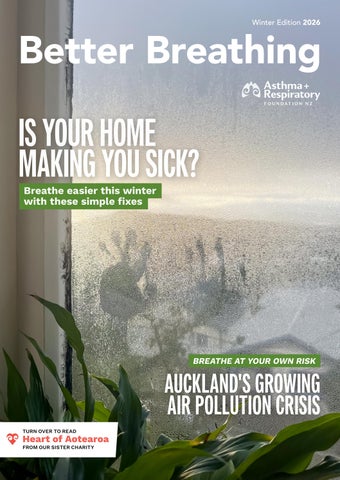
IS YOUR HOME MAKING YOU SICK? Breathe easier this winter with these simple fixes
BREATHE AT YOUR OWN RISK
AUCKLAND'S GROWING AIR POLLUTION CRISIS TURN OVER TO READ
Heart of Aotearoa FROM OUR SISTER CHARITY
Contents
Our Team
B E T T E R B R E AT H I N G W I N T E R 2 0 2 6
Chief Executive Letitia Harding
03 Letitia's message
Deputy Chief Executive, Education & Development Manager Joanna Turner
04 Keeping your home healthy 06 Questions raised over rental housing compliance 09 Dirty air, dangerous consequences 10 Blue Shirt Day wrap-up 13 Days of significance 14 Why am I so tired?
Individual Giving Executive Michaela Tahere Grants & Fundraising Executive Hannah Aslett PR & Comms Marketing Manager Chloe Bradwell Digital Marketing Specialist Sam Treseder Digital Content & Marketing Advisor Jared McOnie Māori Community Liaison Sharon Pihema Youth Vaping Educator Penelope Joyce Corporate Sponsorship & Engagement Advisor Paul Aschenberger
You can also read this magazine online. Just head to issuu.com/betterbreathing Please recycle this material after use. This material has been printed with vegetable oil-based/mineral-free inks. The paper used comes from sustainable forests.
Thank you to our Friends of the Foundation partners for supporting our ongoing initiatives.
Office Administrator Lola Sachkova Medical Director Prof. Bob Hancox, BSc, MB CHb, MRCP, MD, FRACP Chief Cultural Advisor – Māori Sir John Clarke, KNZM, CNZM
G O L D PA R T N E R S
S I LV E R PA R T N E R S
Level 2, 85 The Terrace Wellington 6011 PO Box 1459, Wellington 6140 ph: 0800 100 506 B R O N Z E PA R T N E R S
asthmafoundation.org.nz asthmaandrespiratoryfoundation
FOREWORD
LETITIA'S MESSAGE THE COLDER WINTER months are now here, and we know for our respiratory community this is an important time to keep ourselves, and our whānau, strong and healthy to combat those nasty flus and winter colds. For the 1 in 8 people living with asthma in New Zealand, winter can act as a trigger for asthma flareups, which is why we were so pleased to run such a successful Blue Shirt Day campaign to raise more awareness around asthma. Tuesday 5 May brought people together from all over the country wearing blue, and many wearing our very own limited-edition t-shirts. This year we raised more than $18,000, which is amazing! Thank you to everyone for helping us raise funds which go directly towards essential resources for patients and healthcare providers to help better manage asthma symptoms. Read all about Blue Shirt Day on page 11. Another respiratory condition the Foundation is doing a lot of work on is bronchiectasis. Since bringing the Bronchiectasis Foundation under our wing in March, we have been busy updating resources and establishing a support fund for those families who have a child living with this condition. This is why on July 1 — World Bronchiectasis Day — we want to raise more awareness and understanding of an often-hidden respiratory illness. You can read more about our work in the bronchiectasis space on page 13. Of course, one of the most significant changes we can do to combat respiratory illness in Aotearoa is to advocate for healthy homes. The Foundation is a strong supporter of the Healthy Homes Standards, which require all private rentals to have adequate heating, insulation, ventilation,
moisture control, and draughtstopping. These standards are aimed at creating warmer, drier, and healthier rental homes, reducing risks associated with respiratory diseases. If landlords are failing to meet these standards, then they must be penalised with hefty fines. Read more about our stance on page 6. Throughout this magazine, you will find many of our Friends of the Foundation partners who work in the healthy homes space. One of those is Classic Builders — our newest Gold partner. It was great to sit down and chat with their Wellington Regional Manager, Brad Turner, to discuss our current housing stock, and where we need to make changes to ensure investment in quality, yet affordable, homes across New Zealand. Remember, our partners support us because they align with our core values, so if you are a company — or know one — who shares the same values as us, please contact Paul Aschenberger at friends@arfnz.org.nz. I would now like to take this opportunity to celebrate and congratulate Janice Kuka, co-chair of the Board for the Asthma and Respiratory Foundation and the Kia Manawanui Trust – The Heart of Aotearoa, who has been made a Member of the New Zealand Order of Merit for her services to Māori health. Janice has advocated for Māori-led healthcare for nearly four decades. She has been a member of our Board for more than 20 years, and we are honoured to have Janice's leadership and wisdom guide our mahi.
Thoracic Society of Australia and New Zealand (TSANZ) Advocacy Medal in recognition of his outstanding contribution and leadership in respiratory health advocacy. A very welldeserved medal Stuart! Of course, this message wouldn’t be complete without acknowledging the generous support of our readers, our community funding groups, our donor family, and New Zealanders who all share our goal of improving respiratory health in Aotearoa. Thank you for all your support, and we look forward to some exciting changes in the cardiac and respiratory space later this year! Noho ora mai,
Letitia Harding Asthma and Respiratory Foundation NZ Chief Executive
In addition, I would also like to congratulate Dr Stuart Jones, Consultant Respiratory/Sleep Physician at Counties Manukau DHB and a member of the Foundation’s Scientific Advisory Board. Dr Jones received The Better Breathing 3
Keeping your home healthy For people living with asthma, COPD, bronchiectasis and other respiratory conditions, home should be a place where it is easier to breathe — not harder. BUT MANY New Zealand homes are cold, damp and poorly ventilated, which can worsen respiratory symptoms, increase the risk of infections and make recovery more difficult. Everyday issues such as condensation, mould, dust and stale air can all affect lung health, particularly during winter. The average Kiwi household creates around eight litres of moisture every day through cooking, showering, drying clothes and even breathing. 4 Better Breathing
Without proper heating and ventilation, that moisture can quickly lead to dampness and mould — two common triggers for respiratory illness. Creating a warm, dry and healthy home can make a real difference to respiratory health and overall wellbeing.
Safe, effective heating options include heat pumps, wood pellet burners and electric heaters. Unflued gas heaters should be avoided because they release moisture and pollutants directly into the air inside the home. Simple ways to keep homes warmer include:
Keep your home warm
Ǫ Closing curtains before sunset
Warm homes are healthier homes, especially for people with respiratory conditions. Health New Zealand recommends indoor temperatures of at least 18°C, and above 20°C for older people, babies and young children.
Ǫ Opening curtains during sunny winter days
Cold air can irritate sensitive airways and trigger asthma symptoms, coughing and breathlessness. Homes that are difficult to heat are also more likely to develop condensation and mould.
Ǫ Heating the rooms used most often
Ǫ Using draught stoppers around doors and windows Ǫ Insulating ceilings and floors
Reduce dampness and mould Dampness and mould are major triggers for respiratory illness.
HEALTHY HOMES Mould spores can irritate the lungs, worsen asthma and allergies, and contribute to respiratory infections. In New Zealand, one in five homes are considered damp, and more than half of all rental properties have visible mould. Many everyday household activities contribute to indoor moisture. For example, drying clothes indoors can release up to five litres of moisture into the air from a single load of washing, cooking can add another three litres a day, and every shower or bath contributes around 1.5 litres per person. To reduce moisture build-up: Ǫ Open windows regularly, even in winter Ǫ Use extractor fans in kitchens and bathrooms Ǫ Dry clothes outside whenever possible Ǫ Wipe condensation from windows Ǫ Use lids on pots while cooking Ǫ Leave space between furniture and walls to improve airflow Dehumidifiers can also help reduce moisture levels, particularly in bedrooms and homes prone to condensation.
Improve ventilation Good ventilation helps remove moisture, airborne irritants and viruses from indoor spaces. During winter, many people keep their homes closed up to stay warm, but trapping stale, damp air indoors can increase mould growth and allow pollutants to build up. Opening windows and doors regularly is one of the simplest ways to improve airflow. Crossventilation — opening windows
on opposite sides of the home — can be especially effective. Extractor fans should vent outside rather than into roof cavities, and filters in heat pumps and ventilation systems should be cleaned regularly to maintain good air quality. Ventilation also plays an important role in reducing the spread of respiratory viruses such as influenza, RSV and COVID-19, which can significantly worsen symptoms for people with underlying lung conditions.
Watch indoor air quality People with respiratory conditions are often more sensitive to indoor air pollution. Smoke, dust, chemicals, fragrances and airborne particles can all irritate the lungs and trigger symptoms. Health New Zealand estimates human-made air pollution contributes to more than 13,000 hospital admissions for respiratory and cardiac illnesses every year, along with more than 13,000 cases of childhood asthma. Improving indoor air quality can help reduce flare-ups and support better breathing. You can do this by: Ǫ Avoiding smoking or vaping indoors Ǫ Minimising scented sprays and strong cleaning chemicals Ǫ Vacuuming regularly (with a HEPA filter) to reduce dust and allergens Ǫ Wash bedding frequently in hot water
ABOVE: Draught-proofing
windows and doors is a great way to keep your home warmer.
Small changes can make a big difference Respiratory disease affects around one million New Zealanders and places a significant burden on families and the health system, costing the country an estimated $8.4 billion every year. While not every home issue can be fixed overnight, small changes can still have a meaningful impact. Keeping homes warmer, drier and better ventilated can help reduce respiratory triggers, improve sleep and support overall wellbeing.
Ǫ Consider using an air purifier Wood smoke and gas cooking can also contribute to indoor pollution, particularly in poorly ventilated homes.
For people living with respiratory conditions, a healthy home is more than just comfort – it is an important part of staying well and breathing easier every day. Better Breathing 5
HEALTHY HOMES
QUESTIONS RAISED OVER RENTAL HOUSING COMPLIANCE WITH WINTER JUST around the corner, many Kiwis go to sleep in rental homes that may still be putting their health at risk. Since July last year, all private residential landlords must ensure their properties fully comply with the Healthy Homes Standards — a legal requirement introduced in 2019 to make rental homes warmer, drier, and healthier. These standards introduced minimum standards for heating, insulation, ventilation, moisture ingress and drainage, and draught stopping in rental properties. Yet despite having six years to prepare, questions remain about how many rental homes are truly compliant. The Asthma and Respiratory Foundation NZ warns that without effective enforcement, these standards risk leaving tenants, especially those with respiratory conditions, exposed to cold, damp homes that threaten their health. Foundation Medical Director Professor Bob Hancox says one thing we have learnt from research into housing and health in New Zealand is that many homes are too cold and too damp. "Having a warm and dry house is very important for respiratory
health, particularly for people with respiratory diseases such as asthma or COPD.
where properties are signed off by landlords but clearly fall short of the standards.
"Improving the quality of housing is one of the best ways to help people stay well through the winter."
"Without qualified, independent inspections, there's no way to guarantee consistency or integrity in the process," he says.
Currently, landlords can selfcertify that their property meets the Healthy Homes Standards, and there is no requirement for an independent, physical inspection of the property.
"It's like letting drivers issue their own warrants of fitness."
"Implementing the healthy homes standard would go a long way to keep people out of hospital and GP clinics, but at the moment, we don’t know how well the standards are being applied," Professor Hancox says. The Foundation is renewing its call to the Government to require independent, accredited assessments of all rental homes to ensure that the Healthy Homes Standards are actually being met. New Zealand Institute of Building Inspectors Chief Executive Neville Scott says the fact that landlords can self-certify is a loophole that undermines the intent of the law. "We fully support the Foundation in their call to Government, as we see — all too often — cases
According to Tenancy Services NZ, more than 600,000 households rent in New Zealand, and research shows that rental stock is of poorer quality than owner-occupied homes. A recent report by Stats NZ on housing in New Zealand revealed that almost 30 per cent of households that did not own their home experienced dampness at least some of the time. Those same households were more likely to experience visible mould over A4 size at least some of the time (22.9 per cent). Dr Lucy Telfar-Barnard, public health researcher and member of the Foundation’s Scientific Advisory Board, says the current state of many rental properties is both unacceptable and avoidable. "We’re still seeing families living in mouldy, poorly ventilated homes that actively worsen chronic conditions like asthma. "Effective enforcement of the healthy homes standards is essential for protecting our most vulnerable populations and reducing health inequities." The Foundation's call is part of its ongoing commitment to improve the health outcomes of those living with respiratory conditions in NZ.
6 Better Breathing
TM
Better Breathing 7
ASTHMA & ALLERGY SAFE WOOL CARPETS Wools of New Zealand is a proud gold sponsor of the Asthma and Respiratory Foundation New Zealand. Wool carpets have an innate ability to create a warmer, drier interior with cleaner more breathable air. Along with other measures, wool carpets can play a part in creating healthier homes. View our 100% New Zealand wool carpets and order free samples to your home.
www.woolsnz.com
8 Better Breathing
ENVIRONMENT
DIRTY AIR, DANGEROUS CONSEQUENCES WHEN PEOPLE THINK about environmental harm, they often picture rising seas, extreme weather or plastic waste. But some environmental threats are far less visible — and are affecting people’s health every day.
“Air pollution is a direct and daily threat to people’s hearts and lungs.
As conversations sparked by World Environment Day (June 5) continue, new research is drawing attention to the growing human cost of air pollution in Auckland, where more than 700 people are dying each year from traffic-related emissions — a toll now rivalling smoking.
To address this, there needs to be long-term, Governmentled change, Ms Harding says.
A new University of Auckland report reveals that more than 90 per cent of Aucklanders are breathing air that falls short of international health standards, with vehicle emissions responsible for the vast majority of harm. Nationwide, air pollution killed 3300 Kiwis and was responsible for more than 13,100 hospital admissions for respiratory and cardiac illnesses, and 13,200 cases of childhood asthma, in 2016. Letitia Harding, Chief Executive of the Asthma and Respiratory Foundation NZ and Kia Manawanui Trust – The Heart of Aotearoa, says the findings highlight a preventable public health crisis.
“We are seeing the consequences in asthma, heart disease, and other respiratory illnesses affecting our communities every day.”
“Cleaner air means fewer hospital visits, fewer missed school days, and longer, healthier lives. “That’s what’s at stake if we fail to act, and why reducing pollution must be treated as a priority.”
More than 700 people die from traffic-related emissions every year in Auckland — a toll now rivalling smoking. The report shows transport is responsible for around 80 per cent of harmful air pollution in Auckland, with pollutants like nitrogen dioxide and fine particulate matter penetrating deep into lungs and even entering the bloodstream, increasing the risk of stroke, heart disease, lung cancer, and asthma.
Dr Ian Longley, Director of The Air Quality Collective, says the scale of harm demands a coordinated national and local response. “The science is clear and increasingly difficult to ignore. “Air pollution is contributing to thousands of deaths across New Zealand each year, and much of it is coming from sources we can control — particularly vehicles,” Dr Longley says. “Auckland’s air quality in some areas is comparable to major international cities, yet our policy response has not kept pace with the evidence. “It’s that gap that is costing lives.” Proven solutions already exist and are being used successfully overseas, he says. “Other cities around the world have already shown that measures such as low-emission zones, stronger vehicle standards, and investment in public transport can rapidly improve air quality. “These are practical steps that deliver real health benefits.” The World Health Organization estimates that globally indoor and outdoor air pollution exposure currently kills about seven million people yearly due to cardiovascular diseases, such as strokes and ischaemic heart disease, and respiratory diseases such as acute respiratory infections, chronic obstructive pulmonary disease, and lung cancer. According to the World Bank, the global health cost of mortality and morbidity attributed to air pollution was $8.1 trillion in 2019.
Better Breathing 9
WORLD ASTHMA DAY
That's a wrap on Blue Shirt Day '26 WE'RE THRILLED TO announce that — with the help and support of many New Zealanders across the motu — we raised a whopping $18,279 for our second ever Blue Shirt Day. It was incredibly heart-warming to see so many people get involved this year to show up for the 1 in 8 Kiwi affected by asthma and help raise awareness. We are so humbled by the generosity, and we loved seeing the photos of workplaces, schools, and whānau dressed up in blue on the big day. Every donation helps support the Foundation in providing essential resources to patients and educators, emergency asthma kits for schools and whānau, assist
with research towards improved treatment and care, and more. A massive mihi to our amazing Friends of the Foundation partner HRV, who supported Blue Shirt Day once again by matching donations up to $5000. And that's not all — they also gave away a free HRV system to one very lucky household! We couldn’t be more grateful of their support in helping us improve the lives and wellbeing of every Kiwi affected by asthma. We want to give another big thank you to Wellington Airport who also supported our campaign once again. It was awesome to see the Blue Shirt Day kaupapa up on the big screens.
Thank you to our other supporters including Premium Apparel and Muzzy Shirts, who helped bring our Blue Shirt Day tees to life, and MTA, Moana Road, Edsports, and Mills Albert Wellington Saints, who kindly gifted some exciting prizes. And, of course, a big thank you to our amazing models, who generously gave their time (and faces) to this year's campaign. It was such a privilege to have members of our community affected by asthma volunteer and be the face of the campaign once again. From all of us here at the Asthma and Respiratory Foundation NZ: ngā mihi, Aotearoa — we simply couldn't have done it without you!
$18,279 total raised
Madison and Patrick Ejay and Faith
219
Blue Shirt Day tees sold
Greg Brooke, Cherry, and Lucy
A big thank you to HRV, who matched donations up to $5000 and gave away a free HRV system to one lucky household!
No mould. No mildew. A Showerdome® shower top stops steam and moisture leaving your shower, so you can enjoy mist-free mirrors, a dry bathroom and a warm, clear enclosure.
showerdome.co.nz Showerdome® Ltd 2026. All rights reserved.
12 Better Breathing
DAYS OF SIGNIFICANCE
SHINING A LIGHT ON BRONCHIECTASIS BRONCHIECTASIS IS A longterm lung disease that makes it harder to clear mucus from the airways, leading to ongoing coughs, infections, shortness of breath and tiredness. Each year, around 73 children are diagnosed, 1,450 people are hospitalised, and about 140 people die from the disease — nearly three people every week. While the most common cause of the disease is having an infection, such as pneumonia or whooping cough, in many cases the cause of the disease is unknown. To support people living with bronchiectasis, the Foundation provides a range of practical resources for adults, including
an Action Plan, Living Well with Bronchiectasis guide, patient handbook and fact sheet. To mark World Bronchiectasis Day on July 1, the Foundation is developing resources for children with bronchiectasis and their whānau. This work builds on the Foundation absorbing the Bronchiectasis Foundation earlier this year.
Help support whānau impacted by bronchiectasis To learn more about the Esther-Jordan Muriwai Āhuru Fund, scan the QR code below.
In April, the Foundation also established the Esther-Jordan Muriwai Āhuru Fund, in honour of a young Northland woman who died from bronchiectasis at the age of 24. The fund will help families cover costs to support their children living with bronchiectasis.
HEALTH SUPPORT IN EVERY LANGUAGE AS AOTEAROA MARKS a series of language weeks, we want to highlight the importance of access to clear, understandable health information for everyone. At the Foundation, we’re committed to making sure people can understand and manage their respiratory condition in the language that is most meaningful to them. That’s why many of our patient resources are available in te reo Māori, Samoan, Tongan, Simplified Chinese, and English. Our translated resources are free and easy to access, supporting patients, whānau and health professionals across Aotearoa.
Check out our full range of free, multilingual resources for patients, carers, and whānau on our website at asthmafoundation.org.nz/resources or scan the QR code.
Better Breathing 13
WELLBEING
WHY AM I SO TIRED? FATIGUE IS A common problem for people with long term respiratory conditions. The reason for this can vary from person to person. For some, it will be related to the severity of their lung condition and symptoms like breathlessness or cough. For others it may be due to nutrition, fitness or infections. It could be a combination of all these things. Whatever the reason, it is a frustrating and debilitating symptom and can impact on your quality of life. Physiotherapists and occupational therapists work with people to help manage fatigue. Management strategies are often simple ideas that aim to conserve energy (especially with routine daily tasks) so that you have energy left for the more enjoyable things in your life. Planning and pacing are two key principles of energy conservation. Planning means thinking about what you need to do in a day or over the week and working out
14 Better Breathing
your priorities. Pacing is spreading activities out across the day and allowing adequate time to complete activities including time to rest. Sometimes tasks can be broken down into more manageable chunks. For example, instead of vacuuming the whole house at once, do one room a day. Another way of conserving energy is adapting tasks. Equipment can be helpful. Sitting on a shower stool in the shower, leaning on a shopping trolley at the supermarket or hanging washing on a drying rack rather than the clothesline are all ways to reduce energy demand. Talk to an occupational therapist to find out what adaptive equipment might be beneficial for your needs. Maintaining good nutrition is important for your energy levels but can be a challenge. Sometimes the process of preparing and eating a meal feels too much. Ready meals are an easy option or cooking a larger amount and
freezing portions to eat at a later date. Alternatively, doing some meal prep earlier in the day can make cooking your evening meal less tiring. If you are concerned about being low weight, talk to your GP about high calorie supplements that are easier to consume or ask for a referral to a dietician. Living with fatigue can be hard work but sometimes making a small change in how you do things can make a big difference to how you feel. What change can you make today?
About the author Zöe Manderson is a respiratory physiotherapist in Taranaki for Te Whatu Ora and a member of the Asthma and Respiratory Foundation NZ's Scientific Advisory Board.
10
%F OF
on DVS Ventilati bathroom Systems and ducts extraction pro of $500* e lu a v e th r e ov *T&Cs apply
Breathe easy with DVS Did you know a damp home creates an ideal breeding ground for bacteria, dust mites and mould which can make asthma and allergies worse, increase the frequency of coughs, colds and chest infections and weaken the immune system? D S Home Ventilation V Ventilati on System is vital for managing air quality and A DV DVS airborne pollutants. For a drier, healthier home choose DVS – fresh air in, stale air out. *T&Cs apply. Please mention this print ad to receive our special offer. This offer cannot be combined with any other offer, Group Buying Rate or promotion, is non-transferable and cannot be exchanged for cash. 10% discount off the retail price of DVS Ventilation System and bathroom extraction products at the time of purchase. A minimum spend of $500 applies. Offer runs from 1/06/2026 until 31/08/2026.
FREE CONSULTATION DVS.CO.NZ | 0800 387 387 BRANZ Appraised
Better Breathing 15