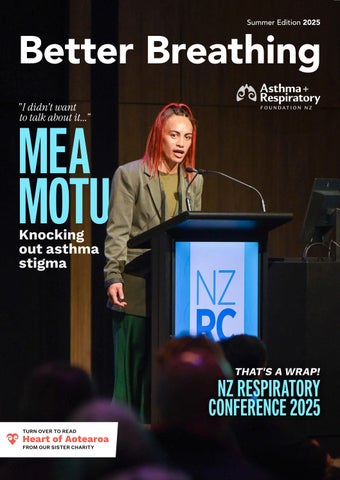
Summer Edition 2025
Better Breathing "I didn't want to talk about it..."
MEA MOTU Knocking out asthma stigma
THAT'S A WRAP!
NZ RESPIRATORY CONFERENCE 2025 TURN OVER TO READ
Heart of Aotearoa FROM OUR SISTER CHARITY
Contents
B E T T E R B R E AT H I N G S U M M E R 2 0 2 5
03 Letitia's message 04 NZRC 2025 highlights
Our Team Chief Executive Letitia Harding Deputy Chief Executive, Education & Development Manager Joanna Turner
06 Mea Motu's battle with asthma
Individual Giving Fundraising Executive Michaela Tahere
07 Kath Cross' achievement
PR & Comms Marketing Manager Chloe Bradwell
08 Half marathon for asthma awareness 09 Updated NZ COPD Guidelines 11 Tips for better breathing
Digital Marketing Specialist Sam Treseder Digital Content & Marketing Advisor Jared McOnie Māori Community Liaison, Youth Vaping Educator Sharon Pihema Community Liaison, Youth Vaping Educator Penelope Joyce Corporate Sponsorship & Engagement Advisor Paul Aschenberger Medical Director Prof. Bob Hancox, BSc, MB CHb, MRCP, MD, FRACP
You can also read this magazine online. Just head to issuu.com/betterbreathing
Chief Cultural Advisor – Māori Sir John Clarke, KNZM, CNZM
Please recycle this material after use. This material has been printed with vegetable oil-based/mineral-free inks. The paper used comes from sustainable forests.
Thank you to our Friends of the Foundation partners for supporting our ongoing initiatives. G O L D PA R T N E R S
S I LV E R PA R T N E R S
Level 2, 85 The Terrace Wellington 6011 PO Box 1459, Wellington 6140 ph: 0800 100 506
B R O N Z E PA R T N E R S
asthmafoundation.org.nz
asthmaandrespiratoryfoundation
FOREWORD
LETITIA'S MESSAGE AS WE ROLL into the end of the year, it’s a great time to reflect on what a busy year it has been! This summer edition of the magazine highlights some of the key activities we have been up to, and includes the inaugural launch of our first flip magazine – a collaboration with our sister charity, Kia Manawanui Trust – The Heart of Aotearoa. Together, this magazine covers the respiratory and cardiac areas in which we have been involved in the last quarter of 2025. At the end of October, we held the biennial New Zealand Respiratory Conference (NZRC) at Tākina – a new venue for us – which didn’t disappoint. With almost 300 in attendance, we heard from a range of amazing speakers, including our opening keynote speaker, Mea Motu. Mea is a New Zealand world boxing champion who has battled with asthma her entire life. Mea’s address was extremely passionate, and gave us all an insight into what it is like to reach an international level of a physically demanding sport, like boxing, while living with asthma. You can read more about Mea’s journey on page 6. As a not-for-profit organisation, we are lucky to have some wonderful external supporters who raise awareness of varying respiratory conditions. Kath Cross is one of those people. Kath’s struggle and journey as a lung transplant recipient is not only inspiring, but it also educates people on a lung condition many might not know about. Rheumatoid arthritis-associated obliterative bronchiolitis (RAOB) is a rare lung disease that mimics 'popcorn lung' and can often be misdiagnosed as chronic obstructive pulmonary disorder (COPD). Kath, at age 52, just completed the 30km Lake Taupō Cycle Challenge, just nine months
after receiving a double-lung transplant. Read more about Kath’s incredible journey on page 7. Of course, as well as our external individual supporters, we have our Friends of the Foundation partners. Our partners support us because they align with our core values to improve respiratory outcomes for all. You can find one of those companies on page 10, and if you are an organisation that wishes to support us, then please contact Paul Aschenberger at friends@arfnz.org.nz. We are pleased to update you on our youth vaping education Train the Trainers (TTT) programme, which has now trained 81 educators across the country, and the feedback has been fantastic! The educational tools provided in this course help these trainers to inform and empower rangatahi and young people within their own community. It is a fabulous oneday course designed for anyone engaging with young people and their whānau about vaping harms. It is suitable for a wide variety of community settings to ensure widespread awareness, so if you are interested in attending a workshop, please email Sharon Pihema at sharon@arfnz.org.nz to find out more. As the leader in respiratory knowledge, the Foundation produces both the New Zealand Chronic Obstructive Pulmonary Disorder (COPD) Guidelines and the NZ Adolescent & Adult Asthma Guidelines, and it was this year, at our conference, that we released the new 2025 COPD Guidelines. Lead author and the Foundation’s Medical Director, Professor Bob Hancox, presented on the changes that have been made since the previous guidelines were released in 2021. You can read more and download a copy on page 9.
Of course, this message wouldn’t be complete without acknowledging the generous support of our readers, our community funding groups, our donor family, our Friends of the Foundation partners and New Zealanders who share our goal of improving respiratory health in Aotearoa. Thank you for all your support, and we look forward to another great year in 2026! Noho ora mai,
Letitia Harding Asthma and Respiratory Foundation NZ Chief Executive
Better Breathing 3
CONFERENCE
KATI, TATARI, WHAKAHA. HIGHLIGHTS FROM THE NEW ZEALAND RESPIRATORY CONFERENCE 2025
Foundation Chief Cultural Advisor – Māori Sir John Clarke and Matua Peter Jackson.
4 Better Breathing
Late October saw New Zealand’s largest gathering of respiratory health professionals for the biennial New Zealand Respiratory Conference, hosted by the Asthma and Respiratory Foundation NZ. WITH THE THEME ‘Stop, Pause, Breathe’ (‘Kati, Tatari, Whakahā’), the event invited delegates to slow down, reflect, and consider the path forward in a health system under immense pressure. Over two days, 20 leading clinicians and researchers shared insights spanning clinical care, public health, and cutting-edge research. Te Whare Tapa Whā plenary, chaired by Sir John Clarke KNZM, CNZM, set the tone by highlighting the Foundation’s commitment to Māori health and community partnerships. Sessions throughout the conference underscored the
persistent burden of respiratory illness, which accounts for one in 11 hospital stays, carries a minimum cost of $8.44 billion, and disproportionately affects children, older adults, Pacific Peoples, and Māori communities. Yet the conference was more than statistics and data. It was a space for connection, reflection, and collaboration. As attendees left the conference, the message lingered: stop to listen, pause to consider solutions, and breathe – knowing that through unity, expertise, and shared commitment, meaningful change in respiratory health is possible. Better Breathing 5
MEA MOTU'S STORY
FIGHTING FOR EVERY BREATH: BOXING CHAMP'S ASTHMA BATTLE WORLD CHAMPION BOXER Mea Motu almost risked her whole life in the ring, unknowingly fighting with severe asthma that went untreated for years.
“I kept getting puffed out, but I was stubborn and ignored it.
The 35-year-old shared her story at the 2025 New Zealand Respiratory Conference in October, telling delegates that the moment she first realised something was wrong came while she was redefending her world title in the UK two years ago.
She was embarrassed, so she kept it quiet, she says.
“I was really scared. I didn’t know what to do, but I refused to pull out of the fight,” she says.
Even when she was prescribed inhalers, she wasn’t using them properly, she says.
“It felt like ice burning on my chest but I survived round 9 and 10. In my head, I thought, ‘I just have to keep going’.” Mea had been boxing for five years by then, but the signs had been there all along.
“The week before every fight, I’d find myself in hospital.”
“I’m a top athlete. I didn’t want to talk about it. “I kept thinking, ‘What’s wrong with me? Why am I struggling?’”
“I was really scared. I didn't know what to do.” “I struggled mentally. I felt stupid.” It was her fight in the UK that forced her to take charge of her health. “Up until that point, I was so stubborn, I was trying to be tough. “But, in reality, I was living in fear. I was killing myself and I’d almost risked my whole life.” The mother-of-five wishes she had taken her symptoms more seriously earlier. “I didn’t realise you can die from it,” she says. “It’s not ‘just asthma’ – it’s really serious.” LEFT: Mea Motu sharing her story with delegates at this year's New Zealand Respiratory Conference.
6 Better Breathing
COMMUNITY SPOTLIGHT
KATH CROSS' INSPIRATIONAL RIDE A year ago, Kath Cross was rationing every breath, wondering whether she would live long enough to see another birthday. IN LATE NOVEMBER, with a stranger’s lungs inside her chest, Kath crossed the finish line of a 30km mountain bike ride as part of the Lake Taupō Cycle Challenge – something she once considered impossible. The 52-year-old says returning to a start line felt overwhelming in the best possible way. “It’s been a long time since I have lined up for a race,” she says. “I didn’t have a race strategy – it was all about enjoying the ride and finishing.” The lead-up to the race didn’t go as planned. A chest infection in the week prior dropped her lung function to 64%. “It was probably a bit harder than I thought on the lungs, but overall pretty good – lots of downhills so time to recover.” Still, the simple act of riding – something she once struggled to do – felt like a victory in itself. The finish line delivered its own mix of disbelief and humour. “When I crossed the finish line, I thought ‘yay, I did it!’,” she says. “But I did wonder why they didn’t call my name out – it was because they were busy calling out the
oldest lady riding the length of the lake, which was actually my mum, so that was a bit of a laugh.” There were some emotional moments along the way too. Kath thought a lot about her friend, Jan, who passed away after getting her lung transplant. For someone once told her time was running out, Kath says that reaching the finish line was far more than a physical achievement. “This was about showing what’s possible,” she says. “I’ve been given a new life, and I’m using it.” Her efforts didn’t just carry her across the line – they helped raise $3400 for the Asthma and Respiratory Foundation NZ. Better Breathing 7
COMMUNITY SPOTLIGHT
HALF MARATHON RUNNER CALLS FOR BETTER UNDERSTANDING OF ASTHMA WHEN SAMANTHA MAGEE laced up her running shoes, she turned a personal challenge into a moment of awareness in support of the one million Kiwis living with asthma. In early November, she completed the Auckland Half Marathon with her partner, using the event to draw attention to a condition she has managed since childhood. Samantha has lived with asthma her entire life, yet sport has always been important to her. “I’ve always enjoyed sport, even with asthma,” she says. “People often assume you can’t or shouldn’t run, but that idea never matched my experience.” While she knows that exercise is one of many possible triggers for asthma, the life-long condition presents differently for everyone. “Asthma has shaped my life, sure, but it hasn’t stopped me from doing the things I love,” Samantha says. Misconceptions about asthma are common, she says.
8 Better Breathing
“I’ve often found myself correcting assumptions about fitness, exertion, and the day-to-day realities of managing asthma.” With one in eight New Zealand children affected, she believes better understanding is overdue. “There’s still a lot people don’t realise – about symptoms, triggers, and how unpredictable it can be.” That unpredictability became all too real in 2024 when Samantha’s friends lost their young son, Ethan, after a sudden asthma attack while at an emergency department. “It was heartbreaking,” she says. “It made me think more seriously about how quickly asthma can turn.” The half marathon became a way to recognise that reality while contributing to the Asthma and
“Asthma has shaped my life, sure, but it hasn’t stopped me from doing the things I love.”
Respiratory Foundation’s work in research and education. “Raising awareness is vital, and asthma remains far too common and far too dangerous in New Zealand.” On the day of the half marathon, Samantha found the experience both steadying and reflective. “Crossing the bridge felt especially meaningful,” she says. “I thought about Ethan a lot.” Samantha’s initial fundraising target was $500. By the time she finished, she had raised nearly $2000.
HEALTH PROFESSIONALS
NEW ZEALAND COPD GUIDELINES: 2025 UPDATE THE ASTHMA AND Respiratory Foundation NZ released the New Zealand COPD Guidelines: 2025 Update in October. The guidelines summarise the latest national and international evidence in a concise, New Zealand-specific resource. The persistent and unacceptable health disparities for Māori and Pacific people is emphasised, highlighting ways to promote equity.
The updated guidelines also highlight the critical role of spirometry in diagnosis and assessment, emphasise the potential of nonpharmacological management of COPD, and simplify inhaler recommendations for prescribers.
The full guidelines are available on the Foundation's website. A summary is published in the New Zealand Medical Journal (2025 Nov 7; 138(1625)). All other COPD resources have been updated to reflect the changes made to the guidelines.
For GPs, the update offers clearer decision pathways, simplified inhaler recommendations, and a renewed focus on patient partnership.
Check out our free COPD resources online! Scan the QR code below or head to asthmafoundation.org.nz/resources
NEW ZEALAND COPD GUIDELINES: 2025 UPDATE
NEW ZEALAND COPD GUIDELINES 2025 UPDATE
QUICK REFERENCE GUIDE
To view the full New Zealand COPD Guidelines: 2025 update, visit the Asthma + Respiratory Foundation NZ website at
asthmafoundation.org.nz
NEW ZEALAND COPD GUIDELINES: 2025 UPDATE | QUICK REFERENCE GUIDE
Make your home a healthier place with HRV Ventilation At HRV, our purpose is simple. We’re here to make all Kiwi homes healthier together. As New Zealand’s most trusted ventilation brand for four years in a row, we help create drier, warmer, healthier homes through advanced ventilation systems featuring high-performance filtration that reduces asthma and allergy triggers. Join thousands of Kiwi’s who breathe easier with HRV. To get started, call HRV on 0800 478 123 or learn more at hrv.co.nz.
hrv.co.nz | 0800 478 123 10 Better Breathing
Making all Kiwi homes healthier together.
WELLBEING
5 tips for better breathing this summer Summer is here and it’s time to take a breather. While you are enjoying some relax and recharge time, try these ideas to promote better breathing.
1. Breathe through your nose
3. Tummy breathing
Start small, even if it’s only a few minutes each day. Once you have established a regular exercise habit it is much easier to continue.
When you breathe through your nose, it warms and adds moisture to the air you are breathing in. It also filters and cleans the air. All this means better quality air hitting your airways which can reduce airway irritation. When you are sitting or at rest, try and nose breathe if you can.
The diaphragm is a big dome shaped muscle that sits under your ribs. It is the largest (and usually most efficient) muscle for breathing. When the diaphragm contracts down to draw air into your lungs, it squashes onto your tummy, causing your tummy to rise. That is why diaphragm breathing is sometimes called tummy breathing. We have other breathing muscles around our upper chest for when we need more air flow, but at rest, the diaphragm is usually doing most of the work. Rest a hand on your chest and a hand on your tummy to see if you are tummy breathing.
5. Let go
2. Focus on the out breath Often when people are breathless, they feel like they are fighting to get enough air in, when in fact the more useful strategy is to focus on the out breath. Think of a glass of water. If you keep pouring water in, eventually the glass is full, and you need to tip the water out to make room for more. Our breathing is similar. If we keep focusing on breathing in, in, in, our lungs get full, and it becomes more difficult to breathe. ‘Empty the glass’ by focusing on a long out breath and your next breath in will come more easily.
4. Exercise Sometimes people avoid exercise because it makes them breathless. This creates an unhelpful cycle: avoiding exercise leads to reduced fitness, reduced fitness makes exercise harder and results in more breathlessness… and so it goes on! Reverse the cycle by doing some regular exercise.
It can be common for people to hold tension around their shoulders. Whenever you do anything with your hands, your shoulder muscles are turned on to provide stability. Stress can also contribute to your shoulder muscles being tense. This can all have an impact on your breathing pattern. Take time now to let go. Allow your shoulders to drop. Doesn’t that feel better?! Here's to better breathing in 2026!
About the author Zöe Manderson is a respiratory physiotherapist in Taranaki for Te Whatu Ora and a member of the Asthma and Respiratory Foundation NZ's Scientific Advisory Board. Better Breathing 11