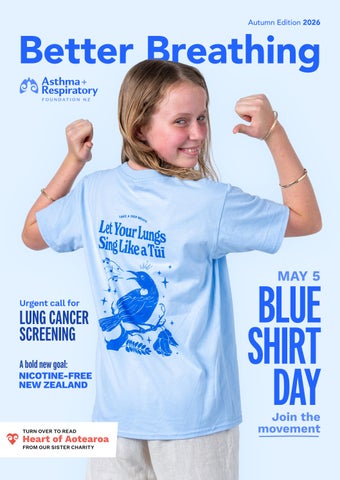
Autumn Edition 2026
Better Breathing
MAY 5
Urgent call for
LUNG CANCER SCREENING A bold new goal:
NICOTINE-FREE NEW ZEALAND
TURN OVER TO READ
Heart of Aotearoa FROM OUR SISTER CHARITY
BLUE SHIRT DAY Join the movement
Contents
Our Team
B E T T E R B R E AT H I N G A U T U M N 2 0 2 6
Chief Executive Letitia Harding
04 Blue Shirt Day 2026
Deputy Chief Executive, Education & Development Manager Joanna Turner
07 Calls for lung cancer screening 08 Bronchiectasis fund launched
Individual Giving Fundraising Executive Michaela Tahere
10 Winter season protection
Grants & Fundraising Executive Hannah Aslett
11 Managing your respiratory condition this autumn 12 Vaping education goes global 13 A nicotine-free country 14 Quit vaping product approved You can also read this magazine online. Just head to issuu.com/betterbreathing Please recycle this material after use. This material has been printed with vegetable oil-based/mineral-free inks. The paper used comes from sustainable forests.
Thank you to our Friends of the Foundation partners for supporting our ongoing initiatives.
PR & Comms Marketing Manager Chloe Bradwell Digital Marketing Specialist Sam Treseder Digital Content & Marketing Advisor Jared McOnie Māori Community Liaison, Youth Vaping Educator Sharon Pihema Community Liaison, Youth Vaping Educator Penelope Joyce Corporate Sponsorship & Engagement Advisor Paul Aschenberger Office Administrator Lola Sachkova Medical Director Prof. Bob Hancox, BSc, MB CHb, MRCP, MD, FRACP
G O L D PA R T N E R S
Chief Cultural Advisor – Māori Sir John Clarke, KNZM, CNZM
S I LV E R PA R T N E R S
B R O N Z E PA R T N E R S
Level 2, 85 The Terrace Wellington 6011 PO Box 1459, Wellington 6140 Thank you to Pub Charity Ltd. for their continued support of the Foundation, allowing us to provide Better Breathing magazine free of charge to the respiratory and healthcare communities.
ph: 0800 100 506 asthmafoundation.org.nz
asthmaandrespiratoryfoundation
FOREWORD
LETITIA'S MESSAGE WELCOME BACK! I hope everyone had a safe and happy summer. However, we know that for some of our lovely whānau, the weather hit hard once again, and our thoughts go out to all those affected. Since the end of 2025, it’s been a busy and productive time for us. Of course, the most significant development has been the amalgamation of the Lung Foundation NZ into our organisation. It is a huge privilege to be trusted with the substantial work the Foundation has already done in the area of lung cancer, especially around a National Lung Cancer Screening Programme (NLCSP). Lung cancer kills more Kiwis than any other cancer and is the fourth most commonly diagnosed cancer in both men and women. This year, it will claim the lives of 1800 Kiwis. We know that Health New Zealand has developed a case for the programme, but it seems little has been done to progress it. We will be fighting for this to be a priority of the next Government and for it to be included in the 2027 Budget, and have it underway in 2028. We are also pleased to announce that the Bronchiectasis Foundation will also amalgamate with us. In October 2025, at the NZ Respiratory Conference, we released the updated adult bronchiectasis patient handbook and action plan to assist patients in managing their condition. Now, with the amalgamation, we can broaden our resources and support for bronchiectasis to include children. We acknowledge the dedicated hard work and passion that is behind the Bronchiectasis Foundation, and we embrace this opportunity. On Tuesday 5 May, we’re calling on you to support the 1 in 8 New
Zealanders affected by asthma by wearing blue. This is a fantastic time to rally your friends and whānau and join the Blue Shirt Day movement. See how you can get involved on page 4. It's nearly that time of year again — World Smokefree Month. When it comes to education around vaping and smoking, we have not taken our foot off the accelerator. Some of the work we have done includes being part of the Smokefree 2025 Health Sector Advisory Group to the Ministry of Health, and standing up alongside our national stopsmoking providers who risked losing their government contract for refusing to supply vapes to help people quit. When we heard that Tākiri Mai Te Ata Trust was advised by Te Whatu Ora that they intended to terminate its Stop Smoking Service contract because they refused to supply vaping devices, we had to speak out. I am pleased to say that we recently heard that this decision has now been revoked! We hope other stop-smoking providers managed to achieve the same outcome. I am also pleased to report that our Train-the-Trainer vaping education programme was invited across the ditch to run a workshop with the Prevention Education & Research Unit at Westmead Hospital, Sydney, where they shared valuable insights and learnings about vaping among young people in the New Zealand context. In exchange, we also learnt ways we can better support our already nicotine-dependent rangatahi to quit. You can read more about this on page 12. Throughout this magazine, you will see a sprinkling of our Friends of the Foundation partners. Our partners support us because they align with our core values to improve respiratory outcomes
for all. We therefore want to acknowledge our most recent partner, Apex Medical, for coming on board. If you are a company — or know one — who share the same values as us, please contact Paul Aschenberger at friends@arfnz.org.nz. Of course, this message wouldn’t be complete without acknowledging the generous support of our readers, our community funding groups, our donor family, our Friends of the Foundation partners and New Zealanders who share our goal of improving respiratory health in Aotearoa. Thank you for all your support, and we look forward to some exciting changes in 2026! Noho ora mai,
Letitia Harding Asthma and Respiratory Foundation NZ Chief Executive
Better Breathing 3
WORLD ASTHMA DAY
Blue Shirt Day
WORLD ASTHMA DAY
This Tuesday 5 May, we're coming together to support the 1 in 8 New Zealanders affected by asthma. That's right — the Asthma and Respiratory Foundation's Blue Shirt Day campaign is back for a second year as part of the annual World Asthma Day. We're calling on the friends and whānau of those living with asthma to get involved by supporting the Blue Shirt Day kaupapa — host a fundraiser, make a donation, or simply spread the word. Every little bit counts! Last year, our first ever Blue Shirt Day campaign was a huge success, with almost $12,000 raised and 69 official Blue Shirt Day t-shirts sold. Thanks to the generous support of everyone who got involved, we've been able to continue our work creating vital resources, educating health professionals and patients, and
advocating for those living with asthma and other respiratory conditions. This year, we're calling on New Zealanders across the motu to join the movement once again. Some of you have ordered one of our now-sold out limited edition Blue Shirt Day 2026 tees, which kick-started our efforts to reach our $20,000 goal. Now it's time to rally your friends, family, co-workers, and community groups to dress in blue on the big day and get involved. However big or small, your contribution drives the education, care, and research that truly make a difference.
It's easy to get involved! Host a blue-themed fundraiser Start a fundraiser as an individual, or team up with your workplace, school, or community group to reach even more people, and help raise vital funds for the Foundation.
Make a donation Help change outcomes for New Zealanders living with asthma. Your donation helps us provide trusted education and resources that reduce hospitalisations and save lives.
Wear blue and spread the word Show up to mahi in your blue shirt on the big day, and share with your co-workers about how asthma affects you or your whānau.
Learn more at blueshirtday.org.nz or simply scan the QR code below!
Make your home healthier this winter with HRV Ventilation Every Kiwi family deserves to live in a home that feels warm, dry and healthy. But as winter sets in and homes are closed up, condensation, dampness and stale air can quickly take over. These conditions are not just uncomfortable, they can impact your health, especially for those with asthma or allergies. That is why ventilation matters. A well ventilated home helps remove excess moisture and bring in fresh, filtered air. It reduces condensation, limits mould, and creates a healthier space to live in. It is about balance. Keeping the warmth in, while letting damp, stale air out. As we head into winter, small changes can make a big difference to how your home feels every day. To learn more, book a free home assessment with our team today.
hrv.co.nz | 0800 478 123 6 Better Breathing
Making all Kiwi homes healthier together.
LUNG CANCER
CALLS FOR LUNG CANCER SCREENING FOR NZ'S DEADLIEST CANCER AUSTRALIA SCREENS FOR lung cancer. England screens for lung cancer. New Zealand does not, yet it is the country’s deadliest cancer. Lung cancer kills more Kiwis than any other cancer and is the fourth most commonly diagnosed cancer in both men and women. This year, it will claim the lives of 1800 Kiwis. With such stark outcomes, strengthening the national approach to lung cancer has never been more urgent. In early March, the Asthma and Respiratory Foundation NZ announced it was formally absorbing the Lung Foundation NZ, strengthening its national respiratory voice.
particularly among people who started young, smoked heavily, or smoked over many years, she says. “We know who is most at risk. We have the technology to detect it earlier. Now we need the commitment.” Health New Zealand’s proposed programme would target people aged 50–74 based on individual risk, focusing on those with significant smoking histories. Modelling suggests that over 20 years, the programme could detect around 9000 lung cancers and save more than 6000 lives — around 300 lives each year.
Asthma and Respiratory Foundation NZ Chief Executive Ms Letitia Harding says this news also signifies the passing of the baton to champion for a national lung cancer screening programme.
Despite advances in treatment, lung cancer survival remains significantly lower than most other major cancers, in part because many cases are diagnosed at stage III or IV, often after presentation to an emergency department, Ms Harding says.
Health New Zealand have been developing a proposed case for a national lung screening programme, but it seems little has been done to progress it, she says.
“We know that earlier detection is associated with less intensive treatment, lower costs, and better outcomes, so it should be a priority for the current — and
incoming — Government.” Lung Foundation NZ Board Chair Dalton Kelly says transferring the Lung Foundation’s work into the Asthma and Respiratory
“We know who is most at risk. We have the technology to detect it earlier. Now we need the commitment.” Foundation ensures advocacy continues with greater scale. “The Lung Foundation was established to stand up for people facing one of the toughest diagnoses imaginable. “Placing that work within a 60-year national respiratory organisation gives it long-term strength at a time when screening and early detection are critical.” The Foundation is calling on the government to implement the proposed programme within two years, and for this to be included in the 2027 Budget.
“The business case has been done, yet they seem to have stalled on implementation. “We screen for breast, cervical, and bowel cancer, yet the cancer that kills the most New Zealanders still has no screening programme.” There needs to be an urgent implementation of this targeted screening programme for people at high-risk, Ms Harding says. About 85 per cent of lung cancer is attributable to tobacco smoking, Better Breathing 7
BRONCHIECTASIS
FUND LAUNCHED TO HELP WHĀNAU AFFECTED BY BRONCHIECTASIS A NEW FUND named in honour of a young Northland woman who died from a devastating lung disease at 24 will help support families affected by bronchiectasis. The Asthma and Respiratory Foundation NZ has established the Esther-Jordan Muriwai Ahuru Fund after formally absorbing the Bronchiectasis Foundation last month. The fund will help families cover costs to support their children living with bronchiectasis. Asthma and Respiratory Foundation NZ Chief Executive Ms Letitia Harding says the new fund reflects the organisation’s commitment to supporting families affected by bronchiectasis. “The cost of attending medical appointments and managing treatment can place a huge burden on families, especially when children need repeated
hospital care, so we hope this fund will help ease some of that pressure.”
years in and out of hospital fighting the condition before passing away in June 2014 at the age of 24.
Bronchiectasis remains one of the most serious respiratory conditions affecting children in New Zealand, Ms Harding says.
Despite the severity of her illness, Esther-Jordan became a determined advocate for others living with bronchiectasis. A kura kaupapa graduate with a degree in Māori Studies, she was also a former Miss Aotearoa and Miss New Zealand beauty pageant contestant, and wrote a book for the children's ward to help tamariki feel more at ease and supported in preparing for surgery and settling into the ward.
“The Bronchiectasis Foundation played an important role in raising awareness of the disease and supporting the thousands of families who are affected by it. “We are honoured to carry that work forward and build on the legacy Esther-Jordan and her whānau created.” About 140 people die from this disease each year — that’s nearly 3 people each week. About 73 children are diagnosed annually, and 1450 people are hospitalised each year. The Bronchiectasis Foundation was established in honour of Whangārei woman Esther-Jordan Muriwai, who spent more than 14
A year after her passing, her parents founded the Bronchiectasis Foundation. Her father, Camron Muriwai, says handing over the Foundation’s kaupapa to the Asthma and Respiratory Foundation ensures that work can continue to grow. “Esther-Jordan was always thinking about the next kid who might be going through what she was – she wanted people to understand this disease and how many families it affects. “The Foundation was our way of carrying on the work she started, so knowing that her name, her legacy, will now help families like ours means a lot to our whānau,” Mr Muriwai says. “It’s exactly the kind of support Esther would have wanted other kids to have.” Mr Muriwai wanted to acknowledge Sir John Clarke for the blessing of the name of the fund, which translates to 'comforting.'
8 Better Breathing
Oscillating Positive Expiratory Pressure Device
The Aerobika is a drug free device used to help treat COPD Bronchiectasis and Cystic Fibrosis. The small portable device relies on Oscillating Positive Expiratory Pressure (OPEP) to assist in the clearance of excess mucus secretions from your lungs.
Scan QR code to learn more today. 1 Burudpakdee C, et al. Pulmonary Therapy. 2017;3(1):163- 171. 2 Kim SR, et al. Front Med (Lausanne). 2023 May 12;10:1159227. 3 Poirier C, et al. CRC 2025
Better Breathing 9
VACCINATIONS
EXPERTS URGE PROTECTION AHEAD OF WINTER SEASON WITH AUTUMN BEGINNING and a recent wave of COVID-19, respiratory viruses are already circulating in the community.
cooler months is one of the simplest and most effective ways people can protect themselves, Ms Harding says.
For people with conditions such as asthma, chronic obstructive pulmonary disease (COPD), bronchiectasis, or cardiovascular disease, these infections can lead to much more serious illness.
“Being prepared before the winter respiratory season begins can make a real difference in preventing severe illness and keeping people out of hospital.”
Ms Letitia Harding, Chief Executive of the Asthma and Respiratory Foundation NZ and Kia Manawanui Trust – The Heart of Aotearoa, says the recent COVID-19 wave is a reminder that respiratory viruses continue to pose a significant risk for people already living with lung and heart disease. “Every winter brings increased circulation of respiratory viruses, and for people living with chronic conditions, the consequences can be much more serious. “An infection that might be mild for someone else can quickly become dangerous for someone whose lungs or heart are already under strain.” Ensuring vaccinations are upto-date as we settle into the
Late last year, the Foundation called for the reinstatement of the FluTracking programme ahead of the coming winter to help strengthen monitoring of respiratory illness in the community. FluTracking has been an essential community surveillance tool since 2018, helping track influenza, COVID-19, RSV, and other respiratory illnesses nationwide. Foundation Medical Director and respiratory physician Professor Bob Hancox says surveillance of respiratory infections is important for giving us advance warning of outbreaks and preparing health services. “The FluTracking programme gave us real-time information about influenza-like illnesses
in the community and will be badly missed this winter.” In addition to tracking, vaccinations play an important role in reducing the impact of respiratory illness each year, Professor Hancox says. “People with chronic respiratory diseases are more vulnerable to complications from infections such as influenza, COVID-19 and RSV. “Vaccination reduces the risk of severe disease, hospitalisation, and exacerbations of underlying lung conditions.” Trust Medical Director and cardiologist Dr Sarah Fairley says respiratory infections can also place significant strain on the heart, particularly for people already living with cardiovascular disease. “When someone with an existing heart condition gets a respiratory infection, the body is under much greater stress. “Fever, inflammation and reduced oxygen levels mean the heart has to work harder, which can increase the risk of complications such as heart failure or other cardiac events,” she says. “Vaccination is one of the most effective ways people with heart conditions can reduce their risk of serious illness during the winter respiratory season.” People living with respiratory or cardiac conditions are encouraged to speak with their healthcare provider about recommended vaccinations ahead of winter.
10 Better Breathing
WELLBEING
MANAGING YOUR RESPIRATORY CONDITION THIS AUTUMN THE START OF March saw the first significant dusting of snow on Mount Taranaki, and with it, a few days of noticeably colder weather. A reminder that autumn is here and cooler days are on their way. For people with respiratory conditions, this is a good time to plan ahead for how your self-management might change at this time of year.
If you use inhalers, make sure you are taking them as prescribed. Think about your house, too. A healthy home is a warm, dry home. Check out the Asthma and Respiratory Foundation's website for tips. There may be some things you can do to improve your home before winter arrives.
Managing cooler temperatures
Walking outside might not be quite so appealing in the approaching months, but this doesn’t mean you should stop exercising. Plan ahead for what you could do as an alternative. This might mean finding an indoor exercise option. Check out what is on offer in your community — indoor heated swimming pools, gyms or exercise groups may be available. If you prefer to stay at home (or want a cheaper option), YouTube is a good place to look for exercise videos. Start easy by searching for
Cooler temperatures can trigger respiratory symptoms like cough, shortness of breath, and wheeze in some people. If this is a problem for you, it is helpful to have strategies to manage it. Breathing through your nose warms and humidifies the air you breathe in making it less aggravating to your airways. Alternatively, wearing a scarf over your nose and mouth can help.
Keep exercising
a “seated exercise programme." If you are unsure, talk to your GP or physiotherapist about appropriate exercise for you.
Get your flu jab Anyone who works in healthcare will tell you how bad the flu season was last year, with people of all ages admitted to hospital. Talk to your GP about getting your flu jab this autumn for an extra layer of protection for you and your whānau.
About the author Zöe Manderson is a respiratory physiotherapist in Taranaki for Te Whatu Ora and a member of the Asthma and Respiratory Foundation NZ's Scientific Advisory Board.
Better Breathing 11
VAPING EDUCATION
TRAIN-THE-TRAINERS VAPING EDUCATION GOES GLOBAL Written by Māori Community Liason, Sharon Pihema RECENTLY, Pene and I travelled to Sydney to deliver our Train-the-Trainers seminar internationally for the first time. Being invited from Aotearoa New Zealand to share this work was a huge honour and a proud moment for our team. It reflects years of commitment, innovation, and hard work in developing youth vaping education without government funding — made possible by community funders who believed in this kaupapa. The seminar brought together professionals tackling youth vaping in many ways: from NSW Ministry of Health, Western Sydney Local Health District, the Royal Australian College of
12 Better Breathing
General Practitioners, and The Children’s Hospital at Westmead, to educators, clinicians, health promoters, school staff, and community workers supporting migrant and refugee families. The range of experience sparked rich discussion and fresh perspectives. We focused on creating meaningful change through passion, empathy, and connection. The programme grew from communities seeking practical ways to respond to youth vaping, and we highlighted the importance of collaboration when addressing complex public health challenges.
whānau lies at the heart of the Train-the-Trainers approach. By equipping educators, clinicians, and community workers with knowledge and practical tools, they can better support the young people and families they work with every day. Participants were also eager to explore Aotearoa New Zealand’s approach to youth vaping and how it compares with Australia. These conversations sparked reflection on policy, prevention strategies, and community engagement.
Whakawhanaungatanga — building relationships and trust — was central to the seminar.
The response was overwhelmingly positive. Many participants said they felt inspired and appreciated the focus on empathy, connection, and practical action.
Strengthening the workforce so they feel confident and supported in conversations with young people and their
We returned home refreshed and energised, carrying new ideas and insights to help strengthen and grow this work.
WORLD SMOKEFREE MONTH
A NICOTINE-FREE COUNTRY Written by Asthma and Respiratory Foundation NZ Chief Executive Letitia Harding EVERY MAY, World Smokefree Month reminds us how far we’ve come — and how far we still have to go. For New Zealand, 2026 was meant to mark a milestone: a smokefree Aotearoa. Yet while smoking rates have fallen, progress has stalled. Health inequities persist, and nicotine addiction — through cigarettes and vaping — remains widespread. This is not a moment for celebration. It’s a moment to confront reality and set a new, ambitious direction. The Asthma and Respiratory Foundation has long championed strong policies to protect Kiwis from tobacco: phasing out sales and limiting retailers. These
measures could have delivered a real generational shift. But too often, the conversation has shifted to vaping. Vaping does not break addiction — it simply shifts it. We call it “harm transfer" to distinguish it from “harm reduction," which is a term often used by pro-vaping public health lobbyists and policy makers. Too many young people are starting down a path that could lead to long-term dependence, and too many adults remain reliant on nicotine in another form. This is why we are calling for a bold new goal: a Nicotine-Free New Zealand. Not “smokefree”, not “reduced harm”, but "nicotine-free". Achieving it means ending addiction in all forms, tightening regulation on all nicotine products, supporting people to quit safely, and making public health the absolute priority. Critics may argue this is unrealistic or overly restrictive. But is it any more unrealistic
than the original Smokefree 2025 vision once seemed? A nicotine-free vision is ambitious — but ambition is what’s needed. It would signal to young people that nicotine is not harmless, it would protect communities most affected by tobacco or vaping-related disease and would reclaim New Zealand’s place as a global leader in public health. We cannot settle for halfmeasures or short-term fixes. Vapes and nicotine replacement therapy products may help some people, but they will never achieve a nicotine-free Aotearoa on their own. Real progress requires clarity, commitment, and courage. New Zealand once led the world in tobacco control. Now it is time to lead again, with a goal that truly matters: a generation free from nicotine dependence.
Better Breathing 13
VAPING NEWS
FIRST MEDICALLY-APPROVED QUIT VAPING PRODUCT WELCOMED MEDICALLY-APPROVED support for Kiwis hooked on vaping offers hope for those ready to quit and is an important step in the fight against New Zealand’s vaping epidemic, the Asthma and Respiratory Foundation says. Medsafe has approved New Zealand’s first vaping-specific Nicotine Replacement Therapy (NRT) product. The approval includes a therapeutic indication to treat nicotine vaping dependence. Foundation Chief Executive Ms Letitia Harding says while this product has been on the market for years for smokers, this new indication recognises that NRT is not just for smokers who want to quit, but also for those struggling to quit vaping.
survey found that 20% of Year 12 students and 26% of Year 13 students reported vaping in the past seven days — a significant increase from previous years in this age group. The Foundation has been conducting vaping education workshops in schools for years, aiming to curb vaping trends.
“Nicotine dependence from vaping is a real and growing problem, so having clinically validated support to quit is important."
“Medsafe’s approval of this product is a welcome development.”
Last year, the Foundation strengthened prevention through a new community Train-theTrainers programme — which equips educators, youth workers and whānau advocates with the tools to teach rangatahi about the harms of vaping.
Figures from the Foundation’s nationwide 2024 youth vaping
The Foundation met with Associate Health Minister Casey
“Nicotine dependence from vaping is a real and growing problem, so having clinically validated support to quit is important.
14 Better Breathing
Costello to request financial support for running these workshops and programmes, but was turned down, Ms Harding says. “We are proud of our ongoing community education initiatives, but they are reliant on the generosity of our grant providers and donations. “Luckily, these communities do care what is going on in their own backyards, and are prepared to back this mahi,” she says. “While a cessation product is helpful for those already dependent, it doesn’t stop young people from starting in the first place.” The Foundation continues to advocate for stricter laws around vaping. It wants to see the Government halt the establishment of further Specialist Vape Retailers (SVRs), ban the sale of vapes in general retailer stores, invest in educational programmes like Train-the-Trainers, and reexamine the prescription model.
by Carrier
Air with care
The NEW all in one with a 10 year Warranty
The quietest ever softer than a whisper at 18db Built in air purification for the healthiest indoor air Ai activated for 30% less power consumption Monitor and adapt your energy use with the Carrier app Modern Compact design in dove grey or white Wifi and bluetooth compatible 5 Eco settings for absolute energy efficiency Confidence comes standard with a 10 year Warranty Affordable and sustainable for now and for ever
Better Breathing 15