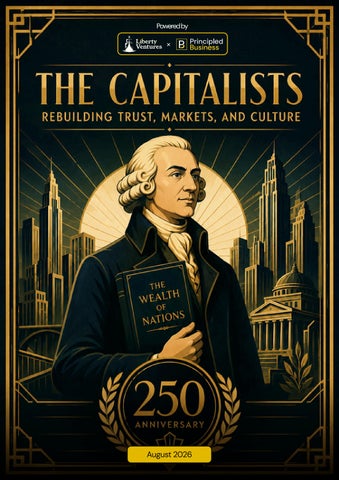
Powered by
August 2026
TABLE OF CONTENT 09
The Power of One: Benjamin Richter's Beginner's Mind Approach to Business
11
Executive Advice: James Keyes Lessonsrson Were Saying the Same Thing
13
Founder Advice: Your Business Story Is a Test of Your Strategy
15
Beyond the Stage: What Really Happens at the Principled Business Necker Summit
16
Building Companies That Last: Lessons from the Principled Business Executive Summit
18
Reclaiming the Narrative of Capitalism
20
Building Connections That Create Opportunity: Lessons from Principled Business Connect
23
Breakthrough Builders at FreedomFest: Three Founders Rebuilding Education From the Ground Up
26
Necker Island and the Brushfires of Freedom
28
When the Earth Shakes, Institutions Are Tested: Venezuela’s Crisis
30
Network Updates
32
Building the Next Generation of Entrepreneurs: The Principled Business Pitch Competition at FreedomFest
34
An Institution Supporting Liberty in a Healthy Way
Capitalism is often discussed as an idea. At Principled Business, we are more interested in how it is practiced. The decisions made by founders, investors, executives, and business leaders every day have a real impact on the strength of our markets, our institutions, and our communities. How we build companies, allocate capital, treat
employees,
serve
customers,
and
create
opportunities for others all contribute to the kind of economic system we leave behind. This issue is a look at that work in practice. It brings together lessons from leaders across our network, conversations from our recent events, insights from our members, and stories of people building businesses with a long-term view. Their industries and approaches may differ, but they share a commitment to creating value, taking responsibility, and building something that lasts. The 250th anniversary gave us an opportunity to reflect on where capitalism has been and where it can go next. More importantly, it reminded us that the future is not something we simply inherit. It is something we build through the decisions we make today. That is what Principled Business is ultimately about: bringing together the people who are building that future and creating a community where ideas become action. We hope this issue gives you something worth thinking about, something worth challenging, and perhaps something worth building.
The Principled Business Team
APPLICATIONS ARE
NOW OPEN!
Join the Principled Business Startup Accelerator and Pitch your startup to investors at Demo Day during the Principled Business Summit in Austin
Applications Close
September 15, 2026
Demo Day
October 28-30, 2026
principledbusiness.org/programs/startup-accelerator Selected founders must have a ticket to attend the Principled Business Summit in Austin
APPLICATIONS ARE
NOW OPEN! A platform and real resources for business leaders building the movement of capitalists for capitalism.
Applications Close
August 31, 2026 www.principledbusiness.org/programs/ambassadors
Invest in a Future Where Business Acts as a Force for Good At Principled Business, we champion a vision of free enterprise rooted in human dignity, long-term value, and ethical leadership.
Your contribution fuels: Leadership forums that elevate value-aligned entrepreneurship Mentorship and capital for rising founders Advocacy for liberty-based, principled business practices A global network of changemakers driving impact with purpose
Donate Today!
Monthly
Yearly
Membership Levels The business network for investors, executives, and founders to create value, make money, and advance the principles capitalism together. Top Pick
General Membership Perfect for individuals or small teams Weekly Opportunity Updates Find out on a weekly basis what events, opportunities, and people are doing in the Liberty Ventures Network that you can tap into
Leadership Circle Ideal for growing businesses ready to scale Member Success Representative Intentional Connections Leadership-Circle Only Events
Member Events
Visibility
Get invited to online and inperson events just for Liberty Ventures Members
Business Resources
Any Amount
$ 5000/year
Corporate Sponsorship Tailored for teams needing customization Collaborative Campaings We work with sponsors who are interested in supporting the Liberty Ventures Network to develop campaigns and initiatives that help our members, help the sponsor, and help the network make a greater impact
Brand Recognition Listing of corporate brand across Liberty Ventures media, events, and newsletters
Inquire
Visit our website to explore the full list of features, detailed FAQs and plan comparisons. Let’s take the next step and grow your business!
www.libertyventuresnetwork.com/membership
The Power of One: Benjamin Richter's Beginner's Mind Approach to Business Written by Jake Hoffman This article was drafted with partial assistance from AI tools.
The hiring process at Bradford Airport Logistics tells
Richter’s eyes lit up, and his grin widened as he spoke
you everything you should know about how its Founder
of Bradford’s Leadership Bootcamp and its impact on
and Chairman, Benjamin Richter, approaches business.
retention and advancement. The firm prides itself on
Bradford recently saw 17,000 applications narrowed to
developing leaders who rise from entry-level positions
158 hires. That less-than-one percent acceptance rate
through the ranks, along the way recruiting others with
is more selective than Harvard’s or McKinsey’s. For a
like minds and untapped potential. He beamed with joy
company operating airport logistics across the globe,
as he told me about an individual who joined the
you might expect the opposite approach. Scale fast,
Bradford frontline more than a decade ago, rose to a
hire faster, optimize for growth. But Richter is not a
management position, and recruited another individual
conventional business leader, and over the course of
who did the same. Richter called this employee a
our lunch together, I realized he is optimizing for
“grandfather”— someone passing along a cherished
something else entirely: people.
tradition
of
people
development
and
culture
preservation that has sustained Bradford Airport "Don't underestimate the power of one," Richter said
Logistics and made it a far-and-away leader in its
when I asked him what advice he'd give young leaders.
industry.
"One person can make a difference. Just show up." This is no platitude. In the same breath, he told me how
I must admit, as a sometimes-over-analytical MBA
great tolerance for and appreciation of each human
student, prone to seeing business value in financial
being in the organization are key to outstanding
statements, I was not without skepticism toward
leadership. I scribbled notes, seeking to understand
Richter’s attitudes. But I felt deep sincerity in every
what drives this man. What struck me most was that,
thought he voiced, and, besides that, his business
as
success is undeniable.
I
probed
him
about
business
strategy,
he
continuously traced each idea back to people.
Capitalists for Capitalism Magazine
09
I leaned into belief, wanting to know what undergirds his incredible optimism about his workers, which some leaders may see as cogs in a machine. I asked him point-blank, “Where does this inspiration come from?” His unlikely answer: a Buddhist concept, Shoshin, meaning "Beginner's mind.” A blank slate. The mind unencumbered by rigid reference points and calcified ways of thinking. "Children naturally have this," he explained. "They're fascinated by everything." That fascination became his compass early. After earning his industrial engineering degree, Richter spent his early career as an ERP consultant and project manager
for
light
manufacturing
companies.
He
watched implementation after implementation fail. Most consultants would have grown cynical. Richter grew curious. The ERP work taught him to see systems holistically, to distinguish between acute issues and systemic ones, to conduct anomaly analysis, and to understand how processes and people intersect. This combination—systems
thinking
and
a
relentless
curiosity—became his unfair advantage when building outstanding people organizations and high-performing businesses.
When
he
founded
Bradford
Airport
Logistics, he designed around a conviction that most leaders claim, but few actually practice: that untapped human potential is everywhere if you're curious enough to find it.
terminal logistics by being gentle. They did it by combining
radical
belief
in
people
with
radical
accountability. "We give people a safe place to fail," Richter explained. But safe to fail doesn't mean safe to coast. It means psychological safety to take risks, to surface
problems,
because
the
performance.
to
admit
organization When
you're
mistakes, is
serious
constantly
precisely about analyzing
anomalies, you need people who will tell the truth. When you're promoting from within, you need people who will stretch. When you're pioneering a new
Richter recommends being fascinated by everything. For him, that includes each person who walks through the door. Where conventional leaders see a resume, Richter sees possibility, and he has built and stewarded an organization that has embedded this belief in its culture. Hiring is optimized to find people who fit the culture, and everyone is encouraged to be curious when approaching business and organizational challenges. That entry-level hire who's struggling? That process that just broke down? Beginner's mind asks: Is this a person problem or a systems problem? Is it acute or systemic? Either way, what can I learn?
stereotype
of
people-first
leaders:
his
organization charges hard at performance goals and meets them.
Capitalists for Capitalism Magazine
industry category, you need people who will try things that might not work. That "grandfather" story Richter mentioned—about the frontline worker who became a manager and recruited another who did the same—isn't just heartwarming. It's proof that when you give people genuine development and belief in their potential, they don't just meet performance goals. They exceed them. Then they find others with untapped potential and do it again. As I walked away from our lunch, I realized that the beginner's mind isn't just about openness to ideas. It's about openness to people—to what they might
Here’s how Richter’s approach diverges from the softhearted
Bradford didn't become the global leader in airport
become, to what one person can contribute, given the right conditions. Richter is still asking those questions. And Bradford Airport Logistics is still finding answers that others miss.
10
Executive Advice: James Keyes Lessons Written by: Alexka Medina Companies rarely fail overnight. The visible decline often comes after years of decisions, missed signals, weak leadership structures, or a culture where honest feedback disappears. For business leaders, understanding
why
companies
struggle
is
as
important as understanding why they succeed. This is why we are highlighting the leadership lessons of Jim Keyes, former CEO of 7-Eleven, following his conversation on the School of Hard Knocks Podcast, “This is What ‘Always’ Happens Before a Company Crash.”
His
perspective
experience for
provides
entrepreneurs,
a
valuable
executives,
and
investors because he has led through both growth and crisis. Keyes spent more than two decades at 7-Eleven, moving through nearly every major leadership position within the company. He led operations, served as Chief Financial Officer and Chief Operating Officer, and eventually became CEO. When he took the role, 7-Eleven was a $12 to $13 billion company. Today, the company operates at a global scale of approximately $60 to $70 billion with around 90,000 stores worldwide. His career demonstrates an important principle of leadership: companies are defined by how leaders respond when circumstances change. Before Keyes became CEO, 7-Eleven faced one of its most difficult periods. After a leveraged buyout placed significant debt on the company, 7-Eleven eventually reached bankruptcy in 1991. The situation threatened the future of the organization, but Keyes saw an opportunity within the challenge. “In a successful company I may have worked another 20 years and never risen to the top,” Keyes explained. “But in a challenged company, when I had my head up and looked at it as an opportunity, I ended up being able to sit in chairs like being chief financial officer of a public company.”
Capitalists for Capitalism Magazine
This lesson applies to companies at every stage. Difficult periods reveal leadership capacity. When organizations face uncertainty, leaders must decide whether they will focus only on the problem or identify the opportunities created by change. Keyes’ experience also highlights the importance of avoiding internal cultures where leaders only hear agreement. One of the most common risks inside successful organizations is losing access to honest feedback. “You can’t have the yes men around you,” Keyes said. “They’ll yes you to death.” For founders and executives, this is a practical reminder.
Strong
leadership
requires
surrounding
yourself with people who challenge assumptions, question decisions, and provide information that helps improve outcomes. A leader who only receives confirmation eventually loses perspective.
11
After helping guide 7-Eleven through its recovery, Keyes
experienced
challenge:
managing
another
important
leadership
growth
across
international
markets. When the company’s Japanese licensee expressed interest in expanding into China, 7-Eleven needed to carefully evaluate the opportunity while protecting relationships with partners across other countries. Keyes emphasized that international business requires patience and trust. Markets operate differently, and successful partnerships often begin with relationships before transactions. Leaders who understand this invest time in learning from others and building credibility before pursuing opportunities. Another theme throughout Keyes’ career is the connection
between
humility
and
responsibility.
Leading a multi-billion-dollar company does not remove the need for curiosity. In fact, the larger the organization becomes, the more important it is for leaders to remain open to different perspectives.
Success creates new challenges. As companies grow, leaders face greater pressure to make decisions quickly while managing more complexity. The solution is not having all the answers. The solution is building teams, systems, and relationships that help leaders make better decisions. At Principled Business, we believe the most valuable business lessons often come from leaders who have experienced both success and adversity. Jim Keyes’ story offers a broader lesson for business leaders: growth requires more than financial performance. Sustainable companies are built through adaptability, accountability, and leadership that remains connected to reality.
Capitalists for Capitalism Magazine
12
Founder Advice: Your Business Story Is a Test of Your Strategy Written by: Balraj Parhar A founder’s ability to explain a business often reveals
Coury introduced founders to NARRATIVE, a framework
how well the founder understands the business itself.
built around nine elements: Name the Hero, Aches, Roadblock, Resolve, Ally, Truth, Impact, Vision, and Ending.
Founders preparing to meet investors tend to focus on what they want to communicate. They refine the market
The framework starts with the customer. The customer is
size, explain the product, present their traction, and
the hero, not the company. Founders need to define who
build financial projections. All of these details matter.
they serve and describe the problem in terms the
But before an investor evaluates the opportunity, they
customer actually experiences. What does the problem
need to understand why the problem matters, who
cost them? What prevents them from solving it? What
experiences it, and why the founder is positioned to
makes them ready to act?
solve it. Only then does the company enter the story as the Ally. This was the focus of a recent Principled Business Founder Accelerator session led by Coury Deeb,
This distinction changes the way founders communicate.
Founder of Nadus Films. Drawing from his experience in
Instead of leading with features, they explain why those
documentary storytelling, Coury challenged founders to
features matter. Instead of presenting market size as
rethink how they communicate their companies. His
proof of opportunity, they establish why customers need
approach starts with a simple question: does the
a solution. Instead of making the company the center of
audience believe the founder, the problem, and the
every slide, they show how the company helps the
opportunity?
customer achieve a better outcome.
That question has implications far beyond a pitch.
For business leaders, the lesson extends beyond fundraising. The same clarity affects sales, hiring,
A business story is a test of strategic clarity. If you
partnerships, product strategy, and growth. When a
cannot clearly explain who your customer is, what
leadership team cannot agree on who the customer is or
problem they face, why existing solutions fall short, and
why the customer buys, those gaps eventually appear
why they will change their behavior, the issue may not
across the organization.
be the presentation. The business itself may need sharper positioning.
Capitalists for Capitalism Magazine
13
A strong story also gives data a purpose. Market size establishes scale. Traction demonstrates demand. Financials show potential. Product details explain the solution. But each piece of information becomes more
meaningful
when
the
audience
already
understands the problem. Before your next pitch, put the deck aside. Write down your customer, their specific problem, the obstacle preventing them from solving it, and the outcome your company creates. Then explain why your business is the right ally to help them get there. If those answers are unclear, adding more slides will not fix the pitch. The next Principled Business Founder Accelerator
APPLICATIONS ARE
NOW OPEN!
cohort is now accepting applications. The program begins in late September and will culminate in a Demo Day at the Principled Business Summit in Austin, October 28–30, 2026, giving founders an opportunity to put these skills into practice in front of entrepreneurs, investors, and business leaders. The goal is not to tell a better story for the sake of the pitch. It is to develop enough clarity about the business
that
the
story
becomes
a
Join the Principled Business Startup Accelerator and Pitch your startup to investors at Demo Day during the Principled Business Summit in Austin
natural
expression of the strategy. Your story should make the business easier to understand. It should also make clear why the business deserves
Applications Close
September 15, 2026
Demo Day
October 28-30, 2026
principledbusiness.org/programs/startup-accelerator Selected founders must have a ticket to attend the Principled Business Summit in Austin
to exist.
Capitalists for Capitalism Magazine
14
Beyond the Stage: What Really Happens at the Principled Business Necker Summit Written by: Chris Gosselin Every year, Principled Business brings founders, investors, and builders together on Necker Island for a few days of conversation that ends up shaping the next twelve months for a lot of the people in the room. The talks are the main event, but the deals, partnerships, and ideas that come out of the hallway conversations are the reason people keep coming back. Mark Bailey's story is a good example of what that actually looks like. He spent decades building a restaurant company, sold it, and put the proceeds into Liberty Ventures. He'll tell you the real return wasn't financial. It was the access: sitting beside founders and investors who opened doors he'd never have found on his own. That's the pattern at Necker. People don't just pitch each other, they end up backing each other, hiring each other, and holding each other to a standard that's hard to find anywhere else. Then there were the talks that made everyone in the room lean forward. Lars Mapstead argued that humanoid robotics will gut labor costs and reshape healthcare within a decade, an ambitious claim that sparked some lively pushback from the room. That's the nature of Necker: ideas are explored, and everyone is willing to engage with them openly. Kelsey Grammer brought a different kind of weight to the stage, speaking not as a founder but as someone who understands what it costs to hold a position publicly when it's unpopular. That thread ran through several talks. Guzel Ganieva spoke about the personal price of confronting corruption when powerful institutions want silence. Daniel Shakhani made the case that entrepreneurs who sacrifice their families for their companies are undermining the very legacy they're trying to build. Different stages, same message: conviction has to survive contact with difficulty, or it isn't real. The moment that summed up the whole summit wasn't even planned. Mike Sherbakov was mid-presentation when he handed the microphone to the audience and asked them to describe what the community had meant to them.
Capitalists for Capitalism Magazine
One story led to another; nobody talked about slides or keynotes. They talked about the relationships that had changed their businesses, their careers, their families. That's the part you don't get from a recap. You had to be in the room when the crowd argued with Lars about robots and healthcare, when Kelsey Grammer talked about the cost of conviction, when the microphone came back with a story nobody expected. The talks are the reason people show up, the people and the room is the reason they come back.
15
Building Companies That Last: Lessons from the Principled Business Executive Summit
Written by: Alexka Medina
Building a successful company requires more than achieving growth. As organizations scale, leaders face a new set of challenges: protecting culture, making difficult decisions, developing teams, and creating systems that allow the business to thrive beyond the founder.
together
CEOs,
founders,
and
senior
executives to discuss what it takes to build enduring companies. Through conversations on leadership, artificial intelligence, scaling, and principled capitalism, the summit focused on one central question: how do leaders create businesses that generate lasting value? One of the strongest themes throughout the event was the importance of leadership self-awareness.
When executives operate from ego or fear, those culture, discussion
and
integrity
in
leadership.
Growth
requires
executives to make decisions without having perfect information, but strong leaders create environments where teams feel comfortable challenging ideas, raising
eventually and on
influence
performance. ethics
over
decision-making,
Danielle ego
Laughlin’s
highlighted
the
importance of building trust through consistent actions, especially when leaders face difficult choices.
Capitalists for Capitalism Magazine
A key leadership question emerged: Are you surrounding yourself with people who tell you what you want to hear, or people who tell you what you need to hear? As companies grow, the ability to scale becomes a leadership challenge of its own. The transition from a smaller organization to a larger enterprise requires founders and executives to move from personally solving problems to building systems and developing leaders.
Companies often reflect the mindset of their leaders. behaviors
fear
concerns, and bringing forward different perspectives.
The Principled Business Executive Summit in Atlanta brought
Fred Le Franc continued this conversation by exploring
David Simnick, Founder and CEO of Soapbox, and Curtis Hite, CEO of Improving, shared lessons from scaling companies while maintaining operational discipline and cultural alignment. Their conversations emphasized that the strategies that create early success often need to evolve as the company grows.
16
Successful leaders understand that growth requires structure.
They
accountability,
build
organizations
decision-making,
and
where
innovation
extend beyond a single individual. The summit also explored how technology is reshaping the future of business. Colin Bowman’s conversations around artificial intelligence focused on a critical distinction:
technology
alone
does
not
create
competitive advantage. Leaders must understand how to apply technology in ways that improve productivity, decision-making, and team performance. AI is changing how businesses operate, but the companies that benefit most will be those that combine
technological
capability
with
strong
leadership and human judgment. Beyond growth and innovation, the summit examined the responsibility businesses have in creating value. John Coleman, Brandon Hatton, and Eldar Souliaev discussed the connection between people, profit, and purpose, reinforcing that principled capitalism is not separate from business performance. Companies succeed when they solve real problems, serve customers, develop employees, and create value for the communities around them. Profit provides sustainability, but principles provide direction. The Executive Summit concluded with a conversation featuring Michael Dorf, Founder, Chairman, and CEO of City Winery, focused on building companies capable of lasting through change. Enduring companies are not created through a single decision or strategy. They are built through thousands of choices made by leaders who understand their responsibility to employees, customers, investors, and society. The future of business belongs to leaders who recognize that success is measured not only by how much a company grows, but by the value it creates along the way.
That is capitalism in practice.
Capitalists for Capitalism Magazine
17
Reclaiming the Narrative of Capitalism Written by: Dustin Palmer The world seems fractured today. Wars are breaking out, systemic racism pollutes our society, and poverty runs throughout our streets. How can we use capitalism to solve some of these problems? Capitalism, at its heart, is a voluntary transaction of goods and services. The idea that it is voluntary is key to the beginning of problem solving. Some believe that, in a transaction, someone has to lose for another to win. And this is far from the highest truth. When someone loses something for another to win, it becomes a net negative – and we are all worse off for it. This could be why capitalism is under fire as an ideology, and some are calling for a socialist alternative. The greatest companies in history have been built on a motive of purpose, not solely profit. Consider Henry Ford – his mission was clear, and it transformed the modern world. In 1908, he famously said, “I will build a motor car for the great multitude.” In keeping true to his mission, he innovated the assembly line to bring his vision to the world. In 1914, he doubled the industry standard daily wage for his workforce, creating upward mobility. He paid fair wages to maintain a strong and engaged workforce, resulting in lower turnover, which provided strength to a burgeoning middle class. This approach helped make him into one of the most transformational and successful entrepreneurs in history. By revisiting Henry Ford’s approach, we can reimagine capitalism not just as a profit engine, but as a tool for human advancement and flourishing – just as it was always meant to be. An immigrant named Levi Strauss with his business partner created the blue jean in 1873 with the purpose of providing cowboys, miners, and railroad workers with practical and durable denim wear. But he was also deeply committed to running an ethical and principled based business. Unlike many business owners of the time, Strauss championed fair labor wages, humane working conditions, and a diverse workforce even at a time when this was not the standard. What happened not only created a major fashion trend into popular culture, but also one of the most enduring and sustainable brands in history. For a more recent example, Whole Foods (founded in 1980) states that their purpose is to “nourish the people and the planet.” They were so successful in executing their original mission that retail giants like Walmart had to adjust their approach to organic foods. Purpose drives the economy. This is where capitalism has the greatest potential: solving real-world problems through innovation, competition, and purpose-driven action.
Capitalists for Capitalism Magazine
18
There is a movement happening right now, calling for purpose-driven companies to step up. This call-toaction is leading investors, entrepreneurs, employees, suppliers, and all stakeholders towards a win-win-win solution. Stakeholder capitalism, or stakeholder theory, is a driver for a net-positive world. One that initiates a future of problem solving. And this is not altruistic; it is better business. One of the greater recent demonstrations was with Paul Polman at the helm of Unilever. From a conversation with Just Capital, he says, “But what I’ve learned with Unilever is that if you can get into people’s individual purpose and then translate that into a corporate purpose,
that’s
an
incredible
force
for
change…
Ultimately it has resulted in Unilever showing that a longer term multi-stakeholder model with purpose at its core is also better for the shareholders.” With this mindset he led Unilever to a 290% increase in shareholder value during his tenure. The world is changing at a rapid pace, and with developing artificial intelligence, many are worried their jobs will be displaced. But a purpose-driven economy can channel these innovations into solutions that enhance,
rather
than
replace,
human
potential.
Capitalism will prove its highest purpose, of giving back to the world a system of inclusion, not exclusion.
The love for humanity is discovered in a simple equation: win-win-win.
Can
poverty
be
alleviated
through
capitalism? Yes, as upward mobility, not stagnation, is capitalism’s true direction. Wars will probably always happen, but if we start thinking in a win-win-win mindset, maybe we can be less likely to engage in destructive, zero-sum conflicts. People will always be biased towards their own worldview, but through a winwin-win mindset, maybe we can grow in empathy towards a variety of worldviews as diverse perspectives help ideas flourish. The future of capitalism is not yet written, but if we reclaim its narrative and commit to a higher purpose, we can create a compelling system where everyone comes out ahead. Remember, the greatest entrepreneurs and companies in history have already taken this approach. It is the laggards that create a culture of short-term thinking that drives more problems than solutions. Envisioning a culture of collaboration rather than protectionism is the heart of the solution. Movements such as Principled Business are highlighting the companies doing this today and sharing their stories. The future of capitalism is up to us. If we reclaim its true purpose, we can build an economy where everyone thrives.
Capitalists for Capitalism Magazine
19
Building Connections That Create Opportunity: Lessons from Principled Business Connect Written by: Alexka Medina Building meaningful businesses requires more than having the right strategy, resources, or talent. Leaders need
access
to
communities
where
they
can
exchange ideas, discover opportunities, and build relationships with people who share their values. Principled
Business
Connect
brought
together
founders, executives, investors, hiring companies, and professionals from across the Principled Business community for a virtual summit focused on one central question: how do we create the spaces where principled people can find each other and build together? With
65
attendees
joining
live,
the
event
demonstrated that meaningful connections are not limited by physical location. Through an interactive Gatherly experience, participants were able to move through the virtual venue, visit company booths, meet other attendees, and engage in conversations in a way that reflected the spontaneity of an in-person gathering. The strongest theme throughout the event was the importance of connection as a foundation for opportunity.
Business leaders often focus on growth through products, capital, and strategy, but many of the most valuable opportunities come through relationships. The right introduction can create a partnership. A conversation can lead to an investment. A shared idea can become the foundation for something much larger. That belief is at the center of Principled Business: creating a network where leaders who believe in the power of business and free markets can identify one another, collaborate, and create value together.
Capitalists for Capitalism Magazine
The event opened with remarks from Alexander McCobin, Founder and President of Principled Business, who highlighted the organization’s mission to engage, educate, and activate business leaders to advance the principles of capitalism. Capitalism has generated unprecedented prosperity and improved lives around the world, but sustaining that system requires leaders who understand its principles, advocate for its success, and demonstrate its value through their actions.
20
Principled Business Connect was designed as a platform to help those leaders connect, share their stories, and find collaborators within a growing community. One of the central conversations of the event explored the role of business as a force for freedom. The leadership panel, “Business as a Force for Freedom,” featured Danielle Laughlin, Founder and Legal Strategist at Sage Business Council; Harry LaRosiliere, Senior Vice President of Wealth Management at UBS and former Mayor of Plano, Texas; and Isabela Hollingshead, Director of Partnerships at Priolto. Although each panelist approached the topic from a different
professional
perspective,
their
insights
highlighted a common principle: business creates freedom when it allows individuals and organizations to create value, make meaningful choices, and build toward long-term goals. Danielle Laughlin discussed the importance of having the right legal foundation and decision-making clarity, explaining that founders gain freedom when they understand their options and have the confidence to make difficult decisions. Harry LaRosiliere connected business ownership and wealth creation with the ability to choose how to use one’s time and pursue meaningful goals. Drawing from his experience as both a business leader and former mayor, he emphasized the importance of making decisions with
The event also highlighted another important element of the Principled Business community: creating pathways for people to find meaningful opportunities. The
Virtual
Job
Fair
connected
attendees
with
organizations including CitizensPortal, Young Americans for Liberty, Foundation for Economic Education, and Principled Business, allowing employers and candidates to have direct conversations beyond traditional hiring platforms.
a long-term perspective, even when the benefits are not immediately visible. Isabela Hollingshead explored the operational side of freedom, highlighting that many founders unintentionally become constrained by their own success. Companies grow stronger when leaders build systems, empower teams, and create organizations that can succeed beyond one individual.
Capitalists for Capitalism Magazine
21
Principled Business Connect was only a glimpse of what this community represents. The future of business will not be shaped only by ideas, technology, or capital. It will be shaped by the relationships between the people building, investing, and leading organizations around the world. When principled leaders have a place to connect, opportunities follow. That is Principled Business in practice.
The Mastermind Session, led by Zach Oehlman, created another opportunity for members to exchange ideas, discuss challenges, and receive feedback from other leaders navigating similar experiences. However, the most significant impact of Principled Business Connect came from the Expo Hall. While the sessions provided valuable insights, the conversations happening between them became the true center of the experience. Attendees visited company booths, connected with sponsors, explored opportunities, and built relationships with people they may not have otherwise encountered. The success of the Expo Hall reinforced an important lesson: people do not join communities simply for information. They join communities to connect. The value of a network is created when individuals have the ability to find the right people at the right moment, whether that means discovering a new business partner, meeting a potential employer, finding a collaborator, or learning from another leader’s experience.
Capitalists for Capitalism Magazine
22
Breakthrough Builders at FreedomFest: Three Founders Rebuilding Education From the Ground Up Written by: Michelle Bernier FreedomFest calls itself the World's Fair of Liberty. On the Main Stage, a session titled Breakthrough Builders: Three Ventures Radically Reinventing Education put that label to the test. Moderator Chad Thevenot hosted three founders who share a single premise. Education reform moves too slowly through committees and legislatures. Founders who build new institutions move faster. The 45-minute session, running from 2:00 to 2:45 PM, gave each speaker a tight 15-minute window. Joe Ross opened with Reach University's Apprenticeship Degree. Jessica Kill followed with The American Revelation, a civic education initiative built around historian and actor Kelsey Grammer. Pano Kanelos closed with the Global Accreditation Project, an effort to redesign how colleges earn legitimacy in the first place.
Joe Ross: Turn Your Job Into a Degree
Based in the workplace. Learning happens where
Ross opened with his own story. He grew up a self-
hours.
students already work, not in a separate building after
described hellraiser in Massachusetts, struggled in school, and needed reading intervention in second grade.
Credit for learning at work. Reach University counts job
He went on to serve in the Navy, then testified before
performance toward degree requirements.
Congress on modern apprenticeships. That path shaped his answer to a question most working adults face:
Credential of true value. A degree tied to real work
choose your job or choose your degree.
experience carries weight with employers because it proves capability, not just attendance.
Ross rejects the choice. Reach University built the Apprenticeship Degree on a simple formula: fifty percent
The numbers back the pitch. Ross cited 15 million open
job work, fifty percent coursework. Students earn credit
jobs across the country against a labor pool of working
for what they already do at work. The workplace
adults five times larger than the vacancies themselves.
becomes the classroom.
The gap is not a shortage of people. The gap is a mismatch between where people work and where they
Ross built the model around three letters plus a fourth
earn credentials.
idea: Reach University has enrolled 3,500 students as of July Affordability. Tuition runs $75 a month. Students never
2026, with a footprint spanning California, Texas,
take out a loan.
Louisiana, Mississippi, Alabama, Georgia, Tennessee, Arkansas, Colorado, Michigan, and Massachusetts.
Capitalists for Capitalism Magazine
23
The initiative rests on three delivery channels: A mobile app. Kill's team describes the app as the largest American museum ever built, sized to fit in a pocket. Users get daily videos, civics quizzes, history lessons, and a digital Civic Passport. The app adds game mechanics too: earn stamps for completed challenges, compete on leaderboards against other states, and unlock exhibits tied to real museums and events. A book. The American Revelation: A 250 Year Guide to American History organizes the country's story around defining moments from each year. The foundation designed the book for homes, classrooms, and public institutions. A television series. CBS Mornings will air 60-second episodes Monday through Friday starting July 6, 2026. Episodes will also stream on PlutoTV, which reaches over 80 million monthly active users, and distribute across the Paramount Global social ecosystem. The foundation opened Phase I fundraising at a $2 million target, split evenly between the app and the book. Corporate sponsors get banner placement, a The university also launched the National Center for the Apprenticeship Degree, or NCAD, to help other institutions adopt the same model. Ross calls the strategy R&D: rip off and duplicate. He wants competitors to copy the format, because every copy moves another working adult toward a degree without a loan.
verbal thank-you from Grammer at each episode's end, and a dedicated segment when an episode covers the sponsor's founding year. Individual donors move through five tiers, from Champion at $50,000 up to Founder at $1 million and above, with the top tier earning a private event at Independence Hall hosted by Grammer.
Jessica Kill: Teach the Country Its Own Story Kill represents The American Revelation Foundation, a 501(c)(3)
founded
by
Kelsey
Grammer.
The
foundation's mission centers on daily exploration of American history, both its achievements and its failures, paired with a renewed case for liberty, selfdetermination, and civic responsibility. Grammer frames the project as personal debt repayment. In his founder statement, he credits the sacrifices of prior generations for his freedom, his career, and his safety. The foundation plans to release 250 videos, one for each year of American history since 1776, hosted by Grammer himself.
Capitalists for Capitalism Magazine
24
Pano Kanelos: Rebuild Accreditation Itself
The Common Thread
Kanelos
Global
Three founders, three sectors, one strategy. Each
Accreditation Project, known as GAP. Where Ross
builder identified a system that moves too slowly for
rebuilt the degree and Kill rebuilt civic education,
the people it serves, then built a faster alternative
Kanelos targets the gatekeeping system that decides
outside it. Ross built a degree around the job people
which institutions count as legitimate in the first place.
already have. Kill built a civic education platform
closed
the
session
with
the
around a story people already care about. Kanelos built GAP proposes an outcomes-based accreditation
an accreditation model around outcomes people
model
already value.
built
institutional
for
innovation,
pluralism.
accountability,
Traditional
and
accreditation
rewards schools for following a fixed process. Kanelos
Thevenot closed the session on time at 2:45 PM,
argues for a system that rewards schools for
thanking each presenter in turn. The message for the
producing results, opening space for new institutional
FreedomFest audience carried past the Main Stage:
models that the current system was never built to
stop waiting for institutions to reform themselves. Build
recognize.
the institution you need.
Capitalists for Capitalism Magazine
25
Necker Island and the Brushfires of Freedom Writting by: Chris Gosselin As America’s 250th birthday approaches, a group of
Throughout our time together, the conversations quickly
founders, investors, veterans, and builders who care
moved beyond individual presentations. What began as
deeply about freedom shared a dream to visit Necker
separate talks evolved into real trust and a genuine
Island. We traveled there with a group of people who
desire to support one another. The shared wisdom
share a deep love for building a freer future. We spoke
flowed naturally, from discussions about the coming Age
openly about our wildest creations, played games like
of Abundance through AI to the transformative power of
children, held sports competitions, and shared meals that
Bitcoin and what these shifts could mean for individual
celebrated
sovereignty,
what
brought
us
together:
curiosity,
economic
opportunity,
and
human
possibility, and shared values. We also had the honor of
flourishing. We were humbled to share ideas in a place
spending time with Sir Richard Branson, learning through
where leaders like Nelson Mandela and Desmond Tutu
conversations shaped as much by questions as by
once gathered.
answers. As our time on the island came to an end, one question echoed in our minds: What is your masterpiece?
Under the tropical sun and warm Caribbean breeze, we shared incredible lunches, and the afternoons belonged
The island's daily rhythm invoked a flow state of mind.
to adventure. We went kiteboarding, sailing, e-foiling, and
Each day began with breakfast overlooking the ocean.
experimented with underwater electric jetpacks. The
Every morning from nine until noon, we held a Principled
spirit of adventure these activities invoked felt perfectly
Business Summit. Each leader gave a full, honest overview
aligned with the slightly surreal landscape we found
of their business, the future they hoped to create, what
ourselves living in. We turned every activity into friendly
they could contribute to the community, and what
competitions, laughing through wipeouts and celebrating
support they needed. These sessions blended personal
our breakthroughs. Necker Island is also a living wildlife
journeys, hard life lessons, conviction around freedom
sanctuary.
and capitalism, and strong support for Principled Business, which was the heart of the experience.
Capitalists for Capitalism Magazine
26
We walked among free-roaming lemurs, joined their
We hold these truths to be self-evident: that life, liberty,
daily feeding, visited the flamingo sanctuary, stood
and the pursuit of happiness are not merely words, but
beside massive tortoises, and were stunned by
enlightened perspectives meant to elevate humanity. We
kangaroos hopping through the tropical landscape.
are citizens of an idea of America that knows no
Those
no
boundaries. The best way we can advance liberty today
conventional gathering could match. As the sun dipped
is to trigger an American Renaissance by creating as
toward the horizon each evening, we gathered for
many masterpieces as possible within our lifetimes. That
dinners that stretched long into the night. As we broke
is exactly why Principled Business will open Necker
bread, stories flowed freely, debates sharpened our
Island to the entire Veteran Fund tribe for the first time.
perspectives, and ideas sparked. Every meal felt like a
To our courageous founders and incredible investors:
true celebration of liberty.
come join us next May on Necker Island alongside
moments
created
a
connection
that
leaders who can truly accelerate your path. On our final day, Richard Branson gave us a send-off we will never forget. In classic British fashion, he walked
It is clear that when veterans who have defended liberty
down to the dock himself, waved goodbye as our boat
build with like-minded entrepreneurs, we unlock the
pulled away, and had his staff jump in the water behind
power of our principles. In the name of 250 years of
us for one final joyful farewell. His humility captured
America, let’s commit our energy, time, treasure, and
something essential about the spirit of the island. As
sacred honor to one another to manifest the art of the
we looked back at him standing on the dock, we felt
possible. Join the tireless minority next year and spread
overwhelmed with gratitude. Most of us had waited our
liberty from Necker Island to your corner of the world.
entire lives to experience Necker Island, but none of us could have predicted the impact this group of mission-
“It does not take a majority to prevail… but rather
aligned builders would have on one another. As we
an irate, tireless minority, keen on setting
sailed away, Alexander McCobin and Mike Sherbakov
brushfires of freedom.”
agreed that Principled Business would invite the entire Veteran Fund tribe to Necker Island next year in May
Samuel Adams
2027.
Capitalists for Capitalism Magazine
27
When the Earth Shakes, Institutions Are Tested: Venezuela’s Crisis Written by: Alexka Medina A natural disaster reveals more than the strength of the ground beneath us. It reveals the strength of the systems built above it. On June 24, 2026, Venezuela experienced a devastating
double
earthquake
that
affected
communities across the northern region of the country, including La Guaira and surrounding areas. The destruction was immediate, but the deeper impact came in the hours and days that followed, when
a
country
already
facing
institutional
challenges was forced to confront a difficult reality: the ability of a nation to respond to a crisis depends long before the crisis begins. Earthquakes
cannot
be
prevented.
Human
suffering can be reduced. The responsibility of a state is not to control nature. It
is
to
prepare
preparation
for
requires
its
consequences.
investment
in
That
emergency
response systems, properly equipped hospitals, trained
rescue
teams,
reliable
infrastructure,
scientific planning, and institutions capable of acting quickly when lives are at risk. When those systems are absent, a natural disaster becomes a measure of institutional strength.
The disaster exposed a reality that scientists had warned about for years: the region’s geography requires careful
Venezuela has faced this question before.
geological planning. The mountains rise immediately behind densely populated coastal areas, creating unique
In 1999, the northern coast of Venezuela experienced
risks for communities built without proper consideration of
one of the worst natural disasters in the country’s
environmental conditions.
history. The tragedy in Vargas, now La Guaira, caused catastrophic landslides and flooding after intense
The lesson from Vargas should have been clear. Rebuilding
rainfall affected communities located between the
after a tragedy is not enough. A country must understand
Caribbean Sea and the Cordillera de la Costa.
why the tragedy happened and build institutions capable
Thousands of people lost their lives, and entire
of preventing the same vulnerabilities from creating future
communities were destroyed.
losses.
Capitalists for Capitalism Magazine
28
Decades
later,
the
same
territory
faced
another
devastating event. The earthquake itself was not the only crisis. The response revealed another layer of vulnerability: the consequences of years of weakened public capacity. In the aftermath of the disaster, communities faced shortages of essential resources and limited emergency response capabilities. Hospitals struggled with existing challenges. Rescue operations lacked the equipment and infrastructure expected after a major disaster. In many areas, the first response came from citizens themselves. Neighbors
searched
through
damaged
structures.
Families organized donation campaigns. Businesses, nonprofits, and volunteers created collection centers to provide food, medicine, and supplies. But a society should not have to replace the basic functions of the institutions responsible for protecting it. Civil society is strongest when it works alongside capable Strong
societies
depend
on
institutions
that
are
accountable, decentralized, and prepared. Emergency response
requires
local
knowledge,
flexibility,
and
coordination. Communities closest to a crisis often understand its needs first, but they require systems that empower them with resources and authority.
institutions. It becomes a sign of institutional failure when ordinary citizens must become the primary emergency response system because the state lacks the resources or capacity to respond. This is not only a question of resources. It is a question of governance.
A centralized and weakened state creates the opposite outcome. Decisions become slower. Local capacity becomes limited. Citizens are left waiting during the moments when action matters most. The arrival of international assistance following the earthquake demonstrated the importance of global cooperation during humanitarian crises. But it also raised an uncomfortable question: why did outside support become necessary before Venezuela’s own emergency systems were able to fully respond? The answer lies beyond the earthquake itself. Rebuilding Venezuela requires more than repairing damaged infrastructure. It requires rebuilding institutions capable of protecting human life, respecting scientific knowledge, and serving citizens before tragedy occurs.
Capitalists for Capitalism Magazine
The greatest lesson from this disaster is not simply that Venezuelans are resilient. That has been proven many times. The greater lesson is that resilience should never become a substitute for functioning institutions. A country’s strength is not measured only by how its people respond after a crisis. It is measured by whether
those
people
had
the
protection,
preparation, and support they deserved before the crisis began.
29
NETWORK
UPDATES Highlights from our global community of investors, executives and founders advancing principled capitalism.
James Alford CEO of Block One Distillery, earned a platinum medal in Sip Magazine's Best of the Northwest competition for his farm-to-bottle potato vodka and was named to the Tri-Cities People of Influence 2026 list.
Kurt Luidhardt Founder of Liberty Spenders, recorded live at the U.S. Christian Chamber of Commerce conference in Orlando and was featured at NRB 2026 in Nashville.
Diogo Costa
President of FEE, published an analysis challenging Trump's proposed movie tariffs and is leading FEE's Summer Campus at the University of Maryland in July to mark the Declaration of Independence's 250th anniversary.
Brian Bourgerie
brought together entrepreneurs, investors, and innovators across Puerto Rico at last month's Uncommon EntrePReneurs networking event in San Juan, featuring presentations from Foundation for Puerto Rico, GNQ Insilico, GPO Plus, and Liaison.
Liya Palagashvili
Senior Research Fellow at the Mercatus Center at George Mason University, testified before the House Subcommittee on Workforce Protections on how locum tenens providers help address healthcare shortages and ensure greater flexibility and access to care for patients, especially in underserved communities.
Paul Wendee Managing Director and Chief Value Officer at Paul M. Wendee & Associates, LLC, published Intrinsic Value Wealth Report Pocket Guide to Private Capital Markets, a new guide covering venture capital, angel investing, and early-stage alternative investments, now available on Amazon Kindle.
Brett Hurt
Just launched his highly anticipated book Love Conquers Fear: Humanity, AI, and the Age of Abundance for All, exploring the intersection of AI, consciousness, and human flourishing, with endorsements from bestselling authors and leading thinkers.
Scott Alford
Partner and COO at Oraclum Capital, was featured on The Derivative podcast in April 2026, discussing how Oraclum Capital grew from $700,000 to $70 million in AUM in just two and a half years.
NETWORK
UPDATES Highlights from our global community of investors, executives and founders advancing principled capitalism.
Amit Singh and NearStar Fusion were selected as a showcase company at DCA Live's CapitalCapital 2026 event in Washington, DC, presenting their fusion energy technology to a strong lineup of investors and companies.
Justin Callais published a new piece for America's 250th birthday, digging into Archbridge Institute's newest American Dream Snapshot survey to ask whether the Dream is actually alive or already lost. The data says something more interesting than either camp wants to admit: most Americans report making real progress toward their own version of the Dream, even as public pessimism about the country hits a new high.
Capital Factory's portfolio just welcomed Valaurum, a company solving a problem gold has always had: it's hard to own in small, secure, verifiable amounts. It's the kind of company that fits right into Capital Factory's growing lineup, Seed-stage, product-driven, and building something tangible in the fintech space.
Michael Strong
just published Radical Optimist, the full story behind thirty-five years spent building schools most people said couldn't work. The pattern is remarkable: eighth-grade girls in an Anchorage classroom everyone had written off gaining four years of critical thinking growth in a single semester, a school built in portable buildings in the New Mexico mountains that outranked the magnet schools and wealthy suburbs at 36th in the country, and The Socratic Experience launching in the fall of 2020 with three students and a credit card. Worth the read if you've ever wondered what happens when someone refuses to accept "impossible" as the final answer: https://buff.ly/scXExIU
Matt Cole CEO of Strive Management, was featured on Exploring Prosperity with host Bob Dewey, where he walks through why he shifted from managing one of the country's largest pension funds to putting his conviction behind Bitcoin as a strategic corporate asset, and how Strive is using disciplined balance sheet construction and capital structure innovation, including products like SATA, to maximize Bitcoin yield for shareholders. Watch the full conversation here.
Building the Next Generation of Entrepreneurs: The Principled Business Pitch Competition at FreedomFest Written by: Alexka Medina Building a company requires more than a great idea.
The first session, Storytelling and Your Founder Narrative, focused on one of the most important
Founders must be able to communicate their vision,
elements of fundraising: investors do not only invest in
understand the problem they are solving, build a
ideas. They invest in people. Through this training,
strong strategy, and inspire others to believe in the
entrepreneurs learned how to build a narrative that was
future they are creating.
both emotionally compelling and intellectually credible, connecting their personal journey, their company’s
The
Principled
Business
Pitch
Competition
at
mission, and the broader impact they hope to create.
FreedomFest brought together entrepreneurs from across industries to showcase the companies they
The second session, How to Build a Winner Pitch Deck,
are building and compete for the opportunity to
focused on transforming a business idea into a clear
present their businesses in front of judges and a live
investment
audience of entrepreneurs, investors, and business
investors evaluate companies, how to communicate
leaders.
traction at different stages, how to present their competitive
But the competition was not only about the final
opportunity.
advantage,
Founders
and
how
explored
to
frame
how
their
fundraising goals with clarity and confidence.
pitch. It was about preparing founders to become stronger entrepreneurs.
The final session, Facing Investors: The Art of the Q&A, prepared founders for the moment where many pitches
Before taking the stage in Las Vegas from July 8–11,
are truly tested. Entrepreneurs practiced answering
finalists from the competition participated in a
difficult questions around competition, financials, market
founder training program designed to strengthen the
opportunity, founder-market fit, and long-term strategy.
skills
that
matter
most
when
building
and
communicating a business.
Capitalists for Capitalism Magazine
32
After weeks of preparation, finalists took the stage at
A biomedical engineer with a PhD from Carnegie Mellon
FreedomFest in Las Vegas to pitch their businesses to
University,
judges and a live audience of entrepreneurs and
technology during her doctoral research and has spent
investors.
more than a decade transforming that innovation into a solution
Sanna
developed
designed
to
the
identify
company’s
and
core
address
an
This year’s competition highlighted founders building
underserved healthcare challenge before it becomes
solutions across industries, from artificial intelligence
severe.
and healthcare technology to education and consumer products. The top three winners were:
Third Place: Shelley Gupta — BāKIT Box delivering STEM-focused baking kits that bring culturally diverse recipes and hands-on learning into households across the country. With a background in strategy
First Place: Jose Padilla — LegalMente AI
consulting and an MBA from the University of Chicago
Jose Padilla is the Founder and CEO of LegalMente AI, an AI-powered legal platform designed to help small businesses access affordable legal support. A venture capital and startup lawyer with more than 20 years of experience and founder of Padilla Law PLLC, Jose built LegalMente to make quality legal services more accessible to entrepreneurs who may otherwise be priced out of traditional legal support. The platform helps
businesses
with
essential
needs
including
contract drafting and review, business formation, and patent support.
Booth School of Business, Shelley built BāKIT Box to transform baking into an educational and cultural experience for families. Each entrepreneur arrived with a unique vision, but they shared
a
common
communicate
why
challenge: their
learning
company
how
matters,
to
build
conviction around their mission, and create the relationships needed to move their businesses forward. The Principled Business Pitch Competition is part of a broader effort to support entrepreneurs who are building companies rooted in innovation, value creation, and the belief that business can be a force for human flourishing. The next group of entrepreneurs is already building what comes next. Applications for the newest Principled Business Pitch Competition cohort are now open, giving founders the opportunity to receive investor-focused training, refine their pitch, and earn their place on stage
Second Place: Sanna Gaspard — Rubitection Sanna Gaspard is the Founder and CEO of Rubitection, a healthcare
technology
company
developing
at the Principled Business Summit in Austin alongside leading entrepreneurs, investors, and business leaders.
a
diagnostic and care management platform for bedsores and chronic wounds.
Capitalists for Capitalism Magazine
33
An Institution Supporting Liberty in a Healthy Way Written by: Leigh Tucker Too often, when institutions claim to support liberty, what they really offer is permission- conditional, limited, and tightly controlled. Healthy institutional supports looks different. It creates a framework which enables individuals and business to act freely, innovate responsibly, and retain agency over their decisions. The distinction matters because institutions have the power to shape markets. They can determine outcomes, encourage or limit participation, remove alternatives or establish trustworthy parameters which allow individuals the freedom to make their own choices. The latter exhibits a healthy expression of institutional power as it keeps agency in tact while creating conditions in which the market can function. On June 29, 2026, the state of Texas announced a compelling example of what that kind of support can look like. Acting Texas Comptroller Kelly Hancock announced the inaugural release of Texas Lone Star Coins and Modern Texas Redback gold bills, a new program administered through the Texas Bullion Depository
(TXBD).
These
authorized are
Texas’s partnership with Valaurum to issue Aurum® gold
available to investors and collectors and represent a
bills through the state-owned Texas Bullion Depository
thoughtful expansion of access to physical gold.
meaningfully expands that access. Beyond the product,
commemorative
precious
metal
products
what makes the initiative particularly interesting is the “We are proud to oversee this important initiative on
institutional model behind it. Texas partnered with
behalf of the people of Texas,” Hancock said. “The
Valaurum for its proprietary private-sector technology
State of Texas Commemorative Series reflects years
while retaining public oversight. This initiative marks the
of hard work to build a depository that Texans can
first time a U.S. state has issued precious metal bills, a
trust, and it’s an honor to bring a program of this
milestone not only for Texas, but for how institutions
caliber to market — one that celebrates Texas
can
history while advancing the financial protections for
dominating them.
responsibly
participate
in
markets
without
Texans that the Legislature envisioned.” These bills bear the state seal and the signatures of At a time when gold is trading at near historic highs,
Governor Abbott and the Texas Comptroller reinforcing
access to secure, physical stores of value matters
trust and legitimacy. Yet the program stops short of
more than ever. For many individuals, gold represents
mandating use, restricting ownership, or crowding out
preservation, a way to maintain purchasing power
private alternatives. Texas, and others, are free to
and financial agency.
engage with these products as they see fit.
Capitalists for Capitalism Magazine
34
Texas has the scale to influence markets simply by how it chooses to act. In this case, it chose to enable rather than control. Institutional strength does not have to mean control. A healthy institution is willing to build credible structures without dictating how individuals use them. This framing is important. The goal was not to replace existing markets or declare a new monetary regime. It was to expand choice. Created by the 84th Texas Legislature in 2015, the Texas Bullion Depository was designed to provide secure, transparent access to precious metals. The new coin and gold bill programs represent a natural evolution of that mission – not an ideological leap, but a practical one. For founders, CEOs, and capital allocators who believe in capitalism as a system rooted in voluntary exchange and individual agency, the lesson here is instructive. Healthy institutions don’t dictate outcomes. They create infrastructure, set clear rules, and invite participation rather than enforce compliance. This principle extends beyond government. Business leaders
design
companies,
platforms,
and
marketplaces. They have the opportunity to ask whether the systems they build increase the capacity of individuals to choose and innovate for themselves. Texas didn’t try to be the market; it supported one. In doing so, Texas shows us how a public institution can reinforce liberty through partnership and respect for innovation.
Capitalists for Capitalism Magazine
35
Thanks to the Team This magazine, and more importantly, all of the work that is described in these pages, is thanks to the hard work of a large group of leaders in Principled Business, working day in and day out to build the movement of capitalists for capitalism.
Alexander McCobin
Michelle Bernier
Alexka Medina
Diego Laurentin
Dustin Palmer
Emel Torres
Balraj Parhar
Rejoice Mzumara
Nour Nour
Luke Ripp