




by Elizabeth O’Gorek
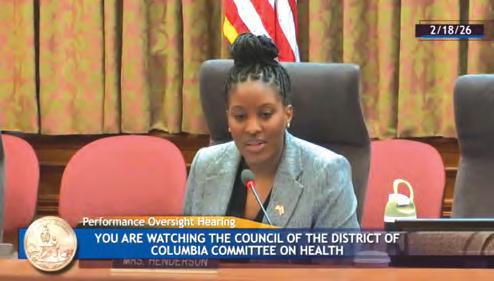
On Feb. 17, 2026, a student lost consciousness during class at Paul Public Charter School (5800 Eighth St. NW). Despite the school’s health technician and other sta providing care, the student did not regain consciousness until emergency medical technicians arrived and began treatment. According to testimony by Kristin Yochum, executive director of operations, before the DC Council Committee on Health, “Our health tech and sta provided excellent maintenance care,” but the DCPS health technician “does not have the training to assess advanced medical needs.”
e student was transported to a hospital. “ is is not an isolated incident,” Yochum added.
Weeks before students return to class, DC Health says it has lled 78% of the 201 health-suite positions planned for the coming school year. e agency is still recruiting nurses and health techni-
cians to sta 187 participating public and public charter schools.
e vacancies add uncertainty to a system that was already providing uneven coverage. During the 2025-26 school year, only half of participating schools received 40 hours of health-suite coverage each week, while one-quarter received 24 hours or less, according to gures cited by the chair of the Committee on Health, Christina Henderson (I-At Large). A health-suite employee may be a registered nurse, a licensed practical nurse or a health technician, so even 40 hours of coverage does not necessarily mean a nurse is on campus full-time.
DC Health presented a sta ng plan to a parent advisory committee on July 14 that calls for 44 clusters serving the 187 schools, an average of about four schools per cluster. At least one health-suite employee would be assigned to each campus, while a registered nurse would provide clinical guidance

Our health tech and sta provided excellent maintenance care,” but the DCPS health technician “does not have the training to assess advanced medical needs.”
and support across the cluster.
e plan would add licensed nurses, shrink most clusters and restore a shorter epinephrine course for school employees. Parents who have pressed the District to place a full-time nurse in every school welcomed the changes. But DC Health has not said how many hours of care each campus will receive or how often its assigned employee will be a licensed nurse.
DC Health is a District agency separate from DC Public Schools (DCPS). rough its School Health Services Program, it provides and oversees health-suite sta at participating DCPS and public charter schools with approved health suites. Schools may opt out and hire their own nurses, but they remain responsible for meeting District health and immunization requirements.











DC Health introduced the cluster model in 2023 in response to a shortage of school nurses. Its original plan grouped four nearby schools, assigned each campus a full-time health-suite employee and placed two nurses and at least two health technicians within each cluster. Nurses perform clinical assessments and develop individualized health plans. Health technicians can provide first aid, administer authorized medications and perform other tasks under a nurse’s supervision, but they cannot independently assess advanced medical needs.
Most clusters later expanded to five schools under the Children’s National Hospital’s Chil-
to roughly the size DC Health proposed in 2023. The agency’s July presentation did not explain the reason for that revision.
DC Health plans 201 health-suite positions for fiscal year 2026: 44 registered nurses, 47 licensed practical nurses and 110 health technicians. It described that as an increase from 185 positions in fiscal year 2025. However, the fiscal year 2025 categories listed in the same presentation ‒ 39 registered nurses, 32 licensed practical nurses and 104 health technicians ‒ add up to 175. DC Health had not explained the discrepancy by publication time.
dren’s School Services (CSS) program, which then employed and managed health-suite staff through a grant from DC Health. In June 2025, DC Health brought the program in-house and began directly hiring and managing the staff. The agency told families that the change was intended to provide more consistent and direct oversight.
The transition did not immediately produce that consistency. DC Health reported an 18% vacancy rate among registered nurses and a 14% vacancy rate among licensed practical nurses and health technicians during the past school year. Director Dr. Ayanna Bennett described the first year of in-house management as tumultuous and gave the agency a B. Henderson called that grade “generous.”
Expanding clusters from four schools to five without announcing the change made supervision more difficult, Henderson said in a July 16 interview. “I think that if somebody’s managing four schools, that’s a little bit different than managing five, because you’re also starting to talk about a stronger or a longer geographic distance,” she said.
The new plan returns most clusters
As of July, the agency said 16% of the planned positions were filled by registered nurses, 15% by licensed practical nurses and 47% by health technicians. “DC Health is actively recruiting staff with the goal to have all positions hired by the start of SY26-27,” the agency said.
Even if all 201 positions are filled, the plan promises only that one health-suite employee will be assigned to each participating school. It does not guarantee 40 hours of weekly coverage or a fulltime nurse at every campus.
The distinction has a complicated legal history. The DC Council passed a law in 2017 that would have required a registered nurse in every public and public charter school for at least 40 hours a week. But the requirement was contingent on funding, never took effect and was repealed in 2023. The operative District law requires at least 20 hours of registered-nurse services per week. At elementary and middle schools, licensed practical nurses
may supplement registered nurses in meeting that minimum.
Robin Roesch, a practicing registered nurse and a member of Parents United for School Health, or PUSH, a volunteer parent organization that works to ensure adequate medical supervision in schools, said the cluster structure itself makes recruitment harder. “As a practicing nurse with experience in nurse recruitment, I can say clearly the current structure makes school nursing significantly less attractive,” Roesch told the council in February. Managing coverage gaps and floating between buildings, she said, “is not a sustainable model.”
Sarah Buckley, an Amidon-Bowen Elementary School parent and PUSH member, entered the July 14 meeting with DC Health frustrated by a model that reduced the number of nurses while increasing their supervisory responsibilities. “You’ve designed a system that will be driving nurses out because you are fundamentally changing the job,” she told Hill Rag before the meeting. “You’re putting nurses’ licenses at risk because they are supposed to be remotely supervising health technicians at schools miles away.”
Afterward, Buckley called the discussion “one of the most positive meetings we have had so far.” She credited Dr. Sara Beckwith, senior deputy director of DC Health’s Community Health Administration, with listening to parent concerns and trying to address them.
One concrete change is the return of an hourlong epinephrine certification course during the 2026–27 school year. DC Health previously offered a short course that allowed teachers and other school employees to recognize a severe allergic reaction and administer an EpiPen without completing the longer Administration of Medication (AOM) training. The agency discontinued the shorter course last school year.
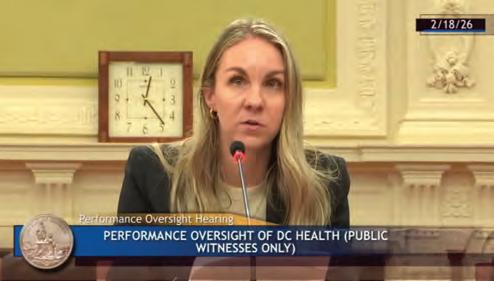
Buckley’s son has life-threatening food allergies, and his teachers had traditionally taken the shorter course. “Taking away an EpiPen training makes my son less safe,” she testified in February. “It doesn’t increase the number of AOMs; it just increases the chance that my son and others will not have access to an adult who can identify and respond to allergic emergencies.”
District law generally requires schools to have at least two employees trained to administer medication whenever students are present, separate from health-suite personnel. Four schools had no certified Ad-

































ministration of Medication employees and 29 had only one when oversight data were compiled. DC Health said it was working with those schools and that some employees may still have been completing certi cation.
DC Health says it assigns sta according to health-suite use and the number of students with serious or treatment-intensive conditions, including high-risk allergies and procedures such as catheterization. at calculation depends partly on Universal Health Certi cates (UCH), medication forms and other information supplied by families.
Only 28% of students had a UHC on le in scal year 2025, according to council oversight testimony. When families submit forms or enrollment changes, a school’s documented needs can shift, prompting DC Health to move nurses during the year. Henderson said the District needs an electronic system that reliably receives health information from medical providers. e consequences of thin or mismatched sta ng become clearest during an emergency. PUSH survey respondents described vacant health suites and a lack of trust. “My son takes medication,” one parent wrote, “and we didn’t send his second dose because I have no con dence that someone would have administered it at lunchtime.”
Henderson does not view the cluster model as a permanent solution to staing school health suites, although she said it may remain the District’s reality while the workforce and funding are constrained. She also stopped short of calling for a registered nurse at every campus, noting that school enrollment and student medical needs vary widely.
“I do feel like the agency needs to be doing a better job with managing this program, now that it has gone from Children’s (Children’s National Hospital’s) to in-house; it was a rocky start,”
Henderson said. She called for better communication with families, public comparisons between District schoolnurse salaries and those in surrounding jurisdictions and a clearer explanation of how schools qualify for nursing sta .
Sixteen schools opted to hire their own nurses during the 202526 school year. Some, including the SEED Public Charter School, need more hours because students board on campus. Henderson said DC Health should consider grants that would allow interested charter schools to employ nurses directly, similar to a school-based behavioral health pilot, and should publish the costs of several sta ng models.
She also suggested that assigning a nurse to two nearby schools could make the cluster model less burdensome, even if the District cannot immediately fund one nurse for every campus. DC Health said it is not considering a charter-school grant pilot and raised questions about how schools would cover absences when a directly employed nurse is sick or on leave.
PUSH members worry that allowing individual schools to buy additional coverage could leave wealthier communities with full-time nurses while other students remain in a weakened cluster system. eir goal remains a full-time licensed nurse in every public and public charter school, accompanied by public sta ng benchmarks and coverage data.
For now, the July plan represents movement without resolving that dispute. DC Health plans for smaller clusters, an increased number of licensed nurses and more school employees able to respond to allergic emergencies. But with the rst day of school approaching, families still cannot tell from the plan how many hours their health suite will be open or whether a nurse will be in the building during an emergency.
e DC Nurses Association did not respond to requests for comment by publication time. ◆

Apply today for School Year 2026-2027. Seats are limited. Complete the application online through MySchoolDC.org
#ChoosePaul and we’ll choose you back! Increase your chances of being matched with Paul PCS by making us your #1 selection


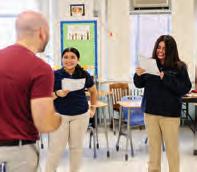
• College and career readiness begins in 5th Grade; by 8th Grade Scholars begin their exposure to Career and Technical programming
• Paul PCS has been recognized as an OSSE Leading School for Special Education for two consecutive years
• Virtual instruction for all students on Fridays
• Guaranteed seat for Paul 8th grade families into 9th grade at Paul IHS
• Bilingual Family Engagement team to meet the needs of families
• SAT Prep, Tutoring, Honors AP Classes, dual Enrollment, and In-House College Assistance
• Over 20 competitive middle school, junior varsity, and varsity athletic team
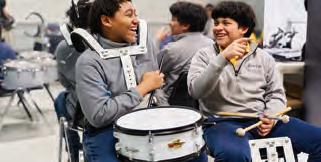
• Extended day after school programs including e-sports, cooking club, band, and tutoring

• Social Justice School is among the highest-performing middle schools in DC
• Rated in the top 25th percentile of all DC middle schools
• Designated a “Strong Performing School” by the DC Public Charter School Board
AFTER-SCHOOL PROGRAMS: Engaging and enriching programs with a focus on STEM, CTE, and social justice topics.
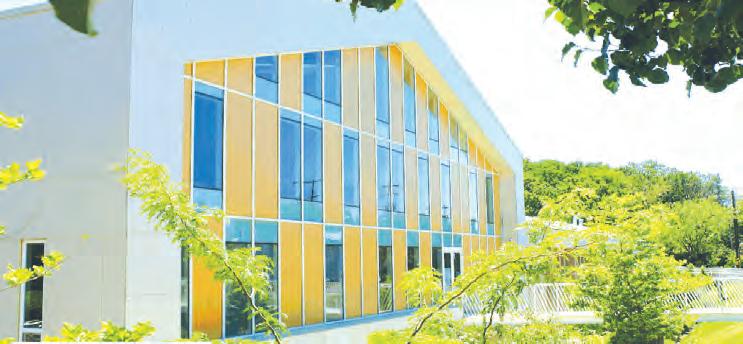
CONVENIENT LOCATION: Our new permanent facility at 5455 Third Street NE is just two blocks from Fort Totten Metro, making access easy for families.
CREW: Every child belongs to a tight-knit family known as their CREW—like homeroom, but better.
EXPEDITIONARY LEARNING: Students explore real-world issues, read texts, and study social justice topics that matter to them.
LIBERATORY DESIGN THINKING: Hands-on, research-based problem-solving to tackle community challenges.
SOCIAL JUSTICE: Graduates lead or participate actively in campaigns to shape the future.

by Alena Martin
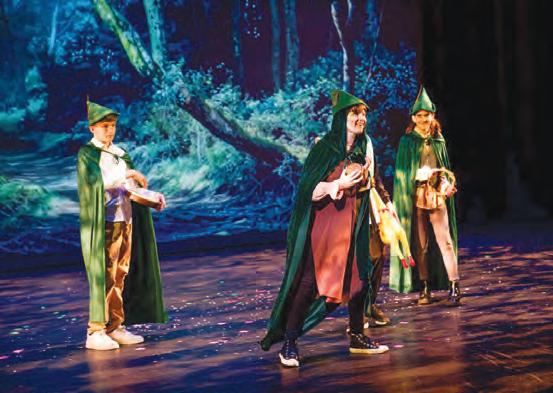
Large bouncy wigs, colorful costumes and patterned set pieces filled the stage at Stuart-Hobson Middle School at 410 E St. NE. Dozens of actors danced and sang in sync while students in the balcony swept spotlights over the stage. The cast and crew were preparing for the school’s spring production of “Hairspray,” the final product of months of auditions, rehearsals and afterschool work.
For many middle school students, drama begins as a chance to sing, act, design sets or try something new with friends. But during a formative period of brain development, theater can teach much more than performance. A 2019 report by the University of Chicago Consortium on School Research and Ingenuity found that arts learning can help young people develop social-emotional competencies when adults are intentional about structuring the work.

District middle school students in drama programs are learning collaboration, communication, confidence, leadership, time management and the ability to take risks in a supportive space. Middle school drama programs serve as developmental accelerators, simultaneously sharpening cognitive executive function through rehearsal discipline, cultivating interpersonal soft skills through ensemble collaboration and instilling real-world life skills.
At KIPP DC Valor Academy (5300 Blaine St. NE), drama teacher Andrea Gerald emphasizes teamwork, communication and mutual support. The cast becomes a family through the production process, learning how to be vulnerable in front
of peers and support classmates doing the same. Most students arrive with little acting experience, so they move together through auditions, callbacks, rehearsals and opening night. Students from different friend groups who might not otherwise interact have to come together to create a finished performance.
“Working together for a common goal, I think is my main goal,” Gerald said. Students quickly learn that they need one another to make the production work. Gerald builds that expectation in her classroom. A whiteboard lists reminders for the community: give each other applause, try your best and learn how to say yes. “I learned it’s all about connection,” one student said. “How you connect with the other actors and the ensemble.” Theater also gives Valor students practice with time management, balance and independence. Re-
hearsals often happen at the same time as sports practices, and many students are involved in both. Coaches and Gerald make clear that students have made commitments to both teams.
“If you’re coming to track practice on Monday, Tuesday, Wednesday, and you have rehearsal Monday through Friday, then you need to be at rehearsal Thursday and Friday,” Gerald said. Gerald, coaches and teachers help students organize their schedules until they can balance more on their own. By the end of production, Gerald hopes students feel the joy of completing something difficult and new. “[I hope they get] the joy of knowing that they’ve accomplished something that they’ve never done before,” she said. “Even some of the ones that have done it with me before, the joy in knowing I can do this again.”
At Capitol Hill Day School (210 South Carolina Ave. SE), drama builds independence, leadership and collaboration by gradually giving students more responsibility. Performing arts begin at the pre-K through eighth-grade private school. By fifth grade, students take two performing arts classes each week and learn theater production from improvisation to set design.
That learning shows up in the fifth-grade devised theater program, where students write, produce and perform their own show, and in the sixth-grade one-act play at Miracle Theatre. Seventh and eighth graders can continue in a musical theater elective with more independence over the production. At the Atlas Performing Arts Center (1333 H St. NE), sixth graders serve as apprentices









to the staff, preparing for the roles they may take the next year.
As students take on more responsibility, they learn how to lead peers and collaborate inside a group. Seventh and eighth graders who serve as choreographers or stage managers have more input in the show and help make decisions. That means practicing how to give and receive feedback, follow directions, know when to step forward and when someone else needs the spotlight.
The CHDS program also connects drama to academics, especially English language arts. Students interpret scripts, study what characters want and think about how choices on stage come from the text. “It’s almost like an English language arts kind of focus. Of interpreting a script and interpreting what you know what a character is doing, thinking, [and] what their motivations are,” said upper-grades head and outplacement coordinator Tom Sellevaag. In seventh and eighth grade, he said, students are encouraged to dig deeper and “get inside their character’s head.”
Because the program builds year by year, students become more confident in their abilities. By the upper grades, Sellevaag said, their performances can become surprisingly convincing. “They can be quite moving,” he said. “You really start to believe [their performance].”
Students gain independence and socialemotional skills while still enjoying the work. The drama teacher, Sellevaag said, has “made it fun and made it relevant and made students feel like they have agency.”
At Stuart-Hobson, drama teacher Tori Pergerson has spent the past 10 years building a program around confidence, belonging and student leadership. The public middle school’s program also strengthens the pipeline from elementary feeder schools by helping students find a community soon after they arrive.
Sixth graders begin with acting fundamentals and communication. They audition in front of peers, practice public speaking, learn stage presence and try improvisation. As the sixth grade production develops, older students work with them in small groups, giving feedback and serving as mentors.
Pergerson also uses theater to teach academic context. In “Hairspray,” for example, students had to understand the history behind the story they were acting, including why slurs were
used and what they meant in the world of the play. The goal was not only to say lines correctly, but to understand the history and choices behind them.
Pergerson said one of the clearest areas of growth is confidence. Students learn to take risks, try unfamiliar roles and see what they can produce. Because the program runs all year and includes two productions, students have repeated chances to develop their acting skills and confidence on stage.
“We’re pushing you to get up in front of people and talk and act, or do all these things,” Pergerson said. Students begin to feel that, even in sixth grade, they matter and belong, she said. “So that sense of belonging, it’s just growth, and I see it exponentially because they just feel like they have some investment here and they’re a part of something.”
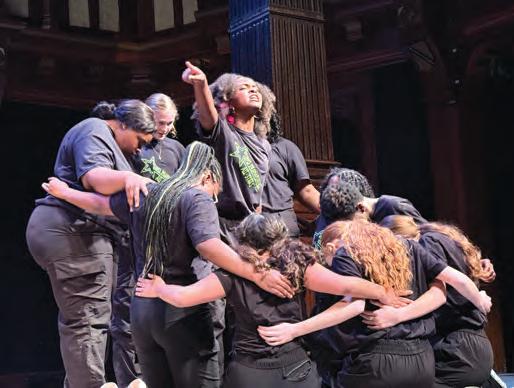
mentoring younger students taught leadership. Students practice giving constructive criticism and serving as role models for sixth graders.
Drama also teaches dedication. Evan Pergerson, a seventh grade actor who is also the drama teacher’s son, said he has learned how to stay committed and work hard.
For many students, the program is an incentive to get to school for zero period before the regular day starts and to maintain their grades. If they miss zero period, they miss that day’s rehearsal and any changes made to scenes.
Leadership continues during the show itself. Gigi Bruckner-Rust, a seventh grader who played Tracy Turnblad in this spring’s “Hairspray,” said
When the performance begins, teacher Pergerson steps back. “I sit right out here, I don’t go backstage for anything. I officially hand them their show,” she said. “They know what they’re supposed to do.”
As the final notes played at dress rehearsal, the cast on stage and teachers in the front rows cheered to end the last rehearsal before opening night. Students changed out of wigs and ruffles and gathered for one last meeting before showtime. The cast of “Hairspray” still had a few hours until curtain, but the room was filled with the energy of these students who had worked for months and were ready.
Programs like Stuart-Hobson’s show how middle school theater can teach the life skills adults often hope students will learn somewhere: time management, collaboration, confidence, responsibility, leadership and the courage to try. The students may not describe it that way while they are singing and dancing, but the lessons are built into the process.
Pergerson said her students tease her because she keeps saying she will make T-shirts with all the sayings about the life skills students get from drama. It’s one more reason she keeps doing the work. “A lot of people can’t say they love their job,” Pergerson said. “I love my job. I love it.” u













































by Elizabeth O’Gorek
Last school year, Maria’s six-year-old came home with a new favorite song, “State Farm, buh-bah-buh-bah, boop-bop-bah!” Maria wondered where her kindergartener had picked it up ‒ screen time is very limited at home. But Maria’s child could tell her. It was from a commercial she watched on a YouTube video in aftercare.
“It could be worse, I know,” Maria told me. “But it seems insidious. Why is my kindergartener singing the praises of big insurance?”
Before the pandemic, a computer for every student represented progress. Parents and digitalequity advocates pressed schools to close a divide that left some children doing assignments on a parent's phone while classmates used laptops. The pandemic made devices necessary for remote classes, and laptops stayed central when buildings reopened. DC Public Schools works to maintain a one-to-one student-to-device ratio in grades 3-12 and one device for every three children from pre-K through second grade.
Six years after schools closed, the pendulum has swung the other way. Parents who once demanded laptops now ask how often children should open them. Teachers and officials question whether personalization software improves learning. Pediatricians and researchers warn that screen lessons can displace conversation, handwriting, creative play and work with teachers and classmates. And the most affluent schools are turning to paper over software.
“I think we need to be more thoughtful about how we integrate technology so that it remains a tool to enhance, not supplant core instruction,” said DC Councilmember Christina Henderson (I-At Large) during a recent debate over the DCPS contract for the i-Ready learning platform.
DCPS began its Empowered Learners Initiative before the pandemic, promising devices, digital resources and teacher training to close the digital divide. It started with a one-to-one ratio in selected grades, expanded to all students in grades 3-12 and
is now soliciting another device contract.
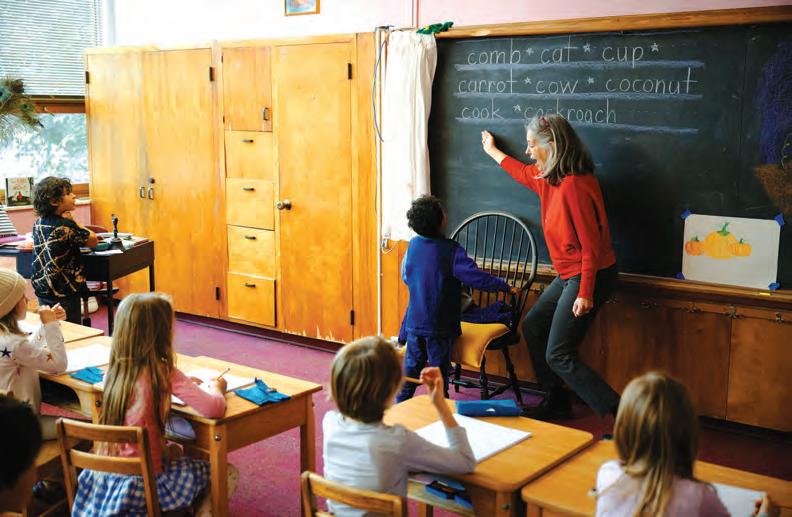
But just because a laptop is in the classroom does not mean it’s being used. Some teachers rely on online assignments, videos and adaptive-learning programs, while others emphasize books, paper, discussion and hands-on work.
The lack of consistent limits helped produce the backlash. In letters to councilmembers, parents reported computers being used for lessons, testing, independent work, indoor recess and aftercare. They also complained about students watching YouTube, sometimes including age-inappropriate advertising, without clear instructional purpose.
Those concerns led Henderson to introduce a resolution that could have blocked a one-year DCPS contract with Curriculum Associates, which provides i-Ready. DCPS has used i-Ready for math diagnostics since 2014 and expanded it in 2021 to reading, math diagnostics and personalized instruction. The platform assesses students and assigns lessons.
DCPS recommends 30 to 45 minutes of iReady instruction per subject each week. Henderson said school-system data showed 17 schools exceeded that guidance, with some assigning more than an hour per week in both reading and math. She said DCPS had no clear intervention for overuse and could not show that extra time improved outcomes.
DCPS defended the platform, reporting an average of 32 minutes per student, per subject, each week. Former chancellor Lewis Ferebee told councilmembers an internal analysis found students who met recommended i-Ready usage were more likely to reach proficiency on DC CAPE, even after accounting for prior achievement and demographics. He said the association was especially strong for economically disadvantaged students and multilingual learners.
That finding does not settle the question. Critics note that it is an association, not independent proof that i-Ready caused gains. They also question company-backed research and cite pending litiga-
tion involving student data collection and privacy.
Henderson withdrew the resolution after councilmembers said rejecting the contract shortly before school began would leave DCPS without enough time to choose an alternative and train teachers. The withdrawal allowed i-Ready to remain for 202627 and compelled DCPS to make concessions to parental and council concern.
Ferebee committed DCPS to grade-specific instructional and non-instructional technology guidance, including i-Ready limits and before- and aftercare guidance.
A July 10 letter from DCPS chief of teaching and learning Corinne Colgan and chief of data and technology Cyrus Verrani to Schools Beyond Screens DC promised thresholds and follow-up when i-Ready or other platform use exceeded recommendations, limits for movies, videos and YouTube, aligned and ad-free online content and a route for families to escalate concerns.
“Greater clarity and consistency are needed in how technology is implemented in practice,” Colgan and Verrani wrote. They said DCPS would retain a blended-learning model in which technology supports teacher-led instruction rather than replacing classroom discussion, peer interaction and hands-on work.
If grade-by-grade limits, monitoring thresholds, approved alternatives, aftercare rules and enforcement mechanisms existed prior to this discussion, they were unpublished when the letters were sent.
Schools Beyond Screens DC formed this spring as a local chapter of a national parent-led organization. More than 1,000 District parents signed its petition for intentional classroom technology, according to volunteer working-group member Maya Mechenbier.
The group is not demanding that DCPS eliminate computers or technology. What they want, Mechenbier said, is to understand what technology is in the classroom and why. They also want to be sure that the device or application has educational outcomes grounded in evidence and aligned with learning goals.
“We are not anti-technology at all,” Mechenbier said. “We really are asking, where there is a screen in the classroom, that it is for a good reason.”
In this, they are closely aligned with professionals. The American Academy of Pediatrics says educational-technology guidance remains limited, and evidence gaps persist around which products improve learning. A study also found that many teachers feel little influence over district-level technology decisions.
International evidence is mixed. An analysis by the Organization for Economic Co-operation and Development (OECD) found that students using digital devices for learning between one and five hours per day scored higher in mathematics than those reporting no use. Yet nearly one-third of 15-year-olds said devices distracted students during most or every math class. The organization recommends judging technology by outcomes.
Mechenbier credited Henderson's proposed resolution with forcing a more substantial discussion among the DC Council, DCPS, parents and teachers. The July 10 response left the group encouraged, she said, because the commitments could resolve many concerns if implemented. “I think we feel really positive about that and are looking forward to seeing how that goes in the coming weeks,” Mechenbier said.
Unlike DCPS, the District's charter sector does not operate under one instructional technology policy. Each charter organization is its own education agency, so practices differ significantly.
At Washington Latin Public Charter School, every student must use a school-issued Chromebook to access class materials. Students assigned takehome computers must bring them charged each day. The school describes technology as a supplement that widens experiences and perspectives; its policy focuses on responsible use and care.
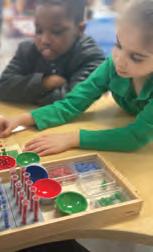
At Northeast Stars Montessori, a private Capitol Hill preschool serving children from 24 months through kindergarten age, screens stay in a supporting role so early learning is rooted in touch, movement and direct experience. Its Montessori approach emphasizes physical materials and faceto-face interaction, protecting concentration and self-reliance.
That approach is visible in science and math. Children observe plant growth, make rain gauges to study evaporation and use materials that nest or connect to reveal patterns. In Montessori terms, abstract ideas begin with the hands. Northeast Stars describes its curriculum as STEM-based, but its STEM leans on experiments, outdoor exploration and manipulatives.
The same philosophy shapes practical life and sensorial work. Pouring, scooping, food preparation and sorting build motor control and attention; the pink tower, knobbed cylinders and sandpaper numerals introduce size, shape and number through touch. Northeast Stars reminds families that problem-solving, spatial awareness, persistence and cooperation often start away from a monitor.
Other charter schools use less technology, par-
ticularly in younger grades, but there is no comprehensive public accounting that lets families compare screen use across the sector. Schools Beyond Screens DC includes charter parents and has begun talking with charter stakeholders, although its initial advocacy focused on DCPS, where central policy can affect more than 50,000 students.
Private schools present an even wider range. Some market sophisticated technology programs, coding, digital design and one-to-one devices as college and work preparation. Others make limited screen use part of school identity.
Washington Waldorf School follows the latter model. Young children have little or no classroom screen time. Digital media enters in middle school through internet research and digital responsibility; high school students learn coding and take computers apart. Phones and smartwatches stay locked away during the school day.
Eben Kaplan, a cybersecurity consultant whose children attend the school, said his fifth grader's first classroom film was a documentary about civil rights protests at Glen Echo. Children instead draw, work with their hands and play imaginatively.
“With every technology, some things get easier and things get harder, and I don't think we always think about those trade-offs,” Kaplan said. Waldorf, he added, is “very, very conscious and deliberate about when we're introducing what and why.”
That option, however, is tied to private-school access. A system in which affluent families can purchase low-screen instruction while public-school students spend more time on inexpensive digital programs would create a new digital divide. It is why some advocates resist individual opt-outs and favor stronger standards for everyone.
For most of the District’s students, opting out is not an option. DCPS’s acceptable-use policy allows parents of children under 13 to opt out of personalinformation collection by particular online services. It also requires any application bought by the central office, a school or a parent-teacher organization to undergo security review. The policy governs privacy, safety, AI and acceptable conduct, but not instructional screen-time limits.
The next stage of DC's debate will be less about whether children should have computers than who decides when they open them. Parents want transparency, teachers want control and schools still must teach digital literacy and equitable access.
The pendulum may be swinging, but it has not returned to looseleaf and textbooks. But there is increasingly a demand that schools think about what technology they use, when they use it and why. u

by Maggie Tatum
Every fall, families settle into the rhythm of a new school year. And every fall, once the new-year shine wears o , some parents begin to notice that something isn't quite right. Homework that used to take 20 minutes now takes two hours. A child who used to talk about school comes home and shuts the door. A teacher's email arrives with a subject line that makes your stomach drop. It's easy to picture a struggling child as one who is failing tests or acting out in class. But often kids are still eking out decent grades while quietly struggling. e outcome looks the same, even as the e ort behind it grows. e challenge is noticing the right cues so you don't miss your
kid's quiet call for help. Some of the most common warning signs are whispers, easy to misread as a phase or an attitude problem. Here's what to watch for.
If getting through a single worksheet turns into an hour of tears, refusal or arguments, the issue usually isn't the assignment itself. It's what the assignment demands: sitting still, organizing materials, starting a task with no clear rst step, holding instructions in mind while executing them, recruiting mental energy for a non-preferred task after a long day. ese are executive

functioning skills, the mental processes kids (and adults!) use to manage attention and follow through. When they're underdeveloped, even simple homework can feel enormous. A child melting down over “easy” work isn't being dramatic. ey're often genuinely stuck and exhausted.
Grades are an obvious signal but they're often a lagging indicator. Watch instead for how your child talks about themselves. Comments like “I'm just bad at school” or “I never get anything right” tend to show up well before report cards do. Kids sense when something is harder for them than



it seems to be to their peers, even if they can't articulate why. at gap between e ort and outcome is where shame quietly takes root.
Stomach aches, headaches and sudden reluctance to get out of bed are classic signs of school-related anxiety, especially in younger kids who don't yet have the language to say “I'm overwhelmed” or “I'm scared of getting called on.” If these complaints cluster around speci c days ‒ a subject, a test, a particular class ‒ that pattern is worth paying attention to.
Meltdowns over changes in routine or shifting plans can look like a discipline problem. Often, it's closer to the opposite: a child whose coping capacity is already maxed out by the demands of the school day, with nothing left in reserve when one more thing goes sideways. If your child holds it together at school and falls apart the moment they're home, that's not a contradiction, it's often a sign of how much e ort the day actually costs them.
“I don't want to” and “I can't” can sound identical from the outside. A child who suddenly refuses to read aloud or start a project may not be choosing to be di cult ‒ they may be avoiding a task that consistently makes them feel incapable. Avoidance is often a child's best available strategy for managing repeated failure, especially before they have the words to say so directly.
Missing homework that was actually completed, forgotten permission slips, a backpack that's a black hole ‒ these
are common enough to write o . But when they're persistent and paired with any of the signs above, they're often part of the same picture: a child whose organizational and workingmemory skills haven't caught up to what's being asked of them.
None of these signs on their own mean something is seriously wrong. Kids have hard weeks. But when you notice a pattern, several signs together, showing up consistently over more than a few weeks, it's worth paying closer attention to rather than waiting for it to resolve on its own.
Start by talking to your child's teacher, who sees your child in a context you don't and can tell you whether what you're seeing at home matches the classroom. If concerns persist, talk to your pediatrician or school counselor, who can help determine whether an evaluation for a learning di erence, ADHD or anxiety makes sense.
e earlier these patterns are identi ed, the easier they are to address, not because your child is broken, but because kids do better when the adults around them understand what's underneath the behavior. Left unexplained, struggle becomes a story kids tell themselves: that they're lazy, crazy or stupid. What they need instead are attuned adults who help them understand themselves and access the supports they need to nd their own way toward independence.
Maggie Tatum is the founder of Empowerment EDU, where she coaches children, teens and families navigating ADHD and executive functioning challenges. ◆

Dyslexia—OrtonGillingham
Autism
by Kathleen Donner
You can have your child’s car safety seat inspected and properly installed at the Department of Motor Vehicles Inspection Station. Inspections are free during normal operating hours at 1001 Half St. SW. A passenger child safety technician will install the seat and share information about the importance of proper use. www.dmv.dc.gov/service/car-safety-seat-program
Celebrate elephants, culture and conservation during EleFest, a three-day festival at the National Zoo, leading up to World Elephant Day on Wednesday, Aug. 12. The festival runs Friday, Aug. 7, through Sunday, Aug. 9, and features after-hours experiences, early morning yoga alongside the elephant herd, live performances, family activities and interactive art. Activities on Saturday and Sunday from 10 a.m. to 2 p.m. feature elephant-themed activities, cultural
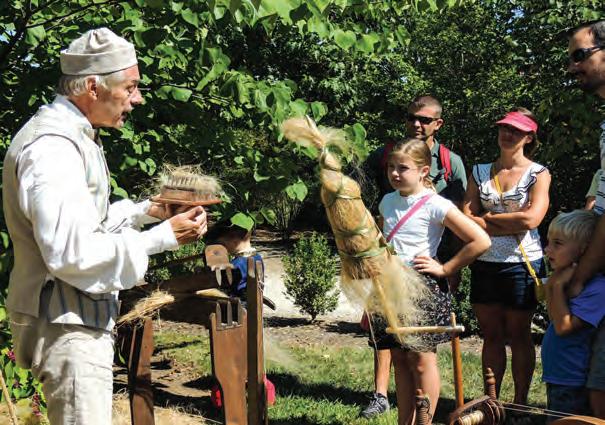
On Saturday, Sept. 19, and Sunday, Sept. 20, from 9 a.m. to 5 p.m., both days, step back in time at the Colonial Market & Fair, a 12-acre site featuring food and wares made by colonial artisans. Explore ceramics, furniture, glasswork, textiles, woodcraft, soap and more. Talk to artisans and watch them demonstrate their craft using 18th-century techniques. Enjoy early American entertainment, meet General Washington and take home handmade items. The Colonial Market & Fair is included with general admission: $30 for adults, $16 for ages 6-11, free for five and under. www. mountvernon.org

On Saturday, Aug. 15, from 11 a.m. to 1 p.m., visit the “Great Cat” exhibit and celebrate the many species of cats living at the National Zoo. Get the inside scoop from staffers about how the cats spend their days, and learn about conservation programs that save cats in the wild. Watch animal feedings, talk to experts, craft your own catthemed art and play games that celebrate your favorite felines. www. nationalzoo.si.edu
experiences and family-friendly entertainment. www.nationalzoo. si.edu
The Marine Corps Marathon Kids Run, on Oct. 26, the day prior to the MCM, is a one-mile, just-forfun running challenge for kids aged 5-12. Participants may select from six specific starting waves. Shuttles from Metro, post-event hospitality, entertainment, games and mascots make this an unforgettable event. Registration is $27.
Each participant receives a shirt, access to the Camp Miles Family Fitness Festival and a medal at the finish line. www.marinemarathon. com
The Folger’s exhibition galleries are now home to a permanent costume corner. Visitors of all ages can dress up as Shakespeare’s characters or contemporaries. Find the costume corner near the east entrance of the Shakespeare Exhibition Hall. www.folger.edu





On Friday, Aug. 28, Sept. 25 and Oct. 23, from 5 to 7 p.m., bring the family to Hill Center, 921 Pennsylvania Ave. SE, to enjoy an evening filled with live music. This concert is outdoors, perfect for little ones to dance and play to the beat of their favorite songs. King Bullfrog is the hottest sensation in family music in the DC area. Tickets are $14 for kids; $7, adults; kids under two do not require a ticket. Beer, wine and cheese pizza for purchase. www. hillcenterdc.org
Art-Play-Practice at Phillips@THEARC, 1801 Mississippi Ave. SE, invites you to experience works from The Phillips Collection in an immersive, hands-on way. Designed for all ages, Art-Play-Practice is open Fridays from 11 a.m. to 3 p.m., and second Wednesdays from 6:30 to 8:30 p.m. during Crochet Circle. Spark creativity with a complimentary art supply giveaway bag, available while supplies last. Free admission. All ages welcome. www.phillipscollection.org/artplay-practice
Kids aged 4-12 are invited to run the bases at Nationals Park after every Sunday afternoon home game, weather permitting. Kids Run the Bases takes place entirely inside the park. Participants line up at the GEICO Presidents Photo Station behind Section 131. Families with checked strollers at Main Guest Services should not pick up their strollers until after the event. The run begins approximately 20 minutes after the end of the game and lasts about an hour. Kids start their run at first base and are directed around the bases to home plate. Sliding into
bases is prohibited. An adult must accompany each participating child to the field; adults drop children off at first base and meet them near home plate. (Adults may not accompany children as they run.) One adult is permitted onto the field per participating child. Here are the remaining dates this year: Aug. 9, vs. Reds; Aug. 30, vs. Marlins; Sept. 13, vs. Angels; Sept. 27, vs. Mets. www.mlb.com/nationals/fans/jr-nats/kids-runthe-bases
On Thursdays in August at 11 a.m., listen to a tale about a bear whose shadow scares away the fish he's trying to catch, leading him on a humorous quest to get rid of that pesky shadow. Create your own shadow puppet after the story. Free; timed-entry passes required. www.airandspace.si.edu
On Tuesday, Aug. 11, from 2 to 4 p.m., at Southwest Library, 900 Wesley Pl. SW, explore archeology through games, puzzles, crafts and teamwork. Students will work together to map an
indoor version of a sunken shipwreck off the coast of Maryland and Virginia while solving the mystery of what happened to the ship. From 2:00 to 2:30 p.m., there will be a short introduction for students new to the Young Archeologists' Club. Students who attended previous programs can arrive at 2:30 p.m. A free, hands-on opportunity for participants aged 8-14, the club is instructed by professional archeologists and educators. Younger students may attend when accompanied by an adult. Register at www.dclibrary.org/ plan-visit/southwest-library. Archeology in the Community is a DC nonprofit dedicated to connecting learners to heritage and archeological science. For questions, contact beth@archaeologyincommunity.com.
On Wednesday, Aug. 15, Sept. 30, Oct. 28, Nov. 18 and Dec. 16, from 10:45 to 11:15 a.m.; join the American History Museum for story time in collaboration with the DC Public Library. Children and their grownups can enjoy story time as an interactive way to exercise language and literacy skills. Story time is designed for learners aged five and under, but all are welcome. www.americanhistory@ si.edu
On Aug. 9 and Sept. 13, from 10 to 11 a.m., join Planet Word, 925 13th St. NW, for Sunday Storytime, a free monthly program designed for young children and their grownups. Featuring songs and read-alouds presented by children’s librarians from the DC Public Library, Sunday Storytime is ideal for ages 2-6. After storytime, attendees are invited to explore the museum or stop by the pop-up DC Public Library wagon to check out children’s books using their library cards. Registration includes general admission to the museum. For questions or concerns regarding accessibility needs, contact support@planetwordmuseum.org.
NSO’s “Hook” in Concert at Wolf Trap
On Saturday, Sept. 5, at 7:30 p.m., follow the second star to the right and straight on until morning. Celebrate Steven Spielberg’s epic with the National Symphony Orchestra, as John Williams’ score comes to life with the full film on screen. Robin Williams stars as an adult Peter Pan who rescues his children from Captain Hook (Dustin Hoffman) and rediscovers the magic of who he truly is. Tickets start at $43. All persons, regardless of age, must have a ticket. Ticket prices are the same for adults and children. www. wolftrap.org
The Honeycomb Project of DC Greens puts kids at the forefront of social change. Families volunteer through parent and child groups, with farm tasks designed for little hands. Little Growers Volunteer Days at The Well at Oxon Run, 300 Valley Ave. SE; remaining days are Saturday, Aug. 15, Sept. 12 and Oct. 17, from 10:30 a.m. to noon. All ages are welcome. This activity is best for ages five+. www.dcgreens.org
What's the connection between fruit and poop? On Monday, Aug. 10, from 10 a.m. to noon, join Lilly Anderson, the US Botanic Garden’s family
education specialist, to explore how plants and animals help each other and the relationship between plants making fruit and animals eating that fruit. Think and learn about what makes a fruit a fruit, why fruits tend to taste sweet and why it benefits plants when animals eat their fruits. This is an onsite, drop-in program. No registration needed. www.usbg.gov
“Ninja Kidz Live: Infinite Possibilities” is designed for children aged 4-12, but the show is equally entertaining for parents and families. The performance appeals to both kids discovering Ninja Kidz TV for the first time and longtime fans who follow the channel on YouTube. Kids and families are challenged to take part in interactive games, solve ninja puzzles and test their agility alongside the performers. “Ninja Kidz Live: Infinite Possibilities” is at the Warner Theatre, 513 13th St. NW., on Sunday, Aug. 30, at 3 p.m. Tickets start at $53. www.warnertheatredc.com
On Monday, Aug. 17, from 4 to 7 p.m., visit the Museum of Illusions, CityCenterDC, 927 H St. NW, a venue filled with perspective changingrooms, installations and images. Nothing is ever quite as it seems. Stop by the DC Library table for swag and book giveaways while supplies last.

Registration for this event is mandatory. www. dclibrary.libnet.info/event/16657182
Across the meadow from the Filene Center, at Wolf Trap National Park, the Children’s Theatrein-the-Woods has been a summer tradition for children and families. Performances ranging from music and dance to puppetry and storytelling are interactive, educational and fun. All shows are about an hour long and begin at 10:30 a.m. (gates at 10 a.m.). Here are the remaining shows this summer: July 31 and Aug. 1 and 2, Maryland Youth Ballet; Aug. 5, Joanie Leeds & Joya; Aug. 6, Native Arts Collaborative; Aug. 7, 8 and 9,” The Wonders of Wiggly River”; Aug. 14, 15 and 16, “Don’t Let the Pigeon Drive the Bus! The Musical.” Tickets are $14. After each performance, children and parents are encouraged to continue enjoying the free and open space in the park. Theatre-in-the-Woods, 1551 Trap Rd., Vienna, Virginia. www.wolftrap.org
The First Tee is an international youth development organization introducing the game of golf and its inherent values to young people. Afterschool and in-school golf programs help reinforce values like integrity, respect and perseverance. First Tee programs in DC are at Langston, East Potomac and Rock Creek golf courses. Read more at www.firstteedc.org. u
Just minutes from DC, the Arlington County Fair focuses on educating, entertaining and showcasing the best of Arlington for people of all ages. Admission is free; programming including rides, games and other activities may be fee-based. The Arlington County Fair, Aug. 12 to 16, is at the Thomas Jefferson Community Center, 3501 Second St. So., Arlington, Virginia. Outdoor hours are 5:00 to 10:30 p.m. on Wednesday and Thursday; 2:00 to 10:30 p.m. on Friday; 10 a.m. to 10:30 p.m. on Saturday; 11 a.m. to 10 p.m. on Sunday. Indoor hours are 4 to 10 p.m. on Friday; 11 a.m. to 9 p.m. on Saturday; 11 a.m. to 7 p.m. on Sunday. A Sensory Tent offers all the magic of the fair without loud sounds or music, with volunteers to assist as needed. www.arlingtoncountyfair.us/fair
Capitol Hill Learning Group (CHLG) capitolhilllearninggroup.com
CHLG’s Preschool program, located at 9th & Maryland Ave. NE, is a Christ-centered, parent/ teacher cooperative for children ages 2.5 to 5 years. Established in 2006, CHLG is licensed by DC and employs professional teachers, with parents serving as classroom assistants on a rotating basis. The program features hands-on learning, small class sizes, and a tight-knit community.
Northeast Stars Montessori Preschools (NES) www.nestars.net
Northeast Stars Montessori Preschools is a fully licensed preschool with locations in Capitol Hill, DC and Old Town Alexandria, VA. NES is one of the best-kept secrets, providing individualized educational opportunities that support the whole child. Teachers deliver “Montessori and More!” through mixed-age classrooms for children ages two to five, carefully planned lessons, and the integration of Spanish, music, and the arts. NES also offers before-care, extendedday learning from 3:00 to 6:00 p.m., and flexible part-time enrollment options.
Starling Montessori School starlingmontessorischool.com
Starling Montessori School is a family-run Montessori childcare center on Capitol Hill serving children ages 16 months to 6 years. Its small, thoughtfully prepared classrooms foster independence, concentration, confidence, and a lifelong love of learning through respectful, individualized care. The Toddler Community serves children ages 16–36 months, while a new Primary classroom for ages 3–6 opens in August 2026. Led by AMI-trained guides, Starling offers uninterrupted work cycles, practical-life activities, language and sensorial learning, outdoor exploration, and an extended-care option
Burgundy Farm Country Day burgundyfarm.org
An inclusive, creative, and nurturing environment, engaging the whole child. Burgundy
boasts an expansive, wooded 26-acre Alexandria campus. Outdoor learning spaces, exterior decking on all academic buildings, two outdoor stages, a barn, natural play spaces, and numerous playgrounds expand our students’ learning space. Discover Burgundy today!
Capitol Hill Learning Group (CHLG) K-8 capitolhilllearninggroup.com
CHLG’s K-8 University-Model® program, located at 9th & Maryland Ave. NE, offers a Christ-centered micro-school experience. Established in 2006, CHLG features dedicated teachers, small class sizes, and a close partnership between home and school. The program integrates a Christian worldview into all learning, fostering responsible, independent, and self-driven learners.
DeMatha Catholic High School dematha.org
DeMatha Catholic High School provides a rigorous college preparatory curriculum to young men in the Washington area, including 87 Advanced Placement and Honors courses, 22 college dual-enrollment courses, and individualized academic support. Students are committed to service while participating in numerous co-curricular activities, including nationally recognized athletic and music programs.
Bridges PCS
bridgespcs.org
Bridges Public Charter School opened in 2005 and serves a culturally and linguistically diverse student population in Pre-K3 through 5th grade. The school’s developmentally appropriate, student- and family-centered approach includes small class sizes, well-trained staff, and individualized student planning. Bridges PCS implements the Universal Design for Learning (UDL) framework and incorporates hands-on learning across all grades. Specials include art, music, physical education, and gardening.
E.L. Haynes Public Charter School elhaynes.org
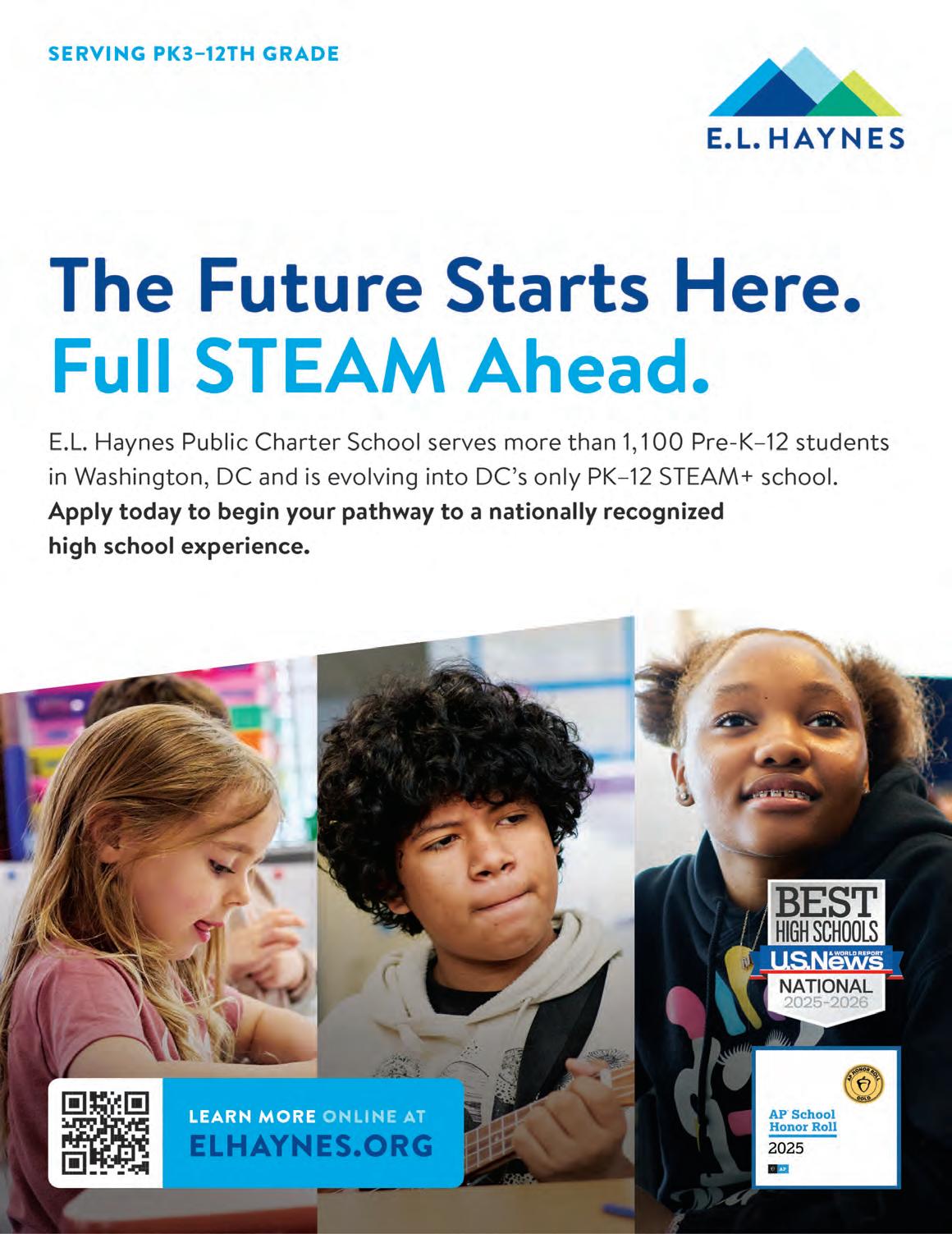
The award-winning E.L. Haynes Public Charter School serves over 1,100 Pre-K-12th grade
students in Washington, DC. We’re a learning community where every student, of every race, socioeconomic status, home language, and ability, prepares to thrive in college, career, and life. Together, we create a more just and kind world.
Global Citizens PCS globalcitizensschool.org
Global Citizens Public Charter School is the first dual language immersion public elementary school in Washington, DC, that offers language immersion in both Mandarin-English and Spanish-English, the top three languages spoken in the world. Global Citizens will offer Pre-K34th grade during the 2026-2027 school year, and will expand an additional grade level each year until it reaches Pre-K3 – 5th grade in 2027. We equip children to become empathetic, globally competent, and socially-minded leaders who are prepared for a future we cannot yet imagine.
Lee Montessori PCS leemontessori.org
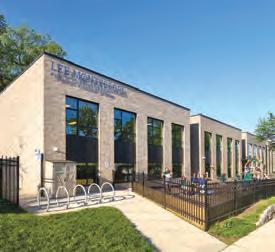
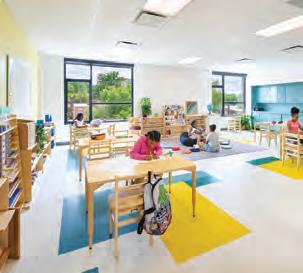
Our East End campus in the Fairlawn neighborhood serves students in PK3-5th grade and will grow to serve 6th graders next year. We integrate traditional Montessori education with an explicit focus on anti-racism, combined with a supportive foundation of positive discipline and restorative justice practices. This means each one of our students can flourish and show up authentically as their true selves. When they go out into the world, we know they will embody our core values of grace, bravery, growth, joy, and equity because of what—and how—they learned at Lee Montessori.
Paul Public Charter School paulcharter.org
Paul Public Charter School (Paul PCS), located in Northwest Washington, DC, provides a college preparatory program for grades 6-12, focusing on global awareness and engagement. Paul’s mission is to educate and help students grow into responsible citizens, independent thinkers, and leaders.
Richard Wright PCS richardwrightpcs.org
Richard Wright Public Charter School for Journalism and Media Arts provides a strong, academically enriching, and rigorous program while providing hands-on learning of funda-
mental concepts and skills essential in Journalism, Broadcast Journalism, Film, Graphic Design, Visual Art, and Music Production. In addition, the school’s innovative curriculum elevates the literacy levels of all its students.
Sela Public Charter School SelaPCS.org
Sela PCS is DC’s only Hebrew-language immersion school, proudly rated a Tier 1 school by the DC Public Charter School Board and honored with a Blue Ribbon by the U.S. Department of Education. With a diverse student body and staff reflecting the multicultural vibrancy of the nation’s capital, Sela offers an academically rigorous curriculum. Daily Modern Hebrew instruction is fully integrated into the program, fostering strong language proficiency and enriching the overall educational experience. Sela’s new Wallholla vertical playground provides students with even more opportunities for active, imaginative play.
Social Justice PCS thesocialjusticeschool.org
Serving grades 5–8, The Social Justice School fosters an inclusive community of middle school students, empowering them to become scholar-activists committed to creating a more just and equitable world. Its academic model integrates rigorous academics, social justice, social-emotional learning, and character development through expeditionary learning and hands-on design-thinking projects. Students also benefit from enriching after-school programs. Now located in its new permanent home at 5455 3rd Street NE, just two blocks from the Fort Totten Metro, The Social Justice School is recognized as one of DC’s highest-performing middle schools.
Capitol Kids Therapy LLC capitolkidstherapy.com
Founded in 2000 on Capitol Hill, Capitol Kids Therapy provides pediatric speech and language therapy for children up to 12 years
of age. Conveniently located at 2nd and D St. NE, they offer office-based, home-based, school-based, and daycare-based therapy services. Their therapists specialize in a variety of areas, including (but not limited to) speech therapy, language therapy, feeding therapy, oral motor therapy, and articulation therapy. Additional services include screenings, parent consultations, parent/teacher workshops, evaluations, and treatment. Capitol Kids Therapy is dedicated to helping your child achieve their full potential.
School Consulting
DowneySchoolConsulting.com
Downey School Consulting offers expert tutoring and educational guidance for students of all ages. Services include OrtonGillingham-certified instruction, test preparation, executive functioning support, and assistance with navigating public, charter, and private school admissions. Specializing in autism, ADHD, and dyslexia. Personalized, experienced support to help every child thrive.
Early Stages earlystagesdc.org
Early Stages is an evaluation center for children aged 2 years 8 months to 5 years 10 months. This DC Public Schools (DCPS) program identifies delays and disabilities that may impact a child’s education.
Early Stages can evaluate any DC child who is not attending a DCPS school, including DC children who are homeschooled. The program can also evaluate children who are not DC residents if they attend a private school or child care center in DC. Early Stages cannot evaluate children enrolled in public charter schools. All services are FREE.
My Total Tutor mytotaltutor.com
My Total Tutor offers personalized, 1-on-1 support for K–12 students, rooted in learning science and tailored to each student’s unique needs. From SAT prep and executive function coaching to subject-specific tutoring, every session is designed to build confidence and independence. Founder Ali, who studied cognitive science and neuroscience at UCLA, helps students of all abilities thrive by aligning teaching with how they learn best.
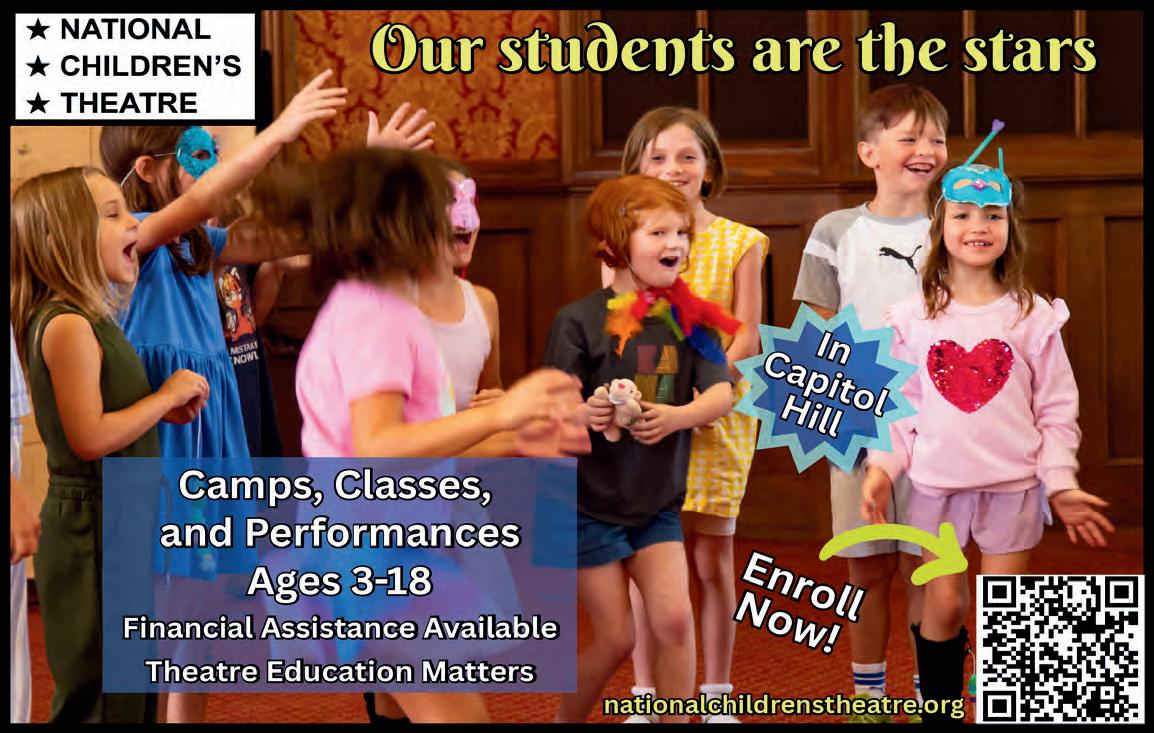
National Children’s Theatre nationalchildrenstheatre.org
Theatre education programs that help kids shine. Classes and summer camps for children ages 3–18 invite students to explore and perform imaginative stories of courage, friendship, and perseverance—building confidence while having fun. Families are invited to a culminating performance on the final day of each session.
Polite Piggy’s politepiggys.com
Serving DC families since 2008, Polite Piggy’s provides nurturing before- and after-school care, spring and winter break camp days, camp most days school is out, and summer camp. Programs are offered at Maury ES, Amidon-Bowen ES, J.O. Wilson ES, School Within School, and Capitol Hill Montessori at Logan. Camp days are open to families citywide, giving children a welcoming place to learn, play, and grow when school is not in session. Programs operate Monday through Friday. For enrollment information, call Ms. Rolanda at (240) 480-3195 Monday through Friday between 10:00 am and 6:00 pm.
The Washington Urban Debate League urbandebatewashingtondc.org (WUDL) supports students across the DMV, from elementary to high school, in developing communication, confidence, and critical thinking skills through debate. Our afterschool programs, tournaments, and mentorship initiatives prepare students to become thoughtful leaders and engaged citizens. By promoting dialogue, fostering understanding, and enhancing academic achievement, we help strengthen communities. Join your school’s debate team, or talk to us about starting one if your school doesn’t have one yet. u