BOCAGE COUNTRY CLUB HIGHLAND JEFFERSON TERRACE KENILWORTH PERKINS SOUTHDOWNS UNIVERSITY CLUB
ADVOCATE THE SOUTHSIDE
T H E A D V O C AT E.C O M
|
W e d n e s d ay, M a r c h 11, 2026
If you would no longer like to receive this free product, please email brtmc@ theadvocate.com.
1GN
Danny Heitman AT RANDOM
At a Louisiana art opening, I saw a hopeful answer to the headlines Thanks to “Winter,” a book by Val McDermid that I wrote about last week, I learned about a tradition in McDermid’s native Scotland that helps locals avoid the winter blues. Every January, the National Gallery of Scotland brings out 38 brilliant watercolors by William Turner for everyone to see. Henry Vaughan, a wealthy patron who donated the pictures long ago, made the January show a condition of his bequest. He thought showing the masterpieces in weak winter light would be the best way to preserve them. Vaughan’s idea had another pleasing result. During Scotland’s gray winters, Turner’s vivid images give visitors to Edinburgh’s premier art venue a redeeming splash of color. McDermid’s story about Vaughan and those Turner watercolors really resonated with me because every winter, I find myself especially drawn to the dazzling palettes in art museums, too. My birthday falls in January, when the holidays are gone and the weeks can fall prey to post-Yuletide blahs. For the past few years now, I’ve answered that challenge by giving myself the gift of an art museum visit. Previous itineraries have included the Dallas Museum of Art, home to a stellar Van Gogh exhibition in 2022, and the LSU Museum of Art, which staged an exhibit of American Impressionist paintings last winter. This year, my wife and I flipped the script a bit by visiting an art show to celebrate Valentine’s Day rather than my birthday. The LSU Museum of Art obliged with an evening of Champagne, desserts and fellowship to open its new exhibit of Marc Chagall lithographs, which runs through May 24. Chagall’s lyrical sense of humor and vivid embrace of color make his pictures blaze like a festive hearth, and opening night visitors to the exhibit almost seemed to warm their hands around his masterworks. “I need this now,” the museum’s executive director, Mark Tullos, said of the exhibit. “This puts me at peace. I’m glad you’re here to enjoy this with us.” Chagall, who died at 97 in 1985, lived in several places throughout his life, but his most formative years were in France. In a nod to Chagall’s artistic roots, Rudolphe Sambou, consul general of France in New Orleans, was on hand to offer remarks, too. “Culture is not an ornament for prosperous times,” Sambou told listeners. To the contrary, Sambou pointed out, it’s a sustaining part of our shared humanity. I thought about Sambou’s words as patrons sipped bubbly from plastic cups and milled around the lithographs, which were mostly conceived to explore romantic love. In a season of grim headlines, it was comforting to see so many people gathered at an event that joyously celebrated matters of the heart. For Chagall, who had suffered in life but answered its pain with beautiful images of soaring spirituality, art wasn’t merely an escape. It was a way to summon the best in us, something we all need now more than ever. Email Danny Heitman at danny@dannyheitman.com.
PROVIDED PHOTO
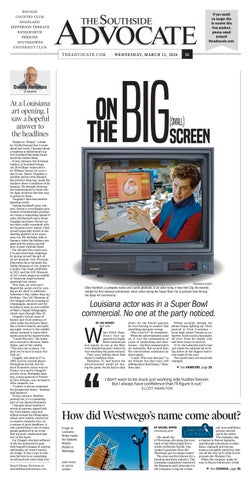
Elliot Hamilton, a Lafayette native and Loyola graduate, is an actor living in New York City. He recently landed his first national commercial, which aired during the Super Bowl. He is pictured here filming the Base 44 commercial.
Louisiana actor was in a Super Bowl commercial. No one at the party noticed. BY JAN RISHER
W
Staff writer
hen Elliot Hamilton’s face appeared in a Super Bowl commercial last month, no one at the Midtown Manhattan party where he was watching the game noticed. They were talking about Bad Bunny’s halftime show. Hamilton, 31, had known the advertisement would air during the game, but he had no idea
when. By the fourth quarter, he was starting to suspect that something had gone wrong. “Was I lied to?” he wondered. When the advertisement came on, it was the culmination of years of auditioning and nearmisses — his first commercial to air nationally. But around him, the conversation continued uninterrupted. “I said, ‘Who was that guy?’ to my friends, but they were still talking about Bad Bunny,” Hamilton said.
Within seconds, though, his phone began lighting up. Texts poured in from Louisiana — from high school friends in Lafayette, from Loyola classmates all over, from his family who had been sworn to secrecy. At 31, the Lafayette native had just made his national advertising debut on the biggest television night of the year. Two weeks later, not much had changed.
ä See HAMILTON, page 2G
I don’t want to be stuck just working side hustles forever. But I always have confidence that I’ll figure it out.” ELLIOT HAMILTON
How did Westwego’s name come about? A sign on Louisiana Street marks the Salaville Historic District in Westwego. STAFF PHOTO BY SOPHIA GERMER
BY RACHEL MIPRO Contributing writer
The small city of Westwego sits along the west bank of the Mississippi River within Jefferson Parish. One reader’s question: How did Westwego get its unique name? The area was first known for a bustling maritime industry. The Louisiana Legislature chartered the Barataria and Lafourche Canal Company to dig out a chan-
nel, in an ambitious project carried out in the 1830s. The company dug a channel to Bayou Segnette, and through extensions in other lakes, channels and bayous, made a navigable waterway that ran all the way up to what is now present-day Morgan City. When the company made its way to Bayou Lafourche, a lock
ä See CURIOUS, page 3G
2G ■ Wednesday, March 11, 2026 ■ theadvocate.com ■ The Advocate
lll
HAMILTON
was the Fournets — his mother’s large, lively and loud family of storytellers — who shaped his instincts on stage. “The only way to get their attention is if you tell a good story,” Elliot Hamilton said. “They all talk over each other. If you don’t hook them, they won’t listen.” That lesson translates easily to stand-up comedy.
Continued from page 1G
Hamilton still auditions regularly — about two to three times a week for commercials, web shows and television roles. He still works weekends at a Brooklyn restaurant that specializes in Southern food. During the week, he coaches youth baseball. He buys and resells baseball cards for extra money. He performs stand-up comedy five nights a week, mostly at open mics. He runs a show at Freddy’s Bar and often performs at O’Keefe’s Bar & Grill, Halyard’s Bar and Young Ethel’s — all in Brooklyn. “In acting,” he said, “you audition for like 8 billion things and never get anything — and then something just appears.” The Super Bowl commercial was his second national advertisement, but the first one he shot never aired.
After the cameras cut away
Choosing sports, then acting Hamilton graduated from Episcopal School of Acadiana in 2013 and earned an economics degree from Loyola University New Orleans in 2017. Acting, for most of that time, lived in the background. He had always liked performing. As a child, his mom says he was unusually verbal. He memorized the presidents and could recite them to a crowd. He enjoyed performing. Then, somewhere around middle school, sports took over. Mark Broussard, his high school baseball coach at Episcopal School of Acadiana, said that during the Super Bowl advertisement, he first recognized his former student’s voice and then he realized it was Hamilton on television. Hamilton is grateful for his time on the baseball field — despite it taking him away from theater and performing. “In junior high and high school, if you do anything other than sports, kids make fun of you,” Hamilton said. “So, I leaned into that.” He was part of his small high school’s theater productions, which were directed by Kat Surratt Movassaghi. She says she loves seeing former students pursuing paths of the arts in today’s world. “I always knew there was something special about him on the stage. He had a dry wit and good
Elliot Hamilton is pictured here acting in an independent horror film. comic timing,” Movassaghi said. Despite his ease on the stage, Hamilton chose to major in economics at Loyola and didn’t return to acting until his senior year, when he took a theater elective. He auditioned for a campus play and landed the lead. “All the theater kids were like, ‘Who’s this econ major getting the lead in our play?’ ” his father, Dr. Scott Hamilton of Lafayette, said. For Elliot Hamilton, getting back on stage felt less like a detour and more like a correction. “I remembered how much I liked it,” he said. “I was like, why did I ever get away from this?”
From accounting to waiting tables After graduating from Loyola in 2017, he took a job in accounting in New Orleans. He worked in an accounting firm for four years while quietly auditioning for independent films and small roles in New Orleans, where the film industry was booming at the time. He signed with an agent. He auditioned constantly. Nothing landed. Then, in 2021, he booked a role in an Amazon series that was set to shoot in New Orleans. On his first day on set, production shut down
PROVIDED PHOTO BY VICTORIA KEMP
because of COVID exposure. Soon after, he learned his scene had been written out. “It was really devastating,” he said. Two weeks later, he booked a small role in AMC’s “Mayfair Witches.” That one did film. It was enough to convince him the grind might lead somewhere. After he was fired from his accounting job, he leaned further into acting and performing. “I just didn’t care about becoming a better accountant,” he said. “If I don’t have full interest in something, it’s very hard for me to apply myself. But if I do, I kind of obsess over it.” He began waiting tables in New Orleans — and the money was good. Then he moved to New York in 2022, chasing broader opportunity. He says the first few months in the Big Apple felt like an adventure. He clicked with the pace of life immediately. “Every day I got up, I was excited,” he said. “You don’t know what’s going to happen, but it’s going to be interesting.”
Since the Super Bowl, he has been testing the story of the unnoticed commercial at open mics. It usually works. Still, he admits it feels awkward. He’s not completely comfortable talking about the experience. “It feels self-congratulatory,” he said. “Like, ‘Hey, I was in a Super Bowl commercial.’ ” In reality, the moment was less glamorous than it looked from afar. At the party in Manhattan, he eventually had to tell friends what they had missed. They pulled up the commercial on YouTube and replayed it. He still appreciates the element of surprise. “I think it’s more fun if your face just comes on the screen and people have no idea it’s going to,” he said. He knows building a career today is nearly impossible without the likes and follows. The industry, he knows, now runs on visibility. Social media followers matter. Short clips matter. Recognition matters. Even still, Elliot Hamilton appreciates the other indicators of success. “As long as I feel like I’m making progress, I’m comfortable,” he said. Most viewers saw him for a few fleeting seconds during the Super Bowl. The rest of the work — the auditions, open mics, restaurant shifts and coaching sessions — continues long after the cameras cut away. Back home in Louisiana, they noticed. Elliot Hamilton grew up in a large, loud Louisiana family where stories competed for air, and attention had to be earned. In New York, on small stages and in crowded audition rooms, he’s still earning it. Follow Elliot Hamilton on Instagram @definitelyelliothamilton.
tive and hardworking. “He auditions every day,” she said. “He hasn’t given up.” Like many parents, she hopes her son will one day buy a house and settle into financial stability. As parents, the Hamiltons have watched their son navigate the ups and downs of the arts with surprising tranquility. “He doesn’t mind the uncertainty,” she said. Elliot Hamilton acknowledges the instability. Acting pays well when the jobs come, he said, but the challenge is never knowing when that will be. “I don’t want to be stuck just working side hustles forever,” he said. “But I always have confidence that I’ll figure it out.” Work has never intimidated him. As a teenager, he spent summers working at his grandfather Howard Fournet’s Chevron station on Johnston Street in Lafayette — pumping gas, patching tires and cleaning the service bay in the heat. From 7 a.m. to 5 p.m., six days a week. “It taught me a lot about being hot outside in the summer,” he said Embracing the hustle with a laugh. His mother’s brother, Brian Email Jan Risher at jan.risher@ Elizabeth Fournet Hamilton, his mother, describes her son as posi- Fournet, ran the service station. It theadvocate.com.
S H E L L I S PRO U D TO S P O NSOR THE
Louisiana Sportsman Show
MARCH 20–22, 2026 ST. JOHN THE BAPTIST COMMUNITY CENTER / HWY 51 / LAPLACE The Louisiana Sportsman Show features exhibits from some of the biggest vendors in the state. This is also a place where entrepreneurs showcase the culture of Louisiana. The 2026 Show promises to be better than ever with a large kids’ activity zone and a food court featuring some of the top restaurants from the River Parishes. This high-energy event draws anglers, hunters, and outdoor lovers from across the region. Bring the family and enjoy the show!
Meet Jimmy Houston! Share adventures with America’s Favorite Fisherman and get an up-close look at Jimmy’s signature Shell Rotella bass boat.
● Free Parking ● Free admission March 20 (Friday) for active members of the military, veterans, and first responders. ● Free Kids Fishing Tournament ● Wetland Watchers will bring their “critters” and knowledge of Louisiana’s diverse environment. ● Louisiana Educators will host STEM activities. ● Dogs are Welcome Enjoy amazing retriever competitions. For more information visit www.louisianasportsmanshow.com
shell.us/louisiana | #PoweringProgress
The Advocate ■ theadvocate.com ■ Wednesday, March 11, 2026 ■ 3G
lll
CURIOUS
Continued from page 1G was built, creating the Company Canal waterway. Maritime workers, drawn by trade, became familiar with the area. But Westwego owes its name and population increase to later developments — namely the growth of the railroad industry a few decades later. New Orleans native John Churchill Chase gave an account of the settlement’s history in his book, “Frenchmen, Desire, Good Children and Other Streets of New Orleans.” The New Orleans, Mobile & Chattanooga Railroad, by 1870, had completed a line to Mobile. The company decided not to go onto Chattanooga, instead turning westward, aiming for Texas. The western division of the company, known as the New Orleans, Mobile & Texas Railroad, started looking for suitable sites for this westward line. They needed to build a terminus
with all the trimmings, docks, wharves and infrastructure for a railroad ferry. A plantation was purchased for this purpose and renamed Amesville. Disappointment struck when Amesville was discovered to have an unstable riverbank, unsuitable for transportation and construction purposes. A new site had to be found. The area near Company Canal, with its steady riverbank, rose to the occasion. The Westwego terminus was built there, and by 1871, construction on a western line began. Local stories have several versions of the naming process for this terminus. One of the more popular versions attributes the name to railroad conductors shouting “West-We-Go,” as the trains took off westward. Chase has a different theory: New York board directors. “It grew out of a series of meetings of the railroad’s board of directors in faraway New York,” Chase wrote. “They had purchased a huge plantation, only to find it useless for terminus pur-
“The New Orleans, Mobile and Texas Railroad have completed and have in operation their main stem from Westwego, distant from Canal street about five miles on the opposite bank of the river, Donaldsonville,” the Times-Picayune reported on July 19, 1872. While the terminal name caught on quickly, “Westwego” the city took time to build. Sensing an opportunity in 1892, entrepreneur Pablo Sala bought a tract of land on the lower side of Company Canal. He split the land into 162 plots, naming the whole area “Salaville.” After an 1893 hurricane wrecked the nearby fishing community of Cheniere Caminida, many Cheniere refugees bought PROVIDED IMAGE BY USGS plots and moved into the area, A 1950s map of Company Canal in Westwego at left, and Harvey Canal in drastically swelling the area’s population. Residents knew the Harvey, at right area by the Westwego terminus and the name of Westwego became the common way to referposes. … When the recommenda- from here!” In 1872, one of the earliest docu- ence the settlement. tions came in from the engineers The name was formalized in that the Company Canal was mented newspaper uses of the suitable, it was with great relief name was reported in The Times- 1919, when the area was incorpothat they voted, “Then west we go Picayune. rated as the “Village of Westwego.”
BETWEEN THE PAGES WITH DR. MARC SIEGEL
Scalise among cases called ‘miracles’ in new book Bestseller tells stories of divine, modern medicine working together
it includes science. It’s like saying, “Let’s value the preciousness of each human soul.” Doctors like that, because many of them, the vast majority, already believe. What led to your including prayers in the book? And does a miracle have to come from a prayer, in your opinion, or through prayer? Prayers are connected to miracles, but not all your prayers are going to be answered the way that you ask. I added that section because those are healing prayers. These are, for the
BY JUDY BERGERON Staff writer
Dr. Marc Siegel offers three reasons why his book, “The Miracles Among Us,” was recently on The New York Times and Publishers Weekly bestsellers lists for seven weeks. First, it’s hopeful. Second, people like stories, and third, people can relate to these stories. Siegel “The idea that miracles aren’t rare, that they’re more common than we think, that they are relatable, is very uplifting to people, and it’s also true,” Siegel said. His years in the medical field don’t conflict with his belief in these inexplicable events, as Siegel sees the doctors and the divine working together in these situations, he said. Siegel spoke by phone from New York, where he’s a clinical professor of medicine and practicing internist at NYU Langone Health, medical director of “Doctor Radio” on SiriusXM and senior medical analyst for Fox News. The author devotes each of 16 chapters to a different “miracle” subject, detailing, through extensive research and interviews, how divine intervention unfolded for that person. Among these stories are those of Buffalo Bills safety Damar Hamlin’s cardiac arrest during a 2023 game, Dan Redfield’s traumatic brain injury and subsequent hemicraniectomy (removal of the front half of the skull) after a fall from a moving golf cart, and that of House Majority Leader Steve Scalise of Metairie. Scalise was critically wounded by gunfire in a 2017 shooting during a practice for the annual Congressional Baseball Game in Alexandria, Virginia. He had a 10% chance of survival. Here, the author discusses the Scalise case, how different religions view miracles, how accurate the TV medical dramas are and why he included prayers in his book. This interview has been edited for clarity and brevity. What struck you as you interviewed Scalise about the shooting and its aftermath? His courage and strength. His indomitable spirit. He’s a person of great faith in prayer. He believes that people praying for him made a big difference. He believes the people on the field that got him off the field, into that helicopter,
got the tourniquet on, got the IV and gave him fluids. And he arrives in the ER with a blood pressure close to zero and needing 50 units of blood. He feels that that coordination of effort was divine. In the book, you touched on the different religions and how they look at miracles. Would you talk a little on that? The Catholic Church tends to define miracles as there is no other explanation but divine intervention. But it’s not the only way to look at a miracle. Cardinal (Timothy) Dolan says to me that there’s also soft miracles where, if God’s hands are the hands of great physicians, that, plus an accumulation of coincidences, leads to a miracle that would be a soft miracle, where a personal God is present in the world. That is incredibly uplifting to people — the effects of prayer, God choosing what miracles he wants to give. That’s perhaps a Christian point of view on miracles, but not a Catholic point of view. It’s certainly the Jewish point of view on miracles, that God is present every day and makes his presence felt every day in magical events. I’ve had many conversion moments in my life, and many things occur that are unfathomable. Like the time in the ICU when I was a resident, when a man had been in a coma for three months, the family praying every day at the bedside. The man woke up when everybody had written him off, and we thought the family was crazy. They’re saying, “Look, he’s moving. Look, he’s twitching. Look, his heart rate’s going up.” We were just dismissive, and then the man walks out of the ICU and goes back to work. What do you do when you are working alongside a doctor who doesn’t believe any of this? I haven’t had that, because over 70% of doctors have faith and over 55% think they’ve seen miracles in their daily practice. But doctors don’t want to admit it because they’re afraid that people will see them as diluting their science. Not a single physician has complained or come to me and said, “This is hogwash,” because I’m careful to distinguish what is a miracle, including science. It’s not instead of science,
most part, healing miracles, and I am a healer. I see myself as a healer. We’re too ecumenical about it these days. We’re like, “We’re scientists.” But there’s no distinction between faith and science when you get inside the human body and see the incredible miracle of life itself. So I think the prayer section fits because it’s icing on the miracle cake. How well do you think TV medical dramas are capturing accurately what happens in a hospital? “The Pitt” is doing a good
job, and I think “ER” did a pretty good job. I think “Grey’s Anatomy” does a pretty good job. But here’s where they fall short: Drama always supersedes the differential diagnosis. So something that’s unlikely, if it’s dramatic enough, will appear more likely in a medical drama, whether it’s “The Pitt, or whether it’s “ER” or whether it’s “Grey’s Anatomy,” the drama supervenes. Anything to add? If my book accomplished
anything, it’s to teach people that there’s no separation between science and faith. That doesn’t need to be there. Most doctors will tell you they’ve seen miracles in their practice. Look at miracles as an accumulation of events that have a positive outcome — that creates a sense of hope and togetherness in our society at a time when it’s badly needed. Email Judy Bergeron at jbergeron@theadvocate. com.
TAKE THE �0-DAY WALK TEST During M�rch, purch�se �ny p�ir of regul�r-price Johnston & Murphy shoes �nd we�r them for !" d�ys. If you’re not completely s�tisfied, return them for � full refund.*
Gillian Penny Loafer
Tyson Plain Toe Leather Oxford
*To receive a full refund, shoes must be returned with the original receipt within 10 days from date of purchase. Selection varies by size and store. Call 1-800-345-5273 to find a Dillard’s store near you.
4G ■ Wednesday, March 11, 2026 ■ theadvocate.com ■ The Advocate
lll
THE PERFECT GIFT! Celebrate LSU baseball’s eighth national championship with this hardcover collector’s book
ONLY
35
$
95
OR VISIT STORE.THEADVOCATE.COM
ORDER
PLUS COMMEMORATIVE POSTERS Celebrate the Tigers’ eighth national championship with commemorative stadium edition and front page posters.
ADVOCATE THE
T H E A D V O C AT E.C O M
T H E T I M E S - P I C AY U N E
|
M o n d ay, J u n e 23, 2025
5
NOLA.COM
✦
M O N D A Y, J U N E 2 3 , 2 0 2 5
✦
1C
COLLEGE WORLD SERIES
$2.00X
1991 1 • 1993 • 1996 • 1997 • 2000 • 2009 • 2023 • 2025
COLLEGE WORLD SERIES L S U
✦
SPORTS
BATON ROUGE, LOUISIANA
C C U
3
GRRR-8 8!
NSHIP TIGERS WIN EIGHTH NATIONAL CHAMPION
LSU BASEBALL WINS ITS
EIGHTH
NATIONAL TITLE
NATIONAL CHAMPIONSHIP
NDISPUTED UN LEGEENDARY PITCHING, TIMELY HITTING AND LSU’S KNACKK FOR THE MOMENT RECHARGE DYNASTY TALK
CELEBRATION ALEX BOX STADIUM WEDNESDAY, JUNE 25TH, 2025
STAAFF PHOTO BY HILARY SCHEINUK
The Tigers celebrate after defeating Coastal Carolina 5-3 in game two of the College Worl d Series finals in Omaha, Nebraska, on Sunday. The roar is restored. When Jay Johnson took over aas the LSU baseball coach in 2022, the six-time national champion Tigers were in the midst of a 13--year title drought. The Tigers returned to the top of college baseball during the 2023 season. LSU survived s a dicey regional that went to a winner-take-all final at Alex Box Stadium against upstart LLittle Rock. Then LSU dominated, sweeping the super regional and College World Series in seveen games. After Sunday and Johnson’s second national title, he has LSU threatening to reboot a dynnasty that blossomed under legendary coach Skip Bertman. No. 8 is on its way to Baton Rouge. ä SEE COMPLETE COVERAGE OF THE TIGERS’ COLLEGE WORLD SERIES WIN. PAGGE 1B
WEATHER HIGH 94 LOW 74 PAGE 12A
Classified .....................6C Deaths .........................9A Metro ...........................8A Comics-Puzzles .....3C-5C Living............................1C Opinion .....................10A Commentary .............11A Lottery..........................8A Sports ..........................1B
100TH YEAR, NO. 358
STAFF PHOTO BY HILARY SCHEINUK
LSU center fielder Chhris Stanfield, right, celebrates with catcher Luis Hernandez as they both score on a two-run single by left fielder Derek Curiel in the fourth inning of Game 2 of the Collegge World Series finals against Coastal Carolina on Sunday at Charles Schwab Field in Omaha, Neb. LSU scored four runs in the decisive inning and won 5-3 to earn its ssecond title under coach Jay Johnson in four years. BY KOKI RILEY OMAHA, Neb. — To calll anything a dynasty requires a certain level of consiistent, championship excellence. The Boston Celtic cs in the 60s, New York Yankees in the 90s and UCo onn women’s basketball in the 2010s certainly fit th he description. LSU winning five national championsh hips in 10 years under Skip Bertman definitely qualiifies. Coach Jay Johnson n’s Tigers aren’t quite there yet, but what LSU acco omplished Sunday afternoon at Charles Schwab Fielld was remarkable nevertheless and potentially the b beginning of another baseball dynasty in Baton Roug ge. For the eighth tim me in program history, and for
the second time in three seasons, LSU won the national championship. The Tigers took down Coastal Carolina 5-3 in Game 2 of the College World Series final to secure the 2025 title. “Unbelievable. I’m so proud right now,” Johnson said. “It’s not to be taken for granted being here two years ago. That was special. Greatest night of my life. “This is equal and maybe even tops it in some ways.” The win secured Johnson’s second title in four years at LSU, making him the first coach in college baseball history to accomplish that feat at the same school. The Tigers did it despite bringing back just 12 players who appeared in a game from last year’s team, adding 12 players from the transfer portal,
three junior-college recruits and 10 freshmen in the offseason. “We (added) really talented freshmen ...,” Johnson said. “In a month’s time, we were able to add Chris (Stanfield). We were able to add Anthony (Eyanson), Zac Cowan, Luis Hernandez, Danny Dickinson to those 12 guys who were the right 12 guys.” With the score tied 1-1, the fourth inning proved to be the difference between a coronation and a Game 3 on Monday. The Tigers scored four runs on a walk, a hit by pitch and four singles to take a 5-1 lead. Sophomore Jake Brown led off with a walk before a single from junior Jared Jones and a hit by pitch loaded the bases for the junior Stanfield.
Rabalais: Thesse Tigers measure up to LSU’s toweringg expectations, Page 4C
Braswell’s fingerprints all over Tigers’ College World Series title, Page 5C
See which Tigers made an appearance on the All-CWS team, Page 5C
Staff writer
VISIT STORE.THEADVOCATE.COM OR
ä See LSU, page 4C