COURSEY HARRELLS FERRY MILLERVILLE OLD JEFFERSON PA R K V I E W SHENANDOAH TIGER BEND WHITE OAK
ADVOCATE THE SOUTHEAST
T H E A D V O C AT E.C O M
|
W e d n e s d ay, J a n u a ry 14, 2026
“
To see the core stage of the rocket we had been building for years rolled out of Michoud, led by a New Orleans-style second-line parade, and then to give the iconic ‘Go’ command over the radio when we tested it — I’ll never forget those moments.
Danny Heitman AT RANDOM
Some thoughts on hope as a new year arrives
“
As a journalist, I often get to connect with people throughout the year who are smart and thoughtful, and I treasure what they say about their life and work. Their ideas about hope come back to mind each January as I try to cultivate a brighter view of the future. A new year can renew our sense of possibility, though that kind of confidence might be hard in such an anxious world. Here are some pearls of wisdom I encountered last year, words that have helped me keep things in perspective. Last October, I attended an evening program with Essie Chambers, winner of the 2025 Ernest J. Gaines Award for Literary Excellence. Now in its 18th year, the award honors the legacy of Gaines, the Louisiana author best known for Chambers “The Autobiography of Miss Jane Pittman” and “A Gathering of Old Men.” I’ve worked in a small way as a volunteer for the awards program, which is curated by the Baton Rouge Area Foundation, so meeting Chambers was special for me. She was honored because of her debut novel, “Swift River,” which has gotten widespread acclaim since it was published in 2024. As Chambers pointed out when she discussed her novel at the Baton Rouge ceremony, success as an author came slowly for her. For a long time, Chambers recalled, she was known as one of those people always trying to finish a novel. “It took me almost 10 years to write ‘Swift River,’ ” she told listeners. “I do think there can be courage in small steps.” The point is that progress moves so slowly at times that it can seem almost imperceptible. But steady effort over time can eventually pay off, as Chambers and her debut novel make clear. It’s a good point to keep in mind in this season of New Year’s resolutions, when so many of us get discouraged if results don’t come instantly. The important thing, Chambers suggested, is to make a start somewhere and chip away at it, even when the finish line seems elusive. “Beginning is a messy business,” she said, “full of doubt and stubborn hope.”
1GN
If you would no longer like to receive this free product, please email brtmc@ theadvocate.com.
AMANDA GERTJEJANSEN
PHOTO PROVIDED BY ERIC BORDELON
Boeing senior production manager Amanda Gertjejansen is coordinating efforts among various departments to build one of the Artemis rocket’s most important components.
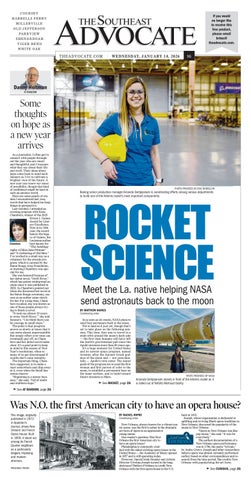
ROCKET SCIENCE Meet the La. native helping NASA send astronauts back to the moon
BY MATTHEW HAINES Contributing writer
In as soon as six weeks, NASA plans to send four astronauts back to the moon. Not to land on it just yet, though that’s set to take place on the following mission. This time, they aim to travel in a wide orbit around the moon’s dark side — the first time humans will have left the Earth’s gravitational pull since the Apollo missions more than 50 years ago. It’s a huge moment for United States and its newest space program, named Artemis, after the Ancient Greek goddess of the moon and — not coincidentally — Apollo’s twin sister. The stated goals of the program are to send the first woman and first person of color to the moon, to establish a permanent base on the lunar surface, and to build toward future missions to Mars.
ä See ROCKET, page 2G
PHOTO PROVIDED BY NASA
Amanda Gertjejansen stands in front of the Artemis rocket as it is rolled out of NASA’s Michoud facility.
ä See AT RANDOM, page 2G
Was N.O. the first American city to have an opera house? This image, originally published in 1872 in Appleton’s Journal, shows New Orleans’ old French Opera House. Built in 1859, it stood out among its French Quarter neighbors as a particularly elegant, imposing and modern structure. PROVIDED PHOTO
BY RACHEL MIPRO
Contributing writer
New Orleans, always known for a vibrant music scene, was the first to usher in the dramatic art form of opera to an appreciative young nation. One reader’s question: Was New Orleans the first American city to have an opera house? Philadelphia is commonly credited with the oldest existing opera house in the United States — the Academy of Music opened in 1857 and is still operating today. However, OperaCréole founder and Artistic Director Givonna Joseph turned to the longdestroyed Théâtre d’Orléans to credit New Orleans with the first opera house in the U.S.
back in 1815. Joseph, whose organization is dedicated to uplifting and reviving Black opera traditions in New Orleans, discussed the popularity of the music in New Orleans. “Opera in New Orleans was like pop music,” she said. “It was for everybody.” The earliest documentation of a New Orleans opera performance was in 1796, the opera “Sylvain,” by Andre Gretry. Joseph and other researchers believe opera was almost certainly performed earlier, based on other correspondence and research from the time period. She credits New Orleans with popularizing the art form.
ä See CURIOUS, page 2G
2G ■ Wednesday, January 14, 2026 ■ theadvocate.com ■ The Advocate
lll
ROCKET
Continued from page 1G But the upcoming Artemis missions aren’t only a big deal for NASA, they’re a massive milestone for New Orleans, home to the 832-acre Michoud Assembly Facility. The facility is nicknamed “America’s Rocket Factory,” thanks to its important role in the enormous rockets that powered the Apollo, Space Shuttle and now Artemis adventures. As many as 3,500 employees work at the facility in New Orleans East, but perhaps no one exemplifies the Crescent City’s role in the future of space exploration more than senior program manager Amanda Gertjejansen. She works with Boeing, a NASA partner at Michoud. Her leadership role on the Integrated Product Team means she is coordinating efforts among various departments to build one of the Artemis rocket’s most important components. For the past eight years, Gertjejansen’s career trajectory has mirrored that of Michoud’s role in the Artemis program. “Amanda’s career is the story of how to build a rocket,” said Patricia Soloveichik, a former member of Boeing’s space and launch systems communications team. “She was there to turn on Michoud’s lights when the Artemis program began, and she’s still there now leading the teams that are assembling the very rockets sending our astronauts back to space. Amanda has been a big part of it all.”
STAFF FILE PHOTO BY SOPHIA GERMER
Amanda Gertjejansen and Ashley Guidry stand in front of the second Artemis rocket during a 2022 tour at NASA’s Michoud Assembly Facility in New Orleans. The third Artemis rocket, which is also being assembled in New Orleans, plans to land on the moon in 2026.
A curious mind Gertjejansen, 38, grew up in Gentilly. She said she was aware of NASA’s work even then. “I was a kid when Michoud’s big external tanks were powering the Space Shuttle program and helping to build the International Space Station,” she said, “I’ve always loved science and math, so I was interested.” At Ben Franklin High School, Gertjejansen said she was “just fine” at subjects like reading comprehension and writing, but her love of science flourished. She remembers quarterly projects in physical science class sparking her interest. “One project I’ll never forget was we had to take this ping pong ball and, with just a single motor that had to turn off by itself, we had to get it to drop something like 60 centimeters in 3 minutes,” she said. “Solving challenges like that were really fun for me, and they still are.” It doesn’t take much imagination to draw the connection between those projects and the work being done at Michoud. But Gertjejansen said an equally important influence was her role as Ben Franklin’s yearbook editor, where she was responsible for pulling sections together from various teams. “Overseeing big projects and integrating the different sectors of work is exactly what I am responsible for as an industrial engineer,” she said. “It’s part of what drew me to that major at LSU.” An engineering degree also represented financial security, something she said she watched her mother struggle with. Even as an adolescent, Gertjejansen vowed to choose a career path that would provide her enough money to support herself. Mission accomplished. She landed an internship with Boeing at Ridley Park, Pennsylvania, outside of Philadelphia. Her team was on the assembly floor, building Boeing
CURIOUS
Continued from page 1G Opera quickly became a growing presence in the local theater scene, and a proper space was needed to house these performances. The Théâtre d’Orléans, located on Orleans Avenue between Royal Street and Bourbon Street, opened to the public in 1815, according to the research of Henry Arnold Kmen, in his book, “Music in New Orleans: The Formative Years, 1791– 1841.” The building, which had taken years to build due to constant funding and construction struggles, was soon destroyed by fire in 1816. Rebuilt and reopened in 1819, the theater became a lodestone for U.S. opera. A flood of theater spaces would follow, including the Camp Street Theatre, the St. Charles Theatre and the New American Theatre. “We were first in the country on many levels,” Joseph said. “We debuted over 200 operas in America for the first time. Sometimes we had two or three opera houses going at a time, and free people of color had the money to support
STAFF FILE PHOTO BY BRETT DUKE
NASA’s Michoud Assembly Facility in New Orleans is nicknamed ‘America’s Rocket Factory,’ thanks to its important role in the enormous rockets that powered the Apollo, Space Shuttle and now Artemis adventures. CH-47 Chinook helicopters during the aircraft’s 50th anniversary. It was a pivotal time for Gertjejansen. “My housemate’s manager was a flight test manager, and he invited us to join him on a Chinook test flight,” Gertjejansen remembered. “We had the headphones on and could hear the startup commands over the radio. I was just blown away. Like, ‘Wow, we do some very cool stuff at Boeing!’ ” The internship turned into a job, and Gertjejansen was having a blast — in her 20s and far from home. Unfortunately, the good times were tragically interrupted. Gertjejansen learned her mother had become sick and was given just six months to live. “I decided to leave my job and return home to take care of my mom,” she said. “Unfortunately New Orleans didn’t have a lot of jobs in science and math with Michoud closed since the end of the Space Shuttle program. I thought
my dream career was over.”
Coming home That was 2012, when Boeing had recently landed the contract at Michoud to help build the largest segment of the longest, most powerful rocket ever made. This “core stage” section would occupy 212 feet of the 322-foot-tall Space Launch System (SLS) rocket tasked with sending humans back to the moon and beyond. When Gertjejansen informed Boeing that she would be returning home to care for her mother, they offered her a position on the company’s Michoud team. “Against all odds, my mother lived for another five years, and I can’t thank Boeing enough for giving me that time with her,” she said. “And,” she added, “it didn’t hurt that I got to come home to a city I love and build a rocket in my backyard.”
New Orleans to the moon Gertjejansen remembers turn-
ing the lights on at Michoud in those early days. “It had been years since anyone had worked in these spaces,” she said, “so when I flipped on the lights for morning meetings, you’d have stray cats running out of who knows where. It was wild and showed it would be a long road for us.” Like Soloveichik said, Gertjejansen’s career followed that same road as Artemis. She was part of the small team that prepared the empty facility and then installed the first large welding tools that would one day build a rocket. By 2018, she had become an industrial engineering manager, responsible for the rocket’s engine section and its vital system of fueling tubes. An industrial engineer, Gertjejansen said, is responsible for the efficiency of a project. How are each of the teams balanced, where are the bottlenecks, and where and how should resources be deployed to solve those bottlenecks? As she moved through Boeing’s
Many of these theatre spaces were destroyed by fire; the Théâtre d’Orléans fell prey to flame in 1866 and the French Opera House went ablaze in 1919. “Unfortunately, some of these beautiful opera houses burned down,” Joseph said. “As I tell people, when you have to use real flame to light the stage, it becomes problematic.” While the spaces disappeared, the impact of opera in New Orleans reJoseph mained, including in the city’s most famous musical genre. Joseph discussed the STAFF FILE PHOTO BY SOPHIA GERMER legacy of musicians of color, who, A plaque commemorates the site of the old French Opera House at when barred from mainstream performances, found their own Toulouse and Bourbon streets in the French Quarter. performance spaces and styles. great acclaim. Created in the “We ended up being kicked them. style of European opera houses out of the classical and operatic “We also learned that someon the corner of Toulouse and arena,” Joseph said. “Many of times enslaved people who could Bourbon, the building had an orour musicians found work in Stohire themselves out on a Sunday —making money as iron workers chestra pit, four tiers of seating ryville, and they came together and plasterers and all that and with musicians who were experts and a gallery. would use that money to buy their in African rhythms and Caribbe“There will be, we are confreedom — also bought a ticket to vinced, no such elegant and coman sounds. All of those structures the opera.” came together, and that’s what modious theatre in the country,” The city’s French Opera House, reads a Daily Picayune report on created jazz. People don’t realize one of the grandest opera spaces that opera and classical music the near completion of the opera in the city, was built in 1859 to had this role of creating jazz.” house, dated Oct. 25, 1859.
ranks, Gertjejansen proved talented at answering these questions. “Amanda is reliably able to convert ambiguity into executable plans, which is why she is consistently assigned to high-priority and technically challenging work,” said Mickey Bennett, manufacturing director for the entire Space Launch System program. In 2019, Gertjejansen’s efforts were rewarded, as she was promoted again — this time to senior operations manager, responsible for the final assembly of the entire 212-foot core stage for Artemis’ initial mission, Artemis I. The following year she moved with the core stage to the John C. Stennis Space Center in Hancock County, Mississippi, where she helped lead testing efforts. “By then, I had been working on Artemis for years,” Gertejansen said. “To see the core stage of the rocket we had been building for years rolled out of Michoud, led by a New Orleans-style secondline parade, and then to give the iconic ‘Go’ command over the radio when we tested it — I’ll never forget those moments.” The Boeing team is now working on core stages for several Artemis missions simultaneously. Today, Gertjejansen is coordinating efforts to build those rockets. She travels frequently to Florida’s Kennedy Space Center, where she is helping integrate the vehicle with the rest of its components including boosters, the second stage of the rocket and the Orion spaceship that will carry the astronauts as part of the upcoming Artemis II mission. “The vehicle is stacked vertically and almost ready to go,” Gertjejansen said, “and it’s amazing to think that this thing I have been working on in various capacities for the last eight years is about to send four astronauts around the moon for the first time in a halfcentury.” “It’s all the sweeter that we’re building some of its most important components — for this mission and the many more to come — in the city I call home.”
AT RANDOM
Continued from page 1G For a magazine story last year, I interviewed Arthur C. Brooks, who writes and lectures about the best way to achieve happiness. His latest book, “The Happiness Files,” elaborates his thinking on the subject. I asked Brooks how he finds hope these days. “I understand that wellbeing trends are moving in the wrong direction, and I’m not incredibly optimistic about those trends making a full Uturn,” Brooks told me. “But I’m not hopeless. The reason I research, write, speak and teach about happiness is because I think — notwithstanding the data in front of me — that I can make a difference. That’s what gives me hope.” His comments reminded me that hope isn’t only something you feel but something you do. It’s a truth I’ll try to embrace as 2026 unfolds. Email Danny Heitman at danny@dannyheitman.com.
The Advocate ■ theadvocate.com ■ Wednesday, January 14, 2026 ■ 3G
lll
FAITH & VALUES Catholic order to help revive historic Quebec church BY VICTOR GAETAN
Contributing writer
The largest church in Quebec City, Saint-Roch, gives its name to a hip neighborhood on the St. Lawrence River where shipyards once drew a population of working-class Catholics. The church, the fourth to occupy the site, was built on medieval architectural lines in 1811, and the vast stone structure is still grand, though it now houses a homeless shelter in its basement where several community organizations also find shelter. St. Roch’s last fulltime priest left 30 years ago. For the last few years, Saint-Roch had been open for just one Mass a week, drawing complaints on tourist websites from visitors. “I came on a Wednesday and was disappointed that it was only open a few hours on Sunday,” wrote one, “so missed my chance of seeing inside the church where my ancestors worshipped.” But lately, hope has arrived in the form of a group of priests and brothers from a faraway mission field that has little to do with Saint-Roch’s gentrified cafes and bars. On Dec. 17, Cardinal Gérald Cyprien Lacroix, archbishop of Quebec, will announce that the church’s new custodians will be the Missionaries of Africa, a 157-year-old Catholic order dedicated to planting peace and church communities in undeveloped places. Though its first recruits came from Europe, beginning in 1901 its ranks were filled by Quebecois. “Hundreds of vocations came from Quebec to serve in Africa. Some are still living, although older now and most retired,” Lacroix told Religion News Service. In thanks for the city’s dedication, the cardinal explained, “the Missionaries of Africa’s international office (in Rome) offered to come back and establish themselves here in Quebec,” saying, according to Lacroix, “You helped us so much. You helped us train priests, form priests, work with the poor, establish parishes in many countries of Africa. Now we know you need help, and we want to come and work with you. Whatever you need, wherever you need us, we are available.”
PROVIDED PHOTO BY VICTOR GAETAN
he Rev. Serge St-Arneault is seen in the Missionaries of Africa offices in Montreal. St-Arneault is one of three Missionaries of Africa who will move to Quebec City to take over as guardians of Saint-Roch Church. Founded by French Cardinal Charles Lavigerie in 1868 while he was serving as bishop of Algiers, Missionaries of Africa were among the first Catholics to systematically evangelize east and west Africa. The cardinal was a huge personality of his time, adviser to Napoleon III, then emperor of France, and Popes Pius IX and Leo XIII. Lavigerie was passionate about evangelizing Africa while ending the slave trade, buying freedom for untold thousands while lobbying the Vatican for increased antislavery commitment. Lavigerie dressed his priests in white robes, similar to kaftans worn by Muslim imams in North Africa. A black and white rosary worn around their necks signaled Catholic identity. The missionaries were known as les pères blancs (the white fathers) and most were, indeed, white. Today, the majority of active
white fathers are Black, serving across Africa as well as in Mexico and Asia. While seminaries in France and Canada have closed, in countries such as Burkina-Faso, Ghana and Kenya their classes are full. In Uganda, in 1911, the missionaries established the first modern Catholic seminary south of the Sahara, which continues today. The Rev. Barthélémy Bazemo, provincial of the Americas for the Missionaries of Africa, based in Washington, D.C., who helped shepherd the Saint-Roch project, explained that the order is also responsible for two other churches, in Brooklyn, New York, and Queretaro, Mexico. Staffing up at Saint-Roch is especially important because Quebec’s Catholic community is experiencing a resurgence in faith: Between 2023 and 2025, the number of baptisms in the archdiocese increased more than 500%, mainly of adults
under age 30. The majority of those baptized were born in Africa or Latin America. “We have a lot of migrants, a lot of people from different countries, and among them many Africans from different countries,” explained Lacroix, who served as a missionary to Colombia for eight years as a young priest. He calls the rash of baptisms one of the city’s “signs of hope” because “many newcomers are fervent, giving a good witness and helping us.” Immigration is a major demographic driver in the province of Quebec. Permanent immigration increased in 2024 over 2023, with more than 15% of new permanent residents last year coming from the central African nation of Cameroon, according to the Institut de la Statistique du Québec. “What gives me a lot of hope is to see what the Lord is doing, through the work of the Holy Spirit, in dif-
ferent areas of our diocese,” said Lacroix. “We have some parishes that are growing. Young people are discovering the faith. We are seeing more youth groups. This year we had more than double the number of catechumens, during the Easter season.” Currently, 17 seminarians are studying for the priesthood in Quebec City. “We crossed some very difficult years. There are still many challenges, but I see hope, I see hope. We also have more seminarians than we have had in the last decade,” the cardinal said. Just as Lavigerie sent missionaries in groups of three, a team of three Francophone missionaries, Lacroix said, “will be a pastoral and compassionate presence at Saint-Roch for the people in Quebec City’s Lower Town, a historic area where there is a lot of need. So, we are very, very happy. We’ve been wanting to do this for a long time, but we just didn’t have the personnel.” Two of the three are Canadianborn and currently based in Montreal: the Rev. Serge St-Arneault and Brother Dennis Walsh. The third, the Rev. Jean Paul Guibila, served as a missionary in Congo and is currently working at the Missionaries of Africa headquarters in Rome. He’s expected to arrive in Quebec City early next month. St-Arneault helps lead Montreal’s Centre Afrika, which provides support ranging from employment advice to choir practice space for diverse African communities. He said he and his confreres have minimal material needs. In terms of housing, he said, “Whatever the diocese provides is fine for us.” (Saint-Roch’s rectory was sold off years ago.) “We will feel at home as long as we are able to serve the church and the pastoral needs of the community.” Bazemo, born in Burkina-Faso, explained to RNS: “We feel strongly that we must open up to ministry in the Global North. In the past we were geared toward Africa but now the African world has gone beyond. There’s a need for our charism worldwide.”
Helping Small Businesses Thrive
Rewriting the Rules: R LaQueda Ricks Turns HR Expertise into a Growing Business
A
fter more than two decades in human resources, LaQueda Ricks understood the complexities of people and policy, and had become a trusted leader in her field. She spent years helping organizations structure HR departments, guide leadership development, and champion workplace equity. Now she was ready to do it on her own terms. As a result, 4D HR Consulting was born; a firm named for the four pillars that guide its work: Discover, Design, Develop, and Deliver.
“The tips the Shell LiveWire program gave me were game changers. It helped me connect with my audience and build my platform.” L AQUEDA RICKS | 4D HR CONSULTING
Introduced to the Shell LiveWire program through Louisiana Economic Development (LED), LaQueda saw it as a chance to take 4D HR to the next level. “You have to learn everything, from accounting to branding,” she explained. Through Shell LiveWire, LaQueda dug into profit and loss statements, budgeting, and branding. She refined her messaging, began leveraging social media, and even had posts go viral; something she attributes directly to what she learned in the program. Since completing Shell LiveWire, LaQueda is positioning 4D HR for national partnerships, all while staying rooted in her mission: Aligning people, policy, and performance.
Ready to grow your business? Applications for the 2026 Shell LiveWire Louisiana program are open through January 26, 2026 for businesses from Ascension, Assumption, East Baton Rouge, West Baton Rouge, Iberville, Jefferson, Lafourche, Livingston, St. Charles, St. James, St. John the Baptist, St. Mary, and Terrebonne Parishes. All industries welcome.
Apply now at www.shell.us/livewire.
shell.us/louisiana | #PoweringProgress
4G ■ Wednesday, January 14, 2026 ■ theadvocate.com ■ The Advocate
lll
FRONT PAGE POSTERS! DVOCA VOCATE AD THE
T H E A D V O C AT E.C O M
T H E T I M E S - P I C AY U N E
BATON ROUGE, LOUISIANA
|
M o n d ay, J u n e 23, 2025
5
NOLA.COM
✦
M O N D A Y, J U N E 2 3 , 2 0 2 5
✦
1C
SPORTS COLLEGE WORLD SERIES
$2.00X
1991 • 1993 • 1996 • 1997 • 2000 • 2009 • 2023 • 2025
UNDISPUTED
COLLEGE WORLD SERIES L S U
✦
C C U
3
GRRR-8!
LEGENDARY PITCHING, TIMELY HITTING AND LSU’S KNACK FOR THE MOMENT RECHARGE DYNASTY TALK
TIGERS WIN EIGHTH NATIONAL CHAMPIONSHIP
STAFF PHOTO BY HILARY SCHEINUK
The Tigers celebrate after defeating Coastal Carolina 5-3 in game two of the College World Series finals in Omaha, Nebraska, on Sunday. The roar is restored. When Jay Johnson took over as the LSU baseball coach in 2022, the six-time national champion Tigers were in the midst of a 13-year title
STAFF PHOTO BY HILARY SCHEINUK
drought. The Tigers returned to the top of college baseball during the 2023 season. LSU survived
LSU center fielder Chris Stanfield, right, celebrates with catcher Luis Hernandez as they both score on a two-run single by left fielder Derek Curiel in the fourth inning of Game 2 of the College World Series finals against Coastal Carolina on Sunday at Charles Schwab Field in Omaha, Neb. LSU scored four runs in the decisive inning and won 5-3 to earn its second title under coach Jay Johnson in four years.
a dicey regional that went to a winner-take-all final at Alex Box Stadium against upstart Little Rock. Then LSU dominated, sweeping the super regional and College World Series in seven games.
BY KOKI RILEY
blossomed under legendary coach Skip Bertman. No. 8 is on its way to Baton Rouge. ä SEE COMPLETE COVERAGE OF THE TIGERS’ COLLEGE WORLD SERIES WIN. PAGE 1B
WEATHER HIGH 94 LOW 74 PAGE 12A
Classified .....................6C Deaths .........................9A Metro ...........................8A Comics-Puzzles .....3C-5C Living............................1C Opinion .....................10A
OMAHA, Neb. — To call anything a dynasty requires a certain level of consistent, championship excellence. The Boston Celtics in the 60s, New York Yankees in the 90s and UConn women’s basketball in the 2010s certainly fit the description. LSU winning five national championships in 10 years under Skip Bertman definitely qualifies. Coach Jay Johnson’s Tigers aren’t quite there yet, but what LSU accomplished Sunday afternoon at Charles Schwab Field was remarkable nevertheless and potentially the beginning of another baseball dynasty in Baton Rouge. For the eighth time in program history, and for
the second time in three seasons, LSU won the national championship. The Tigers took down Coastal Carolina 5-3 in Game 2 of the College World Series final to secure the 2025 title. “Unbelievable. I’m so proud right now,” Johnson said. “It’s not to be taken for granted being here two years ago. That was special. Greatest night of my life. “This is equal and maybe even tops it in some ways.” The win secured Johnson’s second title in four years at LSU, making him the first coach in college baseball history to accomplish that feat at the same school. The Tigers did it despite bringing back just 12 players who appeared in a game from last year’s team, adding 12 players from the transfer portal,
three junior-college recruits and 10 freshmen in the offseason. “We (added) really talented freshmen ...,” Johnson said. “In a month’s time, we were able to add Chris (Stanfield). We were able to add Anthony (Eyanson), Zac Cowan, Luis Hernandez, Danny Dickinson to those 12 guys who were the right 12 guys.” With the score tied 1-1, the fourth inning proved to be the difference between a coronation and a Game 3 on Monday. The Tigers scored four runs on a walk, a hit by pitch and four singles to take a 5-1 lead. Sophomore Jake Brown led off with a walk before a single from junior Jared Jones and a hit by pitch loaded the bases for the junior Stanfield.
Rabalais: These Tigers measure up to LSU’s towering expectations, Page 4C
Braswell’s fingerprints all over Tigers’ College World Series title, Page 5C
See which Tigers made an appearance on the All-CWS team, Page 5C
Staff writer
After Sunday and Johnson’s second national title, he has LSU threatening to reboot a dynasty that
100TH YEAR, NO. 358
Commentary .............11A Lottery..........................8A Sports ..........................1B
ä See LSU, page 4C
Celebrate the Tigers’ EIGHTH national championship in baseball with front page and stadium posters.
START SHOP NOW! HERE >> OR VISIT STORE.THEADVOCATE.COM
GREAT EIGHT
The story of LSU Baseball’s eighth national championship
Pre-order for only
31.95
$
PRE-ORDER
OR VISIT LSU8.CHAMPSBOOK.COM Pre-order by check/money order and ship my order to the address below after Aug. 29, 2025.
Quantity of books: ___ x $43.67* = $________ total *Includes sales tax, shipping, and mail-in processing fees; discount expires July 30, 2025. Order online for best price.
OR CLIP AND FILL OUT FORM
Checks payable to Pediment Books
Pay with credit/debit/PayPal online: LSU8.ChampsBook.com
PLEASE PRINT LEGIBLY
Send form and payment to:
Address
LSU Baseball 2025 c/o Pediment Books 12004 NE 95th St., Ste. 850 Vancouver, WA 98682
City
State
Please remember to make checks payable to Pediment Books
Phone
Name
Zip
LSU Baseball 2025 • #PS1