If you would no longer like to

If you would no longer like to
Last fall, my friend Tom reached out one Saturday to report that his yard was bare of birds, though he’d set out three feeders full of seed. How long, I wondered, had the feeders been in place?
“An hour,” Tom told me, laughing at his own impatience to get results.
I reminded him, as I often remind myself, that birdwatching isn’t like ordering a movie on Netflix. Sometimes, you have to wait a while for something to see. It was late afternoon, and songbirds often eat more in early morning or around dusk. I headed over to Tom’s house to help him keep vigil.
We each poured something cool to drink and sat down in a quiet corner of the yard, chatting softly as we cast an occasional glance at the feeders to see if they’d drawn their first visitor We talked about jobs and children, friends and neighbors, the passage of time, and whether an old oak a few feet away had reached the end of its life.
Tom’s feeders remained vacant as we caught up on things, though he shared a video the next morning of a chickadee arriving to sample the feast I wasn’t sure what I’d liked the
ä See AT RANDOM, page 2G
BY ROBIN MILLER Staff writer

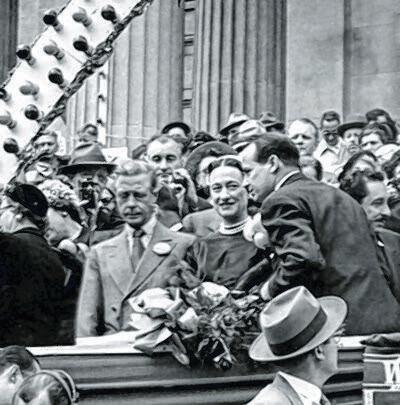
The year was 1950. Edward, Duke of Windsor, abdicated the throne of England 14 years earlier to marry American socialite and twicedivorced Wallis Warfield Simpson, passing the crown to his brother, Albert, who became King George VI and was the father of Queen Elizabeth II. As for the former king, Edward was free to do what he liked. In 1950, he and his duchess hopped an ocean liner and crossed the Atlantic to North America.
New Orleans’ Mardi Gras was their eventual destination They arrived in the Crescent City to
ä See CURIOUS, page 2G
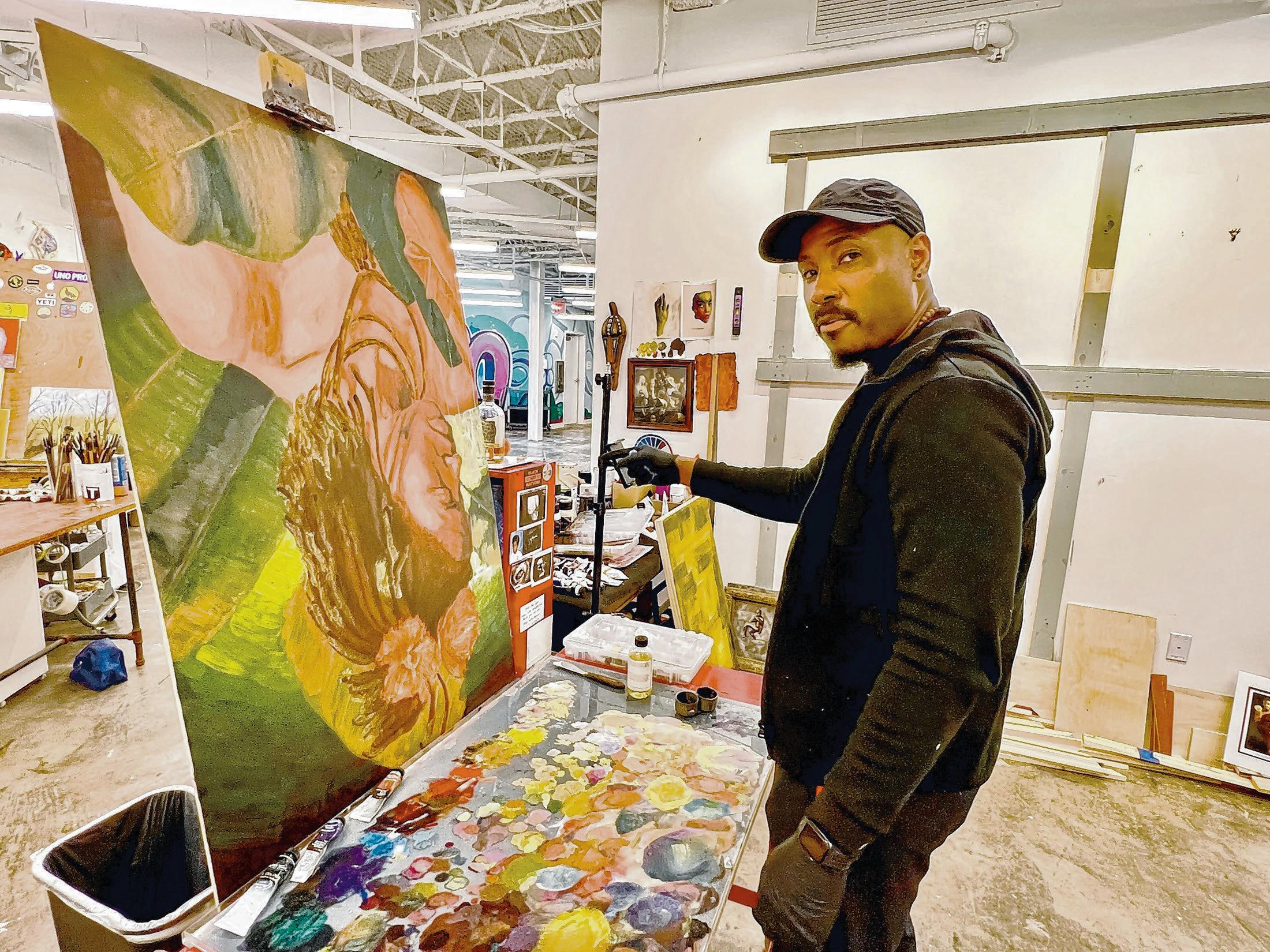
Artist Mike Weary looks inward, forward for inspiration in his first solo museum show

BY ROBIN MILLER Staff writer
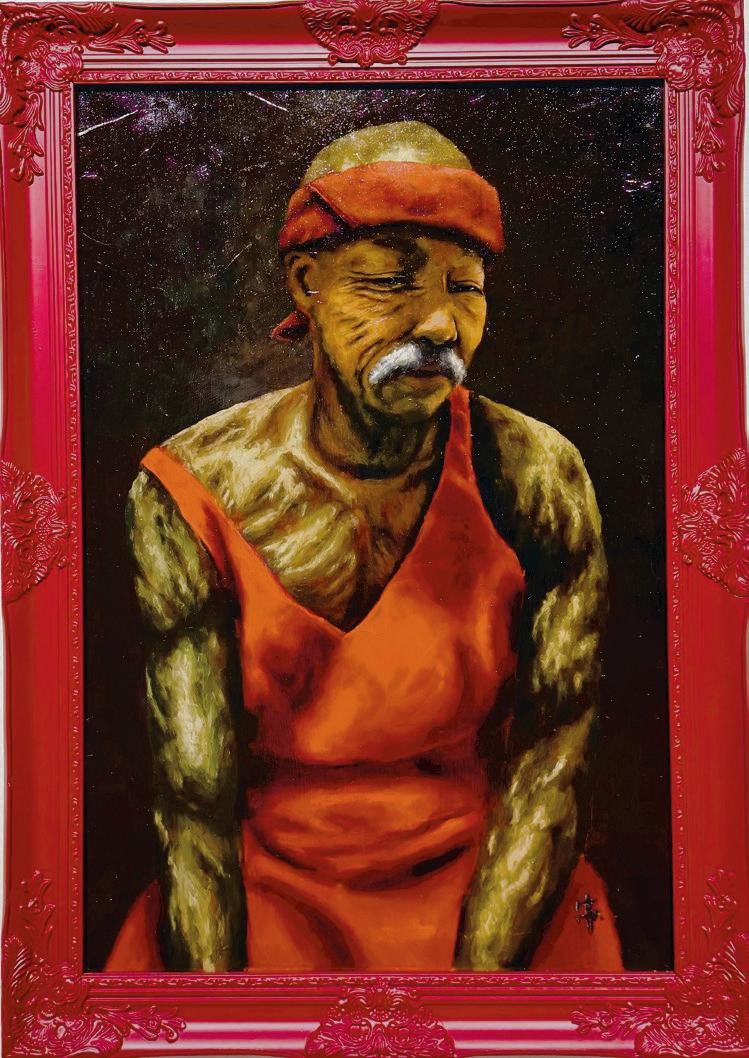
Friends from New Orleans always recognize the weathered man draped in a red dress in Mike Weary’s painting as a competitor in the city’s annual Red Dress Run charity race. But not all of Weary’s friends are from New Orleans, so the subject is lost on some.
The painting’s title confuses them even more: “I Stole Time, Reminiscing on a Future, I will Have Forgotten.” The work is Weary’s favorite in his retrospective exhibit, “The Rise of the House of Weary,” running through April 12 in the Louisiana Art & Science Museum’s second floor Main Gallery For Weary, artist-in-residence and artist liaison for the Arts Council of Greater Baton Rouge, the painting is about more than the dress and much more than the Red Dress Run. The piece, along with the show’s other paintings, also offers a slice of his life.
“That’s me,” Weary said, gaz-
ing at the painting. How so, when Weary is decades younger than the guy in the picture?
“It’s a self-portrait of me as an older man,” he continued. “I was trying to examine and understand my masculinity and the toxic traits of it while mirroring back to ‘The Portrait of Dorian Gray.’”
A ‘Dorian Gray’ connection
Weary’s mention of Oscar Wilde’s novel is deep. The story follows a young man whose portrait bears the marks of his sins while he remains forever young.
“I wanted to create something that showed the years of weathering,” he said. “So, it’s the same storyline of ‘The Portrait of Dorian Gray,’ where all of those acts on his soul are reflected through his portrait. But I wanted this painting to reflect that part of me in the vein of the effect of my masculinity.” Weary previously shied away from self-portraits, saying they made him self-conscious.
“I’m not a big fan of it,” Weary said. “I’ve always had this weird thing about looking in mirrors. But as I’m painting, I sometimes do a little bit of self-reflection, and it helps me get through it I’ve had conversations with three or four of my friends who are just against wearing a dress, and I started thinking about how it’s not that deep. But then, maybe it is.”
The conversations led to questions, which eventually led to the painting.
“It made me ask a million questions about myself and if I cared that much,” Weary said “And it made me think about how to take those feelings of being insecure and project them out into the world. So I kind of went through a big change in my view of who I am as a man and in my masculinity.
A different perspective
Weary not only painted his self-portrait from an alternate perspective, he painted it upside down.
He developed the technique to challenge himself to look at his work from a different viewpoint Walk into his studio at the Cary Saurage Community Arts Center, and any current work-in-progress will be upside down on the easel.
All hang right side up once installed on gallery walls, as do the paintings in the LASM exhibition, which, Weary says, represent the last five years in his life. Those years included a newborn daughter to him and wife, Maia.
“Her name is Evie, and she’s 3 years old now,” he said “But she wasn’t born yet, when I started this painting.’
In the front of the gallery, the painting “American Nomads” greets visitors to the show. The main characters in this piece are a man and woman stationed in
Continued from page 1G
most the spectacle of this little bird having breakfast, or the time I’d passed with a friend as we shared sentry duty the day before. When I started birdwatching more than three decades ago, I thought of waiting as the price I had to pay for the chance to spot something beautiful. With age, I’m learning that the wait itself can be its own gift, a kind of sanctuary in which my life finds its center I thought about all of this again a couple of days after Christmas last year, when the season’s first goldfinch arrived at my window feeder Goldfinches normally show up in my south Louisiana yard around Yuletide, a holiday meant to underline the value of waiting. Advent, the church season before Christmas, is grounded in the idea that anticipation can deepen our sense of what’s truly important. In practice, the holidays don’t often bring the kind of pause that honest waiting is supposed to cultivate. Instead, December’s calendar fills with parties and shopping, a blur of busyness in which seasonal serenity tends to get lost.
We’re now at the doorstep of Mardi Gras, when our goldfinches usually begin to leave for the year
I’m trying to enjoy their daily visits to the tube feeder just beyond our living room, and I’ve loved watching them flock on our lawn to savor the seed I’ve scattered in the grass. I sometimes startle them at the window, and they rise and fall like a yellow wave lapping at the edge of the porch. Once the goldfinches leave, I’ll have to wait many months for their return. Maybe the years are trying to tell me that waiting can be its own reward. Email Danny Heitman at danny@dannyheitman.com.
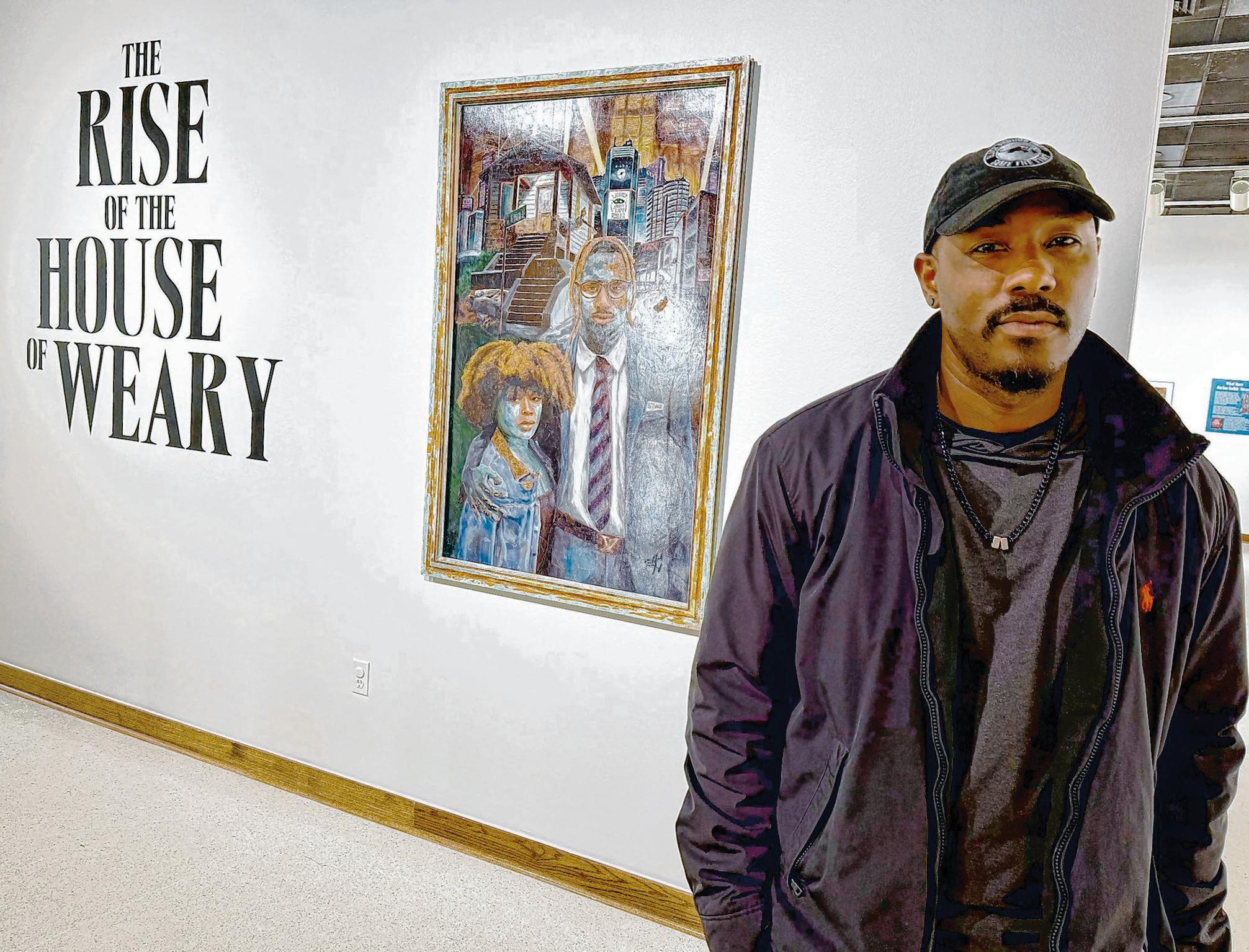
front of New Orleans’ ever-changing landscape. The duo is young and beautiful against the chaotic backdrop.
Weary photographed the couple as they were walking through the courthouse parking lot on St. Ferdinand Street across from the Cary Saurage Center
“They were coming from court, and I don’t know if they were boyfriend and girlfriend or husband and wife, but I asked if I could take their picture,” he said.
“I wanted to pattern them after Grant Wood’s ‘American Gothic,’ but I wanted to give them a different relationship.”
That’s when their faces began changing, becoming something more personal — something that tied directly into his own life journey
“This is essentially my Katrina painting,” Weary said. “I grew up in New Orleans, so I made the couple a brother and sister who move back to New Orleans and buy back
Continued from page 1G
great fanfare on Feb. 21, 1950, by train after vacationing in Mexico City.
They were wined and dined at Antoine’s, received the keys to the city from Mayor deLesseps “Chep” Morrison and watched the Rex procession along St. Charles Avenue from the Boston Club Balcony
But it was what happened after the parade that made Mardi Gras history
“Is it true that King Edward, who abdicated the throne of England, came to Mardi Gras in New Orleans with his wife Wallis Warfield Simpson — and the two of them bowed to Mardi Gras royalty?” one reader asked.
In short, they did. Hierarchy was inverted. Social codes blurred, and the Old World met New Orleans.
The historic moment still exists — frozen in wax at The Great River Road Museum, next to Houmas House in Darrow Its displays include the wax figures that once belonged to New Orleans’ former Musée Conti Wax Museum, which closed in 2016.
The Great River Road Museum purchased and restored the figures, including likenesses of the Windsors.
The figures, dressed in reproductions of the Mardi Gras ball outfits worn by the British royalty stand before a costume worn by a previous Rex, the king of Carnival.
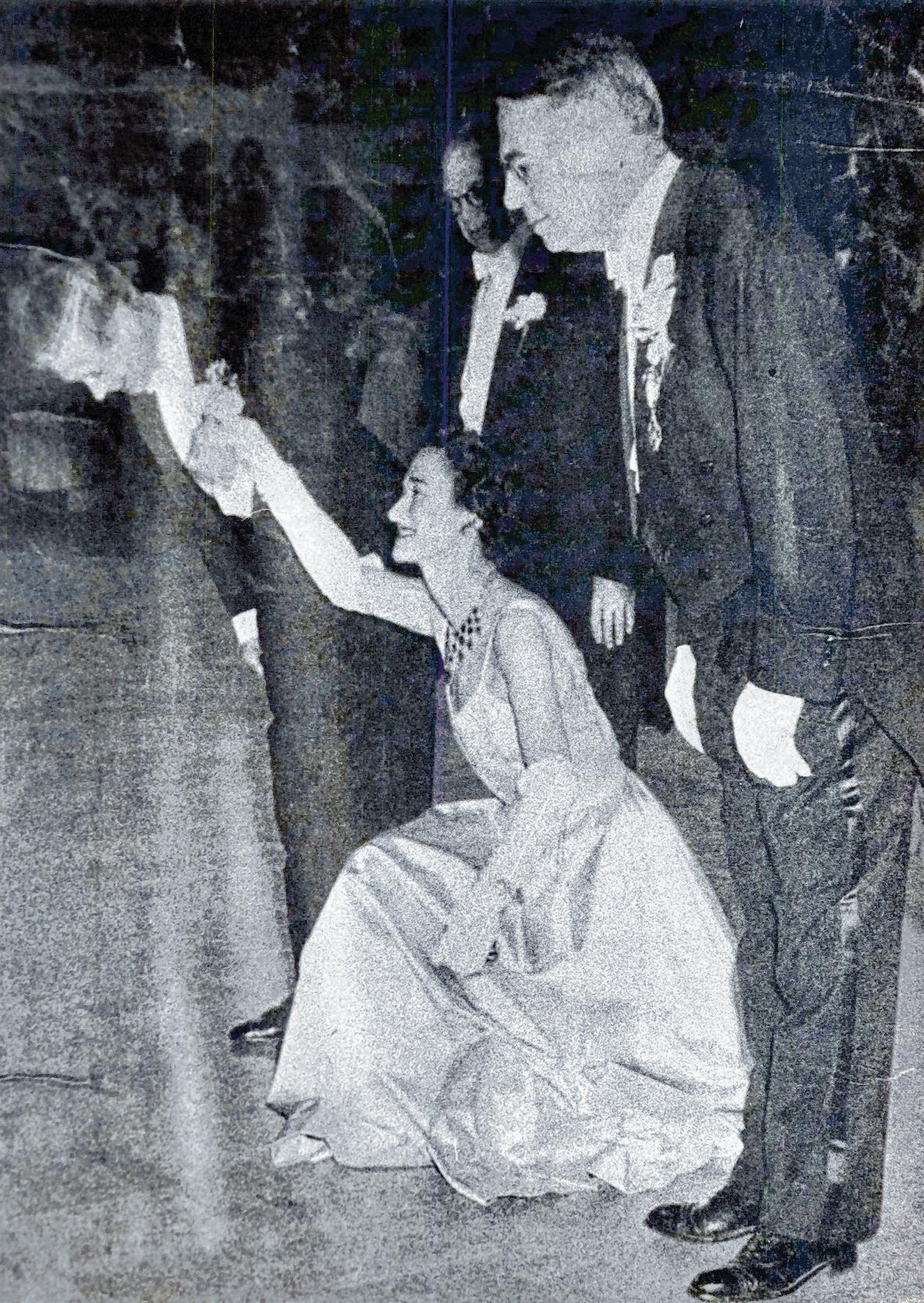
A photo behind the figures shows the duchess in a graceful curtsy while holding the hand of the duke as he bows.
The 1950 Rex was local businessman Reuben H. Brown; his queen, Mary Brooks Soulé, was a debutante.
But as the king and queen of Carnival, they were New Orleans royalty meaning they didn’t bow to anyone — including the former king of England and his wife.
The moment repeated itself that evening when the Windsors also bowed to Mystick Krewe of
their family home.”
The longer he painted, the more the couple came into focus, morphing into his son, Ezra, and daughter, Evie.
“My wife was still pregnant with my daughter at the time I was painting this,” Weary said. “I didn’t even know what Evie would look like, but these are my children in 20 years.”
Weary placed them in front of his childhood home, standing along a street that opens up to the city’s downtown district.
“It shows the future of New Orleans with the Superdome and JAX Brewery at one level, but I also wanted to create the future claustrophobic buildings overhead,” he said. “I wanted that feeling of the urban environment to be so consuming that you really can’t feel the natural elements around you.”
Chaos at the Capitol
Weary also translated these
elements to Baton Rouge in his painting, “American Radicals,” where a Black man in a suit and hat stands against the backdrop of the Louisiana State Capitol, where, once again, chaos ensues.
He based the man on an attorney he often passed on the street. The State Capitol stands as the symbol of state politics’ bastardization of Christianity
“This is really just about the radical spectrum,” Weary said.
“This is kind of coming from a critique of fascism. So, I wanted to paint the Capitol, where it all kind of revolves. I put an ‘8’ on a tree to depict the eighth circle of hell inside of the Capitol. And that’s mainly because carved in stone at the entrance are two enslaved people.”
In the midst of this societal commentary, Weary’s “House” is filled with joyful, tender moments and milestones, which includes a wooden cutout of his daughter.
But it’s the smaller painting of
Comus royalty Graciously welcomed Meanwhile, Times-Picayune reporter Pondine Schoenberger recounted in her Feb. 22, 1950, front-page story how royalty from both the Rex Organization and the Mistick Krewe of Comus graciously welcomed the Windsors. “Real royalty shared the spotlight with make-believe royalty in New Orleans Tuesday, and it was anyone’s guess who caused the most excitement,” Schoenberger wrote. “The Duke and Duchess stood on the balcony of
the Boston Club while Rex, king of the Carnival, toasted his fair queen and her court.”
Schoenberger’s story followed the duke and duchess through an itinerary that included talking to reporters and meeting New Orleanians, a luncheon and a meeting with the king and queen of the Mistick Krewe of Comus, who, according to their tradition, weren’t publicly named. They also got into the spirit of Mardi Gras.
“What His Royal Highness seemed to enjoy most about the parade were the bands, particularly the little blonde drum
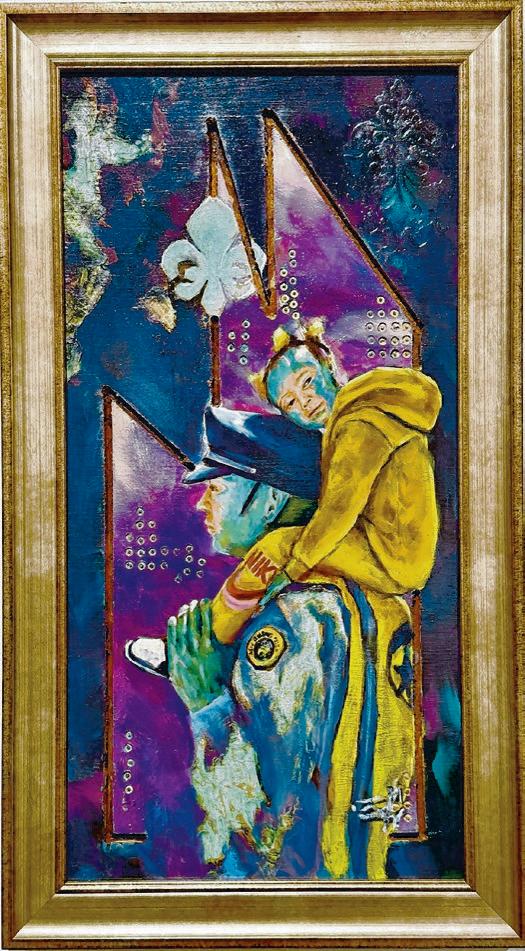
Weary’s goddaughter that captured the heart of the museum’s curator, Tracey Barhorst. The scene shows Weary’s goddaughter, Jordan, on the shoulders of her dad, Weary’s best friend, Ryan, a New Orleans policeman, at a Mardi Gras parade
But Barhorst sees it as a slice of her own life.
“My dad was a New Orleans policeman for three years,” she said.
“When I was about to turn 4, my mom was pregnant and he took me to a Mardi Gras parade
“And I remember that exact moment in my life, and I think of that moment when I look at this painting. It’s my favorite in the exhibition.
And this is the moment when Weary’s “House” opens its doors to others, some of whom may even find a common thread in the red dress.
Email Robin Miller at romiller@ theadvocate.com.
majors,” Schoenberger wrote “He and the duchess also seemed to get a big kick out of reaching for necklaces and other baubles thrown from the floats. They would grab them eagerly then toss them back to the crowd.”
The day’s festivities finally wound down with an escort into the Rex Ball in the Municipal Auditorium.
“Following the grand march, the Windsors were led up to the royal throne, which dominated the stage,” Schoenberger wrote “Here, they were formally presented to the King and Queen of Comus, who were standing at the time The duchess went into a graceful curtsy and the duke bowed from the waist.”
Cheers exploded from the crowd, while the Comus royalty reciprocated with their own bows. Yes, according to the article, Comus royalty bowed. Then came the presentation to the Rex court.
“Again curtsy and bow were the occasion for prolonged applause from the spectators,” Schoenberger wrote However, Schoenberger mentions no bows by Rex royalty
Finally, Arthur Hardy, perhaps the foremost authority on Mardi Gras, cited an account of the event by authors Charles Dufour and Leonard Huber in the first official history of the Rex organization, “If Ever I Cease to Love” in a Feb. 15, 2017, article for The Times-Picayune:
“When the captain of the Comus organization presented the Duke and Duchess of Windsor, they looked anything but apathetic. The Duchess hit the floor with two of the most beautiful and graceful curtsies ever seen, and the Duke bowed from the waist, almost touching the floor with his forehead. Comus’ 2,500 guests were in ecstasy They responded with deafening applause.”
More than 75 years later, the royal encounters still stand among the most remarkable moments in the city’s Carnival history
Email Robin Miller at romiller@ theadvocate.com.
Angel food cake, banana pudding can help bring back focus into life
There is a saying that what is old is new again, and the latest obsession to take hold on social media is proving the adage true
The tactile and analog activities of the past are having a renaissance and it’s not just about nostalgia. Amid the algorithms and constant digital stimulation, a quiet revolution is happening — people are turning to “oldfashioned” hobbies again. Analog hobbies, or “granny hobbies” as they have affectionately been nicknamed, include activities such as baking, canning, knitting, gardening or needlepointing. Retro writing styles and instruments like typewriters, calligraphy and wax seals are having a resurgence as well More than quaint throwbacks, these activities offer a way to decompress by flexing creative muscles and grounding us in rhythm and sensory detail, something our minds crave after being overstimulated by digital noise.
The grounding effect is more than metaphorical Instead, slow, repetitive movements shift the body’s stress response, calm the nervous system, boost focus and give your brain something to do that does not involve doomscrolling. So, when you knit, garden or knead dough, you are doing more than just passing the time; your body interprets that rhythm and focus as safety, which results in a drop in cortisol, a slower heart rate and deeper breathing
This month, we are leaning into the analog trend and baking some of my favorite nostalgic recipes from scratch (save for the pudding mix) — angel food cake and banana pudding. If you follow along on Instagram(@ Louisiana_Bakes), I have posted my favorite recipe for lemon curd, which is a delicious accompaniment to the angel food cake and a great way to use the leftover egg yolks that result from the recipe.
The banana pudding recipe is a nod to a fixture in my childhood — vanilla wafers — and a dessert that appeared often at family gatherings. With these dishes and any others you create, may the sifting folding and whisking give your nervous system permission to downshift and reclaim stillness in a noisy world.

Angel Food Cake Serves 8-10.
1
(refrigerate or
unused
1 Preheat oven to 300 F.
2 Sift cake flour and 2⁄3 cup of sugar 2 to 3 times.
3. Using the whisk attachment of a stand mixer beat egg whites until frothy Add the salt and cream of tartar Beat until the egg whites hold soft peaks. Add the remaining 1 cup of sugar, 1 tablespoon at a time, beating continuously until the egg whites are glossy and hold stiff peaks. Add the vanilla and beat to incorporate.
4. Using a rubber spatula, carefully fold the flour and sugar mixture in three portions so as not to deflate the egg whites too much.
5. Spoon the batter into an ungreased tube (angel food cake) pan and smooth the batter Rap the pan on the counter two to three times to burst any air bubbles.
6. Bake until cake is golden and springy on top and a skewer inserted into the center of the cake comes out clean (approximately 1 hour 20 minutes).
7. Invert the cake on the counter using the feet of the cake pan, if present; or invert it over the top of a long-neck bottle and let cool for 2 hours.
Serves 15. Recipe is by Magnolia Bakery. 1 (14-ounce)
1 (12-ounce)
cookies (reserve 4-5 cookies for garnish)
1. In a large mixing bowl or the bowl of a stand mixer, beat together the sweetened condensed milk and water until well combined.
2. Add the instant vanilla pudding mix and beat well until mixture is
Garnish with additional wafers and bananas or wafer crumbs on the top layer
7. Cover tightly with plastic wrap and allow to chill in the fridge for at least 4 hours (up to 8 hours, but no longer because bananas will start to brown).
BY RICH COLLINS Staff writer
When Gov Jeff Landry named Susan Bourgeois secretary of Louisiana Economic Development in early 2024, she embarked on a statewide listening tour to find out what mattered most to local business owners, community leaders and everyday Louisianians.
While she heard many inspiring stories during her conversations, people frequently lamented Louisiana’s poor performance in national economic and quality-of-life rankings or the lack of population growth relative to other Southern states There was a general feeling, she said, that what’s possible elsewhere couldn’t happen here.
At the recent Mardi Gras celebrations in Washington, D.C., LED unveiled a new program aimed at changing that narrative something Bourgeois believes is key to successful economic development efforts.
It’s called the Louisiana Storytellers initiative, and it’s a marketing campaign that seeks to recruit 1,500 volunteers from around the state and arm them with information they can use to help spread the word about the opportunities Louisiana has to offer and the progress it has made in addressing some of the state’s longstanding problems.
“It is aimed at keeping people here, attracting people here and expanding existing Louisiana businesses,” Bourgeois said. “It’s really a comprehensive value initiative to use Louisiana’s private sector as our army.”
‘Amplify the opportunities’ LED already has 800 volunteer storytellers, all of whom signed up for the program at the agency’s pavilion at the Washington Hilton during the Mardi Gras festivities. Storytellers are given access to a website containing data about recent “positive” developments in the state, including new investments, job growth, reforms to the
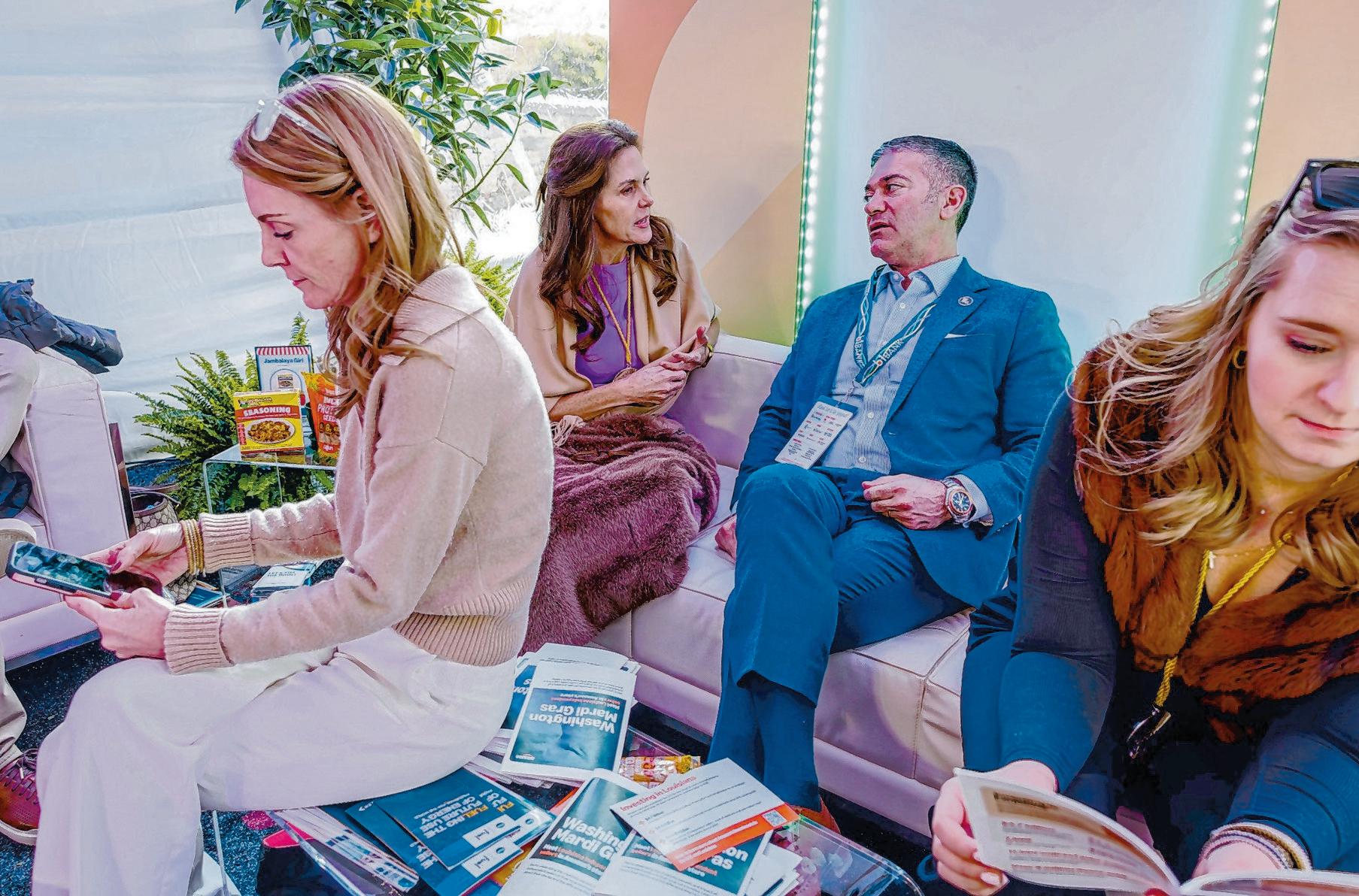
tax structure and improvements in school test scores. They can also download slide decks detailing such data points and insert them into presentations when speaking to community or industry groups.
The goal, program director Rachel Shields said, is not to ignore Louisiana’s obvious challenges but to give people facts that will help them spread the word about what’s going right.
“We want to help amplify the Louisiana opportunity story from the inside,” said Shields, LED’s chief engagement officer “Because we know economic development is driven by narrative from trusted voices.”
LED also hopes to use its storytellers in targeted ways. When volunteers sign up to participate in the program, LED collects information
about their industry, company, geographic region of the state and areas of interest or expertise.
“We can break that down geographically or by subject matter when we have a specific message to push,” Bourgeois said. “If we learn of a new development, say, that is relevant to hospital CEOs or health care companies, we can send it to them.”
Storytellers are also encouraged to share information about their companies expansions or job postings, for example — that will be posted to the storytellers site. There’s also a text tip line to help LED collect leads.
“If an exec is sitting on a plane talking to another exec who expresses interest in relocating, they can text the hub and we’ll reach out,” Shields said.
The storytellers initiative follows other new projects and changes at LED since Landry took office.
During the past two years, his administration has revamped the agency, launched a new innovation division — LA.IO for short — and released a new statewide economic development plan. The agency’s new leadership also benefited from good timing.
Bourgeois was appointed just as the state entered talks to land the Meta Hyperion data center in north Louisiana, a project with a nearly $30 billion price tag that is bringing major investment to a formerly quiet agricultural parish. That announcement was followed last March by another big
deal: the Hyundai steel plant near Baton Rouge. It will be the South Korean automaker’s first steel mill in the U.S. Altogether, LED has announced a record $76 billion in investment in the state since Landry took office.
To be sure, the deals are not without controversy Consumer advocates worry Entergy ratepayers will be on the hook for the cost to build new natural gas power plants to fuel the Meta data center Environmental advocates worry about the impact of mega projects on the quality of life in nearby communities.
Critics also lament that the state continues to give tax breaks to new industry while cutting back on investments in health care and education.
Bourgeois said she is not dismissing the critics or the state’s problems. But she said making people more aware of positive things happening in the state has only an upside.
“Do we have challenges in education? Yes,” she said. “But we have forward momentum, so we are equipping sector influencers with information to spread that story in a way that we could never afford through a traditional advertising buy.”
Now that Washington Mardi Gras is a wrap, the agency — whose fiscal year 2026 operating budget and project commitments top $261 million — is reaching out to statewide economic development partners to get more volunteers for the campaign, which was executed with help from Louisiana-based Innovative Advertising as part of a broader $75,000 spend.
“We believe by end of year this year we’ll have thousands of storytellers aggressively communicating,” Shields said. “We want to move the needle and change how we talk about Louisiana.”
Email Rich Collins at rich. collins@theadvocate.com.