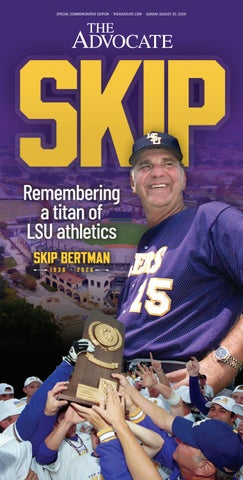
SPECIAL COMMEMORATIVE EDITION • THEADVOCATE.COM • SUNDAY, AUGUST 30, 2026
Remembering a titan of LSU athletics SKIP BERTMAN 1938 - 2026
1938 SKIP
BERTMAN 2026
Remembering the many stories from the career, life of a legend BY SCOTT RABALAIS | Sports columnist
The main scoreboard at Alex Box Stadium honors legendary LSU baseball coach Skip Bertman after his death on Friday, Aug. 14, 2026.
My assignment for our Skip Bertman commemorative section was to write a column full of stories about the man, the coach, the administrator. The legend. Eighteen years he spent as the LSU baseball coach. Seven more as athletic director. Eight hundred and seventy victories. Five national championships. Eleven College World Series trips and 16 NCAA Tournament appearances. How to choose from among all of that, a virtually infinite treasure trove that spanned from Detroit, where he was born in 1938, to Miami Beach, where he grew up, to LSU and even to the Olympics, where he coached the U.S. team to a bronze medal in 1996? If Skip were here, he would surely encourage me to do my best, the way he inspired so many over the years. That or he’d look over my shoulder and roll those expressive eyes of his at what I came up with. Here are a few stories about a man who, among his many other traits, was a master storyteller:
One of Bertman’s favorite anecdotes was about the catcalls he dealt with in his early LSU days. “I’d hear from the stands, ‘Hey, Bertram!’” Skip said. “I was ‘Bertram’ for about eight years. I’d hear, ‘Hey Bertram, we’re one point down.’ I’d turn around and say, ‘They’re not points, they’re runs.’” Actually, it wasn’t a fan who first called him “Bertram.” It was none other than the great Mickey Mantle. In 1970, while baseball supervisor for the Miami Beach parks department, Bertman got the Yankees legend to give a baseball clinic. Mantle, who had clearly been out in South Beach the night before, had trouble hitting off the first pitcher Bertman put out there, so Skip went to the bullpen for Miami coach Ron Fraser. Mantle promptly hit a home run.
“This guy’s a little better, Slip Bertram!” Mantle yelled. Soon, every coach in the Miami area was calling Bertman by his new Mantle mantle. “Oh, all the coaches loved calling me that,” he said.
Bertman could take a joke. About 1986 or so, LSU was at Tulane for a midweek game. In the late innings, Skip went out to the mound to change pitchers. His daughter Lisa, who died in 2012, was a student at Tulane at the time. On the way back to the dugout, Bertman looked up and saw someone holding a big white sign that read: “Even Skip’s kid doesn’t go to LSU!” “Now that was pretty good,” Bertman said with a laugh during a 1996 TV interview with former Advocate writer Lee Feinswog.
Bertman’s near clairvoyant baseball knowledge was legendary. On Easter Sunday 1999, during the one season I was The Advocate’s LSU baseball beat writer, Skip and I were on the field alone at Tennessee after the Tigers lost two of three to the Volunteers. “The season’s over,” Skip said. I didn’t understand what he meant, considering there were about six weeks left in the regular season. “This team,” Skip said, “can’t get to Omaha.” That 1999 team had its faults, but it also had pitching ace Kurt Ainsworth, an All-American and a first-round draft pick by San Francisco. But sure enough, Bertman was right. LSU made it to the super regionals in that first year of the expanded 64-team NCAA Tournament but lost to Alabama. A year later, though, LSU beat Stanford for its final College World Series title on Skip’s watch.
STAFF PHOTO BY PEARL SPURLOCK
Most coaches and athletes remember the losses more than the wins. Bertman was no different after his final LSU team was eliminated 7-1 by Tulane in Game 3 of the 2001 super regional at Zephyr Field in Metairie. “I guess you could write he did OK,” Bertman said. “But see the asterisk. He lost at the end.” Before the super regional, Bertman told then-Tulane coach Rick Jones his team might beat LSU, but not to expect to win the College World Series in the Green Wave’s first trip there. “Coach,” Jones told Bertman, “I’ll take that chance.” When Tulane eliminated the Tigers, Bertman asked Jones whether he could speak to his Green Wave players. “We go out behind home plate and he says, ‘I’ve been to Omaha 18 times (with LSU and Miami),’” Jones said. “The fences are shorter, but (Jake) Gautreau, you can reach them. The bases are 90 feet apart, but Andy (Cannizaro), you can steal them. And Barth (Melius, one of the team’s top pitchers), you can baffle them.’” As he left, Bertman walked past then-Tulane assistant coach Jim Schlossnagle, now coaching at Texas. “He told Schloss, ‘You’ve got no chance,’” Jones recalled with a laugh. “And he was right.” Tulane went 1-2.
Angeles Dodgers manager Tommy Lasorda, but one that fit Bertman as well: “The difference between possible and the impossible lies in a man’s determination.” It seemed impossible to build a baseball dynasty at LSU, until Bertman did it.
In 2009, LSU opened its current Alex Box Stadium, a project that likely wouldn’t have happened without Bertman’s determination to upgrade the program from its former Depressionera ballpark. Four years later, LSU decided to name the field for Bertman, who insisted the stadium remain, like the old one, named only for Alex Box, the first LSU athlete to die in combat in World War II. They did put a plaque in the LSU clubhouse, attributed to longtime Los
When Bertman retired as athletic director in 2008, I asked him what he wanted his legacy to be. In one of the all-time great understatements, Skip said: “I think I left the baseball program much better than I found it, and I think I left the athletic department much better than I found it. That’s important to me. The people here deserve the best. I had a great time.” No greater than the time you gave everyone else, Skip.
Bertman agreed to become athletic director before his final season as baseball coach ended. His nomination drew unanimous approval from the LSU Board of Supervisors, which was battling with LSU President Mark Emmert over who would get the job. Voting against Bertman, then LSU board chairman Ronald Anderson said, would be like voting against God. Out of baseball for the first time since he was a teenager, Bertman spent the next seven years coaching LSU coaches. “It was a dream come true,” thenLSU gymnastics coach D-D Breaux said. “He held everyone to the same standard of excellence he held himself to. He’d tell me, ‘You do what I tell you to do and you’ll be on top.’ “Everyone who spent time in his hula hoop gained from it. You walked away smarter, more joyful. He was an extraordinary person.”
1938 SKIP
BERTMAN 2026
SKIP BERTMAN TIMELINE
Former LSU baseball coach, athletic director had an unprecedented run in Baton Rouge BY KOKI RILEY Staff writer Former LSU baseball coach and athletic director Skip Bertman had an unprecedented tenure at LSU, leading the baseball program to its first five national championships before serving as athletic director for seven seasons. Here’s a full timeline of Bertman’s time at LSU, from the time he was hired as LSU’s baseball coach in 1983 until his death on Friday, Aug. 14, at the age of 88.
APRIL 25, 1983 — Bertman was hired as LSU baseball’s second-ever full-time baseball coach after serving as Miami’s associate head coach since 1976, helping the Hurricanes win a national title in 1982.
MAY 23, 1985 — LSU makes the NCAA Tournament for the first time under Bertman and for just the second time in program history. It was the Tigers’ first of 16 appearances in the tournament under Bertman. LSU played two games in the NCAA Central Regional in Austin, Texas, losing to Houston 11-4 before bowing out of the tournament a day later to Lamar in a 4-3 loss.
MAY 30, 1986 — LSU reached the College World Series for the first time in program history. It was the first of 11 appearances the Tigers made in Omaha under Bertman. LSU went 1-2 in the World Series that season, losing to Loyola Marymount 4-3 in its first-ever CWS game before beating Maine 8-4 and falling to Miami 4-3. That season also marked the first time Bertman won the National Coach of the Year Award and the first time LSU became SEC
champions under his command.
SEPT. 28, 1988 — The United States takes down Japan 5-3 in the Gold Medal game at the 1988 Seoul Olympics. Bertman served as the pitching coach, and LSU legend Ben McDonald was also on the team.
JUNE 8, 1991 — For the first time ever, LSU won the College World Series. The Tigers took down Wichita State 6-3 to claim Bertman’s first of five national championships at LSU. LSU had made the World Series in four of the previous five seasons before finally winning it all in 1991.
JUNE 12, 1993 — LSU wins its second national title in three years by taking down Wichita State again in the final, winning 8-0. The Tigers became just the fifth program to win two titles in a three-year span, joining Southern Cal, Stanford, Texas and Arizona State.
AUG. 2, 1996 — Bertman, as the head coach, leads Team USA to a bronze medal at the 1996 Olympics in Atlanta. He led a roster that included LSU infielders Jason Williams and Warren Morris. JUNE 7, 1997 — LSU takes home back-to-back national championships, becoming the first program to accomplish the feat since 1988, when Stanford won consecutive titles. Southern California and Texas are the only other programs to have won backto-back national championships.
JUNE 17, 2000 — Bertman wins his fifth national championship in 10 seasons at LSU. The Tigers took down Stanford 6-5 in the final, capping off a baseball dynasty in Baton Rouge. It
would take another nine seasons before LSU would return to the mountaintop of college baseball.
history. By Mainieri’s third season, he led LSU to a sixth national championship in 2009.
MAY 11, 2001 — Bertman’s No. 15 is retired at Alex Box Stadium just weeks before his coaching career came to an end.
JULY 4, 2006 — Bertman is inducted into the College Baseball Hall of Fame after leading the Tigers to five national championships, 11 College World Series appearances, six SEC Tournament titles and seven SEC regular season crowns.
MAY 12, 2001 — Baton Rouge mayor Bobby Simpson announced that the city will name the stretch of road connecting Nicholson Dr. with River Rd., next to the original Alex Box Stadium, after Bertman. Simpson also declared that day as Skip Bertman Day in Baton Rouge. JUNE 3, 2001 — Bertman’s final game as LSU baseball’s head coach is a 7-1 loss to Tulane in the super regionals. His assistant, Smoke Laval, took the job following Bertman’s departure. During his time as head coach, Bertman won six National Coach of the Year awards, seven SEC Coach of the Year awards and owns the highest winning percentage in SEC history (.724). His career record was 870-330-3. AUG. 6, 2001 — Bertman officially begins his tenure as LSU’s athletic director, replacing Joe Dean, who had served in the role since 1987.
JUNE, 2002 — Bertman was inducted into the Louisiana Sports Hall of Fame alongside eight others. JULY 27, 2003 — The American Baseball Coaches Hall of Fame inducts Bertman, just over two years after his coaching career came to a close. JUNE 27, 2006 — Bertman hires Paul Mainieri to replace Laval and become the 25th head coach in LSU baseball
JUNE 2008 — Bertman retires as athletic director after seven years in the role. LSU won nine national championships under his tenure as athletic director. He hired four coaches that went on to win national championships, including Mainieri, Les Miles (football), Dennis Shaver (men’s and women’s track and field) and Chuck Winstead (golf). SEPT. 9, 2011 — Bertman gets inducted
into the LSU Athletics Hall of Fame alongside Seimone Augustus, Wendell Davis, Suzette Lee, Lloyd Peever and Carl Maddox.
MAY 17, 2013 — The field at Alex
Box Stadium is officially named after Bertman, four years after the new Alex Box Stadium first opened in February of 2009. The old Alex Box Stadium had been LSU’s home from 1938-2008.
SEPT. 13, 2019 — A statue of Bertman
is unveiled outside of Alex Box Stadium. The structure features Bertman leaning on a dugout railing as the centerpiece of the “Legacy Plaza.”
AUG. 14, 2026 — Bertman dies at
the age of 88 as one of the greatest college baseball coaches of all time and arguably the most important figure in the history of LSU athletics.
1938 SKIP
BERTMAN 2026
LSU figures, dignitaries comment on Skip Bertman’s impact NOLA.com | Staff report
So many people use words like GOAT (greatest of all-time), but Skip truly was the GOAT. He was the greatest of all time, and I was just lucky enough to call him, not only my boss, but a dear friend.
Paul Mainieri
LSU baseball coach from 1995-2006
The word legend is often used to signify the greatness of a person, but in sports being a legend isn’t measured by the trophies you collect. Those are just symbols of accomplishments. A legend is a person who changes a standard forever, and that is what Skip Bertman did. He took something ordinary and made it extraordinary. Most importantly, he left his players and those he touched better than he found them. His goal was to impact the scoreboard of life. Louisiana will dearly miss him!
Jeff Landry
Louisiana Governor
Skip Bertman was (simply) the best. His impact on College Baseball will live on forever. I feel so blessed to have had him as a coach and a mentor. He meant so much to so many. I will miss you, Coach.
Mike Bianco
Ole Miss coach, who played for Bertman and served as an assistant coach for him at LSU
I’m so blessed to have been a small part of the juggernaut that Skip Bertman built. Skip changed my life. He taught me lessons that I still carry with me and pass on to others today. I’ll never forget getting on the bus after we won the 2000 Natty in Omaha and Skip greeting each of us personally. It was an incredible feeling, but more than that, it put into perspective what we had just accomplished. That was Skip — he made everyone around him believe they could accomplish something special. RIP Skip. There will never be another.
Ray Wright
Few people have had a greater impact on LSU than Skip Bertman. As the greatest college baseball coach of all time, and later as our Athletics director, Skip developed a championship standard and culture still guide us today. Personally, he was a dear friend, mentor and advisor, and I’m forever grateful for the trust and faith he placed in me to serve this institution. I will continue to honor Skip by leaning into the lessons he taught me every day. Our thoughts and prayers are with his loved ones at this time.
Verge Ausberry LSU athletic director
An outfielder for Skip Bertman’s last championship squad in 2000
He had different ways to push your buttons and motivate you. He was a guy who would tear us down at times to build us up. You don’t understand it when you’re 19 or 20 years old. You don’t understand all the stuff you’re going through. But as you get older, you realize, ‘That’s why he did that, and that’s why he did that.’ You start to figure it out a little bit.
Skip’s impact can be measured by far more than just five College World Series titles and seven SEC Championships. It can be seen in the success of his players both on and off the field. As athletic director, he oversaw one of the most successful eras in the history of our institution. Angela and I join the LSU family in expressing our heartfelt condolences to Coach Bertman’s family, his players and his countless friends. His legacy will live on forever here at LSU.
Ben McDonald
Wade Rousse
Former LSU pitcher
LSU president
By far the greatest part of being the baseball coach at LSU the last five years is the relationship I was able to build with the greatest college baseball coach of my lifetime, Skip Bertman. The mentorship, and most importantly, the friendship we built is easily one of the best, most rewarding, and special relationships I have ever had. What an honor it has been to sit with, talk baseball with, smile with, and laugh with Coach. Coach Bertman was so far ahead of his time while leading the LSU Tigers, and as a young coach just starting my journey, I watched, studied, and admired his incredible skills of leading, motivating, teaching, coaching, and ultimately cultivating what became ‘The Powerhouse’ of College Baseball. Being able to share the 2023 and 2025 National Championships with Coach Bertman watching is something I wouldn’t trade for the world. The impact he made and legacy he has left on the state of Louisiana and college baseball is beyond remarkable and will never be duplicated. I love you Coach, I will miss you, and will continue to work every day in a manner that I know would make you proud.
Jay Johnson
LSU baseball coach
There are finite numbers that can quantify Skip Bertman’s coaching success. Wins, titles, All-Americans. What cannot be measured is the personal impact he had on so many lives, including mine, through his wisdom, his instincts, his compassion, and his humor. He changed lives. His legacy will last across Louisiana, college baseball and countless players and friends and their families for generations.
Herb Vincent, SEC associate commissioner
1938 SKIP
BERTMAN 2026
Captain America: For Morris, playing for Skip at Olympics was special bonus BY KOKI RILEY Staff writer Before the age of NIL, the transfer portal and courts granting players extra years of eligibility, there was Warren Morris. Morris spent only four seasons (199396) playing for LSU under legendary coach Skip Bertman, who died last Friday at the age of 88. But, before Morris started his professional baseball career, he actually played for six Bertman-managed teams. Bertman was the head coach of Team USA for the summers of 1995 and 1996, and Morris — an LSU legend in his own right, who blasted a walk-off home run over Miami in the College World Series final in 1996 that clinched LSU’s third national title — played on both national teams. “I may be the only person that he’d probably coached (who) basically played six seasons for him,” Morris told The Advocate. Jason Williams was the only other Tiger on the 1996 national team, but he did not play for Team USA the summer before. Morris was LSU’s only player on the 1995 team that participated in games across the country ahead of the Atlanta Olympics the next year. Morris, therefore, had a front-row seat to all things Bertman during the mid-1990s. His familiarity with the legendary coach and his tactics gave him a perspective on Bertman that his Team USA teammates, many of whom had little to no experience playing under him, weren’t as used to. For example, before every game, Bertman would tell a story to his team, with each tale ending in a lesson he thought they needed to learn that day. One story would be about a marathon runner at the 1961 Olympics, while another touched on astronauts and the camera they shot with on the moon.
For Morris, this was Skip It was a period of his career being Skip. But his teammates that Morris will never forget. had never experienced “I get goosebumps thinking anything like it before. about running out on that field “I can remember those guys for the first time,” Morris (being) like, ‘Oh my gosh,’” said, “and taking the field Morris said. “‘It’s almost like and you’ve got USA on your we get a movie before the chest and the whole crowd’s game.’ chanting USA. I mean, that’s “They weren’t used to that, just something special I’ll because every other coach never forget.” I’ve ever played for before Preparing players to a game, they’re kind of like, perform in front of 50,000+ ‘Alright, guys, let’s go get fans, with the expectations of them,’ and that’s it. But he put a nation on their shoulders at more into it, and I think they a home Olympics, would’ve liked that.” been a daunting task for Bertman would also have any coach. But to Morris, his Team USA players do Bertman was the same coach STAFF PHOTO BY ALEX BRANDON visualizations, having them with Team USA as he was with LSU baseball player Warren Morris donates his home run bat that he used create a mental image in their to clinch the 1996 College World Series to Joe Dean, LSU athletic director, LSU. heads of what success would before a game with Coach Skip Bertman, center, on June 20, 1996. Bertman even used the look like for them on the field. same signals he had at LSU This was a normal practice at with Team USA, despite game 11-6, and Morris remembers his LSU, where the mind’s eye was a crucial teammates being in awe of the number the fact that his third base coach was part of Bertman’s coaching philosophy. of fans in attendance that day at Alex Mississippi State coach Ron Polk. Some of Morris’ teammates believed Box Stadium. “We’re going to play Mississippi State that the mental imagery work was “The crowd was into it, it (was) loud,” next year… so he’s going to know our hoky, but most of them bought into the Morris said. “I just remember some of signals,” Morris said. “But (Bertman) concept. Tennessee pitcher R.A. Dickey those guys from California were like, didn’t care. He just kept the same ones.” — who went on to win a Cy Young Bertman’s decision to not change ‘Man, is it seriously like this for every Award nearly two decades later — was up his signals ultimately didn’t cost game?’ I said, every game.” so enthralled by Bertman’s teachings him. LSU won two more national Team USA played 42 games in the that he implemented his visualization championships under Bertman, summer of 1995, then 40 games the techniques into his routine after his including the next season in 1997. next year, including the Olympics. The time with Team USA. The Bertman way resulted in five Americans went 7-2 in Atlanta, winning For the two years Bertman was the national championships and a 71-11 head coach of the national team — he the bronze medal by taking down record during his time as the head was also the pitching coach on the Nicaragua after falling to Japan in the coach of Team USA. What was the point 1988 national team that won the Gold semifinals. of doing anything differently? Morris played a big part on both Medal in Seoul — they played in games “I think (the players) really latched all around the country prior to the teams, hitting .361 with five home runs onto (him)…,” Morris said. “I can’t in 41 games in 1995 before mustering remember one guy that was like, ‘Ah, Olympics. Most of them were held at Team a .327 average with eight homers in 32 I’m doing it my way.’ They were all good USA’s training ground headquarters games the next summer. Williams also players. He’s not trying to change your in Millington, Tennessee, but one of led the Americans in batting average batting stance or anything like that. the scrimmages was played in Baton with a .417 mark in 1996, hitting five “But just as far as the thought process Rouge a month before the Olympics. homers and posting a .479 on-base and (everyone) being all on the same Team USA faced Australia and won the percentage. team, I mean, it was the LSU way.”
THE INNER CIRCLE OF LSU BASEBALL
We Love You, Skip. Ivan and Jennifer Cabrera, Janice and Billy Guitreau, Luke, Richard and Susan Lipsey, David Thornton, and Sharon Pol
1938 SKIP
BERTMAN 2026
Tigers give legendary coach fitting sendoff in final game at old Alex Box Stadium BY PETER FINNEY The Times-Picayune Editor’s note: This piece by legendary columnist Peter Finney originally published in The Times-Picayune on June 13, 2008, following the final game played at the old Alex Box Stadium in Baton Rouge. Skip Bertman had watched LSU’s baseball Tigers wallop their way into the College World Series, defeating UC Irvine by the football score of 21-7 in the final game played at 70-year-old Alex Box Stadium. “I looked at all those screaming fans in yellow shirts and I wept,” said a former coach just as old as the ballpark that served as the home field for five NCAA championship teams. Bertman couldn’t help thinking back to the day in 1983 when he was at Alex Box for the first time, an assistant at Miami being recruited to take over the Tigers. “LSU was playing Alabama,” he said. “I vividly remember counting the crowd. I remember stopping at 348.” On Monday, Bertman was part of a crowd of 8,173 that lifted the total attendance for the three-day super regional beyond 23,000, which, Skip recalled, “was 2,000 more than we drew for my second season at LSU.” At the moment, Bertman cannot imagine anyone happier than a 70-yearold who has just put a heart attack behind him and gone on wearing a milewide smile. “I’m happy for two reasons,” he said. “I’m happy for the best fans in college baseball, for sending the season total beyond 200,000. And I’m happy for the players, for Coach Paul Mainieri and his staff, for the way they’ve made this the most memorable season I can remember. “Let me say this. I can’t predict what’s
going to happen in Omaha. I do know I never took a younger team to the World Series. I also know what this group did to get there, winning 25 of its last 26 games, has been miraculous.” So has the Bertman legacy, the five skins on the wall he leaves behind. • In 1991, it was Chad Ogea, later a World Series pitcher with the Cleveland Indians, beating Wichita State in the championship game. • In ‘93, it was Todd Walker coming up with an MVP performance at the plate and Brett Laxton fanning 16 Wichita State players in the finale. • In ‘96, it was Warren Morris’ No. 1 contribution to the CWS highlight reel, his dramatic two-out, two-run homer in the bottom of the ninth to beat Miami 9-8. • In ‘97, it was shortstop Brandon Larson playing MVP ball for the long-hitting club that outscored Alabama 13-6. • In 2000, down by three runs to Stanford in the eighth inning, it was homers by Blair Barbier and Jeremy Witten that helped tie it up, followed by Brad Cresse’s winning single. This kind of success was responsible for a number of things. For a bar in Omaha named “Bourbon Street.” For a supermarket in an Omaha suburb stocking Manda sausage, a cookout favorite for LSU zealots. For Tigers zealot Charles Lessard being introduced to the Nebraska State Legislature, a moment Lessard remembered this way: “It was neat. There I am dressed in purple and gold waving to all these people in suits and ties.” Those Tigers visits also were responsible for cupid’s arrow bringing together Doug Cosman of Baton Rouge and bride-to-be Pam of Omaha, who tied the knot during the ‘97 World Series,
quick exit in the doubleelimination tournament, it was like a circus leaving town. The tents came down and the cookouts stopped. As a Nebraska state trooper put it: “When LSU’s not here, you see one motor home and a thousand fights. When LSU’s here, you’ve got 100 motor homes and a great party.” “In a way,” said John Collins, a charter member of Bertman’s Coaches Committee, “Skip wound up making college baseball a way of life in Omaha as much as he did in Baton Rouge.” Collins, who’ll be following the Tigers to STAFF PHOTO BY MARK SALTZ Rosenblatt Stadium for LSU baseball coach Paul Mainieri, left, and athletic director Skip the 10th time, was among Bertman hug after the game against UC-Irvine in the NCAA Super the audience of 645 that Regional in Baton Rouge on June 9, 2008. attended Bertman’s home opener in ‘84. and delayed their honeymoon until after “A lot of the fans the championship game. The wedding didn’t dig baseball,” he recalled. “They reception was at Barrett’s Barlycorn, questioned pickoff plays, questioned an Irish pub where a guy named Stinky when the batter took a pitch. Some tends bar. showed their football mentality by Whenever the Tigers were in CWS calling the umpires ‘refs.’” contention, you’d find Stinky making That’s why, as he looks back to the repeated calls to Alex Box to check on beginning, Collins feels the Tigers’ the team’s progress. With LSU flags surprising baseball run was perfectly flapping in the breeze outside, Barrett’s timed, a fitting farewell to the man Barlycorn became a haven for LSU who launched the ship, whose duties as fans. athletic director will officially come to When he was asked if the purple-and- an end at the end of the month. gold memorabilia might scare off fans Keep in mind those duties included from competing schools, Stinky said: the recommendation of Les Miles as “I sure hope so. All we want are those the football coach three years ago and, free-spending, long-staying people this school year, included overseeing a from Cajunland.” program that sent 19 of 20 varsity sports Omaha baseball historians came to into postseason play, an LSU record. realize whenever an LSU team made a Take a bow, Mr. Bertman.
Honoring a Louisiana Legend Skip Bertman's legacy will forever be part of LSU and Baton Rouge. A champion, a mentor, an inspiration to generations. Thank you, Coach. You will be deeply missed. Gerry Lane Enterprises
u o , y S k k n ip! a h T Skip Bertman didn't just coach LSU baseball — he built something that changed Baton Rouge forever. From a standing start in 1984, he turned Alex Box Stadium into the loudest, proudest place in college baseball and brought home five national championships along the way. He taught a generation of Tigers how to win, and he taught the rest of us how to show up for them. At Manda, we've had a front-row seat to that pride for years, and we've loved every bit of it. Skip's energy, his swagger, and his belief in what LSU could be still run through this program today. Thank you, Skip, for the memories, the championships, and for showing all of us what Tiger pride really looks like.
WE’RE PROUD TO HAVE BEEN ALONG FOR THE RIDE,
1938 SKIP
BERTMAN 2026
Looking back on 5 CWS championships 1991 COLLEGE WORLD SERIES By this point, Skip Bertman had already built LSU into a baseball powerhouse; the Tigers had been to Omaha three of the previous four seasons and had reached the semifinals twice. But they hadn’t yet gotten over the hump, with Bertman memorably remarking that his players enjoying the hotel swimming pool in 1989 was a sign the team was just happy to be there. That all changed in 1991, and in fairly undramatic fashion: LSU went unbeaten in eight NCAA tournament games and outscored its College World Series opponents 48-15 in four games and setting CWS records for home runs (nine), runs per game (12), slugging percentage (.603) and fielding percentage (.993 with just one error). Catcher Gary Hymel, a Baton Rouge native, hit four of the homers. In the championship game, LSU jumped to a big lead against Wichita State and held on 6-3 behind the pitching of Chad Ogea.
THE BIG MOMENT Facing Wichita State ace Tyler Green, who was the No. 10 pick in the Major League Baseball Draft that week, LSU used Armando Rios’ tworun home run in the second inning to build a 4-1 lead.
WHAT SKIP SAID “I’ve always believed that anything you vividly imagine, ardently desire, sincerely believe and enthusiastically act upon must, absolutely must, come to pass.” (from Bertman’s autobiography, “Skip: The Man and the System.”)
SCORES FROM OMAHA May 31: LSU 8 Florida 1
June 2: June 5: LSU 15 Fresno State 3 LSU 19 Florida 8
June 8: LSU 6 Wichita State 3
1993 COLLEGE WORLD SERIES After failing to reach Omaha in 1992, the Tigers entered the ’93 season as the consensus No. 1 team in the country. But the season was no pleasure cruise — LSU committed 125 errors, a school record, lost three early games and had to fight through the losers bracket of the regional to make it back to the College World Series. Once there, LSU flashed a flair for the dramatic. The Tigers rallied from a 7-2 deficit to beat Texas A&M but lost to Long Beach State on a late Gauchos rally, setting up a winner-take-all semifinal two days later. Long Beach again had LSU on the ropes, but this time, the Tigers rallied to win 6-5. They again faced Wichita State in the final. Brett Laxton, the national freshman of the year, shut out the Shockers with 16 strikeouts and gave Bertman and the Tigers a second national title.
THE BIG MOMENT Bertman’s teams had a never-say-die attitude, and the ’93 title run is a great example. Armando Rios and Todd Walker each had a huge hit in a comeback win over Texas A&M, but they weren’t done yet. Down 5-3 going to the bottom of the ninth of the elimination game against Long Beach, Rios tied the game with a two-run double and scored the winning run on Walker’s walk-off single. The long, dramatic game set up a quick turnaround for the next day’s championship, but LSU rode momentum to an easy victory.
WHAT SKIP SAID “The most important thing about that team was its tenacity and belief. We didn’t get as much sleep the night before as you’d like, but the adrenaline rush carried us through.”
SCORES FROM OMAHA June 4: LSU 7 Long Beach State 1
June 6: LSU 13 Texas A&M 8
June 9: Long Beach State 10 LSU 8
June 11: LSU 6 Long Beach State 5
June 12: LSU 8 Wichita State 0
1996 COLLEGE WORLD SERIES Everyone remembers Warren Morris’ legendary home run to beat Miami — Bertman’s former team — in the championship game for LSU’s third national title. But the setup to the moment is worth re-telling, too. LSU was 0-4 against Florida that season but beat the Gators twice in Omaha. Then against Miami, the Tigers fell behind 2-0 early and 7-3 in the sixth inning. LSU got two in the seventh inning and two more in the eighth, with Nathan Dunn’s RBI single scoring Morris to tie it 7-7. Miami retook the lead 8-7 in the top of the ninth, setting up Morris’ heroics in the bottom of the inning. Morris, meanwhile, had missed most of the season with a broken hamate bone in his right hand. He hadn’t hit a home run all season, but, as the CBS broadcast noted early in the game, the Tigers were 21-0 with him in the starting lineup.
THE BIG MOMENT With two outs, Morris jumped on the first pitch, a breaking ball over the inner half of the plate that he turned on and sent screaming toward the right-field corner. At first, it didn’t look like it had the height to clear the fence and would merely be a dramatic game-tying hit. Instead, it found the front row for a 9-8 win and became the first — and to this point, the only — walk-off home run in the final game of a College World Series.
WHAT SKIP SAID “It’s like, “What can happen now? What’s next? This is the greatest championship I’ve ever been associated with, including the gold medal in Korea and three other national championships. This team is special. We have some great guys and some tremendous talent. We were picked No. 1 in a couple of polls and had pressure. They handled it. We had injuries. They handled that. I didn’t always make the right moves. They handled that and still trusted me. This is the most exciting thing to ever happen to me because of the way the game unfolded.”
SCORES FROM OMAHA June 1: June 3: LSU 9 Wichita State 8 LSU 9 Florida 4
June 6: LSU 2 Florida 1
June 8: LSU 9 Miami 8
1938 SKIP
BERTMAN 2026
1997 COLLEGE WORLD SERIES
2000 COLLEGE WORLD SERIES
While no one argues that Bertman built one of college baseball’s greatest dynasties at LSU, this marked the lone instance the Tigers earned back-to-back CWS titles under his watch.
Bertman’s squads were remarkably consistent throughout his 18 years as LSU coach, and there was no drop-off at the end of his run. The 2000 season provided his final College World Series title before he decided to step away and become LSU athletic director following the 2001 campaign.
There are also few who will push back when you label the ‘97 Tigers as Bertman’s most powerful squad.
After sweeping through Texas, Southern Cal and Florida State on the way to the championship game, Stanford gave Bertman’s squad quite the test in the finale.
The “Gorilla Ball” era was at its peak with Bertman stocking his lineup with power bats.
The Cardinal held a 5-2 lead and were five outs away from a championship when the LSU onslaught began as three seniors - Brad Cresse, Blair Barbier and Jeremy Witten - came up with the big hits to propel LSU to a 6-5 win for the championship.
LSU hit 188 home runs as a team to set a single-season Div. I record which still stands. Third baseman Brandon Larson led the way with 40 - the fourth most in a single season by a Div. 1 player as he was one of nine Tigers to hit double-digit homers.
It was senior receiver Trey Hodges who allowed the Tigers to mount the late rally, throwing four scoreless innings while allowing two hits and striking out four. He was named the CWS Most Outstanding Player, picking up a pair of wins and a save in Omaha.
LSU rallied past Rice 5-4 in the opener in Omaha before dispatching of Stanford in back-to-back games to set up the championship game rematch against the same Alabama team that beat the Tigers in the title round of the SEC Tournament.
THE BIG MOMENT
LSU avenged that 12-2 loss by trouncing the Crimson Tide 13-6 at Rosenblatt Stadium.
When Barbier, a senior catcher, stepped to the plate with Ryan Theriot standing on second and the game tied 5-5, he was mired in a 1-for-12 slump in Omaha. On a 1-0 pitch, Barbier yanked a ball through the hole and into left field to allow Theriot to beat the throw home and set off the celebration in Omaha.
THE BIG MOMENT After Warren Morris finished off a CWS title with a home run in Omaha the year prior, Danny Higgins got the championship game started with a solo homer to set the tone for a decisive win over the rival Crimson Tide. Higgins also added a two-run single in a six-run first inning as the party started early for the LSU faithful with a 9-0 lead after two innings.
WHAT SKIP SAID
May 30: LSU 5 Rice 4
June 1: LSU 10 Stanford 5
June 4: LSU 13 Stanford 9
“They just won’t give up. Of all the national championship teams, this is the best one. I visualized Brad getting a hit in the ninth. But I had him hitting a homer. This stuff really works. It’s a belief system. It’s really important.”
SCORES FROM OMAHA
“We were the SEC conference champions this year, not Alabama. We showed them that we’re No. 1.”
SCORES FROM OMAHA
WHAT SKIP SAID
June 10: LSU 13 Texas 5
June 12: June 15: LSU 10 Southern Cal 4 LSU 6 Florida State 3
June 17: LSU 6 Stanford 5
June 7: LSU 13 Alabama 6
Honoring SKIP BERTMAN
Louisiana’s Favorite Son, Beloved LSU Coach, and
BASEBALL LEGEND
Skip Bertman sharring his famous “Hold the Rope” m metaphor with employees at Shell Norco during a safety meetin ng in 2016.
Some coaches win games. Some build programs. Some become legends.
And a select few are among the greatest of all time. That was Skip Bertman. Bertman’s legacy extends far beyond championships, trophies, and Hall of Fame honors. He was a visionary, a teacher, and a leader whose lessons applied as much to life as they did to baseball. What made Bertman special was his ability to inspire people to believe in themselves and in a larger vision. Whether he was speaking to players, fans, business leaders, or employees, he consistently hit a home run with a simple message: success begins with vision.
During a visit with Shell employees in 2016, Bertman shared many of the same principles that guided his championship teams. He spoke about the importance of discipline, teamwork, perseverance, and staying focused through life’s challenges– values that are just as important in the workplace as they are in the field. Bertman believed success is earned one pitch, one play, and one day at a time. He encouraged people to recognize their own potential. “There is only one of you,” Bertman once said. “No one can take your place.” For generations of LSU players, fans, and Louisianians, Skip Bertman was more than a coach. He was a mentor, motivator, and ambassador for the university and the state he loved. The celebration of his life’s work and enduring legacy will never end. There will only be one Skip Bertman and no one can ever take his place.
shell.us/louisiana | #PoweringProgress
Celebrating a Life
THAT CHANGED THE GAME We join the LSU family and Baton Rouge in celebrating the life and legacy of Coach Skip Bertman: a champion, a leader and a Louisiana legend. He trusted, challenged and inspired those around him, and in doing so became a model for leadership that extends far beyond the diamond. He raised the bar for LSU, Baton Rouge and Tiger fans everywhere. We’re proud to celebrate Coach Bertman’s remarkable life and a legacy that inspires us to keep holding the rope for one another.
fmolhealth.org/lsu