LLSU OVERCOMES SLUGGISH START TO BEAT LA. TECH 1C SOUTHERN DEMOLISHED BY NO. 22 HOUSTON 6C
ADVOCATE THE
T H E A D V O C AT E.C O M
BATON ROUGE, LOUISIANA
|
S u n d ay, S e p t e m b e r 13, 2026
$2.50X
SAINTS AT LIONS NOON • FOX 1C H
‘This is where we are’ With increased security, churches seek new ways to welcome congregants
BY BOB WARREN Staff writer
STAFF PHOTO By CHRIS GRANGER
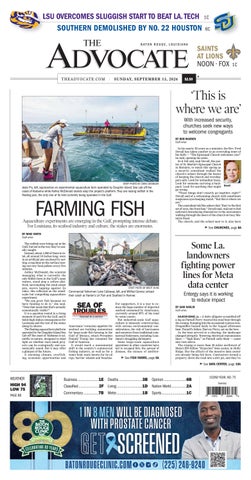
Josie Pry, left, approaches an experimental aquaculture farm operated by Dauphin Island Sea Lab off the coast of Alabama while Ashley McDonald stands atop the project’s platform. They are raising redfish in the floating pen, the only one of its kind currently being operated in the Gulf.
FARMING FISH
Aquaculture experiments are emerging in the Gulf, prompting intense debate. For Louisiana, its seafood industry and culture, the stakes are enormous.
In his nearly 30 years as a minister, the Rev. Fred Devall has taken comfort in an overriding tenet of his faith — “The Episcopal Church welcomes you!” he said, opening his arms. So it felt odd, said Devall, the pastor of St. Martin’s Episcopal Church in Metairie, to watch this spring as a security consultant walked the church’s ushers through the basics of keeping the church and worshippers safe: Look for unfamiliar faces. Look for someone carrying a backpack. Look for anything that might Devall go wrong. “Those things don’t exactly go together, right?” Devall said of a welcoming church with sometimes suspicious eyes keeping watch. “But this is where we are.” The consultant told the ushers that “they’re the first set of eyes, the front line,” Devall said. And not to feel awkward introducing themselves to the newcomers walking through the doors of the church on busy Metairie Road. The church, and the school next to it, also have
ä See CHURCHES, page 8A
BY MIKE SMITH
Staff writer
The redfish were biting out in the Gulf, but not in the way they’re usually caught. Instead, about 1,000 of them in total, all around 10 inches long, were in an artificial pen enclosed by netting, a machine on the surface tossing out tiny food pellets every five minutes. Ashley McDonald, the scientist managing what is currently the only finfish farm in the Gulf’s open waters, stood atop a yellow platform surrounding the wind-swept pen, waves lapping against its sides. She reflected on the smallscale but compelling aquaculture experiment. “We can grow fish because we have funding to do it,” she said. “Does that mean that that’s actually economically viable?” It is a question rooted in a rising moment of peril for the Gulf, and it holds high-stakes consequences for Louisiana and the rest of the states along its shores. The floating aquaculture platform operated by the Dauphin Island Sea Lab off the coast of Alabama is scientific in nature, designed to shed light on whether such small projects can be ecologically and economically sound. But it may offer a glimpse of the future. A warming climate, overfishing, economic opportunities and
Some La. landowners fighting power lines for Meta data center
STAFF PHOTO By BRETT DUKE
Commercial fishermen Luke Callaway, left, and Wilfred Gomez unload their catch at Harlon’s LA Fish and Seafood in Kenner.
SEA OF
TROUBLES Second in a series
Americans’ voracious appetite for seafood are building momentum for large-scale fish farming in the Gulf of Mexico, which President Donald Trump has renamed the Gulf of America. It would mark a monumental shift in the country’s commercial fishing industry, as well as for a water body more known for its oil rigs, barrier islands and beaches.
For supporters, it is a way to reduce the huge number of imported seafood consumed by Americans, currently around 85% of the total by some counts. But industrial-scale Gulf aquaculture is intensely controversial, with serious environmental considerations, the risk of hurricanes and concerns from traditional commercial fishermen, including Louisiana’s struggling shrimpers. Some large-scale aquaculture operations in other countries have led to escaped fish, the spread of disease, the misuse of antibiot-
ä See FISH FARMS, page 6A
Entergy says it is working to reduce impact
BY SAM KARLIN Staff writer
CALHOUN BRAKE, La. — A baby alligator scrambled off a log as Parnell Perry weaved his mud boat through the swamp, bumping into the occasional cypress tree. Dragonflies buzzed lazily in the August afternoon heat. Parnell’s father, Harvey Perry, sat on the bow. As the boat arrived at a clearing, the landscape changed abruptly. Towering electrical transmission lines — “high lines,” as Parnell calls them — came into view above. The swamp is more than 30 miles northwest of Meta’s $50 billion “Hyperion” data center, in Holly Ridge. But the effects of the massive data center are already being felt here. Contractors turned a property down the road into a dirt pit, and they’ve
ä See DATA CENTER, page 10A
WEATHER HIGH 94 LOW 75
Business ......................1E Deaths .........................3B Opinion ........................6B Classified ..................... 2F Living............................1D Nation-World................2A Commentary ................7B Metro ...........................1B Sports ..........................1C
PAGE 8B
1 IN 8 MEN WILL BE DIAGNOSED R WITH PROSTATE CANCER C ELEBRA
TING 8 0 YEAR S
GET SCREENED
BATONROUGECLINIC.COMM
(225) 246-9240
102ND yEAR, NO. 75