COURSEY • HARRELLS F E R R Y • PA R K V I E W • MILLERVILLE •
OLD JEFFERSON • SHENANDOAH • TIGER BEND • WHITE OAK
THE SOUTHEAST
ADVOCATE T H E A D V O C AT E.C O M
|
W e d n e s d ay, Au g u s t 19, 2026
If you would no longer like to receive this free product, please email brtmc@ theadvocate.com.
1GN
Jan Risher
Finding joy in a low-stakes, creative self-portrait I have never learned to draw. Growing up, I thought being able to draw was something you could do or you couldn’t — and no matter how much I wanted to, I couldn’t. For decades, I equated drawing well with being an artist. I’ve learned that I was wrong about both. So many people I trust have told me that anyone can learn to draw. I believe them. I’ve never taken a drawing class. Circumstances have always seemed to get in the way. I’ve also gotten a better sense of the Venn diagram between drawing well and being an artist.
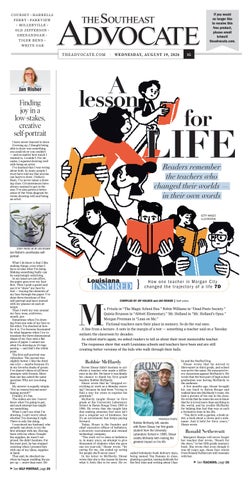
Readers remember the teachers who changed their worlds — in their own words GETTY IMAGES ILLUSTRATION
STAFF PHOTO BY BY JAN RISHER
Jan Risher’s unorthodox selfportrait
What I do know is that I like making things, even when I have no idea what I’m doing. Making something badly can be surprisingly satisfying. In my latest art-ish effort, the paper goes over my face first. Then I grab a pastel and use it to “draw” my face by feel — tracing the elements of my face through the paper. I’ve done three iterations of this self-portrait and have started with my glasses on each attempt. Then I work my way around my face: nose, eyebrows, mouth, jaw. Sometimes when I’m drawing from one side of my face to the other, I’m shocked at how far it is. I’ve become fascinated by what happens when I try to translate the three-dimensional shape of my face onto a flat piece of paper. I cannot see what I’m drawing as it’s happening — and that’s the whole point. The first self-portrait was ridiculous. The second was slightly better. I like the third one a lot — maybe because it’s in my favorite shade of green. I’ve shared videos of all three attempts with friends. More than one has asked the same question: Why are you doing this? My answer is equally simple: “For no reason beyond entertaining myself!” Frankly, it’s fun. The stakes are low. I never know what I’m going to get, and each attempt has taught me something. When I can’t see what I’m drawing, I can’t worry about whether I’m drawing it right. There is only the doing. I convinced my husband, who actually can draw, to try the first attempt with me. Having been with me when I bought the supplies, he wasn’t surprised. He didn’t hesitate. For the most part, he has stopped resisting when I present him with one of my ideas, supplies in hand. That said, he shocked me when he began wadding the paper up — more than once. He
ä See SELF-PORTRAIT, page 2G
Louisiana
INSPIRED
M
How one t eacher in Mor g an Ci t y change d t he t r aje c t or y of a li f e 7D
COMPILED BY JOY HOLDEN and JAN RISHER | Staff writers
s. Frizzle in “The Magic School Bus.” Robin Williams in “Dead Poets Society.” Quinta Brunson in “Abbott Elementary.” Mr. Holland in “Mr. Holland’s Opus.” Morgan Freeman in “Lean on Me.” Fictional teachers earn their place in memory. So do the real ones. A line from a lecture. A note in the margin of a test — something a teacher said on a Tuesday outlasts the classroom by decades. As school starts again, we asked readers to tell us about their most memorable teacher. The responses show that south Louisiana schools and teachers have been and are still creating better versions of the kids who walk through their halls.
Robbie McHardy Byron Slosar didn’t hesitate to celebrate a teacher who made a difference in his life. He knew it was finally his chance to thank his first grade teacher, Robbie McHardy. Slosar wrote that he “dropped everything at work on a Monday morning” because he had been “trying to find a way for years to express his gratitude.” McHardy taught Slosar in first grade at the University Laboratory School in Baton Rouge from 1985 to 1986. He wrote that she taught him that making someone feel seen isn’t just a singular act of kindness, but it’s an investment that keeps paying forward. Today, Slosar is the founder and chief executive officer of hellohive, a diversity recruitment and résumé technology company. “The work we’ve done at hellohive is, in many ways, an attempt to give thousands of students what she gave one six-year-old,” Slosar wrote. “By caring for me, she ended up caring for people she’ll never meet.” In his letter to McHardy, Slosar wrote that she is the reason he knows what it feels like to be seen. He re-
PROVIDED PHOTO
Robbie McHardy, left, stands with Byron Slosar, her first grade student from the University Laboratory School in 1985. Slosar credits McHardy with making the greatest impact on his life.
lie and the Stuffed Dog. Slosar wrote that he moved to Shreveport in third grade, and school was never the same. He measured every classroom against McHardy’s. He wrote that the best part of high school graduation was having McHardy in the audience. A few months ago, Slosar brought his son back to Baton Rouge and walked him into McHardy’s room. He took a picture of his son in the class. He wrote that he wants his son to know that he is loved more than anything in the world, and he credits McHardy for helping him feel that way at such a formative time in his life. “You did it with a garden, a book order, a book about a clown and a nickname. And it held for forty years,” Slosar wrote.
Ronald Nethercutt
Margaret Sharpe will never forget her teacher that wrote, “Reach for the stars,” in her fifth grade memory book. She wrote that even though it was 60 years ago, those four words called Scholastic book delivery days, from Ronald Nethercutt still resonate being named Top Banana in class, with her. planting a garden, tasting kohlrabi for ä See TEACHERS, page 2G the first time and writing about Char-
2G ■ Wednesday, August 19, 2026 ■ theadvocate.com ■ The Advocate
lll
Former ‘The Voice’ contestant signs with Motown Gospel Abbeville is too small for Koryn thorne earned a gold record with her 2017 debut single, “Won’t He Hawthorne to win “The Voice.” Those words from Hawthorne’s el- Do It.” The million-seller reached No. 1 ementary school teacher in a 2015 on three Billboard gospel interview have stayed with charts. The hit stayed at me all these years. No. 1 for 41 weeks on BillHawthorne’s powerful R&B voice was seemingly board’s Hot Gospel Songs crushing the competition in chart, setting a record for Season 8 of the reality singthe longest reign at the top spot for a female artist. ing competition on NBC. Herman Seven years later, the But votes from viewers Fuselier inspirational hit has 100 ultimately decided the winmillion views on YouTube ner. Folks in Hawthorne’s and more than 60 million streams small, south Louisiana hometown on various online music platfelt that put her at a disadvantage to big-city contestants. The teach- forms. Hawthorne’s career has iner and a cast of family, friends and cluded two Grammy nominations and multiple music and image church members worked Vermilawards. ion Parish and the surrounding She enlarged her territory in area for support. Throngs of fans showed up for a July with a recording contract from Motown Gospel. Yes, that’s parade and celebration of Koryn part of the landmark record label Hawthorne Day, Mayor Mark that gave the world Diana Ross Piazza’s official proclamation on and the Supremes, Marvin Gaye, May 6, 2015. Stevie Wonder and other legends. Yet the small-town concerns beJ. White Did It, who has procame reality. Hawthorne advanced to the show’s final four, then beduced No. 1 hits on the Billboard Hot 100 for Cardi B and Megan came the first eliminated. Sawyer Thee Stallion, is the producer of Fredericks, a 16-year-old singer from New York with a strong social Hawthorne’s first project. The EP comes out Oct. 2. media following, won the event. “His Favorite,” the project’s Fourth place has proven to be first single, already has 54,000 a blessing. Now a contemporary views in less than two weeks on Christian and gospel singer, Haw-
FILE PHOTO BY TRAE PATTON/NBC
Koryn Hawthorne, left, takes the stage with her coach, Pharrell Williams, on the live finals of ‘The Voice’ in 2015. YouTube. Motown Gospel describes her voice as a “powerful bridge” between gospel, R&B and contemporary music. “What has always stood out to us is her ability to meet people where they are and make music that feels both personal and up-
lifting,” said Walter Thomas, executive vice president of Motown Gospel and TAMLA Records, about Hawthorne. The uplifting voice from Abbeville was too small to win “The Voice.” Now the whole world gets to savor it.
Herman Fuselier is executive director of the St. Landry Parish Tourist Commission. A longtime journalist covering Louisiana music and culture, he lives in Opelousas. His “Zydeco Stomp” show airs at noon Saturdays on KRVS 88.7 FM.
GETTY IMAGES ILLUSTRATION
TEACHERS
Continued from page 1G Sharpe wrote that although “Mr. Nethercutt was not a big man in music education. She went on to stature, he cast a huge, rich shad- become a teacher, a principal and a ow” in her life. He was the small curriculum supervisor. She wrote man on a tall ladder who directed that Nethercutt still “stands head and shoulders above” the Ponchatoula High the many outstanding School Band on Friday teachers that shaped nights. her career in educa“He was the band dition. rector who encouraged scared, self-conscious fifth-graders to pick up these unfamiliar instruments and turn the squeaks and thumps into actual music,” MorganDee Hawkins, Sharpe wrote. a 2026 graduate from Sharpe remembered St. Joseph’s Academy, taking his cue, blowwrote that her chemising her whistle and try teacher, Courtney leading the band out Malbrue, took her unPROVIDED PHOTO der her wing during her onto the field to the lively strains of “Hey MorganDee Hawkins, junior year. Look Me Over” while left, stands with Hawkins wrote that the crowd sang and she struggled in chemCourtney Malbrue, the istry because science clapped along. Nethercutt took stu- teacher that made a and math had never dents to LSU football difference in her life at come naturally to her, games to see the Gold- St. Joseph’s Academy. but Malbrue never stopped believing in en Band from Tiger Land and dared them to dream that her. She displayed patience, enthey could be a part of something couragement and a willingso magical. ness to help Hawkins unFrom fifth grade to college at derstand the material. Southeastern University, Nether“More importantly, she cutt was an anchor for Sharpe in made me believe that I
Courtney Malbrue
SELF-PORTRAIT Continued from page 1G
explained that wadding the paper would make it mold against his cheekbones and nose. I tried his technique on my second attempt, although wadding up perfectly good paper felt vaguely sacrilegious. The portrait was only marginally bet-
ter. For my third attempt, I went back to perfectly good flat paper. Being asked why I’m doing this has made me wonder: Why am I doing this? I think it has something to do with the surprise. I never know what I’m going to find when I take the paper away. Most of what fills my week runs on the opposite instinct. There are deadlines — so many deadlines. There is research. There
was capable of succeeding, even when I doubted myself,” Hawkins wrote. By Hawkins’ senior year, her bond with Malbrue had grown so strong that she became the student’s godmother. “She has been much more than a teacher — she has been a mentor, a role model and a constant source of support. Her belief in me gave me confidence both inside and outside the classroom, and I will always be grateful for the positive impact she has had on my life,” Hawkins wrote.
Jeanie Bastin Sadie Harris jumped at the chance to honor her fourth grade teacher, Jeanie Bastin, from Juban Parc Elementary School in Denham Springs. She wrote that Bastin “was a bright light” in her life. Harris wrote that Bas-
is reporting. There is writing. There is editing. There are stories that need to keep the readers reading. Most of what I make is supposed to work. Life is full of things that are supposed to turn out. This one isn’t. I don’t want fun and surprise to live only in the margins of everyday life. Maybe I like the repetition as much as anything. I put the paper
tin was stern, but in the best way possible. “She was kind, hard-working and did everything in her power to ensure her students received the instruction they needed. She taught me Science and Social Studies, and you could see her passion for education every day. She made coming to school fun,” Harris wrote. Bastin had fun science experiments, Harris remembered. She and Bastin still keep in touch 17 years later. Harris wrote that Bastin is the reason she wanted to become a teacher. “I have always looked up to her and always will,” Harris wrote. “I am now teaching fifth grade in my hometown, and I hope to have the impact on my students that she had on me.”
up, I draw what I cannot see. There is no way to cheat it. I can’t see the drawing, so I can’t judge it while I’m making it. Low stakes and delight are not the same thing, but I think they might be cousins. Nobody expects a blind portrait to be good. The green one surprised me. The jaw is roughly in the right place. It captures something of the way I look off to the side. It makes me smile.
The third portrait sits on my desk right now, green face turned slightly away from the window. I’m going to frame it. If you want to try your own version of a blind self-portrait, please do! Send photos of your effort to jan.risher@theadvocate.com. Email Jan Risher at jan.risher@ theadvocate.com.
The Advocate ■ theadvocate.com ■ Wednesday, August 19, 2026 ■ 3G
lll
BOOKS
La. author explores Acadian roots Through war and romance, book gives insight into expulsion
BY JOY HOLDEN
Staff writer
“Like Snow Before Sun” by Marianne Rabalais Sulser, Atmosphere Press, 323 pages. The novel “Like Snow Before Sun” by Marianne Rabalais Sulser is a fictional account of the AcaReview dians and Mi’kmaq tribe on the eve of the French and Indian War and the Expulsion of the Acadians. Sulser weaves a tale of redemptive love and brutal violence among the complex alliance of Acadians and Mi’kmaq as they encounter the British. Marianne Rabalais Sulser is an Alexandria native living in Colorado with her husband and three children. She is a graduate of LSU’s Manship School of Mass Communication and the Paul M. Hebert Law Center. Sulser’s maternal ancestors were among the Acadians expelled from Nova Scotia in the 1750s, and she grew up hearing Cajun French and family stories that shaped her identity. After working on her own genealogical research, Sulser still had questions. As a lawyer, she found herself on a quest to uncover her ancestors’ stories from Nova Scotia. So she turned the exploration into a novel that illuminates the terror of the time through the eyes of an Acadian and Mi’kmaq woman. “Like Snow Before Sun,” which was released in June, brings this chapter of history to life through the story of a fierce young woman named Jeanne LeJeune who is caught between loyalty, love and survival as war reshapes her world. In 1755 Halifax, Jeanne LeJeune has always lived between worlds — the fierce daughter of a French merchant and a Mi’kmaw woman, she is torn between her village life
PROVIDED PHOTO
Marianne Rabalais Sulser, an LSU alumna, is the author of ‘Like Snow Before Sun.’ and her mother’s people. When her father is seized by English soldiers, Jeanne’s fragile peace shatters. To free her father, Jeanne agrees to guide an English officer through Nova Scotia as he maps the land. Her choice entangles her in the coming war. With allegiances to the Acadians and the Mi’kmaq, Jeanne’s mission to free her father becomes a journey of danger, betrayal and passion. The character Jeanne is inspired by one of Sulser’s own ancestors — a woman of Acadian and Mi’kmaw heritage. Henry Young, Jeanne’s love interest, draws from an actual British
officer who may have secretly helped Acadians escape deportation. “Like Snow Before Sun” is an intricate look at the Acadians, the Mi’kmak and the English in Acadia in 1755. The novel puts in perspective how fierce the hatred was between the English Protestants and the French Catholics during the 18th century. Sulser covers political intrigue, ferocious violence and community tumult while cultivating an enemies-tolovers romance. Full of heartache and drama, the novel captures the unstable time for Acadians and Mi’kmaq
in a grounded story of family and the fight for freedom. Sulser creates lush descriptions of the forest and the coast of the Northeast. Through her descriptions of nature and action, she builds an unforgettable world. Through familiar dialogue, Sulser draws a direct line from Acadians to Cajuns in their language and ways. The title of the novel comes from Chief Tecumseh, who said, “They have vanished before the avarice and the oppression of the White Man, as snow before a summer sun.” Sulser wrote that the quote
made her think of not only First Nations but also the loss of Acadiana and Louisiana Cajun culture. She hopes readers develop a deeper understanding of the resilience required to survive displacement and how Cajun culture has endured. Sulser will be at the Louisiana Book Festival in Baton Rouge on Oct. 31. To learn more from the resources Sulser used to research this novel, visit mariannesulser. com. Email Joy Holden at joy. holden@theadvocate.com.
At a celebrity bookshop in California, I found greatness on the shelf When my family and I visited Summerland, California, in May, I assumed that blue skies would be part of the mix. California is known for its sunny weather, and who wouldn’t expect a place called Summerland to offer endless sun? But our excursion unfolded during the area’s season of “May gray,” a local quirk of the weather that brings clouds and chill. Days like that make wide, clear windows all the more welcome to harness the subdued light. The thought came to mind as we browsed in Godmothers, a Summerland bookstore that opened two years ago in a restored gambrel barn. The shop’s broad banks of windows are a big part of its California feel. While some bookstores embrace a cloistered sensibility, this venue looks outward, connecting books with the world beyond its doorstep. There are other nods to California’s brightly casual vibe. Warm wood floors create an inviting mood, and along with the high bookcases, broad farm tables hold some of the stock, too. Other light touches, such as a small end table bearing a tiny stack of volumes, make Godmothers seem less like a store and more like a
DOWNLOAD
Danny Heitman AT RANDOM
home. The shop was the brainchild of high-profile literary agent Jennifer Rudolph Walsh and popular beauty author Victoria Jackson. Various stories have credited Oprah Winfrey, a friend of the owners, with coining the shop’s name. Because it’s in Santa Barbara County, Godmothers attracts its share of celebrities. Harry and Meghan, Duke and Duchess of Sussex, have stopped by. We didn’t see any stars on our visit, but when I go to a bookstore, I’m looking for greatness on the shelves. Luckily, Godmothers had an abundance of talent in its stock. One of the small pleasures of visiting a bookshop is being reminded of the good books already waiting for you at home. I was happy to see “Whistler,” Ann Patchett’s new novel, and Anne Fadiman’s “Frog: And Other Es-
DOWNLOAD
says” at Godmothers. I was doubly pleased to know that I’d acquired them some weeks before for my to-be-read pile back in Louisiana. I headed upstairs to the shop’s spacious second floor, which included a lovely row of glass panes and a selection of books on art and design. My purchase for the day was “The World According to Vincent,” a bright yellow hardback that alternates some of Van Gogh’s best paintings with pithy excerpts from his writings. I’ve been so taken with it that I’ve explored an equally charming companion volume, “The World According to Matisse.” Visiting Godmothers reminded me that bookstores can be a great welcome mat for any community. That’s surely true of our own bookstore scene in Louisiana, as Steve Garbarino made clear earlier this year in “Big Easy Reading,” a celebration of New Orleans bookshops in Airmail magazine. Van Gogh said the secret of making beauty “is to a large extent good faith and sincere feeling.” The best bookshops, I’ve learned, offer both. Email Danny Heitman at danny@dannyheitman.com.
DOWNLOAD
DOWNLOAD
PHOTO PROVIDED BY LEAH NORTON
The children’s section in Godmothers, a Summerland, California, bookshop, rests near a wide bank of windows that allows plenty of natural light.
ONE great state FOUR great apps
4G ■ Wednesday, August 19, 2026 ■ theadvocate.com ■ The Advocate
lll
THE PERFECT GIFT! Celebrate LSU baseball’s eighth national championship with this hardcover collector’s book
ONLY
35
$
95
OR VISIT STORE.THEADVOCATE.COM
ORDER
PLUS COMMEMORATIVE POSTERS Celebrate the Tigers’ eighth national championship with commemorative stadium edition and front page posters.
ADVOCATE THE
T H E A D V O C AT E.C O M
T H E T I M E S - P I C AY U N E
|
M o n d ay, J u n e 23, 2025
5
NOLA.COM
✦
M O N D A Y, J U N E 2 3 , 2 0 2 5
✦
1C
COLLEGE WORLD SERIES
$2.00X
1991 1 • 1993 • 1996 • 1997 • 2000 • 2009 • 2023 • 2025
COLLEGE WORLD SERIES L S U
✦
SPORTS
BATON ROUGE, LOUISIANA
C C U
3
GRRR-8 8!
NSHIP TIGERS WIN EIGHTH NATIONAL CHAMPION
LSU BASEBALL WINS ITS
EIGHTH
NATIONAL TITLE
NATIONAL CHAMPIONSHIP
NDISPUTED UN LEGEENDARY PITCHING, TIMELY HITTING AND LSU’S KNACKK FOR THE MOMENT RECHARGE DYNASTY TALK
CELEBRATION ALEX BOX STADIUM WEDNESDAY, JUNE 25TH, 2025
STAAFF PHOTO BY HILARY SCHEINUK
The Tigers celebrate after defeating Coastal Carolina 5-3 in game two of the College Worl d Series finals in Omaha, Nebraska, on Sunday. The roar is restored. When Jay Johnson took over aas the LSU baseball coach in 2022, the six-time national champion Tigers were in the midst of a 13--year title drought. The Tigers returned to the top of college baseball during the 2023 season. LSU survived s a dicey regional that went to a winner-take-all final at Alex Box Stadium against upstart LLittle Rock. Then LSU dominated, sweeping the super regional and College World Series in seveen games. After Sunday and Johnson’s second national title, he has LSU threatening to reboot a dynnasty that blossomed under legendary coach Skip Bertman. No. 8 is on its way to Baton Rouge. ä SEE COMPLETE COVERAGE OF THE TIGERS’ COLLEGE WORLD SERIES WIN. PAGGE 1B
WEATHER HIGH 94 LOW 74 PAGE 12A
Classified .....................6C Deaths .........................9A Metro ...........................8A Comics-Puzzles .....3C-5C Living............................1C Opinion .....................10A Commentary .............11A Lottery..........................8A Sports ..........................1B
100TH YEAR, NO. 358
STAFF PHOTO BY HILARY SCHEINUK
LSU center fielder Chhris Stanfield, right, celebrates with catcher Luis Hernandez as they both score on a two-run single by left fielder Derek Curiel in the fourth inning of Game 2 of the Collegge World Series finals against Coastal Carolina on Sunday at Charles Schwab Field in Omaha, Neb. LSU scored four runs in the decisive inning and won 5-3 to earn its ssecond title under coach Jay Johnson in four years. BY KOKI RILEY OMAHA, Neb. — To calll anything a dynasty requires a certain level of consiistent, championship excellence. The Boston Celtic cs in the 60s, New York Yankees in the 90s and UCo onn women’s basketball in the 2010s certainly fit th he description. LSU winning five national championsh hips in 10 years under Skip Bertman definitely qualiifies. Coach Jay Johnson n’s Tigers aren’t quite there yet, but what LSU acco omplished Sunday afternoon at Charles Schwab Fielld was remarkable nevertheless and potentially the b beginning of another baseball dynasty in Baton Roug ge. For the eighth tim me in program history, and for
the second time in three seasons, LSU won the national championship. The Tigers took down Coastal Carolina 5-3 in Game 2 of the College World Series final to secure the 2025 title. “Unbelievable. I’m so proud right now,” Johnson said. “It’s not to be taken for granted being here two years ago. That was special. Greatest night of my life. “This is equal and maybe even tops it in some ways.” The win secured Johnson’s second title in four years at LSU, making him the first coach in college baseball history to accomplish that feat at the same school. The Tigers did it despite bringing back just 12 players who appeared in a game from last year’s team, adding 12 players from the transfer portal,
three junior-college recruits and 10 freshmen in the offseason. “We (added) really talented freshmen ...,” Johnson said. “In a month’s time, we were able to add Chris (Stanfield). We were able to add Anthony (Eyanson), Zac Cowan, Luis Hernandez, Danny Dickinson to those 12 guys who were the right 12 guys.” With the score tied 1-1, the fourth inning proved to be the difference between a coronation and a Game 3 on Monday. The Tigers scored four runs on a walk, a hit by pitch and four singles to take a 5-1 lead. Sophomore Jake Brown led off with a walk before a single from junior Jared Jones and a hit by pitch loaded the bases for the junior Stanfield.
Rabalais: Thesse Tigers measure up to LSU’s toweringg expectations, Page 4C
Braswell’s fingerprints all over Tigers’ College World Series title, Page 5C
See which Tigers made an appearance on the All-CWS team, Page 5C
Staff writer
VISIT STORE.THEADVOCATE.COM OR
ä See LSU, page 4C