BOCAGE COUNTRY CLUB HIGHLAND JEFFERSON TERRACE KENILWORTH PERKINS SOUTHDOWNS UNIVERSITY CLUB
ADVOCATE THE SOUTHSIDE
T H E A D V O C AT E.C O M
|
W e d n e s d ay, J u n e 10, 2026
If you would no longer like to receive this free product, please email brtmc@ theadvocate.com.
1GN
Jan Risher LONG STORY SHORT
From online friend to family
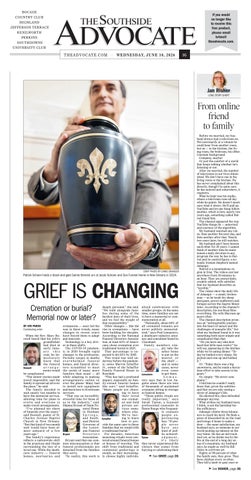
STAFF PHOTO BY CHRIS GRANGER
Patrick Schoen holds a black-and-gold Saints-themed urn at Jacob Schoen and Son Funeral Home in New Orleans in 2024.
GRIEF IS CHANGING Cremation or burial? Memorial now or later?
BY JON PARKS
Contributing writer When the Rev. Marc Boswell heard that his wife’s grandfather had died in early January this year, he immediately knew that the funeral arrangeBoswell ments would be complicated. “The winter storms made travel impossible, and the family is spread out all over the place,” he said. The family decided to wait nearly two months to have the memorial service, allowing time for plans to evolve and everyone to make travel arrangements. “I’ve planned my share of funerals over the years,” said Boswell, pastor of St. Charles Avenue Baptist Church in New Orleans. “But that kind of two-month wait would have been almost unheard of a few years ago.” The family’s experience reflects a nationwide shift in the practices and rituals surrounding the loss of a loved one. While the deathcare industry — funeral homes, mortuaries and
crematoria — once led the way in these trends, many changes in recent years have forced them to adapt and innovate. Technology is a key driver in these shifts. The COVID-19 pandemic in 2020 brought rapid changes to the profession. Periodic surges in deaths overwhelmed funeral homes, and funeral directors scrambled to meet the needs of many more families than usual — all while adapting to making arrangements online or over the phone. Many had to install new equipment and learn how to livestream services. “That was an incredibly stressful time for those of us in the industry,” said Shanna Bryant of Seale Funeral Home in Denham Springs, and Southeast District Governor of the Louisiana Funeral Directors Bryant Association. Bryant said that one common misconception is that funeral professionals are detached from the families they serve. “In reality, this work is
deeply personal,” she said. “We walk alongside families during some of the hardest days of their lives, and we feel the weight of that responsibility.” Other changes — like the rise in cremations — have been building for decades. According to the National Funeral Directors Association, at least 63% of Americans chose cremation over traditional burial in 2025. That percentage is expected to hit 82% by 2045. This trend was well underway before the pandemic, notes Marvin Schaffer Jr., owner of the Schaffer Family Funeral Home in Rosedale. “This has had a profound impact, especially on family-owned funeral homes like ours,” said Schaffer. “Many people are choosing to have their loved one cremated and hold private services somewhere else. We’re having to learn Schaffer how to provide the same care to these families that we would with a traditional burial.” For decades, American mourning rituals were centered around funeral homes or houses of worship. The shift from traditional and communal gatherings is steady, as they increasingly choose highly individu-
alized celebrations with smaller groups. At the same time, more families are not to have a memorial or commemoration at all. “Nationally, about 60% of all cremated remains are never publicly memorialized,” says Poul Lemasters, a deathcare industry attorney and consultant based in Cincinnati. Family members simply take the ashes home to put on the mantel or the shelf — and in some cases, never even come to get them. Lemasters Lemasters says that in Los Angeles alone there are tens of thousands of unclaimed cremains sitting in storage in funeral homes. “Those public rituals are really important,” says Sarah Tipton, a licensed professional counselor in Baton Rouge who frequently counsels people experiencing loss. “If people never have any kind of public acknowledgment, Tipton i t ’s l i k e l y they never experienced the closure that comes from burying or celebrating their
ä See GRIEF, page 2G
Before we married, my husband always had a television on. Not necessarily at a volume he could hear from another room, but on — in the kitchen, the living room, the bedroom, his office. Constant background. Company, maybe? Or just the comfort of a world that keeps talking whether he’s listening or not. After we married, the number of televisions in our lives diminished. We don’t have one in the living room or the kitchen. He has never complained about this directly, though I’m quite sure he has noticed and somewhere, it registers. What he kept was his studio, where a television runs all day while he paints. He doesn’t much care what it shows. He’ll pull up YouTube and let one thing follow another, which is how, nearly two years ago, something called Balrod found him. The channel appeared the way YouTube things do — uninvited and courtesy of the algorithm. My husband watched one video, then another the next day, and then another after that. Nearly two years later, he still watches. My husband and I have known each other for 35 years. I cannot think of another time he maintained a daily devotion to any program the way he has to Balrod and its central figure, a nomadic Iranian shepherd named Jahangir. Balrod is a mountainous region in Iran. The videos can last anywhere from 30 minutes to an hour. They are posted daily, crudely edited, with subtitles that my husband describes as “terrible.” The videos show the daily life of Jahangir — a small, tireless man — as he tends his sheep and goats, grows sunflowers and forages across the Zagros Mountains. According to the channel’s description, his son Reza films everything. His wife Maryam appears often. The channel description promises an “unforgettable journey into the heart of nature and the challenges of nomadic life,” but what my husband found in it was something both more simple and complicated than that. “Do you have any idea how hard that little man works?” he will say, appearing in the kitchen while we’re eating dinner. “Today he bathed every sheep. He picked each one up and bathed it.” Or: “Today there was a big snowstorm, and he made a herculean effort to take acorns to his goats.” Or, simply: “He never complains.” I told him he couldn’t really know that, given the subtitles and that we are only seeing a sliver of Jahangir’s life. He allowed this, then defended Jahangir anyway. What strikes my husband most, I think, is not the hardship but the sufficiency. Jahangir climbs three kilometers to reach his herd. He finds a piece of discarded tin on the road and brings it home to make a door — the same satisfaction, my husband says, as someone in our world picking up takeout on the way home. He has an old truck. And yet, as he drinks tea by the fire at the end of a long day on top of a mountain, my husband says, he might as well be Bill Gates in a private jet. Eighty or 90 percent of what the family eats, they grow. They have chicken every so often. They kill a lamb or goat once or
ä See RISHER, page 3G