GARDEN DISTRICT G O O D W O O D • TA R A S PA N I S H T O W N C A P I TA L H E I G H T S LSU LAKES MELROSE PLACE BEAUREGARD TOWN
ADVOCATE THE MID CITY
T H E A D V O C AT E.C O M
|
W e d n e s d ay, M ay 27, 2026
If you would no longer like to receive this free product, please email brtmc@ theadvocate.com.
1GN
Jan Risher LONG STORY SHORT
Books on my nightstand keep disappearing
STAFF PHOTOS BY DAVID GRUNFELD
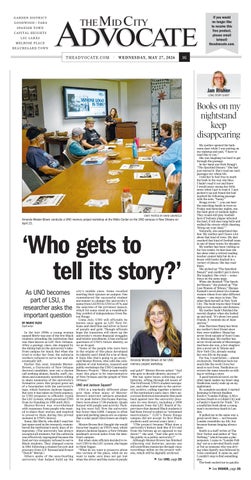
Amanda Mester-Brown conducts a UNO memory project workshop at the Midlo Center on the UNO campus in New Orleans on April 23.
‘Who gets to tell its story?’ As UNO becomes part of LSU, a researcher asks the important question
BY MARIE FAZIO Staff writer
In the late 1950s a young woman named Merle was one of the few Black students attending the institution that was then known as LSU New Orleans. After a geology class, she stopped by the dining hall on the university’s lakefront campus for lunch. But when she tried to order her food, the cafeteria workers refused to serve her and she eventually left. Earlier this year, Amanda MesterBrown, a University of New Orleans doctoral candidate, sent out a clarion call seeking alumni, faculty, staff, students and community members willing to share memories of the university’s formative years. Her project grew out of a fascination with the university’s logo, which features Jackson Square. But now it has taken on fresh urgency, as UNO prepares to officially rejoin the LSU system, which governed UNO from its founding in 1958 until 2013. Mester-Brown was overwhelmed with responses from people who wanted to share their stories, and inspired to preserve them during this pivotal moment in UNO’s history. Some, like Merle, who didn’t want her last name used in the research, remembered the institution’s early days of integration. (The university has always accepted all students, but the cafeteria was effectively segregated because the food service company refused to serve Black students. They changed course in 1961 following a student boycott and pressure from A.P. Tureaud and Ernest “Dutch” Morial.) Others spoke of the once-bustling university that helped build up the
city’s middle class. Some recalled meeting their spouses on campus. One remembered the successful student movement to change the university’s name from LSUNO to UNO in 1974, and the selection of the privateer mascot, which for some stood as a swashbuckling symbol of independence from Baton Rouge. Come July, UNO will officially be known once again as LSU New Orleans and shed blue and silver in favor of purple and gold. Though officials hope the transition will shore up the university’s recent financial struggles and bolster enrollment, it has surfaced questions of UNO’s future identity, as we as its past. “Some of the people who were here in the origins of this place developed its identity and I think for a lot of them it feels like that’s going to go away,” said Mester-Brown, who calls the com- Amanda Mester-Brown at her UNO pilation of oral histories, research and memory project workshop. public workshops the UNO Community Memory Project. “Most people really and gold?” Mester-Brown asked. “And want this place to be representative who gets to decide identity anyway?” She has spent hours collecting oral of New Orleans and the people of New histories, sifting through old issues of Orleans.” The Driftwood, UNO’s student newspaUNO and Jackson Square? per, and other materials in the univerUNO is a markedly different place sity archive, culling together a history now than when many of Mester- of the institution’s early days. She’s unBrown’s interview subjects attended. covered historical documents that push At its peak before Hurricane Katrina, back against how the university presthere were about 17,00 students. Quads ents its own history, including a 1958 buzzed with people and activity. Park- statement from the LSU Board of Suing lots were full. Now the university pervisors that deemed Black students it has fewer than 6,000. Campus is often had been forced to admit as “unwanted quiet and parking spaces are so copious matriculants.” (LSU’s Baton Rouge that a solar panel farm leases an empty campus did not accept its first Black students until several years later.) lot. “(The project) became ‘What does a Mester-Brown first thought she would focus her inquiry on UNO’s seal, which university’s history look like if it’s told depicts Jackson Square, a New Orleans from the bottom up as opposed to top landmark several miles from the lake- down?’ ” she said. “And who gets to be the public in a public university?” front campus. Although Mester-Brown has finished But when state officials decided to revert UNO to the LSU system, she began collecting oral histories, anyone can still contribute memories through voice to think bigger. “What do we want to preserve about recordings online on the project webthis version of the place, what do we site, which will be digitally archived. want to make sure does not get lost ä See UNO, page 2G when the silver and blue turns to purple
My mother opened the bathroom door while I was putting on my makeup and said, “I have to read this to you.” She was laughing too hard to get through the passage. In her hand was Rick Bragg’s “The Speckled Beauty.” She had just started it. She’s read me such passages my whole life. I told her to feel free to mark the book in the way she likes. I hadn’t read it yet and knew I would enjoy seeing her little notes when I get to read it. I just picked it up and found she had marked the following passage with the note, “funny.” Bragg wrote: “...you can hear the marching bands in town on Friday and Saturday nights, see the faint glow of stadium lights. They would still play football here if bubonic plague infected the land, if old men rang bells and walked the streets while chanting ‘Bring out your dead.’ ” Naturally, she underlined that line. My mother and I know a lot about that kind of town. My dad coached that kind of football team in one of those towns for decades. My mother has been visiting us for two weeks. In that time she has done what a retired reading teacher cannot help but do in a house with books stacked in a variety of places: She has read them. She picked up “The Speckled Beauty” and couldn’t put it down. She laughed. She cried — sometimes on the same page. When she finished “The Speckled Beauty,” she picked up “The Lion Women of Tehran,” Marjan Kamali’s novel about two Iranian women whose lives take different shapes — one stays in Iran. The other finds herself in New York City. The book tracks their friendship across decades and distance. My mother hadn’t finished the second chapter when she looked up and said, “It’s about two good friends. It reminds me of Jean and me.” Jean Harrison Sharp has been my mother’s best friend since they were toddlers. Sharp has never lived outside of Scott County, Mississippi. My mother has never lived outside of Mississippi. And here she was, a few chapters into a novel set in Tehran and New York City, already seeing her own life on the page. For fun, I read fiction — almost exclusively. Nonfiction feels too much like the work I love but need to rest from. Nonfiction exercises the same muscles as editing or writing a story. A good historical novel, on the other hand, makes my heart sing. Nonfiction rarely ends up on my nightstand. By complete accident, I started listening to Patrick Radden Keefe’s “London Falling: A Mysterious Death in a Gilded City and a Family’s Search for Truth.” It’s a nonfiction book about a young man’s mysterious death in London. It pulled me in the same way a great novel does — not because London resembles my life, but because human longing always does. Keefe is a staff writer at The New Yorker and author of “Say Nothing,” which became a phenomenon. I came to “London Falling” not as a devoted Keefe reader but as someone who was driving when Spotify mis-followed by voice command. It came on, and I couldn’t stop to find something else. The book sucked me in quickly.
ä See RISHER, page 2G