BOCAGE COUNTRY CLUB HIGHLAND JEFFERSON TERRACE KENILWORTH PERKINS SOUTHDOWNS UNIVERSITY CLUB
ADVOCATE THE SOUTHSIDE
T H E A D V O C AT E.C O M
|
W e d n e s d ay, A p r i l 29, 2026
If you would no longer like to receive this free product, please email brtmc@ theadvocate.com.
1GN
Jan Risher LONG STORY SHORT
He paints chickens; I paint the backgrounds
STAFF PHOTOS BY JAVIER GALLEGOS
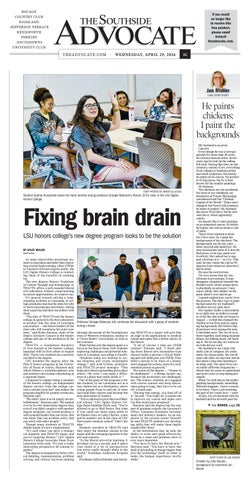
Student Sophia Kryszewski raises her hand recently during professor Granger Babcock’s Honors 2015 class in the LSU Ogden Honors College.
Fixing brain drain LSU honors college’s new degree program looks to be the solution
BY HALEY MILLER
Staff writer
As many universities encourage students to specialize and tailor their education around high-earning, often STEMor business-focused degree paths, the LSU Ogden Honors College is reminding them of the benefits of zooming out. The new degree, Honors Traditions in Critical Thought and Scholarship, or TRACTS, offers a well-rounded liberal arts education without compromising on career opportunities, its creators say. It’s geared toward solving a longstanding problem in Louisiana of college graduates leaving the state for jobs or doctoral programs elsewhere, taking their expertise and their tax dollars with them. “The idea of TRACTS and the honors college in general is the best educational product that the state of Louisiana can produce — the future leaders of the state who will transform the state over time,” said Brian Haymon, chair of the Dean’s Advisory Council in the honors college and one of the architects of the degree. TRACTS, a standalone Bachelor of Arts housed in the honors college, launched with its first cohort in August 2025. Thirty-two students are currently enrolled in the degree. LSU modeled the degree after the Plan II honors program at the University of Texas at Austin, Haymon said, which follows a multidisciplinary arts and sciences curriculum culminating in a capstone thesis. Compared to simply being a member of the honors college, an independent degree carries from the college carries a certain “gravitas” and makes the program eligible for greater resources, Haymon said. “We didn’t want it to be simply an embellishment,” Haymon said. “We wanted it to be its own stand-alone degree that, even if you didn’t couple it with another degree program, you would produce a well-rounded leader that can write, that can think, that can problem solve, that can work with other people.” Though many students in TRACTS double major, it’s not a requirement. “It’s cool when you have a biological engineer and TRACTS major, and you’re studying Homer,” LSU Ogden Honors College Associate Dean Drew Lamonica Arms said. “It’s just a really interesting perspective all coming together.” The degree is designed to foster critical thinking, communication, problem solving and ethical decision-making
Professor Granger Babcock, left, continues the discussion with a group of students during a break. through discussion of the foundational texts of Western civilization, similar to a “Great Books” curriculum, as well as the sciences. What further sets the degree apart is a focus on the Bayou State, with students exploring challenges and potential solutions in Louisiana, according to faculty. “Students today are looking to create meaning and create meaningful change,” said Josh Grimm, professor and TRACTS project manager. “This helps give them a grounding and a place where, ‘Oh, wow, I can make a difference in a place that really needs it.’ ” One of the goals of the program is for the students to see Louisiana not as a way station but as a destination, where young people from in and out of state can build their careers and become the next generation of leaders. “You’re allowed to go to Harvard Medical School,” LSU Ogden Honors College Dean Jonathan Earle said. “You’re allowed to go to Wall Street. But what if you could use those same skills to do finance here in Lake Charles, come and be number one in the class of LSU Shreveport medical school? That’s the idea.” Students enrolled in TRACTS said they enjoy the seminar classes in the major and the sweeping exposure to the arts and sciences. “In the liberal arts-style learning, it develops you as a person, and it opens your mind to a lot of perspectives you never really thought about in the world,” freshman Anderson Krupala said. Freshman Aditya Khutale said declar-
ing TRACTS as a major will give him an edge in his applications to medical school and make him a better doctor in the future. “A lot of classes I take are STEM related,” Khutale said. “I think adding these liberal arts, humanities-type classes builds a person’s critical thinking and soft skills past just STEM. They build a person to be more of a leader, more engaged in society, more of a wellrounded person in general.” The motto of the degree — “choose to be challenged” — is fitting, faculty say, because the professors are challenged, too. The honors students are engaged with course content and keep discussions going so long, they have to be cut off, Grimm said. “Having that energy, you feed off of it,” he said. “You really do. It pushes me to improve my course and make sure I’m that much more prepared.” Haymon said the degree has the support of graduate schools, the Governor’s Office, Louisiana Economic Development and industry leaders. As an employer in the private sector himself, he said TRACTS students are developing skills that will make them highly sought-after hires. In the Information Age, he said, the ability to write and speak effectively, work on a team and problem solve is ever more important. “You have to have the liberal arts,” Haymon said. “You have to have this kind of grounding in things bigger than just the technology itself, in order to make the human experience worthwhile.”
My husband is an artist. I am not. Even though he was a newspaperman for more than 30 years, he’s always been an artist. Seven years ago he took up the calling full time. During that time, he has created a variety of art, everything from collages to linoleum prints and small sculptures, but mostly he paints oil on canvas. He prefers to do big pieces, but he is best known for his smaller paintings. Of chickens. The chickens are not accidental. For most of my childhood, my hometown of Forest, Mississippi, considered itself the “Chicken Capital of the World.” Times have changed, but Forest still produces its share of poultry. My husband has never lived there, but he married into it, which apparently counts. He doesn’t like to start painting on an unpainted canvas. So before he begins, the canvas needs a coat of paint. I have never learned to draw, but I love color. So, I paint the backgrounds of his chickens. The backgrounds can be any color — loose, layered and imperfect. He may incorporate some of it into the final piece, or he may paint over it entirely. He’s asked me to suggest a horizon in it — so I try. That said, he may rotate the canvas 90 degrees from whatever direction I had in mind. He sees his own horizon. I’m very aware that my contribution is provisional. It may disappear completely beneath the finished work, which means there is absolutely no pressure. I mix colors wildly, then slather on the paint, hand it over and let go. I cannot explain how much I love the process. The days I get to paint backgrounds for my husband’s chickens are my peak days. His regular studio is unavailable to us right now, an indirect casualty of the fire that took our house in August — so that has changed the rhythm of our lives and my painting backgrounds. But before that, those hours were among the ones I cherished most. The two of us in there together, each doing separate things, not talking much, not needing to. He let me play my music as we both did our work. My husband is not a man who seeks a lot of company. He cooks alone. He cleans alone. He was 40 years old when we married, and he had spent a long time learning to be alone well. Our inner lives run on wildly different frequencies — which took me years to understand and more years to stop taking personally. When I’m with him in the studio painting backgrounds, something different happens. I have a reason to be there. I have a job touching the part of art I most love — color. In fact, my involvement with my husband and his artwork goes far
ä See RISHER, page 2G
STAFF PHOTO BY JAN RISHER
Chicken by Julio Naudin, background by columnist Jan Risher