BOCAGE COUNTRY CLUB HIGHLAND JEFFERSON TERRACE KENILWORTH PERKINS SOUTHDOWNS UNIVERSITY CLUB
ADVOCATE THE SOUTHSIDE
T H E A D V O C AT E.C O M
|
W e d n e s d ay, A p r i l 22, 2026
If you would no longer like to receive this free product, please email brtmc@ theadvocate.com.
1GN
Jan Risher LONG STORY SHORT
The internet learned my brother doesn’t blink
STAFF PHOTO BY SOPHIA GERMER
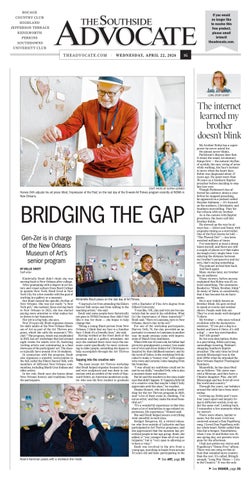
Harvey Orth adjusts his art piece titled, ‘Impression of the Past,’ on the last day of the 8-week Art Thrives program recently at NOMA in New Orleans.
BRIDGING THE GAP Gen-Zer is in charge of the New Orleans Museum of Art’s senior program BY WILLIE SWETT Staff writer
Kimbrielle Boult didn’t think she was moving back to New Orleans after college. After graduating with a degree in art history and visual culture from Bard College in upstate New York, Boult lived in New York City for a few months with the goal of working in a gallery or a museum. But Boult missed the specific rhythm of New Orleans. She was not really “a New York girl,” she realized. Since moving back to New Orleans in 2023, she has started paying more attention to what makes her so drawn to her hometown. Her job is a big help, she says. Now 23 years old, Boult organizes classes for older adults at the New Orleans Museum of Art as part of the Art Thrives program, which she calls the museum’s “55+ club.” The program, which was established in 2022, has art workshops that last around eight weeks for adults over 55, featuring visiting artists and culminating in a final showcase of the participants’ art. The classes typically have around 16 to 18 students. In connection with the program, Boult also organizes a monthly conversation in the fall, called the Elders Sacred Talk, with members of different New Orleans communities, including Mardi Gras Indians and older artists. In her role, Boult says she learns about New Orleans history and traditions from the participants.
Kimbrielle Boult poses on the last day of Art Thrives. “I learned a lot from attending the Elders Sacred Talk series and from talking to the teaching artists,” she said. Boult said some people have historically not gone to NOMA because they didn’t feel like it was for them — she hopes to help change that. “Being a young Black person from New Orleans, I think that my face is a familiar face. I think it’s a friendly face,” she said. Having worked at the front desk at the museum and as a gallery attendant, she says she realized there were ways the museum could specifically be more welcoming to older people, something she hopes to help accomplish through the Art Thrives program.
Tapping into the creative vein The most recent Art Thrives workshop that Boult helped organize focused on clay and wire sculptures and was done in connection with an exhibit of the work of Hayward Oubre, an American modernist sculptor who was the first student to graduate
Naomi Kornman poses with a necklace she made.
with a Bachelor of Fine Arts degree from Dillard University. “I was like, ‘OK, clay and wire are two materials that he used in his exhibition. What [is] the importance of these materials?’ ” Boult said. “Here in Louisiana, here in New Orleans, there’s clay in the soil.” For one of the workshop participants, Harvey Orth, 76, the clay provided an opportunity to connect to Louisiana in another way: he made ceramic coins with impressions of Mardi Gras doubloons. When Orth was 10 years old, his father had given his grandparents a money tree made out of wire and silver dollars for Christmas. Inspired by that childhood memory and by the work of Oubre, in the workshop Orth decided to make a “money tree” with copper wire roots and ceramic coins hanging from the branches. “I was afraid my ambitions could not be met by my skills,” recalled Orth, who is also a museum donor and docent. But he said the teachers in the class made sure that didn’t happen. It “tapped a little bit of a creative vein that maybe I didn’t fully appreciate until the class,” he recalled. Dianne Honoré, who led a beading workshop for the Art Thrives program in 2025, said “a lot of them come in, thinking, ‘I’m not an artist,’ and they make the most beautiful art.” “It’s a wonderful experience in that they share a lot of similarities in age-related experiences, life experience,” Honoré said. She said Boult helped ensure everything went smoothly in each class. Bridget Bergeron, 63, a retired educator who lives outside of Lafayette and has participated in Art Thrives programs, said she appreciated that the museum has prioritized people in her age group. Boult, she added, is “way younger than all of our participants,” but is “very open to allowing us to have a voice.” Boult was involved in the arts from a young age, marching in bands from around 10 years old and later participating in the
ä See ART, page 2G
My brother Robin has a superpower he never asked for. He almost never blinks. Parkinson’s disease does that. It steals the small, involuntary things first — the natural rhythm of eyelids, the easy swing of arms while walking, the face’s instinct to move when the heart does. Robin was diagnosed about 15 years ago. He spent more than 30 years as a Southern Baptist preacher before deciding to stop late last year. Though Parkinson’s has affected his cadence, about a year before he stopped preaching, he appeared on a podcast called Hayden Alabama — it’s focused on the outdoors, Christianity and Southern storytelling. They hit the trifecta with my brother. As is the custom with Baptist preachers, the hosts call him Brother Robin. He showed up the way he always has — direct and funny with exquisite timing as a storyteller. One of the first stories he told — “The Plowed Dirt” — has been watched millions of times. I’ve watched it at least a dozen times myself, and there are still a couple of places in it that make me laugh every single time. Considering the distance between my brother’s perspective and my own, that’s saying something. The podcast invited him back. And back again. Many stories later, my brother has an audience. Those viewers, before anyone explained that Robin was ill, noticed something. The comments flooded in: “Blink, Brother, blink.” So many of them, so consistently, that it has become his de facto name. He is now widely known as Brother Blink. He gets invited to speak at events and outdoor shows. People seek him out. They’ve even made well-designed T-shirts. My brother — who once refuted evolution with the declarative sentence, “If you put a dog in a basket and leave it there, it’s still a dog” — now has merchandise. Ain’t life grand? By his own description, Robin is a gun-toting, Bible-carrying, camouflage-wearing, Walmartshopping Southern Baptist preacher. The only time he lived outside Mississippi was in the mid-1990s when he attended the New Orleans Baptist Theological Seminary. Meanwhile, he has described me as follows: “My sister married a Mexican, and they have a Chinese daughter. Plus, she left Mississippi and has lived all over the world and country.” Through the years, our holidays around the table have been interesting. Growing up, Robin and I were four years apart and largely living in different worlds, even under the same roof. Looking back, I remember a few moments when we weren’t. There were others, harder to name, but the most vivid was centered around a Dan Fogelberg song. I loved Dan Fogelberg with my whole heart. Robin called him Dan Eat-a-booger. Nonetheless, when I was 14 and Robin was 10, one spring day, our parents were gone for the afternoon. I had just gotten my stereo and Fogelberg’s “Home Free” album. There was one song on that album that sounded more country than the rest. It’s called, fittingly enough, “Long Way Home — Live in the Country.” It was the only
ä See RISHER, page 2G