BOCAGE COUNTRY CLUB HIGHLAND JEFFERSON TERRACE KENILWORTH PERKINS SOUTHDOWNS UNIVERSITY CLUB
ADVOCATE THE SOUTHSIDE
T H E A D V O C AT E.C O M
|
W e d n e s d ay, A p r i l 15, 2026
If you would no longer like to receive this free product, please email brtmc@ theadvocate.com.
1GN
FROM ASHES
STAFF PHOTO BY JOHN BALLANCE
The Louisiana Legislature considered naming the Horace Wilkinson bridge for both Norman E. Lant and Horace Wilkinson, Horace Wilkinson Jr. and Horace Wilkinson III in 1968.
Did state officials eye another name for Mississippi River Bridge? BY ROBIN MILLER
Staff writer
Three Wilkinsons plus one Lant equals one Mississippi River bridge. That was the original equation for the $46 million, cantilever “New Mississippi River Bridge” after it opened to Interstate 10 traffic April 10, 1968. Originally, the Louisiana State Legislature considered placing two names on the bridge that year, with one name representing three people and the other commemorating a single person. In the end, only one name was placed on the bridge: Horace Wilkinson.
Who was Norman E. Lant? Still, Ernie Smithling is correct in pointing out that state lawmakers considered giving the bridge a double moniker. “I once read where the bridge was going to be named for the three Horace Wilkinsons in West Baton Rouge Parish and a guy named Norman Lant,” the Walker resident said. “If this is true,
ä See CURIOUS, page 2G
Danny Heitman AT RANDOM
A crawfish boil reminds me why they’re so special When my wife and I got married three decades ago, our rehearsal dinner was a backyard crawfish boil. A small windfall of a spring wedding in Louisiana is that crawfish are in season. They were plentiful that year, so we enjoyed our festive feast without breaking anyone’s bank. Serving boiled crawfish to our guests was also a natural icebreaker. We had friends and relatives from many places in the wedding party, and not everyone had met. As we huddled over steaming mounds of mudbugs, it was impossible for anyone to stay strangers for long. Peeling crawfish, after all, isn’t for the bashful. The work of the table, joyously messy, nudged everyone to quickly hop in. Amid the claws and tails — and the quickly stained shirts and dresses — our circle of celebrants quickly bonded. Our guest list included visitors from North Carolina; Minnesota; Chicago; Washington, D.C.; and Alaska. Not everyone had peeled crawfish before, but we paired the novices with the locals, and the rite of initiation for newcomers to Louisiana cuisine was part of the fun. I remember few details of our wedding, which passed in a blur, as nuptials for young couples seem to do. But that crawfish boil on the evening before our wedding has stayed with me. The memory underlines for me the close connection between food, friendship and family that defines this corner
ä See RANDOM, page 2G
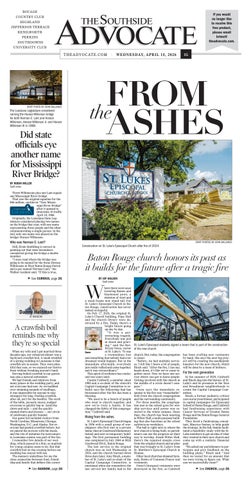
Construction on St. Luke’s Episcopal Church after fire of 2024.
STAFF PHOTOS BY JOHN BALLANCE
Baton Rouge church honors its past as it builds for the future after a tragic fire BY JOY HOLDEN Staff writer
W
here there were once towering flames and blackened pews, a skeleton of steel and a wood frame now stand tall. For St. Luke’s Episcopal Church in Baton Rouge, construction has never looked so hopeful. On Feb. 17, 2024, the original St. Luke’s Church building, Pope Hall and the church library were destroyed by a fire. Today, there’s a bright future going up day by day. “It was a gutwrenching tragedy. Everybody was just in shock and grieving,” said the Rev. Bryan Owen, rector at St. Luke’s. “It was Owen a tremendous loss and something that nobody had ever dreamed would happen. But in the immediate aftermath, everybody just really rallied and came together, and it was extraordinary.” This spirit of resilience has continued two years later. Connie Caldwell, a member since 1985 and a co-chair of the church’s Capital Campaign Committee to rebuild, says the fellowship that has blossomed after the fire has been a blessing. “We used to be a bunch of people who went to church together, and now we’re truly a family. It has changed the fabric of this congregation,” Caldwell said.
Rising from the ashes St. Luke’s Episcopal Church began in 1956 with a small group of worshippers who first met in a private home, then at Goodwood Elementary School and next in temporary buildings. The first permanent building was completed in July 1964 at 8833 Goodwood Blvd., Baton Rouge. The last service in the original church was on Ash Wednesday in 2024, and the church burned down three days later. Amy Binck, a member of St. Luke’s and co-chair of the Capital Campaign Committee, is emotional when she remembers the last service her family had in the
St. Luke’s Episcopal students signed a beam that is part of the construction of the new church. church. But, today, the congregation is closer. “Before, we had multiple services. I felt like I knew a lot of people, Binck said. “After the fire, I can say, hands down, it’s like we’ve come together more. Now we have one service where you get to know people. Getting involved with the church in the middle of a crisis doesn’t compare.” Owen says the immediate response to the fire was “remarkable” both from the church congregation and the surrounding community. For three months, the congregation met in the school gym for worship services until power was restored to the whole campus. Since then, the church has been meeting in Witter Hall, a multi-purpose building that also functions as the school cafeteria on weekdays. The hall is right next to where the new church is being built, so parishioners can see the progress on their way to worship. Inside Witter Hall, there’s the repaired steeple cross from the original church and an altar that was brought to St. Luke’s from St. Matthew’s Episcopal Church in Houma. Other local churches donated hymnals, Books of Common Prayer and vestments. Owen’s liturgical vestments were destroyed in the fire, so Caldwell
has been crafting new vestments by hand. She says the next big project will be creating the needlepoint kneelers for the new church, which will be done by a team of knitters.
For the next generation In the summer of 2025, Caldwell and Binck dug into the history of St. Luke’s and its presence in the Tara and Broadmoor neighborhoods to create the Capital Campaign Committee. Binck, a former pediatric critical care nurse practitioner, participated in capital campaigns for Episcopal School of Baton Rouge, and Caldwell had fundraising experience with Cancer Services of Greater Baton Rouge and the Baton Rouge General Foundation. They hired a fundraising consultant, Maurice Seaton, to help guide the strategy. In the fall, Seaton facilitated a feasibility study with the St. Luke members to get an idea of what they wanted in their new church and come up with a realistic financial goal. “We asked our parishioners to participate and give feedback on the building plans,” Binck said. “And then we tested for an amount that we were trying to figure out. What can we successfully raise?”
ä See CHURCH, page 2G