PROTESTERS GATHER FOR ‘NO KINGS’ MARCH IN BATON ROUGE 3A
ADVOCATE THE
T H E A D V O C AT E.C O M
BATON ROUGE, LOUISIANA
|
S u n d ay, M a r c h 29, 2026
$2.50X
Higher ed leaders OK three-year bachelor’s degree Students will ‘get to work a year faster’ BY HALEY MILLER Staff writer
STAFF PHOTOS By LESLIE WESTBROOK
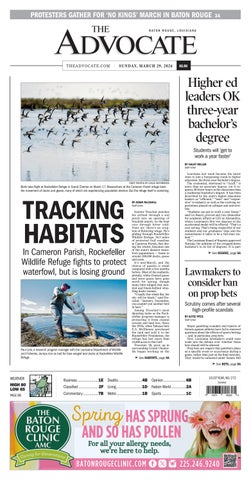
Birds take flight at Rockefeller Refuge in Grand Chenier on March 17. Researchers at the Cameron Parish refuge track the movement of ducks and geese, many of which are experiencing population decline. But the refuge itself is vanishing.
TRACKING
HABITATS
In Cameron Parish, Rockefeller Wildlife Refuge fights to protect waterfowl, but is losing ground
Paul Link, a research program manager with the Louisiana Department of Wildlife and Fisheries, dumps rice as bait for blue-winged teal ducks at Rockefeller Wildlife Refuge.
BY AIDAN McCAHILL Staff writer
Scooter Trosclair punches his airboat through a soil patch into an opening of brackish marsh. As the boat cuts through bitter coldfront air, there’s an eruption of fluttering wings. He’s gliding through Rockefeller Wildlife Refuge, 26.5 miles of protected Gulf coastline in Cameron Parish, that during the winter, becomes one of the state’s densest waterfowl populations — home to around 200,000 ducks, geese and coots. It’s mid-March, and the chorus of quacks is small compared with a few months before. Most of the mallards, pintails, white-fronted geese and snow geese have gone north for spring, though many blue-winged teal, mottled and black-bellied whistling ducks remain. “Usually this whole flat, the sky will be black,” said Trosclair. “January, December, you couldn’t put another bird in here.” Among Trosclair’s most daunting tasks as the Rockefeller program manager is protecting it from coastal erosion and land loss. Since the 1910s, when Tabasco heir E.A. McIlhenny purchased the land and sold it to the Rockefeller Foundation, the refuge has lost more than 15,000 acres to the Gulf. Trosclair, 50, grew up in surrounding Grand Chenier. He began working on the
ä See HABITATS, page 4A
Louisiana last week became the latest state to join a burgeoning trend in higher education: the three-year bachelor’s degree. The credential, shortened to “AccB,” is more than an associate degree, yet it requires 30 fewer hours in the classroom than a traditional bachelor’s degree. It has been described by the state’s higher education leaders as “efficient,” “lean” and “responsive” to industry as well as the evolving expectations placed on colleges and universities. “Students can get to work a year faster,” said Liz Beard, provost and vice chancellor for academic affairs at LSU at Alexandria, where Louisiana’s first two degrees in the accelerated model will be offered. “That’s a cost saving. That’s being respectful of our students and our graduates’ time and the commitment it takes to be a full-time student.” The Louisiana Board of Regents approved Tuesday the addition of the stripped-down bachelor’s to its list of degrees. It is part
ä See DEGREE, page 6A
Lawmakers to consider ban on prop bets
Scrutiny comes after several high-profile scandals BY ALYSE PFEIL Staff writer
Major gambling scandals and reports of threats against athletes have led to renewed questions about the effects of sports betting — and, in particular, prop bets. Now, Louisiana lawmakers could soon wade into the debate over whether those bets should still be allowed. Prop bets are wagers that gamblers place on a specific event or occurrence during a game, rather than just on the final outcome. They would be outlawed under Senate Bill
ä See BETS, page 6A
WEATHER HIGH 80 LOW 65 PAGE 8B
Business ......................1E Deaths .........................4B Opinion ........................6B Classified ..................... 2F Living............................1D Nation-World................2A Commentary ................7B Metro ...........................1B Sports ..........................1C
U HAS SPRUUNG AND SO HAS H POLL E EN For all your allergy needss, we’re here to help.
101ST yEAR, NO. 272