A TOAST TO REX AND COMUS
LIVING, 1D
N O L A.C O M
|
S u n d ay, F e b r u a ry 22, 2026
$2.50X
Roof program can’t keep up with demand Only 20% of homeowners awarded grant
BY SAM KARLIN Staff writer
STAFF PHOTO By ENAN CHEDIAK
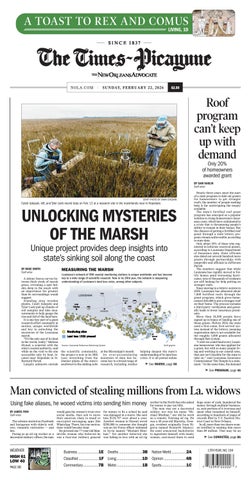
Caleb Izdepski, left, and Tyler Loeb record data on Feb. 12 at a research site in the marshlands near in Hopedale.
UNLOCKING MYSTERIES OF THE MARSH Unique project provides deep insights into state’s sinking soil along the coast
BY MIKE SMITH Staff writer
A skinny bayou curves between thick reeds of marsh grass, revealing a spot hidden deep in the muck with an importance far greater than its surroundings would suggest. Standing atop wooden planks, Caleb Izdepski and Tyler Loeb pull up chunks of soil samples and take measurements to help gauge the rise and fall of the land here. It is one tiny part of a giant research effort constantly in motion, unique worldwide and key to unlocking the mysteries of the Louisiana marsh. “It’s the only one of its kind in the world, really,” Melissa Hymel, a scientist with the state’s coastal authority, said while on the visit to the site accessible only by boat, located near Hopedale in St. Bernard Parish. Largely unknown outside
MEASURING THE MARSH
Louisiana’s network of 390 coastal monitoring stations is unique worldwide and has become key to a wide range of scientific research. Now in its 20th year, the network is deepening understanding of Louisiana’s land loss crisis, among other subjects.
55
49
LOUISIANA
Baton Rouge
12
Slidell
Lafayette
Source: Coastwide Reference Monitoring System
the scientific community, the project is now in its 20th year, stretching from the chenier plains of the state’s southwest to the sinking soils
Staff graphic
at the Mississippi’s mouth. helping deepen the state’s Its ever-accumulating understanding of its land loss mountain of data has be- crisis. It is all posted online come key to a broad range of ä See MARSH, page 6A research, including studies
Nearly three years since the start of a state program to dole out grants for homeowners to get stronger roofs, the number of people seeking help is far outstripping the money available. The state’s fortified roof grant program has emerged as a popular solution to rising homeowners insurance costs, which have culminated in a crisis that is threatening people’s ability to remain in their homes. But the chances of getting a fortified roof grant through a state lottery program remain unfavorable, according to state data. Only about 20% of those who registered in lotteries received grants, according to Louisiana Department of Insurance data. State officials also doled out several hundred more grants through partnerships with nonprofits and officials in Jefferson Parish. The numbers suggest that while Louisiana has rapidly moved to fortify homes amid worsening hurricanes, tens of thousands of residents are still looking for help putting on stronger roofs. Since moving to a lottery system in 2024, Louisiana has allocated about 7,000 fortified roofs through the grant program, which gives homeowners $10,000 to put a stronger roof on their home. The process includes a third-party verification and generally leads to lower insurance premiums. More than 34,000 people have signed up in hopes of landing one of those grants. Before 2024, the state used a first-come, first-served system instead of the lottery, meaning registration data is not available for the roughly 3,000 grants allocated through that system. “I wish we could fund every Louisiana homeowner who has applied for a grant, but with so many people living and working in our coastal zone, that just isn’t feasible for the state to take on,” said Louisiana Insurance Commissioner Tim Temple in a statement. “At the same time, the demand
ä See PROGRAM, page 4A
Man convicted of stealing millions from La. widows in the North Sea who asked huge sums of cash, laundered the Using fake aliases, he wooed victims into sending him money worker money through multiple businessfor money to pay tax bills.
BY JAMES FINN
would gain the women’s trust over social media, then ask to move Staff writer their amorous chats to email or The scheme started on Facebook encrypted messaging apps like and Instagram with elderly wid- WhatsApp. There, his true motivaows, romantic entreaties — and tions would become clear. lies. He pressed one 77-year-old ManPosing as an oil rig worker or a deville woman who believed he decorated military officer, the man was a four-star military general
WEATHER HIGH 61 LOW 40 PAGE 8B
for money to fix a school he said was damaged in a storm. She sent him $124,757 over about a year. Another woman in Hawaii wired $250,000 to someone she thought was an Air Force officer stationed in Syria named “Michael Minihan.” Yet another believed she was falling in love with an oil rig
The man was not a decorated soldier, nor was his name “Michael Minihan,” nor did he work on a remote, freezing oil rig. He was a 45-year-old Marietta, Georgia, resident originally from Nigeria named Kenneth Akpieyi. He used concocted backstories to ingratiate himself with lonely women, convinced them to send
Business ......................1E Deaths .........................3B Nation-World................2A Classified ..................... 1F Living............................1D Opinion ........................6B Commentary ................7B Metro ...........................1B Sports ..........................1C
es, sent portions of it overseas and spent what remained on himself, according to hundreds of pages of records filed in U.S. Eastern District Court in New Orleans. In all, more than two dozen women testified to sending him more than $9 million. That may be an
ä See CONVICTED, page 8A
13TH yEAR, NO. 194