If you would no longer like to receive this free product, please email brtmc@ theadvocate.com.
Danny Heitman AT RANDOM
As a new year starts, making plans nudges me to dream
My grown daughter changed careers a couple of years ago, a transition that required her to go back to school for an interior design degree. Years after graduating from college, she was back in the classroom, reconnecting with the joys of homework.
Among her assignments were some drawings for design projects detailed plans about where and how to place sofas and chairs, tables and shelves, rugs, desks and pieces of art I asked her to mail me some of her homework so that I could keep it near my keyboard
Like many parents, my wife and I often displayed school work from our daughter and son when they were small. The latest report cards and crayon drawings found their way to the front of our fridge or a family bulletin board. Seeing our children’s creations reminded us of their special place in our lives.
Just because our daughter is now an adult, keeping her close in this way still seemed like a good thing to do.
Knowing how sentimental I am, she sent me some of her drawings. Shortly after their arrival, I slipped one from its big manila envelope and taped it to my office wall. My daughter’s skills have improved since she finished that assignment, and the drawing on my wall is a reminder of how far she’s come. The picture makes me smile when I glance across my desk and notice it.
My daughter’s handiwork reminds me of the plans I drew in shop class during my high school years. Although we built nothing grander than a small bookshelf, our teacher required us to chart out our work in detail on paper There was a textbook perfection to the plans that life seldom matched In its imagined form on the paper, my little shelf was straight and true.
While putting the plan in motion, though, I quickly met reality Bent nails, splinters and knotted pine taught me that things are usually harder in the doing than in the thinking.
The charm of every plan, I suppose, is that it brings us deep within its dream of possibility, inviting us to think about the future as a frontier full of promise That can be a special comfort here in January, after the brightness of the holidays has subsided and we return to the routines of work and obligation. Where does wonder live after the decorations are back in their boxes, the holiday trees ditched at the curb? I think about all of this each January when I climb the steps to my office and begin another year
ä See AT RANDOM, page 2G
If these walls could talk …
Uncovering stories inside the Rural Life’s barn, LSU duo preserves Steele Burden’s sketches
BY ROBIN MILLER Staff writer
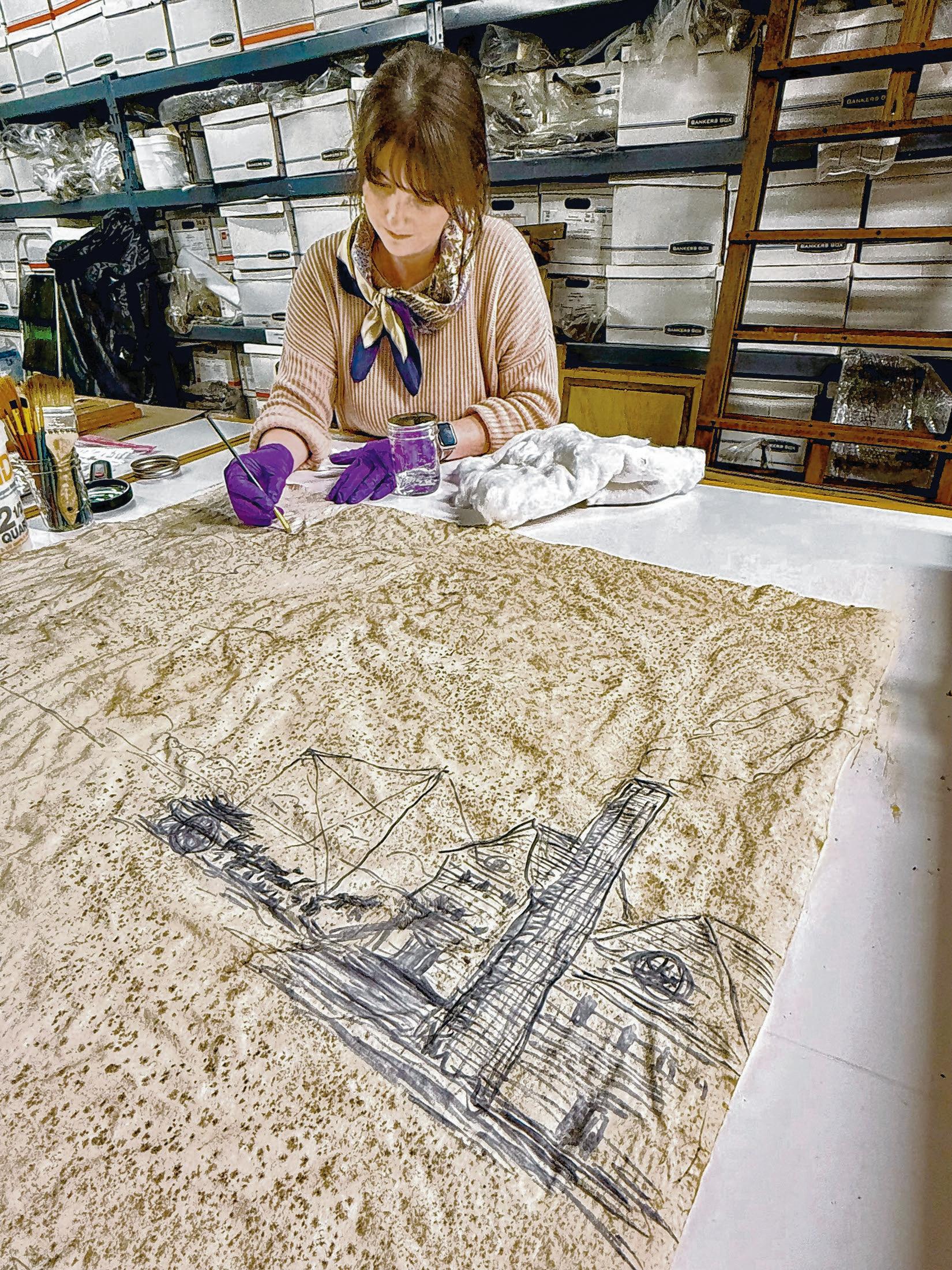
Demi Dauterive uses a bam-
boo swab to dab acetone around the drawing, careful not to apply too much of the solution at once.
The sketch is a rendering of a man driving a mule-drawn wagon stacked high in sugarcane.
Dauterive knows there’s something to be preserved here, a story of everyday life at Windrush Plantation told through rough lines made by Steele Burden’s pen. Or was it a graphite pencil — a distinction that now matters.
The artist’s medium has yet to be determined, which presents a challenge because if any of these drawings are lost, much of Burden’s narrative will also be lost with them.
It’s a narrative that lingers in the background of the exhibit of funeral carriages and farm equipment on the walls of the LSU Rural Life Museum’s barn in Baton Rouge. Burden drew them directly on the vinyl attached to the insulation, which was installed to hold warmth in the room.
The only problem is the room doesn’t have a climate-control sys-
now
tem, which doesn’t bode well for the artifacts it houses. So, museum staff are in the process of figuring out how to refurbish the space to preserve the artifacts, which include Burden’s drawings.
This is where Dauterive, of St. Bernard, became part of Burden’s
story She’s working on her master’s degree in art history while also working alongside her art professor, Jane Ashburn, to preserve Burden’s sketches. Sonowcomesthequestion—why?
ä See BARN, page 2G
Does anyone remember the zany N.O.-focused
BY RACHEL MIPRO
the Singing Bird contributed to mingled feelings about the show, which was often accused of mining for shock value one guest is said to have bit off a chicken’s head on air
David Cuthbert, longtime New Orleans reporter and former writer for The Times-Picayune, had somewhat unflattering memories of the program.
“If memory serves [the show] involved an ever-changing array of people yearning to be thought of as New Orleans ‘characters,’ whose entertainment
STAFF PHOTOS BY ROBIN MILLER
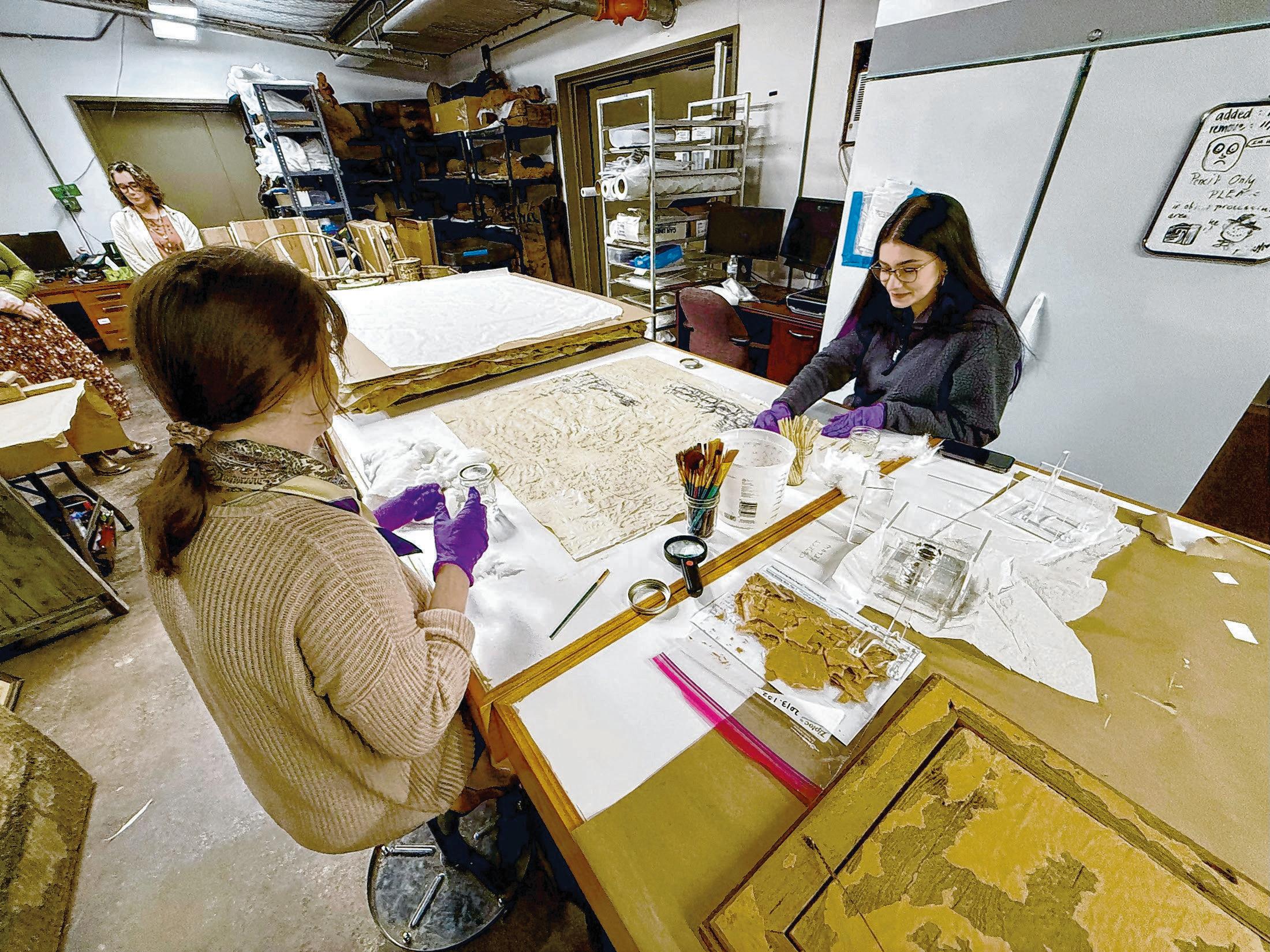
master of fine art student Demi Dauterive, right, and her art professor, Jane Ashburn, have been working
to preserve Steele Burden’s barn sketches at the LSU Rural Life Museum.
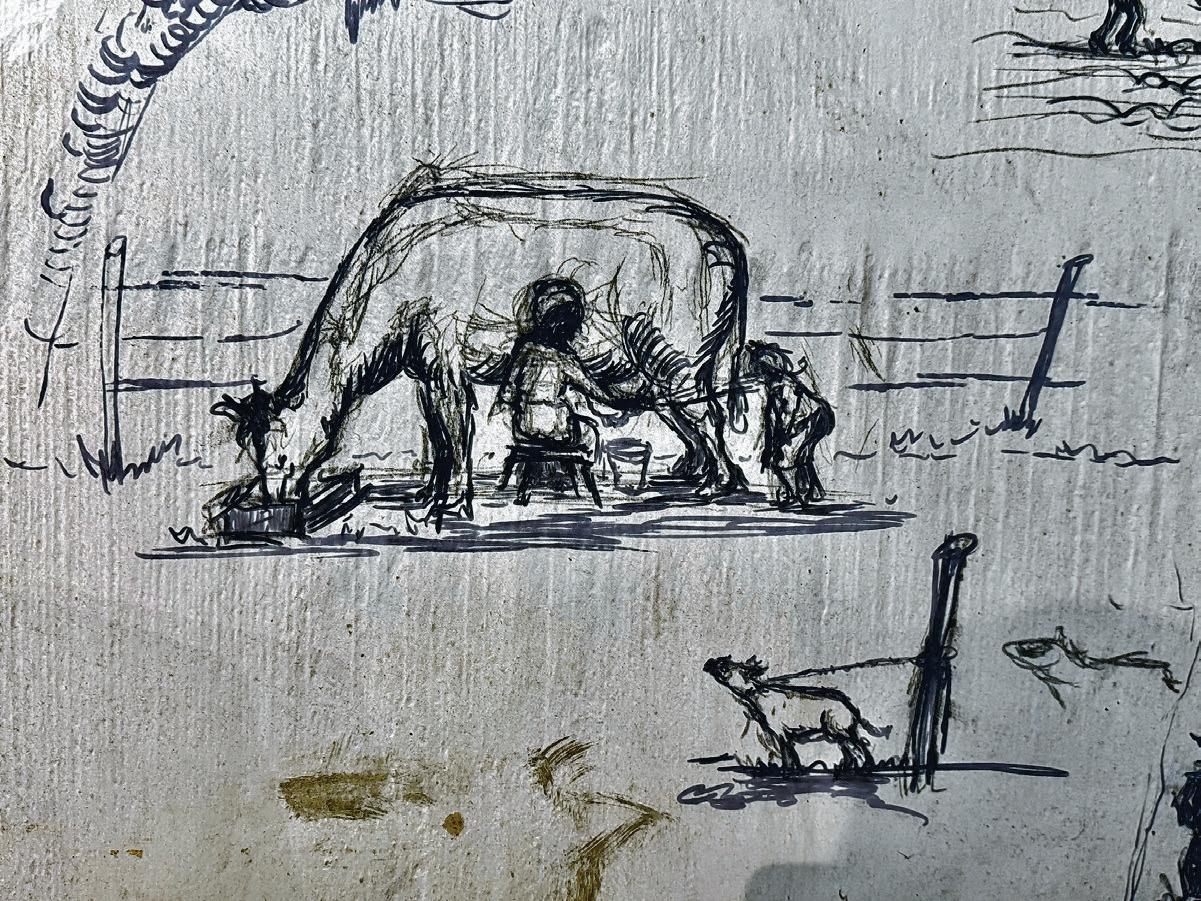
Steele Burden’s drawing of a farm worker milking a cow is one of many he sketched on the LSU Rural Life Museum’s barn walls to tell the story of daily life on Windrush Plantation, which is
the museum.
Expectations hazy in relationship
Dear Harriette: I don’t feel secure in my current relationship I feel like the guy I have been seeing is going to ghost when it takes him a while to respond, even if things seem fine on the surface. We have this odd dynamic where I am always excited about anything he suggests for a date, but whenever I try to initiate the plans, he has a weird or flimsy excuse for why he can’t go. I’m left feeling like I am chasing after him or begging him to spend time with me, and that is so embarrassing. His behavior leads me to overthink every interaction I have with him and wonder if I am doing something wrong, even though I know that relationships should not feel this one-sided. I’m annoyed that he only makes an effort when it is convenient for him, while I am putting in emotional energy that never seems to be matched. I have tried to bring up how this makes me feel bad, but he brushes it off or changes the subject, which makes me even more unsure about wanting to continue to see him. My friends all tell me I deserve someone who treats me better, but I keep hoping he will become more consistent. I am starting to question whether I keep ignoring red flags because I want this to work so badly How
do I figure out whether this relationship has real potential or if I should walk away for my own mental health? — Dating Today Dear Dating Today: I have recently read a few studies about dating patterns today and people’s satisfaction levels with those they are dating. It seems that dating has become oddly impersonal. In what is now known as “hookup culture,” many people are getting intimate before they know each other, which creates a false sense of intimacy where one partner characteristically gets hurt. When expectations aren’t clear, interest levels are unknown and a general desire not to be committed prevails, you can end up in the situation you are in terribly lopsided. Your friends are right: If he acts uninterested in what you suggest and bows out unless the date was his idea, he doesn’t deserve you A relationship should be reciprocal. Both of you should have input into how you spend your time. Don’t sit pining for someone who is unwilling to dance with you
Send questions to askharriette@harriettecole. com or c/o Andrews McMeel Syndication, 1130 Walnut St Kansas City, MO 64106.
Mattel, Alex Aster team up for Barbie young adult novel
BY HILLEL ITALIE
AP national writer
NEW YORK The publishing arm of Mattel Inc. is teaming with million-selling novelist Alex Aster on a Barbie young adult novel in which the iconic doll embarks on a journey across “treacherous, magical lands.”
“Barbie: Dreamscape,” scheduled for July 28, is the first novel for young adults out of Mattel Publishing since the imprint was announced three years ago. The novel is not tied to the blockbuster 2023 “Barbie” movie and no screen adaptation is currently planned, according to Mattel. The toy and family entertainment company is calling Aster’s book a “coming-of-age story” that finds Barbie declared “Fateless” at the graduation ceremony of the “enchanted” Swancrest Academy “To earn a Fate, she must journey across treacherous, magical
CURIOUS
Continued from page 1G
value was nil,” Cuthbert said The show underwent more of a tonal shift when then-station owner Dave Wagenvoord took over as host. Wagenvoord reportedly dedicated more air time to sponsors, such as water bed promoter Red Kagan.
“New Orleans Nite People” was canceled shortly after the station was sold, according to Times-Picayune reporting From the same scorching Times-Picayune account of the show: “It was deranged. It was disgusting. It was discontinued. An hour long edition of ‘Stupid Human Tricks’ featuring any eccentric or nut case who popped up in the studio audience or walked through the studio doors.”
The show has largely disappeared from the collective consciousness. Former WGNO producer David Jones, who joined the organization in 1980, said the involved parties had already left the station. Jones later tried to track down a couple of the characters to include in a new weekly series, but the search proved unsuccessful.
“In the ’70s they did produce a lot of odd ball shows,” Jones said via email.
The other show, alternately
AT RANDOM
Continued from page 1G
lands in search of the mysterious beings who control the destinies of everyone in Heartland — and the buried truths that could change her world forever,” Thursday’s announcement reads in part. “Because to forge her own path, Barbie must step out of the box and into the unknown.”
The publishing imprint is focused on Mattel’s “extensive catalog of children’s and family entertainment franchises,” including Barbie, Hot Wheels and Polly Pocket. Earlier this week, Mattel Inc. announced it had created an autistic Barbie doll, part of the Fashionistas line committed to diversity
Aster, a social media favorite best known for her “Lightlark” series and for the adult novel “Summer in the City ” said in a statement that Barbie dolls were a formative part of her childhood.
referred to as “Late Night New Orleans,” and “Late Nite New Orleans” was also treated none too gently in the local paper Current WLAE-TV staff members did not have records of the show, but a Times-Picayune search turned up some information — in the form of another scathing review
The show was announced as a joint project between radio station WTIX and WLAE. DJs Tony Ponseti and Jay Richards headed the show set to launch September 1992. The two were meant to host “Late Nite New Orleans” every Tuesday, with new live musical acts broadcasted from the Palm Court Cafe in the French Quarter But by December, multiple delays and a lack of funding led the Times-Picayune to term the show a “dead issue.”
From the December 1992 article on the show: “Once touted as its most ambitious local production ever ‘Late Nite New Orleans’ instead has turned out to be one of WLAE’s biggest busts.”
While the two shows were ultimately short-lived, memories of the programming lives on.
Do you have a question about something in Louisiana that’s got you curious? Email your question to curiouslouisiana@ theadvocate.com. Include your name, phone number and the city where you live.
design
Heitman at danny@dannyheitman.com.
BARN
Continued from page 1G
Even Burden wouldn’t have claimed his drawings were anything close to masterpieces. Still, they were more than mere doodles.
Follow their progression along the walls, and the story of Windrush comes to life. They tell the story of the people who lived on the 400-acre spread and their daily farm life as witnessed by Burden. It’s nothing fancy or history-changing, but this was what happened here.
Steele Burden grew up here
Burden grew up on the Essen Lane plantation with his siblings, Pike and Ione. The trio donated their family home to LSU in the 1960s, and the museum was established in 1970, with Steele Burden running it.
His museum vision, like his sketches, focused on rural settings and the daily struggles of farmers, laborers and enslaved people. He actively sought out and moved historic buildings, as well as artifacts, to the grounds to tell the story
As an artist, Steele Burden was particularly noted for his ceramic sculptures, which commented not only on everyday life in Louisiana but its culture and politics. His artistic endeavors also included painting, drawing, photography and landscape design, all influenced by his grandfather Capt. O.B. Steele, who was both an artist and art collector
“Steele Burden was a storyteller,” said Katherine Fresina, the museum’s curator “His works were inspired by his own vision and memories, and they became another way of sharing his stories.”
And though his barn sketches hadn’t been forgotten, they weren’t always noticed. Perhaps it was because they were drawn in black lines, appearing as scribbles on the wall.
LSU duo steps up
The museum asked Ashburn to take a closer look.
“I teach an ‘Introduction to Conservation’ course, and I brought my classes out here,” she said. “And in that course, students are given two objects from the Rural Life ephemeral collection to work with. So the objects aren’t from the permanent collection, and they’re not the cataloged objects. They’re the additional objects that are out here but maybe don’t have provenance.”
The students’ assignments included researching the history of each object and its materials and taking the steps to conserve and stabilize it.
“Every single object is different, and with that class, I’ve had students who then want the opportunity to do extra work,” Ashburn said. “So, Demi is doing an independent study and the museum has selected something that they’re interested in creating a case study. That’s how we’ve selected this work.”
Ashburn and Dauterive began their project in the heat of August and continued well into December, planning to restart soon. They knew they were taking a chance at each step, the first of which was figuring out Steele Burden’s medium for the drawings.
“We still don’t know,” Dauterive said, continuously moving the cotton swab over the vinyl as she talks.
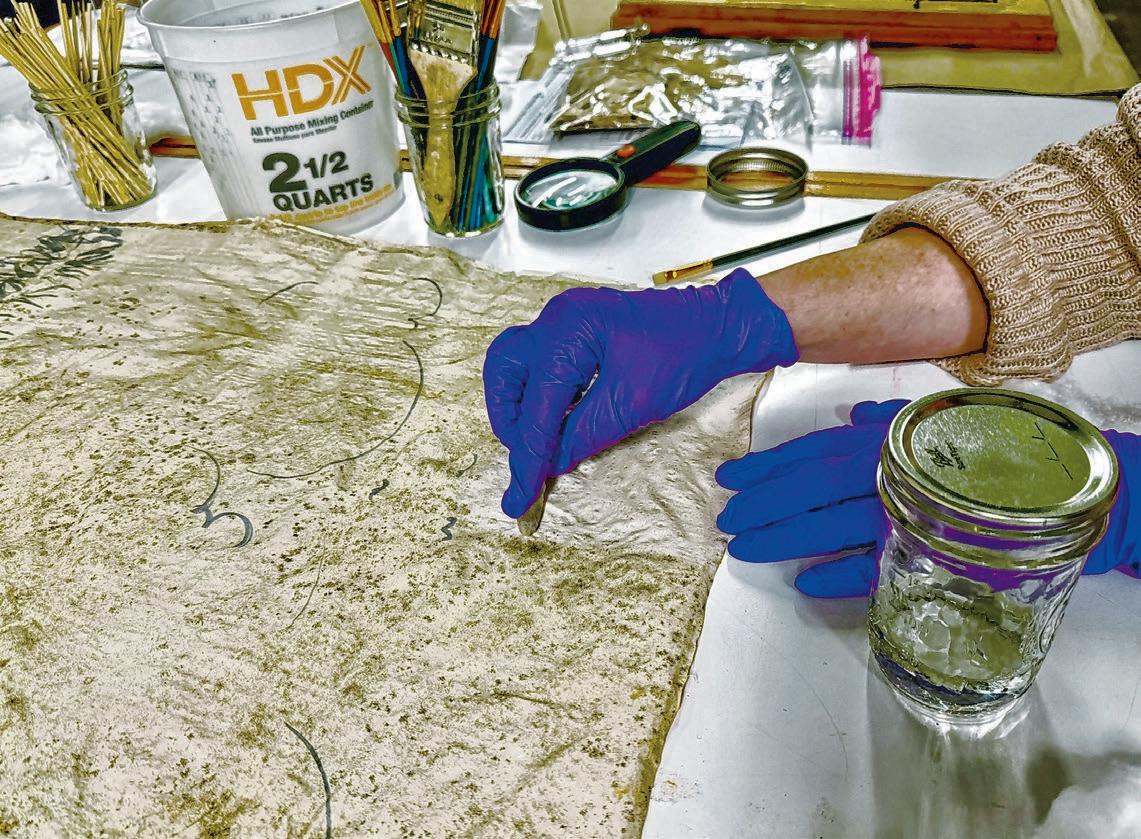
“I’ll have to say it’s kind of guesswork,” Ashburn added. “Part of this process is testing to see what solvents will re-solubilize it. We’ve got some guesses as to what he used, maybe paint marker, but we aren’t sure. All we know is this particular medium isn’t affected by the acetone. We tested it and let it sit for two weeks, and we still haven’t seen any kind of effect.”
The re-solubilization essentially loosening the material again, removes brown spots from years of being exposed to Louisiana’s environmental elements.
Just the beginning
Ashburn throws a quick glance toward the end of the table. Drawings removed from the walls are stacked high, separated by insulation. But this is just a sampling.
The walls are long and still filled with drawings, and though the cleaning process is slow, each new step offers encouragement.
“The drawings had to be removed using personal protective equipment,” Dauterive said. “So, we’re being very careful.” And since the insulation is old, its adhesive doesn’t cling to the
outer vinyl bearing the drawings.
“It’s brittle and old, and the adhesive isn’t exactly what it used to be,” Dauterive said. “So, I went out there with a mask, protective glasses and something covering my clothes, and I just picked up a drawing from a palette and started scraping it. Then I started peeling it back until the backing came completely off. I was able to use the acetone to melt the adhesive completely away from the drawing.”
As their cleaning swabs get closer to the actual drawing, the duo switches to paintbrushes to delicately work around the lines lines that have had a way of opening up their understanding of Steele Burden’s world.
Burden’s humor shines
“He didn’t take himself too seriously,” Dauterive said. “He definitely had a sense of humor.”
“On the main part of the barn, there was this drawing that looked like three men and some dogs hunting something,” Ashburn added. “But the something is in the tree It looks vaguely mouseshaped, but it’s very large.”
A raccoon? Or maybe an opossum?
“Maybe, but we don’t know,” Ashburn said. “But it’s mouseshaped. We were laughing the other day, saying that it just looked like a large rat. His sense of humor does shine here.”
For now the rat in the tree will remain a mystery, but Dauterive hopes this project will solve the sketch’s restoration process.
“I’m writing a guide on how to preserve these, and I’m hoping it will streamline the process to get through this quicker,” she said. “It will be a manual that anyone
pick up and continue this work after I leave.”
Email Robin Miller at romiller@theadvocate.com.
Harriette Cole SENSE AND SENSITIVITY
can
STAFF PHOTOS BY ROBIN MILLER
LSU Professor of Art Jane Ashburn teaches a class in art conservation. She brings her students to the LSU Rural Life Museum as part of the class. She currently is working with master of fine art student Demi Dauterive in a project to preserve Steele Burden’s barn sketches.
Ashburn uses a bamboo swab stick to carefully clean a Steele Burden sketch. The drawing is one of many Burden drew on the LSU Rural Life Museum’s barn walls.
Author, illustrator releases new books for children
BY LAUREN CHERAMIE Staff writer
Paul Schexnayder has been a professional (colorblind) artist for more than 30 years He is frequently featured as a festival poster artist, and his work has been placed in galleries and shows throughout Louisiana.
Schexnayder
Schexnayder is also an author/ illustrator of several children’s books, including “I Know My Louisiana Colors” and “The Gumbo Gators series.” His most recent release, “The Adventures of Boudin Boy” is his first young reader book The story centers around an old Cajun couple who uses their famous boudin recipe to make a son who goes on wild adventures throughout the swamps of Louisiana. In the fall, Schexnayder will release a second book of Boudin Boy’s adventures, titled “Boudin Boy Meets Cracklin’ Dog.”
How does art and writing intersect in your life? How did it culminate into a children’s book? I always get the story from the art. I’ll do something and think, “Who is that character? What are they doing? Where are they going or where are they coming from?” That has always been where I start. Now, maybe a phrase or something visual that I see is where the stories usually come from, especially the last couple of books
that I’ve done. For this book, I wrote the story a long time ago, but it was too long to be a picture book. So I shelved it and then my publisher recommended a young reader/middle grade chapter book. I sent it to them and they asked
for it to be a little longer to be a chapter book. I did, and it all worked out.
Children’s books tend to have this sort of whimsy to them that you can have fun with the plot and the characters.What was the appeal for you to write a young reader
book? The fun. I always forget, like, wait, he’s a boudin boy He could do anything. I always think that he’s a little boy and he has to do certain things. No, he can’t. I could go crazy That is what really opened up the second half the book that they wanted to make it longer I could make him do anything. I just have to remember that. Somebody told me that he could blast off in a rocket and take his boudin around space. And I’m like, yes! I could do that. It’s wide-open. As an adult, I forget that sometimes. What are some of your favorite spots to get boudin in Louisiana? I have not tasted a boudin that I haven’t liked. I don’t eat it all the time, so it’s always a treat when I do.
Everybody loves The Best Stop. Kartchner’s in Scott was so good. Legnon’s Boucherie in New Iberia is really good. I have to say this: My ultimate favorite is no longer with us, because when the husband and wife died, the recipe went away It was Nook’s Boudin in New Iberia. She did everything by hand. Did you pull any inspiration from your childhood to write about Boudin Boy’s Cajun adventures?
There’s a little bit. I think he’s a very curious kid but also respects and loves his parents. That’s always in the back of his head, and I love my parents. I always try to do the right thing. That’s me in there in him.
He’s very observant of things, and I wanted to put that in there. Not just of nature but kind of oldfashioned things. I’m about to be 60, and I’m the youngest of five, so I’ve taken on that role, growing up as the baby watching everything and learning the good and the bad.
Now Boudin Boy is an only child. He’s got a lot to learn. The premise of the story is that the main character is a food, and you mention a secret batter in the book that helps to create him. How was food integrated in your family growing up?
It was more of a ritual, once-aweek thing. I remember my dad always cooking barbecue chicken on Sundays while we were in the pool, with the smoke everywhere. We had a large family, and my parents were good friends with other people who had big families. Every holiday we’d all be together, so it’d be five or six different families all celebrating Thanksgiving. We’d have over 100 people, and everybody had to bring a dish. It was this ritual every year for Thanksgiving, Easter, New Year’s Day, Labor Day etc.
It was wonderful, and that’s such a great memory I’ve done so many paintings of the different homes we were at — some on the bayou and some in the country The food part, the tradition and culture, it was infused in our everyday life.
Schexnayder will host a book release party from 10 a.m. to 1 p.m. Feb. 14 at A&E/Paul Schexnayder Gallery, 335 West St. Peter St., New Iberia, with crafts, boudin boy cookies, boudin bites and book signings. Additional events and book signings include: 11 a.m. to 1 p.m. Feb. 21 at Barnes & Noble, 3721 Veterans Blvd., Metairie; 2 p.m. to 4 p.m. Feb. 21 at Barnes & Noble, 1200 S. Clearview Parkway New Orleans; 9 a.m. to noon March 7 at Legnon’s Boucherie, 410 Jefferson Terrace Blvd., New Iberia and 10 a.m. to 2 p.m. April 11 at Books Along the Teche Literary Festival, The Bazus Building, 210 E. Main St., New Iberia.
Author explores the mythology of Mississippi Delta
BY RIEN FERTEL
Contributing writer
“When It’s Darkness on the Delta,” by W. Ralph Eubanks, Beacon Press, 264 pages.
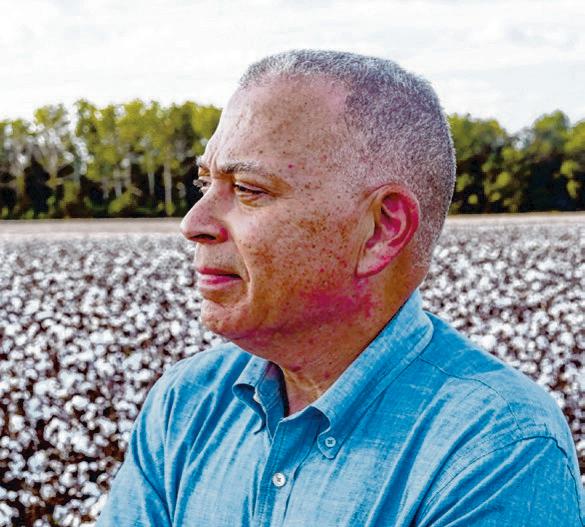
The Mississippi Delta has long haunted Ralph Eubanks, a professor and writer in residence at the University of Mississippi’s Center for the Study of Southern Culture, as a study in contrasts and contradictions.
“I have come to think of the Mississippi Delta,” he writes in his new book, “When It’s Darkness on the Delta,” as “a liminal space of madness where my thoughts are sometimes lost between the darkness and the intermittent light that can be found in this land’s glowing sunsets.”
Raised in the piney-hilled woods of south-central Mississippi, a young Eubanks often accompanied his father to the unincorporated Delta town of Mileston He still remembers those visits, “dropping down that hill at Yazoo City and how everything just changed,” he tells me. “Like I was in this other world.”
Decades earlier, a New Deal program purchased 10,000 acres of former plantation lands surrounding Mileston with the intention of transforming the lives of 110 Black sharecropping families, transforming them into shareholders in a farm cooperative and eventually landowners
In 1949, the elder Eubanks, a young and idealistic Tuskegee grad with a degree in agronomy,
moved to town to advise farmers enrolled in the program. Hostility by White residents, especially wealthy descendants of the Delta’s planter class, forced him out by 1956.
Mixing history, journalism, photography and memoir, Eubanks challenges our understanding of a place that has become, in the minds of many, a pilgrimage site for Blues fans.
“To understand the Delta,” he writes, “you must experience it not just through the history and rhythm of the blues, but through the struggles and stories that created the music.”
This interview has been condensed and edited
Why does the Mississippi Delta continue to capture the imaginations of not just Americans? You make the point that it’s
never completely been about the music.
The person that I think put it the best was June Jordan, when she said it’s one of those places that’s mythical. It’s like Plymouth Landing. Like Harlem All of these are really big places that we have mythologized. And the Delta’s mythology has gone from the South to the rest of the world. And why is that? I think it’s just because it is one of those places that’s wrapped in stories, layered stories.
When you get people talking about it, they all go at different layers of it all. Some of it is true, some of it is myth. And sometimes even when you’re exploring the myth, when you dig through that, you can get to the truth.
And Blues music, one of the first popular musical forms in this country, was a way of storytelling It wasn’t a way of storytelling; it was a way of protest The ways this art form has traveled around the world is endlessly fascinating to me. I was in Berlin a couple years ago, in the Stasi archives, and one of the things I did not know about is something called the Blues Masses, where they used the Blues to protest the repression that was happening in East Germany
When people are oppressed, they have to find some way to release that, and that very often comes through art. In this case, the Delta came through the Blues.
There’s this poignant moment in the book that I can’t let go of.You’re reporting on a school play that tells the story of a family who integrated the school system in the
town of Drew And you end up joining the production.
I’m doing these interviews with Gloria Carter Dickerson about her organization, We2gether Creating Change. And they need an adult from the community to play (prominent local Civil Rights leader) Amzie Moore. And I’m thinking, I can do this, and I can see what it is that’s happening with this group.
But I also saw that there was this piece that was missing. As I’m looking out, I know every White face in the crowd — it’s every White liberal in the Delta — and I realize there’s no White person under age 25. We’re maybe 2 miles from North Sunflower Academy (a private school, established in 1966, to provide a segregated education for White students). They are present. But why aren’t they here?
Each night, we were talking about the “cruel and intolerable burden.” That was the last line of the play (spoken by an actor
playing activist Marian Wright Edelman). And that line just kept bumping off my head. The intolerable burden is still with us. It’s just taken a different form. And realizing these kids are opting out of school integration, and they’ve never been to an integrated school. That’s the great irony of it all.
What do you think your father would think if you could take him back to the Delta today?
He went there with a great deal of idealism, and I think he truly believed that things like Mileston, this idea of farm cooperatives, could be transformative for Black people in the Delta. Lots of people believed that. In the post-war era, this is what was going to change the lives of Black people in the South And I think he would be saddened to see that what he thought was going to happen didn’t happen. My father would have been 100 years old on New Year’s Eve, and had he lived, I think he would have seen the Delta of today pretty close to what it was when he arrived there in 1949. Everyone underestimated the ways that the plantation power structure would work so hard to maintain their dominance. It is in that struggle for power that we see the problems in the Mississippi Delta. It is that eternal power struggle. And it is one that is rooted in economics rather than politics.
Rien Fertel is the author of four books, including, most recently, “Brown Pelican.”