GARDEN DISTRICT G O O D W O O D • TA R A S PA N I S H T O W N C A P I TA L H E I G H T S LSU LAKES MELROSE PLACE BEAUREGARD TOWN
ADVOCATE THE MID CITY
T H E A D V O C AT E.C O M
|
W e d n e s d ay, D e c e m b e r 17, 2025
If you would no longer like to receive this free product, please email brtmc@ theadvocate.com.
1GN
Jan Risher LONG STORY SHORT
Starting a longtime tradition
UNABANDONED N.O. artist imagines a postapocalyptic Louisiana through reclaimed oil wells BY ALEX LUBBEN
Staff writer
Hannah Chalew salvaged an old oil well from the Poland Avenue scrapyard in New Orleans. She coated it with bagasse, or sugar cane pulp, from Grow Dat, the urban farm in City Park. The paint is recycled, from another nonprofit, the Green Project, and the plants — palmettos, cypress, elephant ear — are largely from the Coalition to Restore Coastal Louisiana’s greenhouse. The embedded plastic trash — a toothbrush, a COVID-19 test, an old burned CD — “came from my life,” she said. “Plastic will be a fossil marker of our time, here long after we’re gone.” The result is an artwork that gestures at what humans might leave behind, a sculpture called “Orphan Well Gamma Garden.” It’s a window into the post-apocalypse, where the stuff of civilization has coagulated around Chalew’s reclaimed steel wellheads, that questions the kind of future that humans are creating, and what might survive us. “I felt kind of like a reverse archaeologist, imagining how some person in the distant future would
think about this, like, disembodied sippy-cup top,” Chalew said. “What will the people, or the creatures, who encounter this make of it?” That work turned out to be only the first in a series of orphan-oilwell-inspired work. A new piece, “Christmas Tree” — named after the Christmas Tree wellheads that pockmark Louisiana’s coastline and are so called because they taper somewhat like a tree — was inspired by a June trip to the mouth of the Mississippi River. There, Chalew saw wells that had become “orphaned.” The companies that owned them had gone bankrupt and responsibility for plugging them had fallen to the state. Some were leaking oil. She wonders, too, what kind of plant life might recolonize old wells. She embedded “Christmas Tree” with oak wood and resurrection fern — a plant that can dry out and enter into a desiccated, dormant state, and remain that way for up to a century. When exposed to water, the fern comes back to life. She said she wanted to imagine “what might recolonize” old, abandoned fossil-fuel infrastructure. Chalew’s “Christmas Tree” is on
STAFF PHOTOS BY SOPHIA GERMER
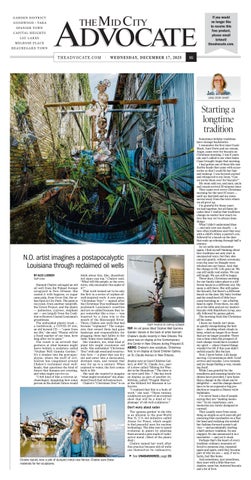
TOP: An art piece titled ‘Orphan Well Gamma Garden’ stands in the back of artist Hannah Chalew’s studio recently in New Orleans. The piece was on display at the Contemporary Arts Center in New Orleans during Prospect.6. ABOVE: Chalew’s new sculpture, ‘Christmas Tree,’ is on display at Good Children Gallery on St. Claude Avenue in New Orleans. display now at Good Children Gallery, at 4037 St. Claude Ave., part of a show called “Mining for Wonder in the Humdrum.” The show is on view until Dec. 7. She has work on display as part of another exhibition, called “Fragile Matter,” at the Hilliard Art Museum in Lafayette. “I realized that this is a body of work,” she said. “These totemic sculptures are part of an eventual show that will be a kind of ‘orphanage’ of old well sculptures.”
Don’t worry about radon The ‘gamma garden’ in the title is an allusion to the post-World War II, U.S.-led initiative called Atoms for Peace, which sought to find peaceful uses for nuclear technology. The idea was to speed evolution in plants by planting them around a pole made of radioactive metal. (Most of the plants died.) Chalew named her work after this practice because old oil wells can themselves be radioactive,
Chalew stands near a pile of dumped metal near Venice. Chalew uses these materials for her sculptures.
ä See UNABANDONED, page 2G
Sometimes holiday traditions have strange backstories. I remember the first time Uncle Mack, Aunt Doris and my cousin, Angie, came over for biscuits on Christmas morning. I was 8 years old, and I called to see what Santa Claus brought Angie that morning. I had gotten one of those life-size Barbie heads that came with accessories so that I could fix her hair and makeup. I was beyond excited and whispered to my mom, “Can we invite them over for biscuits?” My mom said yes, and aunt, uncle and cousin arrived 30 minutes later. They came over every Christmas morning for the next 52 years — until my dad died and my mom moved away from the town where we all grew up. I’m grateful for those years we had together, but all these decades later I realize that traditions change no matter how much we love the way we’ve always done things. What I didn’t understand then — and only now see clearly — is how often traditions start that way: with a child’s whim, a parent’s yes, followed by a knock on the door that ends up echoing through half a century. As we settle into December again, I find myself thinking about how traditions not only start in unexpected ways, but they also can end quietly, without ceremony, even the ones we thought were stitched into our bones. And, that the change is OK. Life goes on. We can still smile real smiles. We can still laugh. We can still be happy. These days, Christmas morning for our family takes place in a different house in a different city. My mom is still there. She still makes the biscuits, but there’s a different knock on the door. My baby brother and his small herd of little boys come barreling in — not a Barbie head in sight. From there, we still sit at the table and eat my mama’s biscuits with Blackburn syrup, usually followed by games galore. The morning feels like Christmas all the same. I know my family isn’t alone in quietly renegotiating the holidays — deciding which rituals to keep, which no longer fit or those that are no longer possible. There was a time when the prospect of such change would have crushed my spirit — when I feared things wouldn’t be OK if this year didn’t unfold exactly like the last. Now, I know better. Life keeps moving. Circumstances shift. Grief arrives and recedes. Love remains and joy keeps finding a way, remaking itself. While I am grateful for the steadiness and meaning family traditions have provided, I now know that a change in the ritual can be delightful — and the change doesn’t have to be an expensive big production or require a Disney-style hullabaloo. I’ve never been a fan of people saying they are “making memories.” In my experience, core memories are rarely designed or curated. They usually stem from something as simple as an 8-year-old girl smearing blue eyeshadow on a Barbie head and realizing she needed her fashion-forward cousin’s advice — and accidentally starting a half-century tradition. No one clapped. No one announced it in a newsletter — and yet it stuck. Perhaps that’s the heart of every tradition: ordinary moments offered to someone else, repeated again and again, until they become part of who we are — and, if we’re lucky, feel like home. And sometimes, just sometimes, they start with a little blue eyeshadow, some hot, buttered biscuits and a lot of love.