PANTHERS AT SAINTS • 3:25 P.M. • FOX 1C THE
ACADIANA
ADVOCATE
T H E A C A D I A N A A D V O C AT E.C O M
|
S u n d ay, d e c e m b e r 14, 2025
$2.50X
Panel rejects bid by chief justice to reduce pay
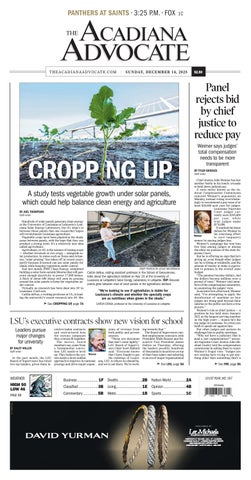
CROPP NG UP
ä See LSU, page 5A
ä See PAY, page 6A
Staff writer
STAFF PHOTOS By LESLIE WESTBROOK
Caitlin deNux, visiting assistant professor in the School of Geosciences, talks about the agrivoltaics testbed on Nov. 24 at the University of Louisiana at Lafayette’s Solar Energy Laboratory in Lafayette. TOP: Broccoli plants grow between rows of solar panels in the agrivoltaics testbed.
“We’re looking to see if agrivoltaics is viable for Louisiana’s climate and whether the specialty crops are as nutritious when grown in the shade.” CAITLIN DENUX, professor at the University of Louisiana at Lafayette
LSU’s executive contracts show new vision for school Leaders pursue major changes for university
centive-laden contracts sions of revenue from and restructured how both public and private the various campuses sources. they oversee fit together. “These are decisions The moves, board that don’t come lightly,” members say, come from LSU Board of Supervia fundamental convicsors Chair Scott Ballard BY HALEY MILLER said. “Everyone knows Staff writer tion: LSU needs to level that I have fought to get up. They believe the sys- Rousse the rankings of LouisiIn the past month, the LSU tem needs a more unified Board of Supervisors has hired approach to improve its national ana, LSU, to where we should be, two top leaders, given them in- prestige and drive major expan- and we’re not there. We’re work-
WEATHER HIGH 50 LOW 46
Business ...................... 1F Deaths .........................2B Nation-World................2A Classified .....................3B Living............................1E Opinion ........................4B Commentary ................5B Metro ...........................1B Sports ..........................1C
101ST yEAR, NO. 167
© D. YURMAN 2025
PAGE 6B
Staff writer
ing towards that.” The Board of Supervisors ratified employment contracts with President Wade Rousse and Executive Vice President James Dalton on Thursday, offering the leaders possibly hundreds of thousands in incentives on top of their base salary and ushering in an era of major organizational
BY JOEL THOMPSON
ä See CROPPING UP, page 7A
BY TYLER BRIDGES Chief Justice John Weimer has lost another battle in his lonely crusade to hold down judicial pay. A state entity known as the Judicial Compensation Commission rejected Weimer’s arguments on Monday, instead voting overwhelmingly to recommend a pay raise of at least $25,000 next year for judges. Louisiana Supreme Court judges currently earn $195,000 per year, while trial judges make $176,000. It marked the latest defeat for Weimer in his yearslong effort Weimer to save taxpayers money by paying judges less. Weimer’s campaign has won him few fans among judges or among the other six justices of the state Supreme Court. But he is offering no sign that he’s giving up, even though other judges say he is tilting at windmills, and the amount of money at stake is equivalent to pennies in the overall state budget. “The pennies become dollars, and the dollars become millions over a period of time,” Weimer told members of the compensation committee, in countering the judges’ view. In an interview afterward, Weimer said, “I’m attempting to apply the disinfectant of sunshine on how judges are being paid beyond their salaries so the public can have a true picture.” Weimer’s role as chief justice — a position he has held since January 2021 as the longest-serving member on the high court — means he’s the top judge in Louisiana. So critics are loath to speak out against him. But other judges and justices do challenge him in public meetings. “Why not have a judiciary that is paid a just compensation?” associate Supreme Court Justice John Michael Guidry told the compensation commission in asking them to reject Weimer’s frugal view. “Judges are not coming here trying to get anything other than something that’s a
A study tests vegetable growth under solar panels, which could help balance clean energy and agriculture Hundreds of solar panels generate clean energy at the University of Louisiana at Lafayette’s Louisiana Solar Energy Laboratory, but it’s what’s in between those panels that one researcher hopes will revolutionize Louisiana agriculture. Vegetable crops have been planted in the shady areas between panels, with the hope that they can produce a strong yield. It’s a relatively new idea called agrivoltaics. Agrivoltaics, or AV, is the science of raising crops — whether livestock or row crops — alongside solar production. In states such as Texas and Arkansas, “solar grazing” has taken off in recent years, partly because livestock can use solar panels for shade while keeping vegetation under control. Just last month, RWE Clean Energy completed building a solar farm outside Monroe that will generate enough electricity to power 17,000 homes. A flock of about 600 sheep will soon be grazing around the solar panels to keep the vegetation under control. Virtually no research has been done into AV in Louisiana. Until now. Caitlin deNux, a visiting professor at UL, is leading the university’s recent research into AV. She
Weimer says judges’ total compensation needs to be more transparent
AVA I L A B L E AT