ADVOCATEADVOCATEADVOCATE
FROM BAY TO BAYOU
Traveling photographer stays to capture Louisiana
BY JOY HOLDEN Staff writer
Documentary photographer Philip
Gould has traveled the world, captured numerous landscapes and a rich variety of people, but nowhere compares to the soul connection he feels in south Louisiana.
At the age of 20, San Francisco Bay Area
native Gould found his future behind the lens of a camera when his mom bought one that, as he says, “wasn’t half bad ”
“It was 1971. I commandeered it and started taking pictures like crazy,” said Gould.
The new hobby led him to study journalism at a local community college and a photojournalism degree from San Jose State, knowing that he needed to make photography his career
“It spoke to me loudly,” he said Right out of college in 1974, Gould landed a job in New Iberia taking pictures for The Daily Iberian The assignment turned out, for Gould, to be “the best first job a photographer could hope for.”
In a town where there was little news, he had free rein to photograph anything
as long as readers enjoyed the pictures.
Gould says the opportunity in New Iberia made all the difference in a career that has spanned five decades, multiple countries, several museum exhibitions and more than 20 books.
After a year and a half in New Iberia, in 1976, Gould moved to Dallas to work at the Dallas Times Herald. In 1978, the oak

trees, Spanish moss, waterways, music and people lured him back to Acadiana.
“I found that Louisiana had a wonderful sense of rootedness,” Gould said, “in that people are from here — and not only that, their ancestors are from here.”
He says he liked that it was a French speaking area and that people had a wonderful sense of humor here.
“I just somehow viscerally connected to Cajun culture,” he said.
That connection led to his first book, “Les Cadiens D’Asteur: Today’s Cajuns,” which was released in 1980, and it became a traveling exhibit.
Since then, Gould’s work has been exhibited in the Field Museum of Natural History, the Hilliard University Art Museum, the Louisiana Art & Science Museum, the New Orleans Museum of Art and the Virginia Museum of Fine Arts.
Gould has created and co-authored 16 books that range from “Ghosts of Good Times,” about abandoned dance halls in south Louisiana to “Bridging the Mississippi,” a conclusive look at every bridge that crosses the Mississippi River and contributed to many more.
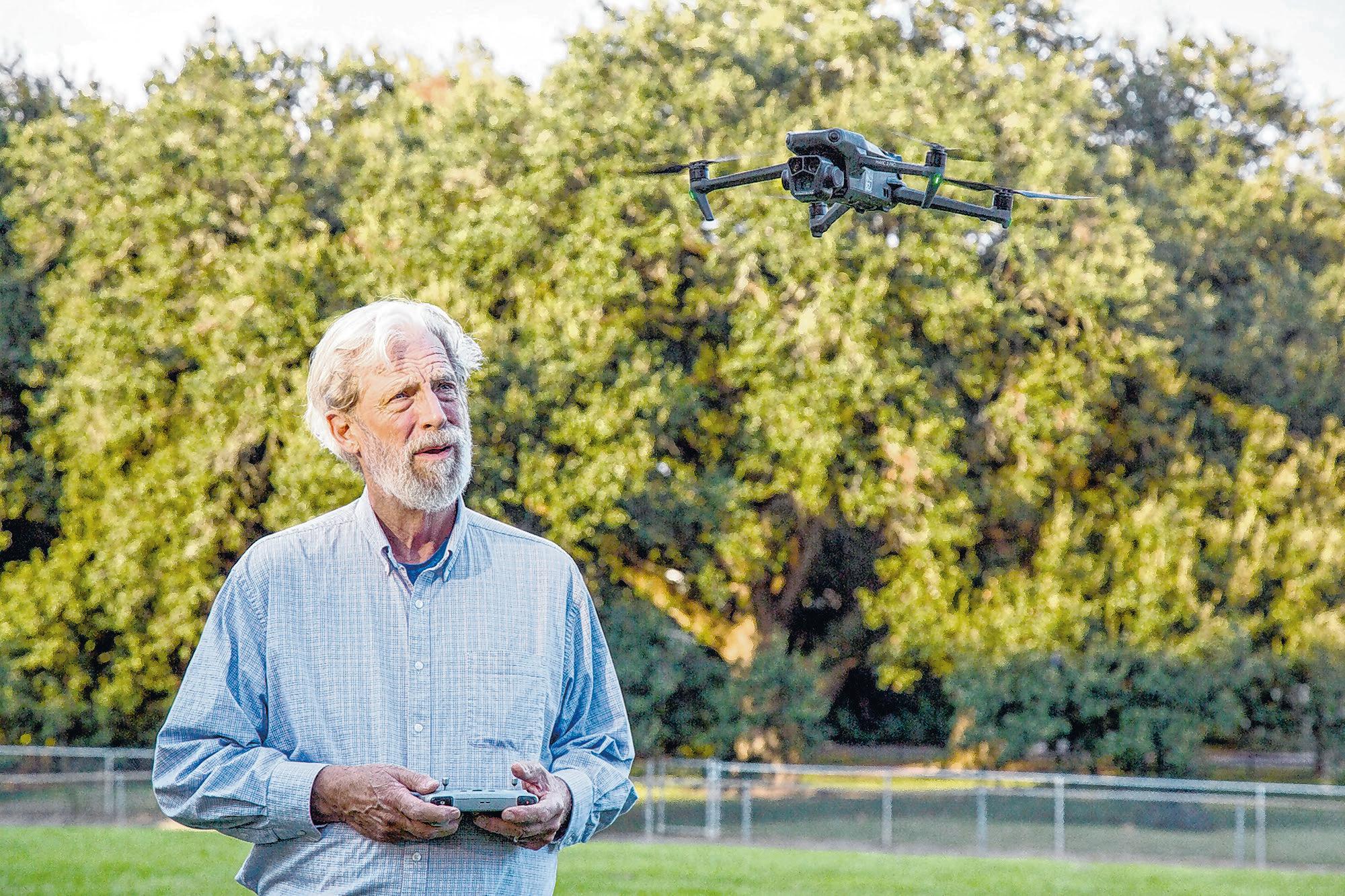
His most recent project is “Louisiana from the Sky,” which will be published by UL Press and available Dec. 9.
If you would no longer like to receive this

Long distance isn’t a thing anymore — aside from international calls, which can be bypassed by any number of apps or online options.
Even still, I remember the first long-distance call I ever received as clear as a bell.
I was 14 and was outside playing basketball in the driveway with a half-dozen neighborhood kids.
My mother threw open the front door and said, “Jan, you have a long distance call!”
Everyone froze, unable to process that someone would be calling one of our motley crew long distance.
Back then, a long-distance call was validation. Seconds counted. Someone, somewhere beyond the city limits thought I was worth spending money to reach.
After what my mother said registered, I ran inside to the black phone hanging on the kitchen wall. Its long coiled cord stayed tangled. I knew exactly how far I could wander while talking on the phone.
“Hello,” I said, breathlessly A man from Roosevelt State Park in Morton, Mississippi, a whopping 15 miles away, was calling for me.
He was calling about a skateboarding contest from the summer before. He worked at the park and remembered that I had won the competition the previous year which is another story all together (I had been the only girl in the contest and had won against at least 15 young men, most of whom were well into their 20s. It was the stuff of dreams.)
But I digress. This man’s job was to relay to me that park administrators had hoped I would return to defend my title.
Much like the legendary (in my own mind) skateboarding contest of the previous summer this was heady stuff.
Alas, I had a job and had to work that Saturday I was unable to join the skateboard competition again. I remember that I wasn’t even very disappointed. The long-distance phone call (witnessed by friends) was a sort of prize in and of itself.
Sitting in the newsroom, considering the difference in attitudes now about receiving phone calls, I looked around to the three 20-somethings who sit near my desk.
I had a hunch as to what the answer would be, but I asked anyway
“Do y’all know about longdistance calls?” I said.
At 22, the youngest of the trio said, “Do you mean a landline?” I quickly realized that she had no idea long-distance calls had ever been a thing.
Another veteran journalist jumped in to help me explain. The 22-year-old was shocked that there used to be charges for calls based on the distance between two places. The other journalist and I went on to explain how much timing mattered with long-distance calls — a long-distance call made in the middle of the day was high dollar
After 5 p.m., the rates dropped and after midnight they dropped even further
We told her that in the not-sodistant history of cellphones, there were charges for roaming and other long-distance features — that if you traveled with your cellphone and called in another region, there were costs that went along with the
PROVIDED PHOTO BY PHILIP GOULD
Barrier reefs in Point Aux Chien from the book ‘Louisiana from the Sky’
PROVIDED PHOTO BY PHILIP GOULD
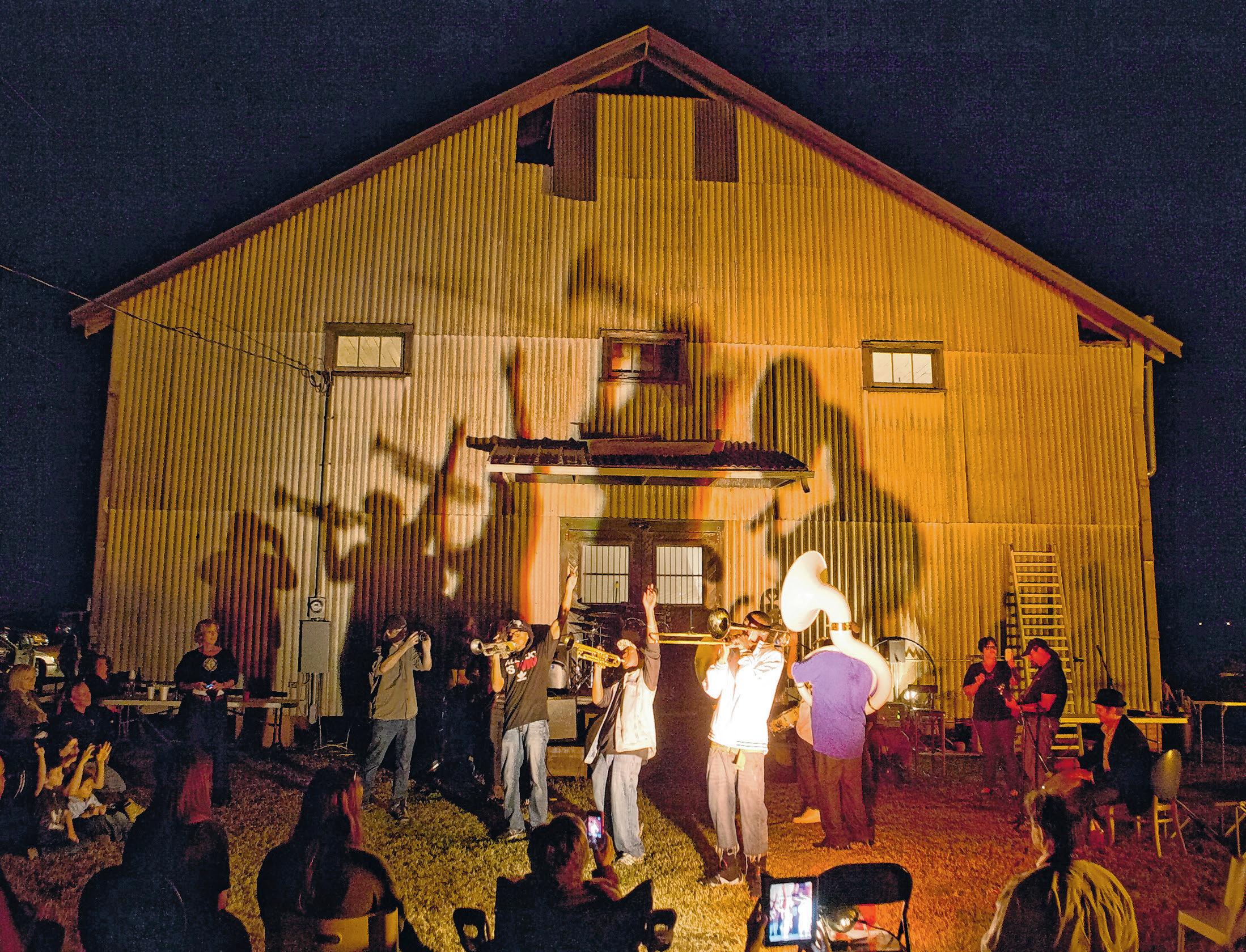
Philip Gould captures a moment of Louisiana culture at Fire and Water Fest.
PROVIDED PHOTO BY COLIN GOULD
ASK THE EXPERTS
Trombonist retrained his brain to play again
New Orleanian plays weekly despite developing focal dystonia after Katrina
BY JOY HOLDEN Staff writer
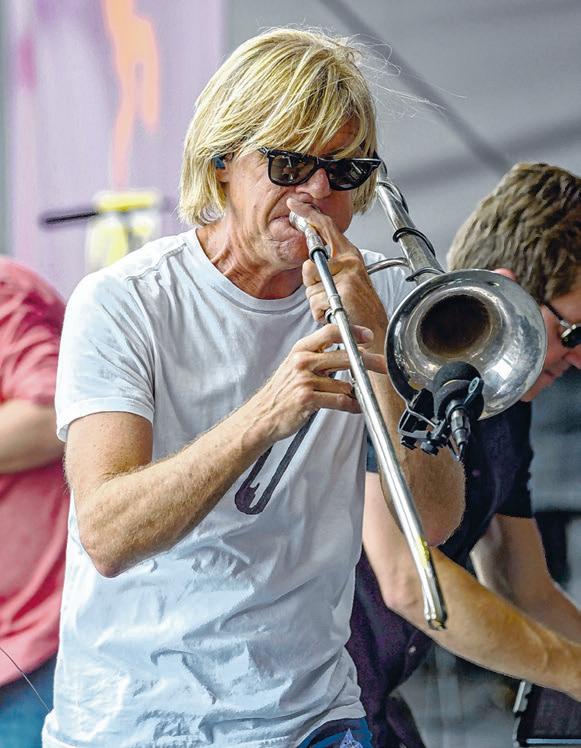
New Orleanian Craig Klein is a Grammy-winning trombonist, educator and composer. His influence spans over 200 recordings with legends like Dr. John and the Neville Brothers, and he actively performs with top brass ensembles. Klein has championed brass band music on international stages and through media like the radio station WWOZ His advocacy for musicians’ health has also encouraged more open conversations and resources around artist care.
Klein struggled with focal dystonia, making trombone playing difficult, but he remains dedicated. In addition to playing weekly at Preservation Hall in New Orleans, he hosts jazz shows on WWOZ and advocates for the station. Tell me about yourself and your life in music in New Orleans.
I grew up in Metairie. My inspiration comes from my uncle, who is my mom’s younger brother, Jerry He is seven years older than me and plays trombone. I came up watching him, admiring him, and I wanted to be just like him. We still play together in a brass band called The Storyville Stompers since 1981.
As I was growing up in the suburbs in the 1970s, we would go to the French Quarter as 15- and 16-year-old kids because Bourbon Street had good music going. It was jazz and blues.
I specifically remember coming out of Pat O’Brien’s with my friends, and Preservation Hall is right next to Pat O’s. In those days, they would open up the shutters so you could look through the old New Orleans-style glass windows and see what was going on.
I can still see it like it was yesterday It was just so mesmerizing and magical. The window sits right behind the drums and the trombone player When I looked in, I thought it was a dream. I’d never really heard the music like that before, and so I left my friends. I stayed there and listened.
Every time we would go back to the corner, I would go to that window and hear as many songs as I possibly could And then sometimes, if I had an extra $3, I would pay the cover charge and go in and stand along that back wall. I thought it would be cool to
BAYOU
Continued from page 1G
The book offers a distinct perspective on the Bayou State as seen from overhead with drone photography This idea for the collection of overhead photos grew from his childhood in California, where he was used to seeing mountains and more dynamic landscapes.
The flatness of Louisiana had always lacked that kind of drama, or so he thought “I felt this void,” Gould said “My premise has been that you really can’t see Louisiana in its full glory and potential from the ground You have to put something up in the air — so the whole flat landscape spreads out before you, and you can see its true drama.”
When asked about his favorite subject to capture, Gould said that he loves photographing people living in amazing architecture.
He also said that he’s often inspired by unusual concepts that become full-scale projects like his early 2000s series on train stations in France, “Les Plus Belles Gares de France.”
‘He’s like our memory’ Mark Tullos, executive director at the LSU Museum of Art, met Gould in 2002 when in Lafayette
The first time he saw Gould, the photographer was standing on top of a 14-foot ladder at a festival, documenting Louisiana’s joie de vivre. Tullos was worried for Gould’s safety, but the photographer was undeterred.
“I remember meeting him soon after that,” Tullos said, “and I was having a conversation about the lengths he will go to get a marvel-
Q&A WITH CRAIG KLEIN GRAMMY-WINNING TROMBONIST, EDUCATOR AND COMPOSER
play there.
When Storyville Stompers started in ‘81, that’s when I started really chasing New Orleans music, after the Olympia brass band.
What is it like to play Preservation Hall?
It’s a dream come true. Preservation Hall started in 1961, and it’s still the best place in the world to hear traditional jazz.
It’s an honor and a privilege and an obligation to keep this music going for the elders.
Can you tell me about your experience with focal dystonia?
Focal dystonia only affects maybe 2% or 3% of musicians and normally it’s a muscle movement disorder Have you heard of the term “the yips” in sports? It’s like that, but with musical instruments.
The neurons in your brain become tangled, and the wiring becomes unwired. It happened after Hurricane Katrina. We had to move to Baton Rouge, and I started coming back to New Orleans to help musicians rebuild houses.
There was so much stress. The stress affects different people in different ways. For me, I started noticing I couldn’t start a note.
I felt like something was happening. Then I started noticing more and more, “Man, something’s wrong on my chops. I can’t start this note, this passage. I’m really suddenly not so good.”
I knew I could play, but it just felt like my playing disappeared.
It was the hardest thing I’ve ever dealt with. I had never been more depressed in my life.
At some point, I went online, and focal dystonia pops up and it lists all of the symptoms. I’m going, check, check, check.
It affects different musicians.
For instance, like clarinetists or pianists, they get it in their fingers. Guitar players will sometimes get it in their fingers. It only
shows up when you have your instrument So for me, whenever I put the horn on my face, my chops would lock up.
I didn’t tell anybody except for my fellow trombone players, so they knew I had this. I was able to hide behind them in the band.
How did you eventually get help?
I started finding people I reached out to another horn player Dion Tucker in New York, and he helped me get some help.
One way to come out of this is you have to retrain your mind.
We already know we know how to play the instrument. We have to
rewire our brain. Neuroplasticity is what it is. So I had to almost relearn everything I’m thinking I’m probably about 75% there I took sessions with specialists over Zoom. They have taken me to a level that I never even thought I would even get to at some point. I work on it every single day. Has this condition changed your relationship to music and performing?
I always appreciated (music) because I love it, but (focal dystonia) made me appreciate it even more. You just have to be able to play and to contribute to what this culture is.
When you lose something, and you love it, man, and when you have a chance to get it back, you appreciate it more than you can ever imagine.
What is your relationship to WWOZ, and what does the jazz station mean to New Orleans?
Growing up, I didn’t own a lot of the records they were playing. On Saturday, Big Mama Rankin had the traditional jazz show, and I would put her on the radio. I would get my horn out, and I would play along. And that’s how I learned a lot of music, by playing along with it.
In my beginning years, WWOZ played that important part of my career, teaching me the music. I wasn’t going to be able to go out and buy all of those records. It just couldn’t possibly be done It’s a very important resource for musicians.
I wanted to do a show on OZ. It was always on my bucket list. So, I started sitting in on the other DJ shows and watching and learning. And then they started calling me to sub.
The next thing you know, a Saturday morning slot is open. To now be a part of the OZ family, and to play music that I love it’s just a special thing for me. I feel like it’s almost full circle Email Joy Holden at joy.holden@ theadvocate.com.

ous capture, a marvelous image. And he’s a master of that. He’s a real visionary He’s in that same family of great artists like Fonville Winans and C.C Lockwood.”
Tullos in his role back then as director of the Hilliard Art Museum in Lafayette, used to take visitors to nearby zydeco clubs to hear local music, where he would often see Gould taking pictures.
“I remember so clearly going to festivals or different events that were important in Louisiana, and seeing Philip like this sort of ghost walking around with his camera,” said Tullos. “He’s like our memory,
he goes through gathering all these images — and then you go back to an exhibition (at a museum) later and you see an image. You go, ‘I remember that, and I remember that day.’” UL history professor Michael Martin says that Gould’s work goes beyond documenting. He says Gould’s photographs evoke and convey things that are easy to identify with even for those not from Louisiana or the United States, for that matter
“He’s going beyond documenting. You can hear the music. You can feel the dance floor kind of
bouncing up and down. You can see the dust coming up off of the floor,” Martin said of Gould’s work.
“You can look at his photographs and say, ‘You know what, I can kind of sense what it would be like to be there.’” Five decades in, Gould’s photographs often do more than record a moment — they remind the people of south Louisiana who they are Through his lens, the ordinary becomes luminous, and the familiar turns timeless.
Email Joy Holden at joy.holden@ theadvocate.com.
Continued from page 1G
nience. She was amazed. As we talked, I could see how foreign “long distance” seemed to her To her, calls had always been free and endless. I remembered when they had been a currency of care. These days, we can FaceTime someone in Singapore for free, yet often feel thinner more disposable. There was something about knowing the seconds counted — the cost of the call made the words matter more. Perhaps we didn’t realize that we were rationing conversations, but I wonder if most of us chose words with more care because each minute ticked away like dropping money in a jar I don’t miss long-distance bills or busy signals. However, I do miss the magic that came with the phone ringing and having no idea who would be on the other end of the line but knowing it was someone who knew or had an important reason to be reaching out. How lovely to think of hearing my mother opening the front door and yelling, “Jan, you’ve got a long-distance call!” It all still matters.
Email Jan Risher at jan. risher@theadvocate.com.
PROVIDED PHOTO BY PRESERVATION HALL
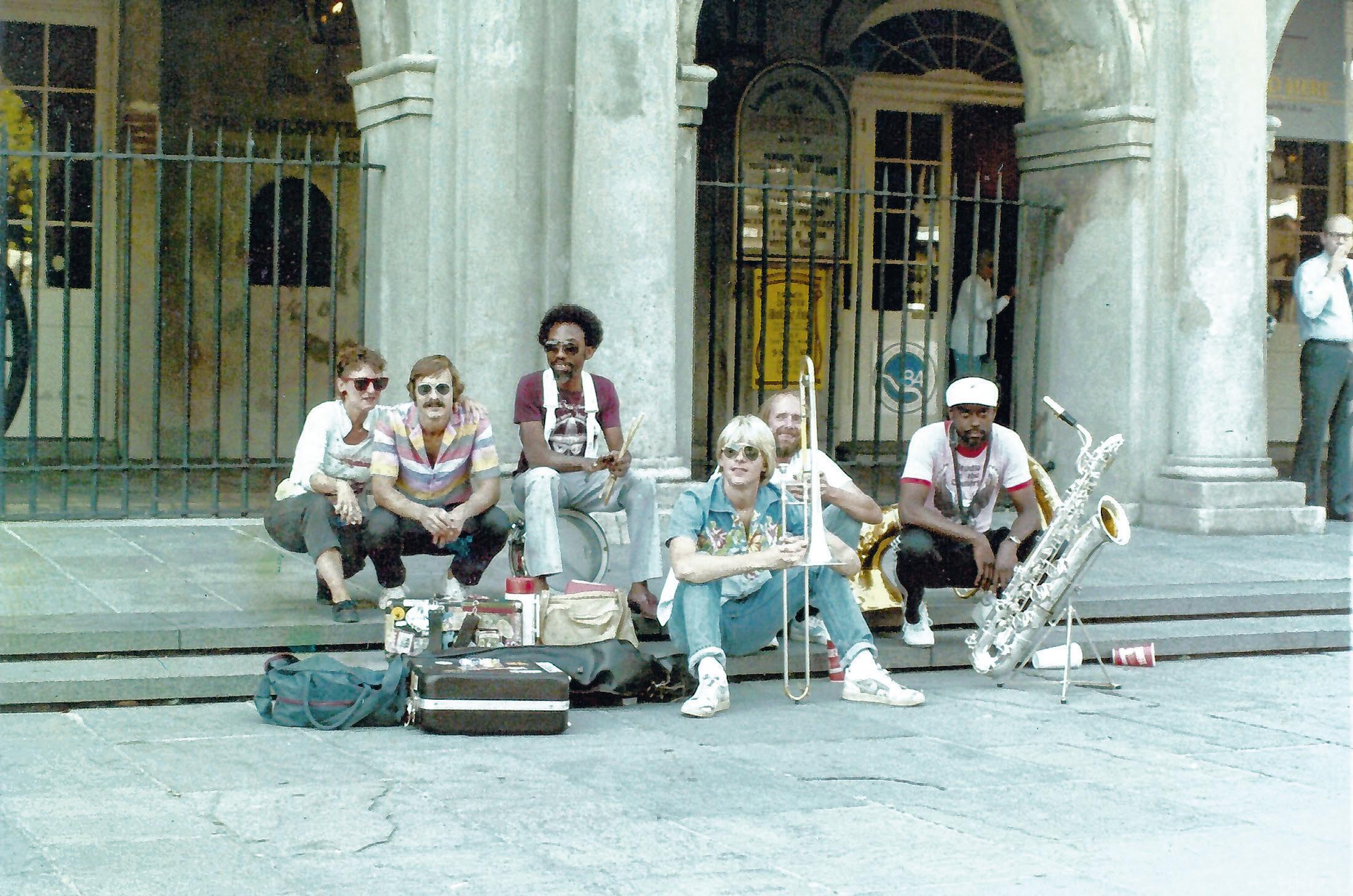
Trombonist Craig Klein, front center, busks with other musicians in the French Quarter in the 1980s.
STAFF FILE PHOTO BY MATTHEW HINTON
Craig Klein performs on the Gentilly Stage on April 29, 2016, during Jazz Fest in New Orleans.
PROVIDED PHOTO BY MOLLY REEVES
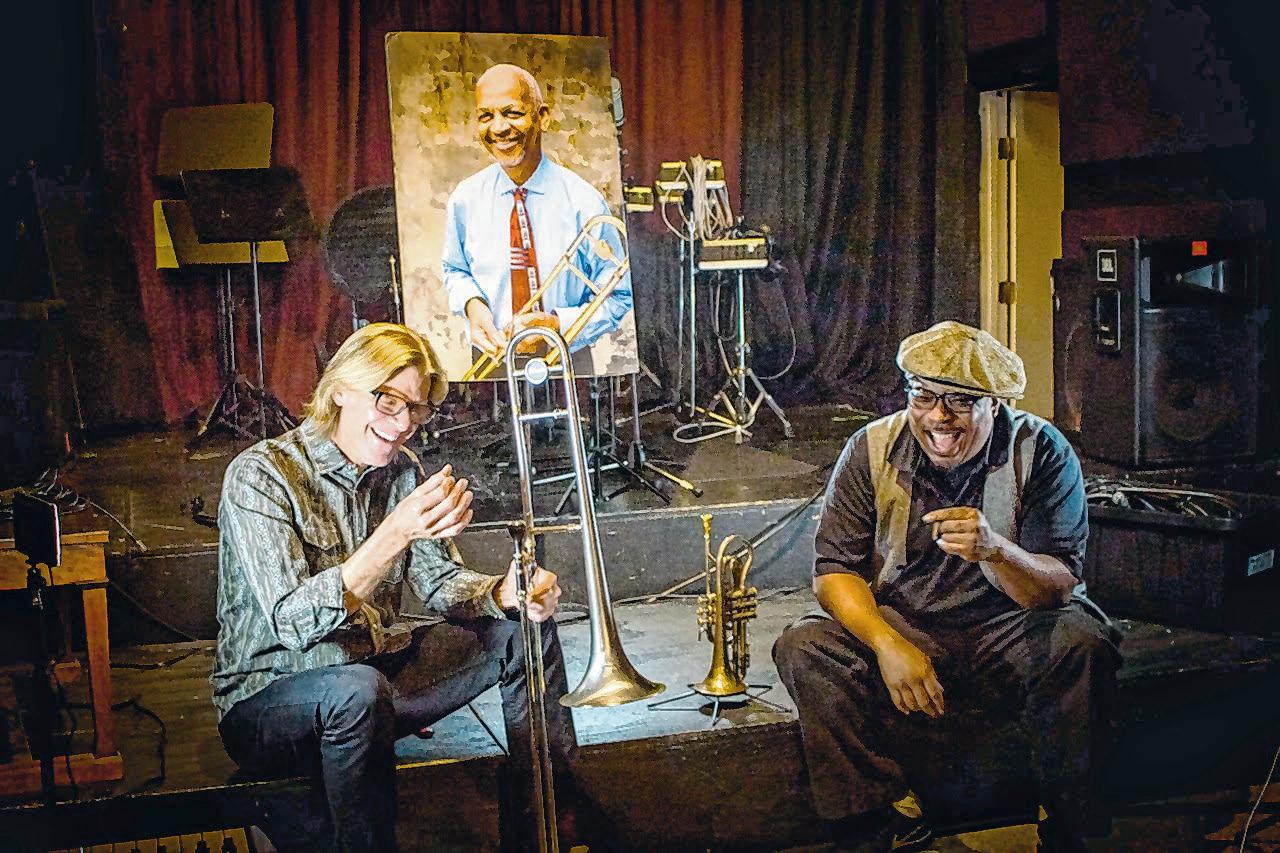
Craig Klein and Kevin Louis recorded a tribute to Lucien Barbarin.
PROVIDED PHOTO BY PHILIP GOULD Raymond Manson prays under the Crescent City Connection.
Louisiana Digital Library continues preservation work
BY CHRISTOPHER CARTWRIGHT Staff writer
In the basement of the LSU Hill Memorial Library, down several hallways and past rooms with desks full of papers and boxes and books, Gabe Harrell is at work scanning pages from journals written in the 1800s
“Right now, we’re working on this manuscript collection, the Capell family papers,” Harrell, the LSU Special Collections’ Digitization Lab Manager, explained.
“These are plantation records that we are working on getting digitized and put in the digital library once the new one is up and running.”
That library, the Louisiana Digital Library is an extensive online archive of more than 350,000 items from libraries, museums and other repositories across the state. Accessible for free to anyone, it includes manuscripts, photographs, newspapers, oral histories and other items.
It’s now undergoing an upgrade.
Gina Costello, LSU Libraries’ Associate Dean of Technology and Special Collections, said that a $190,320 grant from the Louisiana Board of Regents has funded a new microfilm scanner after the previous one stopped working “We were not going to be able to afford to replace it unless we got a grant, so this has been wonderful for us,” she said.
‘Free for anyone to use’
The digital library started in 1999 and has grown extensively since its beginning, with materials spanning centuries Scans of American Sugar Cane League bulletins are interspersed with portraits of LSU students from 1870, architectural drawings of university buildings, Ascension Parish Library scrapbooks and audio recordings of Cajun folktales.
Elisa Naquin, LSU Special Collections’ Metadata and Digital Strategies Librarian, said that while LSU manages the software, institutions around the state can
contribute.
“We manage it, provide it for the state, and it’s free for anyone to use, anyone who has an internet connection, but also free for any institution in the state that wants to contribute,” she said “It gives them a platform to use, and then they don’t have to purchase their own.”
Around 32 organizations have added to the library, including the Historic New Orleans Collection, East Baton Rouge Public Library Amistad Research Center and State Library of Louisiana.
Beyond purchasing the new microfilm scanner, Naquin said the funds are also paying for a system to host the digital library online.
“We were able to, with the help of this grant, purchase a really nice sort of modern system that’s going to be more user-friendly, both for the institutions that contribute and also for researchers searching for materials,” she said. “I think it will both increase the amount of materials going into the LDL, and I think it’ll increase access as well.”
Hundreds of years
The grant will be used to also digitize a specific collection. Deep in the library’s archives — six floors of floor-to-ceiling shelves containing everything from miniature books to maps — are large filing cabinets filled with roughly 600 microfilm reels of handwrit-
ten police jury minutes. The minutes cover meetings in 60 parishes from 1811 to the 1940s, and one reel of film covers between 500 and 1,000 images.
“We’re probably going to do just about 150 (reels) to start out, and then it’ll be a long-term project,” Costello said.
Yet the LSU Special Collections maintains far more documents than those available online. Costello and Harrell explained that many materials are frequently used by university classes, leading to them being prioritized for digitization.
“We have an active instruction program where undergraduate and graduate student classes come in,” Costello said. “They can handle
the materials, and sometimes it’s the first time they’ve seen things that are, you know, that old.”
The Capell family papers are one such example, with Costello stating that history and English classes frequently study them. Beyond university use, the library also prioritizes items that need to be preserved in the face of decay or deterioration.
“We want to keep them for hundreds of years to come,” she said. “We want them to be here when none of us are here. That’s our mission.”
Email Christopher Cartwright at christopher.cartwright@ theadvocate.com.



STAFF FILE PHOTOS BY JAVIER GALLEGOS
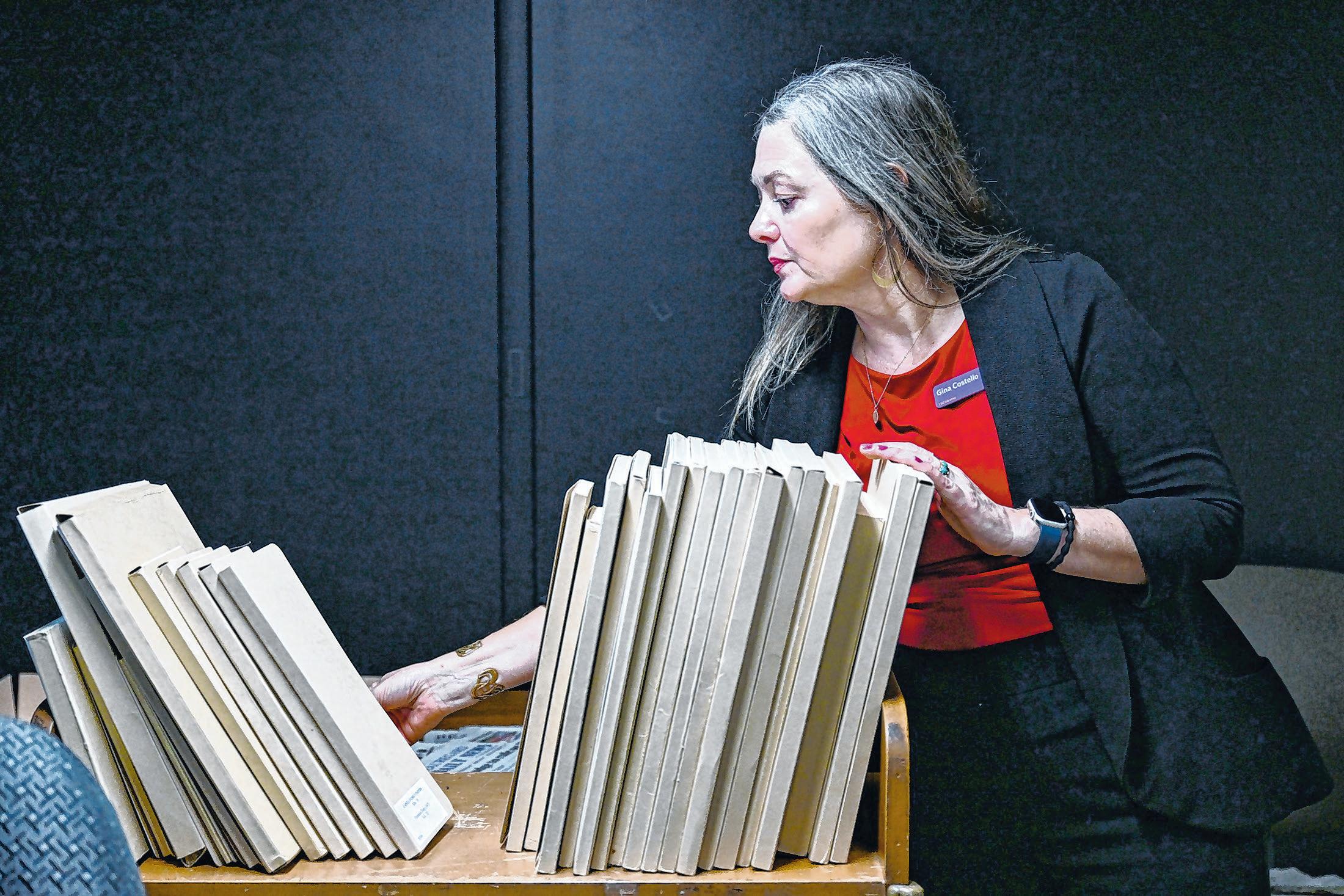
Gina Costello, Associate Dean of Technology and Special Collections, looks through a collection of materials that are going to be digitized via a scanner at LSU Hill Memorial Library on Sept. 18.