
BACK IN TOWN

The University of Louisiana at Lafayette’s homecoming week festivities culminated Saturday with an alumni parade and the homecoming game pitting the Cajuns against the University of Southern Mississippi Golden Eagles. The week also featured a food truck roundup, car show and Paint the Town Red competition. While rain threatened early Saturday, the sun came out for tailgating and the 4 p.m. kickoff.

University of Louisiana at Lafayette running back Bill Davis runs with the ball against the Southern Miss defense during their Sun Belt Conference football game at Our Lady of Lourdes Stadium in Lafayette on Saturday.
State’s toll of heat deaths likely undercounted
Many La. coroners lack standards for classifying fatalities as ‘heat-related’
BY SAM KARLIN | Staff writer
Summers in Louisiana are getting hotter and more dangerous, and the number of heat-related deaths in the state in recent years has hit record levels. But whether a death is classified as “heat-related” depends on an inconsistent, vague system: a patchwork of 64 elected coroners, each with their own protocols and standards for investigating deaths.

Some coroners say they have no way of tracking heat deaths at all. Others say they don’t have any on record over the past decade. Those with the most training say they go as far as checking liver temperatures to determine whether heat played a role in a death. As a result, the state’s toll is likely inaccurate and undercounted “You’re not going to find anything that’s standard going on,” said Dr Todd Thoma, coroner of Caddo Parish. “I hate to say coroners are a ragtag group, but they are. There’s 64 parishes and 64 coroners. Some are better trained, some are less trained ”
Confusion persists over $100K fee for H-1B visas
In La., universities and hospitals are among biggest program sponsors
BY ALYSE PFEIL | Staff writer
President Donald Trump last month began charging companies a $100,000 fee for each new application to sponsor a skilled employee from another country to temporarily work in the U.S. on an H-1B visa. The move is aimed at American tech companies who hire foreign workers, which the Trump administration argues have “prominently manipulated the H-1B system, significantly harming American workers in computer-related fields.”
But it could also impact Louisiana universities and hospitals that use the H-1B visa program to fill jobs.

Trump said the fee will incentivize companies to hire Americans. And his commerce secretary, Howard Lutnick, said businesses must weigh whether the $100,000 fee is worth it.
“Either the person is very valuable to the company and America, or they’re going to depart,” Lutnick said.
But the new policy has caused confusion since it was rolled out Sept. 19. H-1B visa applicants around the globe, employers and immigration lawyers “were in state of panic” immediately following Trump’s announcement, said Mary Kate Fernandez, a business immigration attorney at Adams & Reese who represents
Whether districts will be redrawn for midterm elections is uncertain
BY MARK BALLARD | Staff writer
WASHINGTON — Thinking about how the U.S. Supreme Court will handle the Louisiana case that could reshape the Voting Rights Act, the crowning legislative achievement of the civil rights era, Southern University political science professor Albert Samuels says he can’t help but think back. Out of Louisiana, he noted, came the litigation that helped end Reconstruction laws protecting the formerly enslaved the “grandfather clause” that kept Blacks from registering to vote and the landmark Plessy case, which enshrined Jim Crow laws limiting African American opportunities.
“Ironically it’s Louisiana at the center of this again,” Samuels said after listening to the 21/2-hour Supreme Court hearing Wednesday over whether the state Legislature — relying on Section 2 of the Voting Rights Act of 1965 violated the Equal Protection Clause of the U.S. Constitution when drawing the second Black majority

STAFF FILE PHOTO By DAVID GRUNFELD
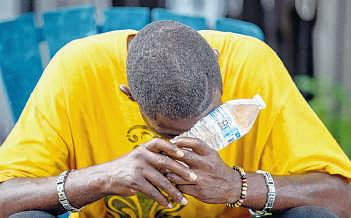
Ernest Miller uses a cold bottle of water to try to stay cool in New Orleans’ summer heat on
STAFF PHOTOS By BRAD KEMP
Confetti flies from the Phi Mu Sorority float during the University of Louisiana at Lafayette Homecoming Parade at Our Lady of Lourdes Stadium in Lafayette on Saturday.
Embassy issues warning in Trinidad and Tobago
PORT-OF-SPAIN Trinidad The U.S. Embassy in Trinidad and Tobago cautioned Americans on Saturday to stay away from American government facilities on the twin-island nation.
It was an unusual warning that came as tensions grow between the United States and Venezuela over deadly U.S. strikes in Caribbean waters targeting suspected drug traffickers.
The embassy didn’t specify why it issued the warning, saying only that, “due to a heightened state of alert, please avoid and refrain from visiting all U.S. government facilities through the holiday weekend,” as it urged people to “be aware of your surroundings.” Monday is a holiday to celebrate Dilawi, a Hindu festival of lights widely celebrated in Trinidad and Tobago, where 35% of its 1.4 million people identify as East Indian. Venezuela is located just miles away from Trinidad, where people in one coastal community are mourning the disappearance of two local fishermen believed killed in a U.S. strike on Tuesday The alert is based on threats directed at American citizens in the Caribbean nation, with U.S. authorities saying “it could be linked” to ongoing tensions in the region, Trinidad and Tobago’s minister of homeland security, Roger Alexander told The Associated Press. However, local authorities declined to share specific details about the reported threats.
Bus crash in Brazil leaves at least 17 dead
SAO PAULO A passenger bus in northeastern Brazil crashed into a sand embankment and flipped on its side, killing at least 17 people, authorities said Saturday The bus was carrying about 30 passengers, police said. The number of injured, who were taken to nearby hospitals, was not immediately clear The vehicle crashed in Saloá, a city in the state of Pernambuco, and was bound for the city of Brumado, in the neighboring state of Bahia.
Police said the driver lost control of the bus, crossed into the opposite lane and hit rocks on the roadside. He then returned to the correct lane but crashed into a sand embankment, causing the vehicle to overturn.
The cause of the crash is under investigation. The driver suffered minor injuries and tested negative for alcohol, police said Bahia Gov Jerônimo Teixeira said on X that his administration was supporting rescue efforts and the identification of victims. “I am following the situation with my team and deeply mourn the loss of lives, the injuries and the suffering of all the families,” he wrote.
Taylor Swift’s Easter egg sparks windfall for otters
San Francisco An Easter egg dropped by Taylor Swift in the film for her new album is proving to be a boon for sea otters in Northern California.
The pop star wore a vintage Monterey Bay Aquarium otter conservation T-shirt in a release party movie for her new “The Life of a Showgirl” album, sending her ardent fans on a quest to buy the shirt last produced in the 1990s. After the aquarium was flooded with calls about buying the T-shirt showing two otters floating on their back, it decided to rerelease the garment Thursday as part of a special campaign to raise $1.3 million, a nod to Swift’s favorite number, said Liz MacDonald, the aquarium’s director of content strategy
The aquarium met and surpassed its goal to raise the funds for its sea otter conservation program in less than eight hours, averaging about $100,000 in sales every 15 minutes, MacDonald said.
“We definitely had a little Taylor Swift dance party in the office yesterday afternoon when we hit the goal,” she said The aquarium began accepting back-orders and by Friday afternoon it had raised $2.2 million, according to its website.
How Swift acquired the T-shirt that was last produced more than 32 years ago — when she was just 3 years old remains a mystery
‘No Kings’ protests bring party vibe
Protesters demonstrate against Trump nationwide
BY MIKE PESOLI and GARY FIELDS Associated Press
WASHINGTON — Protesting the direction of the country under President Donald Trump, people gathered Saturday in the nation’s capital and communities big and small across the U.S. for “No Kings” demonstrations that the president’s Republican Party disparaged as “Hate America” rallies.
With signs such as “Nothing is more patriotic than protesting” or “Resist Fascism,” in many places the events looked more like a street party There were marching bands, a huge banner with the U.S. Constitution’s “We The People” preamble that people could sign, and demonstrators wearing inflatable costumes, particularly frogs, which have emerged as a sign of resistance in Portland, Oregon.
It was the third mass mobilization since Trump’s return to the White House and came against the backdrop of a government shutdown that not only has closed federal programs and services but is testing the core balance of power, as an aggressive executive confronts Congress and the courts in ways that protest organizers warn are a slide toward authoritarianism.
Trump himself was spending the weekend at his Mar-a-Lago home in Florida.
“They say they’re referring to me as a king. I’m not a king,” Trump said in

a Fox News interview that aired early Friday before he departed for a $1 millionper-plate MAGA Inc. fundraiser at his club.
Later Friday a Trump campaign social media account mocked the protests by posting a computer-generated video of the president clothed like a monarch, wearing a crown and waving from a balcony
People packed into New York City’s Times Square, Boston Common and Chicago’s Grant Park; outside state capitols in Tennessee and Indiana and a courthouse in Billings, Montana; and at hundreds of smaller public spaces. More than 2,600 rallies were planned on the day, organizers said.
Many protesters were angered by attacks on their motives. In Washington, Brian Reymann said being called a terrorist all week by Republicans was “pathetic.”
“This is America. I disagree with their politics,
but I don’t believe that they don’t love this country,” Reymann said, carrying a large U.S flag “I believe they are misguided. I think they are power-hungry.”
More than 1,500 people gathered in Birmingham, Alabama, evoking and openly citing the city’s history of protests and the critical role it played in the Civil Rights Movement two generations ago.
“It just feels like we’re living in an America that I don’t recognize,” said Jessica Yother, a mother of four. She and other protesters said they felt camaraderie by gathering in a state where Trump won nearly 65% of the vote last November
“It was so encouraging,” Yother said. “I walked in and thought, ‘Here are my people.’”
In San Francisco hundreds of people spelled out “No Kings” and other phrases with their bodies on Ocean Beach Salt Lake
City demonstrators gathered outside the Utah State Capitol to share messages of hope and healing after a protester was fatally shot during the city’s first “No Kings” march in June.
“Big rallies like this give confidence to people who have been sitting on the sidelines but are ready to speak up,” Democratic U.S. Sen. Chris Murphy said in an interview with The Associated Press.
While protests earlier this year — against Elon Musk’s cuts and Trump’s military parade — drew crowds, organizers say this one is uniting the opposition. Top Democrats such as Senate Minority Leader Chuck Schumer and Independent Sen. Bernie Sanders are joining what organizers view as an antidote to Trump’s actions, from the administration’s clampdown on free speech to its military-style immigration raids.
“We’re here because we love America,” Sanders
said, addressing the crowd from a stage in Washington. He said the American experiment is “in danger” under Trump but insisted, “We the people will rule.” The national march against Trump and Musk this spring had 1,300 registered locations, while the first “No Kings” day in June registered 2,100.
Republicans sought to portray protesters as far outside the mainstream and a prime reason for the government shutdown, now in its 18th day From the White House to Capitol Hill, GOP leaders called them “communists” and “Marxists.” They said Democratic leaders including Schumer are beholden to the far-left flank and willing to keep the government shut to appease those liberal forces.
“I encourage you to watch — we call it the Hate America rally — that will happen Saturday,” said House Speaker Mike Johnson, RBenton.
“Let’s see who shows up for that,” Johnson said, listing groups including “antifa types,” people who “hate capitalism” and “Marxists in full display.”
Many demonstrators, in response, said they were meeting such hyperbole with humor, noting that Trump often leans heavily on theatrics such as claiming that cities he sends troops to are war zones.
“So much of what we’ve seen from this administration has been so unserious and silly that we have to respond with the same energy,” said Glen Kalbaugh, a Washington protester who wore a wizard hat and held a sign with a frog on it. New York police reported no arrests during the city’s protests.
Trump: U.S. to send survivors of strike on vessel
Pair were aboard suspected drug ship sunk by U.S
BY KONSTANTIN TOROPIN and CHRIS MEGERIAN Associated Press
WASHINGTON The two survivors of an American military strike on a suspected drug-carrying vessel in the Caribbean will be sent to Ecuador and Colombia, their home countries, President Donald Trump said Saturday.
The military rescued the pair after striking a submersible vessel Thursday, in what was at least the sixth such attack since early September.
“It was my great honor to destroy a very large DRUG-CARRYING SUBMARINE that was navigating towards the United States on a well known narcotrafficking transit
route,” Trump said in a social media post “U.S. Intelligence confirmed this vessel was loaded up with mostly Fentanyl, and other illegal narcotics.”
After Trump’s announcement, the Pentagon posted on X a brief black-and-white video of the strike. In the clip, a vessel can be seen moving through the waves, its front portion submerged inches below the water’s surface. Then, several explosions are seen with at least one over the back of the vessel.
fice for Ecuador’s government said Saturday it was not aware of the plans for repatriation.
Meanwhile, the Ministry of Foreign Affairs and the presidential press office in Colombia did not immediately return messages seeking comment.

With Trump’s statement on his Truth Social platform of the death toll, that would mean U.S. military action against vessels in the region has killed at least 29 people.
capture and detain combatants and to use lethal force to take out their leadership.
Trump is also treating the suspected traffickers as if they were enemy soldiers in a traditional war
home
The repatriation would avoid questions for the Trump administration about what the legal status of the two would have been in the U.S. justice system. It may also sidestep some of the legal issues that arose out of the detention of enemy combatants in the global war on terrorism as well as challenges to the constitutionality of the current operation.
Customer Service: HELP@THEADVOCATE.COMor337-234-0800
News Tips /Stories: NEWSTIPS@THEADVOCATE.COM
Obituaries: 225-388-0289•Mon-Fri 9-5; Sat10-5;ClosedSun
Advertising Sales: 337-234-0174•Mon-Fri 8-5
Classified Advertising: 225-383-0111 •Mon-Fri 8-5
The Republican president said two people onboard were killed one more than was previously reported — and the two who survived are being sent to their home countries “for detention and prosecution.”
However, the press of-
The president has justified the strikes by asserting that the United States is engaged in an “armed conflict” with drug cartels. He is relying on the same legal authority used by the George W. Bush administration when it declared a war on terrorism after the Sept. 11 attacks, and that includes the ability to
Burning ship loaded with gas abandoned in Gulf of Aden
1 mariner missing near yemen
BY JON GAMBRELL Associated Press
DUBAI, United Arab Emirates
A Cameroonian-flagged ship caught fire Saturday in the Gulf of Aden off Yemen after possibly being struck by a projectile, officials said, with at least one mariner missing and another still likely aboard the burning tanker after the rest of the crew abandoned the vessel.
U.K. and European Union officials offered differing opinions about what sparked the blaze on the Falcon, with the
British suggesting a projectile hit it, while the EU said that it appeared to be “an accident.” They warned ships in the area that the vessel could explode, because it was “fully loaded” with liquefied petroleum gas.
The incident comes as Yemen’s Houthi rebels have been attacking ships through the Red Sea corridor However, the rebels didn’t immediately claim to have been involved, though it can take them hours or even days to do so.
The British military’s United Kingdom Maritime Trade Operations, or UKMTO, center issued an alert about the Falcon, describing the incident
as taking place about 130 miles east of Aden.
“A vessel has been hit by an unknown projectile, resulting with a fire,” the UKMTO said. “Authorities are investigating.”
The EU’s Operation Aspides, which has been patrolling the area, said that the Falcon’s crew of 26 was all Indian except for one Ukrainian. The Greek frigate HS Spetsai was nearby the Falcon, while the French also sent an aircraft overhead, the EU operation said.
“Initial indications suggest that 15% of the ship is on fire and the fire was caused by an accident,” the EU naval force said, without elaborating.
Subscribe: theadvocate.com/subscribe E-Edition: theadvocate.com/eedition Archives: theadvocate.newsbank.com

ASSOCIATED PRESS PHOTO By OLGA FEDOROVA
Thousands of protesters fill Times Square on Saturday during a ‘No Kings’ protest in New york.


Floods in Mexico signal need forimprovedweather warnings
BY MARÍA VERZA Associated Press
MEXICO CITY The most recent torrentialrains in east-central Mexico, which have left atleast 76 deadand dozens more missing, have raised questions again about the government’sability to alert people to severe weatherintime Authorities continue to describe the days of torrential rain last week that setoff landslides and river flooding as unpredictable.Residents talk aboutnever havingseenanythinglikeit. But researchers say what wasconsiderednormal before no longer exists, because climatechange has accelerated these events and made them more frequent. And that requires preparation.
“We’re being more and more affected by these phenomena andwecan’t go on like this,failing by not knowing what to do and not having …adequatewarning,” said Christian Domínguez, aresearcheratthe Atmosphere and Climate Change Institute at
VISAS
Continued from page1A
employers across the South “Itwas pandemonium.” Amonth later,it’snot clear which employers willhave to pay the fee.
“It’sstill extremely cloudy on who it’sgoingtoapply to,” Fernandez said.
Nationally,tech giants like Amazon, Microsoft,Meta, Apple and Google are among the top sponsors of employees on H-1B visas, according to public data available from U.S.Citizenship and Immigration Services. So are Indian IT companies like Infosys and Tata Consultancy Services.
In Louisiana, however,universities and hospitals are among the biggest sponsors of H-1B visas. And sparse guidance from the Trump administration has left those institutions with questions on what it means for them.
Amongthose navigating

Mexico’sNationalAutonomous University. She recalled that last year’scrises were drought-related and this year,it’sthe rain. It’sa pending issue for Mexico and for countries withmore resources and advanced technology like the United States,which experienced adevastating flash flood in Texas this year that killed at least 136 people. Expertssay society and governments appear to be stuckinthe past andhaven’t accepted that severe weather is now thenorm
States.” No such announcementhas been made public.
H-1B 101
TheH-1B visa programallows U.S. companies to hire foreign-born professionals andskilledworkers who have acollege degreeona temporary basisfor up to six years.
Forthe privatesector, there is acap of 85,000 new visaseveryyear,and applicants are selected through a lottery system. Some organizationsare exempt from that capand have no limits on the number of H-1B visas they can sponsor or when they can applyfor thosevisas.Among them are universities and nonprofits affiliated with universities, including health care systems.
Ochsner, Tulane and LSU have been top sponsors of H-1B visasinLouisianain recent years. This year, at least 92 applications have been approved for Ochsner,82for Tulane
By FELIX MARQUEZ
In Mexico’scase, its president forthe past year,Claudia Sheinbaum, is atrained scientist with abackground in climatechange. But while she expressedwillingnessthis week toreview prevention protocols, shedidn’tmention climatechangeand insisted it was impossible to predict with precision how much rain was going to fallinsome places
“The language being usedhas to be considered” in how to communicatethe dangersinanevent, Carlos Valdés, former head of
Mexico’sNational Disaster Prevention Center.“The first thing we have to do is recognize that thereisa change…the atypical is now the mosttypical.”
Thereare technological gaps.
For example, Domínguez recognizedthat Mexicodoesn’thaveall of the instrumentation for things like measuring river levels in real time that could provide detailed hydrological forecasts or enough weather radars to allow meteorologists to make better forecasts.
But she emphasized that even with theexisting forecasts there could be much betterprevention strategies,ifofficials think not only of preparing for hurricanes, but also the possibility thatthe confluence of various weather systems, as occurred last week, hasthe potential to create adangerous situation.
In theGulf Coaststate of Veracruz, the day before the main rivers in the northern part of the statejumped their banks, torrential rain was forecast to dump
nearly 8inches of rain. It ended up being three times that, but the original forecast should have been enough for residents and authorities to get organized, Domínguez said.
But in Poza Rica, the hardesthit city,residents started to flee their homes when the water was already flooding them.Some said that authorities warned them too late. Most didn’tthink it wasgoing to be so bad.
JonathanPorter, chiefmeteorologistwithAccuWeather, said that withclimate change,severe weather is happening outside of theseason when it would be expected andinplaces not normally associated with aflooding risk.
“A severe weather event can developanywhere when the ingredientscome together,” he said.
Mexico has risk maps, and civil defense officials are in charge of alerting people, “but beyond alerting, the people have to also understand what is being said,” Domínguez said.
shared similar reservations.
asocial media post by White House PressSecretary Karoline Leavitt. It took effect Sept.21.
“The government has basically been silent other than thatinitial guidance that was issued theday after the proclamation,” Fernandez said.
In themeantime, there are questions about which employers have to pay the fee, how exactly to remit payment,and at what point in the application process to pay “Westill don’tknow who it’sgoing to apply to,” Fernandezsaid. “I haven’thad in my own practice and I haven’theardofany other practitioner having paid this fee, because it’s just still so up in theair.”
She said someU.S. consulates abroad are putting visas on hold because they’reunsure if they need to charge $100,000.
Louisianaemployers
LSU currentlyhas just
specific implications to our budgetand hiring practices,” he said.
“LSU HealthNew Orleans remains committed to attractingand retainingtop talent to serve Louisiana and beyond. Assuch, we will evolve our processes to adhere to changing federal regulations,” Nelson said.
‘A lotofuncertainty’
Universitiesand hospitals arestill tryingtofigure out what thenew rules mean, said Jeremy Neufeld, director of immigration policy at Institute for Progress, anonpartisan Washington think tank thatfavorsrecruiting high-skilled immigrants to the U.S. from around the world
“Right nowthere’s still a lot of uncertaintyinsome of the guidance that’sbeen issuedand how it relatesto the text of the proclamation,” Neufeldsaid.
Forexample, the proclamationsaysthe feeapplies forthosewho areentering
“There is wide agreement that the H-1B program could be improvedtoallow it to better target visa applicants withthe skills that theAmerican economy needsthe most,” said Tulane spokesperson Michael Strecker
“But a$100,000 fee per applicantisa costly and unnecessary expense for universities and businesses alike and threatens to hamperour nation’s economic advancement,much of whichhas been based on our abilitytoattract theworld’s greatest talent,” he said.
Foreign labor, theeconomy
Fernandez, the business immigration attorney,said many people don’trealize how much of the American economyisbuttressed by foreign labor
“There’sjust amisunderstanding of what foreign labor meanstothe economy
and all sectors,” said Fernandez.“It’snot just tech jobs.”
Agriculture, health care, and education allbenefit from foreign workers,she said.
That idea comes up in alawsuit challenging the $100,000 feeasunlawful andbeyond the scope of the president’sauthority.Itwas filed earlierthis month in federal court in California. The plaintiffs include major labor unions, the American Association of University Professors, anurse staffing company,religious groups and others.
“The government failed to considerharms to hospitals, churches, schools and universities, and small businesses andnonprofits,or how the fee will harm communities across thenation,” the complaint says. Email Alyse Pfeil at alyse pfeil@theadvocate.com.





congressional district now held by Cleo Fields, D-Baton Rouge.
“The court’s six conservative justices seemed inclined to effectively strike down a Black-majority congressional district in Louisiana because it relied too heavily on race,” Samuels said. “If they gut or weaken the VRA, the impact will go far further than whether Cleo Fields can keep his seat.”
From their questions and comments, Samuels said, the court’s six conservative justices appear open to the arguments by the Louisiana Attorney General’s Office and the dozen White Louisiana voters, called the Callais litigants, who claimed the Constitution forbids configuring election districts based on race. Louisiana contends lower courts essentially forced the Legislature to draw a second Black majority district.
At issue is Section 2, which allows race to play a role in redistricting when minority voter strength is diluted by packing single districts and spreading the rest of the minority population across White-majority districts.
Samuels’ observations echoed national legal commentators.
“It will be an earthquake in the American political system,” UCLA law professor Rick Hasen wrote on the Election Law Blog. He surmised that the conservative justices will interpret previous laws and opinions “to sap Section 2 of its power without formally overturning it.” A number of Black members of Congress 19 according to Fair Fight, a voting rights group based in Atlanta could quickly find their districts endangered because Section 2 was relied upon to draw them.
Those include Louisiana’s 2nd Congressional District, held by Rep. Troy Carter, DNew Orleans. Carter says the creation of a second majority-minority district “was not about race.”
“It’s about fairness, compliance with federal law and ensuring that Black voices in Louisiana are not silenced,” he said. “The current map is the product of bipartisan compromise, legislative action and judicial review. The Voting Rights Act is not a relic — it is a living promise that our democracy belongs to everyone. For nearly 200 years, Black Americans had virtually no representation in government.”
The case was heard as President Donald Trump presses Republican-majority states to redraw their congressional maps now instead of waiting for the decennial Census count.
The acknowledged goal is to create enough GOP seats that the Democrats can’t retake the majority in the U.S. House come the November 2026 midterm elections.
During Wednesday’s arguments before the high court, the three liberal justices Elena Kagan, Sonia Sotomayor, and Ketanji Brown Jackson — pointed out Section 2 has successfully identified instances in which minority influence at the polls was weakened. They added that remedying those problems doesn’t necessarily mandate redistricting based on race.
Three conservative justices — Clarence Thomas, Samuel Alito and Neil Gor-

such repeatedly suggested that race-conscious district lines were unconstitutional
Whichever side can persuade two of the remaining three justices will win.
Several legal observers focused on three other conservative justices — Chief Justice John Roberts and justices Brett Kavanaugh and Amy Coney Barrett as the keys for how the decision will go. They were harder to read.
As a young lawyer who joined government during the Reagan administration, Roberts forwarded conservative efforts to dismantle the Voting Rights Act.
As chief justice, Roberts led the majority to invalidate the Voting Rights Act’s Section 5, which required states with a history of discrimination to obtain federal approval before making any changes to election practices.
“Our country h as changed,” Roberts wrote in that ruling. “Congress must ensure that the legislation it passes to remedy that problem speaks to current conditions.”
That decision left Section 2 lawsuits as the only way to enforce the Voting Rights Act.
Roberts and Kavanaugh joined the three liberal justices two years ago in upholding Section 2 in a case that ended with Alabama configuring a second Black majority district. Roberts didn’t have much to say in court Wednesday but did point out that while the facts were similar Louisiana couldn’t necessarily rely on the outcome in Alabama case because that challenge “turned out to be an improper evidentiary showing.”
Kavanaugh, meanwhile, focused on a timeline to end the 60-year-old law
“This court’s cases in a variety of contexts have said that race-based remedies are permissible for a period of time, sometimes for a long period of time, decades in some cases, but that they should not be indefinite and should have an end point,” he said.
Barrett agreed with Kavanaugh that there should be an “end point” but suggested the solution should be “narrowly tailored.” It’s a “big ask to change it,” she said. Historically, the justices wait until June to release their decisions argued in the fall Unless justices rule during the next few weeks, it will be hard for states to apply the court’s decision to newly drawn congressional election configurations before the 2026 midterm elections.
Several Republican-run states, including Louisiana, have begun the process of moving procedural and filing deadlines just in case there’s enough time. Gov. Jeff Landry included ad-
justing next year’s election schedule when he issued a call Thursday for a special legislative session to begin Oct. 23.
Some Louisiana Republicans are privately saying the Legislature should draw new districts to favor GOP candidates for all six seats in the state’s congressional delegation. But that depends on what the Supreme Court says in its ruling.
Louisiana Solicitor General J. Benjamin Aguiñaga said in court during arguments that he would be
rights activists gather outside the Supreme Court in Washington early Wednesday, as the justices prepare to take up a major Republican-led challenge to the Voting Rights Act, the centerpiece legislation of the Civil Rights Movement.
wary of a map that elects six White Republicans. Nearly half the state’s registered Democrats — 526,507 of 1,087,755 — are clustered in Carter’s and Fields’ congressional districts. When assigned new congressional districts, those Democrats could turn safe “red” districts, such as Majority Leader Steve Scalise’s in the New Orleans area and House Speaker Mike Johnson’s in northwestern Louisiana, into more competitive contests.
Louisiana’s four Republi-

ASSOCIATED PRESS PHOTO By MATT BROWN Rep. Troy Carter D-New Orleans, and other members of the Congressional Black Caucus speak outside the U.S Capitol after arguments were heard on the Voting Rights Act at the Supreme Court in Washington on Wednesday.
can congressional districts as they exist today were drawn to include an overwhelming percentage of registered White voters, ranging from 68% in Rep. Julia Letlow’s 5th District to 78% in Scalise’s 1st Congressional District to 75% in Johnson’s district.
The Black-majority districts created under Section 2 have narrow African American majorities. Only 52% of Carter’s 2nd District are registered Black voters, while 38% are White voters In Fields’ 6th Congressional
District, White voters make up 40% of the electorate while 55% are Black voters G. Pearson Cross, who teaches political science at the University of LouisianaMonroe, said the Supreme Court’s hearing left him thinking Section 2 might be coming to an end.
“The patience of the court for considering race in an issue like this has kind of run out,” he said.
Email Mark Ballard at mballard@theadvocate. com.










Theconsequences of Louisiana’sfaulty dataare stark, clouding the state’svisibilityinto whoisdying and why.Many Louisiana residents are vulnerable to extreme heat because of high rates of poverty,lack of access to adequate air conditioning and widespread underlying health conditions.
The lack of an accurate heat-related death count each year also obscures the scale of the problem: these deaths almost always occur out of the public eye, unlike deaths from crime or other natural disasters. They typically do not draw any media attention or federal government resources.
The heat deaths that coroners have been able to identify in recent years paint an alarming picture.
In New Orleans, elderly people have died mowing the lawn or trying to cool off in homes where spotty air conditioning units can’t keep up. Homeless people have died under overpasses. The prevalenceofconcrete and buildings has worsened the city’sheat island effect, and solutions haveproved elusive.
Twoyears ago, the state recorded an all-time high of heat-related deaths: 86. Deaths remained higher thanusual last year,before falling during arelatively more temperate summer this year
Still, there is broad agreement among coronersand health professionals that the true death toll is unknown —and far higher than therecorded tally Health professionals across the world say they struggle to countheat-relateddeaths, with ahost of factors— including medical judgment that varies by doctor— making it all but impossible to understand thetruetoll of extreme heat.

Aman swelters in the NewOrleans summer heat in 2023. FromNew Orleans to Baton RougetoShreveport, tracking heat related deathsisnearly impossible because of the way coroners work in the state,according to aTimes-Picayune analysis.
was acontributingfactor but notthe ultimatecause of death.
That heatwave revealed shortcomings in the way Louisiana and the restofthe country traced thenumber of people whodie from heatrelated illnesses.
But little has changed in nearly three decades since then.
Agency officials manually search for keywords like “heat”and “hyperthermia” on deathcertificates, which hashelped them catch afew heat deaths that were otherwise not classified that way on their certificate.
ence of having that many deathstobegin with,they might not be as comfortable
recording these deaths.”
Excess deaths soar
Another heat wave 30 years ago in Chicago brought afamiliarstory: Temperatures soared well into the 100s for days, and elderly people, often isolated andwithout adequate air conditioning, diedinrecord numbers.
The Cook County Medical Examinerclassified 465 deaths as heat-related that summer
But later studies that examined the excess number of deaths in Chicago during theperiod, compared with similar timeframes in past years, found the real number wascloser to 700.
Excess death analyses can often better capture the scope of heat deaths. But there are other ways state and local officials can get a better sense of the problem, like speeding up the process of certifying deathcertificates, Ebi said. And cities shouldbefo-
cusing moreonpreventing deathstobeginwith, she said.
“There is ahigh level of interest in the media to know exactly what the number is,” Ebi said. “The amount of money that’sgoing to take to be able to do that, we could invest in early warning systems, and we could invest in cooling shelters, andwecould invest in taxis to take people to the cooling shelters.”
Someplaces in Canada and Europe have gotten better at conducting quick excessdeath analyses,Ebi said. But they still don’tprovide granular information about the people who died andthe circumstances that led to their deaths —which can help prevent them.
“Knowing this two years later doesn’treally help,” Ebi said about delays in getting such information. “It helps in going to policymakers and saying, ‘This problemismuch bigger than you think.’”
“The number of bad health outcomes associated with heat are drastically underreported.”
The state still has not standardizedthe practice, and coroners offices say it is difficulttodetermine whether heat contributed, rather than directly caused, adeath.Each Louisiana parish has an elected coroner, and they have varying levels of expertise, moneyand manpower. Only onecoroner’soffice in the state, Jefferson Parish, run by Dr.Gerry Cvitanovich, is accredited bythe National Association of Medical Examiners, which has higher standards for investigatingdeaths.The rest only followstate law,which merely requires autopsiesin ahandfulofcases including homicides and child deaths.
Using thatmethod, the Health Department found several more deaths in 2023 than the 86 officially reported by the Centers for Disease Control and Prevention.
“The numberofbad health outcomesassociated with heat are drastically underreported,”said Zach Schlader,associate professor at Indiana University’s School of Public Health.
TheHealth Department haspublisheda document guiding healthprofessionalsonhow to track heat deaths and is promoting it at conferences, Herrock said. ‘Reallytough’
At the same time, heat is becoming arising threat to human health in cities across the U.S. because of climatechange, and officials are struggling to grapple with aproblem that is overlooked by many residents.
“Heatisa silentkiller,” said Kristie Ebi, professor of global health at the UniversityofWashington.
“People by and large don’t recognize that heat is a risk.” Decades-oldproblem
In 1998, aheat wave gripped partsofLouisiana and Texas, bringing unrelenting heat that killed cattle, buckled railroads andbroughtmiseryto residents. The state epidemiologist at the time was flummoxed by the rising death toll, as many elderly residents perished in homes without adequate AC.
“There areprobably many more outtherethat we haven’theard of yet,” said Dr.Louise McFarland, the former state epidemiologist, to areporter at the time. In all, at least 41 died in Louisiana that year,shattering records But health professionals knew then —asthey do now —that it was adramatic undercount. Coroners hadno standard practice for identifying heat-relateddeaths especially those where heat

ZACH SCHLADER associate professor at Indiana University’s School of Public Health presents
Death investigators in Cvitanovich’soffice are trainedtotake livertemperatures, ambientair temperatures and make note of other factors that makeit likely heat contributed to adeath, said TimGenevay, director of forensic operations.
Theoffice handles autopsies for more than adozen southLouisiana parishes and, in many cases, theinformation provided is not enough to determine contributingfactors to deaths, according to Genevay and other officials in the office.
“Aroundthe state, you have deathinvestigators whoare not certified, who don’tknowthe procedure, Genevay said.
For instance, someone who died of heart complications during aheat wave may have not otherwise died, but it’susually up to acoroner’sbest judgment whether to listheat as acontributing factor Ebi, of Washington University,saidhalfofall deaths during heatwaves are cardiovascular related. Andoverstretchedemergencyroom doctors are more concerned with saving aperson’slifethan taking arectal temperature to determine if the heat played arole, she said.
The Louisiana Department of Health has taken steps to get aslightlymore comprehensive count of heat deaths, said spokesperson Emma Herrock.

Because Louisiana’scoronersystem is parish-by-parish, the level of rigor varies widely.Some small, rural parisheshaveshoestring budgets. Others with more staffing are better at identifying deaths.
Thoma, the Caddo coroner,said there’s no foolproof way to identify heat deaths. Someone whodies outside may have ahigh internal temperature at first, but it can drop tothe outside air temperature by thetime his investigators arrive. If officials aren’tspecifically looking for heat deaths, he said, they’ll miss them.
“Some arealwaysgoing to be missed,” he said.“If it’sthe middle of summer and theyhaven’tbeen seen in two to threedays …they may have had aheat stroke two to three days earlier, but it doesn’tshow up on an autopsy.”
Dr.Reade Quinton, president of the National AssociationofMedical Examiners,said the organization hasspent years wrestling withthe question of how to standardizeheat death reporting.
But he believes coroners need thefreedom to make amedical opinion. If acoronercomes across an elderly New Orleanian whodied mowing thelawn on ahot summer day, ahost of questions arise:“Didhehavea cardiac event?Did he have astroke? Is it heat-related? How much?”
“You might have twomedical experts with different opinions,” he said.
Still, coroners canfind more heat deaths if theyare trained to look for them.
“It’stough. It’s really tough,” Quinton said. “Thosetiny parishes witha one- or two-man office and they don’thave the experi-

PelicanCreditUnion haspartnered with Southeastern LouisianaUniversityAlumni Association to launch thenew Southeastern SchoolPrideDebitCard,designedtocelebrateand amplifythe public university’s role in theregion.
With everyswipe of theseuniquedebit cards, Pelicandonates apercentageofthe transaction totheSLUAlumniAssociation.Thispartnership empowers students,alumni, andfanstoturn theireverydayspendingintoeffortless, monetary contributionstotheir favorite university “Weloveworking with this organization becausetheyare an engagedpartner, andthey want to show theirLionPride everytimethey opentheirwallet,”saidLeighPorta,ChiefGrowth OfficerofPelican Credit Union.
Asanot-for-profitfinancialinstitutionoperatingthroughoutthe majormarkets in Louisiana, PelicanCreditUnionis driven by thegrowthand successoftheirmanyschoolpartnershipsthroughoutthe state. Southeastern is Pelican’ssecond university partnership, followingasuccessful collaborationwithSouthernUniversity. Since launchingdebit cardswithSouthernlastyear, Pelicanhas donatedmorethan$32,000 in funds to theSouthernUniversityAlumniFederation.
“WeareexcitedtoteamupwithPelicanCredit Uniontolaunchthe official Southeastern School PrideDebit Card,” said MalayneSharp,Director of Alumni Relationsfor Southeastern.“We’re grateful forthe partnershipwithPelican andthe opportunitytocreatemeaningfulbenefits for theSoutheasternLouisiana Alumni Association andour Lion family.”
Theseacademicpartnershipsimpacttheregion’s financial literacy for thebetterbydevelopingan awareness of theresources offered by thecredit unionandLouisiana’spublicuniversities.Pelican regularlycollaborateswithacademicleaders to hostfreeclassroomworkshopsandpresentations to advancestudents’financialeducation
“Ascommunitypartners,weattendoncampus events like tailgates, homecomingcelebrations, andconferences.But more importantly, we offer freeclassroomeducation,”Portasaid.“Professors
recognizethe valueofthe educationprovidedby Pelicanand itsimpactonyoung adultstudents preparingfor professional careers. Financial educationhasalwaysbeenahugepartofwhatwe do at Pelican, andwelookforward to continuing to trailblazeinthisarea.
Giving back is at thecoreofPelican’s values Thecreditunion embraces a“PelicanPays” mindset—aphilosophythatbegan with several giveaway initiativesatlocalrestaurants and grocerystores. Theinitiativewas designed to inspirecommunity memberstopay it forward, andthe sentimenttookona life of itsown.The catchphrasenow reflectsthe generous spirit of Pelicanand itsidentity as an impactfulcommunity partner.
“Weare very passionate aboutwhatwedo here,”saidPorta.“It’sagoodfeelingknowingyou work fora business that is socially responsible andhas good intentions at heart.
Thenew Southeastern School PrideDebit Card is availabletoanyonewithorwho opens aPelican Credit Unioncheckingaccount. The debitcardfeaturesthe Southeastern University logo andcolorsand canberequested online or in-personatany Pelicanbranch. Formore informationonthe Lion PrideDebit Card visit: https://www.pelicancu.com/universal/southeastern-university-debit-card.





December1st -23rd 5:30PM- 9:00PM
Santa •HolidayShopping
Rides


STAFF FILE PHOTO By DAVID GRUNFELD
By Stevie Cavalier Licciardi | stevie.licciardi@theadvocate.com
This articleisbrought to youbyPelican Credit Union.



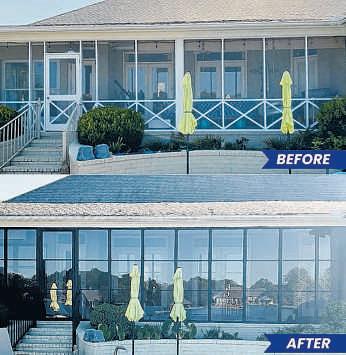

















EDUCATION
Layoffsdeplete officesatEducation Department
BY COLLIN BINKLEY AP education writer
WASHINGTON— Anew roundoflay-
offs at the Education Department
is depleting an agency that was hit hard in the Trump administration’s previous mass firings,threatening new disruption to the nation’sstudents and schools in areas from special education to civil rights enforcement to after-school programs
The Trump administration startedlayingoff 466 Education Department staffers on Oct. 10 amid mass firings acrossthe government meant to pressure Democratic lawmakers over the federal shutdown. The layoffs would cut the agency’sworkforce by nearly afifthand leaveitreduced to less than half its size when President Donald Trump took office on Jan. 20.
The cuts playinto Trump’s broader plan to shut down the Education Department and parcel itsoperationstoother agencies Over the summer,the department started handing off its adult education and workforce programs to the Labor Department, and it previously said it was negotiating an agreement to pass its $1.6 trillion studentloan portfolio to the Treasury Department. Department officials have not releaseddetailsonthe layoffs and did not immediately respond to a request for comment. American Federation of Government Employees Local 252, aunion that represents more than 2,700 department workers, said information from employees indicates cuts will decimate many offices within the agency All but ahandful of topofficials are being fired at the office that implements the Individualswith

DisabilitiesEducation Act, afederal law that ensures millions of students with disabilities get support from theirschools, the unionsaid.
Unknown numbers arebeingfired at theOffice for Civil Rights, which investigates complaintsofdiscrimination at thenation’sschoolsand universities.
The layoffswould eliminate teams thatoversee theflow of grant money to schools across thenation, theunion said. It hitsthe office that oversees Title Ifunding for the country’slow-income schools alongwith the team that manages 21st Century Community Learning Centers, the primary federal funding source for after-school and summer learningprograms. Without staff overseeing funding forhigh-poverty schools or special education, schoolsmay face delays

in receiving reimbursementfrom the federal government,said Sasha Pudelski, director of advocacy for the American Association of School Administrators.
“We’re talking aboutthe people who worked on the beating heart of ourfederal public school programs,” Pudelski said.
The layoffs will also eliminate teams that oversee TRIO,aset of programs that help low-incomestudentspursuecollege, and another that oversees federal funding for historically Black colleges and universities.
In astatement, union president Rachel Gittlemansaidthe new reductions, on top of previous layoffs, will “double down on the harmtoK-12 students, students with disabilities,first generation college students, low-income stu-
dents, teachers and local education boards.”
The Education Department had about 4,100 employees when Trump took office. Afterthe newlayoffs, it would be down to fewer than 2,000. Earlierlayoffs in March had roughly halved the department, but some employees were hired back after officials decided they had cut toodeep.
The new layoffs drew condemnation from arange of education organizations. Although states design their own competitions to distribute federal funding for after-school programs, asmall team of federal officials providedguidanceand support “that is absolutelyessential,” said Jodi Grant, executive director of the Afterschool Alliance.
“Firing that team is shocking, devastating, utterlywithout any
basis, anditthreatenstocause lasting harm,” Grantsaidina statement.
If upheld, the cuts will make it impossible forthe government to fulfill itsduties carrying outspecial education laws,according to astatement from the National Association of State Directors of Special Education.
Thelayoffs will reduce the department’s specialeducationofficefromroughly 200 workers to about five, said Katy Neas, CEO of The Arc of the United States, which advocates forpeople with disabilities. Neas, whohelped lead the office underformer President Joe Biden, said families rely on those teams to makesure states and schools are following complex disability laws.
One prominent example dates to Trump’sfirst term,when the special education office determined that Texas had illegally placed a cap on the number of students who could receive special education services in each district. Under pressure from the U.S. Education Department, Texas lawmakers lifted the cap in 2017.
“As aresult, tens of thousands of children in Texas now can accessthe educationsupport that they need, whereasbefore they couldn’t,” Neassaid.
Thegovernment’slatest layoffs are being challenged in court by theAmericanFederationofGovernment Employees andother national labor unions. Their suit, filed in SanFrancisco, said the government’s budgeting andpersonneloffices oversteppedtheir authority by ordering agencies to carry outlayoffs in responsetothe shutdown.
In acourt filing, the Trump administration saidthe executive branchhas wide discretionto reduce the federalworkforce. It said the unions could not prove they were harmedbythe layoffs because employees would not actually be separated foranother 30 to 60 days after receiving notice. AP education writer Annie Ma contributed to this report.



ASSOCIATED PRESS FILE PHOTO By JOSE LUIS MAGANA
Israel says Hamashandedoverremains of 2hostages
BY TOQA EZZIDIN, SAM MEDNICK and SAMY MAGDY Associated Press
CAIRO— Israel’smilitary
said Hamas handed over “two coffins of deceased hostages ”from Gaza to the Red Cross late Saturday, while Israel increased pressure on the militant group to share the rest morequickly under their ceasefire.
No names were immediately released.
Israel announced earlier Saturday that Gaza’ssole crossing with the outside world, Rafah, would stay closed “until further notice,” tying it to Hamas’ release of remains. On Thursdayit had said the crossing likely would reopen Sunday Hamas has now handed over the remains of 12 of the 28 dead hostages in Gaza, akey step in the week-old ceasefire process meantto endtwo yearsofwar.The militant group says devastation and Israeli military control of certain areas of Gaza have slowed the handover.
The statement by Israeli Prime Minister Benjamin Netanyahu’soffice on the Rafah crossing came shortly after the Palestinian embassy in Egypt said it would reopen Monday for people returning to Gaza. Hamas called Netanyahu’sdecisiona violation of the ceasefire deal.
The Rafah crossing has been closed since May 2024, when Israel took control of the Gaza side. Afully reopened crossing wouldmake it easier for Gazans to seek medical treatment, travel or visit familyinEgypt, hometo tens of thousands of Palestinians. Israel has been returning the bodies of Palestinians with no names, only numbers. Gaza’sHealth Ministry posts photos of them online, hopingfamilies will come forward.
“Just like they took their captives, we want our captives. Bring me my son, bring all our kids back,” said

Palestinians watchmembers of the Hamas militantgroup search for bodies of Israeli hostages on SaturdayinHamad City,Khan younis, in the southernGazaStrip.
atearfulIman Sakani, whose son went missing during the war. Shewas amongdozens of anxious families waiting at Nasserhospital. One woman knelt, crying over abodyafter identifying it. As part of the ceasefire agreement, Israel on Saturday returned 15 bodies of Palestinians to Gaza, bringing the total it has returned to 135.
Meanwhile,Gaza’sruins werebeingscouredfor the dead. Newlyrecovered bodies brought the Palestinian toll above68,000, according to Gaza’sHealth Ministry
Thousands of people arestill missing, according to the Red Cross.
The ministry, part of the Hamas-run government, doesn’tdistinguish between civilians and combatants in its count. But the ministry maintainsdetailedcasualty recordsthatare seen as generallyreliable by U.N. agencies and independent experts. Israel has disputed them without providing its own toll.
Hamas-led militants killed around1,200 people, mostly civilians, and abducted 251 people in the attackonsouth-

ern Israel that sparked the war on Oct. 7, 2023.
tors to increasethe flow of aidinto Gaza as closures of crossings and Israeli restric-
tions on aid groups continue.
“Vast parts of the city arejust awasteland,” U.N.
humanitarian chiefTom Fletcher said Saturday while visitingGazaCity, where international food security experts declared famine earlier this year
U.N. data on Friday showed 339 trucks have been offloaded fordistribution in Gaza sincethe ceasefire began. Under the agreement, about 600 aidtrucks perday should be allowed to enter COGAT, the Israelidefense body overseeing aid in Gaza, reported 950 trucks —including commercial trucks andbilateral deliveries crossing on Thursday and 716 on Wednesday,the U.N. said.
Israelhas said it let in enough food and accused Hamas of stealing muchof it, whichthe U.N. and other aid agencies deny Hamas againaccused Is-
rael of continuing attacks and violating the ceasefire, asserting that38Palestinians had been killed since it began. There was no immediate response from Israel, which still maintains control of about half of Gaza.
On Friday,Gaza’sCivil Defense, first responders operating under the Hamas-run Interior Ministry,said nine people were killed, including women and children, when their vehicle washit by Israeli fire in Gaza City The Civil Defense said the car crossed intoanIsraelicontrolledareaineastern Gaza.
Israel’sarmy said it saw a “suspicious vehicle” crossing theso-calledyellowline and approaching troops. It said it fired warning shots, but the vehicle continued to approach in amannerthat posed an “imminent threat.” The army said it acted in accordance with the ceasefire.
Israel also saidthe remains of a10thhostage that Hamas handed over Fridaywere identifiedasEliyahu Margalit.The 76-year-old was abductedfrom kibbutz Nir Oz during the Oct. 7attack. Hisremains were found after bulldozersplowed areas in the southern city of Khan Younis.
U.S.President Donald Trump has warned that he would greenlight aresumption of thewar by Israelif Hamas doesn’t return the remains of all dead hostages. Hamas hassaiditiscommitted to theceasefire deal, but thatthe retrievalofremains is alsohampered by the presence of unexploded ordnance in the territory’s vast ruins.
TheIsraeli organization supporting familiesofthose abducted said it will continue holding weekly rallies in Tel Aviv until all are returned.
“Wedon’twant to go back to fighting,God forbid, but this whole ordealmust end, andall thehostages must be returned,”saidIfatCalderon, aunt of freedhostage Ofer Calderon. Hamas has urgedmedia-

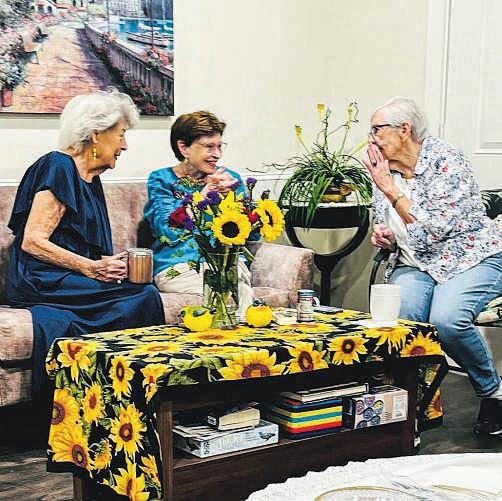
OctoberisNationalLong-Term Care Planning Month, atimetothink aboutthe future –not from aplace of worry, butfroma placeofloveand foresight.It’sa perfecttime forindividuals andfamiliestoconsiderhow to maintain theirindependence,dignity and peaceofmindasneeds change with age. The goal isn’t just to preparefor thefuture, butto ensure that future care reflectseachperson’s values andlifestyle
Thespiritofcareand connection is at theheart of TheVincent Senior Living,a communitydesignedtomakeresidents truly feel at home.AtThe Vincent, thehallmarks of Southern hospitality– warmth,kindnessand personal attention–aren’t just words. They arethe values that areseenevery day. Whether aresidentisenjoyingamorning walk around thepond, chatting with neighborsovercoffee or receivingpersonalizedcarefroma trained staff member,The Vincentensures that they aretreatedlikefamily.
Forthose seekingindependencewithout theburdensofhomemaintenance,the IndependentLivingapartmentsand Cottage








Living homesatThe Vincentoffer freedom, comfortand community. TheAssistedLiving communityhas more support, with personalized care wrappedindignity andrespect amid aclose-knitneighborhoodwithamovie theater, libraries, bistro andbeautysalon that turn everyday routines into opportunitiesfor socialization. Also at TheVincent,the Memory Care neighborhood offers comfort, safety and compassion for individualsfacingAlzheimer’s or dementia. Therapeutic activities like music andpet therapy, sensoryexercises andpersonalized meal plansnurture residents’ physical health andemotionalwell-being– allrooted in patience,persistence andheart Long-termcarecan feel like adifficult topic, butatThe Vincent, it’s reframed as a loving decision
ASSOCIATED PRESS PHOTO By JEHAD ALSHRAFI































Government shutdown nears second longest on record
They were looking at missing a paycheck on Wednesday But Trump directed the Pentagon to redirect money
BY KEVIN FREKING Associated Press
WASHINGTON The federal government shutdown is quickly approaching the second longest on record with no end in sight. Some lawmakers are predicting it could become the longest, surpassing the 35 days from President Donald Trump’s first term.
The Trump administration is using the current shutdown to buttress priorities it favors while seeking to dismantle those it doesn’t. Nevertheless, Democrats are insisting that any funding bill include help for millions of Americans who will lose health insurance coverage or face dramatically higher monthly premiums if Congress does nothing
The shutdown began Oct. 1. It is having an impact federal workers, the economy and the services the government provides.
Furloughs and firings
The federal government employed nearly 2.3 million civilian employees as of March 31. The Congressional Budget Office estimated that about 750,000 of those employees would be furloughed each day during a shutdown. That means they don’t report to work until the shutdown ends Others are considered “excepted” and do go to work, helping to protect life and property and perform other essential services.
Both groups of workers will get paid, but on a retroactive basis. That means they are facing the prospect of missing a full paycheck later this month after receiving a partial one earlier for work performed in late September
The nation’s 1.3 million active-duty service members got a temporary reprieve.
A second reprieve looks unlikely Of note for taxpayers, the government tab for paying furloughed workers while they are at home comes to roughly $400 million a day, according to a CBO estimate provided at the request of Sen. Joni Ernst, R-Iowa.
The administration is also trying to fire thousands of federal workers in agencies that don’t align with its priorities. Republican leaders in Congress have said that’s part of the fallout from a shutdown Past presidents, however, did not use shutdowns to engage in mass firings.
The Republican administration has announced one reduction in force affecting 4,100 workers, with the biggest cuts happening at the departments of Treasury, Health and Human Services, Education and Housing and Urban Development.
White House budget chief Russ Vought said in an interview on “The Charlie Kirk Show” that many more are planned.
“I think we’ll probably end up being north of 10,000,” Vought said.
“We want to be very aggressive where we can be in shuttering the bureaucracy,” Vought said. “Not just the funding, but the bureaucracy, that we now have an opportunity to do that.”
A federal judge has temporarily blocked the firings, saying the cuts appeared to be politically motivated and were being carried out without much thought. White House press secretary Karoline Leavitt said Thursday that the administration was “100%” confident that it will prevail on the merits in subsequent legal action.
Lawmakers acknowledge that many federal workers live paycheck to paycheck and will face some financial stress during the shutdown.

Food banks in some communities have boosted efforts to help them. The Capital Area Food Bank, for example, said it would hold additional food distributions in the Washington region beginning Monday to support federal workers and contractors.
Economic Impact
Past shutdowns have had slight impacts on the economy, reducing growth in the quarter during which the shutdown occurs, but growth increases slightly in the following three months to help make up for it
One estimate from Oxford Economics said a shutdown reduces economic growth by 0.1 to 0.2 percentage points per week. A shutdown that lasts the entire quarter, which has never occurred, would reduce growth for those three months by 1.2 to 2.4 percentage points. Some industries are hurt worse than others.
The U.S. Travel Association said the travel economy is expected to lose $1 billion a week as travelers change plans to visit national parks, historic sites and the nation’s capital, where many facilities such as Smithsonian Institution museums and the National Zoo are now closed to visitors.
The U.S. Chamber of Commerce noted that the Small Business Administration supports loans totaling about $860 million a week for 1,600 small businesses. Those programs close to new loans
during the shutdown. The shutdown also has halted the issuance and renewal of flood insurance policies, delaying mortgage closings and real estate transactions.
The Federal Aviation Administration has reported air controller shortages in cities across the United States, from airports in Boston and Philadelphia, to control centers in Atlanta and Houston.
Flight delays have spread to airports in Nashville, Tennessee, Dallas, Newark, New Jersey and more.
Political fallout
The party that insists on conditions as part of a government funding bill generally doesn’t get its way That was the case in 2013 and 2018 for Republicans. It remains to be seen how things will shake out this time, but neither side appears to be budging.
and cities.
So far, the public is rather split on who is to blame for the impasse. Roughly 6 in 10 U.S. adults say Trump and Republicans in Congress have “a great deal” or “quite a bit” of responsibility for the shutdown, while 54% say the same about Democrats in Congress, according to the poll from The Associated Press-NORC Center for Public Affairs Research. Perceptions could change depending upon how




























LOUISIANAPOLITICS
Johnsonattractspublicity during government shutdown
WASHINGTON
—U.S. House Speaker Mike Johnson got an earful when he fielded calls on C-SPAN last weekend.
Samantha, amilitary wifefrom Virginia, complained about Johnson’sdecisioninmid-September nottoconvene the Houseuntil Senate Democrats agreedwith Republicans to reopen government.


“I am very disappointed in my party and I’m very disappointed in youbecause you do have the power to call the House back,” Samantha told Johnson.“Yourefused to do that just for ashow.”
Johnson, R-Benton, repeated what he’soften said lately: the House did its job by passing a resolution continuing government operations when spending authorityexpired Oct. 1. It’sDemocratic senators who have refused 10 times, as of Thursday,toapprove the resolution that has kept government closed for the past two weeks and probably forthe next couple.
The shutdown has thrustJohnson into his highest profile in the public’seye during atwo-year leadership tenure as the behindclosed-doors Republican whisperer on Capitol Hillwho gets bills passed.
Usually calm, even taciturn, Johnson now calls himself “Mad Mike.”
He holds daily newsconferences and goes on television often to hammer the GOP theme that Senate Minority Leader Chuck Schumer,D-N.Y., is beingbullied by socialists bentonpicking afight with President Donald Trump. Schumer’s“got to get permission from Bernie and AOC, Ithink, before he can ever vote to open the governmentagain,” Johnson said Thursday on Fox News, referring to Vermont Sen. Bernie Sanders and New York City Rep. Alexandria Ocasio-Cortez— two
Legislator —orWorld Gumbo Champ?
State Rep. Beau Beaullieuhas won two elections to the state House from New Iberia and now chairs one of the most important legislativecommittees.
But nowadays he’d rather talk gumbo. Beaullieu’steam won its category in the World Gumbo Championship last Sunday in New Iberia. It was Beaullieu’sfourth victory in six years. The 35th annual cook-off filled Bouligny Plaza in downtown New Iberia in an event sponsored by the Greater Iberia Chamberof Commerce. About 100 teams competedin fivedifferent categories:amateur seafood, amateur chicken and sausage, amateur Melange (meaning they cook other combinations), professional seafood and professional non-seafood. Beaullieu’s team —all are members of the local Kiwanis Club —competed in the Melange category.Theymade turkey and andouille gumbo.
To prepare, he and his team

leaders of the Democratic progressive wing. “Wehave alot of things to do, but they’ve turnedthe lightsoff andrealpeopleare hurting,”Johnsonadded.
Little negotiation progress has beenmade with theHousegone andthe Senate stalled.
Noting congressional Republicans have allowed Trumpto rescind congressionally approved appropriations, Democrats say they don’ttrust theGOP and arguethe shutdown is their only
debonedeightsmoked turkeyand cutup30pounds of andouille, 15 of onions, 10 of celeryand 10 of bell pepper. Eachofthe teams had to cook thegumbo on-site Sunday Beaullieu, who said he begantomake gumbo with his mom while in high school, said his jobisto make sure the roux has the propercolor, texture and seasoning.


“I’mincharge of making sure it tastes right,” he said.
“I make the final call on it.” What’sthe secret?
“Camaraderie and patience,” Beaullieu replied. Yes, but what areyour secrets?
“Wehave acouple,” he said.
“Butitwouldn’t be asecret if I shared it.”
Are youthe best gumbo cook in the Legislature?
“If we’re going by world championships, it’spretty clear,” Beaullieu said.“Ihaven’t been challenged.”
Whatabout the statesenator fromNew Iberia,Blake Miguez?
“Miguezcan’t cook abaloney sandwich,” Beaullieu said.
RepliedMiguez: “Maybe so, but


jalva, D-Arizona, who diedearlier this year
Grijalva would be the last signature necessary on the bipartisan petition requiring Johnson to hold avote on forcing the Trumpadministration to release the files on Jeffrey Epstein, the late financier accused of trafficking underaged girls and friend to the elite.
Johnson called “absurd” the Arizona senators’ complaints that he wasdelaying Grijalva’soath to keep the Epstein vote from happening. Once the House reconvenes, Johnson said, he would swear in Grijalva.
He pointed out on CNNThursday that Rep. Julia Letlow,RBaton Rouge, had to wait25days forher oath.
“Wedidn’thave news conferences to go banging on doors and make abig thing of it, because we understood that is the regular process and tradition,” Johnson said. It’sstill too early to tell if Democratic and Republican gambits to place the blame on the other for the shutdown is working.
Apoll released Thursday spread the blame for the shutdown about equally,with 58% of the 1,289 Americans surveyed saying congressional Republicans were at fault and 54% pointing to the Democrats. The Associated PressNORC Centeratthe University of Chicago results are pretty muchin line with other recent surveys.
But that’sinWashington.
leverage to delay theexpiration of tax credits that will cause the price of insurance policies to double for manylower income Americanswho buy their health care coverage on the Affordable Care Act marketplace.
Trumpand SenateMajority Leader JohnThune, R-S.D., have hinted they’re open to an extension for the ACA subsidies. Thune went on the liberal MSNBC Thursday to say he’d consider avote on the tax credits, which if passed, would need House ap-
I’m really good at BBQ. I’m smoking Cassidy as we speak.” (Miguez is one of the Republicans challenging U.S. Sen. Bill Cassidy in next year’selection. Cassidy of course would take issue with Miguez’s BBQ abilities.)
Back to gumbo: “I have not found alegislator who is brave enough to meet the challenge,” Beaullieu said. “If youwrite this, (Rep.) Chad Boyer,(Rep.)Ryan Bourriaque and (Sen.) Robert Allain will be the first ones to stepup to the challenge. They know their way around apot.”
So what do you say,guys? Are you up to thechallenge?
Groups call for early education funding
Louisianagovernment should spend an additional $95 million over the next 10 years on early childhood education programs, theLouisiana Association of Business and Industry and the Louisiana Policy Insitute for Children said in anews release this week. The groups released astudy by theEarly Childhood Care and Education Commission. It argues Louisiana’seconomy is projected
proval, alongwith avote to reopen government.
The empty halls of the U.S. Capitol are now the stage forpopup political theater,such as when Democratic Arizona Sens. Mark Kelly and Ruben Gallego confronted Johnson outside his office, with atroop of reporters, to complain that Adelita Grijalva had not received theoath of office. Arizona elected Grijalva, aDemocrat,onSept. 23 while the House was out of session. She filled the seat of her fatherRep. Raúl Gri-
to expand over the next few years, but, “without access to affordable, high-quality child care, manyparents are unable to fully participate in the workforce.”
Parents’ inability to find good early childhood education costs thestate’semployers $762 million ayear and shrinks the state’s economy by $1.3 billion ayear, thereport found.
The report praised recent work by legislators to add moremoney to theChildCare Assistance Program,dedicate funding sources for theEarly Childhood Education Fund, which matches local spending, andpass tax credits for business that support child care costs.
But, “withmore than 100,000 economically disadvantaged children still unserved, the Commissionurgesa continued effort to ensure greater access to high-quality ECE so that Louisiana can thrive,” the groups’ news release says.
In addition to the $95 million annual investment, the groups call for an additional $30 million in the Early Childhood Dducation fund and further programstoincentivize employers. LABI represents Louisiana
Back home in Louisiana, the political drama is largely unnoticed, said G. Pearson Cross, aJohnson constituent and apolitical science professor at University of Louisiana Monroe.
The effects of the federal shutdown haven’treally been felt yet in Louisiana, so Johnson’sactions haven’tbeen noticed, Cross said. “Johnson generally gets apass from his constituents.” But that maybetested if the government closure starts impacting Louisiana.
EmailMark Ballard at mballard@theadvocate.com.
businesses and manufacturers, and is an influential lobbying group. The Policy Institute for Children is anonprofit think tank that researches policy proposals to benefit children from birth to age four Barksdale couldsee upgradesindefensebill
Louisiana’sBarksdale Air Force Base could get morethan $20 million in upgrades if Congress passes the version of the National Defense Authorization Act, the huge bill that authorizes spending on the military The version of the bill passed by the Senate includes $18 million forconstruction and modernization of infrastructure forthe base’snuclear mission and housing improvements, according to a newsrelease from Sen. Bill Cassidy.Italso includes $2.2 million for anew on-base Child Development Center,which will allow capacity formore families; there is currently awaitlist. The bill has not been madelaw yet. It now heads to the House to work out aconsensus bill between the twochanges.

ASSOCIATED PRESS PHOTOByJ.SCOTT APPLEWHITE
Speaker of the House MikeJohnson, R-Benton, answers questions Thursday during anewsconferenceonday 16 of the government shutdown, at the Capitol in Washington.
Capitol Buzz STAFF REPORTS
Mark Ballard









GULF COAST
Mississippi researchers launch boats into hurricane
BY KASEY BUBNASH Staff writer
As Hurricane Humberto was rapidly gathering strength just east of the Caribbean late last month, researchers with the University of Southern Mississippi were busy preparing an experiment.
Leila Hamdan, a professor of ocean sciences, and her team loaded two fiberglass sailboats into a truck and headed for North Carolina’s coast. From there, the boats set sail for the eye of the Category 5 storm, where they encountered 150 mph winds and waves that rose several stories high. But though the boats were out at sea, no one was on board.
Measuring just 4 feet long, the vessels, known as C-Stars, are completely remote-controlled and unmanned. They’re part of a larger effort, Hamdan said, to collect weather and climate data from the kinds of places people can’t always reach.
“For example,” she said, “in the eyewall of a hurricane.”

Propelled by wind and outfitted with solar-powered sensors, C-Stars operate individually or in fleets to gather data from within and around storms, including wind speed and direction, sea-surface and air temperature, air pressure and relative humidity all elements that help scientists understand how and why hurricanes form, and where they might go. That data is then transmitted back to scientists in real time via satellite Once a CStar is recovered, scientists can also access wave condition data and high-resolution images and videos collected while at sea. The National Oceanic and Atmospheric Administration has expanded its use of unmanned vessels and aircraft in recent years as a way to collect data from dangerous or extreme environments at a lower cost and lesser risk. But Hamdan said the latest fleet of C-Stars, several of which were launched this summer in partnership with NOAA



and robotics company Oshen, are among the smallest in the game.
“These boats are durable, they’re small, they’re light enough that one person can
pick them up and put them in the water,” Hamdan said. C-Stars have been used in the U.S. and Europe on missions to monitor marine mammals and collect ocean
data But their expedition into Hurricane Humberto was a first, as far as Hamdan knows, making them the smallest unmanned vessels ever to travel into a Category 5 storm and live to tell the tale.
The C-Stars were recovered shortly after passing through the storm, and, while some of them are in need of a little repair, Hamdan said her team did not record any total losses.
While several C-Stars will remain near the Caribbean Sea, Hamdan said two will return to their usual resting place off the coast of Gulfport, Mississippi, ready to launch into any storms that






might form in the Gulf of Mexico as the 2025 Atlantic hurricane season comes to a close.
“So really exciting stuff happening right here in Mississippi,” Hamdan said.
Greg Foltz, a Miami-based oceanographer with NOAA, said the C-Stars are still experimental, and past efforts to get the boats into hurricanes weren’t as successful. They missed Hurricane Gabrielle by about 40 miles.
But Foltz said the boats could soon become a vital resource for hurricane researchers and scientists, who have long grappled with the problem of how to gather data in the strongest part of a storm, particularly close to the water’s surface. That’s the portion of a storm that people feel when it hits land, and having a better understanding of the forces at play inside a storm’s core could improve hurricane modeling, intensity and track forecasting and could improve help better predict rapid intensification.
Hurricane Hunters, drones and data-collecting probes that researchers drop into storms are all on the frontlines of the same battle, but Foltz said C-Stars are able to collect continuous data in a way that other tools can’t.
Foltz said C-Stars are roughly a fifth of the size of unmanned vessels NOAA has used in the past, some of which were roughly 20 feet long. Their small size makes them easy and inexpensive to launch,





Immigrationcrackdown weighs on U.S. labormarket
BY PAUL WISEMAN and GISELA SALOMON Associated Press
Maria workedcleaning schools in Florida for $13 an hour.Every twoweeks,she’d get a$900 paycheckfrom her employer,acontractor
Not much —but enough to cover rent in the house that she andher 11-year-old son share with five families, plus electricity,a cellphone and groceries.
In August, it all ended. When she showed up at the job one morning, her boss told her that she couldn’t work there anymore. The Trump administration had terminated President Joe Biden’shumanitarian parole program, which provided legal work permits for Cubans, Haitians, Venezuelans as well as Nicaraguans like Maria.
“I feel desperate,” said Maria, 48, who requested anonymity to talk about her ordeal because she fears being detained and deported. “I don’thave any money to buy anything. Ihave $5 in my account. I’m left with nothing.”
President Donald Trump’s sweeping crackdown on immigration is throwing foreigners like Maria out of work and shaking the American economy and job market. And it’shappening at atime when hiring is already deteriorating amid uncertainty over Trump’serratic trade policies.
Immigrants do jobs cleaning houses, picking tomatoes, painting fences —that most native-born Americans won’t, and for less money.But they also bring the technical skillsand entrepreneurial energy that have helped make the United States the world’seconomic superpower Trump is attacking immigration at both ends of spectrum, deporting low-wage laborersand discouraging skilled foreigners from bringing their talents to the United States. And he is targeting an influx of foreign workers that
eased labor shortages and upwardpressure onwages and prices at atime when mosteconomists thought that taming inflation would require sky-high interest rates and arecession —a fatethe United States escaped in 2023 and2024
“Immigrantsare good for the economy,” said Lee Branstetter, an economist at Carnegie-Mellon University “Because we hadalot of immigration over the pastfive years, an inflationary surge was not as bad as many people expected.”
More workers fillingmore jobs and spending more money has also helped drive economicgrowth and create still-more jobopenings. Economists fear that Trump’sdeportations and limits on even legal immigration will do the reverse.
In aJuly report, researchers Wendy Edelberg and Tara Watson of the centrist Brookings Institution and Stan Veuger of therightleaningAmericanEnterprise Institutecalculated that the loss of foreign workerswill mean that monthlyU.S.job growth “could be near zero or negativeinthe next few years.”
Hiring has already slowed significantly,averaging a meager 29,000a month from Junethrough August. (The September jobs report has been delayed by theongoing shutdown of thefederal government.) During the post-pandemic hiring boom of 2021-2023,bycontrast, employers added astunning 400,000jobsa month.
The nonpartisan Congressional Budget Office, citing fallout Trump’simmigration andtrade policies,downgradedits forecast for U.S economic growth this year to 1.4% from the 1.9% it had previously expected and from2.5% in 2024
‘Weneedthese people’
Goodwin Living, an Alexandria, Virginia nonprofit that provides senior housing, health care and hospice services, had to lay off four
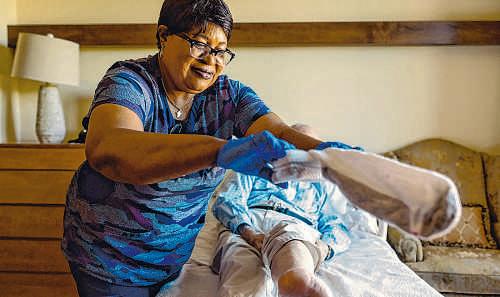
Conteh, an advanced care
Goodness, 92,
employees from Haiti after the Trump administration terminated theirworkpermits. The Haitians had been allowedtoworkunder ahumanitarian parole program and had earned promotions at Goodwin.
“Thatwas avery, very difficult day for us,”CEO Rob Liebreich said. “It was really unfortunate to have to say goodbyetothem, and we’re still strugglingtofill those roles.”
Liebreich is worried that another 60 immigrant workers could losetheir temporary legal right to live and work in theUnitedStates. “Weneedall those hands,” he said.“We need all these people.”
Goodwin Living has 1,500 employees, 60%ofthem from foreigncountries. It has struggled to find enough nurses, therapists and maintenance staff.Trump’simmigration crackdown, Liebreich said, is “making it harder.”
TheICE crackdown Trump’simmigration ambitions,intendedtoturn back what he calls an “invasion” at America’ssouthern border andsecure jobs for U.S.-born workers, were once viewed
with skepticism because of the money and economic disruptionrequired to reach his goal of deporting 1million people ayear.But legislation that Trumpsigned intolaw July 4—and which Republicans call the One Big BeautifulBill Act —suddenlymade his plans plausible.
Thelaw pours$150billion into immigration enforcement, settingaside $46.5 billion to hire 10,000 Immigrationand Customs Enforcement (ICE) agents and$45 billion to increase thecapacity of immigrant detention centers.
And his empowered ICE agentshave shown awillingness to move fast and break things —even when their aggression conflicts with other administration goals.
Last month,immigration authorities raided aHyundai battery plant in Georgia, detained300 South Korean workersand showed video of some of them shackled in chains. They’d been working to getthe plant up and running, bringing expertise in battery technology and Hyundai procedures that local American workersdidn’t have.
The incident enraged the South Koreansand ran
countertoTrump’spush to lure foreign manufacturers to invest in America. South Korean President Lee Jae Myung warned that the country’sother companiesmight be reluctant about betting on America if their workers couldn’tget visas promptly and risked getting detained.
Medicaid recipients
America’sfarmers are among the president’smost dependable supporters.
But John Boyd Jr., who farms 1,300 acres of soybeans, wheat andcornin southernVirginia,saidthat the immigration raids —and thethreat of them —are hurting farmers already contending withlow crop prices, high costs and fallout from Trump’strade warwithChina, which has stopped buying U.S. soybeans and sorghum.
“You got ICE out here, herding these people up,” said Boyd, founderofthe National Black Farmers Association. “(Trump) says they’re murderers and thieves and drug dealers, allthis stuff. But these are people who are in this countrydoing hard work that many Americans don’twant to do.”
Boyd scoffedatU.S. Agriculture Secretary Brooke
Rollins’ suggestion in July that U.S.-born Medicaidrecipientscould head to the fields to meet work requirements imposed this summer by the Republican Congress. “People in the city aren’t comingbacktothe farm to do this kind of work,”he said.“It takesa certain type of person to bend over in 100-degree heat.”
The Trumpadministration itself admits that the immigration crackdown is causing laborshortages on the farm thatcould translate into higher prices at the supermarket.
“The near total cessation of the inflow of illegal aliens combined with thelackofan available legal workforce,” the Labor Department said in an Oct. 2filing the Federal Register,“results in significant disruptions to production costs and (threatens) the stability of domestic food production andprices forU.S. consumers.”
‘You’renot welcomehere’
Jed Kolkoofthe Peterson Institute for International Economics said that job growth is slowing in businesses that relyonimmigrants. Construction companies, forinstance, have shed 10,000 jobs since May
“Those arethe short-term effects,”saidKolko,aCommerce Department official in the Biden administration. “The longer-term effects are more seriousbecause immigrants traditionally have contributed morethan their share of patents, innovation, productivity.”
Especially worrisome to many economists was Trump’ssuddenannouncement last month that he wasraisingthe feeonH-1B visas, meanttolure hard-tofindskilled foreignworkers to the United States, from as little as $215 to $100,000.
“A $100,000 visa feeisnot just abureaucratic cost it’sasignal,” Dany Bahar,seniorfellowatthe Center for GlobalDevelopment, said. “It tells global talent: ‘You are not welcomehere.’”
Ukrainiansdisappointedafter U.S. meetingfails to secure missiles
By The Associated Press
KYIV,Ukraine Ukrainians shared their disappointment Saturday that the U.S. may not provide Kyiv with longrange Tomahawk missiles, while work to repair the damaged power supply to the country’sZaporizhzhia powerplant soothedother concerns surrounding Europe’slargest nuclear plant. Ukrainian President Volodymyr Zelenskyy met with President Donald Trump at the White House on
Friday,afterthe U.S. leader signaled that Washington couldprovide Ukraine with the long-range missilesKyiv believeswill help bring Russian President Vladimir Putin to the negotiating table.
YetZelenskyyultimately left empty-handed— an outcomethat dismayed, but did notsurprise,many in the streetsofKyiv, who maintainedtheir determination to end Russia’s 3½-yearinvasionoftheir country One Ukrainian military serviceman, Roman Vynny-
chenko, said that he believed the prospect of Tomahawk missiles for Ukraine was a political “game.”
“Ukraine won’tget those missiles,”hesaid.
Vynnychenko saidUkraine still needed to procure new weapons withorwithout American help, particularly as Russiandrones and missilescontinued to hit civilian infrastructure.
“Every day civilians and soldiersdie, buildings collapse, ourstreets andcities are being destroyed,” Vyn-
nychenko said. Russia invadedits smaller neighbor in February 2022. Trump’s frustration with the conflict has surfaced repeatedly in the nine months since he returned to office. In
recent weeks, he had shown growing impatience with Putin andexpressed greater openness to helping Ukraine win the war,including with the sale of Tomahawks.
ButTrump’stoneshifted
again after he held alengthy phone call with Putin on Thursdayand announced that he planned to meet with the RussianleaderinBudapest, Hungary,inthe coming weeks.
BYSARAH RAZA Associated Press
Aplan to fire live artillery shells overa major Southern California highway as part of amilitary showcase attended Saturday by Vice President JD Vance drew strong objections from Gov Gavin Newsom, who said safety concerns forced him to close aportion of the busy interstate.
governor said in astatement. “Firing live rounds over abusy highway isn’t just wrong —it’sdangerous.”
celebratethe Marine Corps’ 250th anniversary,and watch troopsput on ashow of amphibious vehiclesand Marinesdemonstrating abeach assault. Vanceand his wife, Usha, watched as aircraft shot across the skyand columns of smokerosefrom munitions strikes. Statetransportation officials made thedecision to closethe freeway after practicefirings overthe freeway Fridayevening and arequest from event organizers for signage along the road stating “Overhead fire in progress.” Plan to fire artilleryoverCalifornia
“The President is putting his ego over responsibility withthis disregardfor public safety,”the Democratic
U.S. Marine officials at Camp Pendleton have said therewas nothing unsafe about theartilleryexercise andnoneed to disrupt traffic on Interstate 5, which is themainhighway along the Pacific coast between San Diegoand LosAngeles. Vance, aRepublican,and Defense Secretary Pete Hegseth visited the base in NorthSan DiegoCounty to















ASSOCIATED PRESS PHOTOByERIC LEE
Jackie
partner originally from Sierra Leone, helps Donald
put on fresh socks on Thursdayinhis apartment at GoodwinHouse Alexandria in Alexandria, Va



































































































Lafayette breaks ground on $17.6M sewage project
Lift station aims to bolster downtown development
BY STEPHEN MARCANTEL Staff writer
Lafayette officials celebrated the groundbreaking of a $17.6 million sewage lift station on Thursday
The project, officially named the South Gravity Lift Station, will expand sewage capacity in downtown and surrounding neighborhoods and is considered a linchpin to further development and increased density in the city’s urban core.
It’s expected to unlock a further additional 2,000 units in the area, with the ability the support residential and commercial applications. The project received $5 million in funding from an Environmental
State education leaders focus on absenteeism
Basing funding on attendance could backfire, some say
BY ELYSE CARMOSINO Staff writer
Several members of a new study group to examine Louisiana’s high rates of student absenteeism pushed back this week against proposals to tie school district funding to attendance, warning that doing so could backfire without addressing the root causes of why students miss school. Louisiana’s absenteeism rate rose between 2022 and 2024 before dropping slightly last year. Members of the state’s new Truancy Study Group suggested brainstorming ways for school systems and local agencies to better communicate with families and one another to figure out what’s driving absenteeism. Those reasons can vary widely, they said. Made up of nearly two dozen education professionals, including principals, superintendents, district attorneys and school counselors, the study group’s creation came at the behest of the Legislature. State Rep. Barbara Freiberg, R-Baton Rouge, proposed a bill in the spring that would have tied attendance data to school funding through the Minimum Foundation Program, which is Louisiana’s formula that determines the cost of educating public school students.
Freiberg ultimately pulled the bill, saying the issue needed to be studied, and the Legislature instead passed a resolution to create the Truancy Study Group. But she said at the time that she wanted to ensure districts became “more involved in making sure students are there daily.”
The committee will meet periodically in Baton Rouge until February which is the deadline for them to submit policy recommendations to the Legislature.
“There’s a disconnect sometimes between theory and practice,” said Sharon Clark, a member of the state education board and the study group’s chair during Wednesday’s meeting. “We want to make sure we’re coming up with solutions that work across the state.” The number of students frequently missing school in Louisiana skyrocketed during COVID-19, mirroring national trends.
In many states, chronic absenteeism fell after the pandemic.
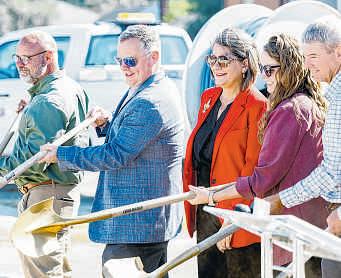
Protection Agency Community Grant Hotel Lafayette, an 83-room boutique hotel set to open near Parc Sans Sousi at the former Don’s Seafood location, is the earliest project to reserve its space for sewage capacity, with one developer saying the hotel would be “dead” without the lift station.
Lafayette Parish MayorPresident Monique Boulet, center, LUS Director Jeff Stewart, second from left, and construction officials participate in a groundbreaking ceremony Thursday for the LUS South Gravity Lift Station in the 1900 block of Johnston Street in Lafayette.
STAFF PHOTO By LESLIE WESTBROOK
Construction is scheduled to start this month with an October 2026 completion date.
Stephen Marcantel writes for The Acadiana Advocate as a Report for America corps member. Email him at stephen.marcantel@theadvocate.com.
Acadiana’s No Kings rally draws hundreds

Local protesters take part in nationwide call for action to stand against president, policies


BY CLAIRE TAYLOR Staff writer
John Ritchey, of Lafayette, wearing a red Make America Great Again cap and holding an American flag, was a lone dissenter Saturday in a sea of people protesting the actions of President Donald Trump and his administration during the second No Kings rally
About 400 people — young, old, Black, White, Asian, Hispanic, Republicans and Democrats gathered in downtown Lafayette chanting, cheering, singing and dancing while brandishing signs criticizing the Trump administration and pushing for change.
The turnout was about the same as the first No Kings rally in Lafayette in June.
Two law enforcement officers kept watch from the roof of the Le Centre International building the old Lafayette City Hall, on Jefferson Street at Lee Avenue, while a drone hovered overhead as protesters filled the triangle at Jefferson Street and Lee Avenue and lined the sidewalks across each street. They were among the millions around the country and across the globe who rallied and marched Saturday to call for an end to U.S. policies and actions that they believe are bringing the nation closer to a monarchy
STAFF PHOTOS By BRAD BOWIE
Hundreds gather for a No Kings protest on Saturday in downtown Lafayette.
ABOVE: Protesters holds signs and chant at Saturday’s No Kings rally downtown.
N.O. asks for tax renewal to continue added patrols
Quarter performers, vendors object to 8 p.m. curfew
BY SOPHIE KASAKOVE Staff writer
As the clock ticked toward 8 p.m one recent Friday the entertainers of Bourbon Street began to scatter Drummer kids hoisted stacks of buckets and sticks; brass players slung trumpets and trombones over their shoulders; and singers, dancers and stunt performers towed speakers, props and tip jars. All weaved around tourists to make it off of the famous party strip as a nightly curfew approached. Though the 8 p.m. endpoint has been enshrined in city ordinance for decades, it’s only within the past year that a crew of New Orleans police officers and Orleans Parish sheriff’s deputies has worked daily to enforce it, telling performers, vendors and homeless residents to disperse often just as the festivities hit full swing. Now, the future of that enforcement push and other French Quarter public safety initiatives will be left to neighborhood voters, who must decide in November whether to renew a sales tax that funds the efforts Early voting begins Nov 1 and runs through Nov 8; the election is Nov 15.
Law enforcement and French Quarter leaders say the patrols, which cover Bourbon Street and other French Quarter areas, have been effective in making the neighborhood safer Business owners who called on police to step up say the previous swarm of late-evening activity made their area less secure and cut into their profits.
“The street has felt better than it’s felt in a long time,” said Alex Fein, president of the nonprofit French Quarter Business League and a commissioner with the French Quarter Management District, the state-created agency that oversees the spending of the tax Fein’s family owns the Court of Two Sisters on Royal Street. “Better, cleaner, safer.”
But the crackdown on Bourbon Street has also frustrated performers and vendors who say the sweeps have made it challenging to eke out a living in the city’s tourist hub and have sanitized the freewheeling chaos that the street is world famous for With a National Guard deployment likely on the way they worry about even more enforcement.
“There should definitely be a police presence but I think too much of it does really mess up the atmosphere,” said Rick Wellington, a juggler who regularly preforms on Bourbon Street. “It makes it look unsafe where it’s really not unsafe.”
The millage
The New Orleans Police Department has long stationed officers on Bourbon Street and throughout the French Quarter But with the
NO KINGS
Continued from page 1B
For Frank Rochel, of Lafayette, it was his first protest. After watching what’s happening in the United States government, he wanted to help make sure the country does not fall into a dictatorship or monarchy When news reporters at the Pentagon last week turned in their media badges and cleared out their offices rather than agree to be censored by Secretary of War Pete Hegseth, Rochel said he felt it was time he took a stand William Preston was a registered Republican most of his life and voted for Trump in 2016.
“I thought he was a businessman, not a lawyer or politician,” he said. “But every time he was on the podium, he called people names He sounded like a high school kid.” Preston also grew concerned about Trump’s disregarding of facts he didn’t agree with and doing things to consolidate the power to himself.
“He’s a sick, twisted little man,” he said. In 1971, when Marvin Gaye released the song and album “What’s Going On,” he was writing about the Vietnam War and problems in America like poverty and systemic racism, said speaker Ola Prejean, of Move the Mindset and the League of Women Voters. American is facing some of those same problems today she said.
The Rev Richard Andrus, of St.

agency campaign to clean up the city ahead of the Super Bowl. It is typically staffed by four or five officers on weekdays, and by more than a dozen officers on weekend nights.
Still being hashed out is just how the district will use the money to address homelessness in the area going forward. The funds have recently helped to move people into housing, but the district is now considering redirecting some of those funds toward mental health and addiction treatment services.
‘We just deal with it’
As 14 officers and deputies made their way from Canal Street down the raucous strip on a recent Friday evening, the regulars who remained on the street knew the drill.
BR mom rejects plea deal in toddler’s death
BY MATT BRUCE Staff writer
force chronically understaffed, it wasn’t until voters approved a sales tax for the French Quarter in 2021 that neighborhood leaders had the cash to increase their ranks. The 0.245% tax, dubbed the “Quarter for the Quarter,” plus federal grants and cash from New Orleans & Co. have funded multiple patrols, a public safety mobile app and other services.
Voters will consider in a few short weeks whether to renew the tax, which is levied on sales of goods in the French Quarter and is designated for “enhanced and supplemental public safety services and homeless assistance services to facilitate economic development projects.”
The tax would generate $4 million in 2026 if it is renewed, according to a September draft budget from the French Quarter Management District, a state-created agency tasked with managing the area.
The district also has about $1.3 million in unused cash from past years, for a total of about $5.3 million from the tax in 2026. All told, most of that money, $4 million, would go toward shoring up police patrols in the area, with a significant share going toward officer overtime and incentives. The district would spend $250,000 of its cash on homeless services, and another $650,000 on pedestrian and vehicle safety measures and streetlight maintenance.
Offering overtime and incentives to officers has allowed the district to go from having less than half of its officer shifts filled in 2022 to nearly 100% of shifts filled in September, said Glade Bilby, a French Quarter Management District commissioner
That comes out to an additional 10,500 police patrol hours per year, which has helped bring response time by law enforcement to under 2 minutes in the French Quarter, according to the district.
The latest police patrol effort on Bourbon Street kicked off in the fall of 2024 amid a multi-

STAFF PHOTO By BRAD BOWIE
A member of law enforcement watches from the roof of the former Lafayette City Hall during the No Kings rally on Saturday in downtown Lafayette.
Anthony Catholic Church in Lafayette’s northside community, held a sign honoring John Lewis, a lifelong civil rights activist who served in the U.S. House of Representatives for Georgia until his death in 2020.
One of Lewis’ most famous quotes urges people to “get in good trouble, necessary trouble, and help redeem the soul of America.” Lewis, Andrus said, was a role model who stood up for rights and “was willing to give his life for the cause of what’s right in the Black community, the cause of what’s right for all Americans.”
The Rev Wilfred Johnson, of New Iberia, criticized religious leaders who are largely doing nothing to challenge what is going on in the country He encouraged them to speak out about what is going on

Barry Sexton, who was hanging out in the Quarter late Friday, began packing up his folding chair from the back doorway of a store as a group of officers began directing him to leave It was unclear whether he had any place else to go.
“It is what it is,” Sexton said, shoving his takeout container into a plastic bag.
Just past Bienville Street, the curfew is another element for Wellington to juggle in his final routine of the night. As onlookers gather around him, Wellington balances on a plastic tube and juggles three knives the length of his forearms, racing against the clock as police start their patrols.
In the three decades he’s spent performing in the Quarter, police have never been stricter than they are now, he said.
“It really hurts us a lot,” said Wellington.
After years of lax enforcement, officers faced some pushback when they got to work initially, said Bilby But as police handed out citations to performers and vendors, especially those selling alcohol, more people began to comply, Bilby said.
It is unclear how many people have received citations for performing or vending on Bourbon Street in recent months, but the enforcement has transformed the strip, with many sights common just a year ago women known as “shot girls” hawking neon plastic test tubes of mysterious alcohol, vendors wheeling wagons full of CBD candy and snacks — all but gone.
As he packed up just after curfew, magician TommEE Pickles questioned the use of so much policing manpower toward performers and vendors.
“They’re bringing out cops to kick everyone off the street, and it’s like, wow You’re taking them off from doing crime?” said Pickles. The majority of officer shifts on the Bourbon Street patrol are overtime, district leaders have said.
and say it isn’t right
Gov Jeff Landry has called a special session of the Legislature, Johnson said, to change voting rights, to dilute the voting power of Black residents.
“What are we going to do about it?” Johnson asked. “We’re going to fight!”
Trump and MAGA Republicans are only thinking about themselves, Johnson said.
“Nothing they’re doing is under the banner of God,” he said.
Lynette Mejia, a Lafayette Parish resident who co-founded Lafayette Citizens Against Censorship, said she is disappointed to see so many Americans bowing their heads and staying silent, capitulating to the Trump administration and Republican lawmakers.
“We will not ease the way for the death of democracy,” Mejia said.
“We are the last line of defense for the United States of America.”
Ritchey, the Republican standing quietly across the street from Saturday’s protest, said he was there to support Trump and the country
He didn’t shy away from discussing the issues with protesters who calmly engaged with him
Asked what specifically Trump has done that he supports, Ritchey said the president closed the border and is sending “illegal aliens” away He said the No Kings protesters are “misinformed people” with no common sense who “don’t think on their own and watch the wrong media.”
Email Claire Taylor at ctaylor@ theadvocate.com
A woman charged in the murder of her 2-year-old daughter will put her fate in the hands of a jury and chance a mandatory life sentence, according to proceedings that played out Thursday in a Baton Rouge court. Lanaya Brittany Cardwell 28 rejected a plea offer from state prosecutors that would have reduced her second-degree murder charge to cruelty to a juvenile in the September 2021 death of Nevaeh Liyla Allen. Her decision came as prosecutors publicly disclosed for the first time that they no longer believe Cardwell inflicted the brutal beating that caused the 2-year-old girl’s death. They now attribute it to her live-in boyfriend, Phillip Kegan Gardner Gardner, 34, was convicted as an accomplice earlier this year for stuffing Nevaeh’s lifeless body into a suitcase after he said he found her unresponsive in the family’s apartment. He drove Nevaeh to Mississippi, where he buried her remains in a shallow grave deep in the woods along the Pearl River When he returned to Baton Rouge, Gardner reported Nevaeh missing and told authorities she had possibly been kidnapped from the family’s West La Belle Avenue apartment. The false report set off a frantic four-day search in two states involving 200 first responders and dozens of law enforcement agencies, including the FBI. It wasn’t until after investigators confronted Gardner with license plate readers that tracked his car to southern Mississippi at the time of Nevaeh’s supposed disappearance that he finally admitted the reports of her kidnapping were a hoax. Gardner confessed to disposing of the child’s remains and told investigators he did it to cover up for Cardwell, who had beaten Nevaeh hours before she died. Cardwell was charged with murder under the auspices that her attack on the child the morning of Sept. 24, 2021 ultimately led to her death.
But testimony during Gardner’s trial unraveled that theory,
EDUCATION
Continued from page 1B
But in Louisiana, absenteeism rates continued to grow, spiking at 24.5% during the 2023 to 2024 school year before dipping to 22.5% last year
State education leaders and lawmakers have said they’re worried those numbers could hinder the state’s recent academic progress.
To push districts to tackle the problem, Freiberg’s bill suggested allocating money based on daily attendance numbers, which schools are now mandated by the state Education Department to regularly collect and submit.
That’s a change from the current formula, which bases funding on head counts that are taken once in February and once in October
Those in favor of linking attendance to funding said it would incentivize districts to do more to reduce absenteeism. But opponents warned that doing so could unfairly penalize public school systems that are already financially strapped.
During Wednesday’s meeting, several study group members shared their frustration over what they said was a lack of support for high-need students, who are often the ones most at risk of becoming chronically absent. Many noted that basing funding on attendance would reduce districts’ ability to afford resources that could help students.
“Kids come to us in survival mode. Some don’t know where their next meal is coming from,” said Robert Wells, principal of Bonnabel High School in Baton Rouge. “If the goal is to do better and support kids to produce better outcomes, to help them leave high school and be able to go out and do whatever it is that they want to do we can’t cut funding.” Freiberg told committee members this week that she understood the pushback and that they needed to find alternative methods to tackle absenteeism.
“I hope you’ll come back to me
according to Assistant District Attorney Kathleen Barrios. A jury found him guilty of obstruction of justice and second-degree murder at the end of a two-week trial in May, and District Judge Fred Crifasi sentenced him to life in prison on Oct. 8.
East Baton Rouge Deputy Coroner Yen Van Vo, the forensic pathologist who conducted Nevaeh’s autopsy, told jurors the toddler suffered at least 12 distinct blows to the head and concluded the effects of those wounds would have been apparent immediately
Video surveillance showed Nevaeh leaving home with the family after Cardwell allegedly struck her in the stomach. She was walking upright, unassisted and showing no apparent signs of head trauma. The toddler also appeared fine when she returned home after Gardner dropped Cardwell off at Hancock Whitney Bank, where she worked as a full-time teller Prosecutors met with Cardwell’s attorney Jarvis Claiborne in Crifasi’s chambers Oct. 9 to discuss the negotiations for a possible plea deal.
“The reason we were discussing that was the state believes that the evidence proved in the Phillip Gardner trial that Mr Gardner is the one who inflicted the 12 blows to Nevaeh’s head,” East Baton Rouge Assistant District Attorney Kathleen Heap said during Thursday’s hearing. “And that he obstructed justice not only to cover up Ms. Cardwell’s actions, but his own actions.”
Heap said after Gardner’s trial, prosecutors learned of unofficial reports of domestic violence prior to Nevaeh’s death that indicated Gardner abused Cardwell. She said the state has also uncovered evidence that Gardner led Cardwell to believe Nevaeh was actually missing, in the same way Gardner duped authorities, and the mother wasn’t aware the report of her daughter’s disappearance was a hoax.
“She did not have knowledge of him putting her in a suitcase and taking her to Mississippi,” Heap said. “That being said, the state also said they could not ignore evidence that Ms. Cardwell punched Nevaeh in the stomach.”
Pleading guilty to juvenile cruelty would cap Cardwell’s possible prison sentence at 10 years. If she goes to trial and a jury finds her guilty of murder, she is almost certain to receive an automatic life sentence, mandated by state law
with legislation that I can carry in the spring that’s not just tied to the (Minimum Foundation Program),” she told them.
Beth Scioneaux, chief financial officer for the state Education Department, said in a presentation Wednesday that while basing funding on attendance can encourage districts to “hyper-focus” on chronically absent students to avoid losing money it also comes with drawbacks.
Average daily attendance data doesn’t take into account students who miss school for reasons outside of their control, like prolonged illness, she said She also noted that districts with higher numbers of economically disadvantaged students usually struggle the most with chronic absenteeism.
As a result, she said that attendance-based funding can make it even more difficult for school systems to address absenteeism’s root causes. Education experts widely say those often stem from problems outside of school.
If Louisiana were to make the switch, “there would have to be some kind of phase-in period,” Scioneaux added “You can’t take millions and millions of dollars away and expect the same level of educational experiences to be delivered.”
To date, six states California, Kentucky, Idaho, Mississippi, Missouri and Texas allocate money based on average daily attendance numbers. Some of those, including Mississippi and Texas, have made recent moves to explore other formulas.
Email Elyse Carmosino at ecarmosino@theadvocate.com.
LOTTERY
FRIDAY, OCT 17, 2025
PICK 3: 2-5-9
PICK 4: 8-8-0-5
PICK 5: 4-6-8-2-8
MEGA MILLIONS: 9-21-27-48-56
MEGA BALL: 10 Unofficial notification, keep your tickets
STAFF PHOTO By SOPHIA GERMER
The New Orleans Police Department walks down Bourbon Street after 8 p.m as part of the nightly sweep in the French Quarter
Nevaeh






west of South Magnolia Street,and south of Louisiana Avenue 3. Case No.2025-21-REZ 100Block Tarpon Street Annexation Arequest to assign a zoning classification






BAKER, LARRYE




FONTENOT,CHRIS B FRANCIS, CARLTON P FRANCIS, ERICAYVETTE
FUSELIER,JAYLIN EDWARD GALLAND, ELSON P GARBER,JUDITH PICKENS GARBER, KRISTANANGELLE GARRETT,JOSEPH CHARLES GAUDIN,LINDA CROSE GERARD, RHONDA D GILBERT, SHAWNJ
GIROUARD, MICHAELLOUIS
BACON, JULIE BAHAM, PAULINE LANELL
BEGNEAUD, ANNE G BELLOWS, CRYSTAL BRIANNE
BENIT,VICTORIA LIV BENJAMIN, HELENA PREJEAN
BENOIT,LINDSEY RAE
BERNARD, GLENN PATRICK
BERNARD, SABRINA PATRICIA
BERNARD, ALICIA CHANTAL
BERNHARD, SETH ALLEN
BERTRAND, PHILIP JAMES
BILLEAUD, LUCILE ANTONIA
BOATMON, ELAINE REEVES
BODIN, MICHAEL SHANE
BONIN, JOHN P BOTT,RYANPHILLIP
BOUDREAUX, BRAD ANTHONY
BOURQUE, AIMEE RENE
BOUTERIE, BENJAMIN EDWARD
BOWDEN, JOHN DAVID
BOWSER, KEN THOMAS
BRASSEAUX, CHRISTOPHER
BRITTON, CHANTZ ALEXANDER
BROUSSARD, BRENT A BROUSSARD, JOEL N
BROUSSARD, LANTIPIOUS ANTHONY
BROUSSARD, MARKELAN JARREL
BROUSSARD, RACHELLE RENEE
BROWN, VIRGINIAYARBROUGH
BROWN, LEON JAMES BRUNO, CHRISTOPHER JAMES BRUNO, SHAKALYESHEREREKERE
BURNS, SHAMARI BUTLER, THOMAS GERALD CARSON,NEVIN TILLERY
CASTILLE, TASHA ALLEMAN
CASTILLE, DERRICK TERELLE
CAVALIER, COREY G CELESTAIN, KRISTAL NICOLE
CELESTINE, DETRA CHAPMAN, KATHRYN MARYFOTI
CHIASSON,DEAN ANTHONY
CLARK, DAVE ALLEN CLEMENTS, DEBORAH P COBB, MATTHEW BRIAN WILLIAM COLE, SHELDON JAMES COLON, ROBERTO COMEAUX, MARK C
COPELAND, CANDACE NICOLE
CORMIER, PAUL CLEVELAND
CORMIER-BRUNO, JOLEEN DENISE
COULON, TAYLOR
CUMMINGS, JUSTINMICHAEL
DANIEL, GAVIN DEVON DARTEZ, CHRISTINE CLAUDETTE DAVIS, DYLAN DERRELL DAVIS, FLINT MICHAEL DAVIS, FLORENCE M DAVIS, CASSANDRA
DEAN, WILLIE RAY
DELAHOUSSAYE, WHITNEY J
DELOUCHE,CLIFF E
DESLATTE, TROY D DEVILLE, MARSHA SUE
DOIGA, ALEXIS ROSE
DOMINGUE, MELISSA ANN
DORN, MELISSA M
DOUGAL, PAUL
DUGAS, JENEE CASTILLE
DUGAS, TAYLOR KATHLEEN
DUGAS, MELISSA PAIGE
DURAND, MARYANN
EASTERLY,LEHDE G
EDWARDS, CHASITY ENOLA LEE
ESCOBAR, ADONAY
ESTER, DARRON WAYNE
ESTES, MISTER BRYAN
FITZPATRICK, JASON FLUCAS, DELBERTRAY
GLADNEY,VLAIR WANDELL
GLAUDE, JOSEPH W
GOULAS,EDMONIA M
GRANGER, SPENCER
GRANT, MATTHEW JOHN
GROETSCH, TIFFANYLOUISE
GUEDES, AFONSO CARLOS
GUIDRY,WALTER C GUILBEAU, CHRISTIELYNN
GUILLIOT,AMY B
GUILLOT, MILEY RENEE
GUY, ASHLEY AYO
GUY, BRITTANY SENEGAL
HARRELL, CHELSI CHAR DAE
HARRIS,MICHAEL JOSEPH
HARTZELL, JOHN I
HEBERT,ANGELE C HEBERT,NICKJOSEPH HEBERT,BREIGHAN NOEL
HEBERT,MARYLOU HEBERT,EMMAM HEBERT,ABIGAIL LYNN HENRY, SARAH HERNANDEZ,FELICIA
HODGE, LATOYALYNN
HONEYCUTT,MARIA JESUSA ALMONTE
HUMPHREY, RITA LANE HUVAL, ROSE G
INGRAM,SHELLEY ANN INGRAM,KRISTINMICHELLE ISTRE, MARY C JACOB, HUNNYINTHAMATH
JACOBS,JOSEPH BRYSON
JAGNEAUX, NICHOLASPAUL JENKINS,MICHELLE LORRAINE JEROME, KRISTINA ELIZABETH JOHNSON, ELIZABETH LAURNA
JOHNSON, LADONNA EAGLIN
JONES, KRYSTALJ JONES, DEBRA M JONES, CHASITYR JONES, JOSEPH EARL JOSEPH,STANFORD JOSLIN, JENNIFER CARMEN JOURNET,DAWNMARIE
JULES, LATOYAJ KOPPEL, ESTHERLOUISE LACHNEY,LANITHOMPSON
LALANDE, DWAYNE P
LANDRY, LINDA H LANDRY, DESIREE DESHAWN
LANGLINAIS, TYLERGAGE
LAPOINTE, MARC J
LASSEIGNE, BERTAL
LYNN
LAVERGNE, JULIE
LEBLANC,TERRI LANDRY
LECAMUS, KEVIN L LEDOUX,JENNIFER A
LEMELLE, BRANDONJ
LEONI, RICARDOROMAN
LESLIE, RONALD JAMES
LEWIS, CYNTHIAPORTALIS
LITTLETONJEANE,LYSSA ANAIS
LIU JEANNETTEMAE
LOCKLEAR, LEX A
LYNCH, CANDYLEAH
MALLET, MICHAELPAUL
MALTRY, DAVIDROBERT
MALVEAUX,KIMBERLYA
MARKS, NANCYLYNNLAFLEUR
MARTEL, RHEA DANIELLE
MARTIN, ANGELNICOLE
MCCLOSKEY, AUSTINEMILO
MCRAE, LEANNA RENEE
MEAUX, CRYSTALGEORGE
MELANCON, VICKIE HULIN
MELOCHE,KATHERINE M
MEYER,KAREN G MICHEL, RONALD C MIRE,PAULETTE




MOORE,TATEKAJINO MORAN,ALICIA MARIE MORGAN,JESSICA AGAYLER MORVANT,JORDANALLEN MOUTON,MICHELLE A MOUTON,REGINALD DEVON MURRAY,MARKITARENEE NGUYEN, PETERPHUOC OLIVIER, SEAN THOMAS PAGE, HOLLY GUAY PALMER, LORRAINE HEBERT PECOT,LINDSEYGUIDRY PEDRO, MANUELCASIMIRO MASSANGA PELAFIGUE,PATRICIA T PEREZ-LEZCANO, DAVID PHILLIPS, BRALEY JESS RADER, NORRIS P REESE, TERESSA DENISE REYES, MONTOYAVICENTE RICE, TERESA MCGANN RICHARD, WOODS TRISHA RISER,MOLLY MARIE RIVERS, JOSEPH B ROBICHEAUX, SARA ELISE ROBINSON, MARGIE RODRIGUEZ,CARLEY BLANCHE RODRIGUEZCAMARGO, ALEXANDER ROMERO, CHARLENEMELANCON ROSADO, ROSA ALICIA ROSEBERRY, ANTONY ROYER,BARBARAH ROYNETTE, JAMIE LYNN OPLT RUBIN, ALTON SANDERS,HARMONYJANE SAVOIE,LANEMICHAEL SAWVEL, ALICIA LAGUARDIA SCHEXNAYDER,KAITLYN MARIE SEIKE,RYANRAMZY SEMAR,RONALDJ SENEGAL,LEEDRICKLAMONT SHAH, ZAREEN SHARAIRI, AMEEN BASSAM SHERROD,LARRY S SIMMONS, RYAN KIRT SIMON, KIM J SIZEMORE, BRANDY BROUSSARD SLADE,MARK A SMITH, BRITTNEYNICOLE SMITH, BONNIE SMITH, PEARLYANN SMITH, BRADLEYHAYWOOD SNOW, JACQUELINE BERTRAND SPANGLER,WILLIAMR STANFIELD,DENETRA LEWIS STEELMAN,KATHRYN LUCILLE STEINER,MICAH DAVID STELLY, TAYLOR STEPHAN, SAVANNAH PEYTON SUMMERS, BELINDA MARIESICKS TAYLOR, RUBY LEE TERRANCE, SHELLYSONNIER TEXADA, JOHN B THERIOT,HARDYJ THIBODEAUX, ASHLEYMARIE THIBODEAUX, CHRISTOPHER DON THORNHILL, DESIREELUQUETTE TORREGANO,AMIYAMONEA TRAHAN,AMANDA F TRAHAN,ZACKERY URIAH TRIM,GERALDLEE URDAZ, STEPHANIE BRUCE USE,JONATHON PAUL UTOMI, CHUKWUMATYLER VEALS, RODERICK VENABLE, LEONARDJOSEPH WELCH,AMANDA LEE WESTBROOK, LAURADOUCET WESTMORELAND, DAVIDBRETT WILLIAMS, CHRISTOPHER JAMES WILLIAMS,LADONNA RACHELLE WILLIAMSBESS, KAYLAMONET WU, YI YOCHAM, MATTHEW LYNN YOUNG, THOMAS MURRAY ZACHERY,JANICE ELIZABETH

OPINION
OUR VIEWS
Don’t letcoastal progress slip away, bitby bit
Erosion is defined as the gradualdestruction or diminution of something.It’saword we know all too well in coastal Louisiana, where damage from storms and climatechange is slowly claiming the land beneath our feet.
But there is another kind of erosion that we fear is occurring.It’sthe erosion of aconsensus thatled to big gains in coastalprotectionand made Louisiana alaboratoryfor research that was widely heralded. In recent months, it is worryinghow fast this consensus —thatour state must recognize coastalland loss as anurgent threat and take bold and unprecedentedactionto address it —isbeing chipped awayatbyall sorts of interests. Some are legitimate,others less so But if unchallenged, before long all our hard-won progress could be washedaway.
With the cancellation of the Mid-Barataria Sediment Diversion in July,weurged the statenot to retreatinits commitment to find ways to restore wetlands andprotect the coast. We recalled the decades of Louisiana leaders across thepolitical spectrum who fought to bring attention— and federal dollars —tocombating the existential threat weface.
Now another wetlands restorationproject has been canceled. The Mid-BretonSediment Diversion, which aimed to restore land east bank of the Mississippi River near Wills Pointbychanneling river sediment into the BretonBasin, faced criticismover its cost and its potentialeffects on local fisheries.
Like the Mid-Barataria diversion, it was to be paid for primarily with moneyfromthe BP oil spill settlement. About $5 billionofthose funds wereset aside to restore the coast. Itwas a windfall that the state wasn’texpecting. Andit changed what was possible in coastal protection Gordon Dove, chairman of the state’sCoastal Protection and Restoration Authority,pointed to other projects under way,suchasland-bridge building and other smallerdiversions that could use the money from the canceledprojects But that is no consolation. Indeed, it points to how far off track we’ve gone.The updated 50-year Coastal Master Plan, approvedunanimously by the Legislaturein 2023,includesthese projects. It’s worth it to rememberin2007, when CPRA first issued areportcalled “Louisiana’s Comprehensive Master Planfor aSustainable Coast,” part of the goal was to draw federal dollars by showing there wasablueprint on how they would be used.
Yetnow it seems we are abandoning that blueprint and canceling projects basedonunclear criteria and with no path forward.
That isn’tthe way to build trust that money is being spent wisely.Itisn’tthe way toaccomplish bold change. It is the way,though, to erode, dollarbydollar, project by project,the visionand legacy of those who havefought so passionately to save our coast.
LETTERSTOTHE EDITOR ARE
WELCOME. HERE AREOUR
GUIDELINES: Letters are published identifying name, occupation and/or title and the writer’scity of residence
TheAdvocate |The Times-Picayune require astreet address and phone number for verification purposes, but that information is not published. Letters are not to exceed 300 words. Letters to the Editor,The Advocate, P.O. Box 588, Baton Rouge, LA 70821-0588, or email letters@ theadvocate.com.

TO SEND US A LETTER SCANHERE

Historically speaking, Sextus Congenius Verus was nobody special. He died nearly 2,000 years ago in what is now Italy.Hewas asailor in theRoman navy,serving on an oarpowered warship called atrireme. He didn’tlead alegion, seize athrone or start anew worldwide religion. Verus’ story,such as it is, is only known to us because his heirs, AtiliusCarus and VettiusLonginus, commemorated his life in several lines of Latin textonastonewhen he died. That stone, in aremarkable series of events, was uncovered earlier this year in aNew Orleansbackyard. Butfor this text, we might never know anything about Verus, who died when he was 42. It would be easy to dismiss thestory of Verus’ tombstone as aquirky tale of an artifact’srediscovery.But it illustrates something important about history
lives of the masses. Those like Verus. Andthat brings me to the present. There are those now whoseek to erase history of some of the masses in American history,especially those victimized through our national sins, like slavery and racism andother related violence.
are also filled with violence, prejudice, cruelty and malevolence.
To tell one without other is morethan adisservice; it’sanintense form of hubris. It’s intellectually and morally cowardly



They would rather we focus on the few (mostly) men at the top whodid say,think and write someincredible things. That’s theonly story they like to hear
The TrumpAdministration has issued edicts to the Smithsonian museums, promising to “restore truthand sanity to American History.” The goal, according to aWhiteHouse news release, is to counteract the “distorted narrative driven by ideology rather than truth.”
In Louisiana, there are worries that signs recounting racist events and enslaved people’slives—such as those at Cane River Creole National Historical Park —will be altered or taken down.
An honest confronting of our past is what enables and equips us to do better.Togoback to the football analogy, if we only look at our good plays, we will never address our shortcomings. Verus is not in any Roman historical highlight. No great poemswere written about him,noepics are dedicated to his exploits. He is not remembered as ahero. His picture is not required to be posted in classrooms. But Verus’ story is an essential part of Roman history.It’sawindow,a very small one, into the world of normal people in his time. At least some thought he wasworth remembering: In the engraving, his heirs referred to him as “most deserving.”
Most history that people learn in school is about wars, kings, battles and leaders. They memorize dates and administrations, movements anderas. Those are elements of history,but they don’ttell the whole story.Areal history tells not just of the few (usually) men at thetop of power structures, but also investigates and recountsthe
To borrow afootball analogy,those who would like to take them down want to pretend like the highlights are thewhole game.
An honest tellingacknowledges that our national and state histories are filled withstories of heroism,bravery, moxie and intellectual brilliance. They
There is alesson forusthere. We can and should remember the Veruses of our own history.Our heroes are worthy of study and commemoration, but so are the people whoserved, who struggled or whowere victims. They, too, are “most deserving.”
Faimon A. Roberts III canbe reached at froberts@theadvocate. com.
When letter writers call for thenewspaper to investigateacertain topic, we forward thoseletterstothe appropriate editor.But readers should know that if theyhave specific tips about storiesin their area, we also have an email inbox for suchitems at newstips@ theadvocate.com
Buthow to make sure your tipgets noticed? First of all, themore detail you can provide about your knowledge of the story,the better.Do you have documentsorother corroborating evidence? Do you know people who areconnected to the story who are willing to talktoareporter? Are you yourself willing to go on the record with what you know?


Secondly,realizethat reporters will put greater stock in atip from someone who has nothing to gain directly from sharing the information.Giving atip about abusiness rival or someone with
whom you have had an ongoing dispute will draw greater skepticism.And even though the information might be true, we do have to consider the source as always Lastly,isthe wrongdoing that you want to expose serious enough thatthe public would have an interest in knowing? Disputes of apersonalnature (a neighbor violating HOA rules, for instance) aren’tusually agood basis for anews story.Unless your personal situation illustrates apattern of wrongdoing by an individual or group, it’sunlikely to be something the newspaper would pursue. Youcan alsolook at whatvarious reporters cover and see if your tip fits in withsomething thatthey have shown an interestin. Often, the best tips come from people who’ve been affected by some problem we’ve written about whosestory can illustrate acomplex is-
sue. Also note that all reporters’ emails are linked to their stories online. So you can contact areporter directly if you have information relevant to astory you’ve seen. As governmental entities increasingly try to make it difficult for journalists to access information and official sources, our relationship with the public becomes more and more important. We are here to serve you, and the information you provide is often crucial to our work. We are committedtoprotecting our sources and handle all information we receive sensitively So send us your tips as well as your letters. Idon’thave acount of letters for you this week, but we will update you on our letters inbox next week. As always, I look forward to hearing from you. Want to see your opinion published in TheAdvocate |Times-Picayune? Submit aletter to the editor


Faimon Roberts
Arnessa Garrett
COMMENTARY
To my father,Iam, andwilleverbe, grateful
My father always said that Oct. 10 was the precise day when the Florida air shifted everso slightly with atease of fall. Every year on that day,he’dlay some wood in the fireplace and strike amatch. If it wasn’t quite cool enough, he’d turn down the thermostat Sometimes, he’d light a stick of incense called “CampfireMemories” to enhance the mood.

Atransplant from Illinois, he moved to Florida with his wife and 2-yearold son upon graduation from law school. In 1950, he told me, he couldn’tget hired in SouthCarolina, my mother’shome state, because he was adamn Yankee. Roughly defined, this prejudice applied to anyone from north of theMason-Dixon or west of the Ohio River Thanks to such post-Civil War resentments,I happenedtobe born in Winter Haven, Florida
Kathleen Parker

—asmall town of orange groves and lakes that caught my father’s eye as he rode southward on the Silver Meteor train line in search of aplace tocall home. In those days, the new frontiers for young couples were Florida, Texas and California. Popsie, as Icalled him, was still many hours from Miami when the train stopped at the aptly named Winter Haven depot. Stepping down to stretch his legs, he was hit with thearoma of millions of orange blossoms and never got back on the train.
In amatter of days, he had found ajob practicing law with alocal firm and sent for my mother and brother. Ashorttime later, Iwas born. Three years after that,mymother died suddenly of afailed heart that had been damaged by rheumatic fever.She was 31, as was my father. Thedecades that followed
were eventful. Subsequent wives and children came and went. My father was alwayssteadyatthe helm, and during my teenage years, Iwas his only resident child. He took me on business trips so Icould see theworld. In New York City,wewere entertained by Ella Fitzgerald while dining at the Americana of New York hotel. He took my bestfriend and me to see the Supremes perform at Miami Beach’s Fontainebleau Hotel but first bought us both anew outfit —each agingham suit,one pink and one blue. He took me dancing so I’d know how,taught me how to tip, fold a napkin to cuethe waiter,look an adult in the eye and return afirm handshake. He also showed me how to fish and talk to trees. Every now and then,we’d share asunset over thelake without aword because none was needed.God was everywhere.
Mostimportant, he taught me to read and love books. We read together when Iwas little. It wasn’tlong before Iwas on fire.I would get so excitedreading that Icouldn’tsit still andwould run in circles through ourhouse with an open book in my hands. At the end of his work andmyschool day,we’d convene in the kitchen for aritual thatremains among my fondest memories. Assuming my perch on awooden stool, I’d peel potatoes while he cooked and taught me most of what I know It’shard to believe he’s been gone for 29 years. Iwould have waited another year for the more poetic three-decade mark to write this column, but time is unpredictable. I’m nowolder than my father was whenhedied at 72. My brother,Jack, died at 75. Both lived hard.
Mainly,Iwas inspired to share these memories because of acool morning breezethat felt like a
VOTING RIGHTS ACTUNDER FIRE
taponthe
shoulderbysomething or someone unseen.Ihad risen tooearly thatThursday,well before sunrise,and wastaking a bagoftrash to the wheeledbin outbythe street.Traipsing barefoot acrossthe wetgrass, Inoted the dark stillness. Then suddenly, aleaf-rustling wind blew in from the west andseemed to surround andenvelop me for afew seconds. Or wasitminutes? Just as suddenly,the wind seemed to stop. Immediately,mymind went to Popsie Alas, this occurrence took place at 5a.m. on Oct. 9, aday early forthe slight shift in the airthathintedatfallinFlorida. But thenIam500 milesnorth in South Carolina. Iwouldn’tbe surprisedifWinter Haven woke up feeling the tug of autumnthat day, Oct. 10 —the same date,I’m reminded, thatPopsie died. Email Kathleen Parker at kathleenparker@washpost.com.
High courtputsracefront andcenter, as if it nevermatters
Race was at the core of Wednesday’sU.S. Supreme Court hearing of Louisiana v. Callais and Robinson v. Callais, apairofcomplicated cases that will likely change Section 2ofthe 1965 Voting Rights Act —orget rid of it. Depending on what the court decides, up to 30 members of the Congressional Black Caucus could lose their seats —including U.S. Rep. Troy Carter, D-New Orleans, and/or U.S. Rep. CleoFields, D-Baton Rouge. Both were at the court for the hearing, crossing their fingers figuratively and processing what they heard literally “It was packed,” Carter told me minutes after the 2.5-hour hearing ended. “I was standing.Couldn’t get aseat. It was an absolutely packed house.”
statement.“This case marks a pivotalmoment in not only Louisiana’s ongoingfight to protect fair representation,but states all across this nation as well.”
Alanah Odoms, executive director of theACLU Louisiana, was in thecourtroom.

Carter said there were people inside and outside from Louisiana, Mississippi, Texas, Alabama and other states, clearly “recognizing the importance of the Voting Rights Act.” He said there were hundreds of people outside ofthe court as popular songs played, including John Legend’s”Freedom” and ”Glory,” both sung by Common. “As Isat and listened to today’s oral arguments in Louisianav.Callais, Iwas reminded of just how much is at stake in our country’s democracy,” Fields wrotein a
Public Service Commissioner Davante Lewis was on thescene. So was Damon Hewitt, aNew Orleansnative wholeads one of the nation’smost important civil rights organizations as president and executive director of the Lawyers’ Committee for Civil Rights Under Law Hewitt, who hasread the various cases and briefs, had waited for this day as some of thenation’stop attorneysmade their cases in favor of continuing Section 2asisversus altering it or gettingrid of it. He had a reserved seat inside the court galley.Hewitt said thecourt seems positioned to make somechanges “Something’sgoing to change,” he told me.“It’s just amatter of how drastically.”
Those who have been watching these SupremeCourt cases, both those whodoand those who don’t wanttosee theVRA weakened, expect change. They include Louisiana Gov. Jeff Landry. The dayafterthe hearing,the governorcalled for aspecial session of theLegislature on Oct. 23.He wants legislators to change the

praised Janai Nelson, president and director-counsel of the NAACP Legal Defense Fund, for making abrilliant factual argument about why the VRA and Section 2have been so critical to rectifying discriminatory voting practices —whether intentional or the as aresult of commonpractice.
Now that the hearing is over,we wait for one of the most critical Supreme Court decisions in our lifetimes.
ASSOCIATED PRESS PHOTOByCLIFFOWEN
Voting rights activists gather Wednesdayoutside the Supreme Courtin Washington, as the justices prepare to takeupamajor Republican-led challengetothe Voting Rights Act.
election schedule for congressional campaigns, since qualifying is in mid-January and Democratic and Republican primary elections are scheduled for April, and no one can tell the high court to issue an opinion on our timetable. If thecourt makes changes, we can pray that they give us enough time to adjust to anew reality Odoms is optimistic. She doesn’t thinkthat the Callais plaintiffs, theU.S. Department of Justice and Louisiana’ssolicitor general had astrong argument under the strict Gingles testestablished in aprevious court ruling. “Gingles looks at current conditions like segregated housing and racial
La.redistricting case will noterode
Wednesday’sSupreme Court hearing on acongressionalredistricting dispute created an interesting and instructive juxtaposition with Helena Moreno’selection as mayor of New Orleans four days earlier In asort of double-reverse way,Moreno’selection is yet one more example of why the court should change its long-flawed interpretation of Section 2 of the Voting Rights Act. But before we start Yes, I get it: Any time anyone talks about changing how the VRA is applied, Black people and other minorities fear the worst. This nation’s history of voting barriers against Black people was abominable until Congress passed the VRA. People of goodwill understandably are skeptical of altering the VRA’s application.
whichthe current design of Louisiana’scongressional districtsis being challenged.
polarization to determine if a remedyisneeded,” she said. “We have bothofthose conditions in this state. We have also never had aBlack candidate elected statewide in Louisiana.” IaskedCarter and Hewitt whether my sense that all justices wereinterested and involved was accurate. Iasked both whether Justices SamuelAlito, Ketanji Brown Jacksonand Clarence Thomas appeared to be the most engaged with questions. They said yes. WasJustice Amy Coney Barrett, Louisiana’sown, just as engaged? No, but she hadacouple of good questions.
Separately,Carter and Hewitt
Ican’tbelieve the Louisiana solicitor general argued (previously) in favor of acongressional map drawn to include two majorityBlack districts, making it more likely that 33% of the state’spopulation would be fully represented in the U.S. Congress, only to flip and argue that it’sonly right that we lookatthese maps with acolorblind approach. Nothing is colorblind whenyou look as Iand others do. Everyone sees our color.Voting isn’tcolorblind. Why erase asignature provision more likely to guarantee fair representation? Make it make sense.
Like Carter,I’m “hopeful that the winning side is the right side.” Like Fields, I’m hopeful that this won’tturn out badly.Like Hewitt, I pray this won’tend with us having “rights without remedies.”
EmailWill Sutton at wsutton@ theadvocate.com.

Will Sutton Quin Hillyer
Still, the fears are misplaced: Copious evidence indicates that the abilityofBlack people to win public office likely will not be diminished if the SupremeCourt reinterprets Article 2. The issue arises in the twin SupremeCourt cases of Louisiana v. Callais and Robinson v. Callais, in
To overly simplify ahorrendously complicated set of earlier rulings, the reigning interpretation of VRA’s Section 2isthat states shouldtry,when feasible, to create Black-majority districts in at least rough proportiontothe percentageofBlacks in the electorate. I(andmany others)have writtennumerous columns on whythat interpretation is wrong, not least because the last sentence of Section 2says“nothing in this section establishes aright to have members of aprotectedclass [i.e., usually Blackvoters]elected in numbers equal to their proportion in the population.” Despite this admonition, the courts have forced states to defy common sense in order to drawenough districts withBlack majorities,even ifitmeans ignoringcountylinesorgeographic features.
Alabama last year was forced to adopt aBlack majority district snaking from theMississippi state line all the way to Georgia, as if Blackvoters in urban Mobile in
the state’s westhave moreinterests in common withBlack voters in the ruralwiregrass areas in the eastthan they do withWhite neighbors two blocks away And the districtinquestion last week in Louisiana v. Callais is a monstrosity, shapedlike aweirdly unbalanced construction crane, stretching 400 miles from East BatonRouge to Caddo Parishway up northwest. The creation of thesedistricts, though, wrongly assumes that racial gerrymandering is necessary to protect minority rights.
The realityis, all acrossthe country,Black candidates get elected from majority-White areas,and majority-Black constituenciesoften elect White candidates.Touse akey phrase from Section 2, voters’ “candidate of choice” is far from certain to share the voters’ race. Moreno, who is Whiteand Hispanic, won in Black-majority New Orleans by earning as many Black votes as either of her two major Black opponents In Mobile, thelastsix mayor’s elections have been won by candidates of the city’sracial minority at the time: In 2005 and 2009, the main Black candidate won when
the citywas still majority White, and in the next four contests, a Whitecandidate wondespite the citybecoming majority (or this time, strong plurality) Black. Nationwide, about half of the Black members of Congress of both partiesrepresent constituencies withBlack voter registrations under 40%. This is true north, south, east and west. And there have been enough cross-racial successesincity elections that prominent Black scholar Ravi K. Perry published a364-page book called “Black Mayors, White Majorities.
To repeat: White voters will elect Black candidates.
Likewise,Black voters will elect White candidates, as New Orleanians did with Moreno, just as overwhelmingly Black Detroit has done three straight times with the popular MikeDuggan. Meanwhile, divvying up people by race is pernicious. It emphasizesimmutable externalities having nothing to do with character or qualifications. What should matter arecommonalities of culture or opinion.
Moreover,inpractice, the electoraleffects of putatively proBlack racial gerrymandering have
played asignificant role in the polarization of American politics. In athoughtful columnonthis subject (with whose ultimate conclusion Irespectfully disagree), my colleague Stephanie Grace acknowledged that the current interpretation of Section 2leads to districts skewed so heavily in one direction or another that “it relieves politicians of having to listen to constituents who don’tshare their views.”
Consider this: To whatever extent political interests still are related to race, wouldn’tHouse Speaker Mike Johnson,R-Benton,havefar more political incentive to listen to Black voters if they comprised,say,33% of his district, rather than ameasly 2%?And couldn’tRep.CleoFields still win in a44% Black district (rather than his current52%)by adding enough votes from White Democrats?
In sum, the right legal interpretation of Section 2also is the right practical answer: To encourage even better racial understanding and cooperation, stop treating race as our defining political characteristic.
EmailQuin Hillyer at quin. hillyer@theadvocate.com

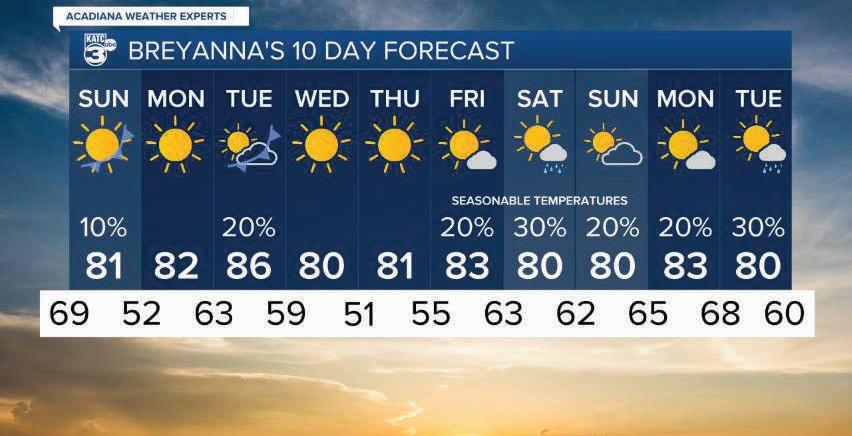




















































SPORTS
Mistakes doom Cajuns on homecoming
Golden Eagles capitalize on enough to ease by UL
BY KEVIN FOOTE Staff writer
There was amountain of missed opportunities for the UL Ragin’Cajuns in a22-10 loss to Southern Mississippi on Saturdayat Our Lady of Lourdes Stadium. Thehomecoming loss continued theCajuns’ longtime struggles against the Golden Eagles, whonow lead theall-time series4312-1. The Cajuns fell to 2-5 overalland 1-2 in Sun Belt play whileSouthern Miss remains tied for first place in the Sun BeltWest at 5-2 and 3-0
LSU‘D’ has no answer forPavia, ‘Dores
Vanderbilt QB rushed forgame-high86yards
BY KOKI RILEY Staff writer
NASHVILLE, Tenn. LSU relied on its defense through its first six games.
Coach Brian Kelly saidasmuch, asits offense struggled to score points andthe defense continued to clampdown on thelikes of Clemson, South Carolina andFlorida. But on Saturday at First Bank Stadium againstVanderbilt, theLSU defense couldn’tget astop. The Commodoresdidn’t have to punt until the fourth quarter,accumulating 399yards andaveraging 5 6 yards per rush when adjusted for lost sack yardage.
The offensive onslaught resulted in a3124 win for the Commodores,raising more questionsabout Kellyasthe Tigers’next two opponents, Texas A&Mand Alabama, sit in the top 10 of the AP poll.
“When you play ateamlikethat,that’s going to take care of the football, is going to eat clock and limit yourpossessions, you equally have to play to thatlevel,”Kelly said. “And we just did not. They were the better team today.”
Trailing by seven,LSU had achance to tie the score with less than five minutesto play,but senior wide receiver Barion Brown dropped apotential first-down throw from fifth-year senior quarterback Garrett Nussmeier on third and 8, forcing the Tigers to punt with two timeouts and lessthan four minutes to play Brown’smistake proved to be lethal as a43-yard carry from Makhilyn Young on Vanderbilt’sfirst play of the ensuing drive essentiallyclinchedthe victory. TheCommodores gained one more first down touse up LSU’sremaining timeouts beforekneelingout the rest of the clock.
“We’re just not on thesame page, and it’s frustrating,” Nussmeier said. “Wejustgot to be better as aunit. Youknow,it’snot on any individual,it’saunit as awhole.
ä See LSU, page 3C

From missed field goals to fumbles at the 1tosquandered turnover opportunities, the Cajuns botched numerous chances to control thegameorregain momentum.
UL quarterback Lunch Winfield finished 12-of-21 passing for 112 yards with an interceptionand no touchdowns. He rushed for 102 yardsand atouchdown on 18 carries.
TheCajuns rushed for217 yardsinthe loss. Bill Davis rushed for 66 yards on 14 carries while Zylan Perry added55yards on 13 attempts. SouthernMissquarterback BraylonBraxtonthrew for 230 yards on 12-of-17 passing with onetouchdown andaninterception Wide receiver Micah Davis had threecatches for 134 yards and ascore.
ä See CAJUNS, page 8C

UL safety Tyree Skipper celebrates an interception with his teammates during a game against Southern Miss on Saturday.UL lost 22-10. STAFFPHOTO By BRAD KEMP


ChicagoBears defensivecoordinator Dennis Allen looks on from the sideline during the first halfofapreseason game against the Miami Dolphins on Aug. 10 in Chicago. AP FILEPHOTO By KAMIL KRZACZyNSKI
LAKE FOREST,Ill. D’Marco Jackson hasbeen in these meetings. The Chicago Bears linebacker knows what to expect. The popquizzes. Thepush to make sure players are paying attention. You’d better be locked in, because thequestionsflyatany moment.
Jackson understands theway Dennis Allen operates.
“It just makes youlikea kidinclass, like‘Oh,isheabout to call on you?’ ”Jacksonsaid. “You ready? You’ve gottoanswerthe question.”
“DA, he’ssuper intense. ... DA doesn’ttakeno excuses, no apologies.” NAHSHON WRIGHT,Chicagocornerback, on defensivecoordinator DennisAllen ä See SAINTS, page 5C
that AmazonPrimeanalyst Richard Shermanremarked that the black and gold played like it wantedits coach fired. Denver Broncos coach Sean Paytonhad humiliatedhis successor in prime time,and Allen’s tenure never recovered.Hewas dismissed twoweeks later,once the Saints’ losing streak hit seven. Contrast that with this Sunday, when Allen prepares to face his
AP PHOTO By GEORGE WALKER IV Vanderbilt quarterback DiegoPavia runs for a first down
1
Georgia rallies late to beat Ole Miss
BY CHARLES ODUM AP sportswriter
ATHENS, Ga. — Gunner Stockton passed for 289 yards and four touchdowns, including three to tight end Lawson Luckie, and No. 9 Georgia overcame Trinidad Chambliss and No 5 Ole Miss’ powerful offense to rally for a 43-35 win over the Rebels on Saturday Georgia (6-1, 4-1 Southeastern Conference) rallied after trailing 35-26 at the start of the fourth quarter Stockton’s 7-yard touchdown pass to Luckie with 7:29 remaining gave Georgia a 40-35 lead. Ole Miss (6-1, 3-1) was denied its first road win over a top 10 team under coach Lane Kiffin even though the Rebels scored touchdowns on their first five possessions.
Stockton completed 26 of 31 passes and added a 22-yard scoring run in the crucial SEC showdown.
“It was a great day,” Stockton said. “We just played for each other and that’s the best part of our team.”
Stockton and the Bulldogs had no turnovers.
In previewing the game, Ole Miss coach Lane Kiffin said winning at Georgia would mean the Rebels have taken “another step” in their move up the SEC. That looked likely when they scored touchdowns on each of their first five possessions, taking a nine-point lead in the third

Georgia quarterback Gunner
quarter
Suddenly, the Ole Miss offense lost its magic as Georgia did not give up another first down.
Following the first punt of the game by either team with 12:44
throws a pass
remaining, Stockton led a nineplay, 67-yard drive capped by the 7-yard scoring pass to Luckie that gave the Bulldogs their first lead of the second half. Following another stop by
Georgia’s defense, Stockton led a 10-play drive to set up Peyton Woodring’s third field goal of the game, a 42-yarder to stretch the lead to eight points with 2:06 remining.
Arizona State hands Texas Tech its first loss
By The Associated Press
TEMPE,Ariz.— Raleek Brown bulled in for a 1-yard touchdown with 34 seconds left and Arizona State rallied after blowing a 12-point, fourth-quarter lead to hand No. 7 Texas Tech its first loss of the season, 26-22 on Saturday
The Red Raiders (6-1, 3-1 Big 12) labored most of the afternoon without starting quarterback Behren Morton (knee), finishing with 276 total yards after averaging an FBS-best 558.8 through the first six games.
Will Hammond showed his mettle after failing to move Texas Tech’s offense through three quarters, orchestrating two late scoring drives. The freshman scored on a 1-yard run and, after Texas Tech’s defense held, found Reggie Virgil on a 12-yard touchdown pass. Hammond put the Red Raiders up 22-19 by running it in for the 2-point conversion — after a holding call on Arizona State on the first attempt — but left too much time on the clock.
The reigning Big 12 champion Sun Devils (5-2, 3-1) started the final drive from their 25 with two minutes left and quickly moved down the field. Sam Leavitt completed 5 of 7 passes for 61 yards on the drive and benefited from a pass interference call on Texas Tech’s Brice Pollack to set up Brown’s TD run.
The Red Raiders reached Arizona State’s 28 on its final drive, but Hammond’s desperation heave into the end zone was swatted down.
Texas Tech followed No 2 Miami, No. 5 Mississippi and No 10 LSU to become the fourth top-10 team to lose this weekend No. 12 GEORGIA TECH 27, DUKE 18: In Durham, North Carolina, safety Omar Daniels returned a fumble a school-record 95 yards for a touchdown and Georgia Tech pieced together enough lategame offense to beat Duke and continue its best start to a season in more than a halfcentury Haynes King threw for 205 yards and rushed for a gamehigh 120 yards, including a 28yard touchdown run with 2:10 left.

Arizona
Georgia Tech (7-0, 4-0 Atlantic Coast Conference) has won its first seven games for the first time since 1966 The last time the Yellow Jackets were 4-0 in ACC play came 27 years ago.
Duke (4-3, 3-1), bidding to hold first place midway through its conference schedule, had its three-game winning streak ended Darian Mensah was 32 for 44 passing for 373 yards and two touchdowns.
Duke was marred by red-zone mistakes — a fumble, a botched attempt on a field goal and a fourth-down penalty The Blue Devils covered 159 yards on their first two possessions combined and didn’t score. They held a 238110 advantage in total yards in the first half.
NO 14 OKLAHOMA 26, SOUTH CAROLINA
7: In Columbia, South Carolina, John Mateer threw for 150 yards and a touchdown and Oklahoma’s defense sacked South Carolina’s LaNorris Sellers six times in the Sooners’ bounce-back victory Oklahoma (6-1, 2-1 Southeastern Conference) saw its perfect start end last weekend with a 23-6 loss to Red River rival Texas The Sooners used a steady offense and a best-in-the-nation defense to get back on track against the Gamecocks (3-4, 1-4).
Sellers, a projected NFL first-
round draft pick, finished with 124 yards passing. As a parting shot, Oklahoma defensive tackle Markus Strong tackled tailback Matt Fuller in the end zone for a safety with about four minutes left.
Blaylock ran for 101 yards and Oklahoma kicker Tate Sandell matched his career long with a 55-yard field goal.
No. 3 INDIANA 38, MICHIGAN STATE 13: In Bloomington, Indiana, Fernando Mendoza completed 24 of 28 passes for 332 yards and four touchdowns and Indiana celebrated its highest ranking in program history with a rout of Michigan State. The Hoosiers (7-0, 4-0 Big Ten), who have won all but one game by double digits, kept pace with No. 1 Ohio State atop the conference standings with touchdowns on their first five possessions.
Mendoza threw a pair of TD passes to Elijah Sarratt, and also hit E.J. Williams Jr and Omar Cooper Jr for scores.
Sarratt’s first touchdown on a 24-yard play put Indiana ahead 14-10 in the second quarter Sarratt’s 27-yard TD reception gave the Hoosiers a 35-10 lead in the third quarter Cooper finished with eight receptions for 115 yards. Kaelon
Pels rookie Queen clear for basketball activities
The New Orleans Pelicans received some good news Saturday Rookie forward Derik Queen has been cleared to resume full basketball activities, the team announced. Queen was diagnosed with a torn scapholunate ligament in his left wrist after injuring it in a Summer League game in Las Vegas against the Portland Trail Blazers. He had surgery on July 18.
Queen, who played at Maryland, was selected with the No. 13 pick in this year’s draft after the Pelicans traded up 10 spots from the No. 23 position to select him. Pelicans coach Willie Green said Queen was a full participant in Saturday’s practice.
He recorded a double-double in the three Summer League games he played.
The Pelicans open the season Wednesday at the Memphis Grizzlies.
Top rebounder in NBA Sabonis to miss opener
Sacramento Kings big man
Domantas Sabonis will miss the start of the season with a hamstring injury
The Kings said Saturday that an MRI determined Sabonis has a Grade 1 strain. He will be re-evaluated in a week.
Sacramento opens the season Wednesday night at Phoenix and plays Utah in the home opener Friday night. Sabonis got hurt Wednesday in an exhibition game against the Clippers. He is the second starter lost to an injury in the preseason. Forward Keegan Murray had surgery on his left thumb and will be out for at least the first few weeks of the season. Sabonis has led the NBA in rebounding the past three seasons, scoring at least 19 points per game in each of those years.
Black added a 29-yard TD rush.
No. 1 OHIO STATE 34, WISCONSIN 0: In Madison, Wisconsin, Julian Sayin connected with Carnell Tate for two of his four touchdown passes, and Ohio State rolled to a victory over Wisconsin.
Ohio State (7-0, 4-0 Big Ten) has an average margin of 25.8 points during an 11-game win streak, which started with its four College Football Playoff victories during its run to the national title last season The Buckeyes have won their first seven games this season by an average margin of 30.6 points.
Sayin passed to Tate for a 34yard touchdown on Ohio State’s first drive and a 10-yard score with four seconds left in the opening period. Both touchdowns came in third-down situations.
This loss was painful for the Badgers in multiple respects, as injured running back Darrion Dupree missed the game and running back Dilin Jones left in the first half with an upper-body injury Fickell said after the game that outside linebacker Christian Alliegro broke his arm in the first half and kept playing.
UAB 31, No. 22 MEMPHIS 24: In Birmingham, Alabama, UAB upset Memphis in the debut of interim coach Alex Mortensen, the son of late ESPN reporter Chris Mortensen, after the Blazers fired Trent Dilfer a week earlier Memphis (6-1, 2-1 American Athletic Conference) reached the 1 twice in the final minute going for a tying touchdown, but two false starts and one delay-of-game penalty stalled the drive. Memphis threw an incomplete pass into the end zone on fourth-and-goal from the 11 UAB (3-4, 1-3) was powered by a new starting quarterback, Ryder Burton, who completed 20 of his 27 passes for 351 yards and three touchdowns. Iverson Hooks caught 11 passes for 172 yards and all three of Burton’s touchdown strikes. The Blazers also ran for over 200 yards against a FBS opponent for the first time since 2023.
Memphis is likely to fall out of the AP Top 25 and may find it challenging to return.
Big-toe injury sidelines Grizzlies guard Pippen Memphis Grizzlies guard Scotty Pippen Jr will have a procedure to fix an issue in his left big toe that will keep him out to start the season. The Grizzlies announced Saturday that a timeline for Pippen’s return will be provided after he has a sesamoidectomy to deal with what they called “ongoing discomfort.” Pippen is expected to make a full recovery Memphis hosts the New Orleans Pelicans on Wednesday night to open the season.
Pippen started his NBA career with the Los Angeles Lakers. He spent the past two seasons with the Grizzlies. He has played 100 games with Memphis and is averaging 10 points with 4.2 assists in his career
Warriors cut sharpshooter Curry, but not that one
The Golden State Warriors cut one of the NBA’s best marksmen, and superstar Steph Curry’s younger brother, in a widely expected move.
Golden State, which had signed Seth Curry as the 15th man on the roster during training camp, announced it had let him go on Saturday morning.
Per NBA finance expert Keith Smith of Spotrac, Seth Curry’s contract was an exhibit 9 deal, which did not count against the salary cap after training camp. Had the team kept him on the roster after 5 p.m. on Saturday, the Warriors would have been required to cut or trade a player to make room for him.
Kim’s late eagle ups her lead to 4 in LPGA event
HAENAM, South Korea Sei Young Kim’s eagle on the 17th hole helped increase her lead to four strokes going into the final round of the BMW Ladies Championship after shooting a 3-under 69 on Saturday Kim finished with a three-round total of 19-under 197, despite a bogey on the 18th.
Yealimi Noh (67) and Nasa Hataoka (69) were tied for second.
American Brooke Matthews, who had trailed Kim by a stroke after the second round, triplebogeyed the par-3 15th and fell six strokes behind Kim in a tie for fourth place after a 74.
This is the first of consecutive LPGA tournaments in South Korea, with the International Crown team event scheduled for next week.
ASSOCIATED PRESS PHOTO By COLIN HUBBARD
Stockton
against Ole Miss on Saturday in Athens, Ga.
ASSOCIATED PRESS PHOTO By RICK SCUTERI
State wide receiver Jaren Hamilton, right, runs with the ball away from Texas Tech defensive back Brenden Jordan, left, in the first half on Saturday in Tempe, Ariz.
VANDERBILT 31,LSU 24
TIGERS’LOSSINNASHVILLE
THE WEEKS NONFACTOR
1
Linebacker Whit Weeks is the heartofthe LSUdefense. Being without him Saturdaybecause of an ankle injury really showedfor the Tigers.Vanderbilt has awell-crafted offense led by the heartofits team, DiegoPavia.Againsthim, LSUfrequently lost containment and struggled toget off the field on third (and fourth) down.Vanderbilt ended up with399 totalyards and was acombined 8of16onthird and fourth downs.
BOXSCORE
2
HUSTLE BUT NO FLOW
LSU produced explosiveplays,notably a62-yard touchdown pass fromGarrett Nussmeier to Zavion Thomas, but it still typified the waythe offense struggles. Nussmeier just gotthe ball away underpressure, and Thomas had to breaktackles before outracingeveryonetothe end zone.The LSU offense has little flow to it, blamethat lies with offensivecoordinator JoeSloan and an offensive linethat hasnever found chemistry.
3
FINAL THOUGHTS
LSU’sinability to playcomplementaryfootball caught up withthe Tigers on Saturday,asitdid in theirloss at Ole Miss.The offense finally showedapulse,scoring more than 20 points against aPower Four team forthe first time, but the defense wasineffectivefor toomuch of this game. Now the Tigers face the likelyprospect of having to runthe table in their final five games to make theCollege Football Playoff.Two words: No way.
This defeat cuts abit deeper
NASHVILLE,Tenn. The LSU Tigers’ seasonended early in the fourth quarter here Saturday against Vanderbilt.
No, not actually Not mathematically
13-42, Richardson 3-22, Barnett 1-4, Newberry 2-3, (Team) 3-(minus 3). PASSING —LSU,Nussmeier19-28-0225. Vanderbilt,Pavia 14-22-0-160. RECEIVING —LSU,T.Green 5-74, Ba.Brown5-40, Z.Thomas 3-78, Johnson 2-2,A.Anderson 1-18, Parker 1-11, Durham 1-2, N.Anderson 1-0. Vanderbilt, Spence 5-56, Stowers 3-32, Sherrill 2-30, Alexander 2-16, Hoskins 1-16, Young 1-10 MISSED FIELD GOALS —LSU,Ramos 52. Defensiveleaders
Tackles LSU: A.J. Haulcy 9tackles, 4assists, 13 total; Davhon Keys 4-5-9; West Weeks 3-3-6;Tamarcus Cooley 4-1-5; Patrick Payton 3-1-4; Harold Perkins 2-2-4; Jack Pyburn 1-3-4; Ahmad Breaux 2-1-3; Mansoor Delane 1-2-3. VANDERBILT: Langston Patterson
5-0-5; CJ Heard2-2-4; Joshua Singh
2-2-4; Randon Fontenette3-0-3; Bryan Longwell 2-0-2;
LSU
Continued from page1C
LSU finished with 325 total yards, averaged 5.9 yards per rush attempt when adjusted for lost sack yardage and earned 6.6 yards per play.Sophomoretight end Trey’Dez Green flashed again with fivecatches for 74 yards and atouchdown But when the unit needed to mount acomeback in the fourth quarter, the Tigers scored just three points.
“Offensively,when we had an opportunity to score touchdowns, we had to take fieldgoals,” Kellysaid, “and that was the differencein thegame.”
Thestory of theday for LSUwas still its defense, at least for the first three quarters. LSU didn’tforce the Commodores to punt until the 8:55 mark in the fourth
At that point, the Tigers trailed 31-24, scoring afield goalontheir priorpossession thanks to a51-yard run by sophomore running back Caden Durham that set them up at the Vanderbilt 2. A1-yard run, afalse-start penalty,a1-yard loss on the ground and an incompletion on third down forced the shortfield goal.
“They did agood job with theircover zero package, and we had aplan,” Nussmeier said. “And, as Isaid, ourdetails justweren’t, they weren’tgood enough.” After the Vanderbilt punt, LSUhadachancetocapitalize butcouldn’t.A10-yardsackon first down halted apotential game-tyingdrive,handingthe ball back to Vanderbilt with 6:28 left to play The Commodorespunted on that ensuing drive as well


Butrealistically It ended when Caden Durhamgot caught from behind at the Vandy 2on theend of a51-yard run. Not to criticize Durham,but you wondered whether theTigerswould fail to punch it in from there.
They did. These wereLSU’s next five plays: Durham runfor 1yard, false start (byTrey’Dez Green, erasing atouchdown catch), no gain on adirect snap toJu’JuanJohnson, incomplete pass, 23-yard Damian Ramosfield goal.
That cut Vanderbilt’slead to 3124 with 11:39 left. That’s wherethe scoring would end, although only because the Commodorestook a kneethree straight times from the Tigers’ 1toburn the final two minutes off of the clock. Let that sink in for amoment. Vanderbilt —atraditionalSoutheastern Conference cellardweller, ateam that had beaten LSUonce in 15 tries since 1976 —could have beaten the Tigers by two touchdowns, if it wanted It wasthe smart play.Itwas the better play.Itwas theplayofa team that deserved the win and thechampagne toastofavictory formation. Itwas somethingthat never should happen between LSU
after adropped pass on third down wouldhave set them up in the redzonewithless than five minutes to play.
LSU couldn’ttakeadvantage of that stop either because of Brown’s drop.
“When our defense made a couple of stops, we couldn’t turn those into positive possessions,”Kelly said.“And obviously, thosetwo (late possessions) in particular But more importantly,it was (not) cashing in on first and goal from the1.Imean, you’ve gottoscore atouchdown there.”
LSU found itselfplaying catch-up formostof the day and was in trouble after Vanderbilt’s 10-play, 75-yard touchdown drive to open thesecondhalf. The score extended the Commodores’ lead to 24-13.
That’swhenNussmeier madeaplay. Facing immediatepressure on second and 10 at the LSU 38, he magically escaped pressure and flipped theballout to senior widereceiver Zavion Thomas, who broke threetackles and sprinted62yards down the sideline for atouchdown.
Thescore, which was followed by atwo-point conversion catch by Green,cut the LSU deficitto24-21 with 6:52 left in the thirdquarter.
It marked the first time LSUhad scored more than 20 pointsagainst aPower Four conference opponent this season. And Saturday wasn’ta badday for Nussmeier, who threw for 225 yards, completed 19 of 28 throws and had two touchdown passes.
“From an offensive standpoint, therewere somegood things there,” Kelly said. “But again, Ithink the thing that stands out is not scoring touchdowns when youhave

and Vanderbilt, no matter howgood the Commodores are.
“A disappointing day,”LSU coach BrianKelly said, “obviously.”
At least he has agrasp of the obvious. This is also obvious: The Tigers (5-2, 2-2 SEC) have five games remaining in the regular season, three against rankedteams (Texas A&M, at Alabama, at Oklahoma), one against an Arkansasteam armed with adangerous offense and one against presumed rent-awin Western Kentucky To aman after the game, the LSU players talked about how they have to be perfect the rest of the way. Howiftheydothattheycan still achieve the program’smanifest goal of reaching the 12-team College Football Playoff.
“We’ve gottogo1-0 everysingle week,” linebacker West Weeks said, “and if we do that, we’re going to be in the playoffs. We knowwhatwe have to do.Wehave to be perfect the rest of the season,and we still have all of ourgoalsinfront of us.”
an opportunity to.”
Trailing 14-10, LSUhad two chances to retake the lead before halftime.
Thefirst series resulted in a52-yard field goal attemptfrom fifth-year senior Damian Ramos that landed wide right,handing the ball to Vanderbilt with2:33left in the first half.
After fifth-year senior linebacker West Weeks’ sack forced aturnover on downs in Vanderbilt territory,LSU was held to just a field goal. The Tigers earned just one first down as Ramos knocked through a42-yard field goal to cutthe Vanderbilt lead to 14-13.
But Vanderbilt hadenough time after Ramos’ kickto march downthe field, with 39 seconds left, fora46-yard field goal that handed the Commodores a17-13 lead heading intohalftime.
Thefirst halfwas thebest opening half of football for theLSU offense. The Tigers accumulated 160 yards, Nussmeier was13of18for 118 yards through theair, and the run game averaged 4.1 yards per carrywhen adjusted for lost sack yardage.
But LSU still trailed because its defense struggled to contain Pavia. TheVanderbilt star quarterback completed 8of13throws for 124 yards while adding 37 yards on the ground in thefirst half. Paviafinishedwith a game-high86yards rushing. Play after play, he punished LSUwith his legs.
“Wefeel like we game-plan andknewwhathis abilities are, in termsofhis ability to scramble,”Kelly said. “We had people thatwere assigned for that, and we just didn’texecuteatthe highest level that we needed to againstareally good quarterback.”
Weeks has to say that. He andhis teammateshavetobelievethat. No one outside the LSU program should, though. What has LSU, with its $18 million roster and its $20 million coaching staff, showntoindicatethatitcan go 5-0 the rest of the way to getto 10-2, the presumed threshold for getting into the CFP? Nothing. Saturday’sdefeat was amicrocosm of the season in all of its frustrating, high-definition glory Onething getsbetterfor LSU and another goes bad.
Theoffense finallystarted a gamewith apulse, driving for a field goal that was the Tigers’ first opening-possession score this season. Vanderbilt countered with a touchdown, but LSU answered with a24-yard touchdown pass from NussmeiertoGreen to start the second quarter Forthe first time, the Tigers scored more than20points against aPower Four team. That’s notleaping over ahigh barwithMondo Duplantis-like aplomb, but it’s
something.
It wasn’tenough. Thedefense, the strengthofthis team most of the season, couldn’t getDiego Paviaand the Vanderbilt offense off the field in critical situations, alathe Tigers’ 24-19 loss at OleMiss. Slipping through their grasp time andagain like he was lightlybuttered, Paviahelped Vandy convert 8of16combined third- andfourth-down situations (LSU was 5of11).WithPavia’s wheelschurning, Vandy wound up with awhopping 239-100 edge on LSU in rushing. In the finalnine minutes, though, the Tigers finally stopped Vandy forcing two punts.Then, in true LSU whack-a-mole style,the offense couldn’tmovethe needle. When the Tigers puntedback to the Commodores with 3:12 left instead of goingfor it on fourth and8 from their 22, Vandy wasabletorun out the clock Taking. A. Knee. Three. Times. Thestory of this LSU season still is unfinished, but this feelslike a watershed defeat for the Kelly era. This was the season he andeveryoneatLSU pointedto. They have allthe players, the staff, the money, the facilities, the stadium and the tradition in place to vaultback into the nationalchampionship hunt for the first time since2019. Asidefrom beingdown afew keystarters Saturdaysuchas linebacker Whit Weeks, defensive tackle Bernard Gooden andmost of the game left tackle Tyree Adams, there were no excuses for the Tigers on Saturday(to Kelly’s credit he didnot trytomakeany). LSU hadthe more talentedroster Instead, the Tigers gotoutplayed andoutcoached Now,it’sdown to this.Perfection the rest of the way or else. CFP or bust.
Thesmart money is on bust.

LSU quarterback Garrett
Nussmeier,left, throws apass over Vanderbilt linebacker BryanLongwell during the first halfof theirgame on Saturday in Nashville,Tenn.
By



AP PHOTO
GEORGE WALKER IV
Scott Rabalais
ASSOCIATED PRESS PHOTOByGEORGE WALKER IV
LSU coach Brian Kelly yells to an official during the second halfagainst Vanderbilt on SaturdayinNashville, Tenn.
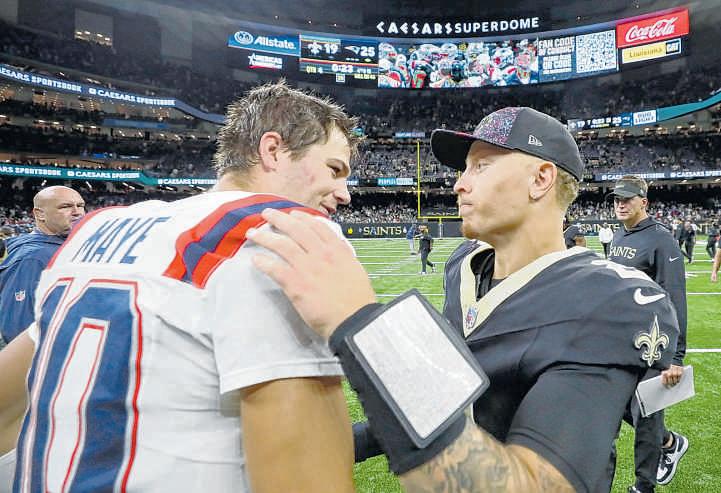
QB classof2024has aspecial look

famed 1983 (JohnElway,Jim Kelly,Dan Marino), 2004 (Eli Manning, Philip Rivers, Ben Roethlisberger) or 2018 (Josh Allen, Sam Darnold, Lamar Jackson, Baker Mayfield) classes. Butit’soff to a strong start Here’show I’d rank theClass of 2024 today, takinginto account how each quarterback has played so far and projectinghis potential:
1. DrakeMaye, Patriots
If we re-drafted the2024 NFL Draft,I believe Maye would be theNo. 1overall pick.Hehas improved dramatically since last season and has outperformed all of his peers this year.His passer efficiency rating (108.0), completion percentage (73.2%), touchdown-to-intercep-
rating on third down, and his 40.5% conversion rateisthird behind only Maye (45.7%) andPenix (45.5%).
Still, his 61.6% completion percentage is well below the league average.
7. J.J. McCarthy,Vikings
The former Michigan standout has had arough start to his NFLcareer.He missed his rookie season because of a knee injury and has been sidelined since Week 2with ahigh-ankle sprain in 2025. His twostarts this season were a mixed bag. He led the Vikings to abig comeback winonthe road against
4. Bo Nix, Broncos Nix’sraw numbers don’tmatch up with thetop three of this group except in one key area: wins. He’s 14-9 as astarter and led the Broncos to aplayoffberth for the first time in nine years as arookie. He still throws too manyinterceptions forSean Payton’sliking, but otherwise, he runs theoffense like aveteran and keeps theBroncos out of negative situations with his mobility,pre-snap reads and play under pressure. He leads thegroup with a95.5 passer led tarter and losses do matter
STAFF PHOTO By DAVID GRUNFELD
quarterback Spencer Rattler,right, and NewEngland Patriots quarterback DrakeMayemeet after the game at

KAMILKRZACZyNSKI
ASSOCIATEDPRESS FILE PHOTO By
ChicagoBears defensivecoordinator Dennis Allen walks on the sideline during the second half of a preseason game againstthe Buffalo Bills on Aug. 17 in Chicago.
SAINTS
Continued from page1C
former team afterthe Bearsrecorded their biggest win of the season. Allen may no longer be ahead coach, but his unit came up big in the Monday night victory over the Washington Commanders. The Bears forcedthree takeaways to extend their season totalto12, the second-most in the NFL.
If Allen holds any grudge towardthe Saints for his firing, he won’tsay so publicly.Sure,he did not even get afull three years at thehelm, going18-25,but Allen will note that 15 of his24 seasons as acoach in the NFL came in NewOrleans. He has too many memories not to think fondly of the place.
Left unsaid is his current roleasacoordinator might be better suited for him than hislast job. Not that Allen has any interest in reflecting on his time leading the Saints
“Yeah, look, Iappreciatethe question,” Allen said with asmile when asked what ultimately went wrong in New Orleans. “I don’t think I’m going to go there. Let’sjustfocusonwhatwe’ve got going on now.”
‘Hewas just DA’
Saints cornerback Rejzohn Wright calls his brother every day So when he found out that Nahshon was joining the Bears and the cornerback would be coached by Allen, Rejzohn wanted to share as much as he could. He toldhis brother to be ready to play physically,practice hard and “be up in people’sface.”
The detailscould go only so far.
“He found out quickly how DA is,” Rejzohn said.
“DA doesn’ttake no excuses, no apologies,” Nahshon said Standing in the Bears’locker room, Nahshon gushed about many of Allen’ssame qualities that Rejzohn did days earlier in abuilding almost 1,000 miles away.The brotherssee Allen as an aggressive coach who instills confidence and holds players accountable to the standard heexpects. For Rejzohn, that meant believing in him as an undrafted free agent after stintswith two other teams. For Nahshon, that means appreciating howdemanding Allen can be.
lack of success as ahead coach in New Orleans?
Asked this, Yiadom said he didn’tthink so,because everycoach has his own way of coaching.
Some coachesdon’t have much to sayoutside of the work itself, he said.
In any event, theBears are glad to have him
“He’sbeen agodsend to me,” said Bearshead coach Ben Johnson, afirst-time head coach, “because he’sbeen incredible, not just from coordinating the defense, but he’shelpedme every step of the way as well.
“So, very gratefulfor himtobehereand everything that he’sdonefor this team up to date. He’sbeen avery successful coach in this league for along time.”
Familiar challenges
When Sewell watches his brother playfor the Bears, he recognizes what thedefense’scall is based on whether the linebacker raiseshis right or left hand.
Saintshead coach Kellen Mooresaid this week that Allen has added new wrinkles to his scheme, as you’d expect coaches todofrom year to year.But at itscore, the Bearsdefense is what New Orleans deployed for almost 10 years. Press man coverage. Defensive ends crashing down hard. Exotic pre-snap disguises with plenty of different fronts.
For the Bears, Year 1ofAllen’ssystem is very much awork in progress.
“My brother won’tbuy in —hedon’twant to be physical,” Rejzohn Wright said withalaugh. “That’s why we’regoing to beat theBears.”
He’s been a godsend to me, because he’sbeen incredible,not just from coordinating the defense, but he’shelped me everystepofthe wayaswell.”
BEN JOHNSON, Bears coach, on defensivecoordinator Dennis Allen
The Wrights aren’tthe only pair of brothers Allen has coached between New Orleans and Chicago.Saints linebacker Nephi Sewell gave his brother Noah Sewell plenty of pointers about playing linebacker under Allen
Asked about the connections, Allen said he hadn’tgiven the topic much thought.But in a way,that makes sense. Allen has spent the last few months installing his schemeand finding ways to matchthat to his players’ skills.
That’show Allen coaches. Sometimes, figuringout the personnel takes precedence over the personal.
“Shockingly,Iain’thave much of arelationship with him,” Saints cornerback Isaac Yiadom said. “I’m not going to lie. We didn’t share many words. Ijust played in thesystem. He was my head coach.” As he finished his sentence, Yiadom turned to teammate Jordan Howden
“You ever talk to DA, really?” he asked.
“He wasn’tatalker,” Howden said.
“Yeah,” Yiadom said. “I don’tknowifanybody Idon’tknow.He was justDA.”
That’snot to say Allen failed to form aconnection with any of his players. Saintsdefensive end Cam Jordan said Allen is always “going to be one of my guys,” while linebacker Demario Davis said he “definitely enjoyedmy time” with the coach. Those are two prominent leaders. And even lesser-knownplayers such as NephiSewelland Rejzohn Wright said they’vehad an opportunity to catch upwithAllensincehis departure. Rejzohn chattedwith Allen briefly when he was in an elevator with Nahshon as the brothers were on the phoneafew weeks ago. But it does raise afascinating question: Did the approach have anythingtodowith Allen’s
Playful trash-talking aside, theChicago defensehas struggled in ways that are familiar to anyone who watched the Saints over thelastfew seasons. The Bears have struggled to stop therun, allowing the secondmost rushing yards pergame at 156.4. Chicago allows explosivesatthe seventh-highest rate. Opponents have scored the sixth-most pointsper game and gained theseventh-most yards.
Butremember,ittook time forAllen’s units to coalesce in New Orleans —even when he was asuccessful coordinator.
And the Bears have started to makesteadyprogress. For one, they’ve gotten healthier,with veterans T.J. Edwards and KylerGordon returning to thelineup. And against the Commanders, ChicagoheldWashington’s well-refined rushing attack to 4 yards per carry and forced two fumbles.
“Even though we aregetting takeaways every single week, Ifeel like we’re getting betteratsomething newevery single week,”Bears defensive end Montez Sweat said. “We’re adding anew play every week or anew scheme.
“It almost seems like the defense is neverending, almost.”
That’s Allen. Sweat said he’s talkedwith Saints defensive end Chase Young, his former teammate in Washington,about thecomplexities of Allen’sfronts for thedefensiveline. As an edge rusher,Sweat hasfound he’s “definitely got to be more disciplined” and create apassrush plan within the scheme.
“I likehim,” SweatsaidofAllen.“He brings avery different style of defense to the game.”
At Halas Hall on Thursday,there was abrief moment when Allen sounded like theSaints coach once again. He talked about the strength of theNew Orleansoffensive line, as well as Spencer Rattler’s mobility.Hepraised wide receiver Chris Olave’s“exceptional routes” and raved about Rashid Shaheed’sprogress.
Buthesaid these things while wearing a Bears shirtand aBears visor in frontofaBears backdrop Allen made clear that he watched theSaints offense. Butout of curiosity, did he turn on the tapeofhis old defense at all?
“No,” Allen said.
Theformer Saints coach smiled again and thenwalked off the podium. There was another practice to get ready for,inanother city that’s now his home.
Email Matthew Paras at matt.paras@theadvocate.com


Saints Bears
TEAM STATS

STAFF PREDICTIONS
JEFF DUNCAN
BEARS24, SAINTS 16: TheBears have wonthree gamesina rowand areplaying with confidence. The Saints arestill in search of their first road win. If theSaintscan seize an earlylead, they mightbeable to dictateterms andsteal thewin Butit’shardtoenvisionit, giventhe Saints’penchanttostart slow
LUKE JOHNSON
SAINTS 27,BEARS 23: This is agut feeling. NewOrleans hasbeenohso-close to knocking offseveral big favoritesthisseason, andthe Bears’ record hasbeeninflated by their hard-to-repeatturnoverluck. As long as theSaintscontinuetakingcareof theball, this feelslikeanopportunity to stealawin
MATTHEWPARAS
SAINTS 26,BEARS 20: Ignore the Dennis Allenangle fora second Hisdefense with theBears isn’tthe sole reason I’mpicking theSaints to prevail. It boilsdowntothis: As an Illinois native,I’vewatched the Bearsfor most of my life.And this is thetypeofgamethattheylosequite often. Simpleasthat.
RODWALKER
SAINTS 20,BEARS 17: If theSaints don’t winthisone,theymay have to wait awhile to getanother.The Buccaneers andRamsare up next youbestbelieve Dennis Allenwill have theBears defenseready,but the Saints should be able to runthe ball
Ke’von Johnson, Northwest Johnson had been out injured since Week 2, and the Raiders’ big-play back made his presence known in a big way in Northwest’s upset win over Church Point. Johnson ran for 229 yards and three touchdowns on 26 carries.
Cole Bergeron, St Thomas More
PREP REWIND
After a slow start, the Cougars quarterback caught fire and never let up in a blowout win. He was 21of-33 passing for 293 yards and five touchdowns in a 63-10 win over Comeaux
FIVE STARS OF THE NIGHT
Wyatt Dubois, St. Edmund It wasn’t the conventional big game, but Dubois was instrumental in the Blue Jays’ 58-36 win over Sacred Heart. Dubois ran the ball nine times for 92 yards and three touchdowns, ran in four two-point conversions and returned a kickoff 70 yards for another touchdown.
GAME OF THE WEEK
Jarrison Reese, Church Point It doesn’t happen often, but the Bears’ versatile threat was too good to overlook. First, Reese ran the ball five times for 69 yards and a touchdown, then he caught 10 passes for 244 yards and three touchdowns in the 43-33 loss to Northwest.
Stephen George, Westminster The Crusaders quarterback completed 15 of 22 passes for 232 yards and a touchdown and also ran it nine times for 83 yards and two more touchdowns in a win over Port Barre to stay undefeated.
LCA too powerful for Notre Dame
Walker throws 3 TD passes; Bellard runs for 3 TDs in win
BY BRANDON COMEAUX
Contributing writer
The Lafayette Christian Academy Knights continued their “revenge tour” with yet another victory on Friday night, this time against district foe Notre Dame in a battle of the top two teams in District 6-2A and the Division III select class.
At this point last season, LCA was 2-5 with losses to Rummel, Westgate, Shaw, Central and Notre Dame.
But after Friday’s 41-7 victory over Notre Dame, the Knights have now avenged four of those five losses and sit at 6-1 overall and 2-0 in district play
“LCA is playing very well now,” Notre Dame coach Lewis Cook said. “We just got outplayed. Our effort was really good and our kids played hard, but we had too many penalties and mistakes and we didn’t play particularly well.”
The Pioneers had eight penalties in the first half and two costly special-teams mistakes that led to short fields and two touchdowns for the Knights.
The Knights started the game by taking the opening drive down the field as senior quarterback and Ragin’ Cajuns commitment Braylon Walker used his legs and his arm to befuddle the Pioneers defense, capping off the drive with an 11yard touchdown pass to senior wide receiver Jace Babineaux
“Our kids executed at a high level and played with tremendous energy from start to finish,” LCA coach Matt Standiford said. “We needed to start fast, and that’s exactly what we did.” Walker threw three touchdown passes, finishing with 173 yards on 9-of-17 passing while rushing for another 29 yards.
“They were running a lot of zone, and I noticed a lot of busted coverages,” Walker said. “We can do a lot of different things on offense with motions and being able to run and throw the ball. That balance helped my receivers get some great matchups.”
One of those great matchups
St.
BY KEVIN FOOTE Staff writer
In some ways, St. Thomas More’s 63-10 victory over Comeaux on Friday at Cougar Stadium was somewhat like the season overall. There were some early stumbling blocks such as the Cougars’ 0-2 start to the season — but once STM got going, it picked up steam in a hurry
“Yes, I’m really pleased,” STM coach Jim Hightower said. “The defense did a nice job with several turnovers and the kicking game was really good. It was excellent to see us putting the kickoffs in the end zone that many times. We’ve not done that before.”
The Cougars opened up the scoring on the third play of the game when Cole Bergeron connected with Blake Caillet on a 32-yard touchdown strike. The next two drives though, stalled prematurely in the form of two turnovers on downs.
“On offense, it’s 11 men,” wide receiver Christian Breaux said. “If one person

featured Oklahoma commit and senior wide receiver Brayden Allen, who had 45 receiving yards and two touchdown catches.
“Being able to contribute with two touchdowns against this team and that defense (Notre Dame) means a lot,” said Allen, who cited lessons he learned from competing against the Pios twice last season. “When the defender decided to press me (on his second touchdown catch), me and my quarterback just looked at each other, and we knew the route I needed to run and he got it to me.” Walker spread the ball to multiple receivers. In addition to his three touchdown passes, Walker
doesn’t do their job, then it’s not going to work, but we got it together — all of us together, and we were able to get the ball down the field.”
Indeed, and the Bergeronto-Breaux connection led the way Next, Bergeron hit Caillet on another 32-yarder to set up Carter Melancon’s 5-yard touchdown run. Then Breaux caught a 52-yard touchdown pass for a 21-7 lead with 7:58 left in the second quarter
“We’ve been working,” Breaux said. “All season, we’ve been working with that, and it’s good when it comes together
“We’ve been clicking all week We had four great days, and they came together on the field.” Breaux made the score 2810 with a 5-yard scoring reception in the corner of the end zone. Breaux finished with eight receptions for 135 yards and three TDs.
“I think we struggled a little bit Week 1, but then after that, I think we’ve been in an upper trajectory week after week,” Breaux said. “Our coaches keep saying, ‘Trust
found junior wide receiver Kaden Ledet multiple times as Ledet led the team with 72 receiving yards.
“Coach always says, ‘When your times comes up, make something happen,’ ” said Ledet when asked about being a part of an offense that features numerous weapons “I’ve been able to do that these last few games.”
Sophomore running back Caiden Bellard was another huge weapon for the Knights as he finished with 109 rushing yards and three touchdowns on 20 carries, as well as a big 19-yard catch.
His first touchdown put LCA up 13-0 in the first quarter His second gave the Knights a 20-point lead,
and his third put the exclamation point on the win.
“Last week, going into the game (against Lafayette Renaissance), a lot of people were talking about how they (LRCA) were going to stop the run, and I let that get to me and I had a bad game,” said Bellard, who rushed for one touchdown and a season-low 28 yards last week. “Coming into this game, I talked to my O-line and I said, ‘Let’s come back focused.’ My Oline blocked and I saw the holes. We got the job done.”
Speaking of getting the job done, the Knights defense shut down a Notre Dame offense that was averaging over 35 points per game.
“That’s phenomenal performances by our defense in back-to-back games,” Standiford said.
Leading the way for the Knights was senior linebacker Jamaison Marzell, who had 13 tackles and a sack.
“We expected to win tonight,” said Marzell.
Senior safety Luke Green also had a big night, finishing with 10 tackles, two forced fumbles and a sack.
“Notre Dame has a great squad, but we were able to key in on a couple of guys to hold them at bay,” Standiford said. “The linemen on offense and defense played extremely well. We were clicking.”

the process and keep working hard every day.’ ” In the middle of that Cougar production, the visiting Spartans completed a 41-
yard pass to Khali Johnson to set up Jaden Celestine’s 19yard touchdown run to trim STM’s lead to 14-7 with 9:07 left in the second quarter
Celestine then caught a 64-yard pass from Sean Brinkhaus to set up Caden Reeser’s 35-yard field goal.
But after that, STM’s defense suffocated the Spartans. Walker Pugh’s interception right before the half set up Bergeron’s 13-yard TD pass to Breaux.
“He’s becoming so consistent,” Hightower said of Breaux.
“He’s a big target, and he knows how to use his body well. His catching window has just gotten bigger and bigger.”
Then Landen Ortte returned an interception 57 yards for a touchdown to make it 56-10.
Tommy Breaux’s interception paved the way for reserve quarterback Eli Clark’s 5-yard scoring run. Earlier in the second half Jack Longman ran in from 18 yards out to cap a 14-play, 97-yard drive in 5:29 to make it 49-10. After some incompletions early on, Bergeron caught fire the rest of the way to finish 21-of-33 passing for 293 yards and five touchdowns.
“We worked every day,
and we can see it every week we get better and better, we keep building on that,” Christian Breaux said. STM’s rushing attack settled for 106 yards in the win.
“We’ve had some injuries,” Hightower said of the running game. “It was good to get Carter Melancon back. He did a good job, and Owen Bailey has developed over the past two or three weeks. So really, I think the running game is headed in the right direction.”
The Cougars have now won five straight games since starting 0-2. How close are they to getting to the level necessary for a deep playoff run?
“That’s a good question,” Hightower said. “We’re going to find out in a couple of weeks (vs. Teurlings), but we’re definitely moving in the right direction.
“We had a great week of practice, the whole week. The kids were really tuned in. If we can continue that, we’re going to get to where we have to be.”
Email Kevin Foote at kfoote@theadvocate.com.
STAFF PHOTO By BRAD BOWIE
Lafayette Christian wide receiver Brayden Allen, right, runs with the ball against Notre Dame on Friday at Gardiner Memorial Stadium in Crowley
STAFF FILE PHOTO By BRAD KEMP
St. Thomas More quarterback Cole Bergeron threw for 293 yards and five touchdowns in the Cougars’ 63-10 win over Comeaux on Friday.
PREP REWIND

Acadiana rolls Lafayette
Wreckin’ Rams extend winning streak over rival to 19 games
BY NICK FONTENOT
Contributing writer
The 42-21 final score in Acadiana High’s 19th consecutive victory over Lafayette High on Friday doesn’t tell the full story
With 10:48 left in the fourth quarter, the Wreckin’ Rams were clinging to a 28-21 lead, and Lafayette had momentum. That’s when Acadiana turned to Syrian Joseph, and he provided the spark Joseph broke free for a 51-yard touchdown to stretch the lead to two scores. After the Rams defense came up with a stop, Joseph struck again, this time from 26 yards out. In less than two minutes, Acadiana slammed the door on the hopeful Mighty Lions’ effort.
“Sy wants the ball,” Acadiana coach Doug Dotson said “I still look at him like he’s developing, but he’s really coming into his own as a running back in our offense. He’s constantly asking for
the ball in big moments, and it’s fun to see how often he comes through. He’s the fastest player on the field and has become a big part of what we do.”
With senior Troy Kennerson battling injuries this season, Joseph made the move from wide receiver to running back and he has flourished. Joseph said he doesn’t overthink the big moment and on his fourth-quarter touchdowns, he knew the Lions couldn’t stop him.
“I don’t really worry about the score,” Joseph said. “I block the noise out, go out there and play Once I broke through, I knew nobody was catching me.”
The Lions capitalized on a handful of Acadiana miscues to keep things close. A first-quarter fumble inside the red zone turned into an 80-yard scoop and score by Parker Abshire.
Later, a 68-yard touchdown pass from Richmond Saunier to Jamieon Brown came after two Acadiana defenders collided. A bad snap over the punter’s head set up another Lafayette touchdown.
Dotson said Lafayette’s defensive plan kept the Lions in it, but he made clear those breakdowns
won’t fly moving forward.
“We’ve had several moments this year where we could’ve taken control, and a mistake let a team hang around,” Dotson said.
“Lafayette played hard and had a good defensive game plan. We were without Collin (DiBetta), so they were able to double Travis (Gallien), which took away a certain dynamic in our offense.
“When that happens, we’ve got to exploit where they’re short. We scored 42 points, but we’ve got to be sharper and cleaner if we want to win these next ones.”
Dotson didn’t label Friday a “trap game,” but he acknowledged his team’s focus is already shifting to Southside.
The 6-1 Sharks are undefeated in district play, and Acadiana will travel to Youngsville next Friday for what’s shaping up to be one of the district’s most physical matchups.
“They’re going to match our physicality,” Dotson said. “It’ll be a hostile environment, and they’re trying to build something over there. Their coaches have done a great job. We’ve got a target on our back, and we have to be ready.”
SUMMARIES
Ascension Episcopal’s ground game pounds
Vermilion Catholic
BY STEVE PELOQUIN
Contributing writer
Ascension Episcopal has a pretty simple recipe for success: play physical, run-oriented football while minimizing turnovers.
The Blue Gators (7-0 overall, 2-0 District 5-1A) played their brand of football on Friday, running for over 250 yards while forcing a turnover for a defensive score to defeat Vermilion Catholic 35-14 in a district contest.
“We talked all week long about being physical and protecting the football, and we’ve really done that all year long,” Ascension Episcopal coach Jay Domengeaux said. “The guys really enjoy that brand of football, and I’m very proud of the way they played tonight, and the way they’ve played all year.”
Ascension Episcopal scored first at the 2:21 mark of the first quarter when quarterback Branon Mitchell scored on a 1-yard plunge.
The Blue Gators defense came up big on VC’s next possession when Sport Gros picked off an errant pass and brought it back 25 yards for a touchdown to make the score 14-0.
“When you get a pick-six or a turnover that you get points out of, that’s the equivalent of specialteams points,” Domengeaux said. “When you block a punt for a score or return a kick for a touchdown or get a pick-six... that puts the other team on their heels and always seems to make a difference in a big game, and that play really gave us a big boost.”
Ascension Episcopal made it 21 unanswered points at the 4:38 mark of the second quarter when Owen LeBlanc scored on a 5-yard run to extend the lead to 21-0.
Vermilion Catholic (2-5, 1-1) scored its first points with only 50 seconds remaining in the first half when William Simon scored on a 1-yard run for the 21-7 halftime score.
The Eagles had an opportunity to make it a one-score game but turned the ball over on downs after
driving into the Ascension Episcopal red zone on the first possession of the second half.
“Well, that was huge, because we talked at halftime about how important it was to get a stop right there,” Domengeaux said. “Kudos to them (Vermilion Catholic) for driving down the field on us, but I was really proud of our defense for stiffening up, keeping them out of the end zone and getting the ball back for us.”
“I told our kids that is what good teams do, and they’re (Ascension Episcopal) a good team,” Vermilion Catholic coach Broc Prejean said. “When you start knocking on the door, a good team makes sure that it stays closed, and Ascension did a great job of that tonight.”
The Blue Gators scored the first points of the second half at the 2:42 mark of the third quarter when Mitchell scored on his second touchdown run of the game this one a 41-yard run — to make it 28-7.
“Branon brings a little versatility,” Domengeaux said. “He can run for a little bit of power when you need it, he can run for a big gamebreaker, and he can also throw the ball down the field, which is probably something we need to connect on a little bit better in the future.” VC, refusing to give up, got closer at the 10:41 mark of the final quarter when Simon scored on a 13-yard run, which trimmed the deficit to 28-14.
Ascension Episcopal put the game away at the 6:05 mark of the fourth quarter when Mitchell connected with Preston Peebles on a 26-yard scoring pass, giving the Blue Gators a 35-14 advantage. “VC is a quality team, which means this is a real quality win for us,” said Domengeaux. “I like when we take care of the football. There have been a couple of times when we’ve been a little risky with it, but when we take care of the football, we execute pretty well. So, I was happy about that, I was happy about the run game, how we handled the line of scrimmage, and how we played defense.”
2-1 Penalties-yards 6-45 6-60 SCORINGSUMMARY LafayetteChristian 13 14 7 7 —41 NotreDame 0 7 0 0 —7 LCA — Jace Babineaux 11 pass from Braylon Walker (Run failed) LCA — Caiden Bellard 4
Penalties-yards 5-30 9-100
SCORINGSUMMARY Sulphur 7 7 0 3 —17 Southside 22 27 14 0 —63 SSIDE — Jovan Joya 1 run (Grant Barras kick)
SUL — Jordan Jardneaux 74 kickoff return (Ethan Stephenson kick)
SSIDE — Kollen Francois 44 run (Barras kick)
SSIDE — Francois 2 run (McCain Weaver pass from Parker Dies)
SSIDE — Francois 64 run (Barras kick) SSIDE — Cameron Allen 74 punt return (Barras kick) SUL — Dalton Shirley 14 run (Stephenson kick)
SSIDE — Ashton Labit 8 pass from Dies (Barras kick) SSIDE — Dies 32 run (kick blocked) SSIDE — Dies 40 run (Barras kick) SSIDE — Coby Broussard 37 run (Barras kick)
SUL — Stephenson 32 FG St. Edmund 58, Sacred Heart 36 Team St.Edmund SH First Downs 22 19 Yards Rushing 283 201 Yards Passing 134 208 Passes (C-A-HI) 6-14-0 11-24-1 Punts-avg 1-42 4-36.8 Fumbles-lost 1-1 1-0 Penalties-yards 6-53 9-94 SCORINGSUMMARY
St.Edmund 14 22 6 16 58 SacredHeart 14 7 7 8 —36
STE — Wyatt Dubois 53 run (run failed)
SH — Jax Fontenot 63 pass from Ellis Fusilier (William Chapman kick)
SH — Gavin Patin 4 run (Chapman kick) STE — Dubois 70 kickoff return (Dubois run) STE — Dubois 1 run (run failed)
SH — Seth Guillory 14 pass from Fusilier (Chapman kick)
STE — Dubois 4 run (Dubois run)
STE — Hudson Simon 24 pass from Nathan Zaunbrecher (Dubois run)
SH — Patin 1 run (Chapman kick)
STE — Nathan Driggs 13 run (run failed) STE — Simon 18 pass from Zaunbrecher (Dubois run) SH — Patin 57 run (pass failed) STE — Driggs 10 run (Cooper Berzas pass from Zaunbrecher) SH — Safety St. Thomas More 63, Comeaux 10 Team Comeaux STM First Downs 10 24 Yards Rushing 122 106 Yards Passing 134 293 Passes (C-A-HI) 7-16-3 21-33-0 Punts-avg 4-29.5 0-0 Fumbles-lost 1-0 0-0 Penalties-yards
Northwest 43, Church Point 33 Team ChurchPoint NW First Downs 23 14 Yards Rushing 208 237 Yards Passing 327 102 Passes (C-A-HI) 13-23-1 5-13-2
Punts-avg 2-30 2-28
Fumbles-lost 0-0 0-0 Penalties-yards 4-18 3-17 SCORINGSUMMARY ChurchPoint 20 0 6 7 33 Northwest 7 7 15 14 —43 CP — Jarrison Reese 10 run (Seth Alleman kick) NWEST — Ke’von Johnson 62 run (Gavin Fontenot kick)
CP — Reese 66 pass from Luke Baudoin (Alleman kick) CP — Reese 36 pass from Baudoin (kick failed) NWEST — Courtlon Young 24 pass from Chaise Dupre (Fontenot kick) NWEST — Dupre 14 pass from Justin Chavis (Fontenot kick) CP — Chad Brooks 7 run (run failed) NWEST — Jayden Lazard kickoff return (conversion good) NWEST — Johnson 2 run (Fontenot kick) CP — Reese 72 pass from Baudoin (Alleman kick) NWEST — Johnson 12 run (Fontenot kick) Teurlings 49, North Vermilion 0 Team NV Teurlings First Downs 6 20 Yards Rushing 38 195 Yards Passing 38 292 Passes (C-A-HI) 9-19-0 10-12-0
5 run (Dills kick)
PHOTO By ROBIN MAy
Acadiana running back Syrian Joseph breaks loose for a big gain during a win over Lafayette on Friday.
Ohtani puts on two-way show for ages
BY GREG BEACHAM AP sportswriter
LOS ANGELES When Shohei Ohtani’s third home run rocketed off his bat and streaked toward the left-field bleachers, the few fans still sitting at Dodger Stadium rose frantically, as if every single seat in the sold-out building had received a shock.
At the plate and on the mound, Ohtani was simply electrifying in Game 4 of the National League Championship Series while he conjured one of the greatest single-game performances in baseball history — perhaps even all of sports.
The Los Angeles Dodgers’ twoway superstar delivered the 13th three-homer game in postseason annals Friday night, connecting in the first, fourth and seventh innings for three epic solo shots traveling a combined 1,342 feet He was similarly brilliant on the mound, throwing scoreless, twohit ball into the seventh inning with 10 strikeouts and a masterful variety in his 100 pitches.
Ohtani also did it all at an extraordinarily important moment for his team: The Dodgers’ 5-1 victory over the Milwaukee Brewers sent the defending champions back to the World Series with a four-game sweep of the majors’ best regular-season squad
“That was probably the greatest postseason performance of all time,” Dodgers manager Dave Roberts said. “There’s been a lot of postseason games And there’s a reason why he’s the greatest player on the planet. What he did on the mound, what he did at the bat, he created a lot of memories for a lot of people.”

ASSOCIATED PRESS PHOTO By BRyNN ANDERSON
Los Angeles Dodgers star Shohei Ohtani celebrates his team’s win against the Milwaukee Brewers in the National League Championship Series on Friday in Los Angeles.
After the raucous postgame celebration of the Dodgers’ second straight NL pennant since he joined the club, Ohtani attempted to deflect some of the spotlight to his teammates.
“There were times during the postseason where Teo (Teoscar Hernández) and Mookie (Betts) picked me up, and this time around, it was my turn to be able to perform,” Ohtani said through his interpreter “And I think just looking back over the course of the entire postseason, I haven’t performed to the expectation, but I think today we saw what the lefthanded hitters could do.”
One left-handed hitter in particular carried the Dodgers to the World Series — and Ohtani, who reached base four times in four plate appearances, even identified the perfect capper to his historic evening.
“This is really a team effort, so
I hope everybody in LA and Japan and all over the world can enjoy a really good sake,” said Ohtani, a connoisseur of the famed Japanese rice wine, while the crowd roared.
Ohtani earned the NLCS MVP award almost solely on the strength of this one iconic game. He was 2 for 11 with a triple and three walks in the first three games of the series.
He had been in an October slump by his lofty standards, going 6 for 38 in the postseason and sitting on an eight-game homer drought after hitting a franchise-record 55 in the regular season.
That’s the nature of Ohtani’s boundless talent, however: He can transform into a sporting superhero seemingly whenever he chooses, and the mound was his telephone booth in Game 4.
“The way he was struggling this postseason, and not to let it affect
him and keep his psyche, his confidence, the same, is really impressive,” Roberts said. “So we knew that he was going to come through at some point. And what better night to do it while he was pitching, too.”
After Ohtani struck out three Brewers in the top of the first inning, he hit the first leadoff homer by a pitcher in major league history during the bottom half — and his night of incredible feats was just beginning.
His second homer was a jawdropping, 469-foot drive that cleared the pavilion roof in rightcenter — a place where few homers ever land — after leaving his bat at 116.9 mph.
His seventh-inning shot settled in the left-center bleachers and crushed the Brewers, who had finally chased him from the mound by getting two runners on in the top of the inning, only to go scoreless anyway when reliever Alex Vesia escaped the jam.
The three-time MVP is the first player with a three-homer postseason game since Chris Taylor did it for the Dodgers in October 2021. Kiké Hernández, Ohtani’s current teammate, also accomplished the feat for Los Angeles in the 2017 NLCS.
Ohtani became the third pitcher and first in 87 years to hit three homers in a game in which he was a starting pitcher, according to the Elias Sports Bureau. The others were Jim Tobin for the Boston Braves on May 13, 1942, and Guy Hecker for Louisville on Aug. 15, 1886.
Ohtani, who hadn’t gone deep since hitting two in Los Angeles’ playoff opener against Cincinnati, is the first Dodgers player with two multihomer games in one postseason. He also became
SCOREBOARD
in
HBP_Woo (Springer), Domínguez (Arozarena). Umpires_Home, Marvin Hudson;
Wolcott; Second, Ryan Additon;
Eddings; Right, Alfonso Marquez;
Oct. 15: Toronto 13, Seattle 4 Thursday, Oct. 16: Toronto 8, Seattle 2 Friday, Oct. 17: Seattle 6, Toronto 2 Sunday, Oct. 19: Seattle 6, Toronto 2 x-Monday, Oct. 20: Seattle at Toronto, 7:08 p.m. (FOX/FS1) National League (TBS, truTV, HBO
After poor execution in the passing game squandered early momentum for UL, the Cajuns opened the second half leaning on their rushing attack. Sparked by Winfield runs of 26 and 14 yards and a 13-yarder from Perry, the Cajuns reached the Southern Miss 14.
But a holding penalty spoiled the drive and the Cajuns settled for a 24-yard Tony Sterner field goal and a 13-10
deficit with 9:35 left in the third quarter
It still was the first time this season UL scored on its first posses-
sion of the third quarter
The missed opportunities weren’t just from the UL offense. With the Eagles facing a third and 13 from their own 2, Braxton hit Davis for a 98-yard touchdown pass to increase the lead to 20-10.
It was the longest touchdown pass in Southern Miss history and the longest scoring pass play in the history of UL’s stadium.
Early in the fourth quarter, still only trailing 20-10, Winfield had a rugged 20-yard run on third and 17 to the Southern Miss 3. On the next play, Winfield was trying to stretch for the goal line but fumbled the ball at the 1 with 12:18 left to play
Then after seemingly forcing the Eagles to punt from their own end
zone, UL ran into the punter to give Southern Miss a first down. The Cajuns owned the momentum in the first quarter but failed to take full advantage of it.
UL opened with a 16-play 85yard drive in 8:01 to take a 7-0 lead
The running game covered 54 of those yards with an 18-yard connection to Caden Jensen highlighting the passing game. Winfield ran it in from the 3 for a 7-0 lead with 3:21 left in the first quarter
The UL defense limited Southern Miss to a three-and-out, a fumble recovered by Cameron Whitfield and a missed 48-yard field goal on the Eagles’ opening three possessions. The problem for the Cajuns was
the first player with two homers in any game with 116 mph or higher exit velocity since Statcast started tracking in 2015. And the right-hander was outstanding on the mound as well.
He issued two early walks but didn’t allow a hit until Jackson Chourio led off the fourth with a groundrule double. Ohtani stranded him with a grounder and two strikeouts. He got two more punchouts in the fifth and sixth, with Dodgers fans rising for ovations each time he walked back to the dugout to exchange his glove for a bat. While his two-way role requires extensive off-field work to stay ready for both jobs, Ohtani had pitched in only two games over the past 30 days before Game 4, thanks to the permutations of the Dodgers’ schedule.
In his last regular-season start, Ohtani pitched six scoreless innings of five-hit ball against Arizona on Sept. 23, throwing a seasonhigh 91 pitches. In his MLB postseason mound debut Oct. 4, he gave up three runs over six innings with nine strikeouts to earn the victory in Los Angeles’ 5-3 win at Philadelphia in the Division Series opener Ohtani also had the motivation of matching his fellow Dodgers starters, who have been phenomenal on the mound ever since the playoff race got serious.
The Dodgers’ rotation held batters in September to an MLB record-low .173 average for a single month. Since the postseason began, Los Angeles’ four starting pitchers — Blake Snell, Yoshinobu Yamamoto, Tyler Glasnow and Ohtani — have allowed just 10 earned runs while pitching 64 1/3 innings with 81 strikeouts over their 10 playoff games.
the offense didn’t come close to capitalizing. UL turned it over on downs at the USM 32 with 11:52 left in the first half and then threw an interception to Corey Myrick, who returned it 27 yards to the UL 32. The Eagles turned that in to a 1-yard touchdown run from Matt Jones to tie the game at 7-7 with 7:42 left in the second quarter
The UL defense tried to recapture the momentum when Tyree Skipper returned an interception 18 yards to the Eagles’ 18 The problem is the offense went backward and then Sterner missed a 36-yard field goal. It was a huge punch in the gut to UL’s hopes. The Eagles got a 30-
yard completion to Kadinn Morris that led to a 32-yard field goal by Creighton Wilbanks for a 10-7 lead with 1:29 left until intermission. UL inserted quarterback Walker Howard into the game to execute the two-minute drill, but he was intercepted by Ahmere Foster He returned it 34 yards to set up a career-high

LIVING


DannyHeitman AT RANDOM
On morning walks, I’ve been watching ayard down the streetwhere agraveyard is slowly blooming from the lawn. Each day,orsoitseems, anew novelty tombstone has sprouted from the grass, part of agrowing tableau thatalso includes plastic skeletonsthat offer me gruesome smiles. Halloween decorations this ambitious take time, and my neighbors have been adding to their display whentheyfind spare moments. Afew days ago, Ispotted an open box in their carport with more grisly supplies for their workinprogress. Abony white toe spilled from the edge of the cardboard container,and aslender skeletal finger beckonedfrom the far corner The dome of askull gleamed from within. For aman of acertain age, such morbid theater should be sobering, but Ichuckleeach time Istroll past the makeshift cemetery that appears each October astone’sthrow from my house. That’sthe sly paradox of Halloween, Isuppose. In winking at death, it sharpens our joy at the simple fact of beingalive. Within my own yard, theseason has brought gentler tidings of mortality Halloween’s

Askeleton sports asnazzy bow tie as he greets visitors to ayard in south Louisiana in advanceof Halloween.
Our trees, increasingly bare, tell me that legions of leaves are dying as the year does. The annual leaf drop used to frustrate my ambitions for a perfectly manicured lawn,but my late neighbor,Zelda Long, taught me to change my priorities.Zelda hadfaced afew challenges that deepenedher sense of what’sreallyimportant, and she urged me to stop fretting about fallen leaves.
She’sbeen gone adozen yearsnow,but Ithink of her eachautumn when the leaves
ä See AT RANDOM, page 4D
Astagecrewman is silhouetted against a backdrop while building the set inside Le Petit Theatre for the opening of ‘The Lehman Trilogy.’



MELODIC HARMONY
Acadiana Symphony Orchestrais‘restoring
thespectacle of thesymphony’ in Lafayette
BY JOANNABROWN Staff writer
Watching the AcadianaSymphonyOrchestra rehearse Verdi’s “Requiem was amaster class in watching artists at work, refining each movement of Giuseppe Verdi’sunforgettablecontribution to sacredmusic.
The large-scale choral work was inspired by the deaths of twoItalian artists, composer Gioachino Rossini andwriterAlessandro Manzoni. Verdi touches on themes of death, judgment andsalvation in apiece that draws dramatic power from theLatin requiem mass. The night before the show in Lafayette, which took place at the HeymannCenteronOct.9,conductorMatthew Kraemerinstructed, directed andchastisedthe symphonyofover200 instrumentalists, choral singers and soloists as they workedthrough the operatic 1874 Italian composition. The performance represented an enormous undertaking for thesymphony’s 41stseason, highlighting theambitious goals of theorganization’s
Do ghosts hauntthe


Over 200 instrumentalists, choral singers and soloists rehearsed through the operatic 1874 Italian composition on Oct. 8.
chairman, Robert Schacht. Aspectacle from startto finish
“This is ahauntingly beautiful piece of music,” said Schacht, who is theCEO of WestfieldHydraulics. “It’sa big, big production, not somethingthat Lafayettehas ever seen. It’s avery exciting time.
“Wewant to re-imagine the 21st-
BY ANNETTE SISCO Staff writer

centurysymphony andrestore the spectacle of going to the symphony.”
The symphony’sperformance of Verdi’s“Requiem” was indeed a spectacle, from start to finish.
Schachtopenedwithamoving speech extolling the shared humanityofmusic,thanking Lafayette for
ä See ORCHESTRA, page 4D
PHOTOSByROBIN MAy
The Acadiana SymphonyOrchestra and Chorus practiced Oct. 8before their performance of Verdi’s‘Requiem’at the Heymann Auditorium.
PHOTO By DANNyHEITMAN
TRAVEL
Stateparknestled in Acadiana jungle
Palmetto Island filled with varietyofwildlife
BYCATHERINE S. COMEAUX
Contributing writer
Catherine S. Comeaux andher
family spent three summersexploring state, national and provincial parks —from Louisiana to Alaska then Nova Scotia and along the Mississippi River in between.This year she turns her attention to our Louisiana state parks to discover the natural beauty of the South less than a day’sdrive from home.
Palmetto Island State Park is nestled in the jungle like swamplands on the Bayou Vermilion, south of Abbeville. Both locals and travelers love the park with its wellshadedcampsites and cozy cabins elevated between the tree canopy and the understory filled with huge palmettos.
In addition to typical outdoor activities like boating, hiking and lazing around the campsite, thepark offersanexcellentplacetolisten and watch for wildlife.
Over 230 bird species are sustainedbythe wetlands,and the nearby crawfishponds combine with rice fields. Black bear have beenspotted (nottobeconfused with dark, furry wildhogs thatcan look bearish from adistance), and “Ursa Major,” alarger-than-life metal bear sculpture created by BrennanSteele, canalwaysbeseen lurking near the splash pad.
Even before construction began on the park in 2002, the land along the bayou was afavoritewilderness camp site for Scout troops.
In theearly 1990s, my Scoutmaster father had taken me tothe area on areconnaissance trip for anupcoming campout. Iwas amazed that the same residential bayou running through our hometown became so wild andbeautiful —nothing like the landscaped bayou-side lawns of Lafayette.
Just after the park opened in 2010, luredbythe memoriesofthattrip with my father and the promise of asplash pad, Itookmychildren for ahike and an afternoon of running through the fountains. We’ve returned severaltimes to explore, each time findingsomething new to love.
Goingbyboat
Our latest trip to the park was supposed to be by boat. After reserving acabin close to thewater, Iplanned our departure.
The idea was to experience the connectivity of the Bayou Vermilion by putting our vessel in the wateratLafayette,passing through the small towns of Milton, Abbeville and Perry as we wended ourway to the cypress-lined banks of Palmetto Island. We would encounter thebayou like the water highway it usedto be, like those who came before us in dugouts and pirogues —except our boat would have an outboard motor on it.
The vision of arriving by water was clouded by the scheduling needs of afamilyoffive.
Practicality called for taking the minivan and trailering our 17-foot aluminum flat to thepark’ssmall boat landing. Being able to“dock” on the slope bank near our cabin gave us the feel of arriving by water (without the hourslongboat ride) and allowed us to readily experiencethe bayou.
Forgiveusfor ourtrespassing
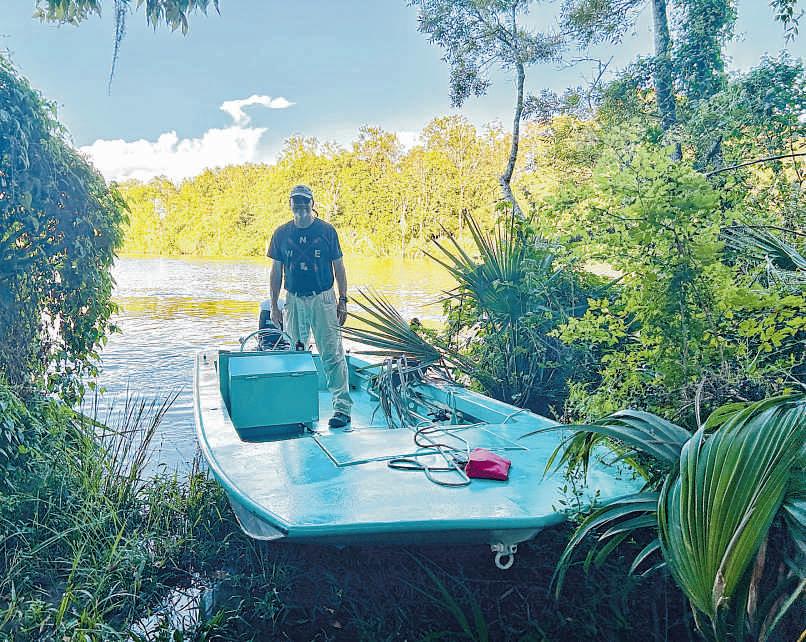
Palmetto Island State Park is an excellent jumping-off point for exploring the waterways.
Therestaurant-rich townofAbbeville is about a30-minute boat ride north. To thesouth, past the remnants of an Ishak shell midden, is Vermilion Bay with opportunities for fishingand dolphin spotting
For the ultimate water-as-highway experience, adventurous boaters can accessthe nearby Intracoastal Waterway and motor toward Brownsville, Texas, or Boston, Massachusetts.
We decided to stay close and head to Abbeville for afternoon mass at St. Mary Magdalen Church downtown. Troublewas, the only public river access in Abbeville is near the Highway 14 bypass not easy walking distance to the church. Fortunately,wefound a spot closer to tie up and made it to mass with plenty of time for afew prayers asking for forgiveness for our trespassing Questionably moored, we decided to head back to our cabin for supper instead of walking to one of the delicious seafood restaurants in Abbeville.
Only at Palmetto Island
This stretch of bayouisaninteresting mixofindustry interspersedwithagriculture and wildness. Pogie processing plants extract omega-3s, shipyards build crew boats, and cows graze in the distance while kingfishers swoop through cypress.
The earlyfallbayou sidesare lushgreen, full of cattails and elephantearsspeckled withfloweringplants
We hope to make it back in the

spring for the flowering of the dark, blood-colored, 6-foot-tall Abbeville red iris (Iris nelsonii). This extremely rarenative Louisiana iris hasonlybeenfoundgrowing in asmall privatewetlandinVermilion Parish. In 2011, 100 Abbeville redirises wereplanted in the state park in hopesofexpanding its range, while making Palmetto Island theonly place in the world to see theirisinits native habitat
When we return,we’ll rentacanoe or akayak at the park for a quieter experiencealong the canoe trails
Ilook forwardtoexploringthis system of man-made canals and ponds that have naturalized well over the years.
Formed by thedredgingtobuild theparkroads,theyconnect to thenaturalflow of thebayou.With
thecontinuous influx of fresh water andmicroorganisms from the Vermilion, the system grows and attracts wildlife
The canoetrails, removed from theboat traffic of the bayou, would be agreat place to teach my kids how to paddle andoffer another new,fun way to experience the park.
Know before yougo
n Kayak and canoe rentals are available on-site
n The maincampground is RVcentric with 20 sites having wellmaintained tent pads.
n For amore secluded tent camping experience, visitors can paddle or hike into several primitive (no bathrooms) “back pack camp sites” around the largest of theponds at the park.
n Tenters can rent the primitive group camp area near the boat launchand have bathroom access within about200 yards.
n Cabins offer decentwheelchair accessibility (bathing is via tubwitha transfer chairstowed in aclosetnearby).
n Bring awagon for carting heavyloadsbetween parking and the cabin entrance.
n The Nature Center is open 9a.m.tonoon Saturdays.
n The Story Walk offers kids achance to connect abook with hiking on the500-foot-long Kid’s Nature Trail. Ask aboutCajun French translations of the featured bookatthe park entrance station.
n Thesplashpad is closed on Mondays.
n The Wi-Fi andcellservice are spotty
n Groceries are available in nearby Abbeville
n Palmetto Country Store offers “beer& food”innearbyMouton Cove
n The Friends of Palmetto Park help enhancethe park experience with their giftsoftime andmoney Visit www.friendsofpalmetto.org to become afriend.
Upcoming events
n Trick or treating: 4p.m.to 6p.m.Oct.25
n Pork in the Park Dutch Oven Gathering: Nov.8
n Santa’sChristmas program: Nov.29
n LatanierCookersand Friends of Palmetto Island Membership ChristmasSocial:Dec. 13
n The Abbeville red iris (Iris nelsonii)bloomsfor aboutthree weeks in mid-April.
By ChristopherElliott
Family’s
Ibooked


Holland America should have honored its verbal commitment to assist when your flightdelay ended your cruise. It looks like your 7:15 a.m. flight was canceled because of amechanical problem The nextflightdidn’t leave until 10 a.m. Thatwouldn’thave given you enough time to reach your ship. Youbooked your flights through Holland America’sFlight Ease program, which promises thatif your flight is delayed or canceled by the airline on the day you are on your way to or from your cruise “our staff is ready to assist you, 24/7. We’ll even take care of any flight changes if needed to join the voyage at the next available port of call.”
But Holland America doesn’t promise you will make your cruise or thatitwould refund your cruise under the Flight Ease program if you miss the boat. Youmade several mistakes when you booked your cruise. First, you should always give yourself acushion between when you arrive and your ship leaves —preferably an entire day.You were cutting it too close. Second, always get travel insurance for your cruise. Insurance would have covered the full cost of your cruise. Flight Ease won’t. Finally,inreviewing your paper trail, it lookslike you spent alot of time on the phone with Holland America. Certainly,when your flight is canceled, you’ll want to call your cruise line right away
But after that, keep everything in writing so that youhavea reliable paper trail showing your efforts to resolve the case. Youmay need to forward it to theHolland America executives whosenames Ipublish on my consumer advocacy site, Elliott.org. It looks like youwere dealing withaHolland America cruise consultant whenyou booked your cruise and airfare. Idon’t see any evidence that theHolland America agent recommended travel insurance to you. He should have done that. More importantly,Holland America should have refunded your airline tickets. Under Department of Transportation rules, an airline mustautomatically refund
youwhen it cancelsaflight. It appears your airline haddone that but Holland America didn’tpass therefund alongtoyou Icontacted Holland America on your behalf. It agreed to refund $759 in airfare in addition to the $832 in taxes and port fees it had alreadyreturned. Unfortunately, you’re goingtolose the valueof your cruise. That’sanexpensive lesson that Iwishyou could have avoided.
Christopher Elliott is the founderofElliott Advocacy,a nonprofitorganizationthathelps consumers solvetheirproblems. Email himatchris@elliott.org or get help by contacting himon hissite.
PHOTOSByCATHERINE S. COMEAUX
Stephan Comeaux arrives by boat to Palmetto Island State Park.
Palmetto Island State Park is nestled in the jungle-likeswamplandson the BayouVermilion, south of Abbeville.
LOUISIANABAKES
Addpersonaltouch with homemade spiceblend

Olivia Regard

It is officially fall and while the cooler temperatures are abit delayed in their arrival, the pumpkin spice takeover is in full swing. From coffee to candles, pumpkin spice is everywhere. Though I will never be the kind of person who runs out to get apumpkin spice latte on the first day of autumn, I do enjoythe flavors and scents that arrive with the change of the season. Pumpkin spice is amain signifier of this transition, even more so than the browning leaves falling from the trees, and its curious blend of spices just feels like fall.
When Ibake cozy fall treats, Iuse homemade pumpkin spice instead of buying apre-made spice mix. Makingyour own pumpkin spice blend is easy and allows you to control the ratio of spices. I love the balance in the recipe below,but if cinnamon or ginger are your favorite, increase the amounts; and if abit more kick from allspice and cloves is your aim, adjust accordingly to make it your own. Once you land on ablend that you love, have fun adding it to hot drinks, cookies, pancakes, muffins or bread this fall. Use the pumpkin spice blend as a1:1 replacement for the spices in the recipe you are making. For example, if arecipe calls for 2teaspoons cinnamon and 1/2 teaspoon nutmeg, substitute 21/2 teaspoons pumpkin spice blend. One of my favorite
recipes for celebrating the changing of the seasons and making my home smell like fall is this pumpkin spice coffee cake. The cake features pumpkin puree, abevy of warm ground spices, apecan and oat-based streusel and asubtle Steen’ssyrupinfused glaze. The cake is moistcourtesy of pure pumpkin puree and sour cream and, best of all except for oat flour (which youcan make at home) youlikely have everything on hand towhip up afall treat whenever the craving hits.
PumpkinSpiceBlend
3tablespoons ground cinnamon
2teaspoons ground ginger
2teaspoons freshly ground nutmeg
11/2 teaspoons ground allspice
11/2 teaspoons ground cloves 1. Combine spices. 2. Store in asmall jar or container until ready to use.
PumpkinSpice Coffee Cake
Coffee Cake:
2cups all-purpose flour 1/2 cup oat flour (see note below)
2teaspoons baking powder
1teaspoon baking soda
3teaspoons pumpkin spice blend (recipe above)
1/2 teaspoon kosher salt 1cup packed light brown sugar
(not
2eggs
1/2 cup whole milk
1teaspoon pure vanilla extract Crumb Topping and Glaze:
1cup oat flour (see note below)
1cup packed light brown sugar
1tablespoon ground cinnamon

1/2 teaspoon kosher salt 10 tablespoons unsalted butter, cut into cubes (keep cold)
1cup chopped pecans, toasted 1/2 cup confectioners’ sugar
1tablespoon heavy cream 1tablespoon Steen’ssyrup (or pure maplesyrup)
1/2 teaspoon pure vanilla extract
Note: If you do not have oat flour,make it. For this recipe, pulse 2cups of whole oats in afood processor until theoats resemble acoarse flour.Use as instructed for cake and crumb topping.
1. Heat theoven to 350 F.
Grease a9-inch-by-13-inch baking pan withbutter
2. Toast the pecans until fragrant, approximately 10 minutes. Let cool.
3. Make the crumb topping by whisking together 1cup oat flour,1cup light brown sugar,cinnamon and salt.Add cold, cubed butter and incorporate into the dry ingredientsusing your fingers or apastry blender Continue mixing until the butter resembles peas and thestreusel forms large clumps. Stir in toasted pecans and chill in the fridge
Letgoofone-sided friendships
until ready to use.
4. To makethe cake, whisk together the remaining oat flour,all-purpose flour,baking powder,baking soda, pumpkin spice blend and salt.
5. In aseparate bowl, whisk together brownsugar,oil, and pumpkin puree. Add sour cream and whisk to combine until no lumps remain. Add eggs one at a time, fully incorporating each egg before adding the next. Whisk in milk and vanilla
6. Fold wetingredients
PHOTO By OLIVIA REGARD
into dry ingredients until the batterismostly smooth.
7. Pour the batterinto the baking panand cover with streuseltopping.
8. Bake for 55-60 minutes, until atoothpick insertedinthe center comes outclean.Let cool
9. Just priortoserving, make the glaze by whisking together confectioners’ sugar, heavycream, Steen’s (ormaple) syrup andvanilla until smooth. Drizzle generously over the crumb topping.
TODAYINHISTORY


Dear Annie: Iamwriting about afriendshipthat has left me hurt and confused. My husband and Ihave known this couple for many years. He has been our friend for decades, and when he remarried, we welcomed his new wife with open arms. She and I became close quickly; we shopped together,met for coffee and had long phone conversations. But over time, she grew distant. Calls became shorter,texts turned into nothing but emojis and her
warmthseemed tofade. When we moved to Florida, instead ofbeing happy for us, she gave me thesilent treatment.Later,when we invitedthem to visit,things felt fine, but as soon as they left, she pulled away again. Thefinalstraw came when they offered to watch our house while we were away for amonth. They never came by once. Our plants died, the thermostat broke, and all Ireceived was abrief “sorry” and aheart emoji. It hurt, especially because we have always been generous with them, even giving away furniture when they needed it.
Since then, she has admitted she is a“bad
texter,” but nothing has changed. Ihave tried to keep thefriendship alive, but Ifeel like Iamchasing someonewho no longer values me. She dismisses my feelings as if Iamholding agrudge over one incident,when in reality, this distance has been building for years.
Am Iwrongtofeel so hurt? Should Iconfront her,write aletter or simply let this friendship go? I miss the person Ithought shewas, but Idonot recognize her anymore. —Confused Friend
Dear Confused: Youhave given this friendship time, energy and generosity What you have received back is distance andhalf-
hearted replies.Ithurts, but it alsotells you all you need to know Friendship has to go both ways. Youcannot keep it alive alone, no matter how much history you share. She has shown you where shestands.The kindest thing you can do for yourselfnow is to stop chasing and focus on people who value your effort Sometimes closure comes not from aletter but from accepting what is.And as AnnLanders would say,itfeels wonderful when you stop banging your head against thewall. Send your questions for Annie Lane to dearannie@ creators.com.
Parent should puteducation at theforefront
By The Associated Press TodayisSunday,Oct. 19, the 292ndday of 2025. There are 73 days left in the year
Todayinhistory: On Oct. 19, 1987, thestock marketcrashed as theDow Jones Industrial Average plunged 508 points, or 22.6% in value(itslargest daily percentage loss ever), to close at 1,738.74 on what came to be known as “Black Monday.”
Also on thisdate: In 1781, British troops underGen. Lord Cornwallis surrendered at Yorktown, Virginia,asthe American Revolutionneared itsend In 1960, theRev.Martin Luther King Jr.was arrested during asit-down protest at asegregated lunchcounter in Atlanta, oneofthe earlyeventsofthe nonviolent protest movement that King wasinstrumental in leading during thenascent Civil Rightsera.
The flight marked thestart of regularcommercial Concorde servicebetween Parisand New York In 2003, Pope JohnPaul II beatified Mother Teresa during aceremonyinSt. Peter’sSquare. Mother Teresa, who founded the Missionaries of Charity global order that attends to society’s outcasts, was elevated to sainthood in 2016 by Pope Francis. She diedin1997. In 2005, former Iraqi President SaddamHusseinwas put on trial by the IraqiInterimGovernment, accused of crimes against humanity.

Dishwasher disaster
Dear Heloise: Isaw aletter where thereader mentioned dishwasherpods and that they were capableofcleaningfriedfoodsoff plates Iusedpods andfoundthat effluent wascoming out of the air gapvent on the sink, so Idismantled all the pipes underthe sink all the way to the outer drainpipe. Iwas shocked to find a glutinous material lining the pipes and restricting the effluent flow,causingitto
Dear Heloise: Iread with interest the letter from Margaret aboutreading and our children. Iknow we all have busy lives, but children and their education are very important Teaching them to sound out words and read is only the beginning. The American educational system actually begins in the home, with parents who devote time each day to helping their children learn basic reading and math skills. Every child should be able to read simplesentences and do simple math before they start kindergarten. Parents need to back up teachers and start demanding more from their children. Don’taccept bad grades.Ifthere is aproblem at school, talk to the teachers and find out what it is. If the problemisbullying, demand that the bulliesbeexpelledfrom school.Ifyour child is the bully,don’tmake excuses for them.Instead, make it clearthat bullying is not allowed and take steps to stop them. Remember this: Unless youhave the cure forcancer or the secrettoworld peace,you will never leave anything behind in this world moreimportant than your children. —A Retired Schoolteacher,inOhio
back up intothe dishwasher Iusedscraper tools,scoured out the material, and found thatitwas plastic. It became apparent that the plastic pods would melt in the hot water from the dishwasher,but when the effluent was pumped out through the pipes, thewater rapidly cooled. The plastic, which was in suspension, thenreformulated at alower temperatureand clogged the pipe, which blocked the outflow Iwrote to thecompany to advisethem of the problem, and Ireceived avery lawyerly and intimidating letter,claiming that their product was excellent and thattheydenied liabilityor responsibility These pods are areal problem. If the plastic doesn’treformulate inside the house pipes, then it will reformulateinside the city system. We switched to granular detergent after I scoured the pipes, and I’ve had no problems since. It
might help your readers to know of this plastic pod problem. —A Reader,via email Africanviolettea time
Dear Heloise: In arecent column of yours,Iread the letter regarding how best to make African violetsflourish. Youmentioned using nails. As achild, Irecall my mother being the queen of blooming African violets, and she seemed to have a magic touch. She would brew standard black tea and allow it to cool to room temperature in awide, shallow bowl. After placing theplastic potted plant in the bowl of tea, she’d let the roots soak for about 30 minutes She said African violets like the acidityofthe tea. We had ahousefull of beautiful purple flowers, and she gifted many to friends and family —Robert M., in Dana Point, California Send ahinttoheloise@ heloise.com.
In 1977, thesupersonic airlinerConcorde made its first landing in NewYork City, flying from France, in three hoursand 44 minutes.
Today’sbirthdays: Artist Peter Maxis88. Actor John Lithgowis80. Fox News host SteveDoocy is 69. Singer JenniferHollidayis 65. Boxing HallofFamer Evander Holyfieldis63. Filmmaker Jon Favreau is 59. Former first daughter AmyCarter is 58. “South Park” co-creator Trey Parker is 56. Comedian Chris Kattan is 55. Filmmaker Jason Reitman is 48. Actor Gillian Jacobs is 43. Actor Rebecca Ferguson is 42.
Staff report
Afterayearhiatus,“LOVE in the Garden” returns to the NewOrleans Museum of Art, the fall outdoor fête at City Park. Planned for Nov.7,the popular event will be held in the Sydneyand Walda BesthoffSculpture Garden to raise funds for the museum The sculpture garden’s Visionaries Gala marking its20thanniversary was held insteadofthe LOVEfest in 2024. Organizers also opted for acooler date on the calendar forthe al fresco fun. It is usually heldinSeptember. Entertainment forthe evening will including Where
Y’acht, withfood provided by local restaurants. Ahighlight of the evening includesthe Cocktail Challenge of love-inspired libationsfromlocal mixologists, with prizes awarded from judges andthe audience vote. The setting for the party features more than 100 pieces on 12 acres surrounding themuseum, including Robert Indiana’siconic“LOVE” sculpture, part of the garden since2003. “LOVE in the Garden offers the opportunity to cometogethertocelebrate oneofthe city’smost important cultural destinations: NOMA’s BesthoffSculpture Garden,” saidSusan M. Taylor, NOMA’s director
Pumpkin Spice Coffee Cake
Annie Lane DEAR ANNIE
Hints from Heloise
‘LOVE’ blooms again in N.O. sculpture garden
Continued from page1D
its investment in the performing arts. With the publication ofthe Lafayette music census report and the recent opening of the Louisiana Scoring Studio at the AcadianaCenterfor the Arts, the artshavelately been more prominentthan ever in conversations about economicand cultural development across the region.
That’sone reason Schacht is happy to have moved to Lafayette from the greater Los Angeles area.Westfieldannounced that it was bringing its affiliate company, Westfield Fluid Controls,toLouisiana in 2020.
“Lafayette is an absolutely fantastic place to live. Thecost of living, the restaurants, the people —ithas all these advantages. Ithas agreat history of music,” he said.
“Keep in mind, Acadiana Symphony Orchestra was founded in the 1980s when alot of organizations like Downtown Alive and Festival International were founded. It wasa time when people were going to turn off the lights in Lafayette. Oil and gas was basically over,and they didn’tknow how to continue. And what they did in this momentof absolute decline was to reach for the arts, to reinvigorate, to aspire to somethingbetter. It’s awonderfulcatalyst for great things.”
Artisticadvisor and guest conductor Matthew Kraemer joined the symphony orchestra earlier this year,doubling his role as music director for the Louisiana Philharmonic Orchestra in New Orleans. His involvement, and reputation as aglobally renowned and influential conductor,isindicative of anew catalyzing era for Acadiana Symphony Orchestra.
Over the past year,the organizationsaidgoodbye to itslongtime musicdirector Mariusz Smolij and executive director Dana Baker.
‘Lafayette is lucky’ Schacht and Acadiana SymphonyOrchestra board member Ryan Furby said thesymphony’s partnership with the Louisiana Philharmonichas alreadyproduced dividends in the caliber of musiciansand performances the organizationhas attracted for this season, which will fea-
CURIOUS
Continued from page1D
veteran. His face, astudy in character,isframed by dramatic, curly hair.Around his neck he wears arosary
Backstage, the space is filled with the boxes, costumesand set piecesone of atheaterthat opened more than 100 years ago. In the gloom far above, over the pulleys and the catwalks,loom massive old cypress beams. But what else is up there in the shadows?
Welcometothe dark side
Audiences might know thetheater as abustling place, filled with light and cheer,but the technical crew sees adifferent side…the dark side.
Working lateinto the night,constructing sets on deadline ahead of opening, they sometimes notice movement and sounds. There are props and costumes that disappear,then materialize somewhere else.
Grimsley recalls the spectator he saw sitting alone in the balcony,watching the builders and wearing ajaunty captain’s hat Whenhelooked again, theman had vanished.
Other workers with longer tenure at Le Petit instantly recognized the description: He was a former patron of the theater,they said, someone who years earlier had gone to what was supposed to be his final resting place. An apparition they called “TheCaptain.” The ghosts seem to manifest


ture a“Home Alone” Christmas concert Dec. 18 at the Heymann, aclassics series with aJan.15 performance titled “Rhapsody on aTheme of Paganini,”and achamber series with spring performanceshosted at St.John Cathedral and St. Mary Catholic Church in Lafayette.
“Wecould not have had amusical director like Matthew,and theperformances like we have, if we hadnot createdthatrelationship,” Furby said. “I think we’ll get to the point where people will be lining up out thedoor to perform with us.”
AddedSchacht, “There’sno waythat regional orchestras canafford this. Lafayette is lucky to be therecipient of this wonderful collaboration.”
The HeymannPerforming Arts Center is also slated to benefit from theair of excitement and growth that energetic board members like Scacht and Furby have brought to the symphony orchestra. After yearsofdiscussion around potentially shuttering the Heymann and building a new performing arts center else-

where in town, Lafayette Mayor-
President Monique Boulet’s202526 operating and capital budget was approved earlier this month with funding to modernize the Heymann at its current location at 1373 S. College Road.
“We’revery, very excited,” Schachtsaid.“Ithink the Heymann is avery specialplace. Mr Heymann hada vision of bringing the community together in the performing artsand insisted
upon it being in an A. HaysTown building. We love the idea of beingabletorenovate this special place and bring it alive.” Loss,grief andredemption Verdi’s“Requiem”brought the building alive in away that showsthe power of musicina community like Lafayette where residentsdon’thave to travel to New Orleans or Houston to see aworld-class orches-
tra perform master works.
“Verdi was probablythe greatest opera composer of the 19th century,” said Kraemer, taking abreak from conducting the orchestra during the show’s rehearsal.
He said thatthe composer conceivedthe requiem out of deep grief from the death of his twofriends, Rossini and Manzoni. Verdi involved13other composers andwrote the final movement himself,which powerfully expressesfeelings of loss, grief and redemption.
“This work requires enormous forces andvirtuosic singing from beginning to end, and it’sjust ajoy,” Kraemer said. “It encompasses all thehuman emotions, Ithink, in 90 minutes.”
To see the Acadiana Symphony Orchestra performthe rest of its season of popular movie classics and great classical works, tickets areavailable at acadianasymphony.org.
Email Joanna Brownat joanna.brown@theadvocate. com.
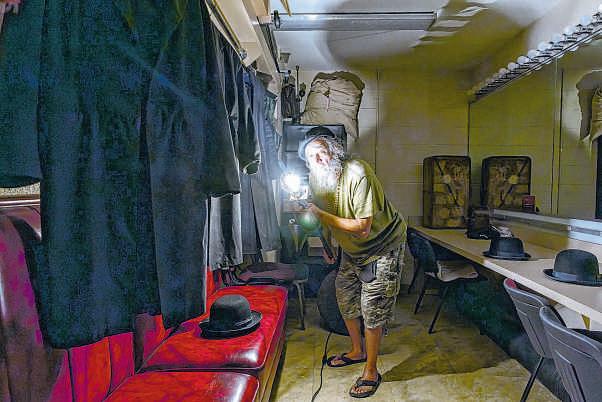
that way —afigure noticed from the corner of theeye, rustling in the shadows or asudden, icy draft
Sincehestarted withNORD’s
Ty Tracy drama troupe in high school, Grimsley hasspent alifetime working all over thecountry in nearlyevery aspect of theater creatingfantasy realms through acting,set buildingand lighting. Acertain opennesstothe otherworldlyseemsto come with the territory
“I’ve worked at Le Petit many times late at night,” Grimsley reflected.“My feelingisthat when you’reonthisearth,you create a lot of energy.And when you die, it takes time for that to dissipate. Some peopledie, andthey don’t knowthey’redead.They stick around.”
Tragedyinthe courtyard
All theaters havetheir legends, their superstitions, their stories. There’sacertain “Scottish play” by William Shakespearethat cannot bementioned by name in anytheater,lest itsghostsand witches cause mayhem. In thecourtyard off Le Petit,

old windows overlook afountain, tables and tropical plants. But what else is looking on?
According to theater legend, abeautiful young woman in a long white gown can sometimes be seen behind theglass, gazing plaintively down at the flagstones.
Could it be the ghost of anew bride, who inexplicably threw herself from the sill during her own wedding reception many years ago?
The shadowy corridors and roomsinatheater may lend themselves to surprise encounters. Grimsley recalls opening a door backstageonce to be confronted by adark man in colonialera clothes whorushed straight at him —and through him.And then disappeared. On another lonely night, ahuge mirror outside adressing room presented thetechnical director with aterrifying image.
“Whatever Isaw scared the hell out of me,” he said. He started, shrank back,looked again. It was only his own reflection. Or was it?
Email Annette Siscoatasisco@ theadvocate.com. Do you have aquestion about something in Louisiana that’s got you curious? Email your question to curiouslouisiana@theadvocate. com. Include yourname, phone number andthe city where you live.
Continued from page1D
fall and Iembrace the change instead of fighting it.
I’mlooking now beyond our dining room window,where a fresh carpet of leaves dropped from our river birch and Drake elm overnight. I’malways surprised to discover each morning how much mysterious work has unfolded outside while I slept, the flight of leaves and owls as silent as snowfall in the darkness.
Over coffee on the patio after sunrise, my wife and Isometimes see the leaves drop in real time—alittle blizzard of brown, orange and red as squirrels scurry on the branches and shake things loose. The squirrel mind, I’ve found, dwells on insurrection, always hatching schemes of theft and assault. Ijust heard one as I write this, its insistent scratch amplified by the roof gutter where it’strying to build anest. I’mback at my keyboard after I tapped the eaves with abroomstick.
My assailant just staged a clever retreat, though I’msure the little gremlin will return. Such is the newsfrom the front lines of fall in suburban Louisiana. Zelda would tell me not to sweat the small things and enjoy the turning of the year —something I’mtrying to do as the days shorten and the calendar drops its final leaves.
Email DannyHeitman at danny@dannyheitman.com.



STAFF PHOTOSByCHRIS GRANGER
John Grimsleylightsupthe dressingroom at Le Petit Theatre in the French Quarter of NewOrleans.
John Grimsleychecks behindthe curtain insideLePetit Theatre.
The eyes of Shakespeare look out from the wall inside themain entrance to Le Petit Theatre.
PHOTOSByROBIN MAy
TheAcadiana SymphonyOrchestra and Chorus rehearse Oct. 8before their performance of Verdi’sRequiem at the Heymann Auditorium.
Conductor and artistic advisor MatthewKraemer leads therehearsal
Duo explores ‘America’s most haunted city’
BY RACHEL MIPRO
Contributing writer
New Orleans natives Rosary O’Neill and Rory O’Neill Schmitt frequently collaborate on writing projects, often turning back to the Crescent City for inspiration The mother-daughter duo have just launched their latest book, “The Haunted Guide to New Orleans: Ghosts, Vampires, and Voodoo.”
Surrounded by ribbons and racks of fur coats in Yvonne LaFleur’s boutique ahead of a book signing, O’Neill and her daughter, Schmitt, talked about their experiences with New Orleans spirituality, veering off into stories of haunted restaurants, prayer methods to avoid ghosts and encounters they believe they’ve had with poltergeists.
The following interview has been edited for clarity and length How did your interest in ghosts start?
Rory Schmitt: My house was haunted. My brother, my dad and I had a poltergeist experience. I was 8. My brother was probably 15. My dad was in his 40s. All of a sudden, the door flew open, and this running blur of energy ran through the living room where we were watching “Star Wars,” and through the dining room, through the laundry room, into the kitchen, we had these like Chinese paper lanterns They started all spinning, and we had a rubber duck that started spinning the spirit or the supernatural, whatever it was, left this black like rectangular, almost like an imprint of a stamp. We would try to wash it off, and then it would come back the next day
BETWEEN THE PAGES WITH ROSARy O’NEILL AND RORy O’NEILL

Rosary O’Neill: My personal beginning, I was raised a lot by my grandmother who lived in a spooky mansion on Carrollton and Sycamore, and she would tell ghost stories from Ireland And I developed a terror She was so terrified of ghosts that she would have three religious objects on her bedroom door, a crucifix, and then we said prayer to Our Lady in the closet, where there was an altar, before we even climbed in bed So there was this whole sense of that, that afterlife was really going to come out if we weren’t careful. We all slept with crucifixes, she had a drawer she pulled out, and we could choose the one we wanted So I think that the belief in ghosts is kind of an extension of the spirituality
‘Gentilly’
BY RIEN FERTEL
Contributing writer
in New Orleans, where people do believe in God and these and where there is belief there are messengers. Does that belief coexist for you?
Rosary O’Neill: I wouldn’t do the ghost book if I didn’t feel it would bring people closer to God. It’s not worth the terror
What do you want readers to know about the book?
Rory Schmitt: We wanted to include
a chapter on voodoo, not because voodoo is ghosts, but voodoos are about recognizing the ancestors of the departed. You know, the spirits who come to visit us during the ceremonies, and who we respect through altars and through prayers too, if you can intercede and help us. We want to honor them and always remember them. But I think remembering to always have some sort

of spiritual protection. It could be carrying a rosary It could be some gris-gris. It could be a shaman, it could be a crucifix, whatever it might be, just to be able to rely and also have a community of support. The scariest experience that I had, I called the Voodoo priestess.
Was this at your house?
Rory Schmitt: A relative’s basement I had a visitation of a ghost when I was sleeping, and I just felt very unsafe. And so I called the priestess I know
She just came in, she did all these different rituals of hers. She yelled, she did the corn meal, the ancient symbols on the floor… the space felt so much better It felt lighter and brighter Still feels like there’s something there, but sometimes there’s a negotiation with ghosts over territory
What would you say are the most haunted places in New Orleans?
Rosary O’Neill: St. Louis Cathedral, because they buried so many people in the floor I wouldn’t go there alone.
details history of N.O. neighborhood as suburban plantation
“Gentilly:A New Orleans Plantation in the FrenchAtlanticWorld,1818-1851”by Na-
thalie Dessens andVirginia Meacham Gould, Louisiana State University Press,288 pages
I had long assumed that New Orleans’ Gentilly neighborhood earned its name from the area’s quiet, pastoral qualities. It sure is gentle up here, I’d say to myself, while driving past block after block of ample-lawned houses.
Nope. The name is actually a corruption of Chantilly that original appellation appears on old maps of the city — a northern suburb of Paris.
That story is told in a new book of the same name, the work of a pair of preeminent scholars of colonial Louisiana, Nathalie Dessens and Virginia Meacham Gould, who trace Gentilly’s early history as a suburban plantation through the letters of its longtime caretaker
The Dreux brothers
Gentilly’s colonial founding fathers were the Dreux brothers, Pierre and Mathurin, middle-class arrivistes from France’s Loire Valley region. Just a year after Bienville planted a flag in a bit of spongy soil that he would call New Orleans, the brothers purchased a long strip of mostly swamp-filled land stretching from the downriver town border up nearly a mile and a half to Bayou Sauvage, a former portage route now paved over by Gentilly Boulevard.
On the waterfront they built La Brasserie, a popular bakery-restaurant — in fact, then one of the only places in town to grab a bite and a beer that Marc-Antoine
Caillot, one of New Orleans’s first chroniclers, lovingly described as having “the feel of an open-air Café in Paris where countless numbers of people go to have fun.”
On their property’s backend, the Dreuxs planted corn, pastured cattle and horses, and, according to the early historian Grace King, built a “style of stately independence” while maintaining “an attitude of aristocratic supremacy” over their Gentilly plantation. Their mini empire, located four and a half miles from the French Quarter, was entirely built on the backs of enslaved laborers. The institution of slavery would define the fortunes of Gentilly and the Dreux family for generations.
Mathurin’s great-grandson Charles Didier Dreux would be the first Confederate field officer killed in the Civil War.
The plantation eventually passed to Louis Leufroy Dreux, whose widow, Marguerite Delmas, married Henri de Sainte-Gême, a French aristocrat who arrived in New Orleans in 1809, in time to serve as a major under Andrew Jackson in the Battle of New Orleans. Soon after marrying Marguerite, he inherited the title of baron and a chateau in southwestern France.
In the early spring of 1818, Henri and Marguerite handed off the keys to Gentilly to 25-year-old Jean Baptiste Auvignac Dorville, who


served as the plantation’s manager for the next four decades.
Over those years, Dorville wrote 218 letters to the Sainte-Gême family, 54 of which are translated from the French, ponderously footnoted, and collected by Dessens and Gould (the original letters reside in the Historic New Orleans Collection’s archives).
Microscopic detail
Dorville’s correspondence will be of uneven interest to the general reader of local history, though will be invaluable to researchers of a more scholarly bent (if they’re not already familiar with HNOC’s collection or Dessens’s 2015 monograph, “Creole City,” which covers much of the same ground).
Documenting, often in microscopic detail, the inner workings
of the plantation, Dorville pays special attention to the enslaved persons living and laboring there. Their names flit in and out of his letters, as readers get to know them through the overseer’s omnipotent and often cruel eyes. They turn the Sainte-Gême property into a viable truck farm growing corn, rice and citrus, including a whopping 40,000 oranges in 1821. They herd poultry and cattle and eventually transform the farm into a full-fledged sugar plantation. In 1824, they raze and rebuild the dilapidated plantation house into what Dorville deems an “elegant,” eight-roomed ”chateau.” They keep the plantation afloat during economic downturns and finance, with their blood, the earnings he sends abroad.
Dorville writes of their illnesses, pregnancies and deaths. He tells of his intimacy with the women’s reproductive cycles, of renting them out as wet nurses, of his own enslaved daughter, Irma.
He provides little news from the city for Sainte-Gême, beyond tidbits concerning other members of the plantation gentry He begs Henri to return, if only for a month Dorville’s pleas would go unheeded, as the letters back and forth grow more infrequent.
‘Gentilly lies heavy on me’
In 1850, he oversaw the selling of the plantation to John McDonough, who, dying shortly after, willed the property to the city of New Orleans. Dorville stayed on, perhaps unable to pull himself away leasing the plantation for another four

years. “Gentilly,” he would write to the Sainte-Gême family in 1855, “lies heavy on me.”
That year, he finally left, moving to a house he built on Esplanade in the Marigny He continued to handle the financial affairs of the Sainte-Gême family and tell them news from New Orleans.
“All the slave states are upside down and the question of disunion is already being discussed,” he wrote three days before the 1860 presidential election “How will this end? Only God knows.” After the war, Dorville moved to a St. Bernard Parish farm, where he died in 1876, three years after posting his final letter to the SainteGêmes. Over the next half-century, the city drained and parceled out the old plantation property, carving out the Gentilly Terrace and Gentilly Gardens neighborhoods.
Following the McDonough purchase, the fates of the enslaved persons that lived on the plantation remain unknown.
Today, the exact location of the Sainte-Gême house also remains unknown. But its footprint is likely buried under the intersection of Gentilly Boulevard and Interstate 610, somewhere in the vicinity of a pair of Black-owned businesses a vegan restaurant named Original Thought and Afro Mart, a pan-Atlantic grocery opened by a Ghanaian immigrant — fitting resolutions, perhaps, to a story of a New Orleans plantation.
Rien Fertel is the author of four books, including, most recently, “Brown Pelican.”

STAFF PHOTO By JOHN McCUSKER
Author Rosary O’Neill wrote ‘The Haunted Guide to New Orleans’ with daughter Rory O’Neill Schmitt.
PROVIDED PHOTO By MADDy THI DROUIN Rory O’Neill Schmitt
ARTS &CULTURE
In installation,African peoplemakeway in strangenew world


The narrative of the current NewOrleans Museum of Art exhibit “Dawoud Bey: Elegy” follows the movement of Africans into and out of American enslavement. In large-scale blackand-white landscape photos, Bey travels theRichmond, Virginia, Slave Trail, Louisiana plantations, and the final miles of the Underground Railroad in Ohio —a story thatfollows the enslaved peoples’ arrival into bondage, their forced agricultural labor,and then their perilous journey north to freedom.
Organized by Valerie Cassel Oliver,acurator at the Virginia Museum of Fine Arts, the exhibit also features two video pieces, andthe eerieaudio soundtrack of one —athree-screen color survey of slave cabins at the Evergreen Plantation in Edgard continuously echoes through the galleries. The video and some of the plantation photos were previouslypart of Bey’sProspect.5 installation at the Historic New Orleans Collection.
Areflection room in the middle of theexhibit offers an opportunity for visitors to record their reaction to three prompts:
•How can the landscape hold memory or tell astory?
•Inwhat ways do you feel history is present?
•How does Bey’swork encourage you to reflect on the influences of history in our lives today?
Gottoget theimage
At apre-opening preview,Bey, aNew York native, Chicago residentand MacArthur Fellow,said he tries to override his personal emotions when making pictures at thesubject sites.
“The reason I’m there is very emotional,” he said. “That’s what drives me to make the work. But once I’m there, it’sapicturemaking process


“The emotional piece of it doesn’ttell you how to make anything. So, it’svery interesting because once I’m there, I’m in problem-solving mode.
“Allthe context,all the information, the sense of place in history,it’salready there. There’s nothing Ican do to makeitmore there, but Ican make it resonate more deeply if Ican figure out how to describe it to you.”
Example: The Virginia-shot “Stonythe Road”images that open the exhibition mostly show an unpopulated foot trail leading through brushand trees.
“How do you give adimension, akind of description, to this narrow,constrained space and not make the same picture over and over?” he said. “It’sonly about from here to there, maybe 5feet wide.
“It’sreally aboutbeing able to see veryclearly what you might call the structuralgeometry of thelandscape,the shape of it, to really see it, andtouse that to begin to shape the pictures themselves,because the slave trail is what it is andwhat it always was.
“And, of course,black and white material is the material of photography’spastratherthan large-scale andcolor,whichisa verycontemporary photographic form of representation. So, with theeliminationofcolor,it’salreadykind of pulling you back intothe past. Whether you realizeitornot as you’re standing there, it’s doing that. So yeah,
DINING SCENE
At 25,Herbsaint feelsfamiliar,
Which restaurant is Herbsaint, Ifound myself musing while sitting for aWednesdaynightdinner.Isitthe one serving the thick gumbo that takes you back to chef DonaldLink’sfirststomping grounds in southwest Louisiana?
the emotionalpiece of it happens before I’m there andafter,but largely before.”
Wisdom sits in places
BrianPiper, NOMA’s curator of photographs, prints anddrawings, pointedout thatBey’seyelevelpositioning of the camera both registers the photographer’s presence in the photos andplaces viewers there,too
“These arepurposely uninhabitedlandscapes at first glance, right?” he said.
“I think thatDawood’sown physical presence is implied, and that’spartofit. You’re meant to sort of think aboutthe photographerinthe landscape. But also, they’re alltaken from acertain eyelevel,sothey’re also meant to have the viewerthink about, youknow, if theywereinthis place, this is what(they) might be seeing at this time. And it creates asortofsense of empathy,I think, to think aboutthe enslaved Africanstaken offofthe boatsin Richmond or enslavedAfrican AmericansinLouisiana or seeking freedom on the way Canada.
“I hope thatour local audiences really think aboutthe waythat memory residesinthe landscape. There’s aphrase that actually comes from Native American thought, thatwisdomsits in places,and thatthe landscape bearsnot just evidencebut some of the spirit of the past andcarriesthatthrough history
“I think that’sinsome ways a very beautiful thing but also a very sobering thing.”
Publishedbythe Virginia Museum of Fine Arts and the Aperture Foundation, the exhibit catalogcan be purchasedinNOMA’s Museum Shopand online at shop. noma.org.
Dave Walkerfocuses on behindthe-scenes coverage of the region’s many museumshere and at www.themuseumgoer com. Email Daveatdwalkertp@ gmail.com.
on from the gumbo and crudo, summed up the enduring character and appeal of this restaurant —one of rock-solid reliable consistency,with gradual change, so that arestaurant that always feels familiar to regulars also stays fresh.

Or is it the onenestling slices of shima ají crudo between crisp apple with a flicker of ginger for aspecial?


Is it the restaurant that’sbeen such asteady presence on St. Charles Avenue that it’sstartingto feel about as permanent as the streetcars thatclatter past its broadwindows? Or is it the place that’sclearly on the bucket list for manyvisitors, who Iwatched stack up at the bar,waiting for tables to turn, as if Herbsaintwas the hot new thing that some influencer just blew up? Stop questioning it and just enjoy,Itold myself. And then proceeded to dig into boththat gumbo and the crudo, served next to each other,and look around the room sparking with hot spot vibes even as it marks 25 years in business this month. Herbsaint (701 St. Charles Ave., 504-524-4114) is the restaurant that launched more than the trajectory of Link as chef-restaurateur The local sourcing, close ties with growers and fishersand the long-running relationships with customers that started here would extend through what is now the Link Restaurant Group as consistent ahitmaker as the modern New Orleans restaurant scene has known. It also propelled the careers for many who have gone on to open their own restaurants aroundthe New Orleans area The downtown restaurant is celebrating its 25th year,aquartercenturyofits own blend of Louisiana, French and Italian flavors.
To celebrate the milestone, the restaurant is serving aweekly three-course special meal, chang-


ingeach Wednesday through Nov 5(see menus below). With anew small plate, entree and dessert cyclingthrough each week,it’smeanttoshowcase the restaurant’sdifferent influences, from rustic Louisiana to classic French to anew fascination with Japanese cuisine, something Link and his chef de cuisine Tyler
Spleen brought homefrom an eating excursion in Japan this year Bistro with history
The restaurant at the corner of St. Charles Avenue and Girod Street had previously been Bizou, from chef Daniel Bonnot Herbsaint opened in 2000 as part of awave of modern bistros then
cropping up around NewOrleans. It originally debuted as aSusan Spicer restaurant, then best known for Bayona. Iremember standing in the dining room foran opening press event aSpicer introduced her relatively unknown partner chef, that being Link himself. Spicer eventually leftthe fold, but Herbsaint has always been about more than one chef and has proved fertile ground forrising talent. Stephen Stryjewski wascooking herewhen he and Link partnered up to open his second restaurant, Cochon. The same happened with RyanPrewitt, nowchef/partner at the group’sPêche Seafood Grill, and Maggie Scales, executive pastry chef and partner at its La Boulangerie bakery cafe, started with Link’sgroup at Herbsaint.
Others who have comethrough Herbsaint over the years now have their own restaurants around NewOrleans, from Costera and the Company Burger to the newly debuted Evviva and Dr.Jones. Amealwithmorethanmemory My recent dinner,progressing
There wasthe “house madespaghetti,” which per the menustyle here tends to undersell the dish. It’s an incredibly rich take on carbonara with afried egg over the top to slice open and further enrich with its running yolk and, oh yes, acrisp plank of guanciale on top of that.
There wasduck leg confit, with the confit part done so wellI could tap abeat on its surface with my knifeand then cut in to reveal the juicy dark meat encased beneath. Dirty rice on the side is areminder this is not southern France, but south Louisiana.
But then there waschawanmushi, the Japanese savory custard, this one imbued with crab and corn, dotted with fairy talesmall pickled chanterelle mushroomsand adashi giving adarkly smoky aroma over the top. Savory Japanese custard would seem like an outstanding outlier even listed as aspecial. But it’s partofwhatHerbsaint does layering standby signatures with the current ideas andinfatuations of its chefs.
Fordessert, there wasnoquestionitwould be abanana brown buttertart, the same in concept as I’ve been ending meals with here foryears, but better.Was the caramel alittle softer, the chew of the tart alittle stickier on the teeth, the crust alittle richer? Or maybe it wasjust the effect of againtasting adish that haslonglivedinmymemory, which is oneofthe things valued restaurants give us through their own longevity Take alook back at Herbsaint’s history with morephotos from our archives at nola.com/wherenolaeats.
Email Ian McNultyat imcnulty@theadvocate.com.
Dave Walker
IMAGE COURTESy OF THEARTIST AND NOMA Dawoud Bey’s‘Untitled (Tangled Branches)’
STAFF PHOTOSByIAN McNULTy
Duck legconfitwithdirty rice has long been amenu standard at Herbsaint restaurant in NewOrleans.
Herbsaint restaurantismarking 25 years.

GAME DAY BOOMING IS
Turnkeyservices, localvendorsand othercompanies aretapping into agrowing tailgating industry
BY IANNESALVOSA Staff writer
Sincethe 1990s,Kristineand art rumney have been tailgating in their rV nearthe LSuagcenter, where theyset up camp with their family and spend the day cooking, visiting and soaking up the atmosphere ahead of the showdown in death Valley. In recent years,they’ve noticed some changes. their game day outpost, one of dozens of rVslined up in LSu’sdesignated lot for mobile
homes and rVs, costs $1,000 per season. It used to be free. the crowds arebigger,too. and, others have noted,morecorporate logosare visible among the tents sprinkled across the campus.
“thirty years ago, there wasnone of this,”Kristine rumneysaid on the morning of the recent LSuvs. Southcarolina game, thoughshe’s notcomplaining. thechangeshave helped the university better manage the tailgates and cut down on some of thegameday hassle, she said.
as longtimefootballfanshave observed, tailgating has evolved, as ever-larger crowds gather forevermore spectacular game day experiences.Inthe process, what was traditionally adownhomeway forfamily and friends to get together before thegamehas become big business on many levels.
LSu —which sets the standard for tailgating in Louisiana and, many wouldargue,among division 1 schools in the ncaa—now licenses premium spots on campus to aturn-
keytailgate company that hasexclusive rights to setuplavish, pregame parties. the university also provides choice game dayreal estate to itscorporate partners, whoshell out six or seven figuresa year on licensing packages that allowthem to advertise as sponsors of LSuathletics. brandedtailgates, company executives say,are a waytoreach thousands of potential customers andentertaintop clients.
ä See TAILGATING, page 2E
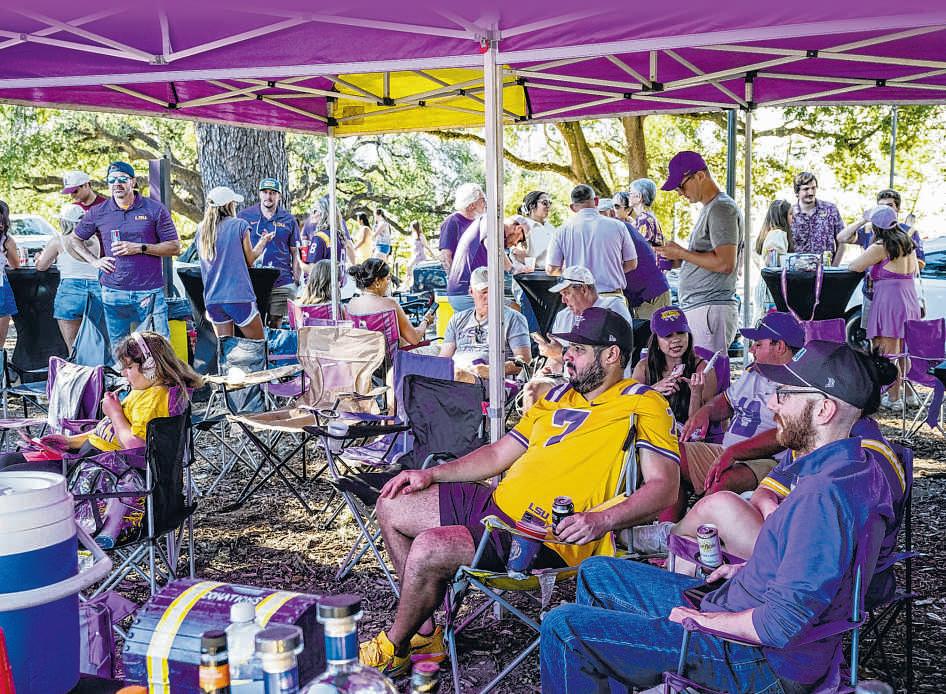
Colleges
BY RICH COLLINS Staff writer
school year,she had bred and sold 10 baby geckos for $400 each,including a complete “starter kit” that included an enclosure and supplies. Each transaction


her atidy
Aftertransferring from Tulanetothe nursing program at Loyola University New Orleans at the end of her freshman year,Lee has continued to grow her startup company, Katamaran Reptile Ranch, now headquartered in her half of shotgun double near campus. Over the past 12
ä See COLLEGES, page 2E

wonLoyola University’s business pitch competition last month for the geckobreeding business she runs from her shotgun apartment in NewOrleans.
JOHNSON
STAFF PHOTO By DAVID GRUNFELD
Acadian to expand into Sabine Parish
Acadian Ambulance will offer services in Sabine Parish starting Jan. 1.
Acadian, the nation’s largest employee-owned ambulance service, was selected to be sole provider of ground ambulance emergency and nonemergency transportation services in Sabine Parish, the parish’s Emergency Medical Services advisory board decided. The Sabine Parish Police Jury confirmed the selection during its Wednesday meeting.
Acadian will offer modern ground
TAILGATING
Continued from page 1E
Then, there are the vendors and small businesses that have long supplied game day necessities.
For them, the growth of tailgating means increased sales that have multiplied noticeably in just a few years.
“LSU has a reputation for having one of the best tailgates in the entire country,” said Ben Price, director of partnership and business strategy for LSU Sports Properties, an independent company that handles licensing deals for the university “People come from all over to experience it. That presents tremendous business opportunities.”
‘Explosion in interest’
The changes in tailgating can be traced, in part, to the rise of social media, which has altered what fans expect from special events, whether football games, concerts or festivals. They want an Instagramworthy experience and an entire industry has sprung up to satisfy their demands.
At the same time, universities have become more sophisticated about monetizing college athletics and now have sports licensing divisions and companies that handle the business for them, like Playfly Sports, the Pennsylvania-based owner of LSU Sports Properties
The confluence of factors can be seen in the way that tailgates have become bigger, splashier and more corporate.
“In the past five to 10 years, there has been an explosion in interest
COLLEGES
Continued from page 1E
months, she has grossed roughly $30,000 by breeding and shipping the lizards nationwide.
As she’s worked to grow the business, Lee has received support from Loyola’s Center for Entrepreneurship and Community Development, an 11-year-old initiative that’s been cranking up programming to meet rising student interest in all things entrepreneurial.
She is far from the only one getting similar help.
Across the state, colleges and universities are cultivating student entrepreneurs and helping them launch successful startups through new and expanded entrepreneurship classes, on-campus business incubators and pitch competitions.
The move comes as young people show a greater awareness of entrepreneurship than older generations and less interest in trying to climb the corporate ladder for the duration of their career
The internet and social media have fostered the growth of this trend by providing access to lowcost marketing, customer feedback, e-commerce and networking.
Lee’s business for instance, is powered the website MorphMarket, an “Etsy for reptiles” of sorts that connects buyers and sellers online
“Students of this generation see an opportunity while they are young to take risks and try to build something on their own,” said Shafin Khan, a vice president at the University of New Orleans Re-
ambulances equipped with the latest medical technology and staffed by trained paramedics and emergency medical technicians, local crews within the parish and advanced dispatch systems for call handling.
It’s the latest move into other areas of Louisiana for Acadian, which expanded into Concordia Parish in July
Office Hours Sandwich Shop to close
A mid-city Lafayette lunch spot announced it will close after 20 years.
Office Hours Sandwich Shop, 2303
on the brand side for inclusion with college athletics at the highest level,” Price said. “It’s not just about coming here on Saturday night It’s a way of life.”
LSU, to be sure, isn’t the only university in the state where a cottage industry has sprung up around tailgate culture. Since Tulane University in New Orleans completed its Yulman Stadium on the Uptown campus in 2014, dozens of organizations pay a fee to set up tailgate tents on the main quad, attracting hundreds of alumni and neighborhood fans every week during the season.
Southern University has a robust and venerable tailgate tradition all its own at its north Baton Rouge campus, where food trucks and local vendors serve thousands of Jaguars fans. Tailgating is also a thing at the University of Louisiana in Lafayette where a dozen or so RVs line up on Friday nights before the game to get the party started early But LSU has taken it to a new level.
Beer please, bellhop
One of most obvious examples of the changing nature of tailgating is LSU’s 5-year-old partnership with Revelry, an Arizona company with New Orleans ties that offers turnkey tailgate services. For roughly $14,000 a season, Revelry staff will set up a 10-foot by 20-foot tent with couches, tables, a big-screen TV, ice chests, coffee and a bellhop. When the party’s over, they’ll break everything down.
The company’s licensing agreement with LSU gives it exclusive rights to two key spots: the area outside of Patrick F. Taylor Hall on
search and Technology Foundation, which runs some of the school’s entrepreneurship programming.
“They want to leave their mark and that’s why there’s high demand at the competitions.”
From basketball to donuts
Lee’s fellow undergrad entrepreneurs at schools across Louisiana have set out to solve a wide range of problems
During his freshman year at UNO in 2022, Andrew Bradford partnered with his friend Julien
Bourgeois to take the top prize at the school’s inaugural StartupUNO pitch competition. Bradford and Bourgeois have since racked up about $70,000 in prize money for “Automatic,” their Apple Watch app that helps basketball players improve their performance by providing shot-by-shot analysis as they practice. The app, recently renamed Ball AI, has been downloaded 40,000 times.
“Pitch competitions teach you how to speak publicly and how business works,” Bradford said “Engineering and computer science majors aren’t going to learn to write financial models, create a pitch deck or strengthen networking skills, but starting the business has given that to us for the rest of our lives.”
In Lafayette, University of Louisiana at Lafayette student Ethan Ly launched a mochi donut business, “Domochi,” which offers an assortment of colorful, Instagramworthy treats in flavors that include beignet, matcha and Nutella. Social media marketing is a key to the venture’s growth

BUSINESS BRIEFS
W. Pinhook Road, announced in an email recently that it will end a 20year run when it closes on Friday
Owned and operated by Aaron and Rene Miller, the eatery that specializes in plate lunches, hamburgers and po-boys will “pack it in,” the email read.
“All good things must come to an end, and unfortunately we’re quickly approaching that point,” the email read. “It’s been an honor and a pleasure being able to enjoy your company and serve you lunch all this time.”
The email did not identify a reason for the closure but indicated customers could come by and ask,
South Stadium Drive dubbed “The Original Louisiana Hot Sauce Tailgate District” and the area in front of Matherne’s market on Nicholson Drive dubbed “The Huddle.”
Matt Truax, a New Orleans native who founded the company in 2019 before selling it, said Revelry will do nearly 800 tailgates at LSU this season, which is nearly sold out
“The Michigans and Penn States have big footprints, but in the SEC, the tailgating culture is just more electric,” said Truax, who now serves as Revelry’s vice president of events.
LSU’s contract with Revelry trickles down to other local business. The company partners exclusively with Acme Oyster House to provide food, if customers don’t want to bring their own. On game day, the restaurant operates out of an external kitchen set up nearby to cook on-site and provide fresh food to their clients.
This season, Acme will fill more than 40 catering orders per game, which presents not only a revenue booster but a marketing opportunity, Acme interim CEO Monique Ricci said.
“This gets our boots on the ground with fans and shows them what we can do,” Ricci said.
What better way to brand?
While the footprint of LSU’s official turnkey tailgates through Revelry continue to grow — it’s up 40% since 2019, Price estimates — so does the number of corporate tailgate parties hosted by official LSU partners, of which there are roughly 150.
This season, about 20 of them are throwing branded tailgates at
Loyola student Tristan Sariego founded Breeze Shuttles in 2023 to provide safe and affordable latenight rides for students. The service began with golf carts and is expanding to add electric vehicles to its fleet
Other student-led ventures include an online game to help children develop emotional intelligence; 3D-printed biodegradable Mardi Gras beads; a tool to improve the efficiency of solar panels; and an app to help farmers manage their crops more efficiently
Some of the companies have a higher potential for growth than others.
Tulane senior Dylan Murray is one of four co-founders of Exactics, a biotech startup that has raised $1.5 million from investors so far to help launch its first product, an athome test that can confirm if a tick is infected with the bacteria that can cause Lyme disease, enabling early detection and treatment
Last month, Tulane’s 2-year-old venture capital firm, Tulane Ventures, announced a $250,000 investment in the young company, which has contracted the Tulane National Biomedical Research Center to validate the effectiveness of its product.
“They have plans for developing future diagnostic tools,” said Kimberly Gramm, leader of the Tulane Innovation Institute. “Lyme disease is the first of many, and infectious diseases is one of Tulane’s areas of scientific focus.”
‘It’s how you take control’
The school leaders supporting these young entrepreneurs see the

noting “we’ll be happy to bend your ear with all the details and share memories with you.”
Court records show the establishment was ordered in January 2023 to pay $54,452.88 in past due sales taxes, interest and penalties by 15th Judicial District Judge Marilyn Castle.
ASICS Louisiana-themed sneaker to be released
Lafayette-based Sneaker Politics will partner with ASICS to introduce a Louisiana-themed sneaker, the GEL-K1011 Live Oak. The design features a rugged
choice spots on campus they secured through larger partnership deals that may also include stadium signage, social media and digital promotions. Blue Plate Mayonnaise and Powerade are among the companies handing out promotional tchotchke.
Law firm Jones Walker also throws corporate tailgates on campus. Since 2003, it has hosted a large pre-game gathering for its staff, clientele and their families outside the Manship School of Mass Communication. The firm selects the biggest game each season — this year it’s LSU vs. Texas A&M to host festivities that allow them to connect with clients outside of the office.
“Many of our clients are LSU related and LSU fans, and so it provides them an opportunity to tailgate and to interface with them in a very informal and fun environment,” Brandon Black, head of the firm’s Baton Rouge office, said. At the annual tailgates, which attract up to 800 attendees, the firm gives out branded merch like buttons and cup koozies with Jones Walker, LSU and opposing team branding. It also hosts tailgates at Ole Miss and Texas A&M for their Mississippi and Texas offices.
“It’s definitely a signature event that our clients look forward to every year,” Chief Marketing Officer Kim Perret said.
Local vendor buy-in
For local businesses, the opportunities to capitalize on the tailgate craze are endless. Chef Jeremy Coco, an LSU alumnus, provides tailgate catering services, including on-site cooking, dropping off
coursework and extracurricular programming as a way to enhance learning in all departments.
“We’re giving students across all disciplines different tools to identify problems, analyze markets and pitch their solutions through new courses, mentorship programs and campus-wide competitions,” said Gramm.
The ultimate goal, she added, is to see more companies launched in New Orleans that create jobs and keep more talented graduates in the local community
Changes at Tulane and elsewhere reflect efforts to achieve that goal.
Tulane’s Albert Lepage Center for Entrepreneurship and Innovation debuted in 2017, and the school’s minor in entrepreneurship became available five years later Separately, Tulane’s Innovation Institute launched in 2022 to help students faculty and community members turn ideas into businesses.
The same year, UNO launched its StartupUNO pitch competition.
Xavier University of Louisiana established its Entrepreneurship Institute in 2023. LSU launched its major in entrepreneurship four years ago and hosts multiple pitch competitions and other similar programs across all disciplines.
The University of Louisiana at Monroe has a long-running event that attracts applicants from around the state. UL at Lafayette debuted its “Inn-eaux-vate” pitch competition six years ago and has seen growing interest.
“We had 83 students submit applications this year, which is crazy,” said Jonathan Shirley a program manager at UL’s entrepreneurship

build with an Earth-driven palette, which symbolizes the state’s ancient live oak trees that are known for their ability to withstand hurricanes and other environmental challenges, Sneaker Politics announced.
The shoe will be released for sale at 9 a.m. Saturday, Oct. 18, at all Politics stores and online
The model was introduced in 2024 and bridges ASICS’ golden era of performance running with contemporary lifestyle design Sneaker Politics, owned and operated by Derek Curry has a new location at 4533 Johnston St. in Lafayette with others in New Orleans, Dallas and Austin.
meals at clients’ tents and delivering meals to fans’ homes. His business focuses on year-round meal delivery, but tailgate catering rakes in high rewards. Each football season generates about $20,000 to $30,000 in revenue.
The demand for nicer, more comfortable tailgates is also opening doors for companies that, initially, didn’t have anything to do with tailgating. Sondra Richard founded Adventure Rent A Camper several years ago to provide furnished RVs for campers or those in need of temporary housing. Soon after launching, she received calls from clients interested in renting a camper for tailgating Now, tailgates make up at least half of her rentals.
“It’s kind of like going to your nearest hotel,” she said. “You just check in, and everything is there.”
Smaller businesses are also benefitting from recent trends Jamilla Barnes, who runs Carnival Concessions food truck with her siblings Deanna Branch and Eddie Bynog Jr started selling funnel cakes and crawfish nachos at fairs and festivals in 2014. In 2022, the siblings, all Southern graduates, started vending at Southern tailgates to be a part of its “electric atmosphere.” Tailgates now make up 25% of their sales, and Grambling State University has reached out to them to start serving at their tailgates. Barnes said Carnival is game for it. Football fans are always looking for convenient food at tailgates, she said. “And not everybody can pack up a grill or have an RV or a tent.”
Email Ianne Salvosa at ianne. salvosa@theadvocate.com.
center “That’s about double what we had last time.”
Earlier this year, Tulane hosted a training program for faculty to help them find ways to embed innovation and entrepreneurship into their classes. The school also has created the Startup Strategy Lab for undergraduates, and the Tulane Innovation Institute has partnered with the Young Entrepreneurship Academy to provide an after-school program for high schoolers.
Loyola hosts the annual Wolf Pack LaunchU pitch competition, which Lee won last month, along with the 4-year-old Side Hustle Expo, which is a combination of a pop-up market and science fair
“Our goal is to help students survive off of their passions,” said Sam McCabe, director of the school’s entrepreneurship center
Taking the goal a step further Loyola began hosting New Orleans Entrepreneur Week last year The multiday event originally created by the Idea Village now connects undergrads with founders, investors and entrepreneurial support organizations from around the region.
To Shirley, this type of programming is about more than developing business skills.
“It’s a philosophy for life,” he said. “It’s how you take control and do what you want to do. That mentality is something more universities are looking to weave into their curriculum because it’s a skillset that transcends whatever job you might go get.”
Email Rich Collins at rich. collins@theadvocate.com.



ASK THE EXPERTS
Lafayette could be a major hub for the drone industry
BY ADAM DAIGLE Acadiana business editor
Lafayette, of all places, could be-
come a major player in the drone industry
Earlier this month, global drone manufacturer DMR Technologies announced it will house its manufacturing base in Lafayette, where it will employ more than 500 people and build its Field Ranger X50. The 10-foot by 10-foot device can weigh 220 pounds when its 13-gallon tank is full and fly for nine minutes on a fully charged battery
The announcement was the latest of several by drone companies that are setting up shop in the Acadiana area, spawning a new industry sector in the process. Others include logistics company Blueflite and services company FlyGuys.
Bruce Bosworth is among the local players in this emerging field, which has the potential to alter the way many businesses in operate in the decades to come. He spent 22 years in the U.S. Navy before founding SoLa Drones, based in Scott, in 2023 with his son Jack.
SoLA Drones is now partnering with DMR on its Louisiana venture. In this week’s Talking Business, the Bosworths discuss their relationship with DMR why the drone industry can do well in Lafayette and the company’s plans for the old Reptile Tannery of Louisiana building
This interview has been edited for clarity Tell me about the X50 and how it can be used. What makes this model unique?
Bruce: It’s designed for a number of things but primarily herbicides or pesticides for agricultural purposes. So if you have rice, sugar cane, soybeans — all those crops we have in Louisiana — it does a great job. We’ve got a couple of these right now that are being used for sugar cane. The first results are coming back from the sugar mills right

now, and they’re very positive, well above the mill average. And this replaces the traditional human pilot spraying acres of crops from the air?
Q&A WITH BRUCE BOSWORTH AND JACK BOSWORTH
Bruce: Obviously it doesn’t have the capacity of an airplane. However, for safety purposes, there’s no risk. It’s well-defined within a small area It doesn’t make any loud noise. It’s not flying over tree lines or near power lines. If we do get close, it’s got an obstacle avoidance radar so you can very safely navigate lines and power lines and get much, much closer than you can with an airplane. You can cover much more of that field precisely DMR has a global footprint but is expanding into the U.S. market.You all are a young company. How did the two of you get connected?
Jack: They originally reached out to us as they were entering the U.S. market. We came aboard originally as dealers and distributors for them, but as the market changed and drones — (global drone leader) DJI specifically — became more difficult to get, we explored different opportunities to partner with them We realized with onshoring, distribution, manufacturing and assembly, there was a huge potential there. We worked with some partners to kind of put that together here. What role is Lafayette going to play in the production? And why is this area key to its future?
Bruce: Lafayette is going to be their flagship facility for assembly and manufacturing, and the other locations Kentucky Alabama, Michigan — are going to remain as distribution and sale partners. Manufacturing will be here. It’s




just Louisiana and the pro-business climate that we have. And the Gulf South region and the climate yearround (works) for the ag spraying. We’re the nation’s leader in sugar cane and No. 2 in rice. It just made sense that it start somewhere that’s got a great city, great infrastructure and close proximity to agriculture.
You were in the Navy for 22 years. How did you transition into this industry and find a niche so quickly?
Bruce: I grew up in Fort Worth, did a full career and retired from the military and moved back to Lafayette. I always wanted to have my own business, and we were interested in drones. With the proximity to agriculture and what was going on, we recognized that spray drones were coming on board. So we taught ourselves how to do that and fly it. That led to Jack joining me, and he was like, let’s figure out
where we can take this. This rep-
resents a neat opportunity for us to grow as a business and a partnership with a more established and larger group. What’s next in this process? When will the first X50 roll out of the Lafayette facility?
Bruce: We’ll get the first
to
with the
and
piece, starting with the X50. Then we’ll add in more
and manufacturing
By the end of 2027, we should be fully up and running on some of those different product lines. But the next three months, we’re really focused on establishing and renovating this facility The first quarter next year is when we’ll start pushing products out the door Hopefully as early as January
Email Adam Daigle at adaigle@ theadvocate.com.

BY RICH COLLINS Staff writer
El Guapo, the New Orleans-based producer of nonalcoholic cocktail bitters and syrups, is a familiar sight in high-end restaurants, bars and shops. Now two of the company’s products will be available on the shelves of Walmart, the country’s biggest retailer
The move comes after El Guapo CEO Christa Cotton successfully competed against 500 entrepreneurs earlier this month in the 12th annual Open Call event at Walmart’s headquarters in Bentonville, Arkansas, where she snagged one of the retail giant’s coveted “golden tickets.” The prize entitles her to sell El Guapo’s canned Bitters & Soda and other products on Walmart shelves and in online marketplaces.
Cotton is hopeful the new deal will allow her to expand operations at El Guapo’s Mid-City manufacturing facility
“Scaling at this level is no joke,” Cotton said. “This is an opportunity that can affect real change if we can execute and do it well.”
In 2017, Cotton began brewing the all-natural bitters and syrups that are used to build flavorful cocktails in the same way spices are used to season a meal Bitters are made by blending ground roots, berries, barks, peels and other ingredients into a liquid base. Syrups, made from sugar, water and added flavors, add a touch of sweetness to drinks.
El Guapo is known for getting creative with its bitters flavor combinations, which include chicory pecan, cucumber lavender and even “crawfish boil.”
During the pandemic, the company survived by growing its online business, supplying ingredients to customers who wanted to make high-end cocktails at home. Then, in 2022, after raising more than $1 million from the Gulf South Angels, the New Orleans Startup Fund and other investors, the company moved from a 3,000-square-foot manufacturing
AROUND THE REGION

“Scaling at this level is no joke. This is an opportunity that can affect real change if we can execute and do it well.”
facility on Tchoupitoulas Street in Uptown New Orleans to its current 36,000-square-foot space near Norman C. Francis Parkway and Tulane Avenue, where about 20 employees help manufacture, package and ship products. Before the Walmart deal, the company had about 5,000 commercial customers, including the wellknown retailers World Market and Crate & Barrel. Now the company’s growth potential is unlimited, though a golden ticket doesn’t guarantee success. On the contrary, the com-
CHRISTA COTTON, El Guapo CEO
pany will have to prove it can meet Walmart’s expectations for large, timely shipments. Cotton said the number of Walmart locations that will sell El Guapo is initially contingent on production capacity and how fast the brand can ramp up, though the goal “is to grow into nationwide shelf space.”
For now, Walmart will sell several variations of El Guapo’s canned bitters and soda products, which Cotton describes as an alternative to sparkling waters and sweetened carbonated drinks. The Love Potion flavor includes chamomile,

hibiscus and orange blossoms combined with rose, jasmine and lavender Cucumber Lavender is complemented with citrus and mint.
“People want a nonalcoholic beverage that doesn’t taste like juice,” Cotton said. “And research shows that women hate the term ‘mocktail,’ so we refuse to use that in our marketing. It’s an elevated adult beverage.”
Challenges and opportunities El Guapo will join dozens of other Louisiana products to grace
Walmart shelves. Other homegrown foods include Reily Foods Co.’s Luzianne Tea, French Market Coffee and Blue Plate Mayonnaise, among others; Baton Rouge-based Hanley’s Foods salad dressings; and Louisiana Fish Fry Products, also of Baton Rouge.
Food manufacturers have said landing big deals with national retailers like Walmart and Amazon can be game changers, exposing national shoppers to local brands and increasing demand for local products. Executing on such contracts, however, ups the pressure on small companies and requires adequate capital, manufacturing and distribution capabilities and lots of planning.
Cotton is aware of the challenges ahead and is excited about them. She said she will share more details about exactly how many stores El Guapo will initially appear and which specific products they will carry in the weeks to come.
In the meantime, she credits Greater New Orleans Inc the regional economic development nonprofit, for bringing the opportunity to her attention and encouraging her to apply GNO Inc. hosted a Road to Open Call event in June at The Shop at the Contemporary Arts Center in downtown New Orleans where she was one of dozens of businesses that pitched their products.
Overall, thousands of consumerpackaged goods companies applied to participate in the national competition this year Of the 500 or so who were invited to pitch in Arkansas, fewer than 200 earned the right to sell their products on Walmart shelves.
“It was an amazing experience,” Cotton said. “I left with a totally different impression of Walmart. The camaraderie and culture there is really strong. They are making an effort to support small brands and help




NATION & WORLD
Buildings adopting ice batteries for cooling
Sustainable air conditioning technology gains traction
BY ISABELLA O’MALLEY Associated Press
Every night, some 74,000 gallons of water are frozen at Norton
Audubon Hospital in Louisville, Kentucky The hospital used to get all of its air conditioning from a conventional system found in most U.S. buildings, but now, 27 tanks of ice sustain a network of cold-water pipes keeping operating rooms at safe temperatures and patients comfortable.
This type of thermal energy storage, also known as ice batteries, is being added to buildings in the U.S. for its ability to provide cool air without releasing planet-warming emissions. These systems cut electricity usage and lower the strain on the grid With rising temperatures and the growing demand for electricity in the U.S., ice thermal energy storage offers a sustainable option for cooling buildings.
Trane Technologies, a company that makes heating and cooling equipment, says it has seen a growing demand for this technology over the past few years. Its ice batteries are mostly used in schools as well as commercial and government buildings. Nostromo Energy, another company that makes ice batteries, is pursuing customers among energy-intensive data centers that have high cooling demands. Smaller systems are also made for homes by companies such as Ice Energy. Ice thermal energy storage tech-

ergy Some commercial buildings use lithium batteries, which can store excess solar or wind energy that are available intermittently Dustin Mulvaney, environmental studies professor at San Jose State University, said ice batteries are a sensible option for health care settings and senior homes because lithium batteries can pose a fire risk.
Manufacturers also see opportunities in data centers, which are increasing in number to support artificial intelligence and have high energy and cooling needs. A December report from the Department of Energy found that data centers consumed more than 4% of the electricity in the country in 2023 and that number could grow up to 12% by 2028.
With rising temperatures and the growing demand for electricity in the U.S., ice thermal energy storage offers a sustainable option for cooling buildings.
nology varies between manufacturers, but each follows a similar concept: At night when electricity from the grid is at its cheapest, water is frozen into ice that thaws the next day to cool the building. The ice chills water that is circulating through pipes in the building, absorbing heat from the rooms and creating a cooling effect. Air cooled by the system is then pushed through vents.
Norton Audubon uses a Trane ice battery system. Trane said its ice batteries are often used alongside traditional air conditioning, and the ice-based cooling is used to lower energy
costs during peak demand times. The traditional AC components are typically left in place or downsized when ice batteries are added. The stored ice doesn’t require energy to thaw which reduces the strain on the grid and minimizes the building’s electricity usage, ultimately lowering monthly bills.
“Storing energy for further uses is where we’re going with the future of the grid,” said Ted Tiffany, senior technical lead at the Building Decarbonization Coalition He said access to air conditioning is a major public health need that is being exacerbated by a warming planet, and ice batteries are a sustainable way to address health risks associated with extreme heat.

Beyond Innovation.
Today’sdynamic andconstantlyevolvingdata-centric worldprovidesorganizations with substantialopportunity, butnot withoutcomplexity, risk,and potentialchallenges. JonesWalkerLLP helpsyou minimize exposure,respond effectively,and differentiateyourorganization.
Theprivacy,datastrategy, andartificialintelligenceteam at JonesWalkerhelps clientswitha full spectrum of dataprivacy,dataprotection, andAIsolutions,including identifying, preventing,and respondingtodataincidents, contractingand transactionalsupport,emerging technology guidance, andlitigationand disputeresolution, allwhile managing andmitigatingrelated risks.
VisitJones Walker’s AI Lawand Policy Navigatorat ailawblog.com.
WilliamH.Hines
Managing Partner bhines@joneswalker.com 504.582.8000
CharlesAvenue NewOrleans,LA70170-5100 joneswalker.com
Energy costs at Norton Audubon were $278,000 lower for the first year the ice battery system was in operation after it was installed 2018. The hospital estimates that the system and other energy-saving measures have saved it nearly $4 million since 2016.
“The technology has been awesome for us,” said Anthony Mathis, a Norton Healthcare executive who oversees sustainability He said he receives inquiries from other building operators about the technology and thinks more facilities will adopt it as awareness grows.
Experts on sustainable energy say ice thermal energy storage is among the options commercial buildings can use to reduce electricity demand or store excess en-
“Data centers are very energyhungry and about 30% to 40% of their energy use is for cooling. That’s where a solution like ours could really help,” said Yoram Ashery, CEO of Nostromo Energy Nostromo Energy said it is discussing deals to install its systems with several large data center operators, but declined to provide further details. Its ice battery technology is also used at the Beverly Hilton hotel in California. California is the biggest market for this technology because the grid there uses a lot of solar power during the day but switches to polluting energy sources such as natural gas after the sun sets. Ice batteries can be used for air conditioning in the late afternoon and evening instead of drawing from the grid.
“A lot of utilities are really interested in this type of load-shifting technology,” said Joe Raasch, chief operating officer at Ice Energy, another ice thermal energy storage company He said summer is typically the most expensive time for utilities to operate because of the air conditioning demand.
“It’s really great technology that the grid really needs because so much of the future electric load is driven by cooling,” Raasch said.
LOOKINGBEYOND: JonesWalkeron ResponsibleAIUse inBusiness
Drivingbusiness transformation througheffective andresponsible AI implementation.
As emerging technology rapidly transforms business operations, our firmishelping Louisiana companiesadopt artificial intelligence (AI) usepoliciesand governancestrategiestoensure effective andresponsibleAI implementation

AI policies andgovernancestrategiesshould reflect industry regulations, specificAIuse cases, jurisdictional laws,and theneed forhuman oversightand employee training.ByaligningAIgovernancewithbusiness goals andriskprofiles,organizations canharness AI’s potential whilemaintaining complianceand trust.
With thoughtful strategy,AIcan be apowerfultool forinnovation andgrowthacrossthe state’sbusiness landscape—and we areproud to help lead theway forward.

ASSOCIATED PRESS FILE PHOTO By DAMIAN DOVARGANES
Thermal energy storage, also known as ice batteries, is being added to buildings in the U.S for its ability to provide cool air without releasing planet-warming emissions. These systems cut electricity usage and lower the strain on the grid. With rising temperatures and the growing demand for electricity in the U.S., ice thermal energy storage offers a sustainable option for cooling buildings.
Graham H. Ryan
AIALouisiana’s Design Awards laudsarchitectsand projects
Staff report
Thetransformationofa200-year-oldcottage into amuseum, aproject to put aperformance pavilion in apublic park and the renovation of aRomanesque university hall were allrecognized recently by the Louisiana chapterofthe American InstituteofArchitects.
The 2025 AIA LA Design Awards were presented at the annual AIA Louisiana Conference of Architecture in Lake Charles.
Judges selected six Merit Awards, two Honor Awards and one Members’ Choice Award out of 62 entries reviewed by ajury ofnationally recognized architects.
Winners included five firms based in New Orleans, one based in BatonRouge and from Lafayette. Apair of New Orleans-basedarchitects also came away with individualawards.
n RHH Architecture, of Baton Rouge, won the Members’ Choice Awardfor TheRetreat at Quarters Lake, agrief and bereavement care facility arranged in aprotective configuration. Anchored by abutterfly gardenatits center,the inward-facingdesign andpitched roofs help deflect sound and bring natural light into atranquil setting.The winnerofthe Members’Choice Award is voted on byall of AIA Louisiana’s membership.
n Trapolin-Peer Architects, of New Orleans, received an Honor Award forthe renovation and expansion of RichardsonMemorial Hall at the Tulane School of Architecture. Theprojectreorganized disjointedprogram spaces by linking the original 1909 structure to amodern addition with anew entry, relocated offices and expandedlabs.Jurors praised the“striking interplay betweenold and new” and suggested every space there “reflects thoughtful contrast and cohesion.”
n SO Studio, of Lafayette, was honored with a Merit Award for the Carencro Welcome Centerand Museum.The project involved restoring a200-year-old Acadian cottage, adding a freestanding bathroom facilityinthe process. Judges noted the preservation of original architectural, describing the contemporary addition “a perfect younger sibling to thehistoricbuilding.”
n AQ Studios, of New Orleans, was awarded a Merit Award for its work on 34 Restaurant& Bar,which was transformed from adirt-floor warehouse into aEmeril Lagasse’snewest restaurant. The Portugueserestaurant’sdesign features a“woodencocoon” entrance tunnel leading to amoody,layered interior of quartzite, wood, brass and an open-fire grill.
n Bell Butler Design &Architecture, of New Orleans, earned aMerit Award for Birkdale Concierge in Huntersville,North Carolina. The minimalist pavilion anchorsanoutdoor plaza and includes apronounced roof lineand astage for events

STAFF
Bousillagewalls are displayedthrough clear wall panels insidea refurbished 200-yearold Acadian cottagethat houses the CarencroVisitors Center
n Holly &Smith Architects, of Hammond, was awarded aMerit Award for its work on the Nunez Community CollegeStudent Testing andCareerCounselingCenter in Chalmette. Judgesdescribed thenew campus building as “very handsome,” featuring metal panels with restrained and elegant colors and aharmoniouscompositionofindoor and outdoor spaces.
n NANO, of New Orleans, received aMerit Award for its design of Octavia Books + Scrambled Café, whichmerges apostmodernbuilding and ahistoric corner store in the West Riverside neighborhood. The project features pivoting bookcases, preserved brick walls anda wood acoustic ceiling, with judges praisinghow “tookadvantage of ahistoric buildingwith hidden character by exposing it and integrating amodern aesthetic.”
n TrahanArchitects, of New Orleans,received a Merit Award for the Performance Pavilion at Luther George Park in Springdale, Arkansas. Inspiredbythe rolling Ozark hills, the sculptural structure framesviewsacross thesite while doubling as astage and shade canopy Judges described it as “unique in itsdesign and innovative in construction.”
n Mark Heck,principal of Studio%5ERISE in New Orleans, received the Emerging Professional Award for his state-level leadership in the fieldofarchitecture. Heck was AIALouisiana’s2024 board president, aidinginthe passage of legislation limitingthe ability for civil engineers to practice architecture. Heck haspreviously served on the boards of AIA New Orleans and theLouisiana Architecture Foundation.
n Caroline Garfield,anintern architect with EskewDumezRipple in New Orleans,received the Louisiana Associates Professional Achievement Award. The co-chair of theAIA New Orleans Committee on the Environment, Garfieldhas led education and advocacy efforts around sustainability,stormwater management,healthy materials and affordable housing.
ISSUED OCT.8-14
Commercial alterations
BREWERY: 329 DullesDrive, open/closed addition to Adopted DogBrewing to include expansion to the deck area that will be mostlycovered; applicant, Pecot &Co. Architects; contractor, BECC Enterprises; $24,000.
EVENT SPACE: 710 Jefferson Blvd.,description, additions to parking area for The Wilyard; applicant, Architects BeazleyMoliere;contractor, Sharpco Construction; $400,000.
MEDICAL: 1214 CoolidgeSt., description, renovation for new large staff break room, offices and other offices for Ochsner Lafayette General Medical Center;applicant, MBSB Group; contractor, The Lemoine Co.; $362,069.
CAFÉ: 4807 Johnston St description, interiorcosmetic and appliance renovation for Baskin Robbins; applicant, Passion Home Design; contractor, Vincent Enterprises; $95,000.
INDUSTRIAL: 1330 W. WillowSt.,description, new building with 9,813 square feet of warehouse space for ASH Industries; applicant, Design Xodus; contractor, Rudick ConstructionGroup; $1,775,000.
CLINIC: 103 Broadmoor Blvd., description, shed for BroussardVet Clinic; applicant and contractor, Tuff Shed; $12,755.
OFFICE: 210 Production Drive, description, interior rebuild, bathroom renovation, electrical work and other work for Freeway Insurance office; applicant and contractor, JM Roofing; $105,000.
MEDICAL: 4212 W. Congress St description, split one large groom with twodoors into twosmaller rooms at Ochsner Lafayette General Orthopedic Hospital; applicant, WHLCArchitecture; contractor, The Lemoine Co.; $25,000.
Newcommercial
WAREHOUSE: 107 Medical Park Drive, description, warehouse forcabinet company;applicant, Fonseca CustomDesigns; contractor, Taylor’sSpecialty Construction Services; $95,000.
OFFICE: 2125 W. WillowSt. description, new office and warehouse forColville Plumbing; applicant and
BUILDINGPERMITS
contractor, Patel Construction; $700,000.
OFFICE: 515 Guilbeau Road, description, existing shell space building that will includebanking call center, officesand asmall break room; applicant, Meritus CreditUnion; contractor, C.M. Miciotto &Son; $699,974. STORAGE: 203 Fountainhead Drive, description, 3,000-square-foot storage building; applicant, Istre Engineering Services; contractor, Laviolette General Contracting; $225,000.
Commercial demolition OTHER: 301 E. WillowSt., description, none listed; applicant and contractor, LMichaud Construction; $3,000.
Newresidential
410 FLORES COURT: Manuel Builders, $320,500.
400 FLORES COURT,NO. 3: ManuelBuilders, $292,250.
104 LAKE OAKDRIVE: DR Horton, $248,625.
106 LAKE OAKDRIVE: DR Horton, $291,250.
107 LAKE OAKDRIVE: DR Horton, $312,625.
105 LAKE OAKDRIVE: DR Horton, $266,875.
301 OAKHEIGHTS DRIVE, DUSON: DR Horton, $271,625.
247 OAKHEIGHTS DRIVE, DUSON: DR Horton, $280,000.
203 BLUE COVE DRIVE: McLainHomes, $564,250.
207 PORCHVIEWDRIVE: Tippet LLC, $320,250.
235 RAMBLEWOOD DRIVE: Jordan Stark, $1,25,125.
705 BLUEBIRD DRIVE,LOT
501: DSLD,$257,500.
705 BLUEBIRD DRIVE,LOT
DRIVE,LOT
DSLD,$241,750. 705 BLUEBIRD DRIVE,LOT 506: DSLD,$241,750. 705 BLUEBIRD DRIVE,LOT 508: DSLD,$182,375.
705 BLUEBIRD DRIVE,LOT 507: DSLD,$241,750.
111 HAMILTONPARC WAY: ManuelBuilders, $358,375.
100 LAKESIDE DRIVE,LOT 27: BaileyHome Builders, $460,750. 200 BRADDISH COURT: DSLD, $279,875.
113 WAKELYCOURT: DSLD $233,250. 207 HOMESTEAD LANE: BCS Builders, $590,500.

$334,000.
345 WHITE PINEDRIVE: DR Horton, $271,625. 417 JUDICE LANE, DUSON: DSLD,$299,750. 106 CANAL ST.: Living-N-Style Design and Building; $176,375. 111 WAKELYCOURT: DSLD, $299,750.
OLD SUGAR MILL DRIVE, YOUNGSVILLE: LevelConstruction &Development $289,926. 105 HIGHPOINT WAY, YOUNGSVILLE: LevelConstruction &Development $308,334.
BENSON GROVE DRIVE, YOUNGSVILLE: Andries Builders, $325,000.
HEDGEMOORE COURT, YOUNGSVILLE: GenGroup Construction, $424,000.
HEDGEMOORE COURT, YOUNGSVILLE: GenGroup Construction, $400,400. 215 IVY COTTAGEDRIVE, YOUNGSVILLE: Magnolia Construction &Roofing, $650,000. 608 SUMMERST.,BROUSSARD: DSLD,$151,109. 802 SUMMERST.,BROUSSARD: DSLD,$140,650. 107 LOTUS ST., BROUSSARD: DSLD,$137,455.
109 LOTUS ST., BROUSSARD: DSLD,$125,734. 101 LOTUS ST., BROUSSARD: DSLD,$140,980. 301 GRAND OAKDRIVE, BROUSSARD: ManuelBuilders, $290,000. 207 GRAND OAKDRIVE, BROUSSARD: ManuelBuilders, $320,000.










FILE PHOTO By LESLIE WESTBROOK
BY THE NUMBERS
Foreclosure rates on the rise in south Louisiana
BY JONAH MEADOWS Staff writer
Foreclosure filings surged across south Louisiana during the first half of the year with double-digit increases recorded in the New Orleans, Baton Rouge and Lafayette metro areas.
Across the state, 45 of 64 parishes had an increase in the number of residential foreclosure filings for the first six months of 2025 compared with the same period in 2024, according to Attom Data, a national research firm that aggregates foreclosure and property sale data from 3,000 counties and parishes around the U.S. Orleans Parish had the largest number of residential foreclosure filings in the first half of the year — 434, a 36% increase over last year In Jefferson Parish, which has a larger population than Orleans but fewer housing units, the number of filings rose 50% to 184 from 123 last year St. Tammany Parish had 230 filings, a 22% increase over 2024, while East Baton Rouge Parish logged 233, an increase of 24% The rate of increase was smaller in Lafayette and Livingston parishes, where the number of foreclosed properties rose by just 18% and 8.5%, respectively Attom Data’s foreclosure market report compiles the total number of housing units with notices of default, scheduled auctions and completed bank repossessions.
Real estate brokers say they’ve noticed the uptick in foreclosure activity and aren’t surprised by the data. They attribute the rise, in

part, to the fact that some homeowners overextended during the pandemic-era buying frenzy of 202021 and are now getting squeezed by escalating insurance premiums and declining property values.
“When there is a sharp escalation in the insurance rates, the amount homeowners (with a mortgage) have to put into escrow goes up and that can price people out of what they can afford,” said David Favret, regional vice president for Louisiana and Mississippi with Compass. “So, we’re definitely seeing an increase, though it’s a small increase.”
Compared with other
states, Louisiana, overall, had a slightly higher than average increase in foreclosure filings during the first half of this year, with the number of filings up 24% compared with the same period last year
The trend has continued through the third quarter In September, 1 out of every 4,700 homes in Louisiana was in foreclosure, which landed the state 21st out of the 50 states in terms of the number of filings, or, roughly, the middle of the pack. Florida, where the rate of foreclosure filings is roughly twice that of Louisiana, topped the list. South Dakota came in last.
“This isn’t unique to our
economy here in Louisiana,” said Jeffrey Furniss a Baton Rouge broker with Coldwell Banker One, who specializes in foreclosure sales. “It’s going on everywhere.”
Gary Wagner, an economist at the University of Louisiana at Lafayette, said the uptick can be traced, more broadly, to a slowdown in the economy across the country He points to other economic indicators that also are inching up — higher default rates on credit cards and auto loans.
But he doesn’t think there is “any reason to sound the alarm bells.”
“This is consistent with an economy that has been

with other states, Louisiana, overall, had a slightly higher than average increase in foreclosure filings during the first half of this year Some real estate brokers attribute the rise to the fact that some homeowners overextended during the pandemic-era buying frenzy of 2020-21 and are now getting squeezed by escalating insurance premiums and declining property values.
slowing for the past 18 months or two years,” he said. “But I am not seeing a lot of other data that makes me concerned. Something to watch, yes. But not worried yet.”
For a bit of context, Wagner and others point out that while foreclosure filings are up and continuing to climb, they are nowhere near the highs of the mortgage banking crisis that triggered the Great Recession in 2008 and sent foreclosure rates skyrocketing in 2009-11. At the end of September, a little more than 100,000 homes across the U.S. were in foreclosure In 2009 more than 900,000 were.
“In terms of the rate of increase, what you are basi-
cally seeing is that we didn’t have any foreclosures for almost four years,” Furniss said. “Foreclosure activity just stopped after COVID. Now we’re kind of getting back to normal.”
While Louisiana’s foreclosure rate is more or less in line with national trends, the state leads the nation in one regard: the length of time it takes to complete a foreclosure. Statistics show it takes an average of about 3,600 days nearly a decade —to complete a foreclosure once it is filed. In Texas, by comparison, it takes less than six months. Email Jonah Meadows at jonah.meadows@ theadvocate.com.
The Louisiana MenhadenIndustry: An Economic Engine for Coastal Communities

Thisarticle is brought to youbythe Louisiana CommercialFishing Coalition LLC
Formorethan acentury,Louisiana’s commercial menhaden fishery has been apillar of the state’s coastal economy, providing stable jobs,sustaining businesses, and fuelingessential industriesworldwide. From the Gulf waters to global markets,menhaden fishing supports communities and industries thatrely on its valuable marine ingredients–fish mealand fish oil –for aquaculture, petfood, and human nutrition.
Leading the industry,OmegaProtein andits fishing partner Ocean Harvesters, along with Daybrook Fisheries and its fishing partner Westbank Fishing, operate one of the largest and most productive fisheries in America. Theirwork transforms Gulf menhaden into highvalue products thatdriveinnovation and sustainabilityacrossmultiple industries
AVital Industry for Louisiana
More than fishing, the menhaden industry drives the economyand supports communities:
•$419M annual economic output
•2,000+ direct &indirect jobs
•$25M in state &local taxes
•$50K+ annual wageswith benefits
Thesewell-paying jobs,particularly in rural areas,sustain Louisiana’sworking coast through multiple generations.Ina state wherecommercial fishing is deeply
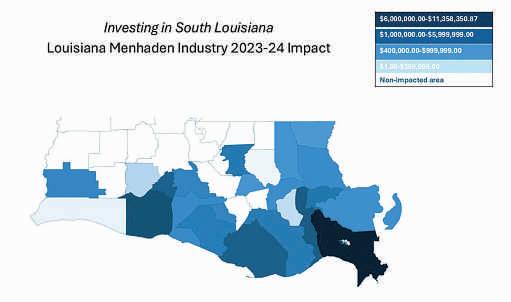
woven intoour culture, themenhaden industry ensures thateconomic opportunityremains arealityfor coastal families
Regional Economic Impact Together,OmegaProtein and Ocean Harvestersgenerate well over$100 million in economic activityannually, benefiting Vermilion Parish and surrounding areas.With aworkforce of morethan 260direct and skilled employees,thesecompanies provide stable,high-wage jobs,offering more than $21 million in annual payroll and benefits –making them among thelargest and highest-paying employers in theregion. Likewise, Westbank Fishing, aLouisianabased, U.S.-owned company, plays avital role inPlaquemines Parish, with all its catchprocessed locally at Daybrook Fisheries in Empire, LA. Together,these operations support over400 employees, making itthe largest employerinsouthern Plaquemines Parish.In 2023, total employee compensation, including wages, bonuses,and benefits, reached $36.5 million,
underscoring the industry’s critical economic role in theregion. Statewide, the Louisiana menhaden industry procures goods valued at over $62.4millionfrombusinessesin32 parishes.Beyond its coreoperations in Plaquemines ($11.4million) and Vermilion($7.4 million) parishes, significantindustry-relatedexpenditures
flowinto: JeffersonParish ($6.4 million), Terrebonne Parish ($6 million), Lafayette Parish ($5.9 million), Orleans Parish ($3.7 million), East BatonRouge Parish ($3.5 million) and Lafourche Parish ($3.2 million), among others

Additional parishes benefiting from over $1 millionin industry-driven spending include St.Mary,St. Martin, Calcasieu, Iberia,St. Tammanyand St.John the Baptist.Many othersreceive between $500,000 to $1 million, reinforcing howthe menhaden industry fuels localeconomies farbeyond coastal fishing communities This widespread economic footprintin Louisiana underscores the industry’s vital role in creating jobs supporting small businesses, and


sustaining Louisiana’sworking coast statewide.
CommitmenttoSustainability and Innovation
When the Louisiana menhaden industry thrives,sodoour coastal communities.Weare committedto both economic growth and responsible stewardship of our unique coastal environment. Our work supports:
•A science-driven approach to fisheries management, ensuring responsibleharvest levels and minimal environmental impact
•Long-term jobstabilityfor generations of fishing families
•Innovation in marine ingredient production to improve nutrition worldwide Louisiana’smenhaden industry has long-balanced economic prosperitywith responsiblestewardship of ourmarine resources.Through science-based managementand ongoing innovation, we remain committedtosustainable fishing practices thatprotect our waters support our communities,and drive economic growth. As we look to the future, this industry willcontinue to provide stablejobs, strengthen local businesses, and deliver essential products thatpowerglobal nutrition—ensuring thatLouisiana’sworking coast thrives for generations to come.







LOUISIANA

PULLING TOGETHER
Breast cancer warriors practice on Bayou St. John for rowing competition in Boston
BY EMILY WOODRUFF Staff writer
Shortly before sunset on a recent Wednesday, a group of women stepped into a long, narrow boat on Bayou St. John. At the coxswain’s command, they pushed off, eight blades cutting into the bayou at once.
It’s a far cry from their first practice about a year ago, when they could barely lift the boat into the water
The women belong to the Survivor Rowing Club, a team of breast cancer survivors who meet several times a week to row and workout. Of around 28 rowers, only one had ever rowed before. But they all know the lasting effects of
breast-cancer treatment the fatigue, scars and fear of recurrence. Out on the bayou they’re trying to reclaim strength, community and the parts of themselves that felt buried by the cancer Later this month, they’ll compete in their very first race, and it’s a big one: the Head of the Charles Regatta in Boston, the world’s largest rowing competition, often described as the Super Bowl of the sport.
“It’s like the mecca of rowing,” said coach Rob Phillips, watching from the banks of the bayou before starting the electric motor on his boat. “They’re starting with the mecca.”
ä See ROWING, page 2X

Researchers grow mini-hearts with blood vessels
BY MIRIAM FAUZIA
DALLAS Scientists at the University of North Texas report a breakthrough in building tiny, lab-grown replicas of human organs. These replicas, called organoids, can mimic some functions and structures of real organs, but a key limitation has been the lack of blood vessels. The UNT team, working with Stanford Univer-
sity, managed to grow mini-hearts that have their own blood vessels. Using the same strategy, the researchers also created vascularized mini-livers. The study, published in Science in June, suggests a path toward more realistic organ models for studying disease and testing clinical therapies. This research could also one day help tackle barriers scientists face in generating full organs outside the body, said Gi-
useppe Pettinato, director of the stem cell and organoid research lab at Beth Israel Deaconess Medical Center in Boston, who was not involved in the study
Organoids are grown from stem cells that mimic real tissue. Despite advances in growing organoids since the mid-2000s, there has remained the challenge of incorporating blood vessels, said Adam Yang who co-authored the study and is an assistant professor
of biomedical engineering at the University of North Texas.
Guiding stem cells into tissue demands a precise diet and timing of nutrients and growth chemicals. Typically, scientists mature each cell type under its ideal conditions and then mix them together, Yang said. But in true organs, multiple cell types develop side by side and influence each other’s growth.
Yang and his colleagues focused on growing heart organoids, a
project he became involved with at Stanford in 2016 and brought with him when he joined UNT in 2020.
The researchers arranged human stem cells into precise shapes using a technique that guides stem cell growth with geometric cues, Yang said.
To track the development of each cell, Yang and his colleagues added genetic tags that glowed
ä See MINI-HEARTS, page 4X



STAFF PHOTOS By SOPHIA GERMER
The Survivor Rowing Club practices on Oct 1 on Bayou St. John in New Orleans as they prepare to take part in the Head of the Head of the Charles Regatta in Boston.
Catherine Koppel, left, rows in front of coxswain Kathleen Robert.
The Dallas Morning News (TNS)

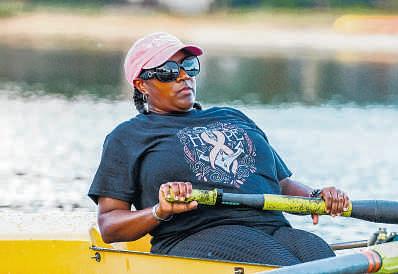
ROWING
Continued from page 1X
Fighting against recurrence
Dr Karen Blessey, the group’s founder was diagnosed with breast cancer 10 years ago. An internal medicine doctor, she was used to being the one giving diagnoses
“Facing your mortality at 45 with two small children was very humbling,” Blessey said She started the local chapter last August, recruiting other people she knew with breast cancer Rowing is historically an expensive and exclusive sport But not for Survivor Rowing Club. All breast cancer patients are welcome, and Ochsner Health, where Blessey works, has provided much of the funding to rent equipment so the club remains free to everyone.
The women range in age from their 30s to their 70s. Some finished treatment years ago; others are less than two years out from their last surgery But they’re all still navigating what comes after survival: regular checkups, side effects from hormonal treatments or surgeries, and the fear that the cancer might come back.
That’s one reason why Blessey focused on rowing, despite never having done it before. Research shows that 150 minutes of moderate to strenuous exercise — “real huffing and puffing” — weekly decreases the risk of recurrence. For those who can’t or don’t want to row because they haven’t regained their range of motion, the club offers an alternative: Walk on Water, which hosts weekly walks by bodies of water
“It’s one thing to just tell people you need to exercise,” Blessey said. “It’s another thing to give them a way to do it.”
Lauren Reech first heard about the club from a co-worker who was also a survivor She was a runner, but didn’t know the first thing about rowing. She loves the sport now But the support from people who understand that cancer doesn’t end after you ring the bell keeps her coming back.
“It’s not just like a time in my life that was 10 years ago,” said Reech, who was diagnosed at 35 after a family member’s diagnosis prodded her to get a mammogram herself. “The effects of it are felt for a lifetime, whether it be pain, menopausal symptoms, body-
image issues. You kind of all have that in common.”
Allison Durant 60, was treated for breast cancer nine years ago.
When she lost her hair, she had a hard time recognizing herself in the mirror Rowing makes her feel like herself.
“It makes me feel young, like part of some sort of baseball team,” Durant said. “It takes you back to this youthful place of everybody working together for a common good, and it takes the focus off of the breast-cancer part.”
‘This is rampant’
At Phillips’ first meeting with the group, there were nine women. In true New Orleans small-world fashion, he knew six of them but had known about a cancer diagnosis for just two of them.
“That’s when I was like, ‘OK, this is rampant,’” Phillips said, whose mother is also is a breast-cancer survivor
Breast cancer is the most commonly diagnosed cancer among women in Louisiana, accounting for nearly 14% of all invasive cancers statewide. Over 3,700 new cases are found each year, according to statistics compiled by LSU Health. Louisiana ranks No. 4 in the nation for its breast-cancer death rate.
“When another friend ends up with cancer my first word is ‘F***.’
Another one,” said rower Erika Olinger
For Gwen Taylor, 50, October’s onslaught of pink ribbons and 10Ks used to be a painful reminder of loss. She lost her mother and aunt to breast cancer — both diagnosed in their 30s and gone in their 50s.
At 45, an MRI found hers, even though she tested negative for genetic links.
“When they would have those breast cancer walks, it didn’t save my mom,” Taylor said.
Now, she’s running in the Crescent City Classic and it’s “pink everything,” along with rowing several times per week.
“I know I’m doing something to keep me healthy, so it doesn’t stress me out like it used to,” Taylor said.
‘We’re warriors’
Still, a lot of the women have developed a distaste for some of the culture that creeps up around October
“We hate the term survivor,” said Olinger “We’re warriors. We’re gonna beat the s*** out of it.”
That camaraderie carries them

through. When they don’t feel like showing up for their three-day-aweek practices, they keep each other in line.
“Get your butt here,” one teammate told another “I am waiting for you. I got a playlist.”
At one point during a recent practice, as the women finished another long row, Suzette Doucet, just a year and a half out from her last surgery, had a request.
“This is going to sound crazy,” she said.
“You, crazy?” laughed her teammate.
“Could you make waves for us?” she asked the coach following them in a small boat.
The coach took the lead, weaving back and forth to simulate the conditions they might face in midOctober’s Head of the Charles.
While there will be no 10-foot alligator sightings in Boston, there will be more turns, more wake and far more boats to navigate around.
The team rowed through it, perfectly timed. After treatment, Doucet couldn’t lift her hands over her head. She couldn’t lift luggage into the overhead bin. Rowing helped her find herself again.
“We went from feeling strong, to losing your identity and feeling weak, to feeling strength again and the joy and the humor of all these smart-alecks running around,” she laughed.
Email Emily Woodruff at ewoodruff@theadvocate.com.


WE WANT TO HEAR FROM YOU
The Louisiana Health section is focused on providing in-depth, personal accounts of health in the state.This section looks at medical innovations, health discoveries, state and national health statistics and re-examining tried and true methods on ways to live well. Health editions will also profile people
who are advancing health for the state of Louisiana.
Do you have a health story? We want to hear from you.
Email margaret.delaney@theadvocate. com to submit health questions, stories and more.
STAFF PHOTOS By SOPHIA GERMER
Members of the Survivor Rowing Club carry their boat to the water on Oct. 1 at Bayou St. John in New Orleans.
Members of the Survivor Rowing Club get ready to practice.
Coach Robert Phillips talks to the Survivor Rowing Club from an electricmotored boat
Gwen Taylor rows as the Survivor Rowing Club practices on Oct. 1.
The Survivor Rowing Club members row on Bayou St. John.


WYes, youcan have your Mondayred beans and EatFit,too

Ir fascinating my Mon if that up Bat Mon the least growing and Louisiana, passed of Monday and Sunday al hocks are co en we face lo hanging (which original co into ex —a su haveourredbeansandourMonday comfortfood,too.
Redbeansarewildlynutritious.They’re apowerhouseforfiberandplant-based protein,plusthey’reamongthefoods withthehighestantioxidantcontent. Thequietheroofbetter-for-youred
MollyKimball,RD,CSSD,isaregistereddietitian withOchsnerHealthandfounderofOchsnersEatFit nonprofitinitiative.Formorewellnesscontent,tuneinto Molly’spodcast,FUELEDWellness+Nutrition,andfollow @MollykimballRDand@EatFitOchsneronsocialmedia Emailnutrition@ochsner.orgtoconnectwithMollyor scheduleaconsultwithherteam.
BY THENUMBERS LA.TOPSU.S.AVERAGE CHILDCARE CENTERSPER 1,000 CHILDREN

Youcanfindthisrecipeandmany moreinTheEatFitCookbook.Purchase yourcopyonlineorfindlocalretailersat ochsner.org/eat-fit/shop.Besuretouse promocodeADVOCATEatcheckoutfor 10%offyourorder.
Free bystanderCPR training eventinVermilion Parish
BY MARGARETDELANEY Staff writer
HEALTH NOTES
n SUN Bucks.


On Saturday,Oct. 25, Acadian Ambulance and Abbeville General Hospital will host two free community CPR training sessions. Both sessions will be at Kaplan High School, 200 E. Pirate Lane, Kaplan. One sessionwill be from 9:30 a.m. to 10:30 a.m., and the second sessionwill be from 11 a.m. to noon.
Registration open for diabetessymposium





Thetraining will provide instruction on hands-only CPR trainingand highlight the benefitsofbystander CPR. It will also include demonstrations on what to do whensomeone is choking, theuse of an automated external defibrillator and stop-the-bleed techniques. Cancer center completes Gonzales renovation


In September,MaryBirdPerkins Cancer Center completed therenovation and expansionofits Gonzaleslocation at 1104 W. La. 30. The 6,000-square-foot facility expansion features a2,500-square-foot infusion suite with 14 semiprivate infusion bays and one privateroom, astate-of-the-art lab, aretail pharmacy,new exam roomsand more
North Oaks Hospital System invites community members to its annual Diabetes Symposium from 11 a.m.to12:30 p.m. on Nov. 4. With athemeof“Every Step Matters,” the event is geared to help participants take control in their diabetes journeys. It will be hosted in the E. Brent Dufreche Conference Center within NorthOaksDiagnostic Center, at 15837 Paul Vega M.D. Drive, on the North Oaks Medical Center campus in Hammond. Admission is free, but preregistration is required and can be completed online at northoaks.org/diabetessymposium2025. SU Ag Center relaunchesfree teletherapyrural communities


Onaverage, there are 4child care centers per 1,000 children in Louisiana, slightly higher than the national averageofthree centers
Accessible, affordable child care can increase opportunities for parents or guardians to pursue further education or participate in paid work to earn income and in somecases, gain health care andretirement benefits to support their families.
Research has shown that, in addition to supporting economic securityfor families, access to high-quality child care contributes positively to achild’s health and development, according to the University of Wisconsin PopulationHealth Institute’s2025 County Health Rankings & Roadmaps. These parishes had the mostchild care


Southern University Ag Center’sfree virtual counseling program “Rural Connections for Rural Resilience,” hasreopened for enrollment.



centers per 1,000 children, in descending order: n Madison Parishwith 9 child care centers per 1,000 children.
n East Carrolland West Feliciana parishes with 8 child carecentersper 1,000 children.
n Avoyelles, Franklin, Iberville, Lincoln, St Helenaand Webster parishes with 7 child care centers per 1,000 children These parishes had thefewest child care centers per 1,000 children, in ascending order:
n LaSalle,Sabine and
parishes with 1 child
per 1,000 children.
n Assumption, Beauregard, Jackson, Red Riverand
Patients will also gain accesstoenhanced programs and resources, including apatient navigator,adietitian, palliative care specialists andclinical trials. This expansion will more than triple theGonzalesCancer Center’s capacity,allowing it to serve over 300 patients each month.
Louisiana Department of Health acquires SNAP
TheLouisiana DepartmentofHealthhas acquiredthe Supplemental NutritionAssistance Program fromthe Departmentof Children and Family Services. SNAP will continue to provide benefits to participants without interruption in service. There are no changes to eligibility as partofthis move. The shift simply brings SNAPunder thedepartment so that nutrition assistance can be better aligned with other servicesunderthe department, such as Medicaid, officials said.
The goal of thetransition is to consolidate benefit applications into one agency,reducing paperwork and wait times for residents and increase efficiency of staff.
In additiontoSNAP, LDHisalsoacquiring thefollowing services from DCFS: n Disability Determination Services, n Electronic Healthy Incentives Project, n Family Independence Temporary Assistance Program, n Kinship Care Subsidy Program,
The program, which is open to adults, aims to combat alarming mental health trends by providing free teletherapy services to rural communities where access to mental health services is often limited due to geographical barriers. The program will run until July 15, offering eight free counseling sessions with licensedmentalhealth professionals through acollaborationwith Soundminds Counseling. To sign up forthe Rural Connectionsfor RuralResilienceprogramvisit, bit.ly/4pvD37W ProjectLazarus WellnessCenter opens in NewOrleans
Project Lazarus Wellness Center celebrate the restoration of theprogram as ahub for residential programming, social offerings andcommunity collaboration in support of at-risk individuals living withHIV whoare facing housing insecurity
The NewOrleans-basednonprofit, at 2824 Dauphine St., was founded in 1985 to provide assistance in transitional and supportive housing, accesstomedical andwellness programs andopportunitiesfor community engagement.
Health Notes is an occasional listing of health happenings around Louisiana. Have something you’d like to share? Contact us at margaret.delaney@ theadvocate.com.
HEALTH MAKER
Tulane senior raises $1.5M for biotech startup
Firm developing test to check ticks for Lyme disease
BY MARGARET DELANEY Staff writer
Exactics, a biotech startup, is developing multiple at-home tests for infectious diseases, starting with a rapid test that will allow users to determine if a tick carries the pathogen that causes Lyme disease. It takes 15 minutes.
Dylan Murray, a computer science, premed and psychology senior at Tulane University, is the co-founder and chief operating officer of Exactics and the pioneer for much of its funding. The startup was founded by students from the University of Chicago and Tulane: Julian Kage, chief executive officer; Sean Greeby, chief scientific officer; Max Almeida, chief technology officer; and Zachary Sarmoen, chief financial officer
Murray tapped both Tulane University and the University of Chicago’s grant programs to raise $1.5 million for the Exactics company What did the early days of the biotech startup look like?
My co-founder Julian Kage, was my lab partner in freshman biology at the University of Chicago, before I transferred to Tulane He was tall. He was in a fraternity He was not at all what I was expecting. We became lab partners because we both wanted to get through our labs as fast as possible. We were great friends instantly But back in 2018, when he was only 13 years old, he had this best friend who started getting incredible

Kage and Dylan Murray.
pains in his joints and his legs His friend had this fatigue, and he had to stop spending time with Julian and a lot of his other friends. Doctors spent months trying to figure out what was wrong. They found later that it was Lyme disease Julian, who had been looped into an invention convention circuit in middle school, was primed to ask himself, “What’s the solution?” Julian recalls one day watching a school nurse pick ticks off of kids at the school’s nursing office He said, at 13, “That’s when we should be testing. That’s when you should be able to know if your is for Lyme disease.”
At 13, he created an alpha design for a lateral flow immunoassay — which is a fancy way of describing something like an at-home
rapid test like COVID tests or a pregnancy test.
He created a design for a test that would be able to take a tick as a sample and test it to determine whether or not the tick had recently transmitted Lyme disease. He won all these awards, including a grant from the Ford Foundation that would allow him to apply for patents.
At 18, when he finally arrived freshman year at the University of Chicago to be lab partners with me in biology, he received the patents for his tick-testing technology
What is the importance of this technology for Lyme disease?
Lyme disease is a really big problem in the North, and it’s spreading to all over America. Rates have been increasing, and states that have rarely seen cases are
seeing them higher than ever before.
Dogs and horses are also at risk. By feeding on your blood, if a tick is carrying the bacteria for Lyme disease, it will transmit the bacteria to you and give you Lyme disease.
The problem that Julian’s childhood friend, Brendan, faced, and that about half a million Americans face every year, is that we often don’t catch the symptoms in time.
The unfortunate thing about Lyme is that it can become untreatable over time. This can happen in a matter of months. It can happen a matter of years. You can develop muscle paralysis. You can develop brainstem swelling or joint pain arthritis if you don’t catch Lyme disease in time.
This test streamlines ev-
erything.
With this test, just take the tick, crush it into the test, and it tells you if the tick was carrying Lyme disease.
How did you become involved with Exactics?
I traveled to New Orleans with my ex-partner over Easter It was very last minute, but I fell in love with New Orleans. I applied to transfer to Tulane for my sophomore year of college on the plane ride back to Chicago.
I was just more of a Tulane-ian at heart.
The next year, the summer after my sophomore year at Tulane, Julian, my old lab partner, called me.
He said, “Remember those patents I was telling you about? I’m going to start a company, and we’re going to a pitch competition. I was wondering if you could help me convince people that this is a good idea.”
That’s where this starts for me.
The reason I was brought on was to talk to people.
That summer in New Orleans, I made the trip twice to Chicago to talk about Exactics. I would pitch to everyone. My Uber driver The waiter The flight attendant on my travels home.
In May 2024, I got to start as the chief operating officer of Exactics.
Tell me about the business plan and launch of the TiCK Test for 2026?
Our first test is called the TiCK Test. It will be launching in 2026 through our licensing partners.
Zach, Julian and I, as part of our business plan, wanted to go out and find a company that already has established brand to use their distribution path to sell the test. We found Tick Solutions Global, the inventors of
the TiCK MiTT, who have a vast international distribution network. They will support our 2026 launch for the TiCK Test in major pet health and outdoor retailers. We want to partner with companies like Tick Solutions Global to sell our tests so we can go to market and reach a wide swath of customers as soon as possible. We’re making another version of the TiCK Test — currently called TiCK Test Plus — to test ticks for up to 200 tick-borne diseases. What are the next steps for this startup?
I think sometimes we get pigeonholed as a tick-testing company That couldn’t be further from the truth. We’re currently working on solutions for broader infectious diseases. After tickborne diseases, it’s going to be STDs. The idea is to have the exact same business model where we’re going after companies that have that established brand and using their brand association to help sell our tests get to people as soon as possible. When we started this, Julian and I both wanted to be doctors. I remember us studying for our freshman chemistry exams, our bio exam, thinking about another four years of this work, and then another of medical school and another four years of residency We wanted to be doctors because we wanted to help people. What I think we both realized is that our new path in this company offers us an opportunity to help people on a ginormous scale — if we can pull it off. This is the next chapter of our lives — launching this company and getting it off the ground. This interview has been edited for length and clarity
Things that sting: How to handle bug bites in South Louisiana
BY SHANTELL GOMEZ
Contributing Writer
In Louisiana, pesky bug bites are far too common — even into fall and sometimes winter
There’s no escaping mosquitoes. Even a cold winter won’t keep the stinging, biting creatures away for long. Swatting, scratching and attempts to outsmart the bugs that thrive in our warm, humid climate is the norm. So what can be done to treat and prevent the things that sting from going from bad to worse?
From mosquitoes to caterpillars, here’s what to know:
Mosquitoes
Sitting through a soccer game at dusk, many know that the mosquitoes are relentless. They thrive in Louisiana’s wetlands and abundant water They especially love hanging around at sunrise and sunset. They’re not just a nuisance — mosquitoes can also carry West Nile virus and other illnesses. According to the Louisiana Department of Health, West Nile virus is endemic to all parts of Louisiana.
“When an insect bites, it leaves behind its saliva, which our body’s immune system reacts to. Histamine is released, causing inflammation and itching,” said Lauren W. James, a nurse
MINI-HEARTS
Continued from page 1X
different colors for different cell types, then fed the cells a recipe of nutrients and growth chemicals designed to help blood vessels blossom alongside heart tissue. With that method, the researchers could watch a human heart unfold in real time. “You can see the heart beating as soon as day nine or 10,” Yang said. After about two weeks of nurturing, the research-
practitioner and Lafayette resident
That’s why bites swell and itch so quickly
Don’t forget the basics, James said, use insect with DEET or picaridin (a synthetic compound first made in the 1980s that is odorless).

“Controlling mosquito populations in your yard is key,” James said.

ness or trouble breathing, call 911 immediately
Caterpillars
Some of the fuzzy caterpillars in Louisiana carry the worst stings. The puss caterpillar for example, hides venomous spines that feel like a burning rash when touched.
“Kids are especially at risk because caterpillars look so harmless,” James said.
These medications work by blocking histamine, a substance released during allergic reactions that causes itching and inflammation.
Keeping bugs out
While no method is perfect, a few simple steps can make a difference:
n Install screen doors on entrances that tend to be left open.
“Empty and clean anything that holds water at least once a week — buckets bird baths even kids’ toys. Mosquitoes are attracted to scent too, so skip perfumes or scented lotions if you know you’ll be outside.”
PROVIDED PHOTO
Nurse practitioner Lauren W. James notes, ‘Controlling mosquito populations in your yard is key. Empty and clean anything that holds water at least once a week — buckets, bird baths, even kids’ toys. Mosquitoes are attracted to scent too, so skip perfumes or scented lotions if you know you’ll be outside.’ James
To treat bites, wash the skin with soap and water, then press on a cold pack.
A hydrocortisone cream with soothing ingredients like aloe or oat can calm the itch. If resisting a scratch isn’t possible, James recommends covering bites with a bandage
“It helps avoid a superficial infection,” James said.
Ants
The LSU AgCenter advises that if stung, use tape to pull out the spines, wash with soap and water, then apply ice packs. Severe symptoms like nausea or headache require immediate medical care.
Remedies
n Run a diffuser with essential oils like citronella or peppermint on the patio.
n Keep the yard trimmed and clear of debris, which attracts insects.
n Wear loosefitting long sleeves and pants to prevent skin exposure to insects and their bites.
Alcohol wipes create temporary relief, but the best bet is to wash with soap and water, apply ice and use hydrocortisone cream or an antihistamine like Benadryl.
If the bite is scratched open, dab on a little Neosporin or Mupirocin to avoid infection And as tempting as it is, don’t scratch — that only makes it worse. Bees and wasps
Bees usually sting only when provoked, while wasps are more aggressive and can sting multiple times. Both hurt immediately, and swell-
Fire ants are another Louisiana trademark. One ant may bite, and suddenly there are a whole bunch of welts. For prevention, wear shoes in grassy areas and gloves while working in the yard.
ers saw the mini-hearts had built their own branching blood vessels, complete with hollow tubes, although without circulating blood The mini-hearts also formed the three layers of their larger counterparts and even some nerve cells
The researchers ran tests that showed these organoids looked and behaved like human hearts about six-and-ahalf weeks into pregnancy, Yang said. To show their recipe works for other organoids, the scientists used the same approach to grow
mini-livers that developed hollow blood-vessel networks alongside various types of liver cells.
Since what Yang and his colleagues grew are technically gastruloids, or embryolike organoids, it’s unclear whether their approach will yield a mature vascularized model, Pettinato said.
A gastruloid helps understand how the body assembles itself in the early stages of development, Pettinato explained. “But with an organoid, you have to have an actual, functional 3D struc-
ing can last a couple of days.
“The first thing to do is check for a stinger — bees leave them behind, wasps don’t,” James said.
Scrape it out with something like a credit card, not tweezers. From there, a cold pack, antihistamines, or even a simple baking soda paste can help with pain and swelling.
“Most people will have a mild localized reaction — redness, itching, and swelling,” said James. “But more severe allergic reactions, such as anaphylaxis, can be life-threatening.”
If swelling spreads beyond the bite or you notice dizzi-
ture that will mimic what is a real organ.”
Such organoids afford scientists a bird’s-eye view into how organs form. They can also help model diseases in human tissue and test how drugs interact with such tissue. This could accelerate drug discovery and open doors to more personalized medicine. Organoids are already used in preclinical research. Intestinal organoids have helped reveal how COVID-19 invades the gut and brain organoids are shedding light on
While some remedies may take the edge off like tobacco on a bee sting or mud on mosquito bites — James said the best path is still straightforward.
“Clean with soap and water, use ice for inflammation, apply cortisone cream, and if needed, take an oral antihistamine. Most people already have everything they need at home,” James said.
According to the Louisiana Pharmacists Association, over-the-counter treatments such as topical antihistamines can be effective in managing itching and swelling associated with insect bites and stings.
early-onset Parkinson’s disease. Cancer organoids are being used to screen chemotherapies and match breast cancer patients to more effective treatments. Yang acknowledges there’s still work to be done to create organoids that have the same complex vasculature as inside the body He hopes to replicate larger blood vessels like arteries and veins and potentially have real blood circulating through an organoid. Another innovative avenue of research is incorporating
Bug zappers may look satisfying, but research shows they kill more harmless insects than mosquitoes. You’re better off with repellents, fans on the patio, and screens on your windows. Living in south Louisiana means dealing with bug bites it’s just part of life. But being prepared can save a lot of discomfort Keep bug spray in the car, cortisone cream in the cabinet and ice packs ready to go in the freezer
Ultimately, the goal is to enjoy being outside while striking a balance with the creatures that come with it.
nanomaterials into organoids to harness their diagnostic and therapeutic potential, such as for gene therapy something that Yang is also looking into. In gene therapy, organoids could be used to test a variety of drugs that compensate for faulty genes, sussing out the risk before testing in humans, Yang said. If he and his team could create a system for testing any kind of therapy or treatment, he added, it could provide better guidance and confidence for clinical trials.
PHOTO PROVIDED By EXACTICS
Exactics cofounders in Chicago Lab HQ with a prototype of the TiCK test include, from left, Sean Greeby, Julian
Ochsner combines innovation and compassion in blood cancer treatment forAcadianapatients
By Amanda McElfresh amcelfresh@theadvocate.com
Thisstory is brought to you by OchsnerHealth.
AtOchsner Cancer Center of Acadiana, people diagnosedwith blood cancers
find morethan the latest treatments —theyalsofind avillage of peopleready to help them on their journeyback to health. With adedicatedteam of board-certified hematologists and oncologists, specialized nurses, genetic counselors, dietitians and support staff,the Center combines cutting-edge therapies with compassionate community-focused care
Blood cancersaccountfor only about 10%ofall cancer diagnoses,orapproximately 187,000 patients nationwide each year.Most forms of the diseaseare classified as leukemia,lymphoma or myeloma,although thereare some relateddisordersoften grouped with blood cancers. But within thatrelatively small percentagelies awide varietyofdiseasesubtypes,each with its owncomplexities
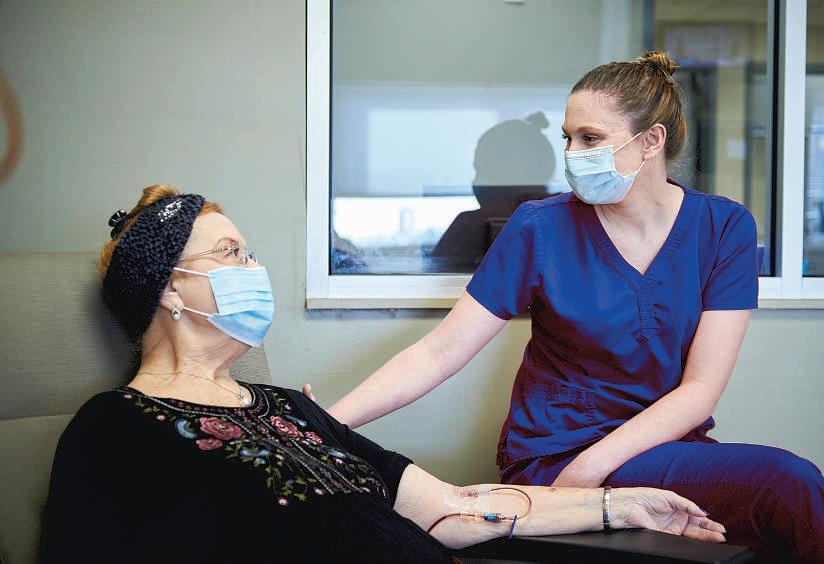
wasdiscovered.
“In most cases, thesetypes of cancers do not have one definitivecause,”said Steven J. Saccaro, MD,hematologyoncology, Ochsner Cancer Center of Acadiana.“Some peopleare born with genetic predispositions.Some maybe at risk if theywereexposed to certain medications or environmental toxins Based on the subtype of blood cancer patients maypresent with different symptoms or even no symptoms at all.”
Treatmentplans depend on a patient’sparticular type of cancer, their overall health and the severityofsymptoms Options rangefromcareful observation and regular testing to chemotherapy, bone marrow transplants immunotherapyand newer cellular therapies
“Some cancerscan remain at alowergrade forawhile,”Dr. Saccaro said. “If symptoms develop or the diseasebecomes moreaggressive, we move forwardwith the treatmentwebelieve will work best foreach patient.”
Dr.Saccarorefersthose patients to Ochsner MD AndersonCancer Center in NewOrleans forthe therapywhile continuing to managetheir care in Lafayette. Treatmentinnovations have made substantial differences forpatients.Two decades ago, the five-year survival rate forpeople with chronic myeloid leukemia was50%, and the standardtreatmentprotocol washigh-dosechemotherapyand a bone marrow transplant.
StevenJ.Saccaro,MD
Dr.Saccarosaid thattoday, the five-year survival rate is morethan 80%, and most patients only need to takea pill fortheir treatment.
therapies with adeeply supportivecare team, Ochsner is redefining whatcancer care lookslikeinSouth Louisiana —providing hope, healing andthe very best treatments to people in Acadiana “Having awelcomingenvironment surrounded by knowledgeable people who have experience in this world can reassurethem,”Dr. Cain said. “If someone has areaction or aproblem, we areable to addressitimmediately becausewehave done this before.”
“Thesetreatments hold alot of promise, and we have had very good results with alot of differenttypes of blood cancers. The targetedtherapies have been amazing,”hesaid. “HereinLafayette, we have conventional chemotherapyand other therapies,plus accesstoour partners formoreadvanced therapies.Itisamazing to bring thosetreatments to Acadiana and expeditepatientcare.



Increasingly,thattreatmentinvolves immunotherapy. Whilechemotherapyis designed to destroy cells,immunotherapy instructs apatient’simmune system to recognizecancer,and in the best case scenarios,attack or defend against it
“The applications of immunotherapyare growing exponentially,” said Michael S. Cain, MD,hematology oncology, Ochsner CancerCenterof Acadiana “The number of cancers thatcan be targetedwith immunotherapydrugsalsocontinues to increase. We’reevenmoving from infusions to moresubcutaneous injections,which can be easier formanypatients.”
Forpatients with relapsed lymphoma or myeloma,anewer option maybetouse apatient’sown T-cells to attack the cancer through CART-cell therapy, or chimeric antigen receptor T-cell therapy.
“CAR-T has been one of the most exciting advances.Ithas replaced the need forabone marrow transplantin some lymphoma patients,” Dr.Saccaro said. While CAR-Tisnot offered locally

“We’ve seen many improvedoutcomes as oral drugsand injectables have become morewidely available,”hesaid. “Survival rateshavegreatly improvedfor blood cell cancers, and thereare a lot of therapies still being investigated. Alot of people areliving with thesediseases.We’re continuing to makeit possible forpeople to livelonger,healthier happier lives.”
Regardlessofthe treatmenttype, patients from across South Louisiana receivecareatOchsner Cancer Center of Acadiana’s infusion centerinLafayette. Dr.Cain noted that beyondchemotherapy, the centerprovides immunotherapy, antibiotics,blood and platelet transfusions,catheter and port maintenance andgamma globulin infusions
MichaelS.Cain,MD
“It truly is an all-encompassing infusion center. We’vedesigned it to be as comfortable and welcoming as possible,”Dr. Cain said. “The centerherein Lafayettehas 72 chairsand 18 nurseswho aretrained to administer thesemedications.Wesee about 1,700 patients per month. Schedulingquickly is very important becausewe don’twantpeople to wait.”
Ochsner alsohas smaller infusion centers in NewIberia,Crowleyand Jennings. Dr.Cain said theselocations bring advanced treatmentcloser to the patients, and the medications used thereare the same as thoseusedinlargercancer centers By combining theseleading-edge
Dr.Saccarosaid the Lafayettecampus includes physicians,counselors, nurse navigators,social workersand others who provide holistic care to patients and their families and tap into the larger Ochsner network if theyneed additional

CAR-Thasbeenoneofthe mostexcitingadvances. Ithasreplacedthe needforabonemarrow transplantinsome lymphomapatients.
StevenJ.Saccaro,MD
support or resources
“Wecollaborate every day. The six physicians in themain cancer centerin Lafayettetalk on adaily basis about the best thing to do in certain situations,” Dr.Cain added. “Weask each other if someone elsehas encounteredsomething similar and howtheyhandled it.Wetalk often to our colleagues in NewOrleans and BatonRouge. We hold regular case reviewmeetings, called tumor boards wheremultiple specialistscome together to discusspatientcare. The goal is always to bring the highest leveloftreatment, and moreand more,thatcareistailored to each individual.
This seamlessprocessmeans that multiple specialists canoffer guidance.For example, Dr.Saccarosaid thatwhenarecentpatient’streatmentstoppedworking, he and his team connected with another Ochsner location to enroll him in aclinical trial, lessthan twoweeksafter the problem
Forthe thirdconsecutiveyear Ochsner LafayetteGeneral Medical Center (OLGMC) —inclusiveof Ochsner LafayetteGeneral Surgical Hospital, Ochsner LafayetteGeneral Orthopedic Hospital and Ochsner Cancer Center of Acadiana has been ranked the Best Hospital in Southwestern Louisiana Among its distinctions,OLGMC is recognized by U.S. News &World Report as High Performing in Leukemia,Lymphoma and Myeloma —one of eightareas where the Center meets topnational benchmarks in outcomes,complications and nursing quality. This recognition underscores the excellence of OLGMC’sblood cancer care team and ensurespatients in Acadiana have accesstonationally recognized expertiseclosetohome.

Havingawelcoming environment surroundedby knowledgeablepeople whohaveexperiencein thisworldcanreassure them.Ifsomeonehasa reactionoraproblem, weareabletoaddress itimmediatelybecause wehavedone thisbefore.
MichaelS.Cain,MD

Expert cancer care close to home



JasonBreaux,MD
SurgicalOncology
AtOchsnerCancerCenterofAcadiana,webelievethateveryindividual’s journeywithcancerisunique.Withcompassionandexpertise,wecollaborate withyoutodevelopacomprehensivetreatmentplantailoredtoyourspecific diagnosis.Weunderstandthattheroadtoremissioncanbechallenging,but withusbyyourside,hopeandhealingconvergealongyourpath,and—in thefaceofcancer—youareneveralone
Learnmoreatochsner.org/CCA
LOUISIANA
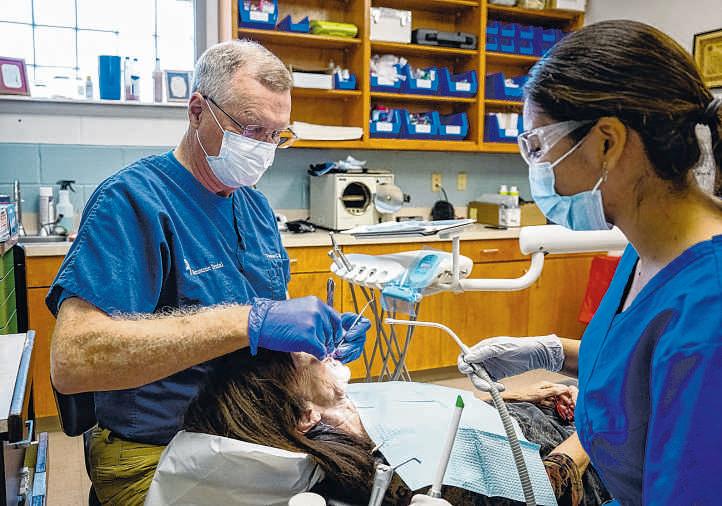
Fulfilling
God’scalling
Team of dentists serveby healing thoseinpain
BY MATT BRUCE Staff writer
Faith abounds in many different ways.
For some,ittakes shape in mentorship to the lost and broken, while othersare inspired to donate to the poor and misfortunate.
One of the ways faith shows its face at St. Vincent de Paul in Baton Rouge is through ateam of medical professionals that work to provide free dental care for people in desperate need.
Forthe pasteight years, alegion of oral surgeons, pharmacists, retired dentists, nurses and other practitioners have participated in avolunteer program that treats uninsured patients with dental emergencies whenthose patients can’t afford to payfor the much-needed treatment.
“It feels like that’s what Godwants us to do. And there’snothing that makes me feel better than to be certainthatthis is what Godwants me to do,” said Dr Steven Brooksher,one of theprogram’s
founders. “There are few times in my life where he’sput his fingeronmeand told me this is whereheneeds me. If you can be clear aboutthat,you don’thave to worry about anything else. Youcan trust thatGod will take care of you.”
Meetinga need
Dental care for indigent populations emerged as perhaps the biggest unmet need in the capital city’shealth care system years ago. Hospital staff workers at emergency rooms in the area were surveyed andpointedtoa growingcrisis: Howtohandle homeless and low-income patients that go to the ER in excruciating pain with adental emergency that requires immediate attention when they have no health care coverage?
There wasnowhere in BatonRouge to send uninsured patientsfor dental treatment in thosescenarios.Doctorsoften prescribed them medicine to relieve the pain. But once the meds ran out, patients inevitably showed back up in ERs or urgent careclinicsweekslaterwith the same untreated problem.
To address that challenge,Baton Rouge leaders established the Baton Rouge Area Volunteer Dentists,orBRAVO,program in 2018. By then, St. Vincent de Paulhad already been running aone-mandentist
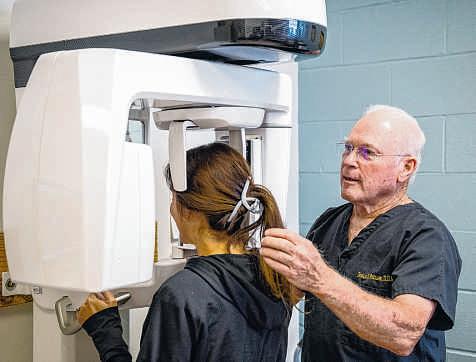

office inside its community pharmacy for decades.The small clinic was at that time an internal operation —only used to treat transient guests from St. Vincent de Paul’shomeless shelter.The BRAVO program openedthe clinic’s services up for patients allacrossthe city. Anyone who proves they lackdental benefitsorhave unaffordable copays qualify for the program andcan get free treatment.
“I showed up,and IknewI wasinthe right place. I’vebeen hereeversince,” saidDr. Douglas Strickland. “I get much more outofitthanI give.You help people out thathave no clue of what to do.”
Fillings,rootcanalsand extractions
Strickland beganvolunteering to treat patients at St. VincentdePaul about 15 years ago. He’sone of thetwo retired dentists that screen,examine anddiagnose patients there on aweekly basis. The dentists do X-rays to determine each patient’smost acute needs and refer them to other volunteer dentists, who then treat thosecritical deficiencies at theirprivateclinics
The programislimited to themost pressing needs, notcomprehensive or preventive care. The dentists perform extractions, give fillings and do root canals for some teeth, butthey don’tdo molars.
Thereare currentlyabout 18 dentists throughout metro Baton Rouge participating in the BRAVO program.Last year, the team of volunteers did work on 318 patients, providing more than $100,000 worthofdental services, program officials said.
Organizers hope more local dentists —particularly oral surgeons —will volunteer to participate so BRAVO can treat morepeople in need and offermore services. They’re also putting acall out to thecommunity for more equipment or cash donations to buy necessarysupplies


Sweetness in surprising places
In the news industry,we’ve spent the past two decades talking aboutdisruption. The internet, of course,completely changedhow people consume news —creating anonstop, never-ending news cycle.
Iremember early discussions prophesying whatthe World Wide Webwould do —listening to people who knewa lotmore thanIdid talk abouthow it would allpan out. In the yearssince, the details of those early discussions have made me skeptical when someone tells me whatlife is going to be like in 30 years. Thatsaid, Idorealize that disruption demands adifferent approach —new ways of doing things anda fresh look at why we do thematall. In my ownlife,nothing has causeddisruption like ourrecent house fire —whichhas led to newwaysofdoing things and some re-evaluations of how and what we do at all. The results have yieldedsome surprises. Not only areweliving in atemporary rentalhome, but for the most part —savethe kindness of friends who have shared extra pieces —we’resurrounded by rentedfurniture. Ididn’teven knowitwas possible to rent kitchensuppliesorget abathroom in abox —all the basics, down to spatulasand toothpaste. At first pass, the little rental hadthe basic necessities, but it did notreflect ourmoreeclectic approach to life.Inthe weeks sincewe’ve movedin, bit by bit, it feelshomier andmorecomfortable
It’sstrange, the small things thatremind me of what we lost. Forexample,when Iwas packing forour recentbreak to the beach,Iwas making my mental checklist of supplies. Ididn’t even considersunscreen and beach towels because we have a stash of those Exceptnow,wedon’t—and thatrealizationwas astrange one.
The fire also changedour pace —and ourplans. We had to cancel abig trip we had been planning formonths, which left ourcalendars empty,giving my husband andmetime we don’t usually have together.So, on Saturdaymorning, we went to the mall.
Ican’t remember the last time we went to the mall together, certainly notwhenwehad time to stroll andlook around and weren’tona mission to geta specific item. On Saturday, without aplan, we approached the mall the way we did when Iwas much younger. And youknowwhat? It wasa blast. We window-shopped. Isaw things Ididn’tknow Ineeded like abeautiful set of pajamas, things thathadn’tcrossed my mind in the post-fire swirl. Wandering the mall made me think aboutthe disruption shopping hasfaced,too.Ihad never thought aboutthe parallels be-
ä See RISHER, page 2Y

STAFF PHOTOSByMICHAEL JOHNSON
Dr.Thomas Nash, DDS,inspectsapatient’s teethwith assistance from pre-dental student Jennifer Mona recentlyatthe St. Vincent DePaul dentalclinicinBaton Rouge.
Dr.Douglas Strickland assists apatient for X-rays.
St.Vincent DePaul dental clinic’sDr. Thomas Nash,dental coordinator Maria Moore and Dr.Douglas Strickland
INSPIRED DISCUSSIONS
ASK THE EXPERTS
Attorney turns old gym into community center
BY JOY HOLDEN Staff writer
Grant Parish native Bonita Armour has practiced law in Louisiana for nearly 30 years, but it was an investment in fitness that has turned her community around. A Louisiana Christian University and LSU Law School alumna, Armour found herself without a place to work out. She solved the problem by creating a home gym with her husband for her and her friends to do CrossFit.
They named their group B22, inspired by the Taylor Swift song “22.” Armour says she and her friends want to have fun, feel 22 and do this for the rest of their lives. When Armour’s fitness group outgrew their home gym, she knew she had to go bigger She never could have imagined how much bigger her fitness club, B22Fit, was going to be.
After buying the former Grant High gymnasium in Dry Prong, which was abandoned for seven years at the time of purchase, Armour poured sweat equity and more money into the large building. Once she finished cleaning and renovating, the community came calling. All Grant Parish needed was the facility and a slew of programs developed at the site. Armour has said yes to many ideas and requests, and now B22Fit is the sports recreation center of the parish. For her vision tenacity and commitment, the Louisiana Blue Foundation has awarded Armour an Angel Award for 2025.
This interview was edited for length and clarity
What was the condition of the Grant High School gym when you bought it?
I had gone to high school there, but I hadn’t been in it for 30 years. When we went and looked at it, it was in horrible shape. The floors were rotten. The roof was leaking. It was yellow
My friends said, “No, do not do this. It is a money pit. It’s too big. We’ll never use it.”
But my God, the architecture of this place was amazing. This facility was the rec center at Camp Claiborne until the end of World War II. After the war, Dry Prong didn’t have a high school or any gym. So, men took apart the gym, numbered all of those boards and
CALLING
Continued from page 1y
“When you’re coming to work somewhere that you don’t have to necessarily — you’re doing it for altruistic motives or a desire to help — it’s a whole different atmosphere entirely,” Strickland said.
A full-service operation
BRAVO was a collaborative effort mapped out by the Greater Baton Rouge Dental Association, the Mayor’s Healthy City Initiative, Our Lady of the Lake hospital and the Baton Rouge Clinic. The Wilson Foundation, Blue Cross and other sponsors from area dental offices raised more than $50,000 in grants to refurbish the clinic in 2018. The equipment upgrades transformed it into BRAVO’s hub.
It’s a full-service operation.
Volunteers at the community pharmacist prescribe patients the antibiotics and other medications they need for their treatments, and no money ever exchanges hands throughout the process
“One thing that’s unique about this program is we serve folks
hauled it back here and put it together It was the biggest gymnasium around at the time. I thought, “We’ve got to restore this. We’ve got to save it.” I financed it. I made arrangements and signed the papers and bought it in March 2018, but I still had no support.
How did the Dry Prong community get involved?
I bought one of those paint sprayers, because it was all red, ugly brick. I got this really dark gray color that I thought was really cool, and I sprayed the entire outside of the building. I power-washed it and started painting.
People started driving by, and they stopped and said, “Hey, I see you doing all this painting. Can I help?” They brought people, and then my girls, who had been working out with me, started helping.
We had the community come together
I bought it March 1, and July 1, we were ready to move in. I took all of my workout equipment that I had in my three-car garage, moved it all over, and we started. We opened it up to the public in October 2018.
What programs does B22Fit offer?
Our plan was to have a place to work out for CrossFit, but we were able to start a Rock Steady boxing affiliate here in Dry Prong to help Parkinson’s patients. Four ladies in their 70s walked in, and they said they wanted to join That started the Coffee Club, which has about 50 members who are 60 and older It gets people out of the house and keeps them going.
Then I met this group called “Teen Challenge.” The girls who finish the program told me that, after they transition out of Teen Challenge, they don’t have anywhere to go. So we bought the auditorium and the property on the other side of the road that’s part of the campus (the old Grant High School) We started Chesed House, which is a nonprofit for girls coming out of Teen Challenge, to give them transitional housing and work on campus.
We got hit by Hurricane Laura in 2020, and a tornado hit the campus and tore off every roof on campus. We sort of had to start over In that process of rebuilding, we were able to build an indoor walking track for our people who have
that don’t have Medicaid,” said Sunnie Johnson-Lain, St. Vincent de Paul’s CEO. “Some of them are working poor, people who don’t qualify for Medicaid, or they are transient and don’t qualify So it’s really an underserved population.”
Dental problems like periodontal disease can cause tooth decay and abscesses in the mouth. Patients grappling with tooth pain often can’t chew properly, which leads to poor nutrition. When left untreated, serious oral health issues can even increase the risk of cancer if inflammation causes an infection that spreads through the bloodstream, studies suggest Gum disease has also been linked to an increased risk of heart disease, according to the Harvard Medical School.
Christ-like care
Many of BRAVO’s patients are people living in survival mode, preoccupied with daily necessities like where they’ll sleep at night and when they’ll get their next meal. Others suffer with mental illness, according to program leaders. So dental concerns take a back seat to more pressing needs in their lives.
“For the people that St. Vincent

Parkinson’s and for elderly people.
Then we had another building that was just educational classes and computer rooms, and we gutted that out to make indoor soccer
We usually have 100 to 150 kids who are playing each season.
When Grant Parish went to a four-day school week, kids were off on Mondays, so we started an out-of-school program. Finally, we started a nonprofit back in 2019 called B22 Sports Complex, which we are trying to renovate the ball fields and get grants for that. We have an old football field and an old softball/baseball field.
We got a grant to build a new walking trail around the whole campus. We just had our first race.
What does it mean to you to have watched this incredible center develop for your community? It was not planned. It was part of God’s plan and not mine. We’re just trying to help our community
That’s what it’s all about. Every day is a miracle to keep the lights on. What changes have you noticed in the community in the last five years?
It has drawn people together in our community and even inspired other communities around us to grow We’ve helped another couple in the community open a gym in Montgomery out of an old school.
It’s gotten people out of their houses The older people’s doctors’ reports are coming back so much better They have developed friendships, and it’s given so many people a reason just to keep on fighting against Parkinson’s.
It’s drawing families together It’s giving kids a place to come and play that’s fun and safe. You can come and bike, you can skate, you can get out, you can exercise
DePaul serves, most of them have a long list of problems that are pretty overwhelming,” Dr Brooksher said. “So dental care doesn’t come up until they have pain and it interferes with their life.”
Dr Thomas Nash began volunteering at St. Vincent de Paul’s clinic several years ago after he retired from his private practice near Bluebonnet Boulevard. His call to serve was three-fold. He wanted to continue honing his skills after retirement, and he enjoyed mentoring young students from dental schools that volunteered at the clinic But beyond those professional and social reasons, a spiritual catalyst propelled Nash to enlist.
“I see the people coming in as brothers and sisters of Jesus Christ,” he said. “Like it says in the Gospel, ‘If you’ve done it to the least of these, my brother then you’ve done it to me.’
Johnson-Lain cited the scripture in the biblical book of Matthew as a core gospel for St Vincent de Paul’s communityoriented ministry She dabbed away tears while describing the underlying spiritual component of holistic care upon which the operation is founded.
“We literally believe that every person we’re serving is Christ. That is our mission — to see Christ in the face of the poor and to show a small glimpse of God’s love to them,” Johnson-Lain said.
“I always say that St. Vincent De Paul is actually a faith-formation program disguised as service The goal of everyone is to get to heaven and to get everyone we serve to heaven. So if we can share that compassion, that mercy and that service, then our work is done.”
Email Matt Bruce at matt. bruce@theadvocate.com.
RISHER
Continued from page 1y
tween the struggles news organizations have experienced in the wake of the internet and the ones retail has seen. One of the challenges the internet brought aside from the bias and the flood of AI-generated fake news — is that our news feeds are now tailored to our interests and viewpoints. Therefore, often we don’t browse the news to seek the stories that we don’t know are out there
Pre-internet, reading the news meant stumbling on stories we wouldn’t have sought out — simply because they were printed beside the ones we did. That kind of accidental discovery broadened our perspectives.
Shopping at the mall felt so similar
I saw things I never would have seen online because I wouldn’t have sought them out. I bought things simply because I came across them, not because I’d gone searching. Maybe that’s what disruption does best it shakes us out of our routines just enough to help us notice what we’ve stopped seeing.
Disruption has me rethinking what makes a house feel like home. I know now that I don’t need all the stuff I had before, and I’m giving careful thought to what’s worth replacing. It’s made me appreciate the wonders of a Saturday at the mall and reminded me of the beauty of one headline beside another
Sometimes, the surprise is where the sweetness lives.
Email Jan Risher at jan. risher@theadvocate.com.
PROVIDED PHOTO
Bonita Armour is founder and owner of B22Fit in Dry Prong
A group of B22Fit women pray before they start an exercise class.
View of B22 from the rafters
STAFF PHOTO By MICHAEL JOHNSON
Dr. Thomas Nash inspects X-ray results at the St. Vincent DePaul dental clinic in Baton Rouge.
BY RICH COLLINS Staff writer
Chuck Keith knowsa thing or two about makinglive music sound good.
The three-decade veteran of the industry has toured the world with ahandful of household name performers, sliding faders on mixing boards to control audio levels in theaters, arenas and even acastle in France overlooking theMediterranean Sea.
“I’ve worked everywhere you can imagine, from giant festivals to crappy little bars,” Keithsaid.
Now,inhis current roleasan adjunct professor at Loyola University NewOrleans,Keithshares his knowledgewith anew generation of audio engineers —and he’s contributing to anew collaboration with the City of New Orleans that couldhelp improve the sound quality in New Orleans music venues while providing real-world training for his students.
The $60,000 Tune-Up Grant Program will provide $5,000 grants to eight to 10 New Orleans music venues and pay for consultingservices from Keith and his team of upper-level students participating in anew Loyola coursecreated for the initiative.
About two dozen venues —including breweries, nightclubsand outdoor spaces —submitted applications before the mid-September deadline. From that group, nine awardees were selected: d.b.a, Cafe Negril, Anna’s, Banks Street Bar,Chickie WahWah, Neutral Ground Coffeehouse, the Allways Lounge &Cabaret,Kermit’sTreme Mother-in-Law Lounge and the Original Nite Cap.
Keith has already visited several of the awardees in advanceofhis team of student sound engineers making recommendations and implementing changes
“We’re bringing alot to thetable for venues, whowillhavethe opportunity to upgrade their systems and learn how to manage sound levels inside and outside their businesses,” Keith said.
‘Bestinthe world’
The new Tune-Up Grant Program, created by the three-yearold Mayor’sOffice of Nighttime Economy,started as away to help venues address soundcomplaints from nearby homeowners and businesses, but the scope of the initiative eventually expandedto include the improvement of audio quality overall.
“When you see ashowinNew Orleans, you’re going to see some of best musiciansinthe world, and we thinkthe sound qualityinthe rooms should be the best as well, said Julia Heath, the department’s policy and outreach manager since 2023.
To get the project started, Keith said he plans to visiteach venue during theday to measure noise levels.He’lltalktoowners, staff and neighborstoget feedback. A second visitatnightwill allow his team to record sound levels during aperformance.
“We’ll be able to seethe difference,” Keith said. “People might think that it’smuch louderatnight,


but thatmay or maynot be true
We need abaseline to know for sure.”
To control noise, theLoyola student consultantswill likely recommendavarietyofsolutions, including building andinstalling “bass traps” to absorb low frequencies, and hanging foam panels or heavy curtains on walls to soak up more sound. They mayrepositionsubwoofers, thespeakersthat generatethe problematic low frequencies,to minimizesound resonance and tilt PA speakers down afew degrees.
“There will be alot of tapestries in my future,because sound abatement is aboutsoft goods,” Keith said.“Each room will require different things.”
The Loyolateam will provide club owners withequipment and training —and will offer suggestionsboth for inexpensive quick fixes and morelong-term solutions. An existing partnership with ahigh-end audio company may lead to deals on new gear
“We’re trying to help guide them

themost efficient wayofusing the money to get mostbang forbuck,” he said.
The goal is forthe experience to benefit students as well as venue owners, Heath said.
“It’sa way to getthemout of theirbubble and into the real world,” she said. “We’re hoping this program teaches them how to be flexible with resources available, knowing thatthe venues won’t be able to spend $50,000 to get anew system.”
Nighttimeisthe righttime
The Tune-Up program is the latest initiative from afledgling city department withamandate to solve problems related to aportion of the hospitalityindustrythat brought 19 million tourists to the city in 2024and hadaneconomic impact of roughly $10 billion, according to New Orleans &Company,the city’sdestination marketing organization.
The department, which has three staffers and a$500,000 annual budget,has unveiled aseries of initia-
tives focused on making life easier forhospitality workers, musicians and others. In August, it unveiled aprogram in partnershipwiththe private sector to offer discounted parking for hospitality workers in downtownNew Orleans. Special parking zones specifically for musicians are in the works.
Anew harm reduction program in coordination with the city’s health department provides training to avoid opioid overdose and alcohol-related accidents, and a new “best practices” guide for nightlife businessescovers everything from security plans to health insurance, hurricanepreparedness andhealthdepartment compliance.
Last year,the nighttimeeconomy office completed its first New Orleans music industry census. It also collaborates withThe Ella Project, anonprofit that offers legal counseling to artists and musicians, to present free workshops covering musicbusiness skills. And it mediates disputes between businesses and their neighbors.
“It turns out most of the time people just need to talk to each other face to face,” Heath said Step in theright direction
Despite his road warrior lifestyle and his Texas roots, Keith has made his home in New Orleanssince2003 —and specifically at amarina on LakePontchartrain where he livesyear-round on his sailboat Since2007, he has been on the sound productionteam at Bayou Boogaloo, where he’s“gained experiencewith sound mitigation at alarge scale,” and he runs sound every Saturday nightatthe Blue Nile on Frenchmen Street. Keith said he’sbeen wanting to createalive sound degreeat Loyola, and this collaboration with thecityisa step in the right direction.
“It’sright up my alley,” he said. “Wedon’t have abig studio world in NewOrleans, so someofthe studio engineers Loyola trains end up going to California or Nashville, but we do have agood grassroots live music industry Now Iwant to raise the level of its sound quality.”
























STAFF PHOTO By CHRIS GRANGER
Should we emulate Jacobwhen he wrestles with God?
This Sunday’sOld Testament churchreading, accordingtothe Revised Common Lectionary used jointly by anumber of Christian denominations, contains arguably one of the oddest passages in the Bible.


Amid alengthy Genesis story about Jacob and his large entourage traveling to see his brother Esau, we reach the famous, but strange, tale of Jacob spending all night wrestling an unnamed and mysterious “man” who couldn’t defeatJacob but who did knock Jacob’ship from its socket.Bythe end of the passage, though, it is said that Jacob actuallyhad “striven with God” and “seen God face to face, yet my life is preserved.
As pure narrative, this interlude seems like ablind alley.It interrupts, but seems to have absolutely no thematic continuity with what comes before and after As metaphor,though, the passage seems to abound with meaningand insight.
To be sure, some blessed people seem to have arelationship with God suffused with nearly pure peace and joy.Itseems to me, though, that far more of us, of widely varying degrees and styles of belief, feel that the bulk of the time we are wrestling with God rather than experiencing beatific harmony.
Part of this involves the age-old questionofhow God can beomniscient, omnipotent,and all-loving while allowing so much pain to exist in his creation. The pat answer about man’sown bad choices allowing evil into the world do not, cannot,explain sufferings from cancers and other dread diseases or from natural disasters, none of which involve human decisionsor human agency Heck, Iwant to put God on trial even for some far more quotidian annoyances, such as allergicrhinitis (bad “hay fever”)and mosquitoes. If sneezes and itchesare part of His design, those alone can seem like evidence of incipientcosmic sadism.
Again and again, then, we wrestle with God. We wrestle to understand Hisfull nature and His intentions. We wrestle with His silence and apparent abandonment of uswhen things go terribly while our prayers seem to disappear into the ether And, at one time or another,surely all of us have felt like GeneHackman’sdoomed priest character in “The Poseidon Adventure” who, before the ultimate self-sacrifice, yells at God: “Wedidn’task you to fight for us —but, dammit, don’tfight against us!”
Here, though, is the interesting thing: Aside from the disjointed hip (which is no fun: Idislocated my own hip in first grade!), God doesn’t actually punish Jacob for wrestling with Him. Instead, God rewards and blesses Jacob and gives him the new name of “Israel” that would also apply to Jacob’sdescendants forever The metaphoric message is evident: While wrestling with Godis never “safe” (again, the hip!),God seemstoactually want us to wrestle with Him. He wants us brave and resilient enough to grapple with who and what God is, ahumanbeing directly encountering divine being: striving, striving, striving God demands from us not mere obedience nor facilebromides of belief, but strenuous effort from the wholes of our bodies and souls. Frankly,this isn’tthe God Iwould choose if Iwere in charge. The God Iwant, the God many of ushumans want, would be easier. Butthat’s not the God we need —nor theone who really does give us unfathomable blessings.
Advocate/Times-Picayune
columnist Quin Hillyer has adegree in theology from Georgetown University.Heis an Episcopalian who attended an Episcopal grade school and a historically Jewish high school, studied Martin Luther at aJesuit University, and taught at aBaptist college. His novel“The Accidental Prophet,” amelding of theology and satire, grapples with exactly the questions in this column.

According to the National Park Service, St.Gabriel RomanCatholic
Mississippi River.According to records and oral history, the parish
the Mississippi River
LOUISIANAPILGRIMAGE
7sites to visitduring theCatholic Church’s Jubilee year
BY LAUREN CHERAMIE Staff writer
For theCatholicChurch’s2025
Jubilee Year,the late Pope Francis selected thetheme “Pilgrims of Hope.” During this time, which began Dec. 24,Pope Francisencouraged people to encounter Christ through pilgrimagestosacred spaces Since PopeLeo XIV’selection, he hasalsoembracedpilgrimages In July,hesaid,“Apilgrimage has avital parttoplayinour life of faith for it removes us from our homes and our daily routinesand gives us time and space to encounter God more deeply,” as reported by the Catholic NewsAgency Louisiana archdioceses have designated pilgrimagesitesfor visitors to celebrate and observethe Jubilee, which ends Jan. 6.
“In most religions, the idea of a pilgrimage is sacred,” saidthe Rev. Msgr.KeithDerouen of Opelousas. “I suspect that, for us as Christians, it goes back to the Jewsmaking pilgrimage once ayear to Jerusalem for Passover.”
These sites sometimes offer indulgences, or specialgraces,while also allowing participants to focus on spiritual renewal and prayer:
OurLadyofPromptSuccor
2701 State St., New Orleans
In 1810, the statue of Our Lady of Prompt Succor,known for granting quick and favorable help, arrived in NewOrleans.The shrine is locatedon campus at Ursuline Academy of New Orleans,the oldestschool for girls in the country.For over two centuries, theUrsuline Sisters have gathered thewritten petitions in thesanctuary of theshrine and prayed for theintentions.
BlessedFrancis Xavier Seelos 919 Josephine St., New Orleans Francis Xavier Seelos cametothe United States from Germanyin1843.

He was assigned New Orleans in 1866. Located in St. Mary’sAssumption Church, the shrine features the remains of Seelos, his original lead coffin, artifacts and more.
St.Augustine Catholic Church 1210 Governor Nicholls St., New Orleans St. Augustine is oneofthe oldest Black Catholic churches in the country, established by free people of color in 1841 in Treme. The church is the site of theTombofthe Unknown Slave dedicated to the memory of enslaved people who were buried in unmarked graves.
Vietnamese Holy Martyrs 5069 Willowbrook Drive, New Orleans MaryQueen of Vietnam Church houses the Shrine of the Vietnamese Holy Martyrs, whichhonors117 VietnameseMartyrs killed for their faith in the19th century in Vietnam.Visitors can receive Plenary Indulgence —the complete remission of alltemporal punishment due to sin.
St.MartindeTours Catholic Church
133 S. Main St., St.Martinville In 1765, agroup of Acadian exiles
arrivedinSt. Martinville after the British deported themfromAcadie in Canada. St. Martin de Tours Catholic Church is the third oldest in Louisiana, recognizedasthe MotherChurchof the Acadians. The church was placed on the National Register of Historic Places on April 10, 1972.
St.Gabriel Catholic Church
3625 La. 75, St. Gabriel St. Gabriel Catholic Church, established in the late 18th century,is oneofthe oldest wooden churches in theMississippiRiver Valley, featuring the original bell of the parish in its tower that’sstill used. Before thechurchwas remodeled around 1870, it was an example of the earliestformofCreolearchitecture, using cypress from nearby swamps to build it.
Shreveport Martyrs
315 Marshall St., Shreveport Holy Trinity Catholic Churchishome to the Minor Shrine to the Shreveport Martyrs, whichhonors fivepriestswho served the sick during the 1873 yellow fever epidemic in the city.The priests were declared “Servants of God,” the first of four steps in the canonization process.
Christianauthor shares advice to deal with anxiety
BYJOY HOLDEN Staff writer
“Nervous Systems: Spiritual Practices to Calm Anxiety in Your Body,the Church, and Politics” By SaraBillups, Baker Books, 225 pages
Review
Sara Billups, aSeattle-based writer and cultural commentator, presents acandid look at anxiety of the individual anxietyofthe Christian church and anxietyofpolitics in her second book, “Nervous Systems: Spiritual Practices to Calm Anxiety in Your Body,the Church, and Politics,”which will be released Nov.4 Billups, who earned aDoctor of Ministry in the sacred art of writing at thePeterson Center
for the Christian Imagination at Western Theological Seminary,is honest about strugglingwithher own generalized anxiety disorder throughout the text.
Thefirst third of “Nervous Systems”includesmemoir-style writingasBillups describes heranxietywhile herparentsare experiencingmajor healthcrises. Billups recommends tangible practices to manage the anxiety,mostly from herexperiences with the spiritual exercises of St. Ignatius.She explains howembodiment andsacraments ground us in the present.
Billups then takesacritical yet compassionate eye to the American Christianchurch and its proclivitytofear and anxiety,which hasresultedinaresurgence of Christiannationalism. While doingso, sheraises herown
spiritual anxiety by examining scrupulosity,anobsessive compulsivedisorder that revolves around moral or religious guilt. She unpacks herown fears of belonging within her home church of 20 years and howstability and community are the roots of conqueringthatworry Her recommendation fordealingwithsystemic anxiety is expansiveness toward God and others.
Finally,Billups examines anxiety in politics and advises holy indifference and detachmentfor Christians who are dealing with fear and anxiety in the current political environment.
“Nervous Systems” is atimely read that is aresource of practices and recommendations in times of tension.

Quin Hillyer
STAFFFILE PHOTOJOHN McCUSKER
The Rev. Byron Miller stands inside the National Shrine of Blessed Francis Xavier SeelosinNew Orleans. The bones of Seelos, whocame to the United States from Germanyin1843,are in the container at left,and apicture of him is on the wall behind Miller
STAFF PHOTO By DAVID GRUNFELD
Churchisone of the oldest wooden churches along the
wasformed in 1761. It sits across River Road closeto
SUNDAY, OctOber 19, 2025


CURTIS / by Ray Billingsley
SLYLOCK FOX / by Bob Weber Jr





GET FUZZY / by Darby Conley
HAGAR THE HORRIBLE / by Chris Browne




MOTHER GOOSE AND GRIMM / by Mike Peters
ZIGGY / by Tom Wilson





ZITS / by Jerry Scott and Jim Borgman
SALLY FORTH / by Francesco Marciuliano & Jim Keefe





PEARLS BEFORE SWINE /byStephan Pastis

directions: Make a 2- to 7-letter word from the letters in each row Add points of each word, using scoring directions at right. Finally, 7-letter words get 50-point bonus. “Blanks” used as any letter have no point value All the words are in the Official SCRABBLE® Players Dictionary, 5th Edition.
word game
instructions: 1. Words must be of four or more letters. 2. Words that acquire four letters by the addition of “s,” such as “bats” or “dies,” are not allowed. 3. Additional words made by adding a “d” or an “s” may not be used. 4. Proper nouns, slang words, or vulgar or sexually explicit words are not allowed.
todAY's Word — disseMBLed: dihSEM-beld: Hid under a false appearance.
Average mark 37 words Time limit 60 minutes
Can you find 57 or more words in DISSEMBLED?


ken ken
instructions: 1 -Each rowand each column must contain thenumbers 1through4 (easy) or 1through6 (challenging) without repeating 2 -The numbers within the heavily outlinedboxes, called cages, must combine using thegiven operation (inany order)toproduce the target numbersinthe top-left corners. 3 -Freebies: Fillinthe single-boxcages withthe numberinthe top-left corner
instructions: Sudoku is anumber-placing puzzle based on a 9x9 gridwith several given numbers. The object is to placethe numbers 1to 9in theempty squares so that each row,each column and each 3x3 boxcontains the same number only once. The difficultylevel of the Conceptis Sudoku increases from Monday to Sunday
directions: Complete thegridso that numbers 1–132 connect horizontally, vertically or diagonally

Sudoku
Edited by Rich Norris and Joyce Nichols Lewis
zhouqin Burnikel
super Quiz
Great play, no reward
Today’s deal is from a recent matchbetweenateamfromItaly and a team from Norway All the players were top tier. Declarer won the opening diamond lead in dummy with the ace, led a heart to his ace, and cashed the king of hearts to draw the last trump. He cashed dummy’s ace and king of spades and ruffed a diamond back to his hand. He cashed the queen of spades, discarding a club from dummy, and exited with a low club. Had West played the jack, East would have been endplayed with the king and forced to give a ruffsluff, presenting declarer with his doubled contract. West was Italian Giovanni Donati, and he rose with his ace of clubs, swallowing East’s king, and cashed two more clubs for down one. Outstanding play! At the other table, they reached the same contract but not doubled. The timing was slightly different Declarer ruffed a diamond at trick two and then played the ace and king of hearts and then the ace and king of spades He crossed back to his hand with a trump and East, Norway’s Boye Brogeland, discarded the king of clubs! This
would have been crucial if partner’s clubs were ace-queen-10 instead of ace-queen-jack. It was a brilliant play that did not gain for his team, but we can still admire the excellent defense at both tables
Tannah Hirsch welcomes readers’ responses sent in care of this newspaper or to Tribune Content Agency inc., 2225 Kenmore Ave., Suite 114, Buffalo, Ny 14207. E-mail responses may be sent to gorenbridge@ aol.com. © 2025 Tribune Content Agency
LIBRA (Sept. 23-Oct. 23) Share your feelings and intentions and find out where you stand. Communication is the key to making informed choices and moving forward with your life.
SC ORPIO (O ct. 24 -Nov. 22 ) Social events will lead to new opportunities. Tap into the resources available in your community and embark on a new adventure A change will raise awareness.
SUBJECT: POTPOURRI
(e.g., Who was President Biden’s vice president?
Answer: Kamala Harris.)
FRESHMAN LEVEL
1. “Au” is the chemical symbol for what element?
Answer________
2. What was sparked by the shooting of Archduke Franz Ferdinand?
Answer________
3. What does the “T” stand for in the acronym LGBT?
What was the birth name of the boxer
What is venison?
By what name is the painting “La Gioconda” popularly known?
The first names of TV’s

help you recognize what’s possible and encourage more meaningful human connection. You don’t have to spend money to enjoy the company of others.
Take this Super Quiz to a Ph.D. Score 1 point for each correct answer on the Freshman Level, 2 points on the graduate Level and 3 points on the Ph.D. Level.
ship appears appealing and can become a lucrative prospect.
AQUARIUS (Jan. 20-Feb. 19) Update personal papers to ensure everything is ready to go if necessary Self-improvement, fitness and a healthy lifestyle will help you feel great.
PISCES (Feb. 20-March 20) Finding common ground with others will
SAGITTARIUS (Nov. 23-Dec. 21) Establish what you enjoy doing and revamp your resume to suit your needs It’s your responsibility to plan for your future based on what makes you happy CAPRICORN (Dec. 22-Jan. 19) Live and learn. Do your best to avoid opposition. Expect others to scrutinize your actions. Excess and overindulgence can lead to a negative response if you give in to temptation.
VIRGO (Aug. 23-Sept. 22) A financial change is evident. Manage your money with care. Being too generous or paying for someone else’s mistake can’t buy you love or acceptance. Offer your time, not your cash. wuzzLes
ARIES (March 21-April 19) A change of heart will lead to better relationships and an understanding of what matters most to you. A cash infusion or a gift someone offers will encourage you to make positive lifestyle changes.
TAURUS (April 20-May 20) A change of pace will help you recognize what’s purposeful and rewarding. Use your voice, do what you can and make a difference. A partner-
GEMINI (May 21-June 20) Figure out what’s lacking in your life and make a change. Stop waiting for everything to come to you when a take-charge attitude will help you deal with negatives in your life.
CANCER (June 21-July 22) Do something that brings you joy A domestic adjustment that helps you make your surroundings more peaceful is a great place to start.
LEO (July 23-Aug. 22) Let your actions speak for you. A kind gesture will go a long way to impress
those you encounter Be the one to brighten everyone’s day, and the rewards will be overwhelming.
The horoscope, an entertainment feature, is not based on scientific fact.
© 2025 by NEA, inc., dist. By Andrews McMeel Syndication
goren Bridge
1. Gold. 2. WWI. 3. Transgender.4.CassiusClay 5. The meat of adeer.6."Mona Lisa "7.Blanche. 8. Roosevelt. 9. Nevada.10. "The Shining." 11.In adeck of Tarot cards. 12. Amy.13. Hanukkah. 14.Marilyn Monroe. 15.The world's tallest structure.
SCORING: 24 to 30 points —congratulations, doctor; 18 to 23 points—honorsgraduate; 13 to 17 points —you’replenty smart, but no grind; 5to12points —you really shouldhit the booksharder;1point to 4points —enroll in remedial courses immediately; 0points who reads thequestions to you?
The heat of autumn is different from theheat of summer.One ripens apples, theotherturns them to cider. —JaneHirschfield






jeFF mACnelly’sshoe/ by Gary Brookins &Susie MacNelly
FoXtrot/ by BillAmend dustin /bySteve Kelley&JeffParker