Area scientists mark discovery of signal
Observatory braces for potential cuts by Trump administration
BY CLAIRE GRUNEWALD
Staff writer
A signal lasting less than a second traveled about 1.3 billion light years before it reached an observatory deep in the piney woods of Livingston 10 years ago. The brief signal — caused by a pair of black holes colliding — was the first gravitational waves ever detected, and it created
a new way for scientists to look into the universe.
The Sept. 14, 2015, detection confirmed a key prediction of Albert Einstein’s general theory of relativity, earned the Nobel Prize in physics and kick-started a new era of astronomy.
“Most of us had figured that with nature being perverse, that the first signal would be really hard to pull out of the noise. And then the signal came beautifully, beautifully clear,” said Joseph Giaime, head of the Laser Interferometer Gravitational-Wave Observatory in Livingston.
The observatory is one of two in the United States funded by the National Science
Foundation with its counterpart, LIGO Hanford, in Washington state. Ten years and hundreds of gravitational wave detections later, LIGO is celebrating the anniversary of the historic event after a busy summer
Since May, scientists have been bracing for potential budget cuts after the Trump administration proposed slashing more than half of the foundation’s upcoming fiscal year budget. If the cuts are approved, a LIGO observatory could shut down.
The observatory also announced the discovery of the most massive black hole merger ever detected. More recently, LIGO had its sharpest detection yet that proved
one of theoretical physicist and cosmologist Stephen Hawking’s theories to be correct.
A black-hole hunting machine
Since the historic discovery in 2015, LIGO detectors have logged more than 300 gravitational wave events from black hole collisions. This number has far surpassed scientists’ expectations from 10 years ago. LIGO is able to detect so many events because the observatories are consistently improving and upgrading their gravitational wave detectors. Typically, the detectors
Darlene Denstorff
AROUND LIVINGSTON
Livingston Parish Fair kicks off with parade
The Livingston Parish Fair, Oct. 4-12, kicks off Oct 4 with a parade. Departing from Doyle Elementary School near Will Hughes Road, the parade advances north on La. 63 and wraps up at the fairgrounds via U.S. 190. A colorful mix of fire trucks, police vehicles, floats, marching bands, dance teams and costumed groups makes its way alongside horseback riders and covered wagons. Participants are judged in different age divisions upon returning to the fairgrounds. Organized by volunteers Rip Jones, Nancy Stewart and Derek Gardner, this parade celebrates both modern charm and long-held traditions.
ä See AROUND, page 2G
Charles Salzer SPORTS ROUNDUP
Doyle volleyball poised to take next step with senior squad
Success in girls’ athletics is nothing new for Doyle High, which has won state championships in recent years in softball and basketball. The Tigers added a volleyball team four years ago and, not surprisingly, success has followed there, as well. There have been milestones checked off every season — a first playoff appearance, a first playoff win, an undefeated run through district – among others. This year’s team has already added a couple of program firsts with wins over parish rivals Walker and Live Oak
The season is only a few weeks old, but another possible first already awaits when Doyle (7-0) travels to Denham Springs on Wednesday The Tigers have never defeated the Yellow Jackets, but can lay claim as the top team in Livingston parish with a win. There is no
ä See SALZER, page 2G
Denham Springs robotics team gets ready for its season
BY RICHARD MEEK Contributing writer
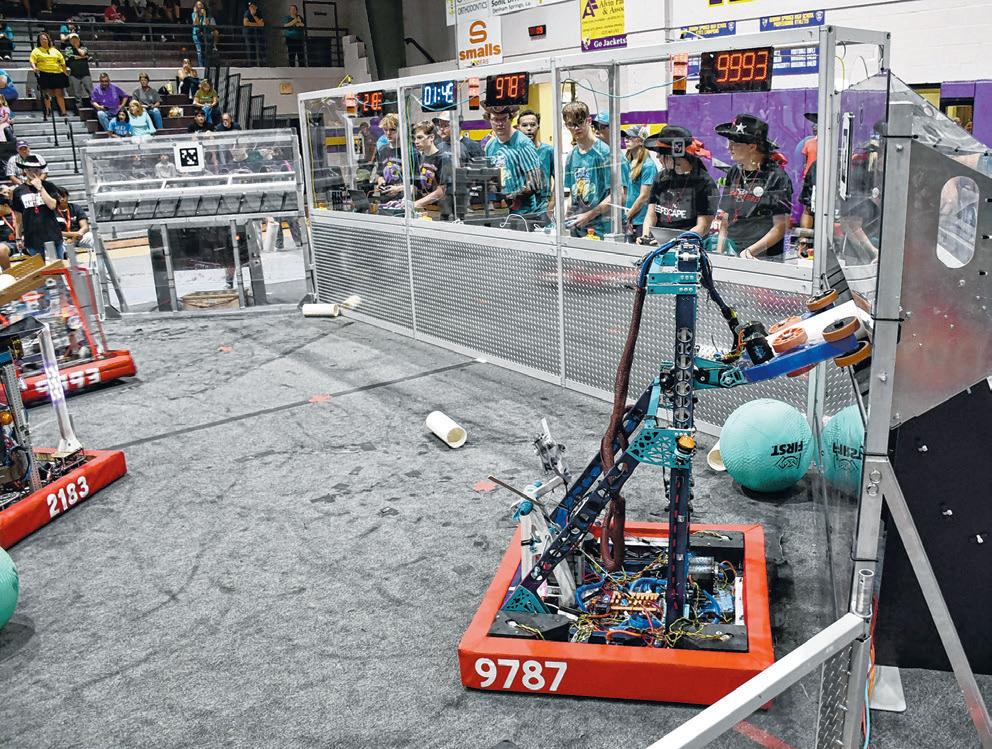
Robots scooting across the “field,” robotically picking up bright green balls to place in a “barge,” with high school students controlling every move from a computer panel behind sheets of Plexiglas. For the more mature set, perhaps, a bit futuristic. Think the Jetsons meet Generation Z.
For the younger set, the future is now
Several hundred students representing nearly 30 schools from as far away as Mississippi and Florida gathered Sept. 13 at Denham Springs High School to compete in the Dow Red Stick Rumble, a showcase of young minds flaunting their creativity and technical smarts.
Daniel Eiland, who has served as Denham Springs robotics coach since 2019 after serving eight years in a similar capacity at Woodland High School in Shreveport, said each robot is designed, engineered and finally built by students during a two-month period at the beginning of the second semester Eiland said all of the parts are 3D designed by using machine tools, routers and mills, helping the students build a foundation machinery and programming. Robots are programed through the use of JAVA, an advanced, general purpose program intended to
PHOTOS BY RICHARD MEEK
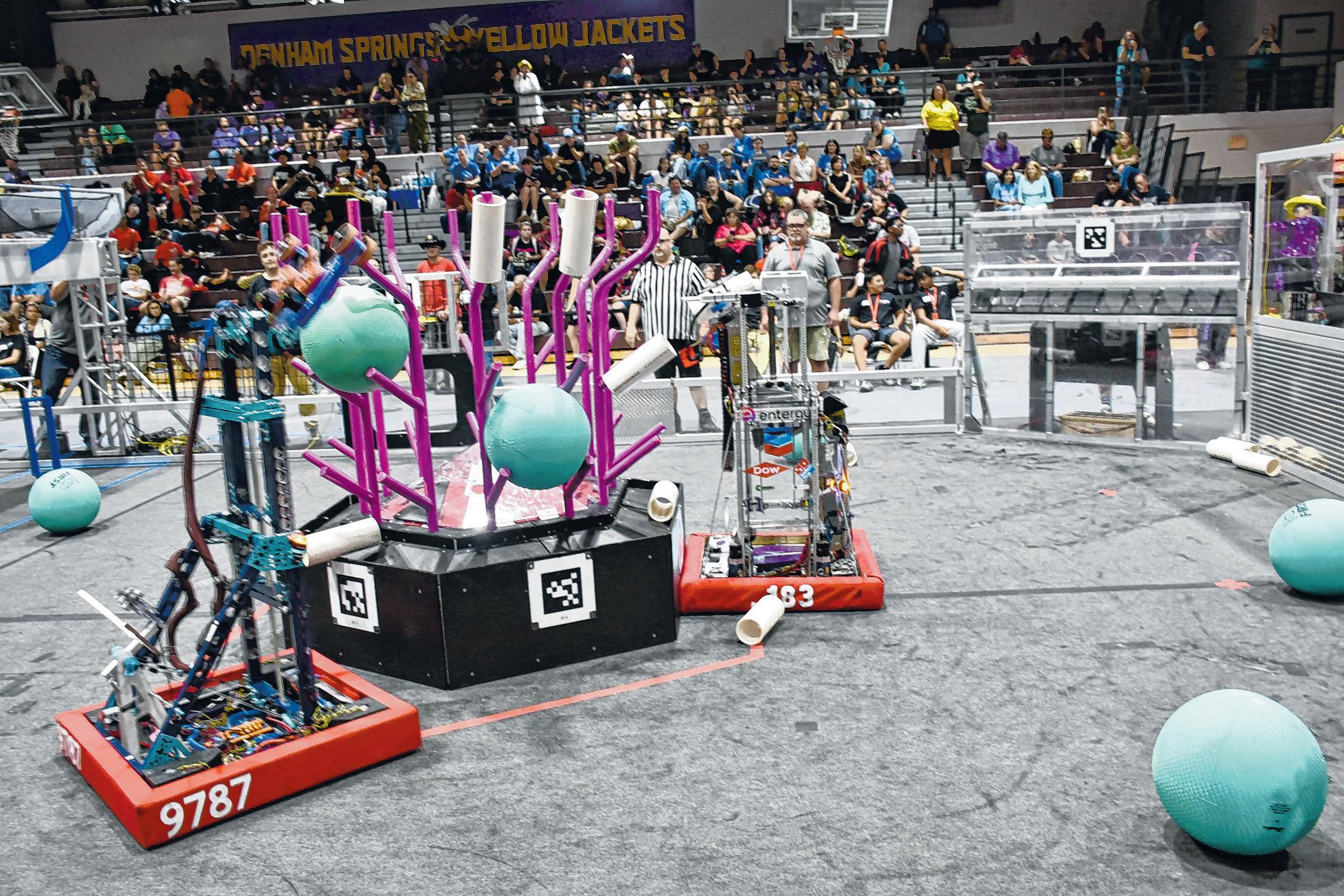
Robotic traffic during the Dow Red Stick Rumble Sept. 13 at Denham Springs High School at times resembled typical day along Baton Rouge’s congested roadways.
Continued from page 1G
run for a few years, then shut down for a few years for improvements. LIGO Livingston has plans to shut down for upgrades in November
However, there is a number it is hoping to increase. So far, LIGO has only detected at least two binary neutron star mergers
Gabriela González, LSU professor and also the spokesperson for the international LIGO Scientific Collaboration during the 2015 breakthrough, said these mergers are rarer than originally expected
This cosmic event occurs when two neutron stars, which are remnants of collapsed massive stars, collide and produce a powerful explosion. They are detected by gravitational waves as well.
“That’s why we keep working on increasing the sensitivity of the detectors, because we want to see if we can see more of those neutron stars,” she said.
González also said by building better and longer detectors, scientists could see systems farther away, and ultimately, more star mergers.
Funding up in the air
The fate of LIGO funding for the next fiscal year might be decided in the next few weeks, as the upcoming federal fiscal year for the U.S. government begins Oct. 1 In May, the Trump administration announced a proposed federal budget request for 2026 that would cut $5.2 billion, or 57%, of the foundation’s $9 billion annual budget. Under the proposed federal budget, only
AROUND
Continued from page 1G
Denham Springs Fall Festival
Experience the charm of Downtown Denham Springs Oct 4 with the city’s Fall Festival.
Stroll through over 150 vendor booths along Range Avenue featuring antiques, art, crafts, greenery and more. Enjoy food favorites like jambalaya, burgers and funnel cakes. Take a walk down Mattie Street to explore local creativity, listen to music at Train Station Park.
Step into our antique stores, browse seasonal sales, visit the Old City Hall exhibits, and soak in the fall atmosphere while people watching from cozy rest areas.
Tangipahoa Parish Fair Oct. 1-5
Visit the Tangipahoa Fair Oct 1-5 at the Florida Parishes Arena.
To register as a vendor or to find more information, visit https://www tangifair.org/forms.
ProWrestling 225 comes to Albany
Pro Wrestling 225 Returns to Albany Sept. 27.
The wrestling event is a fundraiser to support Albany Hornets Wrestling and A-Town Elite Wrestling, 29777 South Montpelier Road, Albany Fans can expect high-energy matches, thrilling moves, and entertainment for the whole family— all while helping raise funds for local athletes and programs. Chamber plans 30th annual golf tournament
The Livingston Parish Chamber of Commerce is planning its 30th annual Golf Outing on Oct. 17 at Carter Plantation in Springfield. Registration is underway for sponsors and teams. Visit https:// business.livingstonparishchamber. org/events/details/30th-annualgolf-outing-8609 for information.
Send news and events for Livingston and Tangipahoa parishes to livingston@ theadvocate.com by 4 p.m. Friday or call (225) 388-0731.
one LIGO observatory would operate with a reduced level of spending for LIGO technology development in the 2026 fiscal year, according to the budget proposal. A U.S. House subcommittee in July proposed a budget that would cut only 23%,
SALZER
Continued from page 1G
parish volleyball tournament, but the Tigers already own wins over Livingston’s other three teams. There was also a win over Covington giving Doyle three early wins over Division I opponents. The Tigers were 2-6 against Division I teams last year, but have shown an ability to compete with teams in any classification. Smaller schools don’t always grab an opponent’s attention, but Doyle coach Ashlie Byrnes said her team is ready to play anyone. “I think a lot of those teams are still playing us as the un-
derdog, and we’re showing them that we are Doyle volleyball, not an underdog,” Byrnes said last week after a straight set win over district foe Independence. “Our goal this year is to make the Cajundome (for the state championship tournament). I definitely think we can do it.”
A key component for Doyle has been its seven-member senior class. It’s a group that has made the playoffs all three of Doyle’s previous seasons, and is motivated to take another step.
“We’ve experienced being freshmen and sophomores and juniors,” middle blocker Faith Bridges said. “Being a senior changes our mindset and makes us cherish every moment together We know we have to really push toward the
end of the season.”
about $2 billion, from the foundation. A U.S. Senate subcommittee proposed a budget that would cut only $16 million from the science organization.
González, along with 2,000 other top scientists in the country, recently signed an open letter to Congress warning it about the damage budget cuts could do to the nation.
González said she felt prompted to do so because she believes LIGO and other projects sometimes aren’t talked about enough.
“I think that when people read about science, they always think it’s happening somewhere else. This is happening in Louisiana. We have a detector that is discovering black holes in Louisiana,” she said.
Giaime does not know when a budget will be passed and said the scientists are nervously waiting to see what happens.
“LIGO will be an extremely different place, and many aspects of our program will be on life support,” he said about possible large budget cuts.
Email Claire Grunewald at claire. grunewald@theadvocate.com.
For Doyle, those senior moments together have been years in the making. They provide a backdrop for players like right-side hitters Kenzie Smith and Harley Lovell, defensive stars Bonnie Henderson and Allie Lebourgeois, and setter Christlyn Smith.
Senior outside hitter Rorie Calais summed it up this way
“Our team thrives on friendship,” she said. “We’ve all grown up together We’re very close and I think that really makes our team different.”
Charles Salzer covers Livingston sports for the Livingston-Tangipahoa Advocate. To reach Salzer, email livingston@theadvocate. com.
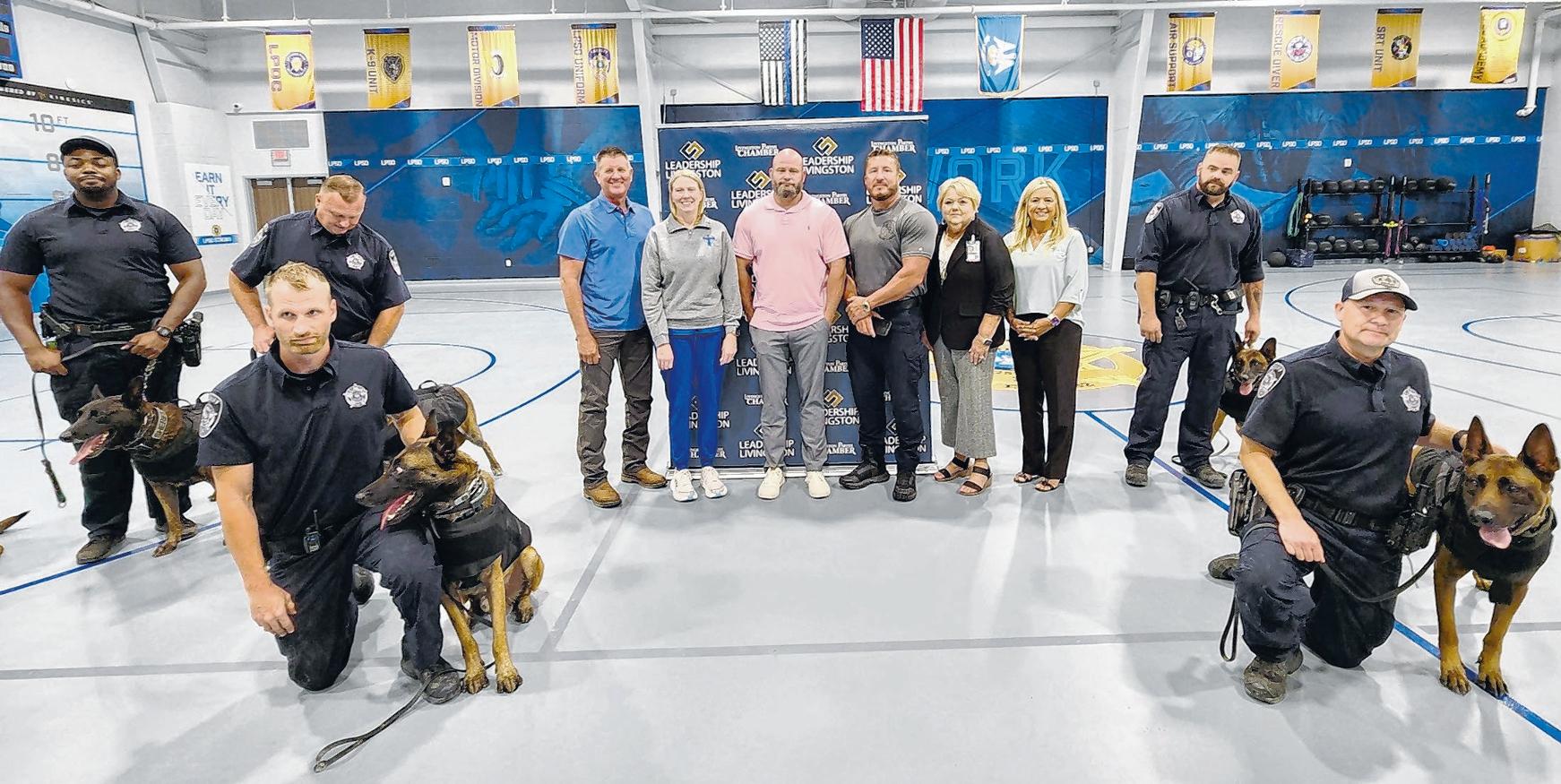
LPSO K-9’s outfitted with bullet proof vests thanks to money raised by Leadershihp Livingston team
Community news report
The K-9 team at Livingston Parish Sheriff’s Office has new bulletproof vests thanks to the East Side Project Group 2023 of Leadership Livingston program.
The gear was funded through sponsors contacted by project members.
The Chamber of Commerce coordinated with the Livingston Parish Sheriff’s Office, which measured and ordered the vests for the K-9s. A project reveal and sponsor recognition event on Sept. 9 brought together the K-9 team officers, team members, sponsors, chamber officials and stakeholders.
Sheriff Jason Ard said, “We appreciate this group looking out for our 4-legged officers. They work hard every day to protect and assist in the betterment of our parish. They are eager to serve and are a true support system of the LPSO.”
April Wehrs said the project team was proud to be a part of the work of the K-9 unit at LPSO.
“From the day we visited the training center and saw these K-9s in action, we knew it was a
The K-9 team at Livingston Parish Sheriff’s Office has new gear thanks to the East Side Project Group – 2023 of Leadership Livingston program. Bullet proof vests were funded through sponsors contacted through project members. The Chamber coordinated with the Livingston Parish Sheriff’s Office who measured and ordered the vests for the K-9s.
great fit for our group.”
Members of the project team are Tab Lobell, Tracy Bryson, Seth Mosby, Paul Brignac, Tracy Miley, Lynda Gardiner, Mallory
Forbes and Kenny Bayhi. For more information on the project, visit lpbiz@livingstonparishchamber.org or call (225) 665-8155.
Leadership Livingston and Livingston Chamber Foundation are divisions of the Livingston Parish Chamber of Commerce, the parish’s business association.
STAFF PHOTOS BY JAVIER GALLEGOS
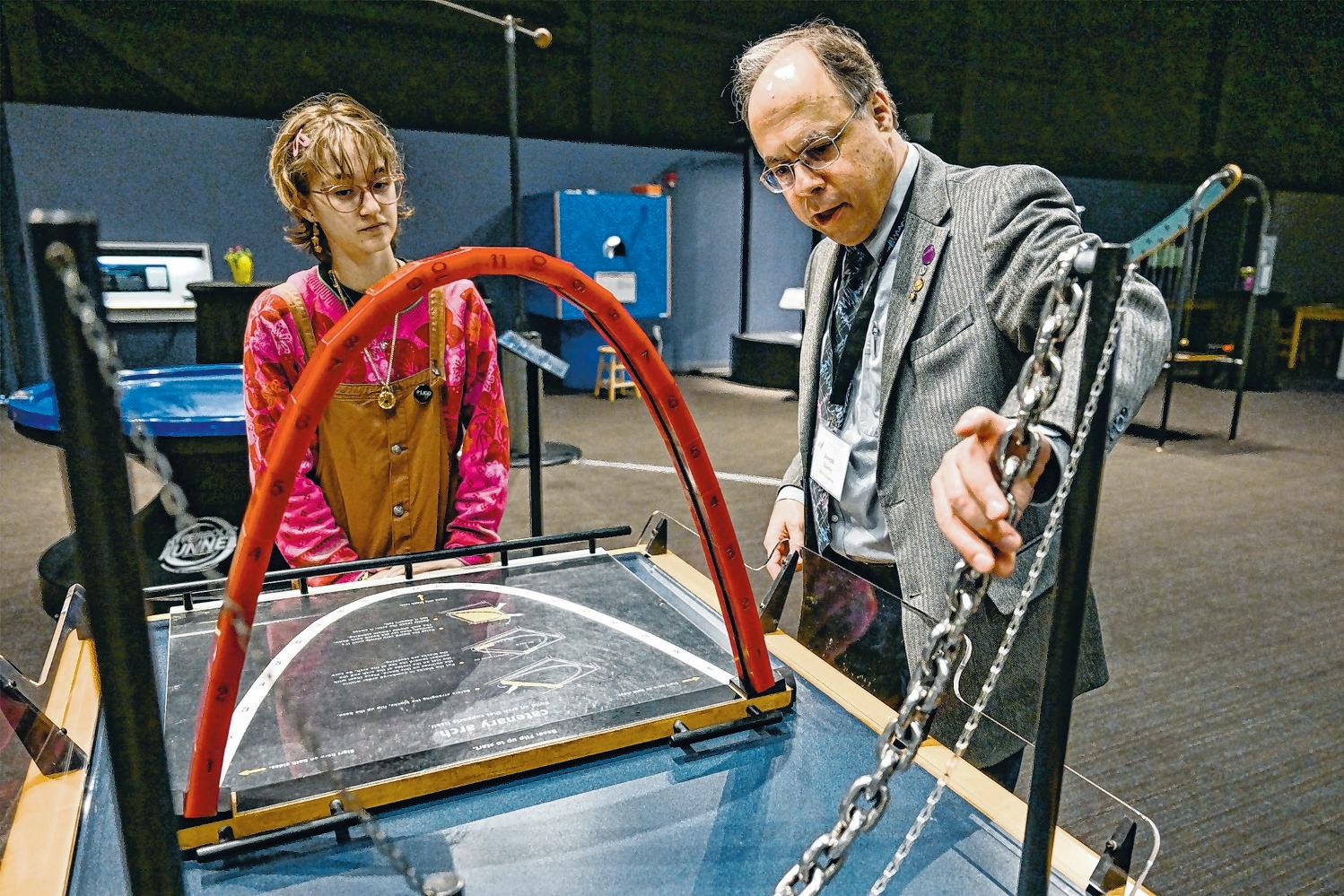
Joseph A. Giaime, right, observatory head of LIGO Livingston, explains the science behind the catenary arch to his daughter Domenica on Saturday
Gabriela Gonzàlez, LSU Boyd Professor of Physics, speaks during a 10-year celebration of LIGO’s initial gravitational wave detection on Sept. 13.
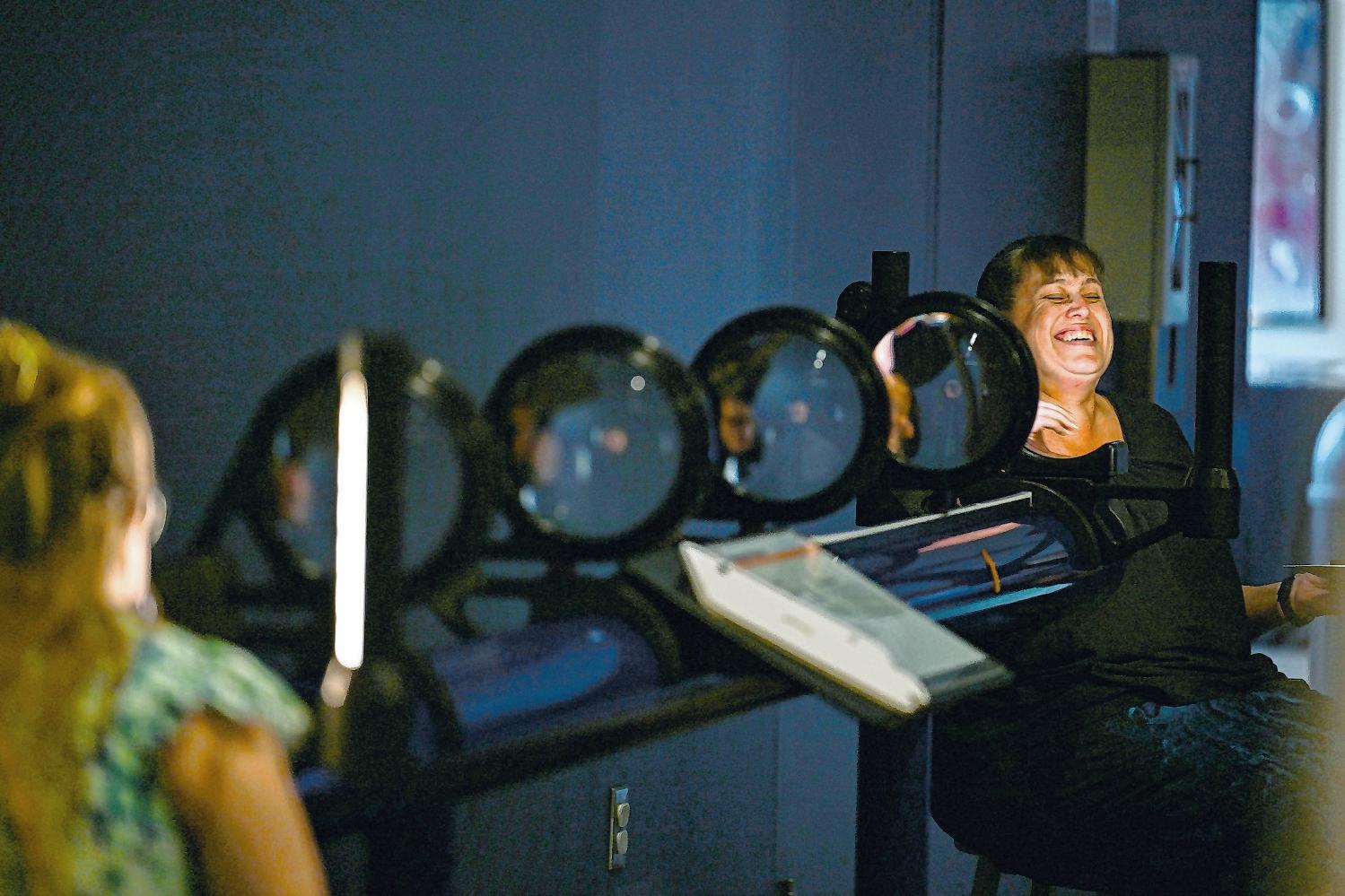
Ann Bourgeois, right, laughs while playing with a glass lens exhibit with Michelle Cowdrey, left, during a 10-year celebration of LIGO’s initial gravitational wave detection.
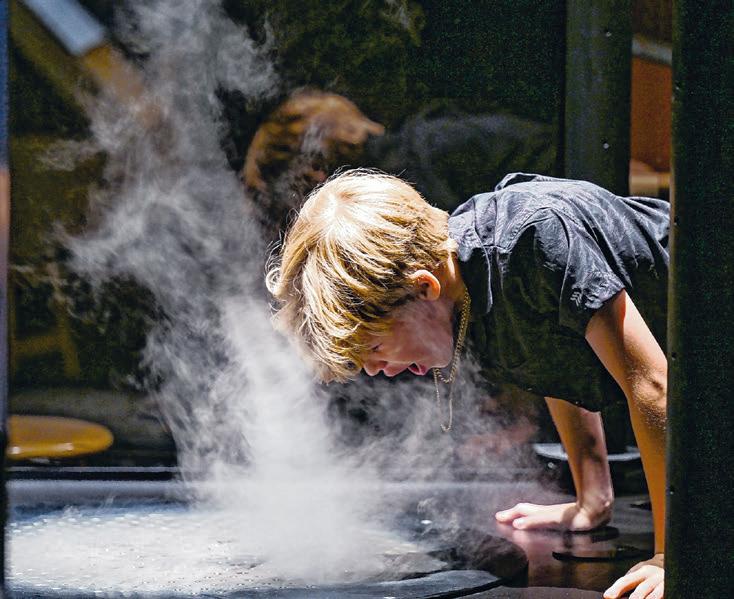
Bryce Laxen, 9, sticks his head in a live model tornado at LIGO in Livingston.
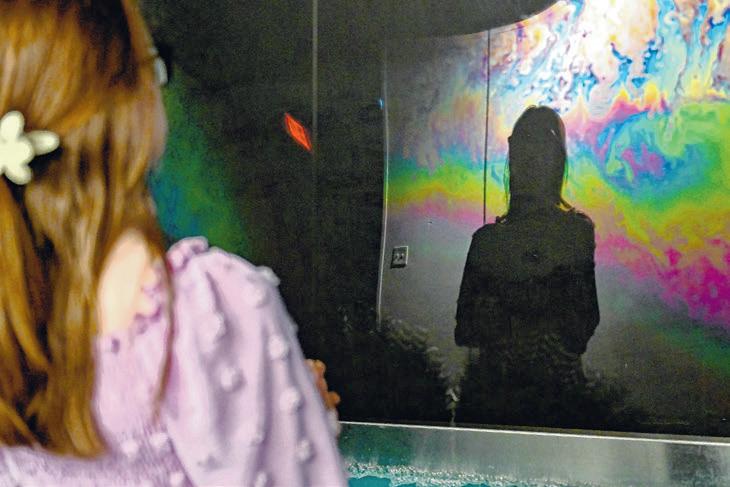
Abigail Laxen, 11, looks at her reflection in a wall of soap film for bubble blowing
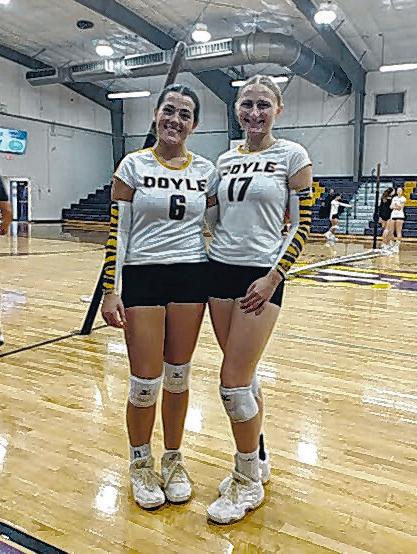
PROVIDED PHOTO Doyle seniors Rorie Calhoun, left, and Faith Bridges before a recent match.
PROVIDED PHOTO
raise it like a human would raise one’s arm and place the ball in the large barge that sits high atop the field
Also, robots must pick up rings from a station and place each on a “tree” to earn more points.
But for all of its intricacies, Eiland said robotics is much more than a glitzy display of modern technology Rather, he explained students are exposed to a multi-faceted business dimension that helps build life skills
Eiland said the business team is focused on fundraising, marketing, making presentations to potential sponsors and presenting awards..
“We have an entire team whose goal is to talk about what our team does,” he said. “They are presenting to professional judges when we go to events.” Additionally, students will make presentations at the Louisiana State Capitol and have also spoken at the Michoud NASA plant in New Orleans East.
“Whenever we go (to Michoud) we have to talk to their engineers as to what we are doing,” Eiland said. “Students are educated in all of these things, life skills they can bring to the workforce.”
Fundraising is of particular importance for without money the team would not have the proper equipment and funding for travel. Annually fundraising goals can top out at $150,000.
“We don’t sell cookies and candy,” Eiland said. “We go talk to sponsors and the students present a portfolio of what we do, and where their sponsorship money is going.”
“Everything you find in a marketing agency is what they do,” he said. “I like to think of them almost like a Fortune 500 company
“They are getting skills they would never have otherwise, he added.”
A robot being controlled
Depending on the school, teams will travel throughout the region, including Denham Springs which have competed in Louisiana, Arkansas, Mississippi and the Bayou Regional. The team scored adequate points to earn a spot in the world tournament in Houston earlier this year where 600 teams from places such as Israel, Mexico, Japan and Turkey competed
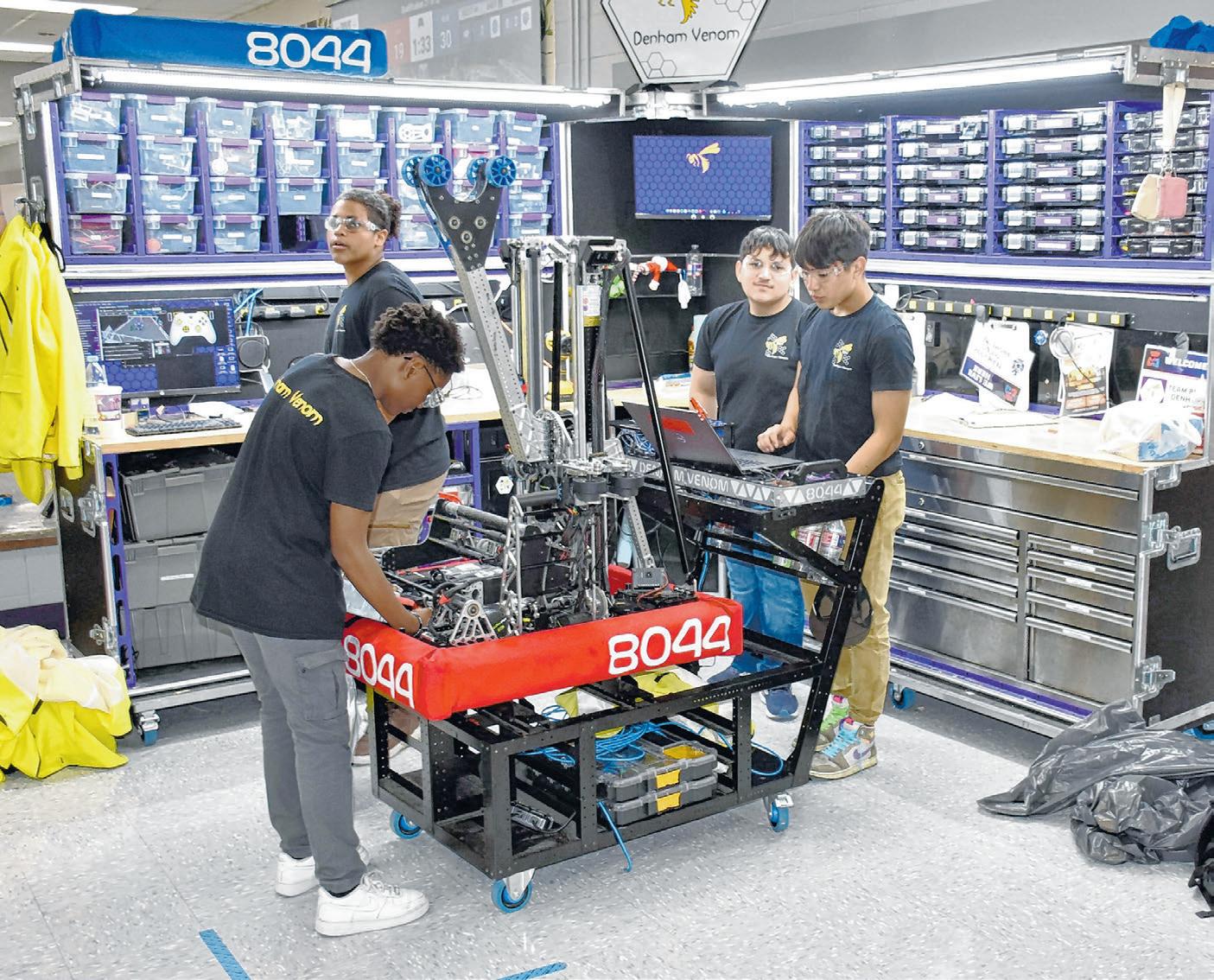
At the end of the Dow Red Stick Rumble, the winning alliance was made up of Denham Venom from Denham Springs, the SWLA Tech Pirates from Lake Charles and KNOS Robotics from New Orleans. The team alliance was captured by Denham Venom, which went undefeated in the playoff matches. For more information on the Denham Venom, visit https://www.denhamspringshs.org/denham-venom.
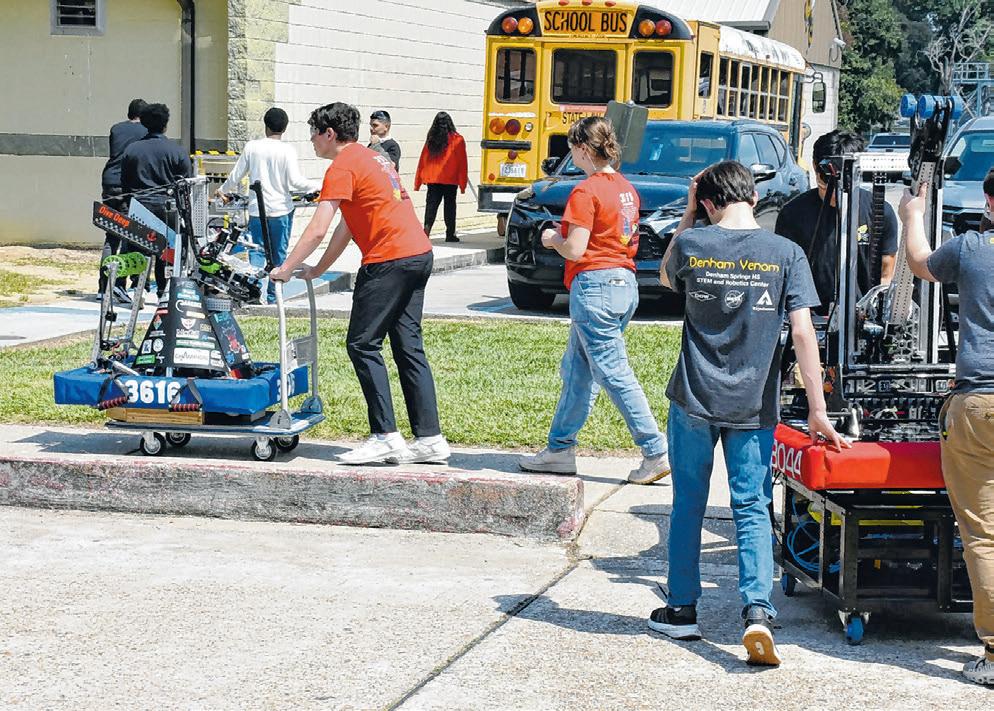
Students pushed their robots from the designed pit area back to the gym for live competition during the Dow Red Stick Rumble.
PHOTOS BY RICHARD MEEK
Each robot is controlled by students manning laptop computers behind a Plexiglass barrier to protect from injury, as shown during the Dow Red Stick Rumble Sept. 13 at Denham Springs High School.
Students control their respective robots during the Dow Red Stick Rumble Sept. 13 at Denham Springs High School.
Ponchatoula receives Keep Louisiana Beautiful grant
Community news report
The city of Ponchatoula was one of 11 organizations to receive Keep Louisiana Beautiful grants
KLB has awarded $72,017 in grants to 11 organizations in 10 parishes for beautification projects.
“We are proud to support these communities as they invest in projects that make Louisiana more welcoming, vibrant, and attractive,” said Lt. Gov Billy Nungesser “By working together, we can keep Louisiana beautiful and
Keep Hammond Beautiful cleanup dates announced
Community news report
Keep Hammond Beautiful has announced dates for its fall cleanup events.
Volunteers are needed for the Saturday, Sept. 27, cleanup at the Welcome to Hammond sign and railroad tracks on the corner of 401 S.W Railroad Ave. and E Coleman Street. The event is set from 8 a.m. to 10 a.m. KHB will provide litter sticks, garbage bags, gloves and safety so volunteers can pick up litter on the sidewalks and green spaces on the edge of downtown. Another cleanup day is planned for 8 a.m. to 10 a.m. Saturday, Oct 25, at Clarke Park, 801 S. Holly St. Saturday Nov 22 is the next litter pick up day set. The location will be announced at a later date. The KHB board meeting is at 11:45 a.m Oct. 16 at the Hammond Recreation Center and a glass recycling event is set from 8 a.m. to noon Oct. 18 at the Hammond Farmers Market. For more information, visit https://facebook.com/KeepHammondBeautiful.
ensure our Sportsman’s Paradise shines for generations to come.”
“Beautification visually enhances a community, leading to increased tourism, economic development, and an improved quality of life for residents,” said Susan Russell, KLB executive director “People are less likely to litter in areas that are well-maintained and beautiful, so reducing litter in highly visible areas is an additional key driver of this grant. First impressions count, and this grant program helps communities look their best.”
Ponchatoula is using its grant to revitalize the city’s entrance with a new welcome sign and native plants. The KLB Beautification Grant provides reimbursement grants for beautification projects ranging from $1,000 to $10,000. Grant projects should enhance and beautify entry points of municipalities and parishes, or highly trafficked roadway medians. Plants and trees must be at least 25% native to Louisiana and other restrictions apply In addition to beautifying public spaces,
projects exhibit diverse community support, collaborations between organizations, matching contributions, and benefits to community residents. Eligible to apply for the KLB Beautification Grant were Louisiana parishes and municipalities. In 2025, KLB awarded $1.12 million in grant funding. Grant opportunities include the Greener Grounds Grant, Healthy Communities Grant, Community Affiliate Grant, University Affiliate Grant, Trash Receptacle Grant, Beautification Grant, Sheriff’s
Livingston library announces October book club selections
Community news report
The Livingston Parish Library’s October book club selections have been announced. All parish library branches host monthly book clubs for adults, and each club features a different “Book of the Month.” For more information on a particular book club, call the branch.
Joyful Reads Book Club
10:30 a.m., Oct. 7, South Branch: “Camino Ghosts” by John Grisham. Will an ancient curse darken the skies over Camino Island? Bruce Cable and Mercer Mann are about to find out in this New York Times bestseller
Sunny Side Up Book Club
10 a.m., Oct. 14, Watson Branch: “The Shack” by William Paul Young. After his daughter’s murder, a grieving father confronts God with desperate questions — and finds unexpected answers — in this riveting New York Times bestseller
Spine Tinglers Book Club
6 p.m., Oct. 14, at the Watson Branch: “We Used To Live Here” by Marcus Kliewer In this haunting debut, two homeowners’ lives are turned upside down when the house’s previous residents unexpectedly visit.
Box of Chocolates Book Club
2 p.m., Oct. 16, Denham Springs-
Evergreen
Community news report
Walker Branch: “Rebecca” by Daphne du Maurier First published in 1938, this classic gothic novel is such a compelling read that it won the Anthony Award for Best Novel of the Century.
ASB Book Club
10 a.m., Oct. 27, at the AlbanySpringfield Branch: “Home Is Where The Bodies Are” by Jeneva Rose. From the New York Times bestselling author comes a chilling family thriller about the (sometimes literal) skeletons in the closet.
Main Branch Book Club
10:30 a.m., Oct. 28, Main Branch in Livingston: “Magic Lessons” by Alice Hoffman. In this bewitching novel that traces a centuries-old curse to its source, beloved author Alice Hoffman unveils the story of Maria Owens, accused of witchcraft in Salem, and matriarch of a line of the amazing Owens women and men featured in “Practical Magic” and The Rules of Magic.”
South Branch Bookies
5:30 p.m., Oct 30, South Branch: “The House in the Pines” by Ana Reyes. Armed with only hazy memories, a woman who long ago witnessed her friend’s sudden, mysterious death, and has since spent her life trying to forget, sets out to track down answers. What she uncovers, deep in the woods, is hardly to be believed.
Life Services hosts gala
Evergreen Life Services, a nonprofit organization dedicated to empowering adults with intellectual and developmental disabilities in Southeast Louisiana, is rolling out the red carpet for its annual fundraising gala, Lights, Camera, Take Action. The Hollywood-style event will take place at 5:30 p.m. Sept. 25 at The Mezzanine Event Hall in Hammond. The gala supports Evergreen Life Services’ mission to serve, provide for, and champion individuals with disabilities through programs and services such as day habilitation, cultural arts, vocational training and community homes.
These initiatives provide participants with life skills, creative expression, vocational training and safe, supportive living environments.
“Every ticket, bid and donation at Lights, Camera, Take Action supports our programs that transform lives,” a news release said. “This event is more than a fundraiser; it’s an opportunity for our community to step into the spotlight and become advocates for adults with disabilities.” The events includes a Best Dressed Movie Character contest, cash bar, silent auction and games. Tickets and sponsorships are limited. For more, visit wl.donorperfect.net/weblink/weblink.aspx?name=E344136&id=62.
Grant and Surveillance Camera Grant. Information on these grants can be found at KeepLouisianaBeautiful.org.
During the KLB State Conference from Sept. 23-24 at the Crowne Plaza Executive Center in Baton Rouge, Jan Windhorst, grants director for KLB, will lead a breakout session on KLB’s grant opportunities. Other beautification and community improvement topics are included in the agenda, which can be viewed on the KLB State Conference webpage.
21st Judicial District DA race kicks off
BY CLAIRE GRUNEWALD Staff writer
The race for district attorney in the 21st Judicial District kicked off one day after longtime DA Scott Perrilloux announced his retirement.
On Sept. 16, Perrilloux announced his decision to retire after 30 years as DA and not seek reelection when his term ends early in 2027. The election for the next DA will be in the fall of 2026.
a news release. Cascio has worked for over a decade under Perrilloux in the 21st Judicial District, which includes Livingston, Tangipahoa and St. Helena parishes.
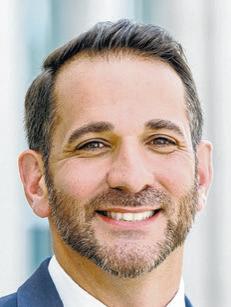
Assistant District Attorney Brad Cascio, a lifelong Hammond resident and Republican, announced his campaign Sept. 17 in
“For the past 12 years, I’ve stood in the courtroom every day fighting for victims, holding criminals accountable and making sure our families are safe,” Cascio said in the release. “As DA, I will continue to do the job I’ve been doing. I’ll be a relentless advocate for justice, a voice for the voiceless and a protector of the vulnerable.”
He has prosecuted more than 4,000 cases since 2013, according
to the his announcement Cascio has secured multiple life sentences and also Louisiana’s first courtordered physical castration of a sex offender “When someone takes responsibility and works toward a better path, we should give them the tools to succeed. Building safer communities means holding offenders accountable and helping people rebuild lives,” he said.
Cascio also serves as the city prosecutor for Denham Springs and French Settlement. He also sits on the boards for the Capital Area Law Enforcement Planning Commission and the Tangipahoa Council on Aging.
Early voting for the Oct. 11 election starts Sept. 27 and ends Oct. 4, excluding Sunday, Sept. 28, from 8:30 a.m. to 6 p.m. Runoff elections, if needed, are scheduled Nov. 15.
The deadline to request an absentee ballot is Oct. 7 by 4:30 p.m., other than for military and overseas voters, through the Secretary of State’s Voter Portal or your Registrar of Voters Office. On election day, polls are open from 7 a.m. to 8 p.m.
Beta
Sigma Phi International
Sorority members from Denham Springs, Gonzales, Baton Rouge and Walker recently donated school supplies to a Baton Rouge elementary school. The Iota Master Chapter of Beta Sigma Phi International, a sorority that strives for service, sisterhood and cultural enrichment, donated school supplies to Shenandoah Elementary School, which serves 550 students from pre-K through fifth grade.
Cascio
chapter donates to Shenandoah Elementary
PROVIDED PHOTO
From left, Ellie Jones, executive secretary; Elizabeth Callegan, principal of Shenandoah Elementary; and Pat Buturla, Iota Master Chapter of Beta Sigma Phi International, service chair, show supplies Iota Master Chapter brought to the school