If you would no longer like to receive this free product, please email brtmc@ theadvocate.com.
Danny Heitman AT RANDOM
Confessions of a lifelong Louisiana scavenger
Like a cat bringing an unlucky bird or mouse to the doorstep, my grown children sometimes like to share news about things they find in their adventures out of doors. Luckily, their treasures are more benign than what the proverbial cat drags in. Earlier this summer, they were visiting each other in California when they decided to gather shells from the beach
A picture soon arrived on my smartphone — a lovely image of seashells lining a beach towel, creating a banner that cheered me throughout the summer When I flip through pictures from this anxious year, that snapshot will be a keeper What is it, I was moved to wonder, that drives our impulse to gather bright, shiny things? Maybe it’s the primal hunter-gatherer in our genes, a survival tool we’ve continued to carry into our comfortable modern lives. I thought about all of this over the summer as I read the late Penelope Fitzgerald’s reminiscences about foraging for odd little treasures during her British childhood a century ago It’s no surprise that Fitzgerald’s sharp eye for the glimmering bits and bobs of the rural English landscape would lead her to become a novelist, an occupation where a gift for the small detail can be a plus. When the young Fitzgerald was sent out for errands, she’d find time for a little scavenging, too.
“On the way there and back, across the fields and by the roadside, I had my collecting to do,” she tells readers. “Feathers, pheasant feathers in particular, were needed for headdresses. My brother, when he was at home, was a warrior brave, and I was Minnehaha. Then there were horseshoe nails, cast horseshoes, snail shells, beechnuts, pignuts, flints, and wayside flowers. When I got home, everything was laid out on my bedroom windowsill to be counted and recounted, one of the most reassuring activities for a small child.
Some of us don’t outgrow the scavenging habit, and I count myself among the tribe. I live a few blocks from my office, so I often walk to work, and the things I find along the way tend to end up on a shelf above my desk as a small reminder of life’s variety
“They’re talismans of a sort, pointing me toward a simple reality,” I confessed in a magazine essay earlier this year
“It’s the idea that the sheer plenitude of my daily walks unfolds in their inexhaustible
ä See AT RANDOM, page 3G
from George
the first time, collector loans 40 George Rodrigue pieces for landmark exhibit
SBY ROBIN MILLER Staff writer
he’s there, not in the center of the crowd but in a space off to the side with just enough separation from the others to quietly command attention.
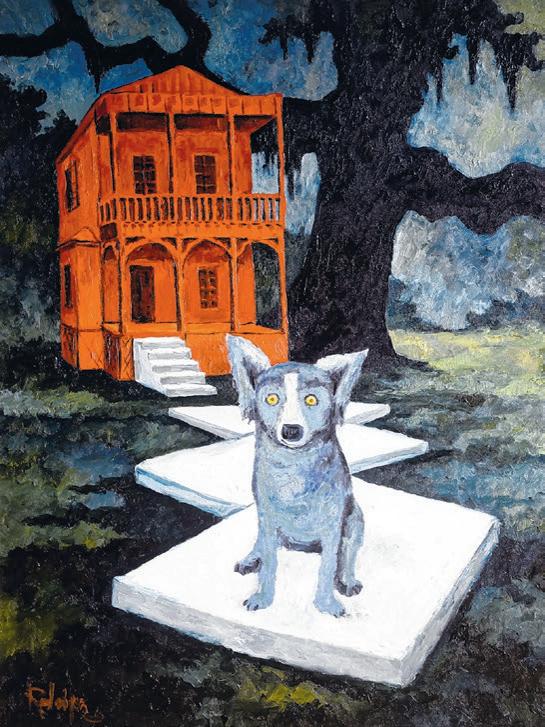
Here, she’s “The Watchdog,” though we know her as Blue Dog, inspired by George Rodrigue’s white terrier-spaniel mix
ä Watch a video of the exhibit. GO TO THEADVOCATE. COM.
“This is George Rodrigue’s first painting of the Blue Dog, and we have it in this show as part of his ‘The Bayou Collection,’ ” said Michelle Schulte, LSU Museum of Art curator
“There are 40 pieces in this collection, and this is the first time they’ve been on exhibit together outside the George Rodrigue Family Trust.”
A private collector, who asked the museum to remain anonymous, bought the collection and loaned it to the museum’s exhibit, “A Bayou State of Mind,” featuring 80 works by 33 Louisiana-affiliated artists.
Connected by bayous Rodrigue’s collection dominates the show, filling the main gallery’s walls and setting the framework for the story told by this exhibit
PROVIDED PHOTO BY TONY BERNARD
George Rodrigue’s 1984 painting, ‘Watchdog,’ is the artist’s first painting of his iconic Blue Dog The painting is part of his ‘The Bayou Collection,’ which is included in the LSU Museum of Art’s exhibit, ‘A Bayou State of Mind.
— a narrative about the people, places, traditions and cultures of Louisiana, from cities to rural areas connected by bayous.
And though a “bayou state of mind” means something different to the diverse regions of this state, the bayou is the lifeblood in this show
“For me and other natives, this is more than an art exhibition, it’s
a cultural homecoming for many of Louisiana’s most beloved visionaries,” said Mark Tullos, executive director of the LSU Museum of Art.
The exhibition is about how artists reflect, reminisce and are inspired by Louisiana, according to Schulte, and is broken up into three categories “Urban Experience,” “Rural Memory” and “Water.”
Show features 33 artists
Artists represent different parts of the state, some from out-of-state with Louisiana connections.
“We’ve mixed things up a little bit,” Schulte said. “The artists who don’t actually live or come from Louisiana just came here for visits They were wandering through, and they were so inspired by the landscape and the land of Louisiana that they reacted upon it.”
And Rodrigue’s works enhance this show by telling the stories of his rural Cajun culture.
Rodrigue was 69 years old when he died in Houston in 2013. He was born in New Iberia and often recounted the story of his sickly childhood, when he was diagnosed with polio and confined to bed.
He often talked about his mom buying him a paint-by-numbers set to alleviate his boredom.
Rodrigue always ended the story by noting that he turned the paintby-numbers surface face down and
EXHIBIT, page 2G
Did the Choctaw people fight alongside Andrew Jackson?
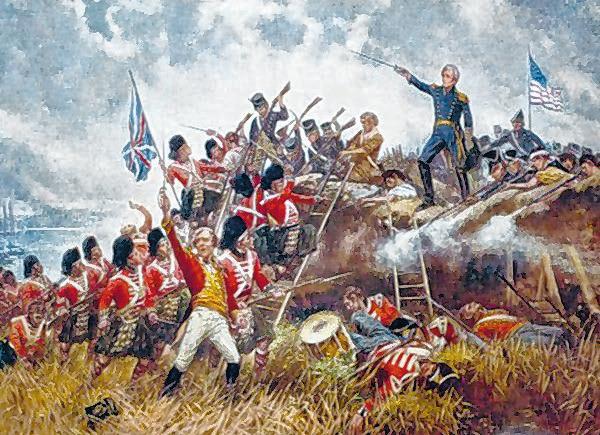
the Battle of New Orleans in January 1815.
BY MATTHEW HAINES Contributing writer
STAFF PHOTO BY ROBIN MILLER
A selection
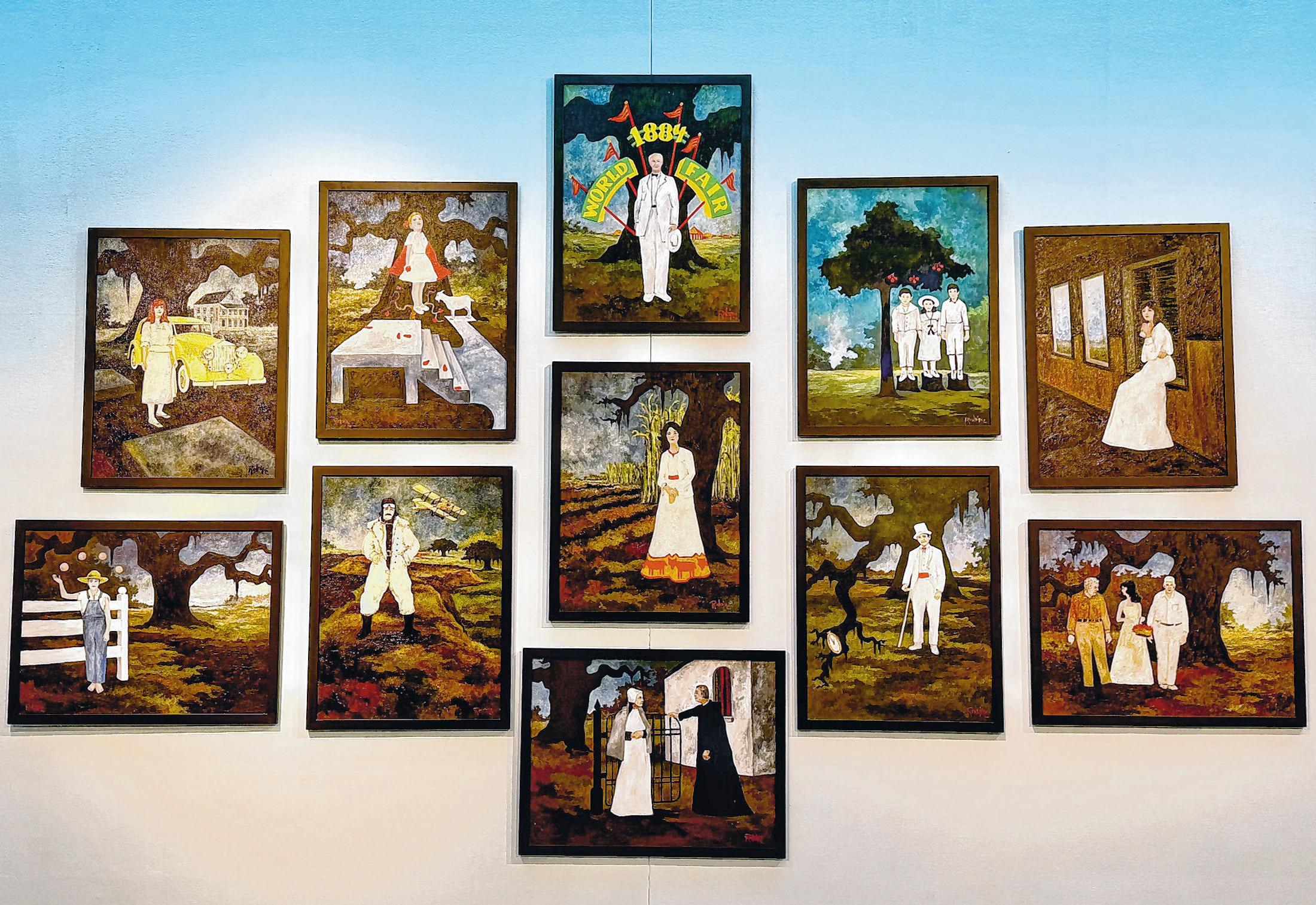
Rodrigue’s ‘The Bayou Collection’ hangs salon-style in the LSU Museum of Art’s exhibit, ‘A Bayou State of Mind,’ featuring 80 works by 33 Louisiana affiliated artists. The show runs through Jan. 4
Maj. Gen. Andrew Jackson, with sword raised, rallies American forces against the British in a painting depicting the American victory at
began painting on the backside. Rodrigue eventually recovered and attended what was then the University of Southwestern Louisiana, now the University of Louisiana at Lafayette.
Though the Blue Dog paintings became his trademark, Rodrigue started out painting the landscapes, live oak trees and people of his ancestral home of south Louisiana “The collection in this show is based on ghost stories,” Schulte said “They are a collaboration between George Rodrigue and author Chris Segura to create a book called ‘Bayou’ for the 1984 World’s Fair in New Orleans. Chris wrote the ghost stories, and George illustrated them.”
This collaboration gave rise to the painting series.
Different paintings have been part of private collections over the years, but now they are together for the first time.
“Now, a collector from LSU who’s a big museum fan purchased them, and they’re now on long-term loan to us,” Schulte said “We’re going to travel the collection after this show comes down, and so that’s really exciting for us to be able to get George Rodrigue outside of the state in this iteration.”
Why? Because most people associated Rodrigue with his iconic Blue Dog, and though that’s accurate, the Blue Dog is really a part of the Acadian world in Rodrigue’s paintings.
Which is why the Blue Dog, or “Watchdog,” as she’s known in this show isn’t the star but a part of the show Though this blue canine would eventually pave the way for the pop art icon that the Blue Dog has become, this first one is different.
She’s more organic, as much a part of the landscapes as the Acadian figures She seems to feel at home among the works by other artists artists like Malaika Favorite, whose pieces share the story of her mom hanging clothes on a line.
“So, we talk about water in all kinds of ways in this show, and we talk about water in terms of reminiscence and memory,” Schulte said “Malaika remembers her mother washing clothes and having this connection with water But then, below these pieces are pieces from her Katrina series, which reflect on her experiences during that.”
Rodrigue isn’t alone
Rodrigue isn’t alone in rooting art in Louisiana’s landscape and memory
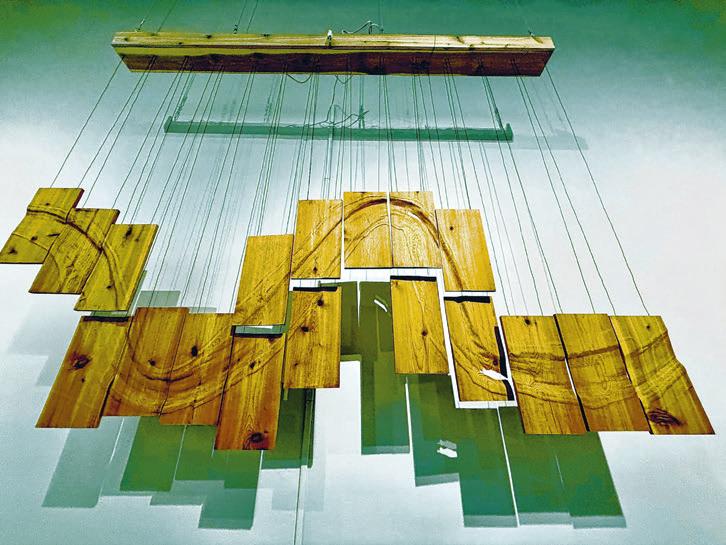
Nathalie Miebach’s sculpture, “The Baton Rouge Flooding,” reflects the blue in the blue tarps that covered so many Baton Rouge rooftops after the storm, according to Schulte.
Jesse Allison and Derick Ostrenko’s son-
‘A BAYOU STATE OF MIND’
Runs through Jan. 4 at the LSU Museum of Art in the Shaw Center for the Arts, 100 Lafayette St. l Hours are 10 a.m. to 5 p.m.Tuesday, Wednesday, Friday and Saturday; 10 a.m. to 8 p.m Thursday and 1 p.m. to 5 p.m. Sunday.
l Admission is $5, for age 13 and older; and free for children 12 and younger, museum members, students with ID, LSU faculty and staff with ID, educators, and veterans and their families with military ID l The museum also is hosting a free public reception for the exhibit at 6 p.m. Sept. 11 with many of the exhibit’s artists in attendance l For more information, call (225) 578-3000 or visit lsumoa.org
ic sculpture, “The Humming Mississippi,” resonates unique sonic qualities shaped by the contours of the Mississippi River
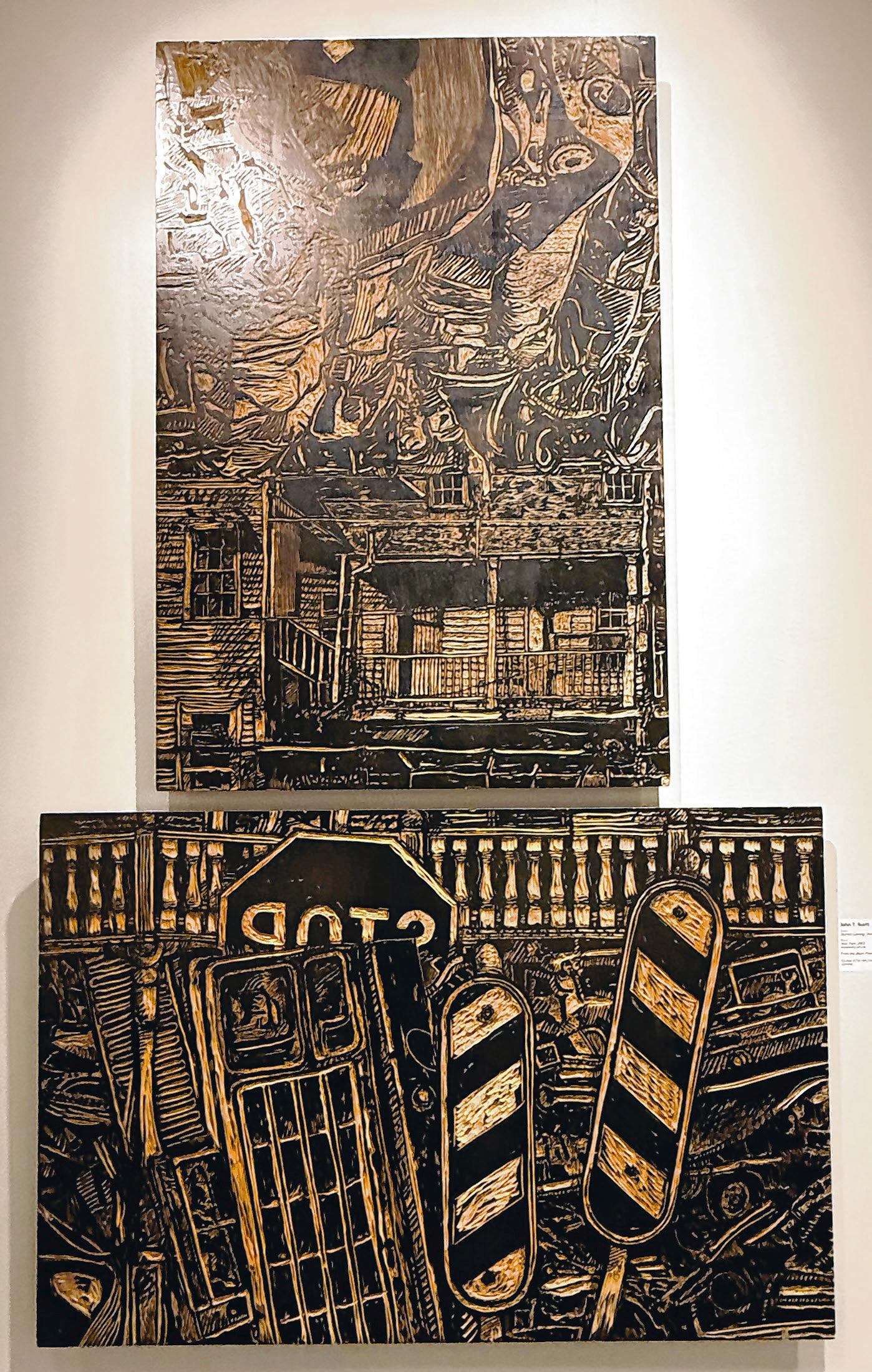
John T. Scott’s prophetic woodcut, “Stop Sign,” depicting devastation in New Orleans’ streets after a storm, which was made before Katrina.
The show was originally slated for last year but with the 20th anniversary of Katrina, the museum chose to delay it.
Meanwhile, in the show’s “Urban Experience” section, Monroe-based artist Vitus Shell’s large canvases examine New Orleans’ French Quarter wrought ironwork from a different perspective.
“When people go to New Orleans, they see this wrought iron, and it’s sort of like this Gothic kind of idea of the city,” Schulte said. “People take pictures of it, but from Vitus’ viewpoint, the wrought iron was generally made by enslaved people and integrated into this architecture that’s now celebrated and viewed by tourists, but they don’t really understand the connotations and the background of it.”
Shell’s two images border New Orleans artist James Michalopoulos’ painting, “On a Normal Night,” showing his version of the historical wrought iron. Like water, migrating through the gal-
leries to get a last look at the first iteration of the Blue Dog is the natural path.
After taking in the bayou-inspired exhibit, reflecting on the Blue Dog’s origins and what she would become in the art world is a reminder of change and Heraclitus’ quote: “No man ever steps in the same riv-
er twice, for it is not the same river and he is not the same man.” Rodrigue’s Blue Dog would never be the same again, either Email Robin Miller at romiller@ theadvocate.com.
STAFF PHOTOS BY ROBIN MILLER
The original woodblocks used by late New Orleans artist John T. Scott to make his prophetic large prints are included in the LSU Museum of Art’s exhibit, ‘A Bayou State of Mind.’
AT RANDOM
Continued from page 1G
supply of particulars: the orphaned screwdriver, the huge rubber band, even an unclaimed 20-dollar bill.”
We scavengers tend to find each other, too, which is how I ended up comparing notes with Joanna Brichetto, a Nashville author who’s written about her own windfalls from walking city streets.
They include “an extra-heavy hotel spoon sized for coffee,” she writes, “and good as new after a trip through the dishwasher.”
All the more reason, I guess, to keep walking and keep looking.
Email Danny Heitman at danny@dannyheitman.com.
CURIOUS
Continued from page 1G
U.S. was that seamen from the United Kingdom were boarding American vessels and forcing American sailors to join the British war effort
A third reason and this one gets to the crux of how Choctaw fighters became involved in this war they called Balbaha Ittibi, or “ForeignLanguage-Speaking Battle” — is that the British opposed American expansion into the West by arming certain Indigenous American tribes in the defense of their land. Specifically, they supported Tecumseh, the leader of both the Shawnee tribe and an effort to band together several tribes to oppose this American encroachment.
Tecumseh went from tribe to tribe, attempting to convince them to join his pan-Indian alliance, explained Ryan Spring, cultural research associate with the Choctaw Nation of Oklahoma Historic Preservation Department.
“But, when he eventually found his way to the Choctaws,” Spring said, “things didn’t go as he planned.”
Choosing sides
It was actually 1811 when Tecumseh, along with 20 Shawnee warriors, reached Choctaw lands. Those lands were centered in what is now Mississippi, but extended from parts of Louisiana all the way to Florida.
Tecumseh gave impassioned speeches about how the Anglo-Americans were stealing native land and that something must be done to stop them. But when the Shawnee leader suggested joining together to fight the American incursions, Choctaw Chief Pushmataha argued that banding against the Americans would lead to the destruction of his tribe, as well as others.
The nearby Muscogee “Creek” Nation, however was feeling the pinch of the United States’ expansion. They decided to join Tecumseh’s alliance and, by 1813, a rift had formed between the tribes preparing for war against the U.S., and those hoping to create an alliance with the Americans. That summer, the Muscogee demanded the Choctaw abandon their village of Fvkitchimponta and — with the help of British-supplied weapons — began their military campaign against the United States. This was known as the Creek War, and is considered part of the War of 1812.
“Chief Pushmataha watched these events and knew it would be a mis-
take to fight against the U.S.,” Spring said. “But he also knew it would be impossible to keep his young Choctaw warriors neutral.”
“Fighting in battle is a rite of passage among the Choctaw,” Spring added, “and so Pushmataha felt if his warriors were going to join the fighting one way or another, it had better be on the side of the Americans.”
The Choctaw chief approached the United States, offering to raise an army to fight alongside them. When Jackson called for the help of his new Choctaw allies in the summer of 1814, nearly 800 warriors, Pushmataha included, volunteered to fight near Pensacola.
The Choctaw-American alliance defeated the Muscogee, freeing the partnership to focus on the wider War of 1812. Specifically of concern were the British, who by December had amassed 11,000 soldiers in coastal Louisiana. Their objective: Capture the port city of New Orleans and win the war Choctaw join the Battle of N.O
As the Americans mobilized their defenses to meet the British before they reached New Orleans, Pierre Juzan led between 50 and 60 Choctaw from Pensacola toward St. Bernard Parish. Juzan’s family was of French heritage, though he was raised — and later worked — among the Choctaw in Alabama, making him a logical leader of this Choctaw contingent in the U.S. Army
After arriving in late December 1814, Juzan and the Choctaw warriors took their position at the extreme left side of the American line, abutting the swamp.
“A lot of different groups were necessary in winning the Battle of New Orleans,” Spring explained, “and the Choctaw were an essential part of that.”
On Dec. 28, for example, a large force of British soldiers attacked a force of Tennessee riflemen. The British killed a captain and were doing damage to the Tennessee troops when suddenly they became aware of gunshots coming from behind. Miraculously, it was the Choctaw, who had managed to sneak through the swamp and get behind the British line, inflicting heavy casualties on the enemy
“The Choctaw didn’t fight like European and American armies, which frustrated the British,” Spring said.
“The warriors would kill the pickets standing guard and then sneak into camp and do things like quietly assassinate one British soldier in every tent in the middle of the night. That was frightening and destroyed British mo-
rale in advance of the main battle.”
When the Battle of New Orleans ended with a decisive American victory on Jan. 8, 1815, the Choctaw probably believed their role would make for a positive relationship with the United States for years to come. Unfortunately, they would soon learn that was not the case.
Preserving history
Less than one year after the battle, the territorial government of Mississippi recognized Pushmataha and the Choctaw for their help in the Creek War. Memories, however, proved short. Within 14 years, the new state of Mississippi terminated Choctaw sovereignty and declared that Choctaw lands belonged to America. By 1830, Andrew Jackson, now the U.S. president, signed the Indian Removal Act, pushing tribes such as the Choctaw — a tribe that answered his call for help less than two decades earlier — out of their ancestral homelands and into Oklahoma territory
“They didn’t even pay Choctaw soldiers for their service in the Army like they promised,” Spring said. “The end of the war and the years that followed were a big turning point for American-Choctaw relations. Jackson needed us until he didn’t.”
Although the U.S. treated Indigenous people terribly in the decades that followed the War of 1812, Spring said he has appreciated how dedicated the National Park Service has been in recent years to ensuring the Choctaw’s important role in the war is remembered.
Annually, for example, Spring and the Choctaw Nation are invited to New Orleans to take part in a wreathlaying and reenactment of the battle. Some years, Choctaw students are asked to educate onlookers about their ancestors’ part in the conflict. Efforts like this, Spring said, are essential.
“It’s impossible to tell the story of the Choctaw people without mentioning the U.S. just like it is impossible to tell the story of the War of 1812 or of the United States without talking about Choctaw Nation,” he said. “We are allies. Our histories are shared, and it’s important we learn and acknowledge the entirety of that history.”
Do you have a question about something in Louisiana that’s got you curious? Email your question to curiouslouisiana@theadvocate. com. Include your name, phone number and the city where you live.
PROVIDED PHOTO BY DANNY HEITMAN
Seashells collected by Danny Heitman’s grown children line a beach towel in California. Heitman says even in adulthood, he’s a scavenger, too, often finding odd treasures in his daily walks.