Where’s the thunder in the La.
music industry?

July kicked off with another banner week for Louisiana music, especially grooves that originate from Lafayette and the surrounding area. “A Tribute to the King of Zydeco,” the star-studded Clifton Chenier salute that’s making headlines from New York City to Bangkok, Thailand, sat at No. 2 on the iTunes World Music Albums Chart. It was knocked from No. 1 by “Songs from the Heart,” a new release from 87-year-old swamp pop legend and retired school principal Johnnie Allan, of Lafayette. The album jumped to the top spot within two days of its July 3 debut.
Many are celebrating the latest lightning strikes for Louisiana music. But where’s the thunder — the business infrastructure that keeps music
flowing and growing at home?
The question is as old as 1920s trailblazer Amedé Ardoin, who had to go as far as San Antonio and New York City to record songs that laid the foundation of zydeco and Cajun music.
The answer remains missing like Joline the mysterious figure in Ardoin’s French songs of love and lost Lafayette journalist Christiaan Mader, of thecurrentla. com, opined: Where are the booking agents, managers, publishing houses and other must-haves for a sustainable, brick-and-mortar industry?
Mader points out music’s $1.5 billion impact to Louisiana is “almost 10 times the output in Mississippi, birthplace of Elvis Presley, and about twice the output of Alabama, home of recording mecca Muscle Shoals.”
In light of the Chenier tribute success, Mader asked the sustainability question to some local insiders He was met with the usual head-scratching Our music is powerful enough to influence the influencers, like the Rolling Stones. They barely blinked when asked to perform on the “King of Zydeco” tribute. Yet the state is filled with Grammy nominees who work as carpenters, teachers, truck drivers and other jobs because music doesn’t pay the bills
There are no easy answers. But one strategy must be continued public awareness. Keep the business of music in people’s eyes and ears Few fans stop to consider in this digital age, when their favorite artist is a push button away Yet that musician earns fractions of a penny for each stream. One thousand streams fetch a fat check of $4. Changing the public mindset is particularly hard in Lafayette, a city now entering its third generation of major music events that don’t cost a penny to attend. That’s 50 years
ä See INDUSTRY, page 3G
If
State Archaeologist Chip
Archaeological
Louisiana’s chief archaeologist steps down after decades of digging
BY JAN RISHER Staff writer
Chip McGimsey is no Indiana Jones seeking the Holy Grail.
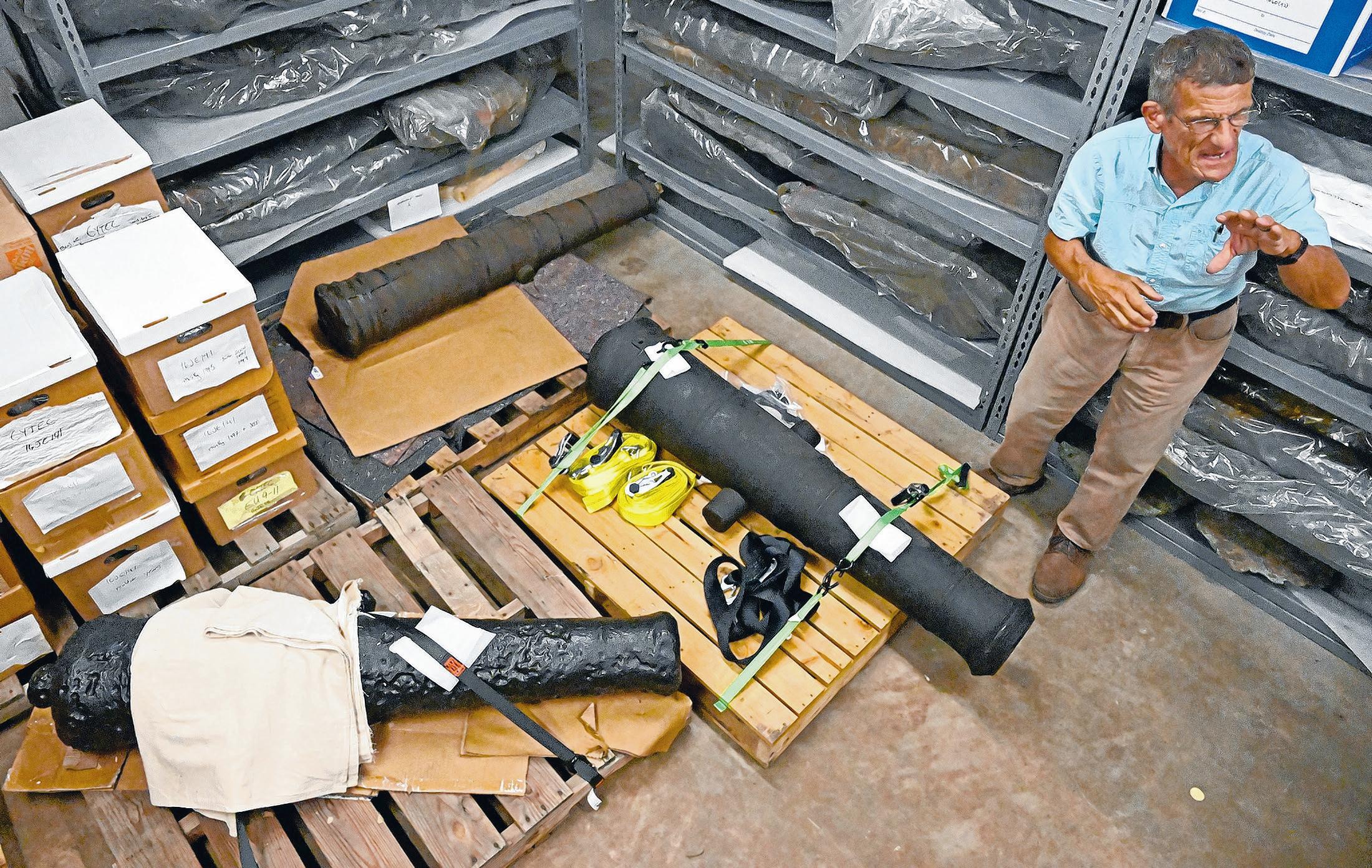
“Indiana Jones was looking for individual artifacts and stealing them — and we don’t do that,” McGimsey said as he walked by box after box of carefully labeled artifacts in the state’s archaeological storage warehouse in Baton Rouge.
The site looks like a smaller version of the anonymous government storage site where the Ark of the Covenant is placed at the end of the first Indiana Jones movie However, with McGimsey as a guide, the anonymity evaporates.
A walk through the boxes and bundles is like a walk through time:
n He points out cannons from a ship that sank between 1812 and 1820. It was found in the 1990s during the Mardi Gras pipeline exploration at about 4,000 feet in federal waters about 40 miles off the coast of Louisiana.
n Nearby, there’s another cannon that was made in 1697 in Sweden. It has a fleur de lis on top and was
also recovered from the Mardi Gras shipwreck.
n Thousands of dart points, often called arrowheads, gathered from sites throughout Louisiana line the shelves.
n Boxes of ancestral remains line a long shelf and await their return to Native American tribes.
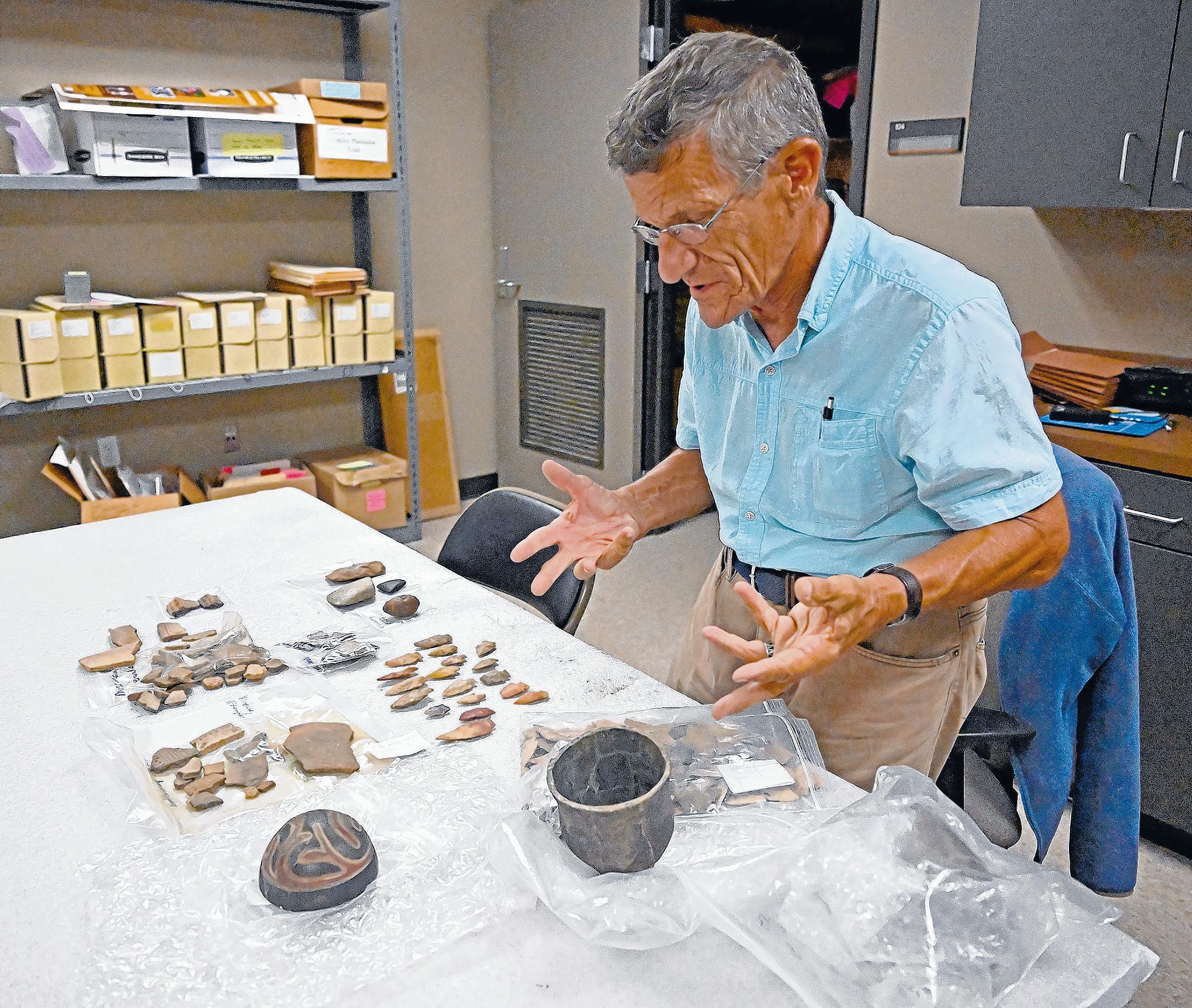
McGimsey 71, can tell the story of every item, every box.
Archaeologists don’t collect stuff
While the nation celebrated its 249th birthday on July 4, the day marked the end of McGimsey’s 30-year career as Louisiana’s state archaeologist. He’s spent the time uncovering and protecting the stories of Louisiana’s past.
There were no fireworks. Just the quiet significance of time passing a life dedicated to bridging what was and what remains.
probably used by the French military, maybe as ballast.
n Then there are artifacts from El Nuevo Constante, a Spanish ship that sank in 1766 off the Louisiana coast and was recovered between 1980 and 1982.
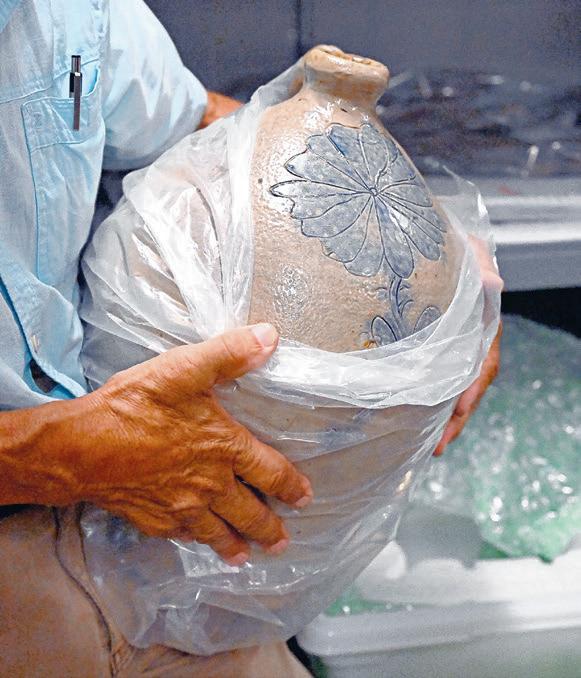
n There are beautiful oversized crockery jugs, made in America,
Instead of Indiana Jones’ obsession with trophy artifacts, McGimsey sees them as pure information. Simply handing a pile of artifacts to McGimsey doesn’t reveal a story
“That’s really what archaeologists are after,” he said. “We don’t
ä See ARCHAEOLOGIST, page 2G

BY RACHEL MIPRO Contributing writer
Herman Fuselier
STAFF PHOTOS BY HILARY SCHEINUK
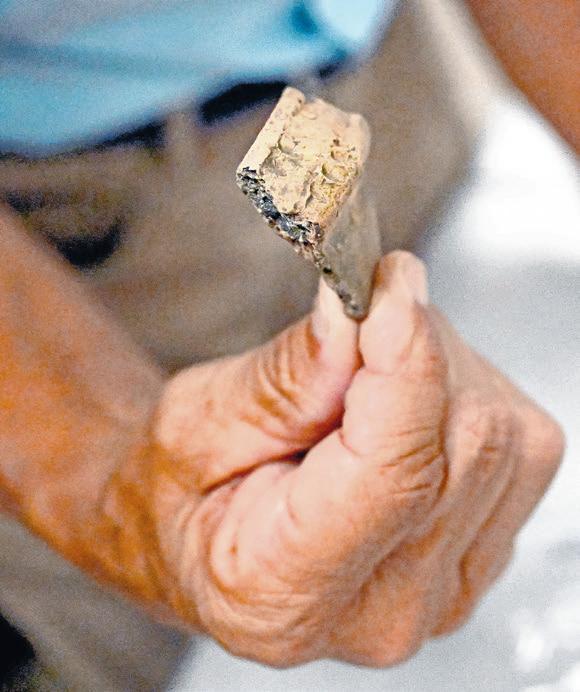
McGimsey discusses a handful of artifacts July 2 at the State of Louisiana
Archives in Baton Rouge. After decades of serving in the position, McGimsey retired July 4.
McGimsey shows off a stoneware jug from the Mardi Gras shipwreck at the State of Louisiana Archaeological Archives in Baton Rouge.
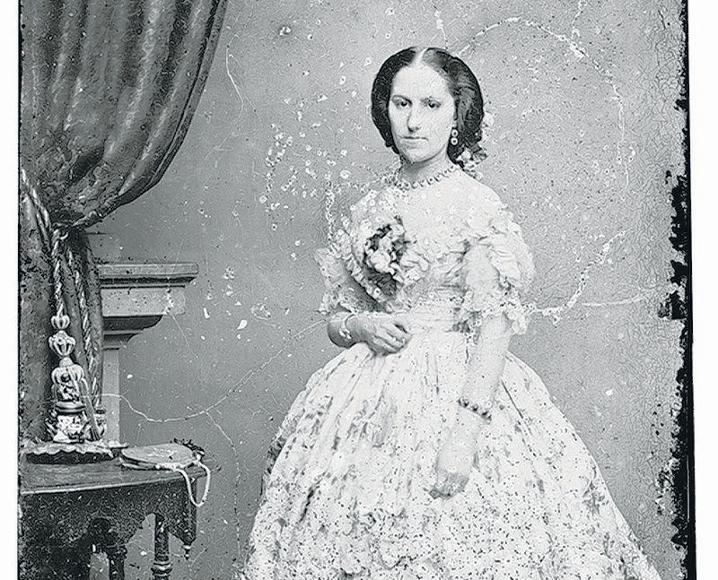
Myra Clark Gaines, photographed between 1855 and 1865, fought for 57 years to win her birth father’s property in the longest suit in American history.
cance.
collect stuff. We go after information Artifacts are just one part of the information that’s in the ground.”
He likens artifacts to words in a story
He suggests imagining cutting up a book so that each word is its own little slip of paper “Someone could hand you a bag with all the words and say, ‘Tell me the story,’” McGimsey said. “You can understand why you can’t. Because in order to tell the story you need to know where each word is relative to every other word — in a sequence of sentences, paragraphs, pages and chapters.”
When he and other archaeologists spend time at a site or multiple sites — studying pieces and patterns, comparing findings and connecting threads across locations — they begin to uncover a narrative. They can form hypotheses about what was happening, when, where and with whom.
“It’s knowing where everything fits relative to everything else,” he said. “That’s the part that fascinates me.”
The big challenge
In his last week on the job, he met with his colleague from the state’s archaeology outreach and education program.
“The big challenge is to get people to have an awareness of the past — how to reach the broadest audience and ultimately, in some way, be willing to support it,” McGimsey
said. “The thing that makes archaeology difficult is that it’s nonrenewable. You can’t re-
introduce a species like gray wolves or a fish in your river and let them start over again.
Once you erase history, it’s gone forever.”
McGimsey and his fellow archaeologists are working to determine which sites can be saved and for those that can’t be saved, what knowledge can be gathered and used to deepen our understanding of the past.
Helen Bouzon, an archaeologist with the state of Louisiana, has worked with McGimsey for three years.
“He knows everything about everything,” she said. “Even if it’s not written somewhere, you can be like, ‘Chip, what about this site? What do you know?’
And off he goes, with a near-encyclopedic knowledge of the site, its details and signifi-
She says his retirement marks a significant loss of institutional knowledge.
“I’m not a prehistoric archaeologist, I’m a historic archaeologist. So getting to work with Chip was the first pre-contact archaeology I’ve done,” Bouzon said. “So that was overwhelming, having him watch me try and do excavations on pre-contact sites. But I also learned about things I’ve never done before.”
The Brookhill Through the years, McGimsey’s work has been largely invisible to most, but when the Mississippi River ran low in 2022 and the Brookhill was exposed, his work surfaced





STAFF PHOTO BY HILARY SCHEINUK
Chip McGimsey shares information on a group of cannons at the State of Louisiana Archaeological Archives in Baton Rouge. Clockwise from left are an undated cannon found near the Ernest N. Morial Convention Center, a 1679 Swedish cannon found near Chandeleur Sound, and a 1799 Scottish cannon from the Mardi Gras shipwreck.
and captured public imagination. He did 47 media interviews about the Brookhill, which sank Sept. 29, 1915, as a hurricane blew in from the Gulf.
“The Brookhill was one of those things sent from heaven,” he said “It was a piece of history that people could walk up and touch. For most people, history exists in a museum case or a video. You can look at it, but you can’t really interact with it.”
The Brookhill was easily accessible — like a downtown Baton Rouge temporary tourist attraction. People could cross the railroad tracks that run right beside
CURIOUS
Continued from page 1G
rightful heir to this, she was not going to back down.
“Even after her first husband died and she got remarried, there were times that she was in there arguing for herself. She was not going to let anything get in her way And I think that was her just wanting to prove that she means something and that this is hers.”
The child of a secret marriage
Gaines was born in New Orleans in the early 1800s to Clark and a Frenchwoman named Zulime Carrière.
The two had been married secretly After they split, Clark destroyed evidence of the relationship when he wanted to remarry, Dunn said.
Gaines was raised by friends of Clark and kept ignorant of her real parentage until around 1832, when she was going through her adoptive father’s papers. Clark’s 1811 will bequeathed his vast tracts of New Orleans land to his mother, administered by his business partners, extremely influential power brokers Beverly Chew and Richard Relf. The two would benefit heavily from the will, Dunn said, allowing them to receive much of his fortune and land.
Gaines found evidence of another will, made in 1813, that declared her his heir and left her all his property and fortune estimated then at $35 million.
Dunn said Gaines unearthed evidence that the two business partners ha destroyed this will for personal gain. As a newlywed, she filed the first lawsuit with the help of h husband, William Whitney since women weren’t allowed to sue on their own Elizabeth Urban Alexan der author of “Notorious Woman: The Celebrated Case of Myra Clark Gaines,” talked about New Orleans’ response to her case
“Those questions wer not particularly well re
INDUSTRY
Continued from page 1G
the Mississippi River, walk down the hill and see, touch, walk around and even walk on it.
They could take any photograph they wanted. They could take pictures of their kids on it.
“Whatever that old TV commercial was, you know, up close and personal? The Brookhill brought history alive to people,” McGimsey said.
Perhaps, he speculates that the “Brookhill frenzy” was due to a combination of factors, including the possibility that the low Mississippi River was caused by climate change.
Even still, he’s not sure why it captured the attention of so many
“If it had been a Civil War gunboat, then absolutely, I could understand why everybody would be fascinated and want to see it and
ceived by the New Orleans community, because if Myra Gaines was right, then the legal titles to a fairly large portion of New Orleans were being called into dispute,” Alexander said. “So the whole power structure of New Orleans gathered together to support the executives of Clark’s will who were still alive, and to oppose this young couple.”
Sued and jailed for libel Chew and Relf sued Whitney for libel, landing him in jail for a threeweek stint. When Whitney died of yellow fever three years later, Gaines
whatnot,” McGimsey said. “But I mean, this was a work boat a ferry that all we had was one of the pontoons, and she didn’t do anything interesting except she sank three times.”
Life after McGimsey says that Indiana Jones’ impact on archaeology wasn’t all bad.
“My guess would be, in the end, it was kind of a wash,” he said of the media franchise. “I think it brought archaeology to a lot of younger people who wouldn’t have ever otherwise thought about it.”
McGimsey explains that Jones’ swashbuckling image of archaeology isn’t factual.
“But it served to bring the concept of archaeology to a huge au-
dience. Out of that, I suspect there were some kids who said, ‘Yeah, I’d like to be an archaeologist,’ and even continued to say that after they figured out what it really meant.” Along the way, McGimsey figured out just that.
Even though he’s retiring, with all the contacts he’s made throughout his career, McGimsey won’t be quitting archaeology any time soon.
“The most fun thing I know to do is to be out walking the field looking for stuff or standing in 100-degree heat in a 3-foot hole in the ground digging up dirt,” he said. “For me, it just doesn’t get any better than that.”
Email Jan Risher at jan.risher@ theadvocate.com.
blamed the imprisonment for weakening him. After her first husband died, she remarried, and her second husband also supported her cause.
In 1858, the Louisiana Supreme Court finally nullified the 1811 will and upheld the validity of the 1813 will. But by this time, the original estate had been split up and sold off, with much of Clark’s former land now belonging to the city Gaines then had to sue the city for her land, enduring decades more of legal troubles.
Alexander described Gaines as savvy, bucking social norms that expected
women to stay quiet and unseen. Alexander said she’d dress fashionably — in one case showing up in court in black velvet, with diamonds in her hair and a silk hat with bird of paradise feathers. She’d have her second husband, a general stand beside her in full uniform and introduce her before she’d talk.
“In other words, she’s a picture of femininity while she’s doing something that women are not supposed to do,” Alexander said.
“She wanted to be part of her lawsuit, and she was.
“She argued her case by herself in court,” Alexander said. “She was able
to manipulate this sort of classification system of a woman as a lady, without completely violating it.”
Setting the trail for women
The final tally was 57 years in court, with Gaines’ litigation pending in at least one court every single year Alexander calculated. The lawsuit was heard 17 times before the U.S. Supreme Court and had over 70 court filings in various probate and district courts.

of free Festivals Acadien et Creoles, 42 years of Downtown Alive, 38 yea of free Festival Internat al and 37 years of free Lunch. Citing financial lenges, organizers ended Rhythms on the River June, after a 25-year run free shows.
All of the events starte as noble causes, but they’re difficult to maintain wi tle or no money coming Changing the minds generations accustomed music being free and is a long-haul fight. Public officials, investors, media and economic developm interests must be in the conversation, too. All play a role in building sic industry that’s not holding its breath for next lightning strike.
Herman Fuselier is a broadcaster and tourism director living in Opelousas. His “Zydeco Stomp” radi show airs at noon Central time Saturdays on KR 8.7 FM and online at KR Public Media.

After the case was finally settled in Gaines’ favor, her heirs were awarded $923,788, but years of dragging litigation had incurred heavy legal fees, Dunn said. In the end, her heirs were left with just over $60,000 after these costs were paid. “She didn’t get to really reap the benefits,” Dunn said. “But the legacy of this, she really set the trail for women to be able to go on and have a much bigger role in their personal lives and society.”

Do you have a question about something in Louisiana that’s got you curious? Email your question to curiouslouisiana@ theadvocate.com. Include your name, phone number and the city where you live.
STAFF PHOTO BY HILARY SCHEINUK