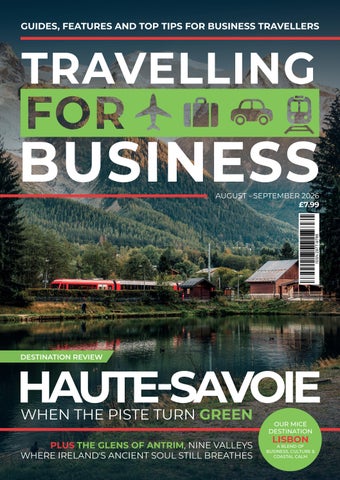
GUIDES, FEATURES AND TOP TIPS FOR BUSINESS TRAVELLERS
AUGUST - SEPTEMBER 2026 £7.99
DESTINATION REVIEW
HAUTE-SAVOIE WHEN THE PISTE TURN GREEN PLUS THE GLENS OF ANTRIM, NINE VALLEYS WHERE IRELAND'S ANCIENT SOUL STILL BREATHES
OUR MICE DESTINATION
LISBON
A BLEND OF BUSINESS, CULTURE & COASTAL CALM
Check in,
chill out Once you set foot in a Virgin Atlantic Clubhouse, you won’t want to leave. Grab a bite to eat (or two), freshen up with an in-house shower, or find a quiet corner to send off a few emails. It’s all so relaxing, you’ll have to remind yourself you’ve got a flight to catch. London Heathrow, Johannesburg, New York JFK, San Francisco and Washington DC are waiting for you. Our newest Clubhouse in LAX opens March 2025.
Untitled-2 1
27/11/2024 08:
The Travelling For Business Team
WELCOME TO
TRAVELLING FOR BUSINESS
YOUR ULTIMATE GUIDE FOR SUCCESSFUL BUSINESS TRAVEL
T
here is a scene in this issue I keep coming back to. Two French brothers, one a Paris speakeasy owner, the other a former trader, jolting across the Philippines in a hitched lorry with no camera crew, insisting that a bad experience is always better than a dull life.
Editor Richard Alvin Reviews & Features Editor Andrea Thompson Graphic Designer Grace Moseley Videographer Jacob Pinchbeck Content Sales Manager Laura Phillips Capital Business Media, Group MD Richard Alvin Business Development Director Stephen Banks Chief Creative Director Stuart Hyde Finance Director Andrew Martin
As manifestos go, and as a rebuke to the airport-hotel-boardroom circuit we all know too well, it takes some beating. Matthias and Bastien Cadéac d’Arbaud are on page 16, and their parting advice, "mingle, mingle, mingle", is the motto of this edition. The news pages are full of movement. Heathrow has surrendered Europe’s busiestairport crown to Istanbul, European carriers have quietly written the Gulf out of the summer schedule, Riyadh’s King Khalid has switched off the Tannoy altogether, and scientists at Surrey want a radiation scale that could ground flights in extreme space weather. Even easyJet is rewriting the script, opening hundreds of cabin crew roles to the over 50s. When the headlines get that busy, the cure is altitude. Andrea Thompson finds HauteSavoie transformed once the pistes turn green, rides the reborn Tramway du Mont Blanc, and walks the nine Glens of Antrim, where Ireland’s ancient soul breathes. We board the Caledonian Sleeper, give Marseille the 48 hours it deserves, and go antiquing from Stow-on-the-Wold to Saint-Ouen.
The hotel desk has rarely been busier: the Edinburgh Grand’s old-school swagger, Ardbeg House on Islay, Maison Proust in the Marais, The Dean Dublin, Margate House on the Kent coast, the Great Southern Killarney, Meneghetti in Istria, Quellenhof on Lake Garda and The Bolder, hovering above a Norwegian fjord. In Egypt we revisit the Old Cataract and the Four Seasons Cairo, then spend a morning inside the Grand Egyptian Museum. In New York, we find out what $15,000 a night buys on the 38th floor of Essex House. And at The Grove in Hertfordshire, a sand beach in a walled garden. Elsewhere, Lisbon completes its quiet conquest of the meetings world, Guanajuato performs, Machu Picchu keeps its secrets, ghost terminals stand silent, eSIMs finally make roaming painless, women lead the solo travel boom and Volvo’s EX30 Cross Country proves gloriously silly. One date for the diary: our Awards finalists are revealed on page 33, and the winners will be crowned on 22 October at 88 Wood Street, London, in partnership with Uber for Business.
Until then, do as the brothers say: mingle, mingle, mingle.
Travelling For Business is published in London by
CBM Travel LLC 1420 Celebration Boulevard Florida 34747 +1 212 531 5116 The Capital Business Media Group, Level 18, Forty Bank Street London, E14 5NR +44 20 7148 3861 Travelling For Business is printed using sustainable paper sources and vegetable ink, and is PEFC certified. Copies are recycled at the end of the issue.
RICHARD ALVIN
EDITOR, TRAVELLING FOR BUSINESS © CBM Travel LLC A Capital Business Media Group Company.
Off to new adventures.
CONTENTS DESTINATIONS Haute-Savoie When The Pistes Turn Green The Glens Of Antrim Nine Deep Emerald Valleys Lisbon Europe's Rising MICE Star Guanajuato Mexico's Most Beautiful City
10 20 38 65
HOTEL REVIEWS The Grove Hertfordshire, UK Margate House Kent, UK Ardbeg House Scotland, UK The Edinburgh Grand Scotland, UK The Great Southern Killarney Ireland Essex House New York, U.S. The Dean Dublin Ireland Maison Proust Paris, France Meneghetti Wine Hotel Croatia Quellenhof Luxury Resort Lake Garda, Italy The Bolder Norway The Old Cataract Aswan, Egypt Four Seasons Cairo, Egypt
47 48 49 50 51 54 56 57 58 59 60 61 62
EXPERIENCES The Caledonian Sleeper Britain's Most Atmospheric Journey Marseille 48 Hours In France Saint Michel D'Aiguilhe The Chapel That Touches The Sky Antiquing in the Cotswolds A Weekend Of Timeless Treasures Antiquing in Paris A 48 Hour Treasure Hunt Tramway Du Mont Blanc A New Chapter For A Legendary Line Inside Cairo's Grand Egyptian Museum A Jam Packed Morning The Secrets Of Machu Picchu A Bucket List Trip
25 26 42 44 45 52 63 68
FEATURES Latest News A Bad Experience Is Always Better Than A Dull Life The Ryder Cup Get Ready For 2027 in Ireland Plan, Fuel, Reward The Smarter Way To Travel For Business The Travelling For Business Awards 2026 The Finalists Solo Travel Why Women Now Lead The Trend Ghost Terminals Airports That Were Built & The Forgotten Volvo EX30 Cross Country Car Review Digital Travel Data & How It Really Works Why Innovation Driven Cities Keep Evolving
6 16 28 32 33 46 64 74 76 78
NEWS
HEATHROW LOSES EUROPE'S BUSIEST AIRPORT CROWN TO ISTANBUL
Istanbul handled more passengers than Heathrow in July, a first that hands the west London hub a fresh argument for its third runway and leaves corporate flyers facing tighter slots. Heathrow has been overtaken as Europe's busiest airport. Istanbul airport handled 8.15 million passengers in July against 7.9 million at the west London hub, ending a run that stretched back more than two decades before the pandemic and was interrupted only by the coronavirus travel restrictions of 2020. Figures published in August showed Heathrow's July passenger total fell 1.5 per cent compared with the same month last year, partly due to the war in Iran, while the Turkish hub recorded a 2.3 per cent increase. Heathrow had already trimmed its passenger and profit forecasts for the year, blaming the conflict in the Middle East for softer demand. It had regained the top spot only in 2023. The comparison is not entirely like for like. Istanbul airport opened in late 2018, was built on a new site away from the city and
6
its residential neighbourhoods, has a vastly bigger footprint and can operate around the clock. Its position near the Gulf, now the crossroads of international air travel, has also fuelled its growth. Istanbul airport's chief executive, Selahattin Bilgen, called the milestone significant. "Thanks to our three independent runways, which can be operated simultaneously 24 hours a day, our advanced operational capabilities and high capacity, we have successfully overcome the capacity constraints faced by many major global hub airports," he said. A fourth runway is set to become operational by the end of this year. For UK business travellers the change is more than symbolic. Heathrow's two runways are operating at close to full capacity, which means fuller aircraft, fewer spare slots when disruption strikes and limited room for airlines to add the new routes that corporate flyers increasingly book through rival hubs in the Gulf and Turkey. Heathrow is seeking government permission to build a third runway, with a
£33bn expansion plan that would allow it to accommodate 150 million passengers a year. The airport said: "The case for expansion has never been clearer, as Heathrow was overtaken in July by Istanbul airport as the busiest hub in Europe. Our plans will ensure the country gets the infrastructure it needs to stay competitive and will deliver all-important economic growth." The transport secretary, Heidi Alexander, launched a consultation on the Heathrow expansion national policy statement in June. Airlines have since demanded a review of Heathrow's costs before any approval, and Greater Manchester's mayor, Andy Burnham, has argued the plans divert infrastructure investment "away from the north and traps it in London". While Heathrow slipped back, other UK airports posted their best ever July figures. London Stansted welcomed 3.1 million passengers, its busiest month on record and a 6.3 per cent increase year on year, while Manchester served 3.4 million. For travel managers, that is a reminder that the regional network is absorbing growth the capital's hub cannot.
NEWS Qatar and UAE airspace at all EUROPEAN CARRIERS WRITE THE Kuwait, altitudes. Gulf airports are open and Gulf are flying. European operators GULF OUT OF THE SUMMER SCHEDULE carriers are simply not cleared into the airspace
KLM's Tel Aviv return has drawn the headlines, but Dubai, Riyadh and Dammam stay suspended until 24 October, and most European rivals have settled on the same date. KLM resumed flying between Amsterdam and Tel Aviv on 25 August, ending a sixmonth suspension that was widely read as a sign of normalisation. For corporate travel programmes, the more consequential line sits further down the airline's own alert page: Dubai, Riyadh and Dammam stay suspended up to and including 24 October. That is the date that matters. Tel Aviv is a thin business market for a European hub carrier. The Gulf corridor is the one that carries the trips, and for UK companies routing through Schiphol it remains shut well into the autumn.
extensions inside five weeks, each one longer than the last. Programmes that rebooked against the earlier dates have rebooked twice.
The rest of the market has clustered around the same point. Lufthansa and SWISS are suspending Dubai to 13 September, and Abu Dhabi, Amman, Beirut, Dammam, Riyadh, Erbil and Muscat to 24 October. British Airways has Dubai, Tel Aviv, Bahrain and Amman out to 25 October, has cut Doha and Riyadh to once daily and has dropped Jeddah permanently. Air Canada is out on Tel Aviv and Dubai to mid-January 2027. Singapore Airlines, Cathay Pacific, Finnair and ITA all sit at 24 to 26 October for Dubai. Turkish Airlines has restored Abu Dhabi, Dubai, Beirut and Amman, with Iran still suspended.
The Tel Aviv return is not a clean resumption either. Flights operate via a technical stop in Larnaca, where crews overnight rather than staying in Israel, with no timeline given for normal layovers. That adds block time, complicates same-day returns and puts a second failure point into the rotation.
Two things stand out. Air France and KLM, part of the same group, are running visibly different postures, with Air France on short rolling extensions and KLM on a single long one. And the clustering around 24 and 25 October is the IATA summer season boundary, not a security forecast. Most carriers have written the Gulf out of summer and will take a fresh decision for the winter schedule.
KLM's Gulf extensions tell the story in miniature. First 23 August, then 6 September, then 24 October, three
The blockage is not primarily about demand. EASA's conflict zone bulletin advises operators to avoid Bahrain,
above them.
Three practical points for the next quarter. Do not book the Gulf on a European carrier without a fallback identified, whether that is a Gulf carrier, a Turkish Airlines connection or a rescheduled trip. Assume suspensions get extended rather than lifted, because that is what the pattern since June shows. And check insurance wording carefully, since many corporate policies exclude losses arising from military airspace closures. Schedules were correct as of 13 August 2026 and are changing frequently. Verify with the operating carrier before booking.
NEWS
UK CAR HIRE RATES STAY FLAT BUT GROUND COSTS ARE MOVING Amex GBT forecasts UK car rental rises of just 0.6 to 1.3 per cent, while surcharges, supplier consolidation and ride hailing quietly reshape what a ground transfer really costs. UK companies will see some of the smallest car hire increases in Europe over the next two years, with rates forecast to rise by between 0.6 and 1.3 per cent, according to the latest Ground Monitor from American Express Global Business Travel. The annual forecast, produced by Amex GBT Consulting, puts UK car rental rates near the bottom of the European table
alongside France and Spain, where prices are expected to be flat to 0.5 per cent higher. Recovering vehicle supply and strong competition between providers are keeping a lid on UK pricing. For SME travel bookers, that makes ground transport one of the few parts of the trip budget not under obvious inflationary pressure, although the total cost of getting from an airport to a meeting is shifting in less visible ways. Elsewhere in Europe the picture is patchier. The Netherlands is set for the sharpest rises at 4 to 5 per cent, driven by motor vehicle tax changes that push up the cost of running a rental fleet. Germany is forecast at 1 to 2 per cent, Scandinavia at 1 to 2.5 per cent, the United States and Canada at 1.5 to 2 per cent and Australia at 3 to 3.4 per cent. Anyone hiring in North America should read the headline rate with caution. Amex GBT flags a significant rise in the number and value of city surcharges, including day of week charges and airport fees. Once limited to a handful of cities, they now push up the real cost of hiring even where base rates barely move. The report also puts a number on a question many travellers settle by instinct. Amex GBT modelled airport to city centre return journeys in ten major US business
destinations, comparing daily rental rates against ride hailing fares and factoring in tolls and parking. Over a single day, renting came out cheaper in five cities outright, with several others close enough that ride hailing wins once refuelling is added. Stretch the same trip across two days and ride hailing was cheaper in every city tested. The supplier list is changing shape too. Lyft completed its acquisition of European multi-mobility app FREENOW in July 2025, bought premium provider TBR Global Chauffeuring, then agreed to buy the London black cab business of Gett. Uber announced plans to buy executive chauffeur platform Blacklane in March 2026. Amex GBT advises corporates to ask newly acquired black car suppliers whether they can still deliver on reliability, comfort and pricing. With supply chains recovered, the consultancy says it is now less risky to consolidate a car programme onto one or two suppliers, and that rental companies will usually offer a better deal in return for committed volume. It also suggests auditing usage by ACRISS code, since a single category can contain up to ten car types and premium bookings quietly lift the average daily rate.
7
NEWS
SCIENTISTS WANT A RADIATION SCALE FOR GROUNDING FLIGHTS University of Surrey researchers want clear trigger points for rerouting or grounding aircraft during extreme space weather, with long-haul polar routes from the UK the most exposed. Extreme bursts of high-energy solar particles could drive radiation at cruising altitude sharply higher and upset the electronics aircraft rely on, according to University of Surrey research published in the Journal of Space Weather and Space Climate on 11 August 2026. The study concludes that airlines need clear trigger points for rerouting, descending or holding aircraft on the ground. For UK business travellers the risk is concentrated on long-haul polar routes, where the Earth's magnetic field gives the least protection. The researchers stress that a typical solar flare is not about to close airports, and that grounding would be a drastic step reserved for a very rare event. Airliners cruise at roughly 8 to 14 km, where atmospheric shielding thins with height
8
and towards the poles. During November 2025's major solar storm, high-altitude readings hit nearly ten times the usual level. Analysis of the far stronger February 1956 event suggests a comparable storm could deliver in one flight about as much cosmic radiation as a passenger normally accumulates from a year of flying. Operationally, the researchers think aircraft systems may prove the harder problem. Incoming particles can cause Single Event Upsets, or bit flips, which corrupt data or knock a computer off its task, and ICAO's space weather manual acknowledges that semiconductor-based avionics can misbehave in a solar radiation event. Redundancy soaks up isolated faults, but the study estimates an extreme event could lift upset rates from a handful an hour to thousands. Airbus temporarily grounded 6,000 A320s last year over a flight control computer vulnerable to intense solar radiation. "The recent Airbus A320 grounding linked to cosmic radiation shows that space weather is not a theoretical risk; it is already
affecting aviation," said lead author Dr Fan Lei, Senior Research Fellow at Surrey Space Centre. ICAO rates flights over and near the poles as the most exposed and warns that a geomagnetic storm can spread the affected area to lower latitudes. The Surrey team singles out routes such as Heathrow to Vancouver, noting a severe storm can extend the effects over the UK. The team's answer is an aviation-specific atmospheric radiation scale matching severity to response: closer monitoring, then rerouting, then grounding for the gravest events. ICAO has run a worldwide space weather advisory service since November 2019, but the researchers argue the sector has no way of converting those bulletins into operational decisions. "An atmospheric radiation scale has been needed for a long time, as current alerts based on low-energy proton events give at least ten false alerts for every true alert," said co-author Professor Clive Dyer, Visiting Professor at Surrey Space Centre. Surrey Space Centre head Professor Keith Ryden said there is currently "no consistent way for the aviation sector to assess and respond to extreme space weather risks", and that the scale should help "operators act quickly to protect passengers, crew and critical onboard systems".
NEWS now need a different habit: keep RIYADH SWITCHES OFF THE TANNOY number the airline app open with push notifications check the departure boards on a AS KING KHALID GOES SILENT enabled, regular cycle rather than once on arrival, and
Boarding calls have ended at Saudi Arabia's busiest airport, leaving screens, apps and push alerts to carry gate information and putting the onus firmly on the traveller. King Khalid International Airport in Riyadh has formally moved to a silent airport model, switching off routine public address announcements in favour of digital communication. Boarding calls, gate changes and final notices are no longer broadcast over the loudspeakers, and only emergency messages will still be delivered over the PA system.
For UK business travellers heading to Saudi Arabia's busiest airport, the practical consequence is immediate. Nobody is going to shout your name across the terminal any more. Passengers are expected to take their cues from flight information screens, airline apps, mobile notifications and staff on the floor, which puts the responsibility for catching a gate change squarely on the traveller. Riyadh Airports Company, which runs the airport, says the change is intended to cut noise pollution, improve the clarity of information and create a more premium atmosphere in the terminal. The airport has expanded its digital infrastructure to support the switch, with real time updates displayed throughout the building, enhanced mobile alerts from airlines and staff stationed at key junctions to help with wayfinding. The upside for anyone travelling on business is a terminal that is genuinely easier to work in. Constant overhead announcements are the single biggest obstacle to taking a client call, joining a video meeting or holding an informal conversation before boarding, and removing them makes the gate area a usable workspace rather than somewhere to be endured. The trade off is vigilance. Frequent flyers who have spent years half listening for their flight
choose a seat within sight of a screen. That matters most for anyone connecting through Riyadh on a tight turnaround, where a gate change buried in a phone notification is easy to miss. Push alerts only work if data does, so make sure roaming is active or connect to the airport WiFi on landing. The switch places Riyadh alongside Singapore Changi, Zurich and Helsinki, where quieter terminals are already treated as part of a premium passenger experience. It also sits within Saudi Arabia's wider aviation programme under Vision 2030, which aims to establish Riyadh as a major global hub for both business and leisure traffic. That context matters for UK companies because Riyadh is no longer an occasional destination. Direct capacity between Britain and the Saudi capital has been building steadily, with Riyadh Air opening Manchester to Riyadh ticket sales and the kingdom pursuing an expansion built around three new airlines, while the city has been positioning itself hard as a business events destination. For travel managers, it is worth adding a line to pre-trip guidance for Riyadh reminding staff that announcements have gone, and that the airline app is now the primary source of gate information.
NEWS
EASYJET OPENS HUNDREDS OF UK CABIN CREW ROLES TO OVER 50S Applications open this month for 2027 flying across easyJet's UK bases, as the airline reports a 127 per cent rise in crew aged over 50 since 2022. easyJet has said the number of its cabin crew aged over 50 has risen by 127 per cent since 2022, and is opening applications this month for hundreds of new crew jobs across its UK bases in 2027. Around one in ten of the airline's cabin crew, 12 per cent, are now over 50, while the number aged over 60 has almost quadrupled over the same period. For UK business travellers, the shift is one of the more visible changes on board a short-haul network many use weekly. Crew recruitment sits directly behind the reliability of early-morning departures and the standard of service on routes SME travellers depend on, and filling hundreds of roles ahead of summer 2027 will shape how well the airline's UK bases cope with peak demand. The push builds on an initiative first launched in 2022 to attract older workers, and on a 2024 Returnships scheme that offered free taster sessions to hundreds of career changers over 50. Research published by easyJet alongside the campaign found that 80 per cent of
UK adults who changed career after 50 reported an improvement in their overall happiness, and 65 per cent wished they had done it sooner. Travel and tourism emerged as the most attractive sector for a career change after 50, with the most common reasons for switching being job flexibility at 41 per cent, greater satisfaction and fulfilment at 38 per cent and wanting new experiences at 32 per cent.
at the chance. I knew I already held all the skills required for the job, but it gave me another way to use my communication, organisation and interpersonal skills in a new and exciting setting," she said. Michael Brown, Director of Cabin Services at easyJet, said: "It's been incredibly encouraging to see the numbers of cabin crew over 50 more than double since 2022 - evidence that many are increasingly viewing cabin crew as a fantastic career pivot regardless of age. "With hundreds of cabin crew roles set to be available across the UK, we would encourage even more to apply, and we look forward to seeing this community at easyJet grow further in the years to come."
Four in five UK adults who changed career after 50, 79 per cent, now regard their age as an asset rather than a barrier. The transferable skills they cited, problemsolving at 40 per cent, staying calm in unexpected or stressful situations at 35 per cent and strong communication at 33 per cent, are the ones that matter most to a business traveller when a flight goes wrong. One of them is Francesca Hicks, 64, a former secretary and nurse for people living with dementia. Eighteen months after joining, she has flown more than 250 times. "When the opportunity to join easyJet as cabin crew came up, I jumped
9
DESTINATION REVIEW
WHEN THE PISTES TURN GREEN
HAUTE-SA By ANDREA THOMPSON
There is a moment, somewhere between late spring and early summer, when the Alps shed their winter identity. The pistes soften, the snow retreats, and the mountains inhale again. What was once a landscape of speed and adrenaline becomes something gentler, greener, and infinitely more surprising. Haute Savoie so often defined by skiing, snowboarding and the choreography of winter reveals its true self when the pistes turn green.
MY JOURNEY THROUGH HAUTE SAVOIE BEYOND WINTER
AVOIE
DESTINATION REVIEW
I arrived expecting a summer version of a ski resort. What I found instead was a region transformed: forests humming with life, waterfalls in full voice, villages that looked almost theatrical in their prettiness and mountains that invited exploration rather than conquest. Haute Savoie in summer is not the Alps-lite; it is the Alps unmasked.
Haute Savoie isn’t all soft meadows and slow, sensory days. Once the snow melts, the region becomes an open air playground for adrenaline seekers. The same slopes that turn green in summer also turn wild carved with mountain bike trails, whitewater rafting, paragliding launch points and hiking routes that climb straight up the ridgelines. Electric mountain bikes make the ascents feel effortless, but the descents are pure exhilaration, sweeping down former ski runs where cows now trim the grass and wooden chalets dot the landscape like alpine punctuation marks. Above the villages, paragliders drift across the sky in bright arcs of colour, catching thermals that lift them over forests, cliffs and the deep, glacial valleys below. It’s a reminder that the Alps in summer are not a gentler version of winter; they are a different kind of thrill entirely one shaped by freedom, altitude and the quiet hum of nature at full power. MORE ON THE NEXT PAGE
11
DESTINATION REVIEW
SAINT GERVAIS: MY GATEWAY TO A DIFFERENT KIND OF MOUNTAIN My journey began in Saint Gervais Mont Blanc, a village that feels like a secret even though it sits beneath Europe’s highest peak. In winter, Saint Gervais is a launchpad for skiers heading towards the vast Evasion Mont Blanc domain. In summer, it becomes something else entirely a spa town, a cultural hub and a base for exploring the high Alps without ever clipping into skis. The Thermes de Saint Gervais Mont Blanc were my first stop. A spa carved into the mountainside, fed by thermal waters that have been flowing for more than 200 years. The experience was elemental: warm pools framed by rock, steam rising into the alpine air and a sense of calm that felt almost medicinal. It was the opposite of winter’s frenetic energy, a reminder that the mountains can heal as much as they can thrill. From the spa, I walked to the Tramway du Mont Blanc, one of the most atmospheric journeys in the Alps. The tram climbs slowly, deliberately, through forests and pastures, before emerging into high altitude wilderness. At the Nid d’Aigle “the Eagle’s Nest” the world opened up. Mont Blanc loomed above, glaciers glinted in the sun and the air felt sharper, cleaner, more honest. It was one of those places that make you quiet, even if you didn’t intend to be. The tramway is a gift for non skiers like me: a way to reach the high mountains without technical hiking, crampons or guides. It was also my first real reminder that Haute Savoie is not just a winter playground; it is a year round stage for drama, beauty and awe.
IN SUMMER, IT BECOMES A PARADISE FOR HIKERS, BOTANISTS CHAMONIX: AND ANYONE WHO WANTS TO A SUMMER ICON BENEATH THE GLACIER WALLS FEEL THE SCALE OF NATURE No journey through Haute Savoie feels WITHOUT NEEDING TO CONQUER IT complete without a stop in Chamonix, a town whose name alone conjures images of extreme winter sports, frozen ridgelines and the world’s most famous mountaineering history. Yet arriving in summer revealed a completely different personality - one that was softer, greener and unexpectedly charming. The dramatic peaks remained, of course, but the roads I could only imagine buried under metres of snow were clear and winding, lined with cafés, boutiques and sunlit terraces. Chamonix in summer felt like a mountain capital rediscovering its elegance. I wandered through the town centre, where the river rushed through like a silver ribbon, cooling the air and giving the village a sense of movement even when everything else felt still. Restaurants spilled onto pavements, including a Michelin starred gems tucked discreetly among the chalets, proving that Chamonix’s culinary
12
DESTINATION REVIEW
ambition is as strong in July as it is in January. The atmosphere was lively but never frantic with ablend of hikers, families, climbers and curious travellers all drawn to the magnetism of Mont Blanc towering above. One of the highlights of my visit was an unexpected privilege: a sneak preview of Chamonix’s newly reopened museum, a space dedicated to the history of the valley, its mountaineers and the evolution of alpine life. The museum was beautifully curated modern, tactile and surprisingly immersive. Exhibits of historic clothing, climbing equipment and early ski gear were displayed in a way that invited interaction rather than observation. Even as a non skier, I found it fascinating; the hands on displays and storytelling made the region’s heritage feel alive, human and deeply compelling. I could easily have spent hours there, tracing the threads of adventure, innovation and resilience that shaped Chamonix into the legend it is today. Outside, the village continued to charm with its wooden balconies draped in flowers, artisan shops selling local cheeses and chocolates and views that shifted constantly as clouds drifted across the peaks. Chamonix may be synonymous with winter, but in summer it becomes something else a cultural, culinary and scenic powerhouse that feels both iconic and intimate.
WATERFALLS, WILD FORESTS AND THE MAGIC OF SIXT FER À CHEVAL The next morning, I travelled into the Haut Giffre valley to visit one of the region’s most spectacular natural landmarks: the Rouget waterfall in Sixt Fer à Cheval. Known locally as the “Queen of the Alps,” the waterfall is at its most powerful in summer, when snowmelt feeds the river and the cascade becomes thunderous. Standing at its base, mist cooling my face, it was impossible not to feel small in the best possible way. The waterfall is framed by cliffs and forests, and the village of Sixt Fer à Cheval sits just beyond, a cluster of chalets, artisan shops and cobbled lanes that feel almost too picturesque to be real. I wandered through the village with a local guide, stopping at tiny food shops selling reblochon, saucisson, mountain honey and fruit tarts that tasted of alpine summers. Everything felt handcrafted, intentional, rooted in place. Haute Savoie’s villages are not curated for tourists they are lived in, loved and quietly proud. Sixt Fer à Cheval is also the gateway to one of Europe’s largest natural amphitheatres a horseshoe of cliffs and waterfalls that feels like a lost world. In winter, it is inaccessible. In summer, it becomes a paradise for hikers, botanists and anyone who wants to feel the scale of nature without needing to conquer it.
13
DESTINATION REVIEW
14
DESTINATION REVIEW
RIDING THROUGH VINEYARDS: A TASTE OF HAUTE SAVOIE’S ALPINE WINES From the cliffs and waterfalls, the landscape softened as we cycled (electric of course) the lower valley, where rows of vines stretched across gentle slopes. Haute Savoie isn’t widely known for wine, something I realised as I pedalled past neat rows glowing in the afternoon sun, but the region has a small, proud winemaking tradition each producing limited edition bottles shaped by altitude, mineral rich soils and the cool alpine climate. Riding along narrow lanes between the vines, the air warm and fragrant, the mountains rising dramatically behind. It felt almost surreal: the Alps, but with a whisper of Tuscany. The cycling was gentle here, a welcome contrast to the steep forest climbs earlier in the day and the scenery was so beautiful I kept stopping just to take it in - the patchwork of green, the wooden farmhouses, the distant peaks still dusted with snow. The tasting took place at a tiny family run domaine, the kind of place you’d never find without local guidance. The winemaker Nicholas Montessuit greeted us with the kind of quiet pride that comes from being the third generation crafting something rare. Sampling crisp whites with alpine freshness, delicate rosés that tasted of summer fruit, and a surprisingly complex red that carried the warmth of the valley. Each glass told a story of resilience vines that survive cold winters, ancestral Gringet grapes that ripen slowly under long mountain days and a tradition kept alive by just a handful of passionate growers. It was one of those experiences that felt deeply rooted intimate, authentic, and completely different from anything I expected in the Alps and added a new dimension to the region: Haute Savoie isn’t just about mountains; it’s about the life that thrives in their shadow.
ELECTRIC MOUNTAIN BIKING: RIDING THE ALPS IN A NEW WAY From the vineyards, I travelled to Les Carroz, where electric mountain bikes waited for a ride through forests, meadows and most unexpectedly ski runs. In winter, these slopes are busy, noisy, alive with skiers. In
summer, they become green corridors of wildflowers, grazing cows and wooden chalets that look like illustrations from a storybook. Electric mountain biking was one of the great revelations of the trip. It made the mountains accessible to everyone, all fitness levels, all ages, all abilities. The bikes flattened the climbs, allowing me to focus on the scenery rather than my lungs and the scenery was extraordinary. I rode through forests where the air smelled of pine and earth. I passed cows wearing bells that chimed softly as they grazed nature’s own soundtrack. I pedalled past tiny wooden houses, each one a perfect example of Savoyard architecture: steep roofs, carved balconies, flower boxes overflowing with colour. At one point, I took the bike onto a ski lift - a surreal moment that perfectly captured the region’s transformation. In winter, the lift carries skiers. In summer, it carries cyclists, hikers, paragliders and families heading to mountaintop restaurants. The Alps reinvent themselves with astonishing ease. The descent into Samoëns was exhilarating winding trails, sweeping views and the constant sense of moving through a landscape that was both wild and welcoming. Reaching the valley floor, the village appeared below like a postcard stone buildings, church spires, gardens and the river weaving through it all.
SAMOËNS: A VILLAGE WITH SOUL Samoëns is one of the most beautiful villages in the French Alps. It is also one of the most surprising. Unlike many mountain resorts, Samoëns is a real village with a year round community, a rich history and an atmosphere that feels more cultural than commercial. I explored its lanes, stopping at bakeries, cheesemongers, chocolatiers and artisan shops selling pottery, textiles and handmade soaps. Everything felt curated by passion rather than marketing. The village square, shaded by ancient trees, was filled with locals chatting, reading, or simply watching the world go by. The highlight was the Jaÿsinia Alpine Botanical Garden, a steep, winding
garden carved into the mountainside. With free entry it is home to more than 2,500 species of alpine plants, arranged in terraces, rockeries and hidden corners that feel almost enchanted. The garden is a masterpiece of botanical design — scientific, artistic and deeply peaceful. From the top, the view over Samoëns was breathtaking. The village sits in a bowl of mountains, each one rising in layers of green.
THE VILLAGES OF THE VALLEY: A STRING OF ALPINE JEWELS Haute Savoie’s villages are its greatest treasure. Each one has its own personality, its own rhythm, its own story and I only managed to see a handful. Saint Gervais is elegant, spa focused, and deeply connected to Mont Blanc. Sixt Fer à Cheval is wild, dramatic and shaped by waterfalls and cliffs. Samoëns is cultural, artisanal and quietly sophisticated. Les Carroz is sporty, friendly and perfect for outdoor adventure. Just to name a few! Together, they form a constellation of experiences that go far beyond skiing. You can spend a morning hiking to waterfalls, an afternoon exploring botanical gardens and an evening dining in a village square lit by lanterns and laughter.
THE MAGIC OF THE GREEN ALPS What struck me most during the trip was how alive the mountains felt. In winter, the Alps are beautiful, but they are also dormant, covered, waiting. In summer, they wake up. The forests are full of birds. The rivers run fast and clear. The meadows explode with colour. The villages breathe more slowly. The mountains feel closer, more intimate. Haute Savoie in summer is not a consolation prize for non skiers. It is a revelation and a version I never knew existed. It is a region that reinvents itself with the seasons, where adventure is gentle, immersive and accessible. Nature is not a backdrop but a companion where the pistes turn green and everything changes. For me although winter may be Haute Savoie’s headline act summer, autumn and spring are its soul.
15
INTERVIEW
A BAD EXPERIENCE
IS ALWAYS BETTER THAN A DULL LIFE
16
INTERVIEW
French brothers MATTHIAS and BASTIEN CADÉAC D’ARBAUD turned a late-night idea hatched in a bar into 100 THINGS TO DO BEFORE YOU DIE, a self-produced adventure series now streaming on Prime Video in eight territories
T
hey talk to Richard Alvin about crossing the Philippines by plane, horse and hitched lorry, and why business travellers should stop hiding in their hotels.
On paper, the Cadéac d’Arbaud brothers should not work as a television double act. Matthias is the hospitality showman: founder of Bar Zelda, the Paris speakeasy named after F. Scott Fitzgerald’s wife, more than a decade as the globe-trotting face of Don Papa, the Philippine sipping rum eventually snapped up by Diageo, with detours through an American reality show and a French rock band along the way. Bastien is the numbers man: a Société Générale trading floor in the United States, a string of start-ups, and two years fronting Capital, France’s flagship business programme on M6, as its first-ever nonjournalist presenter. One built his career on late nights; the other on early markets. Yet here they are, together on screen in 100 Things to Do Before You Die, the adventure series they created, produced and present, which landed on Prime Video in May across the UK, the United States, Australia, Canada, Mexico, France, Italy and Germany. The opening instalment sends them across the Philippines by plane, car, horse, motorcycle and jeepney, the gloriously chaotic converted trucks that serve as the archipelago’s buses, taking on what the billing promises are the craziest activities and wildest challenges the country has to offer. The tagline is two words: no limits.
The premise, they say, is a response to a world, and a television landscape, that has become too comfortable. “We all experience the fact that we’re scrolling on our phones for an hour or two every day, some people even more than that,” they explain. “We just thought we were at a time in our lives where we wanted to actually start doing crazy things, and to experience all the cool countries and the activities those countries have to offer. That was the plan. And then we turned it into a show.” The genesis was suitably unbusinesslike. “The whole project started in a bar, probably at one or two in the morning,” Matthias admits. “It came from Bastien. And in the morning, the day after, we decided to put it together and make it real.” The hardest part of getting a passion project off the ground? “It’s like going to the gym: the hardest part is putting your sneakers on.” There was rather more to it than sneakers. Instead of hawking the format around commissioners, the brothers financed and made the series themselves through their own production venture, and sold the finished product. “We self-produced everything, and then we distributed it, meaning we took the risk of producing it without knowing the outcome,” they say. It is the sort of bet a former trader and a bar
owner would understand better than most: put your own capital on the table, and back yourself to deliver. Amazon’s decision to roll the show out across eight-plus territories, subtitled in fourteen languages, suggests the wager paid off. Given the transport manifest, the obvious question is which leg of the journey genuinely frightened them, and which they would never repeat. The answer, it turns out, is the one the cameras largely missed. “You don’t see everything in the show, but at some point we’re hitchhiking,” they recall. “As we hopped into the lorry, the crew, the camera guys, had to take another truck. So it was just the two of us in the cab, with only our phones and no camera crew. The way the guy was driving was crazy.” Then, with the deadpan gratitude of men who have made peace with the memory: “Thank you, by the way, for saving us, because our engine had failed and the car collapsed.” For Matthias, the choice of the Philippines as the series opener was personal. His decade-plus with Don Papa, distilled on Negros, the country’s sugarcane island, meant he arrived thinking he knew the place. “Frankly, that was the first step towards the first episode,” he says. “I realised, after spending years in the Philippines, that I thought I knew the country, and there is so much more to be discovered. The more time I spent overseas, the more I realised there was more to find. That brought us to this point. If we had to make a first episode: let’s do it there.”
17
INTERVIEW
It is a striking choice nonetheless. On western screens, South-East Asian travelogues default to Thailand or Vietnam; the Philippines, despite being one of the great archipelagos on earth, rarely gets the treatment. So what are travellers missing? “The beauty of the Philippines is that there are something like seven thousand islands,” the brothers say. “There are still a lot of remote, non-touristic places, and the people there are still really genuine. Whenever we went to a small remote village, there was nobody remotely like a tourist agent used to offering activities to western European travellers. It’s back to what you might have expected of travelling in the 1980s, when most of these countries were pretty much untapped. You don’t feel that you are in any way a product for them, or a way to make money.” They offer an example. “A lot of the things we did, going out fishing for instance, would be a proper paying activity elsewhere. But they said: why would you want to pay for that? That’s our daily life; that’s how we earn money. Of course we’ll just bring you with us.” The generosity, they found, extended everywhere. “There are countries where you have to fight not to be scammed at every
18
turn. There, when you’re invited to someone’s place for lunch or dinner, they offer you everything, and you have to struggle, to say no, no, let me give you something.” And then there is the national soundtrack. “Filipinos are natural-born storytellers, which matters to us, because that’s what we do: we run on stories. And you should see their skills at karaoke. There’s something about music in the Philippines. They say Filipinos have the perfect ear, the perfect pitch.” Having heard plenty of it at close range, do they agree? A diplomatic pause. “We do… and we do not.” The storytelling instinct invites an obvious comparison: does the show sit in the tradition of Anthony Bourdain and his successors, getting under the skin of a country, albeit with extreme activities bolted on? They are happy to acknowledge the debt, up to a point. “There have been travel shows before, obviously, and some are really cool, a big source of inspiration. But ours is different in several ways. First, it’s a road-tripstyle show: whatever happens is on camera. Nothing is scripted; there are activities that are planned, and things that aren’t. Second, it’s the story of two brothers. Most shows are one guy. We believe that when we’re
together meeting new people, it fosters and boosts the interaction. And then we have the specific activities. So it’s a travel show, but it’s more than that: a mix of crazy, unusual activities and once-in-a-lifetime encounters, with remote tribes who aren’t used to seeing tourists at all.” They are equally deliberate about avoiding the genre’s biggest cliché, the bucket list, despite a title that flirts with it. “We try not to make it sound like a bucket list. Even though it’s unscripted, we try to have a narrative, to tell a story in between the challenges, to bring in the brotherhood.” The other differentiator is how it looks. “It’s much more cinematographic. The quality of the image, and the way it’s filmed, is not a vlog. It’s not a GoPro extreme-challenge experience. The images are part of the story we’re telling. Let’s be honest: a lot of people have swum with sharks on a GoPro, and you watch about thirty seconds before you get bored, because it’s not pretty. We wanted to mix the challenges and the experiences with the prettiness of the images.” They then volunteer something they say no interviewer has heard before: “We made the music ourselves, even the jingle. We’ve never mentioned that in a previous interview.”
INTERVIEW
Travelling for Business readers, of course, are more likely to have forty-eight hours in the Philippines than a hundred days. Where should they spend them? The answer is a full-throated defence of the city almost everyone is told to skip. “Most people try to avoid Manila,” they say. “They land at the international airport, lock themselves into a resort or a big hotel by the airport, and fly out first thing the next morning to the islands, Palawan and that kind of place. And yes, everything there is beautiful. But I would recommend trying Manila. It’s a once-in-alifetime experience, a city a bit like Mexico City, or even Los Angeles. You need someone to hold your hand. It’s not like New York or London, where you can just walk down the street and whatever will be, will be. You need someone to explain the rules to you. You can get lost, literally and metaphorically; it’s a megalopolis of twenty million people. But if you have someone to show you around, it’s worth it. Give it a shot; give it a chance. It’s a fantastic city.” If Matthias supplied the destination, Bastien supplied the operating model. His CV of trading floor, start-ups and prime-time business television reads oddly next to a programme about jumping off things in the
tropics, and he knows it. “When you look at it, these different career paths can seem a little bit odd,” he says. “But to me it’s all in line. When you are curious, when you like adventure, when you like new experiences, that’s the mindset of an entrepreneur. It’s the same: risk-taker, adventurer. Even this project: we’re hosts, but also producers. We started a company. It all makes sense to me.” As for how two such different brothers divide the labour, Bastien answers with the precision of a man who once presented France’s biggest business show. “The roles are separated in a very specific and precise way,” he says. “Matthias does nothing, and I do everything.” The rebuttal arrives instantly: “No, no, we get along pretty well. We know our strengths and who’s good at what, so that’s just what we do. Which is quite unfair, because everybody greets me.” Their biggest argument during filming, they insist, is still to come: “Probably in the next one.” The pair are unusually well placed to advise this magazine’s readership, having both logged years of corporate travel before ever pointing a camera at themselves. “We’ve both travelled a lot for work, so we can totally relate,” Bastien says. “I remember travelling
to Indonesia, to Mexico, to Turkey, to Russia, pretty much everywhere, and you’re always a little bit tired, because of the flights and the early meetings. Sometimes you’re tempted to stay in and order room service. I could have done that. But it’s such a regret when you go back home and realise there might be cities you’re never going to go back to. You need to realise the chance you have to be travelling for work. When you’re done with your meeting, go out, on your own if needs be, have a beer, and see how a random beer can lead you to a crazy adventure: a night out in one of these amazing cities. Go out of your nice hotel and experience what will become really nice memories. Even if things turn out badly, remember that sometimes bad experiences turn into great memories. A bad experience is always better than a dull life.” It is as neat a manifesto for the show, and as neat a rebuke to the airport-hotelboardroom circuit, as you could ask for. But the brothers have a shorter version, delivered as a parting shot with matching grins: “Stop listening to your mum. Accept drinks from strangers. And mingle, mingle, mingle.” 100 THINGS TO DO BEFORE YOU DIE is streaming now on Prime Video.
19
DESTINATION REVIEW
20
By ANDREA THOMPSON
DESTINATION REVIEW
NINE VALLEYS WHERE IRELAND’S
ANCIENT SOUL STILL BREATHES
THE OF
GLENS ANTRIM There are landscapes that feel visited and landscapes that feel encountered. The Glens of Antrim are nine deep, emerald valleys carved into the northeastern corner of County Antrim and belong firmly to the latter. They are places of quiet drama, where the Atlantic light shifts by the minute, where the hills seem to hum with old stories, and where the coastline unfurls in a way that feels both cinematic and deeply rooted in Irish tradition. For travellers who want to experience Ireland at its most elemental, the Glens offer one of the island’s most magical journeys. Stretching along the famed Causeway Coastal Route, the Glens form a chain of natural amphitheatres running from Glenarm in the south to Glentaisie in the north. Each valley has its own personality: some gentle and pastoral, others steep and shadowed, all threaded with rivers that tumble toward the sea. Together, they create a landscape that feels almost mythic - a place where folklore and geology intertwine, where the past feels unusually close and where the rhythm of the road invites you to slow down and simply absorb the beauty around you.
A LANDSCAPE WRITTEN IN MYTH AND TIME The Glens are steeped in folklore. Locals will tell you that fairies once danced in the hollows, that giants shaped the cliffs and that the ancient kingdom of Dalriada still whispers through the forests. Whether you believe the stories or not, the landscape makes them feel plausible. The valleys are so green they seem lit from within and the air carries that unmistakable Atlantic freshness that makes colours appear sharper, skies wider and shadows deeper. It’s easy to see why storytellers have been drawn here for centuries.
MORE ON THE NEXT PAGE
21
DESTINATION REVIEW
where fishing boats bob gently in the water. Walk the forest trails of Glenariff, where the sound of waterfalls echoes through the trees and take time in Cushendun, a village with a distinct Cornish feel thanks to its early 20th century architecture. The nearby caves, carved by the sea, add a touch of drama and have even appeared on screen in Game of Thrones.
WHERE TO STAY: FROM SEASIDE CHARM TO COUNTRY COMFORT The Glens offer a mix of cosy inns, boutique guesthouses and coastal hotels that make the most of the scenery. In Ballycastle, the Marine Hotel sits right on the seafront, offering rooms with views of the waves and easy access to the northern glens. It’s a perfect base for travellers who want comfort without losing that sense of being close to the elements. Glenariff, often called the “Queen of the Glens,” is the most dramatic of the nine. Its forest park is a world of cascades, wooden walkways and moss covered ravines that feel almost tropical after rain. Glenarm, the southernmost glen, sets a gentler tone with its stately castle, walled gardens and a village that feels like a postcard. Glendun, with its graceful stone bridge and river curling through the valley like a silver ribbon, is one of the most peaceful, and Glentaisie, the northernmost glen, opens out toward Ballycastle and the wild Atlantic beyond, offering views that seem to stretch all the way to Scotland.
DRIVING THE COASTAL ROUTE The Causeway Coastal Route ties the Glens together in one of Ireland’s most spectacular drives. The road hugs cliffs, dips into villages, skirts beaches and rises into viewpoints where the sea stretches endlessly toward the horizon. On clear days, the Mull of Kintyre appears like a ghostly silhouette. On misty days, the coastline feels mysterious and ancient, as though you’ve slipped into another century. It’s a route best taken slowly. Stop in Glenarm for coffee and a wander through the castle gardens. Pause at Carnlough Harbour,
For something more intimate, the villages of Cushendall and Cushendun offer charming B&Bs where the welcome is warm, the breakfasts are hearty and the pace is wonderfully slow. Many are family run, with owners who know the glens inside out and can point you toward hidden trails, quiet beaches and viewpoints that don’t appear on any maps. If you prefer a country house feel, the area around Glenarm offers elegant stays with gardens, fireplaces and that unmistakable sense of rural Irish calm. These properties are ideal for travellers who want to lend exploration with downtime, ideal for long walks followed by cosy evenings by the fire.
WHAT ELSE TO DO: CASTLES, CLIFFS AND COASTAL WONDERS
GLENARIFF, OFTEN CALLED THE Beyond the valleys themselves, the Glens sit within one of Ireland’s richest regions for “QUEEN OF THE GLENS,” sightseeing. Glenarm Castle is a highlight, its walled garden, tearoom and IS THE MOST DRAMATIC OF THE NINE with seasonal events that bring the estate to life.
The castle has been home to the Earls of Antrim for centuries and its grounds offer a glimpse into the area’s aristocratic past. Further north, the dramatic cliffs of Fair Head rise 600 feet above the sea, offering one of the most breathtaking coastal walks in Ireland. It’s a place of raw beauty windswept, rugged and unforgettable. From Ballycastle, you can also take the ferry to Rathlin Island, a windswept outpost known for its puffins, seals and lighthouse. The island feels wonderfully remote, a place where time slows and nature takes centre stage. Of course, the Glens sit within easy reach of the Giant’s Causeway, one of Ireland’s most iconic natural wonders. The basalt columns, shaped by volcanic activity, form a landscape that feels almost otherworldly. It’s busy in peak season, but still worth the trip, especially if you arrive early or stay late, when the crowds thin and the light softens.
22
DESTINATION REVIEW
23
DESTINATION REVIEW
WHY THE GLENS STAY WITH YOU The magic of the Glens of Antrim lies in their contrasts. They are wild yet gentle, remote yet welcoming, ancient yet alive with everyday life. They offer the kind of beauty that doesn’t shout but lingers in the memory, in the senses, in the quiet moments when you realise you’ve stumbled upon a place that feels truly special. It’s the combination of elements: the Atlantic light, the emerald valleys, the rhythm of the road, the sense of old stories lingering in the air. But it’s also the people who are warm, welcoming and fiercely proud of their landscape. Stop in any village pub and you’ll hear tales of fishermen, musicians, poets and farmers who have shaped life here for generations.
THE MAGIC OF THE GLENS OF ANTRIM LIES IN THEIR CONTRASTS. THEY ARE WILD YET GENTLE, REMOTE YET WELCOMING, ANCIENT YET ALIVE WITH EVERYDAY LIFE.
GETTING TO THE GLENS OF ANTRIM
ALL YOU NEED TO KNOW
NEAREST AIRPORTS • Belfast International Airport (BFS) – approx. 40 minutes to the Glens. • Belfast City Airport (BHD) – approx. 1 hour. Both airports have car hire, taxis and bus links. BY CAR The Glens are best explored by car. From Belfast, follow the M2 north, then join the A26/A44 toward Ballycastle or the A2 Coast Road, one of the most scenic drives in Ireland. Expect dramatic sea views, cliff edges and winding roads through all nine glens. BY FERRY • Cairnryan to Belfast (Stena Line) – around 2 hours 15 minutes. • Liverpool to Belfast (Stena Line) – around 8 hours. • Cairnryan to Larne (P&O Ferries) – around 2 hours; Larne is just 30 minutes from the Glens. Ideal if you want to bring your own car. BY PUBLIC TRANSPORT Translink buses run from Belfast to Ballymena, Cushendall and Ballycastle, but services between individual glens are limited. A car is strongly recommended for flexibility. CAR HIRE Available at both Belfast airports and in Belfast city centre. Pre booking is advised in peak season. BEST BASE TOWNS • Cushendall – central for exploring multiple glens. • Cushendun – coastal, quiet and picturesque. • Ballycastle – great for dining, ferries to Rathlin Island and access to the northern glens. WHEN TO GO Late spring to early autumn offers the best weather and visibility for hiking, coastal drives and photography.
24
A Night on the
EXPERIENCE
CALEDONIAN SLEEPER
Britain’s Most Atmospheric Journey T here’s a particular kind of magic to London Euston late at night the crowds thinning, the departure board glowing softly and along Platform 1, the Caledonian Sleeper waiting with quiet purpose. It doesn’t feel like boarding a train, it feels like stepping into a story, one that has been unfolding for more than 150 years.
Returning to your cabin, the bed is already turned down, lighting softened and the sense of uninterrupted movement becomes part of the charm. There are no transfers nor security queues just a continuous journey north through the night.
The Caledonian Sleeper’s history stretches back to 1873, when Britain introduced its first sleeping cars, allowing passengers to travel vast distances while they slept and a revolutionary idea at the time. Through steam, nationalisation and privatisation, the service evolved before being rebranded in 1996, yet the essence remains unchanged an overnight link between London and Scotland that feels both nostalgic and quietly radical in an age of rushed travel.
softly lit, and anchored by a Glencraft mattress handmade in Scotland. Storage is discreet, bedding crisp and despite the bunk bed layout, the space feels cocooning rather than cramped. Once the train pulls out at 11:45pm, the gentle rhythm of the rails becomes almost meditative, a soft rocking that lulls you into sleep as the miles slip by unnoticed.
Morning arrives gently as the Scottish countryside rolls past your window. Breakfast, ordered the night before, is delivered to your room, allowing you to savour the landscape with coffee in hand before the train glides into Glasgow Central just after 7:30am right in the heart of the city with no connections required.
Before bed, the Club Car is the heart of the experience. Conversations hum, glasses clink, and dinner unfolds at an unhurried pace such a rarity in modern travel. The menu leans into Scottish provenance, with local produce and rich flavours paired with Highland whisky, creating a sense of arrival long before the train crosses the border.
What the Caledonian Sleeper offers is more than transport. It’s accommodation, dining, heritage and experience woven into one seamless night. In an era of delays, queues and travel fatigue, it feels almost subversive in its simplicity. You go to sleep in one city and wake up in another refreshed and unhurried.
Boarding begins around 10:15pm and the first surprise is how much it resembles a boutique hotel rather than a train. Staff greet you warmly, guide you to your carriage, and lead you to your cabin, which, although compact, is cleverly designed,
25
EXPERIENCE
MARSEILLE 48 HOURS IN MARSEILLE FRANCE'S OLDEST, BOLDEST, SUN-SOAKED PORT CITY Grittier than the Riviera and all the better for it, France's second city serves up 2,600 years of history, wild coastal coves and the country's best bouillabaisse — with a swagger entirely its own.
Forget the polished Côte d'Azur clichés. Marseille is raw, sunlit and gloriously alive - a Mediterranean melting pot where fishing boats, street art and sea-urchin stalls jostle for space beneath a cobalt sky. France's oldest city, founded by Greek sailors around 600 BC, it has spent centuries absorbing the peoples of the Mediterranean and the result is a place with real edge and heart. Two days is enough to be thoroughly seduced. DAY ONE: The Old Port, Le Panier and Bouillabaisse
and its no-nonsense charm or graze on Panisses (crisp chickpea fritters) from a seafront stand. Afternoon: Follow the Corniche Kennedy, the dramatic coastal road, south past little swimming coves to the real showstopper: the Calanques. This national park of blinding-white limestone cliffs plunging into turquoise water begins right at the city's edge. Hike to Sugiton or En-Vau, or take a boat to swim in coves that feel a world away. Short on time? A ferry to the island fortress of the Château d'If, of Count of Monte Cristo fame, is the classic alternative.
Morning: Begin, as the city does, at the Vieux-Port (Old Port), where every morning fishermen sell their glistening catch straight off the boats on the Quai des Belges. Hop aboard the little ferry boat that has shuttled locals across the harbour for over a century, then climb or take the tourist train up to Notre-Dame de la Garde, the goldendomed basilica the Marseillais call "la Bonne Mère," for a jawdropping panorama over the terracotta sprawl and the sea beyond.
Evening: For a grand finale, the ambitious will book months ahead for AM par Alexandre Mazzia, the three-Michelin-starred temple of inventive cooking. For something more relaxed, feast on justcaught seafood at La Boîte à Sardine, then toast the trip with a last pastis by the floodlit Old Port.
Lunch: You can't come to Marseille and not eat bouillabaisse, the city's legendary saffron-scented fish stew, served in two acts - broth first, then the fish. The real thing takes time and money, so book ahead at Chez Fonfon, tucked into the impossibly pretty fishing cove of Vallon des Auffes.
To feel truly Marseillais, slow down. Play or at least watch a game of pétanque in the shade of a plane tree; swim off the Plage des Catalans or the rocks below the Corniche as the locals do; and pick up a block of the famous olive-oil savon de Marseille soap to take home. If you can, catch Olympique de Marseille at the roaring Stade Vélodrome — football here is closer to religion. Eat where the queues form, not where the menus are translated. Marseille rewards the curious and the unhurried: linger over an apéro, let a conversation start at the next table, and don't over-plan - half the joy here is stumbling on a tucked-away square or a rooftop view you didn't know to look for.
Afternoon: Walk it off in Le Panier, the ancient hilltop quarter and the city's soul with a tumble of pastel lanes, artisan ateliers, hidden squares and vivid street art. Nearby, the extraordinary MuCEM (the Museum of European and Mediterranean Civilisations), wrapped in a lace-like concrete lattice, is linked by a vertiginous footbridge to the old Fort Saint-Jean, one of the great pieces of modern European architecture and free to wander around at dusk. Just along the waterfront, the striped Byzantine bulk of the Cathédrale de la Major is worth a look before you climb back into the maze. Evening: Head up to Cours Julien and the streets around NotreDame du Mont, the bohemian heart of Marseille, where murals cover every wall and the bars and terraces buzz late. Start, of course, with a pastis the aniseed apéritif invented here and always over ice. DAY TWO: Markets, the Corniche and the Calanques Morning: Dive into Noailles, the intoxicating market quarter often called "the belly of Marseille." At the Marché des Capucins, spices, olives, North African pastries and Mediterranean produce spill across the stalls this is the city at its most gloriously multicultural. Pick up a bag of navettes, the orange-blossom biscuits baked here since 1781. Lunch: Grab a table at Chez Étienne in Le Panier a cash-only, nobookings institution famous for its wood-fired moitié-moitié pizza
26
LIVE LIKE A LOCAL
WHERE TO STAY For the leisure traveller - Mama Shelter Marseille. Playful, designled and brilliant value, this Philippe Starck-styled bolthole sits in the buzzing, mural-covered Cours Julien, with a lively rooftop bar and the city's best nightlife on the doorstep. Perfect for a fun, sociable city breaks with money left over for dinner. For the luxury stay - InterContinental Marseille – Hôtel Dieu. The city's grandest address: a majestic 18th-century former hospital transformed into a five-star landmark gazing down over the Old Port, with a spa, elegant terraces and a Michelin-pedigree restaurant. Marseille at its most polished and romantic - the splurge that becomes the highlight of the trip. For the business traveller - Sofitel Marseille Vieux-Port. Sleek, central and supremely practical, the Sofitel pairs harbour and NotreDame-de-la-Garde views with contemporary rooms, meeting and event spaces and an executive lounge. Walkable to the Old Port and a short hop from Gare Saint-Charles and the business district. Polish and productivity in equal measure.
EXPERIENCE
ALL THE INFORMATION YOU NEED: Getting there: Around 2 hours' direct flight from several UK airports to Marseille Provence Airport; or the TGV from Paris in about 3 hours 15 minutes. Airport to city: Roughly 25km out; a shuttle bus or train reaches Gare Saint-Charles in about 25–30 minutes. Time difference: +1 hour ahead of the UK (CET). Best time to visit: May–June and September–October for warm days and swimmable seas
without the peak-summer heat and crowds. Local transport: Walkable centre, plus two metro lines, trams, the cross-port ferry boat and hire bikes; the Calanques are reached by bus, boat or on foot. Essential dishes: Bouillabaisse, panisse, navettes, oursins (sea urchins, in winter), and a pastis at sundown. Perfect for: Food lovers, culture and street-art fans, architecture buffs and anyone after a city break with a wild coastline attached.
27
FEATURE
ONE YEAR OUT, THE
RYDER CUP
RUSH TO ADARE HAS ALREADY BEGUN In September 2027 the Ryder Cup comes to Adare Manor, Ireland's first hosting since 2006 and the biggest corporate hospitality event on next year's European calendar By RICHARD ALVIN
28
FEATURE
The approach announces the money before the gates do. Turn off the half-built N21, where the €150 million Adare bypass is racing a June 2027 deadline, and the village arrives first: a Heritage Town of 1830s thatched cottages currently sharing its single main street with construction traffic and the beginnings of a temporary railway station that will exist for one week in September 2027. Then come the gates, the 840-acre estate and the manor itself, a Tudor Revival pile said to feature 365 windows and 52 chimneys, which JP McManus bought in 2015 for a reported €30 million and rebuilt at a cost he has never confirmed, reopening in 2017 with a Michelin star in the Oak Room and, eventually, the number one resort ranking in Condé Nast Traveller's readers' poll. The golf course is the reason everyone is coming. Tom Fazio tore up the 1995 Trent Jones original and rebuilt it as a piece of tournament infrastructure: 200,000 tonnes of sand under the fairways, 50 miles of drainage pipe, SubAir systems beneath all 18 greens and fibre-optic conduit ringing every hole for the broadcast build. In 2026 the course is reserved for resort residents, at €550 a round plus a compulsory €120 caddie. A year out, the estate is already half machine, with the grandstand build starting in early 2027 and a record 20,000 seats to follow.
THE EVENT, DECODED FOR CORPORATES First, the dates, because an unofficial reseller is already circulating wrong ones. Ryder Cup week runs Monday 13 to Sunday 19 September 2027, with the match itself from Friday 17 to Sunday 19. It is the centenary staging, with Europe under Luke Donald going for a third consecutive win, and organisers expect around 250,000 spectators across the week, roughly 60,000 of them from overseas. Demand has already been demonstrated, brutally. When the island of Ireland priority window opened in April, more than 150,000 residents had registered and the allocation sold out in under an hour; the global ballot
closed on 29 June, with results pending as this issue went to press. General admission match-day tickets were priced at €499 a day, the most expensive in European Ryder Cup history, with practice days from €89. "Only tickets secured via official Ryder Cup channels will be accepted," the organisers state flatly, and resold tickets can be cancelled: treat the resale market as a way to buy a very expensive piece of paper. For corporate hosts, the realistic route in is official hospitality, and at the time of going to press the shelves were already half empty. Ryder Cup Europe sells four Premium Experience tiers direct. The Samuel Ryder Club, a shared lounge between the fan village and the 9th hole, starts at €550 per person per day excluding VAT; the Captains Club, beside the 5th green and 6th tee, at €600; both are down to limited single days. The top-table Trophy Suite beside the 11th is sold out entirely; when it was on sale, the Irish Times reported a Thursday-to-Sunday price of €13,549 a head. Private Ryder Cup Suites, the full corporate chalet product, remain on application. Richard Atkinson, the European Tour Group's chief Ryder Cup officer, has called the level of interest "unprecedented" and defended the pricing bluntly: "We are lower than Bethpage. Our prices are proportionate to a global sporting event." The ticket-inclusive alternative is the official travel programme: Ryder Cup Travel Services is the official provider, Gullivers Sports Travel and The Experience Golf are the appointed tour operators, and Carr Golf sells official packages from €4,598 per person including Thursday-to-Sunday tickets, Killarney accommodation, daily transfers and breakfast. Anything outside those channels should be verified with RCTS in writing before a deposit moves. Two further details tell you how the week will feel. Alongside the record grandstand build comes an official campsite, a first for the event and a measure of how far demand outruns local beds. The €499 gate price, nearly double Rome's, was even raised in the Dáil; none of the noise has slowed sales. As Irish Times sportswriter Denis Walsh put it, "the burning issue will be availability, not cost".
The tickets sold out in an hour, the top suites are gone and the beds within an hour of the first tee are going fast. Richard Alvin on what business travellers and corporate hosts should do about it, this autumn. 29
FEATURE
season; the Savoy, putting five-star beds in Limerick city with the rail and shuttle hub on the doorstep; and Limerick's four-star stock, Castletroy Park and the Limerick Strand among them, already marketing Ryder Cup packages. The honest advice is that anything within an hour, booked through an official channel, at a price that merely stings, is a good outcome.
BEYOND THE CUP: THE GOLF COAST Strip out the Ryder Cup and the south-west still makes the strongest incentive case in these islands, which is precisely why it is getting expensive. Fáilte Ireland values golf tourism at more than €300 million a year, from over 220,000 overseas golfers who spend roughly three times what the average visitor does, and the top courses have priced accordingly. Ballybunion's Old Course, about an hour and a quarter from Adare, is €450 in 2026, weekday mornings only for visitors; Lahinch put its fee up 20 per cent this spring to the same figure; and Tralee, Arnold Palmer's first European design, is likewise €450. The bellwether is Old Head of Kinsale: €500 this year, and the only club in the set to have already published its Ryder Cup-year rate of €550 for 2027. Budget saner money at Waterville (€400) or the underrated Dooks (€260), and note the small print: full non-refundable payment at booking is common, caddies at €110-plus a bag are often mandatory, and Ballybunion and Lahinch offer no buggies for the able-bodied. Above all, treat every marquee tee time in September 2027 as something to secure this year, not next.
THE LOGISTICS REALITY Shannon is the smart gateway and knows it. The airport is a 35-minute transfer from Adare, against two and a quarter hours or more from Dublin; Aer Lingus flies in from Heathrow around three times daily, Ryanair from Gatwick, Stansted and Manchester, and 2025 was the airport's best year in 16. A €40 million upgrade must finish by April 2027: new baggage hall, dedicated European and US passport channels, and an outsize baggage carousel for golf clubs that is already installed. "We expect a lot of general aviation, private jet traffic," Shannon Airport Group commercial director Vanessa McTigue said in June. Adare Manor has its own helicopter landing area, prior permission required and overflying the village prohibited; expect Shannon's general aviation apron to resemble a trade fair that week. Match week itself will be car-hostile by design. There is no on-site public parking:
30
spectators arrive by a dedicated shuttle train from Limerick Junction to the temporary Adare station, by shuttle bus from Limerick and Galway, or via pre-booked park-andride sites 10 to 30 minutes out. For a group of eight with a driver, the practical plan is a base within the shuttle catchment and a fixed morning drop at a park and ride, not a chauffeured crawl to the gates. Now the crunch. Adare Manor's own rooms are spoken for by teams, officials and the innermost circle, and the village's two hotels, the Dunraven and Fitzgeralds Woodlands House, will not touch the demand. The published market is already wild: one four-bedroom house within walking distance listed at €25,600 for the week, and the official Property Rental Programme is renting private homes on a standard eight-night basis. The credible group answers are a tier out: Dromoland Castle, 40 minutes north on a 450-acre Clare estate with its own parkland course, at around €1,000 a night in a normal high
Most UK groups will bolt 48 hours in Dublin onto either end. Stay at the Shelbourne on St Stephen's Green (specifying a refurbished floor, as a rolling renovation runs to May 2027), dine at the two-starred Chapter One, and book the Gravity Bar at the Guinness Storehouse, which takes up to 500 for a private reception. Golf completists can add the K Club, host in 2006, where the Palmer North green fee of €260 suddenly reads like value.
WHAT 2006 PAID, AND WHAT 2027 EXPECTS The K Club match remains the benchmark for what this event does to a host economy: Deloitte's assessment for Fáilte Ireland put direct expenditure at €143 million, from 260,000 attendees of whom 36,000 were corporately entertained, and Rome 2023 raised the bar to €262 million in economic activity. For Adare, the Irish government predicts returns of up to €160 million; against that sits public spending of some €58 million on the event, per Irish Times reporting, plus the €150 million bypass. The value-for-money argument will run for years; the corporate hospitality argument is simpler, because the audience is coming regardless. Limerick, at least, is planning for the day after, with up to €5.7 million in legacy
FEATURE
funding announced in February for Adare's village hall, heritage centre and public realm. The owner is thinking bigger still. "Hosting golf's greatest team contest will provide many economic benefits to the Irish economy and the south west community in particular," McManus said when the dates were confirmed. He is rarely quoted and even more rarely wrong about an investment. The corporates who share his timing, and book this autumn, will be the ones smiling on the first tee.
RYDER CUP 2027: WHAT CORPORATES NEED TO KNOW DATES: Event week 13 to 19 September 2027; match days Friday 17 to Sunday 19 September. Adare Manor, Co. Limerick. TICKETS: General admission €499 per match day; practice days from €89. The Irish priority sale sold out in under an hour; the global ballot closed 29 June 2026, results pending at press time. Returns are released only via official channels, and resold tickets can be cancelled.. HOSPITALITY, AT TIME OF GOING TO PRESS: Samuel Ryder Club from €550 pp/ day ex VAT and Captains Club from €600 pp/ day ex VAT, both limited single days only; the Trophy Suite is sold out (Thursday to Sunday was €13,549 pp, per the Irish Times); private suites on application to Ryder Cup Europe. OFFICIAL CHANNELS ONLY: Ryder Cup Europe (Premium Experiences), Ryder Cup Travel Services, official tour operators Gullivers Sports Travel and The Experience Golf, plus Carr Golf packages from €4,598 pp. Verify any other operator's status with RCTS in writing. DO NOW: Secure accommodation within an hour of Adare; buy remaining hospitality days; register a ticket account. Can wait: ground transport (event shuttles will serve most groups). AVOID: Secondary-market unofficial packages.
tickets
and
SAMPLE ITINERARY: HOST PLUS THREE CLIENTS, THREE NIGHTS (INDICATIVE, PRICED JULY 2026) ITEM
COST
Official package (Carr Golf): Killarney hotel 3 nights, Thu to Sun grounds tickets, daily transfers, breakfast, from €4,598 pp
€18,392
Samuel Ryder Club hospitality upgrade, Friday, c. €1,836 pp incl. VAT (Dec 2025 pricing via Irish Times)
€7,344
Flights London Heathrow to Shannon, Aer Lingus, 4 x c. €260 return (current fares as proxy; expect multiples for event week)
€1,040
Client dinner, Limerick or Adare village, 4 covers
€600
Indicative total for four
C. €27,400 (about £23,500)
GETTING THERE: SHANNON (SNN), THE SMART GATEWAY: 43km, about 35 minutes to Adare. Aer Lingus from Heathrow c. 3x daily; Ryanair from Gatwick, Stansted and Manchester. A €40m terminal upgrade completes April 2027, including a golf bag carousel. DUBLIN (DUB), THE FALLBACK: 2h15 to 2h30 by road via the M7; rail Dublin Heuston to Limerick from about 2 hours, then 25 minutes to Adare. Kerry and Cork airports also sit within 90 minutes and are named in the official transport plan. MATCH WEEK: No on-site parking. Shuttle trains run Limerick Junction to a temporary Adare station; shuttle buses from Limerick and Galway; pre-bookable park-and-ride sites 10 to 30 minutes out. THE NO-FLY OPTION: SailRail, London Euston to Dublin via Holyhead ferry, around £53 one way, 8 to 9 hours, then rail to Limerick. Check Holyhead berth restrictions nearer the time. MONEY: Euro; Irish VAT applies to hospitality prices quoted ex VAT. A 5 per cent tip covers most things; caddies expect €110 to €120 plus.
All prices as published or reported at time of going to press; event-week airfares and remaining hospitality inventory will move. Verify before committing budgets.
31
TRAVEL INFO
PLAN, FUEL, REWARD THE SMARTER WAY TO
TRAVEL FOR BUSINESS
BY ANDREW LAUGHLAN, HEAD OF ENTERPRISE, UBER FOR BUSINESS UK
W
hen you’re travelling for business, you should be focused on the why. That’s often about meeting clients, building relationships and connecting with colleagues. How you get there shouldn't feel like a drain on your time and energy, or a source of stress. Organising flights, accommodation and transport can become a job in itself, however, whether you’re arranging this yourself or relying on someone else. If your flight is delayed or your train is cancelled, this can have a knock-on effect. While some disruption is unavoidable, there are ways to reduce the friction that comes with travelling for work. Here are four tips to help your next business trip run more smoothly.
PLAN AHEAD WHERE POSSIBLE When you need to be somewhere at a fixed time, having a reliable transport option matters. Rather than standing in the taxi rank or trying to arrange transport when you leave the airport, reserving a ride in advance can save time and give you one less thing to think about. Knowing how you’ll get from the airport to your destination means you can spend more time preparing for your meeting and less time worrying about the journey. Travellers told us they saved an average of seven minutes per trip through reduced booking, waiting and travel time by using Uber for Business.
32
FUEL YOUR JOURNEY When you’re dashing between meetings, it’s easy to forget to eat. Finding food can be challenging when you’re unfamiliar with the local area, have limited options nearby or arrive at your accommodation late at night. Having food delivered is the most convenient solution. And if you’re visiting colleagues, ordering lunch to the office leaves more time to connect with your team. 83% of employees told us that ordering meals through Uber for Business saves them time.
PAIN-FREE EXPENSING Capturing and submitting expenses is one of the more frustrating parts of a business trip. Many expenses are still processed manually, with employees keeping paper receipts and submitting them post travel. This can mean waiting days or even weeks for reimbursement, as well as spending time tracking down receipts and making sure everything is accounted for at monthend. We spoke to employees in UK businesses who told us that, before using Uber for
Business, the most common business travel option was to pay for a taxi out of their own pocket and expense the cost afterwards (51%). Using a travel tool that handles trip and meal expenses automatically can make this process simpler, saving time for both you and your employer.
MAXIMISE THE REWARDS FROM YOUR TRAVEL If you’re a frequent traveller, you’re already likely to be signed up to hotel and airline rewards programmes - but it’s worth checking how you can earn extra rewards. Linking rewards programmes, such as British Airways Club or Marriott Bonvoy, to the Uber app provides another way to earn benefits from the journeys you’re taking. For example, business users can earn extra Avios through eligible Uber Eats orders, airport trips and Uber Reserve bookings. And if your employer uses Uber for Business, it’s worth asking about Uber One. Eligible employees can access a free 12-month membership, which provides savings on business and personal rides, promotions and £0 delivery fees on Uber Eats orders, at no added cost to their employer. Business travel shouldn’t be complicated. If you plan ahead and use digital tools to take care of the logistics, you can spend less time worrying about the small things and more time making the most of the trip.
T H E
FINALISTS
THE DEFINITIVE AWARDS FOR GLOBAL BUSINESS TRAVEL LEADERS
24 CATEGORIES
ONE UNFORGET TABLE NIGHT
in partnership with
TOGETHER AT 88 WOOD STREET, LONDON 22ND OCTOBER 2026 AWA R D S .T R AVE L L I N G FO R B U S I N E S S .CO.U K
THE FINALISTS AIRLINES & CABINS
AIRLINES & CABINS
AIRLINES & CABINS
BEST LONG-HAUL AIRLINE
BEST SHORT-HAUL AIRLINE
BEST BUSINESS CLASS EXPERIENCE
British Airways Cathay Pacific
Aer Lingus British Airways
Air France Air India
Emirates Etihad Airways Qatar Airways
easyJet Jet2.com KLM
British Airways Club Suite Cathay Pacific Aria Suite Emirates
Riyadh Air Singapore Airlines
Loganair Lufthansa
Qatar Airways Qsuite Riyadh Air
Turkish Airlines United Airlines Virgin Atlantic
Norwegian Ryanair SAS
Singapore Airlines United Polaris Suite and Studio Virgin Atlantic Upper Class
AIRLINES & CABINS
AIRLINES & CABINS
AIRPORTS, LOUNGES & PRODUCTS
BEST PREMIUM ECONOMY EXPERIENCE
BEST STANDARD CLASS
BEST LUGGAGE BRAND
Air France British Airways
Antler Away
Cathay Pacific Emirates
Briggs & Riley Carl Friedrik
EVA Air Japan Airlines Jet2.com
Eastpak Gomatic July
Qatar Airways Singapore Airlines
Rimowa Samsonite
Virgin Atlantic
Tripp Tumi
Air France Premium British Airways World Traveller Plus Cathay Pacific Premium Economy Emirates Premium Economy EVA Air Japan Airlines Norse Atlantic Premium Qantas Singapore Airlines Virgin Atlantic Premium
AIRPORTS, LOUNGES & PRODUCTS
BEST AIRLINE LOUNGE AIRPORTS, LOUNGES & PRODUCTS
BEST AIRPORT IN THE WORLD Helsinki Hong Kong Istanbul London City London Heathrow Munich Paris Charles de Gaulle Singapore Changi Tokyo Haneda Zurich
AIRPORTS, LOUNGES & PRODUCTS
Air France Lounge, Heathrow T4
BEST THIRD-PARTY LOUNGE
Air India, The Maharaja Lounge BA Concorde Room, Heathrow T5 Emirates Lounge, Manchester
Amex Centurion Lounge, Heathrow T3
Lufthansa Lounges, Heathrow T2 Qantas London Lounge, Heathrow T3 Qatar Airways Al Mourjan The Garden, Doha Qatar Airways Premium Lounge, Heathrow T4 Singapore Airlines SilverKris First, Heathrow T2 Virgin Atlantic Clubhouse, Heathrow T3
T R AV E L L I N G F O R B U S I N E S S AWA R D S 2 0 2 6 · I N PA R T N E R S H I P W I T H U B E R F O R B U S I N E S S
Aspire and Luxe by Aspire, Liverpool Aspire Pre-Flight Hospitality Clubrooms, Heathrow T3 Elior, Leeds Bradford Escape Lounges No1 Lounges Plaza Premium Group Plaza Premium Lounge, Heathrow T4 The Executive by Escape, Manchester T2
AWA R D S .T R AV E L L I N G F O R B U S I N E S S .CO. U K
THE FINALISTS HOTELS
HOTELS
MICE DESTINATIONS
BEST UK HOTEL
BEST BUDGET HOTEL BRAND
BEST MICE VENUE UK
100 Princes Street Claridge's Gleneagles Grantley Hall Heckfield Place Kimpton Fitzroy London Lucknam Park Raffles London at The OWO The Belfry The Newt in Somerset The Peninsula London
B&B Hotels easyHotel Hampton by Hilton Holiday Inn Express ibis Motel One Point A Hotels Premier Inn Travelodge Wetherspoon Hotels
The Savoy
ACC Liverpool Birmingham ExCeL London Hilton London Metropole ICC Belfast ICC Wales, Newport Macdonald Burlington Hotel, Birmingham Manchester Central Scottish Event Campus, Glasgow The Eastside Rooms, Birmingham
L O Y A LT Y HOTELS
BEST LUXURY HOTEL BRAND
BEST HOTEL LOYALTY PROGRAMME
MICE DESTINATIONS
BEST MICE DESTINATION EUROPE
ALL Accor Bulgari Dorchester Collection Four Seasons InterContinental Kimpton Mandarin Oriental Maybourne Rosewood Six Senses
Best Western Rewards GHA DISCOVERY Hilton Honors IHG One Rewards Leaders Club Marriott Bonvoy Shangri-La Circle World of Hyatt Wyndham Rewards
The Peninsula Hotels
Barcelona Copenhagen Fira de Barcelona Imperial Riding School, Vienna Madrid Meliá Avenida América, Madrid Montenegro Prague Vienna W Barcelona
L O Y A LT Y HOTELS
BEST UPSCALE HOTEL BRAND Curio Collection Hilton Hotels & Resorts Hotel Indigo Hyatt Regency Jumeirah Leonardo Hotels Marriott Hotels Novotel Only YOU Hotels Radisson Blu
BEST FREQUENT-FLIER PROGRAMME Air Canada Aeroplan Emirates Skywards Etihad Guest Flying Blue Loganair Avios Miles & More Qatar Airways Privilege Club Singapore Airlines KrisFlyer The British Airways Club (Avios) Virgin Atlantic Flying Club
MICE DESTINATIONS
BEST MICE DESTINATION REST OF THE WORLD Abu Dhabi Bangkok Marriott Marquis Queen's Park Dubai ICC Sydney JW Marriott Marquis, Dubai Las Vegas Marina Bay Sands, Singapore Orlando Riyadh Singapore
T R AV E L L I N G F O R B U S I N E S S AWA R D S 2 0 2 6 · I N PA R T N E R S H I P W I T H U B E R F O R B U S I N E S S
AWA R D S .T R AV E L L I N G F O R B U S I N E S S .CO. U K
THE FINALISTS TECHNOLOGY
MOBILITY
SPECIAL RECOGNITION
BEST TRAVEL APP
BEST CAR RENTAL COMPANY
BEST ATTRACTION BUYOUT FOR CORPORATE GROUPS
Airalo
Arnold Clark Car & Van Rental Avis Budget Group
British Airways app Flighty
Business Solutions by Disneyland Paris F1 Arcade Guinness Storehouse, Dublin
Drivalia Enterprise Car Club Enterprise Mobility
Hopper Navan Priority Pass+
Merlin Events (London Eye, Madame Tussauds,
Europcar Mobility Group UK Hertz
SAP Concur Trainline
LEGOLAND, Alton Towers and more) Natural History Museum, London
Sixt
TripIt Virgin Atlantic app
Science Museum, London Sphere, Las Vegas
SPECIAL RECOGNITION SPECIAL RECOGNITION
ACCESSIBILITY AWARD
SUSTAINABILITY AWARD
Tower of London (Historic Royal Palaces) Universal Destinations &
Air France-KLM
Eurostar Helsinki Airport (Finavia)
Emirates Gatwick Airport Hidden Disabilities Sunflower Scheme Teesside International Airport Titanic Hotel Belfast United Airlines Virgin Atlantic
Experiences Warner Bros. Studio Tour London
Amsterdam Schiphol (Royal Schiphol Group) British Airways (IAG)
Belfast City Airport Delta Air Lines easyJet
Norwegian Sherbet London The Pig Hotels (Home Grown Hotels) TravelPerk (GreenPerk) United Airlines
JOIN US ON THE NIGHT
The winners will be revealed at the Travelling for Business Awards 2026 gala dinner, an evening celebrating the very best in global business travel.
BOOK YOUR TABLE TOGETHER AT 88 WOOD STREET, LONDON
·
22ND OCTOBER 2026
AWA R D S .T R AVE L L I N G F O R B U S I N E S S .CO. U K SCAN TO BOOK YO U R TA B L E
in partnership with
YOUR SKYWAY TO
A WORLD OF CHOICES.
Discover our 2025 summer schedule, now open for booking, with some of the best premium cabins in the sky and an experience that makes out of office out of this world.
MICE DESTINATION REVIEW
EUROPE’S RISING MICE STAR LISBON’S BLEND OF
BUSINESS, CULTURE AND COASTAL CALM
38
LISBON
PORTUGAL
MICE DESTINATION REVIEW
In 2025, Lisbon was ranked the number one city on earth for international association congresses, nudging aside Paris, Barcelona and Vienna, and collecting a shelf’s worth of “Europe’s Leading Meetings & Conference Destination” trophies along the way. The world has finally caught up with what Lisbon has been building: a city with the infrastructure of a heavyweight and the soul of somewhere you’d happily stay an extra few days.
What’s striking is how little of this transformation has relied on reinvention. Lisbon hasn’t tried to become something it isn’t. Instead, it has taken the qualities that made it irresistible the light, the food, the river, the human scale and layered on the kind of serious, grown up hardware that global organisations need. The result is a city that feels both purposeful and pleasurable, a place where business travellers find themselves lingering, and where leisure travellers discover a cosmopolitan capital that still feels intimately Portuguese. Much of Lisbon’s modern confidence radiates from the river. Follow the Tagus east and you reach Parque das Nações, the former Expo ’98 site that has matured into a sleek, contemporary district with a rhythm entirely its own. This is Lisbon’s engine room: a cluster of large scale venues, hotels and transport links that give the city its international reach.
For years, Lisbon occupied a curious place in the European imagination, a city beloved by travellers yet somehow peripheral in the grand sweep of global decision making. It was the charming outsider, the sunlit alternative to Paris or Barcelona, a place where organisers might take a punt if they wanted a change of scene. That era has quietly ended.
FIL, the Lisbon Exhibition & Congress Centre, anchors the district with its vast, column free pavilions and dedicated meeting spaces the kind of facility that can absorb a global gathering without breaking stride. Next door, the Altice Arena rises like a metallic wave, a 20,000 seat landmark that has become synonymous with Web Summit and the city’s tech forward identity. Even if you’re not attending an event, the energy of the district is unmistakable: joggers tracing the riverfront boardwalk, families spilling out of the Oceanarium, and the hum of trains and metro lines converging at Gare do Oriente.
MORE ON THE NEXT PAGE
39
MICE DESTINATION REVIEW
Yet Lisbon’s appeal isn’t defined by scale alone. Move west and the city shifts gear, revealing a portfolio of heritage spaces that feel almost cinematic. The Cordoaria Nacional once a rope factory, now a cavernous stone monument hosts dinners that echo with centuries of maritime history. Palaces along the river open their doors for receptions that feel more like scenes from a period drama than corporate gatherings. Even the simple act of stepping into Belém, with its Manueline arches and the scent of warm custard drifting from the original pastel de nata bakery, feels like entering a chapter of Portugal’s story. Lisbon understands atmosphere, and it uses it generously. Part of the city’s rise is logistical. Humberto Delgado Airport sits inside the city limits, a rare luxury for a European capital. You can land, clear arrivals, and be at the river within minutes. As the hub of TAP Air Portugal, Lisbon connects naturally to Europe, the Americas and Africa, making it a crossroads for travellers who might otherwise face awkward transfers. On the ground, the city is refreshingly intuitive: a modern metro, affordable taxis, walkable neighbourhoods, and a population that switches to English with easy warmth. The hotel landscape has expanded rapidly too, from international five star names to design driven boutiques and renovated historic properties that feel distinctly Lisbon rather than generically “luxury”. But the deeper reason Lisbon has surged lies in its value - not just financial, though that certainly helps, but experiential. Compared with London, Paris or Zurich, Lisbon stretches a budget further without ever feeling like a compromise. Meals linger longer. Rooms feel larger. Days feel brighter. With nearly 300 days of sunshine a year, the city sidesteps the seasonal bottlenecks that plague other European capitals. Winter here is a gentle, Atlantic washed season of blue skies and crisp mornings, perfect for exploring without crowds. There is also a sense of alignment, a city and a country working in concert. Turismo de Portugal and the Lisbon Convention Bureau have become adept at supporting international organisations, offering bid assistance, ambassador programmes and sustainability guidance. Portugal’s leadership in renewable energy lends credibility to events with environmental commitments, and the national hospitality culture warm, unfussy, quietly proud means visitors feel looked after without being fussed over.
By day, it is a city of infrastructure, connectivity and capability. By night, it becomes something softer - a place of music, food, river breezes and human warmth. 40
Still, statistics and infrastructure only tell half the story. Lisbon’s real magnetism reveals itself after the final session ends, when delegates spill into the streets and discover a city that rewards curiosity. Food is the most immediate pleasure. Lisbon is a city built on the Atlantic, and its cuisine reflects that elemental relationship: grilled fish so fresh it barely needs seasoning, seafood stews fragrant with herbs, and bacalhau prepared in more variations than anyone can reasonably count. The
ritual of a pastel de nata - warm, blistered, dusted with cinnamon is non negotiable, especially at Belém, where they have been baking them since 1837. Wine is democratic and delightful: crisp vinho verde, generous Douro reds, and chilled white port that feels tailor made for late afternoons by the river. The city’s geography makes exploration effortless. Tram 28 rattles through Alfama’s tiled lanes, past laundry strung like bunting between windows. The climb to Castelo de São Jorge rewards you with a panorama of red rooftops cascading towards the water. Belém offers architectural grandeur and riverfront calm; Bairro Alto offers taverns where fado drifts out into the night. Lisbon is a city where you can do a great deal in a short time without ever feeling rushed. And if you have a day to spare, the surroundings open up like a storybook. Sintra’s palaces shimmer with pastel colours and misty romance. Cascais offers surf, seafood and a breezy coastal charm. The Estoril coast stretches out with beaches that feel worlds away from the capital. Inland, the Alentejo’s cork forests and wineries offer a slower, sun drenched counterpoint. Lisbon is not just a destination; it is a gateway to an entire region of experiences. What Lisbon has achieved is rare: a dual identity that feels entirely natural. By day, it is a city of infrastructure, connectivity and capability. By night, it becomes something softer - a place of music, food, river breezes and human warmth. Delegates arrive for a conference and leave planning a holiday. Travellers come for a weekend and find themselves imagining a life here. Lisbon has stopped being the charming alternative. It has become the obvious choice because it understands what people want from a city today: competence, beauty, and a sense of welcome.
41
EXPERIENCE
SAINT MICHEL
D’AIGUILHE THE CHAPEL THAT TOUCHES THE SKY
Some landmarks impress you with scale, others with beauty. Saint Michel d’Aiguilhe does something rarer - it astonishes. Rising from the centre of Le Puy en Velay like a needle of volcanic rock, its slender basalt column carries a chapel so improbably perched that it seems to hover between earth and sky. Even from a distance, the sight is arresting: an ancient Romanesque sanctuary balanced on an 82 metre pinnacle, as though placed there by a divine hand rather than human ambition. Built in 962, the chapel has watched over the town for more than a millennium. Pilgrims once climbed the rock at the start of the Via Podiensis, one of the great routes of the Camino de Santiago. Today, the ascent remains part of its magic. A staircase carved into the rock winds upwards in a gentle spiral, each turn revealing a wider sweep of terracotta rooftops, cathedral spires and the volcanic silhouettes that define this corner of the Auvergne. By the time you reach the summit, the town feels far below, softened by distance, and the chapel appears almost weightless a delicate arrangement of arches, frescoes and stone that seems to float on its basalt pedestal. Inside, the atmosphere shifts. The chapel is small, intimate, and unexpectedly warm,
42
its frescoes glowing softly in the half light. Scenes of the archangel Michael and early Christian iconography wrap the interior in a sense of continuity, as though the centuries between then and now have thinned. Step outside again and the panorama is extraordinary: the statue of Notre Dame de France rising from another volcanic plug across the valley, the cathedral of Le Puy anchoring the old town, and the surrounding hills rolling away in gentle folds. It is a view that rewards stillness. Saint Michel d’Aiguilhe is open throughout the year, but it is at its most atmospheric from spring to early autumn, when the air is clear and the light sharpens the contours of the rock. Early morning offers solitude; late afternoon brings a golden warmth that turns the chapel into a beacon. Even in summer, the site rarely feels crowded the climb naturally spaces visitors and the summit remains a place of quiet contemplation.
Le Puy en Velay itself is a town worth lingering in. Its medieval streets curl around the cathedral, opening into squares lined with cafés and small restaurants. Stay in one of the elegant boutique hotels near the historic centre, where restored stone buildings and shuttered windows create a sense of timelessness. Dinner might be a refined take on regional Auvergne cuisine lentils from the surrounding fields, local cheeses, slow cooked mountain dishes paired with wines from the Rhône Valley. Afterwards, a drink in the cathedral square feels almost ceremonial, especially as the evening light settles over the volcanic peaks. Saint Michel d’Aiguilhe is not a large site, nor a long visit but it is one of those rare places that leaves an imprint, a reminder of how architecture, geology and faith can combine to create something quietly transcendent. A chapel in the sky, reached by a staircase of stone, overlooking a town shaped by centuries of pilgrimage.
Win the ultimate trip Race to Necker with Sky High Club There are one-of-a-kind trips. And then there’s shout it-from-the-mountaintops, pinch-me-I’m-dreaming incredible. And if you’re a member of our Sky High Club, that experience could be closer than you think. Log the most bookings between now and 31st July, and you could be packing your bags for a five-night stay at Richard Branson’s private island, Necker, courtesy of Virgin Limited Edition. You’ll be treated to Upper Class flights, two nights at the sensational Sandals resort in Antigua and then get whisked away by private jet thanks to Tradewind to the sparkling waters and white sands of Richard’s home in the British Virgin Islands. Start your engines, the race is on! Visit virginatlanticskyhighclub.com
T&Cs apply.
EXPERIENCE
The Cotswolds is a landscape of honey stone villages and rolling hills, but for collectors it is also a region rich in antiques. Market towns such as Stow on the Wold, Tetbury and Burford have long been centres of trade and today they are lined with dealers offering everything from Georgian furniture to quirky decorative finds.
A
ntiquing breaks are curated escapes that turn the hunt for vintage treasures into a travel experience by blending the thrill of exploring antique shops, flea markets and galleries with immersion in design rich settings and boutique hospitality. A 48 hour escape here is about slowing down, browsing, and discovering objects that carry centuries of stories.
shops sit alongside the Corinium Museum’s artefacts. It’s the perfect finale: a reminder that antiquing here is about connecting with history as much as shopping.
DAY ONE Stow on the Wold and Burford Begin in Stow on the Wold, where the market square has been a trading hub since medieval times. Antique shops cluster around the square, specialising in English country furniture, silver and art. After lunch, head to Burford, whose high street is a parade of galleries and dealers. Here, the mix of serious collections and whimsical curiosities makes browsing a delight. Stay overnight at a boutique property such as Thyme, a restored manor estate whose interiors blend rustic elegance with contemporary design. DAY TWO Tetbury and Cirencester Tetbury is the jewel of Cotswolds antiquing, with a high street lined with dealers offering Regency furniture, objets d’art and decorative pieces. Its proximity to Highgrove adds prestige. After lunch, continue to Cirencester, once a Roman capital, where antique
WHY GO? An antiquing getaway in the Cotswolds offers immersion in a landscape where history feels tangible. Boutique hotels mirror the aesthetic of the finds, creating continuity between the day’s treasure hunting and the evening’s relaxation. For travellers seeking authenticity and design, the Cotswolds delivers a restorative and inspiring escape.
Cotswolds Antiquing Essentials GETTING THERE: Around 90 minutes by train or car from London. BEST TIME: Spring and autumn for mild weather and lively markets. INSIDER TIP: Visit Tetbury’s Long Street for the highest concentration of antique dealers.
A WEEKEND AMONG ENGLAND’S TIMELESS TREASURES
ANTIQUING IN THE
COTSWOLDS
44
EXPERIENCE
ANTIQUING IN
PARIS
A 48 HOUR TREASURE HUNT THROUGH THE CITY OF LIGHT DAY ONE Saint Ouen and the Marais Start at the Marché aux Puces de Saint Ouen, Europe’s largest flea market. With more than 1,700 dealers, it is a labyrinth of stalls selling Art Deco mirrors, mid century furniture, vintage couture and rare books. Spend the morning wandering its themed sections, then return to the Marais, where independent antique shops and galleries line cobbled streets. Staying in a boutique hotel such as Maison Proust makes the experience seamless, its interiors echoing Belle Époque glamour. DAY TWO Left Bank and Latin Quarter Cross the Seine to the Left Bank, where Saint Germain des Prés is dotted with antique bookstores, art dealers and vintage shops. Browse rare prints and manuscripts, then wander toward the Latin Quarter, where flea markets and vintage stalls mix with student energy. It’s a lively finale, reminding visitors that antiquing in Paris is about connecting with the city’s cultural DNA as much as finding objects.
WHY GO? Paris is the ultimate antiquing destination because it offers scale and intimacy in equal measure. Saint Ouen overwhelms with choice, while the Marais and Left Bank provide curated experiences. Boutique hotels elevate the getaway, mirroring the aesthetic of the finds and offering immersion in design and history. For travellers seeking authenticity and atmosphere, Paris offers a weekend that is both exhilarating and restorative.
Paris Antiquing Essentials GETTING THERE: Eurostar from London to Paris in just over 2 hours. BEST TIME: Year round, though spring and autumn offer the most pleasant browsing weather. INSIDER TIP: At Saint Ouen, focus on Paul Bert Serpette for high end design and Dauphine for eclectic finds.
P
aris has always been a city of collectors, and antiquing here is as much about atmosphere as acquisition. From sprawling flea markets to intimate galleries, the French capital offers a weekend of discovery where every object carries a story. 45
SOLO TRAVEL
TRAVEL INFO
46
SOLO TRAVEL BOOM 2026: WHY WOMEN NOW LEAD THE TREND
S
olo travel is among the fastest-growing travel segments, with women making up around 70% of solo travellers and driving demand for safety, comfort and authenticity.
Solo travel has moved from the margins to the mainstream, emerging as one of the fastest-growing segments in the industry and prompting hotels, airlines and operators to rethink how they cater to travellers heading off on their own. Once regarded as unconventional, travelling alone is now defined by a search for independence, self-knowledge and deeper cultural connection and it is women who are setting the pace. Industry estimates put the female share of solo travellers at around 70%, a shift that reflects both changing social norms and a growing confidence among women in exploring the world on their own terms. The trend is reshaping demand. Solo travellers, and women in particular, are prioritising safety, comfort and authenticity in equal measure. For many the essentials are straightforward: welllit accommodation, walkable neighbourhoods, reliable transport and hotels that feel welcoming rather than anonymous. In this market, operators are finding, comfort has become a form of empowerment and safety a gateway to curiosity. The motivations are as varied as the travellers themselves. Some set out in search of clarity, a pause from routine and a chance to hear their own thoughts. Others travel to test themselves, to discover who they are when no one else is shaping the itinerary. Central to the appeal is the freedom of movement, the ability to change plans on a whim, to linger in a museum or café, and the thrill of experimentation, from unfamiliar food to conversations with strangers who would never otherwise cross their path. Above all, travellers say, solo trips deliver perspective. The change comes not through grand revelations but through small, cumulative shifts: navigating a foreign city alone builds confidence, while conversation with a stranger builds empathy. Many describe returning home more patient, more open and more attuned to nuance. The rise also reflects a broader cultural moment in which adventure is defined less by extremes than by intention. Travellers are increasingly seeking experiences that feel meaningful rather than performative such as walking the final stretch of the Camino, learning regional dishes in a local kitchen, joining conservation projects or simply spending a week in a city that has long intrigued them. These quieter, more personal journeys are, participants say, often the most transformative. For women, safety remains the single most important factor, with comfort close behind: thoughtfully designed hotels, restaurants where solo diners feel welcome, and wellness spaces that encourage reflection rather than spectacle. The industry has begun to respond, with a growing number of brands recognising that solo travellers are not an afterthought but a powerful and discerning demographic. For all the emphasis on independence, operators and travellers alike are keen to stress that solo travel is not about being alone but about being present - a reminder, as one traveller puts it, that independence is not isolation, and that some of the most profound journeys are those taken in one's own company.
UK HOTEL REVIEW
LUXURY COUNTRY HOUSE HOTELS NEAR LONDON
THE
GROVE HERTFORDSHIRE
T
hree hundred acres, an 18th-century mansion and a sand beach in the walled garden — the estate that proves a proper country house hotel can exist within the M25.
and a bathroom that was its best-considered part with freestanding bath, walk-in shower, robe, slippers and Bamford toiletries. Arriving during school holidays at full occupancy: check-in busy, lobby lively, the team moving people through well. The calm the estate promises begins at your own door, not at reception, once the suite door closed, the noise vanished.
The Grove was built around 1720 for Charles Buck, became the seat of the Earls of Clarendon and later the Villiers family, and opened as a hotel in 2002 under the Levy family. The restoration was serious, not cosmetic: the Grade II-listed mansion kept its bones as contemporary wings rose alongside, and Chelsea Gold Medallist Michael Balston's gardens dissolve from formal planting into woodland rather than stopping at a line. Its 214 rooms divide between the historic Mansion and the modern West Wing - a choice of atmosphere, not a hierarchy: period detail against cleaner lines and garden views. My ground-floor Deluxe Suite opened straight onto a semi-private terrace: sitting area with table and settee, king bed,
Dining is plural, not tiered. The Glasshouse plays live cooking stations as theatre; The Stables serves British food above the golf course; Madhu's brings Indian cooking into the mansion; the Lounges do afternoon tea and a surprisingly accomplished sushi counter; Sequoia Kitchen feeds the spa; Skewd, in the Walled Garden, does award-winning contemporary Anatolian. One dish did not land and was put right without fuss - more telling than a flawless plate. Breakfast, ordered to the room and eaten on the terrace, was faultless. The Walled Garden is the estate's best idea: a Victorian enclosure now holding Ralph's Beach. Real sand, palms, loungers, cabanas for hire plus a heated outdoor pool, croquet lawn, tennis courts and the kitchen garden supplying the chefs. Warmer months only, so book accordingly. Sequoia Spa adds 18 treatment rooms, an indoor pool and
studios; Kyle Phillips's championship course hosted the 2006 WGC-American Express Championship and the 2016 British Masters. May to September brings an Everyman outdoor cinema, and “The Greatest Showman” under an evening sky with popcorn was, unexpectedly, the most memorable. Families are unusually well served. Behind the Walled Garden, Anouska's OFSTED-registered Kids' Club takes two- to nine-year-olds in a lodge with secure garden, play park and its own kitchen, on a diet of crafts, Lego, role play and story time. Beyond it: archery, axe throwing, birds of prey on a gloved hand, mini–Land Rovers, bikes for every age, holiday tennis and rugby camps, musical instruments along Asher's Woodland Trail. Babysitting can be arranged. A substantial corporate operation runs alongside, its function space separated so groups and leisure guests barely register one another; we will review the MICE offering separately. What stays with you is the sheer sense of space across those three hundred acres. The Grove does not pretend to be remote; it simply is. Time a stay for the months the Walled Garden is open to catch it at its most enchanting - though its beauty in any season is easy to imagine.
47
A QUIRKY, DESIGN DRIVEN BOUTIQUE HOTEL PERFECT FOR WORK TRIPS ON THE KENT COAST
MARGATE HOUSE This is not a guesthouse and not a traditional business hotel. It is a boutique property with a curated, lived in aesthetic that blends candlelit warmth with contemporary art and a touch of seaside eccentricity. The history of the building is typical of Margate’s architectural patchwork. Once a private residence, later a boarding house, it has been restored with an eye for character rather than polish. The owners have leaned into the building’s quirks, preserving original proportions and layering in antique pieces, textured fabrics and a palette of soft, dusty pinks. The lounge sets the tone: an apothecary cabinet lined with candles, low lighting, velvet seating and the kind of mismatched curios that feel collected rather than designed. It is atmospheric without being theatrical, a space that encourages guests to slow down, read, talk or simply enjoy the quiet hum of the house.
48
M
argate House is one of those rare coastal hotels that feels instantly personal. Set just off the seafront, a short stroll from the promenade and the Turner Contemporary, it occupies a handsome period building that has been reimagined with a distinctly modern sensibility.
crisp linens and layered throws. Bathrooms are well considered, with walk in showers, good water pressure and Le Labo toiletries that elevate the experience beyond the usual coastal hotel offering. Every room includes a generous snack drawer stocked with treats, a detail that feels indulgent and thoughtful rather than gimmicky. Amenities are intentionally curated rather than extensive. There is no spa or gym, but the house offers the kind of comfort that encourages guests to settle in. The lounge becomes a natural gathering point in the evenings, with candles lit and music low. For business travellers, it is a refreshing alternative to the standard corporate environment. The atmosphere is relaxed, the seating comfortable and the pace slow enough to make catching up on emails feel almost enjoyable.
The vibe throughout is intimate and quietly stylish. Sofas in muted rose tones anchor the communal spaces, while vintage mirrors, sculptural lamps and small clusters of books create a sense of home. Pop art punctuates the walls, adding flashes of colour and humour that keep the aesthetic from drifting into nostalgia. It is a clever balance of old and new, cosy and contemporary, with enough personality to stand out in a town increasingly known for its creative energy.
Food and drink follow the same philosophy. Breakfast is served in the dining room, a bright space with natural light and a relaxed, home style feel. It is not a buffet driven business hotel breakfast but a more personal offering, often featuring local produce, fresh pastries and simple, well prepared dishes. Coffee is taken seriously, and the service is warm without being intrusive. For other meals, guests are encouraged to explore Margate’s growing food scene, with excellent options within walking distance.
Margate House has a small number of rooms, each individually decorated. Expect soft lighting, tactile fabrics and a mix of antique furniture with modern accents. The pop art theme continues upstairs, giving the rooms a playful edge that contrasts with the otherwise serene palette. Beds are generous and comfortable, dressed in
Margate House is a boutique hotel with genuine character. It is candlelit, art driven and quietly luxurious, offering a stay that feels both intimate and contemporary. For business travellers looking for something different from the usual chain hotel, it is a standout choice: stylish, comfortable and rooted in the creative spirit of Margate.
A
rdbeg House on Islay represents the newest chapter in the long, smoky, sea sprayed story of one of Scotland’s most iconic distilleries.
Founded in 1815, Ardbeg has survived closures, revivals and reinventions, becoming a cult favourite among whisky lovers for its intensely peated single malts. The creation of Ardbeg House is a natural evolution, a shift from producing whisky to curating an immersive lifestyle experience that lets guests live inside the brand’s mythology. Originally part of the distillery’s estate, the house has been meticulously restored and reimagined as a retreat that honours Islay’s rugged character while offering contemporary luxury. The design draws deeply on local tradition: stone from island quarries, timber reclaimed from whisky casks, and textiles woven by Hebridean artisans. Interiors are layered with earthy palettes, tactile fabrics and bespoke furnishings, creating a space that feels both authentic and elevated. Lounges and tasting rooms carry subtle references to whisky culture, while the atmosphere mirrors the island’s spirit wild weather, long stories and a dram shared by the fire.
Bedrooms That Tell Their Own Stories Each bedroom at Ardbeg House has been designed as a narrative - a chapter in the wider tale of the distillery and the island. The Malt Room: Warm, golden and quietly dramatic, this room draws inspiration from
UK HOTEL REVIEW
the malting floors. Expect honeyed wood, soft amber lighting and textiles that echo barley hues. It feels cocooning, like stepping into the heart of the whisky making process.
are luxurious without excess, rooted in the island’s natural textures.
The Peat Chamber: Darker, moodier and deeply atmospheric, this suite channels the peat bogs that define Ardbeg’s flavour. Charcoal linens, smoky tones and reclaimed timber create a space that feels grounded and elemental a nod to the island’s earth and the distillery’s signature intensity.
Best for those who want to inhabit the world of Ardbeg rather than simply taste it, the House offers unparalleled access to the distillery and its people. Private tastings of rare expressions take place in the bespoke tasting room; dining experiences pair Islay produce with Ardbeg whiskies; and guided tours offer behind the scenes insight into production, heritage and innovation.
The Sea Spirit Suite: Inspired by Ardbeg’s coastal home, this room is lighter and more fluid. Soft blues, driftwood textures and gentle maritime references evoke the shoreline of Port Ellen, where sea spray meets smoke and the house stands as a beacon for those who come not just to visit, but to belong. The Heritage Room: A tribute to the distillery’s long history, this suite blends antique pieces with contemporary craftsmanship. Expect framed archive imagery, vintage leather, and textiles woven by Hebridean artisans, a room that feels like a living museum without ever becoming nostalgic. Bathrooms throughout the house continue the storytelling: stone basins, deep soaking tubs, brushed metal fixtures and views that frame the rugged landscape. They
Living the Ardbeg Story
A Home for Those Who Belong to Islay Ardbeg House is more than accommodation it is a living brand experience, a fusion of heritage, hospitality and storytelling. Guests become part of the island’s rhythm, surrounded by design that mirrors the whisky’s character and the spirit of Islay itself. As the brand describes it, this is “a home for those who find beauty in wild weather, long stories and a dram shared by the fire”. Positioned firmly in the luxury category, Ardbeg House is premium, but the value lies in immersion, narrative and rarity. A stay here is both a collector’s experience and a design led escape, making it one of Scotland’s most distinctive new retreats.
ARDBEG HOUSE
SCOTLAND’S MOST STORY DRIVEN LUXURY STAY FOR WHISKY ENTHUSIASTS 49
UK HOTEL REVIEW
A NEW TOWN ADDRESS WITH OLD SCHOOL SWAGGER
EDINBURGH ST ANDREW GRAND SQUARE
THE
E
dinburgh has no shortage of hotels with heritage, but few let you inhabit it quite as completely as The Edinburgh Grand. Set on the south east corner of St Andrew Square, the former Royal Bank of Scotland headquarters is one of those New Town landmarks you’ve probably walked past for years without ever seeing inside. The Grand began life between 1936 and 1942, as a neo classical banking powerhouse with a distinctly American modernist edge. The marble columns, the soaring atrium, the bronze balustrades and the acres of dark, burnished wood — English oak, Honduran mahogany, American elm, Mexican pine — speak of a time when craftsmanship was a statement and money was no object. Crucially, the Chris Stewart Group resisted the temptation to turn the building into a museum piece. When the bank moved out and the rooms fell silent, they coaxed the structure back to life in 2018. The design language is unmistakably Scottish, deep heritage greens, brass and amber accents, art deco geometry and beautifully judged period details. Full length windows and high ceilings keep everything generous and bright, while bespoke Bute wool fabrics, woven on the Isle of Bute, soften the grandeur with texture and warmth.
50
There are just 50 apartments, each shaped by the quirks of the original 1930s office layout. No two are alike, which is part of the charm. What sets these spaces apart is that they are genuine homes from home. Most come with fully equipped kitchens including dishwasher, fridge freezer, washer dryer, Nespresso machine and dining tables that seat six. For business travellers staying multiple nights, or executives travelling with family, this is gold dust: the ability to cook, spread out, work, host and still have housekeeping take care of the aftermath. Bedrooms are dressed in those soft Bute fabrics, with excellent beds, flat screen televisions and generous wardrobes. Bathrooms are a highlight: marble, warm greens, double sinks and some with sculptural freestanding baths with Arran Aromatics toiletries.
The old banking hall now houses Hawksmoor, arguably the most dramatic dining room in Edinburgh. Up on the fourth floor, The Register Club is the building’s social heart offering breakfast, all day bites and an indulgent afternoon tea. In the evenings, a “wandering bar man” mixes cocktails tableside, which adds a touch of theatre. At street level there is Lady Libertine, a buzzy café bar for wine, small plates and live music. Beneath it, the old bank vault has been transformed into a subterranean cocktail den. The basement gym is well equipped and the spa offers the essential post sightseeing or post meeting recovery. Shared terraces provide breezy views over the rooftops toward the Firth of Forth, and the ground floor lounge is an easy place to hole up with a book or laptop.
The Edinburgh Grand is, quite simply, the most Edinburgh way to stay in Edinburgh. It gives you a slice of the city’s history to actually live in - not behind a rope, but in a warm, witty, wood panelled home with a kitchen, a vault turned bar downstairs and the whole New Town on your doorstep. You arrive as a guest and leave feeling as though you briefly owned the best address in town.
T
he Great Southern Killarney is a restored Victorian landmark that pairs 170 years of history with contemporary five star comfort an ideal base for exploring Killarney’s lakes, trails and the Ring of Kerry.
The hotel first opened in 1854 as Ireland’s purpose built railway hotel and has welcomed generations of visitors drawn to Killarney’s wild beauty; its long story is central to its character. Set in the heart of Killarney town, the Great Southern overlooks Lough Leane and sits within easy reach of the Ring of Kerry drive and the Kerry Way walking trail, making it a practical launchpad for both scenic drives and multi day hikes. The property is surrounded by six acres of gardens and views across the national park. The hotel’s Victorian grandeur has been carefully restored under the Scally Hotel Collection; in 2026 it was relaunched with the Splendour, Untamed brand and
awarded five star status following extensive renovations to guestrooms, dining and public spaces. Interiors marry original architectural features pillared entrances, a grand foyer and the gilt domed Arbour Brasserie with contemporary touches. Public rooms retain period detail (panelled drawing rooms, open fires) while new furnishings and lighting give the hotel a refreshed, elegant feel. Arbour itself combines Victorian scale with a modern brasserie aesthetic and champions seasonal produce from County Kerry. The Great Southern offers more than 100 rooms across a range of categories, including historic suites, junior suites,
THE GREAT SOUTHERN
KILLARNEY
EUROPE HOTEL REVIEW
garden view rooms and the exclusive Railway Residence (two and four bedroom self contained options). Rooms are decorated in a quietly luxurious, traditional style with deep pile carpets, king size or four poster beds, antique furniture and original sash windows but with modern comforts such as king beds, generous work surfaces and complimentary treats. Bathrooms range from claw foot baths in the grand suites to contemporary wet rooms; in room amenities include handmade Irish products and plush robes. Facilities include Arbour restaurant, Brownes Bar, a health club and beauty rooms, meeting and event spaces, and a programme of curated experiences under the Untamed banner including guided foraging, photography walks in Killarney National Park and wellness sessions designed to connect guests with the landscape. Family and leisure offerings include afternoon tea, picnic packing for excursions and the Railway Residence for larger groups. Choose the Great Southern for its historic gravitas, central location and the balance of Victorian grandeur with modern five star comforts. It’s especially well suited to travellers who want immediate access to Killarney’s outdoors by day and refined dining and cosy, fireside evenings by night all within a property that wears its history with contemporary confidence.
HISTORIC IRISH LUXURY WITH TIMELESS CHARM IN THE HEART OF KERRY 51
EXPERIENCE
TRAMWAY
DU MONT BLANC A NEW CHAPTER FOR A LEGENDARY LINE
THE EXTENDED TRAMWAY DU MONT BLANC TO NID D’AIGLE The Tramway du Mont Blanc has always been one of Europe’s most romantic mountain railways a slow, rhythmic ascent from the valley floor at Saint Gervais les Bains into the high Alpine world beneath Mont Blanc’s immense white crown.
With the newly extended and modernised line now officially open to Nid d’Aigle, the tramway enters a new era, one that honours its century old heritage while making the high mountains more accessible than ever. The journey begins at Le Fayet, where the tramway first departed in 1909. From here, the line rises through Saint Gervais and continues towards the high pastures of Col de Voza, offering views of the Arve valley and the jagged Aiguilles. The final stretch and historically the most dramatic now feels smoother, quieter and more assured thanks to upgraded track, improved infrastructure and the arrival of a new generation of rolling stock. The terminus at Nid d’Aigle, perched at 2,372 metres, remains one of the most extraordinary arrival points in the Alps. Step off the tram and you’re immediately confronted with the vast, creaking sweep of the Bionnassay Glacier, its fractured blue ice spilling down from the Dôme du Goûter. One of the most charming aspects of the tramway’s revival is the continuation of its naming tradition. The new Stadler EMUs, Jeanne, Anne, Marie and Marguerite - are named after the daughters of the founder of the original operating company, preserving a heritage that dates back to the mid 20th century. Earlier generations of engines also carried female names, chosen to reflect both the gentleness and resilience required to operate a mountain railway. By christening the modern fleet after the founder’s daughters, the tramway reinforces its identity as not just a mode of transport, but a living story, one carried forward by family, memory and place. The extension to Nid d’Aigle is more than an engineering upgrade. It’s a restoration of purpose. For decades, the terminus has served as the gateway to the Refuge de Nid d’Aigle, a rustic mountain hut sitting just above the station at roughly 2,410 metres. From here, climbers begin the classic Goûter route to Mont Blanc, while hikers
52
set off towards the glacier’s edge or the sweeping ridge paths of the Bionnassay. The improved tramway makes these experiences more reachable without diminishing their wildness. What’s striking on this newly reopened line is how seamlessly the tramway blends heritage with modernity. The wooden trimmed interiors nod to the original 1909 carriages, yet the ride is whisper quiet, electrically efficient and impressively stable. The panoramic windows feel almost cinematic, framing the glacier, the serrated ridges and the improbable little refuge clinging to its perch above the ice. In an age of fast travel, the Tramway du Mont Blanc remains defiantly slow and that’s precisely its magic. The extended line to Nid d’Aigle is not just a reopening; it’s a revival of one of Europe’s great mountain journeys, now more beautiful, more accessible and more meaningful than ever.
SERVICE INFORMATION TRAMWAY DU MONT BLANC – 2026 FARES • Adult return (Le Fayet/Saint Gervais → Nid d’Aigle): €40 • Family Pack: €124 (2 adults + 1 young person + 1 young person at –75% + up to 3 additional young people free) • Intermediate return (Col de Voza/Bellevue → Nid d’Aigle): €26.40 OPERATING NOTES • Weather dependent service; some trains run express without intermediate stops. • Journey time: approx. 1 hour 15 minutes. • Best views: right hand side when ascending.
EXPERIENCE
53
U.S. HOTEL REVIEW
ROOM WITH A VIEW Inside the Promenade Suite
ESSEX HOUSE HAS OPENED ITS FOURTH CENTRAL PARK SUITE ON THE 38TH FLOOR. We went up to see what $15,000 a night buys you.
T
here is a particular kind of Central Park view and most hotels do not have it. Stand at a window on the East Side and you look at the park sideways. Stand on the West Side and you get the same thing in reverse. What you want and what almost nobody can sell you is the view straight up the middle, the one where the park unrolls in front of you like something laid out for your benefit.
Essex House sits at the centre of Central Park South, and the Promenade Suite is on its 38th floor. So that view is exactly what you get: head-on, unobstructed, running north until the buildings on 110th Street close it off. We should get the number out of the way. It starts at $15,000 a night, which puts it in conversation with a small number of Manhattan addresses and out of conversation with everything else. The question is not whether that is a lot of money, it is whether the room has been thought about with the seriousness that figure implies and mostly, it has. The suite is named for the Promenade the Mall and Literary Walk, that cathedral nave of American elms where New York has gone to see and be seen since the 1860s. It is the fourth entry in the hotel's Central Park Suite Collection, after the Artisans Terrace, Meadow Terrace and Delacorte Presidential. Each is meant to tell a park story. You can see the brief in the floor plan. The 1,390 square feet are organised around an expansive parlour, an open kitchen and a dining table for six, rather than around a bed. It is a suite designed for people
54
who intend to have other people in it, to breakfast before the museums, a birthday dinner or the kind of evening where nobody wants to go downstairs. Wimberly Interiors did the design, and the origin story is unusually specific: a Bang & Olufsen sound system became the creative starting point, which led the team towards Lincoln Center and the Metropolitan Opera, ten minutes up the road. Hence merlot, aubergine and deep green, cut with softer tones borrowed from the park. It could have been heavy. It is saved by texture from de Gournay, Phillip Jeffries and Pierre Frey wallcoverings. Furniture from Baker, Soho Home and Hickory Chair, warm woods and burnished metal picking up the building's 1931 Art Deco detailing without doing a costume-drama impression of it. The Oscar de la Renta Home tabletop is the sort of detail that either delights you or passes unnoticed, which is roughly the correct ratio. Ryan Art Advisory curated the art: a geometric abstract by Scott VanderVoort, floral works by Brooklyn's Tess Michalik.
A standard configuration sleeps six, a king primary, a second bedroom with two full beds. The primary bath has a freestanding tub, a proper dressing area and a separate shower. There is a second full bathroom and a powder room, which matters more than it sounds when six people are getting ready at once. Then the clever part. Adjoining rooms turn the suite into three or four bedrooms and if you need it, the entire 38th floor can be taken privately. Pricing on application, as these things always are. Guests also get a guided walk of the Mall itself, which is a nice loop to close. The design is good, the flexibility is genuinely useful and the bathrooms are better than most. The honest answer is that you are buying the window. Everything else is the frame around it. An extremely well-made frame.
U.S. HOTEL REVIEW
BY ANDREA THOMPSON 55
EUROPE HOTEL REVIEW
S
ome hotels arrive quietly; The Dean Dublin arrived with a bang. Opened in 2014 in the Georgian terraces of Harcourt Street, it quickly became one of the city's defining boutique stays — a trendsetter rooted in Dublin's nightlife, design culture and creative energy.
The location is cinematic: steps from Camden Street and long-standing institutions like Devitt's, the pub famed for its upstairs Guinness and nightly trad sessions. This is Dublin at its most authentic, and The Dean sits right at the centre of it. Walk through the doors and the tone shifts instantly. The lobby glows under Tracey Emin's neon declaration I Fell in Love Here, a sentiment that feels surprisingly accurate once you settle in. The interiors are a riot of texture and personality: decadent floral walls, rich fabrics, industrial touches and lived-in antiques layered with contemporary design. Beyond the Emin, the hotel houses a substantial collection of original Irish art, with works mounted throughout the building turning every corridor into a gallery of modern Irish creativity. The rooms, spread across the main building and the adjoining Townhouse, continue the aesthetic story. Each is a vintage-meetsArt-Deco hideaway stocked with Irish snacks, Smeg fridges, Rega turntables and Marshall amps, rainfall showers and beds so soft you practically disappear into them. It is a sleek, mood-lifting environment that feels unmistakably Dublin. Beyond the rooms lies a maze of intimate bar spaces, private dining corners and social nooks designed for mingling with the city's creative crowd. The most iconic feature is Sophie's, the rooftop glasshouse with 360-degree views stretching to the Wicklow Mountains, long crowned the place to see and be seen. While it is closed for renovation, The Dean Bar keeps the energy alive with cocktails, coffee, pints and all-day dining. The gym is another surprise: a serious fitness space with Olympic-grade equipment, multi-room studios and professional-level machines. For slower days, there is a heated pool with massage jets, plus sauna and steam room. Step outside and Dublin unfolds effortlessly. St Stephen's Green, Grafton Street, Temple Bar and the city's best pubs and cultural landmarks are all within an easy walk — everything is that close. One caveat worth knowing: this is the middle of the nightclub district, and the hotel is candid that it has no quiet rooms, only quieter ones. Service is where The Dean truly shines. Staff deliver insider recommendations, genuine warmth and that unmistakable Irish hospitality that feels both relaxed and deeply attentive. The Dean Dublin is for travellers who want style, art, atmosphere and a walkable, insider-approved slice of the city.
THE
DEAN DUBLIN
A CONTEMPORARY CLASSIC IN THE HEART OF HARCOURT STREET 56
EUROPE HOTEL REVIEW
A BELLE ÉPOQUE DREAM IN THE HEART OF THE MARAIS
MAISON PROUST PARIS
Located on Rue de Picardie in the Marais, this design led boutique hotel is a tribute to Marcel Proust and the glittering Belle Époque world he inhabited. Conceived by Jacques Garcia, the interiors are a masterclass in mood rich colours, antique furnishings and Cordoba leather lining the hallways, all designed to transport guests into a literary reverie. The hotel’s 23 rooms and suites are spread across six floors, each themed to reflect Proust’s universe. The first three floors celebrate prominent Parisian characters, the fourth honours painters, the fifth pays homage to authors and the sixth recreates the apartments of Proust himself. Every room is individually decorated with paintings, fabrics and colours that echo the spirit of its namesake. The effect is immersive: plush carpets, moulded ceilings and bathrooms lined with Cordoba
P
aris has no shortage of grand hotels, but Maison Proust offers something rarer: intimacy, atmosphere and a sense of living inside a novel.
leather create a harmony of shades and textures that feels both opulent and deeply personal. Attention to detail is everywhere. Bespoke lampshades feature passages from “In Search of Lost Time”, while alcoves and writing desks invite guests to linger in thought. The rooms are not simply places to sleep - they are curated spaces designed to evoke memory, imagination, and the timelessness of Proust’s prose. Bathrooms are equally indulgent, with marble finishes and high end toiletries that align with the Belle Époque aesthetic. The spa, tucked beneath the hotel, offers a water lounge that can be privatised, a rare luxury in Paris. Dining is informal yet elegant, with salons serving breakfast, lunch, dinner and drinks throughout the day, reinforcing the sense of being in a private residence rather than a conventional hotel.
Why choose Maison Proust over one of Paris’s larger, more famous hotels? The answer lies in atmosphere. Grand palaces may impress with scale, but Maison Proust seduces with intimacy. Here, every corridor and guestroom feels like part of a story, every decorative choice a deliberate nod to Proust’s world. It is a hotel that values narrative over spectacle, offering guests not just accommodation but immersion in a cultural and literary heritage. Maison Proust is a rare find. It is luxurious without being ostentatious, theatrical yet deeply comfortable. Staying here is less about ticking off Parisian landmarks and more about inhabiting nostalgia, elegance and timeless Parisian chic. In a city where the choice of hotel can define the trip, Maison Proust stands apart as a boutique property that offers not just a bed, but a story.
57
EUROPE HOTEL REVIEW
A COUNTRY HOUSE, A WINERY, A WAY OF LIFE
MENEGHETTI WINE HOTEL
S
ome hotels feel like escapes; Meneghetti feels like a homecoming. Tucked deep in the quiet interior of Istria, down a long track lined with cypress trees and vines, this restored estate is the kind of place that reveals itself slowly. You don’t simply arrive you settle in, exhale, and let the rhythm of the land take over. The story begins in the late nineteenth century with Mr Meneghetti, a landowner who farmed this pocket of countryside. The estate slipped into disrepair through the mid twentieth century until, in 2000, it was rediscovered by Miroslav Plišo and Romana Kajfež. What they found was an overgrown, forgotten stone mansion; what they created is one of the Adriatic’s most seductive rural retreats. With a scholar’s respect for Istrian architecture and agricultural heritage, they replanted vineyards and olive groves, revived the farmhouse, and welcomed their first guests in 2004. Today, Meneghetti farms 40,000 vines and 700 olive trees, producing thirteen wines and its prized emerald olive oil, all grown metres from your bedroom. The setting is idyllic: inland near the medieval hill town of Bale, midway between Rovinj’s Venetian charm and Pula’s Roman amphitheatre. The estate feels wonderfully
58
remote warm stone, lavender, birdsong yet the best of Istria is within easy reach. A path even leads through the vineyards to Meneghetti’s private beach club on the Adriatic, a rare luxury for an inland property. Architecture is “cultivated rustic”: low, honey coloured stone buildings, terracotta roofs, dry stone walls and weathered timber, all hugging the contours of the land. Inside, the aesthetic shifts to cool, calm minimalism. Chalky whites, sage greens and sandy neutrals soften exposed stone and beamed ceilings. Contemporary furnishings keep the mood serene, while antique touches like an armoire here, a wrought iron bed there nod to the estate’s past. It feels less like a hotel and more like the country home of someone with impeccable taste with a very good wine cellar! From the original four rooms, Meneghetti has grown into a hamlet of around fifty.
Rooms and suites in and around the old mansion include compact Superiors, characterful Vintage Rooms with skylights and antique furniture, and spacious Executive Suites. Across the grounds, Estate Residences offer private gardens or plunge pools, rising to the Colossal Residences and the Il Capo Meneghetti Pool Villa, a 225 square metre hideaway with its own pool and garden. Bathrooms are clean lined with walk in rain showers, generous vanities and Meneghetti’s own toiletries. Turndown brings thoughtful touches: house made truffles and a locally blended night balm. Food and wine are exceptional. The Michelin recognised Meneghetti Restaurant serves refined Istrian Mediterranean dishes such as truffle rich risottos, Adriatic fish, farmhouse breakfasts and much of it dressed in the estate’s olive oil. The Wine Lounge offers tastings of Meneghetti’s Malvazija, Classic Brut and other labels, paired with local salami, cheese and estate oils.
A serene spa features indoor pools, a sauna and vinotherapy treatments; outside, heated pools sit between the vines. Tennis, yoga, cycling and truffle hunting round out the experience. Meneghetti is luxury grown, not imported. It’s a place where the wine in your glass, the oil on your plate and the stone above your head all come from the same few hundred acres - a rare, rooted sense of place that rewards slow, indulgent travel.
A
rriving at the Quellenhof Luxury Resort Lake Garda on one of those soft Garda afternoons when the light seems to float rather than fall, I was met by a smiling valet parking attendant.
The resort sits above Lazise on quiet, olive lined slopes, just far enough from the lakeside bustle to feel private, yet close enough that you can dip into Bardolino or Lazise whenever the mood strikes. It’s the Italian expression of the South Tyrolean Quellenhof family, and you feel that Alpine DNA immediately - the calm, the precision, the sense that everything has been thought through. The architecture is clean and contemporary, but never cold. Stone, glass and pale woods set the tone, softened by neutral fabrics and sculptural lighting. Inside, the resort feels expansive and serene, with floor to ceiling windows framing Lake Garda like a moving painting. It’s quietly luxurious but elegant without ever trying too hard. My room followed the same aesthetic: pale timber floors, soft fabrics and a terrace that opened onto olive groves and a sliver of lake beyond. The layout was generous, with that effortless flow that makes you instantly comfortable. The bathroom was a standout large, light filled, finished in stone, with a
walk in shower and excellent lighting. Toiletries by Dorfer Med continued the wellness theme and the amenities were exactly what you want in a resort of this calibre: Nespresso machine, plush robes, a well stocked minibar, spa bagnand slippers that were actually worth wearing. Breakfast was the kind that encourages lingering: local cheeses, pastries, fruit, and à la carte dishes that were far too tempting, with its own juice room where guests can press and customise their own vegetable juices. The restaurant leans into refined Mediterranean cooking with fresh fish, handmade pastas, seasonal vegetables all with subtle South Tyrolean touches. A standout was the wine cellar containing around 1000 wines with a local focus and offering tastings with their inhouse experts. One of my favourite moments came by the pool. Staff drifted between loungers with trays of chilled watermelon slices, a small gesture that somehow captures the resort’s entire ethos: relaxed, thoughtful, quietly indulgent. The atmosphere around
EUROPE HOTEL REVIEW
the pools, including the adults-only options, was peaceful even at full occupancy, and service was discreet. The spa is exceptional. I booked a massage that was genuinely restorative rather than routine and the facilities which included saunas, steam rooms, thermal areas, indoor outdoor pools were all beautifully designed. It’s the kind of spa where you lose track of time, emerging slower, softer and slightly more human. During my stay, I met well travelled couples, wellness focused guests and families who appreciate space and calm. It’s a resort for people who want Lake Garda’s beauty without the crowds and who value design, service and a sense of quiet luxury. Quellenhof Luxury Resort Lake Garda is one of the lake’s most polished contemporary retreats with Italian elegance but Alpine serenity. Beautifully designed, impeccably serviced and deeply relaxing, it’s the kind of place you leave already planning your return. I certainly did.
QUELLENHOF LUXURY RESORT LAKE GARDA
ITALIAN CALM WITH ALPINE PRECISION
59
EUROPE HOTEL REVIEW
FLOATING ABOVE THE FJORD
THE
BOLDER NORWAY'S CLIFF-EDGE DESIGN LODGES
H
igh on a mountainside above the Lysefjord, a cluster of glass-and-cedar cabins offers one of the most spectacular and most photogenic nights' sleep in Scandinavia.
Some hotels have a view. The Bolder is the view, a scatter of architect-designed lodges cantilevered over one of Norway's most dramatic fjords, where the wilderness begins the moment you step inside. The Bolder was the vision of local developer Tom Bjarte Norland, who set out to let guests live inside western Norway's landscape rather than merely look at it. The lodges perch on a clifftop above the Lysefjord in Forsand, Rogaland around an hour from Stavanger and amid the same fabled scenery that gave the world Preikestolen (Pulpit Rock) and Kjerag. The result is a design pilgrimage as much as a place to stay. The headline act is the quartet of Star Lodges, designed by the celebrated Norwegian studio Snøhetta with interiors by Danish design house Vipp (a second
60
style, the Sky Lodges, is reached by a rope bridge and lift). Each cabin is a sculptural, asymmetric form clad in untreated red cedar that silvers gracefully with age to melt into the rock. To tread lightly on the site, they were prefabricated, flown in by helicopter and set on slender concrete pillars — so they appear to hover above the fjord. Vast floor-to-ceiling windows dissolve the walls, while a skylight is angled precisely for watching the stars from bed. Inside, it's masterclass Scandinavian restraint: a calm, tactile palette of wood, marble, leather and polished concrete, each lodge given its own identity through differently toned timber flooring and panelling soft, natural hues that never compete with the drama outside. The built-in bed sits low beneath the glass, framing the fjord as you wake, while an upper level houses a sleek Vipp-designed
kitchen and dining space. The bathrooms are as considered as everything else stoneaccented and stocked with Scandinavian bath products. The whole 38-to-60-squaremetre interior is engineered around a single idea: the outward view. This is deliberately about less, not more: no bustling lobby, no distractions, just you, the silence and the fjord (a lounge and restaurant are planned to expand the offering). What surrounds you does the rest. Days are for hiking Preikestolen and Kjerag, cruising or kayaking the Lysefjord, and long walks in Rogaland's raw wilderness; nights are for the sauna-warm glow of the cabin, a home-cooked supper behind the glass, and stargazing or, in winter, the northern lights through that clever skylight. Why go? Because The Bolder distils everything remarkable about Norway into a single, unforgettable room. For the designliterate traveller, the once-in-a-lifetime incentive, or anyone craving total escape, it's less a hotel than a piece of inhabitable art and a night you'll be describing for years.
AFRICA HOTEL REVIEW
A LEGENDARY NILE PALACE REBORN UNDER MANDARIN ORIENTAL
THE OLD
CATARACT Opened in 1900 by Thomas Cook to welcome the earliest wave of luxury travellers journeying through Egypt, the hotel quickly became a magnet for royalty, writers, statesmen and Hollywood stars. Today, as it prepares for its next chapter under Mandarin Oriental, with a full reopening in 2027, the Old Cataract stands ready to reclaim its place as one of the world’s great heritage hotels. The hotel’s location is nothing short of extraordinary. Rising above the First Cataract of the Nile, it overlooks the golden sands of Elephantine Island, the sailboats drifting past on the river, and the desert beyond. The building itself, a majestic Victorian era structure of pink granite, Moorish arches and sweeping terraces glows at sunset, when the entire façade turns the colour of pomegranate. Inside, the atmosphere is unmistakably grand. High ceilings, polished marble, carved woodwork and deep crimson fabrics create a sense of timeless opulence. The hotel’s legendary terrace, where Winston Churchill once sat smoking cigars and watching the river, remains one of the most evocative viewpoints in Egypt.
Few hotels can claim a guest list as illustrious as the Old Cataract. Agatha Christie famously stayed here while writing Death on the Nile, and parts of the novel were penned on the terrace overlooking the river. Tsar Nicholas II, Princess Diana, Omar Sharif, Howard Carter, Jimmy Carter, and countless writers, actors and dignitaries have all passed through its doors. The hotel’s suites still carry their names, each one a tribute to the personalities who shaped its legend. The Old Cataract offers a collection of rooms and suites split between the historic Palace Wing and the more contemporary Nile Wing. Expect soaring ceilings, ornate cornices, rich textiles and a palette of deep reds, golds and desert neutrals. Many rooms feature private balconies with uninterrupted Nile views, the kind of vistas that make you pause, breathe and simply take in the stillness of Upper Egypt. Bathrooms are generously sized, clad in marble, with freestanding tubs and rainfall showers. In room amenities include plush robes, Egyptian cotton linens, artisanal toiletries, Nespresso machines and curated minibars featuring local delicacies. Under Mandarin Oriental’s stewardship, the rooms will be further elevated with refined detailing, enhanced technology and a renewed focus on craftsmanship.
ASWAN The Old Cataract’s amenities are designed for slow, indulgent days. There is a palm lined pool overlooking the Nile, a serene spa offering treatments inspired by ancient Egyptian rituals, and elegant lounges where afternoon tea is served with silverware and ceremony. Dining spans refined Egyptian cuisine, Mediterranean dishes and classic European favourites, all enjoyed against the backdrop of the river. The hotel’s gardens are lush, fragrant and meticulously landscaped offering shaded pathways and quiet corners perfect for reading, writing or simply absorbing the atmosphere. Reaching the Old Cataract is simple. Aswan International Airport is well connected to Cairo and major Middle Eastern hubs. From the airport, the hotel is around 25 minutes by car, with private transfers available. Travellers can also arrive by luxury Nile cruise, docking just moments from the hotel. More than a hotel it is a piece of living history. With Mandarin Oriental’s full reopening in 2027, this legendary property is poised to enter a new era of elegance, blending its storied past with contemporary luxury.
S
ome hotels are simply places to stay; others are part of the world’s cultural fabric. The Old Cataract Hotel in Aswan belongs firmly to the latter. A grand, rose granite palace perched on the banks of the Nile, where history, glamour and storytelling have intertwined for more than a century.
61
AFRICA HOTEL REVIEW
FOUR SEASONS
C
airo has its fair share of luxury hotels, but the Four Seasons at the First Residence remains the city’s undisputed grand dame. Opened in the late 1990s and last renovated around 25 years ago but with some selective refreshes, it carries a distinctly French sensibility throughout, a kind of gently faded chic that feels more Parisian hôtel particulier than Middle Eastern mega resort. Even before you reach reception, the mood is set by a spectacular fresh flower display in the lobby: towering arrangements in colours that echo the hotel’s period furnishings and polished marble. The building sits on the western bank of the Nile, directly opposite the site of the new Cairo Zoo, giving it a rare dual outlook: one side onto the river’s slow, silvery sweep; the other onto a vast green expanse in the making. Its location in Giza places you close to the city’s cultural landmarks while keeping the energy at a comfortable level, ideal for business travellers who want Cairo’s intensity on their terms. The hotel has 262 rooms and suites, all decorated in soft, classical tones with French-influenced detailing. My Superior Nile-view room's palette leaned into creams, golds and muted pastels with a generous writing desk which made working easy. The room included all the expected Four Seasons touches: a well stocked minibar, Nespresso machine, fine glassware and thoughtful stationery. The marble topped
CAIRO
bathroom was a highlight very spacious, with a deep soaking bath, separate walk in shower with excellent water pressure and Byredo Gypsy Water toiletries that felt indulgent without being overpowering. Of course, the signature Four Seasons bed delivered its usual magic, marshmallow soft pillows, perfect mattress tension and the kind of sleep that resets you entirely. Breakfast is served in a grand, light filled room anchored by a stained glass window and a glittering chandelier. The spread is extraordinary, I’ve never seen such a breadth of breads and pastries in one place. It’s the kind of breakfast that makes you want to linger longer than planned. On the rooftop, the two outdoor pools offer a serene escape, complete with a blue agate accented bar that feels almost Mediterranean. The spa is divided into separate men’s and women’s areas, each with treatment rooms, relaxation lounges and steam facilities, while the gym overlooks the Nile, a motivating backdrop for jet-lag workouts. One of the hotel’s most unexpected advantages is its own attached shopping centre, accessible directly from the lobby. High end boutiques, cafés and lifestyle stores make it easy to pick up gifts or essentials without leaving the property. Connected to the First Mall is the First Residence Casino. Discreetly accessed through the mall rather than the main lobby, it adds a touch of old world glamour to the property - all velvet, low lighting and classic table games. For business travellers, it’s a novelty to have gaming, luxury shopping and fine dining all under one roof, without ever stepping into Cairo’s traffic. The hotel also offers a selection of boutique scale meeting rooms, dressed in the same French period style as the rest of the property. Dining options extend beyond the showstopping breakfast room: Aura, the poolside restaurant, serves elegant Levantine dishes; La Gourmandise in the adjoining mall offers French patisserie and light bites and the Tea Lounge - all marble, soft golds and quiet refinement - is perfect for informal meetings or a calm hour of work with a pot of mint tea. Elegant, atmospheric and unmistakably Four Seasons, this is a hotel that understands both luxury and longevity, a Cairo classic that still knows how to charm.
WHY THE FOUR SEASONS CAIRO AT THE FIRST RESIDENCE REMAINS EGYPT’S MOST ELEGANT GRAND DAME 62
Inside Cairo's
EXPERIENCE
GRAND EGYPTIAN MUSEUM:
By Andrea Thompson
A Morning of Pyramids, Stories & the Human Heart of Ancient Egypt
I arrived at the Grand Egyptian Museum already buzzing with that particular kind of awe only Cairo can conjure. I’d spent the early morning at the Pyramids, watching the sun rise over Giza’s desert plateau, a moment that feels almost unreal in its stillness. By the time I reached the GEM, I was already full of questions. Luckily, I was about to meet the perfect person to answer them. Our guide, Tarak Sarhan an archaeologist, professor and natural storyteller greeted us with the warmth of someone who has spent a lifetime not just studying history, but living inside it. Within minutes, he had transformed what could have been a standard museum tour into something far richer: a journey through time, architecture and the human stories behind the world’s most extraordinary civilisation. The Grand Egyptian Museum (GEM) itself is a marvel. Although its full public opening has been phased, the building officially began welcoming visitors in 2023, marking one of the most ambitious cultural projects of the century. Designed by the Irish firm Heneghan Peng Architects, the structure is shaped around a dramatic triangular geometry, a subtle echo of the pyramids just beyond its glass façade. Its position is no accident as the museum sits on a direct axis with the Great Pyramid, creating a visual and symbolic link between ancient engineering and modern design. Inside, the scale is staggering. Light pours through vast atriums, illuminating statues, stelae and fragments of daily life that span more than 5,000 years. Tarak guided us through it with the enthusiasm of someone seeing it for the first time, even though he must have walked these halls hundreds of times. He lingered on the craftsmanship of workers, the evolution of hieroglyphs, the politics of pharaohs and the small human details that make ancient Egypt feel startlingly close. One of those details made us laugh! What Tarak fondly called “the earliest sick notes.” Carved into small slabs were messages from workers explaining why they couldn’t come in - ailments, excuses and the occasional suspiciously vague complaint. It was a reminder that people were still people whatever era they lived in.
We could easily have spent two full days exploring every gallery. The museum is vast, layered and meticulously curated and Tarak’s knowledge made each object feel alive. The experience culminated in the moment I had been waiting for - the Tutankhamun galleries. Seeing the treasures of the boy king displayed with such care, the chariots, jewellery, ritual objects and, finally, the iconic death mask was profoundly moving. The mask, with its lapis blue stripes and serene gold face, is displayed with a reverence that stops you in your tracks. It is both art and legacy, a reminder of the fragility of life and the power of memory. Walking out into the Cairo sun afterwards, I felt changed. The GEM isn’t just a museum; it’s a bridge between worlds ancient and modern and thanks to Tarak, it became something deeply personal too: a reminder that history is never just about the past. It’s about the people who shaped it and the people who carry it forward.
63
TRAVEL INFO
Some were undone by politics, others by economics and a few by sheer miscalculation. Together, they form a quiet atlas of aviation’s forgotten dreams.
GHOST
Many of these ghost terminals were victims of over confidence. Forecasts promised millions of passengers; reality delivered a trickle. Ciudad Real Central Airport in Spain is the most striking example a billion euro project with a runway long enough for an A380 and a terminal designed for two million travellers a year. It opened in 2009 and closed just three years later.
The Airports the World Built, Then Walked Away From
Spain offers another cautionary tale in Castellón–Costa Azahar Airport, inaugurated in 2011 with statues, speeches and political pride but not a single scheduled flight. It became a symbol of infrastructure built for headlines rather than passengers. Flights eventually arrived, but the airport never grew into the regional gateway it was meant to be.
TERMINALS
Airports are meant to be places of momentum with engines rising, people rushing, the choreography of travel unfolding hour by hour. Which is why the strangest airports of all are the ones where nothing moves.
Airlines never committed, high speed rail outcompeted it, and the financial crisis drained any hope of recovery. For years, the terminal sat immaculate and empty, its jet bridges hanging like abandoned limbs. Cargo operations have since revived parts of the site, but the passenger terminal remains a monument to ambition that outpaced demand.
Other ghost terminals were undone not by economics but by geography. Montreal Mirabel in Canada was conceived as North America’s next great hub, opening in 1975 with the largest terminal in the world. It was simply too far from the city it was meant to serve. Passengers disliked the long journey, airlines refused to relocate, and the airport’s grand passenger terminal was eventually mothballed and later demolished. Cargo remains, but the dream of a global hub evaporated long ago. Some airports were abandoned in an instant. Nicosia International Airport in Cyprus, once the island’s main gateway, was frozen in time during the 1974 Turkish invasion. It sits today inside the UN buffer zone, untouched for half a century. Departure boards, luggage belts, even an aircraft remain exactly as they were left a perfectly preserved relic of a world that moved on without it. Then there are the airports that hovered in limbo, neither open nor abandoned. Berlin Brandenburg spent nearly a decade as Europe’s most infamous ghost terminal. Completed in 2011, stocked with shops and staffed for opening, it was abruptly halted by catastrophic fire safety failures. For nine surreal years, the airport stood ready but unusable a fully built terminal waiting for permission to exist. These ghost terminals matter because they reveal how fragile aviation ambition can be. They show what happens when airports are built for projections rather than people, for imagined futures rather than the travellers standing in front of them. Each abandoned concourse is a reminder that infrastructure only thrives when it understands the rhythms of the world around it and not what the world planners hoped would appear.
Scattered across the world are terminals that were built with ambition, opened with fanfare, or planned with grand visions, only to be left behind.
64
What’s striking now is how sharply the industry has pivoted. The next generation of terminals is being shaped with a far more human sensibility: calmer spaces, softer architecture and an understanding that airports are no longer just transit points but places where travellers pause, reset and recalibrate. Against the silence of these ghost terminals, today’s airports feel almost like a rebuttal proof that when design listens rather than dictates, the journey becomes something richer, gentler and far more attuned to the people passing through it.
DESTINATION
Mexico’s Most Beautiful City, Reimagined for the Luxury Traveller
Guanajuato Guanajuato is a city that doesn’t simply welcome you, it performs.
A tangle of jewel bright houses spills down the hillsides, baroque churches glow gold at sunset, and narrow alleyways twist into hidden plazas where musicians still wander at night. Recognised by UNESCO for its architecture and cultural significance and often described as the most beautiful city in Mexico, Guanajuato is a destination where history, art and modern indulgence meet in a way that feels both cinematic and deeply authentic. Continued onto next page
65
DESTINATION REVIEW
A City Built on Silver and Stories Founded in the 16th century, Guanajuato grew wealthy on silver mining, a legacy still visible in its ornate churches, grand theatres and elegant colonial mansions. The city’s topography shaped its personality: steep hills, winding streets and subterranean roadways create a sense of discovery at every turn. Walking remains the most atmospheric way to explore, and the compact size makes it easy to wander from one historic sight to the next. The city’s cultural identity is anchored in creativity. Diego Rivera, one of Mexico’s most influential artists, was born here, and his childhood home is now a museum filled with sketches, personal objects and early inspirations. Guanajuato is also home to the Festival Internacional Cervantino, Latin America’s most important arts festival, held every October and transforming the city into a stage for global theatre, dance and music.
What to See: Architecture, Art and Atmosphere Guanajuato’s charm lies in its ability to surprise. Turn one corner and you’re met with a sweeping plaza; turn another and you’re climbing a staircase carved into the hillside. The city’s most iconic landmarks are woven into this labyrinth. Teatro Juárez, completed in 1903, is one of Mexico’s most beautiful theatres a Moorish influenced masterpiece with velvet interiors and a façade guarded by bronze muses. It remains a living cultural venue and an essential stop for anyone who appreciates architecture or performance. Nearby, the Basílica Colegiata de Nuestra Señora de Guanajuato rises in a blaze of yellow and red. Built between 1671 and 1696, it is the city’s emblematic structure, a vivid expression of Guanajuato’s baroque heritage and artistic spirit. Art lovers should not miss the Museo del Pueblo de Guanajuato, a small but compelling museum showcasing local art and the creative movements that shaped the region’s identity. For a deeper connection to the city’s most famous son, the Diego Rivera House Museum offers an intimate look at the early life of the artist whose murals would later define Mexican modernism.
What to Do: Wander, Taste, Explore Guanajuato is a city best experienced slowly. Start with a morning walk through the historic centre, stopping for coffee in a shaded plaza. Wander the narrow streets some barely wide enough for two people and let the city reveal itself. The region is also known for its mezcal route, offering visits to artisanal and industrial producers where travellers can learn about
66
DESTINATION REVIEW
Guanajuato’s charm lies in its ability to surprise. Turn one corner and you’re met with a sweeping plaza; turn another and you’re climbing a staircase carved into the hillside. The city’s most iconic landmarks are woven into this labyrinth.
the spirit’s heritage and taste small batch varieties straight from the source. For a panoramic view, take the funicular up to the Pípila Monument, where the entire city unfurls below in a mosaic of colour. In the evenings, join a callejoneada - a traditional musical walking tour led by local performers - for a joyful immersion into Guanajuato’s storytelling traditions.
Luxury Places to Stay Guanajuato’s luxury scene is understated, elegant and rooted in heritage. Boutique hotels housed in restored colonial mansions offer atmospheric stays with modern comforts. Casa del Rector: A design forward boutique hotel with sweeping city views, a rooftop pool and contemporary Mexican interiors. Its location near the historic centre makes it ideal for travellers who want culture at their doorstep. Hotel Boutique 1850: Overlooking the Jardín de la Unión, this stylish hotel blends French inspired décor with Mexican craftsmanship. Expect personalised service, refined rooms and one of the best locations in the city. Villa María Cristina: A member of Small Luxury Hotels of the World, this property
offers a serene escape with lush gardens, a spa, elegant suites and a sense of old world grandeur.
Where to Eat: Elevated Mexican Cuisine Guanajuato’s dining scene is rich with regional flavours, from hearty mining era dishes to contemporary interpretations of Mexican classics. Casa Valadez: A refined brasserie style restaurant overlooking the Jardín de la Unión, known for its polished service and elevated takes on traditional dishes. La Vie en Rose: A French Mexican patisserie and café perfect for breakfast or a leisurely afternoon treat.
July to August and winters from December to February. Extreme conditions are rare, making it a reliable destination in any season. To avoid crowds, skip April, July, August and December; June is the quietest month to visit. For culture lovers, October is unmissable thanks to the Cervantino festival.
Guanajuato’s Essentials Best Time to Go: Year round, but June is the quietest month. Climate: Warm and temperate; summer rain cools the heat, winters are mild.
Los Campos: A modern Mexican bistro offering creative small plates, mezcal cocktails and a warm, intimate atmosphere.
Currency: Mexican Peso (MXN).
For travellers seeking a deeper culinary experience, the region’s mezcal tastings and artisanal food producers offer memorable excursions beyond the city centre.
Time Difference: Guanajuato is typically GMT 6 (GMT 5 during daylight saving).
When to Go Guanajuato enjoys warm, temperate weather year round, with summers from
Language: Spanish is dominant; English is common in tourist areas.
How to Get There: Fly to León/ Guanajuato International Airport (BJX), around 30 minutes from the city. Connections available via Mexico City, Dallas, Houston and other major hubs.
67
EXPERIENCE
MACHU PICCHU THE SECRETS OF
WHY THE WORLD’S GREATEST PUZZLE BELONGS ON EVERY BUCKET LIST
68
EXPERIENCE
T
here are bucket list destinations, and then there is Machu Picchu, a place that feels less like a ruin and more like a riddle. Perched high in the Peruvian Andes, wrapped in cloud forest and carved with impossible precision, it remains one of the world’s most mesmerising archaeological enigmas. Even after a century of study, Machu Picchu refuses to give up all its secrets. That, perhaps, is its greatest allure. MORE ON THE NEXT PAGE
69
EXPERIENCE
Increasingly, travellers are placing Machu Picchu at the top of their lifetime travel lists. It is the kind of place that feels mythic long before you arrive and even more extraordinary once you do. A citadel in the sky. A royal estate. A ceremonial centre. A cosmic observatory. A puzzle that archaeologists, astronomers and historians are still trying to solve.
WHERE IT IS AND WHY IT FEELS OTHERWORLDLY Sitting 2,430 metres above sea level, on a narrow saddle between two jungle covered peaks in southern Peru. The nearest city is Cusco, once the capital of the Inca Empire. From there, the landscape rises and folds into dramatic ridges, cloud forests and
deep river valleys until the ruins appear, a stone city suspended between mountains and mist. The setting is so improbable that when American explorer Hiram Bingham reached it in 1911, he believed he had found the “Lost City of the Incas.” What he actually found was something far more complex.
WHO BUILT IT AND WHO LIVED THERE Machu Picchu was built in the mid 15th century by Inca emperor Pachacuti, the visionary ruler who expanded the empire across the Andes. It was not a fortress or a city in the traditional sense. Instead, it was likely a royal estate, a place for ceremony, astronomy, agriculture, and elite residence. Around 750 people lived there at its height mostly priests, artisans, astronomers, and attendants. The Incas abandoned it in the 16th century, possibly due to Spanish invasion, disease, or political shifts. Remarkably, the Spanish never found it, which is why Machu Picchu remains so intact.
THE UNSOLVED PUZZLES: WHY MACHU PICCHU STILL MYSTIFIES US Despite decades of research, Machu Picchu remains a puzzle. Its purpose, its astronomical precision, and its engineering continue to provoke debate. THE SOLSTICE WINDOW One of the most astonishing features is the Temple of the Sun, where a perfectly carved window aligns with the June solstice sunrise. On that morning, sunlight pours through the opening and illuminates a specific stone inside the temple - a deliberate, ceremonial design that reveals the Incas’ mastery of astronomy. THE TEMPLE OF THE THREE WINDOWS This iconic structure frames the rising sun and the sacred mountains beyond. Its geometry is so precise that researchers still debate whether it was used for ritual storytelling, astronomical observation, or royal ceremony. THE ROCK OF THE SOUTHERN CROSS
Increasingly, travellers are placing Machu Picchu at the top of their lifetime travel lists
70
Near the Intihuatana stone often called the “hitching post of the sun” lies a carved rock believed to align with the Southern Cross constellation. The Incas used the stars as a calendar, and this rock may have been part of a larger cosmic map. THE ROYAL TOMB Beneath the Temple of the Sun lies a carved chamber known as the Royal Tomb, decorated with niches and
EXPERIENCE
sculpted stone. No remains were found, but its craftsmanship suggests it was a place of elite ritual — possibly for Pachacuti himself. THE ENGINEERING MYSTERY Machu Picchu’s foundations are a marvel: terraces, drainage systems, and stonework so advanced that the site has survived earthquakes, landslides and centuries of tropical rainfall. The Incas built without wheels, iron tools or mortar yet their structures remain perfectly fitted.
A BUCKET LIST ICON AND A SITE UNDERPPRESSURE Machu Picchu receives around 1.5 million visitors a year, far more than the site was designed to handle. To protect the ruins, Peru has already introduced timed entry
slots, mandatory guides for certain routes, and daily caps on visitors. There are ongoing discussions about further limits or higher fees to preserve the site for future generations. For now, access remains open but controlled.
THE END OF THE INCA TRAIL For many travellers, Machu Picchu is the triumphant finale of the Inca Trail, a four day trek through cloud forests, ancient pathways and high passes. The trail ends at the Sun Gate, where hikers see Machu Picchu for the first time, a moment often described as life changing. You don’t need to hike to reach Machu Picchu, but knowing the trail exists adds to the sense of pilgrimage.
ESSENTIAL INFORMATION WHERE IT IS Machu Picchu, Andes Mountains, Peru — 75km from Cusco. ALTITUDE 2,430m above sea level. Cusco (your likely base) sits at 3,400m — higher than Machu Picchu. ACCLIMATISATION Spend 2–3 days in Cusco before visiting. Altitude sickness is common. HOW TO GET THERE • Fly to Cusco (via Lima). • Take the train to Aguas Calientes (3.5 hours). • Shuttle bus up to the entrance (25 minutes). • Or hike the Inca Trail (4 days, permit required). ENTRANCE TICKETS Approx $45–$65 USD depending on route (standard circuit vs. Huayna Picchu/Machu Picchu Mountain). Tickets must be booked in advance — often weeks ahead. VISITOR LIMITS Daily caps apply; more restrictions are expected in future. BEST TIME TO VISIT • Dry season: May–September (peak season, best weather). • Shoulder season: April & October (fewer crowds, still good conditions). TIME DIFFERENCE Peru is 5 hours behind the UK (BST). WHERE TO STAY In Aguas Calientes (closest to the site): • Inkaterra Machu Picchu Pueblo Hotel - eco luxury, cloud forest setting. • Sumaq Machu Picchu Hotel upscale, Peruvian inspired design. • El MaPi by Inkaterra - stylish, modern, great for shorter stays. In Cusco (for acclimatisation): • Belmond Hotel Monasterio historic, atmospheric, exceptional service. • Palacio Nazarenas luxury boutique with oxygen enriched rooms. • Antigua Casona San Blas charming, intimate, beautifully restored.
71
Feel the business We believe doing brilliant business deserves a brilliantly different travel experience. That’s what the Virgin Atlantic partnership with Delta Air Lines is tailor-made for, to offer more choice, more connections and second-to-none service at every step of the journey. With plenty of delightful touches along the way. Unmatched choice and flexibility With 86 daily nonstop flights between the UK and US, including up to 34 daily flights from London Heathrow to 14 US gateways, there’s no better Joint Venture across the Atlantic. Whether you’re heading to New York for an all-important pitch or LA for a big launch event, our extensive network ensures you have the options you need to get there on time, and in style. Silky smooth connections Our partnership with Delta goes much further than just a flight. With seamless transfers to 220 destinations, connecting across North America is smoother than a Dreamliner takeoff. A network with a growth mindset We’ve never been ones to rest idle on the tarmac. And our expanding direct network proves it, with 9 daily flights between London and New York, Atlanta 3 times a day, and a new direct Toronto service taking off in March 2025.
Priority boarding, seats for free Business travel shouldn’t feel like hard work. That’s why we offer free seat assignment, priority boarding and priority rebooking to our corporate contract travellers in all cabins as standard*. Preflight, made delightful Our airport lounges are a destination in themselves. Glide through our Heathrow Upper Class Wing and private security before heading straight to our flagship Clubhouse, and enjoy one-of-a-kind experiences in the newly opened and achingly high-end Delta One® Lounge in New York. *T&Cs apply
Suite dreams are made of this Our Upper Class and Delta One® cabins offer the ultimate in comfort and privacy. With entertainment you can’t wait to dive into, premium dining and lie-flat seats, and WiFi* on all flights to and from the UK, we’ve thought of everything you need to make your journey as relaxing, or productive, as you want it to be. Plus little extras like the softest sleepsuit and Delta’s Missoni-designed amenity kits take flying in style to a whole new level. Virgin Atlantic and Delta. Ten years taking care of business. *International WiFi coverage may vary across Delta aircraft
CAR REVIEW
VOLVO EX30 CROSS COUNTRY REVIEW
Volvo’s compact SUV blends off-road styling with rapid performance, but does it make any sense? As someone who grew up as part of a ‘Volvo Family’, the EX30 Cross Country ticked all of my boxes on paper. It’s premium without feeling gittish, and it appeals to that part of my brain that answers to the automotive call of the weird.
74
CAR REVIEW
Visually, the EX30 Cross Country combines the ruff ‘n tumble style of the original V70 Cross Country and XC70, with the Scandinavian minimalism exuded by the standard EX30. Yet for all of its left-field charm and ultrasilly 422bhp, it remains a difficult car to recommend… There’s plenty to like about the EX30 Cross Country’s design. Volvo takes the standard car’s fuss-free aesthetic, and introduces a chunky new rear bumper, roof rails, cladding, and a new front panel etched
Things aren’t all bad, though. The blue ‘Textile & Nordico’ trim is fashioned from upcycled denim on the seats and door inlays, making a nice change from the swathes of vegan leather (see, ‘plastic’) so commonplace in EVs today. The white-flecked, blue dashboard is crafted from recycled plastic bottles, but there’s nothing to suggest this, as it feels sturdily finished as you’d expect from a Volvo. Meanwhile, a full-length sunroof floods the cabin with natural light, providing the EX30 Cross Country with a
in a brown Volvo, this does mean range is compromised at 271 miles, and efficiency is far from spectacular with consumption of between 3.1 and 3.4 miles per kilowatt hour. Despite its ruff ‘n tumble design, the Volvo EX30 Cross Country is very much a softroader, so don’t be taking it to your local green-laning meet unless you want to look silly. However, in the twisty stuff, Volvo’s smallest model is pleasantly engaging thanks to a compact 4.2 metre by 1.8m footprint. Having enough point ‘n squirt power under your right foot to spin a moon helps, too. In fact, the EX30 Cross Country put me in mind of an electric rallycross car, and it certainly put a smile on my face more than once. Yet the motorway was where the EX30 Cross Country truly excelled. It was quiet and refined, with minimal road noise and comfortable seats. That extra suspension travel makes absorbing any potholes a doddle, and top marks to Gothenburg for not forgetting these crucial ingredients that make a Volvo a Volvo. If 422bhp doesn’t sound like your smörgåsbord, Volvo offers the EX30 Cross Country as a rear-wheel-drive (RWD) car with 276bhp.
unique sense of Scandinavian modernism and a real sense of place. The Volvo EX30 Cross Country has a 69kWh battery, irrespective of trim level. Our car has the dual-motor, all-wheel drive P8 drivetrain, which packs 422bhp and a 0-62mph time of 3.7 seconds. Volvo insists the 2000s supercar-beating performance is to ensure safe overtaking. I believe it’s a sign that the ladies and gentlemen at Volvo HQ in Gothenburg have a sense of humour.
with a topographical map of Kebnekaise, the highest mountain range in Sweden. All of these design elements along with the 19-inch alloys are finished in matt black. Paired with our car’s “Sand Dune” finish all of this looked, well… rather elegant. Step inside the EX30 Cross Country, and it’s like no Volvo before. Everything is in the centrally-mounted, 12.3-inch touchscreen. Want to adjust the heating? Touchscreen. Want to open the centrally-mounted glovebox? Touchscreen. Want to adjust the drive mode? Touchscreen. Given Volvo is – historically – a byword for both safety and logic, I found this approach to things disappointing.
FIGURES
While it is a laugh to smoke the usual suspects away from a set of traffic lights
As a ‘Volvo Guy’, I wanted to sing the EX30 Cross Country’s praises and talk about it in the same breath as the Amazon and the 850 R. Its Scandinavian modernist design language is truly unique, and the Littlest Volvo certainly doesn’t take itself too seriously with 442bhp. Most importantly, it feels like a proper Volvo, albeit one that’s been shrunken down into a compact package. But at the end of the day, the EX30 Cross Country is a heart over head car. It’s not cheap, and that software package/ infotainment screen is a serious departure from the sensibleness usually synonymous with Volvo.
PRICE: £46,560
TOP SPEED: 112mph
POWERTRAIN: Dual-motor, all-wheel-drive
0-60MPH: 3.7 seconds
BATTERY: 69kWh
RANGE: 271 miles
POWER: 422bhp
CONSUMPTION: 3.1 - 3.4m/kWh
TORQUE: 400lb ft
CHARGING: Up to 175kW
75
FEATURE
DIGITAL TRAVEL DATA
HOW
REALLY WORKS
(AND WHY IT’S CHANGING EVERYTHING)
76
FEATURE
S
taying connected overseas has changed more in the past decade than in the previous fifty years. Once upon a time, international roaming meant eye watering bills, unpredictable charges and the constant fear that one wrong tap would cost more than your hotel.
The only affordable workaround was Skype, the early hero of cheap calls home, but even that required Wi Fi strong enough to hold a conversation. For many travellers, especially after Brexit, the situation has only become more confusing. Some mobile tariffs still offer free calls and data within the EU, but plenty don’t, and it only takes a few emails or a map refresh to start racking up charges before you’ve even reached your hotel.
sounded fiddly, technical and easy to get wrong, so most travellers did nothing and simply absorbed the fees. Then came eSIMs the quiet revolution that removed the physical card entirely. No more hunting for a phone shop in a foreign country, no more swapping trays, no more worrying about losing your home SIM in the bottom of a suitcase. An eSIM is simply a digital SIM profile you download to your phone. You can buy it before you travel, activate it when you land, and deactivate it when you’re home. The only real downside is that if your phone breaks, transferring an eSIM to another device can be trickier than moving a physical card but Holafly’s app and support team are able to help immediately with this. For most travellers, the convenience outweighs everything else and with most phones since 2018 supporting multiple SIMs (some iPhones can store up to eight eSIMs) the flexibility is enormous.
HOW eSIMS ACTUALLY WORK NO PHYSICAL CARD Your phone downloads a digital SIM profile. KEEP YOUR UK NUMBER Your main SIM stays active for calls and texts but do remember to keep data roaming turned off on your primary SIM to avoid unintended carrier fees. ADD A TRAVEL DATA PLAN The eSIM handles data abroad, avoiding roaming fees. ACTIVATE INSTANTLY Scan a QR code; no shop, no tray, no swapping. DEACTIVATE ANYTIME Remove the profile when you’re home. ONLY LIMITATION Harder to transfer if your phone breaks.
To understand how this shift is reshaping travel communication, we caught up with Ricardo Rodríguez, Head of Sales B2B at Holafly, one of the fastest growing global eSIM providers. He says the biggest change is psychological: “Travellers used to feel anxious about roaming — they’d turn off data the moment they landed. eSIMs have flipped that. Now people expect to be connected instantly, without worrying about the bill.” Holafly’s mission is to make that instant connectivity feel effortless. “We wanted to remove every barrier,” Rodríguez explains. “No stores, no physical cards, no technical steps. You buy the eSIM, scan the QR code, and you’re online. That’s it.” He adds that business travellers, in particular, can’t afford downtime: “If you’re flying for work, you need data the moment the wheels touch down. eSIMs give you that reliability.” What’s striking is how Holafly has shaped its offering around real world travel patterns. “People don’t travel the same way,” Rodríguez says. “Some go abroad once a year, some every month, and some live between airports. So, we built products for every rhythm.” It’s this flexibility from single country holiday plans to global unlimited data that has made eSIMs feel less like a tech upgrade and more like a travel essential. For years, the advice was simple: buy a local SIM. But almost nobody really understood how that worked. Taking out your own SIM felt risky - would you lose your contacts, would your number change, would WhatsApp stop working? The process
That’s where the story naturally lands: eSIMs aren’t just a workaround for roaming fees anymore. They’re becoming the default way travellers stay connected, with Holafly positioning itself as one of the most intuitive, traveller friendly providers in the space.
HOLAFLY TRAVELLER TIERS 1. OCCASIONAL TRAVELLER (1–2 TRIPS A YEAR) Perfect for holidays, weekend breaks, family visits. Simple regional plans, unlimited data options, no contracts. 2. FREQUENT TRAVELLER (MONTHLY OR QUARTERLY TRIPS) More flexible packages, longer validity, multi country coverage. Ideal for business travellers who need reliable data on arrival. 3. CONSTANT FLYER (WEEKLY INTERNATIONAL TRAVEL) Unlimited data options, global plans, multiple eSIM profiles. Designed for people who live between airports and time zones.
77
FEATURE
Why Innovation Driven Cities Keep Evolving
and Why Hotels Are at the Heart of It C
ities have always been defined by commerce, but the world’s most forward thinking urban centres are now being shaped by something far more human: hospitality. The cities leading the next decade aren’t just business hubs; they’re cultural ecosystems where hotels, restaurants, creative spaces and neighbourhood institutions drive innovation as much as tech clusters and financial districts. In these places, hospitality isn’t a supporting act it’s the engine that keeps the city evolving. Walk through Dublin’s Harcourt Street, London’s Shoreditch, Barcelona’s Poblenou or Copenhagen’s Vesterbro and you feel it instantly. The energy doesn’t come from office towers or corporate campuses. It comes from the hotels with rooftop bars that double as creative salons, the lobby lounges that hum with remote workers and entrepreneurs, the neighbourhood restaurants that become unofficial meeting rooms, and the cultural venues that blur the line between work and leisure. Innovation follows people and people follow great hospitality.
Hotels as modern urban anchors In innovation driven cities, hotels have become the new civic centres.
78
They’re no longer just places to sleep; they’re places to gather, collaborate, create and connect. A hotel like The Dean Dublin, The Hoxton, The Ned, or citizenM doesn’t simply reflect the city’s culture it shapes it. These properties curate art, music, design and food in ways that influence the neighbourhood around them, attracting locals as much as travellers. A rooftop bar becomes a networking hub. A lobby becomes a co working studio. A restaurant becomes a neighbourhood institution. A spa or wellness space becomes a sanctuary for residents and visitors alike. Hotels are now the places where the city’s creative and professional communities intersect and that intersection is where innovation thrives.
Hospitality as cultural infrastructure Cities that invest in hospitality invest in culture and culture is the new infrastructure of innovation. A beautifully designed hotel lobby, a chef led restaurant, a rooftop bar with panoramic views, or a wellness space that feels like a retreat all contribute to a city’s creative metabolism. These spaces encourage people to linger, talk, collaborate and imagine.
This cultural richness becomes a competitive advantage. Talent chooses cities where life feels inspiring, and hospitality is often the first touchpoint of that inspiration. A hotel that feels alive with art, music, design, and a sense of place becomes part of the city’s identity. It’s why global travellers increasingly choose hotels that offer a “local immersion” rather than a generic stay.
The rise of the walkable, cinematic hotel neighbourhood Innovation thrives in walkable districts, and hotels are often the anchors that make those districts feel cohesive. When a hotel sits within steps of independent cafés, galleries, nightlife, parks and transport links, it becomes a gateway to the city’s most cinematic experiences. Guests can move seamlessly between meetings, meals, cultural moments and downtime and that fluidity is exactly what modern travellers want. Hotels in these neighbourhoods don’t just benefit from the area’s energy; they amplify it. They host events, showcase local artists, partner with
FEATURE neighbourhood businesses, and create itineraries that encourage guests to explore beyond the traditional business district.
Hospitality as a catalyst for urban evolution The cities evolving fastest are those where hospitality leads the way. Hotels are investing in design, sustainability, wellness, technology and community programming at a pace that rivals any corporate innovation strategy. They’re creating spaces that feel human, inspiring and connected and that human connection is what keeps cities dynamic. The bottom line: innovation driven cities evolve because their hospitality scenes evolve. Hotels are no longer passive participants in urban life; they’re active catalysts shaping how people live, work, travel and create. The future belongs to cities where hospitality is treated not as an amenity, but as a cultural force and to the hotels bold enough to lead that evolution.
How Two U.S. Hotels Are Redefining What an Innovation City Looks Like If innovation driven cities are becoming more cultural, more walkable and more human, the next question is simple “what does this look like on the ground?” In the United States, two hotels offer a clear answer. InterContinental Bellevue at the Avenue in Washington State and Nobu Hotel Palo Alto in Silicon Valley show how hospitality can anchor an innovation district, shape a neighbourhood’s identity, and give business travellers a sense of belonging in cities built on ambition. They are not just reflections of their surroundings, they are catalysts, helping define how these cities evolve.
InterContinental Bellevue at the Avenue: A New Cultural Centre for the Pacific Northwest Bellevue has long been the polished, understated counterpart to Seattle’s tech driven intensity. But the arrival of InterContinental Bellevue at the Avenue signals a shift in how the region expresses its innovation story. This hotel doesn’t sit beside the city’s evolution; it accelerates it. The property rises within a mixed-use development designed for connection: restaurants, retail, residences and cultural spaces woven into a walkable grid. Inside, the hotel feels like a manifesto for modern Pacific Northwest luxury: sculptural lighting, warm minimalism, and a design language that balances global polish with local calm. It’s a space that encourages both productivity and presence. More importantly, it has become a new civic anchor. Executives, founders and visiting investors use the lobby as a meeting ground. The restaurants draw locals as much as travellers, giving Bellevue a social centre of gravity it previously lacked. Event spaces host product launches, investor gatherings and cultural programming that spills out into the neighbourhood. In a region where innovation is increasingly decentralised and spread across satellite offices, hybrid workspaces and start ups, the InterContinental provides a central pulse. This is hospitality as urban strategy: a hotel that helps define the rhythm of a city in transition.
Nobu Hotel Palo Alto: Silicon Valley’s Cultural Maturity, Finally Expressed Silicon Valley has never struggled with influence but it has often struggled with cultural identity. Palo Alto, the intellectual heart of the Valley, has long needed a
hospitality space that matches its global stature. Nobu Hotel Palo Alto delivers exactly that. The hotel’s aesthetic is unmistakably Nobu: warm minimalism, natural textures, Japanese inspired calm. In a region known for relentless pace, the design feels almost radical and a reminder that innovation also requires stillness, intention and clarity. But Nobu’s true impact lies in how it reshapes Palo Alto’s social infrastructure. The restaurant is a meeting ground for venture capitalists, founders, visiting CEOs and global talent. Deals begin over sashimi. Ideas spark at the bar. The hotel’s atmosphere refined, cinematic, quietly confident mirrors the sensibilities of the people shaping the future of technology. For the first time, Silicon Valley has a hospitality space that feels equal to its influence. Nobu gives the region a cultural centre of gravity, something it has long lacked. It’s a hotel that understands that innovation isn’t only built in boardrooms it’s built in the spaces where people gather.
The New Blueprint for Innovation Cities Together, InterContinental Bellevue and Nobu Palo Alto show how hospitality now leads urban evolution. These hotels don’t sit on the edges of innovation districts; they define them. They create environments where global talent feels at home, where culture and commerce intersect, and where cities express their identity with confidence. Innovation driven cities evolve because their hospitality scenes evolve and in the U.S., these two hotels prove that the future of business travel and the future of urban development belong to properties bold enough to shape the cities around them.
79
WHEN IT COMES TO SUSTAINABILITY, THE SKY SHOULDN’T BE THE LIMIT.
We, the Lufthansa Group, enable our customers to offset their CO2 emissions immediately through Sustainable Aviation Fuel or via long term climate protection projects such as reforestation. Learn more on makechangefly.com
#MakeChangeFly
Learn more