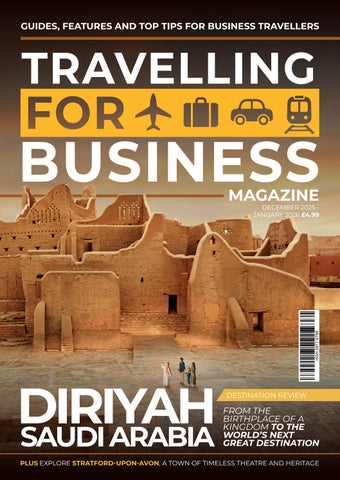
Travelling For Business Magazine - December 2025/January 2026 Edition
Check
in,
chill out
Once you set foot in a Virgin Atlantic Clubhouse, you won’t want to leave. Grab a bite to eat (or two), freshen up with an in-house shower, or find a quiet corner to send o a few emails. It’s all so relaxing, you’ll have to remind yourself you’ve got a flight to catch.
London Heathrow, Johannesburg, New York JFK, San Francisco and Washington DC are waiting for you. Our newest Clubhouse in LAX opens March 2025.
WELCOME TO TRAVELLING FOR BUSINESS
YOUR ULTIMATE GUIDE FOR SUCCESSFUL BUSINESS TRAVEL
There is a particular energy that comes with the turn of the year. Many take it as a recalibration, a moment when business travellers reassess how, why and where they move through the world. This issue of Travelling For Business is shaped by exactly that instinct: travel not as excess, but as intent.
Our cover destination, Diriyah, captures this shift perfectly. From the birthplace of the Saudi state to one of the most ambitious cultural giga-projects on the planet, it is a place where heritage is not preserved under glass but engineered into the future. Walking its ochre alleys and vast construction sites reveals Saudi Arabia’s global ambition in real time, a destination being built not just to be seen, but to matter. It is rare to witness a national narrative unfolding at this scale, and rarer still to feel that business travellers are being actively designed into the story.
Elsewhere, we look at how the mechanics of business travel are changing. From London’s luxury hotels quietly preparing guests for significant rate rises, to US cities reclaiming their status as conference powerhouses, the economics of movement are once again front and centre. At the same time, SMEs are redrawing the global business map, looking beyond traditional European and transatlantic routes towards Asia, Africa and the Middle East, driven by growth, not glamour.
Yet this issue is not purely transactional. Stratford-upon-Avon reminds us that heritage remains one of Britain’s most persuasive calling cards, while Oklahoma’s bold reimagining of Route 66 shows how nostalgia, when handled intelligently, can become a
Until next time…
modern business draw. Vienna, meanwhile, continues its quiet renaissance as one of Europe’s most compelling MICE destinations, pairing imperial grandeur with sustainability and infrastructure that actually works. Hotels, as ever, sit at the intersection of power and personality. From the cultural weight of Trump Hotels to the intimacy of properties like Bab Samhan or The Rubens at the Palace, we explore what today’s executives are really buying when they check in: space, discretion, signalling, and increasingly, a sense of story.
We also acknowledge the growing emphasis on wellbeing and personal optimisation, from world-class detox retreats to the rise of “Glowmad” travellers who see beauty, wellness and performance as inseparable. Even the passport itself is no longer neutral, with second citizenship emerging as a strategic business asset rather than a luxury indulgence.
Taken together, we hope that this issue reflects a truth many seasoned travellers already know: business travel in 2026 is no longer about distance covered, but about choices made. Where you go, where you stay, and how you move through the world now say as much about your strategy as your schedule. As always, our aim is to help you travel better, smarter, and with intent.
RICHARD ALVIN EDITOR, TRAVELLING FOR BUSINESS
Editor Richard Alvin
Reviews & Features Editor
Andrea Thompson
Graphic Designer
Grace Moseley
Videographer
Jacob Pinchbeck
Content Sales Manager
Laura Phillips
Capital Business Media, Group MD
Richard Alvin
Business Development Director
Stephen Banks
Chief Creative Director
Stuart Hyde
Finance Director
Andrew Martin
Travelling For Business is published in London by
+1 212 531 5116
The Capital Business Media Group, Level 18, Forty Bank Street London, E14 5NR +44 20 7148 3861
Travelling For Business is printed using sustainable paper sources and vegetable ink, and is PEFC certified. Copies are recycled at the end issue.
CONTENTS
DESTINATIONS
Diriyah The World's Next Great Destination
Stratford Upon Avon Shakespeare's Birthplace And Legacy
Vienna Europe's Rising Star In The MICE Landscape
St. John's Cananda Fog, History And Harbour Views
Algarve Bleisure On The Fairway In Portugal
Bab Samham Diriyah
Ettington Park Hotel Stratford Upon Avon, UK
Rubens Hotel London, UK
The Trafalgar St. James London, UK
Buxton Crescent Hotel & Spa Buxton, UK
The Torridon Scottish Highlands, UK
Domaine De Fontenille Isle Of Skye, UK
Domaine De Fontenille Luberon, France
The Imperial Riding School Hotel Vienna Hotel Bergland SÖlden Austria Villa Nai 3.3 Croatia
Experimental Chalet Verbier Switzerland
Budrutt's Palace Hotel Switzerland
Bellevue Syrene Sorrento, Italy
Grand Hotel La Favorita Sorrento, Italy
EXPERIENCES
The Art Of The New Year Detox The World's Finest Retreats Glowmads The Beauty-Led Travellers Reshaping Global Hospitality Riding The Cass Scenic Railroad Autumn Splendour
Alpine Reflections Three Iconic Lakes To Visit In Grindelwald
Shai Weiss On Crisis, Cancer & The Future Of Virgin Atlantic
NEW YORK, LAS VEGAS AND CHICAGO LEAD U.S. CITIES SET TO HOST MOST BUSINESS CONFERENCES IN 2026
The findings come as the global exhibition, convention and meetings market is forecast to grow from $34.13 billion in 2025 to $35.28 billion in 2026, reflecting renewed enthusiasm for face-to-face networking, knowledge sharing and direct client engagement. This resurgence is closely linked to a projected 4 per cent increase in corporate travel in 2026, following a dip in 2025, with business travel spending expected to exceed $407 billion by 2028. With 2026 shaping up to be a pivotal year for conferences and corporate events, experts at Booking.com for Business analysed data from global conference platform All Conference Alert to identify the U.S. cities already listing the highest number of confirmed business conferences for the year ahead.
A global centre for finance, trade and professional services, New York City tops the list with 140 business conferences already planned for 2026. Events span a wide range of sectors, from economics and leadership to engineering and medicine.
A new study has revealed the U.S. cities set to host the highest number of business conferences in 2026, as demand for in-person events continues to rebound and corporate travel returns to growth.
Among the headline events scheduled are a Global Business Summit in January focused on economic challenges and sustainable growth, a Global Conference on Women in Business and Leadership in February, and an International Conference on Accounting and Finance in April. The breadth of events reinforces New York’s status as a year-round destination for international business travel.
Ranking second, Las Vegas has 75 business conferences planned for 2026, underlining its reputation as one of the world’s bestequipped cities for large-scale meetings and exhibitions.
Tourism, gaming and entertainment employ more than 390,000 people in the city, and its conference calendar reflects that expertise. In April 2026, Las Vegas will host the International Conference on Tourism and Hospitality, bringing together global leaders to shape the future of the sector.
The city’s appeal is strengthened by its scale. Las Vegas offers nearly 14 million square feet of meeting and exhibition space and is home to three of the largest convention venues in the U.S.: the Las Vegas Convention Center, Mandalay Bay Convention Center and the Venetian Expo.
Chicago takes third place with 65 business conferences already listed for 2026. Long known as “the city that works”, Chicago’s strong industrial and manufacturing heritage continues to influence its role as a hub for innovation and economic growth.
In March 2026, the city will host the International Conference on Manufacturing Research, an event designed to foster collaboration between researchers and industry professionals, explore partnerships and strengthen global links in manufacturing and industrial innovation.
Nadine Blokker, Booking.com for Business expert, said that despite the rise of digital tools, in-person conferences remain critical for professional growth and commercial success.
“In-person conferences are irreplaceable for networking, skill development and business opportunities,” she said. “To make the most of them, preparation is key.”
She advises business travellers to create a personalised conference schedule, booking travel and accommodation early to secure better fares and reduce stress. Choosing hotels close to conference venues can also maximise networking opportunities and minimise time lost in transit.
For companies managing multiple events or travelling teams, Blokker recommends
using corporate travel management platforms to centralise bookings, track expenses and keep documents accessible.
As 2026 approaches, the data suggests that U.S. cities with strong infrastructure, global connectivity and established business ecosystems are once again becoming focal points for international conferences and a major driver of the next phase of business travel growth.
LONDON'S LUXURY HOTELS SET TO PASS ON STEEP BUSINESS RATES RISES TO GUESTS
A stay in a luxury London hotel is likely to become significantly more expensive from next year, as operators grapple with sharp increases in business rates and seek to pass on higher costs to customers.
Changes to the way business rates are calculated will see the collective annual bill for four and five-star hotels in the capital rise by around a quarter in the 2026–27 tax year, from £335 million to £416 million, according to analysis by property agent Savills.
The increase follows measures announced in the budget by the chancellor, Rachel Reeves, which include the introduction of “permanently lower tax rates” for more than 750,000 retail, hospitality and leisure properties from 2026. The relief will be funded by a new levy on larger properties with a rateable value — broadly equivalent to annual rental value — of £500,000 or more.
Savills said the reforms will disproportionately affect high-end hotels in prime locations. Two luxury hotels in London are expected to see their business rates bills increase by more than £1 million next year, while a further 16 face rises of more than £500,000.
The impact is expected to intensify over time. Savills estimates that the total business rates bill for top-tier hotels will climb to £535 million in 2027–28 and
exceed £645 million by 2028–29, placing sustained pressure on an industry already dealing with rising operating costs.
Hotel operators have seen margins squeezed in recent years by higher minimum wages, increased employers’ national insurance contributions and elevated energy and supply costs. Analysts believe many will have little choice but to raise room rates to offset the latest tax increases.
“How operators choose to respond remains to be seen,” said Thomas Emanuel, a director in Savills’ hotels division. “With further tax changes ahead, uncertainty persists, and in areas facing the steepest increases we may see some combination of higher prices, tighter margins, or a gradual shift towards more tech-led and streamlined operations.”
Data from real estate analytics firm CoStar highlights how prices have already risen sharply. In October 2019, the average nightly rate at a five-star hotel in the UK stood at £253.75. By October 2025, that figure had climbed to £357.17 — an increase of 41 per cent.
Emanuel said the changes to business rates would not affect all hotels equally. While around three quarters of the UK’s 3,904 four and five-star hotels are expected to see higher annual bills, only about half of three-star hotels will face an increase.
Large hotel groups have already begun to flag the financial impact. Whitbread, the owner of Premier Inn, has warned that the reforms will add around £50 million to its costs in the next financial year.
Industry bodies have also raised concerns about the wider consequences for hospitality. UK Hospitality has described the looming rises as “eye-watering” and warned that, without additional relief, hotels and other venues such as pubs could be forced to cut jobs, raise prices or, in some cases, close altogether.
With London’s luxury hotels playing a key role in attracting international business travellers and tourists, operators and analysts alike fear that sustained cost pressures could ultimately make the capital a more expensive, and less competitive — destination at the top end of the market.
JETBLUE TO OPEN FIRST-EVER AIRPORT LOUNGE ‘BLUEHOUSE’ AT NEW YORK JFK
JetBlue has announced that its firstever airport lounge, BlueHouse, will officially open at New York’s John F. Kennedy International Airport on December 18, marking a major milestone in the airline’s push to deliver more premium, customerfocused experiences.
The 9,000-square-foot lounge will open at 5am ET in Terminal 5 and forms a central part of JetBlue’s wider JetForward strategy, which aims to enhance the customer journey both in the air and on the ground. Designed to feel welcoming rather than exclusive, BlueHouse is intended to reflect the energy and character of New York City while offering travellers a calm, comfortable place to work, relax or socialise before a flight.
JetBlue president Marty St. George said the opening would help make the airline’s flagship terminal feel more like home for customers. He described BlueHouse as warm, comfortable and distinctly JetBlue, adding that it reflects what customers have been asking for as the airline looks to bring affordable premium experiences into the airport environment.
Spanning two floors, the lounge draws inspiration from classic New York apartments and Art Deco design, featuring decorative moulding, brass accents and locally curated artwork. The space also includes subtle references to JetBlue’s history and its roots as New York’s “Hometown Airline”.
Stephanie Evans Greene, JetBlue’s senior vice president of marketing and brand, said the goal was to create a space that feels personal and layered with character, much like a real New York home. She added that JetBlue’s identity and local iconography have been woven throughout the lounge to make it feel familiar and comfortable for repeat visitors.
Food and drink play a central role in the BlueHouse experience. Fresh grab-and-go meals are prepared daily and curated by Union Square Events, with offerings inspired by New York favourites such as bacon, egg and cheese sandwiches in the morning and pastrami on rye later in the day. The beverage menu highlights local partners, including Joe Coffee for barista-made espresso, craft beers and cocktails curated by The Greats of Craft and Please Don’t Tell, and teas from Steven Smith Teamaker.
The lounge has been designed to cater to different travel needs, combining open social spaces with quieter areas for rest or focused work. High-speed Wi-Fi and power outlets are available at most seats, while dedicated quiet zones offer a more peaceful environment. A game room
stocked with JetBlue-branded games and children’s toys adds a family-friendly element, and a custom photo booth allows customers to take home a souvenir from their visit.
Access to BlueHouse will be complimentary for JetBlue’s most loyal and premium customers, including Mosaic 4 members, JetBlue Premier Cardmembers and transatlantic Mint passengers. The airline said access would be carefully managed to avoid the overcrowding and long queues often associated with airport lounges.
Ed Pouthier, vice president of loyalty and personalization at JetBlue, said BlueHouse represents one of the most significant enhancements ever made to the TrueBlue loyalty programme, offering a new level of recognition for frequent flyers and premium cardholders.
With the launch of BlueHouse at JFK, JetBlue is taking its first step into the airport lounge space, signalling a broader ambition to redefine premium travel in a way that remains accessible, relaxed and closely tied to the airline’s brand and New York roots.
UK SMALL AND MEDIUMSIZED ENTERPRISES ARE RE-DRAWING THE GLOBAL BUSINESS MAP
The findings suggest a shift not just in destinations, but in mindset. Faced with domestic uncertainty, tighter margins and intensifying competition in traditional markets, SMEs are becoming more outward-looking, seeking opportunity in faster-growing regions and emerging commercial hubs.
ASIA AND AFRICA MOVE INTO FOCUS
The study, which surveyed 1,000 UK SMEs, shows a sharp rise in intent to travel to Asia over the next 12 months, up 26 per cent year-on-year. Africa follows closely, with intent rising by 16 per cent, while the Middle East continues to gain traction as a strategic destination for British businesses.
When asked to identify regions they expect to prioritise for business travel in the year ahead, Asia tops the list at 25 per cent, followed by the Middle East (19 per cent), Australia (18 per cent), South America (13 per cent) and Africa (13 per cent).
The data points to a diversification of international ambition. Rather than relying on established transatlantic and European routes, SMEs are increasingly exploring markets aligned with infrastructure investment, energy transition, technology, manufacturing and regional trade growth.
A SHIFT AWAY FROM TRADITIONAL HUBS
Historically, Europe and North America have dominated UK outbound business travel, accounting for 79 per cent and 33 per cent of SME trips respectively last year. However, Travel Counsellors’ research shows that this dominance is beginning to soften.
The proportion of SMEs planning business travel to Europe over the next 12 months has fallen by 12 per cent year-on-year, signalling a gradual rebalancing away from established commercial centres in favour of new opportunities further afield. This does not mean Europe and the US are losing relevance, but it does suggest that SMEs are increasingly supplementing traditional markets with exploratory travel to regions offering higher growth potential and less saturated competition.
BOOKING DATA BACKS UP THE TREND
Travel Counsellors for Business’ own booking and sales data reinforces the survey findings. In FY2025, Riyadh emerged as the company’s fifth mostbooked corporate travel destination, reflecting Saudi Arabia’s growing pull as it accelerates investment under Vision 2030.
Texas ranked sixth, while Johannesburg placed ninth, highlighting the continued importance of US regional hubs alongside
a growing appetite for African markets. Elsewhere, year-on-year booking growth exceeding twenty-fold was recorded in destinations including Borneo, Pahang, South Africa National Park and Aruba — a clear signal of expanding geographical horizons.
These shifts suggest SMEs are no longer simply following established trade routes, but actively testing new markets through face-to-face engagement, partnerships and on-the-ground intelligence.
BUSINESS TRAVEL AS A GROWTH TOOL
Melanie Quinn, Director of Travel Counsellors for Business, says the data reflects a renewed confidence among UK SMEs despite economic headwinds.
“This data highlights the ambition and creativity of UK SMEs as they look to unlock growth on a global stage,” she says. “While Europe and the US continue to play an important role in UK-outbound business travel, we’re seeing businesses actively explore new markets across Asia, Africa and the Middle East, seeking out further revenue opportunities and forging business-building partnerships.”
For many SMEs, international travel is no longer a discretionary expense but a strategic investment, a way to diversify revenue streams, reduce over-reliance on
According to new research from Travel Counsellors for Business, British SMEs are increasingly looking beyond Europe and the United States, with a marked rise in business travel to Asia, Africa and the Middle East as they plan for growth in 2026.
domestic demand and build resilience in uncertain conditions.
SUPPORTING COMPLEX TRAVEL PATTERNS
As SME travel becomes more global and complex, the need for specialist support is growing. Travel Counsellors for Business provides 24/7 hands-on assistance through dedicated corporate Travel Counsellors, combining personalised service with technology designed to manage multiregion itineraries and fast-changing schedules.
Quinn adds: “We support SMEs at every stage of their growth journey, combining highly personalised service with industryleading technology. Our goal is to make business travel feel seamless, while providing high-touch support aligned to each client’s wider business strategy.”
Taken together, the data paints a picture of UK SMEs entering 2026 with a broader, more confident global outlook. As traditional markets mature and competition intensifies, emerging regions are no longer seen as peripheral — they are becoming central to growth strategies.
For business travel providers, airlines and destinations alike, the message is clear: the future of SME travel is more diverse, more ambitious and far more global than before.
FROM THE BIRTHPLACE OF A KINGDOM TO THE WORLD’S NEXT GREAT DESTINATION
DIRIYAH
DESTINATION REVIEW
BY ANDREA THOMPSON
Afirst hand look at the past, the present, and the extraordinary future rising from the banks of Wadi Hanifah.
There are places where history is preserved behind velvet ropes and then there is Diriyah, The City of Earth, where the past stands unguarded beneath the open sky, its mudbrick walls still warm from the sun and its stories carried on the breeze. Walking through its ochre alleyways, I felt the rare sensation of stepping into a narrative that is both ancient and urgently contemporary. Few destinations manage to hold the past and the future in the same breath. Diriyah does and I witnessed it firsthand.
The name itself carries centuries of meaning. “Diriyah” traces back to the Al Dura’a tribe, ancestors of Prince Mani’ bin Rabiah Al Muraidi, who founded the settlement in 1446 AD. Standing on the fertile banks of Wadi Hanifah, I could imagine the moment he chose this oasis with shaded palms, the flowing water, the natural protection of the valley. It was a decision that would shape the Arabian Peninsula. Over time, the settlement grew into a thriving hub of trade, scholarship, and craftsmanship, its position along caravan routes drawing merchants and thinkers from across the region.
But it was in the 18th century that Diriyah’s destiny crystallised. At Turaif, now a UNESCO World Heritage Site, became the seat of the First Saudi State (1727–1818). As I wandered through its fort-like restored palaces and mosques, the significance of this place felt almost physical. This wasn’t simply a political capital; it was the cradle of Saudi identity, the ancestral home of the Al Saud family, and the symbolic birthplace of the nation.
Today, that birthplace is being reimagined on a scale that is almost impossible to comprehend until you stand in the middle of it.
BY ANDREA THOMPSON
A GIGA PROJECT OF ASTONISHING SCALE - SEEN UP CLOSE
Diriyah is undergoing one of the largest cultural and lifestyle transformations on the planet - a 14 square kilometre masterplan designed to welcome 50 million visitors annually and create more than 180,000 jobs.
Diriyah Company has awarded construction contracts worth $27 billion since the beginning of 2024. More than $5 billion of tenders were awarded in the first half of this year alone, including a $600 million contract to develop the scheme’s flagship luxury retail destination.
It will eventually host over 100,000 residents, workers, students, and visitors across its districts, blending cultural institutions,
entertainment venues, retail boulevards, hospitality clusters, educational facilities, and residential neighbourhoods into a single, coherent destination and once completed is forecast to contribute $18.6 billion to Saudi Arabia’s GDP.
I had been briefed on the numbers before arriving, but nothing prepares you for the reality of standing in the middle of it. Diriyah operates three shifts a day, each with around 80,000 workers. That’s nearly a quarter of a million people moving in a 24 hour rhythm restoring heritage, building boulevards, shaping landscapes. More than ninety cranes sweep across the skyline, their silhouettes rising above the mudbrick horizon like a choreography of steel.
The scale of construction at Diriyah is almost as astonishing as its heritage. To recreate the district’s signature mud brick aesthetic, engineers excavated millions of cubic metres of earth, much of it repurposed on site and transformed into traditional style adobe bricks using modern, sustainable techniques. This circular approach not only reduced waste but ensured that the new buildings echo
the colour, texture and authenticity of the original Najdi architecture.
Beneath this restored heritage district lies one of the most ambitious subterranean infrastructures in the Middle East. Diriyah has been engineered across four distinct levels, each hidden below the pedestrian only surface. At ground level, visitors wander through car free streets, courtyards and plazas designed for walking, gathering and lingering. One level down sits a vast parking network, removing vehicles entirely from view. Below that, a dedicated utilities layer keeps the district’s power, water and cooling systems out of sight, ensuring the historic setting remains uncluttered. Then the deepest level, future proofed space has been reserved for the Riyadh Metro - a buried backbone that will eventually connect Diriyah seamlessly to the wider capital. It’s a city built downwards so that life above can unfold with calm, clarity and heritage at its heart.
Inside the visitor centre, I was shown the full scale masterplan model by Nawaf Rajeh, Development & Innovation Marketing Executive Director at Diriyah Company. It is a vast architectural sculpture mapping every future district, museum, hotel, cultural landmark, and residential community. Seeing it laid out in miniature even down to the last palm tree and then stepping outside to watch it rising in real time - was one of the most striking juxtapositions of my career. By 2030, the year Saudi Arabia hosts the World Expo and Diriyah aims to be fully realised. Based on what I saw, it will be extraordinary and would love to witness the completed city.
In his own words, Jerry Inzerillo, chief executive of Diriyah Company “Our vision
is to build a vibrant, walkable city where people can live, work, learn and celebrate culture in one extraordinary destination."
BUJAIRI TERRACE: THE NEW SOCIAL HEARTBEAT
My first stop was Bujairi Terrace, the dining district perched above Wadi Hanifah with sweeping views of At Turaif. It is a place where Najdi architecture with its intricate wooden doors and tiny windows meets global gastronomy with Michelin starred restaurants, Saudi culinary concepts, and elegant terraces where business meetings stretch into sunset. Restaurants include Somewhere, my personal favourite, Takya, Angelina, yes fantastic hot chocolate, and BiBi were among the highlights, each capturing a different facet of Diriyah’s contemporary spirit.
The atmosphere is refined yet relaxed, cosmopolitan yet unmistakably rooted in
place. It is the kind of district that signals a destination’s confidence and its readiness to welcome the world toegther with the help of outdoor air-conditioning to bring the average temperature of its plazas, walkways and open-air dining districts to about 28C during the scorching summer months.
A CITY OF CULTURE, HOSPITALITY, AND GLOBAL AMBITION
As I explored the wider development, the scale of Diriyah’s future became clear. Nearly forty luxury hotels are rising across the masterplan, including names such as The Ritz Carlton, Baccarat, Armani, Raffles, Faena, and Chedi. Eighteen thousand residences are being built, among them three hundred branded homes designed in partnership with some of the world’s most prestigious hospitality groups. Retail and dining will span more than half a million square metres, while office space will exceed 1.6 million square metres. A university, sixteen schools, four healthcare assets, and more than two dozen cultural institutions will anchor the community.
This is not a replica city or a speculative experiment. It is a destination built with intention with heritage as the anchor and modernity as the expression.
WADI SAFAR: THE FUTURE OF ULTRA LUXURY LIVING
One of the most compelling areas I visited was Wadi Safar, set to become Saudi Arabia’s most exclusive lifestyle estate. Even in its early stages, the scale and serenity of the landscape were striking. Here, the Greg Norman designed Royal Diriyah Golf Club is taking shape, alongside the Royal Diriyah Equestrian and Polo Club. Forty two kilometres of cycling, hiking, and horse riding trails will weave through the valley, connecting ultra luxury branded residences including the Oberoi Residences, Aman’s Amansamar villas, The Chedi Residences, and Faena’s sculptural homes. It is a rare blend of natural beauty and architectural ambition, a place where the world’s most discerning travellers will eventually gravitate.
A WINDOW INTO THE PAST - AT TURAIF
Today, At Turaif has been reimagined as an immersive heritage district where the past is not simply preserved but brought vividly to life. Its network of restored palaces, defensive towers, and narrow mudbrick lanes are complemented by a series of thoughtfully curated museums, audio guided and expert led tours, and the beautifully presented Arabian Horse Gallery. Accessible pathways and discreet visitor facilities make exploration effortless, while subtle night time lighting transforms the district into an atmospheric tableau, allowing the architecture to glow softly against the desert sky.
Walking through At Turaif feels less like visiting a historic site
BY ANDREA THOMPSON
and more like stepping directly into the origins of the Saudi state, with storytelling and interpretation woven seamlessly into the experience.
Today, the district has become a cultural landmark in its own right, drawing more than a million visitors each year. Its appeal lies in the balance it strikes between authenticity and contemporary relevance: heritage tours sit alongside seasonal events, artistic installations, and cultural programmes that animate the site throughout the year. At Turaif is a living stage for Saudi Arabia’s evolving cultural identity.
A JOURNEY THROUGH THE FUTURE
Having visited the core of the project: the UNESCO listed At Turaif; the emerging Diriyah Square with its future retail and residential clusters; the elegant Bab Samhan hotel, where Najdi tradition meets contemporary luxury; the site of the Royal Diriyah Opera House, set to become the nation’s first and largest most advanced performing arts venue; and Souq Al Mawsim, a vibrant seasonal market that brings the destination to life during Diriyah Season. Each site offered a glimpse of a destination that will soon rival the world’s great cultural capitals.
WHERE HERITAGE AND AMBITION MEET
Diriyah is not a theme park, nor a reconstruction, nor a nostalgic tribute. It is a living, breathing place one with deep roots and a bold vision. Being there, walking between the preserved past and the rapidly emerging future, I felt the rare sensation of watching a national narrative evolve in real time.
Diriyah is where Saudi Arabia began. Now, it is where the world will gather.
ESSENTIAL INFORMATION
GETTING THERE
Direct flights from London to Riyadh operate daily with several major carriers. The journey takes around 6 hours and 30 minutes, landing at King Khalid International Airport, which is approximately a 25–30 minute drive from Diriyah. Transfers are efficient, and business class passengers benefit from fast track immigration and dedicated lounges.
LANGUAGE
Arabic is the official language, though English is widely spoken in hotels, restaurants, and business environments.
Signage across Diriyah’s new districts is bilingual, making navigation straightforward for international visitors.
DRESS CODE
Saudi Arabia’s dress code has evolved, but modesty remains the guiding principle.
• Women are not required to wear an abaya, though many choose loose, elegant clothing that covers shoulders and knees.
• Men should avoid shorts in formal or business settings.
In Diriyah’s heritage districts, a slightly more conservative approach feels appropriate, while luxury hotels and dining venues are relaxed but polished.
ETIQUETTE
Saudi hospitality is warm, generous, and deeply rooted in tradition. A few points to keep in mind:
Greetings are formal; a handshake is common, though wait for your counterpart to initiate.
Using the right hand for giving or receiving items is considered respectful.
Public displays of affection are discouraged.
During meetings, tea or Arabic coffee may be offeredaccepting is a sign of courtesy.
Business culture values punctuality, patience, and relationship building.
WHAT TO AVOID
Saudi Arabia is welcoming and increasingly international, but it’s wise to avoid:
• Discussing sensitive political or religious topics.
Photographing government buildings or security personnel.
Wearing overly revealing clothing in public spaces.
• Eating, drinking, or smoking in public during Ramadan daylight hours.
WEATHER
Diriyah experiences a desert climate with distinct seasonal shifts.
• October to March offers the most pleasant conditions, with warm days and cool evenings — ideal for exploring At Turaif and Bujairi Terrace.
• April to September brings intense heat, often exceeding 40°C, though Diriyah’s shaded walkways, cooling technologies, and indoor venues make summer visits manageable.
Evenings can be surprisingly cool in winter, so a light jacket is useful.
WHERE EARTH MEETS LIGHT
THE
SOULFUL
ALLURE OF BAB SAMHAN
There are hotels that impress, and then there are hotels that feel as though they have been quietly waiting for you. Bab Samhan, set in the heart of Diriyah, belongs firmly to the latter.
Part of Marriott’s Luxury Collection and owned in partnership with the Diriyah development authorities, the property is a rare example of heritage restored with restraint, a hotel that honours its past without becoming a museum to it.
Bab Samhan is formed from seven historic Najdi buildings, once private family homes and merchant residences, now meticulously reimagined into a single, seamless retreat. The original mud brick structures thick, cool, and textured with the soft irregularities of hand built walls — have been preserved wherever possible.
These buildings are linked by labyrinthine passageways once wide enough for a camel to pass through, now forming shaded corridors that twist gently between courtyards, gardens and quiet alcoves. Walking them feels like stepping into a living fragment of old Diriyah, where the architecture itself tells the story.
Inside, the hotel is a study in contemporary Najdi elegance. The 134 rooms and suites are dressed in a palette of sand, clay and soft desert neutrals. Carved wooden screens filter the light, casting geometric shadows that echo the region’s traditional motifs. Textiles are tactile and grounded: woven rugs, hand embroidered cushions, and ceramics that nod to centuries of craft. The effect is calming, almost monastic, yet undeniably luxurious.
Bathrooms continue the narrative with polished stone, deep soaking tubs and walk in rain showers with Byredo Le Chemin locally inspired toiletries infused with oud, citrus or desert botanicals. In room amenities include
thoughtful touches: generous wardrobes, elegant tea sets, and intuitive lighting that shifts with the day.
Beyond the rooms, Bab Samhan opens into a world of four restaurants including Taleed by Michael Mina, each celebrating regional flavours with a modern sensibility. Expect refined Saudi dishes, Levantine influences, and menus that feel rooted rather than reinvented. The atmosphere attracts a blend of discerning leisure travellers, cultural explorers, and business guests seeking a quieter, more authentic alternative to central Riyadh.
The hotel’s spa, indoor pool, fitness centre and generous meeting spaces round out the offering, but the true draw lies just beyond its walls. Diriyah, the birthplace of the Saudi state is undergoing a remarkable transformation. Guests can wander the UNESCO listed mud brick citadel of At Turaif, explore new galleries and cultural centres, or simply sit in a café overlooking the Wadi Hanifah valley as the call to prayer rolls across the cliffs.
Bab Samhan is more than a luxury hotel; it is a restoration of memory, a return to the architectural language of Najd, and a beautifully executed bridge between past and present. Staying here feels like inhabiting a chapter of history, one written in warm earth, soft light and the quiet dignity of a place that knows exactly where it comes from.
ROUTE HOW OKLAHOMA IS TURNING AMERICA’S MOTHER ROAD INTO A MODERN BUSINESS TRAVEL DRAW 66 AT 100
With the longest drivable stretch of Route 66 anywhere in the US, Oklahoma is positioning the centennial not simply as a nostalgic celebration, but as a catalyst for long-term tourism growth, inward investment and a renewed pitch to international and business travellers. At the centre of that effort is Matt Pinnell, who also serves as Oklahoma’s Secretary of Tourism and Branding.
Speaking to Richard Alvin, Pinnell outlines why Route 66 matters more than ever, culturally, economically and strategically, and how the state is transforming an icon of Americana into a contemporary, experience-led destination for time-poor professionals as well as leisure travellers.
A ONCE-IN-A-GENERATION OPPORTUNITY
“The Route 66 Centennial is a once-in-ageneration opportunity for Oklahoma,” Pinnell says. “Culturally, this highway tells our story, a story of resilience, innovation and culture. Route 66 runs through the heart of our state, and every community along the corridor has contributed to its legacy.”
That legacy is deeply woven into Oklahoma’s identity. From small towns that boomed with roadside motels and diners to cities that became logistical hubs for oil, agriculture and manufacturing, Route 66 shaped how the state grew, and how it presented itself to the world.
Economically, the centennial is expected to be one of the biggest tourism drivers Oklahoma has seen in decades. “We’re expecting a surge in domestic and international visitors,” Pinnell explains. “With that comes new spending, new business opportunities and long-term growth for Oklahoma’s tourism industry.” For business travellers, that surge is already influencing how the state thinks about meetings, incentives and corporate travel itineraries. Rather than positioning Route 66 as a standalone leisure trip, Oklahoma is integrating it into a broader proposition that blends commerce, culture and experience.
Few highways carry the emotional and cultural weight of Route 66. For nearly a century, the so-called Mother Road has symbolised freedom, reinvention and the promise of the open road. As the route approaches its centennial in 2026, no state is leaning into that legacy more assertively, or more strategically, than Oklahoma.
PRESERVING AUTHENTICITY WITHOUT FREEZING TIME
Route 66’s power lies in its authenticity, and Pinnell is acutely aware that overcommercialisation could undermine what makes it special. “Our goal is to protect what makes Route 66 iconic while giving travellers new reasons to stay longer,” he says.
That balance is being achieved through targeted restoration and thoughtful modernisation. Historic neon signs are being relit. Classic motels, diners and main streets are being restored. Ageing bridges and roadways are being repaired, not replaced with something anonymous, but preserved as working heritage.
At the same time, Oklahoma is investing in contemporary storytelling and visitor infrastructure. New museums, interactive attractions and improved wayfinding are helping international travellers navigate the route with confidence. One of the most ambitious projects is the state’s partnership with Google Arts & Culture, which has produced A Culture Trip Down Route 66, an interactive, AI-powered experience that blends historic photography, virtual tours and oral histories.
“Visitors want authenticity,” Pinnell says, “but they also expect high-quality, innovative amenities. We’re delivering both.”
THE MUST-SEE MILEPOSTS
With more Route 66 mileage than any other state, Oklahoma’s challenge is not scarcity but abundance. Pinnell admits it is difficult to narrow down highlights, but there are several landmarks that consistently resonate with international visitors.
There is the instantly recognisable Blue Whale of Catoosa, a piece of joyful kitsch that has become one of the route’s most photographed stops. In Miami, Oklahoma, the restored Coleman Theatre offers a reminder of the architectural ambition Route 66 once inspired.
For a more contemporary take, Pops pairs modern design with old-school roadside hospitality, while Tulsa’s Mother Road Market showcases Oklahoma’s evolving culinary scene inside a former warehouse.
Anchoring the experience is the Oklahoma Route 66 Museum, which provides essential historical context for travellers tackling the route for the first time.
“These places give you a sense of how varied Route 66 is in Oklahoma,” Pinnell says. “It’s not just nostalgia — it’s living culture.”
COURTING THE UK AND EUROPE
Oklahoma’s ambitions extend well beyond domestic road-trippers. The state has been deliberately building its profile in the UK and Europe, where Route 66 remains one of the most powerful symbols of American travel.
“Earlier this fall, representatives from the Oklahoma Tourism & Recreation Department and I travelled to London for Brand USA Travel Week,” Pinnell explains. “We met with international tour operators and industry professionals, building relationships and sharing why Oklahoma should be a top destination for UK and European visitors.”
For British travellers in particular, Oklahoma offers something increasingly rare: a version of the US that feels authentic, accessible and less frenetic than the coasts. Combined with competitive pricing and improving air connectivity, the state is positioning itself as both an entry point and a centrepiece for wider US itineraries.
$30 MILLION AND COUNTING
Behind the storytelling is serious investment. Through the Oklahoma Route 66 Revitalization Grant Program, the state has committed more than $30 million to Route 66 projects, the largest investment of its kind by any state.
“These funds are helping restore main streets, repair roadways, build new attractions and enhance signage and visitor experiences,” Pinnell says. The emphasis is on enabling communities rather than imposing a top-down vision.
Community-led projects sit at the heart of the centennial preparations. Towns along the route have access to grants, training and promotional support. From neon restorations and murals to festivals and pop-up events, local businesses are being encouraged to shape how their stretch of Route 66 is presented.
“Local restaurants, boutique hotels and attractions are already preparing for the additional visitors,” Pinnell notes. “This is truly a statewide team effort.”
WHY ROAD TRIPS ARE BACK - AND BUSINESS TRAVEL IS FOLLOWING
One of the most significant shifts Pinnell has observed is the resurgence of the road trip — not as a budget option, but as a premium, experience-led choice.
“Travellers want experiences that feel authentic and personal,” he says. “Things you can’t get anywhere else.” Road trips, experiential travel, outdoor recreation and culinary tourism are all growing, and Oklahoma sits at the intersection of those trends.
For business travellers, that translates into bleisure itineraries that feel intentional rather than tacked on. A conference in Oklahoma City can be followed by a curated Route 66 drive. A meeting in Tulsa can include tribal cultural experiences or a guided food tour.
“We’re investing in and promoting our tribal, cultural and historical assets,” Pinnell adds. “That’s what international visitors are looking for.”
THE HUMAN SIDE OF THE MOTHER ROAD
Despite the scale of the investment, Pinnell’s most vivid Route 66 memories are intensely personal. “I’ve travelled every mile of Oklahoma’s Route 66, often with my wife and kids in tow,” he says. “The moments that stand out are always tied to the people.”
It might be a conversation with the owner of a restored filling station, a volunteer sharing local history in a museum, or a plate of chicken-fried steak in a familyrun diner. “That’s the magic of the Mother Road,” Pinnell reflects. “It’s the people who keep this highway alive.”
SELLING OKLAHOMA TO THE CORPORATE TRAVELLER
Oklahoma’s pitch to business travellers goes beyond nostalgia. “We’re selling Oklahoma as a place where business and experience go hand in hand,” Pinnell says.
A central US location, competitive operating costs and modern event facilities make logistics straightforward. What differentiates the state, however, is the ease with which meetings can be wrapped in meaningful experiences.
From Route 66 excursions to cultural districts, outdoor recreation and a growing food scene, Oklahoma is encouraging companies to think differently about incentive travel and extended stays.
HOTELS, VENUES AND THE RISE OF BLEISURE
Recent years have seen significant reinvestment in hospitality infrastructure. New boutique hotels sit alongside renovated historic properties, while major conference centres have been upgraded or newly built.
In Oklahoma City, properties such as Omni Oklahoma City Hotel and the emerging OKANA Resort combine proximity to meeting spaces with access to entertainment and cultural attractions. In Tulsa, the historic The Mayo Hotel blends Art Deco heritage with modern business amenities.
“From boutique properties to extendedstay options, you can find high-quality hotels across the state,” Pinnell says. “They understand today’s business-leisure traveller.”
GETTING THERE AND GETTING AROUND
Accessibility remains critical, particularly for international travellers. Oklahoma has invested heavily in airport modernisation in both Oklahoma City and Tulsa, improving terminals, adding gates and enhancing the overall passenger experience.
“We’re actively pursuing additional direct routes and strengthening airline partnerships,” Pinnell explains. Combined with upgraded highways, improved rental services and better urban transit, the aim is to make Oklahoma feel straightforward rather than remote.
BEYOND THE CENTENNIAL
While the Route 66 Centennial provides a powerful deadline, Pinnell is clear that the ambition extends well beyond 2026. The investments being made now are designed to support tourism, business travel and community development for decades to come.
Route 66, once a symbol of departure, is being reimagined as a reason to stay, a spine connecting business, culture and community across the heart of America. For Oklahoma, the Mother Road’s second century may prove even more transformative than its first.
A TOWN OF TIMELESS THEATRE AND HERITAGE SHAKESPEARE’S BIRTHPLACE AND LEGACY
STRATFORD UPON AVON
DESTINATION REVIEW
Stratford-upon-Avon is more than just a dot on the map of Warwickshire; it is a town that has become synonymous with theatre, heritage, and timeless English charm.
Nestled on the banks of the River Avon, its timber-framed houses, cobbled lanes, and bustling markets create a picture-perfect backdrop for visitors from around the world. Yet what truly sets Stratford apart is its connection to William Shakespeare, whose birthplace and legacy continue to draw millions each year. The town is a living museum of Tudor England and a vibrant cultural hub.
DESTINATION REVIEW
A TOWN STEEPED IN HISTORY
Founded in the 12th century, Stratford grew as a market town thanks to its riverside location. The medieval street plan remains intact, with Henley Street, Sheep Street, and High Street lined with half-timbered buildings that whisper stories of centuries past. The Guild Chapel, with its medieval wall paintings, and the Grammar School where Shakespeare studied, offer glimpses into the town’s educational and religious life. Holy Trinity Church, where Shakespeare was baptised
Shakespeare Theatre and Swan Theatre staging world-class productions. Backstage tours and exhibitions make the RSC accessible to all, ensuring Shakespeare’s words remain alive in the town where he was born.
WHAT TO SEE AND DO
Beyond Shakespeare, Stratford offers a wealth of attractions. The River Avon invites boat trips, swan-watching, and riverside strolls through Bancroft Gardens. The Stratford Butterfly Farm is a tropical haven filled with exotic species. The MAD Museum showcases mechanical art and interactive design, while Tudor World offers immersive experiences of Elizabethan life. Seasonal events, from the Stratford Literary
and later buried, is a place of pilgrimage, its stained glass and riverside setting adding to the atmosphere. Stratford’s history is not confined to Shakespeare alone; it reflects the broader story of England’s evolution from medieval market town to modern cultural destination.
WHY STRATFORD IS FAMOUS
Stratford’s fame rests on Shakespeare’s global legacy. His plays are performed worldwide, yet the town remains the epicentre of his story. Theatres attract international audiences, while preserved Tudor architecture offers authenticity. Festivals, markets, and cultural events reinforce its reputation as a quintessential English town. Stratford is both a shrine to literature and a living, breathing community.
SHAKESPEARE’S LEGACY
Shakespeare’s Birthplace on Henley Street is the most iconic site, preserved with period furnishings and live performances in the garden. Anne Hathaway’s Cottage in Shottery enchants with its thatched roof and orchards, while Hall’s Croft showcases Jacobean domestic life. New Place, Shakespeare’s final residence, now features heritage gardens and sculptures interpreting his works.
The Royal Shakespeare Company anchors the town’s cultural life, with the Royal
WILLIAM SHAKESPEARE'S BIRTHPLACE
Festival to Christmas markets, keep the town buzzing year-round. Magic Alley, with its whimsical wizardry and butterbeer, adds a quirky twist to the town’s offerings. For families, the town offers plenty of interactive experiences, from storytelling trails to hands-on workshops at Shakespeare’s Schoolroom. Art lovers can explore galleries showcasing local and national talent, while music enthusiasts will find concerts and recitals at venues such as the Stratford Playhouse.
WHERE TO STAY
Accommodation ranges from Gothic grandeur to boutique chic. Ettington Park Hotel, a neo-Gothic mansion set in 40 acres, offers spa facilities and richly decorated interiors. The White Swan Hotel, a historic inn, combines Tudor charm with modern comfort. Boutique options like Hotel Indigo and The Arden Hotel provide stylish stays, while larger chains such as Crowne Plaza and DoubleTree by Hilton cater to business and leisure travellers alike. Country retreats like The Welcombe Hotel add spa and golf facilities, perfect for longer escapes.
WHERE TO EAT AND DRINK
Stratford’s dining scene is diverse. Fine dining includes Salt, the town’s Michelinstarred restaurant, and Lambs of Sheep Street, housed in a 16th-century building. Loxleys Restaurant & Wine Bar offers grills
and roasts, while The Opposition serves modern European cuisine. Traditional pubs like The Dirty Duck and The Garrick Inn provide hearty fare and historic atmosphere. International flavours abound at Osteria Da Gino (Italian), El Greco (Greek), and The Boat House (Thai). Afternoon tea at Hathaway Tea Rooms or Claridge-style indulgence at The Vintner completes the culinary journey.
Food festivals and farmers’ markets add to the culinary appeal, showcasing local produce, artisanal cheeses, and craft beverages. Stratford’s riverside pubs and wine bars also make for perfect evening retreats after a day of sightseeing.
BEYOND THE TOWN
BEYOND STRATFORD
Stratford is a gateway to wider Warwickshire and the Cotswolds. Warwick Castle offers medieval drama with jousts and dungeons. Kenilworth Castle enchants with romantic ruins and Elizabethan gardens. The Cotswolds beckon with honey-stone villages, rolling hills, and market towns like Chipping Campden. Day trips to Oxford or Birmingham add urban variety to the rural charm.
For outdoor enthusiasts, the surrounding countryside offers walking trails, cycling routes, and canal-side paths. The Avon Valley and nearby Cotswold Hills provide opportunities for exploration, while golf courses and country estates add leisure options.
PRACTICAL TIPS
• GETTING THERE: Rail links from London (2 hours) and Birmingham (1 hour).
• BEST TIMES TO VISIT: Spring blossoms, summer theatre season, autumn colours, winter markets.
• INSIDER TIPS: Book RSC tickets early, explore side streets for hidden gems, enjoy riverside walks at dusk.
Stratford-upon-Avon is a town where history, theatre, and riverside beauty converge, offering a rich tapestry of experiences. Whether you come for culture, relaxation, or exploration, Stratford has it all. With its Shakespearean heritage, thriving arts scene, and access to the wider Warwickshire countryside, it remains one of England’s most enchanting destinations - a place where the past and present meet in perfect harmony.
ETTINGTON PARK HOTEL
A GOTHIC ESCAPE IN STRATFORD-UPON-AVON
Nestled in 40 acres of lush Warwickshire parkland, just six miles from Stratford-upon-Avon, Ettington Park Hotel is one of England’s most atmospheric country house hotels.
A neo-Gothic mansion with roots stretching back over 800 years, it has been carefully restored to preserve its historic grandeur while offering modern comforts. Its dramatic turrets, stained glass windows, and stone carvings make it feel more like a stately home than a hotel, and the surrounding River Stour and ruins of a Norman church add to its romantic setting.
The property has long been associated with the Shirley family, whose lineage dates back to medieval times. Today, Ettington Park is part of the Hand-Picked Hotels collection, known for preserving heritage properties across the UK. The hotel’s location makes it an ideal base for exploring Shakespeare’s birthplace, the theatres of Stratford, and the rolling countryside of the Cotswolds.
INTERIORS AND DECORATION
Inside, Ettington Park is richly decorated with period details. The Great Drawing Room, with its 18th century décor, is a highlight. The elegant plasterwork, tall windows, and antique furnishings create a refined yet welcoming atmosphere. Corridors are lined with portraits and tapestries, while guest rooms blend
traditional design with contemporary touches.
The hotel offers a range of rooms, from Classic Doubles to Superior Family Rooms, each individually styled. Many are named after figures connected to the estate’s history. During our stay, we were fortunate to experience the Shirley Suite, a spacious and beautifully appointed room that pays homage to the family’s legacy.
The suite features a large double bed dressed in crisp linens, with period furniture and warm, muted tones that complement the Gothic architecture. Heavy drapes frame tall windows overlooking the grounds, while decorative details – carved wood, patterned fabrics, and subtle lighting – create a sense of intimacy. The bathroom is equally luxurious, with marble surfaces, a deep bathtub, and a walk in shower. Toiletries by Gilchrist & Soames are provided reflecting the hotel’s commitment to quality and heritage.
The Great Drawing Room Restaurant holds 2AA Rosettes, serving seasonal British cuisine with flair. Breakfasts are generous, offering continental, full English, vegetarian, vegan, and gluten free options. There is also an indoor pool, steam room, sauna, and jacuzzi that provides relaxation after a day of sightseeing.
The hotel is dog friendly by prior arrangement, with thoughtful touches such as bowls and baskets provided. Outside the landscaped gardens are perfect for morning walks, with deer often spotted roaming nearby.
Ettington Park Hotel is an immersion into English history and hospitality. With its Gothic splendour, richly decorated interiors, and thoughtful amenities, it offers a memorable retreat for couples, families, and history enthusiasts alike.
ART
OF THE NEW YEAR DETOX
LANSERHOF TEGERNSEE GERMANY
Set amid Bavarian forests, Lanserhof is Europe’s most acclaimed medical spa. Interiors are serene and contemporary, with pale woods and vast windows. Guests undergo Lanserhof’s signature cure programme, blending naturopathy, fasting, and diagnostics. Pilates, cryotherapy, and mindfulness sessions complete the holistic reset. Bathrooms are spa like, with soaking tubs and organic toiletries. It’s a detox that feels both clinical and cocooning.
Christmas feasting is a joy - tables laden with roasts, puddings, and champagne toasts that stretch into the small hours. Yet as the year turns, the appetite shifts. January is the month of clarity: Dry January, gym memberships, and promises to “start fresh.” Increasingly, travellers are looking beyond home routines to detox retreats, places where the reset feels immersive, indulgent, and enduring. These retreats are not about deprivation. They are about luxury renewal: elegant suites, Michelin level cuisine, and therapies that combine science with spirituality. Whether you crave a pilates focused programme, a couples’ reconnection, a bespoke medical journey, or something unusual and transformative, the world’s finest retreats offer a spectrum of experiences.
SHA WELLNESS CLINIC ALICANTE, SPAIN
Perched above the Mediterranean, SHA is a temple of modern wellness. Its minimalist architecture frames sea views, while programmes combine cutting edge diagnostics with macrobiotic cuisine. Guests can choose bespoke detox itineraries, nutritional rebalancing, stress management, or advanced fitness all guided by doctors, therapists, and chefs. Suites are serene, with pale woods and terraces overlooking the sea. SHA is ideal for those who want their resolutions backed by science and style.
CHIVA SOM HUA HIN, THAILAND
This legendary retreat is a sanctuary of tropical gardens and teak pavilions. Chiva Som offers tailored detox journeys whether weight management, stress relief, or cellular renewal. Rooms are decorated with Thai silks and calming palettes, while amenities include meditation salas, hydrotherapy suites, and a world class spa. Dining is exquisite: plant based menus crafted with Thai flair. It’s a retreat where detox feels like indulgence.
CLINIQUE LA PRAIRIE MONTREUX, SWITZERLAND
On the shores of Lake Geneva, Clinique La Prairie is synonymous with longevity. Guests stay in elegant suites overlooking the Alps, while programmes combine cellular therapy, nutrition, and bespoke fitness. The spa features cutting edge treatments, from cryotherapy to IV infusions, ensuring a detox that feels both scientific and indulgent. The setting, snow capped peaks mirrored in the lake adds a cinematic grandeur.
THE RANCH MALIBU CALIFORNIA, USA
For those seeking intensity, The Ranch delivers. Days begin with sunrise hikes in the Santa Monica Mountains, followed by strength training, yoga, and plant based meals. Suites are rustic chic, with stone fireplaces and organic linens. Massages ease sore muscles after demanding schedules. It’s a detox that demands discipline but rewards with transformation, perfect for those who want resolutions to stick.
ANANDA IN THE HIMALAYAS INDIA
Set in a former Maharaja’s palace above Rishikesh, Ananda blends Ayurvedic tradition with international spa therapies. Suites are decorated with silk drapes and carved wood, while bathrooms feature marble tubs overlooking the Ganges valley. Guests can immerse in yoga, meditation, and Ayurvedic detox rituals, guided by expert practitioners. The palace gardens, scented with jasmine, add a regal serenity to the experience.
KAMALAYA KOH SAMUI, THAILAND
Built around a cave once used by Buddhist monks for meditation, Kamalaya is spiritual as well as physical. Villas cascade down a hillside to the sea, decorated with natural woods and open air terraces. Detox programmes include herbal therapies, yoga, and emotional healing, making it ideal for couples seeking reconnection. The retreat’s philosophy “feel life’s potential” infuses every detail, from spa rituals to sunset meditations.
THE SOPHISTICATED RESET
These retreats transcend the notion of abstinence; they embody the art of luxury renewal. Each destination offers its own distinctive interpretation of detox - clinical precision in Switzerland, spiritual immersion in India, tropical serenity in Thailand, or disciplined fitness in California. Collectively, they form a curated atlas of
VANA DEHRADUN, INDIA
Vana is a contemporary ashram where architecture is minimalist yet soulful. Detox programmes are bespoke, combining Tibetan healing, Ayurveda, and modern diagnostics. Rooms are serene, with floor to ceiling windows. It’s an unusual retreat less about indulgence, more about profound recalibration of lifestyle and spirit. Guests leave not just lighter, but with a renewed sense of purpose.
possibilities for travellers seeking resolutions that feel indulgent, transformative, and enduring.
With the festive season behind us, January becomes a moment to pause, recalibrate, and invest in personal wellbeing. These eight retreats demonstrate that detox can be as varied and inspiring as the journeys themselves - whether the focus is on physical vitality, emotional clarity, or spiritual depth.
AROUND THE WORLD POWER, PLACE AND THE POLITICS OF BUSINESS TRAVEL TRUMP HOTELS
In the world of business travel, hotels are rarely neutral spaces. They are stages for negotiation, quiet deal-making and the subtle signalling that defines corporate life. Few hotel brands embody this reality more explicitly than Trump Hotels.
The Trump hospitality portfolio is not large by international standards, yet it punches well above its weight in terms of profile. Each property sits at the intersection of power, wealth and visibility, often becoming a destination in its own right rather than a passive place to stay. For travelling executives, that makes Trump Hotels both intriguing and, at times, divisive.
This is a hotel brand shaped less by consistency than by personality. From grand golf resorts on wild Atlantic coastlines to urban towers in financial centres, Trump Hotels present a distinctive approach to luxury business travel, one that
blends comfort, theatre and a deliberate sense of occasion.
Richard Alvin looks at the fact that the question is not political allegiance but professional practicality: where are Trump Hotels located, who do they suit, and what do they genuinely offer today’s business traveller?
A BRAND BUILT ON PRESENCE, NOT SCALE
Unlike Marriott, Hilton or Accor, Trump Hotels never set out to dominate the global hospitality landscape through sheer numbers. Instead, the strategy has been
TRUMP TURNBERRY SCOTLAND
BEST FOR: Executive retreats, board-level off-sites, discreet deal-making
Perched on the Ayrshire coast, Trump Turnberry is less a hotel than an institution. Acquired by Donald Trump in 2014 and extensively refurbished, the resort has become one of the most talked-about luxury destinations in the UK.
The draw for business travellers lies in its remoteness. Turnberry is not a place for quick meetings; it is a destination for considered conversations. The hotel’s meeting spaces are understated, the service is polished, and the environment encourages long stays and focused thinking.
Golf is central to the experience, with the Ailsa Course regularly ranked among the world’s best. Yet even non-golfers find value in the setting. Private dining rooms, extensive grounds and a sense of isolation make Turnberry ideal for confidential discussions away from the noise of London or Edinburgh.
For senior executives and board members, Turnberry remains one of the UK’s most effective business retreat venues.
to secure landmark locations and imbue them with a recognisable sense of status. Rooms tend to be larger than average, meeting spaces are prominent, and service leans toward formality rather than casual familiarity. These are hotels designed for executives who expect to be recognised, remembered and accommodated with minimal friction.
For some companies, the Trump name introduces reputational considerations. For others, particularly in sectors such as property, finance, energy and private capital, the brand still carries weight. As ever in business travel, context is everything.
TRUMP INTERNATIONAL GOLF LINKS DOONBEG IRELAND
BEST FOR: European strategy sessions, incentive travel, relationship-building
Across the Irish Sea, Trump International Golf Links Doonbeg occupies a similarly dramatic stretch of coastline in County Clare. Less formal than Turnberry, but no less impressive, Doonbeg blends five-star hospitality with a relaxed, almost residential feel. For European business travellers, Doonbeg offers accessibility without intrusion. Shannon Airport is close, yet the resort feels entirely removed from the everyday. Meetings here often take place in private lounges, over long lunches or during coastal walks rather than in traditional boardrooms.
It is a popular choice for incentive travel and leadership gatherings, particularly for companies seeking to reward senior teams while still enabling productive discussion.
TRUMP NATIONAL DORAL MIAMI, USA
BEST FOR: Conferences, large corporate events, North and South American business
If Turnberry and Doonbeg are about discretion, Trump National Doral Miami is about scale. Known globally for its Blue Monster golf course, Doral is one of the most substantial properties in the Trump portfolio.
The resort boasts extensive conference and event facilities, capable of hosting large international gatherings. Its proximity to Miami International Airport makes it practical for delegates travelling from across the Americas, while the resort setting allows for networking beyond the conference hall.
For business travellers, Doral is a workhorse hotel: efficient, wellresourced and unapologetically bold. It suits industries that favour visible success and high-energy environments, from real estate to international trade.
TRUMP INTERNATIONAL HOTEL & TOWER CHICAGO, USA
BEST FOR: Finance, legal and corporate headquarters travel
Overlooking the Chicago River, Trump International Hotel & Tower Chicago is one of the brand’s most successful urban properties. Its location places it within easy reach of the city’s financial and legal districts, making it popular with executives visiting regional headquarters.
Rooms are spacious, views are impressive and service is deliberately formal. Meeting spaces cater well to small and medium-sized corporate gatherings, while the hotel’s restaurants and lounges are well suited to client entertaining.
For business travellers accustomed to New York or London standards, Chicago’s Trump property feels familiar — a luxury city hotel with a clear focus on corporate needs.
TRUMP INTERNATIONAL HOTEL LAS VEGAS, USA
BEST FOR: Conferences with downtime, extended stays, discreet city access
Las Vegas may not immediately suggest discretion, but Trump International Hotel Las Vegas offers a surprisingly controlled business environment. Crucially, it is a non-gaming hotel, which instantly sets it apart in a city built on distraction.
Located just off the Strip, the hotel provides large suites, strong meeting facilities and residential-style accommodation. Many business travellers use it as a base during major conventions, appreciating the ability to retreat from the sensory overload of Las Vegas when work is done.
For executives attending CES or other large trade events, it offers a balance of accessibility and calm that is increasingly rare in the city.
TRUMP INTERNATIONAL HOTEL VANCOUVER, CANADA
BEST FOR: Asia-Pacific business links, extended executive stays
Although the hotel has since been rebranded, Trump International Hotel Vancouver remains a notable chapter in the brand’s global expansion. Positioned in one of Canada’s most international cities, it attracted business travellers with ties to Asia-Pacific markets.
The property was known for its residential-style suites, making it suitable for longer stays, relocation projects and senior executives overseeing regional operations. While no longer operating under the Trump name, its inclusion illustrates the brand’s historical appeal in gateway cities connecting global markets.
TRUMP INTERNATIONAL GOLF CLUB DUBAI, UAE
BEST FOR: Middle East business travel, client entertaining, incentive programmes
Dubai is synonymous with ambition, making it a natural fit for the Trump brand. Trump International Golf Club Dubai sits within the DAMAC Hills development, catering to executives operating across the Middle East, Africa and South Asia.
While not a traditional hotel, the club plays a significant role in corporate hospitality. Business travellers frequently use it for meetings, client entertainment and networking events, particularly within property, construction and finance sectors. Dubai-based executives often value the club as a neutral meeting ground that signals success without the formality of a boardroom.
TRUMP INTERNATIONAL HOTEL WAIKIKI, USA
BEST FOR: Asia-Pacific executives, bleisure travel, informal negotiations
At the more relaxed end of the spectrum, Trump International Hotel Waikiki caters to business travellers blending work with leisure. Its location appeals to executives with interests in Japan, Australia and the wider Pacific Rim.
Rooms are large, many with kitchen facilities, making them ideal for longer stays. While meeting space is limited, the hotel excels as a base for informal discussions and relationship-led business, where time together matters more than formal agendas.
ARE TRUMP HOTELS RIGHT FOR MODERN BUSINESS TRAVELLERS?
From a practical perspective, Trump Hotels consistently deliver on space, service and facilities. For senior executives, they offer environments designed to make hosting easy and travel comfortable.
The more complex question is perception. In an era where corporate values are scrutinised, some organisations prefer politically neutral brands. Others, however, continue to prioritise comfort, discretion and location above all else.
What remains clear is that Trump Hotels are rarely accidental choices. Staying in one sends a signal, of confidence, visibility or alignment with a certain style of business culture.
THE BUSINESS TRAVEL VERDICT
Trump Hotels occupy a distinctive niche. They are not for every traveller or every company, but for the right audience they remain highly effective tools of business travel.
These are hotels that understand the psychology of power: the importance of space, recognition and environment in shaping outcomes. For executives who value those elements, Trump Hotels continue to offer something few global chains can replicate, a sense that the hotel itself is part of the conversation.
In business travel, that can be a powerful advantage.
VIRGIN ATLANTIC ON CRISIS, CANCER AND THE FUTURE OF SHAI WEISS
Speaking just days before stepping down as Virgin Atlantic’s chief executive, Shai Weiss reflects to Richard Alvin on seven years defined by survival, sacrifice and renewal, and why the hardest decisions ultimately saved the airline he has now handed over.
Shai Weiss is standing in the middle of the Saudi desert, roughly an hour’s drive outside Riyadh, bow drawn, arrow steady. “Come on,” he says, with a grin that is half encouragement, half challenge. “Let’s see if you can beat me.”
He releases. Bullseye. Again. And again.
It later transpired that while the rest of the delegation had been sightseeing during a Middle East tour last spring, Weiss had been quietly honing his archery technique, waiting for the right moment to turn a casual excursion into a contest. It is an entirely on-brand detail. Weiss, after all, does not like losing.
When we spoke, he was just days away from stepping down as chief executive of Virgin Atlantic. He has now handed over the controls, passing on the baton on January 1st, closing a seven-year tenure that will be remembered as one of the most turbulent in modern aviation history. He leaves behind an airline that survived a pandemic, returned to profitability and emerged reshaped, operationally, financially and culturally.
We meet inside Virgin Atlantic’s engineering hangar at Heathrow, the smell of toast drifting in from the staff canteen. Weiss is animated, engaged, keen to talk about net promoter scores and premium demand trends. I am more interested in how he came to be Sir Richard Branson’s right-hand man, and what it cost to keep one of Britain’s most recognisable airlines alive.
FROM
TELECOMS TO TRANSATLANTIC AVIATION
Weiss’s relationship with Branson began not with aircraft, but with cables and broadband. In November 2004, Weiss was a managing director at NTL, the cable television company. He spent 45 minutes in Branson’s Holland Park home pitching an ambitious three-way merger between NTL, Telewest and Virgin Mobile.
The Branson he encountered bore little resemblance to the kitesurfing, balloon-flying caricature familiar to the public. “He was
absolutely stony-faced,” Weiss recalls. “Purely business. Focused. He asked a few questions, but not many. I walked out not knowing whether it had gone well or badly.”
Only later did Branson admit that maintaining that poker face had taken every ounce of discipline he had. Seconds after Weiss left, he was, by his own account, jumping up and down with excitement.
The deal eventually gave birth to Virgin Media. Weiss stayed on, later becoming a partner in the Virgin Green Fund and sitting on boards across the Virgin Group. But advisory roles were not enough. “What I really wanted,” he says, “was to go back into operations. To lead.”
That opportunity came in 2014, when he joined Virgin Atlantic as chief financial officer. By 2017 he was chief commercial officer. In January 2019, he became chief executive.
STABILISING A FRAGILE AIRLINE - THEN COVID HIT
Virgin Atlantic had long been a beloved brand with a fragile balance sheet. Rivals, particularly British Airways, frequently questioned its financial resilience, pointing to years of oscillating between profit and loss. Weiss was determined to change that narrative.
“There was a real opportunity to put the airline on a sustainable footing,” he says. “The strategy was working. We were seeing genuine momentum.”
Then, in early 2020, the world stopped flying.
For airlines, the pandemic was not a downturn but a sudden elimination of revenue. Aircraft were grounded, borders closed, and cash burned at extraordinary speed.
“You’re trying to keep an airline alive with virtually no income,” Weiss says. “There’s no playbook for that.”
Sir Richard Branson later described the period in stark terms. “I’d spent 50 years building a business and suddenly thought, ‘Was it really worth it?’” he told me in 2022. Earlier this year, on Necker Island, he
kissed Weiss’s feet in a symbolic, and characteristically Bransonian, gesture of gratitude for saving the airline.
“THIS WAS THE HARDEST CALL OF MY LIFE”
For Weiss, much of 2020 blurs into a haze of 18-hour days, mostly spent working from home. One date, however, remains sharply etched in his memory: May 5.
He pulls up a photograph on his phone, his home office, captured moments before a video call with 10,000 employees.
“This was me getting ready to tell them that 3,000 people would have to leave,” he says quietly. “To save Virgin Atlantic.”
The redundancies were brutal but, Weiss argues, unavoidable. A second round later that year brought the total to 4,500 job losses. Virgin used the furlough scheme, but, unlike its publicly listed competitors, it was unable to access state-backed loan facilities.
“If Virgin Atlantic had been a listed company,” Weiss says, “I have no doubt it would have received government support.”
Critics countered that Branson, as a billionaire, should have funded the airline himself. Weiss bristles slightly at the suggestion. “The idea that ‘there’s a billionaire with an island, therefore the business doesn’t deserve support’ is incredibly short-sighted,” he says. “This is about tens of thousands of jobs, supply chains, connectivity.”
In the end, Virgin survived by raising private capital, including funding from hedge funds, a fact some in Whitehall took as vindication. “I suspect the Treasury would say, in retrospect, ‘The company survived, so we were right,’” Weiss concedes.
The loans, however, cast a long shadow. It was not until late 2025 that Virgin Atlantic finally cleared its Covid-era borrowing.
JERUSALEM, NEW YORK AND LEADERSHIP UNDER PRESSURE
Born and raised in Jerusalem, Weiss grew up on Ethiopia Street in the city centre. He attended the Hebrew University Secondary School before moving to the US to study business at the City University of New York. Military service followed in the Israel Defence Forces, where he rose to platoon commander, an experience that shaped his approach to leadership.
After returning to New York to complete an MBA at Columbia University, Weiss embarked on a corporate career that would ultimately take him into the heart of British aviation.
It was fitting, then, that New York played a pivotal role in Virgin Atlantic’s recovery. In November 2021, after nearly two years of disruption, the airline resumed full services to the US, its most important market.
But by then, Weiss knew something else was wrong.
“I was exhausted, but not just tired,” he says. “There was pain. I could tell it was more than normal stress.”
Scans and tests followed, delayed by a severe bout of Covid. Then, on April 7, 2022, the diagnosis came: stage three colon cancer.
“OF COURSE I WAS SCARED”
Weiss speaks about his illness with striking candour. Treatment, he says, was oddly simpler than running an airline through a pandemic. “There aren’t 5,000 options,” he shrugs. “You have surgery, chemotherapy, and you hope.”
Stage three cancer meant extensive surgery and the removal of lymph nodes. Delegating work during treatment was difficult but unavoidable.
Now in remission, he resists any suggestion that the experience fundamentally changed him. “I didn’t have a great revelation,” he says. “I didn’t find a different me.”
But when pressed on fear, the stoicism cracks, just slightly. “Of course I was scared,” he says firmly. “Who isn’t scared of dying? Or of being a burden?”
He pauses. “Anyone who says they weren’t scared of cancer probably hasn’t had cancer.”
BACK IN THE BLACK, AND WHAT HE LEAVES BEHIND
In 2024, Virgin Atlantic returned to profitability for the first time since the pandemic, posting a £20 million pre-tax profit on £3.3 billion in revenue. In late 2025, the airline secured $745 million in funding from Apollo, strengthening its balance sheet and underwriting future growth.
Weiss formally handed over the role on January 1 to Corneel Koster, previously the airline’s chief customer and operating officer. His tenure outlasted that of his predecessor, Craig Kreeger, and earned respect even from rivals. “Shai has always been a valued industry colleague,” says Sean Doyle, chief executive of British Airways. “We don’t always agree, but we’ve recognised that a joint voice can be more powerful than a single one.”
Strategically, Weiss leaves an airline increasingly focused on premium travel. Virgin Atlantic is midway through a major cabin refit programme, increasing the proportion of Upper Class and Premium seats to reflect post-pandemic demand among business
travellers. Confirmed plans include new long-haul routes, with non-stop services to Seoul and Phuket scheduled to begin in 2026. Challenges remain, not least at Heathrow Airport. Weiss has been outspoken about the proposed third runway and the £49 billion price tag attached to expansion. “The current regulatory model simply doesn’t work,” he says. “You can’t load those costs onto airlines and passengers.”
Would he support a shorter runway to avoid rerouting the M25? “I prefer a cheaper runway,” he says. “That’s the priority.”
WHAT COMES NEXT
Since announcing that he was stepping down, Weiss has remained guarded about his next move. He planned first to return to Israel to spend time with family and friends, including his sister Dana, one of the country’s best-known television journalists.
“In Israel, nobody cares what I do,” he smiles. “I’m just her brother.” Second-most famous in the family? He bristles gently at the suggestion. “This is not a competition,” he insists.
Perhaps not. But whether in business, survival, health or archery in the desert, Shai Weiss leaves Virgin Atlantic having demonstrated that leadership is rarely about showmanship. It is about endurance, judgement and the willingness to make the hardest decisions, and to live with them long after the applause fades.
CORNEEL KOSTER
EUROPE’S RISING STAR IN THE MICE LANDSCAPE
THE AUSTRIAN CAPITAL PAIRS HERITAGE WITH INNOVATION
VIENNA
Vienna is quietly and confidently reasserting itself as one of Europe’s most compelling MICE destinations. Long celebrated for its imperial grandeur and cultural cachet, the Austrian capital is now pairing heritage with innovation to attract a new wave of business events, congresses, and incentive travel. For planners and delegates alike, Vienna offers a rare combination: a city steeped in history yet firmly focused on the future.
WHY VIENNA IS ON THE RISE
Vienna’s resurgence in the meetings and events sector is backed by hard numbers and strategic investment.
• RECORD-BREAKING GROWTH: In 2022, Vienna hosted over 4,300 meetings, a 143% increase from the previous year and nearly 80% of pre-pandemic levels. This rebound signals not just recovery, but renewed relevance, positioning Vienna among Europe’s most active conference hubs.
• SMART INFRASTRUCTURE: The city’s commitment to sustainable urban development is evident in projects like Ariana, one of Europe’s largest urban expansions, and Weitsicht Cobenzl, a biosphere park venue with panoramic city views. These developments highlight Vienna’s ability to combine cutting-edge facilities with environmental responsibility.
• GREEN CREDENTIALS: Nearly half the city is green space, making Vienna the world’s greenest metropolis. For ecoconscious planners and attendees, this translates into wellness-oriented environments, outdoor networking opportunities, and a city that aligns with global sustainability goals.
MORE ON THE NEXT PAGE
VENUES THAT BLEND HISTORY AND MODERNITY
Vienna’s venue portfolio is one of its strongest assets. Few cities can offer such a seamless blend of historic grandeur and modern functionality.
From the colonnaded halls of the Weltmuseum to the Monet-to-Picasso galleries of the Albertina, event spaces double as cultural experiences. Delegates can meet surrounded by centuries of art and history, adding gravitas and inspiration to any agenda. Boutique hotels such as Altstadt Vienna provide artistic, flexible spaces with sustainable practices and modern AV setups, ideal for smaller, creative gatherings. At the other end of the scale, properties like Andaz Vienna Am Belvedere deliver 2,200 m² of event space, including a 705 m² ballroom, catering to large-scale conferences and gala dinners.
The Imperial Riding School, Autograph Collection has quickly established itself as one of Vienna’s premier MICE properties. Following its extensive 2024 renovation, the hotel now offers over 13,600 sq. ft. of meeting space across 10 rooms, accommodating up to 400 delegates in theatre. Standout venues include the Franz Joseph Room, with floor-to-ceiling windows overlooking the historic gardens, and the Reitschule rooms, which can be combined for larger gatherings. Its mix of grandeur, flexible layouts, and advanced AV capabilities makes it a strong choice for international congresses, corporate meetings, and incentive events.
The Austria Centre Vienna, the country’s largest conference centre, continues to attract international congresses with its 24 halls and 180 meeting rooms, all equipped for hybrid formats. Meanwhile, venues such as Hofburg Vienna allow planners to stage events in imperial surroundings, offering a unique sense of place that few destinations can rival.
TRANSATLANTIC APPEAL
Vienna’s growing appeal is not limited to Europe. Events like M&I Transatlantic Vienna are capitalising on the surge in North American travel to Europe, connecting vetted American buyers with top-tier European suppliers. Intelligent matchmaking and high-impact meetings are positioning Vienna as a hub for crosscontinental collaboration.
The city’s central location makes it an ideal gateway for delegates travelling between continents. With direct flights to major US cities and strong rail connections across Central Europe, Vienna is increasingly seen as a strategic meeting point for global business.
CULTURE MEETS COMMERCE
Vienna’s unique ability to link business with world-class culture is a major draw. Delegates can transition seamlessly from seminars to symphonies, from networking receptions to museum tours. The city’s cultural calendar, from the Vienna Philharmonic to the State Opera, provides
endless opportunities for incentive programmes and social itineraries.
The 150th anniversary of the Vienna World Fair in 2023 underscored the city’s legacy as a congress pioneer.
EXPANDING THE VISION
Vienna is not resting on its laurels. Beyond its historic core, the city is investing in new districts and transport links that make it more accessible and future-ready. The expansion of Vienna International Airport and improved rail connections across Central Europe are enhancing its role as a gateway city.
Digitalisation is another priority. Hybrid-ready venues and advanced tech infrastructure are supporting blended events, ensuring Vienna remains competitive in a world where virtual participation is increasingly standard. Planners are also noting the city’s
emphasis on resilience and sustainability, with venues adopting green building standards and offering carbon-neutral event packages.
Vienna’s culinary scene adds another layer of appeal. From Michelin-starred dining to traditional coffeehouse culture, the city offers incentive programmes that celebrate its gastronomic heritage. Networking over a slice of Sachertorte or a glass of Grüner Veltliner provides delegates with authentic experiences that go beyond the boardroom.
Vienna isn’t just back, it’s evolving. With its blend of old-world charm, cuttingedge venues, and a strategic push toward sustainability and international connectivity, it’s fast becoming a toptier choice for planners seeking depth, elegance, and ROI.
EXPECT TO SEE GREATER
‘CONSUMERISATION’ OF BUSINESS
TRAVEL EXPERIENCES IN 2026
BY ANDREW LAUGHLAN, HEAD OF ENTERPRISE,
Aswe move into 2026, several pressing trends are likely to impact business travel experiences over the next year.
Organisations will be looking to increase the convenience of business travel to ease the challenges their employees typically face. At the same time, however, they will have to balance this with a need to gain visibility and control over the trips. The result will likely be greater ‘consumerisation’ within business travel.
One way this will manifest itself is through greater adoption of consumer apps, which are becoming an accepted staple of the travel tool kit. For several years, ride-hailing apps, like Uber, were seen as a great option for on-demand transportation when travellers needed to get to a
meeting, event or the airport. But they now offer so much more.
Travellers can now use their apps to reserve rides in advance and lock in prices when they do so – to avoid the potential for surge charging closer to the time. They can also choose to travel in premium vehicles when they need extra space and comfort, for example, to prepare for a meeting. If travellers want to ensure their ride is environmentally friendly, they can opt for an electric vehicle.
Consumer apps give organisations an easy way to provide all these options. And the bonus is that most people are already familiar with using ride-hailing apps. To access all the options that Uber for Business has to offer, users just need to toggle between their personal profile in the Uber app and their business profile.
From the organisation's perspective, this has many benefits. This includes enabling automated expenses. This is amazing for travellers, as they no longer need to request receipts from every taxi ride and then go through the painstaking process of filling out expense forms. But, at the same time, it also gives the organisation greater visibility over spending.
UBER FOR BUSINESS UK
Our research shows that when it comes to ground transportation priorities - aside from the big factors of cost saving and sustainability – nothing matters more to companies than gaining greater visibility over their spending.
When employees’ business profiles are linked to the company account, it’s not just spending that companies can track, however. They can also monitor the CO2 emissions from each trip. With companies increasingly looking to monitor and reduce their carbon footprint, this has become a vitally important consideration for many businesses.
A linked profile can also allow companies to integrate travel-tracking solutions, so organisations always know where their employees are, wherever they might be travelling in the world. This allows companies to fulfil their duty of care to their employees, while providing reassurance to employees.
This trend towards consumerisation will be tremendously beneficial for all. It’s increasing travel options and eliminating the annoyance of managing expenses, all through a simple solution they already know well – and, in the case of Uber for Business, available in more than 70 countries worldwide. Organisations can provide all this while gaining visibility over the trips their employees are making, wherever they are in the world.
Win the ultimate trip
Race to Necker with Sky High Club
There are one-of-a-kind trips. And then there’s shout it-from-the-mountaintops, pinch-me-I’m-dreaming incredible. And if you’re a member of our Sky High Club, that experience could be closer than you think.
Log the most bookings between now and 31st July, and you could be packing your bags for a five-night stay at Richard Branson’s private island, Necker, courtesy of Virgin Limited Edition.
Start your engines, the race is on! Visit virginatlanticskyhighclub.com
You’ll be treated to Upper Class flights, two nights at the sensational Sandals resort in Antigua and then get whisked away by private jet thanks to Tradewind to the sparkling waters and white sands of Richard’s home in the British Virgin Islands.
THE BEAUTY-LED TRAVELLERS RESHAPING GLOBAL HOSPITALITY GLOWMADS
JOALI MALDIVES RAA ATOLL, MALDIVES
A sanctuary of sensory luxury, Joali is a design-led resort where every villa features a curated beauty bar and a dedicated wellness concierge. Guests indulge in cryotherapy facials, Ayurvedic rituals, and sunset yoga on the beach. With art installations and turquoise vistas, it’s a dream for both skin and soul.
ANANTARA UBUD BALI, INDONESIA
Set in the lush hills of Ubud, this resort offers a holistic approach to beauty and wellbeing. Guests can experience Balinese healing rituals, volcanic clay wraps, and botanical steam baths. The jungle setting and open-air architecture create a serene backdrop for mindful rejuvenation.
A new wave of travellers is redefining luxury through the lens of wellness, aesthetics, and self-care. Known as Glowmads, these beauty-conscious globetrotters curate their journeys around skincare rituals, spa experiences, and destinations that nourish both body and soul. For them, travel is not just about escape - it’s about radiance, ritual, and rejuvenation.
HERE ARE FIVE STANDOUT HOTELS THAT SPEAK DIRECTLY TO THE GLOWMAD ETHOS:
Glowmads seek out hotels that offer more than plush bedding and panoramic views. They’re drawn to properties that integrate wellness into every detailfrom the toiletries in the bathroom to the treatments in the spa and the lighting in the lobby. Their itineraries are shaped by what soothes, inspires, and enhances their glow.
Glowmad travel is rising because it taps into a deeper need: to feel good, look good, and connect meaningfully with place. As wellness becomes a lifestyle and beauty becomes culture, hotels that cater to this ethos are not just trending - they’re transforming travel.
WALDORF ASTORIA NEW YORK USA
After an eight-year restoration, this art deco icon is back with a vengeance. From black marble bathrooms to Cole Porter’s grand piano in the lobby, it’s a masterclass in timeless glamour. The spa offers bespoke facials and aromatherapy, while the rooms are designed for deep rest and indulgence.
W PRAGUE CZECH REPUBLIC
A bold reimagining of a belle époque landmark, W Prague is a visual feast. Rooms feature peacock-print chaises, jewel-toned mosaics, and marble-topped bars. Glowmads will appreciate the Minus One cocktail bar’s moody lighting and the Bisou restaurant’s Jazz Age elegance - perfect for skincare selfies and slow mornings.
WHY SECOND PASSPORTS
ARE BECOMING THE ULTIMATE BUSINESS TRAVEL ADVANTAGE
For decades, the passport in your pocket was something you barely thought about. You queued, you stamped, you moved on. For British business travellers, especially those who built careers on frictionless global movement, that quiet assumption has evaporated. Today, the passport has become strategy.
Second passports, once the preserve of globetrotting aristocrats, expats with a family tree to trace, or the ultra-wealthy, are rapidly entering the mainstream of international business thinking. Not as a luxury, but as insurance. Mobility insurance. Political insurance. Commercial insurance.
The late-2025 news that George Clooney quietly acquired French citizenship barely caused a ripple. That, in itself, is revealing. What would once have been celebrity trivia now feels like common sense.
FROM PERK TO PLAN B
Dual citizenship has long appealed to travellers who wanted shorter queues, fewer visas and more freedom. But in a post-pandemic, post-Brexit, increasingly volatile world, it has taken on a new role. For entrepreneurs, investors and senior executives, a second passport is no longer about aspiration – it is about resilience.
British passport holders know this better than most. Brexit stripped UK citizens of automatic freedom of movement across the European Union, turning what was once a seamless commercial bloc into a patchwork of residency limits, work permits and administrative hurdles. A second EU passport, whether Irish, Italian, French or Portuguese, instantly restores that lost mobility.
For business travellers who split time between London, Paris, Milan and Frankfurt, the difference is profound. One passport opens doors. The other erects barriers.
WHO IS ACTUALLY APPLYING?
The stereotype of dual citizenship as a billionaire’s hobby no longer holds. According to advisers working at the sharp end of the market, demand has broadened dramatically in the past three years.
Firms such as Henley & Partners, which specialises in citizenship and residency planning, report a surge not just from emerging markets but from established economies. Americans now represent a significant share of applicants. Britons have surged into the top tier since Brexit.
The motivations are strikingly similar. Political uncertainty. Tax unpredictability. Travel disruption. And, crucially, the realisation during Covid that even a powerful passport can suddenly become useless.
Executives who found themselves locked out of countries where they had homes, investments or teams learned a harsh lesson. Mobility cannot be assumed.
BUSINESS TRAVEL WITHOUT FRICTION
For frequent flyers, the practical advantages of dual citizenship are immediate. Dual nationals typically exit and enter countries using the passport of that jurisdiction. A British-French dual national, for example, leaves the UK on a British passport and enters the EU as a French citizen, bypassing third-country queues and visa limits.
That alone can save hours every month. For senior leaders whose time is monetised, it is not trivial.
More importantly, a second passport can unlock the legal right to live and work without sponsorship. For founders expanding into Europe, or executives relocating teams, this can mean the difference between speed and stagnation.
Education is another factor. Dual citizenship can grant children access to domestic tuition rates, scholarships and work rights across entire regions. A passport choice made today can shape a family’s options for decades.
THE THREE ROUTESAND WHY THEY ARE NARROWING
Most second passports are acquired via one of three routes: descent, naturalisation or investment.
Citizenship by descent is often the simplest, if you qualify. Irish, Italian and Polish ancestry has long provided a legal gateway back into Europe. But governments are tightening the rules. Italy’s 2025 decree limiting claims to two generations sent shockwaves through applicant communities worldwide and introduced a new sense of urgency.
Naturalisation - living legally in a country for five to ten years before applying - remains viable but slow, expensive and uncertain. Fees, language tests and cultural exams are increasing, not decreasing.
Citizenship by investment, meanwhile, is undergoing a quiet retreat in Europe. Malta, Cyprus, Spain and the UK have all dismantled or curtailed so-called “golden passport” or visa schemes amid political pressure. What remains is increasingly selective, targeted and expensive.
Outside Europe, however, the landscape is very much alive. Caribbean nations such as Grenada, St Lucia and Antigua continue to offer investment-based citizenship, prized for their political neutrality and broad visafree access.
THE HIDDEN RISKS
Dual citizenship is not without complications, and serious applicants ignore them at their peril. Taxation is the most obvious. The United States taxes citizens regardless of residence, meaning dual nationals face ongoing obligations even after relocating. Others may face higher overall tax exposure depending on residency rules.
Military service can also pose risks. In times of conflict, renewing or using certain passports can expose individuals to conscription or travel restrictions. In such scenarios, a neutral second passport can provide essential flexibility.
There is also a growing trend toward “citizenship maintenance” costs. Proposals in countries such as Italy to charge expatriate citizens for healthcare access hint at a future where holding a passport comes with annual obligations.
And perhaps most importantly, the value of any passport is not fixed. Diplomatic relationships shift. Visa agreements change. What is powerful today may be diluted tomorrow.
WHY GOVERNMENTS ARE CLOSING DOORS
From a state’s perspective, the rush for second passports presents a dilemma. Citizenship confers rights, not just revenue. European authorities argue that passports should reflect genuine connection, not commercial transaction.
At the same time, many governments are quietly replacing crude investment schemes with “merit-based” pathways, rewarding exceptional contribution, innovation or strategic investment. The era of writing a cheque and receiving a passport is fading. The era of curated citizenship is emerging.
Smaller states, particularly those vulnerable to climate change or demographic decline, are experimenting with targeted programmes designed to fund national priorities rather than property speculation.
A PLAN B FOR UNCERTAIN TIMES
For business leaders, the appeal of a second passport is ultimately psychological as much as practical. It represents optionality in a world where optionality is shrinking.
It means being able to move capital, talent and family without waiting for permission. It means insulating commercial plans from political cycles. It means knowing that if one door closes, another remains open.
As one adviser put it bluntly: eligibility is not permanent. If you qualify today, you may not tomorrow.
For Britain’s globally minded entrepreneurs, executives and investors, the question is no longer why second passports are in demand. It is why anyone who can still qualify would delay.
In a world where borders harden overnight and policies change without warning, the smartest travellers are no longer just packing lighter. They are planning further ahead.
And, increasingly, carrying more than one passport.
A WORLD OF CHOICES . YOUR SKYWAY TO
Discover our 2025 summer schedule, now open for booking, with some of the best premium cabins in the sky and an experience that makes out of office out of this world.
A BOUTIQUE GEM BY VICTORIA STATION IN LONDON
RUBENS HOTEL
In the 19th century, the site housed apothecarists, stationers, and Madame Excalier’s celebrated dressmaking rooms before being redeveloped in 1885 by the Aerated Bread Company. At the turn of the 20th century, entrepreneur James Rossdale transformed the Buckingham Palace Road properties into The Hotel Rubens. During World War II, it served as headquarters for General Władysław Sikorski’s Free State Polish Army, a legacy marked by a commemorative plaque. Passing through several owners, the hotel was eventually acquired by the Red Carnation Hotel Collection, which restored it to its place among London’s leading luxury hotels.
From the moment you arrive, The Rubens sets the tone. Outside the entrance, the hotel’s doorman - immaculately turned out - offers a welcome steeped in old world courtesy, a gesture that speaks to the property’s respect for tradition. The building itself carries echoes of Victorian London, yet its interiors have been reimagined with bold design choices that resonate with a contemporary audience.
Step into the bedrooms and individuality takes centre stage. Each space is dressed in carefully chosen fabric wallpaper, creating atmosphere and character unique to that room. Unlike the uniformity of many chain hotels, The Rubens delights in these bespoke touches, ensuring every stay feels distinctive, textured, and inviting.
I stayed in one of the hotel’s suites, and the attention to detail was remarkable. The marble bathrooms gleamed, fitted with Floria toiletries that added a touch of indulgence. The suite was carefully composed, each detail chosen with intention, a space where fabrics, furnishings, and art combined to create
a sense of intimacy. This individuality is Rubens hallmark: no two rooms are alike, and guests are encouraged to feel they are discovering something unique.
Rubens food and beverage offering is equally distinctive. The main restaurant is a study in elegance, with chandeliers casting a warm glow over tables and striking blue lion ornaments that has become something of a talking point. The menu is eclectic, but the highlight is the curry restaurant, where recipes have been handed down through generations of the chef’s family. It’s a rare treat to find such authenticity in a hotel setting, and the dishes carry both love, flavour and a story. The bar, meanwhile, is a playful nod to tradition, upholstered in red tartan that gives it a gentleman’s club like feel.
Afternoon tea at Rubens is an event in itself. Served in a lounge overlooking the Royal Mews, it combines classic British ritual with a dash of theatre. The hotel’s most expensive tea is kept literally under lock and key, stored in a box to which only the Food & Beverage Manager has access. It’s a detail that underscores Rubens commitment to exclusivity and storytelling - tea as both luxury and legend.
Its meeting spaces are designed with personality, most notably the Leopard Room, which continues the hotel’s playful use of animal prints. This design motif runs throughout the property, a deliberate choice by the owners as a nod to their South African roots injects vibrancy and individuality into spaces that might otherwise feel corporate. The result is a hotel that makes meetings memorable. Rubens Hotel succeeds because it understands that modern travellers want more than comfort, they want experience.
TheRubens at the Palace in London has a rich royal and social history, dating back to the early 18th century. Originally part of the grounds of Buckingham Palace, the site evolved from shops and lodgings for palace staff into one of London’s most distinguished hotels, with a legacy tied to royalty, wartime resilience, and high society.
By combining history with bold design, by offering dining rooted in family tradition alongside contemporary luxury, Rubens creates a narrative that guests can step into. Its location near Victoria Station makes it practical, but its atmosphere makes it special.
In a city where hotels often compete on scale or brand recognition, Rubens offers something rarer: intimacy, individuality, and a sense of discovery. Whether you’re checking in for business, leisure, or simply curiosity, Rubens is a property that rewards attention - a boutique gem in a regenerated corner of London.
BOARDROOMS BY DAY, ROOFTOPS BY NIGHT
THE
TRAFALGAR ST. JAMES
The Trafalgar St. James is a central London hotel that blends history, style, and practicality, making it an excellent choice for business travellers who want to combine convenience with character.
Its location on Trafalgar Square places guests at the heart of the capital, yet the atmosphere inside remains calm and refined.
The building itself has a fascinating history. Once home to offices overlooking one of London’s most iconic landmarks, it was transformed into a luxury hotel and is now part of Hilton’s Curio Collection. Its position on Trafalgar Square means guests are steps away from the National Gallery, the Strand, and Westminster, making it ideal for meetings or networking in the city’s political and cultural core.
Inside, the hotel is decorated in a contemporary British style, with rich tones, plush furnishings, and subtle nods to its heritage. The design balances modern elegance with comfort, creating spaces that feel both stylish and welcoming. The property offers 131 rooms and suites, ranging from compact city rooms to expansive suites, each designed with business and leisure travellers in mind.
Our Garden Suite on the lower ground floor, was beautifully appointed with a colour scheme of soft neutrals accented by deep greens and warm wood, echoing the tranquillity of a private garden retreat despite being in the centre of London. The suite was spacious enough to work comfortably, with a dedicated desk area, while also offering a lounge space to unwind. Off a generous dressing room, complete with Dyson hairdryer and clothes steamer, sat a marble-clad bathroom that felt indulgent yet practical. Twin sinks, a walk-in shower, deep bath and a Japanese Toto toilet added a sense of modern luxury, complemented by Molton Brown toiletries. Amenities such as a well-stocked minibar, Smeg kettle and Nespresso machine rounded out the experience. Overall, the suite felt private and calm, despite its busy location.
Dining is another highlight. The Rockwell restaurant and wine bar offers a menu built around small plates, perfect for sharing or sampling a variety of flavours. The food was
excellent, with dishes showcasing seasonal ingredients and global influences. The wine list is extensive, curated to suit both casual drinkers and connoisseurs. Service was attentive yet relaxed, striking the right balance for both business dinners and social evenings. Even on a Monday night, the restaurant was almost full, a testament to its popularity. On weekends, live music adds atmosphere, making it a lively spot for entertaining clients or unwinding after meetings.
No review of the Trafalgar St. James would be complete without mentioning The Rooftop, the hotel’s celebrated terrace bar. Open on select days and weatherdependent, it offers panoramic views across Trafalgar Square, including Nelson’s Column and the London skyline.
For business travellers, the Trafalgar St. James offers the perfect combination: a central location with easy access to London’s commercial districts, stylish and comfortable rooms designed for both work and relaxation, dining and rooftop spaces that impress colleagues and clients alike. For leisure travellers, it provides a gateway to London’s cultural highlights, all within walking distance. Quiet yet central, historic yet modern, the hotel embodies the best of London’s hospitality.
ANDREA THOMPSON
A STAY AT
BUXTON CRESCENT
A JOURNEY THROUGH HISTORY, WELLNESS, AND MODERN LUXURY
The Buxton Crescent, designed by John Carr of York and completed in 1789 for the 5th Duke of Devonshire, was built to establish Buxton as a fashionable Georgian spa town.
Facing St Ann’s Well, where mineral-rich waters have flowed since Roman times, the Crescent became a symbol of health and society. After lying derelict for decades, the building reopened in 2020 following a £70 million restoration, reclaiming its place as a jewel of English spa heritage.
The hotel offers 81 bedrooms, blending Georgian elegance with contemporary comfort. Public spaces feature chandeliers, period artwork, and soft lighting, while guest rooms range from cosy attic hideaways to expansive suites.
I stayed in a Junior Suite with a four-poster bed, a leather headboard, and muted brown and blue tones. The bathroom was indulgent, with a deep bathtub and walkin shower.
The Crescent’s amenities extend beyond its rooms:
• Darwin’s Bar: A stylish lounge with craft ales, cocktails, and wines, themed around the Darwin-Wedgwood family legacy.
• Restaurant 1789: Serving refined British cuisine with international flair, the restaurant focuses on seasonal, local produce. Afternoon tea, Sunday lunch, and pre-theatre dining are highlights.
• The Spa: A true centrepiece, offering three pools — a rooftop indoor-outdoor
pool, a relaxation pool with a starry ceiling, and restored Victorian baths filled daily with Buxton’s thermal waters. Facilities include saunas, steam rooms, a salt cave, and treatment suites for holistic therapies.
• The Buxton Crescent Experience Museum: Located within the hotel, this interactive heritage centre explores the Crescent’s history, Buxton’s spa culture, and the restoration journey.
Buxton is a gateway to the Peak District National Park, but the town itself offers rich attractions:
• Buxton Opera House: A Frank Matchamdesigned theatre hosting opera, drama, and the Buxton International Festival.
• Pavilion Gardens: A heritage park with boating lake, cafés, and family-friendly walks.
• Poole’s Cavern & Solomon’s Temple: A spectacular limestone cave and Victorian viewing tower with panoramic views.
Before & After: The Champneys Era
This review reflects my stay before the hotel was taken over by Champneys in late 2025. Previously operated by Ensana, the Crescent was already a five-star spa destination.
Under Champneys’ management, the property is entering a new chapter:
• Continuity of heritage: The 81 bedrooms and spa facilities remain, but Champneys is adding its signature wellness programmes and curated retreats.
• Future renovations: Plans include upgrading bedrooms and public spaces, enhancing spa treatment areas, introducing energy-efficient systems, and expanding wellness dining concepts.
• Portfolio integration: Buxton Crescent now joins Champneys’ prestigious collection, aligning with its centenary vision of holistic health and rejuvenation.
Buxton Crescent Hotel & Spa offers a rare blend of history, wellness, and culture. With Champneys now at the helm, the hotel is poised to evolve further - combining centuries-old heritage with modern wellness innovation.
Buxton Crescent remains a destination where history flows as richly as its thermal waters, and its future under Champneys promises even greater luxury and wellness focus.
SCOTLAND'S HIDDEN GEM
TORRIDON THE
A LUXURIOUS RETREAT IN THE HIGHLANDS
The Torridon is your great escape, nestled in an otherworldly landscape where rugged mountains meet the gleaming sea loch and endless skies.
This boutique Scottish resort captures the splendour and charm of the surrounding Highlands; in the evocative colours and textures of its interior spaces, the meticulously sourced local produce adorning every plate and the warm and caring nature of our team.
If you can tear yourself away from the Torridon’s many luxuries, the wilderness is waiting, just outside. Head for the hills, let your cares drift away on the breeze, and reconnect with what’s truly important.
I recently had the pleasure of staying at The Torridon, a luxurious retreat nestled in the stunning Scottish Highlands. This five-star boutique resort, located at the head of a magnificent sea loch, offers a unique blend of history, elegance, and natural beauty.
The Torridon was originally a Victorian shooting lodge, built in 1887. Today, it is
owned by the Torridon family, who have lovingly restored and transformed it into a premier destination for travellers seeking both adventure and relaxation. The exterior of the hotel retains its historic charm, with its grand stone façade and picturesque setting against the backdrop of rugged mountains and serene waters.
Ben Damph House took 20 years to build, which began in the 1860's and was finally completed in 1887.
William King-Noel, the first Earl of Lovelace, built this hunting lodge in 1887. Lovelace was an English landowner, Lord Lieutenant of Surrey and a distinguished scientist. He gains a footnote in history for marrying Lord Byron's only legitimate daughter, Ada, a pioneering 'poetical scientist' who assisted Charles Babbage in understanding and writing the first computer program. She also developed a vision on the capability of computers to go beyond mere calculating or numbercrunching while others, including Babbage himself, focused only on those capabilities. The Torridon is a good example of the kind of Scottish holiday home that the English nobility enjoyed after Queen Victoria made the Highlands of Scotland "respectable" again. The original entrance was through the Dining Room until the addition of the clock tower. In order to build the house all materials had to be shipped in by the boat and even the soil in the kitchen garden was brought over from Ireland. The house was built during the 50th year of Queen Victoria's Reign and you will notice that the Hall and Eilean Chasgaig Room (the Dining Room) are dedicated to her. You will see that
the Drawing Room has an unusual Zodiac ceiling. again another tribute to Queen Victoria who was fascinated by astrology.
The Torridon boasts 18 individually designed rooms and suites, each offering a unique blend of traditional Scottish décor and modern luxury. My room was a haven of comfort, featuring plush furnishings, a cozy fireplace, and breathtaking views of the surrounding landscape. The bathrooms are equally impressive, with deep soaking tubs, walk-in showers, and luxurious toiletries from Noble Isle.
The hotel offers a range of facilities to ensure a memorable stay. The Torridon’s AA 3 Rosette restaurant, 1887, serves exquisite dishes made from locally sourced ingredients, including produce from the hotel’s own kitchen garden.
For a more casual dining experience, Bo & Muc offers hearty, seasonal fare in a relaxed setting. The hotel also features a wellstocked whisky bar, perfect for sampling some of Scotland’s finest spirits.
One of the standout amenities at The Torridon is its extensive range of outdoor activities. The Torridon Outdoors centre offers guided hikes, mountain biking, kayaking, and archery, allowing guests to fully immerse themselves in the natural beauty of the Highlands. For those seeking relaxation, the hotel’s library and drawing room provide cozy spots to unwind with a good book or enjoy afternoon tea.
Staying at The Torridon is a truly unique experience. The combination of luxurious accommodations, exceptional dining, and a wide range of activities makes it an ideal destination for both adventure seekers and those looking to relax and rejuvenate.
The attentive staff, stunning location, and rich history of the hotel create an unforgettable stay. If you’re looking for a place that offers both elegance and a connection to nature, The Torridon should be at the top of your list.
LUXURY
IN THE DETAILS
KINLICH LODGE
ON THE ISLE OF SKYE
Kinloch Lodge on the Isle of Skye is a historic family-run retreat, offering 18 individually designed rooms, acclaimed dining, and authentic Highland hospitality. Easily reached via the Skye Bridge or ferry, it remains one of Scotland’s most atmospheric destinations.
Kinloch Lodge sits on the Sleat Peninsula, at the foot of Kinloch Hill and on the tranquil shores of Loch na Dal. Originally a 17th-century farmhouse, it later became a shooting lodge and public house before being transformed in the 1970s by Godfrey Macdonald, 8th Lord Macdonald, and his wife, cookery writer Claire Macdonald, into a luxury hotel. Today, their daughter Isabella Macdonald continues the tradition of welcoming guests as though into her family home.
The lodge’s chalk-white buildings stand out against the rugged Skye landscape, offering a sense of seclusion and intimacy. Inside, the atmosphere is warm and homely, with roaring fires, antique furnishings, and a décor that blends heritage with comfort.
Kinloch Lodge has 18 rooms, spread across two main buildings:
• North Lodge: home to the restaurant, bar, and one lounge.
• South Lodge: closer to the loch, with suites and its own drawing room.
Each room is individually decorated by Isabella Macdonald, with help from her designer brother-in-law. Expect ornate wallpaper, vintage furniture, hand-selected art, and cosy touches that reflect the family’s personality. Bathrooms feature walk-in showers, freestanding tubs, and L’Occitane toiletries, while rooms include plush robes, tea and coffee facilities, and views of either the loch or surrounding hills.
The lodge is renowned for its awardwinning restaurant, which elevates locally sourced, seasonal cuisine. Guests can enjoy inventive dishes showcasing Skye’s produce, paired with fine wines and whiskies. After dinner, lounges with open fires provide a relaxed space to unwind.
Beyond dining, Kinloch offers:
• Wellness treatments and massages
Outdoor activities such as hiking, fishing, and wildlife watching
Easy access to Skye’s dramatic landscapes, from moorland walks to coastal explorations
Reaching Kinloch Lodge is part of the adventure:
• By Car: Drive from Inverness (approx. 2.5 - 3 hours) via the Skye Bridge, which connects the mainland at Kyle of Lochalsh to Skye. From the bridge, it’s about 30 minutes to Sleat.
• By Ferry: Alternatively, take the Mallaig–Armadale ferry, which lands on Skye’s Sleat Peninsula, just a short drive from the lodge.
• By Air: The nearest airport is Inverness Airport, around 70 miles away.
A family home turned luxury retreat, with its rich history, intimate atmosphere, and spectacular location, it remains one of the Isle of Skye’s most sought-after stays, easily accessible yet worlds away from the bustle of modern life.
A JOURNEY INTO FOG, HISTORY AND HARBOUR VIEWS
ST. JOHN'S
St. John’s, Newfoundland and Labrador has become one of Canada’s most intriguing destinations - a city of colour, history and ocean front drama that rewards travellers with atmosphere, culture and a sense of discovery.
A CITY STEEPED IN HISTORY
Widely recognised as the oldest city in North America, with European settlement dating back to the 1500s. Its harbour, carved into the Avalon Peninsula, was a vital base for fishing fleets and transatlantic trade.
The city’s maritime heritage is everywhere from the Basilica of St. John the Baptist to the cobbled lanes leading down to the waterfront.
Signal Hill, overlooking the city, is a landmark of global importance. In 1901, Guglielmo
Marconi received the first transatlantic wireless signal here, cementing St. John’s place in communications history. The hill also offers panoramic views of the harbour and the Atlantic beyond, a reminder of the city’s strategic position at the edge of a continent.
GEOGRAPHY AND SETTING
St. John’s sits on the easternmost tip of North America, closer to Europe than many Canadian cities. Its harbour opens directly onto the Atlantic, making it both a gateway and a frontier. This geography has shaped its identity: a city that feels both worldly and remote, cosmopolitan yet deeply tied to the sea.
CLIMATE AND ATMOSPHERE
The climate is maritime and changeable. Winters are cold and snowy, with temperatures often below freezing, while summers are mild, averaging 16–20°C in July and August. St John’s is famously foggy
SIGNAL HILL
and known as the foggiest city in Canada thanks to the clash of the Gulf Stream and Labrador currents. Yet this lends the city a distinctive atmosphere, with mist rolling over cliffs and harbour.
WHAT TO SEE AND DO
• Signal Hill & Cabot Tower: History and sweeping views.
• Cape Spear: The easternmost point in North America, with a lighthouse and rugged coastal trails.
• Quidi Vidi Village: A fishing hamlet turned arts hub, home to craft breweries and galleries.
• The Rooms: A striking museum and cultural centre showcasing Newfoundland’s art and heritage.
• George Street: Two blocks packed with pubs and live music and the highest bar density in Canada.
• Whale & iceberg tours: Seasonal boat trips reveal the raw drama of the North Atlantic.
WHERE TO STAY
Accommodation ranges from boutique hotels with harbour views to modern chains
and heritage inns. Alt Hotel St. John’s and JAG Hotel are popular for design led stays, while the Murray Premises Hotel offers historic charm. Most options are within walking distance of downtown attractions, reflecting the city’s compact scale.
THE VIEW AND VIBE
Instantly recognisable for its “Jellybean Row” houses, painted in bright colours that climb steep hillsides. The harbour is framed by cliffs, with fishing boats and cargo ships sharing space. It’s a city where colour, sea, and sky combine into a vivid tableau.
It’s popularity has grown because it offers authenticity with accessibility and visitors are drawn to its layered history, dramatic scenery, and famously friendly locals. It balances small town warmth with cultural vibrancy, making it feel both welcoming and distinctive.
DESTINATION EXPERIENCE
GETTING THERE FROM THE UK
Flights from London to St. John’s take around 5–6 hours, making it one of the shortest transatlantic journeys. St. John’s International Airport (YYT) is just 15 minutes from downtown.
With it’s blend of heritage, hospitality, and natural spectacle, the climate may be brisk, but the welcome is warm. For business travellers and leisure seekers alike, it offers a rare mix: a city that feels historic yet fresh, perched at the edge of a continent yet deeply connected to the world.
Set within a beautifully restored 18thcentury bastide, this boutique hotel is part of the Fontenille Collection, a group of refined properties that blend heritage with contemporary luxury.
From the moment you pass through the iron gates and into the landscaped grounds, you’re greeted by rows of vineyards, ancient trees, and the soft hush of countryside life. It’s a place designed for slowing down, for savouring moments, and for reconnecting with nature and yourself.
The hotel offers 25 rooms and suites, many located in the main house with views over the gardens and vines, while others are tucked into converted outbuildings that once served as stables and wine cellars. My room was a soothing blend of pale wood floors, soft linen drapes, and a large rustic tiled bathroom with a walk-in shower, plush towels, and locally sourced toiletries that smelled of lavender and citrus elegant without being fussy.
One of the highlights of staying at Fontenille is the on-site winery, just across the road from the hotel. Housed in a former agricultural barn, it’s now a sleek, modern space where passionate staff guide tastings and even offer a “Blend Master” experience, where you can create your own wine, cork it, and take it home. Savouring premium rosé and red blends on the terrace as the sun sets truly captures the essence of Provence.
Dining at La Cuisine d’Amélie, the hotel’s restaurant, is a celebration of the region’s bounty. Breakfast is a continental spread of flaky pastries, homemade jams, and fresh fruit. Lunch and dinner are more refined, with dishes like marinated trout, roasted lamb, and goat’s cheese from nearby farms. The restaurant crafts each dish with vibrant, fresh ingredients sourced locally in season, delivering a delightful medley of tastes. Every meal is carefully prepared to perfection and beautifully presented, promising an irresistible feast for the senses.
DOMAINE
A VINEYARD RETREAT WITH SOUL IN THE LUBERON DE FONTENILLE
Tucked away in the village of Lauris, just a short drive from Lourmarin and the heart of the Luberon, Domaine de Fontenille is the kind of place that feels like a secret elegant, peaceful, and deeply rooted in the rhythm of Provence.
Beyond the food and wine, Domaine de Fontenille offers a heated outdoor pool, yoga classes, bike rentals, and walking paths through the surrounding countryside. It’s just far enough from the tourist trail to feel secluded, yet close enough to explore nearby villages like Cucuron, Lourmarin, and Bonnieux.
What makes Fontenille truly special is its atmosphere. It’s luxurious, yes - but also warm, welcoming, and deeply connected to the land. Whether you’re here for a romantic escape, a solo retreat, or a wine-soaked weekend with friends, it offers a perfect balance of comfort and authenticity.
I left feeling nourished, relaxed, and already planning my return. If you’re looking for a place that captures the essence of the Luberon - its flavours, its beauty, and its soul then Domaine de Fontenille is the place to find this.
FROM STABLES TO STORIES
VIENNA'S IMPERIAL RIDING
Arriving at the Imperial Riding School Hotel, tucked into Vienna’s Landstraße district, feels like stepping into a storybook of the city’s past.
The building itself began life in the 19th century as Emperor Franz Joseph I’s military equestrian school, changing to Vienna’s largest cinema and then into a postbus depot after the Second World War. The heritage still resonates in its vaulted arches, regal façade, and subtle equine motifs.
Yet the hotel has been reimagined for today’s traveller, and as part of Marriott’s Autograph Collection, the result is a property that balances grandeur with playful modernity.
The lobby sets the tone: marble columns, soaring ceilings, and archways that echo the building’s original architecture, softened by contemporary furnishings and curated art. Look closely and you’ll spot equestrian details woven into the design by duo Martin Goddard and Jo Littlefair with stable-inspired flooring, horsehair panels, and even seating arranged in horseshoe formations. It’s a clever nod to the past without feeling heavy-handed.
With 342 rooms and suites, the hotel is larger than you might expect from its boutique-like vibe. My room, a deluxe double on the 7th floor, was spacious and comfortable, with postcard views over the district. Interiors are chic but understated: hardwood floors, jeweltoned accents inspired by Gustav Klimt and Egon Schiele, and leather details that subtly reference the equestrian theme. Bathrooms are sleek, with green marble
SCHOOL HOTEL
tops, arched mirrors, rainfall shower and stocked with Saint Charles Apothecary that feel indulgent yet practical and cutglass tumblers. Along with locally made Julius Melni coffee machine and kettle. No unnecessary amenity kits in the rooms but are available upon request.
There’s an indoor pool framed by tiled archways, a fitness centre, yoga room, steam and sauna. The landscaped gardens one of Vienna’s largest private gardens with outdoor seasonal bar laid out in a horseshoe pattern and pays tribute to the school’s founder and variety of apple once grown, a detail for which it is historically renowned.
Dining options include the Cameo café, The Farrier bar and The Elstar restaurant highlighting Austrian flavours, with applebased treats appearing as a playful nod to the horses once trained here.
The hotel also caters well to business travellers, with capacious meeting rooms and with easy access to Vienna’s transport network. In total, 13 rooms each room bears a name that reflects the building’s history or the surrounding neighbourhood, telling its own story.
The hotel attracts a mix of groups, cabin crew, business travellers, and designconscious guests as the location is another highlight. Being slightly removed from the Inner Stadt means you avoid the tourist crush, yet you’re within walking distance of Belvedere Palace, the Botanic Gardens, and the amazing tram links straight into the city centre. It’s the kind of base that makes exploring Vienna effortless while offering a restful escape at day’s end.
The Imperial Riding School Hotel is a successful reinvention of a historic landmark. It’s regal without being stuffy, modern without losing its soul. Staying here feels like inhabiting a piece of Vienna’s imperial past, reinterpreted for a contemporary audience.
What struck me the most was the team, both profession but genuinely warm. They gave the place its character, making the grandeur feel approachable and the quirks feel charming. It’s rare to find a hotel that can be elegant, witty, and welcoming all at once, but this one pulls it off with ease. It’s firmly on my return list and, to borrow the immortal words of Austria’s own, I’ll be back.”
ALPINE ELEGANCE WITH A TOUCH OF ESPIONAGE
BERGLAND SÖLDEN
Nestled in the heart of the Ötztal Valley, Hotel Bergland Sölden emerges like a scene from a Bond film: sleek, enigmatic, and quietly luxurious. It’s no coincidence as the hotel played host to the cast and crew of “Spectre” with its Sky Spa and surrounding landscapes featured prominently in the film’s icy sequences. Beyond the Bond glamour, Bergland offers a deeply personal experience - one that blends design, wellness, and culinary excellence in a setting that feels both remote and refined.
This family-run and proudly independent hotel has been a fixture in Sölden for over a decade, evolving into a five-star design and spa hotel that reflects the region’s natural beauty. The architecture is modern alpine, clean lines, warm wood and expansive glass, designed to frame the mountains rather than compete with them. Inside, the aesthetic is tactile and earthy. Felt, wool, stone, and linen come together in a palette of soft greys and warm neutrals. It’s a space that invites quiet luxury, with thoughtful details at every turn.
The hotel offers 86 rooms and suites, each designed with comfort and clarity in mind. Many feature private balconies with panoramic views of the Ötztal Alps, while interiors include a generous space to work or unwind. Nespresso machines, flat-screen TVs,
There’s a cinematic hush as you ascend the winding road towards the snow-dusted peaks and into Sölden’s alpine embrace.
and high-speed Wi-Fi. Bathrooms are sleek and spacious and stocked with premium organic Saint Charles Apothecary toiletries, made in Austria,and beautifully scented.
Dining is a highlight. The gourmet halfboard includes breakfast and a multicourse dinner that showcases regional produce with international flair. The hotel’s à la carte restaurant, Black Sheep, offers elevatted alpine cuisine, while the fireside bar and cigar lounge provide a moody, elegant space for post-ski cocktails. The wine cellar is well-stocked with Austrian vintages and international classics, and the hotel’s commitment to provenance is evident in every dish from the local breads and cheeses which are all sourced from nearby artisan bakeries.
The Sky Spa is perched on the hotel’s rooftop, offering indoor and outdoor pools, saunas, and treatment rooms with mountain views. It’s a sanctuary of calm,
ideal for recovery after a day on the slopes or meetings. The hotel also offers yoga, fitness classes, and direct access to hiking and biking trails in summer, and ski-in/skiout convenience in winter.
Sölden is accessible via Innsbruck Airport, followed by a scenic drive through the Ötztal Valley. The journey itself is part of the experience, winding roads, dramatic cliffs, and alpine villages. Once at Bergland, guests can visit the nearby 007 ELEMENTS museum, an immersive Bond experience built into the mountain or explore the nearby Rettenbach Glacier.
Hotel Bergland Sölden is alpine luxury with a license to thrill - elegant, discreet, and impeccably tailored. Whether you're here for the spa, the slopes, or a martini (shaken, not stirred) of course, this is a hideaway that delivers cinematic style with substance to match. A true secret agent’s sanctuaryminus the tuxedo and Bond villain.
VILLA NAI 3.3
A JEWEL OF SUSTAINABLE LUXURY ON DUGI OTOK
Distinctive luxury retreats.
Opened in 2021, this boutique property is more than a hotel, it’s a design statement and a celebration of the island’s natural beauty.
Built into the contours of an olive grove that has thrived for centuries, the villa feels as though it has grown organically from the land itself.
The architecture is striking yet subtle. Designed by renowned Croatian architect Nikola Bašić, Villa Nai 3.3 blends seamlessly into its surroundings, with stone walls echoing the rugged terrain and minimalist lines that frame sweeping views of the Adriatic. From the outside, it looks almost sculptural, a modernist sanctuary carved into the hillside. Inside, the atmosphere is calm, refined, and deeply connected to nature.
The property offers just eight rooms and suites, making it an intimate escape where privacy and exclusivity are paramount. Each room is decorated with understated
elegance: pale stone, warm wood, and floor to ceiling glass that floods the space with light. The design philosophy is minimalist but luxurious, with every detail carefully considered. Rooms feature hand crafted furnishings, plush bedding, and spacious terraces overlooking the sea or olive groves. Bathrooms are sleek and indulgent, with rainfall showers, deep soaking tubs, and high end organic toiletries that reflect the villa’s commitment to natural, sustainable living.
Amenities are tailored to both comfort and authenticity. Guests can expect locally sourced linens, and artisanal touches that highlight Croatian craftsmanship. The villa’s culinary offerings are equally impressive: its restaurant focuses on seasonal, organic produce, much of it grown on the property or sourced from nearby farms. Olive oil from the estate’s groves is a centerpiece, used generously in dishes that celebrate Mediterranean flavors. Dining here feels both sophisticated and soulful, with menus that change daily to reflect what’s freshest and in abundance.
Beyond the rooms and dining, Villa Nai 3.3 offers a range of experiences designed to immerse guests in the island’s rhythm. There’s a serene infinity pool that seems to spill into the horizon, a spa that uses local herbs and oils in its treatments, and curated excursions that explore Dugi Otok’s hidden coves, cliffs, and villages. Sustainability is woven into every aspect of the property from energy used to materials, making it a model of eco luxury.
With a mix of travellers and couples seeking privacy, to design enthusiasts drawn to its architectural pedigree. It’s not a place for crowds or nightlife; rather, it attracts those who value tranquility, authenticity, and a deep connection to nature. Guests often describe the experience as transformative, a chance to slow down and savour life’s essentials in a setting that feels both luxurious and grounding.
In essence, Villa Nai 3.3 is a rare gem: intimate, sustainable, and breathtakingly beautiful. Staying here feels like being welcomed into a private world where architecture, nature, and hospitality are perfectly aligned. It’s a retreat that lingers in your memory as a reminder that true luxury is not about excess, but about harmony.
EXPERIMENTAL CHALET VERBIER
Opened in 2018, Experimental Chalet Verbier represents the Swiss outpost of the Experimental Group, known for its cocktail clubs in Paris, London, and New York.
Set in the heart of Verbier, the chalet faces the Grand Combin massif to the front and the ski slopes to the rear, positioning it as both a stylish sanctuary and a gateway to the 4 Vallées ski domain.
The exterior retains the traditional chalet silhouette, but inside, Milanese architect Fabrizio Casiraghi has created interiors that are at once playful and elegant. Jewel tones, sorbet shades, and lacquered wood are offset by soft lighting and mid century furniture, giving the spaces a cosmopolitan polish while still evoking Alpine warmth.
ROOMS & SUITES
The property offers 39 rooms and suites, many with terraces or balconies overlooking the peaks. Some feature private jacuzzis, ideal for après ski indulgence. Décor is chic yet cosy, velvet armchairs, patterned carpets, and curated artworks create a sense of intimacy. Bathrooms are sleek, with walk in showers
or tubs, plush robes, and Biologique Recherche high end toiletries. In room amenities include minibars, safes, and thoughtful touches such as fireplaces in select suites.
DINING & NIGHTLIFE
At the heart of the chalet is Le St Bernard, led by Executive Chef Rudy Ballin. The restaurant celebrates Alpine cuisine with mountain cheeses, regional meats, and Valais wines, presented in a contemporary dining room of creamy tones and burgundy accents.
The Experimental Cocktail Club Verbier is a convivial hub, offering signature cocktails beside a crackling fire. For those seeking nightlife, the chalet houses the legendary Farm Club, a Verbier institution since the 1970s, ensuring guests can move seamlessly from refined dining to vibrant après ski.
SPA & EXPERIENCES
The chalet’s Biologique Recherche spa provides tailored treatments, saunas, and relaxation spaces, perfect after a day on the slopes. Beyond the hotel, Verbier offers world class skiing, heliskiing, hiking, and mountain biking. In summer, the pistes transform into trails for walkers and cyclists, while local markets and cultural events add further depth to the stay.
What it apart is its fusion of Alpine authenticity with cosmopolitan flair. It is as much a destination for discerning travellers seeking design and gastronomy as it is for skiers chasing powder. The property embodies a modern Alpine lifestyle, sophisticated, convivial, and effortlessly stylish.
PALACE BUDRUTT'S
HOTEL THE GRANDE DAME OF ST. MORITZ
Fewhotels in the world embody glamour and tradition quite like Badrutt’s Palace Hotel. Perched above Lake St. Moritz, this legendary property has been welcoming guests since 1896, when Caspar Badrutt transformed his vision of alpine hospitality into reality.
More than a century later, the Palace remains the beating heart of St. Moritz, a place where history, elegance, and modern indulgence converge.
The hotel’s façade is unmistakable: a grand turreted structure rising against the Engadin mountains, its silhouette as iconic as the lake it overlooks. Inside, the atmosphere is pure old world charm, yet refreshed with contemporary touches. High soaring ceilings, chandeliers, and polished woodwork, balanced by sleek updates that keep the property relevant for today’s discerning traveller. Walking through the lobby feels like stepping into a living postcard of European high society, with a buzz that is both timeless and very cosmopolitan.
Badrutt’s Palace offers 155 rooms and suites, each individually decorated to reflect a blend of alpine coziness and refined luxury. Many rooms feature balconies with sweeping views of the lake or mountains, while interiors are adorned with rich fabrics, carved wood, and elegant furnishings. Bathrooms are marble clad, with deep soaking tubs, rain showers, and high end toiletries that elevate the daily ritual. Amenities include plush bedding, generous wardrobes, and all the modern conveniences expected of a five star stay - from smart entertainment systems to attentive butler service.
The hotel’s reputation for indulgence extends far beyond its rooms. Guests can choose from nine restaurants and bars, ranging from fine dining at Le Restaurant to lively evenings at King’s Social House, one of St. Moritz’s most glamorous nightlife spots. The culinary program celebrates both Swiss tradition and international flair, ensuring that every palate is catered to. The Palace also boasts a world class spa and wellness centre, complete with indoor and outdoor pools, saunas, and treatments that draw on natural alpine herbs.
Other amenities include a private ice rink, tennis courts, and access to St. Moritz’s legendary ski slopes. The hotel’s concierge team are experts in bespoke experiences, from horse drawn sleigh rides to exclusive shopping excursions thus making every stay individually tailored and unforgettable.
The clientele is a mix of royalty, celebrities, business leaders, and seasoned travellers who appreciate the blend of tradition and glamour. Badrutt’s Palace has long been a magnet for the international elite, and its guest list reads like a who’s who of cultural icons. Yet it also attracts families and couples seeking a once in a lifetime alpine escape.
Some would say a legend in its own right. It feels less like just booking a room but more like stepping into a living story, where heritage and glamour meet seamlessly with modern comfort. Every corner hums with history, yet the experience is upbeat, polished, and full of energy. It’s a place that carries you along with its grandeur where you feel part of its story rather than just passing through.
With roots stretching back to the 18th century - and even further, as the site was once a Roman villa, the property has been reinvented over centuries into a playful yet luxurious retreat. Today, it’s a member of Relais & Châteaux, and manages to be both deeply historic and delightfully eccentric. The first impression is unforgettable. Approaching the hotel, you’re greeted by a façade that hints at grandeur, but once inside, the atmosphere shifts into something more whimsical. The interiors are a kaleidoscope of styles: frescoed ceilings, marble floors, and antique statues coexist with bold modern art,
candy-coloured furniture, and unexpected design flourishes. It’s as if the hotel decided not to choose between classical elegance and contemporary quirk but embraces both and somehow it works.
Having 50 rooms and suites, each with its own personality. Most have balconies or terraces overlooking the glittering sea, and the views alone could justify the stay. Rooms are decorated with a mix of antique pieces and playful modern touches: think
BELLEVUE
SYRENE
A QUIRKY CLIFFSIDE DREAM IN SORRENTO
Perched dramatically above the Bay of Naples, Bellevue Syrene is one of those rare hotels that feels like a fantasy brought to life.
Louis XVI chairs paired with pop-art prints, or pastel walls offset by bold mosaics. Bathrooms are spacious and indulgent, with rainfall showers, deep tubs, and Ecocourtesy kit which is plastic free and leans toward natural, fragrant bars. Other room amenities include plush bedding, espresso machines, and thoughtful extras like fresh fruit and local sweets delivered daily.
One of the hotel’s quirks and of course part of its charm is the hospitality ritual. Guests are treated to complimentary snacks, prosecco, and gelato throughout the day, served in the lounge or on the terrace. It feels less like a hotel perk and more like being welcomed into a friend’s eccentric villa, where indulgence is encouraged and time slows down.
The property’s public spaces are spellbinding in their own right. A cliffside terrace invites you to savour cocktails as the sun melts behind Mount Vesuvius, while a grotto carved into the rock leads you down to the beach club and the sea. The dining room is a stage set for drama, its full length windows stretching across the room, mirrored walls amplifying the light, and mosaic floors guiding you into the villa’s historic heart. Here, refined Mediterranean cuisine celebrates the flavours of local produce and seafood.
Mornings begin with a lavish spread of pastries, cheeses, and fruits, enjoyed against panoramic views that coax you to linger longer than planned. The atmosphere is lifted by live music whether
the delicate touch of a pianist at breakfast or the lyrical strum of a guitarist at dinner adding a touch of magic to every moment.
With a mix of romantic couples, honeymooners, and seasoned travellers who appreciate the hotel’s blend of luxury and eccentricity. It’s not the place for minimalists or those seeking corporate efficiency, although there are various event spaces which are equally as whimsical as the hotel. Instead, it attracts guests who want to be charmed, surprised, and enveloped in atmosphere and the luxury of the Amalfi coast.
In essence, a quirky masterpiece: part palace, part art gallery, part MICE and part seaside retreat. Staying here feels like inhabiting a dream, one where history and indulgence coexist in perfect harmony. It’s the kind of hotel that leaves you with stories as much as memories and still makes you smile long after you’ve checked out.
GRAND HOTEL
LA FAVORITA
SORRENTO’S JEWEL OF ELEGANCE, GASTRONOMY, AND ROOFTOP SERENITY
Perched in the heart of Sorrento’s historic centre, the Grand Hotel La Favorita blends Neapolitan tradition with contemporary luxury.
Just steps from Piazza Tasso and overlooking the Bay of Naples, the hotel is both a gateway to the Amalfi Coast and a sanctuary of elegance. Its history is tied to Sorrento’s long-standing reputation as a destination for cultured travellers, and today it continues that legacy with refined hospitality and a flair for theatrical detail.
The hotel’s interiors are a celebration of Mediterranean artistry. Bright tiled floors, hand-painted ceramics, and classical furnishings create a sense of timeless Italian
style. With 85 rooms, each individually decorated, the property balances grandeur with intimacy.
My room was a delight: the bedroom floor itself was tiled in a blue-and-yellow motif, with whimsical birds appearing in the design - a charming detail that gave the space character. The room also featured muted brown, yellow and blue tones, creating a calm and sophisticated atmosphere. The bathroom was equally decorative, stocked with the hotel’s own line of toiletries, reinforcing its bespoke identity.
Amenities extended beyond the expected. Alongside a kettle and coffee machine, the suite featured a wine drawer complete with glasses, a bottle opener, and a bottle of Pinot Noir — an indulgent touch that elevated the experience.
The rooftop pool is nothing short of an oasis. Surrounded by sun loungers and lush greenery, it offers panoramic views across the Bay of Naples and the Sorrentine Peninsula. At sunset, the spectacle of the sea and Mount Vesuvius in the distance transforms the rooftop into one of the most romantic vantage points in town. Adding to the atmosphere is the rooftop bar, where guests can sip cocktails while taking in the breathtaking views - a perfect blend of relaxation and sophistication.
The hotel’s Zest Restaurant is a tasting venue where gastronomy becomes
theatre. Plates arrive as works of art, with serving dishes designed to heighten the drama. The amuse-bouche - a playful combination of limoncello candyfloss and sorbet — set the tone for an evening of surprises. The most unusual dish was a dessert crafted from porcini mushrooms, creamy hazelnuts, pomegranate, and pumpkin: unexpected yet harmonious, a testament to the chef’s creativity.
Beyond the rooftop, the hotel’s main bar features a wall of original tile patterns, a stylish retreat for aperitifs. The gardens, filled with orange and lemon trees, are fragrant and serene, offering shaded paths and quiet corners for relaxation.
Grand Hotel La Favorita is more than a hotel; it is an experience that captures the essence of Sorrento. With its history, artistry, rooftop vistas, and culinary theatre, it offers guests a stay that is both indulgent and unforgettable, a true celebration of Italian hospitality.
BLEISURE ON THE FAIRWAY IN PORTUGAL
SMARTEST GOLF BREAK FOR BUSINESS TRAVELLERS
ALGARVE
DESTINATION REVIEW
For the modern business traveller, the boundaries between work and leisure have never been blurrier. As hybrid schedules, flexible working and wellbeingled corporate travel policies take hold, bleisure, the art of extending a work trip with leisure has shifted from perk to priority.
Few destinations embody this evolution quite like Portugal’s Algarve, where championship golf courses, high-end resorts and robust business infrastructure sit beneath an almost permanently blue sky. Long associated with sun-seekers and retirees, the Algarve has quietly reinvented itself as one of Europe’s most compelling destinations for executives who want their diary to include both boardroom meetings and back-nine tee times. For business travellers arriving from London, Frankfurt or New York, it offers something increasingly rare: efficiency without exhaustion.
EASY ACCESS, LOW FRICTION
Bleisure trips succeed or fail on logistics, and the Algarve excels here. Faro Airport is well connected to the UK and northern Europe, with direct flights from London taking under three hours, shorter than many domestic rail journeys. For executives working across time zones, that convenience matters.
Once on the ground, travel times are refreshingly short. From the airport, Quinta do Lago, Vale do Lobo and Vilamoura, the Algarve’s golfing triumvirate, are all within 30 minutes. That proximity allows business travellers to schedule early meetings, afternoon calls and still comfortably fit in a twilight round.
It also helps that Portugal consistently ranks as one of Europe’s safest and most politically stable countries, an often-overlooked but increasingly important consideration for corporate travel managers.
GOLF THAT MEANS BUSINESS
The Algarve’s reputation as a golfing powerhouse is well earned. With more than 40 courses, many designed or endorsed by legends of the sport, it offers variety without compromise. For the bleisure traveller, golf here is not simply recreation; it is a networking tool, a decompression ritual and, increasingly, a venue for informal deal-making.
Quinta do Lago remains the flagship. Its North and South courses regularly feature in Europe’s top rankings, blending immaculate conditioning with layouts that reward strategy over brute force, ideal for mixed-ability corporate groups. Nearby Vale do Lobo’s Royal Course, famous for its cliff-top par-3, delivers visual drama that rivals any boardroom presentation.
Vilamoura, meanwhile, offers scale and flexibility. With multiple courses, conference-capable resorts and a marina buzzing with restaurants and bars, it is particularly well suited to incentive trips, leadership retreats and client entertaining.
Crucially, Algarve golf is a year-round proposition. While summer heat can be intense, spring and autumn offer ideal playing conditions, aligning neatly with peak corporate travel seasons. Winter, too, remains mild enough to keep courses busy while northern Europe shivers.
RESORTS DESIGNED FOR WORKING TRAVELLERS
What sets the Algarve apart from more traditional golf destinations is how seamlessly its resorts have adapted to business needs. Luxury properties here are no longer content with offering just spas and sea views; they are building serious workspaces into their DNA.
At Quinta do Lago, resorts cater to executives who expect enterprise-grade connectivity, discreet meeting rooms and flexible accommodation layouts that support longer stays. Many villas and serviced residences are now explicitly marketed to remote workers, with dedicated offices, ergonomic furniture and secure Wi-Fi.
Vilamoura’s larger resorts take this a step further, offering conference facilities capable of hosting multinational gatherings while still maintaining a leisurefirst atmosphere. Morning plenaries can give way to afternoon golf clinics or sailing sessions, reinforcing team cohesion in ways a city-centre hotel rarely can.
This blending of business and pleasure reflects a broader shift in corporate culture. Increasingly, companies recognise that productivity is not maximised by relentless scheduling, but by environments that allow people to perform, and recover, at their best.
THE WELLNESS DIVIDEND
Golf may be the Algarve’s headline act, but its bleisure appeal is underpinned by a wider focus on wellbeing. For executives
under constant pressure, the region’s slower pace offers something genuinely restorative.
Early mornings might begin with a walk along the Ria Formosa lagoon, a protected nature reserve that runs behind much of the central Algarve. Afternoons can be spent cycling coastal trails or enjoying Atlantic-inspired cuisine that is both indulgent and health-conscious.
Portuguese food culture, rooted in fresh fish, olive oil and seasonal produce, aligns neatly with the wellness expectations of modern travellers. Long lunches may be
traditional, but they are rarely heavy, making it easier to return to work refreshed rather than sluggish.
This emphasis on balance has not gone unnoticed by HR departments. As wellbeing becomes a measurable KPI rather than a vague aspiration, destinations like the Algarve are increasingly favoured for off-sites and senior leadership meetings.
NETWORKING BEYOND THE CLUBHOUSE
While golf remains central, the Algarve’s
bleisure credentials extend beyond the fairway. The region has developed a sophisticated dining and hospitality scene that supports high-level networking without feeling contrived.
From Michelin-starred restaurants to relaxed beach clubs, evenings here lend themselves to informal conversations that often prove more productive than formal meetings. Deals are discussed over grilled sea bass rather than PowerPoint slides; partnerships are forged during sunset walks along the coast.
For international executives, there is also a cultural advantage. Portugal’s reputation for warmth and hospitality makes it easier to build rapport quickly, an intangible but powerful asset in business travel.
SUSTAINABILITY ON THE AGENDA
As corporate travel faces increasing scrutiny, sustainability has become a decisive factor in destination choice. The Algarve, long criticised for overdevelopment, has made tangible efforts to address this.
Many golf courses now operate water-efficient irrigation systems, use reclaimed water and actively protect surrounding ecosystems. Resorts are investing in renewable energy, reducing single-use plastics and promoting local sourcing, initiatives that resonate with companies under pressure to meet ESG commitments.
For bleisure travellers, this means fewer compromises. Enjoying a luxury golf break no longer has to feel at odds with corporate responsibility, particularly when operators are transparent about their environmental strategies.
A STRATEGIC PAUSE, NOT AN INDULGENCE
Perhaps the Algarve’s greatest strength as a bleisure destination lies in perception. Unlike long-haul escapes, it does not feel excessive or indulgent. A three- or four-day extension to a business trip can be justified as easily as a LondonManchester rail journey, yet the return on wellbeing and productivity is disproportionately high.
For UK-based executives, especially, the Algarve represents a strategic pause rather than a holiday. Emails are answered, calls are taken, decisions are made, just in better surroundings.
As bleisure travel matures, destinations will increasingly be judged not by novelty but by how well they support this duality. On that measure, Portugal’s Algarve is no longer just a golf paradise; it is a blueprint for the future of business travel.
In an era where time is the ultimate luxury, few places allow you to spend it quite so well, one meeting, one fairway, one sundrenched afternoon at a time.
STEAM, SWITCHBACKS &
AUTUMN SPLENDOUR
RIDING THE CASS SCENIC RAILROAD
Tucked into the Appalachian Mountains of Pocahontas County, West Virginia, the Cass Scenic Railroad offers one of America’s most evocative heritage rail experiences.
Originally built in 1901 to haul timber from the dense forests of Cheat Mountain, the line now carries passengers through a landscape that’s as rich in history as it is in natural beauty.
Cass itself is a preserved company town, complete with original buildings, a restored depot, and vintage Shay locomotives - powerful steam engines designed to navigate steep grades and tight curves. Today, these locomotives pull visitors up an 11-mile stretch of track to Bald Knob, the second-highest point in West Virginia at 4,842 feet. The journey climbs nearly 1,500 feet in elevation, passing through switchbacks, forested slopes, and panoramic overlooks.
WITH TWO MAIN EXCURSIONS
• Bald Knob Trip: A 4.5-hour round trip offering breathtaking views and dramatic elevation changes. Ideal for autumn, when the mountains blaze with red, gold and amber foliage.
• Whittaker Station Trip: A shorter, familyfriendly 2-hour ride that travels 4 miles along Leatherbark Creek, passing historic sites like the machine shop and water tower.
On-site, visitors can explore the Cass Historical Museum, browse the gift shop, and dine at the Last Run Restaurant. The park also offers overnight stays in refurbished company houses, perfect for those wanting to linger in the quiet charm of the town.
TICKET PRICES AND PLANNING
• Bald Knob Trip: Adults $70, Children (ages 4–12) $60
• Whittaker Station Trip: Adults $40, Children $30
Advance booking is strongly recommended, especially during peak foliage season (late September to mid-October).
WHY GO AND WHEN
Cass Scenic Railroad is more than a nostalgic ride; it’s a sensory immersion into the Appalachian heritage. Autumn is the standout season, when the forest canopy transforms into a painter’s palette and the crisp mountain air adds a touch of magic. In contrast Spring and Summer offer lush greenery and wildlife sightings, while Winter brings a stark, quiet beauty.
Whether you're a history buff, a nature lover, or simply seeking a slower pace, Cass delivers a rare blend of industrial legacy and natural grandeur — all aboard a steam-powered time machine.
UPSETTING
which slows digestion and contributes to constipation. Carrying a reusable water bottle, now easy to refill at airports, is one of the simplest habits to maintain abroad.
HOW TO TRAVEL WELL WITHOUT YOUR GUT
For many business travellers, particularly those clocking up long flights or bouncing between meetings and destinations, time away can quietly derail digestive health.
Jet lag, dehydration, disrupted routines, unfamiliar foods and a little too much alcohol can all unsettle the gut. The result? Bloating, constipation, fatigue or that vague sense of sluggishness that takes the edge off even the most beautiful setting.
The good news is that looking after your gut whilst you are aware doesn’t require monk-like restraint. With a few practical adjustments, it’s entirely possible to enjoy local food, good wine and relaxed mornings, without paying for it later.
Skip the plane food and plan ahead
Even on long-haul flights, airline meals are rarely kind to digestion. Mass-produced, highly processed and eaten at unnatural hours, they can confuse both your body clock and your gut microbes, which operate on circadian rhythms just like you do.
For short-haul European flights, the situation is no better. The complimentary biscuits or pretzels are low in fibre, high in salt and sugar, and designed to make you thirsty rather than nourished.
A better approach is simple: eat a proper, balanced meal before you leave home and bring your own snacks. A generous bag of mixed nuts and seeds, the more variety the better, provides protein, healthy fats, fibre and polyphenols that actively support gut health. Think of them as a travel treat rather than a compromise.
Rethink the hotel breakfast
Some of the worst food decisions of a trip are made bleary-eyed at the breakfast buffet. White bread, pastries, sugary cereals and fruit juices masquerade as indulgence but often deliver little more than a sugar spike and a mid-morning crash.
Cooked breakfasts heavy on processed meats don’t fare much better, irritating gut microbes and leaving you sluggish before the day has even begun.
Instead, look for unflavoured yoghurt topped with fresh fruit, nuts and seeds, alongside local cheeses for protein. These foods provide natural probiotics, fibre and polyphenols, and, crucially, tend to be both satisfying and delicious.
Reframing breakfast as a chance to enjoy local produce makes all the difference. In Spain, for instance, a simple plate of goat’s cheese, good olive oil and ripe tomatoes can feel every bit as indulgent as a pastry, and far more sustaining.
Eat for diversity, not deprivation
Vegetable dishes can sound uninspiring on menus, particularly when translated bluntly. Yet “boiled vegetables” often arrive as vibrant plates of local produce dressed with olive oil, herbs and garlic.
Seek out dishes you wouldn’t normally eat at home: grilled aubergines, fried artichokes, flat green beans or seasonal greens. The greater the diversity of plants you eat, the more resilient and varied your gut microbiome becomes.
Mediterranean travel also offers an opportunity to prioritise local fish. Fresh sardines, simply grilled, are rich in omega-3s and far superior to imported, frozen prawns or calamari that appear on many menus.
Choose drinks wisely and hydrate relentlessly
Alcohol is part of the pleasure of travel, but moderation matters. If you’re drinking wine, red is typically higher in gut-friendly polyphenols. For those who prefer something lighter, local orange wines are often an excellent, and interesting, alternative. Hydration, however, is non-negotiable. Heat, flights and long days on your feet all increase the risk of dehydration,
When you want something other than water, fizzy mineral waters or non-alcoholic beers are generally kinder to your gut than sugary soft drinks.
Embrace fermented foods
Fermented foods act as a counterbalance to indulgence, helping to protect the gut lining and reduce inflammation. Fresh cheeses, yoghurt and kefir are easy wins and widely available across Europe.
For longer trips, particularly to destinations where fermented foods are less common, a little preparation goes a long way. Even adding kefir to breakfast a few times a week can help stabilise digestion throughout a trip.
Keep moving, gently
Staying active while travelling isn’t about rigid workouts. Walking cities, climbing steps at landmarks and stretching out long evenings with a stroll all support digestion and help reduce bloating.
Regular movement has a meaningful impact on gut health. A daily step target, even an informal one, keeps things ticking along without turning a holiday into a fitness regime.
Don’t fear a little indulgence
Almost everyone gains weight whilst away. A kilo or two is normal, temporary and rarely worth worrying about. Returning to regular routines, balanced meals and consistent movement usually restores equilibrium within a fortnight.
The real goal isn’t perfection, but resilience. Eat well most of the time, indulge without guilt, and remember that rest, pleasure and reduced stress are themselves powerful contributors to good health.
After all, travel is meant to nourish more than just the gut. Relax, savour local flavours, and trust that a little balance goes a long way.
ALPINE
THREE ICONIC LAKES TO VISIT IN GRINDELWALD
Grindelwald, nestled in Switzerland’s Bernese Oberland, is a gateway to some of the country’s most breathtaking alpine lakes. These high-altitude gems offer panoramic views, mirror-like waters, and unforgettable hiking experiences - especially in autumn, when the landscape glows with golden larch and crisp mountain air.
BACHALPSEE: THE POSTCARD LAKE
Arguably the most photographed lake in the region, Bachalpsee sits at 2,265 metres above
sea level and is famed for its glassy surface reflecting the snow-capped peaks of the Wetterhorn, Schreckhorn and Finsteraarhorn. To reach it, take the gondola from Grindelwald to First, then hike an easy 6 km round trip
along a wide, stroller-friendly path. The walk takes about an hour each way and is ideal from late June to mid-October. Autumn adds a painterly touch, with fiery foliage and fewer crowds. Pack a picnic - the lakeside benches offer one of the best lunch views in the Alps.
FAULHORN SUMMIT LAKE: WILD AND PANORAMIC
Beyond Bachalpsee, the trail continues steeply to Faulhorn, a 19th-century
BACHALPSEE
FAULHORN SUMMIT LAKE
mountain hut perched at 2,681 metres. Near the summit, a smaller unnamed lake lies tucked into the rocky terrain, offering a wilder, more dramatic setting. The full hike from First to Faulhorn and back takes around 4–5 hours and is best suited to experienced hikers. The reward? Sweeping views over Lake Brienz, the Jungfrau massif, and a sense of alpine solitude that’s hard to match. Go between July and early October for clear skies and safe trail conditions.
LAKE EIGER: HIDDEN BENEATH THE NORTH FACE
Less known but no less impressive, Lake Eiger (Eigersee) is a small glacial lake tucked near Alpiglen, directly beneath the formidable north face of the Eiger - one of Europe’s most iconic and feared climbing walls. Accessible via the Eiger Trail, a moderate hike from
Eigergletscher station to Alpiglen, the lake offers a moment of quiet amid grandeur. Its modest size belies its cinematic presence: the still waters mirror the sheer limestone wall above, a face immortalised in mountaineering lore and films such as “The Eiger Sanction”. Late summer and early autumn bring the clearest skies and best trail conditions, when the light sharpens and the air carries a hint of alpine chill. It’s a place where solitude meets spectacle, ideal for hikers seeking reflection, photographers chasing drama, or travellers drawn to the mythic pull of the mountains.
For those seeking high-end accommodation near Grindelwald’s iconic lakes, the region offers several refined options that pair alpine charm with luxury comfort. The Belvedere Swiss Quality Hotel is a standout, with panoramic mountain views, a spa, and elegant dining — ideal for travellers who
EXPERIENCE
want wellness and sophistication in one place. Bergwelt Grindelwald –Alpine Design Resort brings contemporary flair to the mountains, offering sleek interiors, a rooftop spa, and curated experiences tailored to discerning guests. For timeless Swiss hospitality, the Eiger Mountain & Soul Resort blends rustic warmth with modern amenities.
Grindelwald’s lakes deliver a rare blend of accessibility and awe when the colours fade to frost and the silence deepens beneath their snow-dusted peaks.
LAKE EIGER
BY ANDREA THOMPSON
LUXEMBOURG
EU institutions, and bold contemporary architecture. The juxtaposition of old and new is one of Luxembourg’s defining features.
A THREE-HOUR WALKING TOUR OF FORTRESSES, VALLEYS AND QUIET GRANDEUR
Booked via my hotel concierge and the Luxembourg City Tourist Office, I met with my guide, Jean-Claude, outside on what was a brisk, rain-speckled morning.
A lifelong resident of Luxembourg, he was warm, engaging and impressively knowledgeable, exactly the kind of guide who brings a city to life. Despite the drizzle, the tour was far from dampened. Luxembourg is a wonderfully walkable city and armed with an umbrella, we set off on a three-hour journey that revealed its layered history, architectural elegance and modern pulse.
Luxembourg’s free public transport system makes navigating the city effortless. We began with a short tram ride to the central shopping district, passing buildings that once housed local institutions and now home to international banks, a subtle
reflection of the city’s evolution into a European financial hub.
From there, the walk led uphill to one of the city’s most striking vantage points: the viewing platform overlooking the old town and the Pétrusse Valley. The panorama is a blend of medieval fortifications and lush greenery. Luxembourg’s fortified walls date back to the 10th century, later expanded under Spanish, French, Austrian, and Prussian rule.
Once considered one of Europe’s strongest fortresses and dubbed the “Gibraltar of the North”, the city’s defences were largely dismantled in the 19th century under the Treaty of London, though remnants remain as a testament to its strategic importance.
Across the valley, the Kirchberg district rises in contrast, home to the Musée d’Art Moderne Grand-Duc Jean (MUDAM),
The tour continued through Place Guillaume II, the city’s main square, where the neoclassical Town Hall stands with quiet authority. Nearby, the Grand Ducal Palace showcases Renaissance and Baroque influences, with its ornate façade and wrought-iron balconies. Just steps away, the Chamber of Deputies Luxembourg’s parliament occupies a more restrained building, reflecting the country’s understated approach to governance.
The city’s architecture is a blend of periods and influences: medieval alleyways, 18thcentury civic buildings, and modern glass structures coexist in harmony. The walk also passed through cobbled streets lined with high-end shops, boutiques and cafés, offering glimpses into daily life in one of Europe’s most quietly cosmopolitan capitals.
For those with limited time, this three-hour walking tour offers a rich introduction to Luxembourg’s past and present.
COFFEE,
BY ANDREA THOMPSON
CONVERSATION, AND CALL SIGNS
Sitting in my hotel in Vienna, passing the time over a coffee, I struck up a conversation with the person next to me. As it turned out, he was a pilot for a well-known Dutch airline. Our chat quickly turned to the fascinating world of aviation, and particularly the subject of call signs – those distinctive codes that echo across the airwaves.
Aircraft call signs are the unique identifiers used in aviation communication, designed to ensure clarity, safety, and efficiency. They originated in the early days of flight, became formalised through international regulation, and today remain a fascinating mix of practicality and creativity. For pilots, air traffic controllers, and passengers alike, these identifiers are more than technical jargon. They are the language of the skies – ensuring every aircraft is recognised, every instruction understood, and every journey safeguarded.
ORIGINS OF CALL SIGNS
In the earliest years of aviation, aircraft were identified simply by their registration numbers — combinations of letters and digits painted on the fuselage. These were spoken using the ICAO phonetic alphabet (e.g., N111PG would be “November One One
One Papa Golf”). As aviation expanded, this system proved cumbersome, especially for airlines operating multiple flights daily. To avoid confusion between similar sounding numbers, carriers began adopting company identifiers. By the mid20th century, ICAO and IATA formalised the process, ensuring each airline had a unique, approved call sign.
HOW CALL SIGNS ARE CHOSEN
Call signs must be short, clear, and distinctive, ideally no more than three syllables to reduce miscommunication. They must be easy to pronounce in English and other ICAO languages, and many airlines choose names tied to branding, heritage, or culture. Some simply use their name — “Delta” for Delta Air Lines, “Qantas” for Qantas — while others opt for more imaginative identifiers. British Airways uses “Speedbird,” a nod to the stylised bird logo of its predecessor, Imperial Airways. Aer Lingus chose “Shamrock,” reflecting
Ireland’s national symbol, while China Airlines uses “Dynasty,” evoking Taiwan’s historical heritage.
These names often carry stories that connect airlines to their origins, geography, or branding.
CALL SIGNS IN PRACTICE
In daily operations, a flight’s call sign combines the airline identifier with the flight number. For example, British Airways flight 100 becomes “Speedbird 100.” Widebody aircraft capable of generating wake turbulence add the word “Heavy” (e.g., “Speedbird 100 Heavy”), alerting controllers and nearby pilots to exercise caution. General aviation aircraft, by contrast, continue to use their registration numbers. A small Cessna might identify itself as “Skyhawk Eight Charlie Papa,” using the last three characters of its tail number for brevity.
WHY THEY MATTER
Call signs are more than tradition - they are critical safety tools. In crowded skies, clarity is essential. A distinctive call sign prevents confusion between similar flight numbers, reduces the risk of miscommunication, and ensures smooth coordination between pilots and controllers. Beyond safety, call signs have become part of aviation culture. They appear in films like “Top Gun” as in Maverick and Goose, where military pilots adopt personal call signs, and in popular culture references that highlight their mystique.
As aviation modernises, digital systems may one day reduce reliance on spoken identifiers. Yet for now, the mix of practicality, heritage, and creativity ensures that call signs remain one of aviation’s most distinctive traditions.
Feel the business
We believe doing brilliant business deserves a brilliantly di erent travel experience. That’s what the Virgin Atlantic partnership with Delta Air Lines is tailor-made for, to o er more choice, more connections and second-to-none service at every step of the journey. With plenty of delightful touches along the way.
Unmatched choice and flexibility
With 86 daily nonstop flights between the UK and US, including up to 34 daily flights from London Heathrow to 14 US gateways, there’s no better Joint Venture across the Atlantic. Whether you’re heading to New York for an all-important pitch or LA for a big launch event, our extensive network ensures you have the options you need to get there on time, and in style.
Silky smooth connections
Our partnership with Delta goes much further than just a flight. With seamless transfers to 220 destinations, connecting across North America is smoother than a Dreamliner takeo .
A network with a growth mindset
We’ve never been ones to rest idle on the tarmac. And our expanding direct network proves it, with 9 daily flights between London and New York, Atlanta 3 times a day, and a new direct Toronto service taking o in March 2025.
Priority boarding, seats for free Business travel shouldn’t feel like hard work. That’s why we o er free seat assignment, priority boarding and priority rebooking to our corporate contract travellers in all cabins as standard*
Preflight, made delightful
Our airport lounges are a destination in themselves. Glide through our Heathrow Upper Class Wing and private security before heading straight to our flagship Clubhouse, and enjoy one-of-a-kind experiences in the newly opened and achingly high-end Delta One® Lounge in New York.
*T&Cs apply
Suite dreams are made of this Our Upper Class and Delta One® cabins o er the ultimate in comfort and privacy. With entertainment you can’t wait to dive into, premium dining and lie-flat seats, and WiFi* on all flights to and from the UK, we’ve thought of everything you need to make your journey as relaxing, or productive, as you want it to be. Plus little extras like the softest sleepsuit and Delta’s Missoni-designed amenity kits take flying in style to a whole new level.
Virgin Atlantic and Delta. Ten years taking care of business. *International WiFi coverage may vary across Delta aircraft
ON RESTORING
ANDREA RANOCCHIA BORGO ANTICHI ORTI ASSISI
We are sitting in the terraced gardens of Borgo Antichi Orti Assisi, just beyond the medieval walls of Assisi. Olive trees catch the afternoon light; medicinal herbs line ancient stone paths. Ranocchia smiles, pauses, and asks, earnestly, whether his English sounds okay. He only learned the language two years ago, he explains, and still works weekly with a teacher. Could we leave her a message?
It is an unexpectedly human moment from a former international footballer. But then, Borgo Antichi Orti is built on precisely that idea: humility, patience, and presence.
TRADING STADIUMS FOR STONE WALLS
“Football gave me incredible memories,” Ranocchia says, reflecting on a career cut short by a broken ankle. “But after years on
There is something disarmingly gentle about Andrea Ranocchia. For a man who spent more than two decades patrolling defensive lines at the highest level of European football, captaining Inter Milan and testing himself in the Premier League with Hull City, he speaks today with the calm assurance of someone who has found his natural rhythm.
the road, I felt a strong pull to return to my roots.” Umbria, with its quiet power and spiritual gravity, offered something football could not: continuity.
Originally, the site was intended as a family home. Dating back to 1444, the former Benedictine monastery had been long abandoned, its stone structures crumbling, its hortuli, the terraced medicinal gardens cultivated by monks for centuries, overgrown and silent. What began as a private restoration slowly evolved into something larger.
“Swapping stadiums for stone walls wasn’t just a career move,” he says. “It was a way to reconnect with the people and places that shaped me. To create something that would last.”
LEADERSHIP BEYOND THE PITCH
Ranocchia captained teams in dressing rooms thick with pressure and expectation. That experience, he says, now underpins his approach as a hotelier. “Success is never a solo effort,” he reflects. “Teamwork is everything—on the pitch and in hospitality.”
At Borgo Antichi Orti Assisi, that philosophy translates into trust and shared purpose. Staff are encouraged to feel part of the journey, not simply employees in a luxury property. “I lead by example,” he says. “I listen. I take responsibility. That doesn’t change just because the setting is quieter.”
A PATIENT RENOVATION
The restoration itself was a test of endurance. Spanning several years and completed just before the Covid pandemic, the project required a careful balance of preservation and progress. “It was a patient renovation,” Ranocchia says. “Less adrenaline, more endurance.”
Winning a Scudetto, he admits, brings an unmatched rush. But shaping something that must endure for centuries carries its own weight. “You’re not chasing a result. You’re shaping a legacy.”
There were moments when the scale of the work felt overwhelming. Centuriesold stone had to be stabilised, gardens revived, and 12 refined residences created, each designed to honour the site’s monastic origins while offering modern comfort. “At first, it was hard to imagine it finished,” he admits. “But the soul of the place kept us going.”
PRESERVING SPIRIT, EMBRACING COMFORT
In Assisi, architectural intervention is tightly regulated, and rightly so. Yet Ranocchia insists the restraint was also philosophical. “We didn’t want to change much,” he says. “The Borgo already had a soul.”
Modernisation focused inward: warm interiors, understated elegance, and comfort that never overwhelms character. Vegetable gardens were replanted, spaces for reflection carved out, and the ancient hortuli revived as the heart of the property. “The goal was never to reinvent,” he says. “Only to honour what was already here.”
SLOW LIVING FOR THE MODERN BUSINESS TRAVELLER
For today’s business traveller, burnt out, over-scheduled, permanently connected, Borgo Antichi Orti Assisi offers a different kind of luxury. “When guests arrive, they’re surrounded by nature,” Ranocchia explains. “Olive trees, herb gardens, quiet paths. They are invited to slow down.”
Food is seasonal and nourishing, much of it grown on site. Wellness is not prescribed but absorbed: a spa designed to restore balance, green spaces that encourage stillness, and a pool that mirrors the Umbrian sky. The Borgo’s three guiding values—slow living, spirituality, and sustainability—are not marketing phrases here; they are lived experiences.
SMALL RITUALS, LASTING IMPRESSIONS
Guests often arrive expecting comfort; they leave surprised by how deeply immersive the experience feels. “It’s the gardens,” Ranocchia says, without hesitation. “People are moved by them.”
Those same gardens have become soughtafter wedding settings, chosen for their intimacy and symbolism rather than spectacle. “It’s beautiful,” he adds, “but also humble. That balance matters.”
A HANDS-ON CUSTODIAN
In an era of celebrity-owned hotels, Ranocchia is careful to distance himself from the idea of glamour. “I didn’t want something flashy,” he says. “I wanted something that reflects my city and who I am.”
He remains deeply hands-on, from restoration decisions to menus and planting schemes. “This isn’t just a project,” he says. “It’s personal.” Guests may recognise him, and fans are always welcome, but his name is not the product. “What matters is how the Borgo makes people feel.”
QUIET AMBITION
Looking ahead, Ranocchia’s ambitions are measured. He wants Borgo Antichi Orti Assisi to become a point of reference for Umbria “not just a place to stay,” but a place that listens, evolves, and cares.
“We are always refining,” he says. “Always learning.” It is the language of an athlete, still striving, but in a different arena.
FROM ROAR TO REFLECTION
Having played before tens of thousands, Ranocchia now hosts intimate dinners among medicinal gardens. Which feels more surreal? He laughs. “The adrenaline of football is electric. Unforgettable.”
But here, he has discovered another fulfilment. “Seeing guests relax, smile, and feel at home—that brings joy. The scale is smaller, but the emotion is just as real.”
In both worlds, he concludes, it comes down to the same thing: creating moments people remember.
T&T BOOKS
DISCOVER THE WORLD THROUGH THE PAGES OF THESE TRIED & TESTED TRAVEL BOOKS
LICENCE TO THRILL EXPLORING BRITAIN THE BOND WAY
Edward Biddulph’s “The James Bond Lover’s Guide to Britain” takes 007 out of the casinos of Monte Carlo and the beaches of Jamaica and plants him firmly back on home turf. From the Highlands of Scotland to the White Cliffs of Dover, the book maps out film locations, literary references, and places tied to Ian Fleming himself.
Why read it? It’s a treasure hunt to discover where Bond dodged villains, where Fleming found inspiration, and how Britain itself shaped the world’s most famous spy.
Generously illustrated and packed with trivia, it’s perfect for anyone who wants to turn a business trip or weekend away into a Bond-inspired adventure.
Witty, informative, and guaranteed to make Britain feel like the ultimate Bond set — shaken, not stirred!
NEAT SPIRITS & SCOTTISH SECRETS A GUIDE WORTH RAISING A GLASS TO
Angela Youngman’s “The Whiskey & Gin Lover’s Guide to Scotland” is part travel companion, part tasting adventure. It takes readers beyond the distillery tours and into the landscapes, legends, and local stories that make Scotland the spiritual home of both whisky and gin. From Speyside’s single
malts to the craft gin makers of Edinburgh, the book maps out where to sip, savour, and explore.
Youngman blends history, culture, and insider tips into a guide that makes Scotland feel like one long tasting menu, with castles, coastlines, and cocktail bars along the way. it’s spirited, informative, and the perfect excuse to turn your next business trip or weekend escape into a toast to Scotland.
SMALL PLATES, BIG FLAVOURS A TAPAS
TOUR OF MADRID
Jo Fernandez-Corugedo’s “The Tapas Lover’s Guide to Madrid” is a delicious invitation to explore Spain’s capital one bite at a time. Forget the tourist trail, this book takes you into the heart of Madrid’s tapas culture, from bustling markets and traditional
tabernas to sleek modern bars reinventing the classics.
This is more than a food guide, it’s a cultural passport. Each chapter uncovers not just what to eat, but where and why, weaving in history, local traditions, and insider tips that make Madrid’s tapas scene come alive.
WHAT DO YOU LOOK FOR IN TRAVEL LUGGAGE?
SPIRAL UK TRANSPORTER DELUXE RANGE CABIN BACKPACK & 30L BACKPACK
Spiral UK, the brand behind the Transporter Deluxe range, has built its reputation on creating functional yet fashion-forward luggage.
The Transporter concept was born from a simple but powerful idea: to bridge the gap between traditional suitcases and everyday backpacks, offering travellers a hybrid solution that is airline-friendly, durable, and stylish.
We tested two models from the range — the Cabin Backpack in dark grey and the 30L Deluxe Backpack in olive — and both impressed us with their balance of practicality, comfort, and design flair.
TRANSPORTER DELUXE CABIN BACKPACK
Compact but deceptively spacious, the Cabin Backpack is designed with the modern traveller in mind. At 20L capacity (expandable to 24L), it easily holds two days’ worth of clothes, plus a laptop and travel essentials. The sleek silhouette, crafted from Spiral’s weather-resistant WaterTek PU material, is both aesthetically pleasing and hardwearing — ideal for frequent flyers.
Specifications:
• Dimensions: 48 x 30 x 14 cm
• Capacity: 20L, expandable to 24L
• Material: Weather Resistant Spiral WaterTek PU
• Features: Roll-top silhouette with clip buckle, multiple zip-secure pockets,
padded laptop divider (up to 16”), dual side pockets, mesh rear panel and straps for comfort, coated water-repellent zips.
In use, the Cabin Backpack proved outstanding. Comfortable on the shoulders, easy to carry, and structured enough not to sag or look bulky, even when full. It’s a reliable, smart-looking option that blends seamlessly into both professional and leisure settings — perfect for short business trips where efficiency and style matter.
TRANSPORTER DELUXE 30L BACKPACK
The larger sibling in the range, the 30L Deluxe Backpack, was created for travellers needing more capacity without compromising comfort. With a base capacity of 30L (expandable to 36L), it can hold up to five days’ worth of clothes and shoes. We used in conjunction with a vacuum bag.
Despite its size, the bag distributes weight evenly, making it surprisingly manageable even for smaller frames. At 5’3”, our reviewer found it easy to carry, with none of the bulkiness often associated with larger packs. The khaki green finish adds a rugged yet stylish edge, while ergonomic design ensures comfort during longer journeys.
Specifications:
• Dimensions: 52 x 36 x 16 cm
• Capacity: 30L, expandable to 36L
• Material: Weather Resistant Spiral WaterTek PU
Practical, durable, and versatile, the 30L Deluxe Backpack is equally suited to extended business trips or leisure travel.
VERDICT
We would absolutely recommend both models. The Cabin Backpack excels for short, sharp business trips, offering compact efficiency and sleek design. The 30L Deluxe Backpack delivers comfort and capacity for longer journeys, proving that bigger doesn’t have to mean bulkier. Together, they embody Spiral UK’s ethos of combining practicality with design flair — luggage that works as hard as you do, while looking the part.