The gateway to Silicon Valley, mastered
A deep dive for the British business flyer: the International Terminal with the train built in, getting to the city and the Valley, immigration and the trusted-traveller programmes, the lounges worth the walk, where to sleep, and how to make SFO work for you, not against you.
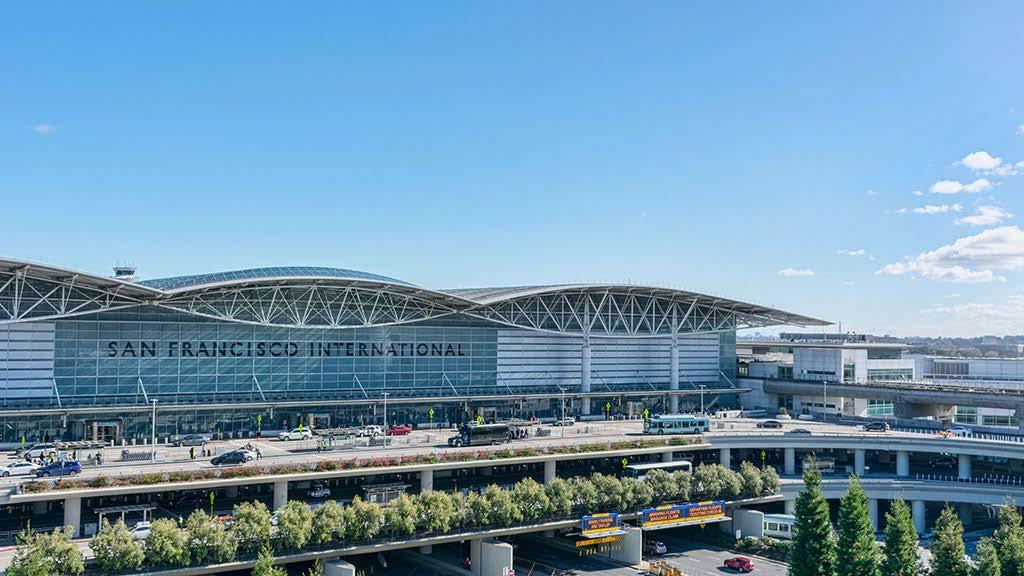
Four terminals in a ring, four runways and a railway built into the international terminal. San Francisco is the gateway to Silicon Valley, and one of the best-run airports in America.
San Francisco International is the principal airport of the Bay Area and the gateway between Britain and one of the most important business regions on earth: the city of San Francisco, with its finance, biotechnology and venture capital, and, to the south, Silicon Valley, the global heart of the technology industry. It is a major hub for United Airlines, with a powerful transpacific network, and is widely regarded as one of the best-run and most pleasant large airports in the United States, with its acclaimed terminals, public art and calm, efficient operation. For the British traveller it is both a major destination, the airport for the tech giants, the venture firms and the city itself, and a Pacific gateway. British Airways, Virgin Atlantic and United all fly here from London, into the International Terminal.
SFO is laid out as a ring of four terminals, Harvey Milk Terminal 1, Terminals 2 and 3, and the International Terminal, all linked by the free AirTrain people mover. Its single greatest asset for the British traveller is the railway: a BART rapid-transit station is built directly into the International Terminal, the only major US airport with a rail link inside its international terminal, putting downtown San Francisco and the Valley within an easy ride. One word of caution: SFO's summer fog can cause delays, a quirk of the Bay. This guide, for the British business flyer, covers the terminals, the train, and the things a US arrival demands: immigration, the trusted-traveller programmes, the dollars and the tipping.
SFO BY NUMBERS
Distance to downtown: about 13 miles; around 30 minutes by the BART train. Terminals: Harvey Milk Terminal 1, Terminals 2 and 3, and the International Terminal. For UK carriers: British Airways, Virgin Atlantic and United all use the International Terminal. The standout: a BART rail station built directly into the International Terminal. Before you fly: an approved ESTA (or visa) is required for entry to the United States.
Page 2 - Introduction and key facts
For the British traveller, SFO is simple: every transatlantic flight, on BA, Virgin or United, uses the International Terminal. The domestic terminals matter only for an onward US flight.
SFO makes the terminal question easy for the overseas traveller. The International Terminal, arranged in two boarding areas, A and G, handles all the airport's international flying, so British Airways, Virgin Atlantic and United's transatlantic and transpacific flights all use it, alongside a long list of Asian and European carriers. It is where you will arrive from London, clearing immigration here before baggage claim, and a fine, modern terminal it is, with good lounges and dining. The domestic terminals matter only if you are connecting onto a US flight: United, the dominant carrier, uses Terminal 3 and part of Harvey Milk Terminal 1 for its domestic operation, with American, Delta, Alaska and others spread across Terminals 1 and 2. For the British traveller, the International Terminal is your terminal.
The four terminals form a ring, linked airside in places and, for all passengers, by the free AirTrain, an automated people mover that circles the airport around the clock every few minutes, also serving the rental-car centre. Moving between terminals for a connection is therefore straightforward, though it does mean leaving and re-entering security where the airside connection does not exist. As ever, confirm your terminal on your booking, and if being dropped off for an international departure, make sure your driver comes to the International Terminal. For the British arrival or departure, the rule could not be simpler: the International Terminal.
RULE OF THUMB
Flying to or from Britain on BA, Virgin or United? The International Terminal, every time. The free AirTrain links all the terminals and the rental-car centre around the clock.
SFO's trump card is the railway in its international terminal: BART runs directly to downtown San Francisco, and south towards Silicon Valley.
No US airport is better placed for rail than SFO, and the British traveller benefits directly. The BART rapid-transit system has a station built into the International Terminal itself, so you step off your flight, clear immigration and can be on a train without leaving the building. Northbound, BART runs directly into downtown San Francisco, reaching Powell Street by Union Square in around thirty minutes for a fare of roughly eleven dollars, the quick, cheap and reliable way into the city, immune to the traffic on the freeways. Southbound, BART runs to Millbrae, where it connects with Caltrain, the commuter line that serves the Peninsula and Silicon Valley, from Palo Alto and Mountain View down to San Jose, putting much of the technology corridor within reach by rail.
The train is the standout for the city and, via Caltrain, for the Valley, but a taxi, ride-share or hire car, covered on the next page, is the practical choice for destinations off the rail lines or deep in the spread-out Valley, where the tech campuses are scattered across a wide area. SFO sits about thirteen miles south of the city and roughly midway between San Francisco and the heart of Silicon Valley, so it is well placed for both. The rule for the regular is to take BART for downtown San Francisco, BART-and-Caltrain or a car for the Valley, and a taxi or ride-share for a single destination off the rail network.
A hire car suits the spread-out Silicon Valley, while taxis and ride-share serve the city, though the Bay Area's traffic and the rail link often make the train the better bet.
For destinations off the rail lines, particularly the scattered technology campuses of Silicon Valley, a hire car is often the practical choice, giving the freedom to move around the Peninsula and the South Bay that the trains, useful as they are, cannot fully provide; the airport's rental-car centre is reached by the free AirTrain. For a single city or Valley destination, a taxi or ride-share offers door-to-door convenience, taken from the designated areas at the terminals, with fares varying from around thirty dollars to the nearer parts of the city to fifty, eighty or more down into the Valley, before the customary tip, and journey times that swing with the Bay Area's heavy traffic. Ride-share services such as Uber and Lyft, both Bay Area companies, are ubiquitous and run at demand-based fares.
That said, given the excellent BART link into the city and down to Millbrae for Caltrain, many business travellers find the train the better option for San Francisco and the rail-served parts of the Valley, taking a car only where the destination demands it. The Bay Area's notorious congestion only strengthens the case for the train where it serves your destination. The verdict at SFO leans on the train more than at most US airports, with a car reserved for the spread-out Valley.
The road traveller's checklist
• A hire car suits the spread-out Silicon Valley campuses; the rental centre is reached by the free AirTrain.
• Taxis and ride-share run from $30 into the city to $80-plus down the Valley, with tip.
• Given the BART and Caltrain links, the train is often the better bet for the city and railserved Valley.
• Being collected from a transatlantic flight? Your driver should come to the International Terminal.
Tipping is expected in the United States, not optional: around 15 to 20 per cent for taxis and restaurants, and a dollar or two per bag for porters. Budget for it as part of the fare.
Page 5 - Getting in by taxi, car and ride-share
Entering the United States at SFO is a more involved business than a European arrival, though the airport runs efficiently. A trusted-traveller programme still makes the difference.
Every UK visitor needs authorisation to enter the United States before travelling: for most business and leisure trips that means an approved ESTA under the Visa Waiver Programme, applied for online well ahead and valid for two years, though some travellers require a full visa, so check your circumstances early. On arrival at SFO you will clear US Customs and Border Protection at the International Terminal, the immigration check; SFO is generally one of the more efficiently run international arrivals among the big US airports, but at the busy times a queue can still build, followed by a customs declaration. The single most valuable thing a frequent visitor can do is enrol in Global Entry, the trusted-traveller programme open to UK citizens, which lets you skip the main queue at an automated kiosk; it requires a UK background check and a US fee, plus an interview, so apply months ahead, but it transforms the arrival.
Departure security is a separate matter, run by the Transportation Security Administration, and at a busy hub the checkpoints can be crowded, so allow time. For the UK traveller flying home it is a standard screening, but for anyone connecting onto a US domestic flight, TSA PreCheck, included with Global Entry, gives a faster security lane, and CLEAR, a paid identity-verification service, moves you to the front of the queue. As a major United hub, SFO sees these programmes well used. The practical advice is the same as at any US gateway: sort your ESTA before you fly, allow real time for immigration on arrival, and if you cross the Atlantic regularly, get Global Entry.
• Apply for your ESTA online well before travel (or a visa if your trip requires one); it is mandatory for entry.
• You clear US immigration at the International Terminal; SFO is efficient but queues can still build.
• For frequent visitors, Global Entry is transformative - apply months ahead, as interviews book up.
• Connecting onto a US domestic flight? TSA PreCheck (included with Global Entry) speeds departure security; CLEAR is a paid alternative.
• Reclaim and re-check your bags on arrival even if connecting onward; US connections are not seamless (see page 10).
Page 6 - Immigration, security and trusted-traveller programmes
The International Terminal has British and Virgin flagships and one of United's best business lounges, all conveniently in one building.
The International Terminal, where the British traveller flies, has an excellent set of lounges. British Airways operates its own lounge in Boarding Area A for Club World and status passengers, and Virgin Atlantic its Clubhouse nearby, both a comfortable base before the flight home. United, for whom SFO is a major hub, runs a United Polaris Lounge in the International Terminal for its long-haul business passengers, among the best business lounges in the country, and there is an American Express Centurion Lounge for eligible card holders along with various Asian carriers' premium spaces, reflecting the terminal's role as a Pacific gateway. For the British business traveller in a premium cabin or with the right card, the choice in the International Terminal is strong and, helpfully, all in one place.
The practical advice is to know what your ticket, status or card opens before you arrive, though the convenience here is that the lounges you need are all in the International Terminal where you fly, with none of the cross-terminal hunting of the bigger, more dispersed airports. A British Airways Club World ticket opens the BA lounge; a Virgin Atlantic Upper Class ticket the Clubhouse; a United Polaris business ticket the Polaris Lounge; a premium American card the Centurion Lounge. For the wait before a transatlantic departure, a good lounge turns dead time into working or resting time, and at SFO, for those with access, the choice is genuinely strong.
SFO is known for some of the best airport dining in America, with celebrated Bay Area names and a strong Californian and Asian flavour.
SFO has a deserved reputation for excellent dining, among the best of any US airport, reflecting the Bay Area's celebrated food culture: outposts of well-known San Francisco restaurants, Californian cooking, strong coffee and a notable Asian-influenced offer that reflects the terminal's Pacific orientation, all in bright, well-designed terminals filled with the airport's acclaimed art collection. For the British traveller flying from the International Terminal, a genuinely good final meal, Californian, Asian or both, is easily had, a long way from the bland fare of many airports. As ever, if you have lounge access, the lounge dining, particularly at the Polaris Lounge, is excellent, so weigh that against a table outside it; but at SFO the restaurants are well worth seeking out in their own right.
Shopping follows the high standard, with a good line in the practical alongside duty-free, technology and Bay Area and Californian branded gifts, and a notable emphasis on local and independent retailers, in keeping with the airport's character. For the working traveller the value is the familiar safety net, the charger, the adaptor or the US plug you forgot, replaceable airside, and in a technology-minded airport the electronics offer is good. The discipline is to do your eating and buying in your own terminal, the International Terminal for the British traveller, and to keep an eye on boarding, though SFO's terminals are well-signed and the walk to the gate manageable.
• SFO has some of the best airport dining in America; seek out the Bay Area and Asianinfluenced names.
• Do your eating and buying in the International Terminal, where the British traveller flies.
• The airport favours local and independent retailers, with a good electronics offer.
• Pick up any forgotten US plug adaptor or charger airside before you fly.
Page 8 - Dining and shopping
SLEEPING CLOSE TO THE GATE
SFO has a hotel on the airport reached by the AirTrain, with the city and the Valley both easily reached by rail for a trip centred on either.
SFO has a convenient on-airport hotel, the Grand Hyatt at SFO, a modern, full-service hotel reached from the terminals by the free AirTrain, ideal for an early flight, a late arrival or an overnight connection, with the comforts and soundproofing an airport hotel needs. Beyond it, a long strip of hotels lines the corridor in Burlingame and Millbrae just north of the airport, reached by shuttle, serving for a cheaper night close to the terminals and well placed for the Peninsula. But the Bay Area's business is spread between two poles, the city of San Francisco to the north and Silicon Valley to the south, so for most trips you will stay near where your work is, with the airport's excellent rail links making both reachable.
The choosing logic depends on where your business sits. For a trip focused on the city, a San Francisco hotel, with BART out to the airport from downtown; for a Silicon Valley trip, a hotel in Palo Alto, Mountain View, San Jose or the surrounding towns, near the campuses; for an early flight, the on-airport Grand Hyatt or a Burlingame hotel. The airport's position midway between the two, and its rail connections, give real flexibility. As always, book with both the trip and the morning's flight in mind, and remember that BART makes a downtown San Francisco hotel a practical base from here.
Grand Hyatt at SFO
On the airport, by AirTrain
On site and full-service; best for an early flight
Burlingame / Millbrae hotels Just north of the airport, by shuttle Cheaper nights; well placed for the Peninsula
San Francisco / Valley hotels The city or the tech corridor For the trip itself; both reachable by rail
SFO sits between the city and the Valley, with BART to San Francisco and BART-and-Caltrain to Silicon Valley, so a hotel near your business in either is well connected to the airport. Page 9 - Where to stay
SFO is a major United hub and Pacific gateway, but a connection onto a US domestic flight still means clearing immigration and re-checking bags first.
SFO is one of United's largest hubs and a major gateway across the Pacific, so the UK traveller may well connect here. But the United States makes every arriving international passenger clear the border before going on: there is no airside transit, so on arrival at the International Terminal you must clear immigration, collect your checked bags, pass through customs, and then hand the bags back in and go through security again before your onward domestic flight, even on a single ticket. Because the International Terminal and the domestic terminals are separate, you may also take the AirTrain to your onward terminal after re-clearing. SFO is well organised and the distances modest by US-hub standards, but the process still takes time, so a connection needs a generous buffer, well beyond a European transfer.
The practical guidance follows. When booking a transatlantic trip with an onward US flight, allow a long connection at SFO, never a tight one, and factor in the AirTrain move to your departure terminal, and the possibility of fog-related delays in the summer months. A trusted-traveller programme speeds both stages, Global Entry at immigration and the included TSA PreCheck at the re-screening, and hand luggage only, where the trip allows, removes the baggage reclaim and re-check entirely. SFO connects to an enormous range of destinations across the West and the Pacific; know that a US connection is not seamless, build your buffer, and clear each stage methodically before you relax.
• There is no airside transit in the US: clear immigration, reclaim bags, clear customs, recheck and re-screen.
• The AirTrain links the International Terminal to the domestic terminals for your onward flight.
• Allow a generous buffer, and more in summer when fog can cause delays.
• Global Entry speeds immigration and includes TSA PreCheck for the re-screening.
• Hand luggage only, where possible, removes the reclaim and re-check step.
Page 10 - Connecting onward
Everything above distilled into the habits that make the most of one of America's best-run airports.
SFO rewards the traveller who takes advantage of its strengths: a single international terminal that gathers the UK carriers, a railway built into it, and a position midway between the city and the Valley. As at any US airport the groundwork is the same, sort the ESTA, know that the International Terminal is yours, and budget for the dollars and the tipping, but SFO makes the rest easy, with the BART train into the city and down to Caltrain for the Valley its great advantage. Lean on a trusted-traveller programme, take the train wherever it serves you, and allow for the summer fog. Master these points and one of the most pleasant large airports in America serves the British business traveller very well.
Twelve habits of the seasoned SFO flyer
• Apply for your ESTA (or visa) well before you fly; it is mandatory for entry.
• The International Terminal is your terminal: BA, Virgin and United transatlantic flights all use it.
• If you cross the Atlantic often, get Global Entry - it transforms the immigration queue.
• Allow real time for immigration, though SFO is among the more efficient US gateways.
• For downtown San Francisco, take BART from the station inside the International Terminal.
• For Silicon Valley, take BART to Millbrae and change to Caltrain, or hire a car for the campuses.
• Use the free AirTrain to move between terminals and to the rental-car centre.
• Budget for tipping - 15 to 20 per cent - as part of every fare and bill.
• On BA, Virgin or United, the International Terminal lounges are all conveniently in one building.
• For an early flight, the on-airport Grand Hyatt is reached by the AirTrain.
• Allow for summer fog, which can cause delays at SFO.
• Connecting onward? Allow a buffer and an AirTrain ride to your departure terminal.
Page 11 - The frequent flyer's playbook
Already among the best-run airports in America, SFO continues to invest in its terminals and its standing as a Pacific gateway.
The defining quality at SFO is its consistent excellence rather than a single dramatic transformation. The airport has steadily rebuilt and modernised its terminals over recent years, from the acclaimed Harvey Milk Terminal 1 to ongoing improvements across the others, with a continued emphasis on design, art, sustainability and the passenger experience that has made SFO a model for American airports. Run by the City and County of San Francisco, it benefits from a region with the wealth and the will to invest in it, and from its strategic position as the United States' premier gateway to the technology economy and across the Pacific. United continues to invest in its hub here, its lounges and its long-haul network. For an airport already regarded as one of the country's best, the work is one of refinement rather than reinvention.
For the traveller, this means an airport that is already a pleasure to use and that keeps getting better, with new and refurbished facilities opening as the modernisation continues. The fundamentals of a US arrival remain as this guide describes them, and the Bay Area's traffic and summer fog will always require a little planning. But the direction is clear: SFO intends to remain among the finest large airports in the United States and the gateway to one of the world's most important business regions, both a destination worth the journey and one of the easiest American airports to use.
To
Getting around
The free AirTrain links all terminals and the rental-car centre
The frequent-flyer edge Global Entry - skips the immigration queue, includes TSA PreCheck
Premium lounges BA Lounge, Virgin Clubhouse and United Polaris - all in the International Terminal
Worth noting Summer fog can cause delays at SFO
Page 12 - The bigger picture and quick reference