
New York's other gateway, mastered
A dive for the British business flyer: United's transatlantic hub and the quick train to Manhattan, which terminal for your airline, immigration and the trusted-traveller programmes, the lounges worth the walk, where to sleep, and how to make Newark work for you, not against you.
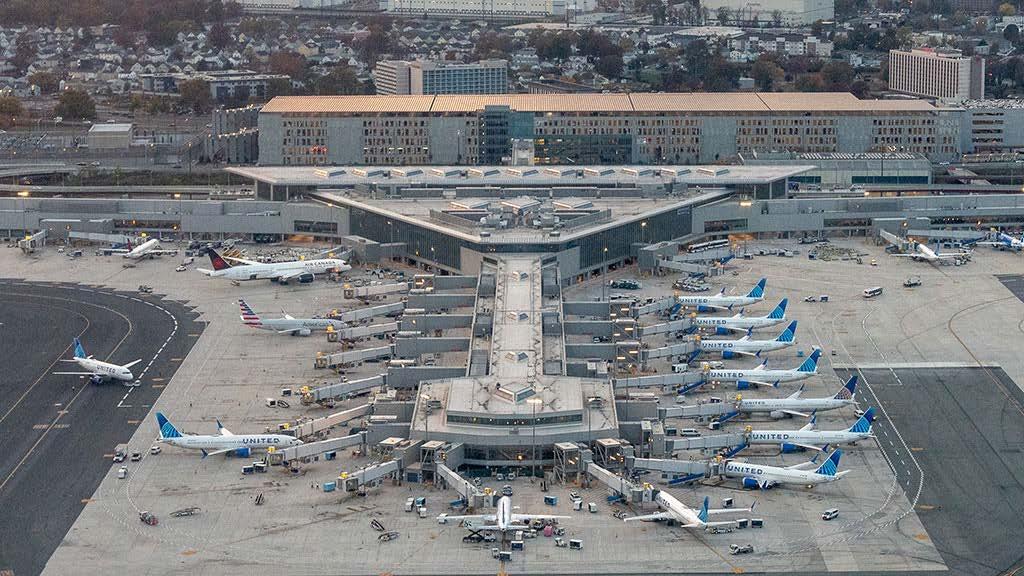
Three terminals, three runways and the quickest train into Manhattan of any New York airport. Newark is United's transatlantic fortress, and for many a smoother way into the city than JFK.
Newark Liberty International, across the Hudson in New Jersey some sixteen miles from Midtown, is the third of New York's airports and, for a great many British business travellers, the most convenient. It is the great hub of United Airlines, which flies a dense transatlantic network from here, and the home of a long list of foreign carriers, with British Airways prominent among them. Its decisive advantage over JFK is the journey in: a direct train links the airport to New York Penn Station in around half an hour, which at the peaks can make Newark the faster gateway to Manhattan despite sitting further out. For the UK traveller, the questions are the same as at any US airport: which terminal, how to clear immigration, and how to reach the city.
Newark is also a much-improved airport. A vast new Terminal A, opened in 2023 at a cost of nearly three billion dollars, has replaced the tired old building with a bright, modern one, and the airport's other terminals carry the international and United operations. Run by the Port Authority of New York and New Jersey, which also operates JFK and LaGuardia, it has shed much of its former reputation for grimness. This guide is written for the British business flyer, and covers not just the terminals and the train but the things a US arrival demands: immigration, the trustedtraveller programmes, the dollars and the tipping.
Distance to Manhattan: about 16 miles; roughly 30 minutes by train to Penn Station. Terminals: A (new, 2023), B (international) and C (United's hub).
For UK carriers: British Airways at Terminal B; United at Terminal C. Fastest into Manhattan: AirTrain to the rail station, then NJ Transit to Penn Station, around 30 min. Before you fly: an approved ESTA (or visa) is required for entry to the United States.
Page 2 - Introduction and key facts
Newark's three terminals are lettered A, B and C, and your airline sets which you need. For the British traveller, it is usually Terminal B or, on United, Terminal C.
Newark is simpler to read than JFK, with just three terminals. Terminal B is the airport's international terminal and the home of most foreign carriers, British Airways among them, along with Lufthansa, Aer Lingus, Emirates, Cathay Pacific, Singapore Airlines and others. Terminal C belongs to United Airlines, whose transatlantic flights from London and across the world make it one of the busiest single-airline terminals in the country, and the place most UK travellers flying United will arrive and depart. Terminal A, the gleaming new building opened in 2023, handles a mix of domestic and some international flying on American, Delta, JetBlue, Air Canada and United's regional services. Always confirm your terminal on your booking.
The terminals are linked by the AirTrain, a free automated monorail that also runs out to the airport's railway station, so moving between them, or to the train, is quick and simple. As at any spread-out airport, the important thing is to arrive at the correct terminal in the first place, particularly for a drop-off, since crossing between them by road is slower than the AirTrain. Confirm the building, use the AirTrain for any connection or for the train into the city, and the rest follows. For the United flyer in particular, Terminal C is a world of its own, with the airline's full range of lounges and services.
Flying British Airways? Terminal B. Flying United? Terminal C.
The free AirTrain links the terminals and the railway station; confirm the right terminal before a drop-off.
Page 3 - Terminals and airline allocation
Newark's trump card is its railway: a direct train to New York Penn Station in around half an hour, which at the peaks beats JFK for speed into Midtown.
Newark's great advantage is its rail link. The AirTrain, the free monorail around the terminals, runs out to the airport's own railway station, where, for a fare of around nine dollars, you join NJ Transit or Amtrak trains that run directly to New York Penn Station in the heart of Midtown Manhattan in roughly thirty minutes, for a combined fare of around seventeen dollars. It is one of the most convenient airport-to-city rail links in the region, and at the peaks, when the roads into Manhattan clog, it can deliver you to Midtown faster than a taxi from JFK. From Penn Station the subway and the rest of the city's network are on the doorstep, and for the Financial District the PATH train, reached via Newark Penn Station, runs directly to Lower Manhattan.
For the business traveller arriving off a long flight, the train is often the smart choice: fast, frequent, immune to the traffic, and depositing you in the centre of Midtown. The AirTrain and the onward train are paid for as you go, with contactless cards accepted, and the whole journey is straightforward once you know to ride the AirTrain to the rail station first. The alternative, a taxi or car door-to-door, is covered on the next page and makes sense when the traffic is light or your destination is awkward for the train, but for Midtown at a busy hour, the Newark train is hard to beat.
AirTrain + NJ Transit to New York Penn Station approx. 30 min around $17 combined
AirTrain + PATH via Newark Penn to Lower Manhattan approx. 45 min Low-cost Taxi / ride-share door-to-door to Manhattan approx. 30 to 45 min about $55 to $80 plus tolls and tip
Page 4 - Getting into Manhattan
A taxi or car gives door-to-door simplicity from Newark, but the New Jersey tolls and surcharges, and the customary tip, add up, and the traffic is unpredictable.
For door-to-door convenience, a taxi or ride-share from Newark is straightforward, taken from the ranks and pick-up areas outside each terminal, and the journey to Manhattan typically takes thirty to forty-five minutes when the traffic allows, though it can be far longer at the peaks. Newark taxis are metered rather than flat-fared, and to the fare you must add the river crossing tolls, which are substantial, any airport and peak surcharges, and the customary tip of fifteen to twenty per cent, so the real cost to Manhattan usually lands somewhere between fifty-five and eighty dollars or more. Ride-share services such as Uber and Lyft operate from designated areas at fares that rise and fall with demand, and can be cheaper or dearer than a cab depending on the hour.
Hiring a car is seldom worthwhile for a Manhattan business trip, where parking is dear and the driving difficult, and a new congestion charge now applies to driving into the busiest part of Manhattan, adding to the cost; a hire car makes sense only for journeys out into New Jersey or beyond. If you are being collected, remember that Newark's terminals are spread around the airport, so the driver must come to the correct one. For most travellers the honest verdict is the same as at the other New York airports: the train for speed and economy into Midtown, and a taxi or ride-share for door-to-door convenience when the traffic is kind.
The road traveller's checklist
• Taxis are metered, not flat: expect $55 to $80-plus to Manhattan once tolls, surcharges and a 15 to 20 per cent tip are added.
• Ride-share (Uber, Lyft) runs from designated areas at demand-based fares.
• Skip car hire for a Manhattan trip; parking is costly and a congestion charge now applies to central Manhattan.
• Being collected? Make sure the driver comes to the correct terminal.
Tipping is expected in the United States, not optional: around 15 to 20 per cent for taxis and restaurants, and a dollar or two per bag for porters. Budget for it as part of the fare.
Page 5 - Getting in by taxi, car and ride-share
Entering the United States is a more involved business than a European arrival, and Newark's queues can be long. Preparation, and a trusted-traveller programme, make all the difference.
Every UK visitor needs authorisation to enter the United States before travelling: for most business and leisure trips that means an approved ESTA under the Visa Waiver Programme, applied for online well ahead and valid for two years, though some travellers require a full visa, so check your circumstances early. On arrival at Newark you will clear US Customs and Border Protection, the immigration check, which at the busy long-haul banks can involve a substantial queue, followed by a customs declaration. The single most valuable thing a frequent visitor can do is enrol in Global Entry, the trusted-traveller programme open to UK citizens, which lets you skip the main queue at an automated kiosk; it requires a UK background check and a US fee, plus an interview, so apply months ahead, but it transforms the arrival.
Departure security is a separate matter, run by the Transportation Security Administration. For the UK traveller flying home it is a standard, if thorough, screening, but for anyone connecting onto a US domestic flight, two programmes are worth knowing: TSA PreCheck, which gives a faster security lane and is included with Global Entry, and CLEAR, a paid identity-verification service that moves you to the front of the queue. Newark, as a major United hub, sees a great deal of connecting traffic, so these programmes earn their keep here. The practical advice is the same as at any US gateway: sort your ESTA before you fly, allow real time for immigration on arrival, and if you cross the Atlantic regularly, get Global Entry.
• Apply for your ESTA online well before travel (or a visa if your trip requires one); it is mandatory for entry.
• Expect a queue at US immigration on arrival; Newark's long-haul banks can be busy.
• For frequent visitors, Global Entry is transformative - apply months ahead, as interviews book up.
• Connecting onto a US domestic flight? TSA PreCheck (included with Global Entry) speeds departure security; CLEAR is a paid alternative.
• Reclaim and re-check your bags on arrival even if connecting onward; US connections are not seamless (see page 10).
Page 6 - Immigration, security and trusted-traveller programmes
Newark's lounge highlight is one of the best business lounges in the country, United's Polaris Lounge, alongside the British Airways and American card lounges.
For the business traveller, Newark's lounge scene is anchored by United. At Terminal C, the United Polaris Lounge, reserved for United and Star Alliance long-haul business passengers, is among the finest business lounges in the United States, with restaurant-standard sit-down dining, a cocktail bar, showers and quiet, comfortable space to work or rest before a transatlantic flight, alongside the airline's network of United Club lounges for other premium passengers and members. At Terminal B, British Airways operates its own lounge for Club World and status passengers, the natural home for the BA flyer. The airport also has American Express Centurion lounge access for eligible premium card holders.
The practical advice is the usual: know what your ticket or card opens, and crucially that it sits in the terminal you are flying from, before you build your timings around it. A United Polaris business ticket opens the Polaris Lounge at Terminal C; a British Airways Club World ticket opens the BA lounge at Terminal B; and a premium American card may open the Centurion lounge, but only where it is located. For the long wait that a transatlantic departure involves, a good lounge turns dead time into working or resting time, and the United Polaris Lounge in particular is worth arriving early for.
The new Terminal A has transformed dining at Newark, and the airport now offers proper restaurants and a real sense of place rather than the old fast-food norm.
Dining at Newark has been lifted markedly by the new Terminal A, which was designed around a strong food-and-drink offer, with sit-down restaurants, local New Jersey and New York names and the order-from-your-seat technology now common in American airports, a world away from the tired concessions of the old building. The international Terminal B and United's Terminal C carry their own spread of restaurants, bars and quick counters, so wherever you are flying from you can find a proper meal before a long flight home rather than merely a sandwich. The standard varies by terminal, with the new Terminal A the strongest, so it is worth knowing where you are; and as ever, if you have lounge access, weigh the lounge catering against a table outside it.
Shopping follows the American airport pattern, with a strong line in the practical, the technology, the pharmacy and the bookshop, alongside duty-free and New York and New Jersey branded gifts. For the working traveller the value is the familiar safety net, the charger, the adaptor or the US plug you forgot, all replaceable airside. The discipline at a spread-out airport is to do your eating and buying in your own terminal, since you cannot easily cross to another airside, and to keep an eye on boarding, because the walk to a far gate in a large American terminal can be a long one.
• The new Terminal A has the strongest dining; Terminals B and C carry their own restaurants and bars.
• Do your eating and shopping in your own terminal; you cannot easily cross to another airside.
• Pick up any forgotten US plug adaptor or charger airside before you fly.
• Watch the boarding screens - the walk to a far gate in a large US terminal can be long.
Page 8 - Dining and shopping
Newark has an on-airport hotel reached by the AirTrain, a cluster of chain hotels nearby, and the option, as ever, of basing yourself in Manhattan.
For a hotel at the airport itself, the Newark Liberty International Airport Marriott sits on the airport and is reached by the free AirTrain, a full-service hotel that is the natural choice for an early flight or a late arrival when you want simply to be on site, with restaurants, a bar, a gym and the soundproofing an airport hotel needs. Beyond it, a substantial cluster of chain hotels sits a short distance from the airport in and around Newark and the surrounding towns, among them familiar mid-range and budget names reached by complimentary or low-cost shuttle buses, offering a cheaper night for those who want only to be near the terminals.
Many business travellers, of course, will base themselves in Manhattan and treat Newark purely as a gateway, taking the quick train in and out, which the airport's rail link makes genuinely easy; for a trip centred on the city, that is often the natural choice. The decision comes down to the shape of the trip: the on-airport Marriott for a dawn departure or a late arrival, a nearby chain hotel for budget convenience, and Manhattan for the trip itself, with the train covering the last stretch. As always, book with the morning's flight in mind, and remember how quick the train into the city is from here.
hotel shortlist
to
As a major United hub, Newark handles huge connecting traffic, but a connection onto a US domestic flight still means clearing immigration and rechecking bags first.
Newark is built for connections, the heart of United's eastern network, but the United States makes every arriving international passenger clear the border before going on, and that catches UK travellers out. There is no airside transit: on arrival you must clear immigration, collect your checked bags, pass through customs, and then hand the bags back in and go through security again before your onward domestic flight, even on a single ticket. United's hub at Terminal C is well organised for this, with re-check desks and connections built into the flow, but the process still takes time, and at a busy arrival bank it can take a lot of time. A connection at Newark needs a generous buffer, well beyond what a European transfer would require.
The practical guidance follows. When booking a transatlantic trip with an onward US flight, allow a long connection at Newark, never a tight one, and on United your inbound and onward flights will usually share Terminal C, which helps. A trusted-traveller programme speeds both stages, Global Entry at immigration and the included TSA PreCheck at the re-screening, and hand luggage only, where the trip allows, removes the baggage reclaim and re-check entirely. Know that a US connection is not the seamless airside affair of a European hub, build your buffer accordingly, and clear each stage methodically before you relax.
• There is no airside transit in the US: clear immigration, reclaim bags, clear customs, recheck and re-screen.
• Allow a long connection at Newark, never a tight one - far more than a European transfer needs.
• On United, your flights usually share Terminal C, which simplifies the re-check.
• Global Entry speeds immigration and includes TSA PreCheck for the re-screening.
• Hand luggage only, where possible, removes the reclaim and re-check step.
Page 10 - Connecting onward
Everything above distilled into the habits that make the most of New York's other gateway, and its great advantage of the train into Midtown.
Newark rewards the traveller who knows its strengths: a quick train into Manhattan, a modern new terminal, and United's deep network for onward connections. As at any US airport, the groundwork is the same, sort the ESTA, know your terminal, and budget for the dollars and the tipping, but Newark adds one real edge, the railway, which at the peaks makes it the faster way into Midtown than JFK. Lean on a trusted-traveller programme to tame the immigration queue, take the train rather than fight the traffic, and Newark becomes not New York's poor relation but, for many a business trip, its most convenient gateway.
Twelve habits of the seasoned Newark flyer
• Apply for your ESTA (or visa) well before you fly; it is mandatory for entry.
• Know your terminal: British Airways at B, United at C.
• If you cross the Atlantic often, get Global Entry - it transforms the immigration queue.
• Allow real time for US immigration on arrival at the busy long-haul banks.
• For Midtown, take the AirTrain to the rail station and the train to Penn Station, around 30 minutes.
• For the Financial District, use the PATH train via Newark Penn.
• For door-to-door, a taxi is metered: $55 to $80-plus with tolls, surcharges and tip.
• Budget for tipping - 15 to 20 per cent - as part of every fare and bill.
• On United, seek out the Polaris Lounge at Terminal C - among the best business lounges in the US.
• For an airport night, the on-airport Marriott is reached by the free AirTrain.
• Connecting onto a US domestic flight? Allow a long buffer and expect to reclaim and recheck bags.
• Confirm your terminal before any drop-off; the terminals are spread around the airport.
Page 11 - The frequent flyer's playbook
With a vast new terminal already open and United investing in its hub, Newark has shed its old reputation and is on the rise.
The defining story at Newark is renewal. The opening in 2023 of the new Terminal A, a nearthree-billion-dollar building, transformed the first impression of an airport that had long been the least loved of New York's three, replacing a cramped, dated terminal with a bright, modern one full of light, technology and good food. United, for whom Newark is a cornerstone hub, has continued to invest in its Terminal C operation and its transatlantic network, and the Port Authority of New York and New Jersey, which runs all three New York airports, is pursuing further improvements across the site. The airport that long traded on its convenient train rather than its charm now has both.
For the traveller, the next few years should bring continued improvement: the full benefit of the new Terminal A, ongoing upgrades to the older buildings, and the steady growth of United's network from a hub it is committed to. There will be construction to navigate in the meantime, and the fundamentals of a US arrival, the ESTA, the immigration queue, the dollars and the tipping, remain as this guide describes them. But the direction is clear. Newark has gone from New York's afterthought to, for many a British business trip, its most convenient gateway, and for the frequent transatlantic flyer it deserves a fresh look.
reference
Before you fly
Fastest into Manhattan
By taxi
The frequent-flyer edge
Standout lounge
Airport hotel
On the horizon
An approved ESTA (or visa) is mandatory for entry
AirTrain plus NJ Transit to Penn Station, around 30 min
Metered: about $55 to $80-plus with tolls, surcharges and tip
Global Entry - skips the immigration queue, includes TSA PreCheck
United Polaris Lounge, Terminal C
Newark Liberty Airport Marriott, on site via the AirTrain
A new Terminal A already open; continued United and Port Authority investment
Page 12 - The bigger picture and quick reference