
A deep dive for the British business flyer: which terminal for your airline, the way into Manhattan, immigration and the trusted-traveller programmes, the lounges worth the walk, where to sleep, and how to make New York's great gateway work for you, not against you.
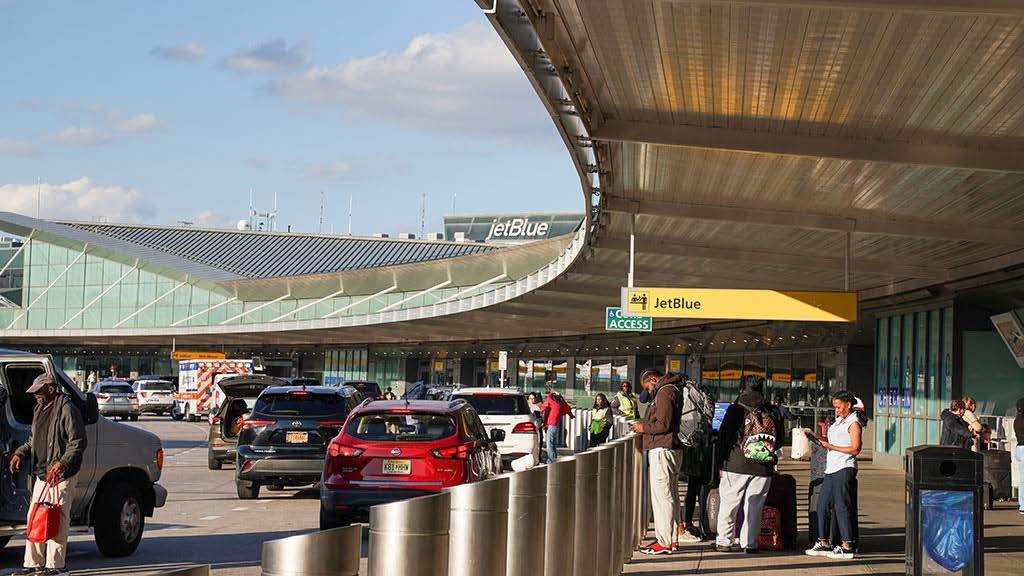
Six terminals, four runways and more international travellers than any airport in the Americas. JFK is the United Kingdom's principal doorway to New York, and it is being rebuilt around you.
John F. Kennedy International is the great gateway between Britain and New York, and for most UK business travellers it is the first and last impression of the United States. Set in Queens some fifteen miles from Midtown Manhattan, it is the busiest international gateway in the Americas, handling tens of millions of overseas passengers a year across a cluster of terminals known by number rather than in a neat row. For the British traveller two of those terminals matter most: British Airways and its oneworld partners fly from Terminal 8, and Virgin Atlantic, alongside Delta and its SkyTeam partners, from Terminal 4. Knowing which is yours, and what to expect of arrival into the United States, is most of the battle.
JFK is also in the middle of the largest transformation in its history, a redevelopment costing well over fifteen billion dollars that is replacing tired old terminals with vast new ones. A gleaming New Terminal One is opening in phases from 2026 on the site of the old Terminal 1, and a new Terminal 6 is rising alongside Terminal 5, with the old Terminal 7 making way for it. For the traveller this means construction to navigate now and a far better airport in time. This guide is written for the British business flyer, and it covers not just the terminals and the trains but the things a US arrival demands: immigration, the trusted-traveller programmes, the dollars and the tipping.
Distance to Manhattan: about 15 miles, 35 to 55 minutes by taxi.
Terminals: T1, T4, T5, T6, T8 in use, mid a 15-billion-dollar-plus rebuild.
For UK carriers: British Airways at Terminal 8; Virgin Atlantic at Terminal 4.
Fastest public transit: AirTrain to Jamaica, then the LIRR to Penn Station, 35 to 45 min. Before you fly: an approved ESTA (or visa) is required for entry to the United States.
Page 2 - Introduction and key facts
JFK's terminals are numbered, not lettered, and not in sequence, so the building you need is set by your airline. For the British traveller, it is usually Terminal 8 or Terminal 4.
JFK is really a collection of separate terminals around a central loop, each operated differently, so getting the right one matters more than at a single-terminal airport. For UK travellers the two that count are Terminal 8, the oneworld home of American Airlines that also hosts British Airways, Iberia, Finnair and Qatar Airways, and Terminal 4, the Delta and SkyTeam hub that is also home to Virgin Atlantic, KLM and others. JetBlue, useful for onward domestic flights, operates from Terminal 5, and the brand-new Terminal 6 rising beside it will take a growing list of carriers including Lufthansa, Air Canada and Cathay Pacific. Always confirm your terminal on your booking, because the rebuild is shifting airlines around.
The terminals are linked by the AirTrain, a free automated rail loop that circles the airport around the clock, so moving between them, or out to the transit and car-hire connections, is straightforward once you are landside. The important point is to arrive at the correct terminal in the first place, particularly if someone is dropping you off, since the terminals are spread around a large site and crossing between them by road is slow. Confirm the building, allow for the AirTrain if you have a connection, and the rest of the day tends to follow.
Terminal Airlines
Terminal 8
Terminal 4
British Airways, American, Iberia, Finnair, Qatar
Virgin Atlantic, Delta, KLM and SkyTeam
Terminal 5 JetBlue
Terminal 6 Lufthansa, Air Canada, Cathay and others
Notes
The oneworld home - most BA passengers
The Delta hub - Virgin Atlantic passengers
Useful for onward US domestic flights
New for 2026, beside Terminal 5
Flying British Airways? Terminal 8. Flying Virgin Atlantic? Terminal 4. Terminals are linked by the free AirTrain loop, but confirm the right one before a drop-off.
Page 3 - Terminals and airline allocation
The AirTrain links the terminals to the city's rail network, and the combination of AirTrain and the Long Island Rail Road is the quickest way into Manhattan at the peaks.
JFK is fifteen miles from Midtown, and at the wrong time of day the road can be slow, so the rail option is worth understanding. The AirTrain, the free loop around the terminals, becomes a paid service, around eight dollars, when you ride it out to the connecting stations at Jamaica or Howard Beach. From Jamaica, the Long Island Rail Road runs fast into Penn Station in the heart of Manhattan in around twenty minutes, giving a total door-to-door time of roughly thirty-five to forty-five minutes, comfortably the quickest public route at the peaks. Also from Jamaica, and from Howard Beach, the subway, the E, J, Z and A lines, runs into the city for a few dollars more, the cheapest option at around eleven dollars all in, though slower at sixty to ninety minutes.
For the business traveller arriving jet-lagged with luggage, the calculation is usually time against cost. The AirTrain-and-LIRR combination is fast and avoids the traffic, depositing you at Penn Station for onward connections; the subway is cheap but slow and less comfortable with bags; and a taxi or car, covered on the next page, is the simplest door-to-door option if the traffic is kind. Whichever you choose, buy or tap for the AirTrain and the onward train as you go, using a contactless card or the OMNY system on the subway, and remember that fares and journey times are quoted here in the local currency and conditions.
4 - Getting into Manhattan
The yellow cab is a New York institution and a simple way into Manhattan, but the dollars add up once tolls, surcharges and the customary tip are counted.
For the door-to-door simplicity that a tired traveller wants, the taxi is hard to beat, and at JFK it comes with a useful certainty: licensed yellow cabs charge a flat fare to anywhere in Manhattan, set at seventy dollars before extras, taken from the official taxi ranks outside each terminal. To that flat fare you must add any bridge or tunnel tolls, a few dollars, peak-time and other surcharges, and the customary tip of fifteen to twenty per cent, so the real cost to Manhattan is usually nearer ninety dollars. The journey takes anywhere from thirty-five minutes to nearly an hour depending on the traffic, which in New York is rarely light. Ride-share services such as Uber and Lyft operate too, from designated pick-up areas, at fares that vary with demand.
Hiring a car is rarely the right choice for a business trip into Manhattan, where parking is ruinously expensive and the driving fraught, so most travellers take the car only for journeys out to the suburbs or beyond the city. If you are being collected, note that the terminals are spread around the airport, so the driver must come to the correct one, and that a new congestion charge now applies to driving into the busiest part of Manhattan, adding to the cost of a car into the centre. For most, the honest advice is a taxi or ride-share for door-to-door convenience, and the AirTrain-and-train for speed and economy at the peaks.
The road traveller's checklist
• Use the official yellow-cab rank: a flat $70 to Manhattan, plus tolls, surcharges and a 15 to 20 per cent tip.
• Ride-share (Uber, Lyft) runs from designated pick-up areas at demand-based fares.
• Skip car hire for a Manhattan trip; parking is costly and a congestion charge now applies to central Manhattan.
• Being collected? Make sure the driver comes to the correct terminal - they are spread around the airport.
Tipping is expected in the United States, not optional: around 15 to 20 per cent for taxis and restaurants, and a dollar or two per bag for porters. Budget for it as part of the fare. Page 5 - Getting in by taxi, car and ride-share
Entering the United States is a more involved business than a European arrival, and JFK's queues can be long. Preparation, and a trusted-traveller programme, make all the difference.
Every UK visitor needs authorisation to enter the United States before travelling: for most business and leisure trips that means an approved ESTA under the Visa Waiver Programme, applied for online well ahead and valid for two years, though some travellers require a full visa, so check your circumstances early. On arrival you will clear US Customs and Border Protection, the immigration check, which at JFK can involve a substantial queue at the busy long-haul arrival banks, followed by a customs declaration. The single most valuable thing a frequent visitor can do is enrol in Global Entry, the trusted-traveller programme open to UK citizens, which lets you skip the main queue at an automated kiosk; it requires a UK background check and a US fee, plus an interview, so apply months ahead, but it transforms the arrival.
Departure security is a separate matter, run by the Transportation Security Administration. For the UK traveller flying home it is a standard, if thorough, screening, but for anyone connecting onto a US domestic flight, two programmes are worth knowing: TSA PreCheck, which gives a faster security lane and is included with Global Entry, and CLEAR, a paid identity-verification service that moves you to the front of the queue. The practical advice is simple: sort your ESTA before you fly, allow real time for immigration on arrival, and if you cross the Atlantic more than once or twice a year, treat Global Entry as the single best investment you can make in a smoother trip.
• Apply for your ESTA online well before travel (or a visa if your trip requires one); it is mandatory for entry.
• Expect a queue at US immigration on arrival; JFK's long-haul banks can be busy.
• For frequent visitors, Global Entry is transformative - apply months ahead, as interviews book up.
• Connecting onto a US domestic flight? TSA PreCheck (included with Global Entry) speeds departure security; CLEAR is a paid alternative.
• Reclaim and re-check your bags on arrival even if connecting onward; US connections are not seamless (see page 10).
Page 6 - Immigration, security and trusted-traveller programmes
JFK has one of the strongest lounge scenes of any airport for the premium traveller, with British and Virgin flagships and a cluster of American card lounges.
For the business traveller flying a premium cabin or holding the right card, JFK is well supplied. At Terminal 8, British Airways operates its Galleries Club and First lounges and, for First and toptier passengers, the Concorde Room, its flagship space, alongside the American Airlines Flagship lounges. At Terminal 4, Virgin Atlantic's Clubhouse, above the A concourse, is among the best business lounges anywhere, with its cocktail bar and elegant design, while Delta runs its Sky Club and the premium Delta One Lounge for long-haul business passengers. The same terminal has become a hub for the American credit-card lounges that many UK travellers can now access, including the American Express Centurion Lounge, the Chase Sapphire Lounge and the Capital One Lounge.
The practical advice is to know what your ticket or card opens, and crucially that it sits in the terminal you are flying from, before you build your timings around it. A British Airways Club World ticket opens the Galleries at Terminal 8; a Virgin Atlantic Upper Class ticket opens the Clubhouse at Terminal 4; and a premium American credit card may open one of the Centurion or Sapphire lounges, but only in the terminal where it is located. For the long wait that a transatlantic departure often involves, a good lounge turns dead time into working or resting time, and at JFK the standard, for those with access, is high.
JFK's newer terminals have lifted the dining well above the old Americanairport norm, with proper restaurants and a strong sense of New York.
Dining at JFK has improved markedly as the terminals have been rebuilt, and the better buildings now carry a genuine sense of place, with outposts of well-known New York restaurants and chefs alongside the familiar coffee and fast-food chains. Terminal 4, the busiest for UK travellers on Virgin and Delta, has a wide spread of options airside, and the new terminals opening through the rebuild promise more of the same. The standard varies by terminal, so it is worth knowing that the older buildings are plainer than the new ones, but across the airport you can now find a proper meal before a long flight home rather than merely a sandwich. As ever, if you have lounge access, weigh the lounge catering against a table outside it.
Shopping follows the American airport pattern, with a strong line in the practical, the technology, the pharmacy and the bookshop, alongside duty-free and a good deal of New York-branded merchandise for the traveller wanting a last-minute gift. For the working traveller the value is the familiar safety net, the charger, the adaptor or the US plug you forgot, all replaceable airside. The discipline at a big, spread-out airport is to do your eating and buying in your own terminal, since you cannot easily cross to another airside, and to keep an eye on boarding, because the walk to a far gate in a large American terminal can be a long one.
• The newer terminals offer proper New York dining; the older ones are plainer, so know your terminal.
• Do your eating and shopping in your own terminal; you cannot easily cross to another airside.
• Pick up any forgotten US plug adaptor or charger airside before you fly.
• Watch the boarding screens - the walk to a far gate in a large US terminal can be long.
Page 8 - Dining and shopping
JFK has one of the most remarkable airport hotels in the world on its doorstep: the restored TWA Hotel, a mid-century design landmark connected to Terminal 5.
For a hotel at the airport itself, JFK offers something genuinely special. The TWA Hotel occupies the beautifully restored 1962 TWA Flight Center, the swooping Eero Saarinen landmark that is one of the great buildings of the jet age, now a full hotel connected directly to Terminal 5 and a short AirTrain hop from the others. It is a destination in its own right, with mid-century styling, restaurants and cocktail bars, a rooftop pool and observation deck looking out over the runways, and rooms with serious soundproofing for an undisturbed night before an early flight. For the business traveller facing a dawn departure or a late-night arrival, it is both supremely convenient and a pleasure to stay in, a rare combination at an airport.
Beyond the TWA Hotel, a cluster of more conventional chain hotels sits a short distance from the airport, among them familiar names reached by a complimentary or low-cost shuttle bus, which offer a cheaper, no-frills night for those who want simply to be near the terminals. Many business travellers, of course, will base themselves in Manhattan itself and treat JFK purely as a gateway, taking the train or a taxi in. The choice comes down to the trip: the TWA Hotel for a memorable and convenient airport night, a chain hotel for budget convenience, and Manhattan for everything else. As always, book with the morning's flight in mind.
The TWA Hotel, in Saarinen's restored 1962 terminal, is among the finest airport hotels anywhere - a design icon with a runway-view rooftop pool, connected to Terminal 5.
A connection through JFK onto a US domestic flight is more involved than a European transfer, because the United States makes every arriving passenger clear immigration and customs first.
The one thing that catches UK travellers out at JFK is the connection onto a domestic US flight. Unlike a European hub, the United States has no airside transit: every arriving international passenger must clear immigration, collect their checked bags, pass through customs, and then hand the bags back in and go through security again before the onward flight, even when both flights are on a single ticket. That process takes time, and at a busy arrival bank it can take a lot of time, so a connection at JFK needs a generous buffer, well beyond what a London or Amsterdam transfer would require. If your onward flight leaves from a different terminal, you must also factor in the AirTrain ride between them after re-clearing security.
The practical guidance follows directly. When booking a transatlantic trip with an onward US flight, allow a long connection at JFK, never a tight one, and prefer itineraries that keep both flights in the same terminal where possible. A trusted-traveller programme helps at both stages, Global Entry at immigration and the included TSA PreCheck at the re-screening, and travelling with hand luggage only, where the trip allows, removes the baggage reclaim and re-check entirely. Know before you fly that a US connection is not the seamless airside affair of a European hub, build your buffer accordingly, and clear each stage methodically.
• There is no airside transit in the US: you must clear immigration, reclaim bags, clear customs, re-check and re-screen.
• Allow a long connection at JFK, never a tight one - far more than a European transfer needs.
• Global Entry speeds immigration and includes TSA PreCheck for the re-screening.
• Hand luggage only, where possible, removes the reclaim and re-check step.
• If the onward flight is in another terminal, allow for the AirTrain ride after re-screening. Page 10 - Connecting onward
Everything above distilled into the habits that separate the seasoned transatlantic traveller from the one caught out by an American arrival.
JFK rewards the traveller who prepares for the United States as much as for the airport. Sort the paperwork, know your terminal, plan the way into Manhattan, and budget for the dollars and the tipping, and a New York arrival becomes routine rather than daunting. The frequent flyer's single greatest advantage here is a trusted-traveller programme, which turns the airport's biggest pain point, the immigration queue, into a brief formality. Master these points and the busiest international gateway in the Americas, for all its scale and its building works, becomes thoroughly manageable.
Twelve habits of the seasoned JFK flyer
• Apply for your ESTA (or visa) well before you fly; it is mandatory for entry.
• Know your terminal: British Airways at T8, Virgin Atlantic at T4.
• If you cross the Atlantic often, get Global Entry - it transforms the immigration queue.
• Allow real time for US immigration on arrival, especially at the busy long-haul banks.
• For speed into Manhattan at the peaks, take the AirTrain to Jamaica and the LIRR to Penn Station.
• For door-to-door, the yellow cab is a flat $70 to Manhattan plus tolls, surcharges and tip.
• Budget for tipping - 15 to 20 per cent - as part of every fare and bill.
• Know which lounge your ticket or card opens, and that it is in your terminal.
• For an airport night, the TWA Hotel is convenient and a design landmark in its own right.
• Connecting onto a US domestic flight? Allow a long buffer and expect to reclaim and recheck bags.
• Skip car hire for a Manhattan trip; take a taxi, ride-share or the train.
• Confirm your terminal before any drop-off; the terminals are spread around the airport.
Page 11 - The frequent flyer's playbook
JFK is in the midst of the most ambitious airport rebuild in the United States, and the airport that emerges will be transformed.
The defining story at JFK is its reinvention. A redevelopment programme costing well over fifteen billion dollars, much of it privately financed, is replacing the airport's ageing terminals with vast, modern ones. The centrepiece is the New Terminal One, a huge international terminal opening in phases from 2026 on the site of the old Terminal 1 and destined to become the largest at the airport, with the new Terminal 6 rising alongside Terminal 5 and the old Terminal 7 cleared to make way for it. When the work is complete, JFK will have shed much of the dated, disjointed feel that long dogged it, replaced by airy new buildings with the lounges, dining and technology the modern traveller expects. The transformation is one of the largest pieces of airport investment anywhere in the world.
For the traveller, the next few years will mean living with the building works, the diversions, the temporary routings and the occasional congestion that a project of this scale brings, set against steadily improving facilities as each new terminal opens. None of it changes the fundamentals of a US arrival, the ESTA, the immigration queue, the dollars and the tipping, which this guide is built to help the British traveller master. But the direction is unmistakable. JFK intends to match its status as the gateway between Britain and New York with terminals worthy of it, and for the frequent transatlantic flyer it is becoming, edition by edition, a far better airport to pass through.