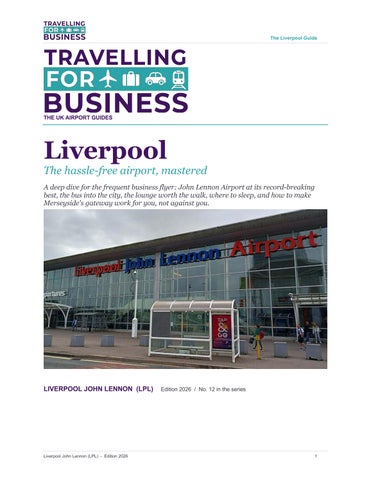
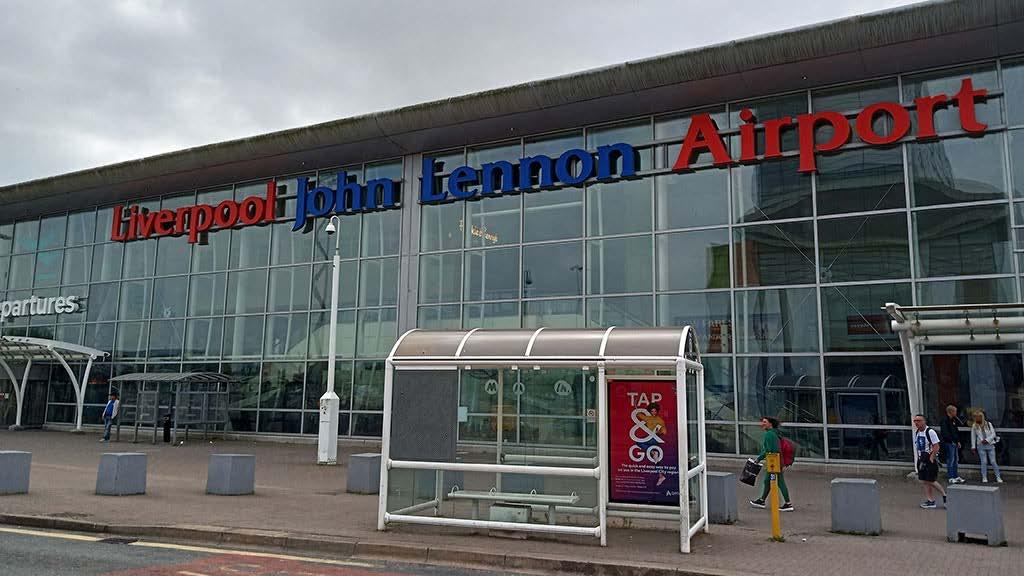
Liverpool John Lennon - Travelling for Business Guide
The hassle-free airport, mastered
A deep dive for the frequent business flyer: John Lennon Airport at its record-breaking best, the bus into the city, the lounge worth the walk, where to sleep, and how to make Merseyside's gateway work for you, not against you.
LIVERPOOL JOHN LENNON (LPL)
Liverpool at a glance
One terminal, one runway and, in 2025, more passengers than in its ninetytwo-year history. Liverpool John Lennon trades on speed and ease, and it has never been busier.
Liverpool John Lennon Airport is the gateway to Merseyside and a serious low-cost alternative for the wider North West, and it has just enjoyed the best year in its long history. In 2025 it carried more than 5.6 million passengers, a record that finally beat the mark set back in 2007 and capped a run of strong growth, and it works them through a single, compact terminal on the banks of the Mersey. The flying is overwhelmingly low-cost and leisure, led by easyJet, Ryanair, Jet2 and Wizz Air across a broad and expanding European network, with new routes for 2026 reaching from Marrakesh to Warsaw. The airport has long marketed itself on being fast, friendly and hassle-free, and for a regional traveller that speed is the whole appeal.
Two things are worth knowing from the outset. The first is that Liverpool, like several of its regional peers, has no railway station of its own, the link to the city being made by a frequent bus, with a rail connection a short hop away. The second is renewal, on two fronts: the airport spent much of 2025 installing the latest security scanners and upgrading its food, drink and lounge facilities, and in the same year it changed hands, with the infrastructure investor Ancala taking majority ownership as the Peel Group stepped away after nearly three decades. The result is a record-breaking airport, freshly invested in and under new ownership. This guide shows you how to use it like a regular.
LIVERPOOL BY NUMBERS
Passengers in 2025: more than 5.6 million - a record in 92 years.
Terminal: one compact terminal; a single runway.
Carriers: easyJet, Ryanair, Jet2 and Wizz Air - a low-cost and leisure airport.
Into the city: a frequent bus, with a rail connection a short hop away.
Owner: Ancala, majority owner from 2025, with Liverpool City Council. Page 2 - Introduction and key figures
One terminal, all low-cost
There is a single terminal and no building to choose, and the airport's whole pitch is that you can move through it quickly. The only discipline is timing and bag rules.
Liverpool keeps the arrival as simple as airports get: every flight uses one compact terminal, with check-in, security and gates close together under a single roof, and the airport has built its reputation on moving people through that building quickly. The flying is almost entirely low-cost and short-haul, with easyJet, Ryanair, Jet2 and Wizz Air running dense European leisure and city networks and a handful of other carriers filling out the schedule, so the airline you fly tells you most of what you need to know about your morning. The compact layout is the appeal, but it also means the building works hard at the peaks, and the school holidays and early-morning waves can fill it quickly.
Because there is no terminal to choose, the discipline shifts to preparation. The low-cost carriers reward hand luggage and online check-in, penalise the unwary with strict bag rules, and pack the early-morning slots, so the seasoned traveller reads the small print before arriving and treats the published check-in and bag-drop deadlines as firm. The airport has introduced a new check-in system aimed at smoothing the early-morning rush, part of the wider investment in the terminal, but the golden rule still holds: turn up prepared, travel light, and Liverpool will live up to its hassle-free billing.
Who flies from Liverpool
RULE OF THUMB
One terminal means no building to choose - but check in online and read the bag rules before you travel.
Treat the early-morning and school-holiday peaks with respect; the compact terminal fills quickly.
Page 3 - The terminal and the airlines
The bus and the train
Liverpool has no airport railway, but a fast, frequent bus reaches the city in half an hour, and a nearby rail station plugs the airport into the Merseyrail network.
The link into Liverpool rests on a good express bus and a short rail connection. The fastest option is Arriva's 500 bus, which runs from outside the terminal to the city centre in around half an hour, calling at the Liverpool ONE bus station and close to Lime Street rail station, every thirty minutes from the early hours until midnight, seven days a week. For a business traveller bound for the city, it is quick, frequent and simple, and Lime Street puts the main-line network, with fast trains to Manchester, Birmingham and London, within easy reach. The bus is the workhorse, and for most journeys into the centre it is all you need.
For those who prefer the train, a short bus hop links the airport to Liverpool South Parkway station, from which Merseyrail services run into the city centre at Liverpool Central, Moorfields or Lime Street, a total journey of around forty minutes that comes into its own for destinations on the rail network. Taxis and private hire wait at the terminal too, quick into the city outside the rush and a sensible choice for two or three travelling together or for an address off the bus routes. The rule for the regular is simple: take the 500 bus for the city centre, use the South Parkway rail connection if your destination suits it, and a taxi for the rest.
Into the city at a glance
Arriva 500 bus City centre, Liverpool ONE, Lime Street approx. 30 min Every 30 min, early until midnight
Bus plus Merseyrail Via Liverpool South Parkway station approx. 40 min For destinations on the rail network
Onward rail From Lime Street to Manchester, London varies Pick up trains in the city
Page 4 - Getting into the city
THE OTHER WAYS IN
By road and car
Liverpool is easy to reach by road from across Merseyside, and the airport keeps the car straightforward, with a charge at the terminal kerb and a free alternative close by.
As a regional airport with a wide catchment, Liverpool does a good deal of its business by road, and it is well placed for it on the south side of the city near the A561, with links to the M62, M57 and M53 and the wider motorway network. Buses link the airport to surrounding towns, and for travellers driving themselves the full range of official parking is on offer, from the value long-stay car parks with their shuttle buses to the short-stay options near the terminal. As at every airport, booking parking online in advance is markedly cheaper than the gate price, and for much of Merseyside and Cheshire the car is the natural choice for an early start with luggage.
Stopping at the terminal carries a charge, as it does almost everywhere now, paid by the usual camera system, with the cost rising the longer you stay. The sensible way around it, as at the other regional airports, is to use a nearby car park with a short transfer for a quick set-down rather than pulling up at the kerb, and to check the airport's current drop-off options when you travel. For central Liverpool the 500 bus will usually win on time and cost, but for the wider region the car earns its place, and the airport's compact, close-to-the-city location keeps the drive short.
The road traveller's checklist
• Use a nearby car park with a short transfer for a quick set-down rather than paying at the terminal kerb.
• Book parking online in advance for the best rates, long-stay for value or short-stay for convenience.
• The airport sits on the south side of the city near the A561, with links to the M62, M57 and M53.
• Check the airport's current drop-off charges and free options when you travel.
THE HONEST VERDICT
Into central Liverpool the 500 bus wins, but the close-to-the-city location keeps the drive short for the wider region. Use a car park transfer rather than the kerb for a simple set-down.
Page 5 - Getting there by road and car
Security, freshly upgraded
Liverpool has just installed the latest-generation security scanners, which suits an airport that has always sold itself on speed.
Security is where Liverpool's recent investment shows most clearly, and it plays to the airport's hassle-free billing. During 2025 the airport installed the latest-generation security scanning equipment, the technology that, where in full use, allows passengers to leave liquids and larger electronics inside their hand luggage rather than unpacking them at the conveyor. The precise rules on liquids and electronics have been changing across UK airports as the new scanners bed in, so it is worth checking Liverpool's current guidance before you fly, but the direction is firmly towards the quicker, less fussy passage the airport has long promised. As at any leisure airport the queues still swing by the hour and the season, with the early-morning and school-holiday peaks the busiest, so the prudent traveller plans to be ahead of them.
For certainty, Fast Track security is sold and is well worth the modest cost for an early or peakseason departure, and is included in some premium fares and lounge packages. The usual discipline pays off most at the busiest times: travel hand-luggage only where you can, follow the signage on liquids and electronics, and check in online. With the new scanners and a cheap Fast Track ticket, Liverpool offers one of the smoother, quicker security experiences among the UK regionals, which is exactly the reputation it has always traded on.
Clearing the airport quickly
• Thanks to the new scanners, you may be able to leave liquids and electronics in your bagcheck the current guidance before you fly.
• Buy Fast Track in advance for an early or peak-season flight, or check whether your fare or lounge includes it.
• Travel hand-luggage only where you can to skip the bag drop entirely.
• Allow extra time at the early-morning and summer holiday peaks, when the single hall is busiest.
TIMING THE ARRIVAL
Short-haul European departures: arrive around two hours ahead, more in peak holiday weeks. Travelling light with Fast Track? Liverpool's whole pitch is that you will be through quickly.
Page 6 - Security and fast-track
WHERE TO WAIT WELL
The lounge worth knowing
Liverpool's lounge was expanded and refreshed in 2025, giving the business traveller a smart, calm base before a flight.
Liverpool's lounge offer was a direct beneficiary of the airport's recent investment. As part of an eighteen-month upgrade to the departure lounge, the airport opened an all-new and expanded Aspire Executive Lounge, a smart, contemporary space offering complimentary food and drink, fast wi-fi and proper places to work, bookable ahead from sensible prices or accessible on a membership such as Priority Pass. For a couple of hours before a flight, a glass and a bite, an inbox cleared and a quiet seat away from a concourse that fills quickly at the holiday peaks, it does exactly what the business traveller needs, and for an early departure it turns the wait into productive time rather than a scramble for a seat.
The advice is the familiar one: book ahead at the busy times, when walk-up space is tight, and check what your fare or card already opens before paying separately. The refreshed Aspire lounge does not pretend to the scale of a Heathrow flagship, but for a busy regional airport on a record run it is comfortable, well-run and good value, and the wider departure-lounge upgrade has lifted the whole experience. Arrive with the time to use it, particularly for an early flight, and the lounge becomes the most useful hour of the trip rather than a queue endured at the gate.
The lounge picture
The fallback if your wait is short
BOOK AHEAD AT THE PEAKS
Walk-up lounge space is tight in the summer and holiday weeks, so pre-book the expanded Aspire lounge, and check whether your fare or card already opens the door.
Page 7 - Airport lounges
BEYOND THE LOUNGE
Dining and shopping
Freshly upgraded and with a Liverpool welcome, the airport's food and shops are gathered close at hand in one compact terminal.
Liverpool's dining took a real step forward with the airport's recent investment, an eighteenmonth programme that delivered a range of new and upgraded food and drink areas across the departure lounge. The familiar bars, coffee houses and quick counters now sit alongside fresher, better options, with a friendly Liverpool welcome and enough choice to put together a decent breakfast before an early flight or a relaxed bite before departure. It is not chef-led fine dining, but for a busy regional airport the offer has improved markedly, and because everything sits within one compact terminal there is no trekking between buildings to find a meal or a proper coffee. The fullest choice is concentrated in the main airside departure area once you are through security.
The retail follows the same one-roof logic, with a tidy spread of fashion, technology, beauty and the practical, the duty-free the holiday crowd expects, and a good line in Liverpool and Beatlesthemed gifts that nod to the airport's famous name. For the working traveller the value is the familiar safety net of the forgotten charger or book, replaceable airside before you board. The sensible habit, even in a compact airport, is to do your eating and buying in the main departure area where the choice is widest, and to keep an eye on the boarding screens at the summer peaks.
Eating and buying, the essentials
• Enjoy the upgraded food and drink in the departure lounge, refreshed in a recent eighteenmonth programme.
• Do your eating and shopping in the main airside departure area, where the choice is concentrated and widest.
• Look for Liverpool and Beatles-themed gifts that nod to the airport's famous name.
• Use the shops as a safety net for chargers, adaptors and reading, and watch the boarding screens.
Page 8 - Dining and shopping
SLEEPING CLOSE TO THE GATE
Where to stay
Two hotels sit right by the terminal, one of them in the airport's handsome original Art Deco building, which makes an early flight genuinely easy.
Liverpool has a real treat for the airport hotel guest. The Crowne Plaza occupies the airport's original 1930s terminal, a handsome Art Deco landmark crowned with the John Lennon lyric that gives the airport its character, now a full four-star hotel a short walk or shuttle from the modern terminal, with restaurants, a bar and a swimming pool. It is among the more characterful airport hotels in the country, and a comfortable base for an early flight or a late arrival. Directly opposite the main terminal, the Hampton by Hilton is the other on-airport choice, a bright, modern, wellpriced hotel that is the second largest serving the complex and ideal for a no-fuss night before a dawn departure.
The choosing logic is simple at a compact, single-terminal airport: there is no building to match, so the decision comes down to character, price and how short a walk you want at what may be an antisocial hour. For something memorable, the Crowne Plaza in the Art Deco terminal is hard to resist; for straightforward value steps from check-in, the Hampton by Hilton opposite the terminal does the job. Both put you within easy reach of the departure hall in the morning, and a scattering of budget hotels nearby fills out the range for those watching the cost. As always, book with the morning's timing in mind.
A hotel shortlist
Hotel
Crowne Plaza
Hampton by Hilton
Budget options
Location
In the original Art Deco terminal
Opposite the main terminal
Nearby
SLEEP IN A PIECE OF HISTORY
Why it earns its place
Characterful four-star, pool and restaurants, a short walk
Modern, well-priced, steps from check-in
Reliable, lower-cost rooms a short transfer away
The Crowne Plaza occupies the airport's original 1930s Art Deco terminal, complete with the John Lennon lyric on the roof - among the more characterful airport hotels in Britain.
Page 9 - Where to stay
Connecting and self-transfer
Liverpool is a point-to-point airport, not a hub, so a connection here is almost always a self-transfer to be planned with care.
Liverpool is built for direct, low-cost flying rather than the seamless hub connection, and that shapes any attempt to change planes here. The carriers that dominate the airport, easyJet, Ryanair, Jet2 and Wizz Air, generally do not through-check baggage or protect connections across separate bookings, so a connection at Liverpool means a self-transfer: you land, clear immigration, collect any checked bag, leave the controlled area, check in again for the onward flight, and pass back through security. The compact terminal at least keeps the walking short, but the sequence is the same as at any low-cost base and must be planned as two separate journeys rather than a single ticketed connection.
The guidance follows directly. Allow a long layover rather than a tight one, and remember that on separate tickets a missed onward flight is your risk, with no automatic re-routing and no duty on the second airline to wait. Travelling hand-luggage only is the single biggest improvement you can make, stripping out the reclaim and re-check entirely and leaving only the walk back through security, where a Fast Track ticket and the airport's new scanners can speed the second passage. Liverpool is at its best as one half of a quick door-to-door journey rather than a place to change planes, so where a connection is unavoidable, build in a generous buffer and clear each stage methodically before you relax.
Self-connecting well
• Assume no through-baggage: most carriers here require you to reclaim and re-check between flights.
• Treat a connection as two separate trips, and allow a long layover rather than a tight one.
• Travel hand-luggage only if you can; it removes reclaim and re-check from the equation.
• Use Fast Track and the new scanners to speed your second pass through security.
• Remember a missed self-transfer is your risk - there is no automatic re-routing on separate tickets.
Page 10 - Connecting and self-transfer
Liverpool, mastered
Everything above distilled into the habits that make the most of the hassle-free airport, at its record-breaking best.
Liverpool rewards the prepared, and rewards them quickly. There is no terminal to choose and the building is compact, so the advantage lies in working with the airport's grain: take the 500 bus into the city, travel light through the new scanners, and respect the low-cost bag rules and the summer peaks. The frequent flyer's edge here is simply leaning on the speed and ease the airport has always promised and recently invested to deliver, and enjoying the fact that for Merseyside it spares the trek to a bigger, busier hub. Master these points and Liverpool lives up to its hasslefree name.
Ten habits of the seasoned Liverpool flyer
• Take the Arriva 500 bus into the city centre, every 30 minutes from early until midnight.
• Use the South Parkway rail connection for destinations on the Merseyrail network.
• Pick up onward main-line trains at Liverpool Lime Street.
• Use a car park transfer rather than the terminal kerb for a quick set-down.
• Book parking online in advance for the best rates.
• Leave liquids and electronics in your bag where the new scanners allow - check the current guidance.
• Buy Fast Track ahead for an early or summer flight.
• Pre-book the expanded Aspire lounge at the peaks.
• For an early flight, sleep at the Art Deco Crowne Plaza or the Hampton by Hilton opposite the terminal.
• Treat any connection as a self-transfer with a generous buffer, not a protected hub change.
Page 11 - The frequent flyer's playbook
WHAT COMES NEXT
The bigger picture
Record numbers, fresh investment and new ownership have Liverpool looking, in time, to a longer runway and the wider world.
The defining story at Liverpool is momentum. The airport has just enjoyed the busiest year in its ninety-two-year history, carrying more than 5.6 million passengers in 2025 on the back of an expanding low-cost network and recent investment in security, dining and its lounge. In the same year it passed into the majority ownership of the infrastructure investor Ancala, as the Peel Group ended nearly three decades as a shareholder and Liverpool City Council retained a stake, bringing fresh backing for the airport's growth. For a place that has long sold itself on being fast, friendly and hassle-free, it is a moment of real confidence, with the records tumbling and the investment flowing.
The longer-term ambition is bolder still. The airport has set out a vision for a substantial investment in its infrastructure that could, in time, include a runway extension capable of supporting longer-haul and transatlantic flights, new piers and a larger terminal, and improved road access, a programme that would lift Liverpool from a purely short-haul, low-cost airport into something with genuine long-haul reach. Those plans remain a matter for the years ahead rather than the next timetable, and much depends on funding and demand. But the direction is clear. Liverpool intends to build on its record run, and for the frequent flyer on Merseyside it is already the quick, easy way to reach Europe, with the wider world a longer-term prospect.
Drop-off
A charge applies at the terminal; use a car park transfer to avoid it
Security Latest-generation scanners installed in 2025
Lounge Aspire Executive Lounge, new and expanded in 2025
Closest hotel
Crowne Plaza, in the original Art Deco terminal; Hampton opposite On the horizon
Record growth, new ownership, and a possible future runway extension