
A deep dive for the British business flyer: Harry Reid International, five minutes from the Strip, which terminal for your airline, immigration and the trusted-traveller programmes, the lounges, where to sleep, and how to make the world's busiest convention city's airport work for you, not against you.
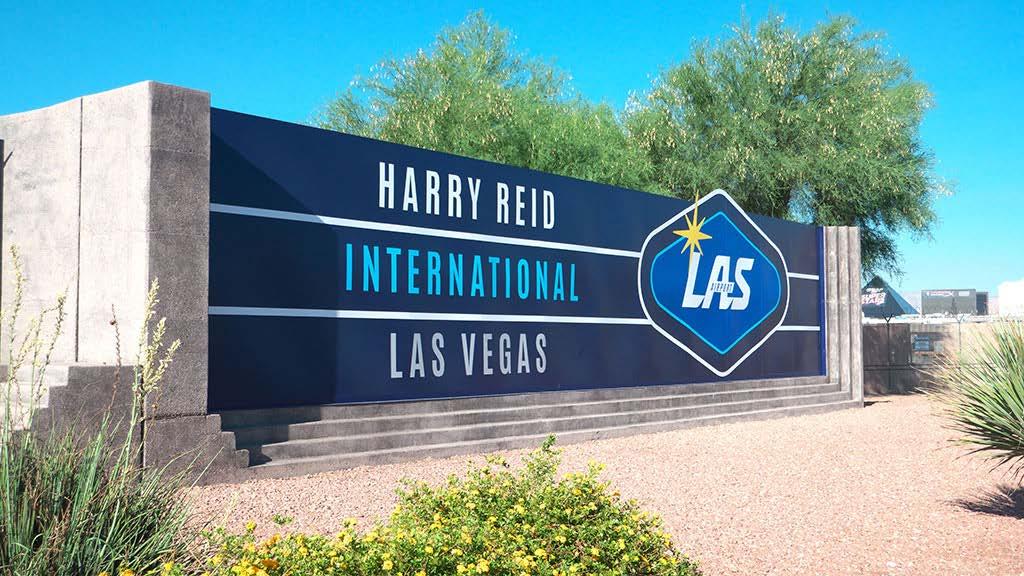
Two terminals, four runways and slot machines at the gate. Harry Reid International sits five minutes from the Strip, and it is the gateway to the convention capital of the world.
Harry Reid International, renamed in 2021 from McCarran in honour of the late Nevada senator, is the airport for Las Vegas, and one of the ten busiest in the United States, carrying close to fiftyfive million passengers a year. To the British eye it is the gateway to a holiday city of casinos and shows, but for the business traveller it is something more: Las Vegas is the convention capital of the world, host to more major trade shows and conventions than any other American city, from the vast technology and consumer-electronics shows to gatherings for every industry imaginable, drawing business travellers in their millions. The airport's defining feature is its closeness, barely five miles from the Strip, a ten-to-twenty-minute drive, so you can be at your hotel or convention almost as soon as you land. British Airways and Virgin Atlantic both fly here from London.
Harry Reid has two terminals, Terminal 1 and Terminal 3, with all international flying, and so the British traveller, handled at Terminal 3. The two are not connected airside but are linked by a free shuttle bus. And then there is the airport's famous quirk: it is the only major airport in the United States with thousands of slot machines inside the terminals, so you can play the slots while you wait for your flight, a fittingly Las Vegas welcome and farewell. This guide, for the British business flyer, covers the terminals, the short hop to the Strip, and the things a US arrival demands: immigration, the trusted-traveller programmes, the dollars and the tipping.
Distance to the Strip: about 5 miles; a 10-to-20-minute drive.
Passengers in 2025: close to 55 million - one of the ten busiest in the US.
Terminals: Terminal 1 (domestic) and Terminal 3 (all international, plus some domestic).
For UK carriers: British Airways and Virgin Atlantic both use Terminal 3. Before you fly: an approved ESTA (or visa) is required for entry to the United States.
Page 2 - Introduction and key facts
Harry Reid has two terminals, and for the British traveller it is simple: every international flight, on BA or Virgin, uses Terminal 3.
Harry Reid's two terminals make the choice easy for the overseas traveller. Terminal 3 handles all the international flying, along with some full-service domestic carriers, so British Airways and Virgin Atlantic both depart from there, and it is where you arrive from London, clearing immigration at its international facility before baggage claim. Terminal 1, the original and larger terminal, handles the bulk of the domestic carriers, including Southwest Airlines, which has a major operation here, across its A, B and C gate areas. For the British traveller, the rule could not be simpler: Terminal 3, every time, whether arriving or departing. Terminal 3's own gates are lettered D and E, with the E gates serving the international flights and their customs facility.
The two terminals are not connected airside, so if you are connecting from an international arrival at Terminal 3 onto a domestic flight from Terminal 1, you must travel between them by the free inter-terminal shuttle bus, which runs every fifteen to thirty minutes, after re-clearing security. Within Terminal 3, an airside tram links the D and E gate areas. As ever, confirm your terminal on your booking, and if being dropped off for an international departure, head for Terminal 3. For the British traveller, Terminal 3 is your terminal, coming and going.
The terminal map for the UK traveller
Flying British Airways or Virgin Atlantic? Terminal 3, every time. The terminals are not connected airside; a free shuttle bus links them for connections.
3 - Terminals and airline allocation
Harry Reid's great advantage is its closeness: the Strip is five minutes away, so a taxi, ride-share or shuttle has you at your hotel in moments.
Getting from Harry Reid to where you are going could hardly be easier, because the airport is so close to the action. The Las Vegas Strip, where most of the hotels, casinos and convention venues are, sits barely five miles from the terminals, a drive of ten to twenty minutes depending on the traffic and your hotel. There is no rail link to the airport, the city's monorail serving only the Strip itself, but with everything so close it scarcely matters. A taxi from the ranks outside the terminals reaches the Strip for a fare of around twenty-five to thirty-five dollars before the customary tip, and ride-share services such as Uber and Lyft operate from designated areas at demand-based fares; for the convention traveller, the venue is rarely far. Many Strip resorts and the convention centres also run their own shuttles.
For the budget-minded, the RTC public bus network serves the airport, with routes running to the Strip, the convention centre and downtown for a few dollars, slower than a cab but inexpensive. The convention centre itself is reached directly by bus, or quickly by taxi. Because Las Vegas is so compact around its core, and because most business and leisure travellers are headed for a Strip or convention-centre hotel, the journey from the airport is one of the shortest and simplest in this series. The rule for the regular is straightforward: a taxi or ride-share to the Strip for speed, a resort or convention shuttle if your hotel runs one, and the bus only if economy is the priority.
Taxi to the Strip
10 to 20 min around $25 to $35 with tip
Ride-share from designated areas approx. 10 to 20 min demand-based
Resort / convention shuttle to many Strip hotels and venues varies often included or low-cost
RTC bus to the Strip, convention centre, downtown slower a few dollars
Page 4 - Getting to the Strip
With the Strip so close, most travellers take a taxi or ride-share; a hire car is needed only for trips beyond the city or the great national parks nearby.
Because Las Vegas is so compact and the Strip so close, a taxi or ride-share is the natural choice for most travellers, taken from the ranks and designated areas at the terminals, reaching the hotels and convention venues in minutes. Taxi fares to the Strip are modest, in the region of twenty-five to thirty-five dollars before the customary tip, and ride-share runs at demand-based fares from the dedicated pick-up areas. For a business trip centred on a Strip or convention-centre hotel, you may need no other transport at all, with the venues, restaurants and meetings within walking distance or a short cab ride of one another along the Strip.
Hiring a car is worthwhile only if your trip takes you beyond the city, to the suburbs, the business parks away from the Strip, or, as many visitors do, out to the spectacular national parks and landscapes of the surrounding desert, from the Grand Canyon to Zion and Death Valley, for which a car is essential. The airport's rental-car centre is a few miles away, reached by a shuttle bus. For the convention or Strip-based traveller, though, a car is usually an unnecessary expense, given the closeness of everything and the cost of resort parking. The verdict in Las Vegas is a taxi or rideshare for the Strip, and a hire car only for trips out of town.
The road traveller's checklist
• A taxi to the Strip is around $25 to $35 before tip; ride-share runs from designated areas at demand-based fares.
• For a Strip or convention-centre trip, you may need no other transport at all.
• Hire a car only for trips beyond the city or out to the national parks; the rental centre is a shuttle ride away.
• Being collected from an international flight? Your driver should come to Terminal 3.
Tipping is expected in the United States, not optional: around 15 to 20 per cent for taxis and restaurants, a dollar or two per bag for porters, and in Las Vegas, a dollar or two for cocktail servers and dealers. Budget for it.
Page 5 - Getting in by taxi, car and ride-share
Entering the United States at Harry Reid is a more involved business than a European arrival, and its leisure volumes can mean long queues. A trustedtraveller programme makes the difference.
Every UK visitor needs authorisation to enter the United States before travelling: for most business and leisure trips that means an approved ESTA under the Visa Waiver Programme, applied for online well ahead and valid for two years, though some travellers require a full visa, so check your circumstances early. On arrival at Harry Reid you will clear US Customs and Border Protection at Terminal 3, the immigration check, and as a busy leisure and convention gateway, often receiving several long-haul flights together, its queues can be substantial at the peak arrival times, followed by a customs declaration. The single most valuable thing a frequent visitor can do is enrol in Global Entry, the trusted-traveller programme open to UK citizens, which lets you skip the main queue at an automated kiosk; it requires a UK background check and a US fee, plus an interview, so apply months ahead, but it transforms the arrival.
Departure security is a separate matter, run by the Transportation Security Administration, and at a high-volume airport the checkpoints can be busy, so allow time. For the UK traveller flying home it is a standard screening, but for anyone connecting onto a US domestic flight, TSA PreCheck, included with Global Entry, gives a faster security lane, and CLEAR, a paid service, moves you to the front of the queue. The practical advice is the same as at any US gateway: sort your ESTA before you fly, allow real time for immigration, and if you cross the Atlantic regularly, get Global Entry. And one Las Vegas note: the slot machines begin the moment you clear security, but the flight will not wait, so mind the time.
• Apply for your ESTA online well before travel (or a visa if your trip requires one); it is mandatory for entry.
• You clear US immigration at Terminal 3 on arrival; queues can be long when several longhaul flights land together.
• For frequent visitors, Global Entry is transformative - apply months ahead, as interviews book up.
• Connecting onto a US domestic flight? TSA PreCheck (included with Global Entry) speeds departure security; CLEAR is a paid alternative.
• Reclaim and re-check your bags on arrival even if connecting onward; US connections are not seamless (see page 10).
Page 6 - Immigration, security and trusted-traveller programmes
Harry Reid's lounges are modest by hub standards, but Terminal 3 has a comfortable option for the British traveller, and the slot machines are never far.
Harry Reid is not a hub in the manner of the great connecting airports, so its lounge offer is more modest, but Terminal 3, where the British traveller flies, has a comfortable choice. An independent pay-to-enter and membership lounge, The Club at LAS, operates in the terminal, accessible by booking or on a membership such as Priority Pass, offering complimentary food and drink, wi-fi and a quiet place to work or rest before the flight home, the natural base for the British Airways or Virgin Atlantic passenger without an airline lounge of their own. The airlines and their partners provide premium-cabin lounge access where applicable, and there are further lounges in Terminal 1 for the domestic carriers. For the business traveller, a lounge offers a welcome refuge from the lively, slot-machine-filled concourses.
The practical advice is the usual: know what your ticket or card opens, and that it is in Terminal 3, before you build your timings around it. For a couple of hours before a transatlantic departure, especially after a busy convention, a lounge turns the wait into restful or productive time, away from the noise and the lights of the main concourse, which in Las Vegas are livelier than at any other airport. Arrive with the time to use it, and the lounge becomes a calm end to a Las Vegas trip; or, if you prefer, the slot machines are there to send you off in the local spirit.
The lounge picture
The Club at LAS
Airline lounges
Concourse seating
Page 7 - Airport lounges
Terminal 3
Terminals 1 and 3
Both terminals
Pay-to-enter, Priority Pass-style membership, or premium cabin
For airlines' premium passengers and members
The fallback - complete with slot machines
Harry Reid offers a lively mix of familiar names and Las Vegas glitz, with the slot machines part of the scenery throughout.
Dining at Harry Reid is a lively, crowd-pleasing affair, befitting a holiday and convention city: a wide spread of national chains, fast food, bars and a number of better sit-down options, including outposts of well-known Las Vegas and celebrity-chef names that nod to the city's status as a dining destination, so a decent meal or a drink before the flight home is easily had. The atmosphere is more boisterous than at most airports, with the ever-present slot machines, the bright lights and the buzz of arriving and departing visitors, a fittingly Las Vegas farewell. For the British traveller flying from Terminal 3, there is a good choice airside, and if you have lounge access, the lounge offers a quieter alternative before a long flight.
Shopping is similarly geared to the visitor, with the practical well covered, the technology, the pharmacy and the bookshop, alongside duty-free and a vast array of Las Vegas souvenirs and gifts, from the kitsch to the surprisingly stylish, for the last-minute present. For the working traveller the value is the familiar safety net, the charger, the adaptor or the US plug you forgot, replaceable airside. The discipline at a busy, lively airport is to do your eating and buying in your own terminal, Terminal 3 for the British traveller, and to keep an eye on boarding, because the distractions of the concourse, the slots included, can make the time slip away.
Eating and buying, the essentials
• Expect a lively mix of chains and Las Vegas celebrity-chef names; a decent meal is easily had.
• The slot machines and bright lights are part of the scenery - mind the time.
• Do your eating and buying in Terminal 3, where the British traveller flies.
• Pick up any forgotten US plug adaptor or charger airside before you fly.
Page 8 - Dining and shopping
In Las Vegas you do not stay at the airport: you stay on the Strip, five minutes away, where the hotels, the conventions and the city all are.
Las Vegas rewrites the usual advice on airport hotels entirely. There is no need to stay at the airport, because the Strip, with its tens of thousands of hotel rooms, is barely five minutes away, and that is where the business is: the great resort hotels and casinos, the convention centres and the meeting venues are concentrated along and around the Strip, so for almost any trip, business or leisure, you will stay there. The choice of Strip and convention-area hotels is vast, from the famous mega-resorts to more modest options, many with their own convention and exhibition space, and most a short cab ride, or for some a walk, from one another. The airport's closeness means you can be from the terminal to your resort, or back, in a matter of minutes.
The choosing logic, then, is not about proximity to the airport, which is a given, but about which part of the Strip or the convention district suits your trip. For a convention at the Las Vegas Convention Center, a hotel near it; for a trade show at one of the resort venues, a hotel there; for a general trip, anywhere along the Strip puts you in the thick of it. There is little reason to consider an airport-area hotel when the Strip is so close and offers so much more. As always, book with your convention or meeting venue in mind, confident that the airport is only minutes away whichever you choose.
Strip resort hotels
Along the Strip, 5 to 15 min away
Where the business and the city are; vast choice
Convention-area hotels Near the Convention Center For a trade show or convention
Downtown hotels
Old Las Vegas, a little further
A cheaper, different flavour of the city
With the Strip five minutes from the terminal and home to the hotels, conventions and the whole city, there is no reason to stay at the airport. Choose by your venue, not by proximity to the airport.
Page 9 - Where to stay
Las Vegas is mostly a destination, not a hub, but a connection onto a US domestic flight still means clearing immigration and re-checking bags first.
Harry Reid is overwhelmingly an origin-and-destination airport, a place people fly to rather than through, so for many British travellers there is no connection to worry about. But where you are flying onward within the United States, the usual rules apply: there is no airside transit, so on arrival at Terminal 3 you must clear immigration, collect your checked bags, pass through customs, and then hand the bags back in and go through security again before your onward domestic flight, even on a single ticket. And here a particular wrinkle applies: because the terminals are not connected airside, if your onward domestic flight leaves from Terminal 1, as many do, you must take the inter-terminal shuttle bus between the terminals after re-clearing, which adds time. A connection at Harry Reid needs a generous buffer.
The practical guidance follows. When booking a trip with an onward US flight from Las Vegas, allow a long connection, never a tight one, and factor in the shuttle bus between Terminal 3 and Terminal 1 if your onward flight uses the latter. A trusted-traveller programme speeds both stages, Global Entry at immigration and the included TSA PreCheck at the re-screening, and hand luggage only, where the trip allows, removes the baggage reclaim and re-check entirely. Many onward flights from Las Vegas are on Southwest from Terminal 1, so the inter-terminal move is common; know that a US connection is not seamless, build your buffer, and clear each stage methodically before you relax.
• There is no airside transit in the US: clear immigration, reclaim bags, clear customs, recheck and re-screen.
• The terminals are not connected airside; an onward flight from Terminal 1 means a shuttlebus move.
• Allow a generous buffer at Harry Reid, well beyond a European transfer.
• Global Entry speeds immigration and includes TSA PreCheck for the re-screening.
• Hand luggage only, where possible, removes the reclaim and re-check step.
Page 10 - Connecting onward
Everything above distilled into the habits that make the most of the convention capital's airport.
Harry Reid rewards the traveller who takes advantage of its great asset, its closeness to the Strip, while respecting the realities of a US arrival. As at any US airport the groundwork is the same, sort the ESTA, know that Terminal 3 is yours, and budget for the dollars and the tipping, but Las Vegas makes the rest delightfully simple: the Strip is five minutes away, you stay there rather than at the airport, and a taxi or ride-share is all the transport most trips need. Lean on a trustedtraveller programme to tame the immigration queue after a busy long-haul bank, and remember the terminals are not connected airside for a domestic connection. Master these points and the world's convention capital is among the easiest American cities to fly into and out of.
Ten habits of the seasoned Las Vegas flyer
• Apply for your ESTA (or visa) well before you fly; it is mandatory for entry.
• Terminal 3 is your terminal: British Airways and Virgin Atlantic both use it, coming and going.
• If you cross the Atlantic often, get Global Entry - it transforms the immigration queue.
• Allow real time for immigration when several long-haul flights land together.
• For the Strip, a taxi is around $25 to $35, or take a ride-share or resort shuttle - it is only minutes away.
• Stay on the Strip, not at the airport; the city, the hotels and the conventions are all there.
• Hire a car only for trips out of town or to the national parks.
• Budget for tipping - 15 to 20 per cent, plus the Las Vegas extras.
• Use The Club at LAS in Terminal 3 for a quiet hour away from the slot machines.
• Connecting onward? The terminals are not connected airside - allow for the shuttle bus to Terminal 1.
Page 11 - The frequent flyer's playbook
Las Vegas is booming, and its airport is running near capacity, with the region planning a second airport to handle the growth to come.
The defining story at Harry Reid is success straining at its limits. Las Vegas has boomed in recent years, adding professional sport, ever-larger conventions and major events to its established tourism and gaming economy, and the airport has grown with it, carrying close to fifty-five million passengers a year and running close to the capacity of its constrained site near the Strip. The airport has invested in modernising its terminals, its technology and its facilities to handle the crowds, but with little room to expand, the region is planning for the future with a proposed second airport, a supplemental commercial airport to be built some way south of the city, to absorb the growth that Harry Reid alone cannot. For a city whose business is welcoming visitors, the pressure on the airport is a measure of its prosperity.
For the traveller, the near-term reality is a busy, lively airport that works hard to move enormous crowds through a tight site, with continued investment in its facilities. The fundamentals of a US arrival remain as this guide describes them, and the airport's two-terminal, non-connected layout will always require a little planning for a domestic connection. But the direction is clear: Las Vegas intends to keep growing as the convention and entertainment capital, with a second airport in the longer term to share the load. For the British business traveller, Harry Reid remains an airport whose great virtue, its closeness to the Strip, makes it one of the most convenient gateways in the country, busy though it is.
reference
The essentials
For UK carriers
Before you fly
To the Strip
Getting around
Where to stay
The frequent-flyer edge
A local quirk
The big picture
At a glance
British Airways and Virgin Atlantic both use Terminal 3
An approved ESTA (or visa) is mandatory for entry
About 5 miles; a taxi is $25 to $35, or take a ride-share or shuttle
No airport rail; the Strip is close, so a taxi or shuttle is all most need
On the Strip - the city, hotels and conventions are all there
Global Entry - skips the immigration queue, includes TSA PreCheck
The only major US airport with slot machines in the terminals
A booming city near airport capacity; a second airport is planned
Page 12 - The bigger picture and quick reference