
A deep dive for the British business flyer: the closest airport to Manhattan, transformed, and the one you use for US domestic flights, which terminal for your airline, the way into the city, the lounges worth the walk, and how to make LaGuardia work for you, not against you.
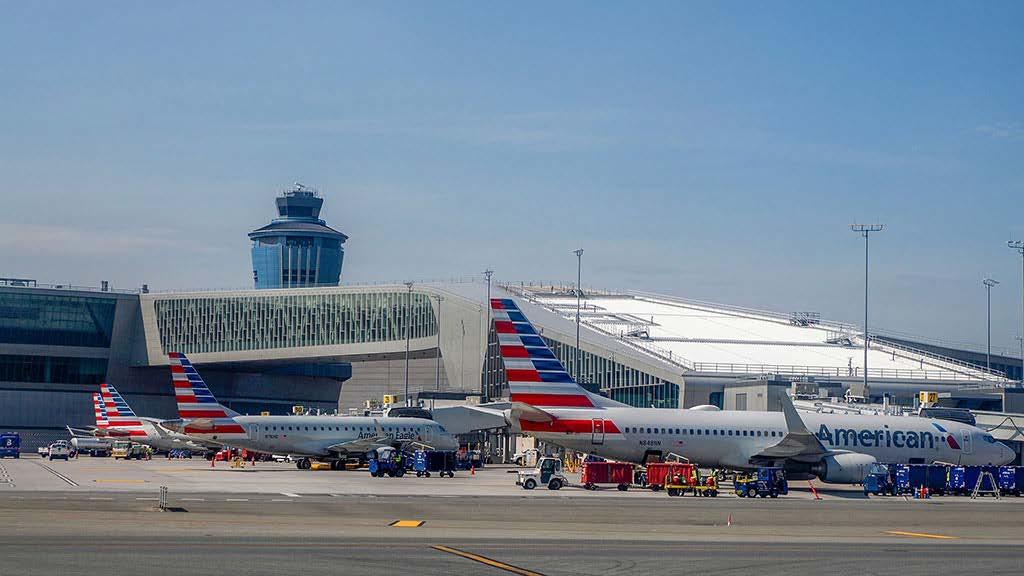
Three terminals, four runways and a transformation that has turned a national embarrassment into one of the finest airports in America. LaGuardia is New York's domestic airport, closest to Manhattan, and reborn.
LaGuardia is the New York airport the British business traveller flies from rather than into. Sitting in Queens just eight miles from Midtown, closer to Manhattan than either JFK or Newark, it handles domestic flights almost exclusively: a long-standing perimeter rule limits most departures to within about 1,500 miles, so there are no transatlantic services, and LaGuardia holds the curious distinction of being the busiest airport in the United States with no direct route to Europe. For the UK traveller, then, this is not an arrival point from home but the airport you use for an onward flight to Boston, Chicago, Atlanta or Washington, or the one you fly back into New York on from elsewhere in the States. Knowing it well is part of mastering a US business trip.
What makes LaGuardia worth a guide of its own is its astonishing reinvention. Once a byword for delays and squalor, famously likened to a third-world airport by a US president, it has been rebuilt from the ground up in a programme costing some eight billion dollars, and now boasts two gleaming new terminals that have won awards as among the best in the world. Run by the Port Authority of New York and New Jersey, it is the proof that an American airport can be transformed. This guide, written for the British business flyer, covers the terminals, the way into the city, and the domestic-flight essentials that make LaGuardia simple to use.
Distance to Manhattan: about 8 miles - the closest of the three New York airports. Terminals: the new Terminal B and Terminal C, plus the historic Terminal A. Character: domestic only - no transatlantic flights; you use it for onward US travel. Into Manhattan: no train; the Q70 bus to the subway, or a taxi in 20 to 40 minutes.
Transformed: an 8-billion-dollar rebuild into one of America's best airports.
Page 2 - Introduction and key facts
LaGuardia's two big new terminals are split by airline: American and most others at Terminal B, Delta at Terminal C. Your onward carrier sets which you need.
LaGuardia is straightforward to read. The vast new Terminal B, opened in stages and repeatedly named among the best new terminals in the world, is the home of American Airlines and a long list of others including United, JetBlue, Southwest, Air Canada and Frontier. The equally new Terminal C, a four-billion-dollar building, belongs to Delta Air Lines, which runs a major operation here. The historic Terminal A, the original 1939 Marine Air Terminal, a charming art deco survivor, handles a small number of flights. For the British traveller connecting onto a domestic flight, the terminal you need is set by your onward airline: American and its partners at Terminal B, Delta at Terminal C.
Unlike the old LaGuardia, the new terminals are spacious, light and easy to navigate, with the dual frustrations of the past, the cramped concourses and the endless queues, largely designed out. The two main terminals are linked landside, and the airport is compact by American standards, so moving around is far easier than it once was. As ever, confirm your terminal on your booking, and if you are being dropped off, make sure your driver comes to the right one. For the UK traveller used to the old LaGuardia, the transformation is the first and most pleasant surprise.
Terminal B American, United, JetBlue, Southwest, Air Canada
award-winning new terminal; most carriers
four-billion-dollar
historic 1939 Marine Air Terminal
Flying American or most others? Terminal B. Flying Delta? Terminal C. The airport is compact and the new terminals easy to navigate; confirm the right one before a dropoff.
Page 3 - Terminals and airline allocation
LaGuardia has no railway, but it is the closest airport to Manhattan, so a taxi is quick and a bus-and-subway combination cheap.
LaGuardia's closeness to Manhattan is its defining advantage, and its weakness is the lack of a direct rail link. A long-planned AirTrain was abandoned, so the public-transport route into the city combines a bus and the subway. The Q70 LaGuardia Link, a free express bus, runs from the terminals to the Jackson Heights and Roosevelt Avenue subway station, where the 7, E, F, M and R trains carry you into Manhattan for the price of a subway ride; the M60 bus offers an alternative to Upper Manhattan and Harlem, connecting with other subway lines. The combination is cheap, at little more than the subway fare, and reliable, though it involves a change and is slower than a cab for a Midtown destination.
For most business travellers, though, the taxi or ride-share is the natural choice here, precisely because LaGuardia is so close to the city. A yellow cab to Midtown takes around twenty to forty minutes depending on the traffic, with a metered fare that, once the tolls and the customary tip are added, usually lands in the region of forty to fifty-five dollars, less than from the more distant JFK or Newark. Ride-share services run from designated pick-up areas at demand-based fares. For a quick trip into Manhattan, the cab from LaGuardia is one of the better-value airport runs in the New York area, and the obvious choice for the time-pressed.
Into Manhattan at a glance
Taxi / ride-share door-to-door to Midtown approx. 20 to 40 min about $40 to $55 with tolls and tip
Q70 bus + subway free bus to Roosevelt Ave, then subway approx. 45 to 60 min little more than the subway fare
M60 bus + subway to Upper Manhattan and Harlem approx. 45 to 60 min subway fare
Page 4 - Getting into Manhattan
Being the closest airport to Manhattan, LaGuardia makes the taxi the easy default, but the dollars, the tolls and the tip still need budgeting for.
For the door-to-door simplicity that a connecting traveller wants, the taxi from LaGuardia is hard to beat, and its closeness to Manhattan makes it both quick and comparatively affordable. Yellow cabs are taken from the ranks outside the terminals and run on the meter, with the fare to Midtown usually in the forties of dollars before extras; to that you add any toll, a few dollars, and the customary tip of fifteen to twenty per cent. The journey is short by New York standards, twenty to forty minutes, though the approach roads around the airport can be slow at the peaks. Rideshare services such as Uber and Lyft operate from designated pick-up areas at fares that move with demand, sometimes cheaper, sometimes dearer than a cab.
Hiring a car is rarely the right choice for a Manhattan trip, where parking is costly and a congestion charge now applies to driving into the busiest part of the city, so a hire car earns its place only for journeys out of town. If you are being collected, the new terminals have wellorganised pick-up arrangements, but the driver must still come to the correct one. For most travellers the verdict is simple and favourable: from LaGuardia, the taxi or ride-share is quick, reasonable and the natural way into Manhattan, with the bus-and-subway as the budget alternative.
The road traveller's checklist
• Taxis are metered: expect roughly $40 to $55 to Midtown once any toll and a 15 to 20 per cent tip are added.
• Ride-share (Uber, Lyft) runs from designated pick-up areas at demand-based fares.
• Skip car hire for a Manhattan trip; parking is costly and a congestion charge now applies to central Manhattan.
• Being collected? Make sure the driver comes to the correct terminal.
Tipping is expected in the United States, not optional: around 15 to 20 per cent for taxis and restaurants, and a dollar or two per bag for porters. Budget for it as part of the fare.
LaGuardia is a domestic airport, so there is no immigration here. What matters is US security, and the trusted-traveller programmes that speed you through it.
Because LaGuardia handles no international flights, the British traveller meets no immigration here: you will have cleared US Customs and Border Protection at your transatlantic gateway, JFK, Newark or wherever you first landed in the United States, and a domestic flight to or from LaGuardia involves no further border check. That is worth understanding, because it means a LaGuardia departure is governed only by security, run by the Transportation Security Administration, which screens domestic passengers much as at any US airport. The new terminals have spacious, modern security halls that have largely banished the notorious queues of the old LaGuardia, but at the morning and evening peaks, when the domestic banks are busiest, it still pays to allow time.
Two programmes are worth knowing for the domestic flyer. TSA PreCheck gives a faster, lightertouch security lane, letting you keep your shoes, belt and laptop in place, and is included if you hold Global Entry, which UK citizens can obtain; for the frequent US traveller it is well worth having. CLEAR, a paid identity-verification service, moves you to the front of the security queue and is available at LaGuardia too. The practical advice for the British traveller using LaGuardia for domestic legs is simple: there is no immigration to worry about, but TSA PreCheck, ideally via Global Entry, makes the security side quick and easy.
• LaGuardia is domestic only: you clear US immigration at your transatlantic gateway, not here.
• A domestic flight to or from LaGuardia involves only TSA security, no border check.
• TSA PreCheck (included with Global Entry) gives a faster, lighter-touch security lane.
• CLEAR, a paid service, moves you to the front of the security queue.
• Allow time at the morning and evening domestic peaks, even in the new terminals.
Page 6 - Security and the domestic airport
The rebuilt LaGuardia has brought it lounges to match, led by a spectacular new Delta Sky Club and the American and card lounges at Terminal B.
LaGuardia's transformation extended to its lounges, which are now a world away from the cramped rooms of old. At Terminal C, the Delta Sky Club is one of the airline's flagship lounges, a large, light-filled space with an outdoor Sky Deck terrace overlooking the apron, open to Delta premium passengers and members, a genuinely pleasant place to wait. At Terminal B, American Airlines operates its Admirals Club and the more exclusive Chelsea Lounge for premium passengers, and the terminal is also home to an American Express Centurion Lounge for eligible card holders, along with other premium spaces. For the business traveller connecting through New York, the standard is now high.
The practical advice is the usual: know what your ticket or card opens, and that it sits in the terminal you are flying from, before you build your timings around it. A Delta premium ticket or membership opens the Sky Club at Terminal C; an American premium ticket opens the Admirals Club at Terminal B; and a premium American card may open the Centurion Lounge there. For a domestic connection with time to spare, or simply to escape a busy concourse, a lounge at the new LaGuardia is a comfortable, productive place to wait, and a far cry from the airport's grim past.
The new terminals made dining a centrepiece, with outposts of celebrated New York restaurants a long way from the old LaGuardia's grim concessions.
Dining was central to LaGuardia's reinvention, and the new terminals carry a genuinely good food-and-drink offer built around New York names. Terminal B and Terminal C both feature outposts of well-known city restaurants, proper sit-down dining, local specialities and the orderfrom-your-seat technology common in modern American airports, so a meal before a domestic flight here is now a pleasure rather than a penance. The contrast with the old airport, whose food was as tired as its terminals, could hardly be greater. As ever, the standard is consistent across the two new terminals, and if you have lounge access you can weigh the lounge catering against a table outside it, though at the new LaGuardia the restaurants are well worth seeking out.
Shopping follows the American airport pattern, with a tidy line in the practical, the technology, the bookshop and the pharmacy, alongside New York branded gifts for a last-minute present. For the working traveller the value is the familiar safety net, the charger or cable you forgot, replaceable airside. The discipline at any airport is to do your eating and buying in your own terminal and to keep an eye on boarding, but at the compact, well-designed new LaGuardia both are easier than at the sprawling international airports, and the walk to the gate is rarely long.
• The new terminals feature outposts of well-known New York restaurants; the dining is a real highlight.
• Do your eating and shopping in your own terminal; the compact new buildings make it easy.
• Pick up any forgotten charger or cable airside before you fly.
• Keep an eye on boarding, though the walk to the gate at the new LaGuardia is rarely long.
Page 8 - Dining and shopping
LaGuardia has little in the way of on-airport hotels, but its closeness to Manhattan means you rarely need one.
LaGuardia is unusual among the New York airports in that there is no real reason to stay at the airport itself, because the city is so close. A handful of hotels sit nearby in Queens, among them familiar chain names a short taxi or shuttle from the terminals, which serve for a very early domestic departure or a late arrival when you simply want to be close by. But the airport's eightmile proximity to Manhattan, and the twenty-to-forty-minute taxi ride, mean that for almost any business trip the natural choice is to stay in the city itself and treat LaGuardia as the quick, close airport it is, taking a cab out in the morning.
The choosing logic is therefore the simplest of any airport in this series. For the rare case of a dawn domestic flight where every minute counts, a nearby Queens hotel keeps the morning short; for everything else, a Manhattan hotel is both more useful and, given the short taxi run, barely less convenient. This is the great advantage of the closest airport to the city: you can base yourself where the business is, in Manhattan, and reach the airport quickly when you need it. As always, choose with the morning's flight in mind, but at LaGuardia that usually points to the city.
LaGuardia is the closest airport to Manhattan, so there is rarely any need for an airport hotel. Base yourself in the city and take the short taxi out in the morning.
Page 9 - Where to stay
LaGuardia's role for the UK traveller is the domestic connection, and the key fact is that you clear US customs only once, at your first point of entry.
For the British business traveller, LaGuardia is almost always part of a connection rather than a destination in itself, and understanding how US connections work makes it simple. The crucial point is that you clear immigration and customs only once, at your first airport of entry into the United States: if you arrive transatlantic at JFK or Newark and then fly on to or from LaGuardia, you do not clear the border again, because the domestic leg is treated as an internal flight. Where a transatlantic itinerary routes you through another US city before New York, you will have cleared customs there, reclaimed and re-checked your bags, and your arrival into LaGuardia is then a simple domestic one, bags delivered to the ordinary carousel.
The practical guidance is therefore lighter than at the international gateways. A domestic connection involving LaGuardia needs only a sensible buffer for the change, with no border check to allow for, though you should account for the time to travel between airports if your transatlantic flight and your LaGuardia flight use different ones, JFK and LaGuardia, for instance, being a taxi ride apart across Queens. Within LaGuardia, the compact new terminals make any connection quick. As ever, TSA PreCheck via Global Entry speeds the security side, and hand luggage only keeps a multi-leg trip simplest.
• You clear US customs only once, at your first point of entry; a LaGuardia domestic leg needs no border check.
• Arriving into LaGuardia on a domestic flight, your bags come to the ordinary carousel.
• Allow travel time between airports if your transatlantic and LaGuardia flights use different ones.
• TSA PreCheck via Global Entry speeds the security side of any domestic connection.
• Hand luggage only keeps a multi-leg US trip simplest.
Page 10 - Connecting and the domestic leg
Everything above distilled into the habits that make the most of New York's closest and most improved airport.
LaGuardia rewards the traveller who understands its place in a US trip: not a transatlantic gateway but the close, quick, transformed airport you use for domestic flights and for getting back into New York. There is no immigration to navigate here, so the groundwork is lighter than at JFK or Newark, and the airport's eight-mile closeness to Manhattan makes the taxi the easy default. Lean on TSA PreCheck for the security side, stay in the city rather than at the airport, and enjoy the fact that the old LaGuardia, once the worst airport in America, is now among its best. Master these points and it becomes the most convenient piece of a New York business trip.
Ten habits of the seasoned LaGuardia flyer
• Remember LaGuardia is domestic only - you clear US immigration at your transatlantic gateway, not here.
• Know your terminal: American and most others at B, Delta at C.
• For Midtown, take a taxi - it is the closest airport, around $40 to $55 with tolls and tip.
• For a budget trip, the free Q70 bus connects to the subway at Roosevelt Avenue.
• Budget for tipping - 15 to 20 per cent - as part of every fare and bill.
• Use TSA PreCheck, ideally via Global Entry, to speed the security side.
• Seek out the new lounges - the Delta Sky Club at C has an outdoor Sky Deck.
• Stay in Manhattan rather than at the airport; the city is close and quick.
• Connecting from another airport? Allow travel time between JFK or Newark and LaGuardia.
• Enjoy the rebuild - the new terminals are among the best in America.
Page 11 - The frequent flyer's playbook
LaGuardia's eight-billion-dollar rebuild is essentially complete, and it stands as the proof that an American airport can be reborn.
The defining story at LaGuardia is its transformation, now largely done. An airport that had become a national embarrassment, cramped, delay-prone and shabby, has been rebuilt almost entirely in a programme costing some eight billion dollars, delivered through public-private partnerships, producing two brand-new terminals that have collected international awards as among the best anywhere. The new Terminal B and Delta's new Terminal C have replaced the old facilities with light, spacious, technology-rich buildings, and the dual carriageway of new roads, parking and public spaces around them has remade the whole site. It is, by common consent, one of the most successful airport redevelopments in the world, and a striking turnaround for a place once held up as the worst in the country.
For the traveller, the benefit is already here: a domestic airport that is now a pleasure rather than a trial, close to the city and easy to use. The constraints remain, the perimeter rule that keeps it domestic, the lack of a rail link, the dependence on road and bus, but within those limits LaGuardia is transformed. For the British business traveller, it will remain the airport you use for the domestic pieces of a US trip rather than the transatlantic crossing, but it is now one you can look forward to rather than dread. The worst airport in America has become one of its best, and the frequent flyer through New York is the beneficiary.