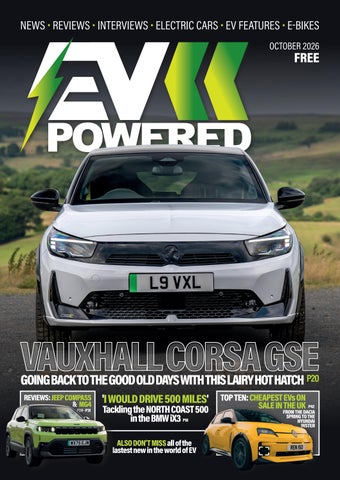
NEWS • REVIEWS • INTERVIEWS • ELECTRIC CARS • EV FEATURES • E-BIKES OCTOBER 2026
FREE
VAUXHALL CORSA GSE GOING BACK TO THE GOOD OLD DAYS WITH THIS LAIRY HOT HATCH P20 REVIEWS: JEEP COMPASS & MG4 P24 - P31
'I WOULD DRIVE 500 MILES' Tackling the NORTH COAST 500 in the BMW iX3 P18 ALSO DON’T MISS all of the lastest new in the world of EV
TOP TEN: CHEAPEST EVs ON SALE IN THE UK P42
FROM THE DACIA SPRING TO THE HYUNDAI INSTER
3 EV POWERED MAGAZINE
EDITOR’S NOTE Swede music
Welcome to the October edition of EV Powered. After a relatively quiet couple of months, the new car hype machine has sprung into overdrive in the last few weeks and we’ve had announcements from everyone from Nissan to Range Rover, with Bentley, Audi and Volvo in between. Volvo’s announcement of plans for seven new European cars by late 2027 is a big deal. Not only is it a bold statement of ambition after a difficult few years, but it also marks a shift in the brand’s strategy. In a world of “global” cars and shared platforms, it’s interesting to hear that Volvo is quite explicitly separating its European and Chinese line-ups to better develop cars that suit different regions. Here at EV Powered, we’re hoping that means some tasty all-electric saloons and estates based on the excellent SPA3 underpinnings. It’s quite a Volvo-heavy month for us at EVP. Just before the new model strategy was announced, Volvo unveiled updated versions of its EX/EC40 and XC60 PHEV, and we went along to take a deep dive into the changes. I’ve always been a fan of both cars and the cosmetic updates definitely help keep them looking fresh and will help the EX40 stay competitive until its inevitable replacement comes along. The technical updates to the XC60 are perhaps even more of a big deal, helping the venerable hybrid stay relevant in an increasingly all-electric world.
While seeing the updated models, George also took the opportunity to speak to one of Volvo’s safety architects, who gave a fascinating insight into how crash data going back decades is still helping Volvo set new safety standards today. While he was poking around new Volvos, I was pushing myself and the BMW iX3 to the limit to see whether the first Neue Klasse car really can do 500 miles on a single charge. I confess, I had a great time enjoying the spectacular scenery and roads of the North Coast 500 in incredible comfort, but you’ll have to read the feature on page 18 to find out whether I managed to do it without a charging stop. Closer to home, the other big news for me is that my Renault 5 long-termer was finally reclaimed, which was a sad day in the Allan household. The sense of loss, however, was softened slightly by the arrival of its replacement – a Cupra Raval in range-topping VZ Extreme trim. This is the first time I’ve run a hot hatch as a long-term test car and it’ll be interesting to see whether the long-term reality lives up to the positive impression it created over a couple of days on the sunny roads of its Spanish homeland. Early signs are good though, and I’ve already got a friend begging to have a proper poke around it as he tries to decide if it’s his next car purchase. I’m also just back from comparing it head-to-head with one of its biggest potential rivals, so check back next month to see how that went, as well as a full round-up of all the big EV announcements from the Paris Motor Show – it promises to be a good one.
Until then, enjoy the read.
Matt Allan Editor, EV Powered The EV Powered Team
EV Powered is published in London by
Capital Business Media Ltd, Level 18, 40th Floor, London, E14 5NR. Tel: 020 7148 3861 EV Powered is printed using sustainable paper sources and vegetable ink, and is PEFC certified. Copies are recycled at the end of each month. © EV Powered Ltd a Capital Business Media group brand.
Editor Matt Allan
Content Sales Manager Laura Phillips
Reporter George East
Capital Business Media, Group MD Richard Alvin
Graphic Designer Grace Moseley
Business Development Director Stephen Banks
Videographer Jacob Pinchbeck
Chief Creative Director Stuart Hyde Finance Director Andrew Martin
EV POWERED MAGAZINE 4
Contents
22
News 5 EV The latest from the EV industry.
Volvo EX40 10 New A deep dive into the design and technology changes. A Safer Future 14 Volvo: Safety Architect, Isabelle Stockman explains. Drive 500 Miles... 18 ICanWould the BMW iX3 really manage 500 miles on a charge?
26
Corsa GSE Review 22 Vauxhall Going back to the good old days with this lairy hot hatch. Compass Review 26 Jeep Is the American 4x4 brand heading in the right direction? Review 30 MG4 Major upgrades help keep MG's ratings-winner relevant. Raval Long-Term Test 34 Cupra We welcome Spain's new hot hatch to the fleet. Buying Guide: Volkswagen ID. 3 36 Used Here's all you need to know if you're considering one. Rheo 3: E-Bike Review 40 Whyte Lightweight carbon commuter with real-world practicality. 10 Cheapest EVs On Sale 42 The Let us guide you through the 10 most affordable models in the UK. EV Batteries Last The Longest? 48 Which Global battery health survey shows packs are lasting longer. Must Pick Up The Pace... 50 UK ...on delivering charging for everyone.
42
30
5 EV NEWS
POLESTAR 4 SUV brings better practicality Polestar has unveiled its new Polestar 4 SUV, and a rear window bringing more space, a lower price and ditching the coupe version’s most controversial feature. Designed to broaden the appeal of the coupecrossover, the Polestar 4 SUV takes the sharp front end of the existing car and blends it with an estatelike rear end. While the car’s overall length is unchanged, the SUV gets a longer, taller roofline and more upright tailgate. It also brings a rear window – addressing one of the most controversial features of the coupe. Thanks to the redesign, the Polestar 4 SUV offers between 530 litres and 655 litres of boot space, and 2.5cm more headroom for rear passengers. The interior of the Polestar 4 SUV follows that of the fastback model but Polestar says its user interface has been upgraded, with additional shortcut widgets and a wider selection of shortcut functions. Under the skin, the Polestar 4 SUV uses the same powertrain as the coupe, with a 100kWh battery and single- or dual-motor options with between 268bhp and 537bhp, although minor tweaks boost range to up to 391 miles.
VOLVO to launch 13 new models in 4 years
Volvo has announced the biggest new product assault in its history with plans for 13 new models by the end of 2030.
The new line-up will include six new cars specifically for China and seven models for “Western” markets including Europe and the United States. In Europe, the focus is heavily on fully electric models with Volvo promising a “full BEV lineup” by 2030. These will include “high” and “low” body types, suggesting that alongside more
SUVs, Volvo will return to its roots with all-electric saloon and estate bodystyles.
current ES90 saloon and EX90 SUV while SPA3 is used in the all-new EX60 SUV.
In the US, Volvo promises even larger models to sit above its seven-seat EX90.
Chinese models will be developed in partnership with Volvo’s parent company Geely and will see the two companies work on shared platforms, parts and supply chains as well as a dedicated tech stack for China.
In Europe and the US, the cars will be based on Volvo’s existing SPA2 and SPA3 platforms and its HuginCore software platform. SPA2 underpins the
EV NEWS 6
RANGE ROVER ELECTRIC arrives with 372-mile range and £154k price JLR has officially launched the first ever Range Rover Electric, promising a more refined and effortless version of its famous SUV.
in 22 minutes, or the onboarding of 132 miles of charge in just 10 minutes. Vehicle-to-load functionality is also standard.
Following a near-two-year delay, Range Rover has revealed full technical specifications and a starting price of £154,070 – £47,000 more than the entry-level petrol version.
JLR insists that the Range Rover Electric is every bit as capable off-road as its petrolpowered siblings while bringing new levels of refinement to the already famously quiet and smooth model.
All versions of the Range Rover Electric feature a two-motor, all-wheel-drive setup producing 542bhp and 627lb ft. That gives it 10bhp and 74lb ft more than the 4.4-litre V8 version. That gets this 2.8-tonne luxury SUV from 0-60mph in just 4.3 seconds and the boundless torque gives a 5075mph time of just 2.7 seconds. The motors have been developed and built in-house at JLR’s Electric Propulsion Manufacturing Centre in the UK, which is also responsible for the massive 118.5kWh battery which powers them. This double-stacked NMC unit is the second-largest of any EV in the UK and gives the Range Rover Electric a range of up to 372 miles on a charge. Peak DC charging of 350kW allows a 10-80% top-up
New integrated traction management systems can adjust motor speed within 50 milliseconds and, Range Rover says, manages slip up to 100 times quicker than an ICE equivalent. A single pedal drive mode is useful not only for on-road motoring but also for managing all the Range
Off-road brand’s first pure EV delivers ‘uncompromised’ alternative to V8-powered luxury SUV. Rover’s torque on tricky terrain and aiding in climbing slopes of up to 45 degrees. While the electric Range Rover’s centre of gravity is lower than the ICE model thanks to the floormounted battery, dual-chamber air suspension ensures it offers similar levels of ground clearance and the same 900mm wading capability. On the road, Range Rover says the new model offers a “near-silent” driving experience that is quieter and smoother than any previous model. Visually, there is virtually no difference between the petrol and electric models. JLR insists that this is a Range Rover first, an EV second. So the only deviations from the famous Range Rover design are aero-optimised wheels and grille, along with a smoother underbody for improved highspeed efficiency. Orders for the Range Rover Electric are open now and customers can choose from short or long-wheelbase versions and six different trim levels priced from £154,070 for the entry-level SE to £225,000 for the long-wheelbase SV Black.
7 EV NEWS design is intended to usher in a more modern era that maintains links with Bentley’s past.
Shortly after Range Rover finally revealed its first pure EV, Bentley did the same, setting the two British brands on a collision course. Like the Range Rover Electric, the Bentley Torcal is a luxury-focused SUV packing plenty of power and range, and set to arrive in early 2027. Expected to cost from around £173,000, the Torcal will be built at Bentely’s Crewe factory and is a new fourth model line, rather than a replacement for an existing car. The Torcal will be launched in two trim levels – a core model and a sportier S version. Both use a two-motor setup with a 113kWh battery. Core models produce a healthy 810bhp and 880lb ft, while the S produces up to 876bhp and 996lb ft with Launch Control activated. In core versions, the Bentley Torcal will go from 0-62mph in 3.3 seconds, while the S model cuts that to just 2.9 seconds. Apparently, Bentley customers find anything more extreme than this “uncomfortable”, so the powertrain has been set up deliberately to be accessible and progressive. Accompanying the impressive acceleration is
a “propulsion sound” inspired by the Bentley 6.75-litre V8 and recorded with real musicians. Beyond all the power and pace, Bentley says the Torcal is as comfortable as a Flying Spur, and as dynamic as a Continental GT Speed. It’s the first Bentley ever to feature active adaptive damping, with two-valve dampers and a range of chassis tunes linked to drive modes. It also brings allwheel-steering for a more agile feel and better low-speed manoeuvrability.
The most obvious indication of that is the grille. Designed to echo the Continental T, this huge illuminated panel features a diamond motif that is echoed around the car. The rest of the car’s shape continues the idea of “upright elegance” with simple surfaces, sharp vertical lines and a simple rear design with slimline lights. Inside, the Torcal blends a very modern curved OLED touchscreen, digital dials and augmented reality HUD with traditional design and materials. There’s a blend of haptic and physical controls and a modern take on the famous bullseye air vents.
The 113kWh battery is good for up to 375 miles of range on a charge and, thanks to 400kW peak DC charging, can go from 10-80% in just 16 minutes.
Traditional materials such as wood and leather are joined by more modern finishes including a new aluminium trim and Merino wool – an automotive first. Bentley is also making nods to sustainability with a new walnut veneer formed from off-cuts and recycled paper.
At a “mere” five metres long, the Torcal is the shortest car in the Bentley line-up, and almost identical in size to the Range Rover. Its external
Bentley says the Torcal offers comfort for five passengers, with a 490-litre boot and 90-litre frunk.
BENTLEY enters the electric era with TORCAL
Crewe’s first EV promises 375 miles of range, limolike comfort and 0-62mph in under 3 seconds.
EV NEWS 8 hatch EV promises VOLKSWAGEN ID. 3 GTI races Hot to channel spirit of in as the most powerful GTI ever famous forebears. Volkswagen has revealed its most powerful GTI model ever with the launch of the ID.3 GTI. Revealed to coincide with the famous GTI name’s 50th anniversary, the ID.3 GTI is a performancefocused take on the heavily revised ID.3 Neo and packs 322bhp and 402lb ft from a rear-mounted motor. That allows it to sprint from 0-62mph in 5.6 seconds and on to a top speed of 124mph.. VW says its electric hot hatch offers everyday usability alongside grin-inducing performance. Central to that is the permanently available maximum torque and adaptive 15-stage dynamic chassis control which VW says combines with the low centre of gravity of an EV to deliver a “pure and dynamic GTI experience”. As befits any car wearing the famous GTI badge, the ID.3 has been given a makeover full of nods to the badge’s 50-year heritage, including a slim red stripe around the grille, a honeycomb grille and tartan seats. Sales are expected to start in mid-2027, with prices likely to be around £45,000.
NISSAN sets sights on city car sector with new PIXO Nissan has just thrown its hat into the rapidly-growing electric city car ring with its funky new Pixo. Measuring 3.8 metres long, the Pixo EV will not only compete with the related Renault Twingo but also the Honda Super-N, the Dacia Spring, plus forthcoming models from Citroen, Fiat and Volkswagen. Based on the same platform and technology as the Twingo, the Pixo gets a distinctly different design, with pixel-inspired front LED headlights, and a sharper bumper paired with a flatter, more defined bonnet, plus pixelinspired wheel designs. Inside, the Pixo also brings a sharper dashboard shape but shares the Twingo’s 10-inch infotainment system with Google built-in. Under the skin, an 80bhp motor delivers a 0-62mph time of 12.1 seconds, while a 27.5kWh battery offers up to 161 miles of range. The biggest difference between the Pixo and the Twingo is that the former charges at 50kW instead of 80kW. Prices are still to be confirmed, but expect the Pixo to start at around £18,000 when it arrives next year.
9 EV NEWS has fully revealed AUDI A2 is reborn as a £32,000, Audi the new Audi A2 for the first time, showcasing its 400-mile efficiency machine smallest and cheapest EV. Priced from around £32,000, the new Audi A2 is available to order now, stealing a march on electrified versions of the Mercedes A-Class and BMW 1 Series. Audi says the efficiency-focused A2 EV is a spiritual successor to the original A2, with an aerodynamic design and roomy interior. In it's most efficient Audi EV yet, with energy consumption of 4.85m/kWh it its most frugal guise. From launch, the A2 is available with three battery and four motor options offering between 168bhp and 322bhp, and between 262 and 401 miles of range. The most efficient version uses a 187bhp motor and 61kWh LFP battery to get from 0-62mph in 7.9 seconds and cover up to 320 miles. Meanwhile, the longest-range version uses an 84kWh NMC battery paired with a 228bhp motor to deliver up to 401 miles of range. Full UK specification will be announced shortly, but we know that adaptive Matrix LED lights, a panoramic sunroof, variable-rate steering and vehicle-to-load functionality will be optional extras.
CEER EXOBOT revealed as First Saudi Arabian EV
1,100bhp saloon and SUV to head up seven-car range as oil-rich nation bids to diversify.
Saudi Arabia’s first homegrown car maker Ceer has revealed its first two cars, and they’re all electric. The famously oil-rich country has launched its assault on the automotive world with the Ceer Exobot – a high-performance saloon and SUV due to go on sale in 2027 as part of a planned sevencar range.
Both models use an all-wheel-drive tri-motor powertrain boasting up to 1,095bhp and 1,106lb ft of torque that allow the low-slung saloon to get from 0-62mph in 2.1 seconds and the SUV in just 2.4 seconds. Both models use a 112kWh battery, which in the saloon delivers a claimed 416 miles of range and up to 348 miles in the SUV.
The radical wedge-shaped cars have been designed under oversight from former McLaren man Rob Melville and are said to call on Saudi Arabian architecture and heritage for inspiration. Both feature enormous gullwing doors inspired by the local Shahin falcon, while 32-element front light bars are a nod to 1932, when Saudi Arabia became a kingdom.
NEWVOLVO Little Swede FEATURE 10
EX40 By GEORGE EAST
grows up
We dive into the DESIGN and TECHNOLOGY CHANGES that are keeping Volvo’s pioneering EV fresh
11 FEATURE Volvo has unveiled an updated version of its allelectric EX40, which is spearheaded by a more mature design, improved cabin quality, and a raft of new safety features. Initially named the XC40 Recharge, the EX40 was introduced in 2020 as an all-electric version of the Volvo XC40 crossover and renamed in 2024 to align with Gothenburg’s plans for a full EXbranded EV range. Now it has undergone a midlife refresh to keep it relevant in an increasingly competitive world, building on three pillars: design, interaction, and safety. We went along to find out if one of the littlest Swedes lives up to the billing.
EXTERIOR DESIGN The new EX40 is still very much an EX40. The C-segment crossover measures just over 4.4 metres long, and 2m wide, retaining the elevated ride height and the distinctive kinked C-pillar of the outgoing car. The biggest changes are at the front and rear. The closed off ‘grille’ remains, but the new car’s upgraded unit has been offset with a smoothfronted bonnet to deliver what EX40 designer Alain Snoodijk describes as a “robustness”. On either side of the grille sit newly interpreted versions of Volvo’s signature ‘Thor’s Hammer’ headlights, which now feature an LED matrix lighting system. Working together, the new grille, bumper, bonnet, and front wings build a premium aesthetic that isn’t dissimilar to a shrunken down version of the flagship EX90. Around the back, the new panels continue courtesy of a redesigned bumper and a new tailgate, while the EX40’s distinctive vertical rear lights also benefit from the LED treatment and a softer design. Volvo offers the new EX40 with a choice of 18inch, 19-inch, or 20-inch diamond cut alloy wheels depending on powertrain.
INTERIOR DESIGN The biggest change to the new Volvo EX40’s cabin is replacing the centrally-mounted nine-inch touchscreen with an 11.2-inch unit. The system runs on the latest version of Gemini, Google’s AI assistant and enables the driver to interact naturally with the vehicle. The screen’s graphics have also been updated, and are much sharper than the outgoing car’s ageing system. Volvo promises that over-the-air (OTA) updates will keep the EX40 relevant in the ultra-competitive compact SUV market. Elsewhere, the EX40’s cabin is traditional, oldschool Volvo. Available in either subtle dark or muted light tones, the new high-quality fabrics
and soft-touch plastics throughout align with the brand’s principle of quiet luxury and are a very much welcome return to form. The same can be said for the physical buttons on the steering wheel for the stereo, assisted cruise control, and digital driver binnacle layout. Of particular note is the new black aluminium trim with silver dogtoothing and a new soft white
lighting signature, which is emphasised by new concave door cards. Inside the doors, the cavernous storage bins remain and are trimmed in a tasteful, robustfeeling fabric, while a twin-mobile phone charger, and huge space beneath the central front arm rest show that Volvo hasn’t forgotten its practical roots.
FEATURE 12
13 FEATURE SAFETY Like all Volvos, the EX40 is built around what its safety architect, Isabelle Stockman, labels the “Volvo Car Safety Standards”. This is a Volvo data set dating back to 1970, which takes information from real-world accidents and uses it to inform Volvo’s latest safety innovations. The new EX40 comes with new cameras, radar, and ultrasonic sensors front and rear, with updated software to match. Its latest ADAS suite ushers in automatic emergency steering, automatic emergency braking, plus collision avoidance and mitigation. The new EX40 introduces Volvo’s door opening alert, which aims to avoid opening doors into the path of any oncoming cyclists, while a new 360-degree camera with 3D view, and a Pilot Pack with lane change assist are optional extras.
PRICE AND TRIM Pricing for the new Volvo EX40 will be announced in the fourth quarter of this year, along with full specs, trim levels, and a date for order books opening. For now, the biggest change in terms of trim levels has been bringing the EX40 in line with the new EX60 and slimming down the range to P5 and P8 variants. These are the P5 Long Range, and the P8 AWD. The P5 packs 248bhp, while the P8 has a hefty 402bhp.
BATTERY, RANGE AND PERFORMANCE While slimming down the range, Volvo has changed almost nothing under the new EX40’s skin - it still rides on the Compact Modular Architecture (CMA) developed by parent company Geely. P5 models use a single rear-mounted motor to deliver 248bhp and 0-62mph in 7.3 seconds. The P8 model is all-wheel-drive with a front-mounted motor boosting power to a health 402bhp and cutting the 0-62mph time to just 4.8 seconds. Both variants use the same 79kWh battery as before but minor updates mean the P5 can cover up to 358 miles while the P8 has a preliminary WLTP range of 335 miles.
NEW VOLVO XC60
Gothenburg's best-seller just got better
Alongside the updated EX40, Volvo has unveiled the latest version of its XC60 plug-in hybrid (PHEV) SUV. Sweden’s answer to the BMW X3 and Mercedes GLC comes with a bigger battery, a fresh look inside and out, plus plenty of tech and safety kit. The biggest change to the XC60 is its battery. Gone is the 18.8kWh unit from the current car in favour of a 37.9kWh pack. By doubling the size of the battery and fitting a new, more powerful electric motor, Volvo has more than doubled the XC60’s electric-only range. In long-range T6 form, the new XC60 can travel up 124 miles on a single charge, and the highperformance T8 is capable of 117 miles – up from 49.1 miles and 47.2 miles respectively. Up front is Volvo’s tried-and-tested turbocharged, four-cylinder 2.0-litre petrol engine which in combination with the 130kW electric motor, affords the T6 a combined 356bhp, and the T8 a sportscar-worrying 461bhp. Externally, subtle but far-reaching changes deliver “improvements where they matter most”. They include new bumpers front and rear, a slimmer grille, new front wings, a sculpted bonnet, and a new reinterpretation of Volvo’s signature ‘Thor’s Hammer’ headlights, plus new LED tail lights. Thankfully, the inside of the Volvo XC60 has also changed very little over the outgoing car. Everything is pleasingly tactile, and there are physical buttons aplenty, including the knurled engine start knob and crystal drive selector. Volvo is keen to accentuate the XC60’s natural airiness and has added a full-length sunroof, and inverted the cabin trims from a convex to a concave form to improve the direction of the interior lighting. An interior trim dubbed ‘Cardamom’ is new for this facelift, and introduces light brown leather seating, with matching fabric elements across the dashboard and in the doors, plus wood-effect trim. Another major change is the shift from a nineinch touchscreen, to a sharper, quicker 11.2inch system running Volvo’s latest software suite and equipped with Google Gemini. The XC60 gets a completely upgraded sensor set, including new cameras, radar, and ultrasonic sensors to support a full suite of driver aids ranging from automatic emergency steering to door opening alert to avoid a collision with a cyclist, pedestrian, or another car.
There’s no word yet on trims or prices, apart from confirmation that a Black Edition will be among the options. Prices are likely to represent a moderate increase over the current £53,265.
AN
INTERVIEW
ISABELLE STOCKMAN 14
VOLVO : A SAFER FUTURE ROOTED IN THE PAST you look at it, Volvo was one of the first VOLVO is set to launch SEVEN NEW CARS however manufacturers to develop a software defined before the term ‘SDV’ became trendy in in Europe by 2030, but none of it can vehicle, electric car circles. happen without a safety data set dating But as Volvo stands on the cusp of the biggest offensive in its 99-year history, what does back to 1970, as SAFETY ARCHITECT model it mean for its primary mindset of automotive and ISABELLE STOCKMAN explains passenger safety? that Volvo’s almost-doubled EV line-up will include “high” and “low” bodystyles, hinting that an electrified S60 and XC70 could well be on the cards. What we do know is that, as ever, safety will be at the heart of what Volvo does, and this will be driven by the brand’s latest vehicle architecture – its scalable, software-defined SPA2 and SPA3 platforms. SPA2 debuted on the EX90 in 2022, while the EV-specific SPA3, with its broader Superset tech stack and HuginCore central computing system arrived earlier this year with the advent of the EX60. Volvo is able to futureproof both platforms via over-the-air (OTA) software updates, and
On the back of its recent 2030 strategy announcement event in Stockholm, it’s fair to say that Volvo is very much back where it belongs. Brand CEO and president, the returning-nowdeparting Håkan Samuelsson, confirmed that by 2030, the Swedish carmaker aims to launch 13 allnew cars across its three largest markets, China, North America, and Europe. Come the start of the next decade, European Volvo as we know it will be an 90-100% electrified manufacturer, with seven new models coming to join the likes of the critically-acclaimed EX60 and the flagship EX90. In the spirit of the true ‘Swedish Tiger’, Volvo has kept largely schtum about its future European EV range. This is despite Samuelsson saying
After all, this is a brand with safety at its heart. The Gothenburg carmaker pioneered the threepoint seat belt in 1959. Fast-forward to 1972, and it launched the rear-facing, NASA-inspired child safety seat after an eight-year development period. In 1991, Volvo’s Side Impact Protection System - or SIPS - became standard issue on all cars, as was WHPS, a Whiplash Protection System. Come the turn of the millennium, the clever people working at Volvo could have rested on their safety laurels. But they didn’t. Volvo invented inner-city autonomous braking in 2008, and in 2020, Volvo capped the top speed of its cars at 112mph, because realistically, why do you need to go any faster?
Continued on next page
15 ISABELLE STOCKMAN AN
INTERVIEW
AN
INTERVIEW
ISABELLE STOCKMAN 16
17 ISABELLE STOCKMAN AN “We continually analyse it and see how we can improve. This holistic approach takes into consideration how to drive the car, what happens in a crash, and also durability. That’s the Volvo Car Safety Standard.” As an example, Stockman points to a very specific type of incident – car versus moose. Not a big issue in the UK, but something that is a real-world concern for Scandinavian drivers.
To discover what lies ahead for Volvo, EV Powered met with Isabelle Stockman, who has been a Volvo safety architect since 2017, to discuss what future EV safety looks like, and how it is rooted in the past. “All of our cars are developed in accordance with our Volvo Car Safety Standard, and to do that, we
Using data gathered from real-world collisions dating back to the 1980s, Volvo has designed and redesigned its cars, gauging the real-life effects of changes and constantly working to improve them further, with the aid of its own crash-test moose. “There are other examples as well,” she adds. “Because we have this data set that we can analyse to understand what's actually happening, we have several generations of side impact protection where we can see, okay,
INTERVIEW “We already have an alert for nearby cars, but now if you try and open the door when there’s a cyclist, a pedestrian, or a scooter coming by who could hit you or the car, you get a warning – all of this is thanks to the upgraded sensor set, which we can upgrade not just today, but over time using OTA updates. By doing this, we can close the gaps in the capabilities of our SPA platforms.” While safety is Stockman’s speciality, it is also the responsibility of everyone within the company. “Putting a car together from start to finish is a difficult job, so we need everyone in our different departments working together,” she highlights. “I really like this way of working, because this level of diversity throws up all sorts of situations. “Using the data set I just told you about, it looks at people of all genders and body types,” she explains. “There is no gender difference in our safety systems, because they’ve been designed with a human-centric approach. They work regardless of who you are.”
“All of our cars are developed in accordance with our Volvo Car Safety Standard, and to do that, we set our own standards built around real people, and real-life situations." set our own standards built around real people, and real-life situations,” explains Stockman. “For that to be possible and for us to understand why accidents occur and people get injured, we use data we’ve been collecting since 1970. With that data set, we have more than 50,000 accidents in that data set and over 80,000 occupants.
there is something we see in the data set, the areas where we can improve. We design for that and develop for that. And then you see that the number of injuries goes down.” And it’s this same six-decades-old database that will inform the next generation of Volvo cars. In Stockman’s words, this life-long learning process ensures that Volvo will “never run out of ideas” when it comes to safety. Of course, she’s not going to share specifics of yet-to-be-announced cars or technology, but at the reveal of the updated EX40 and XC60, Stockman drew on real-world examples of the Volvo Car Safety Standard in action.
It’s this human-centric approach that led to the creation of Volvo’s multi-adaptive safety belt, which it introduced with the EX60. Using the Volvo Cars Safety Standard parameters, the seatbelt adapts to the occupant's body shape and size. The AI-driven system takes real-time data from interior and exterior sensors, which it adapts to an occupant's individual height, weight, body shape, and seating position. In the event of a serious crash, a larger occupant will receive a higher belt load to reduce the risk of head injury, while a smaller occupant in a milder crash will benefit from a lower belt load setting to reduce the risk of rib fractures.
“Let’s start with the EX40, EC40, and XC60,” Stockman says. “They all have a high level of safety to begin with, but the Volvo Car Safety Standard has allowed us to improve the exterior sensors, so we’ve replaced all the cameras, radars, and ultrasonic sensors with new ones, along with the software stack.
Volvo believes this is its most important piece of safety innovation since the three-point safety belt, which has saved over a million lives over the last 67 years.
“So, this makes us feel like we can take steps to improve functions that were already there, but if we can do that now, we can take them one step further.” She points to the new passer-by alert as a case in point.
I don’t know about you, but there’s something deeply comforting in knowing that there’s 60 years of safety data ingrained into your car’s chassis and by default, its DNA.
Meanwhile, Stockman and her colleagues at the Volvo Cars Safety Centre in Gothenburg will continue innovating long into the future.
I WOULD DRIVE
FEATURE 18
500 miles...
W
e were somewhere around Brora, on the edge of Sutherland, when the anxiety began to take hold.
I’d always been aware of our range and the distance to the end of the route, but it was about 60 miles from home that I began to question if we really could make it. The plan had been an obvious one. BMW launches the UK’s first 500-mile EV, so it should be tested on the country’s most famous 500-mile route – Scotland’s North Coast 500.
Can the BMW iX3 really do 500 miles or is the WLTP figure just pie in the sky? When I first floated the idea to BMW I was dubious about the reality. I just wanted to see how close it could get. But the BMW bods seemed surprisingly confident that it would manage the whole thing. So it was that I found myself edging down the north-east coast of Scotland sweating over
19 FEATURE
CAN THE BMW IX3 REALLY MANAGE 500 MILES ON A CHARGE? Matt Allan took it on the UK’s most famous road trip to find out
whether they were right or if I was going to be that clown who breaks down five miles from a charger in search of a headline.
A NEW CLASS OF EV The iX3 is a landmark car for BMW. While the name has been around since 2020, this car is the first of the Neue Klasse models – the
groundwork from which all next-generation BMWs will be built. It’s built on brand-new architecture in a lowemissions factory in Hungary and is the leanest, cleanest BMW EV yet. In fact, thanks to that renewable-powered factory and massive efficiency savings, BMW reckons the iX3 will reach CO2 parity with the petrol X3 in under two years.
At the heart of all of that, and the remarkable 500mile range claim is the sixth generation of BMW’s eDrive technology. Everything is new, from the motors to the individual cells in the mahoosive 108.7kWh battery. The Bavarian brand says all the tinkering and tweaking delivers a 20% cut in energy consumption compared to the previous model. So I immediately set out to stress that to the limit.
FEATURE 20 HIGHWAY TO HEAVEN Starting officially at Inverness Castle, the North Coast 500 is actually 516 miles long and, (you’ve guessed it) runs around the very north coast of Scotland, taking in some of the most stupendous scenery and spectacular driving roads you’ve ever seen. For the sake of our test, however, we started at a shiny new bank of 400kW Ionity chargers on the outskirts of the city to make sure we started with a full 100%. Duly topped up, the trip computer was showing 512 miles of range in Eco mode. With the Max Range function set, that jumped to a barely believable 578 miles. I almost laughed at how easy this was going to be. Even allowing for some optimism on the part of the computer, surely a 60-mile-plus cushion would be more than enough? In fact, so confident was I that I declined to activate Max Range mode and set off for our first stop – lunch on the Applecross peninsula. If, like we did, you take the clockwise route around the NC500, the first hour or two is actually pretty dull. Lots of flat, tree-lined countryside that, if you’re lucky enough to live in Scotland, feels like the Borders or lowland Perthshire. That isn’t brilliant for sightseeing but did help set a nice relaxed pace and solid efficiency. After half an hour of constantly watching the odometer and the predicted range, I slipped into
the natural pattern of any EV driver and simply got on with the driving and forgot about the fact that we were more than 400 miles from the next planned charging stop. A couple of hours into the drive, the range depletion was a little ahead of the starting prediction, but nothing dramatic. Then came the Bealach na Bà – the brutal single-track climb and descent from near Kishorn to Applecross with near-20% gradients and frequent stops to let other traffic pass. It was a sharp wake-up call to the challenge that lay further ahead. Over the course of the six-mile ascent, I lost 47 miles of predicted range and clawed back just five on the equally steep descent down to the picturesque hamlet of Applecross. The “Pass of the Cattle” is the most famous example, but the NC500 is littered with similar steep climbs and descents that take you from the water’s edge to halfway up a mountain in a matter of minutes. Snaking their way between heather-covered hills, pretty lochans and isolated farmhouses these quickly make trying to monitor your range almost impossible. Even worse than the twisting singletrack on the west coast are the long, wide and seemingly endless climbs along the north and east coast. These demand higher speeds to avoid holding up traffic, and sap range at an alarming rate. And, as we all know, you never regain as much on the downhill as you lose on the climb.
That said, the iX3’s regenerative braking earned its keep over the three-day trip. BMW reckons up to 98% of deceleration can be handled by its new setup, recouping exceptional levels of energy for the battery. Over our 500-mile odyssey, it clawed back a remarkable 50kWh – nearly half the battery’s capacity.
TAKING IT TO THE MAX With 512 miles predicted at the start of the journey, I had hoped to stick with Eco mode for as much of the trip as possible. But somewhere between the pretty banks of Loch Maree and our first overnight stop in Ullapool, it became clear the range was dropping faster than hoped and I would need to activate Max Range. This mode caps the motors’ output, switches off the air con and limits the top speed to 60mph. On the NC500, that last matter is irrelevant but lacking air con during a very un-Scottish heatwave did make for some sweaty moments – and not just due to range anxiety.
HALFWAY THERE AND LIVIN’ ON A PRAYER The western third of the NC500 is without doubt the most spectacular. Every corner seems to unlock another breathtaking view of jagged mountains formed by the collision of continents, or sparkling blue sea fringed by golden beaches. But it’s also a killer for an EV’s range. At the halfway mark – Drumbeg – even in Max Range
21 FEATURE mode, the car was predicting just 215 miles left. Did I steal an envious glance at the i7 charging at Durness? Maybe, but I pushed on, confident that the road would get easier as we headed along the northern edge of the country. Reader, it didn't. Having convinced myself the worst of the hills and start-stop single-track were behind us, we spent another good couple of hours winding our way up and down hillsides, stopping to let the tide of rental campervans pass. Closer to the second overnight stop in Thurso the road flattened and widened but also got quicker. By the time we stopped on the edge of mainland Britain’s most northerly town, the numbers said 21% battery and 119 miles of range left. With 140 miles to cover on our final day... That said, this time around was still less stressful than my last experience of an EV on the famous route. Then, I’d been nursing a very early Citroen e-C4 between chargers, genuinely worried that it might not make it between stops. This time, just five years later, I was trying to see if I could do it without any stops at all.
EMOTIONALLY CHARGED Nonetheless, I definitely became more aware of the roadside chargers as we wound our way towards John O’ Groats and back down the east coast on day three.
According to various mapping services, there are around 25 chargers – mostly 50kW – dotted along the route, although I found a few more that were active but not listed. That is plenty to let just about any EV make it around the route, but if you’re planning your own EV tour, it is worth noting they’re mostly concentrated on the east coast, with some awkward gaps on the more rugged western side of the country.
Back-of-a-napkin maths suggests that without that quick stop, I would have ground to a halt 23 miles short of my destination.
Leaving John O’ Groats’ famous white signpost, I confess, my driving got a little more cautious and each new uphill stretch was met with groans of dismay. However, the generally more easygoing part of the route did help my efficiency climb from 4.5 to 4.8m/kWh, bringing a glimmer of hope even as we approached Brora.
I set out on my drive with no agenda. I wasn’t desperate to prove an EV can do the NC500 on one charge, but nor was I trying to disprove BMW’s claimed figure. It was through genuine curiosity and because they seemed like such an obvious fit.
THE MILLION-DOLLAR QUESTION So, did I make it on one charge? No. South of Brora and with 55 miles to go, the car showed just 5% battery and 29 miles left in reserve. Part of me wanted to push on but another part was aware of a charging dead zone just north of Inverness which would leave us with no emergency options if we continued. So a quick 15-minute stop in Golspie gave me an extra 10% in the battery and the confidence to head back to Inverness, where I reached the Ionity station with precisely 5% battery and 31 miles to spare.
That said, the total drive was actually 514 miles, so the car was only 9 miles short of the claimed 500 miles.
BACK TO REALITY
Of course, my competitive streak meant I was keen to manage it, but the fact I fell just short is no great disappointment. The NC500 is not an efficiency-friendly route, and I’m no hypermiling expert. Yet the car still almost made it. And I was trying something that most drivers won’t. On a normal drive around the NC500, one or two brief lunchtime charges would have been more than enough to see us home. Perhaps more relevantly, the iX3 proved that, driven normally, more than 400 miles is still easily achievable. And with the new i3 saloon promising up to 567 miles, maybe there's still hope that I’ll do the NC500 on a single charge.
VAUX REVIEW 22
VAUXHALL GOES BACK TO THE GOOD OLD DAYS WITH THIS LAIRY HOT HATCH
The Corsa GSE is the Griffin's second model to wear the revived GSE badge, and it's impossible not to fall in love with it.
XHALL CORSAGSE 23 REVIEW
BY GEORGE EAST
But the GSE badge is back for Vauxhall's electric era, and the second model to wear the three beloved letters is the Corsa - Britain's best-selling supermini since, well, pretty much forever. Thankfully, Vauxhall has been restrained with the design of its sporty electric Corsa. The regular Corsa Electric is a nice-looking car, and Vauxhall has resisted the urge to make this gobby version look anabolic. There are a few design cues hinting at its performance credentials. The two-tone, threespoke 18-inch alloy wheels are a supposed nod to GS models from ye olden days and are enhanced by the yellow-calipered GSE-branded front brakes.
If you're a regular reader of EV Powered - and why wouldn't you be? - you'll have read not so long ago I drove the all-new Vauxhall Mokka GSE and thought it was an utter hoot. While a worthy car in cooking guise, the Mokka - like 90% of cars on sale today - isn't the most exciting thing on the road. Yet with the GSE treatment, Vauxhall has transformed it into one of the most enjoyable cars I've driven all year.
The Mokka was the first Vauxhall to wear the brand's new-but-not-new 'GSE' sub-brand, which stands for 'Grand Sport Electric'. It's a riff on the old 'GSI' name, which, if you are as wizened as I am, will recall it means 'Grand Sport Injection'. You'll also remember that GSI - and then VXR models used to be everywhere, from the Nova, through to the Corsa, the Astra, the Vectra, and even the Zafira MPV. Then, they just sort of... disappeared.
Up front, an all-new bumper gets a big front splitter with equally sizeable air intakes on either side, while the rear bumper comes with a chunky diffuser and more side-mounted L-shaped air dams. Vauxhall has lowered the Corsa GSE's ride height by 24mm at the front, and 11mm at the rear. In addition to giving the car a meaner, more purposeful appearance, the drop is key to its handling. More of that later, though. CONTINUED ON NEXT PAGE
REVIEW 24 My test car was finished in Contour White, which is a £650 option. As a general rule, I like white cars, and I enjoyed the contrasting black roof, along with the extra black elements on the side skirts, lower bumpers, and the VIZOR grille - a signature design flourish added to all new Vauxhall models. Overall, the Corsa GSE looks pretty damned badass. I'd even go as far as to say that it looks better than an Alpine A290 or a Cupra Raval. Yes. I went there. But where it's nowhere near as appealing as its French and Spanish rivals is the interior. And that's because the Corsa Electric has been around since 2019, which is an age in EV terms. It's not all bad. The interior is logical and makes much, much more sense than the one in its sister car, the Peugeot e-208. Vauxhall has also been considerate in including plenty of storage space around the cabin. There is an old-school glovebox, an area for what I assume to be discarded vapes and energy drink cans, plus a wireless mobile charging plate. Leaning into the GSE badge's heritage, the Alcantara/cloth seats are finished in a chequered black, grey, and yellow pattern and said to be inspired by the Nova. The Alcantara steering wheel also comes with a flat bottom, while a silver/grey insert running the length of the dashboard makes a nice difference to pretend carbon fibre. The smattering of GSE logos lets you know where you're at. When all is said and done, though, the Corsa's cabin does feel old, and it's definitely an
exercise in relatively well-built, driver-focused functionality, not beauty.
Upgrade to the Hankook Ventus S1 boots, and that'll boost range by an additional 12 miles.
While the old-skool physical switchgear is a nice relic of the "good old days", everything does feel as if it's from the past. The graphics on the 10-inch digital driver display and matching touchscreen are too low-resolution for today's standards, and both units are extremely slow to react.
Without sounding like a broken record, the Vauxhall Corsa GSE runs on the same e-CMP platform as its larger Mokka GSE sibling, the Abarth 600e Competizione, the Alfa Romeo Junior Veloce, and the upcoming Peugeot E-208 GTI. That means the Corsa has a 277bhp electric motor on the front axle paired with a 54kWh battery.
This renders the screen option displaying the G-force meter, race timer, 0-62mph counter, frontwheel torque distribution indicator, and battery temperature pretty useless, as it's laggy and seems to work on its own time. Alongside the digital displays and the heated, retro-derived Alcantara seats, Vauxhall includes adaptive cruise control, parking sensors front and rear, lane assist, and four USB-C ports - two up front, plus two in the back - as standard. As it's 2026, wireless Apple CarPlay and Android Auto are part of the package. Truth be told, there's nothing truly remarkable about the Corsa's 54kWh battery. It has a maximum charging speed of 100kW, and a 10%-80% fastcharge will take you 30 minutes. However, the smallest model in Vauxhall's EV range comes with vehicle-to-load (V2L) capability. This means that it can be used to power external electronic devices. It should come as no surprise that the Corsa GSE is no efficiency monster - it's designed to get from Point A to Point B as quickly as possible, while putting a smile on your face along the way. It very much nails this brief. With the standard Michelin Pilot Sport rubber, Vauxhall quotes an official range of 220 miles.
Like the Mokka GSE/600e Scorpionissima/Junior Veloce, this latest gobby Corsa benefits from the front-mounted limited-slip differential (LSD). And, like that trio, it is also truly stellar to drive.
25 REVIEW
The Corsa rides lower than the three we've just mentioned, meaning it feels heaps faster than you're actually moving. There's also less body roll. Most motorsport-related spiel applied to road cars is utter nonsense, but Stellantis developed the Corsa's chassis around the Nürburgring, and it shows. Some time ago I was speaking to a racing driver who has experience with electric rallycross cars. He explained that where you don't have to worry about changing gears in an EV, you can just focus on driving flat out and concentrate on how the car transfers its weight - after all, that's where you make up time. The Corsa gives you full permission to do just that. With the chassis, new anti-roll bar, and uprated steering rack working as one, the whole experience comes together to create a sense of total, intoxicating joy behind the wheel.
What's less intoxicating is the Sam Smith-esque 'engine' whining drone that Vauxhall pumps into the cabin. It's neither pleasant like the burble emitted by the Hyundai Ioniqs 5 and 6 N; nor is it a futuristic aural assault on the ears, like BMW's Hans Zimmer-composed soundscapes. Thankfully, though, you can turn the Corsa's incessant drone off at the push of a button. And that's what I did.
£1,500 Electric Car Grant (ECG). There's just the single trim level with all the previously mentioned equipment and your only options are the fancier paint (£650) and the Hankook tyres.
At this point, I should come clean and tell you that I spent most of my spirited driving on North Yorkshire's Croft circuit. In the real world, where we have to do things like school runs and going to Aldi, I think I could get on with the Corsa GSE, but up to a point.
Like the Mokka GSE, the Corsa GSE is a riot and is wholly worthy of those three letters. While writing this review and sifting through my notes, I had the same smile on my face as I had driving Vauxhall's latest pocket rocket. It is a massively likeable little car.
The ride isn't ironing-board hard, but it rides stiffer than the Mokka. But hear me out - none of this is a huge problem, because if you drive the Corsa GSE in 'Sport' mode - instead of 'Normal' or 'Eco' - then you won't be going far anyway. Reckon on about 150 miles per charge. The Vauxhall Corsa GSE is priced from £32,995 with the application of the UK Government's
When it comes to rivals, there's the Alpine A290, the Cupra Raval, and the Mini John Cooper Works Electric. Later this year, Volkswagen's ID. Polo GTI will be joining the fast-growing ranks of electric hot hatches coming to market.
And before you get all snooty about the Corsa GSE having a slightly naff interior and a dowdy badge, ask yourself this: when did those things ever put any off of buying a Toyota GR Yaris? Or a Subaru Impreza WRX STi? Or a Mitsubishi Lancer Evo? Or a Lancia Delta? The answer is 'never', and that same rule applies here. I, for one, am very much looking forward to the next GSE model Vauxhall has up its sleeve.
VAUXHALL CORSA GSE PRICE:
£34,495 (£32,995 as tested with the £1,500 Electric Car Grant)
POWERTRAIN: Single-motor, front-wheel-drive BATTERY: POWER:
54kWh 277bhp
TORQUE: TOP SPEED: 0-62MPH: RANGE: CONSUMPTION: CHARGING:
254lb ft 112mph 5.5 seconds 232 miles 3.7-3.9m/kWh up to 100kW
JEEPCompass
Is the American 4x4 brand HEADING IN By MATT ALLAN THE RIGHT DIRECTION FOR UK BUYERS?
27 REVIEW Think Jeep and it’s likely the iconic Wrangler or the massive Grand Cherokee will spring to mind. But there's more to the brand, especially in Europe, where it has offered a variety of smaller, more understated models to meet our (dare I say it) more sophisticated tastes. Central to that family of road-focused models is the Compass – a C-segment SUV that has sold more than 2.5 million units since it launched in 2006. In that time we’ve had two versions of the Compass, but the most recent arrived in 2021 and since then the competition has moved on in terms of space, technology and powertrains. So to stay competitive with the likes of the Ford Explorer, Renault Scenic and Toyota C-HR+, as well as related models such as the Vauxhall Grandland and Peugeot 3008, Jeep has set out to make the Compass bigger and better. That’s involved a completely new design, all-new interior and, for the first time, the addition of an all-electric powertrain. But with the C-segment, the industry’s biggest and most competitive, has it done enough to plot a course for success? The Compass is clearly the big brother to the Avenger and has the look of a car designed for Europe rather than the US. That’s because it’s the work of the same Turin-based design team as the Avenger and follows its theme of boxy, bluff but not too aggressive. The muscular squared-off design works well in giving the Jeep a character that’s very distinct from other cars on this platform and ties into Jeep’s rugged roots. There are callbacks to Jeeps of the past – from the slatted faux-grille to the trapezoidal wheel arches – plus scores of Jeep-specific easter eggs. There are also practical touches such as the scratch-resistant lower cladding and short overhangs that give best-in-class ramp-over angles (in case you fancy some light off-roading). The interior design team has done a similarly good job of making the Compass feel different from its stablemates. There’s a pleasing simplicity to things and some nice bespoke touches – from the rotary drive selector to the big red surround for the Selec-Terrain drive mode switch. Those controls, along with several other surfaces, have a rubberised finish that buyers will love or hate but that ties into Jeep’s outdoorsy aesthetic. The hard-wearing fabric and vinyl upholstery is another nod to the brand’s more rugged outlook. It’s just a shame so much of the interior is dull grey and silver. Storage is a big deal for Jeep, so there are heaps of little cubby spaces – from the open dashboard shelf to two deep bins in the centre console. And there’s a 550-litre boot with a two-level floor board, and the rear seats fold 40/20/40 for added flexibility.
Continued on next page
REVIEW 28 Space in those seats is decent enough. There’s good rear headroom thanks to the upright SUV shape and legroom is close to most rivals, although nothing spectacular for the class. A flat floor and wide body means you’ve a decent chance of fitting three people abreast in the rear. The front is similarly spacious, with supportive comfortable seats finished in two-tone fabric and embossed with the Jeep logo. Ahead of the driver is a big, bright digital instrument display, while all the infotainment is handled by a 16-inch central screen, set high up in the dash. It’s quick and clear and there’s a handy line of shortcut keys beneath it. However, like other models on this platform, it’s easy to get tied up in menus navigating between functions. The Jeep Compass is currently available in two powertrain configurations. There’s a 370bhp four-wheel-drive version with a smattering of off-roadfriendly modifications, and the car tested here; a regular front-wheel-drive model. This uses a 74kWh battery and a 211bhp motor which puts it within a few horsepower and a few kWh of most of the mainstream C-SUV class. Range from that battery is 310 miles. That’s enough for most people, but some way short of some rivals, which offer between 350 and 380 miles. If range is super-important, the 98Wh version will, apparently, arrive later this year. The regular 213bhp motor delivers a 0-62mph time of 8.5 seconds which is distinctly average for the class. On-paper numbers aside, there’s also a sponginess to the throttle and brake pedal that speaks of a car set up more
for comfort. Sport mode helps bring sharper response and adds a bit more directness to the otherwise slightly vague steering. Like the styling, Jeep has managed to set the Compass up to feel different on the road from its Stellantis relatives. It sits somewhere between the overly stiff 3008 and the super-squishy C5 Aircross in comfort and handing. Body roll is fairly well managed and big lumps and bumps are dealt with well but there’s a chatter to the ride that means it lacks the composure of a Skoda Elroq or C-HR+.
Like the styling, Jeep has managed to set The Jeep Compass comprises the two aforementioned powertrains, each the Compass up to feel different on the offered with its own differently named trim levels. road from its Stellantis relatives. IT SITS Two-wheel-drive cars come in Altitude, First Edition and Summit variants, priced at £36,999, £39,800 and £40,800 respectively. All include a £1,500 SOMEWHERE BETWEEN THE OVERLY Car Grant courtesy of the Government. STIFF 3008 AND THE SUPER-SQUISHY C5 Electric the 4Xe two-motor model starts at £45,200 for the Upland trim AIRCROSS IN COMFORT AND HANDING. Meanwhile, and £47,900 for Overland, which are roughly equivalent to Summit and First Edition.
Altitude models include 19-inch alloy wheels as standard and come with heated front seats and steering wheel, front and rear parking sensors, adaptive cruise control, digital instruments and the 16-inch touchscreen with built-in navigation plus wireless Android and Apple mirroring. First Edition upgrades the wheels to 20-inch designs and adds adaptive LED headlights and an illuminated grille, plus tinted rear glass. Additional equipment includes a powered hands-free tailgate, heat pump, reversing camera and wireless phone charging. Summit adds cosmetic upgrades alopng with faux-leather seats with power adjustment and a heated windscreen. Features such as a 360-degree parking camera and blind spot monitoring, which are standard on some rivals, also only come as part of paid-for options packs. That slightly stingy spec and uncompetitive pricing could be the Compass’s downfall. Jeep has done a good job of making it look and feel distinctive enough from its Stellantis stablemates, and the basic powertrain is fairly competitive for the segment. It’s also a perfectly nice thing in which to cover the miles. But there’s nothing remarkable about it and it’s fighting for attention in a crowded market where rivals can offer more for less.
29 REVIEW JEEP COMPASS ALTITUDE PRICE: £36,999 TRANSMISSION: Single-motor, front-wheel-drive
TOP SPEED: 112mph 0-62MPH: 8.5 seconds
BATTERY: 74kWh
RANGE: 310 miles
POWER: 210bhp
CONSUMPTION: 3.34m/kWh
TORQUE: 253lb ft
CHARGING: up to 160kW
SKODA ENYAQ
CITROEN E-C5 AIRCROSS
RENAULT SCENIC
A brilliant all-rounder with a broader range of options.
Same powertrain, more space, more comfort and all for less money.
Lacks the Jeep’s rugged styling but offers better range and more intuitive user interface.
RIVALS
REVIEW 30
It’s fair to say that the MG4 has been a success story for the Sino-British car maker since it launched in 2022.
now finds itself up against a tide of rivals offering similar price, range or practicality. So MG has had a rethink and decided to do two things. Firstly, it has launched an all-new even-cheaper car to compete with low-cost B-segment hatchbacks – the confusingly named MG4 Urban. Secondly, it’s given the original MG4 a major overhaul.
MG was already reaping the rewards from cars like the ZS when its first dedicated EV arrived and started flying out of showrooms. Since 2022 when it arrived in the UK, the MG4 has accounted for pretty much half of all MG’s EV sales. With 49,000 units sold, it is the country’s fourth best-selling EV of the last four years.
Sales figures show that very few people bought the entry-level “short range” version of the MG4, so that’s been ditched and the Urban has taken on that shorter-range lower-cost mantle. That means the MG4’s starting price is now higher, but you get more range and power than before as well as a significantly updated interior.
You might think “if it ain’t broke, don’t fix it”. But the EV world moves quickly and after enjoying an almost unique position when it launched, the MG4
With the MG4 update, the brand says it focused on the things that needed fixed — quality and user interface – and didn’t worry too much about other elements.
31 REVIEW
MG4 By Matt Allan
Major upgrades help keep MG’s ratingswinner relevant
The exterior design is virtually unchanged. In fact, aside from a new singlepiece rear spoiler, some new wheel designs and three new paints including the fetching Ealing Green, the MG4 looks exactly as it did before. It’s a slightly oddly proportioned thing, with a short snout and high back end that makes it look a bit like a dog snuffling around on the pavement. Still, that’s not put off the near-50,000 buyers over the last four years, so I’ll not get hung up on it. The focus on the updated MG4 has clearly been inside. The old car’s interior was a disappointing mishmash of cheap, thin materials and a truly awful user interface, both of which have been comprehensively addressed here. You won’t be fooled into thinking this is a £50k premium car but the overall material and build quality is a major step forward and allows the MG4 to sit comfortably among its rivals.
Switchgear looks and feels more robust, as do the dashboard and redesigned centre console. Elements like the air vents, heater controls and drive selector don’t feel like they’ll come apart in your hands. It’s perhaps not as solid as the best in class but it feels on a par with something like a BYD or Renault. As before, there’s plenty of space on board for four adults and the MG4 will work well as a family car. The only shortcoming is a 388-litre boot that is some way short of the best in class, or the cheaper MG4 Urban.
CONTINUED ON NEXT PAGE
REVIEW 32 Among the most notable and welcome changes to the MG4 is a slim bank of physical controls beneath the touchscreen. These sensible, tactile dials and buttons control the air conditioning and volume without in any way spoiling the look of the dashboard, and address one of the biggest problems with the old car. The whole old infotainment system has been swept away and replaced with a 12.8-inch touchscreen running all-new software, and the difference is night and day. The old interface was so poorly designed and slow to respond that it was virtually unusable. The new system is clearer, more logically laid out and so much faster to respond. It’s also customisable and you can set up your own shortcuts for functions including the ADAS system. That driver “assistance” setup is the final area where MG has really listened and responded to feedback. The previous iteration was one of the most inaccurate, intrusive and dangerously aggressive systems out there. So MG has completely recalibrated it to be less sensitive and calmer in its inputs. It’s also made it far easier for drivers to create their preferred setup and access it via an easy shortcut. Virtually every other Chinese brand could learn a lesson from it.
The new entry-point is the Long Range model with a 61.7kWh battery, 189bhp motor and a range of up to 280 miles. Above that, the Extended Range packs the same 74.4kWh battery as before but with an improved 338-mile range. It also gets a power boost to 241bhp. That cuts the 0-62mph time to 6.2 seconds, compared with the Long Range’s 7.5 seconds. There’s also the bonkers XPower, which delivers 429bhp from a dual-motor setup, covers the 0-62mph run in 3.8 seconds and will do 251 miles on a charge of its 64kWh battery. While all that power sounds tempting, the Extended Range feels plenty punchy enough. There’s a sharp response to throttle inputs and it will put on pace easily whether you’re pulling away or attempting an overtake. It can scrub it well too thanks to four stages of well-calibrated braking regen, including a single-pedal option. The original MG4 was notable for surprisingly quick steering and the updates retain that sharpness. It feels lively and more “switched on” than a lot of rivals, thanks in part to that sharp steering and in part to its rear-drive
As part of the strategy to create space between the MG4 and the cheaper MG4 Urban, the “regular” MG4 has dropped its cheapest, shortest-range powertrain. That’s no great loss, as virtually no-one bought it anyway. Most buyers plumped for either the Long Range or Extended Range variants and they’re the ones that MG has retained.
MG4 Premium Extended Range PRICE: £32,995 (£33,540 as tested) POWERTRAIN: Single-motor, rear-wheel-drive
BATTERY: POWER: TOP SPEED: 0-62MPH:
7 4.4kWh 241bhp 112mph 6.2 seconds
RANGE: CONSUMPTION: CHARGING:
338 miles 3.8 m/kWh Up to 144kW
33 REVIEW nature. The steering is perhaps still a little light but it avoids the vagueness and slop that blights most Chinese-built cars. Tip it too quickly into a corner, though, and you’ll discover an element of body roll that’s at odds with the slightly stiff-jointed ride quality. This firmness can sometimes feel a little brittle on badly surfaced roads. Officially, the Extended Range model achieves 3.8m/kWh. In the real world, I saw a very respectable 3.5m/kWh, translating to a real range of around 270 miles. Charging peaks at decent enough 144kW, but a 10-80% charge takes a disappointing 40 minutes. Part of what drove the MG4’s success was its relatively unchallenged value, and MG has worked to maintain that while creating room for a cheaper model beneath it. So where the range once started at around £27,000, it now starts at a fiver shy of £30,000. However, that gets you the bigger battery as standard, which is effectively £2,750 cheaper than the equivalent pre-facelift spec. There’s just one well-specced trim level – Premium, which includes autodipping LED headlights, 18-inch alloy wheels, heated seats, a 360-degree camera, wireless phone mirroring and charging, plus vehicle-toload ability as standard. If you want the extra power and 60 miles of range from the Extended Range model, that’s £32,995.
Even the overpowered X Power model comes in at just £33,995 – £2,750 less than before. It's hard not to like the updated MG4. The badge doesn’t carry the cachet of a VW or even a Kia, and some rivals perhaps have a more high-end or flashier feel, but the MG majors on delivering a usable, sensible family EV. It has taken the original car and apparently fixed all the major problems around quality and user-friendliness while retaining the space, performance and value that made it popular in the first place.
RIVALS RENAULT MEGANE
VW ID.3 NEO
KIA EV4
Recent updates keep Renault’s family hatch competitive.
Fresh upgrades and badge cachet set it apart but so does the price.
More expensive than the MG but with more range and a more robust feel.
SAY HELLO TO MY LITTLE FRIEND CUPRA RAVAL MONTH ONE
By MATT ALLAN
It’s been all change Chez Allan in recent weeks. My beloved Renault 5 has departed, to be replaced with something altogether spicier.
T
he little French hatch has made way for a brand-new Cupra Raval – the latest all-electric offering from the booming Spanish brand.
The Raval and the Renault 5 are, fundamentally, rivals. While the Raval is fractionally larger, lowerspec versions track pretty close to the R5 in price, performance and specification.
But not this one. No, what I’ve got on the driveway is the top-of-thetree Raval VZ Extreme, which is gunning directly for the Renault’s sporty cousin – the Alpine A290. It’s also placed directly to compete
with the likes of the Vauxhall Corsa GSE, Mini JCW, Peugeot E-208 GTI and Volkswagen ID. Polo GTI in the suddenly burgeoning compact hot hatch segment. It’s actually related to the Polo GTI but positioned as the more edgy, rebellious member of the VW Group stable. The Raval district is a famous/ infamous area of Barcelona known
for its mix of trendy boutiques and bars alongside some of the more “colourful” aspects of urban life. It’s the sort of place where you can enjoy a Michelin Guide-level dinner then encounter a local “character” wielding a hammer and throwing a shopping trolley around. You know, edgy. Like the car’s attitude.
35 LONG-TERM REVIEW CUPRA RAVAL VZ EXTREME PRICE: POWERTRAIN: BATTERY: POWER: TORQUE: TOP SPEED: 0-62MPH: RANGE: CONSUMPTION: CHARGING:
£36,310 (£38,580 as tested without ECG) Single-motor, front-wheel-drive 5 2kWh 222bhp 214lb ft 109mph 6.8 seconds 238 miles 3.8-4.5m/kWh up to 135kW
on a dull September day, the Raval’s edgy styling looks bold, and the matte paintwork stands out and turns heads. The Extreme spec means it gets the full whack of kit – from Matrix LED headlights to a Sennheiser sound system and fancy 3D-printed trim – so I’m already feeling spoiled, especially with the optional panoramic sunroof. The first few trips out haven’t disappointed either. Even in comfort mode there’s a pleasing liveliness to its responses, and the suspension has coped surprisingly well with what the council laughably calls “roads” around here. Meanwhile the big standalone Cupra button brings a pleasing weight and
tautness to everything outside the town limits, and engages the Cupra e-Sound, which my youngest child has already declared the coolest thing about the car. One thing I will be keeping a close eye on is the real-world range. Cupra claims 238 miles for this model, and the trip computer is estimating around 200 miles on a full charge. How that changes with a bit more hot hatch-style driving and the impending drop in temperature will be interesting to see. But the first challenge is to see how the Raval fares against what could be one of its biggest rivals with a trip west to test drive it back to back with the new Peugeot E-208 GTi.
Under its achingly cool Manganese Green Matte paint, the Raval VZ Extreme upgrades the standard car’s 207bhp front-mounted motor to a 222bhp unit that delivers 0-62mph in just under 7 seconds. While that isn’t blindingly quick, Cupra wants the Raval to be about more than raw speed. So it’s been fitted with the latest version of the widely-used Dynamic Chassis Control, tuned for this new MEB+ platform. It also features an electronic limited-slip differential and unique steering hardware to give it an edge over lesser versions of the Raval.
I was really impressed by the Raval VZ when I spent a couple of days driving it in the mountains around Barcelona earlier this year. But a few hours on smooth Spanish Tarmac in the sunshine are very different from six months of Britain’s miserable roads and climate, so it will be interesting to see if I’m still so enamored in a few months' time. So far, it’s slotted in nicely as a replacement for the Renault. Even
LONG-TERM LOG
Anyway, away from the name, the Raval is a massive deal for Cupra. It’s the first time the sporty Spanish brand has led development of a model family for the VW Group, so there’s a lot riding on its success. And early signs are good.
Arrived: Mileage since arrival: Average consumption: Monthly charging costs: Costs: Faults:
Sept 2026 638 miles 3.8m/kWh £18.37 None None
USED
USED BUYING GUIDE 36
VOLKSWAGEN BUYING GUIDE ID.3 Later ones are great, early ones definitely ain’t WELCOME TO ONE OF THE STRANGEST AND BIGGEST REDEMPTION ARCS IN VW’S MODERN HISTORY
37 USED BUYING GUIDE Launched in 2020, the Volkswagen ID.3 was the first model in VW’s all-electric ID series of vehicles. Apparently, ID meant - and possibly still means - "intelligent design, identity, and visionary technologies”. The ID.3 was intended to serve as a replacement for the e-Golf, an electric version of the Golf Mk7 – a car widely considered to be one of the best ever cars to roll off of Wolfsburg's production line... ...except in initial guises, the ID.3 very much wasn’t that. Upon arrival, Volkswagen's moonshot EV was plagued by reliability issues, a poor quality cabin, software problems, and an all-around feeling that it was a knee-jerk reaction to Volkswagen's
Dieselgate scandal, instead of a dedicated, well thought-out electric model, which retained all of the VW’s signature traits of quality, dependability, and being easy to live with. Yet amidst the early ID turmoil, Volkswagen then remembered how to build - in its own words, 'grown up cars for grown ups' - and the facelift at the end of 2023 for the 2024 model year (MY) transformed the ID.3 into the car it should have always been: A sensible, well-made family hatchback. Post-facelift ID.3s benefit from a massively improved cabin, up to 351 miles of range, an improved software stack, and a more mature design. In 2025, Volkswagen even
issued a 322bhp 'hot' version called the GTX, they were so pleased with what the ID.3 had eventually become. All things considered, then, the ID.3 is the Volkswagen that had two lives. There's no escaping the fact that early cars were riddled with issues, but post-facelift cars are more than worthy of the iconic 'VW' logo. If it wasn't, it wouldn't be amongst the top-10 best-selling used EVs in the UK.
Model history When the VW ID.3 arrived in the UK, there were three powertrains levels available: entry-level Pure Performance with a 45kWh battery and a 217-mile range; mid-tier Pro with a 58kWh battery and a 226-mile
range, plus a Pro S with a 77kWh unit and a 336-mile range. When Volkswagen revised the ID.3 at the end of 2023 for the 2024 MY, it wasn't just a nip and tuck here and there. In fact, the whole update was a pretty big revision inside, outside, and underneath. The black bonnet section in front of the windscreen was removed completely, while new bumpers front and rear help contribute to a more grown-up look replacing the uvumesque appearance of pre-facelift ID.3s. Inside, the post-2023 cars' software system was completely revamped for a system that didn't lag or glitch, and the 10.3-infotainment screen in the centre of the dash was eventually replaced by the 12.9-inch unit introduced on the GTX.
Continued on next page
USED BUYING GUIDE 38 As it sought to distance itself from the e-Golf, the early ID.3's cabin was a far cry from arguably VW’s most iconic nameplate, and a car that had unfortunately had its name tarnished as a result of its association with the Dieselgate affair. Gone was the 7’s logically-laid out cabin with plenty of high-end, soft-touch materials and muscle memory-friendly switchgear. In fact, early ID.3's leaned into the inherently futuristic nature of EVs, and did a complete U-turn from the Golf. It introduced haptic switch gear on the steering wheel, and additional haptics to adjust the cabin temperature. The problem was that the haptics didn't work properly, and the sliders to adjust how cold or warm you wanted your ID weren't backlit. Thankfully, VW listened. Facelifted cars got proper clicky buttons on the steering wheel, and the temperature haptics were backlit and actually worked. VW also ditched its "wild und crazy" white and orange cabin trim option for more trad, muted hues, which appealed to the brand's usually-conservative customer base, along with much nicer materials. The respective ‘play’ and ‘pause’ symbols are a reminder that Wolfsburg hasn’t lost its sense of humour. A series of technical changes came with the 2024 MY updates courtesy of a revised trim system. The Pure got a bigger 52kWh battery with a 241-mile range, the Pro now came with a 59kWh pack capable of 296 miles on a single charge, while the range-topping Pro S and Performance-focused GTX shared a 79kWh unit. The latter, however, benefited from Volkswagen's new AP550 electric motor with a brushless motor, extending range to 371 miles from the Pro S’s 352-mile capacity. Yet despite the gulf between preand post-facelift ID.3s, all versions have been praised for their enjoyable handling, while later cars are more than worthy rivals to the Renault Mégane and the Kia EV4; both of which are multiple-award winners.
Equipment Like its sister firm, Škoda, VW's trim grade system is pretty baffling. Alongside the Pure, Pro, Pro S, and GTX powertrain naming system, there is then the matter of trim levels. Pre-2024 base-spec cars are called 'Life' and come with a multifunctional heated steering wheel, heated front seats, adaptive cruise control, electric door mirrors, front and rear parking sensors, and an in-built infotainment system compatible with plug-in Android Auto and Apple CarPlay. 'Family' trim added in dual-zone climate control, while the 'Max' trim above introduced adaptive suspension, and progressive steering as part of the gratis ‘Sports' pack. 'Tour’-spec cars sit at the top of the tree, and are only available with the 79kWh battery. Wireless mobile charging, ambient lighting, and an inbuilt navigation system were standard. With its massive battery and silly 0-62mph of 5.7 seconds, the ID.3 GTX comes with dynamic chassis control to handle the extra grunt and grip. There is also a very, very German take on the GTX called the 'Fire and Ice', which is a tie-up between German luxury clothing brand Bogner, and based on the 1986 skithemed action movie of the same name. Please note that revised versions of the Volkswagen ID.3 were renamed Essential and Match to simplify things, and this new naming system corresponded to their Pure, Pro, and Pro S powertrains. VW often tweaked the ID.3’s equipment levels, so check what's included with your local dealer to ensure everything matches up.
Price, range and running costs The VW ID.3 has been here a while, so there are plenty of them around on the used market. In fact, there are 749 for sale on AutoTrader, with the most affordable starting at around £9,500 for a 2020 Pro Performance with 87,000 miles on the clock and a 91% state-of-charge from its battery.
When it comes to the most pricey versions - and this excludes the GTX and oh-so-tasteful 'Fire and Ice' - then an almost new Pro S with a 79kWh battery will cost from around £37k - £39k.
39 USED BUYING GUIDE However, we'd say that the sweet spot lies around the £20k - £25k mark. As always, do try to buy from an approved used dealer for peace of mind. What's more, EVs are no longer exempt from road tax,
meaning that an ID.3 will cost you £200 a year to keep on the road. ID.3s originally costing over £40k (that’ll be the GTX and ‘Fire and Ice’) will also face the Expensive Car Supplement. This applies in years two to six after the car’s first registration and adds another £425 to your annual tax bill. Using a home charging tariff such as Pod Power by EDF, which drops as low as 6.49p/kWh overnight, fully charging an ID.3 Pure's 52kWh battery from a 7kWh wallbox costs as little as £3.37. Even the Pro S with its 79kWh unit won't break the bank at £5.12 for a 0%-100% charge.
Insurance The Volkswagen ID.3 isn't the most expensive EV to insure. The Pure Performance with the 45kWh battery sits in insurance group 19 from 50. The 79kWh cars sit in groups 29/30. As always, where you live, what you do for a living, your age, and whether you have off-street parking will determine how much car insurance you pay annually.
Reliability Truth be told, the ID.3's early issues sledgehammered Volkswagen's decades-honed reputation for reliability, and it's only now that the brand has started to regain some of that amongst long-term buyers. While the semi-conductor shortage of 2020-2023 didn't help, early 2021 ID.3s were developed with an unfinished software package, and these cars in particular did untold damage to VW's bombproof synonym. To make up for this small oversight, Volkswagen offered a heap of incentives including free charging on the Ionity public charging network, three months free leasing, and free winter tyres. To add insult to injury, its own in-house-developed ID Wallbox homecharger needed to be replaced as it could only achieve a maximum charging speed of 4kW. Unfortunately, things didn't stop there. Other issues on earlier cars included 12V failures, disconnecting
keys and rear parking cameras, collapsing steering columns, blank infotainment screens, smartphone connection issues, inaccurate navigation directions, and errant warning lights for parking sensor failures and "manoeuvre braking". Bizarrely though, early ID.3s came with just two front speakers. Later in 2021, a seven-speaker system was added. Why? We have no idea. Remarkably, the ID.3 was only recalled three times by Volkswagen: The first recall was in November 2021, the second in March 2023, and the most recent in December 2025. We are told, though, that the 2024 MY revisions have done wonders for the car's reliability and user experience (UX), with owners reporting a much more pleasant ownership experience than the troublesome, early ID.3s. As always, dealerships are a mixed bag, with some being praised for their efficiency and customer care, while others were slated for their lack of attention, an absence of technical expertise, and long waiting times.
The 'one to have' If you've made it this far, then you'll probably have understood that the Volkswagen ID.3 is the 'Dub that's had two lives - it's gone from something half-baked, to an electric car fully worthy of the VW monikers. Pre-2023 facelift cars are the ones to avoid - their poor reliability is a serious black mark against the ID range, and the poor UX will have you promising to swear off any electric Volkswagen in the future. That would be a mistake, as the revised ID.3 is very good, and the ID 7 is one of our stand-out cars of 2026. Not to mention the heavily updated ID.3 Neo, and the ID Polo should be with us by the end of this year, and are looking to be very much a return to form for Germany’s biggest car manufacturer. If we had to make a decision, then, our ID.3 of choice would be a 79kWh Pro S. As for the colour? Black's pretty good, as it the olive green of the car you see here...
E-BIKE REVIEW 40 By RICHARD ALVIN
WHYTE RHEO 3
LIGHT ON WEIGHT, LIGHT ON TORQUE, LIGHT ON PRICE
Richard Alvin tests Whyte's featherweight city e-bike, a 16.9kg do-it-all that resists the battery arms race in favour of nimble, surefooted handling and a keen price. Designed as a city e-bike, the Whyte Rheo 3 is packed with features meant to make getting about by bike as simple as possible. From integrated lights to a rear rack that is ready to load, this is a machine built to turn the daily commute into a breeze. But what if you do not live in a town? Can all that kit still earn its keep in the rural hills? I spent time aboard the Rheo 3 to find out. At its heart sit an aluminium frame, a hub-based motor and a 250Wh internal battery, teamed with a straight-bladed alloy fork. That deviates from the current trend of piling on front suspension and larger batteries, as seen on bikes such as the Specialized Turbo Vado, in favour of keeping weight down to a claimed 16.9kg (37lb) in size medium. Whyte says the Kynamic hub motor delivers 450W of peak power and 45Nm of torque. Set against that Specialized it has a smaller battery and almost half the torque, yet chief designer Ian Alexander argues the Rheo 3 still delivers a high power-to-weight ratio. As a UK city bike it stays within Electrically Assisted Pedal Cycle rules, so there is no licence, tax or insurance to worry about. Battery placement has been a key focus. Drawing on Whyte's off-road heritage, Alexander sites the pack low in the down tube for a low centre of gravity and sure-footed handling. Whyte suggests
20 to 65km of range with a 3.5-hour charge, and an after-market extender is due in December. The electrics are tied together with the respected Shimano Cues 9-speed groupset and, intriguingly, a Whyte dropper seatpost offering 100mm of drop. Not an obvious addition to a hybrid e-bike, but a practical one for easy on-and-offs. The bike rolls on Whyte's own wheels wrapped in highvolume Maxxis Reaver 45c tyres that soak up potholed streets and rough lanes alike, while a one-piece bar and upright cockpit borrow from contemporary mountain bike geometry.
THE RIDE With its chunky tyres and mountain-bike looks, I pegged the Rheo 3 as a do-all, go-anywhere e-bike, and I was not far wrong. Town to rural, flat to hilly, tarmac to trails, all were tackled with the same ease. The nine-speed Cues drivetrain and Kynamic motor are a fine pairing. Even in a hilly location I found levels one or two of the three assist settings plenty, reserving level three for the steepest climbs. I appreciated the slight overrun of the motor, which avoids the jerky on-off feel of some rivals. The caveat: lean hard on assistance up a climb and forget to knock the power back at the summit, and you can get slung into the next corner. Moderating
the assist before a descent is one to watch, though the bike's surefooted nature builds real confidence. Other than its inability to carry people, the Whyte came a close second to a cargo bike as a car replacement. I loved never having to remember to charge or clip on lights, with mudguards and rack ready to go. My only real gripe is that the cable lines cut across the front light beam, a quick fix for the brand but not one I could sort myself. The dropper post seemed odd at first, but it made sense the moment I put my bike-novice sister aboard. Combined with the low frame, it let her plant both feet at a stop, then raise the saddle to ride. Watching her also underlined how light the Rheo 3 is next to its peers. It is light because the battery is small, and that hampers range. On hilly, cool-weather rides leaning on level two, I used close to 75% in just 20 miles. On a flatter 10-mile loop with level one used sparingly, the battery barely moved, dropping only to 80%.
VERDICT The Rheo 3 is an agile, nimble e-bike equally at home on town errands and rural forays, fastrolling and unfazed by terrain. At around £2,099 it undercuts the Specialized Turbo Vado by roughly a third and weighs some 10kg less. The 250Wh battery limits range on hilly, cold days, but for city and mixed-terrain riders who value agility over endurance, it is easy to recommend.
Thinking about electrifying your commercial fleet?
Electrifying commercial vehicles and HGVs is not just about the vehicles themselves – it involves a detailed consideration of how to keep them on the road without disrupting existing operations. Mer has the experience and knowledge to support you on this journey.
Download Mer’s free eguide for fleet managers to learn more about installing the right EV charging to keep your vehicles powered for their mission-critical journeys Click here to find out more
TOP TEN 42
DACIA SPRING £11,990 Still the cheapest electric car on sale in the UK, despite a recent effort by Leapmotor to undercut it. It’s a pretty basic thing and its driving experience and build quality are reflective of its price, but it is also the cheapest brand new car of any fuel type. There’s an all-new model coming next year but earlier in 2026 the Spring got a range of updates that added air conditioning,
cruise control, rear parking sensors, and a digital instrument display to all models. New motors offer 68bhp or 99bhp and there’s faster charging for its 24.3kWh battery, plus chassis upgrades to improve handling. Entry-level cars are a little bare compared to the Leapmotor T03, but even top-spec versions come in at under £13,000 with the savings applied.
43 TOP TEN
THE 10 CHEAPEST
EVS ON SALE IN THE UK LOOKING FOR A CHEAP ELECTRIC CAR? STEP THIS WAY AND LET US GUIDE YOU THROUGH THE 10 MOST AFFORDABLE MODELS – FROM RENAULT TO BYD Remember when every EV was a £40,000 C-segment SUV and small and cheap remained the preserve of tiny petrol engines? Well times have changed. Advances in battery and motor technology have helped bring down costs dramatically, along with measures such as the Electric Car Grant. The result is that there are now 46 EVs priced under £30,000.
But to make it onto our list of the UK’s cheapest electric cars we need to look far lower than that. In fact, more than half of the country’s cheapest EVs now cost less than £20,000 - a huge change from even just one year ago. There are even more affordable EVs on the horizon but, for now, these are the cheapest EVs on sale in the UK in 2026.
LEAPMOTOR T03 £12,995 The Leapmotor T03 enjoyed about 30 seconds as the UK’s cheapest EV before Dacia cut the Spring’s price again. The first model from a joint project between European/US behemoth Stellantis and China’s Leapmotor, the T03 is a tiny A-segment hatchback that won’t win any beauty pageants but does offer a pretty generous spec for the money. Priced from a shade under £13,000,
thanks to an in-house discount scheme, the T03 gets a 37.3kWh battery good for up to 165 miles, and a 94bhp motor to compete with higher-spec versions of the Spring. A 10.1-inch touchscreen, panoramic sunroof, adaptive cruise control and air conditioning are also among standard features, giving the T03 something of an advantage over the Spring.
FIAT 500e £17,245 Fiat’s electric reinvention of its retro-chic city car blends the styling cues of the earlier models with a sleeker finish and high-tech interior, and what it lacks in space it more than makes up for in charm. The Italian brand has just slashed prices again to make it one of the cheapest electric cars available, perhaps also reflecting its position as one of the oldest
EVs still on sale. Entry level versions come with a less powerful drivetrain featuring a 93bhp motor and 24kWh battery that’s good for around 118 miles of range. If you can find an extra £3,000, higher-spec versions offer an extra 25bhp and, more importantly, a range of almost 200 miles, plus faster charging.
CITROEN E-C3 £18,495 The Citroen E-C3 was already among the UK’s cheapest EVs but to bring prices down even further, the French brand has added a new Urban Range model that’s even cheaper. With the smaller ECG applied, this weighs in at under £18,500. The pay-off is that its smaller 30kWh battery only delivers 130 miles of range and doesn’t come with DC charging as standard. If you can
step up to the £21,215 Collection you’ll get a bigger battery with 199 miles of range, plus DC charging. Every version of the E-C3 gets alloy wheels, wireless smartphone mirroring and Advance Comfort seats, and even the well-equipped Max version with heated seats and a parking camera comes in under £24,000.
BYD DOLPHIN SURF £18,675 BYD entered the UK market with larger family-focused models such as the Atto 3 and Seal, but is looking to compete at the affordable end too with the Dolphin Surf. Predictably, it's a compact city car but one that's positioned to compete with everything from the Spring and T03 to the Renault 5 and Citroen E-C3. Beneath the awkward design is a relatively spacious (for
the segment) and well-equipped four-seat cabin and the choice of three powertrains. The budget-friendly Active trim uses a smaller battery and motor for a Spring-like 137-mile range, while the most efficient Boost offers up to 200 miles. Top-spec cars can't compete with the Renault 5, but at the lower end, there's a lot to like about the Dolphin Surf.
HONDA SUPER-N £18,995 The Super-N is the Japanese automaker’s second attempt at a cute electric city car. The short-lived Honda e failed largely because its limited performance didn’t match its massive price tag but there’s no such worries here, with the Super-N coming in at under £19,000. Measuring a tiny 3.6m long by 1.6m wide, it’s based on a Japanese kei car but beefed up with
a fat body kit and the ability to boost its 64bhp motor to 95bhp for short bursts. Alongside that a simulated gearbox and synthesised “engine” note promise driving fun to match its looks, although the 29.6kWh battery with its 128-mile range means you’ll be having that fun mostly around town.
FIAT GRANDE PANDA £20,995 Its arrival was much delayed, but the Fiat Grande Panda was well worth waiting for and, in some ways, rendered the 500e slightly irrelevant. It’s a brand-new model inspired by the beloved Panda of the 1980s and ‘90s, with retro yet modern boxy styling and a funky high-tech interior with space for four. This Italian rival to the E-C3 and Renault 5 uses the
same underpinnings as the Citroen, which means 111bhp and 199 miles of range from its 44kWh battery, and it’s as charming to drive as it is to look at. There are three trim levels to choose from starting at under £21,000. Even top-spec La Prima (which would be our pick) starts from a fiver under £24,000.
RENAULT 5 £21,495 Renault really seems to have got a handle on the whole EV thing. The Scenic and Megane have won awards all over the place and the Renault 5 and its SUV sibling the Renault 4 are following suit. As well as looking fantastic, the stylish five-door supermini offers a competitive 118bhp motor and 40kWh battery good for 190 miles of range, plus packs high-end kit such as 18-inch
alloys, twin digital screens and keyless entry/start for less than £21,500. If your pockets are a little deeper, there’s a more powerful, longer range version too. This packs 148bhp and a 252-mile range courtesy of a 52kWh battery. Thanks to a more generous £3,750 EGC allowance, that starts at just £23,945.
NISSAN MICRA £21,495 Everything we’ve just said about the Renault goes equally for the Nissan Micra. That’s largely because behind the googly eyes and Nissan badge, it is the same car. But if you’re going to borrow, you might as well borrow from the best, which is what Nissan has done. Like the R5, the Micra starts at less than £21,500 for the smaller-battery version, with the larger
battery taking the starting price to £23,245. There’s also the higher-grade Evolve trim, which pushes the price beyond the equivalent Renault by a couple of hundred quid. Whichever grade you look at, you get a decent equipment list rock-solid technical specs and a thoroughly pleasant driving experience.
HYUNDAI INSTER £22,995 Hyundai is finally bringing its extensive EV know-how from its bigger, more expensive models to the affordable compact sector. It recently announced the Ioniq 3, which will start at £22,245 but doesn’t make it onto our list as it’s not yet on sale. For now, we have to make do with the even smaller Inster. Looking like a Land Rover but with the footprint of a Mini, this
ruggedly styled city car is going head-to-head with Citroen and Renault. And it’s bringing plenty of tech to the fight. Entry level cars get a 42kWh battery with 203 miles of range, plus a heat pump as standard along with twin 10.25-inch screens, adaptive cruise control, rear parking camera and keyless entry.
WHICH EV BATTERIES
LAST THE LONGEST? Global battery health survey shows packs are lasting longer than expected but reveals clear differences between models A new worldwide study of electric cars has revealed the EVs whose batteries last longest and highlighted the impact of charging on battery health.
the best-performing examples retaining 99.15% of their original capacity. By 100,000km, that had dropped to a median of 93.79% and peak of 98.42%
At the opposite end of the table, the Mk1 Nissan Leaf and Renault Zoe performed worst. After 50,000km, the Leaf had dropped to a median SoH of 91.23% and by 150,000km to 86.67%.
Battery degradation remains a hot topic around EVs but the massive study by Aviloo shows that it is nowhere near as big an issue as it was once expected to be. In fact, the Austrian battery diagnostics firm found that after 50,000km (31,000 miles) none of the models tested had, on average, lost more than 10% usable battery capacity.
However, at 150,000km, the MercedesBenz EQA snuck ahead of the Hyundai, with a median SoH of 93.97% compared to the Ioniq 5’s 93.79%.
The first-generation Mini Cooper EV showed similarly poor results, highlighting the impact that frequent charging can have.
The global study looked at 20 of the most popular EVs worldwide and drew data from 500,000 individual vehicles across North and South America, Europe, Australia and Asia. It used this to establish state of health (SoH) figures, which reflects how much of a battery’s original capacity remains usable throughout a car’s life. It found that at 50,000km, the median (SoH) across all 20 models was 95%. However, it also revealed clear differences between different models and even between individual examples of the same model. Marcus Berger, CEO of Aviloo, said: “The truth in this data is that averages hide a lot. Yes, EV batteries are ageing better than the ‘they wear out fast’ myth suggests – but that's not the most useful thing this report tells you. What matters is that battery health varies significantly between models, and even more between individual cars of the same model.”
Longest-lasting EV batteries At 50,000km and 100,000km the Hyundai Ioniq 5 showed the highest state of health. At 50,000km its median SoH was still 97.13%, with
RESEARCH 48 According to Aviloo, smaller-battery EVs, which need more frequent charging cycles to cover the same distance, tend to show faster degradation than largerbattery models. The Leaf also demonstrated the largest gap between individual models – highlighting the impact that different use can have on a battery’s longevity. At 150,000km there was a 13.5% spread between the best- and worst-performing examples, equivalent to a difference of around 18 miles. Most EVs showed variation of around 10-12%. Berger noted: “A gap of 10 or 15 percent in state of health is a real difference in range, in what a car is worth, and in what you can rely on it for.”
Want more control of your business budgeting?
This is Jasmin. She’s one of many business owners who already use a smart meter to feel more in control of their budgeting, because smart meters help you track your energy use and costs over time.
So like Jasmin, you can spend less time guessing and instead know how much you’re spending on your energy bills. Search ‘get a smart meter’ today.
Eligibility may vary. Consumer action required. ALBERT EINSTEIN rights licensed by the H.U.J./BEN Group, Inc.
OPINION 50
UK MUST PICK UP THE PACE ON DELIVERING CHARGING FOR EVERYONE of the queue, the journey from contract to With funding for on-street charging finally front installation takes the best part of a year. Most coming on-stream, Susan Wells, director of EV councils are not yet at that point. matters because the national charging and solar at Hive, examines why roll-out is still This network, while growing, is not growing in the right quickly enough. According to Zapmap, the slow and what can be done to improve matters places UK had 120,388 public chargers at the end of April 2026. But the pace of new installations slowed from 24,557 added in 2024 to 13,281 in 2025 – that’s a fall of nearly half.
Much of the growth that is happening is concentrated in rapid and ultra-rapid en-route charging. That is important for longer journeys and driver confidence, but it does not solve the day-today challenge facing people without driveways. So what is causing the lag, and what needs to change?
Procurement Local authorities have been navigating complex, long-term infrastructure contracts largely independently. Standardised national procurement frameworks would significantly compress the time between funding approval and first installation.
Resourcing
The UK’s EV transition in 2026 is enjoying something it hasn’t always had – momentum that feels structural rather than speculative. One in four new cars registered this year has been electric, and the conversation has shifted from whether EVs work at all, to whether one will work for a specific driver. That is a meaningful change. But momentum in the vehicle market only counts if the infrastructure is ready to meet it. And here, the picture is more complicated. The government’s Local Electric Vehicle Infrastructure (LEVI) fund combines capital funding for charger rollout with a separate capability fund to help councils build the resource and expertise needed to deliver it. What is becoming clear is that much of the work so far has happened out of
public view – in procurement teams and contract negotiations, rather than on streets. Our Freedom of Information (FOI) research examined how local authorities across England were progressing with LEVI funding – including how much funding had been allocated, how much had been spent and where councils were in the procurement and delivery process. What we found was a programme only now entering its delivery phase. Of the 62 councils that responded, 54 had spent nothing from their LEVI capital allocation. For most, that reflects where they are in the programme cycle rather than any lack of intent. Capital approvals only started flowing in earnest through 2024. Building the internal capability to design, procure and manage complex, long-term infrastructure contracts takes time. Even at the
EV teams across many authorities are small and still relatively new to large-scale infrastructure delivery. The capability fund has helped, but experienced delivery expertise remains stretched. Closer involvement from private sector partners – not just as contractors, but as delivery collaborators – could help bring additional pace and operational experience.
Visibility There is currently no consistent public reporting on LEVI project status. Transparent, regularly updated disclosure on where each council sits in the delivery pipeline would drive progress and give drivers a clearer view of when and where infrastructure is likely to arrive. The good news is that, in 2026, contracts are being signed, delivery is beginning and the programme is moving from planning into implementation. But the pace from here needs to match the scale of what was promised. The next stage of EV adoption will depend less on convincing drivers to switch, and more on making charging work for everyone.
COMMUNITY FIBRE