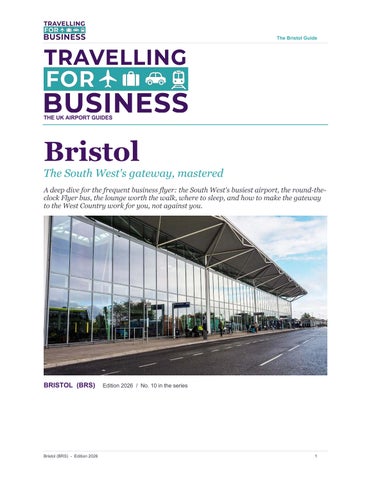
A deep dive for the frequent business flyer: the South West's busiest airport, the round-theclock Flyer bus, the lounge worth the walk, where to sleep, and how to make the gateway to the West Country work for you, not against you.
BRISTOL (BRS)
Bristol at a glance
One terminal, one runway and, for the first time, more than ten million passengers a year. Bristol is the gateway to the South West and South Wales, and it is growing fast.
Bristol is the unrivalled airport of the South West of England and a natural choice for South Wales too, drawing on a wide and prosperous catchment from a single site on the Mendip plateau south of the city. In 2025 it carried a record 10.83 million passengers, having passed the ten-million mark for the first time only the year before, and it is overwhelmingly a low-cost and leisure operation: easyJet runs one of its largest bases here, flying directly to dozens of cities, alongside Jet2, Ryanair and TUI, with a sprinkling of other carriers filling out a network pitched squarely at the value and holiday traveller. For business, it offers a fast, no-nonsense alternative to the long trek to Heathrow or Gatwick for anyone based across the West Country.
Two features shape the experience for the regular. The first is that Bristol, like Glasgow, has no railway station, the link to the city instead being made by a frequent, round-the-clock express bus that does the job well. The second is growth: the airport is part-way through a terminal expansion that will lift its capacity towards twelve million passengers, and it changed hands in late 2025, passing to a consortium led by Macquarie Asset Management. The result is a busy, improving airport on a clear upward path. This guide shows you how to use it like a regular.
BRISTOL BY NUMBERS
Passengers in 2025: a record 10.83 million - the South West's busiest airport.
Terminal: one terminal, mid a major extension; a single runway.
Largest carriers: easyJet, then Jet2, Ryanair and TUI - a low-cost and leisure airport.
Into the city: the round-the-clock Airport Flyer bus - there is no railway station.
Owner: a consortium led by Macquarie Asset Management, from late 2025.
Page 2 - Introduction and key figures
One terminal, all low-cost
There is a single terminal and no building to choose, so the question is not which one but which airline, and how early to arrive for it.
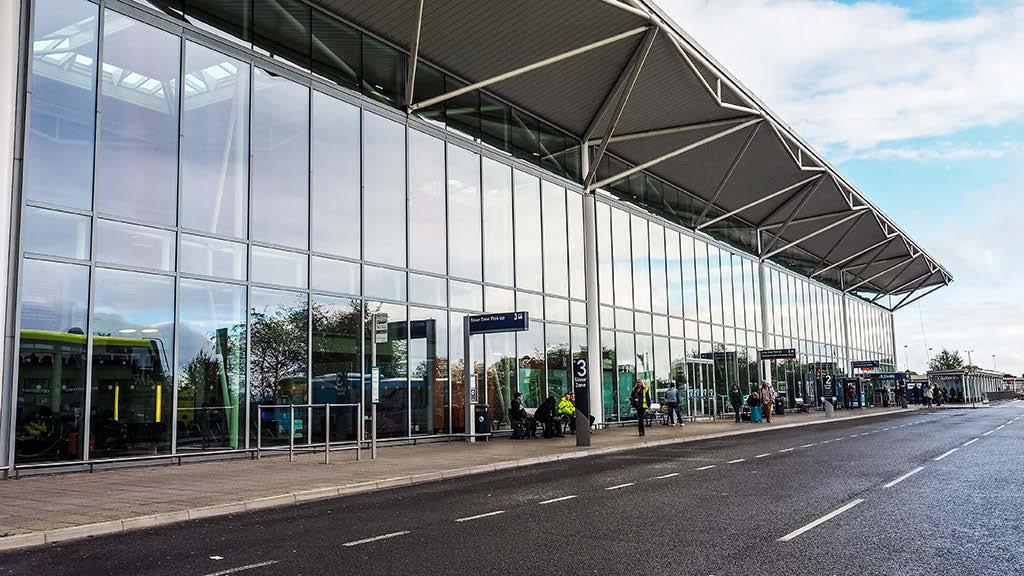
Bristol keeps the arrival simple: every flight uses one terminal, with check-in, security and gates under a single roof and none of the terminal puzzles of the larger hubs. The appeal is the simplicity, but the same compactness means the building works hard at the peaks, and the airline you fly tells you most of what you need to know about your morning. easyJet is the dominant carrier, with the broadest network from its Bristol base, while Jet2, Ryanair and TUI add dense European leisure and holiday flying, and the line-up is almost entirely low-cost and short-haul. The practical consequence is a terminal geared to high volumes of holiday traffic, brisk off-peak and busy when the school holidays and the early-morning waves arrive together.
Because there is no terminal to choose, the discipline shifts to timing and preparation. The lowcost carriers reward hand luggage and online check-in, penalise the unwary with strict bag rules, and pack the early-morning slots, so the seasoned traveller reads the small print before arriving and treats the published check-in and bag-drop deadlines as firm. The good news is that the terminal is in the middle of a substantial expansion that is enlarging the building and adding new shops and places to eat, easing the pinch points that came with passing ten million passengers. Get the timing right and Bristol is one of the easier airports in the country to pass through.
Who flies from Bristol
Carrier Role at Bristol
easyJet
Jet2 / TUI
Ryanair
RULE OF THUMB
The largest carrier and base
Flies
Dozens of European and domestic cities
Leisure and package carriers Holiday destinations across Europe and beyond
Significant low-cost presence A wide European leisure network
One terminal means no building to choose - but check in online and read the bag rules before you travel.
Treat the early-morning and school-holiday peaks with respect; arrive earlier than the compact terminal suggests.
Page 3 - The terminal and the airlines
The Airport Flyer bus
Bristol has no airport railway, but the round-the-clock Flyer bus reaches the railway station and the city centre quickly and often, which is most of what a traveller needs.
The long-discussed rail link to Bristol Airport has never been built, so the connection to the city rests on a genuinely good express bus, and it is up to the job. The Bristol Airport Flyer, service A1, runs from outside the terminal around the clock, with departures as often as every eight minutes, reaching Bristol Temple Meads railway station in around twenty-five minutes and the city centre and bus station in about thirty-five, for a single of around £9.50. Because it serves Temple Meads directly, it plugs the airport straight into the national rail network, so a traveller heading on to Bath, Cardiff, London or the wider South West picks up a fast train at the station rather than at the airport. For the city itself, the Flyer is quick, frequent and simpler than its lack of a train would suggest.
The round-the-clock service is a real asset at a leisure airport full of dawn departures and late arrivals, covering the hours when other options thin out. For destinations the Flyer does not serve directly, a network of other buses and coaches links the airport to Bath, Weston-super-Mare and towns across the South West, while taxis and private hire wait at the terminal for an address off the bus routes or for two or three travelling together. The rule for the regular is straightforward: take the Flyer for the city and Temple Meads, change to the train there for everywhere else, and keep a taxi for the journeys the buses do not reach.
Into the city at a glance
Onward rail
From Temple Meads to Bath, Cardiff, London varies by destination Pick up trains at the station
By coach, road and car
Bristol draws a wide catchment by road, and while the terminal drop-off now carries a charge, the airport keeps an unusually generous free option close by.
As the airport for a large and prosperous region, Bristol does a great deal of its business by road, and it is reasonably placed for it, sitting south of the city off the A38 with links to the M5 and the wider motorway network, though the final approach along country roads can be slow at the peaks. Coaches and buses link the airport to Bath, Weston-super-Mare, Cardiff and towns across the South West, a useful and economical option for places the trains serve less directly, and for travellers driving themselves the full range of official parking is on offer, from the value long-stay car parks with their shuttle buses to the premium options near the terminal. Booking parking online in advance is, as ever, markedly cheaper than the gate price.
Stopping at the terminal now costs money: since January 2026 the drop-off and pick-up zone charges £8.50 for a ten-minute stay, paid by the usual camera system. Bristol, though, is unusually generous in its alternative, with a free Waiting Zone that allows up to a full hour at no charge, a far longer grace period than the few free minutes most airports offer, with a short transfer to the terminal. For an ordinary pick-up or drop-off, the free Waiting Zone is the obvious choice, leaving the premium kerb for those who genuinely need the door. For central Bristol the Flyer bus will usually win, but for the wider region the car and coach earn their place.
The road traveller's checklist
• Use the free Waiting Zone, with up to an hour free, rather than paying £8.50 at the drop-off kerb.
• Book parking online in advance for the best rates, long-stay for value or a premium car park for convenience.
• Buses and coaches link the airport to Bath, Weston-super-Mare, Cardiff and across the South West.
• The airport sits off the A38 south of the city; allow for slow country roads on the final approach at the peaks.
THE HONEST VERDICT
Into central Bristol the Flyer bus wins, but the wide catchment makes this a genuine car-and-coach airport. Use the free hour in the Waiting Zone rather than the £8.50 kerb for any ordinary set-down.
Page 5 - Getting there by coach, road and car
Security and fast-track
Bristol's single security hall is being modernised along with the terminal, but at a busy leisure airport a Fast Track ticket remains the surest way to design out the queue.
Because Bristol channels all its passengers through one security search, the hall is the part of the journey most likely to test the patience, and it is part of the expansion now reshaping the terminal. New scanning equipment is being introduced across UK airports, and the rules on liquids and electronics have been changing as it beds in, so it is worth checking Bristol's current guidance before you fly rather than assuming, but the direction is towards a quicker, less fussy passage. As at any leisure-heavy airport the queues swing widely by the hour and the season, with the earlymorning departures and the school-holiday and summer peaks the busiest, so the prudent traveller plans to be ahead of them.
For certainty, Fast Track security is sold and is well worth the modest cost for an early or peakseason departure, and is included in some premium fares and lounge packages. The usual discipline pays off most at the busiest times: travel hand-luggage only where you can, follow the signage on liquids and electronics, and check in online. For a holiday flight in the thick of summer, when Bristol's single hall is at its fullest, a Fast Track ticket and an early arrival are sensible insurance rather than indulgence, and as the expanded terminal opens the experience should grow smoother still.
Clearing the airport quickly
• Check Bristol's current liquids and electronics guidance before you fly, as the rules are evolving with new scanners.
• Buy Fast Track in advance for an early or peak-season flight, or check whether your fare or lounge includes it.
• Travel hand-luggage only where you can to skip the bag drop entirely.
• Allow extra time at the early-morning and summer holiday peaks, when the single hall is busiest.
TIMING THE ARRIVAL
Short-haul European departures: arrive around two hours ahead, more in peak holiday weeks. Travelling light with Fast Track? You can plan your arrival with real confidence.
Page 6 - Security and fast-track
WHERE TO WAIT WELL
The lounge worth knowing
Bristol keeps a comfortable airside lounge for those who want a calm base before a flight, keenly priced for a busy low-cost airport.
Bristol's lounge offer is modest in scale but well judged for its market. The Escape Lounge, the airport's principal airside lounge, provides the dependable formula of fresh hot and cold food, complimentary drinks, fast wi-fi and charging points, open to passengers of any airline and any ticket class, with access from around £29.99 when booked ahead. For a couple of hours before a flight, a glass and a bite, an inbox cleared and a quiet seat away from a concourse that fills quickly at the holiday peaks, it does exactly what the business traveller needs, and for an early departure it turns the wait into productive time rather than a scramble for a seat.
The advice is the familiar one: book ahead at the busy times, when walk-up space is tight, and check what your fare or card already opens before paying separately, as the lounge can often be entered on a membership such as Priority Pass. It does not pretend to the scale of a Heathrow flagship, but for a busy regional airport it is comfortable, well-run and good value, and the terminal expansion should only improve the wider hospitality offer. Arrive with the time to use it, particularly for an early flight, and the lounge becomes the most useful hour of the trip rather than a queue endured at the gate.
The lounge picture
BOOK AHEAD AT THE PEAKS
Walk-up lounge space is tight in the summer and holiday weeks, so book the Escape Lounge ahead, and check whether your fare or membership card already opens the door.
Page 7 - Airport lounges
Dining and shopping
Practical and expanding fast, Bristol's food and shops are gathered in one terminal, and the current works are adding many more of both.
Bristol's dining is sensible and on the cusp of a real upgrade. The familiar bars, coffee houses and quick counters cover the essentials for a busy morning, and the terminal expansion now under way is adding a clutch of new places to eat and shop, almost doubling the choice as the building grows. It is not chef-led fine dining, but for a busy leisure airport the offer is solid and improving, and because everything sits within a single terminal there is no trekking between buildings to find a decent meal or a proper coffee. The fullest choice is concentrated in the main airside departure area once you are through security.
The retail follows the same one-roof logic, with a tidy spread of fashion, technology, beauty and the practical, the duty-free the holiday crowd expects, and the new outlets arriving with the expansion widening the range. For the working traveller the value is the familiar safety net of the forgotten charger or book, replaceable airside before you board. The sensible habit, even in a compact airport, is to do your eating and buying in the main departure area where the choice is widest, and to keep an eye on the boarding screens, since a busy Bristol departure area can take a few minutes to clear at the summer peaks.
Eating and buying, the essentials
• Do your eating and shopping in the main airside departure area, where the choice is concentrated and widest.
• Expect dependable bars, coffee and quick counters, with many new outlets arriving as the terminal expands.
• Use the shops as a safety net for chargers, adaptors and reading rather than to fill time.
• Watch the boarding screens at the summer peaks, when the departure area is busiest.
Page 8 - Dining and shopping
Where to stay
One hotel sits within an easy walk of the terminal, with a wider cluster a short shuttle or taxi away across the surrounding countryside.
For an early Bristol departure the obvious choice is the on-site Hampton by Hilton, a modern, well-priced hotel barely a five-minute walk from the terminal, which makes the dawn flight or the late arrival genuinely easy and removes any worry about the slow country approach in the small hours. It is the only hotel you can reach on foot, and for a genuinely early start that walkability is worth a good deal. Beyond it, a scattering of hotels sits in the surrounding villages and out towards the city, among them larger country-house and chain options such as the DoubleTree at Cadbury House and various Premier Inn and budget properties, most reached by a short shuttle or taxi rather than on foot.
The choosing logic is simple at a single-terminal airport: there is no building to match, so the decision comes down to whether you want to walk or ride, and to price and standard. For a genuinely early flight, the five-minute walk to the Hampton by Hilton is hard to beat and removes the variable of the country roads in the dark; for a more relaxed stay, or for better value, the wider cluster offers comfortable rooms a short transfer away. The trade-off is the familiar one of convenience against cost, and for a working trip with an early start the small premium for the walkable hotel usually pays for itself in peace of mind. As always, book with the morning's timing in mind.
A hotel shortlist
WALKABLE BEATS THE COUNTRY ROADS
At a dark, early hour the on-site Hampton by Hilton removes the slow approach along the country roads. For a genuinely early flight, that five-minute walk is worth the premium. Page 9 - Where to stay
DoubleTree (Cadbury House) short shuttle / taxi A fuller country-house stay with leisure facilities
Premier Inn and budget options
short shuttle / taxi
Reliable, well-priced rooms a little further out
Connecting and self-transfer
Bristol is a point-to-point airport, not a hub, so a connection here is almost always a self-transfer to be planned with care.
Bristol is built for direct, low-cost flying rather than the seamless hub connection, and that shapes any attempt to change planes here. The carriers that dominate the airport, easyJet, Jet2, Ryanair and TUI, generally do not through-check baggage or protect connections across separate bookings, so a connection at Bristol means a self-transfer: you land, clear immigration, collect any checked bag, leave the controlled area, check in again for the onward flight, and pass back through security. The compact terminal at least keeps the walking short, but the sequence is the same as at any low-cost base and must be planned as two separate journeys rather than a single ticketed connection.
The guidance follows directly. Allow a long layover rather than a tight one, and remember that on separate tickets a missed onward flight is your risk, with no automatic re-routing and no duty on the second airline to wait. Travelling hand-luggage only is the single biggest improvement you can make, stripping out the reclaim and re-check entirely and leaving only the walk back through security, where a Fast Track ticket can speed the second passage. Bristol is at its best as one half of a door-to-door journey rather than a place to change planes, so where a connection is unavoidable, build in a generous buffer and clear each stage methodically before you relax.
Self-connecting well
• Assume no through-baggage: most carriers here require you to reclaim and re-check between flights.
• Treat a connection as two separate trips, and allow a long layover rather than a tight one.
• Travel hand-luggage only if you can; it removes reclaim and re-check from the equation.
• Use Fast Track to speed your second pass through security.
• Remember a missed self-transfer is your risk - there is no automatic re-routing on separate tickets.
Page 10 - Connecting and self-transfer
Bristol, mastered
Everything above distilled into the habits that make the most of the South West's busiest airport.
Bristol rewards the prepared. There is no terminal to choose and the building, though growing, is compact, so the advantage lies in the details: take the round-the-clock Flyer bus and change to the train at Temple Meads, use the free Waiting Zone rather than paying at the kerb, and respect the low-cost bag rules and the summer peaks. The frequent flyer's edge here is simply working with the airport's grain, then enjoying the fact that, for anyone in the West Country, it spares the long haul east to the London airports.
Ten habits of the seasoned Bristol flyer
• Take the Airport Flyer A1 to Temple Meads, around the clock, and change to the train there for everywhere else.
• Check in online and travel hand-luggage only; keep within the strict low-cost bag rules.
• Never pay the £8.50 forecourt drop-off; use the free Waiting Zone, with up to an hour free.
• Book parking online in advance for the best rates.
• Buy Fast Track ahead for an early or summer flight, and check the current liquids guidance.
• Book the Escape Lounge ahead at the peaks, or enter on a Priority Pass-style membership.
• Eat and shop in the main departure area, where the choice is widest and growing.
• For an early flight, sleep at the on-site Hampton by Hilton and walk to check-in.
• Treat any connection as a self-transfer with a generous buffer, not a protected hub change.
• Respect the early-morning and school-holiday peaks; arrive earlier than the compact terminal implies.
Page 11 - The frequent flyer's playbook
WHAT COMES NEXT
The bigger picture
Bristol is growing into its success, expanding the terminal it outgrew and changing hands as it goes.
The defining story at Bristol is growth catching up with the terminal. Having passed ten million passengers for the first time in 2024 and set a record of 10.83 million in 2025, the airport is partway through a terminal extension that will raise its capacity towards twelve million, increasing the floor space by almost half and adding many new shops and places to eat, with longer-term plans for further investment beyond that. In late 2025 the airport changed hands, passing from Ontario Teachers' Pension Plan to a consortium led by Macquarie Asset Management, a change of ownership that brings fresh backing for its growth. For an airport that has long been the South West's link to Europe and the sun, it is a period of significant investment.
For the traveller, the next few years should bring the dividend of all that building: an enlarged terminal with more security capacity, more places to eat and shop, and a smoother experience to match the larger passenger numbers. There will be construction to navigate in the meantime and the perennial summer crush to plan around, and the question of a better public-transport link to the city remains a live one locally. But the direction is clear. Bristol intends to remain the unchallenged gateway to the South West, investing to handle its growth, and for the frequent flyer based anywhere in the region it is already the most sensible way to reach Europe and beyond.
Into the city
Onward rail
Airport Flyer A1 bus to Temple Meads, approx. 25 min, 24 hours
Change to the train at Bristol Temple Meads
Drop-off charge (2026) £8.50 for 10 min; free for up to an hour in the Waiting Zone
Lounge Escape Lounge, from around £29.99, any airline
Largest carrier easyJet, with one of its largest bases here
Closest hotel
On the horizon
Hampton by Hilton, around a 5-minute walk
Terminal extension to 12m capacity under Macquarie-led ownership