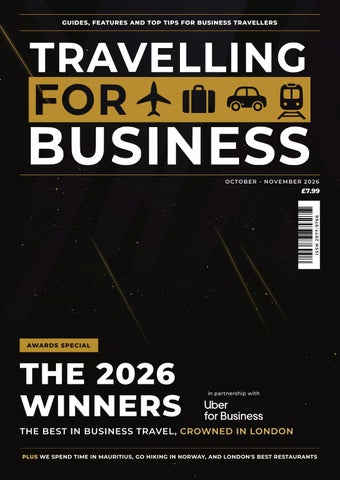
GUIDES, FEATURES AND TOP TIPS FOR BUSINESS TRAVELLERS
O C T O B E R - N OV E M B E R 2 0 2 6
I S S N 2 9 7 7- 9 76 6
£7.99
AWARDS SPECIAL
THE 2026 WINNERS
in partnership with
THE BEST IN BUSINESS TRAVEL, CROWNED IN LONDON PLUS WE SPEND TIME IN MAURITIUS, GO HIKING IN NORWAY, AND LONDON'S BEST RESTAURANTS
etihad.com
Fly to 100+ destinations
Unwind in premium comfort
The Travelling For Business Team Editor Richard Alvin Reviews & Features Editor Andrea Thompson Graphic Designer Grace Moseley Videographer Jacob Pinchbeck Content Sales Manager Laura Phillips Capital Business Media, Group MD Richard Alvin
AWARDS EDITION
Business Development Director Stephen Banks
WELCOME TO
TRAVELLING FOR BUSINESS
YOUR ULTIMATE GUIDE FOR SUCCESSFUL BUSINESS TRAVEL
Chief Creative Director Stuart Hyde Finance Director Andrew Martin Travelling For Business is published in London by
T
his issue is built around the 2026 Travelling for Business Awards, 232 finalists across 24 categories, argued over by a panel that knows the difference between a good lounge and a great one, and occasionally said so rather loudly.
Some winners will surprise nobody. Singapore Airlines and Changi remain the benchmarks the rest of the industry quietly studies. Japan Airlines took Best Standard Class, proof that economy can be done with care, it simply rarely is. Montenegro, a sliver of Adriatic coastline many delegates would struggle to find on a map, walked off with Best MICE Destination Europe. And The Newt in Somerset beat Claridge’s and The OWO to Best UK Hotel, which tells you everything about what we now want from a stay: space, good food and a sense of place. Our Lifetime Achievement honour goes to Sir Rocco Forte, a man who lost one hotel empire and simply built another.
Andrea Thompson chases autumn across six continents, then makes the case for Helsinki as the Nordic meetings city planners keep underestimating.
Away from the awards, the issue travels as widely as ever. I sat down with Dylan Jones, who edited British GQ for 22 years, to talk about London’s great dining rooms and the small, private terror of the walk to the table. Eight years after his death, we ask why business travellers still eat by Anthony Bourdain’s rules, starting with a $6 bowl of bún chả in Hanoi.
There is a love letter to 1970s travel, when going abroad meant vanishing, and a clear-eyed look at whether airline chauffeur services are still worth it. And if you have a free morning before your next conference, our urban safari guide suggests you set an alarm.
Further afield, we explore the four coasts of Mauritius, drive the Transfăgărășan, the road Jeremy Clarkson called the greatest on earth, and sail the British Virgin Islands for five days. We join the queue for Preikestolen, break a journey in Gaziantep for pistachio baklava, and fall, as everyone does, for Hay-on-Wye. Closer to home, Pan Pacific London and St Enodoc in Cornwall make strong cases for the weekend, while the Isle of Man proves that small islands keep big secrets.
Congratulations to every winner. Now go and earn next year’s.
CBM Travel LLC 1420 Celebration Boulevard Florida 34747 +1 212 531 5116 The Capital Business Media Group, Level 18, Forty Bank Street London, E14 5NR +44 20 7148 3861 Travelling For Business is printed using sustainable paper sources and vegetable ink, and is PEFC certified. Copies are recycled at the end of the issue.
Until next time…
RICHARD ALVIN
EDITOR, TRAVELLING FOR BUSINESS
© CBM Travel LLC A Capital Business Media Group Company.
CONTENTS AWARDS The Travelling For Business Awards 2026 The Winners
39
DESTINATIONS Mauritius An Island Of Many Moods Hay-On-Wye The Little Town That Fell In Love With Books Helsinki MICE Guide: Venues, Hotels & Incentive Ideas Zurich Lakes, Legends & A Little Chocolate The Isle Of Man A Little Island With A Very Big Personality Gaziantep & Halfeti TÜrkiye's Culinary Capital
10 20 34 202 211 214
HOTEL REVIEWS Raffles London, UK Pan Pacific London, UK St Enodoc Cornwall, UK Eastwell Manor Champneys Spa Hotel Kent, UK Ambassador Hotel Zurich, Switzerland Kai 36 Graz, Austria Château De La Chèvre D'or Èze, France Swissôtel Mariánské Láznê Czechia Numo Ierapetra Beach Resort Crete, Greece Raffles Singapore
194 196 197 198 204 205 206 207 208 209
EXPERIENCES Hiking In Norway The Most Photographed Cliff British Virgin Islands Five Days Sailing Forget The Serengeti Try Richmond Park TransfăgărăȘan The Greatest Driving Road On Earth
32 200 210 212
FEATURES Latest News Dylan Jones The Best Table In The House The World Turns Gold Chasing Autumn Across Six Continents Why The World Still Travels With Anthony Bourdain Working Late Or On The Go? There's An App For That The Keeper Of The Keys Luxury Hotel Concierge Clubrooms Gatwick South Terminal Lounge Review & Prices When Travel Was Travel A Love Letter To Travel In The 1970s Business-Class Pyjamas Move Down The Cabin Airline Chauffeur Services Are They Worth It? Jeep Compass Car Review The Rock Without A Border Do Business On The Mediterranean Tried & Tested From Books To Skincare
6 16 23 28 192 193 199 216 217 218 222 224 226
NEWS neighbouring country and flying from SAUDI TRAVEL WARNING PUTS athere. are already redrawing plans. Delta RIYADH BUSINESS TRIPS ON HOLD Airlines Air Lines has postponed its first route to
The Foreign, Commonwealth and Development Office (FCDO) now advises against all but essential travel to Saudi Arabia, leaving UK companies with staff, clients or projects in the kingdom facing hard decisions about which trips can still go ahead. The advice, updated on 17 October, also warns against all travel within 10km of the Yemen border. It follows a serious incident at King Khalid International Airport in Riyadh on 10 October, in which Saudi authorities said at least 12 people were killed, and British nationals have been told to stay away from the airport until it is secure. The FCDO says Houthi missile and drone attacks since 13 July have raised the threat to airports across the country, naming cities including Riyadh, Jeddah, Dammam and Yanbu, and judges further attacks, disruption and cancellations very likely. Anyone who wants to leave is advised to consider crossing by land into
the kingdom, a non-stop service between Atlanta and Riyadh that was due to start on 23 October, until next March, citing "evolving developments in the region".
The timing is awkward for Saudi Arabia's hospitality push. Raffles The Red Sea has just opened on Shura Island with 168 keys, including 33 private pool villas and butler service in every room category, exactly the kind of property that would normally draw incentive groups and leadership retreats. For travel managers, insurance is the first question. Travelling against FCDO advice can invalidate cover, so every trip now needs a documented case that it is essential, sign-off under the company's travel policy and written confirmation from the insurer. Travellers should check their flight status before leaving for the airport and sign up for FCDO email alerts. Firms holding provisional group bookings should ask hotels about postponement terms now. Where a meeting can move online, that may be the simpler answer until the advice eases.
NEWS
EMPTY OFFICES BUT FULL FLIGHTS AS HYBRID WORKING DRIVES TRAVEL Britain's offices have rarely looked emptier, yet companies are spending more than ever on bringing people together.
SINGAPORE AIRLINES BRINGS SLEEPER SUITS TO BUSINESS CLASS Singapore Airlines will give business class passengers sleeper suits for the first time from November, as part of a refresh of amenity kits and travel essentials across every cabin on flights longer than six hours. Business class travellers will receive a relaxed-fit navy sleeper suit and an amenity kit from fragrance house BYREDO, with hand cream, lip balm and its Blanche Eau de Parfum. In Suites and First Class, separate men's and women's kits come from French beauty brand SISLEY, alongside 100 per cent cotton sleeper suits and fleece slippers. Premium economy passengers get a batikembossed zip pouch with an INK and WATER white tea lip balm, eyeshades, socks and a dental kit, while economy passengers receive collectible drawstring pouches. For anyone flying overnight to Singapore and stepping straight into meetings, a proper night's sleep is the real benefit. The kits form part of a wider refresh that also covers dining, entertainment and connectivity.
6
New research from Booking.com for Business shows that 11.5 per cent of office space in the South East stood empty in the second quarter of this year, the highest of the markets it analysed. Leeds followed at 10.4 per cent and Edinburgh at 9.7 per cent. At the same time, the Global Business Travel Association (GBTA), in its Business Travel Index published in August, forecasts that global business travel spending will reach a record $1.71 trillion this year, with more than 1.84 billion trips taken worldwide. The two trends are linked. With around four in ten Britons working from home for at least part of the week, face-to-face time has become scarcer and more valuable. Rather than commuting to the same building five days a week, employees are making fewer, more deliberate journeys: flying out to see a client, bringing a scattered team together for workshops or meeting colleagues from another city halfway. For employers, that puts the travel policy at the centre of how teams stay connected. If in-person time is now a deliberate choice rather than a daily habit, it needs to be planned, budgeted and measured, so that each trip delivers the value it is meant to.
BRITISH AIRWAYS ADDS GATWICK TO COLOMBO WITH SRI LANKAN MENU British Airways begins flying from London Gatwick to Colombo on 23 October, and Club World passengers will be served a Sri Lankan menu created with London restaurant group Hoppers until 30 December. Dishes include Hoppers' signature Kalupolspiced chicken with lemon rice and beetroot curry, Pollichathu cod cooked in a banana leaf and watalappam bread pudding. Before boarding, the British Airways Club Lounge at Gatwick will pour a Hoppers cocktail, the Ceylon Pearl. "Food is such an important part of experiencing a destination," said Mark Brega, British Airways' executive chef. The route operates three times a week in World Traveller, World Traveller Plus and Club World, with return fares from £524. It gives Sri Lanka a second London airport for direct flights alongside SriLankan Airlines' Heathrow service. The catch for companies is that it is a winter-season route only, so trip lengths need to fit the operating days and regular travel should not be planned around it beyond the season.
NEWS
HEATHROW PRESSES FOR RUNWAY DECISION AS PASSENGER NUMBERS SLIP Heathrow's chief executive, Thomas Woldbye, has warned that the airport's shareholders "cannot wait forever" for the Prime Minister's backing for a third runway, as September figures showed passenger numbers down 2.3 per cent on a year earlier. Speaking to the Financial Times, Woldbye said shareholders, whose number includes the Qatar Investment Authority, Saudi Arabia's Public Investment Fund and China Investment Corp, would take stock of progress by the end of the year, with a decision on whether to submit a formal planning application reportedly due in the new year. "At some point in time we need a level of certainty," he said. The £33 billion scheme, which includes £1.5 billion to move the M25, is expected to be fully privately financed and would lift capacity to 756,000 flights and 150 million passengers a year. Heathrow aims to secure planning permission by 2029. The Prime Minister, Andy Burnham, has yet to
confirm his support, saying it is subject to consultation and then the planning process. Former chancellor Rachel Reeves suggested in January last year that the runway could open in 2035, a timetable airport bosses have told ministers appears impossible. Heathrow handled 7.2 million passengers in September. Middle East traffic fell 20.1 per cent, which the airport put down to the war in Iran, while UK passengers were down 4 per cent and EU passengers 1.2 per cent. "The debate about whether the UK needs additional hub airport capacity has been settled," Woldbye said, describing expansion as "an investment in the UK's future competitiveness." For corporate travellers, the message is that a two-runway Heathrow running close to capacity is likely to be the reality for years to come. Fuller aircraft and scarce spare slots when disruption strikes make it sensible for travel managers to keep regional airports and connections through rival hubs in their booking options.
NEWS
JETBLUE FIRST CLASS OPENS FOR BOOKINGS AHEAD OF DECEMBER LAUNCH JetBlue's first domestic first class cabin, BlueFirst, is now on sale across more than 30 routes, with the first flight due on 8 December.
LUFTHANSA WINS RACE FOR STAKE IN TAP AIR PORTUGAL Lufthansa is to buy a 44.9 per cent stake in TAP Air Portugal, which the Portuguese government valued at €1.2 billion, after beating Air France-KLM, the only other bidder. The deal was announced on 14 October. The government will remain the main shareholder, with 5 per cent reserved for TAP's more than 9,000 employees to buy, and Portugal's prime minister, Luis Montenegro, said full privatisation could follow by 2028. The sale still needs approval from European Union regulators. TAP carried 16.7 million passengers last year and flies more than 90 aircraft to over 90 destinations, including 16 in Central and South America, 14 in Africa and 11 in North America. Its routes to Brazil are seen as particularly valuable. For UK companies, Lisbon is an important gateway to Brazil and Portuguese-speaking Africa, and TAP already sits alongside Lufthansa in Star Alliance. Any changes to schedules, lounges or loyalty benefits will come only after regulators have ruled, so existing corporate agreements with either airline should continue unchanged for now.
The launch route is a daily service between Boston and Fort Lauderdale, with select New York LaGuardia to Fort Lauderdale flights following within days and Washington Reagan National from 12 December. Routes early next year include San Juan, Cancun, Aruba and Costa Rica, several of them from New York JFK. Passengers get wide recliner seats in a two-by-two layout with up to 7in of extra legroom, priority check-in, expedited security at more than 30 airports, free high-speed wifi and a boxed meal on flights of 899 miles or more. It is a recliner rather than a flat bed. Joanna Geraghty, JetBlue's chief executive, said the cabin was designed "to deliver a more accessible first-class experience". For UK travellers connecting onward from Boston or New York, the detail to watch is the fare structure. The cheapest BlueFirst Base fare includes one checked bag but no seat selection and charges for changes, while BlueFirst and BlueFirst Flex include two bags and no change fees. Travel managers should check how booking tools label each tier before approving it.
HOLLYWOOD BURBANK OPENS NEW TERMINAL FOR LOS ANGELES TRAVELLERS Hollywood Burbank Airport opened its new 355,000 sq ft passenger terminal on 13 October, giving business travellers a modern alternative to the larger airports around Los Angeles. The building brings ticketing, a single TSA security checkpoint and an indoor baggage hall under one roof, with workstation-style seating and power outlets at every seat airside. Separate arrival and departure lanes are designed to ease kerbside congestion, while outdoor boarding has been kept. Alaska Airlines, which has served Burbank since 1981, is a key partner. For UK visitors with meetings in the San Fernando Valley and the studio districts north of downtown, Burbank's short walks and easier access make it worth considering for domestic connections.
7
NEWS
GOVERNMENT TO REVIEW AIRPORT DROP-OFF CHARGES AFTER SHARP RISES The Department for Transport announced on 15 October that it will review drop-off charges at UK airports, after the average cost of a quick stop at the terminal rose by around a third in a year. Research by the RAC found that 16 of the UK's 20 busiest airports increased their fees over the past 12 months. The average "kiss and fly" charge is now £7 for 10 to 15 minutes, £1.70 more than last summer. London Gatwick and London Stansted charge £10, London City £8 for five minutes and Heathrow £7, while Manchester charges £5.50 for five minutes. Drivers who fail to pay can be fined up to £100. A Department for Transport spokesperson said: "It is vital to ensure travel remains accessible and that passengers are treated fairly," adding that airports should show restraint on increases, particularly
where public transport alternatives are limited. Clive Wratten, chief executive of the Business Travel Association (BTA), said: "Up to £10 for a few minutes at the kerb is a lot to ask of travellers." The BTA is calling for a £3 cap, charges at peak times only, a 50 per cent discount for electric vehicles and a single charge per day. Airports argue the fees cut congestion and local air pollution. Stansted, which introduced its Express Set Down charge in 2012, said drop-off journeys are the least sustainable way to reach the airport. For businesses, the charge most often lands on expense claims when staff are dropped off by car for early flights. Travel managers may want to check that their expenses policy covers drop-off fees, and remind travellers to pay promptly to avoid a fine.
NEWS
STARLINK RACE HOTS UP AS UNITED AND KLM EXPAND ONBOARD WIFI
LUXAIR BRINGS LONDON CITY'S LARGEST AIRCRAFT ONTO LUXEMBOURG ROUTE
Reliable wifi on long flights is moving from novelty to expectation, with United Airlines and KLM both stepping up their Starlink plans.
Luxair has started flying its newgeneration Embraer E195-E2 between Luxembourg and London City Airport, putting the largest aircraft currently operating at the Docklands airport on the link between two financial centres.
United now has Starlink on more than 635 mainline and United Express aircraft, covering nearly half its daily departures and more than 2,500 flights a day. It is fitting about 20 aircraft a week and aims to finish by the end of next year. A new tracker at StarlinkTracker.United. com lets passengers check whether a flight within three days of departure has the service, and reflects last-minute aircraft swaps in real time. "Starlink gives customers even more reasons to choose United and keep coming back," said Andrew Nocella, the airline's executive vice president and chief commercial officer. KLM will begin a phased rollout of Starlink on its intercontinental flights from the middle of next year, free for Flying Blue members in every cabin. Chief executive Marjan Rintel said: "This will allow passengers to stay connected even high above the ocean." For companies, fast connectivity turns a transatlantic crossing into usable working time, from clearing email to joining a call. It also strengthens the case for travellers to join airline loyalty programmes, since membership is often the key to free access.
8
The jet, which made its first London City service on 12 October, seats about 136 passengers in a two-by-two layout with no middle seats. Its take-off noise footprint is around 60 per cent smaller than that of current jets such as the E190. Gilles Feith, Luxair's chief executive, described London City as "a special destination for Luxair for more than two decades", while Andy Cliffe, London City's chief executive, said the airport was "excited to welcome Luxair's new-generation E195-E2". For finance and legal teams shuttling between the City and Luxembourg, the extra capacity and quieter cabin add to an airport that recently came top of Blacklane's index for the quickest exit from aircraft to car.
NETJETS PLANS PRIVATE TERMINALS AT DALLAS AND WASHINGTON DULLES NetJets is building three new exclusiveuse terminals in the United States, at Dallas Love Field, Washington Dulles International Airport and Rifle Garfield County Airport in Colorado, and moving its West Palm Beach terminal into a larger space. The largest project, a NetJets-only complex of nearly 114,000 sq ft at Dallas Love Field developed with Signature Aviation, is due to open in late 2028. NetJets' flight activity at the airport has risen by more than 25 per cent since 2022. At Dulles, work starts early next year on more than 14,000 sq ft of space with a lounge and private VIP suites, while Rifle's 6,000 sq ft terminal is expected to open by early next year, ahead of a runway renovation that will close Aspen. Patrick Gallagher, President of NetJets Aviation, said the company is "investing in the infrastructure to deliver an unmatched experience" where its owners fly most. For executives already flying through shared ownership or jet cards, the appeal is time: a quicker transfer from car to aircraft and a private room for a briefing or a confidential call.
NEWS
LONDON CITY NAMED QUICKEST AIRPORT FROM SEAT TO CAR London City is the fastest airport in the world for business travellers to get from their aircraft seat to their car, according to the first Business Travel Efficiency Index from chauffeur company Blacklane. The index draws on chauffeur-tracked arrival, pick-up and drop-off data at 27 leading business travel airports in 12 cities across nine countries between January last year and September this year. London City recorded an average seat-to-seat time of 23.6 minutes, against 48.4 minutes at Tokyo Narita, the slowest. London City, Dallas Love Field and New York LaGuardia were named the most efficient airports overall. For the full journey from landing to hotel lobby, Singapore Changi led for international arrivals at an average of 67.8 minutes, 7.5 minutes quicker than last year, while Narita took 128.2 minutes. International arrivals add about
24 minutes at Heathrow and Chicago O'Hare, and about 21 minutes at New York JFK, compared with domestic arrivals. LaGuardia's landing-to-lobby journey can be up to 42 minutes quicker than JFK's. Timing matters as much as the airport. Mondays and midday journeys into town were smoother, while Fridays and the 9am rush were slowest. At Paris Charles de Gaulle, the drive averaged 53 minutes on a Monday afternoon but 84 minutes on a Tuesday morning. JFK and Charles de Gaulle sit roughly 20 miles from their city centres, yet the journey can take about as long as the 38-mile trip from Gatwick. "Distance alone doesn't tell business travellers how much time to allow," said Kasra Moshkani, CEO Americas at Blacklane. For travel bookers, the data is a useful check on how much buffer to build between landing and a first meeting.
NEWS
NORWAY COURTS BRITISH SKIERS WITH MORE WINTER FLIGHTS Norway is pitching itself as an alternative to the Alps this winter, with Norwegian Air Shuttle adding capacity to Oslo, including more direct flights from London and Edinburgh. Manchester services will rise from two to five weekly departures, with a new Sunday flight aimed at skiers.
LEONARDO HOTELS BUYS THE BRISTOL HOTEL FOR HARBOURSIDE REBRAND Leonardo Hotels UK and Ireland has bought The Bristol Hotel from The Doyle Collection and will rebrand it as Leonardo Royal Hotel Bristol, the group's second property in the city and its tenth Leonardo Royal in the UK. The waterfront hotel on Bristol's harbourside has nine flexible meeting and event spaces for up to 400 delegates, along with Leo's Bar and Restaurant, a fitness centre and on-site parking. A phased £11.5 million refurbishment will upgrade the guest rooms and public spaces. For companies holding conferences or team events in the city, the meeting space is the draw, although planners booking during the works should check which areas will be affected. The deal is part of the growth strategy of parent group Fattal Hotels, which owns and operates 332 hotels in more than 140 destinations.
The campaign brings together Norway Home of Skiing, Avinor, Alpinco and UK operators including Ski Safari, Ski Solutions and Crystal Ski. Trevor De Villiers, chief executive of Norway Home of Skiing, aims to lift British guest nights from 150,000 to 200,000 this coming winter. Resorts featured include Geilo, Hafjell, Kvitfjell, Voss and Narvik, which will host the FIS Alpine World Ski Championships in 2029. For companies planning winter incentives or client hospitality, quieter slopes, shorter lift queues and activities such as dog sledding and Northern Lights viewing offer something different from the usual Alpine trip. The extra Oslo flights also help anyone travelling to Norway on business.
VIRGIN REVEALS FIRST LOOK AT ITS EUROSTAR RIVAL Virgin has released the first image of its black and red high-speed train, giving UK business travellers an early look at the operator planning to challenge Eurostar through the Channel Tunnel from 2030. The group intends to run 20 daily return services between London, Paris, Brussels and Amsterdam, adding almost 7.5 million seats a year and creating up to 1,000 jobs. Alstom will supply 12 Avelia Stream trainsets capable of up to 300km/h and maintain them under a 30-year contract, with the fleet based at Eurostar's Temple Mills International depot in east London. Virgin says it is the only prospective new operator to have secured UK track access, confirmed until at least 2040. On board, Virgin Atlantic's Clubhouses will inspire social spaces for working and relaxing, Virgin Voyages will shape the food and drink, and passengers will earn and spend Virgin Points through Virgin Red. Virgin will also explore links between rail and its airline network. "We're adding capacity for millions more international rail journeys each year, growing the market as a whole," said Josh Bayliss, CEO of Virgin Group. No fares, timetables or classes of travel have been announced. For travel managers, a second operator on three of the busiest corporate routes out of London should mean more departure times and more leverage in rail negotiations, so it is worth bearing in mind for any supplier agreements running towards 2030.
9
DESTINATION REVIEW
F
ar out in the Indian Ocean, some 2,000 kilometres off the southeast coast of Africa and east of Madagascar, lies an island that seems to have been designed for daydreams.
10
AN ISLAND OF MANY MOODS By ANDREA THOMPSON
MAURITIUS
DESTINATION REVIEW
Mauritius is small, roughly 65 kilometres from north to south and 45 from east to west, yet it holds an astonishing variety within its coral reef: powdery beaches and turquoise lagoons, sugar cane fields rippling in the breeze, volcanic peaks wrapped in cloud, waterfalls tumbling into green gorges, and a people whose warmth is as famous as the sunsets. FThe island was born of volcanoes millions of years ago, and you can still read that fiery history in its jagged skyline. Almost all of it is ringed by a coral reef, which turns the water inside into a vast natural swimming pool of impossibly bright blues. Beyond the reef, the ocean crashes in white lines of surf, a constant soundtrack to life on the shore.
Its human story is just as rich. The Dutch named it after Prince Maurice of Nassau, the French made it the Isle de France, and the British took control in 1810, before Mauritius became independent in 1968. Along the way came workers, traders and settlers from Africa, India, China and Europe, and today their descendants have created one of the most harmonious and multicultural societies you could hope to find. Hindu temples, mosques, churches and pagodas sit side by side. English is the official language of government, French is everywhere, and Mauritian Kreol is the language of the street, the market and the kitchen. And yes, this is the home of the dodo, long gone but still cheerfully celebrated on everything from postcards to the national coat of arms. Mauritians are proud of their island and delighted to share it, and visitors quickly feel at home. MORE ON THE NEXT PAGE
11
A TALE OF FOUR COASTS One of the great joys of Mauritius is that each side of the island has its own character, so where you stay shapes the holiday you have. The NORTH is the island's sociable side. Grand Baie is its lively hub, with boutiques, bars and restaurants, while nearby Pereybère and Trou aux Biches offer calm, sheltered lagoons perfect for swimming and snorkelling. At Cap Malheureux, the little red roofed church looks out across the water to the dramatic islets of Coin de Mire, and the sunsets are glorious. The north is generally sunny, dry and protected from the strongest winds, which makes it a lovely choice all year round. The EAST is all about long, luminous beaches. Belle Mare and Palmar stretch for miles, fringed by casuarina trees and lapped by a wide, shallow lagoon. This is where you will find many of the island's grandest resorts, as well as Trou d'Eau Douce, the jumping off point for boat trips to Île aux Cerfs, a sandbar paradise of picnics and swimming. The east catches the breeze, which keeps it beautifully fresh in the heat of summer. The SOUTH is Mauritius at its wildest and most romantic. In places the reef disappears altogether, and the ocean throws itself against black basalt cliffs at Gris Gris, sending spray high into the air. Sugar estates roll down to the sea, villages feel unhurried, and the scenery is dramatic and largely undeveloped. In the southeast, Blue Bay Marine Park offers some of the best snorkelling on the island, with coral gardens just a short boat ride from shore. The WEST is the sunset coast. Flic en Flac, Tamarin and Black River enjoy the driest, warmest weather on the island, with calm water and golden evenings that end in spectacular skies. Dolphins are often seen in Tamarin Bay in the early morning, and big game fishing boats head out from Black River. At the southwestern tip rises Le Morne Brabant, a striking basalt mountain and UNESCO World Heritage Site that once sheltered escaped slaves and now stands as a powerful symbol of freedom.
THE GREEN HEART Head inland and the island climbs to a cool central plateau, where the air is fresher and the rain more frequent. Black River Gorges National Park protects the last of the native forest, home to rare birds, waterfalls and hiking trails with breathtaking views. Nearby, at Chamarel, the Seven Coloured Earth shimmers in bands of red, violet and ochre, and a waterfall plunges almost 100 metres into the forest below. The sacred lake of Grand Bassin, ringed by Hindu temples and watched over by a towering statue of Shiva, is one of the most moving places on the island. Close by, the hill town of Curepipe sits beside Trou aux Cerfs, a dormant volcanic crater with sweeping views across the island. And no visit is complete without Port Louis, the busy capital, where the Central Market buzzes with spices, fruit and street food.
12
DESTINATION REVIEW
SUGAR, SPICE & ALL THINGS NICE You cannot travel far in Mauritius without meeting sugar cane. It was first planted by the Dutch in the seventeenth century, flourished under the French and the British, and for generations it was the island's fortune. Even today, great green seas of cane cover much of the countryside, swaying in the breeze and turning silver when they flower. Old stone chimneys from long closed sugar mills rise from the fields like monuments, and during the harvest, from June to November, the
famous vanilla tea, which makes a lovely souvenir to bring home.
READING THE WIND To understand Mauritius, you need to understand the wind. For much of the year the island is fanned by the southeast trade winds, and they shape life on every coast. During the southern hemisphere winter, from roughly May to September, the trade winds blow at their strongest. The east and south coasts feel the full force, with
ONE OF THE GREAT JOYS OF MAURITIUS IS THAT EACH SIDE OF THE ISLAND HAS ITS OWN CHARACTER, SO WHERE YOU STAY SHAPES THE HOLIDAY YOU HAVE air smells faintly of molasses. To discover the full story, visit L'Aventure du Sucre, a fascinating museum in a former sugar factory near Pamplemousses, where you can taste a dozen different unrefined sugars, from pale golden to dark, sticky muscovado and of course, where there is sugar, there is rum. Then there is vanilla, the island's most fragrant treasure. The vanilla orchid is a delicate climbing vine, and every single flower must be pollinated by hand, a technique perfected on the neighbouring island of Réunion in the 1840s. The pods are then cured slowly for months until they turn dark, glossy and intensely perfumed. You can see vanilla growing at historic estates such as Saint Aubin in the south, and you will taste it everywhere: in desserts, in rum, and in the island's
breezy beaches and choppy water that thrill kitesurfers and windsurfers, especially around Le Morne. The west and north, sheltered from the prevailing wind, stay calmer, sunnier and warmer, so they are usually the best choice for a beach holiday at this time of year. In the summer months, from November to April, the wind softens and the island grows hot and humid. Now the east coast comes into its own, its breezes a welcome relief from the heat. Summer is also the rainy season, with occasional cyclones most likely between January and March, though these are usually forecast well in advance. The lovely thing is that there is almost always a sheltered, sunny coast somewhere on the island. Choose your side to suit the season, and Mauritius will reward you every time.
ESSENTIAL INFORMATION Best Time to Go April to June and September to November, when the weather is warm and dry and the wind is gentler. From May to September, choose the sheltered west and north coasts. From November to April it is hot and humid, the breezy east coast is at its best, and cyclones are possible, mainly between January and March. Time Difference Mauritius is GMT+4 and does not change its clocks, so it is three hours ahead of the UK during British Summer Time and four hours ahead in winter. Getting There British Airways and Air Mauritius fly direct from London Heathrow and London Gatwick to Sir Seewoosagur Ramgoolam International Airport in the southeast of the island. Connecting flights are also available via Dubai with Emirates. Flight Time Around 12 hours direct from London. Currency Mauritian rupee. Language English, French and Mauritian Kreol are all widely spoken.
13
DESTINATION REVIEW
MARADIVA VILLAS RESORT AND SPA
YOUR OWN PRIVATE PARADISE ON THE SUNSET COAST
a happy hour in the Cellar leafing through two magnificent Assouline books. The Impossible Collection of Wine is filled with remarkable stories and labels from legendary bottles, while The Impossible Collection of Cigars includes a quote from Winston Churchill, surely the most famous cigar lover of them all. There is more to discover around the resort, including two shops and an art gallery, perfect for a little browsing between swims. One of Maradiva's most charming corners is the Garden of the Stars, where celebrity guests are invited to plant a tree, each marked with its own plaque. It is great fun to wander through and see who has stayed before you. The latest to add her name is the actress Joanne Froggatt, star of MobLand and Downton Abbey, who chose Maradiva for a family escape in paradise.
The Maradiva experience begins before you have even seen the sea. Guests can be collected from the airport in a vintage Rolls Royce or Electric BMW, and gliding across the island in such style, past sugar cane fields and little villages, sets the tone for everything that follows. There are resorts that wow you on arrival, and then there are those that slowly, gently work their magic until you never want to leave. Maradiva Villas Resort and Spa, on Mauritius's sunny west coast at Flic en Flac, is firmly the second kind. Set in lush tropical gardens along a long sweep of white sand, it looks out across the ocean towards Tamarin Bay and the dramatic silhouette of Le Morne, and from the moment you arrive, the pace of life simply melts away. The resort is made up of 64 villas, all at ground level and all with their own private pool, so the feeling of space and privacy is extraordinary. We stayed in a pool villa, and it felt less like a hotel room and more like our own tropical home. High walls and frangipani trees screened the outside world. Inside, the villa was cool, spacious and elegantly understated, with a vast bed, natural textures and a bathroom made for lingering, complete with Bvlgari toiletries. Outside, the private pool glittered in the sunshine, with a shaded terrace and loungers that quickly became our favourite place on earth. Mornings began with a swim before breakfast, and evenings ended under the stars with nothing but the sound of the ocean. A personal butler is on hand from morning until late, arranging everything from restaurant reservations and boat trips to a candlelit dinner served in your villa. The service throughout was warm, intuitive and genuinely kind, the very best of Mauritian hospitality. It is the little touches that make Maradiva so special. Every afternoon, freshly made cakes appeared in our villa, a daily treat we came to look forward to far too much. At turndown, a lovely thought for the day was left on the pillow, a small gesture that sent us to sleep smiling. Around the main pool, fresh fruit and snacks were offered throughout the day, so there was never any need to move from a sun lounger unless we wanted to.
14
The beach is a joy too: a long stretch of soft white sand, perfect for an early morning walk or a lazy afternoon beneath the palms, with the lagoon calm, clear and wonderfully inviting. Dining is one of Maradiva's great pleasures, and you could stay a week without eating the same thing twice. Cassine serves international dishes from breakfast to dinner. Cilantro celebrates Indian and Mauritian flavours with live music in the evenings, and its fragrant curries are not to be missed. Haiku brings the theatre of Japanese teppanyaki alongside beautiful sushi and sashimi, while the beachfront grill is the place for fresh seafood with your toes almost in the sand. As the sun sets, the Lantana Bar is the perfect spot for a cocktail, watching the sky blaze orange over the sea. If you would rather not leave your villa at all, dining in your room is always an option, and the resort can arrange cooking classes for anyone keen to take a taste of Mauritius home. Epicureans are in for a treat. At the entrance to Cassine is the resort's Cigar and Wine Cellar, which offers two distinct pleasures. On the left, the finest wines are beautifully displayed, with a seating area for tastings. On the opposite side is the humidor, home to a collection of more than 1,500 cigars, including some rare gems, and there are cigar corners outside the Lantana Bar for enjoying one in the evening air. We lost
The spa is a true sanctuary. Inspired by Ayurveda, it offers treatment rooms for singles and couples arranged around a peaceful, leafy courtyard, along with a yoga platform, a hammam and a sauna. Treatments are rooted in ancient Indian traditions of balance and wellbeing, and we emerged from ours feeling utterly restored. When you can tear yourself away from the villa, there is plenty to do. Water sports are complimentary for guests and include windsurfing, kayaking and trips in a glass bottom boat, a wonderful way to see the coral and fish of the lagoon without getting wet. There are tennis courts and catamaran trips too, bicycles to borrow for exploring, and a kids club for families. Early risers may be lucky enough to spot the dolphins that often visit the bay. Beyond the resort, the wild beauty of Black River Gorges, Chamarel and Le Morne are all within easy reach. The grounds are so generous that golf buggies are just a phone call away, ready to whisk you to and from the restaurants. They are a lovely touch, although after all that wonderful eating, we found a gentle walk back through the gardens was very much needed. Maradiva offers that rare combination of complete privacy and wonderful warmth. With your own pool, a butler at hand, superb food, a beautiful spa and a hundred thoughtful touches, it is the perfect place for a honeymoon, an anniversary or simply a long overdue escape. We arrived tired and left glowing, already dreaming of our return.
DESTINATION REVIEW
MAURITIUS ON A PLATE Mauritian food is the island in miniature: a little bit Indian, a little bit Chinese, a little bit French and African, and completely delicious. Forget fine dining for a moment. The real magic happens at roadside stalls, in bustling markets and around family tables. Here is what to eat. Dholl puri: The island's favourite snack and unofficial national dish. A soft, warm flatbread filled with ground split peas, rolled around bean curry, tomato rougaille and a lick of chilli. It costs pennies, and one is never enough. Gâteaux piments: Crisp little chilli fritters, eaten hot from a paper bag. Locals tuck them into buttered bread for breakfast, and so should you. Octopus curry: Known as cari ourite, this is Mauritius in a bowl: tender octopus in a rich, fragrant sauce, best eaten with rice and a view of the sea. Fish vindaye: Golden with turmeric, sharp with mustard seed and vinegar, and utterly moreish. Served cold, it is even better the next day. Bol renversé: The "upside down bowl" is pure theatre: a dome of rice turned out onto the plate, crowned with a glossy stir fry and a fried egg. Millionaire's salad: Made from the tender heart of a palm tree. A whole tree is felled for a single salad, which explains the name. Pineapple with chilli salt: Sold on sticks at the beach, sweet, sour, salty and hot all at once. Trust us. Something sweet: Napolitaines are pretty pink shortbread sandwiches filled with jam. Alouda is a cold, milky drink scented with vanilla and full of basil seeds, the perfect antidote to a hot afternoon. And to drink? Rum, naturally. Sugar cane made this island, and its rums are superb, especially those infused with local vanilla and spices. Raise a glass at sunset, say "santé", and start planning what to eat tomorrow.
15
INTERVIEW
the best table in the house
AND WHO GETS TO SIT AT IT
Dylan Jones ran British GQ for 22 years and lunched in more London dining rooms than most of us have had hot dinners; now he has written their secret history.
E
very business traveller who has entertained a client in London knows the small, private anxiety of the walk to the table. You have booked the right restaurant. You have arrived on time. And then the maître d' picks up two menus and you find out, in front of the person you are trying to impress, exactly what the room thinks of you. BY RICHARD ALVIN
16
Dylan Jones has spent most of his adult life on the right side of that walk. As editor of British GQ from 1999 to 2021 he was, by his own account, in the Art Deco dining room of Le Caprice behind The Ritz several times a week, hosting designers, advertisers, film stars and the occasional supermodel who turned up almost an hour late and left
INTERVIEW
him with the bill. He knows which tables matter and which are Siberia. He has also, it emerges, been keeping notes. The result is Table Hopping: The Secret History of London Restaurants, from Langan's Brasserie to the Wolseley, published this month by Little, Brown. It is an oral history built from more than 100 interviews gathered over 18 months, and it does for the London dining room what his earlier books did for David Bowie, the New Romantics and Britpop. It lets the people who were there tell the story, and then stands back while they incriminate themselves.
HALF A CENTURY SINCE LANGAN'S The timing is no accident. It is 50 years this month since Peter Langan, Michael Caine and the chef Richard Shepherd opened Langan's Brasserie on Stratton Street in Mayfair in October 1976. Jones takes that as his starting gun, the moment a London restaurant stopped being somewhere you went to be fed and became somewhere you went to be seen. Before Langan's, the city's grand dining rooms were largely French, formal and hushed. After it came noise, art on the walls, paparazzi on the pavement and a proprietor whose own behaviour was
frequently more newsworthy than anything his customers got up to. From there the book moves through Joe Allen, Le Caprice and L'Escargot, on to Kensington Place, Harveys, The Ivy, Quaglino's and the Atlantic Bar & Grill, and ends at The Wolseley on Piccadilly, the grand café that Chris Corbin and Jeremy King opened in 2003. The argument running underneath is a big one for anyone who travels for work. In those five decades, Jones contends, London went from a culinary punchline to a city that out-eats Paris and New York, what he calls the global culinary petri dish. Business visitors once tolerated eating in London. Now they plan trips around it.
WHEN THE ROOM WAS THE STORY What Jones did not expect, he admits, was quite how much of his research would have nothing to do with food at all. The more people he interviewed, the more the same theme surfaced: for those who were there, and even more for those who were not, the 1980s and 1990s are remembered as the peak of the London restaurant, a period when the city was awash with money, fame and very few inhibitions.
MORE ON THE NEXT PAGE
INTERVIEW
The stories he has collected are, to put it in language suitable for a business travel magazine, vivid. Lavatories, cloakrooms, bars and, on more than one occasion, the dining room itself all feature as venues for behaviour that had little to do with the menu. One restaurateur recalls being summoned by a security guard late on a Thursday night to deal with a pinstriped City type and his date, who had abandoned all pretence of discretion at a table by the bar while 50 other diners looked on. His verdict was to shrug and let them get on with it, since nobody appeared to be complaining. Jones's explanation for all this is a shrewd one. It was the decade of Britpop, the Young British Artists, New Labour and Trainspotting, and it was also the last decade before the camera phone. Whatever happened in Soho on a Wednesday night, there was a reasonable chance that nobody would ever be able to prove it. The tabloid editors of the period tell him the same thing from the other side of the velvet rope: famous people let their guard down in restaurants and clubs in a way that would be unthinkable today, and the gossip columns filled themselves. It is a useful thought for the modern executive at a client dinner. Every table is now, potentially, on the record.
THE ATLANTIC, JUST OFF PICCADILLY CIRCUS If the book has a single location that stands for the whole era, it is the Atlantic Bar & Grill, which the Irish restaurateur Oliver Peyton opened in 1994 in a vast basement ballroom off Piccadilly Circus. It was, at the time, the biggest restaurant in London, it had a late licence, and for a few years it was almost impossible to get into. The guest list Jones reels off is a roll call of the decade: rock stars, film directors, supermodels, comedians and artists. Peyton remembers Bill Murray standing unrecognised at reception in tracksuit
bottoms, famous faces settling in at six in the evening with a book, and leaving two wellknown drinkers at the bar at teatime one day only to find them in the same seats when he came back 24 hours later. He also recalls offering to walk Alexander McQueen past the queue, lifting the rope himself and being stopped by his own doorman, who wanted to know where he thought he was going. The room is still there. It is now Brasserie Zédel, and the streets above it have changed almost beyond recognition, with Moxy's 532room flagship at Piccadilly Circus the latest sign that this corner of the West End has swapped late licences for lifestyle hotels. Visitors checking in today will find it hard to believe what used to go on beneath their feet.
THE POWER OF THE ROOM IFor Jones himself, the restaurant that mattered most was Le Caprice. Corbin and King had relaunched it on Arlington Street in 1981, and by the time he arrived at GQ it was the unofficial canteen of Condé Nast, the place where magazine people took the people they needed something from. His memories of it are those of a man who was working, not merely eating. There was the lunch at which his publishing director bet a senior department store executive that she could not remove a particular item of underwear without taking off her shirt, a wager she won by a method he says he has never worked out. There was the afternoon he was quietly photographed across the table from a woman then at the centre of a political scandal. And there was Jesus Adorno, the restaurant's celebrated maître d', who on seeing the editor Tina Brown walk in unannounced produced a table from nowhere in what Jones swears was about a minute and a half. That last story is the one that explains the book's title. Jones has argued elsewhere that where you sit is what matters most in a really good restaurant, and that only five London dining rooms still make it matter: Scott's on Mount Street, the River Café, The Wolseley, Colbert on
Sloane Square and Wiltons on Jermyn Street, where he says a booth is essential. Being shown to the table once favoured by Diana, Princess of Wales, at Le Caprice was, for him and for his contemporaries, the moment you knew you had arrived. Anyone who entertains for a living will recognise the instinct. It is also why The Ivy, which Corbin and King bought in 1989 and relaunched the following year, became the most important lunch in town. Jones describes it as a members' club without a membership list: simply securing a table put you in the first division, even if you were then seated by the far wall. Alex James of Blur gives him the definitive Ivy anecdote. In the summer of 1998 he sat down to lunch at 1pm with Damien Hirst and Keith Allen to celebrate a vast advance order for their World Cup single. Eight hours later they were still there, with a bill running to thousands of pounds, almost all of it drink. A famous England footballer and his pop star fiancée came in for dinner and were shown to a perfectly good table. The best one in the room, however, was being held for Harold Pinter. James tells Jones it was "peak Nineties", and it is hard to disagree.
THE ART OF THROWING PEOPLE OUT The other great cast of characters in Table Hopping is the chefs, and above all Marco Pierre White, who opened Harveys on Wandsworth Common in 1987 and promptly became as well known for ejecting customers as for feeding them. Asked about it now, White is unrepentant, and his defence will strike a chord with anyone who has had a quiet working dinner ruined by the table next door. His line was simple, he tells Jones. If a party of deal-makers celebrating too loudly would not pipe down when asked, they went. If anyone was rude to his staff, they went faster. The critic Fay Maschler, who reviewed him for the Evening Standard, admits the constant possibility of an eruption was part of the thrill of eating there. Feuds run through the book like a seam. Gordon Ramsay relives the night he asked the Sunday Times critic AA Gill to leave his restaurant mid-meal, having decided he had taken quite enough unkind copy from him. And the staff get their revenge too. At Kensington Place, the glass-fronted Notting Hill restaurant that also opened in 1987, a waitress who had been fingerclicked at once too often by an overbearing customer delivered a reply so withering, and so unprintable, that it has been repeated in London kitchens ever since. It is a reminder that the rules of the business dinner have not changed much in 40 years. Be on time, keep your voice down and, above all, be civil to the people bringing you your food. They have long memories, and some of them have now been interviewed.
WHAT REMAINS So where does all this leave London in 2026? Tamer, certainly. Jones closes his
18
INTERVIEW
research with a scene at Wimbledon, where he asked the editor of Tatler, seated beside him in a hospitality suite, whether he had ever misbehaved in a restaurant in the way the previous generation apparently did as a matter of routine. The answer was a proud no. He was, he said, "too vanilla". Many of the rooms themselves have gone or changed hands. The original Le Caprice closed in 2020, though King has since reopened the site as Arlington. Langan's has new owners. The Ivy is now a national brand. And The Wolseley, the book's end point, has become an export, with a Wolseley members' club due to open in New York in 2027. Yet the thing Jones is really writing about has survived. London remains a city where deals are done over lunch, where the choice of restaurant says as much as the pitch, and where a good maître d' can make or break an afternoon. The hedonism may have moved on, but the theatre has not.
TABLE MANNERS FOR THE BUSINESS TRAVELLER What, then, should the reader with a client to impress take from Table Hopping? First, that the room matters as much as the menu, so choose one that suits the conversation you need to have. Secondly, that a relationship with the person on the door is worth more than any booking app. Thirdly, that the long lunch is an endangered pleasure worth defending, within reason and within the expenses policy. And finally, that in an age when every phone is a camera, discretion is no longer the restaurant's job but yours. For those planning their next visit to the capital, our guide to the best business restaurants in London is a good place to start. Read Jones's book on the flight over, and you will never look at a corner table in quite the same way again.
"a members'club without a membership list" - Dylan Jones, on The Ivy
Table Hopping: The Secret History of London Restaurants, from Langan's Brasserie to the Wolseley by Dylan Jones is published by Little, Brown and is available in hardback from Waterstones, £30
19
DESTINATION REVIEW
HAY-ON-WYE THE LITTLE TOWN THAT FELL IN LOVE WITH BOOKS
S
ome towns you visit. Hay-on-Wye is a town you fall for, usually within about ten minutes of arriving, somewhere between your first bookshop and your second cup of tea.
Tucked into a fold of the Welsh border, with the Black Mountains on one side and the glittering River Wye on the other, it is small, eccentric, endlessly charming and utterly unlike anywhere else in Britain. It all began with one wonderfully stubborn man. In 1962, Richard Booth opened a second-hand bookshop here and simply kept going. He filled the old cinema, the
20
fire station and shop after shop with books until Hay became the world's first book town. Then, on 1 April 1977, he declared Hay an independent kingdom and crowned himself king. It was a joke, of course. It was also a stroke of genius, and the town has never looked back. Today some twenty or so bookshops line its crooked little streets, and every
By ANDREA THOMPSON
one of them is an adventure. There are antiquarian treasure troves where first editions hide behind glass, shops devoted entirely to poetry, and shelves that climb to the ceiling and wander off into back rooms you'd swear weren't there a moment ago. Richard Booth's own bookshop is a glorious place to start, and a very difficult place to leave. Our advice? Bring an empty bag. You'll need it.
DESTINATION REVIEW
But here's a little secret: Hay is just as lovely when the crowds have gone home. Days take on a delicious, unhurried rhythm. Browse all morning, then linger over lunch in a café where the table next to you is almost certainly writing a novel.
MORE ON THE NEXT PAGE
21
COME FOR THE BOOKS, STAY FOR THE RIVER, THE HILLS AND THE MAGIC
Climb up to Hay Castle, which reopened in 2022 after a painstaking restoration, and gaze out from its rooftop across a patchwork of slate roofs and green hills. Come on a Thursday and the market fills the squares with local cheese, fresh bread and golden jars of Welsh honey. Then there's the river. The Wye loops lazily past the town, home to herons and flashes of kingfisher blue, with red kites wheeling overhead. Hire a canoe and drift downstream on a summer afternoon, and it's hard to imagine anywhere more perfect. It's a river much loved and fiercely protected, too: locals have rallied to restore its health after years of pollution, and their passion is catching. When evening comes, Hay knows exactly how to look after you. The Swan at Hay, a handsome Georgian coaching inn, is the place for a proper stay, while the Old Black Lion, all low beams and centuries of stories, is perfect for a cosy pint by the fire. Menus celebrate Welsh lamb, local cheeses and ciders from just down the lane, and you'll eat remarkably well for such a small town. Step beyond the town and the Bannau Brycheiniog National Park (the Brecon Beacons, as many still call it) opens its arms. Walk up Hay Bluff for sweeping views, discover the romantic ruins of Llanthony Priory hidden in the Vale of Ewyas, or wander over to charming Crickhowell and Talgarth. Getting here is half the fun. London is around three hours by car, or you can take the train to Hereford and hop on a bus for a scenic hour through the border hills. From Cardiff, it's about an hour and a half. Hay-on-Wye is a town built on stories, and it has a happy knack of giving every visitor one of their own. Come for the books, stay for the river, the hills and the magic, and don't be surprised if you find yourself planning your next visit before you've even left.
22
FEATURE
Chasing autumn across six continents
THE WORLD TURNS GOLD
N
by Andrea Thompson
ew England flares in late September, Japan's kōyō sweeps south for two months, and by March the whole business begins again in the forests of Patagonia. CONTINUED ON NEXT PAGE
23
FEATURE
Autumn arrives quietly at first. A single leaf turns gold, a morning feels cooler, a familiar view softens at the edges. Then, almost overnight, the world transforms. Forests flare into colour, mountainsides ripple with copper and crimson, and cities glow with a warmth that summer never quite manages. It is nature's most theatrical season. A slow, elegant unfurling of colour that feels both nostalgic and new every year. As we step into the first days of autumn, here is a journey through the world's most spectacular places to watch the season unfold. No lists, no itineraries, just a visual, immersive sweep across continents, following the colour as it moves.
NORTH AMERICA: BOLD STROKES In North America, autumn is not subtle. It is a full symphony: loud, bright, unapologetic. Nowhere captures this better than New England, where the season begins in late September and rolls southward like a wave of fire. Vermont's valleys become patchworks of scarlet and gold, the kind of colour that looks almost artificial until you're standing in the middle of it. Covered bridges frame rivers lined with maples and the air smells faintly of woodsmoke and cold mornings. Cross into New Hampshire and the White Mountains rise like a painted backdrop, their ridges glowing in layers of red and amber. The Berkshires in Massachusetts offer a gentler kind of autumn with rolling hills, farmhouses and long afternoons that feel made for slow travel. Further south, the Great Smoky Mountains stretch across Tennessee and North Carolina, offering one of the longest foliage seasons in the world. Here, autumn descends gradually from the highest peaks, colouring the hills in waves until early November. Mist hangs in the valleys, turning the mountains into soft blue silhouettes behind the blaze of the trees. Canada's autumn feels vast and wild. In Ontario, Algonquin Park becomes a painter's palette reflected in still lakes. Québec's Laurentians glow with crisp mountain air and deep reds, while Nova Scotia's Cabot Trail curves through some of the most dramatic coastal foliage anywhere in the world. It is autumn with a maritime edge, colour meeting ocean.
EUROPE: SOFTER AND CINEMATIC Europe's autumn is quieter, more atmospheric, more cinematic. It is the season of long walks, warm light, and country that looks like an oil painting.
NORTH AMERICA: GREAT SMOKY MOUNTAINS
24
Scotland's Highlands turn amber and copper, the bracken burning against dark lochs and granite peaks. Glen Affric, often called the most beautiful glen in the country, becomes a corridor of gold reflected in still water. Perthshire, known as "Big Tree Country",
FEATURE
offers towering forests that feel almost cathedral-like in autumn light. Even the cities like Edinburgh, Glasgow and Inverness seem to soften, their stone buildings warming under the glow of the season. Germany's forests are some of Europe's most beautiful in autumn. The Black Forest becomes a tapestry of rust and gold, its villages tucked between hills that look almost storybook. Bavaria's lakes, Königssee, Eibsee and Tegernsee, turn into mirrors for the colour, with mountains rising behind them like dark silhouettes.
NORTH AMERICA: ALGONQUIN PARK
France's autumn is a season of vineyards and river valleys. In Alsace, half-timbered villages sit among golden vines. The Loire Valley's châteaux are framed by gardens turning bronze and crimson. Even Provence, known for lavender and summer heat, has pockets of autumn colour in the Luberon, where orchards and hill towns shine in late-season light.
IT IS AUTUMN WITH DRAMA: Italy's autumn is romantic and warm. vineyards shift into deep gold, BIG COUNTRY, BIG COLOUR, BIG SKIES Tuscany's olive groves fade into soft silver-green and the countryside feels suspended in a kind EUROPE: SCOTTISH HIGHLANDS
EUROPE: TATRA MOUNTAINS
of golden hour that lasts for weeks. Further north, South Tyrol offers one of Europe's most dramatic autumns, with alpine forests blazing beneath snow-dusted peaks and crisp air that makes every colour sharper.
Eastern Europe offers some of the continent's most underrated autumn country. Slovenia's Lake Bled becomes a fairytale scene in gold. The Tatra Mountains on the border of Poland and Slovakia glow with crisp, high-altitude colour. In Romania's Transylvania, rolling hills and medieval towns sit under veils of autumn mist, a scene that feels both ancient and dreamlike.
ASIA: PRECISION AND RITUAL
ASIA: SEORAKSAN NATIONAL PARK
Asia's autumn is a season of ceremony. Nowhere is this truer than Japan, where kōyō, the turning of the leaves, is as culturally significant as cherry blossom season. The colour begins in Hokkaido in late September, sweeping southward over two months. By October, the forests around Nikko and Hakone near Tokyo glow with red maples and golden ginkgo trees. Kyoto's temples become framed by crimson leaves, their reflections shimmering in still ponds. Around Mount Fuji, Lake Kawaguchiko offers one of the most iconic autumn views in the world: fiery trees beneath the perfect symmetry of the mountain. South Korea's autumn is equally spectacular. Seoraksan National Park becomes a country of jagged peaks and blazing colour. Naejangsan is famous for its maple valleys, where the trees turn such vivid shades of red that the entire forest seems to burn. Even Seoul has its own autumn magic: palace gardens, riverside parks and mountain trails that turn into corridors of gold. China's autumn is vast and varied. The Great Wall becomes a ribbon winding through hills of red and orange. In Jiuzhaigou Valley, turquoise lakes reflect forests that look almost unreal in their intensity. It is autumn with drama: big country, big colour, big skies.
25
FEATURE
SOUTH AMERICA: PATAGONIA
SOUTH AMERICA: AUTUMN IN REVERSE In the Southern Hemisphere, autumn arrives in March and lasts through May, a perfect escape for anyone who wants to chase colour outside the northern season. Patagonia's lenga forests turn brilliant red and orange, contrasting sharply with blue glaciers and granite peaks. It is a wild, elemental autumn: the wind, the mountains, the colour and the silence. Chile's Lake District offers a gentler version, with rolling hills and lakes framed by warm tones. Torres del Paine, meanwhile, becomes a place of crisp air and glowing valleys, with fewer visitors than in summer.
AFRICA: ATLAS MOUNTAINS
AFRICA: UNEXPECTED AUTUMNS Africa is not known for classic foliage, but autumn does exist here: subtle, warm and surprisingly beautiful. In South Africa's Winelands, vineyards turn gold and russet, a scene that feels elegant and serene. The light in April and May is soft and warm, perfect for long lunches and slow drives. Morocco's Atlas Mountains shift into muted autumn tones in October and November. Cedar forests around Ifrane and Azrou catch the late-season light, offering a quiet, unexpected kind of autumn beauty.
THE KIND OF COLOUR THAT LOOKS ALMOST ARTIFICIAL UNTIL YOU'RE STANDING IN THE MIDDLE OF IT OCEANIA: NEW ZEALAND
OCEANIA: UNDER SOUTHERN SKIES New Zealand's South Island offers some of the most beautiful autumn colour in the Southern Hemisphere. Arrowtown becomes a pocket of gold, its streets lined with trees that look almost painted. Wanaka and Queenstown glow with warm tones reflected in deep blue lakes. Canterbury's farmland stretches into the distance, dotted with trees turning amber and red. Australia has its own autumn surprises. In Victoria, the town of Bright becomes a corridor of colour. Tasmania's Derwent Valley offers pockets of classic foliage framed by rivers and rolling hills.
A season that belongs to everyone Autumn is universal. It belongs to every continent, every climate, every traveller. It is the season that slows the world down, softens its edges, and reminds us that change can be beautiful. Whether you're standing in a Japanese temple garden, driving through Vermont, walking beside a Scottish loch, or watching the colours ripple across Patagonia, autumn offers the same quiet gift: a moment to pause, breathe, and look. The world is turning gold, and wherever you are, there is a place waiting to show you autumn at its best.
26
FEATURE OCEANIA: AUSTRALIA VICTORIA
FEATURE
THE MAN WHO TAUGHT BUSINESS TRAVELLERS WHERE TO EAT
WHY THE WORLD STILL TRAVELS WITH
ANTHONY BOURDAIN By RICHARD ALVIN
28
FEATURE
Eight years after his death and 70 after his birth, Anthony Bourdain still shapes how business travellers eat, from a Provincetown dishwasher's sink to a $6 dinner in Hanoi.
On the evening of 23 May 2016, in a narrow noodle shop on Lê Văn Hưu Street in Hanoi, the most powerful man in the world sat down on a blue plastic stool roughly a foot off the floor. Barack Obama, in shirtsleeves, was on a state visit to Vietnam. Opposite him, knees folded somewhere near his chin, was a lanky New Yorker with a grey crew cut and a Hanoi beer in his hand. Between them sat two bowls of bún chả: grilled pork patties and belly floating in a sweet, sour, smoky broth, with a tangle of cold rice noodles and a basket of herbs on the side. The bill came to $6. Anthony Bourdain paid it, and said so on Twitter the same night.
He was not, by his own account, a promising young man. He drifted to Vassar in 1973 and drifted out again two years later. That summer of 1975 he washed dishes in a seafood restaurant in Provincetown, at the tip of Cape Cod, and discovered in its kitchen a world that suited him perfectly: loud, profane, piratical, populated by misfits who drank hard, worked harder and answered to nobody but the chef. He was hooked. He enrolled at the Culinary Institute of America, graduated in 1978, and spent the next two decades working his way around the restaurants of New York, including some, he freely admitted, that were catastrophes.
It remains the most famous restaurant scene in modern television, and the most quietly radical. A head of state eating cheap street food, on camera, in a country his own nation had once bombed, talking not about trade deals but about fatherhood and the small freedom of being anonymous in a foreign city. It was everything Bourdain believed about travel, compressed into a single meal. And it is the reason that, nearly a decade on, people still queue on Lê Văn Hưu Street to see that table, now sealed under glass.
That Provincetown summer is now the subject of a film. Tony, directed by Matt Johnson for A24, opened in American cinemas last August, with Dominic Sessa, the breakout star of The Holdovers, as the 19-year-old Bourdain and Antonio Banderas as the tyrannical chef who takes him on. Eric Ripert, Bourdain's closest friend, makes a cameo as a cookery instructor. American critics adored it; the New York Times made it a Critic's Pick. It ends where the legend begins, with a young man walking into his interview at catering college.
A DISHWASHER IN PROVINCETOWN
DON'T EAT BEFORE READING THIS
Jersey. He was born in New York on 25 June 1956, to Pierre, a record company executive, and Gladys, a copy editor at the New York Times. The family holidayed in France, where his father's people came from, and it was there, as a boy on the Atlantic coast near Arcachon, that he ate his first oyster, prised straight from the water by a local fisherman. He would later describe it as the moment food stopped being fuel and became something else entirely: an adventure, a dare, a door into other lives.
By 1998 Bourdain was executive chef at Brasserie Les Halles on Park Avenue South, a bustling, unpretentious steak-frites house that served exactly the food he loved. He was 42, unknown outside the trade and, in his spare hours, writing. He had already published two crime novels that had sunk almost without trace.
Continue on next page
29
FEATURE
Then, in April 1999, the New Yorker ran an essay he had submitted on spec. It was titled "Don't Eat Before Reading This", and it lifted the lid on the professional kitchen with a candour that horrified diners and delighted cooks. Never order fish on a Monday, he advised, because it has probably been sitting in the walkin since Thursday. Be wary of the brunch hollandaise. If you order your steak well done, do not be surprised if the kitchen saves its worst cut for you. A book deal followed within days. Kitchen Confidential: Adventures in the Culinary Underbelly was published in 2000 and became a phenomenon. It was funny, filthy and, crucially, full of love: for the craft, for the people who did it and for the honest pleasure of a meal well made. It sold in the hundreds of thousands, then millions, and turned a jobbing line cook into a literary celebrity almost overnight. Hollywood even turned it into a short-lived sitcom, with a young Bradley Cooper playing a thinly disguised Bourdain. Every chef of a certain age seems to have a battered copy. Its real legacy, though, was not the gossip. It was the voice, the sense that food writing could be swaggering, profane and morally serious all at once. Bourdain had found the register he would use for the rest of his life.
THE ACCIDENTAL BROADCASTER BKitchen Confidential gave him a ublisher's advance and an open question: what next? His answer was to eat his way around the world and write about it. A Cook's Tour, the 2001 book, came with a camera crew attached, led by two young producers,
30
Barack Obama and Anthony Bourdain share bún chả and cold beer on plastic stools in Hanoi in May 2016. Lydia Tenaglia and Chris Collins, who would stay with him for the rest of his career. The resulting series ran on the Food Network, which never quite knew what to make of a host who preferred sheep's testicles in Morocco and cobra heart in Vietnam to anything resembling a recipe. In 2005 he moved to the Travel Channel with Anthony Bourdain: No Reservations, and the format found its feet. Each episode used food as a way into a place: its politics, its history, its grievances and its jokes. He ate with fishermen and gangsters, grandmothers and rock stars, and he always listened more than he talked. The episode that changed everything was never meant to be serious at all. In July 2006 Bourdain and his crew flew to Beirut to film a light-hearted show about the city's restaurants and nightlife. Within days, war broke out between Israel and Hezbollah. The airport was bombed, the crew was trapped in a hotel and they filmed what they could until they were evacuated by the US Marines. The episode that went out was a raw, unsettling piece of television about ordinary people caught in something terrible. It earned an Emmy nomination and showed that a food show could tell the truth about the world.
A MANUAL FOR THE BUSINESS TRAVELLER For readers of this magazine, though, the most useful thing Bourdain ever made may be the least celebrated. The Layover, which ran on the Travel Channel from 2011
to 2013, was built around a question every frequent flyer has asked: what can you do in a city with 24 or 48 hours to spare? The answer was a masterclass in efficient pleasure. How to get from the airport to the centre without being fleeced. Which bar near the hotel opens early. Where to find the bowl of noodles that will fix your jet lag. The episodes were brisk, practical and funny, and they assumed, correctly, that a short stay need not be a wasted one. The philosophy behind it runs through all his work, and it translates almost perfectly to a business trip. Eat where the locals queue. Skip the hotel restaurant at least once. Say yes to the invitation from the client's colleague who wants to take you somewhere "real". Sit at the counter rather than a table. Ask the taxi driver where he eats. And, above all, be curious. "If I'm an advocate for anything," he once wrote, "it's to move."
BÚN CHẢ WITH THE PRESIDENT By the time CNN poached him for Parts Unknown in 2013, Bourdain was the most trusted travel voice in America, and the show's ambitions grew with its budget. He went to Libya, to the Democratic Republic of the Congo, to Iran and to Gaza. The series won a Peabody Award and a shelf of Emmys. It was, for many viewers, the only serious foreign coverage on American television that they actually watched.
FEATURE
Which is how a sitting president came to be perched on a plastic stool. The White House approached the production during Obama's state visit to Vietnam in May 2016, and Bourdain, who loved Vietnam more than almost anywhere, chose the venue. Bún Chả Hương Liên was a family-run place, popular with Hanoians, untouched by the tourist trade. The staff were told to expect important guests, but not who. Security was heavy; the neighbouring diners were reportedly vetted. On camera, though, it looked like what it was: two men having dinner. They talked about what travel does to people: how it makes them less afraid, more humble, better able to see the world from somebody else's chair. Obama spoke about wanting his daughters to see the world, and about how much he missed simply walking into a bar. Bourdain, who could be scathing about politicians, was visibly charmed. The episode went out in September 2016 as the opening show of the eighth series. The restaurant was renamed by public acclaim almost immediately. Hanoians now call it "Bún chả Obama", and the menu offers a Combo Obama: bún chả, a crisp seafood spring roll and a bottle of Hanoi beer, for around 85,000 dong, roughly £2.60. Within months the owners had encased the table, bowls, chopsticks, beer bottles and all, in a glass box upstairs. It is the only restaurant table I know of that has become a shrine.
THE LAST JOURNEY Bourdain never slowed down. He shot more than 100 episodes of Parts Unknown, and in 2017 Les Halles, the restaurant that had made him, closed its doors on Park Avenue South. In June 2018 he was in Alsace with Eric Ripert, filming an episode in the region's winstubs and vineyards. On
8 June he was found dead in his room at a hotel in Kaysersberg. He was 61, and had taken his own life. The response was immediate and global. Chefs left their kitchens to grieve. Fans laid flowers and handwritten notes outside the shuttered Les Halles. In Hanoi, people queued at Bún Chả Hương Liên to sit near the glass case. And Obama posted a photograph from that night in 2016 with a short message that remains the best epitaph Bourdain has had: "Low plastic stool, cheap but delicious noodles, cold Hanoi beer. This is how I'll remember Tony." He went on to say that Bourdain had taught people about food, and about its power to bring them together and to make them "a little less afraid of the unknown".
THE APPETITE LIVES ON What, then, is his legacy, beyond a crowded noodle shop in Hanoi? Part of it is easy to measure. The posthumous guidebook World Travel: An Irreverent Guide, assembled by his long-time assistant and co-author Laurie Woolever, appeared in 2021, the same year as Roadrunner, Morgan Neville's documentary. Woolever followed it with an oral biography. Ripert and José Andrés turned his birthday, 25 June, into Bourdain Day, when cooks and fans around the world raise a glass and eat something he would have liked. This year's would have been his 70th. Now there is Tony. The larger part is harder to quantify but impossible to miss. Bourdain changed what we expect from travel. Before him, the food shows taught you to cook and the travel shows told you where to stay. He taught a generation of travellers, many of them on business, that the most important meal of the trip is the one nobody planned: the stall, the bar, the kitchen table you
were invited to at the last minute. The travel industry's current obsession with "authentic" and "local" experiences owes him a debt it rarely acknowledges. He was also one of the first travel broadcasters to insist that the people serving the food mattered as much as the food itself. He gave Vietnamese grandmothers, Lebanese bartenders and Congolese fixers the dignity of a name and a voice. That instinct, to listen and to pay attention, is exactly what makes a business traveller better at the job. The next time a trip leaves you with a free evening in a strange city, do what he would have done. Leave the laptop in the room. Walk until you find the place with plastic stools and a queue of locals. Order whatever they are having. Pick up the bill. It will almost certainly be cheaper than room service, and you will remember it far longer.
FIVE TABLES TO EAT LIKE BOURDAIN ON A BUSINESS TRIP HANOI Bún Chả Hương Liên, 24 Lê Văn Hưu, Hai Bà Trưng district. The Obama table is upstairs, under glass; ask the staff if you cannot find it. Combo Obama about 85,000 dong. LONDON St John, 26 St John Street, Smithfield, EC1. Bourdain called Fergus Henderson's roast bone marrow and parsley salad his "death row meal", and the dish is still on the menu. Tube: Farringdon or Barbican. SINGAPORE Maxwell Food Centre, Kadayanallur Street, Chinatown. Bourdain was an evangelist for the city's hawker centres; Tian Tian's Hainanese chicken rice is the stall he championed. A 10-minute walk from the CBD. LYON The bouchons of the Presqu'île. Bourdain's 2014 Parts Unknown episode with Daniel Boulud took in Paul Bocuse's restaurant at Collongesau-Mont-d'Or and the city's workingclass bouchons. Two hours from Paris by TGV. TOKYO Golden Gai, Shinjuku. Six narrow lanes of tiny bars, some seating only five or six. Bourdain returned to Tokyo more than almost anywhere and said that if he could eat in only one city, it would be this one.
31
EXPERIENCE
HIKING IN
NORWAY NORWAY'S MOST PHOTOGRAPHED CLIFF IS STILL WORTH THE QUEUE? Preikestolen draws more than 300,000 hikers a year to an unrailed rock above the water, so the trick is knowing when to walk and where to go next.
Some views survive their own popularity. Preikestolen, or Pulpit Rock, is one of the most photographed places in Europe, a flat granite shelf jutting out over the Lysefjord with nothing between its edge and the water 604 metres below. It has been on a million screensavers. It should, by rights, be a disappointment. It isn't, and the numbers suggest travellers know it: Preikestolen logged 11,267 route searches in the past year, with journeys starting from Stavanger, Bergen and Oslo. The Stavanger route alone saw a 71% rise in Google searches over the same period, which tells you the viral tagged images are doing exactly what they were posted to do. THE HIKE ITSELF This is the reassuring part. The round trip is roughly 8km with about 500 metres of elevation gain, and most people need three to five hours on the trail plus transport time. It has more than 300,000 visitors a year, and the infrastructure reflects that: the path is well marked with the red T symbols used across Norway, with stone steps built into the steeper sections. Don't let the numbers fool you into complacency, though. The stonework makes the trail durable, not easy: those steps are uneven, awkwardly spaced and punishing on the descent, and the middle section crosses a boggy plateau that stays wet long after rain. Be prepared: proper boots, not trainers. There are no toilets along the trail, so use the car park facilities before you set off. There are no shops once you leave the car park either, so carry your own food and water. GETTING THERE FROM STAVANGER The logistics have improved enormously. The old car ferry from Stavanger to Tau no longer runs; the Ryfast subsea tunnel made the drive continuous. Driving from Stavanger, you go through the Ryfast tunnel to Solbakk and follow the signs to the Preikestolen car park. Reckon on around 40km by road and 30 to 40 minutes each way, and don't build your day on the tightest possible timing. Without a car, there are two options. The public route is bus 100 to Jørpelandsvågen, then a taxi, which is cheap and flexible but requires a little planning. The simpler route is a direct shuttle: two companies run buses from central Stavanger to the trailhead. Go Fjords departs from Olav Vs gate 3 and operates April to October, daily through June, July and August and weekends only in April, May and September. Pulpit Rock Tours picks up at several citycentre stops including the bus terminal. Buy tickets online in advance; they aren't sold on board.
32
If you're driving, budget for parking. The BaseCamp car park holds 1,000 cars and has 20 EV charging points, with a day rate for hikers of NOK 250. The closest car park is P1, by the visitor centre, and it fills quickly, so arrive very early if you want it. TIMING IS EVERYTHING Here's the thing nobody puts in the caption: at midday in July, the plateau is a queue. Several hundred people, all waiting for the same photograph, on a rock with no railings. The answer is to go early or late. Start at 7am and you'll have the summit to yourself for a while; start at 6pm in high summer and you'll walk down in the long Nordic dusk with the fjord going silver beneath you. Cruise passengers, in particular, should take the earliest available shuttle and stick rigidly to the timetable. Season matters just as much. Guided hikes run all year and in winter a guide is recommended both for safety and for the storytelling. Shoulder season, May or late September, gives you fewer people and better light, at the cost of a real chance of cloud. Off-season, check the forecast, aim to start around 9am, and carry microspikes if temperatures are near freezing. If the top is socked in, the lower viewpoints still open onto the fjord; it's worth walking anyway. BEYOND THE FAMOUS CLIFF The mistake most visitors make is treating Preikestolen as the destination rather than the introduction. The Lysefjord runs 42km and has a great many lesser-known trails alongside the famous three. Kjerag is the serious one. The Kjeragbolten boulder sits 984 metres above the fjord, on a demanding five- to six-hour round trip with steep ascents and rocky paths, best attempted in the warmer months. Because of that difficulty it sees far fewer crowds than Preikestolen, which makes it the pick for anyone wanting something wilder, and stepping onto the boulder is optional. Flørli is the strangest and, for a certain kind of walker, the best. A village deep in the Lysefjord reachable only by boat, once home to a hydropower station, now home to the world's longest wooden staircase: 4,444 steps rising 740 metres from the fjord to the plateau. It's about 6km round trip, up the stairs and down a trail, and it is brutally hard on a hot day. The stairs close from November to April because of snow. Link them and you get a genuine sense of the fjord as a whole. The three sites sit roughly west to east: Pulpit Rock above the outer reaches, Flørli partway along, Kjerag in the innermost stretches near Lysebotn.
EXPERIENCE
“
The stonework makes the trail durable, not easy.
”
WORTH THE CROWDS Both Preikestolen and Kjerag now carry official National Scenic Hike status, a designation reserved for trails managed for the long term rather than simply endured. That matters. A place with 300,000 annual visitors and no railings needs active management, and Norway has chosen to invest rather than restrict. So go, but go properly. Start early, carry your own water, wear real boots and stay back from the edge in the wet. When you've taken the photograph everyone takes, walk 20 minutes back along the ridge, sit down somewhere with no one else in it and look at the fjord for a while. That's the bit the algorithm never shows you.
33
MICE DESTINATION REVIEW
MICE GUIDE: VENUES, HOTELS AND INCENTIVE IDEAS
HELSINKI
34
MICE DESTINATION REVIEW
By ANDREA THOMPSON
Ask a planner to name the Nordic meetings capitals and Copenhagen and Stockholm come out first. Helsinki tends to arrive third in the conversation and first in the feedback forms, which is roughly the opposite of most destinations.
It is smaller than its rivals, easier to work in, and unusually good at the things that decide whether a congress runs smoothly: transport that works, venues that sit within walking distance of each other, and a city that is genuinely interesting once the sessions end.
GETTING DELEGATES THERE Around 180 international flights arrive at Helsinki Airport each day, with direct connections from more than 140 destinations, and passengers voted it the best airport in Europe for customer experience in its size category in 2025. More to the point for anyone managing an arrivals schedule, the train from the terminal reaches the central station in about half an hour, runs every few minutes and costs the price of a coffee. There is no airport transfer to budget for, and no coach fleet idling outside a terminal while you wait for a delayed inbound from Frankfurt. Once delegates are in the city, the geography does the work. Helsinki's major venues, Finlandia Hall, Messukeskus, Paasitorni and the Scandic Marina Congress Center among them, all sit in or close to the centre, so the social programme, the shopping and the sights are on the doorstep rather than a shuttle ride away. Five major conference centres between them handle congresses of up to 15,000 delegates. For a city of this size, that is a serious capacity, and it comes without the sprawl that makes larger destinations exhausting to work in.
MORE ON THE NEXT PAGE
35
MICE DESTINATION REVIEW
THE VENUES Messukeskus, the Helsinki Expo and Convention Centre, is the heavyweight: seven exhibition halls across 58,000 square metres, forty convertible meeting rooms, a 4,400 seat auditorium, a plenary hall for 1,100, restaurants and cafés seating 4,500, and a 244 room hotel attached to the building. Its free 5G wifi is engineered to carry 20,000 concurrent users, which is the specification that determines whether your hybrid stream holds up or falls over in front of a global audience. The centre handles close to 450 events and more than a million visitors a year, so your production team will not be explaining the basics to anyone. It is also investing. Solar, a glass walled space of 1,300 square metres rising almost ten metres, is a €20 million project due for completion in autumn 2027, seating a dinner for around 480 or a meeting for 700 and connecting directly to the main lobby and conference wing. A new façade and main entrance land in autumn 2026, with operations continuing throughout, which is worth confirming in writing if your dates fall inside the works. For occasion, Finlandia Hall is the trump card. Alvar Aalto's marble clad landmark on Töölö Bay reopened in January 2025 after a full renovation, with 1,700 seats in the main auditorium, a restaurant for 650, catering capacity for 2,500 and forty meeting rooms, set in parkland with hotels within walking distance. In 2026 it was inscribed on the UNESCO World Heritage list as part of the
FINLAND HAS BEEN NAMED THE WORLD'S HAPPIEST COUNTRY FOR NINE YEARS RUNNING, WHICH SOUNDS LIKE A SOFT METRIC UNTIL YOU TRANSLATE IT INTO OPERATIONAL TERMS: THINGS WORK, PEOPLE TURN UP, ENGLISH IS UNIVERSAL, THE TAP WATER IS EXCELLENT, AND A LOST LAPTOP BAG TENDS TO COME BACK Aalto Works. Holding a gala dinner inside a World Heritage building is the kind of detail that writes your delegate marketing for you. Below that tier, the character venues are where Helsinki pulls ahead. Paasitorni is a granite Art Nouveau workers' hall turned congress centre. The Cable Factory, a former Nokia plant, gives you raw industrial space for a product launch. Oodi, the central library, and Amos Rex, with its bubbled underground galleries beneath a city square, both make striking reception spaces, and the harbour and archipelago open up options no inland city can match.
WHERE DELEGATES SLEEP The hotel stock spans international brands and local independents, large conference hotels and small boutiques. The Clarion, a sixteen-storey landmark with a rooftop pool and its own congress centre, handles bigger residential programmes; Scandic
36
MICE DESTINATION REVIEW
Park offers 523 rooms and 22 meeting rooms for up to 550; the Radisson Blu Royal sits in Kamppi in the middle of the shopping district; and the NH Collection Grand Hansa brought 224 rooms and ten meeting rooms to a pair of restored historic buildings in the centre. Ten new places to stay have opened or reopened recently, so availability during peak congress weeks is better than it was.
THE INCENTIVE PROGRAMME This is where Helsinki stops being a competent congress city and becomes a memorable one. Book the sauna. It is the national contribution to hospitality and the most effective networking format going, largely because nobody checks their phone in one. The public options on the waterfront make an excellent group evening, and the brave can add the sea. Beyond that, the archipelago is a short ferry hop, with Suomenlinna, the sea fortress and UNESCO site, twenty minutes from the market square. Nuuksio national park is forty minutes inland for a genuine forest day. The design district is walkable, the food scene has quietly become a reason delegates extend their stays at their own expense, and Tallinn is two hours away by ferry if your programme needs a second country. In summer the light barely fades, which does remarkable things to an evening reception. In winter it barely arrives, and the rates reflect that.
THE SUSTAINABILITY LINE, BRIEFLY It is worth one paragraph in your proposal because it is easy to evidence. Helsinki topped the Global Destination Sustainability Index in September 2026 for the third consecutive year, with the highest score in the ranking, and every major conference venue in the city holds an environmental certificate. The city is targeting an 85 per cent cut in greenhouse gas emissions from 1990 levels by 2030. When your ESG reporting team asks what the claim rests on, there is a published, independent answer rather than a brochure.
THE PRACTICAL ARGUMENT Finland has been named the world's happiest country for nine years running, which sounds like a soft metric until you translate it into operational terms: things work, people turn up, English is universal, the tap water is excellent, and a lost laptop bag tends to come back. The Helsinki Convention Bureau provides free support to organisers, covering bid assistance, site visits, delegate marketing material and city hospitality, which is a meaningful saving on a first-time bid. Helsinki will not out dazzle a destination twice its size. What it offers instead is a city where nothing between the airport and the closing dinner is a fight, and where the offsite is the bit delegates talk about afterwards. For most planners, that is the better trade.
37
Y O U R
2 0 2 6
WI NNERS & FI N ALISTS THE DEFINITIVE AWARDS FOR GLOBAL BUSINESS TRAVEL LEADERS 24 CATEGORIES
ONE UNFORGET TABLE NIGHT
in partnership with
TOGETHER AT 88 WOOD STREET, LONDON 22ND OCTOBER 2026 AWA R D S .T R AVE L L I N G FO R B U S I N E S S .CO.U K
THE 2026 WINNERS
and how the panel picked them
Our editorial panel scored every entry against published criteria, argued it out and agreed the shortlists by consensus, and Richard Alvin introduces the winners they chose.
Welcome to the 2026 Travelling for Business Awards, and to the pages that follow: 232 finalists across 24 categories, and the winners chosen from them. If you travel for a living, or buy, book or manage travel for people who do, you will recognise almost every name in this section. That is rather the point. These are the airlines, hotels, airports, lounges, apps and venues that shape the working week of Britain's business travellers, and they have each earned their place here on merit. I say "on merit" deliberately, because it is the principle on which this programme was built. The Travelling for Business Awards are editorially led and independent. There is no fee to be shortlisted, no pay-to-play, and our sponsors, to whom we are very grateful, have no say whatsoever in who wins. Finalists were selected by our editorial judging panel, drawing on people who know airlines, hotels, MICE, mobility, travel technology and corporate travel buying from the inside. Entries were scored against published criteria, shortlists were agreed by consensus, and the editorial team confirmed the results. It is a slower, more argumentative way of doing things than counting votes, but it produces a list we can stand behind. So what did the panel find? In the air, the long-haul contest was as close as ever, but Singapore Airlines took Best Long-Haul Airline, ahead of Qatar Airways and Cathay Pacific. Qatar had its own moment at the front of the aircraft, where the Qsuite won Best Business Class Experience, a reminder that a door, a bit of privacy and a proper bed still count for a great deal on a 10-hour sector. Virgin Atlantic's Premium cabin was named Best Premium Economy Experience, and Japan Airlines won Best Standard Class, which should please anyone who has ever been told that economy cannot be done with care. It can. It simply rarely is.
40
On the ground, Singapore Changi was named Best Airport in the World, a title it wears comfortably. Closer to home, British Airways' Concorde Room at Heathrow Terminal 5 won Best Airline Lounge, and the American Express Centurion Lounge at Heathrow Terminal 3 won Best Third-Party Lounge. Heathrow, love it or loathe it, remains where much of Britain's business travel begins, and it is good to see the lounges there competing so hard for our time before boarding. Our hotel categories are always among the most hotly debated, and this year was no exception. The Newt in Somerset was named Best UK Hotel from a shortlist that included Gleneagles, Claridge's, Raffles London at The OWO and The Peninsula London. That a country estate in Somerset can hold its own against that company tells you something about what business travellers now want from a stay: space, good food and a sense of place, as well as a desk and fast Wi-Fi. Four Seasons won Best Luxury Hotel Brand and Premier Inn took Best Budget Hotel Brand, proof that consistency is valued at every price point.
Europe and the rest of the world, which range from Barcelona and Vienna to Dubai and Singapore, show just how far UK companies are prepared to travel to bring their people together. Universal Destinations & Experiences won Best Attraction Buyout for Corporate Groups, ahead of the Natural History Museum in London. Two categories deserve particular mention, because they reward work that goes beyond the product. The Accessibility Award recognises efforts to make business travel genuinely open to disabled travellers, and the Hidden Disabilities Sunflower scheme is a worthy winner, a simple idea that has changed journeys across the world. The Sustainability Award is judged on measured delivery rather than pledges or marketing, and Eurostar won it, which seems fitting for a company that has spent three decades persuading business travellers that the train to Paris or Brussels is often the better option.
Business travel is still hard work. These are the people making it a little easier.
Loyalty matters more than ever as programmes change their rules, and World of Hyatt won Best Hotel Loyalty Programme, while The British Airways Club was named Best Frequent-Flier Programme. Enterprise Mobility won Best Car Rental Company, and Briggs & Riley took Best Luggage Brand. In technology, Flighty won Best Travel App, which will surprise nobody who has had it warn them of a delay before the airline did. For the events and meetings community, ExCeL London was named Best MICE Venue UK, and our MICE shortlists for
None of this happens without support. My thanks go to our headline partner Uber for Business, to every category sponsor, and to our event partners Destination Luberon, Glen Moray, Madeira Island, Visit Gibraltar, PromPerú, Umlingo and Hotel Ambasador Split, to Business Matters magazine, and to our charity partner Race Against Dementia. Thank you, too, to the judges, who gave up a great deal of their time, and to every company that took part. Most of all, congratulations to our finalists and winners. Business travel is still hard work. These are the people making it a little easier.
Richard Alvin, Awards Director
41
CONTENTS AWARDS 48
SPECIAL HONOUR The Lifetime Achievement Award
52 58 64 70 76
AIRLINES & CABINS The Best Long-Haul Airline Award The Best Short-Haul Airline Award The Best Business Class Experience Award The Premium Economy Experience Award The Best Standard Class Award
82 88 94 100
AIRPORTS, LOUNGES & PRODUCTS The Best Airport In The World Award The Best Airline Lounge Award The Best Third-Party Lounge Award The Best Luggage Brand Award
106 112 118 124
HOTELS The Best UK Hotel Award The Best Luxury Hotel Brand Award The Best Upscale Hotel Brand Award The Best Budget Hotel Brand Award
42
LOYALTY The Best Hotel Loyalty Programme Award The Best Frequent-Flier Programme Award
130 136
MOBILITY The Best Car Rental Company Award
142
MICE DESTINATIONS The Best MICE Venue UK Award The Best MICE Destination Europe Award The Best MICE Destination Rest Of The World Award TECHNOLOGY The Best Travel App Award SPECIAL RECOGNITION The Accessibility Award The Sustainability Award The Best Attraction Buyout For Corporate Groups Award
148 154 160
166
172 178 184
MORE Uber For Business Race Against Dementia Charitable Travel Meet The Judges Business Matters A World Of Support The Place That Makes The Journey Beyond The Boardroom A Taste Of The World 2027 Awards
44 63 69 81 93 111 129 147 165 190
43
HEADLINE SPONSOR
THE UNMEASURED RETURN FOR BUSINESSES -
better ground travel is delivering more than you realise Ground transport is often regarded purely as a cost that must be contained, with taxi booking in particular demonised as the bane of travel managers’ lives. But this is changing. Not only is technology increasingly adept at ironing out the inefficiencies, but new research on UK travel also suggests that well managed ground travel can bring significant benefits to businesses and their employees. THE BAD OLD DAYS: a pocketful of paper It’s not surprising that the phrase “administrative nightmare” used to be associated with managing taxi spend. Persuading employees to book rides only with approved suppliers was almost impossible and a pile of receipts, submitted late, would entail hours of work deciphering, authorising and transferring data into an accounting system. These delays meant that exact figures could only be obtained well after they had happened. Reporting was inevitably inaccurate and the process was frustrating for managers and travellers alike. Modern ride booking platforms, integrating directly with expense management systems, have transformed these processes. Travellers are happy to use an approved supplier if booking a ride
44
for business can be arranged quickly and easily so receipts can be processed electronically and without delay. MOBILITY GROWS BUSINESS The benefits of streamlining ground travel booking are multiple. The benefits of face-to-face meetings are well known and, for most businesses, sales depend on them. An in-person meeting holds infinitely more value than a video call, whether that’s for client relationship building, staff training or business development. Your client-facing team needs to be out there meeting people - but you need to be in control of the costs. In partnership with strategic research consultancy Public First, we spoke to business travellers and employees to find out how our own platform had benefitted them. The results showed significant improvements in several key areas. Not only efficiency and spend optimisation but also employee wellbeing, productivity - and growth. The businesses we spoke to said that Uber for Business had brought an average of 22 more in-person client meetings a year for employees focused on business development. That equated to an additional £7,500 per year - simply through bringing people face to face.
TIME SAVINGS: a more efficient business
£51.7M
Uber for Business delivers measurable time savings for employees through faster booking, shorted wait times, more efficient journeys and simplified expenses. This helps highfrequency travellers fit more into their week, making their businesses more productive.
Value of employees time saved for UK businesses in 2025
7 MINUTES
1.1M HOURS
saved per trip through reduced booking, waiting & travel time
of employee time saved in 2025, including time saved claiming expenses
53%
33 HOURS
of employees say their last journey would have taken longer without Uber for Business
saved per year for high frequency users - that's over 4 working days
1.5 DAYS
83%
saved per year by admin teams through faster, simpler expensing
of employees say they save time ordering meals through Uber for Business
45
SAVINGS: time and money The other most striking saving was time. The benefits of faster booking and shorter wait times add up quickly. According to the responses from our customers, using Uber for Business saved UK businesses an estimated £51.7m last year. The ability to book more comfortable vehicles for longer trips also enabled individual travellers to work while in transit. The survey reported an increase of 1.85 times in the hours spent actively working while travelling. Time too was saved by admin teams, through faster, simpler expense processing. Equally important were the cost savings brought about by making it easy for travellers to stick to corporate policies for booking rides. Uber’s business app is a toggle away from the personal one, so the majority of business travellers are able to use it intuitively. To ensure that corporate policies are followed the app can be configured according to criteria that include price, distance and vehicle type for each user. This helped UK businesses save an estimated £11.3m purely because their employees were no longer making out-of-policy trips. A BETTER WORKING LIFE FOR EMPLOYEES We also found that better business travel can be an important part of employee wellbeing programmes. Aside from the benefits of enabling face-to-face meetings, it’s important that travellers can enjoy a trip that does not involve long waits, is comfortable and which feels safe. Almost two thirds (64%) of respondents in our survey said that they felt safer when travelling for work with Uber against other ride-hailing and taxi services they had used. Uber for Business also offers meal booking, which is another factor that can enhance the traveller’s experience of a business trip. If you are still able to source familiar food on a familiar app when arriving in an unfamiliar place, it can make a big difference to your state of mind. Employee appreciation is real, 30% of those we surveyed considered Uber for Business to be at least as important as other benefits such as gym membership. The research study has revealed that it’s time for travel managers to look differently at their ground travel spend. Instead of thinking purely in terms of cost, consider how to reap the benefits that a streamlined booking platform can provide, from cost savings to productivity to employee wellbeing. And recognise that travel could be one of the keys to your company’s success.
46
1.85X
61%
more time spent working during business travel.
of business managers say Uber for Business is an efficient, cost-effective solution
19 HOURS
57%
Productive time gained while on the move by high-frequency travellers per year
of employees agree it is an efficient and costeffective solution for their organisation
51%
410,000
of emplyees say Uber for Business allows them to spend more time focused on work whilst travelling
£11.3M
Cost savings for UK businesses due to fewer out-of-policy trips
fewer out-of-policy trips in 2025 for UK businesses
REDUCING WASTE: optimising mobility spend Uber for Business helps businesses get more from their travel spend. Better visibility and smarter controls mean fewer outof-policy trips and greater strategic awareness. Businesses save money while unlocking the data-driven insights needed to make smarter decisions.
47
SPECIAL HONOUR
THE LIFETIME ACHIEVEMENT AWARD A career — not a campaign. The Lifetime Achievement award recognises an individual whose body of work has fundamentally shaped the business travel industry. Few people have shaped British hospitality as profoundly as Sir Rocco Forte. Born into the business in 1945, he learned it at the side of his father, Lord Charles Forte, and went on to lead Trusthouse Forte, then one of the world’s largest hotel groups. When Granada’s hostile takeover in 1996 ended that chapter, most people would have stepped back. Sir Rocco started again. With his sister, Olga Polizzi, he founded Rocco Forte Hotels the same year, with a simple conviction: that a small collection of exceptional hotels, each rooted in its city and run with genuine warmth, could compete with the world’s biggest brands. Three decades on, that conviction has been proved many times over. The group’s fifteen hotels, resorts, residences and villas include Brown’s in Mayfair, the Balmoral in Edinburgh, Hotel de Russie in Rome
and Verdura in Sicily. Each is a destination in its own right, and many are a first choice for senior executives travelling in Europe. The expansion continues. The Carlton opened in Milan last November, the group’s tenth Italian address, and the group is expanding into Sardinia, Noto in Sicily and Naples. Olga Polizzi continues to lead design, and a new generation of the family is now involved, making this a hospitality dynasty that has spanned four generations. For a lifetime spent raising the standard of hotel-keeping, and for showing that personal, family-run luxury still has a place in a world of global chains, the Travelling for Business Awards are proud to honour Sir Rocco Forte.
SPONSORED BY
48
WINNER
SIR ROCCO FORTE
the hotelier who promised to return, and did
Thirty years after a hostile takeover cost his family one of the world's biggest hotel companies, Sir Rocco Forte has built a second empire with his sister, Olga Polizzi, and become the industry's most persistent critic of the taxes he believes are driving visitors away from Britain. As he is honoured with this year's Lifetime Achievement Award, Richard Alvin profiles a man who has never been good at taking no for an answer… In January 1996, Rocco Forte walked back into his office to find it surrounded by journalists. Granada's £3.9bn hostile bid for Forte plc
had just succeeded, and the company his father had built from a single milk bar on Upper Regent Street was gone. Asked what he would do next, he gave the reporters a four-word answer: "I shall return." Few believed him. Three decades on, Rocco Forte Hotels runs 15 hotels and residences across Europe, is valued at £1.4bn and counts Saudi Arabia's sovereign wealth fund as a partner. Its founder, now 81, still argues with chancellors and still calls a bad tax a "disgrace" in print. CONTINUED ON NEXT PAGE
49
THE INHERITANCE Rocco Forte was born in Bournemouth on 18 January 1945, the only son of Charles Forte, the Italian-born entrepreneur who turned that 1935 milk bar into Trusthouse Forte. He started working in the business at 14 and has said the lessons he took from his father were "determination and not taking 'no' as an answer." After Oxford, where he won a fencing blue, and qualifying as a chartered accountant, he joined the family firm in 1969, becoming chief executive in 1983 and chairman in 1992 of a business with more than 800 hotels and close to 100,000 staff in 50 countries. The handover was not always smooth. "The only difficult time I had with my father was when it was time to take over," he told Hospitality Design. "When you're a founder of a business, the most difficult thing to do is let go. We had a difficult few years. He sat me down three times, and I resigned each time." He had been chairman for less than four years when Gerry Robinson's Granada came calling. "The tragedy," he said later, "was that they then broke it up." STARTING AGAIN, WITH OLGA Instead, he started from scratch. In 1996 he and his sister, Olga Polizzi, founded RF Hotels, and in 1997 they bought their first property, The Balmoral in Edinburgh, a former Forte hotel that Granada had put up for sale. The ambition was modest, at least at first. "I thought we would take on a few hotels, do them up a bit and run them," he recalled. "It's quite tough starting a business from scratch. I was surprised when I started up again how much I did know." The partnership with his sister has been the making of the brand. Polizzi, deputy chairman and director of design, gives each property its own identity, rooted in the building and the city, rather than imposing a house style. "Olga really understood the design element," he has said. "Olga and I work well together, and it's been marvellous because she's a very special person." Florence, St Petersburg and Brussels followed, and in 2000 the Hotel de Russie in Rome, a building he persuaded its owners to let him turn into a hotel. "I managed to repay the bank in three years," he says. In 2003, Brown's Hotel in Mayfair brought him back to London. Italy has since become the group's heartland, from Verdura and Villa Igiea in Sicily to The Carlton in Milan, which opened last November. It has not all been plain sailing. The 2008 financial crisis forced the sale of a hotel in Geneva, and the pandemic left the business with no income, but Forte kept his staff and reopened without starting over.
50
SPECIAL HONOUR
SHE SAUDI PARTNERSHIP AND THE NEXT GENERATION The most significant moment in the group's recent history came in December 2023, when Saudi Arabia's Public Investment Fund bought a 49 per cent stake, valuing the business at £1.4bn. The family kept 51 per cent, and with it control. The money is being put to work. Forte has said he would like to see "another 15 hotels over the next five or six years", taking the group to around 30. Openings on Sardinia's Costa Smeralda, in Naples and in Noto, Sicily, are scheduled for 2027, with projects in the Italian lakes, the Alps, Greece and Lisbon under study, and the Saudi partnership opening the door to the Middle East. "I need to get bigger," he says, "but in a way that I can keep the ethos of the company as it is." That ethos is a family one. His three children all work in the business: Lydia leads food and beverage, Irene runs the spa offer and her own skincare brand, and Charles oversees brand development. "Having been on the receiving end of a father-son relationship, it's softened the way I work with my children," he says. THE CAMPAIGNER If the hotels are Forte's first passion, fighting for the sector they belong to runs a close second. He was president of the British Hospitality Association from 1991 to 1996, has sat on the executive committee of the World Travel & Tourism Council, and was knighted in the 1995 New Year Honours for services to tourism. Unlike many business leaders, he has never been shy of saying publicly what others say privately. His longest-running argument is that Britain taxes its visitors more heavily than its competitors, starting with 20 per cent VAT on hotel rooms, against 10 per cent in France.
to Rachel Reeves calling the tax a "spectacular own goal". Research by the Centre for Economics and Business Research suggested that restoring the scheme could have brought two million more visitors and delivered a net fiscal gain of £2.5bn. "Rachel Reeves and Labour have promised to prioritise measures that will promote economic growth above all else," Forte said. "Scrapping the tourist tax should be top of the list at the Budget." It wasn't, and he is still pushing. THE LEVY ON THE HORIZON The battleground has now widened to overnight visitor levies. When the Scottish Parliament passed legislation allowing councils to charge them, Forte used a newspaper column to urge councils to boycott the "homegrown stealth tax", calculating that a seven per cent levy would cost The Balmoral about £1.3m a year. Because the charge is applied before VAT, he argued, it amounted to "a tax on a tax, which is unheard of." Edinburgh went ahead regardless, introducing a five per cent levy, capped at five nights, from 24 July this year. It applies to business travellers as well as holidaymakers. England is next. The Overnight Visitor Levy Bill, announced in the King's Speech in May, would give 13 mayoral strategic authorities, including London, Greater Manchester and the Liverpool City Region, the power to charge visitors for overnight stays, with a rate of around five per cent widely expected and charges likely from 2028. Sadiq Khan has welcomed it, and business travel buyers have asked for corporate trips to be exempt. Forte's verdict was characteristically blunt. "It's really a disgrace," he told the Evening Standard in September. "They talk about growth, and all they do is attack business." When a national hotel tax was floated, he warned that the UK "is already not a cheap destination, and this can only deter cost-conscious visitors." For business travel, the point is not abstract: every percentage point added to a room rate lands on a travel budget, and in Edinburgh it already has.
THE "TOURIST TAX"
THE LONG GAME
His best-known campaign concerns what he calls the "tourist tax": the decision by Rishi Sunak, as chancellor, to end VAT-free shopping for overseas visitors from January 2021. Britain is now the only country in Europe without a VAT refund scheme for international shoppers, which means a visitor buying a handbag on Bond Street pays around 20 per cent more than they would for the same item in Paris or Milan.
None of this has slowed him down. Forte represented Britain at four World Triathlon Championships and, at 60, finished second in his age category at the Klagenfurt Ironman. He has little patience for the modern obsession with balance. "No one who's worried about work-life balance has ever built anything in his life," he told Forbes earlier this year.
Forte has been relentless. He called the policy "an appalling own goal for the UK" and pointed to his own hotels as evidence. "My hotels in Italy, Germany and Belgium are booming," he wrote in City AM. "Paris, Milan and Berlin can't believe their luck!" In October 2024 he was among more than 300 business leaders from retail, hospitality, travel and the arts who signed an open letter
He received a lifetime achievement award from PKF in Milan in April, and recognition at the Business Travel Awards adds to a long list. But what drives him is the same thing that sent him back into the arena in 1996. "If you don't keep looking forward," he says, "then it's over." He promised the journalists he would return. Thirty years, 15 hotels and countless letters to the Treasury later, it is hard to argue that he has not.
51
THE BEST LONGHAUL AIRLINE AWARD THE LONG-HAUL CARRIER RAISING THE BAR
E T L E D
AIRLINES & CABINS
THE BEST LONG-HAUL AIRLINE AWARD Long-haul flying is where the modern business traveller's relationship with an airline is made or broken. A short-haul flight can be endured. A 13-hour sector to Singapore, followed by a board meeting at nine the next morning, cannot. Long-haul is where an airline either earns a traveller's loyalty for a decade or loses it in one bad night, and corporate buyers know it. When a travel manager signs a long-haul deal, they are not buying seats. They are buying sleep, connectivity, network reach and an operation that will rebook a stranded executive at three in the morning without being asked twice. That is why this category is judged on far more than the seat. Our panel looked at network depth from UK airports, the strength of hub connections, the consistency of the product across the whole fleet rather than the flagship aircraft photographed for the brochure, disruption handling, loyalty value and the quality of the corporate relationship behind the scenes. The shortlist shows how far the field has moved. Gulf carriers continue to sell the world through a single, well-timed connection.
Asian carriers are spending heavily on new cabins and new lounges. The transatlantic specialists have woven joint ventures so tightly that the logo on the tail matters less than the alliance behind it. There is even a newcomer in its first full year of flying. Free, fast Wi-Fi via Starlink is spreading across fleets at remarkable speed. It is turning the long-haul cabin from a place where work stops into one where it carries on, which is good news for productivity and arguably less good for anyone who used the flight to think. Global business travel spending is forecast by the GBTA to reach a record $1.71 trillion this year, and a disproportionate share of that money is spent on long-haul tickets. With so much at stake, the margin between the best and the merely very good is wafer-thin. Every airline here would be a safe choice for a corporate programme. The question the judges asked was which one a seasoned traveller would choose if the decision were theirs alone.
53
THE BEST LONG-HAUL AIRLINE AWARD
THE FINALISTS
BRITISH AIRWAYS
CATHAY PACIFIC
British Airways commands the UK's largest long-haul network, linking Heathrow and Gatwick nonstop to the Americas, Asia, Africa, the Gulf and Australasia with unmatched frequency and rebooking resilience. Club Suite now spans most of the long-haul fleet, a redesigned First is on the way, and Avios keeps corporate flyers invested.
Cathay Pacific has rebuilt with conviction, committing over £10 billion to fleet, cabins, lounges and digital tools. The new Aria Suite business class is reaching London's double-daily Heathrow rotations, the redesigned Wing First lounge has reopened in Hong Kong, and the carrier's calm, precise service style keeps Asia-Pacific one smooth connection away.
EMIRATES Emirates operates the world's largest widebody fleet, serving eight UK airports with daily departures into Dubai, from which most of the world's population lies within eight hours' flying. A multi-billion-dollar retrofit keeps the A380 flying into the 2040s, spreading its four-class layout — premium economy included — alongside ICE entertainment and chauffeur-drive for premium passengers.
54
ETIHAD AIRWAYS
QATAR AIRWAYS
Etihad Airways pairs boutique service with rapid growth, adding batches of new destinations across Asia, Europe, Africa and the Americas from its striking Zayed International hub, complete with US preclearance. Heathrow gets the A380 and The Residence — commercial aviation's only three-room suite — while returning superjumbos, 787s and A350s keep the product consistent.
Qatar Airways connects the UK to more than 150 destinations through Doha's calm, efficient Hamad International hub, pairing smooth one-stop transfers with a benchmark onboard product. Qsuite redefined business class with doors and configurable suites, complimentary Starlink Wi-Fi is rolling out across the Boeing 777 fleet, and Avios earning suits British corporate programmes.
TRAVELLING FOR BUSINESS AWARDS 2026 · IN PARTNERSHIP WITH UBER FOR BUSINESS
AIRLINES & CABINS
RIYADH AIR
SINGAPORE AIRLINES
Saudi Arabia's new flag carrier flew its first commercial service only in October 2025, yet already links Heathrow and Manchester to around fifteen destinations across Europe, the Gulf, Africa and Asia. Backed by the Public Investment Fund, its clean-sheet 787 cabins, Sfeer loyalty programme and Delta partnership signal serious premium, digital-first ambition.
Singapore Airlines remains the standard against which long-haul service is measured, flying modern A350s and A380s through its efficient Changi hub, with daily departures from Heathrow and Manchester and Gatwick going daily from October 2026. Cabin quality is high in every class, from Suites to an economy regularly rated among the world's best, with free Starlink Wi-Fi arriving from 2027.
TURKISH AIRLINES No airline flies to more countries than Turkish Airlines, whose Istanbul mega-hub links more than 300 destinations to departures from six UK airports, Stansted newest among them. Flying chefs and celebrated catering distinguish the onboard product, Miles&Smiles rewards loyalists generously, and record 2026 traffic confirms momentum across Central Asia, Africa and the Far East.
UNITED AIRLINES
VIRGIN ATLANTIC
United Airlines runs the largest transatlantic operation of any US carrier — 35 years at Heathrow in 2026 — feeding seven American hubs and hundreds of onward cities in a single stop. New 787s bring Polaris Studio suites to London, Starlink Wi-Fi is coming fleet-wide, and its day-of-travel app sets the industry standard.
Virgin Atlantic flies nothing but long-haul, and the focus shows: one of the sky's youngest widebody fleets, a Delta joint venture with real transatlantic depth, and crews encouraged to bring personality to the job. A daily Heathrow–Seoul service launched in March 2026, while Manchester marked thirty years with upgauged flagship routes.
AWARDS.TRAVELLINGFORBUSINESS.CO.UK
·
@TRAVELLINGFORBUSINESS
55
THE BEST LONG-HAUL AIRLINE AWARD
WINNER
SINGAPORE AIRLINES There are airlines that compete on long-haul, and then there is the airline the others measure themselves against. Singapore Airlines has held that position for decades, and in 2026 it showed no sign of relinquishing it. The judges were struck by the consistency of the product across every cabin. Suites and business class set the pace at the front, while an economy cabin is regularly rated among the world’s best, so a company can send a chief executive and a graduate trainee on the same flight with equal confidence. Its London operation runs to modern A350s and A380s through Changi, a
56
hub that has just been named the world’s best airport for a record fourteenth time. Daily services from Heathrow and Manchester are joined by Gatwick, which goes daily from this month. A nextgeneration business class is being fitted across the A350 fleet, and complimentary Starlink Wi-Fi is on its way. What ultimately sets Singapore Airlines apart is discipline: crews who anticipate rather than react, meals ordered days ahead and composed with care, and a service culture that rarely has an off day. For the business traveller, that predictability is the greatest luxury of all.
THE BEST SHORTHAUL AIRLINE AWARD PUNCTUALITY, NETWORK DENSITY & DEPENDABILITY
E T L E D
AIRLINES & CABINS
THE BEST SHORT-HAUL AIRLINE AWARD Short-haul is the workhorse of European corporate travel, and the segment where the smallest operational slips create the biggest commercial consequences. Nobody posts photographs of a 07:10 to Frankfurt. Short-haul is the unglamorous plumbing of British business: the day return to Amsterdam, the Monday-morning shuttle to Edinburgh, the Thursday-evening dash home from Milan that decides whether a weekend begins on time. It is also where most corporate trips actually happen, and where the gap between a good airline and a poor one is measured not in thread count but in minutes. A 40-minute delay on a long-haul flight is an irritation. On a shorthaul day trip it can wipe out the meeting entirely. So our judges weighted this category heavily towards the things that keep a working day intact: punctuality, frequency on the routes UK companies fly most, sensible schedules from regional airports, fair baggage and change policies, an app that handles disruption properly and loyalty that rewards the regular commuter rather than the occasional holidaymaker. The finalists span the full spectrum of European aviation, and that is deliberate. Full-service network carriers sit alongside low-cost
giants, a Scottish regional that lands on a beach, and Nordic and Irish airlines that turn their hubs into gateways to whole regions. Travel managers no longer automatically book the flag carrier. Many programmes now mix legacy and low-cost carriers route by route, buying a flexible fare where it matters and the cheapest reliable seat where it does not. The business class question has also changed. On most European sectors, "business" means a blocked middle seat, a meal and lounge access rather than a different seat, so the real premium is time saved through fast-track security, priority boarding and a guaranteed connection. The airlines that understand this are winning corporate share without spending a penny on cabin hardware. What unites the shortlist is dependability. Short-haul flying rarely delights, and it is not supposed to. But the best airlines in this category make it feel effortless, and for anyone who flies four times a month, that is the highest compliment there is.
59
THE BEST SHORT-HAUL AIRLINE AWARD
THE FINALISTS
AER LINGUS
BRITISH AIRWAYS
Aer Lingus runs the teeming UK–Ireland corridor like a shuttle service, with multiple daily Heathrow–Dublin rotations and direct links from British cities into Cork, Shannon and Belfast. Dublin's US preclearance turns a short hop into a transatlantic superpower, AerClub runs on Avios, and AerSpace guarantees an empty middle seat on key routes.
Hundreds of daily British Airways departures across three London airports keep corporate Europe moving: Heathrow trunk routes and domestic shuttles, BA Euroflyer at Gatwick, and Canary Wharf-friendly BA Cityflyer at London City. Club Europe demand has hit record levels, A320neos keep arriving, and Avios turns weekly hops into long-haul holidays.
EASYJET easyJet is default infrastructure for UK European travel: Gatwick's largest airline, bases the length of the country and dense frequency on core city pairs like Amsterdam, Geneva and Milan. Flexible fares bundle boarding and bags, the app handles disruption deftly, and one of Europe's biggest A320neo order books keeps cutting emissions per seat.
60
JET2.COM
KLM
Leeds-based Jet2.com has turned friendliness, punctuality and straight dealing into a competitive weapon, topping consumer satisfaction rankings while flying from more than a dozen UK airports. A Luton base is expanding, a Gatwick launch is confirmed for 2026, new A321neos are arriving, and a 76-seat business-class 737 signals corporate charter ambition.
KLM serves nineteen UK airports — more than any other European airline — connecting regional Britain from Humberside to Inverness directly into Amsterdam Schiphol, where single-terminal transfers are an indoor stroll. Quiet Embraer E195-E2s fly the thinner routes, Flying Blue spans SkyTeam, and the world's oldest airline name still means unflappable service.
TRAVELLING FOR BUSINESS AWARDS 2026 · IN PARTNERSHIP WITH UBER FOR BUSINESS
AIRLINES & CABINS
LOGANAIR
LUFTHANSA
Scotland's airline since 1962, Loganair links the Highlands, Islands and regional England to the cities where business gets done — including the famous Barra beach landing. ATR turboprops and Embraer jets make thin routes viable, a Southampton base opened in 2025, Jersey gained four direct routes, and Avios is the loyalty currency.
Marking a century in the air, Lufthansa remains the most dependable way into the German economy, feeding Frankfurt and Munich from airports across the UK with connecting banks that open Central Europe, the Middle East and Asia. Free Starlink Wi-Fi now reaches short-haul cabins, and Miles & More anchors Europe's largest frequentflyer programme.
NORWEGIAN Leaner and profitable after restructuring, Norwegian centres its modern Boeing 737 MAX fleet on Gatwick routes to Oslo, Copenhagen and Stockholm, backed by Nordic home bases dense enough for multi-city itineraries. Cabin Wi-Fi and fair baggage policies keep travellers functional, punctuality runs near the top of European tables, and Widerøe extends reach into fjord country.
RYANAIR
SAS
Europe's largest airline, first on the continent to carry 200 million passengers in a year, Ryanair threads hundreds of airports from the Canaries to the Baltics with Stansted as its biggest base. Punctuality ranks among Europe's best, fuel-efficient 737 'Gamechangers' cut costs, and the lowest fares in the market do the persuading.
Restructured and recapitalised, SAS is building Copenhagen into SkyTeam's northern European hub, flowing UK travellers onwards to Oslo, Stockholm and the Baltics in minutes. Codeshares with Virgin Atlantic, Air France and KLM multiply the network's reach, EuroBonus rewards the commute, and calm A320neo cabins deliver short-haul flying without the theatre.
AWARDS.TRAVELLINGFORBUSINESS.CO.UK
·
@TRAVELLINGFORBUSINESS
61
THE BEST SHORT-HAUL AIRLINE AWARD
WINNER
LUFTHANSA Lufthansa celebrates its centenary in 2026, and our judges felt there was no better way to mark a hundred years in the air than with Britain’s top short-haul honour. Founded in 1926, the German flag carrier remains the most dependable way into the heart of the European economy. Its hubs at Frankfurt and Munich are fed from airports across the UK, and its carefully timed connecting banks open up Central and Eastern Europe, the Middle East and Asia in a single stop. Dependability was the deciding factor. After two difficult years, Lufthansa has restored its punctuality, and chief executive
62
Jens Ritter says the airline is now as punctual as it was a decade ago. Twenty-five new, more efficient aircraft join the fleet this year. Starlink Wi-Fi is arriving on board, and at Munich and Frankfurt the lounges run to an exacting continental standard. Behind it all sits Miles & More, Europe’s largest frequent-flier programme, with one account spanning Lufthansa, SWISS, Austrian and Brussels Airlines. For the UK traveller heading into Germany and beyond, Lufthansa is the short-haul airline that simply gets the job done.
CHARITY PARTNER
A Formula 1 legend’s answer to one of the defining health challenges of our time, and the official charity partner of the Travelling for Business Awards for 2026 and 2027. Sir Jackie Stewart spent his racing career solving problems at speed. He was a three-time Formula 1 world champion, and he also led the campaign that made motor racing dramatically safer for the drivers who followed him. When his wife, Lady Helen, was diagnosed with frontotemporal dementia, he discovered a problem that no amount of skill or determination could fix: there was no cure. In 2016 he founded Race Against Dementia to help find one.
discovery: precision, speed, teamwork and relentless improvement. The charity backs talented early-career scientists through its Fellowships. Its Ignition Fund provides quick, flexible grants that let researchers test bold new ideas without waiting years for funding. With Rosetrees, it offers Teams Awards worth up to £750,000 over five years. Uniquely, its researchers also receive elite performance training and mentoring inspired by the pit lane.
The scale of the challenge is hard to overstate. Dementia is now the leading cause of death in the UK, almost a million people in Britain live with it today, and one in three people born today could develop it in their lifetime. Few readers of this magazine will be untouched by it, whether through a parent, a partner, a colleague or a friend.
We are proud that Race Against Dementia is the official charity partner of the Travelling for Business Awards for 2026 and 2027. Capital Business Media will support the charity across its titles and events. We hope our readers, partners and finalists will do the same.
What makes Race Against Dementia distinctive is its approach. Sir Jackie believes that the methods that make Formula 1 teams so effective can accelerate scientific
Business travellers understand better than most that the clock is always running. In the race against dementia, every year of faster progress matters. To find out more, get involved or donate, visit raceagainstdementia.com and join the race.
63
THE BEST BUSINESS CLASS EXPER -IENCE AWARD WHERE PREMIUM CABIN PRODUCT MEETS CONSISTENCY AT SCALE
E T S S R E D
AIRLINES & CABINS
THE BEST BUSINESS CLASS EXPERIENCE AWARD Business class is the cabin most corporate travel policies actively manage, and the cabin against which the rest of the airline industry is benchmarked. For most of the last two decades, the business class arms race was about the bed: whether it was fully flat, how long it was and whether you had to climb over a stranger to reach the aisle. That battle has largely been won. Direct aisle access is now standard on the best long-haul products, and the conversation has moved on to privacy, with doors sliding shut on suite after suite, and to everything that surrounds the seat. This is the cabin corporate travel policies scrutinise most closely, usually reserved for flights over a set duration or for senior staff, and every pound spent on it is expected to deliver an executive who arrives able to work. So our judges looked beyond the hardware to the full experience. That means sleep quality, dining that can be eaten when the traveller wants it rather than when the trolley arrives, the reliability of onboard Wi-Fi, the consistency of crews and, critically, whether the advertised product is the one actually operating on UK routes. Too many airlines still run a
flagship suite on a handful of aircraft and an older seat everywhere else. Corporate buyers notice, and so did the panel. The finalists represent the current state of the art. There are Gulf suites that convert into private meeting rooms and Asian cabins designed with the calm of their airlines' lounges. There are refurbished British and transatlantic products that have closed the gap with their rivals, and brand-new cabins from carriers rebuilding or launching from scratch. Several airlines are in the middle of unveiling next-generation seats, which makes this one of the most fluid categories we judge. What ultimately separated the field was the space between the seat and the service: how it feels to board, sleep, wake and land. The best business class products make a long flight disappear, and in a year when many travellers have been asked to justify every premium ticket, that is the proof of value buyers need.
65
THE BEST BUSINESS CLASS EXPERIENCE AWARD
THE FINALISTS
AIR FRANCE
AIR INDIA
Air France flies French art de vivre: a new-generation Business seat — flat bed, aisle access, sliding door — rolling out across refitted 777s and factory-fitted A350s, menus from Michelin-starred chefs, Yann Couvreur pastry and a sommelier's wine list. Sofitel MY BED bedding curates sleep; Paris lounges add complimentary Clarins spa treatments.
Under Tata ownership, Air India is rebuilding its premium product from the tray table up. The flagship A350's business class pairs privacy-forward 1-2-1 suites and fully flat beds with an interior palette drawn from Indian design tradition, legacy fleets are being refitted, Vistara's polished service culture has been folded in, and hundreds of aircraft are on order.
BRITISH AIRWAYS CLUB SUITE Club Suite gave every British Airways business passenger direct aisle access, a sliding door and a properly flat bed, and the rollout now covers the vast majority of the long-haul fleet. White Company bedding adds domestic softness, Starlink Wi-Fi is arriving fleetwide, and a major Heathrow lounge overhaul is planned alongside the global refresh.
66
CATHAY PACIFIC ARIA SUITE
EMIRATES
Cathay Pacific's Aria Suite wraps each passenger in a calm, timber-toned space behind a sliding door, with a long flat bed, abundant storage and a 4K screen, extending the design language of its celebrated lounges into the aircraft. Both daily Heathrow rotations now carry the suite, and Chinese Classics menus bring Hong Kong's food culture aboard.
Nobody stages business class like Emirates: the A380's Onboard Lounge turns a night flight into a members' club, ICE offers the industry's deepest entertainment library, and Bulgari kits, vintage champagne and bundled chauffeur transfers complete the occasion. A retrofit programme now covering 111 more aircraft is sweeping refreshed cabins across the network.
TRAVELLING FOR BUSINESS AWARDS 2026 · IN PARTNERSHIP WITH UBER FOR BUSINESS
AIRLINES & CABINS
QATAR AIRWAYS QSUITE
RIYADH AIR
The Qsuite closed the door on business class in 2017 and rivals are still catching up. Centre pairs become double beds, quads convert into a private meeting room at 40,000 feet, dining is on demand, and free Starlink broadband spans the 777 fleet — with Qsuite Next Gen unveiled for the incoming 777-9s.
Designed from a blank page, Riyadh Air's 787-9 business cabin pairs privacy-led suites and Saudi-inflected design with a thoroughly digital journey — one polished app from booking to boarding, no cabin lottery, Sfeer loyalty live from day one. Complimentary chauffeur collection and the Hafawa Lounge polish the Riyadh ground experience remarkably early.
SINGAPORE AIRLINES Singapore Airlines delivers business class with unmatched discipline: crews trained to anticipate, pre-ordered dining composed days ahead, a seriously invested wine programme and cabins whose consistency travel managers can bank on. A new-generation doored suite debuts on the A350 fleet in 2026, with London earmarked early, and SilverKris lounges bookend the journey.
UNITED POLARIS SUITE AND STUDIO
VIRGIN ATLANTIC UPPER CLASS
United's Elevated interior on its newest 787-9s gives every Polaris Suite a privacy door, true flat bed and the largest seatback screens of any US airline, while the enlarged Polaris Studio adds lounging space, a companion seat and caviar service. London meets the new cabins early, backed by chef-curated menus and Polaris lounges.
Upper Class competes on delight as well as dimensions: suites with direct aisle access across A350-1000s and A330neos, sliding-door privacy, the two-person Retreat Suite, and The Loft social space mid-Atlantic. The Heathrow Clubhouse — part restaurant, part members' club — now has a Los Angeles sibling, and the Upper Class Wing whisks passengers kerb-to-lounge in minutes.
AWARDS.TRAVELLINGFORBUSINESS.CO.UK
·
@TRAVELLINGFORBUSINESS
67
THE BEST BUSINESS CLASS EXPERIENCE AWARD
WINNER
QATAR AIRWAYS QSUITE When Qatar Airways introduced Qsuite in 2017, it closed the door on business class, literally, and the rest of the industry has spent the years since catching up. Privacy doors are now becoming standard among the world’s best airlines. Yet Qsuite still does things few rivals have attempted. Centre seats combine into a double bed, and groups of four can turn their suites into a private meeting room at 40,000 feet. The judges were equally impressed by the way Qatar has kept the product moving forward. Free Starlink Wi-Fi is now fitted to more than 150 widebody aircraft, and
68
Skytrax named it the world’s best onboard Wi-Fi this year, which turns an overnight flight into a fully connected working day if required. Dining on demand means passengers eat when they choose, and Avios earning makes the product especially attractive to British corporate travellers. Qsuite Next Gen, unveiled for the incoming Boeing 7779 fleet, promises movable 4K OLED screens, digitally controlled privacy dividers and a “Make My Bed” button for turn-down service. For now, the original remains the business class benchmark, and a deserving winner.
CHARITY PARTNER
CHARITABLE TRAVEL A not-for-private-profit travel agency built on a simple idea: that every trip can do some good. It gives up its commission so travellers can give 5 per cent of their booking to a charity of their choice, at no extra cost. Travel has an extraordinary capacity to do good. It sustains communities, funds conservation and brings prosperity to places that would otherwise have little. Yet the money we spend on our journeys rarely flows directly to the causes we care about. Charitable Travel was created to change that. Founded in 2020 by the late Melissa Tilling, a former managing director of Funway Holidays with more than three decades of experience in the travel industry, Charitable Travel is a social enterprise and community interest company. It operates as a not-for-private-profit, financially protected travel agency. Its model is beautifully simple. Instead of keeping the agency commission on a booking, it gives it up, so the traveller can make a free donation of 5 per cent of the cost of their trip to a UK registered charity of their choice. The traveller pays no more than they would elsewhere, and the charity receives a meaningful gift.
The range of travel is as broad as any high-street agency’s: worldwide holidays, cruises, European city breaks, safaris, UK breaks, flights and hotels. Charities of every size have partnered with the company, inviting their supporters to book through it and turning the annual holiday into a source of regular income. Every penny of profit goes to good causes. Melissa Tilling built Charitable Travel to give something back to the industry she loved, and her legacy is a business that proves commerce and conscience can travel together. For the readers of this magazine, many of whom spend a great deal of time on the road, it offers an easy way to make every trip count. We are delighted to welcome Charitable Travel as a charity partner of the 2026 Travelling for Business Awards. The next time you book a trip for yourself, your family or your team, ask whether it could do some good along the way. To find out more, visit charitable.travel.
69
THE BEST PREMIUM ECONOMY EXPER -IENCE AWARD WHY PREMIUM ECONOMY MATTERS TO CORPORATE PROGRAMMES
E T M Y R E D
AIRLINES & CABINS
THE BEST PREMIUM ECONOMY EXPERIENCE AWARD Premium economy has done something the industry once thought impossible. It has carved a real, defensible cabin between economy and business class. When Taiwan's EVA Air and Virgin Atlantic pioneered a middle cabin in the early 1990s, many in the industry doubted there was a market between the back of the plane and the front. Three decades later, premium economy is one of the most important cabins in corporate travel, and arguably the one that has done most to keep business travel affordable. The reason is simple arithmetic. As companies have tightened policy and placed sustainability targets on travel budgets, premium economy has become the compromise that keeps travellers rested and finance directors calm. For many organisations it is now the default long-haul cabin for staff below board level, with business class reserved for the longest overnight sectors or the most senior travellers. Done well, it delivers a wider seat, deeper recline, a leg rest, better food and a quieter, smaller cabin at a fraction of the price of a flat bed. Done badly, it is economy with a different-coloured headrest cover, and the judges were alert to the difference. They looked
at seat width and pitch, at whether a fixed-shell design stops the passenger in front from reclining into your laptop, at dining, amenity kits and lounge access, and at whether there is a separate check-in and priority boarding. They also looked at the cabin's availability across the network, because a premium economy product that exists on only a few UK routes is little use to a corporate programme. The shortlist mixes the cabin's founders with newer entrants that have rethought it entirely. One low-cost transatlantic specialist even treats premium as its flagship rather than its compromise. Several airlines are rolling out new-generation seats this year and next, and complimentary Wi-Fi is arriving in the middle cabin faster than anyone predicted. Premium economy has grown up. It is no longer a pleasant surprise but a product in its own right, and these finalists are the airlines that treat it that way.
71
THE BEST PREMIUM ECONOMY EXPERIENCE AWARD
THE FINALISTS
AIR FRANCE PREMIUM Air France Premium adopts a fixed-shell seat that guarantees personal space whatever the row in front decides, dressed in soft greys, navy and the discreet red accent. Dishes by acclaimed French chefs — Frédéric Simonin's debut on Premium — champagne as standard and a proper cheese course give the middle cabin a rare point of view.
BRITISH AIRWAYS WORLD TRAVELLER PLUS British Airways' quiet overachiever offers small, hushed cabins a few rows deep, wider seats with leg rests and larger screens, amenity kits and catering upgrades that reach the middle cabin first. It flies on effectively the entire long-haul network, and seasoned travellers rate it among the most efficient Avios upgrade targets in the scheme.
CATHAY PACIFIC PREMIUM ECONOMY As Cathay Pacific's fleet undergoes its most comprehensive redesign, premium economy is being rebuilt alongside the headline cabins: an all-new seat on refreshed 777-300ERs, wider and better bolstered, with bigger screens and loungeechoing textiles shaped with JPA Design. Dedicated crew and a menu a step beyond economy serve the double-daily London–Hong Kong route.
72
EMIRATES PREMIUM ECONOMY
EVA AIR
Launched only in 2021, Emirates Premium Economy is arguably the plushest interpretation flying: cream leather seats with wood-effect trim, calf rests, 13-inch ICE screens, chinaware dining and a hushed berth on the A380. Rollout momentum is striking, with all A380 New York services gaining the cabin as the retrofit sweeps the fleet.
EVA Air invented premium economy in the early 1990s and has never let its creation stagnate, now launching fourth-generation seats that widen, deepen and upgrade the founding promise of business-adjacent comfort. Eleven consecutive years of SKYTRAX 5-Star certification underline the consistency, and the daily Heathrow–Taipei service connects Taiwan's manufacturing heartlands.
TRAVELLING FOR BUSINESS AWARDS 2026 · IN PARTNERSHIP WITH UBER FOR BUSINESS
AIRLINES & CABINS
JAPAN AIRLINES
NORSE ATLANTIC PREMIUM
Japan Airlines engineers serenity into its middle cabin: fixed-shell seats so recline never becomes a negotiation, the quiet four-class A350-1000, washoku dining shaped by name chefs and boarding choreography of faint ceremony. Complimentary domestic connections extend an international fare across the whole archipelago — a benefit UK travellers bound for regional Japan quickly prize.
For Norse Atlantic, Premium is the flagship, not the compromise: wide recliners in a spacious 2-3-2 layout aboard 787-9 Dreamliners, leg rests, priority boarding and enhanced dining, at Gatwick-based transatlantic fares that frequently undercut legacy premium economy by a wide margin. New York JFK leads a network flexing to Las Vegas and Cape Town.
QANTAS No airline flies longer overnight missions than Qantas, and its premium economy is engineered for distance: wide, deeply cushioned seats with integrated leg rests on the 787-9s flying Perth–London nonstop and freshly refurbished A380s. Project Sunrise A350s make the cabin central to the longest scheduled flights ever attempted, informed by wellbeing research.
SINGAPORE AIRLINES
VIRGIN ATLANTIC PREMIUM
The fabled Singapore Airlines service standard survives behind the business-class curtain: premium economy passengers pre-order mains from the celebrated meal programme days ahead, champagne follows take-off, and crews work the cabin with unhurried attentiveness. Generous pitch, calf rests and big screens span the A380s, 777s and A350s on every UK frequency.
Virgin Atlantic helped invent premium economy three decades ago, and its Premium cabin keeps the pioneer's conviction: burgundy leather seats with deeper recline and leg rests, dedicated check-in, a welcome glass of bubbles and service on proper china. Flying Club's revamp makes every seat bookable with points, so upgrades come within reach.
AWARDS.TRAVELLINGFORBUSINESS.CO.UK
·
@TRAVELLINGFORBUSINESS
73
THE BEST PREMIUM ECONOMY EXPERIENCE AWARD
WINNER
VIRGIN ATLANTIC PREMIUM Virgin Atlantic was one of the pioneers of premium economy more than three decades ago, and its Premium cabin still carries the conviction of the original idea. The middle cabin should feel like a genuine step up, not a slightly wider economy seat. Burgundy leather seats with deeper recline and leg rests, dedicated checkin and bag drop, priority boarding, a welcome glass of fizz and meals served on proper china all made the case. The judges also rewarded Virgin’s commitment to the cabin’s future. The airline is putting premium seating at the centre of its
74
fleet strategy. New A330neos arriving from this year carry 56 Premium seats, and the planned refit of its 787-9s will expand the cabin significantly. Free, unlimited Starlink Wi-Fi for Flying Club members is rolling out across the long-haul fleet, and the revamped Flying Club makes every seat bookable with points, which puts Premium upgrades within reach of loyal travellers. For corporate travel managers looking for a cabin that keeps travellers rested without the cost of a flat bed, Virgin Atlantic Premium remains the model the sector follows.
THE BEST STANDARD CLASS AWARD WHY ECONOMY STILL MATTERS TO CORPORATE TRAVEL
E T D S D
AIRLINES & CABINS
THE BEST STANDARD CLASS AWARD Most airline awards quietly ignore standard class. The numbers say they shouldn't. On the majority of corporate travel programmes, economy still accounts for the bulk of long-haul sectors flown and the overwhelming majority of short-haul ones, and the experience inside that cabin is where the business traveller spends most of their time in the air. There is a tendency, in an industry that loves photographing flat beds and champagne, to treat economy as a necessary evil. Yet for the junior consultant flying to Singapore, the engineer heading to a site visit in Houston or the sales team on a European roadshow, standard class is not a fall-back. It is business travel. Most corporate policies now set a flight-time threshold below which economy is mandatory, whatever the traveller's seniority, which is precisely why the cabin carries so much of the programme. The airlines that take it seriously deserve to be recognised for it. The differences between a good economy cabin and a poor one are rarely dramatic, but they add up. An extra inch of seat width can make 14 hours bearable. So can a hot meal rather than a sandwich in a cardboard box, an entertainment screen large enough to watch, a generous baggage allowance with no small print, crews who still treat the back rows as guests, and free WiFi that lets a traveller answer email rather than stockpile it. Our
judges looked at all of these, alongside the less visible things that matter to corporate buyers: through-checked bags, protected connections and rebooking that works when it goes wrong. The good news is that standard class is improving. Several of our finalists have rolled out new economy seats this year. Others have chosen to fit fewer seats across their aircraft than their rivals, which is an expensive decision made purely for passenger comfort. Free high-speed Wi-Fi is spreading into economy across the industry, and it may prove the single biggest upgrade the cabin has seen in a generation. This shortlist includes long-haul network carriers and one shorthaul airline that has no premium cabin at all, so every penny of investment lands on the seats everyone flies. That is a fitting reminder of what this award is for: the airlines that make the most common journey in business travel genuinely good.
77
THE BEST STANDARD CLASS AWARD
THE FINALISTS
AIR FRANCE
BRITISH AIRWAYS
Air France's upmarket instincts run the length of the aircraft: long-haul economy serves hot meals with a French accent — champagne pour included — while complimentary high-speed Wi-Fi rolls out free for every passenger via a Flying Blue login. Feeder hops from the UK connect over Paris to one of Europe's best-balanced long-haul maps.
World Traveller keeps the network carrier's unglamorous guarantees — allocated seating, through-checked bags, protected connections, rebooking that works — and adds full meal and bar service on long-haul sectors. Free Starlink Wi-Fi is confirmed for every seat, while Avios works hardest in economy, where reward seats start at modest balances and companion vouchers stretch furthest.
CATHAY PACIFIC Cathay Pacific's refreshed standard cabin, arriving on reworked 777s, brings new seats, larger high-definition screens and calmer design the length of the aircraft. Cantonese comfort food gives economy a sense of place, overnight London timings are engineered for sleep, and Apple Find My integration lets passengers track checked bags throughout the journey.
78
EMIRATES
EVA AIR
Every Emirates flight is a widebody, so standard class always means an A380 or 777 — with the cabin air, ceiling height and hold space that implies. Economy seatback screens rank among the largest anywhere, running thousands of ICE channels, hot meals endure where rivals retreated to paper bags, and Starlink is spreading free WiFi throughout.
EVA Air's standard cabin shows what a five-star operating culture does when nobody is watching: supportive seats, immaculate cabins that survive the final hour of a full flight, and a service rhythm making fourteen hours to Taipei feel routine. Taiwan's first 24/7 customer service operation answers delayed travellers at 3am with a human.
TRAVELLING FOR BUSINESS AWARDS 2026 · IN PARTNERSHIP WITH UBER FOR BUSINESS
AIRLINES & CABINS
JAPAN AIRLINES
JET2.COM
Japan Airlines fits eight economy seats across its 787s where the industry squeezes nine - an expensive choice made for the passenger, giving width on every Dreamliner sector. Generous legroom, washoku menus, spotless cabins and world-leading punctuality follow, while complimentary onward domestic flights stretch an economy fare across the whole of Japan.
Standard class is the whole airline at Jet2.com - no premium cabin to upsell towards - so every investment lands on the seats everyone flies. A 22kg baggage allowance comes without small-print booby traps, the fare screen shows what the card statement will, and quieter A321neos keep replacing older aircraft across the fleet.
QATAR AIRWAYS Every Qatar Airways passenger is a guest, not a load factor, and it shows down to the last row: complimentary Starlink broadband across the 777 fleet at speeds that embarrass airport lounges, Quisine dining with generous portions and route-changing menus, industry-leading baggage allowances, and Hamad International's calm, legible transfers sparing economy travellers the connecting scrum.
SINGAPORE AIRLINES
VIRGIN ATLANTIC
Independent sleep-quality analysis ranked Singapore Airlines first of all carriers at 96.8 out of 100, findings drawn substantially from the standard cabin: ergonomic backrests, rest-tuned lighting and strong pitch. Cooked meals survive the back rows, KrisWorld runs deep, and complimentary Wi-Fi for KrisFlyer members — membership free — extends into the economy cabin.
Virgin Atlantic sells its standard cabin in honest tiers — Light, Classic and extra-legroom Delight — that corporate bookers map straight onto policy. Mood lighting, complimentary meals and bar service survive at the back of one of the sky's youngest all-widebody fleets, and free Starlink Wi-Fi reaches every passenger from May 2026.
AWARDS.TRAVELLINGFORBUSINESS.CO.UK
·
@TRAVELLINGFORBUSINESS
79
THE BEST STANDARD CLASS AWARD
WINNER
JAPAN AIRLINES Japan Airlines proves that economy can be done with genuine care. Its most persuasive argument is one many airlines would consider commercially unthinkable. On its Boeing 787s it fits eight economy seats across where most of the industry squeezes nine. That gives every passenger extra width on every Dreamliner sector, and over a fourteen-hour flight to Tokyo, those inches matter. The rest of the experience matches that philosophy. The judges noted generous legroom, spotless cabins, thoughtful Japanese menus and a level of crew attentiveness that does not fade towards the back of the aircraft. Then
80
there is the punctuality for which Japanese aviation is famous. Complimentary onward domestic connections allow an economy fare to reach almost any corner of Japan, which is a valuable benefit for UK companies with business beyond Tokyo. From October, both of JAL’s daily Haneda–Heathrow services are operated by its flagship A350-1000, giving London travellers the airline’s newest aircraft on every flight. In a cabin most airlines treat as an afterthought, Japan Airlines treats standard class as a matter of pride, and business travellers are the beneficiaries.
JUDGES
MEET THE JUDGES Independent, editorially led and never pay-to-play: the Travelling for Business team who sifted the entries, argued over the shortlists and chose the 2026 winners. Every year, our judges face the same pleasant problem: too many excellent candidates and not enough categories. This year they assessed entries across 24 categories, scoring each against published criteria, agreeing shortlists by consensus and testing every claim against their own experience on the road. Sponsors play no part in the process. The judges answer only to the readers of this magazine. Between them, they have flown the cabins, slept in the hotels, queued at the airports and sat in the lounges featured in these pages. They know the difference between a product that looks good in a press release and one that delivers on a wet Tuesday at Heathrow. Here are the people behind the decisions.
RICHARD ALVIN Awards Director
Richard is the founder and group managing director of Capital Business Media, publisher of Travelling for Business and its sister title, Business Matters. He founded and sold two media companies before establishing Capital Business Media to acquire Business Matters from EMAP. He went on to build it into one of the UK’s leading business titles, which became the official business magazine of the London 2012 Olympic Games. He brings more than three decades of editorial and events experience in business travel to the awards, which he leads as
programme director. A frequent traveller himself, he is the judge most likely to have an opinion on a lounge’s coffee and a hotel’s Wi-Fi speed, and to have tested both.
ANDREA THOMPSON
Reviewer & Features Writer Andrea is the reviewer and features writer for Travelling for Business, and few people spend more time testing the products our readers rely on. Her recent work has ranged from Japan’s most exclusive sleeper train to winter in New York, mountain resorts in Oman and the latest moves in airline dining, hotel loyalty and airport lounges. She has a particular passion for city breaks, new destinations and great food. That brings a sharp eye for the details that make or break a stay, and a healthy scepticism towards anything that promises more than it delivers.
ANA IVES
Travel Journalist Ana joins the 2026 judging panel from the Travelling for Business team, with a decade of experience in business travel journalism.. She brings a fresh perspective on what today’s business travellers value, from seamless technology and genuine sustainability to the small touches that turn a working trip into a good one, and an eye for the brands challenging the established names.
81
THE BEST AIRPORT IN THE WORLD AWARD THE HUB MAKING GLOBAL BUSINESS TRAVEL MEASURABLY BETTER
E T T E D D
AIRPORTS, LOUNGES & PRODUCTS
THE BEST AIRPORT IN THE WORLD AWARD For the corporate traveller, the airport is rarely a destination. It is a transit space, a working environment, and a single point of failure for the carefully planned schedule that decides whether the day's meeting actually happens. Ask a frequent traveller to name their favourite airport and they will rarely talk about architecture. They will talk about time: how long it takes to get from the taxi to the gate, whether security moves, whether a connection can be trusted, whether their bag arrives on the carousel before they reach it, and how quickly they can be in the city centre. The great airports are those you barely notice, because nothing goes wrong.
The shortlist is genuinely global. It includes Asian mega-hubs that other airports study, compact European airports where every gate is a short walk away, a Middle Eastern giant built to grow towards 200 million passengers, and two London airports at opposite ends of the scale. One is the country's great intercontinental gateway; the other lets a passenger arrive 20 minutes before departure and still make the flight.
Our judges assessed this category from the point of view of the business traveller rather than the airline or the retailer. That meant kerb-to-gate times, the reliability of security and immigration, transfer efficiency, punctuality, rail and road links into the city, the quality of places to work, eat and rest, and the ability to absorb disruption without collapsing into chaos. Increasingly it also meant technology: biometric journeys, bag-drop that does not require a queue, and next-generation scanners that let laptops and liquids stay in the bag.
What is striking is how many of these airports are in the middle of major investment. Terminals are being rebuilt, runways added and whole new terminal projects planned for the 2030s. Several have shown that it is possible to grow and improve at the same time, which is no small achievement while millions of passengers pass through every week. For the business traveller, the airport sets the tone for the whole trip, and that tone is usually set long before anyone reaches the gate. Our finalists are the places where it is calm, efficient and, occasionally, a genuine pleasure.
83
THE BEST AIRPORT IN THE WORLD AWARD
THE FINALISTS
HELSINKI
HONG KONG
Northern Europe's best-connected airport makes the small-is-beautiful case: a single coherent building of timber, glass and hush where every gate is minutes on foot, transfers run to some of the continent's shortest reliable times, and blizzards are treated as Tuesdays. Saunas, Moomin shops and Finnair's Nordic network complete the calmest major hub in Europe.
With its third runway system complete and capacity unlocked for decades, Hong Kong International is innovating like a challenger: the world's first smartphone express bagdrop, biometric journeys, autonomous vehicles and renewed flagship lounges. Norman Foster's legible terminal and the twenty-five-minute Airport Express into Central remain among aviation's great conveniences for business travellers.
ISTANBUL Now Europe's busiest airport, Istanbul channels Turkish Airlines' unmatched country coverage through a single colossal terminal built to grow towards two hundred million passengers. One stop links Britain to secondary cities across Central Asia, the Middle East and Africa, a metro runs into the city, and vast lounges anchor the retail boulevard.
84
LONDON CITY
LONDON HEATHROW
No major airport moves a passenger from kerb to cabin faster: arrive twenty minutes before departure at London City and still make the flight, ten minutes from Canary Wharf on the DLR. Next-generation scanners leave laptops packed, high-frequency links serve Europe's financial capitals, and a new premium hospitality space marks four decades.
Heathrow connects London to every inhabited continent at frequencies no domestic rival approaches, and is moving record volumes with increasing composure: security modernisation has ended liquids theatrics, the Elizabeth line puts the City forty minutes away, and the lounge estate spans every alliance and ambition, with a private terminal offering heads-of-state treatment.
TRAVELLING FOR BUSINESS AWARDS 2026 · IN PARTNERSHIP WITH UBER FOR BUSINESS
AIRPORTS, LOUNGES & PRODUCTS
MUNICH
PARIS CHARLES DE GAULLE
Munich, Europe's first five-star hub, treats the transfer passenger as the main event: thirty-five-minute connections that can be trusted, security that moves, and punctuality among the continent's best. The Bavarian layer is unfakeable — Airbräu, Europe's only airport brewery, a Christmas market with ice rink between terminals and Oktoberfest send-offs in traditional dress.
Charles de Gaulle is mid-renaissance: renovated terminals, biometric boarding trials, the Extime retailand-dining outing of maisons and champagne bars, and Air France's La Première lounge — a private apartment with restaurant and spa. The TGV station beneath Terminal 2 puts half of France on the same ticket as a global longhaul map.
SINGAPORE CHANGI Changi is the airport other airports study: biometric, brisk immigration, unnervingly reliable baggage, and the Jewel complex — waterfall, forest valley, serious dining — turning layovers into plans. A S$3 billion, six-year investment programme is upgrading terminals and technology ahead of the vast Terminal 5 project, and the free city tour endures.
TOKYO HANEDA
ZURICH
Nowhere runs an airport this enormous this precisely: Haneda pairs one of the world's heaviest schedules with punctuality small regional fields would envy, barely half an hour from central Tokyo by monorail. Immaculate terminals, calm wayfinding, luggage handled like fragile gifts and rooftop observation decks make the colossus a pleasure.
Everything at Zurich works, on time, quietly: one holdable terminal complex, transfers in minutes, a railway station underneath reaching the Hauptbahnhof in ten minutes and winter absorbed with a practised shrug. The Circle district adds design-led hotels, restaurants and convention space at the kerbside, while extended e-gate access removed the last regular queue.
AWARDS.TRAVELLINGFORBUSINESS.CO.UK
·
@TRAVELLINGFORBUSINESS
85
THE BEST AIRPORT IN THE WORLD AWARD
WINNER
SINGAPORE CHANGI Changi is the airport other airports study, and in 2026 it extended its remarkable record yet again. In March, Skytrax named it the world’s best airport for a fourteenth time, more than any other airport since the awards began. Our judges, looking through the eyes of the business traveller, reached the same conclusion. What sets Changi apart is that everything simply works. Immigration is fast and largely automated, bags reliably arrive on the belt before their owners, transfers are calm and clearly signposted, and the journey into the city is quick and easy. Changi handled almost
86
70 million passengers in 2025, yet rarely feels stretched. Jewel, its glass-domed complex of gardens, dining and the world’s tallest indoor waterfall, turns a long connection into something to look forward to. Changi has not rested on its reputation. A multi-billion-dollar investment programme is upgrading existing terminals and technology, and the vast Terminal 5, due in the mid-2030s, will cement its role as one of the world’s great hubs for decades to come. For business travellers heading to Asia and Australasia, there is no better place to change planes.
Enjoy greater connectivity with Singapore Airlines, flying four times daily from London Heathrow, twice daily from London Gatwick and daily from Manchester. Connect seamlessly via Singapore Changi Airport to destinations across Southeast Asia, Australia and New Zealand.
Untitled-2 1
19/08/2026 12:
THE BEST AIRLINE LOUNGE AWARD THE LOUNGE PRODUCT CORPORATE TRAVELLERS DON'T WANT TO LEAVE
E T E E D
AIRPORTS, LOUNGES & PRODUCTS
THE BEST AIRLINE LOUNGE AWARD The airline lounge has quietly become one of the most contested pieces of real estate in corporate travel. There was a time when an airline lounge meant a tired armchair, a bowl of crisps and a coffee machine with an attitude. Those days are long gone. Lounges have become one of the most powerful tools airlines have for winning corporate loyalty, and one of the few places where they can show off their brand on the ground before the passenger has even boarded.
The pressure on space has never been greater. Rising numbers of status holders, credit-card access and premium passengers have left many lounges uncomfortably full at peak times. The best operators have responded with bigger spaces, table-service dining, zones for working and resting, and, at the very top end, private rooms that feel more like a members' club than an airport.
For the business traveller, the lounge is an office, a restaurant, a shower, a quiet room for a difficult call and, on the way home, a place to decompress. The value is easy to calculate. An hour of productive work, a proper meal that saves eating on board and a shower before an overnight flight can make the difference between arriving able to work and arriving fit for nothing. Corporate buyers increasingly factor lounge access into negotiations, and frequent flyers are well aware of which airlines treat their lounge as a showcase and which treat it as a cost.
Our judges looked at food and drink, design and comfort, work facilities and Wi-Fi, showers and quiet areas, how well each lounge copes with peak loads, and the quality and warmth of the service. Heathrow features prominently on the shortlist, which reflects where Britain's business travel begins, but the panel also recognised lounges in Manchester, Doha and Delhi that show what a premium ground experience can look like. Every lounge here passes the most important test, which is that travellers would happily arrive early to use it. The best are so good that leaving for the gate feels like a sacrifice.
89
THE BEST AIRLINE LOUNGE AWARD
THE FINALISTS
AIR FRANCE LOUNGE, HEATHROW T4
AIR INDIA, THE MAHARAJA LOUNGE
Air France exported its house style intact to Heathrow Terminal 4: a calm, gallery-like palette, furniture chosen rather than procured, French classics and patisserie presented properly, cheese treated with due reverence and champagne at breakfast hours. Showers, quiet corners and Terminal 4's gentler rhythm mean finding a table is rarely a hunt.
Air India's revival under Tata ownership has reached the ground: the flagship Maharaja Lounge at Delhi's Indira Gandhi International showcases India's regional kitchens — a home advantage no imported brand can copy — with upgraded interiors, warmer materials, barista coffee and a tea service taken seriously. Star Alliance elites benchmark it daily against the network's best.
BRITISH AIRWAYS CONCORDE ROOM, HEATHROW T5 The Concorde Room is a private club whose membership happens to be a boarding pass: waiter-served à la carte dining, armchairs around low lamps, private cabanas for sleep or calls, and a terrace over the Terminal 5 apron. Access belongs to First ticket holders and cardholders — almost nobody else — keeping the atmosphere St James's.
90
EMIRATES LOUNGE, MANCHESTER
LUFTHANSA LOUNGES, HEATHROW T2
Premium ground experience is no London monopoly: Emirates built Manchester a full-service, own-brand lounge worthy of its daily A380, with hot dining cooked properly, champagne as standard and staff who remember faces. The masterstroke is direct boarding from lounge to aircraft, paired with chauffeur-drive collections across the North of England.
Precision instruments for the UK–Germany commuter: Senator and Business lounges run to the group's exacting continental standard — proper hot food with pretzels, a decently poured beer beside the espresso machine, showers at commuter speed and workstations laid out for people finishing documents. Capacity meets the Star Alliance peaks rather than apologising to them.
TRAVELLING FOR BUSINESS AWARDS 2026 · IN PARTNERSHIP WITH UBER FOR BUSINESS
AIRPORTS, LOUNGES & PRODUCTS
QANTAS LONDON LOUNGE, HEATHROW T3
QATAR AIRWAYS AL MOURJAN THE GARDEN, DOHA
Walk in from a grey Hounslow evening and the room answers with light, gum-leaf greens and first-name informality: modern Australian cooking, barista flat whites that pass the Melbourne test, an all-Australian wine list and a gin bar with its own Kangaroo Route following. Plentiful showers absorb the A380 double-decker loads with composure.
Al Mourjan's second flagship grows around living trees, layered greenery and daylight in Hamad International's soaring Orchard extension — biophilic design as strategy, dismantling transfer stress. Thousands of square metres hold distinct districts: tableservice restaurants, live-cooked stations, high-street-grade coffee bars, quiet rooms, shower suites and work areas with disciplined acoustics — the reason seasoned flyers route via Doha on purpose.
QATAR AIRWAYS PREMIUM LOUNGE, HEATHROW T4 One of Terminal 4's showpieces: a double-height space of quiet geometry and water features seating several hundred without feeling it, with a proper à la carte restaurant, live cooking stations, a serious champagne bar and quiet zones engineered for the pre-departure doze. The Doha standard, delivered in London across every daily departure wave.
SINGAPORE AIRLINES SILVERKISS FIRST, HEATHROW T2
VIRGIN ATLANTIC CLUBHOUSE, HEATHROW T3
Step through the SilverKris First doors and Heathrow is already Singapore: laksa cooked to order, dining brought to the table, prestige champagne and lighting tuned to the body clock before the eastbound night. Reserved for Suites and First passengers and top-tier frequent flyers, it runs at service ratios most hotels would envy.
Almost three decades in, the Heathrow Clubhouse remains the lounge others are measured against: kerb-to-Clubhouse in minutes through the private Upper Class Wing, a cocktail bar with a devoted espresso-martini following, cooked-toorder brasserie dining and a spa for pre-red-eye treatments. The formula is expanding, Los Angeles now getting its own.
AWARDS.TRAVELLINGFORBUSINESS.CO.UK
·
@TRAVELLINGFORBUSINESS
91
THE BEST AIRLINE LOUNGE AWARD
WINNER
BRITISH AIRWAYS CONCORDE ROOM, HEATHROW T5 The Concorde Room is less an airport lounge than a private members’ club that happens to have a runway view. Access is reserved almost entirely for British Airways First passengers and a small group of the airline’s most valued customers. That exclusivity is the secret of its atmosphere, which remains closer to St James’s than to Heathrow. The judges were won over by the details. There is waiter-served à la carte dining in place of a buffet, armchairs grouped beneath low lamps, and private cabanas for sleeping, working or
92
taking a confidential call. A terrace overlooks the Terminal 5 apron, and the staff know regular guests by name. For an executive facing an overnight flight to Asia or an early-morning arrival in New York, it offers something money rarely buys at an airport: genuine calm. British Airways is planning a major overhaul of its Heathrow lounges, so this is a lounge with a future as well as a past. Whatever comes next, the Concorde Room has set the benchmark that BA’s premium ground experience will be measured against, and it remains Britain’s finest airline lounge.
MEDIA PARTNER
BUSINESS MATTERS Our sister title Business Matters has been the voice of Britain’s entrepreneurs for over four decades, and this year it has helped carry the Travelling for Business Awards to a far wider audience. Every awards programme needs a good storyteller, and in 2026 ours has been close to home. Business Matters, the sister title of Travelling for Business and fellow member of the Capital Business Media family, has been our media partner this year, and we could not have asked for a better one. For over four decades, Business Matters has been the magazine of Britain’s small and medium-sized businesses. It is written for the company directors, founders and entrepreneurs who form the backbone of the UK economy. It covers the issues that keep them awake at night and the ideas that get them up in the morning: funding, government policy, leadership, innovation and growth. Along the way it has become the UK’s largest distributed subscriptionbased monthly business magazine. It reaches more than a million readers online each month and some 90,000 newsletter subscribers, alongside a daily news platform, podcasts and interviews with many of the country’s most successful entrepreneurs. That audience matters to these awards. The owners and directors who read Business Matters are also business travellers. They board the early flight to Frankfurt, take the train to Paris and book the hotel near the client’s office, and many of them make the travel decisions for their teams. Through its pages, newsletters and channels, Business Matters has helped bring the finalists and winners in this section to the attention of thousands of decisionmakers who might otherwise never have heard of them. The two titles have always shared a belief that good journalism and genuine independence are what give an award its value. Like Travelling for Business, Business Matters has no say in who wins. Its role has been to tell the story, and it has told it brilliantly. To the whole Business Matters team: thank you. It has been a pleasure to work alongside our sister title, and we look forward to doing it again.
93
THE BEST THIRDPARTY LOUNGE AWARD INDEPENDENT AND CONTRACT LOUNGES DELIVERING A CREDIBLE BUSINESS TRAVEL EXPERIENCE
E T Y E D
AIRPORTS, LOUNGES & PRODUCTS
THE BEST THIRD-PARTY LOUNGE AWARD Third-party lounges have moved from a niche, often unloved corner of the airport into the corporate travel mainstream. Not every business traveller flies in a premium cabin, holds airline status or departs from an airport where their carrier runs its own lounge. For millions of them, the independent lounge is the only route to a quiet seat, a decent meal and a reliable Wi-Fi connection before boarding. That is particularly true at regional airports, where there may be no airline lounge at all.
airline-agnostic, which suits programmes that book the best fare rather than a single carrier, and they extend premium hospitality to Liverpool, Leeds Bradford and Manchester as readily as to Heathrow. For a traveller flying economy on a regional route, a booked lounge seat is often the only part of the journey that feels considered.
The sector has transformed in the past decade. Contract and independent operators that once offered little more than a buffet and a television now run some of the most impressive lounges in the airport. Some are bookable in advance with capped numbers and table service; others are flagship spaces for card members built with boutique-hotel design and serious cocktail bars. Global networks now sell access through apps, bank cards and corporate programmes, and pre-booking means a guaranteed seat and a receipt for the expense claim.
The flip side of popularity is crowding, and the judges paid close attention to how each operator manages it. They assessed booking and entry, capacity control, food quality, workspace, comfort and design, service standards and consistency across the network. A lounge that is excellent at its flagship airport and indifferent everywhere else scored accordingly.
For corporate travel managers, that matters. Third-party lounges let companies offer a better pre-flight experience to travellers below premium-cabin level at a predictable, modest cost. They are
The finalists include the biggest independent lounge networks in the world, British independents that pioneered the sector, airportgroup brands built by people who run terminals for a living, and a card-issuer lounge that has set a new benchmark at Heathrow. Between them, they have made a premium ground experience accessible to far more travellers than ever before.
95
THE BEST THIRD-PARTY LOUNGE AWARD
THE FINALISTS
AMEX CENTURION LOUNGE, HEATHROW T3
ASPIRE AND LUXE BY ASPIRE, LIVERPOOL
The Centurion network that transformed card-access lounges across the United States brought its full production values to Heathrow Terminal 3: cooked dining, a serious cocktail bar, shower suites and boutique-hotel design, staffed deliberately rich. Entry rewards a banking relationship rather than a fare type — portability that suits travellers who fly whatever the itinerary demands.
Premium pre-flight hospitality is no hub-airport privilege: at Liverpool John Lennon, a classic Aspire room pairs with the elevated Luxe tier — table-touch service, upgraded menus, a quieter finish — serving the 6am professional wave to Amsterdam and Dublin. Pre-bookable and minutes from security, the double act removes the old convenience-versus-lounge trade-off.
ASPIRE PRE-FLIGHT HOSPITALITY One of the world's largest independent lounge estates is in full expansion stride: a third Manchester room on the way, revamped Birmingham facilities, fresh openings from Venice to Copenhagen — and London City choosing Aspire to deliver its first luxury lounge in 2027. Swissport's aviation-services backbone underwrites reliability guests never see but always feel.
96
CLUBROOMS, HEATHROW T3
ELIOR, LEEDS BRADFORD
No buffet — that is the Clubrooms heresy. The premium No1 Lounges concept is a good restaurant with boarding passes: guests are seated, menus arrive, dishes are cooked to order and brought to the table, and capped numbers keep the hush of a members' club. Reservation-only entry gives corporate bookers a guaranteed calm hour, receipted.
One of the world's great contract caterers runs the Leeds Bradford lounge, and it shows where travellers notice: breakfast cooked rather than warmed through, menus leaning local, tea taken as seriously as Yorkshire expects. Pre-bookable and sensibly priced, the room gives the county's professionals one more reason to fly local rather than leak down the M62.
TRAVELLING FOR BUSINESS AWARDS 2026 · IN PARTNERSHIP WITH UBER FOR BUSINESS
AIRPORTS, LOUNGES & PRODUCTS
ESCAPE LOUNGES
NO1 LOUNGES
Born within Manchester Airports Group, Escape was built by people who run terminals for a living and know where patience frays. Daylight, natural textures, food cooked on site and proper measures anchor rooms at Manchester, Stansted and East Midlands, while US sites operate as Centurion Studio Partners with American Express for transatlantic consistency.
The British independent that cleared the ground the UK's crowded lounge scene now competes on: more than a decade of stylish, generously staffed rooms at Gatwick, Heathrow and Birmingham, with cooked breakfasts, barman-made cocktails, runway views and family corners, bookable for close to the price of an airport meal deal with ambitions.
PLAZA PREMIUM GROUP The world's largest independent lounge operator spans scores of airports on every inhabited continent, from flagship Plaza Premium First rooms to airport hotels and concierge services — all on one standardised operational chassis. Experimentation continues at scale: a design-led Elevated concept debuted in Europe at Rome Fiumicino, and Vancouver gained a duallounge split between productivity and indulgence.
PLAZA PREMIUM LOUNGE, HEATHROW T4
THE EXECUTIVE BY ESCAPE, MANCHESTER T2
In a terminal of many flags and few flagship lounges, Plaza Premium serves everyone with the same face: contracted premium passengers from a dozen airlines, status cardholders and anyone paying at the door. Hot dishes are cooked in view — Asian-accented signatures beside British breakfast staples — and because nobody has to use it, it has to be good.
Terminal 2's fast-growing intercontinental departure board now has its top table: capped, pre-bookable entry keeps The Executive composed at the long-haul peaks, service comes to the seat, and warmer, residential design suits champagne send-offs and focused laptop hours alike. The airline-agnostic room lets the North buy a first-class hour regardless of carrier.
AWARDS.TRAVELLINGFORBUSINESS.CO.UK
·
@TRAVELLINGFORBUSINESS
97
THE BEST THIRD-PARTY LOUNGE AWARD
WINNER
AMERICAN EXPRESS CENTURION LOUNGE, HEATHROW T3 When American Express brought its Centurion Lounge concept to Heathrow Terminal 3 in 2021, the first in Europe, it imported the production values that had transformed card-access lounges across the United States. Five years on, the judges agreed that it remains the standard for independent lounge hospitality in Britain. This is a lounge built to boutique-hotel specifications rather than to a budget. There is cooked-to-order dining, a cocktail bar with a serious following, shower suites, comfortable working areas and design that feels considered rather than corporate. Crucially, it is staffed generously,
98
so the space stays calm even during Terminal 3’s busy long-haul departure waves. For business travellers, the lounge’s great strength is portability. Entry depends on a card relationship rather than the airline or fare booked, so a traveller can enjoy the same premium experience whichever carrier the itinerary demands. That suits the modern corporate programme, which increasingly books the best fare rather than a single airline. The Centurion Lounge has shown how far thirdparty lounges have come. It is no longer a fall-back for the traveller without airline status, but a destination in its own right.
THE BEST LUGGAGE BRAND AWARD THE CASE THE BUSINESS TRAVELLER ACTUALLY BUYS, AND REPLACES WITH THE SAME BRAND
E T E D D
AIRPORTS, LOUNGES & PRODUCTS
THE BEST LUGGAGE BRAND AWARD Luggage is one of the few product categories the business traveller actually buys as a personal-use item, and then puts to professional use, day in and day out, across baggage handling systems, hotel pavements, overhead bins, train carriages and ground transport. Business travellers are rarely sentimental about much, but they can be fiercely loyal to a suitcase. It is the one piece of travel kit they choose for themselves, and it goes everywhere with them: into overhead lockers, under train seats, across cobbled streets and over the conveyor belts of every airport on the itinerary. A good case lasts for years and is replaced with another from the same brand. A bad one fails at the worst possible moment, usually with a broken wheel 200 yards from the hotel. The category has changed a great deal. The rise of hand-baggageonly travel has made the cabin case the most important bag most professionals own, and brands now design to specific airline size limits rather than a generic tape measure. That has become more urgent as carriers across Europe tighten enforcement at the gate. Polycarbonate and aluminium shells compete with ballistic nylon. Ejectable battery packs and built-in tracking have arrived, the latter in a market where every frequent flyer has a story about a bag that went to the wrong continent. Organisation matters as
much as protection: laptop compartments, garment sections that keep a suit presentable, and expansion systems that turn a day bag into a weekend case. Our judges assessed durability, design and weight, practicality for the working traveller, the quality of the warranty and repair network, and value for money at each price point. That last point matters, because the shortlist runs from accessible high-street favourites to some of the most coveted names in luxury. A repair promise has become one of the most powerful selling points in the category. Some brands will fix any damage for life, whoever caused it; others back their cases with global service centres and decades-long guarantees. For the business traveller, that can be worth more than the shell itself, and it is quietly the most sustainable thing a luggage brand can offer. Every brand here makes luggage that professionals rely on. The best make cases they will buy again.
101
THE BEST LUGGAGE BRAND AWARD
THE FINALISTS
ANTLER
AWAY
Founded in 1914 and woven into a century of Britain's travelling life, Antler has re-emerged as a design-led premium brand — heritage kept, dust shed. Light polycarbonate shells in confident colours pack like a professional's tool, cabin sizes are cut to real airline limits, and prices undercut the international names it now shares shelves with.
Away rebuilt luggage retail around the direct-to-consumer playbook and colonised the world's boarding queues: a tough polycarbonate Carry-On at a sane weight, straighttracking wheels, compression that adds a day's clothes and the famous ejectable battery. A hundred-day trial and lifetime warranty remove the gamble; the design reads professional Monday, personal Saturday.
BRIGGS & RILEY
CARL FRIEDRIK
The bravest sentence in luggage: if it breaks, Briggs & Riley fixes it — free, forever, no questions, even if the airline did it. Baseline's outside-the-frame handles leave interiors completely flat, one-touch expansion swallows a third more capacity, and the loyalty of road-warrior consultants and airline crews is famously absolute. Second-hand values hold up like a mid-range watch brand's.
The London house makes luggage the way good watchmakers make watches: polycarbonate shells in muted palettes trimmed with vegetable-tanned Vachetta leather that ages rather than wears out, compression interiors that respect a tailored suit, and a new ALUMINIUM collection rendering a golden-age silhouette with modern engineering. Restraint, executed expensively, for one discerning tribe.
EASTPAK
GOMATIC
For the hand-baggage generation, the luggage that matters never sees a hold — and Eastpak's streethardened soft luggage is the right toolkit. Half a century of workwear pragmatism produces packs surviving decades of indifferent abuse, warranties stretch to thirty years, and prices let a company equip an entire graduate intake in one order.
Gomatic builds luggage for people who treat packing as workflow: dedicated homes for laptops, cables and chargers in modular pouches, shirts kept presentable, washbags that hang where hotel bathrooms lack shelves, and expansion systems flexing a day bag into a weekend bag without changing its locker-friendly footprint. Everything from hand baggage — that is the point.
102
TRAVELLING FOR BUSINESS AWARDS 2026 · IN PARTNERSHIP WITH UBER FOR BUSINESS
AIRPORTS, LOUNGES & PRODUCTS
JULY
RIMOWA
Australian challenger July built the world's first trackable suitcase: CaseSafe location technology reports a checked bag's whereabouts from the hold, the carousel or — crucially — the wrong carousel, turning luggage into active insurance. Ejectable power banks, whisper-quiet wheels, 100-day trials and a lifetime warranty on manufacturing faults complete the freshest thinking in the field.
The grooved aluminium shell has been the most recognisable silhouette in world luggage for nearly nine decades: precision-machined closures, ball-bearing wheels, handles without a millimetre of play, and a lifetime guarantee backed by global repair centres that treat dents as biography. LVMH-era collaborations keep the Cologne icon culturally current without softening the function.
SAMSONITE
TRIPP
More journeys have been made on Samsonite wheels than on any other luggage in history. Proprietary Curv material — polypropylene woven and heat-pressed into shells of absurd lightness — underpins ranges from the executive Evoa to the featherweight Lite-Shock, while global service, spares and warranty support solve the corporate fleet problem wherever a wheel breaks.
One of the UK's biggest-selling luggage names for decades, Tripp pairs honest high-street prices with a five-year guarantee that quietly shames pricier rivals. Cabin ranges are sized and marketed against specific airline allowances — shop by carrier name, not tape measure — in practical, findableon-the-carousel colours built to survive real-world baggage handling.
TUMI Tumi has become the default uniform of the serious business traveller: ballistic nylon that shrugs off treatment shredding lesser fabrics, the sculpted 19 Degree polycarbonate and aluminium family, and interiors designed by people who have actually packed for a three-city week. Tracer registration, a global repair network and slow-evolving design reward long ownership.
AWARDS.TRAVELLINGFORBUSINESS.CO.UK
·
@TRAVELLINGFORBUSINESS
103
THE BEST LUGGAGE BRAND AWARD
WINNER
BRIGGS & RILEY Briggs & Riley’s guarantee is the bravest sentence in the luggage industry. If a bag breaks, the brand will repair it free of charge for its lifetime, whoever caused the damage, airline baggage handlers included. Since the company was founded in 1993, that promise has earned it a devoted following among the consultants, executives and airline crews who put their luggage through the toughest use. The judges were impressed that the products live up to the promise. The signature Baseline collection places its telescoping handle outside the bag, leaving the interior completely flat
104
for packing. One-touch expansion adds capacity for the return journey, and clever compression keeps a suit presentable. The designs are understated and built for professionals rather than for the Instagram carousel. Second-hand values hold up remarkably well, which says everything about how long the cases last. In a category crowded with fashionable brands, Briggs & Riley wins on the measure that matters most to the business traveller: total confidence that the case will still be working, or will be repaired, years from now. It is the suitcase people buy once and keep.
THE BEST UK HOTEL AWARD THE UK HOTEL THAT BUYERS, GMS AND SENIOR EXECUTIVES DEFAULT TO FOR THE ROOM, THE MEETING SPACE, AND THE CONSISTENCY
E T K L D
HOTELS
THE BEST UK HOTEL AWARD The UK hotel market is one of the most contested in global business travel. Britain has one of the most varied hotel markets in the world, and choosing a shortlist of 12 from it is an act of considerable restraint. London alone has more great hotels than most countries, and the revival of the country-house hotel, the growth of Edinburgh and the investment pouring into estates from Somerset to Perthshire have made the competition outside the capital fiercer than ever. This is the award for the hotel that buyers, general managers and senior executives turn to when it matters: for the room, the meeting space, the restaurant that impresses a client and the consistency of service that means nothing is left to chance. Our judges looked at the quality of the accommodation and the welcome, food and drink, meeting and event facilities, wellness and spa, location and access, and the hotel's ability to host everything from a private board dinner to a full exclusive-use offsite. The shortlist captures the many faces of British hospitality. There are London grand hotels with more than a century of history,
newer palaces created from government buildings and purposebuilt from scratch, a Bloomsbury landmark reborn with a more informal spirit, and an intimate Edinburgh address with the Castle filling its windows. Beyond the cities are country estates where the gardens, farms and kitchens are as much the attraction as the bedrooms, and resorts where championship golf and serious sports science sit alongside the conference rooms. What has changed is what business travellers ask of a hotel. A desk and fast Wi-Fi are no longer enough. Executives want space, good food, a sense of place and somewhere that helps them arrive at the meeting in better shape than they left home. Corporate groups increasingly favour hotels that can host an entire retreat in one place, under one roof and one contract. Every hotel on this list would make an outstanding choice for a business stay. The winner is the one our panel would choose first.
107
THE BEST UK HOTEL AWARD
THE FINALISTS
100 PRINCES STREET
CLARIDGE'S
Thirty rooms directly on Edinburgh's grand thoroughfare, the Castle filling the windows across the gardens. Red Carnation transformed the century-long home of the Royal Over-Seas League into clubbable, travel-romantic luxury — trunks, maps and expedition memorabilia threaded through Scottish fabrics — where staff learn names by the first morning and impossible requests are sport.
For well over a century, Claridge's has been what the world means by a London grand hotel: museum-grade art deco fabric, a staff culture famous for remembering names, afternoon tea as Mayfair's most useful neutral ground, and a recently added spa closing the one gap tradition left. The reservation book remains among Europe's hardest to crack.
GLENEAGLES
GRANTLEY HALL
A century on, the Glorious Playground remains Britain's definitive resort hotel: an 850-acre Perthshire estate with three championship courses including the Ryder Cupstaged PGA Centenary, shooting and falconry schools, and a century-old wine vault reborn as a private Dom Pérignon dining room. Total-immersion buyouts come with the estate's own railway station.
Yorkshire's contemporary flagship fuses country-house hospitality with sports-science seriousness: 47 intimate rooms, Shaun Rankin's Michelin-starred Yorkshire tasting menus, and the ELITE wing's cryotherapy chambers, altitude training and professionalgrade gym — the UK's biohacking leader. Executives leave in better condition than they arrived, with World Heritage-listed Fountains Abbey as a neighbour and the Dales beyond the gate.
HECKFIELD PLACE
KIMPTON FITZROY LONDON
Heckfield Place refuses everything luxury considers obligatory — no gilt, no lobby theatre — dealing instead in oak, linen, candlelight and silence across 400 Hampshire acres. Biodynamic Home Farm supplies kitchens under Skye Gyngell's direction, the Bothy spa works with estate botanicals, and exclusive use makes it Britain's premier venue for small, consequential gatherings.
Fitzroy Doll's thé-au-lait terracotta palace on Russell Square pairs full Victorian splendour with Kimpton's informal warmth: 334 contemporary rooms behind a facade of cathedrals, a marble staircase made for entrances, petfriendly policies and a nightly social hour. The redesigned lobby doubles as Bloomsbury's living room, with the City and West End equidistant.
108
TRAVELLING FOR BUSINESS AWARDS 2026 · IN PARTNERSHIP WITH UBER FOR BUSINESS
HOTELS
LUCKNAM PARK
RAFFLES LONDON AT THE OWO
The mile-long avenue of limes still does the introduction: a Palladian mansion in 500 acres six miles from Bath, with a long-held Michelin pedigree, a hydrotherapyanchored spa and one of the country's finest hotel equestrian centres. Newly chosen as the first flagship of Accor's Emblems Collection, the family-feel service culture stays untouched.
Churchill worked in the building; Ian Fleming took notes here. The Old War Office's transformation into Raffles' London flagship turned 2,500 rooms of Edwardian baroque into 120 rooms and suites around the great marble staircase, with legendary butlers, a four-floor Guerlain spa and Mauro Colagreco's three-Michelin-starred flagship. Downing Street is a neighbour.
THE BELFRY
THE NEWT IN SOMERSET
Four Ryder Cups have been decided on the Brabazon — more than any venue on earth — and that sporting gravity powers one of Britain's most complete business resorts, minutes from the M42. An £80 million expansion is adding rooms, a leisure club and a major events space aimed squarely at the national conference market.
Not a hotel with grounds but a working estate that happens to include one of Britain's most beautiful places to sleep: celebrated gardens with a baroque parabola of apples, a treetop walk, a rebuilt Roman villa and a cyder press whose bottles became a national export. Even Burberry staged a residency on the lawns.
THE PENINSULA LONDON
THE SAVOY
A purpose-built palazzo at Hyde Park Corner, a decade in the making because the family declined to open until every detail satisfied the house standard: bedside panels controlling everything, valet hatches, pages in pillbox hats and a racing-green car fleet idling in the courtyard. Rooftop Brooklands has gathered Michelin stardom and a great terrace.
London's hotel story is unwritable without the Savoy: Monet painted the Thames from its windows, the American Bar poured the twentieth century's defining cocktails, and the forecourt remains the only street in Britain where traffic drives on the right. The only grand hotel on the river still competes at full power, ranked among the World's 50 Best.
AWARDS.TRAVELLINGFORBUSINESS.CO.UK
·
@TRAVELLINGFORBUSINESS
109
THE BEST UK HOTEL AWARD
WINNER
THE NEWT IN SOMERSET The Newt is not so much a hotel with grounds as a working estate that happens to contain one of Britain’s most beautiful places to stay. Since opening in 2019, it has redefined what a British country hotel can be, and this year it beat some of the most celebrated names in the country to win our top hotel award. At its heart is Hadspen House, a seventeenth-century mansion with 23 rooms and suites. It is complemented by rooms in the converted Stable Yards and the Farmyard, with its own pool, bar and restaurant. Beyond lie extraordinary gardens, including the
110
famous parabola of apple trees, a working farm, a cyder press whose bottles are now sold nationally, a treetop walk and a reconstructed Roman villa. Its spa products are made with botanicals grown on the estate. For business guests, the appeal is space, privacy and a sense of place no city hotel can match. That makes it ideal for leadership retreats, small board gatherings and executives who want to return to work restored. Time Out named it Britain’s best boutique hotel this year. Our judges agreed it is the best hotel in the UK.
AWARD PARTNERS
A WORLD OF SUPPORT One of the pleasures of running a business travel awards programme is the company it brings us into. This year our partners have carried us, at least in spirit, from the lavender fields of the Luberon to the Atlantic cliffs of Madeira, from the Rock of Gibraltar to the Andes of Peru, and from the Dalmatian coast at Split to the whisky country of Speyside. Destination Luberon, Madeira Island, Visit Gibraltar, PromPerú, Hotel Ambasador Split, Glen Moray and Umlingo represent the kind of places and experiences that make travel for business genuinely rewarding. Each has
given generously of its time, enthusiasm and support. Our thanks go to every one of them, for backing the 2026 awards and for reminding us why we travel in the first place.
111
THE BEST LUXURY HOTEL BRAND AWARD THE GLOBAL LUXURY BRAND BUSINESS TRAVEL BUYERS SPECIFY BY NAME
E T Y L D D
HOTELS
THE BEST LUXURY HOTEL BRAND AWARD Luxury, in corporate travel, is no longer about peak experience on a single trip, it is about delivered consistency across a portfolio that may span 60 countries. Any hotel can deliver one outstanding stay. The challenge for a luxury brand is to deliver the same outstanding stay in Tokyo, Dubai, New York and Mayfair, to the same guest, again and again. For the senior executive whose diary is set by the deal rather than personal preference, that consistency is the product. They want to know that wherever the work takes them, the brand will behave exactly as expected.
single, recognisable standard. Others have deliberately stayed small, with barely a dozen properties, each one a flagship. Some speak in the language of grand tradition; others in wellness, sustainability and longevity science; and some have made a point of ensuring that no two of their hotels look alike. London features heavily, with several brands opening or reinventing addresses in the capital over the past year.
This category recognises the global luxury hotel companies business travel buyers specify by name. Our judges looked at the quality and consistency of service across each portfolio, the strength of the brand in the cities where business travellers actually go, the meeting and private dining facilities, privacy and security for high-profile guests, the quality of food, wellness and spa, and the ease of working with the brand as a corporate partner.
What unites them is an obsession with service, and in particular the ability of front-line staff to solve problems before guests notice them. That is the quality corporate buyers value most, because it is the one that protects a senior traveller's time, and it is the hardest of all to train for.
The shortlist shows how differently luxury can be defined. Some brands have built global networks of hundreds of hotels with a
The luxury hotel market is busier than at any point in a generation, with new openings across the Middle East, Asia and Europe. These are the brands that have kept their standards while growing, and that is perhaps the hardest thing in hospitality.
113
THE BEST LUXURY HOTEL BRAND AWARD
THE FINALISTS
BULGARI
DORCHESTER COLLECTION
A Roman jeweller founded in 1884, applying high-jewellery logic to hotels: fewer than a dozen pieces worldwide, in Italian modernism of dark timber, silver travertine and black marble by Antonio Citterio Patricia Viel. Small hotels in prime districts, engineered for privacy — for the traveller whose presence is itself confidential, the scale is the security.
The portfolio needs no adjectives, only listing: The Dorchester, 45 Park Lane, Coworth Park, Le Meurice, Plaza Athénée, Principe di Savoia, Hotel Eden, The Beverly Hills Hotel, Hotel Bel-Air and The Lana. Custodianship is the product — restoring rather than reformatting — with Martin Hulbert's new Stable Suites extending Coworth Park through its stableyard.
FOUR SEASONS Six decades after Isadore Sharp's first Toronto property, Four Seasons remains luxury's most consistent operator: empowered line staff producing the thousand small recoveries travellers remember, a portfolio spanning five continents plus a branded private jet, and a pipeline running from alpine elegance to the Red Sea. Wherever the deal is, it behaves exactly as expected.
114
INTERCONTINENTAL
KIMPTON
Before InterContinental, the international luxury hotel did not exist: created in 1946 for the first intercontinental air travellers, IHG's flagship remains the world's first and largest luxury hotel brand. Eighty years of hosting official business shows in club lounges that work as boardrooms, while a Manchester signing brings the marque to Britain's second business city.
When Bill Kimpton opened his first small San Francisco hotel in the early 1980s, the American boutique hotel did not meaningfully exist. Four decades on, the rituals persist at global scale — an evening social hour people actually attend, pets welcomed without weight limits, unrepeated design per neighbourhood — with signings from Napa to Shanghai and Adelaide.
TRAVELLING FOR BUSINESS AWARDS 2026 · IN PARTNERSHIP WITH UBER FOR BUSINESS
HOTELS
MANDARIN ORIENTAL
MAYBOURNE
Top of the global luxury rankings for a third consecutive year, the fan-flagged group pairs Asian service precision with interiors that defer to their cities — and restaurants full of locals, the telltale of a hotel embedded in its market. A £3.1 billion move private under Jardine Matheson funds renovation and growth without quarterly compromise.
Claridge's, The Connaught and The Berkeley — three London institutions that would each anchor a lesser company — now joined by The Emory, the capital's first all-suite house, whose Flexjet partnership lands guests by helicopter into Belgravia. The Riviera hangs above Monaco, Beverly Hills carries the service religion west, and every martini is poured correctly.
ROSEWOOD Rosewood built A Sense of Place into a system: no two properties alike, each rooted in its location's architecture and rhythm, from the Hôtel de Crillon and The Carlyle to a palatial Munich debut and a Laotian hideaway holding three Michelin Keys. Family-led from Hong Kong, it is the brand competitors study hardest.
SIX SENSES
THE PENINSULA HOTELS
Six Senses decided decades ago that luxury's future was wellness, sustainability and reconnection, then waited for the industry to agree. It now runs from barefoot island sanctuaries to a London city debut at The Whiteley, where a HUM2N partnership puts biomarker testing and longevity protocols alongside room service — wellness as measured protocol, not scented steam.
In an industry measuring success in hundreds of flags, the Hongkong and Shanghai Hotels group has spent a century building barely a dozen — every Peninsula a flagship, largely owned rather than managed, with roots back to 1866. Six new Brewster-green Rolls-Royce Phantoms joined the Hong Kong fleet; twin helipads remain the definitive arrival.
AWARDS.TRAVELLINGFORBUSINESS.CO.UK
·
@TRAVELLINGFORBUSINESS
115
THE BEST LUXURY HOTEL BRAND AWARD
WINNER
FOUR SEASONS More than six decades after Isadore Sharp opened his first hotel in Toronto, Four Seasons remains the most consistent operator in luxury hospitality, and consistency is exactly what corporate buyers prize. Wherever the deal takes a senior executive, from Tokyo to Mayfair to the Red Sea, the brand behaves exactly as expected. The judges credited that reliability to Four Seasons’ service culture. Front-line staff are empowered to solve problems without escalating them, producing the countless small recoveries that travellers remember long after a stay. The measurable results are striking. In 2026 the company earned 62 Forbes Travel Guide Five-Star
116
awards across its hotels, spas and restaurants, more than any other company, for the eleventh year running. The brand has also continued to invest at home. Four Seasons Hotel London at Park Lane unveiled 14 newly designed suites in May. Elsewhere, the pipeline extends from alpine resorts to new urban hotels, alongside residences, a private jet and journeys at sea. For the business traveller, Four Seasons offers something more valuable than glamour: the certainty that every detail will be right, in every city, every time.
THE BEST UPSCALE HOTEL BRAND AWARD WHY UPSCALE MATTERS TO CORPORATE TRAVEL
E T E L D D
HOTELS
THE BEST UPSCALE HOTEL BRAND AWARD Upscale is the segment most corporate travel spend actually lives in. The numbers are not close: across most major corporate programmes, upper-upscale and upscale brands account for a clear majority of room nights booked, and the segment is where the RFP cycle is fought hardest each year. If luxury is where the headlines are, upscale is where the work gets done. These are the hotels where most business travellers spend most of their nights: the conference hotel attached to the convention centre, the city-centre property two streets from the client's office, the airport hotel for the early departure. They rarely make the glossy lists, but they are the backbone of every corporate hotel programme.
Our judges assessed each brand on the consistency of its product, its footprint in the business destinations that matter to UK companies, its meetings and events capability, its value to corporate buyers, the quality of its loyalty scheme and the pace of renovation and new openings. A brand that looks good on a new-build flagship but tired across the rest of its estate scored accordingly, because the traveller is far more likely to be sent to the ordinary one.
That makes the category one of the most competitive we judge. Hotel companies fight hardest for upscale business in the annual corporate request-for-proposal season, because winning a place on a major programme can fill thousands of room nights a year. Buyers, in turn, are demanding. They want a reliable standard in every city on the itinerary, decent workspace, fast Wi-Fi, a good breakfast, meeting rooms that work and a loyalty programme travellers value. They also want all of it at a negotiated rate that holds through the busiest weeks of the year.
The shortlist spans global flagships with more than a century of history, the brand that invented the modern convention hotel, design-led and neighbourhood-inspired brands that bring character to the segment, collections of independent hotels plugged into giant reservation systems, and European groups that have quietly built strong city-centre networks. Several have made significant moves in the UK this year, including major openings in London. Upscale hotels may not always be glamorous, but they carry business travel on their shoulders. These finalists do it best.
119
THE BEST UPSCALE HOTEL BRAND AWARD
THE FINALISTS
CURIO COLLECTION
HILTON HOTELS & RESORTS
Curio resolves hotel choice's oldest tension — character for the traveller, certainty for the booker: hand-picked independents keep their names and eccentricities while wired invisibly into Hilton's reservations and Honors engine. Well over a hundred properties now span five continents, with Genoa's Belle Époque glamour, Amalfi Coast Michelin dining and San Sebastián's Palacio Bellas Artes joining.
For more than a century Hilton has been shorthand for the reliable full-service international hotel, and the flagship keeps earning the position: openings and renovations accelerating from Brazil to Morocco, a new era at the storied Istanbul Bosphorus, convention capability bred into the bones and Hilton Honors as one of the two loyalty currencies that matter.
HOTEL INDIGO No two Indigos are alike: each is designed from its neighbourhood's story — murals, menus and materials from the streets outside — backed by IHG's systems and loyalty machinery. Britain has become a heartland, from the Clerkenwell flagship mined from the district's artisan past to Bath's boutique charm with a business-friendly edge.
HYATT REGENCY
JUMEIRAH
When Atlanta's atrium opened in 1967, the modern convention hotel was born, and Hyatt Regency has led the category since: ballrooms, breakout labyrinths and club lounges across more than two hundred hotels in the world's convention economies. Hyatt Regency London Olympia opens in May 2026, bolted directly onto Britain's transformed exhibition district.
The hospitality face of Dubai itself — including the sailshaped silhouette that became a national symbol — Jumeirah is doubling its portfolio with discipline: three new Dubai developments, the Carlton Tower in Knightsbridge, Patricia Urquiola's new pool at Capri Palace and private islands off Tanzania. Arabian guest-as-honour generosity, executed with international polish.
120
TRAVELLING FOR BUSINESS AWARDS 2026 · IN PARTNERSHIP WITH UBER FOR BUSINESS
HOTELS
LEONARDO HOTELS
MARRIOTT HOTELS
While giants fought over luxury, the Fattal group built relentlessly in the middle of the map: city-centre hotels in the commercial districts where business travel actually happens, tiered across Leonardo, Leonardo Royal and Leonardo Boutique. A landmark UK conversion gave instant national coverage, Germany keeps compounding, and a first US acquisition signals decade-scale planning.
The namesake flag of the world's largest hotel company is engineered around the working traveller: M Club lounges as all-hours bases, Greatroom lobbies where laptops actually open, bedding that became an industry reference and conference hotels anchoring citywide conventions. Every new address — Petaling Jaya to Kobe — plugs straight into Marriott Bonvoy's unmatched network.
NOVOTEL The seed from which the entire Accor empire grew — the first property opened outside Lille in 1967 — Novotel perfected the hotel serving the Monday consultant, Thursday sales team and Saturday family equally well. Sustainability leadership, family-room inventory and the world's first permanent hotel room inside a football stadium complete the all-rounder's case.
ONLY YOU HOTELS
RADISSON BLU
Palladium's lifestyle boutique flag, born in Madrid, believes a city hotel should feel like the best-connected friend you have in town: interiors by leading Spanish designers, rooftops as busy with madrileños as with guests, and scripted formality swapped for Iberian warmth. The Chueca original and larger Atocha property anchor a deliberately compact collection.
Radisson Blu descends from Copenhagen's SAS Royal, the Arne Jacobsen landmark regarded as the world's first designer hotel — Jacobsen designed everything down to the cutlery. That conviction still powers the upscale workhorse of European business travel, anchoring capitalcity districts and airport hubs, with a new terminal hotel placed directly inside Paris Charles de Gaulle.
AWARDS.TRAVELLINGFORBUSINESS.CO.UK
·
@TRAVELLINGFORBUSINESS
121
THE BEST UPSCALE HOTEL BRAND AWARD
WINNER
HYATT REGENCY When the Hyatt Regency Atlanta opened its soaring atrium in 1967, the modern convention hotel was born, and Hyatt Regency has led the category ever since. With more than two hundred hotels in the world’s major convention cities, the brand is built around the way corporate groups actually meet. There are large ballrooms, flexible breakout spaces, club lounges and event teams able to run a congress of thousands or a board meeting of ten. The judges were particularly impressed by the brand’s arrival in London this year. Hyatt Regency London Olympia, with
122
204 rooms and suites, opened this year as part of the £1.3 billion regeneration of the historic exhibition district. It is connected to the Grade II-listed Pillar Hall and sits beside new live entertainment venues. It is a statement of intent for the business-events market in west London. Behind the brand stands World of Hyatt, our Best Hotel Loyalty Programme winner. That gives corporate travellers one of the most rewarding schemes in the industry. For those who travel to meet, Hyatt Regency is the upscale brand that understands them best.
THE BEST BUDGET HOTEL BRAND AWARD WHY BUDGET DONE WELL IS HARD
E T T L D D
HOTELS
THE BEST BUDGET HOTEL BRAND AWARD Budget done well is harder than luxury done well. The luxury brand has the rate to absorb the soft costs of service; the budget brand has to deliver a clean, modern, well-engineered stay at a price corporate procurement teams want to see falling year on year, in markets where labour and energy costs are going the other way. The budget hotel is the unsung hero of British business travel. On any given weeknight it is home to engineers, sales teams, consultants, contractors, trainers and project staff working away from home, people who need a clean, quiet room, a comfortable bed, a decent shower and a good breakfast, and who neither need nor want to pay for a concierge or a spa. Getting that right is far harder than it looks. Budget brands operate on tight margins in a market where staff, energy and food costs have all risen sharply. Yet corporate travel buyers expect rates to stay flat or fall. The brands that succeed are those that have engineered every element of the stay, from the design of the room and the bed to the booking platform and the breakfast, so that quality is built in rather than added on. Get one element wrong and it is repeated across hundreds of hotels before anyone notices. Our judges looked at the quality and consistency of rooms, sleep quality, location and coverage across the UK and Europe, breakfast
and food, the ease of corporate booking and billing, value for money and the pace of investment. That last criterion matters because many budget brands are now in the middle of major room redesigns, adding better lighting, workspace and technology. The finalists show how varied the sector has become. There are household names with hundreds of UK hotels, European groups strong along the motorway and secondary-city networks, designled brands that pack style into compact rooms, a budget operator that strips the stay back to essentials, and a pub chain whose bedrooms occupy some of the most characterful buildings in town. Some are investing in corporate booking tools, consolidated billing and direct connections to the platforms travel managers now use, which is how a budget brand wins a place on a programme. Budget does not mean second-best. For many travellers, these hotels are the most dependable part of the working week.
125
THE BEST BUDGET HOTEL BRAND AWARD
THE FINALISTS
B&B HOTELS
EASYHOTEL
Born in Brittany in 1990, B&B Hotels has compounded into one of Europe's largest budget groups — hundreds of 'econochic' properties across France, Germany, Italy, Spain and beyond, dense along exactly the motorway and secondary-city map where premium networks thin out. Rates hold steady even through the trade-fair surges that send city pricing haywire.
easyHotel rebuilt the budget hotel from zero, charging for precisely what a traveller needs — a clean, safe, central room — with breakfast and housekeeping as paid options rather than baked into the rate. Research even found Gen Z festivalgoers choosing its rooms over tents; small efficient rooms in walkable locations keep the footprint per guest-night light.
HAMPTON BY HILTON Hilton's largest brand by hotel count runs on Hamptonality: staff hired for practical warmth — the shuttle sorted, the late plate found — plus free hot breakfast as a point of principle and a 100% satisfaction guarantee keeping every franchisee honest. A Heathrow Bath Road opening put the brand at Europe's busiest front door.
HOLIDAY INN EXPRESS
IBIS
Thousands of hotels promise the same efficient equation on any continent: uncomplicated room, power shower, fast Wi-Fi and breakfast included in the rate. The nextgeneration 'Dawn' prototype rethinks lobbies to flow from coffee to cocktails, while signings from Western Australia to India's industrialising corridors keep the green-andwhite sign wherever new business travel is created.
When the first ibis opened in Bordeaux in 1974, the modern European budget hotel was effectively invented. Half a century on, the red sign spans core ibis with its famous Sweet Bed, design-led ibis Styles and essentials-only ibis budget — one negotiation, one standard, and very often the closest sensible bed to wherever the work is.
126
TRAVELLING FOR BUSINESS AWARDS 2026 · IN PARTNERSHIP WITH UBER FOR BUSINESS
HOTELS
MOTEL ONE
POINT A HOTELS
Munich-born Motel One built the 'budget design' category on a shrewd trade: smaller rooms, exceptional beds, bar and addresses. Turquoise-accented One Lounges — part lobby, part cocktail bar — became the template half the industry imitates, and the acquisition of seven Flemings hotels signals a bolder expansion phase through takeovers where new-build sites are scarce.
Sacrifice square footage, keep everything else: Point A puts crisply designed compact rooms — hotel-quality beds, rainfall showers, mood lighting — into postcodes budget brands usually price out of, clustered around the City, Shoreditch, King's Cross, Edinburgh, Glasgow and Dublin. St Andrew Square opens in summer 2026, with two new central London hotels approved.
PREMIER INN The UK's largest hotel brand built its dominance on a single-minded promise — a clean, quiet room and a proper bed at a price the expense policy never queries. A brand-new room design rethinks lighting and workspace, hub by Premier Inn serves pin-sharp city locations, Business Booker consolidates billing, and the breakfast is legendarily generous.
TRAVELODGE
WETHERSPOON HOTELS
Nearly six hundred hotels make the red sign one of Britain's most familiar sleeps, housing much of the mobile workforce on any given Tuesday. Budget-luxe rooms roll contemporary design across the estate, office-to-hotel conversions reach into the City, and a direct Spotnana integration plugs inventory straight into modern corporate-booking infrastructure.
A proper bed above a proper pub: dozens of Wetherspoon hotels occupy rescued banks, cinemas and coaching inns — often the most characterful building in town — with breakfast, dinner, a pint and a bed under one roof at prices making even budget giants look ambitious. The estate clusters where decent-value rooms are scarcest.
AWARDS.TRAVELLINGFORBUSINESS.CO.UK
·
@TRAVELLINGFORBUSINESS
127
THE BEST BUDGET HOTEL BRAND AWARD
WINNER
PREMIER INN Premier Inn has built its dominance on a single-minded promise: a clean, quiet room and a properly comfortable bed at a price the expense policy never queries. As the UK’s largest hotel brand, with more than 800 hotels across the country, it is home to a large part of Britain’s mobile workforce on any given weeknight. Few brands are trusted so completely. The judges were impressed that market leadership has not bred complacency. A new room design is rolling out, rethinking lighting, workspace and technology. The hub by Premier Inn format packs smart, compact rooms into city-centre locations where
128
full-size hotels are prohibitively expensive. Business Booker brings consolidated billing and simple management to companies of every size, and the breakfast remains legendarily generous. Most important of all is the consistency. Whether a traveller is in Aberdeen, Birmingham or Bristol, the Premier Inn stay is the same: the comfortable bed, the blackout curtains and the reliable Wi-Fi. For the engineers, sales teams and project staff who keep British business moving, that dependability is worth more than any amount of luxury. Budget done well is hard. Premier Inn makes it look easy.
AWARD PARTNERS
THE PLACES THAT MAKE THE JOURNEY Business travel is rarely just about the meeting. It is about the city you see on the way to it, the dinner that seals the relationship and the extra day that turns a trip into something you remember. Our awards partners understand that better than anyone. They range from a Peruvian tourism board championing one of the world’s great food nations to a French region that has perfected the art of the slow lunch. They include an island in the Atlantic, a British outpost at the gateway to the Mediterranean, a Croatian waterfront
hotel and a Speyside distillery. Different as they are, they share one conviction: that travel should enrich the people who do it. We are grateful for their support of the 2026 Travelling for Business Awards, and proud to call them partners.
129
THE BEST HOTEL LOYALTY PROGRAMME AWARD THE LOYALTY PROGRAMME WORTH CHOOSING A BRAND FOR
E T L Y E D
LOYALTY
THE BEST HOTEL LOYALTY PROGRAMME AWARD Hotel loyalty programmes have stopped being a soft marketing layer and become a serious commercial mechanism. For the frequent business traveller, hotel loyalty is a form of currency, and like any currency, its value depends on what it can buy and how easily. A programme that rewards a Tuesday night in Reading with a free weekend in the Maldives is a powerful incentive. One that devalues points without warning or hides award nights behind blackout dates loses trust quickly. Loyalty has become central to how hotel companies compete for corporate business. Members book direct, stay more often and spend more, and the travellers themselves often care more about their status than about the negotiated rate their company secured. Travel managers know that a programme travellers value can help steer bookings towards preferred hotels, and that ignoring loyalty altogether can push travellers to book outside policy. The programmes have changed significantly. Points now earn on everyday spending through partnerships with ride-hailing, banking and dining brands. Dynamic pricing has replaced fixed award charts in many schemes, making redemptions harder to predict. In response, some programmes have made a virtue of simplicity,
publishing clear redemption levels and milestone rewards members choose themselves. Others focus on recognition rather than points, offering upgrades, breakfast and late check-out across independent luxury hotels. Our judges assessed the value of earning and redemption, the transparency of the rules, the reach of each programme's hotel network, the quality of elite benefits and how reliably they are delivered at the front desk, partnerships, digital experience and how well each scheme serves the business traveller specifically. A benefit that exists in the terms and conditions but not at reception counts for very little. The shortlist ranges from the giant programmes spanning thousands of hotels and dozens of brands to alliances of independents and smaller schemes that compete on generosity and simplicity. Between them they represent hundreds of millions of members. The best hotel loyalty programmes do more than reward spending. They make travellers feel known wherever they stay, and that is what turns a booking into a relationship.
131
THE BEST HOTEL LOYALTY PROGRAMME AWARD
THE FINALISTS
ALL ACCOR
BEST WESTERN REWARDS
Accor Live Limitless dissolves the boundary between travel loyalty and everyday life: Uber rides and Uber Eats orders earn points across key markets, American Express Membership Rewards transfer in, and reward points behave like money — spendable against any rate, in restaurants and bars, and on a distinctly European experiences catalogue. Meeting bookers earn too.
The unfashionable virtues the industry keeps rediscovering: points that never expire, rewards without blackout dates, status at thresholds a working traveller can actually reach. The UK estate maps the market towns and cathedral cities where regional business trades, and because hotels are owned by the people running them, promises are kept by proprietors.
GHA DISCOVERY Earning points without surrendering to sameness: the Global Hotel Alliance unites Kempinski, Pan Pacific, Anantara and dozens of independent brands under one membership. DISCOVERY Dollars accrue as a straightforward percentage of spend and redeem like cash — no charts, no blackout arithmetic — while Live Local grants hotel privileges in a member's own city.
HILTON HONORS
IHG ONE REWARDS
Loyalty's great pragmatist: points from the Tuesday night in Reading fund the anniversary in the Maldives, Points and Money sliders part-pay any room, and balances pool freely between colleagues. Britain got the world's first hotel loyalty debit cards, while the Explora Journeys partnership stretches the currency to luxury ocean voyages.
The programme most thoroughly rebuilt for this decade: richer earning, milestone rewards members choose themselves, one of the category's slickest apps — and Holiday Inn Express blanketing Britain's motorways so points accumulate on itineraries UK business actually runs. A Revolut partnership turns everyday debit spend into instant points, no credit application required.
132
TRAVELLING FOR BUSINESS AWARDS 2026 · IN PARTNERSHIP WITH UBER FOR BUSINESS
LOYALTY
LEADERS CLUB
MARRIOTT BONVOY
The membership of The Leading Hotels of the World trades in treatment rather than points velocity: daily breakfast, upgrades where available, early arrival and late departure across several hundred fiercely independent luxury houses, chosen by invitation and audit. Stays accumulate towards free nights redeemable at any member hotel — elegantly simple, given the calibre.
Sheer universe size: hundreds of millions of members, thousands of hotels across more than thirty brands, so points earned on a motorway Courtyard become an overwater villa. Bonvoy Moments auctions grand prix grids and chef's tables, the KrisFlyer transfer bridge just improved, and Ambassador tier keeps a dedicated service line.
SHANGRI-LA CIRCLE Loyalty as an extension of Asian hospitality: points earn across stays, dining and experiences, spending flexibly against rooms or destination-grade restaurant bills, with tiers ascending to Diamond. From The Shard's vertiginous London address to a Phnom Penh debut, one warmly kept profile serves the corridors where Asia-facing business actually flows.
WORLD OF HYATT
WYNDHAM REWARDS
Routinely named the programme that treats members best: comprehensible redemption charts, milestone rewards through the year, suite upgrades applied at booking rather than begged for at the desk, and Globalist's celebrated Guest of Honour perk gifting status treatment to anyone booked. The Standard and Under Canvas partnerships widen where points live.
Loyalty's most radical act: making the maths simple. Flat, published redemption levels let a traveller calculate a free night on the back of an envelope, across the world's largest hotel franchisor's map of secondary cities, roadside stops and workaday markets premium schemes barely acknowledge. The chart still fits on a beer mat.
AWARDS.TRAVELLINGFORBUSINESS.CO.UK
·
@TRAVELLINGFORBUSINESS
133
THE BEST HOTEL LOYALTY PROGRAMME AWARD
WINNER
WORLD OF HYATT World of Hyatt is routinely described by frequent travellers as the programme that treats its members best, and our judges agreed. While many rivals have moved to fully dynamic pricing that makes redemptions hard to predict, Hyatt has kept a published award chart. That means members can still work out what a free night will cost before they start saving. The programme’s elite benefits are among the most valuable in the industry. They include suite upgrades confirmed at booking rather than requested at the desk, milestone rewards that members choose for themselves, and the much-loved Guest of
134
Honor benefit, which lets Globalist members extend their status treatment to colleagues or friends. This month, members gained the ability to transfer points to one another online. The judges noted that 2026 brought a more complex five-tier pricing structure and higher prices on peak nights. Even so, World of Hyatt remains more transparent than most of its competitors. Partnerships with independent brands have widened where points can be earned and spent. For the business traveller who values recognition as much as reward, it remains the hotel programme to beat.
THE BEST FREQUENTFLIER PROGRAMME AWARD EARN, BURN, ALLIANCE REACH THE FREQUENT FLYER PROGRAMME THAT DELIVERS FOR THE CORPORATE TRAVELLER
E T R E D
LOYALTY
THE BEST FREQUENT-FLIER PROGRAMME AWARD Frequent-flier programmes have changed more in the last five years than in the previous 20. Revenue-based earn, dynamic award pricing, status-on-spend, premium-cabin redemption inflation and the steady tightening of alliance benefits have shifted the maths under every major programme. There was a time when the frequent-flier formula was simple: fly further, earn more, and redeem for a flight somewhere warm. That world has gone. Most major programmes now reward money spent rather than miles flown. Award seats are often priced dynamically. Status is increasingly tied to spending, both in the air and on the ground, and loyalty currencies are earned as readily at the supermarket till as at the departure gate. For the business traveller, the changes have been mixed. Those who fly frequently on expensive, flexible fares often do better than before. Those who fly often on cheaper tickets frequently do worse. In Britain, the most significant change came when British Airways rebuilt its scheme as The British Airways Club and moved status to a spend-based model, prompting many members to look again at the alternatives. That reassessment is exactly what this award is designed to inform. Our judges looked at the value of earning on corporate fares, the availability and price of reward seats, particularly in premium
cabins, the achievability and benefits of elite status, the breadth of airline and alliance partners, the strength of non-flight earning, and the clarity of the rules. They also weighed how often each programme changes them, and with how much notice. The shortlist includes Britain's own carriers and some of the most powerful programmes in the world. Gulf, Asian, European and Canadian schemes are all on it, each with a distinct strategy. One focuses on aspirational redemptions, another on transparent partner pricing and the chance to add a stopover. Others offer transferable currencies that flow between several airlines. A UK regional airline's adoption of Avios has also brought a whole community of Highland and island travellers into the country's biggest loyalty currency. Frequent-flier programmes remain one of the most powerful forces in business travel, shaping which airline a traveller chooses long before the booking tool does. The best still offer genuine value. The finalists show where to find it.
137
THE BEST FREQUENT-FLIER PROGRAMME AWARD
THE FINALISTS
AIR CANADA AEROPLAN
EMIRATES SKYWARDS
A loyalty relaunch that actually improved things: published partner pricing, points-plus-cash on every seat, no fuelsurcharge ambushes on the vast majority of partners, and the celebrated stopover mechanic adding an extra city to a reward booking for nominal cost. The partner roster stretches far beyond Star Alliance into routings megaprogrammes cannot construct.
Emirates Skywards counts tens of millions of members sharing a redemption catalogue people daydream about — A380 upper decks and the emotional bestseller, upgrades transforming fourteen-hour sectors. The unorthodox Jet2.com partnership starts earning at Leeds or Stansted departure gates, HSBC cards deepen everyday collecting, and iO tier awaits the invited few.
ETIHAD GUEST Loyalty's imaginative wing: a five-million-mile race to discover new destinations turned network growth into a member game, and at the summit sits redemption's ultimate flex — miles pointed towards The Residence, the three-room suite in the sky. Beneath the theatre, milesplus-cash on any fare and household pooling keep the mechanics dependable.
FLYING BLUE
LOGANAIR AVIOS
The programme where value hides in plain sight: experience points accrue predictably towards status with no spend-threshold opacity, and monthly Promo Rewards discount reward seats in published, rotating batches — a bargain ritual for the engaged. Paris and Amsterdam both serve Britain's regions, so availability compounds across two great connecting hubs.
The year's most democratising move in British loyalty: the UK's largest regional airline adopting Avios, so the oil worker rotating through Aberdeen and the consultant serving the Highlands earn the same currency as a first-class fare to Singapore. Britain's vast Avios-holding population gains redemptions no other currency reaches — Barra's beach landing included.
138
TRAVELLING FOR BUSINESS AWARDS 2026 · IN PARTNERSHIP WITH UBER FOR BUSINESS
LOYALTY
MILES & MORE
QATAR AIRWAYS PRIVILEGE CLUB
Continental Europe's loyalty heavyweight is simply infrastructure for the German-speaking business world: one account across Lufthansa, SWISS, Austrian and Brussels Airlines, Senator status unlocking dedicated terminals, and HON Circle — European aviation's most coveted card — bringing limousine transfers between aircraft. The flagship credit card moved to Deutsche Bank with enhanced benefits.
Loyalty's most seductive hand: Qsuite bookable with points, and Avios as the house currency — fully transferable between the Doha scheme and its British and Iberian siblings, so supermarket-earned balances flow out as a flat bed to Asia. Private-jet earning with Qatar Executive and Zulal wellness tie-ups push the ecosystem upmarket.
SINGAPORE AIRLINES KRISFLYER KrisFlyer miles redeem into the cabins the industry measures itself against — Suites, flat-bed business class, Book the Cook — with premium reward space held for members rather than auctioned to allies. PPS Club defines top-tier treatment in Asian aviation, Kris+ turns Singapore's restaurants into a miles economy, and HighFlyer serves SMEs.
THE BRITISH AIRWAYS CLUB (AVIOS)
VIRGIN ATLANTIC FLYING CLUB
The Executive Club's rebirth as The British Airways Club rebuilt status around member spend, but the crown jewel is unchanged: Avios, Britain's de facto travel currency, earned at supermarket tills, on Uber rides and across IAG's airlines. Avios-only flights — entire aircraft sold purely for points — remain a scale no rival matches.
Flying Club attacks where legacy schemes defend: a status-upgrade campaign brought tens of thousands of rival loyalists across the aisle, Virgin Points never expire, and the revamp promised every seat bookable with points. Gold and Silver unlock the Clubhouses, while Delta and SkyTeam ties add transatlantic redemption depth on the routes where the airline earns its living.
AWARDS.TRAVELLINGFORBUSINESS.CO.UK
·
@TRAVELLINGFORBUSINESS
139
THE BEST FREQUENT-FLIER PROGRAMME AWARD
WINNER
THE BRITISH AIRWAYS CLUB (AVIOS) No currency is more deeply woven into British travel than the Avios. It is earned on flights across British Airways and its partners, at supermarket tills, on everyday credit-card spending and on Uber rides, and redeemed on everything from a short hop to Edinburgh to a flat bed to Singapore. For millions of UK business travellers, it is the loyalty currency that matters. The programme has changed significantly in recent years. Status in The British Airways Club is now based on spending rather than distance. Since April 2026, flexible fares earn more tier points than basic fares, which
140
rewards the corporate traveller booking flexible tickets. Members can also earn tier points by purchasing sustainable aviation fuel, which is an imaginative addition. The judges recognised the sheer scale of what the scheme offers. That includes its partnerships across IAG and the oneworld alliance, Avios-only flights on which entire aircraft are sold purely for points, and the growing number of airlines that have adopted Avios, now including Loganair. For the British business traveller, there is still no more useful frequent-flier programme to belong to.
THE BEST CAR RENTAL COMPANY AWARD NETWORK COVERAGE, THE DIGITAL PRODUCT, THE CORPORATE PROGRAMME - AND THE CAR WHEN YOU NEED IT!
E T R L Y D
MOBILITY
THE BEST CAR RENTAL COMPANY AWARD Car rental remains a central pillar of the corporate travel programme, particularly outside the largest city centres where ground transport networks thin and the rental vehicle is the practical answer. For a business traveller in central London, a car is a liability. For one heading to a factory in the Midlands, a wind farm in the Highlands or a client on an industrial estate outside Swindon, it is often the only practical option. Car rental remains a vital part of the corporate travel programme, and in Britain, with its patchy regional rail network and sprawling business parks, it is more important than many people realise. What corporate travellers want from a rental company has hardly changed: a clean, reliable car that is ready when they arrive, a fast handover, no surprises at the return desk and an invoice that makes sense. What has changed is how that is delivered. Apps now handle booking, upgrades and keyless unlocking. Loyalty schemes let regular renters skip the counter altogether. Car clubs offer by-the-hour access in cities, and subscription models fill the awkward middle ground between a day's hire and a lease for staff on long projects.
Electrification is the other big shift. Many companies now have netzero targets that cover employees' road mileage, and rental firms are adding electric vehicles to their fleets fast. The best are also helping customers with charging, range planning and emissions reporting, so the move to EVs is practical rather than aspirational. Our judges assessed the breadth of each company's UK and international network, the quality and age of the fleet, the speed of collection and return, digital tools, corporate account management and billing, pricing transparency, EV readiness and customer service when things go wrong. Damage disputes, the industry's oldest complaint, were weighed too. The shortlist includes the global giants, family-owned specialists, a Scottish dealer group with the advantage of a constantly refreshed fleet, a new mobility brand built for the electric decade and Britain's largest car club. Each has earned its place by making the journey from arrivals hall to motorway, or from high street to site, as painless as possible.
143
THE BEST CAR RENTAL COMPANY AWARD
THE FINALISTS
ARNOLD CLARK CAR & VAN RENTAL
AVIS BUDGET GROUP
The rental arm of Europe's largest independently owned car dealer group enjoys what rivals must buy: young vehicles refreshed through the dealer pipeline, in-house workshops on site, and branches in the towns where customers actually live. Vans scale from courier runs to house moves, and pricing consistently undercuts the multinational counters.
One structure answers rental's oldest tension: Avis for the traveller whose time costs more than the car, Budget for the traveller whose finance director is watching, Zipcar for cities where parking makes no sense — one machine across roughly one hundred and eighty countries. Avis Preferred still means profile stored, paperwork pre-done, car ready.
DRIVALIA
ENTERPRISE CAR CLUB
A young brand with old-money backing: built by CA Auto Bank, Crédit Agricole's automotive financing house, Drivalia designed a rental company from scratch for the electric, subscription-led decade — EVs threaded heavily through a young fleet, charging built into its mobility hubs, and terms spanning the day, the month and the projectlength middle ground.
Not a counter but a fleet dissolved into the streetscape: Britain's largest car club scatters thousands of vehicles through cities and campuses, booked by app, unlocked without a human, priced by the hour. Councils, universities and NHS trusts run on it, replacing murky grey-fleet mileage with maintained vehicles, verified drivers and telematics.
144
TRAVELLING FOR BUSINESS AWARDS 2026 · IN PARTNERSHIP WITH UBER FOR BUSINESS
MOBILITY
ENTERPRISE MOBILITY
EUROPCAR MOBILITY GROUP UK
The world's largest mobility and rental company, still family-owned, runs Enterprise Rent-A-Car, National and Alamo across thousands of locations — and uniquely built its British network beyond the airports, into the high streets and industrial estates where replacement cars and one-way hires are actually needed. The founding trick endures: they come and pick you up.
Born in Paris in 1949 and backed by a Volkswagen-led consortium, Europcar wrote much of the continental rulebook for corporate car hire. The UK arm spans airport counters, city branches and one of the country's most capable commercial van fleets, with one profile and one invoice logic whether the colleague lands at Heathrow or Lyon.
HERTZ
SIXT
More than a century after renting its first Model Ts in Chicago, the yellow-and-black livery remains what much of the world pictures at the words car hire. Gold Plus Rewards still does skip-the-counter best at scale — name on the board, keys in the car, gone — and the return lane's drop-and-go stays the fastest quarter-minute in the category.
The Bavarian family firm decided rental cars need not be penance: a fleet famously weighted towards BMW, Mercedes-Benz and Audi metal, an app handling booking, upgrades and unlocking with real slickness, and counters with a reputation for pace — documents checked, keys handed, gone. SIXT+ subscriptions answer the project economy's awkward middle durations.
AWARDS.TRAVELLINGFORBUSINESS.CO.UK
·
@TRAVELLINGFORBUSINESS
145
THE BEST CAR RENTAL COMPANY AWARD
WINNER
ENTERPRISE MOBILITY The world’s largest mobility and rental company remains, remarkably, a family business. Founded by Jack Taylor in St Louis in 1957, Enterprise Mobility now operates the Enterprise Rent-ACar, National and Alamo brands across thousands of locations worldwide. The judges felt it has done more than any rival to make car rental genuinely useful for British business. Its
146
key advantage is its network. Rather than concentrating on airports, Enterprise built its UK operation into high streets, towns and industrial estates, where engineers, site managers and sales teams actually need cars. One-way rentals, van
hire and replacement vehicles are all handled through the same relationship. The famous founding promise still stands: Enterprise will come and pick you up. The judges also rewarded the breadth of its corporate offer. It includes the Enterprise Car Club for by-the-hour access in cities, flexible longer-term rentals, a growing electric fleet and account management that makes billing and reporting straightforward. For travel managers seeking a single partner to cover every form of road travel, from a day’s hire to a fleet solution, Enterprise Mobility is the most complete answer in the market.
AWARD PARTNERS
BEYOND THE BOARDROOM The best business destinations offer more than conference rooms and convenient flights. They give delegates a reason to arrive early, incentive winners a story to tell, and leadership teams a setting that sparks better thinking. That is exactly what our awards partners bring to the table. Madeira and Gibraltar offer year-round sunshine within easy reach of the UK. The Luberon offers some of Provence’s most beautiful villages and vineyards. Peru promises adventure on a grand scale, and Split combines Roman history with Adriatic glamour. Glen Moray adds the warmth
of a Speyside welcome, and Umlingo completes a varied and generous line-up. Each has supported the 2026 awards with real enthusiasm. To all of them, thank you for helping us celebrate the very best of business travel.
147
THE BEST MICE VENUE UK AWARD UK VENUES DELIVERING OUTSTANDING MEETINGS, INCENTIVES, CONFERENCES AND EVENTS FOR CORPORATE GROUPS
E T E E K D
MICE DESTINATIONS
THE BEST MICE VENUE UK AWARD Britain's meetings and events industry is fighting for international business as never before, and the venue is where a conference is won or lost. A great conference starts long before the first delegate arrives, in the conversation between an event planner and a venue team that understands what the client is trying to achieve. It ends with delegates heading home talking about the content rather than the queues, the coffee or the Wi-Fi. Everything in between depends on the venue. The UK meetings industry is in good health but under pressure. Corporate events have returned to pre-pandemic scale, and associations are bringing major international congresses to Britain. Yet planners face rising costs, tighter budgets and growing competition from European cities that have invested heavily in convention infrastructure. Venues are expected to deliver hybrid and broadcast capability, strong sustainability credentials, accessibility as standard and catering that can serve thousands without tasting as though it has. Our judges looked at capacity and flexibility, technical and production capability, location and transport links, nearby accommodation, food and drink, sustainability and accessibility, and the quality of the event management team. They also
considered the venue's track record with the events that test it hardest: the multi-day congress that fills every hall, the broadcastquality product launch, the conference that has to turn around overnight into a gala dinner for the same delegates. The shortlist reflects the strength of Britain's events industry beyond London. It includes the capital's largest exhibition campus, transformed by the Elizabeth line, and a hotel with more than a thousand bedrooms above one of Europe's largest hotel events estates. Birmingham appears as an integrated meetings city in its own right, with a newer venue in its Eastside quarter and a grand Victorian hotel. Manchester's railway-terminus convention centre, Liverpool's waterfront campus, Glasgow's Clydeside complex, which hosted COP26, Belfast's international convention centre and Wales's resort-based convention centre near Newport complete a list that spans all four nations. Every venue here has proved it can host events of national and international importance. The winner is the one our panel believes does it best.
149
THE BEST MICE VENUE UK AWARD
THE FINALISTS
ACC LIVERPOOL
BIRMINGHAM
Convention centre, arena and exhibition halls stand shoulder to shoulder on King's Dock, the Mersey glittering behind: one campus, one contract, every format, with the arena handing gala organisers twelve thousand seats and a river. Hotels built by the events boom cluster within walking distance, and the city's musical gravity writes the evening programme.
Birmingham operates as one integrated meetings machine: the NEC's vast halls beside the airport, the ICC on Centenary Square, arenas, the Vox and a compact core of conference hotels, with most of Britain's population within a couple of hours. No British city outside the capital hosts more exhibitions, and none makes logistics look easier.
EXCEL LONDON The Royal Docks campus where London does its exhibiting at scale: a hundred-thousand-square-metre order of magnitude hosting global medical congresses, worldchampionship esports and trade shows that fill every hall and hotel for a mile. A major extension added space, and the Elizabeth line put Custom House minutes from the West End and Heathrow.
HILTON LONDON METROPOLE
ICC BELFAST
The conference venue its delegates sleep inside: over a thousand bedrooms stacked directly above one of Europe's largest hotel events estates, freshly transformed with broadcast-ready plenaries, exhibition-capable flat floors and catering machinery for thousands. One contract, one team, one bill — with the Heathrow Express and Elizabeth line minutes from the door.
The venue that announced Northern Ireland's arrival as a serious international events destination: purpose-built convention halls beside the Waterfront's concert-hall-quality auditorium, production capability running deeper than venues twice its size, and legacy programmes tying congresses into local schools and universities. Costs undercut comparable cities meaningfully; delegates leave as destination evangelists.
150
TRAVELLING FOR BUSINESS AWARDS 2026 · IN PARTNERSHIP WITH UBER FOR BUSINESS
MICE DESTINATIONS
ICC WALES, NEWPORT
MACDONALD BURLINGTON HOTEL, BIRMINGHAM
A full-scale international convention centre embedded in resort parkland beside the Celtic Manor: a vast pillarfree hall at four-figure scale, a raked broadcast-ready auditorium, daylight everywhere and a forest-facing terrace. Delegates sleep, dine and decompress across the adjoining resort, with London two hours by rail and Bristol Airport thirty minutes.
The grand city-centre hotel as meetings venue: an ornate Victorian address just off New Street — the national rail network's great crossroads — where a stately principal suite hosts several-hundred-delegate dinners under stuccoed ceilings, smaller salons handle the working city's daily business, and bedrooms above make any programme residential at Midlands rates.
MANCHESTER CENTRAL The vast single-span arch of a Victorian railway terminus now shelters one of Britain's most capable convention floors, drilled by the hardest bookings in the business — repeated party conferences with government-grade security and a small city of fringe events. Deansgate sits on one side, the convention quarter's hotels within a few hundred metres.
SCOTTISH EVENT CAMPUS, GLASGOW
THE EASTSIDE ROOMS, BIRMINGHAM
When world leaders gathered for COP26, Glasgow's Clydeside campus carried it — heads of state, tens of thousands of delegates, total security — and functioned. The SEC Centre's halls, the silver-shelled Armadillo auditorium and the OVO Hydro, among the world's busiest arenas, scale a programme from boardroom to twelve thousand seats without leaving the site.
Purpose-built for how meetings now behave: a pillar-free ballroom scaling past a thousand delegates, streaming infrastructure treating the remote audience as first-class, wellbeing design — daylight, quiet rooms, accessibility as standard — and an attached hotel turning residential conferences into lift journeys. Birmingham's Eastside growth quarter puts the venue at the coming high-speed rail era's arrival point.
AWARDS.TRAVELLINGFORBUSINESS.CO.UK
·
@TRAVELLINGFORBUSINESS
151
THE BEST MICE VENUE UK AWARD
WINNER
EXCEL LONDON 2026 has been a landmark year for ExCeL London, and the judges agreed it was a deserved winner. The Royal Docks campus has completed a £220 million expansion, adding 25,000 square metres and a new International Convention Centre. That brings the venue to 125,000 square metres, which it describes as Europe’s largest fully integrated conference and exhibition centre. The first event in the new space was the FIA Formula E World Championship this summer. The new capacity has already been put to work. ExCeL is hosting a record ten major international congresses this year,
152
from the European Association of Urology to the International Trademark Association, bringing an estimated 80,000 delegates and £250 million to London’s economy. Scale alone would not win this award. The judges were equally impressed by the venue’s operational expertise, its sustainability credentials and its transformed transport links. The Elizabeth line has put Custom House within minutes of the West End, the City and Heathrow. For organisers who need to bring the world to London, ExCeL has become the UK’s most capable answer.
THE BEST MICE DESTINATION EUROPE AWARD THE EUROPEAN DESTINATION COMMANDING THE CORPORATE MEETINGS AND EVENTS AGENDA
E T E N E D
MICE DESTINATIONS
THE BEST MICE DESTINATION EUROPE AWARD European MICE is being rewritten by direct air capacity, rail integration and a generation of new and refurbished convention centres that have moved the conversation away from the same five capitals. For UK companies, Europe is the natural home of the conference, incentive trip and leadership offsite. It is close enough for a short flight or a train journey and varied enough to offer something new every year, and the best European destinations have turned hosting business events into a science. The competition is intense. According to the International Congress and Convention Association's latest rankings, Lisbon hosted more international association meetings in 2025 than any other city, followed by Paris, Barcelona and Vienna, and Vienna topped the separate Union of International Associations ranking. Behind those leaders, a new generation of destinations is investing in convention centres, hotels and air connections to win a share of a lucrative market. Planners today want more than a large venue. They want a destination delegates are keen to visit, which lifts attendance before the agenda is even published. They want good air and rail links from the UK and a strong supply of hotels at the right price. They want memorable venues for evening events, sustainability
credentials that stand up to scrutiny, and a convention bureau that makes the process easier rather than more complicated. Our judges assessed each finalist on access from the UK, venue and hotel capacity, value for money, the quality of incentive and evening experiences, sustainability, safety and the support offered to planners. Following the structure of our shortlist, they compared whole cities and countries alongside individual venues and hotels that function as destinations in their own right. The finalists include Europe's established congress capitals, a Scandinavian city that has made sustainability its calling card, a Central European favourite whose setting delights delegates, Madrid in the middle of a remarkable boom, and Montenegro, the category's discovery, where fjord-like bays and medieval towns sit a few hours from Britain. Flagship venues in Barcelona and Vienna complete the line-up. Europe remains the heart of the UK meetings market, and these destinations are setting the pace.
155
THE BEST MICE DESTINATION EUROPE AWARD
THE FINALISTS
BARCELONA
COPENHAGEN
Delegates actually want to come — the truth planners repeat like scripture. Barcelona pairs the Fira's worldchampionship-grade floorspace, home of the planet's mobile industry gathering, with a Mediterranean shoreline, Gaudí skyline and dining of global rank, so registration lifts before an agenda is published. Evening programmes assemble themselves in the Gothic Quarter.
No major destination aligns more completely with the sustainable, human-scaled future of events: green credentials as verifiable civic policy, Scandinavia's largest congress infrastructure, a driverless metro from kerb to airport in minutes and delegates commuting by bicycle within a day. The responsible choice and the popular one — for once, the same city.
FIRA DE BARCELONA One of Europe's largest trade-fair institutions, whose halls set entire industries' calendars: Gran Via's cathedral of lightfilled halls is engineered for six-figure attendances and multi-thousand-exhibitor builds, while historic Montjuïc adds character beneath the palace fountains. A century of move-in choreography and head-of-state accreditation makes operational certainty the institution's house product.
IMPERIAL RIDING SCHOOL, VIENNA
MADRID
Built to drill the Habsburg empire's cavalry, the nineteenthcentury riding hall's vaulted volume — brick, iron, cathedral proportions — now stages Vienna's most memorable dinners under Marriott's Autograph Collection flag. Contemporary meeting rooms, a reception courtyard and residential bedrooms surround it, minutes from the Belvedere gardens, the congress quarters and the museum mile.
Europe's highest capital is enjoying an unmistakable moment: booking data places it among the top business destinations, Barajas keeps smashing records, and restored grandes dames give incentive planners settings needing no dressing. The city runs late and welcomes hard — tabernas, the Prado, football — at five-star rates northern capitals cannot approach.
156
TRAVELLING FOR BUSINESS AWARDS 2026 · IN PARTNERSHIP WITH UBER FOR BUSINESS
MICE DESTINATIONS
MELIÁ AVENIDA AMÉRICA, MADRID
MONTENEGRO
One of Madrid's great conference hotels, purpose-shaped for meetings traffic: an extensive run of function suites scaling from board sessions to conferences of many hundreds, with hundreds of bedrooms above housing a whole congress under the roof that hosts it. The Avenida de América axis puts Barajas one way, Salamanca's boardrooms the other.
The category's discovery: fjord-like bays, walled medieval towns and Mediterranean glamour compressed into a country a delegation can cross in an afternoon. Porto Montenegro's superyacht marina anchors a five-star cluster, new purpose-built conferencing sits inside UNESCOprotected Kotor Bay, and euro pricing undercuts the Riviera dramatically, with Tivat two to three hours from Britain.
PRAGUE No congress city hands delegates a more instantly enchanting setting — spires, castle, the Charles Bridge at first light — and the substance matches: a principal congress centre with castle views from its foyers, venues running through baroque palaces and monastery libraries, and five-star programmes at costs that undercut Western rivals decisively.
VIENNA
W BARCELONA
Vienna has been convening the world since the age of empires: purpose-built congress centres, the Hofburg lending events an imperial palace, and a UN-anchored ecosystem of interpreters, protocol and security craft few destinations can match. Coffee-house networking, Musikverein galas and Heurigen vineyards half an hour from the plenary complete the discipline.
The sail of glass rising from the Barceloneta shoreline is currency on an invitation — attendance takes care of itself. Behind the profile, a rebuilt events machine stacks sky-high venues at the tower's summit above beach-level launch decks, with a grand ballroom, W-formula production instincts and hundreds of design-led bedrooms keeping programmes resident.
AWARDS.TRAVELLINGFORBUSINESS.CO.UK
·
@TRAVELLINGFORBUSINESS
157
THE BEST MICE DESTINATION EUROPE AWARD
WINNER
MONTENEGRO Every year our judges hope to discover something new, and in 2026 Montenegro was it. This small Adriatic nation packs fjord-like bays, walled medieval towns, mountain wilderness and Riviera glamour into a country a delegation can cross in an afternoon. It offers planners something increasingly rare in European MICE: genuine novelty. The destination has invested in the infrastructure to match. Porto Montenegro’s superyacht marina at Tivat anchors a cluster of five-star hotels. New purpose-built conference space has opened at the Hyatt Regency Kotor Bay Resort, within the UNESCO-protected Bay of Kotor.
158
Access from Britain has also improved markedly. This summer British Airways launched the first-ever Heathrow–Tivat service, bringing the coast within about three hours of London. The country uses the euro, which simplifies budgeting, and its prices undercut the established Riviera resorts by a wide margin. The Montenegro Convention Bureau, which presented the destination at IMEX Frankfurt this year, works closely with planners to turn ideas into programmes. For incentive trips and leadership retreats that need to impress, Montenegro is the European destination of the moment.
THE BEST MICE DESTINATION REST OF THE WORLD AWARD THE GLOBAL DESTINATION WINNING INTERNATIONAL MICE BUSINESS
E T E N F E D D
MICE DESTINATIONS
THE BEST MICE DESTINATION REST OF THE WORLD AWARD Long-haul MICE is a category of bids of a different scale. Singapore, Dubai, Las Vegas, Tokyo, Cape Town, Bangkok, São Paulo and the new Saudi destinations. Taking a conference or incentive trip long-haul is a serious commitment. The budgets are larger, the logistics more complex and the expectations higher. Delegates who have flown for 12 hours expect an experience they could not have had in Europe, and the organisers expect a destination that will make that ambition happen without any drama.
available to planners. As in the European category, the shortlist mixes whole destinations with individual venues and hotels that function as self-contained congress cities. Direct lift from the UK counted for a great deal, because a connection adds a day to the journey at each end.
The destinations that win this business do so by operating as a single machine. Government, convention bureau, airport, airline, hotels and venues work together to make the event easier to plan, simpler to reach and more memorable to attend. The best can handle everything from a hundred-person incentive to a trade show with six-figure attendance. They manage visas, transfers, security and ministerial protocol as a matter of routine, and they turn evening programmes into the stories delegates tell for years.
The finalists span four continents. The Gulf is strongly represented, with Dubai's established events machine alongside the newer ambitions of Abu Dhabi and Riyadh, where business events have become a pillar of national transformation. Singapore remains the model of efficiency, with Marina Bay Sands as its most recognisable venue. The United States brings two convention heavyweights in Las Vegas and Orlando, while Bangkok and Sydney show how strongly Asia-Pacific competes. Flagship hotels in Dubai and Bangkok complete a varied line-up.
Our judges assessed each finalist on air access from the UK, venue and hotel capacity, ease of entry, value, safety, the quality of incentive and gala experiences, sustainability, and the support
Long-haul MICE is not for every organisation. But for those that choose it, these are the destinations that turn an ambitious brief into an event worth the journey.
161
THE BEST MICE DESTINATION REST OF THE WORLD AWARD
THE FINALISTS
BANGKOK MARRIOTT MARQUIS QUEEN'S PARK
ABU DHABI The UAE's capital is assembling MICE leadership methodically: the national exhibition centre at full international scale, Yas Island concentrating Formula 1's twilight circuit and Ferrari World minutes from delegate beds, and the Louvre Abu Dhabi's floating dome lending galas civilisational sweep. It will host the inaugural M&I Expo in 2026.
Nearly fourteen hundred rooms rise over Sukhumvit's Benjasiri Park in Marriott's convention-flagship Marquis format, delivered with distinctly Thai grace: grand ballrooms at congress grade, cooking delegates rate as a highlight rather than a logistics line, and service where nothing is ever visibly too much trouble. The BTS Skytrain waits a short walk away.
DUBAI Dubai industrialised eventfulness itself: the World Trade Centre and Expo City's exhibition district anchor the region's business-events landscape, government, venues and airlines pull as one machine, and Emirates makes the city a natural midpoint for three continents. Gala dinners run beneath the Museum of the Future; team days end with sunset dune bashing.
ICC SYDNEY
JW MARRIOTT MARQUIS, DUBAI
Australia's premier convention precinct stands on Darling Harbour with the skyline as permanent backdrop: interconnected convention, exhibition and theatre buildings, an aria-grade plenary doubling as one of the city's great stages, and a celebrated feeding-your-performance culinary programme sourcing from regional producers. Direct London service lands the world nonstop on the harbour's doorstep.
Twin towers among the world's tallest hotel silhouettes hold more than sixteen hundred rooms above an events estate built for Dubai's convention economy: a grand ballroom, rigging and broadcast infrastructure, banquet-for-thousands catering and over a dozen restaurants keeping evening programmes in-house. Business Bay adjoins Downtown; operations are fluent in ministerial protocol and the 2am schedule change.
162
TRAVELLING FOR BUSINESS AWARDS 2026 · IN PARTNERSHIP WITH UBER FOR BUSINESS
MICE DESTINATIONS
LAS VEGAS
MARINA BAY SANDS, SINGAPORE
Around one hundred and fifty thousand hotel rooms, convention floorspace measured in millions of square feet, and a calendar anchored by technology's defining January gathering: for pure hosting horsepower, nowhere deals deeper. The venue spectrum now runs from the Sphere's immersive spectacle to underground people-moving tunnels, with direct British service one hop away.
Three towers carry a ship-shaped SkyPark across the Singapore skyline, with a self-contained congress city beneath: halls and ballrooms in the hundreds-of-events-a-year class, thousands of rooms directly above the plenary, celebrity-chef restaurants absorbing evening programmes and the infinity pool supplying the closing-reception photograph delegates keep for years. The ArtScience Museum next door briefs launches beautifully.
ORLANDO America's convention heavyweight wearing the world's playground: one of the United States' largest convention complexes sits beside the theme-park constellation that makes Orlando the planet's most visited resort destination. Delegates bring partners and children, stays stretch, attendance climbs — and the supplier bench treats six-figure attendances as routine, with direct UK service feeding delegates in volume.
RIYADH
SINGAPORE
No destination is moving faster: business events are a pillar of Saudi national transformation, the King Abdullah Financial District gives congresses a purpose-built stage, a vast new international airport is planned, and hotel flags arrive at giga-project pace. Early movers gain sovereign backing, ministerial engagement and case-study status for first conferences.
Everything simply works: the airport transfer, the venue build, the visa desk and the gala dinner all run to specification, leaving planners free to worry about content. Marina Bay stacks convention floors and thousands of rooms around a skyline made for closingnight photography, while Changi links delegates from three continents overnight.
AWARDS.TRAVELLINGFORBUSINESS.CO.UK
·
@TRAVELLINGFORBUSINESS
163
THE BEST MICE DESTINATION REST OF THE WORLD AWARD
WINNER
SINGAPORE Everything simply works in Singapore, and for event planners that is the greatest compliment of all. The airport transfer, the venue build, the visa desk and the gala dinner all run to specification. That leaves organisers free to concentrate on content rather than contingency planning.
incentive event, a 25,000-strong gathering. In May the Singapore Tourism Board signed a three-year partnership with Informa, the world’s largest business-events organiser, to bring new international shows to the city.
The numbers confirm its status. In 2025 Singapore was named the top meeting city in Asia Pacific by the International Congress and Convention Association for the 23rd consecutive year, hosting 156 international association meetings. MICE tourism receipts rose by 35 per cent to S$2.3 billion. This year the city has hosted its largest-ever meeting and
Marina Bay stacks convention halls and thousands of hotel rooms around a skyline made for closing-night photography. Changi, the world’s best airport, connects delegates from three continents overnight. For organisers taking a conference or incentive long-haul, Singapore offers the rare combination of spectacle and certainty.
164
AWARD PARTNERS
A TASTE OF THE WORLD If our awards partners were a menu, it would be a remarkable one: a dram of Speyside single malt from Glen Moray to begin, a glass of Madeira, Provençal rosé from the Luberon, Peruvian ceviche, and Adriatic seafood on the waterfront in Split, all enjoyed with a view of the Rock of Gibraltar. Travel, at its best, is about exactly these encounters: the flavours, landscapes and people that stay with us long after the expense claim has been filed. Our partners, Destination Luberon, Glen Moray, Madeira Island, Visit Gibraltar, PromPerú, Umlingo and
Hotel Ambasador Split, celebrate that idea every day. Their support has helped make the 2026 Travelling for Business Awards possible. We raise a glass to each of them, with our sincere thanks.
165
THE BEST TRAVEL APP AWARD THE PRODUCT RESHAPING THE WAY WORK MOVES: BOOKING, ON-TRIP, EXPENSE, DUTY OF CARE
E T L P D
TECHNOLOGY
THE BEST TRAVEL APP AWARD The travel app has moved from a convenient companion to the operating system of the corporate trip. Not so long ago, a business trip came with a paper wallet of tickets and a travel agent's telephone number. Today it lives almost entirely on a smartphone. Bookings, boarding passes, hotel keys, rail tickets, lounge access, expenses, mobile data and live flight alerts all sit in apps, and the right ones can save a traveller hours every month. This category recognises the apps that do most to make business travel easier. The field is broad, reflecting how many parts of a trip are now handled digitally. Airline apps compete with independent flight trackers, and itinerary managers sit alongside corporate booking and expense platforms. Rail aggregators, eSIM marketplaces, lounge-access apps and fare-prediction tools have each changed an aspect of how professionals travel. Our judges looked at usefulness to the business traveller, ease of use and design, reliability, especially during disruption, integration with other tools and corporate systems, innovation and value. They gave particular weight to apps that solve real problems rather
than merely digitising old ones: an alert that arrives before the departure board changes, an expense that files itself from a card transaction, or a data plan that works the moment the plane lands. Artificial intelligence is the big story of the year. Several of our finalists have introduced AI assistants that plan trips conversationally, assemble itineraries, apply travel policy automatically and handle rebooking. It is still early days, but the direction is clear: the app is moving from a tool that the traveller operates to one that works on their behalf. For corporate travel managers, apps also matter for duty of care and data. Platforms that combine booking, expenses and traveller tracking give companies a clearer picture of where their people are and what they are spending, which matters most on the day something goes wrong. The best travel apps are the ones travellers open without thinking, and miss most when they are not there. These finalists are on the home screens of business travellers everywhere.
167
THE BEST TRAVEL APP AWARD
THE FINALISTS
AIRALO
BRITISH AIRWAYS APP
The pioneering eSIM marketplace ended the arrivalshall dilemma of extortionate roaming, SIM-stand queues and hotel Wi-Fi roulette: a local data plan for virtually any country, bought and installed in minutes from the sofa, activating on landing while the UK number stays live. Team plans give finance teams predictable connectivity instead of roaming shocks.
One of the most consequential digital rebuilds in British travel replaced a serviceable utility with a travel companion: cleaner booking and seat selection, boarding passes and rebooking surfacing when they matter, Avios one tap away, and wallet passes updating themselves through gate changes. Replatforming the flag carrier's front door mid-flight, landing smoothly.
FLIGHTY Among serious flyers, Flighty is the app that knows first: airline feeds, air-traffic-control data and aircraft tracking fused into one elegant screen, surfacing delays and gate changes before the departure board — sometimes before the crew. It tracks the incoming aircraft, explains why delays happen, and has collected an Apple Design Award.
HOPPER
NAVAN
Before Hopper, travellers guessed; after it, they checked the colour-coded calendar. Trillions of priced itineraries feed forecasts of when fares will rise or fall, while the fintech layer — Price Freeze, cancel-for-any-reason cover, price-drop guarantees — retails risk management by the seat for consultants, founders and SMEs watching every line of spend.
Corporate travel software that employees actually like: booking, expense and payments fused into one consumergrade experience, expenses filing themselves from card swipes, and an AI assistant replacing hold music. A next-generation multi-city engine tackles the roadshow itineraries that break lesser tools, while folding in Reed & Mackay adds high-touch VIP service.
168
TRAVELLING FOR BUSINESS AWARDS 2026 · IN PARTNERSHIP WITH UBER FOR BUSINESS
TECHNOLOGY
PRIORITY PASS+
SAP CONCUR
The digital key to the world's largest independent lounge network: well over a thousand lounges and airport experiences, located, filtered and entered by QR code, with visit history tracked automatically. Dining credits cover airports where lounges are full or absent, and spa, sleep-pod and gaming spaces keep joining monthly — no reissued card required.
Less an app than infrastructure — the system of record for the working journey across a vast share of the world's large employers. A sweep of AI features points towards automated administration: itineraries assembled by intelligent agents, expenses auditing themselves from receipts and card feeds, and policy applied invisibly at booking rather than punitively after it.
TRAINLINE As sustainability targets push corporate mileage from air to rail, the app aggregating hundreds of carriers across dozens of countries has become strategic infrastructure: one search, one basket, one wallet of digital tickets. SplitSave chips at Britain's baroque fares, while SAP Concur and Amex GBT partnerships bring European rail into managed travel.
TRIPIT
VIRGIN ATLANTIC APP
Forward the confirmation emails and a complete, chronological master itinerary assembles itself — nearly two decades after pioneering the idea, TripIt remains gloriously agnostic about where reservations come from. Pro adds real-time alerts, fare-refund monitoring and seat tracking, so company-booked flights, self-booked hotels and client-arranged dinners land in one shareable timeline.
Built as a personal travel companion from booking to boarding, the app carries the red-tailed personality through one continuous journey view — seats, bags, disruption, Flying Club natively inside — with the wit and warmth of the cabins. The first-of-its-kind ChatGPT integration let travellers plan trips conversationally while competitors drafted position papers.
AWARDS.TRAVELLINGFORBUSINESS.CO.UK
·
@TRAVELLINGFORBUSINESS
169
THE BEST TRAVEL APP AWARD
WINNER
FLIGHTY Among serious frequent flyers, Flighty is the app that knows first. It combines airline data, air traffic control feeds and live aircraft tracking into one elegantly designed screen, and it regularly alerts travellers to delays and gate changes before the departure board, and sometimes before the crew. It tracks the incoming aircraft, explains why a delay has happened and predicts when it is likely to clear. The judges rewarded both its intelligence and its design, which has already earned an Apple Design Award. This year Flighty went further. In July it launched a
170
connection assistant that tells travellers whether they will need to pass through passport control, collect bags or change terminals during a layover, and estimates how long the connection will take. It is precisely the information a business traveller needs when a tight connection is at stake. Flighty does not book trips, manage expenses or sell anything. It does one thing, keeping travellers informed, and does it better than anything else available. For anyone who has stood at a gate wondering whether a meeting can still be saved, it has become indispensable.
THE ACCESSIBILITY AWARD RECOGNISING WORK THAT MAKES BUSINESS TRAVEL GENUINELY ACCESSIBLE TO DISABLED TRAVELLERS
E Y D
SPECIAL RECOGNITION
THE ACCESSIBILITY AWARD For disabled business travellers, the question is not whether a journey will be comfortable, but whether it will be possible. This award celebrates the organisations changing the answer. Business travel is hard enough for anyone. For a disabled traveller it can involve a series of unanswered questions. Will the assistance actually turn up? Will my wheelchair arrive undamaged? Will staff understand a condition that cannot be seen? Will the hotel room really be accessible, or simply described that way? For too long, the answers have been uncertain, and the burden of finding out has fallen on the traveller. That is changing, though not quickly enough. The Civil Aviation Authority's latest Airport Accessibility Report found that a record 5.9 million passengers used assistance at UK airports in 2025. Requests have risen by more than 115 per cent since 2015, far faster than overall passenger numbers, which grew by less than a quarter over the same period. The European Accessibility Act, which applied from June 2025, has raised the bar for digital services across the EU. Expectations are rising, and rightly so. This award was open to any travel supplier serving UK business travellers: airlines, airports, hotels, ground transport and the organisations that support them. Our judges looked for work
that makes business travel genuinely accessible to disabled people, rather than compliant on paper. They assessed the quality and reliability of assistance, staff training, the design of physical spaces, accessible digital tools and information, the involvement of disabled people in shaping services, and evidence of measurable improvement. The finalists show that progress comes in many forms. There are airlines engineering ways for wheelchair users to remain in their own chairs on board, adding Braille to cabin interiors and running rehearsal journeys for autistic travellers. Smaller airports are using their compact size to offer continuity of care that larger hubs cannot match. A listed hotel has proved heritage buildings can be fully accessible, and a simple sunflower lanyard, born at a British airport, now helps travellers with non-visible disabilities around the world. Every finalist has made travel more possible for more people. That is worth recognising.
173
THE ACCESSIBILITY AWARD
THE FINALISTS
BELFAST CITY AIRPORT
DELTA AIR LINES
Minutes from Belfast's centre with kerb-to-gate distances measured in footsteps, the airport pairs its compact geometry with an assistance operation of genuine warmth: the same team from arrival to aircraft door, no handover gaps, sensory-aware quiet routes, and specialassistance journeys spending minutes rather than hours in the system. Provision is co-designed with disability groups.
Delta treats accessible aviation as an engineering discipline: its design arm unveiled a prototype seat allowing poweredwheelchair users to remain in their own chairs in the cabin, attacking the forced transfer at its mechanical root. A livedexperience advisory board reviews products, mobilityequipment handling has been rebuilt, and Heathrow and Edinburgh operations carry the standards.
EASYJET Accessible flying is no full-service luxury: easyJet carries more special-assistance passengers than almost any airline in Europe and serves them at low-cost tempo, with assistance bookable simply online and requests staying attached to bookings rather than lost between contractors. Across hundreds of city-pairs, the accessible option becomes the ordinary option — same aircraft, same price logic.
EMIRATES
GATWICK AIRPORT
The travel rehearsal is among aviation's most humane innovations: autistic travellers and their families walk the whole journey — check-in, security, boarding, cabin — before the real day, and the scheme's global expansion has taken hundreds of families into the skies with new confidence. The world's first Autism Certified Airline trained tens of thousands of staff.
This is where the sunflower lanyard was invented, and the pioneer keeps innovating a decade on: detailed step-bystep accessibility guides walk passengers through every stage from forecourt to aircraft — sensory environments, distances, facilities — the pre-travel certainty disabled travellers cite as the greatest anxiety reducer. Dedicated assistance lounges serve both terminals.
174
TRAVELLING FOR BUSINESS AWARDS 2026 · IN PARTNERSHIP WITH UBER FOR BUSINESS
SPECIAL RECOGNITION
HIDDEN DISABILITIES SUNFLOWER SCHEME
TEESSIDE INTERNATIONAL AIRPORT
A simple sunflower lanyard discreetly signals a non-visible disability; a training ecosystem teaches staff what the signal asks. Born at a British airport in 2016, the scheme now spans hundreds of airports, airlines, rail operators and venues worldwide, removing the disclosure burden for travellers with autism, chronic pain, anxiety, dementia and hundreds of other conditions.
The most accessible journey is often the smallest one: a single compact terminal, kerb to gate in minutes, quiet spaces, sunflower recognition embedded across the workforce, and assistance running door-to-aircraft with the continuity only a small operation can promise — at the scale of names rather than reference numbers. Publicly owned, locally accountable.
TITANIC HOTEL BELFAST Heritage hospitality's favourite excuse — that old buildings cannot truly be accessible — dies in Harland & Wolff's former headquarters: lifts and level routes where draughtsmen climbed stairs, roll-in showers and visual alarms engineered into the listed Edwardian envelope, and the celebrated drawing offices hosting conferences disabled delegates attend as participants, not logistics problems.
UNITED AIRLINES
VIRGIN ATLANTIC
Verifiable firsts: United became the first major US carrier to add Braille to aircraft interiors — row markers and lavatory signage readable by touch — restoring independent navigation to blind flyers. App filters identify which aircraft accommodate a wheelchair's specific dimensions, mobility equipment is scanned and tracked, and hiring brings disabled employees into operations.
Assistance as hospitality rather than procedure: dedicated special-assistance teams sized for long-haul reality, trained crew, and the research-led Free to Be Me campaign confronting the barriers LGBTQ+ travellers face abroad — one strand of an identity-inclusion culture that shapes how every marginalised traveller experiences the cabin. Joint-venture standards align across the Atlantic.
AWARDS.TRAVELLINGFORBUSINESS.CO.UK
·
@TRAVELLINGFORBUSINESS
175
THE ACCESSIBILITY AWARD
WINNER
HIDDEN DISABILITIES SUNFLOWER Sometimes the most powerful ideas are the simplest. A green lanyard decorated with sunflowers discreetly tells staff that the wearer has a disability that may not be visible and may need a little more time, help or understanding. There is no need to explain, disclose a diagnosis or ask. Born at a British airport in 2016, the Hidden Disabilities Sunflower has grown into a global movement. It is now recognised by hundreds of airports, airlines, rail operators, venues and businesses around the world, and Lufthansa, easyJet and Munich Airport have recently joined. It helps
176
travellers living with autism, chronic pain, anxiety, dementia, hearing loss and many other conditions to travel with confidence. The judges were particularly impressed that the lanyard is only half of the scheme. The other half is a training programme that teaches staff what the signal means and how to respond. That turns a symbol into a genuine change in behaviour. With the CAA reporting record demand for assistance at UK airports, the Sunflower has become one of the most important accessibility tools in travel, and a British idea the world has embraced.
THE SUSTAINABILITY AWARD RECOGNISING VERIFIABLE ACTION TO CUT THE ENVIRONMENTAL IMPACT OF BUSINESS TRAVEL
E Y D
SPECIAL RECOGNITION
THE SUSTAINABILITY AWARD Business travel cannot simply wish its carbon away. This award recognises the organisations cutting emissions in ways that can be measured, verified and repeated. No issue has divided corporate travel more over the past decade than sustainability. Companies have committed to net-zero targets that include business travel in their scope three emissions. Many have tightened policy, switched short flights to rail and asked whether every trip is necessary. Yet business travel remains essential to commerce, relationships and growth, and the honest challenge is to make it cleaner rather than to pretend it can disappear. The industry has no shortage of pledges. What it has lacked is delivery, and that is the focus of this award. Our judges looked for verifiable action to reduce the environmental impact of business travel: measured results rather than promises, and published data rather than marketing claims. They assessed the scale and credibility of each initiative, independent verification, transparency of reporting, and the extent to which the work helps corporate travellers and buyers make lower-carbon choices. The context is important. Since January 2025, both the UK and the EU have required a growing share of sustainable aviation fuel in
the fuel supplied to aircraft. The UK mandate starts at 2 per cent and rises to 10 per cent by 2030 and 22 per cent by 2040. Supply remains limited and expensive, and the companies prepared to invest in it, and in genuine carbon removal, are carrying a cost others are avoiding. The finalists cover the whole journey. Airlines and airline groups are buying sustainable fuel in volume, investing in new technologies and renewing their fleets. Airports are electrifying ground operations and running on renewable energy. A rail operator offers the lowest-carbon way to cross the Channel, and an electric black-cab fleet is decarbonising the journey to the station. There is a hotel group whose low-food-mile kitchens are built into its business model, and a travel-management platform that puts carbon alongside price at the moment of booking. None of these organisations claims the job is done. All of them show what serious progress looks like.
179
THE SUSTAINABILITY AWARD
THE FINALISTS
AIR FRANCE-KLM
AMSTERDAM SCHIPHOL (ROYAL SCHIPHOL GROUP)
Consistently among the world's largest purchasers of sustainable aviation fuel, Air France-KLM puts real volume and real money behind the transition the industry mostly discusses — and holds the SAF market open through its slowdown while thinner wallets retreat. A350s replace older metal, domestic feeders move onto the TGV, and emissions reporting submits to science-based scrutiny.
Aviation's ground-game pioneer treats everything within the fence as decarbonisable now: automated taxiing trials tow aircraft between runway and stand, ground fleets electrify at scale, and cleaner, quieter aircraft pay differentiated charges. Operating under Europe's most demanding environmental constraints, Schiphol answers with engineering — and publishes progress with uncomfortable Dutch transparency.
BRITISH AIRWAYS (IAG) IAG was the first European airline group to commit ten percent of its flying to sustainable aviation fuel by 2030, and British Airways turned pledge into procurement — long-term SAF deals priced to make lower-carbon flying accessible, plus the largest carbon-removals purchase in the UK, funding projects that actually take carbon out of the atmosphere.
EUROSTAR
HELSINKI AIRPORT (FINAVIA)
The core product is the sustainable option: a London–Paris seat carries a fraction of the equivalent flight's emissions, so corporate policies increasingly mandate the train outright. Renewable-power plans, efficient driving and expansion — more trains, new destinations — keep converting flights to rail, while city-centre-to-city-centre productivity wins the argument before carbon enters the meeting.
Carbon discipline delivered early and reported plainly: renewable energy, geothermal heating and electrified airside vehicles carried Finavia to Europe's front rank on airport carbon neutrality years ahead of industry deadlines — while summer beehives put tens of thousands of pollinators to work monitoring air quality. Winter operations pass sustainability's stress test annually, in public.
180
TRAVELLING FOR BUSINESS AWARDS 2026 · IN PARTNERSHIP WITH UBER FOR BUSINESS
SPECIAL RECOGNITION
NORWEGIAN
SHERBET LONDON
Fleet mathematics is climate policy: Norwegian's young Boeing 737 MAX fleet burns markedly less fuel per seat than the generation it replaced, delivering efficiency on every rotation rather than promising it for every decade. Sharp 2030 intensity targets, Nordic SAF ecosystem participation and Scandinavian directness about the gap between ambition and available fuel complete the case.
Sherbet electrified an icon: one of the capital's largest electric black-cab fleets carries passengers zero-emission through streets where air quality is measured in human health — the same hailed cab, now silent and clean, wheelchair accessibility intact. Corporate accounts add emissions reporting to executive journeys, closing the neglected ground-transport line in scope-three ledgers.
THE PIG HOTELS (HOME GROWN HOTELS) The famous 25-mile menu hard-wired low food miles, seasonality and waste discipline into the business model itself — the environmental performance is not a programme bolted onto hospitality, it is the hospitality. B Corp certification submits the group to external audit, new Pigs restore old estates rather than pour fresh concrete, and the restaurants run full.
TRAVELPERK (GREENPERK)
UNITED AIRLINES
GreenPerk manages travel carbon at the only moment that matters — booking: every flight, train and hotel on the TravelPerk platform priced in carbon as well as currency, with rail-first nudges, certified compensation and exportable scope-three reporting. It packages what a sustainability department would build into software any operations manager can switch on.
United's strategy is bracingly explicit: no reliance on traditional offsets, and a venture portfolio wagering the balance sheet on SAF producers, carbon capture, hydrogen and electric propulsion. It flew the headlinemaking passenger flight with 100% sustainable fuel in one engine, and its leadership says aloud that offsets cannot deliver net zero.
AWARDS.TRAVELLINGFORBUSINESS.CO.UK
·
@TRAVELLINGFORBUSINESS
181
THE SUSTAINABILITY AWARD
WINNER
EUROSTAR Eurostar’s greatest contribution to sustainable business travel is its core product. A seat on the train from London to Paris or Brussels produces a fraction of the emissions of the equivalent flight. It also delivers travellers from city centre to city centre with time to work along the way. Increasingly, corporate travel policies do not merely encourage the train on these routes; they mandate it. The
182
judges rewarded Eurostar for turning that advantage into a long-term commitment. This year the company placed a €2 billion order for up to 50 new double-decker Celestia trains, with the first due in service in 2031.
That will increase seat capacity by around 20 per cent, and new routes to Geneva and Frankfurt are planned. Its depot at Temple Mills in London is also being expanded. Eurostar has spent more than three decades persuading business travellers that the train is often the better option. With carbon reporting now central to corporate travel programmes, its case has never been stronger. This award recognises an operator whose everyday service is the most effective sustainability initiative in European business travel.
THE BEST ATTRACTION BUYOUT FOR CORPORATE GROUPS AWARD ATTRACTIONS OFFERING FULL PRIVATE HIRE OR EXCLUSIVE TAKEOVER FOR CORPORATE GROUPS
T N R E S D
SPECIAL RECOGNITION
THE BEST ATTRACTION BUYOUT FOR CORPORATE GROUPS AWARD When a corporate group takes over a landmark after the public has gone home, the venue becomes the message. This award celebrates the attractions that do it best. There are few things more memorable at a corporate event than having somewhere extraordinary entirely to yourself. Think of dinner beneath a blue whale after the museum has closed, a theme park running its coasters for one company's guests, or a reception in a fortress as the ravens settle and the drawbridge rises. Experiences like these turn an ordinary offsite into something delegates talk about for years. That is exactly why companies invest in them. This award was open to attractions offering full private hire or exclusive takeover for corporate groups. Theme parks, museums, landmarks and experiences were all eligible, in the UK or in destinations UK corporate groups travel to. It reflects a clear trend in the events market. As companies hold fewer but more significant gatherings, they want venues that are unforgettable, that carry their own story and that deliver something no hotel ballroom can. A buyout is also a serious operational undertaking. The attraction must close to the public, transform spaces designed for daytime
visitors into event venues, and manage catering, security, production and guest flow at scale, often within a few hours. Our judges assessed the range and flexibility of the buyout options, the quality of event delivery and catering, the uniqueness of the experience, capacity, accessibility and transport links, and the expertise of the events teams behind them. The finalists range from national museums and a thousandyear-old royal fortress in London to the studio where film history was made, a Dublin landmark crowned by a rooftop bar, a socialgaming concept designed for corporate groups, and theme parks on both sides of the Atlantic. They also include a Las Vegas venue that has reinvented what a room can do. With Universal confirming plans for a UK theme park due to open in 2031, the category looks set only to grow. Every finalist offers something money usually cannot buy: the chance to make an extraordinary place your own.
185
THE BEST ATTRACTION BUYOUT FOR CORPORATE GROUPS AWARD
THE FINALISTS
BUSINESS SOLUTIONS BY DISNEYLAND PARIS
F1 ARCADE
Europe's most-visited destination resort, privatisable by the land, the park or the night: convention centres attached to the hotels, gala dinners beneath the castle's fireworks, and after-hours privatisations through lands the public queued for that afternoon. The Disney Adventure World transformation and new World of Frozen keep handing repeat clients fresh territory, one direct train from London.
The officially licensed Formula 1 social-gaming concept was designed from the first sketch for corporate groups: full-motion simulators with assists dialled per driver — so the CFO races the graduate on honest terms — team championships, chef-led sharing menus and champagne podium ceremonies that photograph themselves. A City flagship and Birmingham anchor the UK footprint.
GUINNESS STOREHOUSE, DUBLIN Seven storeys of brewing legend rise through the world's largest pint glass to the Gravity Bar's 360-degree crown of Dublin — the final hour international groups photograph as proof of a trip worth taking. Floors, bars or the entire Storehouse privatise for corporate evenings, with pour masterclasses as team sport and the skyline as closing speech.
MERLIN EVENTS (LONDON EYE, MADAME TUSSAUDS, LEGOLAND, ALTON TOWERS AND MORE) One relationship unlocks the widest toybox in British events: private London Eye capsules at champagne hour, receptions among the Madame Tussauds wax A-list, sharks gliding past SEA LIFE dinner tables, and LEGOLAND, Alton Towers and THORPE PARK takeovers where coasters run for one company's badge-holders. A single drilled team privatises wonder nightly.
186
NATURAL HISTORY MUSEUM, LONDON Hintze Hall — Waterhouse's Romanesque cathedral of science, Hope the blue whale diving overhead — quietens three hundred executives on entry, nightly. Private galleries wrap receptions in dinosaurs or gemstones, full takeovers hand over the entire institution, and every hire funds the museum's science and collections, letting corporate spend double as cultural patronage.
TRAVELLING FOR BUSINESS AWARDS 2026 · IN PARTNERSHIP WITH UBER FOR BUSINESS
SPECIAL RECOGNITION
SCIENCE MUSEUM, LONDON
SPHERE, LAS VEGAS
Dinner among the machines that made the modern world: Stephenson's Rocket, the Apollo capsule and computing landmarks stand witness while the theme — innovation — comes built into every exhibit rather than decorated onto the room. Illuminate adds a dedicated events floor with skyline views; IMAX gives launches the museum quarter's largest canvas.
The venue that reinvented what a room can do: the world's highest-resolution wrap-around LED canvas dissolves walls around seventeen-thousand-plus seats, haptic seating and spatial audio give corporate shows headlinetour values, and the Exosphere — the largest LED surface on earth — turns the building itself into a company's message, visible across the Strip.
TOWER OF LONDON (HISTORIC ROYAL PALACES) Dinner inside a thousand-year-old royal fortress after the drawbridge closes: Yeoman Warders greet guests as ravens settle, the New Armouries banquets at scale, and the Jewel House can crown an evening with private viewing of the Crown Jewels. The Square Mile's firms can walk their guests to the drawbridge; event revenue conserves the palaces.
UNIVERSAL DESTINATIONS & EXPERIENCES The ultimate corporate flex: the theme park after dark, exclusively yours — whole lands handed over, coasters running for delegates only, branding rendered by people who render blockbusters. Orlando's Epic Universe multiplied the buyout canvas, Hollywood, Japan and Singapore extend the model, and the announced UK park promises Universal-scale private events near London.
AWARDS.TRAVELLINGFORBUSINESS.CO.UK
·
WARNER BROS. STUDIO TOUR LONDON Dinner in the Great Hall — not a replica, the actual set — silences rooms in a market chasing the unrepeatable. Exclusive evening hires move receptions through Diagon Alley with butterbeer on the backlot, capacity flexes from leadership dinners to parties in the hundreds, and Leavesden sits twenty shuttle minutes from Watford Junction.
@TRAVELLINGFORBUSINESS
187
THE BEST ATTRACTION BUYOUT FOR CORPORATE GROUPS AWARD
WINNER
UNIVERSAL DESTINATIONS & EXPERIENCES There are few more spectacular corporate events than a theme park after dark, entirely yours. Universal Destinations & Experiences has made that experience its speciality. Whole lands are handed over to a single company, rides run for delegates only, and events are themed and branded by the same creative teams that build attractions based on some of the world’s biggest film franchises. The judges were impressed by the scale and ambition of what Universal offers. Epic Universe, which opened in Orlando in 2025, has dramatically expanded the canvas for private events. Universal’s parks in Hollywood, Japan and Singapore extend the
188
same model across the world, giving international companies a consistent partner wherever they meet. The event teams combine theme-park operational expertise with the production values of a film studio, which is a combination few venues anywhere can match. The future is closer to home, too. Universal’s planned theme park and resort at Bedford, due to open in 2031, promises to bring Universal-scale corporate events within easy reach of London. For companies seeking an occasion their people will talk about for years, there is no more unforgettable buyout.
C A L L
F O R
ENTRIES
THE DEFINITIVE AWARDS FOR GLOBAL BUSINESS TRAVEL LEADERS
ENTRIES OPEN 1ST NOVEMBER 2026
ENTER NOW
SCAN TO ENTER YOUR BUSINESS
in partnership with
THE FINAL
·
LONDON
9TH MARCH 2027 AWA R D S .T R AVE L L I N G FO R B U S I N E S S .CO.U K
Win the ultimate trip Race to Necker with Sky High Club There are one-of-a-kind trips. And then there’s shout it-from-the-mountaintops, pinch-me-I’m-dreaming incredible. And if you’re a member of our Sky High Club, that experience could be closer than you think. Log the most bookings between now and 31st July, and you could be packing your bags for a five-night stay at Richard Branson’s private island, Necker, courtesy of Virgin Limited Edition. You’ll be treated to Upper Class flights, two nights at the sensational Sandals resort in Antigua and then get whisked away by private jet thanks to Tradewind to the sparkling waters and white sands of Richard’s home in the British Virgin Islands. Start your engines, the race is on! Visit virginatlanticskyhighclub.com
T&Cs apply.
TRAVEL INFO
Working late or on the go? THERE’S AN APP FOR THAT BY ANDREW LAUGHLAN, HEAD OF ENTERPRISE, UBER FOR BUSINESS UK
I
t can be hugely comforting for business travellers to know they can turn to a familiar app whenever they need to book a ride or order food, anywhere in the world. This is at the core of what Uber for Business strives to provide. But, we’ve noticed the way people use our solutions has been evolving recently. Our research shows that business travel is still the number one use for Uber for Business. More than half (52%) say they use the app when they need trips to and from the airport. Domestic business travel was also the second most popular reason to use the app. This was followed by people needing to get to events and conferences, as well as international business travel. But a growing number of people are also using Uber for Business when working late.
WORKING LATE Almost a quarter (24%) said they now use Uber for Business when they are working late and need a ride home from the office. Employers, concerned with employee wellbeing, have become increasingly inclined to offer staff this service when they are working out of hours. With Autumn upon us, and the nights getting darker sooner, we know this will be welcomed by employees who want to get home without any hassle. The survey
192
revealed that almost two thirds (63%) of female respondents also feel safer when they get an Uber to travel to and from work. Employees working late are not just using Uber for Business for rides, however. An even greater number (28%) said they used the app to order food into the office after hours. This was slightly more than the 24% saying they use it to order in their lunch. More than two thirds (69%) said using the app to have food delivered was saving them time, allowing them to focus more on their work.
WORKING ON THE GO Increased productivity was the other major trend in the survey findings. Users of the Uber app are able to access various levels of executive vehicles, which offer comfort and space, enabling them to relax or conduct work more easily. And it appears many are taking advantage of this. Almost half (49%) said they were able to spend more time on important work tasks while taking rides.
The number one activity reported was responding to emails. Almost three quarters (73%) said they do this. Almost half (49%) said they also take phone calls, while managing admin and reviewing documents were also popular tasks. In addition to this, more than a third said they use the travel time to prepare for meetings. With just under a third also saying the availability of a ride hailing app for work meant they were able to attend more inperson business development meetings. At Uber for Business, we are constantly looking for ways to enhance travel experiences and make life easier for employees. So, when you see usage evolve, with employees finding new ways to take advantage of the offering, it is always great to see.
In the intricate choreography of a great hotel, dozens of people conspire to make a stay feel effortless. Yet ask a seasoned traveller who truly makes or breaks the experience, and the answer is almost always the same. It isn't the housekeeper who smooths the linen to a hospital crease each morning, nor the chef plating the tasting menu, nor even the polished general manager gliding through the lobby. It is the composed figure behind the desk near the lift, part local oracle, part fixer, part confidant, who quietly holds a guest's happiness, and with it the hotel's reputation, in their hands. The concierge.
A badge of gold The very best of them wear their credentials on their lapel: a pair of crossed golden keys, the emblem of Les Clefs d'Or, the profession's international society. Founded in Paris in 1929, the brainchild of a handful of concierges who gathered for dinner and resolved to pool their knowledge and contacts, it now counts some 4,000 key-wearers across more than 80 countries, bound by a motto that says everything about the craft: service through friendship. The keys are not bought but earned, through years at the desk and the endorsement of peers, and they signal a guarantee: that this is someone who can, and will, make things happen. The word itself reaches back to the great households of medieval Europe, to the keeper of the keys entrusted with the castle and the comfort of visiting nobility. The modern concierge's remit is far wider and stranger. On any given day they are city guide and ticket tout, therapist and problem-solver, and when required the discreet gatekeeper to a world of experiences no guidebook could ever unlock.
The art of the impossible It is the legendary requests that make the headlines, of course: the sold-out show conjured at an hour's notice, the out-of-print book tracked across three continents, the marriage proposal staged at altitude, the impossible table secured on the busiest night of the year. A truly great concierge treats "no" as the beginning of a conversation, not the end of one. But the theatre of the grand gesture rather obscures the everyday genius of the role: the ceaseless, invisible smoothing of a hundred small frictions that, left unattended, would quietly spoil a stay.
TRAVEL INFO
THE
KEEPER OF THE
KEYS
In an age of algorithms and instant answers, the luxury hotel concierge remains gloriously, defiantly human and, for the guests who matter most, utterly irreplaceable.
Enter the algorithm Which brings us to the question of the moment. Much of a concierge's traditional work, such as booking a car, finding a restaurant or securing a ticket, can now be done from the sofa by anyone with a smartphone. A generation of apps and AI assistants promises to hail the ride, rank the restaurants and answer any question in seconds. Surely, the logic runs, the man in the tailcoat is a charming anachronism, destined for the same fate as the switchboard operator? The reality has proved almost the opposite. Far from rendering the concierge obsolete, the flood of digital information has made them more valuable, not less. For the sheer volume of online suggestion has bred a new anxiety: the nagging uncertainty about what is genuine, what is paid-for, and what is simply wrong. Concierges the world over now report guests arriving at the desk clutching AI-generated itineraries and asking, in effect, for a second opinion; more often than you might think, the human quietly corrects the machine.
What a machine can't do The reason is simple: the luxury guest is not, in the end, seeking a transaction. They are seeking a person, the equivalent of a well-connected friend who happens to live in the city. An app can return ten thousand results; it cannot read the mood of a jet-lagged traveller and sense that what they really need is a quiet table, not a buzzy one. It cannot telephone a peer in Tokyo or Milan and call in a favour built over 20 years. It cannot be trusted with a delicate secret, take genuine responsibility when a plan goes awry, or feel the flush of pride when a stranger's evening is made perfect. Discretion, judgement, empathy, accountability, and a living web of human relationships stretching across the globe: these are not features to be coded. They are the whole point. Technology will, of course, keep taking the drudgery off the concierge's desk, freeing them for the work only a human can do. That, quietly, is the future of luxury: not the absence of people, but their return to the centre of it. The keeper of the keys has been anticipating our needs for the better part of a century. It will take rather more than a chatbot to prise those golden keys from their grasp.
The Golden Keys Les Clefs d'Or ("the golden keys") was founded in Paris in 1929 and went international in 1952. Today around 4,000 members across 80-plus countries and 500plus destinations wear the crossed-keys insignia. The keys are earned, not given, typically requiring several years' experience as a hotel concierge and the endorsement of existing members. The society's guiding principle is "In Service Through Friendship", and its code of conduct forbids any request that is illegal, unethical or immoral.
193
UK HOTEL REVIEW
Where history checks in...
RAFFLES LONDON AT THE OWO
A building that witnessed history The OWO takes its name from the Old War Office. The imposing Edwardian Baroque building, now Grade II* listed, was constructed in 1906 to serve as Great Britain's War Office, and it was from here that Winston Churchill directed the eventual Allied victory in the Second World War. Clad in pale Portland stone, it was the stage for some of the most dramatic decisions of the twentieth century. Remarkably, the ground beneath it carries still older memories, because the Palace of Whitehall once stood on this very site. The roll call of those who passed through its doors is extraordinary. Churchill, Lord Kitchener and Ian Fleming, the naval intelligence officer who went on to create James Bond, all walked its halls. Lord Haldane reshaped the British Army from his office here, and John Profumo later occupied the same rooms as Secretary of State for War. Perhaps the most enchanting story concerns the end of the war itself. On 8 May 1945, Churchill is said to have made two telephone calls from the building: the first to tell King George VI that the war was over, and the second to order 40 cases of Pol Roger from Berry Bros & Rudd.
Spies, codebreakers and secret doors This was also a home of British intelligence. MI5 and MI6 both ran operations from these corridors, and the spies were said to have had their own entrance. During the Second World War, candidates for the Special Operations Executive were interviewed and briefed in the basement, and key agents behind Operation Mincemeat worked here. That audacious 1943 deception, which helped divert enemy forces away from Sicily, was partly conceived in the building's former Naval Intelligence offices. Look closely as you walk the corridors and the building reveals its working past. Beneath your feet, the corridor carpets take their design from the building's original floor grilles, which hide the old telephone and telegraph wires, a quiet reminder of the vast communications network that kept the War Office connected to the world. The corridors stretch some four kilometres in total and keep their unusually generous width, which once
194
allowed couriers on bicycles to deliver messages. Even the floors hold secrets: retiring officers were allowed to choose two of the small black and white hallway tiles to be made into cufflinks. At the heart of it all is the grand staircase, its steps of veined Piastraccia marble rising between alabaster balusters to the balcony where Churchill addressed his staff. Look down as you climb and you notice the risers are unusually shallow. The guides will tell you this was deliberate, so that officers in spurs, and those returning from the front with prosthetic limbs, could manage the ascent with dignity. Two carved lion heads guard the base, and Churchill would rub the nose of the lion on the right for luck after his morning briefings. Guests still do the same, and the stone shows it.
A restoration of rare ambition Bringing this building back to life was a monumental task. The £1.4 billion restoration ran for more than half a decade, and hundreds of craftspeople worked to uncover what decades of government modification had hidden, among it the original oak panelling, the hand laid mosaic floors and the marble fireplaces, many of which had been stripped out over the years and have now been returned to the rooms they came from. Interiors are the work of the late Thierry Despont, and they carry a distinctly statesmanlike air. A rich crimson runs through the scheme, inspired by the coats of the Horse Guards, and the button details on the curtains echo those of the cavalry uniforms. Wood panelling, marble and glittering chandeliers complete a picture of old-world elegance that never feels stuffy. The Household Cavalry are never far away. Step out of the front door and they are directly opposite, mounted and perfectly still. The connection runs deep, and the hotel tells a charming tale of the troopers stopping by once a week for coffee, with apples set aside for their horses, a small ritual that makes this grand address feel wonderfully human.
The suites There are 81 rooms and 39 suites, set across five floors. The jewels are the Heritage Suites, created in the former offices of influential political and military leaders, alongside eight Corner Suites named after notable women and female spies, set within the cupolas overlooking Whitehall. The Haldane
Suite, once the office of Churchill, Profumo and Haldane, can be combined with neighbouring rooms to form the Whitehall Wing, a six bedroom suite for up to 12 guests, among the largest in London. The Churchill Suite occupies what was once the Council Room, with a grand desk, an ancient fireplace, original oak panelling and 1930s wallpaper. The doors are worth a second glance too. They are extraordinarily thick, and they open outwards rather than in, a detail that speaks of a building designed for conversations nobody else was meant to hear. For sheer romance, the Granville Suite is hard to surpass. It honours Christine Granville, the Polish aristocrat and SOE agent said to have been Churchill's favourite spy. Its bathroom, with a gleaming
UK HOTEL REVIEW
copper bathtub, has to be one of the most beautiful bathrooms we have come across. The Nearne Suite is equally captivating, with a vaulted bedroom, a skylight and three curved windows from which you can watch the changing of the Horse Guards. Bathrooms throughout are an indulgence in themselves. Expect marble, underfloor
heating for chilly London mornings, a soaking tub and a double vanity. The toiletries are something special too. London perfumer Azzi Glasser created a signature fragrance for the hotel, with notes of Sicilian bergamot, neroli and clary sage over vetiver, cedarwood and black oud. Minibars are stocked with canned Singapore Slings
and an espresso machine. Suites come with butler service, a Raffles hallmark.
Dining, drinking and the Spy Bar The OWO is home to nine restaurants and three bars. Mauro Colagreco, whose Mirazur holds three Michelin stars, oversees Saison, where Mediterranean dishes are served beneath the restored historic glass ceiling. On the rooftop, Kioku by Endo offers outstanding views over Whitehall, Big Ben and the London Eye, and in the central courtyard, Café Lapérouse occupies a jewellery box pavilion beneath a mirrored roof. Across that grand courtyard lie the private residences. Langosteria brings a touch of Milan, and the Drawing Room is the setting for a spy themed afternoon tea. No Raffles would be complete without its famous cocktail. The Singapore Sling was created in 1915 by Raffles bartender Ngiam Tong Boon, and in the Guards Bar you can order the original alongside the London Sling, made with Raffles' own gin. For something rarer, the bar pours Louis XIII Cognac by the glass from a Mathusalem. Then there is the Spy Bar. This late night subterranean speakeasy sits in rooms once used by the Secret Intelligence Bureau, and you enter through the original MI5 vault doors. The building has appeared in the Bond films Octopussy, Licence to Kill and Spectre, and half an Aston Martin DB5, the carbon fibre body of a stunt car from No Time to Die, now hangs above the bar. Photography is forbidden inside, and the bar is open to residents, hotel guests and by invitation, which only adds to the thrill.
For the business traveller The OWO works beautifully for business. Event spaces include the Whitehall Ballroom, The Lawrence, the Morse and Code Rooms and the Poppy Suite. Downing Street is a five minute walk away. After a long day, the Guerlain Spa and Pillar Wellbeing centre spread across four levels and some 2,500 square metres, with a 20-metre swimming pool, a vitality pool and a gym. Do make time for the history tour, which brings every corner of this remarkable building to life. Raffles London at The OWO is more than a hotel. It is a chance to sleep within the story of Britain itself, and to leave feeling that you have been let in on its secrets.
195
UK HOTEL REVIEW
PAN PACIFIC
T
here are London hotels that impress, and then there are those that quietly recalibrate your expectations of what a city stay can be. Pan Pacific London, just steps from Liverpool Street Station, belongs firmly in the latter category: a modern sanctuary with Asian influences, woven into one of the capital's busiest districts. It's a hotel that understands contrast: serenity against skyscrapers, ritual against rush, warm hospitality against the sharp lines of the City. The building itself is sleek and sculptural, rising from the edge of the historic Bishopsgate quarter. Inside, the aesthetic shifts into something softer: light woods, clean architectural lines, sculptural floral arrangements and a palette of creams, taupes and warm greys. It feels like stepping into a contemporary Singaporean residence, elegant and uncluttered, and
LONDON dedicated butler who appears with the kind of unobtrusive efficiency Pan Pacific does so well. A desk faces the skyline, making writing late at night feel almost cinematic. The electronic curtains glide open at the touch of a button, revealing the morning light spilling across the rooftops. The bathroom continues the theme of understated luxury: Jo Loves toiletries, fluffy robes, thick towels and a deep tub made for long, indulgent soaks. A separate dressing room adds a residential touch, complete with a Dyson hairdryer, immaculate storage and a selection of Chinese teas with a traditional tea set, a detail that feels both thoughtful and culturally rooted. Pan Pacific's wellness offering is one of the strongest in London. SENSORY Wellbeing is serene and beautifully designed, with changing areas in verdite marble, a sauna and steam room, and therapists who understand the difference between routine and ritual. Treatments blend Western science with Southeast Asian traditions, using products from PanPuri of Bangkok alongside Italian and Korean skincare. The infinity pool is a standout: tranquil and atmospheric, with windows running from floor to ceiling and soft lighting that makes early morning laps feel almost dreamlike. Dining is equally considered. Straits Kitchen brings modern Singaporean flavours to London with precision and flair. Ginger Lily, the elegant bar and lounge, serves cocktails with a Southeast Asian twist and one of the city's most beautiful afternoon teas, blending Asian influences with British tradition.
designed with an almost meditative precision. The lobby is calm, scented and beautifully lit, the kind of space where you instinctively lower your voice.
For business travellers, the hotel's meeting and event spaces are exceptional. Flooded with natural light, aesthetically refined and designed in calming neutral tones, they feel worlds away from the usual corporate greys. The technology is seamless, the acoustics excellent and the overall atmosphere conducive to clear thinking, a rarity in central London.
Staying in the Walbrook Suite, a corner of the hotel that feels like a private apartment suspended above London. The first thing you notice is the view of the Gherkin, perfectly framed by windows that run from floor to ceiling. At night, the skyline becomes a constellation of lights, a reminder that you're in the beating heart of the City yet cocooned in complete quiet.
Why stay here? Because Pan Pacific London offers something few hotels in the City can: a sense of exhale. It's a place where design, service and atmosphere work in harmony, where you can step out into the intensity of Liverpool Street and return minutes later to a world of calm. For me, the Walbrook Suite became a temporary home, a space to work, unwind and watch London glitter beneath me. Oh and furry friends are most welcome.
The suite is expansive, with wooden floors, a separate lounge/dining room, and a
Pan Pacific London isn't just a hotel. It's a sanctuary in the Square Mile.
A CALM, CONTEMPORARY SANCTUARY IN THE HEART OF THE CITY 196
PAUL AND EMMA AINSWORTH GIVE A CORNISH CLASSIC A NEW CHAPTER
UK HOTEL REVIEW
ST ENODOC ROCK, CORNWALL
spirits and a world-class wine cellar round out the offering, while Monsieur Maurice, the hotel's vintage French truck, operates as a charming outdoor bar on warm days.
T
here are hotels that evolve quietly, and then there are hotels that step into a new chapter with unmistakable confidence. St Enodoc, perched above the Camel Estuary in Rock, Cornwall, has always belonged to the latter category, a place with deep roots, loyal guests and a rhythm shaped by tides, seasons and returning families. But its latest transformation marks something more significant: a complete reimagining with a renewed sense of purpose, personality and year-round ambition. The Ainsworths acquired St Enodoc in early 2025, taking over a hotel previously run by Lucy and James Strachan under the Barkwell family's ownership since 2019. What they inherited was a beloved Cornish retreat; what they have created is a destination with a new identity and one that sits proudly within the Ainsworth Collection alongside Padstow Townhouse, CiCi's Bar, Caffè Rojano and the Michelinstarred Paul Ainsworth at No6. The relaunch centres on a sensitive but decisive refurbishment led by Emma Ainsworth and interior designer Eve Cullen-Cornes, a close friend and long-time collaborator. Their approach is unmistakably coastal but never clichéd: soft textures, warm tones, natural materials and an ease that mirrors the estuary outside. The result is a hotel that feels lighter, calmer and more contemporary, a space that honours its past without being trapped by it. This first phase focuses on public areas, while a second phase will upgrade the bedrooms and introduce a new gym and wellness centre. The existing rooms already
offer super king-size or twin beds, smart televisions, robes, tea and coffee facilities, Shark hairdryers and bathrooms stocked with Bloom Remedies, a Cornish skincare brand that adds a thoughtful local touch. The relaunch brings two new dining concepts that anchor St Enodoc firmly in Cornwall's food culture. The Estuary Grill is the hotel's signature restaurant, built around the best of Cornwall's land and sea. Dry-aged meat from Philip Warren Butchers and fish from Flying Fish form the backbone of the menu, while daily specials are cooked over fire on an Asado grill by Somerset specialists Fire Made. There are also dishes inspired by Paul Ainsworth's Seychellois heritage, adding a subtle Indian Ocean warmth to the coastal flavours. For something more relaxed, The Flour Garden offers a family-friendly outdoor space open from March to October and available to enjoy on site or take away. The hotel's bar has also been reimagined. St Enodoc Bar is open daily to locals and guests, serving Guinness on tap, Sharp's Brewery lagers and Monte Carlo beers created by entrepreneurs Antho Orengo and Will Scheffer in collaboration with Molson Coors, inspired by the French Riviera. Cocktails,
St Enodoc's relaunch also introduces two new event spaces designed for weddings, corporate gatherings and private celebrations. The Oyster Salon can now host up to 130 guests, a significant increase that positions the hotel as one of the region's strongest contenders for large sit-down events. The Porthilly Pavilion offers sweeping sea views and bi-folding glass doors, creating a bright, flexible space ideal for civil ceremonies, private parties and wellness activities such as yoga and Pilates. Paul Ainsworth describes the project as an effort to "honour a place rich in soul and history" while bringing new energy and accessibility to its next chapter. The ambition is clear: St Enodoc should be a hotel for everyone, locals, returning guests and travellers discovering Rock for the first time, and a destination that thrives not just in summer but throughout the year. The hotel's location reinforces that vision. Rock has long been a magnet for food lovers, families and coastal travellers, and the Ainsworth Collection's presence across the Camel Estuary, including The Mariners pub just down the road. St Enodoc's relaunch is not simply a refurbishment; it is a redefinition. It is a place where coastal calm meets thoughtful luxury, where families return, where food travellers linger, and where celebrations find a home. With its new identity, expanded dining offering, upgraded event spaces and forthcoming wellness centre, St Enodoc is poised to become one of Cornwall's most compelling year-round destinations.
197
greys and warm neutrals against original brick and stone. A freestanding bath sits in the room rather than being hidden away, with a walk in rainfall shower alongside and Elemis products throughout. The ground floor rooms have a private terrace overlooking an outdoor heated pool of their own, screened by bushes and trees and quite separate from the Champneys pools, which gives a group staying here something close to a private club. Parking sits directly outside the door, which delegates arriving separately will appreciate.
UK HOTEL REVIEW
The Champneys spa is the reason most leisure guests come and a considerable asset for any away day. It occupies its own building in the grounds rather than a wing of the house, which is part of the appeal: you walk out across the gardens to reach it, and whatever was said in the meeting room stays behind you. Facilities run to a 20-metre indoor pool, a heated outdoor pool, outdoor hydrotherapy, sauna, steam rooms, thermal areas and relaxation beds, with a treatment list extending to Cryo powered facials and a gym of some 3,000 square feet. The heated outdoor pool, steaming gently on a cold morning with the gardens beyond it, is the image that tends to stay with people. Beyond it are a nine-hole golf course, an all-weather tennis court, croquet lawn, petanque and marked walking routes through the estate.
B
oard at St Pancras, and before you have finished a coffee and a first look at the agenda the train is pulling into Ashford International, thirty-seven minutes later. After five miles of Kentish Lanes, then comes the drive itself. A spectacular approach, long and sweeping through parkland with the house held out of sight until the last moment.
EASTWELL MANOR
CHAMPNEYS SPA HOTEL, KENT When it appears, it is worth the wait: a creeper clad house of honeyed stone, tall, mullioned windows set deep in the walls, gables stepping along the roofline and great chimney stacks rising above it all, the sort of building that looks as though it has stood there for five hundred years. In fact, the present house dates from the 1920s, rebuilt on foundations the estate traces back to the eleventh century, with 62 acres of formal gardens laid out around it. You do not simply pull up at a front door, either. You walk in through a courtyard first, which slows the arrival down and makes rather more of it. By the time anyone has opened a laptop, the place has already made its case. Champneys took the property in the mid2010s and has refurbished steadily since. The result reads as country house rather than spa resort: panelled public rooms, log fires, and
terraces stepping down into clipped topiary and a walled garden that repays a slow circuit before breakfast. It photographs beautifully whenever you come. In summer the borders are a blaze of colour, and the Virginia creeper runs green across the stone; by autumn the whole front of the house has turned deep red; and in winter the frost does the rest. Accommodation divides between suites in the manor itself, several with four poster beds and garden views, and the Mews, a courtyard of cottages converted from the estate's former stable blocks. The Mews is the more interesting proposition for corporate groups, offering privacy, separation and a genuine sense of arrival that a corridor of bedrooms cannot. Inside, the conversion has been handled with restraint. High ceilings and exposed beams are left to speak; the palette is muted
MEETINGS, INCENTIVES & CORPORATE AWAY DAYS 198
Food is a real strength and not, as spa hotel food often is, an exercise in restraint. The kitchen cooks British with an international accent and leans hard on Kentish produce, in a dining room looking out over the grounds, with a separate spa restaurant for lighter eating and an afternoon tea that has a following of its own. Private dining is available, and the standard is high enough to carry a client dinner without apology. The meeting rooms are named after the figures and features of the estate's own history, from the Norman bishop who held the land to the exiled queen who stayed here, which gives an away day a better opening line than most. The largest is wood panelled with bay windows over the gardens and takes a full conference, theatre style or seated; a second, with a historic fireplace, suits presentations; and two smaller rooms work as boardrooms for an executive committee. A marquee goes up in front of the house when the occasion calls for it, which is the answer for larger conferences and awards dinners. Day delegate rates include projector, screen, flipchart and stationery, two refreshment breaks, a twocourse lunch, bottled water, wifi and parking. What distinguishes Eastwell from the competent country house circuit is what happens between sessions. The Hawking Centre, based in the grounds, keeps eagles, vultures, hawks, owls and falcons, and runs everything from one hour group flying sessions to half and full day experiences. As team building it is unusually effective: quiet, individual, memorable, and entirely unlike a raft building exercise. Nobody ever came home from an away day talking about the projector. They talk about the morning the outdoor pool was steaming into the cold, the creeper had turned the house scarlet, and an eagle landed on somebody's arm before lunch. Eastwell has all the practical things covered, boardrooms, spa, excellent food, forty minutes from London, but it is the other stuff that earns the booking. Brief your organiser and go have a look it’s worth it!
TRAVEL INFO
Service is the variable. At its best it is attentive and unhurried, and the table service format is a genuine pleasure for anyone who has spent years queueing at a hot plate. At its worst the kitchen is slow and the menu narrow, which matters far more here than in a buffet lounge: if the food takes forty minutes and the gate calls, the proposition collapses. Allow ninety minutes rather than sixty. Access normally includes Fast Track security, which is a meaningful part of the value at a terminal where the main queue can be unpredictable. Walk in rates start from around £44 and commonly reach £50 to £55 close to departure. Priority Pass is accepted with a supplement of roughly £10 to £15, which is where the pricing makes most sense.
lounge review, prices...
CLUBROOMS
Gatwick South Terminal ...and whether it is worth it
VERDICT For a solo business traveller who wants to eat properly, work quietly and skip the security queue, Clubrooms is the strongest option in the South Terminal and comfortably better than the alternatives for a premium occasion. For groups, for anyone on a tight connection, or for travellers who simply want volume of food for the money, No1 Lounge or My Lounge will serve better and cost less. Book ahead although there is a waitlist but would suggest you arrive early and order promptly.
C
lubrooms is the premium tier of the No1 Lounges portfolio, and at Gatwick South it sets out to do something different from the rest of the airport. There is no buffet, no queue of people balancing plates, and no children. Access is adults only, seating is at tables, and food arrives by waiter from an à la carte menu. The intention is a restaurant rather than a waiting room, and on a good day it delivers exactly that. The room itself is the smallest of the South Terminal lounges, which cuts both ways. The design is considerably more considered than its neighbours, with soft lighting, darker tones and a bar that anchors the space, and at quiet times it is the calmest place airside. When it fills, the compactness tells with the better seating taken early, we observed power sockets are scarce, and the most practical spots for working are the ones nearest the bar and the door, which are also the least peaceful.
199
EXPERIENCE
Five days sailing the
BRITISH VIRGIN ISLANDS Private jet access, luxury yacht charter and the anchorages worth your time Sixty islands, cays and rocks inside forty miles of sheltered water, almost all of it within sight of the next anchorage. The BVI is the easiest serious sailing ground in the world and the reason the charter industry was invented here. Five days is enough to see the best of it, provided you do not waste the first one working out how to arrive.
GETTING THERE: the runway question The honest answer is that most large private jets cannot land in the British Virgin Islands. Terrance B. Lettsome International on Beef Island, connected to Tortola by a short bridge, has a single runway of around 4,650 feet. That accommodates light and some midsize jets, a Phenom 300, a Citation CJ or XLS, a Learjet 75, typically with payload or fuel penalties in Caribbean heat. Large cabin aircraft, the Gulfstream G650, Global 7500 or Falcon 8X cannot operate here. That leaves two approaches. The common one is to clear into San Juan, Puerto Rico, or St Thomas in the US Virgin Islands, both of which take anything, and connect by regional turboprop, helicopter or private launch. It is fast, but both are United States territory, which means US immigration formalities and, for anyone without a US passport, an ESTA or visa simply to change aircraft. The quieter alternative is to route through Antigua or St Maarten, stay outside the US entirely, and take a short charter hop or a yacht tender across. If your yacht is already in the water, the most elegant option of all is to have the boat meet you: a fast tender from Tortola to St Thomas takes well under an hour. Once you are in, helicopters change the calculation. Oil Nut Bay on Virgin Gorda has its own helipad, as does Necker Island, so guests joining a yacht in North Sound can skip Road Town altogether. A footnote for anyone planning further ahead: Cabinet has endorsed taking the runway to 7,000 feet, which would make the territory directly reachable from North America and Europe, though the phase out to tender in 2026 covers under 800 feet and the funding is not yet settled.
200
WHICH YACHT?
DAY TWO: the wrecks, then The Baths
A fully crewed motor yacht of 100 to 180 feet gives you air conditioning throughout, a chef, a stewardess, a tender garage and the ability to reposition at twenty knots when someone changes their mind about dinner. It suits multigenerational groups and anyone who regards sailing as scenery rather than sport.
Sail east to Salt Island and dive the RMS Rhone, a Royal Mail steamer wrecked in the hurricane of 1867 and the finest wreck dive in the eastern Caribbean, lying in thirty to eighty feet of clear water. The wreck sits within a marine park, so there is a permit and park fee, which your crew will arrange. Lunch at Cooper Island, then on to Virgin Gorda.
The more characterful option is a large, crewed catamaran, a Sunreef 80 or a Lagoon Seventy 7, with captain, chef and hostess aboard. You sacrifice speed and gain something the BVI rewards: shallow draught, which opens anchorages a deep hulled motor yacht cannot enter, and the actual pleasure of sailing in fifteen knots of steady trade wind.
Take the tender into The Baths in the late afternoon, once the day boats have gone. Granite boulders the size of houses lie scattered along the shore, forming tidal grottoes you scramble and swim through to reach Devil's Bay. The most photographed place in the territory, and still worth it when the crowds thin. Dinner ashore at CocoMaya in Spanish Town.
Pick up in Road Town, where the major fleets are based, at Nanny Cay on Tortola's south coast, or at Virgin Gorda Yacht Harbour if you want to start in the east. Your broker handles cruising permits and clearance, and provisioning lists should go across a week ahead. Rates for genuine luxury tonnage start around $50,000 a week and climb steeply, plus an advance provisioning allowance, which typically runs at 25 to 35 per cent of the charter fee, with crew gratuity on top. Note too that the territory trades in US dollars.
DAY ONE: Tortola to Norman Island Board in the late morning, clear out and run down Sir Francis Drake Channel to The Bight on Norman Island, an hour under sail. Snorkel The Caves at Treasure Point in the afternoon light, when the fish come out of the shadows. Dinner aboard at anchor. If the group wants noise, the floating bar at the William Thornton is a short tender ride away and has ruined a great many quiet evenings.
DAY THREE: North Sound Ninety minutes north into the enclosed lagoon of North Sound, which is the social heart of the archipelago. Bitter End Yacht Club, rebuilt after Hurricane Irma and reopened with its sailing club character intact, is the anchor. Saba Rock, a resort occupying an entire small island, is a tender ride away and does the best sunset in the BVI from its upstairs bar. This is also Richard Branson country. Necker Island, the private island most people can picture and almost nobody can place, lies just off the northern edge of North Sound, a couple of miles from where you are anchored, with Branson's second island, Moskito, immediately to the west. You cannot drop in uninvited, but you will see both from the deck. For the day itself: Oil Nut Bay opened an overwater spa, Sundara, in 2025, the first in the territory, reachable only by boat or helicopter. Hikers should take the trail
EXPERIENCE above Leverick Bay to Hog Heaven for the view back across the sound.
DAY FOUR: Anegada The outlier, and the day most charter guests remember. Anegada is fifteen miles north across open water, the only coral island in an otherwise volcanic chain, so flat you see the palms before you see the island. Horseshoe Reef, the largest barrier reef in the Caribbean and the fourth largest in the world, has wrecked hundreds of ships and keeps casual sailors away, which is precisely the appeal. Anchor off Setting Point. Hire a moke and drive to Loblolly Bay for the snorkelling or go bonefishing on the flats with a local guide, which is world class and almost unpressured. Eat spiny lobster grilled on the beach at Cow Wreck or Potter's by the Bridge. Stay the night, because the stars out here are extraordinary.
DAY FIVE: Jost Van Dyke and home Run southwest to Jost Van Dyke. Anchor off White Bay and swim ashore to the Soggy Dollar, so named because that was always the only way to arrive, for a painkiller under the sea grape trees. Foxy's at Great Harbour is the other institution. Sandy Spit, a perfect crescent of sand with a single cluster of palms, is ten minutes away and looks exactly like the screensaver. Sail back east to Tortola in the afternoon, clear out, and overnight either aboard or ashore at Scrub Island or Peter Island before flying out the following morning.
WHEN TO GO The sailing season runs from roughly December to July, and where you fall inside it matters more than most people expect. December to April is high season. Dependable trade winds of fifteen to twenty knots, low humidity, air in the high twenties and water around twenty-six degrees. It is also the most expensive and the most crowded, and the best yachts are committed a year out. Christmas and New Year are booked earlier still, and the stronger winter trades, known locally as the Christmas Winds, can gust into the mid-twenties, which is exhilarating under sail and less so for anyone hoping to read on the foredeck. The BVI Spring Regatta, whose dates move from year to year, fills Tortola completely and is either the reason to come or the week to avoid. Late April to early June is the sweet spot. This is when to go if you can choose freely. The trades soften to a steady twelve to eighteen knots, the water is at its clearest for diving the Rhone, the anchorages at Norman Island and North Sound empty out, and rates drop appreciably from the winter peak. Anegada is transformed when there are six boats off Setting Point rather than thirty. June to November is hurricane season. The official window is the first of June to the end of November, with August to October the genuine risk period. Rates collapse and so do the reason to be there: many restaurants and resorts close, charter fleets are repositioned or hauled out and insurance and charter contracts carry named storm clauses. Early June is a reasonable gamble, but September is not.
201
DESITNATION REVIEW
Lakes, Legends and a Little Chocolate
72 HRS IN
ZURICH
There are many reasons to spend a long weekend in Zurich: from business to world class museums, a storybook Old Town, a celebrated bathing culture and a wonderful outdoor dining scene, all set against the backdrop of the Swiss Alps. A walk through the Old Town The best way to begin is on foot, and having a guided walking tour of the Old Town, is the perfect introduction to 2,000 years of history. Zurich began as a Roman customs post called Turicum, on the hill now known as the Lindenhof, a peaceful park with lovely views over the rooftops and the River Limmat. In the Middle Ages the city grew rich on trade, and its powerful guilds built the handsome guild houses that still line the river. The twin towers of the Grossmünster dominate the skyline. Legend says the church was founded by Charlemagne, and it was here in 1519 that the preacher Huldrych Zwingli launched the Swiss Reformation. Across the water, the Fraumünster is famous for its jewel bright stained-glass windows by Marc Chagall,
By Andrea Thompson
202
while St Peter's Church boasts the largest clock face in Europe. Zurich has always attracted remarkable people. Einstein studied here, James Joyce wrote much of Ulysses here, and in 1916 the Dada art movement was born at the Cabaret Voltaire. Today the city is famous the world over for its banks, its watches and, happily, its chocolate. Afterwards, lose yourself in Niederdorf, a maze of cobbled alleys filled with independent boutiques, bookshops, antique stores and cafés.
Life on the water In summer, the lake and the Limmat are the centre of city life, thanks to one of Switzerland's most enduring traditions: Badi Kultur, or bathing culture. There are more than 25 badis, or outdoor bathing spots, each with its own personality. Some are elegant Art Nouveau bathhouses more than a century old, others are simple wooden decks, and many become barefoot bars as evening falls. Locals gather here from dawn until dusk, for a dip before work, a lunch with a view or a drink as the sky turns pink behind
DESITNATION REVIEW
the mountains. Try the historic Seebad Utoquai or the women only Frauenbad at Stadthausquai, and make time for an afternoon of swimming, reading and people watching. You can also float down the Limmat, kayak across the lake, or hire a sauna boat with a wood fired sauna on board. No licence is required, and it is tremendous fun with friends.
Art and culture Zurich has more than 60 museums. You could learn about the nation's past at the National Museum Zurich in the morning, see contemporary art at the Löwenbräukunst in the afternoon, and still not have scratched the surface. The star is the Kunsthaus Zürich, the largest art museum in Switzerland, with 800 years of art including works by Monet, Picasso, Chagall and Giacometti. Its exhibition Evergreens, running from 11 September 2026 to 10 January 2027, brings together some of the best loved artworks in the world, from Monet's water lilies to Warhol's soup can.
Zurich's own mountain A short train ride from the centre, the Uetliberg rises 2,858 feet above the city. Four marked trails lead to the top, from
the gentle Sequoia Avenue and the family friendly Planet Trail, which passes models of the solar system, to the steeper Hohenstein Trail. All reward you with sweeping views over the city, the lake and, on clear days, the snowcapped Alps.
Eat and drink Zurich's food scene is a delight. The signature dish is Zürcher Geschnetzeltes, thinly sliced veal in a creamy sauce served with crisp rösti, and the café culture is superb, whether you want speciality coffee or a rich heisse Schoggi, the local hot chocolate. For summer dining, Lulu is hard to beat, pairing Mediterranean cooking with French bistro classics on a sunny terrace moment from the lake. Serious food lovers should book Silex, an intimate restaurant recognised by the Michelin Guide for its creative small plates of Swiss ingredients and an outstanding wine list. For atmosphere, Capri Bistrot is a chic Italian with a wraparound terrace that buzzes from aperitivo until late.
Where to stay On the lakeshore, La Réserve Eden au Lac Zurich is one of the city's most stylish
addresses. The designer Philippe Starck reimagined this century old building in the spirit of an exclusive yacht club, with maritime interiors, a hidden cigar lounge and beautifully preserved period details. Its rooftop restaurant, La Muña, serves a fresh Japanese and Peruvian menu made for sharing, with glorious views across the water to the Alps. Rates start from £850 per night.
Where to shop In Zurich West, the Viadukt Arches form a 500-metre shopping and food quarter beneath a nineteenth century railway viaduct, full of design led boutiques, cafés and artisan producers. Look out for Swiss designers too: Kristina Thaden's sculptural handbags have appeared in Vogue and Emily in Paris, while YVY, founded by Yvonne Reichmuth, is known for beautifully crafted leather accessories and no visit is complete without a stroll along Bahnhofstrasse, one of the most exclusive shopping streets in the world, home to fine jewellers, fashion houses and Switzerland's legendary watchmakers. Zurich is polished, playful and full of surprises. Three days is enough to fall for it, and just enough to know you will be back.
203
EUROPE HOTEL REVIEW
S
ome hotels simply give you a place to sleep. The Ambassador Hotel Zurich takes you on a journey.
AMBASSADOR
Set directly opposite the Zurich Opera House, this four-star superior boutique hotel reopened in 2023 after an extensive renovation, and it now pairs modern design with its original neo baroque and Belle Époque architecture. The result is a hotel of rare charm, and one I found hard to leave. Its story is part of the appeal. The same family ran the Ambassador à l'Opéra for generations until 2020, when new owners embarked on a multiyear overhaul, and the hotel that emerged is a very different proposition. The inspiration behind it all is Zurich's own history. In the nineteenth century, the city was a global hub of the silk trade, and interior designer Ina Rinderknecht themed each of the hotel's five floors after key trading partners from that era: Great Britain, Spain and the Americas, France, Asia and India. Step out of the lift and you are transported. Travel memorabilia sit backlit behind glass along the corridors, so walking to your room feels a little like travelling the old trade routes themselves. With just 44 rooms and suites, it has that intimate feel where the staff know your face by the second day.
A SUITE WITH A VIEW My suite was on the Spain/South America floor, warm in tone and rich in detail, with
HOTEL ZURICH a small terrace that looked straight across to the Opera House. There is something quietly magical about taking your morning coffee as the city wakes. In the bedroom, beautiful fretwork screens carry a pattern drawn from the floor's own region, a small touch that ties the whole concept together and one I kept coming back to. The comforts are thoughtful and generous: air conditioning, an electrically adjustable box spring bed, soundproofed windows, smart controls, bathrobes, a Nespresso machine and a cute pillow menu in its own little box. The sheets were a pale grey rather than the usual hotel white, which looked wonderfully striking and felt every bit as luxurious. In the bathroom, a rain shower and Grown Alchemist toiletries add a final note of understated luxury.
DINING ON THE SILK ROAD The restaurant continues the story. SILK takes its name from the trade that made Zurich wealthy, and it's known for its gourmet cooking, regional ingredients and striking, artistic interior. Chef Patrick Ansorge and his team blend international
flavours with local, sustainable produce, and there are thoughtful nods to the Silk Road throughout. The bar is a lovely spot for a drink before dinner, complete with a generous spread of complimentary snacks.
IDEAL FOR BUSINESS The hotel is well placed for the business traveller. It sits in the Seefeld district, a few steps from the lake shore, with Bahnhofstrasse within a ten-minute walk, easy tram connections and the airport around fifteen minutes away by train. Rooms have proper workspaces, and for meetings there's the Cocoon Executive Lounge and Boardroom, along with a quiet Reading Room that works well for a smaller gathering. The rooftop terrace, The View is the place to entertain, with panoramic views over the city, the lake and the Alps beyond and there's complimentary Tesla charging for guests. It blends the intimacy of a boutique stay with the refinement of a luxury property, creating an atmosphere that is both welcoming and impeccably polished. I would return without hesitation.
INSPIRED BY THE SILK ROAD, ROOTED IN ZURICH’S HERITAGE 204
K
ai 36, a boutique retreat tucked between the River Mur and Graz’s medieval old town, is one of those rare places where location, architecture and atmosphere align so naturally that staying there feels like stepping into the city’s private narrative.
EUROPE HOTEL REVIEW
KAI 36 GRAZ
The building itself sits at the foot of the Schlossberg, moments from the funicular, in a neighbourhood where cobbled lanes meet riverside paths and church towers rise above terracotta rooftops. It’s a part of Graz that still feels wonderfully local with morning cyclists along the Mur, students drifting between cafés, and the hum of the old town just a few steps away. Inside, Kai 36 is a study in contemporary calm. The design is minimalist but warm, with clean lines, soft neutrals, natural textures and thoughtful lighting that creates a sense of quiet sophistication. What sets it apart, though, is the art: more than 150 original pieces displayed throughout the hotel in rooms and where every corridor reveals something new: abstract canvaes, bold colour studies, delicate sketches. The collection is eclectic but cohesive and feels less like a boutique hotel and more like a lived in gallery, curated with intention rather than decoration. My room, a maisonette overlooking the courtyard, captured the hotel’s aesthetic perfectly. Downstairs, a seating area and desk created a calm workspace, ideal for writing or planning the day’s wanderings. The bathroom was sleek and modern, with a
powerful rainfall shower and March toiletries that added a touch of Austrian indulgence. Upstairs, the space opened into a large, cloud soft bed and a second seating area positioned by the window. From here, the view stretched across Graz’s historic rooftops, with church towers punctuating the skyline. It’s the kind of view that makes you pause — a reminder that the city’s history is not just around you, but beneath you. Although was not keen on the artwork here an abstract painting of a naked woman and a sloth although the sputnik style chandelier was amazing. The maisonette layout gives the room a residential feel, a sense of being gently tucked away in your own little corner of Graz. It’s intimate, atmospheric and beautifully designed. The café bar continues that relaxed, creative energy. Open for breakfast, snacks and drinks until early evening, it’s a bright, welcoming space with a small outdoor terrac overlooking the river. It’s perfect for a slow morning coffee or a glass of wine before heading out into the old town. One of Kai 36’s most unexpected features is its rooftop pool terrace, perched against
the side of the Schlossberg. It’s a serene spot with loungers, views, and a sense of being suspended between the hill and the city. Then there’s the detail everyone talks about: the red Formula 1 car mounted dramatically on the rock face beside the terrace. It’s not a gimmick; it’s a nod to the hotel’s owner, who is connected to Formula 1 leadership and formerly involved at the highest level of the sport. The car is both a statement and a signature, a playful reminder that Kai 36 is anything but ordinary. With the Schlossberg Funicular next door, the old town a short stroll away, and the Mur riverside paths at its doorstep, Kai 36 is ideally placed for exploring Graz. Whether you’re here for culture, food, architecture or simply the pleasure of wandering, everything feels close, easy and beautifully walkable. Kai 36 is a boutique hotel with soul - design led, art driven and deeply connected to its surroundings. It offers privacy without isolation, style without pretension and a sense of place that makes every moment feel rooted in Graz’s charm.
A BOUTIQUE HIDEAWAY BETWEEN THE MUR AND THE OLD TOWN’S STORYBOOK ROOFTOPS 205
EUROPE HOTEL REVIEW
CHÂTEAU
DE LA CHÈVRE D'OR ÈZE
A
medieval village on a limestone peak, a hotel woven through its walls, and a view of the Mediterranean that makes time slow right down. This is one of the most romantic places to stay on the Côte d'Azur. Between Nice and Monaco, the coast road begins to climb. The mountains tumble straight into the sea, the water turns from turquoise to deep sapphire, and high above it all, four hundred and twenty-seven metres up on a limestone peak, sits the medieval village of Èze. Somewhere inside its ancient walls, so completely part of them that you cannot tell where village ends and hotel begins, is Château de la Chèvre d'Or. Nice airport is only half an hour away and Monaco closer still. Yet the moment you leave the car below and walk-up lanes too narrow for anything with wheels, the rest of the world feels very far behind you. The name means Golden Goat, and it comes wrapped in a fairytale. For centuries, villages across Provence have told stories of a chèvre d'or: a goat of gold, or with a golden fleece, that guards treasure hidden deep in the hills and caves, and is glimpsed only by the lucky few. Many have spent a lifetime searching for it. Èze has its own version. A nineteenthcentury shepherdess is said to have hidden the money from her goat's cheese between the stones of her house. Long after her death, a new owner found the treasure tucked into the walls and named the place after it. It's a fitting story for a hotel that feels, even now, like a secret hidden in the rock. What happened next is a matter of record, and every bit as enchanting. In 1953, the hotelier Robert Wolf bought the château and opened it as a restaurant. Three years later, Walt Disney came to stay with his daughter, fell completely under its spell, and urged Wolf to make it a hotel worthy of its setting. Wolf did just that. Then, quietly, he bought up the old houses around it one by one, folding them into the hotel while leaving the village exactly as it was. It is often said that La Chèvre d'Or is less in Èze than of it, and no line captures it better. The hotel cascades down the hillside in terraces joined by stone steps and hidden walkways, through gardens of cypress, olive and bougainvillea set around classical statues. Two pools are carved into the terraces below and seem to float above the Mediterranean, which makes them ideal for a slow afternoon swim with nothing but blue in every direction. Inside, there is no Riviera flash. Instead, you'll find pale stone and old beams, antiques and tiled floors, open fires for cooler evenings, and windows that frame the sea like paintings and let the view do all the talking.
There are 45 rooms and suites, scattered through the château and the village houses around it, and no two are the same. Some gaze out to sea, others across the mountains behind, and each has a detail of its own: a fireplace to curl up besides, a little corner staircase, a terrace as big as a small garden, made for breakfast in the sun or a nightcap under the stars. Several suites are named after the artists and thinkers who found inspiration in Èze. There's Nietzsche, who is said to have written part of Thus Spoke Zarathustra on the path below, and Cocteau, whose drawings are recreated in the mosaic floor of his suite. Bathrooms are marble, several with whirlpool baths, and the toiletries come from Fragonard, the historic perfume house in nearby Grasse. Every practical comfort is taken care of with a light touch: robes and slippers, soundproofed windows, a minibar and safe, free wifi, an evening turndown and room service at any hour. The wellness area is small, intimate and all about the view. There's a sauna that looks out over the Mediterranean, a panoramic jacuzzi high above the sea, and a light-filled fitness room for anyone who can't quite switch off. The massage rooms, by contrast, are deliberately tucked away from the view, so the only thing to focus on is the treatment itself. Treatments use CODAGE, the French brand known for tailor-made skincare, with facials, body treatments, massages and wellness rituals shaped around each guest. Food is the other great reason to come. The restaurant, La Chèvre d'Or, holds two Michelin stars under chef Tom Meyer, a Meilleur Ouvrier de France. His cooking is precise and intensely flavoured, built on deep, rich sauces and plates that move gracefully between vegetables, herbs and seafood. For something more relaxed, Les Remparts serves on the terrace, where the tables look out over the sea. Afterwards, the Bar du Château has vintage brandies and champagne, the natural end to an evening here. This is a hotel for honeymooners and anniversaries, for proposals and "just because" escapes. It also draws a loyal, quietly wealthy crowd who book the same room year after year. The business traveller has a place here too: a single meeting room seats fourteen, just right for an intimate board dinner rather than a conference, with Monaco fifteen minutes down the hill. The village is pedestrian only, with no lift and stairs inside most rooms, so it isn't suitable for anyone with limited mobility.
A LOVE LETTER ABOVE THE RIVIERA 206
S
ome places make you slow down the moment you arrive, and Mariánské Lázně is one of them. Tucked among forested hills in West Bohemia, this graceful spa town has been soothing visitors for more than two centuries.
EUROPE HOTEL REVIEW
Composers, poets and kings once strolled its colonnades, and its mineral springs still bubble up through elegant pavilions scattered across the parks. Together with Karlovy Vary and Františkovy Lázně, it forms the famous West Bohemian Spa Triangle, part of UNESCO's Great Spa Towns of Europe, and it's easy to see why. Into this storybook setting comes something new and rather wonderful. Swissôtel Mariánské Lázně opened in January 2026 as the brand's very first hotel in the Czech Republic, and it has made a dazzling debut. The hotel brings together a handful of historic
SWISSÔTEL MARIÁNSKÉ LÁZNĚ buildings, joined by contemporary additions into one harmonious whole. The result balances historic charm with modern elegance: Art Deco roots, polished interiors and a striking collection of contemporary art. There are 125 air-conditioned rooms and suites, each a calm retreat in soft, natural tones. Beds are deeply comfortable, the bathrooms are sleek, and the windows frame views of the town's leafy avenues and handsome spa architecture. Wellness, of course, is the heart of any stay here. The Pürovel Spa & Sport draws its inspiration from the Swiss Alps and the rhythm of the seasons. Spend an afternoon drifting between warmth, water and quiet, and you'll emerge feeling wonderfully new. When hunger calls, the 105 Dining Lounge serves international cuisine with a delicious local accent. The Bohemian Bar shakes up inventive cocktails, the Swiss Café tempts with irresistible pastries, and Pod Oblaky, whose name means "beneath the
clouds", is a rooftop bar with panoramic views across the town and hills. For business travellers, several stylish event spaces include the Dreambox, a room designed to spark fresh thinking, making the hotel an inspiring choice for meetings and retreats away from the city. Step outside and the town is yours to explore. The magnificent Main Colonnade and the Singing Fountain, where music and water dance together, are just moments away. Beyond them, peaceful parks and forest trails wind past mineral springs and viewpoints, and Chopin House celebrates one of the town's most famous guests. Mariánské Lázně is made for walking, sipping the waters and simply breathing in the fresh, pine-scented air. Why stay? Because Swissôtel Mariánské Lázně captures everything that makes this spa town so special and adds a fresh, joyful sparkle of its own. Whether you're after a restorative long weekend or a calm reset after a busy business trip, it's the perfect place to rediscover the art of doing nothing beautifully.
ART DECO ELEGANCE IN BOHEMIA'S SPA CAPITAL 207
EUROPE HOTEL REVIEW
NUMO Ierapetra Beach Resort, part of Hilton's Curio Collection, has given that secret a polished new address. It's adultsonly and set right on the sand, a resort built for slowing down. Its design takes its cue from what lies just beyond the terrace. Interiors are drawn from the soft grey sand of the beach and the native tamarisk trees that line it, in a palette of sand greys and gentle greens. Earthy materials and clean, contemporary lines create a calm, barefoot kind of luxury. There are around 130 rooms and suites, all with a balcony or terrace. The most soughtafter suites have their own private outdoor pools, so a morning swim never has to involve anyone else. For everyone else there are two main pools: one lively with music, the other kept quiet for reading and
O
n Crete's south-east coast, where the island faces Africa across the Libyan Sea, the town of Ierapetra has long been a secret kept by Greeks and a handful of returning visitors.
dozing. Beyond them is the resort's private beach, with clear water that guests rarely fail to mention.
outdoor space surrounded by gardens and sea views, with a tennis court and weekly classes for those who can't quite let go of their routine.
Food leans Mediterranean with local and international influences. Tamarisk, the main beachfront restaurant, serves generous breakfast and dinner buffets built on fresh Cretan produce. Menoa, the signature restaurant, pairs Mediterranean ingredients with international ideas. By day, the Màre Màre pool bar mixes signature cocktails to the sound of live saxophone. The Modern Bar in the lobby is the place for a later drink, and after dark the open-air cinema screens films against a backdrop of mountains.
For the business traveller, NUMO is less a place to work than a place to recover from it. Free wifi keeps the laptop connected, but the real appeal is distance, in every sense: the resort is about 90 minutes by road from Heraklion airport and a taxi ride from Ierapetra town. That remoteness is exactly the point. It suits an extended stay after meetings in Heraklion or Athens, or a well-earned break with a partner, with no children and no noise.
Wellness is taken seriously. The Ætherèa Spa offers massages, facials and restorative rituals, with an outdoor relaxation area. The Ensoma Fitness Zone is an indoor-
NUMO Ierapetra is, in the end, a place built around the view: sea, sand, mountains and very little else. On Crete's quieter southern coast, that is precisely its luxury.
NUMO
IERAPETRA BEACH RESORT CRETE
BAREFOOT LUXURY ON CRETE'S SOUTHERN SHORE 208
ASIA HOTEL REVIEW
RAFFLES SINGAPORE
R
affles has opened its second Singapore hotel, a hilltop estate of 62 private villas on Sentosa.
Raffles has been part of Singapore's story since 1887, when its original Beach Road hotel became one of Asia's most iconic addresses. In 2025, the brand opened only its second Singapore property, a new era for the legendary name. Raffles Sentosa Singapore sits on a rainforest-wrapped hilltop at the southern tip of Sentosa Island, a secluded estate of heritage fig trees, tropical greenery and resident peacocks. Despite being just 15 minutes from the city, often reached by chauffeured Rolls-Royce, the resort feels blissfully removed from urban life. Designed by Yabu Pushelberg, the interiors honour Raffles' heritage without replicating it. The aesthetic is that of a grand tropical mansion, rendered in warm, natural materials and a palette that is earthy, calming and quietly glamorous. Honeyed travertine flows from indoors to outdoors; French-oak panelling and blue-green millwork soften the architecture; onyx and copper add subtle glow. Tropical touches appear throughout, from pale-green linen seating and rattan to botanical prints, while whimsical murals by Singaporean artist Andre Wee thread personality into the spaces. By day, sunlight filters through timber screens; by night, amber arches glow and the restaurants illuminate like lanterns.
VILLAS AND DINING This is Singapore's first all-villa resort, with just 62 private pool villas cascading down the hillside. Each villa is arranged as separate day and night pavilions behind floor-to-ceiling glass, creating a sense of openness and privacy at once. Sizes range from generous 211-square-metre onebedrooms to the 650-square-metre, fourbedroom Royal Villa, with interconnecting options ideal for families. Inside, oversized beds sit beneath oak ceilings, and the bathrooms are a standout: marble spaces with twin vanities, rain showers and deep soaking tubs overlooking private gardens. Amenities are thoughtful and luxurious: Ortigia toiletries from Sicily, minibars stocked with Bacha Coffee and TWG tea, and the hallmark Raffles Butler service available 24/7. Dining is impressively ambitious for a resort of this size. Empire Grill serves modern Italian beneath hand-painted murals; Royal China offers refined Cantonese; Iyasaka by Hashida is an intimate omakase counter; and The Raffles Room hosts the brand's signature afternoon tea. The speakeasy-style Chairman's Room pours rare whiskies and the Sentosa Sling, a
sustainable twist on the Singapore Sling made with upcycled watermelon skin and lemon leaves grown in the resort's gardens. Private dining can be arranged on the beach or in the gardens. Beyond each villa's private pool, the resort features a 30-metre main pool with cabanas and the standout Raffles Sentosa Spa, housed in a restored 1930s heritage building. It offers 13 treatment rooms, a 22-metre lap pool, steam rooms and an outdoor whirlpool.
MEETINGS, INCENTIVES AND EVENTS Raffles Sentosa is also a powerful destination for meetings, incentives, conferences and events. The Raffles Ballroom seats up to 400 guests, framed by lush garden terraces ideal for receptions or breakout sessions. Smaller meeting rooms cater to board-level gatherings, while the resort's expansive grounds can host product launches, celebrations or incentive events. For high-profile occasions, groups can even book the entire resort exclusively, gaining complete privacy across all 62 villas. Days unfold gently here, drifting between pools, birdwatching, beach time at Tanjong, golf next door, or butler-curated excursions into the city. Raffles Sentosa is famous for its privacy, its nature-wrapped setting and its polished, intuitive service. Couples come for seclusion; families come for space; and discerning travellers come for the rare combination of tranquillity and proximity to Singapore's energy. A serene, sophisticated hilltop escape, and a landmark addition to the Raffles legacy.
62 POOL VILLAS ON A SENTOSA HILLTOP, 15 MINUTES FROM THE CBD 209
Forget the Serengeti, try Richmond Park Deer in Richmond Park, humpbacks off Manhattan, otters in Marina Bay and lions seven kilometres from Nairobi: the free morning before a conference is the best safari you will get.
The safari has always been a journey outward. Dust, distance, a jeep with the roof cut off, two weeks of annual leave. Whilst saving for the plane ticket, the wild quietly moved in next door. Foxes learned bin schedules. Falcons decided office blocks made excellent cliffs. Otters worked out that a stormwater canal is just a river with better lighting. Jet lag, for once, is an advantage: you're wide awake at 5am anyway, and that's precisely when the animals are out. Here are five cities where the free morning before the conference starts is the best game drive you'll get all year.
London: the fox capital Richmond Park at first light in October, when more than 630 red and fallow deer are mid-rut and the roaring carries further than the traffic, is 25 minutes from Waterloo and has you back in town by nine. Then go vertical: peregrine falcons, the fastest animals on Earth, nest on Tate Modern, Charing Cross Hospital and half a dozen towers, hunting pigeons over the Thames at 200mph. The river now holds more than a thousand harbour and grey seals, occasionally hauled out as far up as Greenwich. Overhead, flocks of ring-necked parakeets make Kensington Gardens sound faintly tropical and after dark, walking back from dinner: the red fox, roughly 10,000 of them, entirely unbothered by you.
New York: whales off the skyline Not a capital, but the undisputed capital of unlikely wildlife. Clean-water rules brought back the menhaden shoals, and humpback whales followed them into the harbour, breaching within sight of Manhattan from May to November. Three-hour trips run out of Brooklyn, doable on a Sunday before Monday's meetings. Harbour seals winter off Staten Island; coyotes have colonised the Bronx. Red-tailed hawks raise chicks on Fifth Avenue window ledges and in mid-May, migrating warblers drop into Central Park's Ramble in their thousands: 30 species before breakfast is a normal morning, and the Ramble is a 10-minute walk from most Midtown hotels.
210
Singapore: otters on the commute The city-state's smooth-coated otter families are genuine celebrities, with names, territories and a fan base tracking their movements through canals, marina walls and hotel lobbies. Marina Bay sightings are common enough to build a pre-breakfast walk around. MacRitchie Reservoir's boardwalk, 20 minutes from the CBD, delivers long-tailed macaques, monitor lizards and, if you're lucky, a colugo gliding between trunks. Oriental pied hornbills, locally extinct for a century, now nest in suburban trees.
Nairobi: lions before your first call The only capital on Earth with a full national park at its edge: 117 square kilometres of savannah starting seven kilometres from downtown. Lions, black rhino, buffalo, giraffe and cheetah, with the skyline as a backdrop. Gates open at 6am; a half-day circuit has you showered and in a boardroom by lunchtime.
Berlin: boar in the begonias Some 3,000 wild boar live in and around the city, rooting up Grunewald's woods and, notoriously, suburban lawns. Raccoons patrol the courtyards. But the real prize is the northern goshawk: Berlin hosts one of the densest urban populations anywhere, nesting in cemeteries and city parks. In May, Treptower Park delivers nightingale song loud enough to compete with the U-Bahn. None of this needs a jeep, a guide or a fortnight off. It needs a pair of binoculars small enough for a carry-on, a coffee to go, and the willingness to stand very still on a pavement looking slightly odd while the rest of the city hurries past. Feed nothing, keep your distance, and let the animals set the terms. They were here first, and increasingly they are here to stay. The best game drive of your year may be the one that starts at your hotel door.
Isle an M
DESTINATION
THE OF
Somewhere in the middle of the Irish Sea, roughly equidistant from England, Scotland, Wales and Ireland, sits an island that seems to have been made purely to delight. It's only about 32 miles long, yet the Isle of Man somehow packs in mountains, glens, castles, Victorian railways, sandy coves, fairy folklore, a four-horned sheep, tailless cats and even a colony of wallabies. Visitors arrive expecting a quiet little island. They leave slightly in love.
First things first: the Isle of Man is not part of the United Kingdom. It's a self-governing Crown Dependency with its own parliament, its own laws, its own stamps and money, and a fierce, cheerful pride in all of them. That parliament, Tynwald, has a strong claim to be the oldest continuous parliament in the world,
you can change to the Snaefell Mountain Railway and trundle up to the island's highest peak. On a clear day, legend says you can see six kingdoms from the summit: England, Scotland, Wales, Ireland, Mann and the kingdom of heaven. Back down in Laxey, don't miss the Great Laxey Wheel, affectionately known as Lady Isabella. Built in 1854, she's the largest working waterwheel in the world, and she's magnificent. In Douglas, horsedrawn trams still clip-clop along the promenade in summer. Honestly, it's hard to stop smiling.
History buffs are spoiled, too. Castle Rushen in Castletown is one of the best-preserved medieval castles in the British Isles, while Peel Castle sits romantically on its own little islet, especially glorious at sunset and whatever you do, when you cross
A little island WITH A VERY BIG PERSONALITY with roots stretching back more than a thousand years to the island's Viking settlers. On Tynwald Day, the island's new laws are still read out in the open air on an ancient grassy mound at St John's, in English and in Manx. It's history you can stand next to, and it's completely charming. That spirit is everywhere, right down to the island's emblem, the three running legs. The Latin motto beneath it roughly translates as "Whichever way you throw me, I will stand", and it sums up the place perfectly. In 2016, the whole island was named a UNESCO Biosphere Region, the first entire nation to earn the title, and you can see why the moment you step outside. Walk the coastal paths and you'll find seals basking on the rocks around the Calf of Man, dramatic cliffs tumbling into turquoise coves, and in summer the thrilling chance to spot basking sharks gliding lazily offshore. Inland, wooded glens hide waterfalls and mossy bridges, and after dark the skies are so clear that the island is dotted with official Dark Sky Discovery Sites. Bring a blanket and prepare to be dazzled. The Isle of Man Steam Railway puffs its way between Douglas and Port Erin just as it has since the 1870s. The Manx Electric Railway rattles along the clifftops to Laxey, where
the Fairy Bridge, say hello to the little people. The locals insist on it, and it would be rude not to. Of course, many people know the island for one thing: the TT. Since 1907, the Isle of Man TT races have made the island a place of pilgrimage for motorcycling fans. For two weeks each summer, riders roar around nearly 38 miles of public roads at astonishing speeds, and the whole island hums with excitement. Even if you've never sat on a bike, it's an unforgettable spectacle. Hungry? You're in for a treat. Order Manx queenies, the island's sweet little queen scallops, fresh from the harbour. Try a proper Manx kipper, smoked in Peel, or join the locals in their favourite comfort food: chips, cheese and gravy. Wash it down with a pint from a local brewery and you'll feel like an honorary Manx in no time. Getting there is easy. The Steam Packet ferry sails from Heysham and Liverpool, and there are flights from several UK airports, many taking about an hour. Before you know it, you're stepping into another world. Wild, quirky, historic and wonderfully warm, the Isle of Man is proof that the best things really do come in small packages. Visit once and, like the three legs of Mann, you'll find yourself running back.
211
EXPERIENCE
Driving the
TRANSFĂGĂRĂȘAN J
eremy Clarkson called it the greatest driving road on earth, so we take on the Transfăgărășan: where to start, what to see, where to sleep and exactly when to go.
Most roads simply get you somewhere. A precious few are the destination. The Transfăgărășan is a ribbon of asphalt flung recklessly across Romania's mountainous spine. Its most famous review came from Top Gear: after pitting it against the Alps, Jeremy Clarkson declared the Transfăgărășan "the best road in the world", and the label has stuck ever since. One drive and you understand why.
WHERE IT IS AND WHY The Transfăgărășan (officially the DN7C) carves north to south through the Făgăraș
212
Mountains of the Southern Carpathians, linking the historic regions of Wallachia and Transylvania roughly three hours from Bucharest. Its origins are anything but leisurely. Built between 1970 and 1974 on the orders of the dictator Nicolae Ceaușescu, it was conceived as a strategic military route, a way to move troops across the mountains after the Soviet invasion of Czechoslovakia in 1968 rattled the regime. It was blasted into being at brutal cost: millions of kilograms of dynamite and the lives of many of the soldiers who built it. The improbable, glorious result climbs to 2,042 metres, making it Romania's second-highest road after the Transalpina.
WHAT IT'S LIKE TO DRIVE Sublime, is the short answer. The mountain crossing unspools as a relentless sequence of hairpins, switchbacks, viaducts and dank tunnels, the tarmac clinging to sheer cliffs and threading past tumbling waterfalls. On the northern, Transylvanian flank the road coils down the mountainside in a mesmerising cascade of bends, the shot you've seen on a thousand posters. Pine forest gives way to bare alpine rock and, at the top, a glacial lake. It feels engineered purely for driving pleasure, which makes its grim military purpose all the more extraordinary. The
EXPERIENCE
WHERE TO START, AND HOW FAR End to end the Transfăgărășan runs around 150 kilometres, of which some 90 are pure, adrenal mountain road. The classic approach is to drive it south to north: begin in the Wallachian foothills near Curtea de Argeș, let the drama build past lakes and dams to the summit at Bâlea, then finish by pouring down those celebrated northern hairpins into Transylvania, with the elegant Saxon city of Sibiu as your reward.
WHAT TO SEE ON THE WAY This is a drive to savour, not to rush, and the stops are half the story. Near the southern approach lies Lake Vidraru and its towering 166-metre arch dam, a feat of 1960s engineering with viewpoints, boat trips and even bungee jumping. Just below sits Poenari Castle, the genuine clifftop fortress of Vlad the Impaler, the real Dracula, reached by a lung-busting climb of some 1,480 steps. Higher up, the road's crown jewel is Bâlea Lake, a startling glacial pool at 2,034 metres ringed by chalets, where in deep winter an entirely rebuilt Ice Hotel appears each year. Nearby, a cable car swoops down to Bâlea Waterfall, and the summit is pierced by Romania's longest road tunnel, an 884-metre bore that is narrow, dripping and thrillingly atmospheric. In between, expect roadside grills serving smoky mici and sweet chimney cakes, flocks of sheep ambling across the tarmac, and viewpoints at every bend. Keep an eye out, too, for the striking "Prometheus"
statue at the Vidraru dam and the slender Capra Waterfall near the southern hairpins, both worth pulling over for.
WHERE TO STAY There are few true luxury hotels directly on the pass, so the smart play is to bookend the drive with a proper base. On the route itself, Cumpăna 1409 at Lake Vidraru is a handsome upscale lakeside resort, probably the most comfortable night you'll find on the road. At the northern end, Sibiu offers the polished Hilton Sibiu or the boutique Hotel Am Ring on its cobbled Grand Square, while an hour east the grand, historic Aro Palace anchors Brașov. For a true Transylvanian splurge, the aristocratic Zabola Estate and the beautifully restored guesthouses of King Charles III in Saxon villages such as Viscri deliver rare, characterful luxury amid the rolling countryside.
HOW LONG, AND WHEN TO GO You could blast the mountain section in two or three hours, but that rather misses the point. Give it a full unhurried day of stopping and staring, or better still two, with an overnight near Bâlea or Vidraru; fold it into a wider four-to-five-day loop from Bucharest through Sibiu, Brașov and the Saxon villages and you have one of Europe's great road trips. Timing is everything, because the Transfăgărășan is snowbound for much of the year. It typically opens end to end on 1 July and closes on 31 October. The highest stretches normally stay shut until the end of June, so high summer is the sweet spot for clear, open passes. Set off early in the day: weekday mornings dodge both the crowds and the fog that so often rolls in by afternoon. For the business traveller, it's the ultimate self-drive flourish to bolt onto a Bucharest meeting or a Sibiu city break. This is a spectacular incentive, an unforgettable client escape, or simply the finest excuse to get behind the wheel. Clarkson, for once, was not exaggerating.
surface is smooth, the gradients theatrical, and the sense of exposure genuinely heartquickening: this is a road that demands both hands on the wheel and rewards you with a view around every single corner. Cyclists and motorcyclists adore it too, so expect company on the finest days.
213
Why Gaziantep, Türkiye's UNESCO City of Gastronomy, is worth breaking your journey for, from dawn beyran and pistachio baklava to the world's largest mosaic museum and the drowned village at Halfeti.
&
GAZIANTEP HALFETI
I
n the far southeast of Türkiye, two hours from the nearest city, a minaret rises out of flat green water with nothing around it. No village, no roofs, no shoreline. Beneath it lies the lower half of a town the Euphrates swallowed in the space of a few months in 2000, when the gates of the Birecik Dam closed and the river climbed the hillside: stone houses, orchards, terraces, a mosque. Boats go out over it every day. The town is Halfeti, and the way in is Gaziantep, a city most travellers cross rather than stop in. It sits about 100 kilometres from the Syrian border, at the point where Anatolia meets the Fertile Crescent, and it has been a crossroads for five thousand years, on the Silk Road and on every route between Mesopotamia and the Mediterranean, without ever becoming a place people plan a trip around. It should be. This is Türkiye's culinary capital by common consent and by formal designation, it holds the largest collection of Roman floor mosaics in the world, and the drive out to the drowned village takes less than two hours.
TÜRKIYE'S CULINARY CAPITAL, the Zeugma Mosaics and the Sunken City on the Euphrates
luxury pursuit in Antep, as locals call it. It is how the city organises its day.
board arithmetic until you spend three days trying to make a dent in it.
That day starts earlier than you will want it to. Beyran çorbası is a soup of lamb neck, rice and clarified butter, fierce with pepper and garlic, eaten at five or six in the morning by market traders and men coming out of dawn prayers. Metanet Lokantası is the address people give you. It is not a gentle introduction, but it tells you at once that this is a city with its own rhythms rather than a tourist menu.
Then baklava. Gaziantep baklava has held European geographical indication since 2013, the first Turkish product to earn it, and the reason is the pistachio. Antep fıstığı, grown in the surrounding fields, is intensely green and strong enough to stand up to butter and syrup rather than vanish beneath them. İmam Çağdaş has been making it since 1887 and remains the benchmark. Order it warm, with a Turkish coffee, and order nothing else that afternoon.
A CITY THAT EATS SERIOUSLY
Second breakfast is katmer, the thing most visitors end up talking about afterwards: a round of pastry rolled until almost transparent, filled with clotted cream and a heavy scatter of green pistachio, folded, baked and quartered. Queue by half past seven at Katmerci Zekeriya Usta or one of its rivals, because the wait doubles after eight.
UNESCO added Gaziantep to its Creative Cities Network for gastronomy in 2015, the only Turkish city on the list, placing it in company with Lyon and Parma. The citation rested on several hundred registered local dishes and a tradition thousands of years deep, but the designation is not really the point. What strikes visitors is how ordinary excellence is here. Eating well is not a
Then there is everything else. Antep lahmacun is thicker and spicier than the cracker sold under that name elsewhere, eaten rolled around parsley and raw onion with pomegranate molasses. Ali nazik is smoked aubergine purée and garlic yoghurt under lamb. The city claims more than thirty kinds of kebab and forty ways with aubergine, which sounds like tourist
214
THE BAZAARS The old commercial quarter is where the food comes from and where most of the city's remaining craft still happens. Bakırcılar Çarşısı, the coppersmiths' bazaar, is a working street rather than a heritage display: the noise is the point, men beating trays and pots by hand as they have for generations, with the covered Ottoman market hall of Zincirli Bedesten at its edge. The nearby spice market runs on pistachios, sumac, dried aubergine, peppers strung in ropes and the deep red pepper paste that underpins half the local cooking. In the middle of it, Tahmis Kahvesi has been pouring menengiç for centuries, a coffee
EXPERIENCE
ZEUGMA The other reason to stop is the Zeugma Mosaic Museum, which deserves a full two hours rather than the single hour most itineraries allow. Zeugma was a Roman garrison town fifty kilometres east, guarding a pontoon bridge over the Euphrates at the Persian frontier. The posting proved a quiet one, so officers settled, retired and built villas, flooring them with mosaics of a quality you would expect in Antioch or Rome. When the Birecik Dam was completed in 2000 the site went largely under water, and a rescue excavation lifted the best of the floors ahead of it.
made not from coffee but from roasted wild terebinth berries, thick and faintly bitter, and the local antidote to a morning of eating. One thing to know before you go. Gaziantep was close to the epicentre of the February 2023 earthquakes and still carries the marks: the castle crowning the centre remains closed for restoration and other historic buildings are under scaffolding. The city has recovered its footing quickly and welcomes visitors but expect part of the monument list to be shut.
They are now displayed in a purpose built complex of some 30,000 square metres, opened in 2011, holding around 1,700 square metres of Greco Roman floor mosaic. The famous one is the fragment known as the Gypsy Girl, a young woman's face and extraordinary eyes, probably a maenad, often called the Mona Lisa of the ancient world. She is worth the fuss, but so are the Oceanus and Tethys panel, the bronze Mars and the sheer accumulated scale of it.
drowned Zeugma also took the lower half of this riverside town in 2000. The minaret in the water is at Savaşan, a village that went under with the rest and now surfaces only as a single stone finger and, when the reservoir drops, the tops of a few walls. The way to see it is by boat. Wooden craft leave the harbour through the day for a trip of roughly two hours upstream through a limestone canyon to Rumkale, a fortress on a rock promontory held in turn by Byzantines, Armenians, Crusaders and Seljuks, now ringed by water on almost every side. On the way you pass the church of St Nerses, the Barşavma monastery and the halfsubmerged remains of the old town. Halfeti also trades on its black rose, the karagül, a deep burgundy bloom said to take its colour from the local soil and lose it anywhere else. You will be offered cuttings; enjoy the story and be sceptical about the transaction. There is no straightforward public transport, so a car or a driver arranged through your hotel is the practical option, and the same trip can carry on east towards Şanlıurfa and Göbekli Tepe. Autumn light on the water is the best of the year. Gaziantep has its own airport, which makes all of this easy to bolt onto an itinerary heading elsewhere. Two nights, one great museum, several thousand calories and a boat ride over a drowned village. Not a detour. The reason to come.
The museum came through the earthquakes without damage to building or collection and has been busier since than at any point in its history, with a record 616,000 visitors in 2025 and 2026 tracking ahead of that. Go early or late in the day.
HALFETI Halfeti lies about 120 kilometres northeast, an hour and a half to two hours by road, and it is where the Euphrates does something unforgettable. The dam that
215
216
HEN TRAVEL WAS TRAVE
TRAVEL INFO
A LOVE LETTER TO TRAVEL IN THE 1970S
N
o smartphone, no roaming data and no reviews, just a postcard that arrived weeks after you did.
There was a time not really that long ago when going abroad meant vanishing. You left home, stepped onto a plane, and disappeared into the world with no digital breadcrumb trail behind you. No smartphone, no roaming data, no constant pinging from group chats. Just you, your suitcase, and the hope that your postcard would reach home before you did. Often, it didn't. Postcards arrived weeks later with the obligatory "wish you were here!"
THE ART OF BEING UNREACHABLE In the 1970s and 1980s, the only real way to keep in touch was a postcard or the hotel telephone, normally a contraption hidden under a staircase or in a cupboard, where you'd book a time slot and sit waiting for the operator to connect you. You'd shout down a crackling line, hoping your parents could hear you over the hum of the switchboard. That was it. No websites to warn you that the hotelier in St Raphaël was a sociopath, no alerts about cholera in Naples, no star ratings for Turkish ruins. You simply went and hoped for the best. Travel agents were your lifeline. You'd sit for hours while they leafed through brochures and called properties direct, sometimes repeatedly, because there was no central system, no instant availability checker, no algorithm. Just a desk, a phone, and a directory thick enough to stun a buffalo, but somehow it worked.
WHEN FLYING WAS ELEGANT Flying was an occasion. You dressed for it, shirt, tie, blazer or Sunday best, because your mother insisted and because flying felt special. Airports were airports, not shopping malls with runways attached. You didn't remove your shoes or belt, nor display your toothpaste. You walked straight through, boarded your plane and settled into a seat with actual legroom. Food was free, politely served and tasted better than it probably was because it came with ceremony. Everyone was on their best behaviour. And then there were the smoking rows: yes, those last two rows at the back where passengers shuffled seats back and forth for a quick cigarette. You'd walk through a haze to reach the toilet, emerging smelling like you'd spent the afternoon in a jazz club. It was awful. It was iconic.
AIRPORTS WITH ROOFTOPS AND RADIOS Airports had viewing terraces, real ones. You could go onto the roof and watch planes taxiing, surrounded by aviation fanatics with radios pressed to their ears, listening to the chatter of pilots and controllers. It was communal, simple and strangely soothing. Today, you'd be escorted off the premises for even trying.
TRAVEL WITHOUT A DIGITAL SAFETY NET Travel was risky in a different way. You could get lost, properly lost, because there was no GPS to rescue you from Harlem or the Brecon Beacons. You navigated with paper atlases, arguments, and luck. You hitchhiked. You made mistakes. You discovered things by accident and what happened in Vegas, Nashville or Berlin stayed there, because there was no digital record to follow you home.
WHY IT FELT BETTER It wasn't perfect. It wasn't safer. It wasn't more convenient. But it was freer. You were untethered from home, unreachable, unmonitored, un-Google-able. You travelled with curiosity rather than comparison, with brochures rather than reviews, with instinct rather than influencers. Today, everything is stored on your smartphone, from boarding pass to hotel reservation, city guide and the queue-finding doughnut blogger in the Dolomites. It's efficient, yes. But it's also a little pale compared to the chaos, charm and unpredictability of travel before technology tidied it up.
A FINAL PUFF OF NOSTALGIA Ask anyone who travelled in those decades and they'll tell you: the world felt bigger. Foreign felt foreign. Journeys felt like journeys. And sometimes, when you're standing barefoot at airport security, clutching your transparent bag of approved liquids because they don't have the new scanners, you can't help but miss the days when you dressed in your Sunday best, walked straight through and lit a cigarette in row 32. Travel today is faster, safer, cheaper and more connected, but travel back then was magic.
USINESS-CLASS PYJAMA
TRAVEL INFO
IN-FLIGHT PYJAMAS MOVE DOWN THE CABIN O nce a first-class flourish, in-flight sleepwear has become the softproduct status symbol of the skies.
Business-class travel has long since moved beyond the lie-flat seat and the multi-course menu. One of the clearest signs of that shift is the spread of the businessclass pyjama, a small comfort that says a great deal about how far an airline is willing to go to look after you. The appeal is simple. Changing into a soft cotton set keeps your clothes fresh for arrival, signals to body and mind that it's time to sleep, and for many frequent flyers becomes a quiet souvenir, worn at home long after the flight has landed. Because only a minority of carriers hand them out in business rather than first, the gesture still feels genuinely exclusive: a little insider luxury that not every premium cabin bothers with. Among the most reliable is Qatar Airways, which offers pyjamas across its long-haul Qsuite business cabin, produced in partnership with British lifestyle brand The White Company, comfort with a designer's restraint. For those who like their sleepwear with a fashion label, EVA Air has arguably gone furthest, dressing its Royal Laurel passengers in loungewear designed by the acclaimed fashion designer Jason Wu, turning a practical amenity into something close to a collectable. Etihad, meanwhile, reserves its Giorgio Armani loungewear for first class and The Residence, giving business-class passengers on flights over nine hours its own Emirati-inspired sets, while Qantas keeps things charmingly national: its kangaroo-stamped pyjamas, handed out on its longest hauls, are among the most coveted keepsakes in the sky. Tellingly, the perk is now drifting westward, too: Virgin Atlantic offers sleep sets on overnight Upper Class flights, and US carriers United and American have begun providing them on their longest routes, often on request, a sign the idea has spread well beyond its Gulf and Asian pioneers.
WHY THEY MATTER In an era when many business-class seats look much alike, airlines increasingly rely on soft-product touches to stand apart and pyjamas punch above their weight. They signal care and attention to detail without any change to the hardware, and they subtly reframe the cabin as a restful space rather than a transit zone, encouraging passengers to properly unwind. The benefit is as emotional as it is practical: better sleep, crisper clothes on landing, and a small sense of ritual that makes long-haul feel like an occasion. Business-class pyjamas may never be universal and perhaps that's the point. Whether designer-made, nationally branded or quietly understated, they've become a defining marker of the airlines that want to lift the premium experience through hospitality rather than hardware: soft-product luxury that travellers can, quite literally, slip into.
217
TRAVEL INFO
AIRLINE
For years the chauffeur service was the glittering perk that separated the truly premium cabins from the merely comfortable, a quiet, polished promise that your journey began long before you reached the terminal. Today only a handful of airlines still send a car for their first- and business-class passengers, and even those that do have steadily narrowed the offer. For the business traveller, the question is refreshingly blunt: does it actually make sense any more?
SERVICES ARE THEY WORTH IT?
For years the chauffeur service was the glittering perk that separated the truly premium cabins from the merely comfortable, a quiet, polished promise that your journey began long before you reached the terminal. Today only a handful of airlines still send a car for their first- and business-class passengers, and even those that do have steadily narrowed the offer. For the business traveller, the question is refreshingly blunt: does it actually make sense any more?
CHAUFFEUR
Once a premium-cabin signature, the complimentary airport car now comes with tighter rules and a shorter list of airlines. 218
The shrinking chauffeur club Airlines once wielded chauffeur transfers as a differentiator, a way to justify a higher fare and wrap the whole trip in a single, unbroken experience. Increasingly, though, carriers have pared the perk back or dropped it altogether, pointing to cost pressures and an inconvenient truth: most business travellers
TRAVEL INFO
can simply expense their ground transport anyway. Virgin Atlantic withdrew its chauffeur service in July 2020 on exactly those grounds, saying demand for complimentary ground transfers was falling. What remains is a select club, each member fencing the benefit with its own rules. Emirates still offers the most far-reaching version, available in selected cities worldwide for first and business class though no longer on its cheapest business fares or reward tickets, and generally only within around 50 miles of the airport (unlimited inside the UAE). Etihad includes it with its top cabins between Zayed International and anywhere in the UAE, and from 26 February 2026 extended its global chauffeur to Business Deluxe bookings abroad; Riyadh Air, Air China, Kuwait Airways, Korean Air, Starlux and Air France's La Première each run hub- or cabin-restricted versions; Turkish Airlines offers it on selected long-haul routes; and SriLankan limits it to Heathrow. The direction of travel is clear: fewer airlines, tighter conditions. But the list isn't really the story. The better question is whether the perk still matters.
the airport; you're in a market where ground transport is expensive; and you're not already expensing the taxi. That last condition is the one that quietly undoes the maths. Most corporate travellers aren't paying out of pocket: their company is. Once the ride is going on expenses anyway, the chauffeur slides from cost-saver to nice-to-have. Airlines understand this better than anyone, which is precisely why so many have trimmed the perk: for the average business flyer, the hard business case no longer holds.
Where it still earns its keep Yet in the right circumstances, the car still pays for itself, in money or in something harder to price. On ultra-long-haul trips, arriving rested is a commercial asset, and stripping the friction from either end of a 14-hour flight is worth real money to a traveller heading straight into meetings. In high-cost ground-transport markets such as Dubai, Abu Dhabi and Riyadh, where Emirates, Etihad and Riyadh Air happen to offer transfers, a complimentary car can offset a hefty fare. For the growing ranks of travellers without a corporate expense account, from entrepreneurs, consultants and freelancers to SME leaders paying their own way, it is a straightforward financial win. With time-critical itineraries, a pre-booked chauffeur buys certainty: no hunting for a cab, no surge pricing, no last-minute scramble. When your day is built around meetings, deadlines and logistics, a guaranteed ride to the airport isn't an indulgence, it's simply smart.
When it's really about mental load For many, though, the appeal has little to do with the balance sheet. Chauffeur service is really about mental load: one less thing to arrange, one less receipt to file, one less variable in a day already full of them. That is why the perk still resonates, not because it is extravagant, but because it is efficient. In a job measured in meetings and margins, removing a decision is its own reward.
The verdict Chauffeur service is no longer the defining feature of a premium cabin; it is a luxury add-on that can be valuable in certain markets and for particular travellers, but rarely the reason a business-class ticket gets booked. For most corporate travellers the real value lies elsewhere: in reliability, reduced friction, time saved and a journey that simply flows. In other words, common sense rather than extravagance. Airlines may keep trimming their chauffeur offerings, but the underlying appeal is unchanged. A guaranteed ride to the airport was never really about luxury at all. It was always about getting there, unruffled and on time.
WHO STILL SENDS A CAR (2026) Emirates: The most generous; selected cities worldwide, first and business (excludes the cheapest fares and reward tickets), around 50 miles, unlimited in the UAE. Etihad: Anywhere in the UAE from Zayed International with its top cabins, and selected airports abroad for Business Deluxe from 26 February 2026. Riyadh Air: King Khalid Airport, Riyadh, business class, within 50km. Air France La Première: Seven French cities, first class only. Korean Air, Starlux, Air China, Kuwait Airways: Hub-based, cabin-restricted.
Does it actually save money
Turkish Airlines: Selected long-haul routes, cash fares.
For the business traveller, the value equation is rarely emotional. It is practical. A chauffeur transfer genuinely saves money, but only when several things line up at once: you're booked in a fare class that includes it (many no longer do); you're travelling a meaningful distance to
SriLankan: London Heathrow only, up to 45 driven miles Withdrawn in 2020: Virgin Atlantic. Terms change often, always check the fare rules at the time of booking.
219
CAR REVIEW
JEEP COMPASS GOES ELECTRIC AND GROWS UP
Jeep has made its C-segment SUV bigger, sharper and, for the first time, available as a full EV. Think Jeep and it's likely the iconic Wrangler or the massive Grand Cherokee will spring to mind. But there's more to the brand, especially in Europe, where it has offered a variety of smaller, more understated models to meet our (dare I say it) more sophisticated tastes.
222
CAR REVIEW
Central to that family of road-focused models is the Compass, a C-segment SUV that has sold more than 2.5 million units since it launched in 2006. In that time we've had two versions of the Compass, but the most recent arrived in 2021 and since then the competition has moved on in terms of space, technology and powertrains. So to stay competitive, Jeep has set out to make the Compass bigger and better. That's involved a completely new design, all-new interior and, for the first time, the
ON THE ROAD
PRICES & KIT
The Jeep Compass is currently available in two powertrain configurations. There's a 370bhp four-wheel-drive version, and the car tested here, a regular front-wheel-drive model.
Two-wheel-drive versions of the Compass come in Altitude, First Edition and Summit variants, priced at £36,999, £39,800 and £40,800 respectively.
This uses a 74kWh battery and a 210bhp motor, which puts it within a few horsepower and a few kWh of most of the mainstream C-SUV class. Range from that battery is 285 miles. That's enough for most people, but some way
Meanwhile, the 4xe two-motor model starts at £45,200 for the Upland trim and £47,900 for Overland, which are roughly equivalent to Summit and First Edition. Altitude models include 19-inch alloy wheels as standard and come with heated front seats and steering wheel, front and rear parking sensors and adaptive cruise control. First Edition upgrades the wheels to 20-inch designs and adds adaptive LED headlights and an illuminated grille, plus tinted rear glass. Additional equipment includes a powered hands-free tailgate, heat pump, reversing camera and wireless phone charging. Summit adds cosmetic upgrades along with faux-leather seats with power adjustment and a heated windscreen.
VERDICT Jeep has done a good job of making the Compass look and feel distinctive enough from its Stellantis stablemates, and the basic powertrain is fairly competitive for the segment. It's also a perfectly nice thing in which to cover the miles.
DESIGN & INTERIOR The Compass's muscular squared-off design works well in giving the Jeep a unique character that ties into the brand's rugged roots. There are callbacks to Jeeps of the past, from the slatted fauxgrille to the trapezoidal wheel arches. There are also practical touches such as the scratchresistant lower cladding and short overhangs that give best-inclass ramp-over angles. The interior does a similarly good job of making the Compass feel different from its Stellantis stablemates such as the Vauxhall Grandland. There's a pleasing simplicity to things and some nice bespoke touches, from the rotary drive selector to the big red surround for the Selec-Terrain drive mode switch. Those controls, along with several other surfaces, have a rubberised finish that ties into Jeep's outdoorsy aesthetic. Space on board is decent enough. There's good rear headroom thanks to the upright SUV shape and legroom is close to most rivals, although nothing spectacular for the class. Ahead of the driver is a big, bright digital instrument display, while all the infotainment is handled by a 16-inch central screen. It's quick and clear and there's a handy line of shortcut keys beneath it. However, it's easy to get tied up in menus.
short of some rivals, which offer between 350 and 380 miles. The 210bhp motor delivers a 0-62mph time of 8.5 seconds, which is distinctly average for the class. There's also a sponginess to the throttle and brake pedal that speaks of a car set up more for comfort.
But there's nothing remarkable about it and it's fighting for attention in a crowded market where rivals can offer more for less.
Like the styling, Jeep has managed to set the Compass up to feel different on the road from its Stellantis relatives. It sits somewhere between the overly stiff Peugeot 3008 and the super-squishy Citroën C5 Aircross in comfort and handling. Body roll is fairly well managed and big lumps and bumps are dealt with well but there's a chatter to the ride that means it lacks the composure of the best rivals.
FIGURES
addition of an allelectric powertrain.
PRICE: £36,999
TOP SPEED: 112mph
POWERTRAIN: Single-motor, front-wheel-drive
0-60MPH: 8.5 seconds
BATTERY: 74kWh
RANGE: 285 miles
POWER: 210bhp
CONSUMPTION: 3.34m/kWh
TORQUE: 253lb ft
CHARGING: Up to 160kW
223
FEATURE
ROCK WITHOUT BORDER
THE A
BY RICHARD ALVIN
S
ince July the fence between Gibraltar and Spain has gone, and the Rock now sits inside the Schengen area. Richard Alvin finds a British outpost that has quietly become one of the easiest places on the Mediterranean to do business.
For most of the last half-century, the first thing anyone learnt about Gibraltar was the queue. Cars would back up along the isthmus for an hour or more, and in the worst summers far longer, while Spanish officers checked passports at a frontier that the British had first fenced off in 1909. Any business traveller who tried to combine a meeting on the Rock with an afternoon in Andalusia learnt to build in a margin, and then double it. That queue no longer exists. The treaty between the United Kingdom and the European Union over Gibraltar was signed in Brussels on 14 July, and at midnight the following day the land border checks stopped. Within hours the fence was coming down. Gibraltar now applies Schengen rules at its outer edge, its airport and its port, and the 2.6 square miles of limestone, harbour and Georgian streets are once again joined to the Spanish mainland. It is the biggest change to the
224
place since the frontier reopened in 1985, and for anyone thinking of holding a meeting, an incentive or a board retreat there, it changes the calculation entirely.
What has changed The checks have not disappeared; they have moved. Flights from the UK are processed on arrival at Gibraltar's airport, first by Gibraltar's own officers and then by Spanish officers carrying out the Schengen entry check, rather like the shared controls at Eurostar terminals in London and Paris. Once through, a traveller is free to walk or drive into Spain without stopping again. Gibraltar's government keeps responsibility for its own security and immigration decisions, and the UK government has been clear that the treaty protects the territory's sovereignty. There are practical points to note. Time in Gibraltar now forms part of a Schengen
visit, so frequent travellers should keep an eye on the 90-days-in-180 rule, and the arrangements at the airport are still bedding in. It is worth allowing a little extra time on arrival and checking the Foreign Office's travel advice before departure. These are small adjustments. The prize is a destination where a delegate can land from London in under three hours, check in at a waterfront hotel and be at dinner in Sotogrande or a bodega in Jerez the same evening.
A british place with a spanish view Gibraltar's appeal for business has always been its unusual combination of the familiar and the foreign. English is the official
FEATURE
language. Sterling is the currency, and the law, the shopfronts and the red pillar boxes are reassuringly British. Yet the climate is southern Mediterranean, with more than 300 days of sunshine a year, and the view across the bay takes in the mountains of Spain and, on a clear day, the coast of Morocco. That mix has made it a serious financial and commercial centre in its own right, with strong online gaming, insurance and shipping sectors, and it gives meeting planners something few destinations can: a short-haul trip with no language barrier, no currency risk and a setting that still feels like an adventure. Distances are tiny. The airport, the hotels and the main venues are
than the territory's size would suggest. The Sunborn Gibraltar, a superyacht hotel moored in Ocean Village, can take up to 600 delegates. The Rock Hotel, the grande dame of Gibraltar hospitality, opened in 1932 above the botanic gardens and hosts conferences for up to 300, with one of the best terrace views in the Mediterranean. The Eliott and the Holiday Inn Express in the city centre handle smaller, more flexible meetings. The unique venues are where Gibraltar really stands apart. St Michael's Cave, deep in the Upper Rock nature reserve, has a 600-seat auditorium set among stalactites, with an immersive light show that makes an unforgettable opening for any conference. The Second World War tunnels include Spitfire Hall, where product launches and keynotes take place beneath a full-size suspended Spitfire. The Gibraltar Garrison Library offers an elegant setting for lectures and receptions, and for very large events the Victoria Stadium can accommodate up to 5,000 people. Local destination management companies handle the production, staging, catering and logistics.
Three empires The territory is also investing in the stories that make it memorable. In September the government reopened the Tower of Homage at the Moorish Castle, the first phase of a heritage programme
called Three Empires, which will tell Gibraltar's history through its Moorish, Spanish and British periods. Built in 1344, the tower stands 23 metres high and is described as the largest of its kind in alAndalus. It held out against a Castilian army of around 20,000 in 1349. The former prison complex, to be opened as the Dungeons, and the Northern Defences, a route through centuries of fortifications, are due to follow in the coming months. The cable car to the top of the Rock is being rebuilt to double its capacity and become fully accessible, and is due to reopen in 2027. For incentive groups, the rest of the programme almost writes itself: the Barbary macaques on the Upper Rock, dolphin-watching trips in the bay, lunch at Catalan Bay on the eastern side, and now, without a border to think about, golf at Sotogrande, a day in Ronda or a tapas crawl in Cádiz.
The verdict Gibraltar has spent decades being described as a curiosity, a piece of Britain that happened to be in the wrong place. Since July it has become something more useful: a British-run, English-speaking gateway to southern Spain and the western Mediterranean, with sunshine, short flights and a story at every turn. For companies weighing their next leadership retreat or incentive, it deserves a place on the shortlist.
THE ESSENTIALS GETTING THERE British Airways flies from Heathrow, and easyJet from Gatwick, Manchester and Bristol. Flying time is under three hours. Málaga and Jerez airports are within easy driving distance. ENTRY Gibraltar now applies Schengen rules at its airport and port. UK visitors are checked by Gibraltar and Spanish officers on arrival; check gov.uk travel advice before departure. WHERE TO STAY Sunborn Gibraltar (Ocean Village); The Rock Hotel (Europa Road); The Eliott and Holiday Inn Express (city centre).
minutes apart, and a tunnel now carries traffic beneath the runway that once halted cars whenever an aircraft landed.
Meeting on the rock Visit Gibraltar runs a dedicated MICE service, and the range of venues is wider
MEETINGS Visit Gibraltar MICE team, tel +350 200 45000, email marketing@gibraltar.gov.gi. Visit visitgibraltar.gi Details were correct at the time of going to press and should be checked before booking.
225
T&T BOOKS DISCOVER THE WORLD THROUGH THE PAGES OF THESE TRIED & TESTED TRAVEL BOOKS HISTORIC WEEKENDS SCOTLAND By Helen and Neil Matthewsis Helen and Neil Matthewsis' Historic Weekends Scotland is a compact, characterful guide that reads like travelling with two friends who know exactly where Scotland hides its best stories. Their approach is refreshingly unfussy. More than 20 short break itineraries run from Neolithic standing stones to the 20th century, blending landmark history with the small, local details that make each place feel lived in rather than lectured about. What stands out is the tone: warm, lightly humorous and grounded in genuine curiosity. They move from castles to kirks to coastal paths with an ease that offers depth without academic heaviness. Their historical notes are crisp, their anecdotes well-chosen and their sense of place consistently strong.
MUSLIM BRITAIN AND IRELAND
By Tharik Hussain
Muslim Britain and Ireland is one of those rare books that manages to be both deeply informative and quietly personal. Rather than offering a sweeping overview, Tharik Hussain moves through communities, neighbourhoods and histories with a journalist's clarity and a storyteller's warmth. The result feels essential for anyone wanting to understand the cultural fabric of modern Britain and Ireland beyond the headlines. Hussain traces Muslim heritage from as far back as the eighth century across cities, towns and rural corners, with a focus on lived experience: mosques that anchor communities, food traditions that have travelled continents, and stories that show how identity evolves across generations. It is rich without being heavy, accessible
without oversimplifying, and consistently rooted in real voices. What makes the book particularly valuable for travellers is its practicality. It highlights neighbourhoods worth exploring, cultural institutions shaping dialogue, and places where heritage is expressed through flavour. For business travellers, it offers context that deepens understanding of colleagues, clients and communities: a cultural primer that feels respectful and relevant. Thoughtful, illuminating and beautifully observed, Muslim Britain and Ireland invite readers to see familiar places with fresh eyes. It is a book that broadens horizons without ever leaving these shores. Published by Bradt on 22 December 2026
The practical side is equally well handled. Routes are clear, timings realistic, and food stops and places to stay thoughtfully chosen. You can tell they have walked every mile themselves, which makes the book feel trustworthy when planning a tight weekend escape. For business travellers extending a trip, couples seeking a short cultural break, or anyone wanting an engaging introduction to Scotland's heritage, this is a smart, enjoyable companion. Concise, atmospheric and genuinely useful, it is a guidebook with real personality and plenty of heart. Published by Bradt on 30 October 2026
FROM GATE TO GLOW, SKINCARE ON THE GO BON CHARGE Red Light Face Mask
tone and 96 percent glowing THE TRAVEL FRIENDLY RED LIGHT skin after consistent use. MASK THAT TIGHTENS SKIN IN MINUTES The Neck & Chest Mask, both the face and neck mask, the results were consistently impressive. The face mask delivers 630nm red and 850nm near infrared light, designed to support healthier looking skin, improve tone and texture, and reduce the appearance of fine lines and wrinkles. What stands out immediately is how easy it is to use. The device is lightweight, flexible and contours comfortably to the face, allowing hands free use while working, relaxing or getting ready. Each session takes just ten minutes, making it simple to build into a daily routine without feeling like a chore.
The BON CHARGE Red Light Face Mask has become one of the most talked about at home beauty devices, promising
smoother looking, more radiant skin through targeted red and near infrared light therapy. After two months of testing
Across the first few weeks, skin felt fresher and noticeably tighter after each use, a post treatment feeling echoed by many users who report smoother skin and improved elasticity. Over a full two month period, the cumulative effect became clear: skin looked revived, brighter and evener, aligning with BON CHARGE’s own user data showing 98
percent reporting more even
designed to extend results beyond the face, proved equally effective. Often overlooked areas such as the neck showed visible improvement in texture and firmness, benefiting from the same wavelengths and full coverage LED distribution as the face mask. Used together, the two devices create a cohesive routine that supports smoother looking, more youthful skin across multiple zones.
Both masks are suitable for all skin types and offer a cost effective alternative to frequent in clinic treatments, backed by dermatology expertise and engineered for long term use. The experience is intuitive, comfortable and supported by clear instructions, making it ideal for beginners and seasoned skincare users alike. After two months of daily use, the verdict is clear: BON CHARGE’s red light mask deliver visible, meaningful results. Skin feels fresher, tighter and revived and the convenience of a wearable, hands free device makes consistency easy.
Shark CryoGlow Clinic Body Panel
LED ANTI AGEING DEVICE FOR NECK, CHEST AND HANDS The Shark CryoGlow Clinic LED Body Panel delivers clinic level results for the neck, chest, back and hands, using a combination of red, deep infrared and blue LED light to target ageing, texture, blemishes and pigmentation — all at home. After daily testing, it stands out as one of the most accessible, easy to use body LED devices available, developed with dermatologists and skin scientists. Its ArcFlex Technology allows the panel to contour comfortably to the body, delivering 2x anti ageing power through red and deep infrared wavelengths to support collagen production and improve firmness across key ageing zones. Clinical testing shows improved skin texture in four weeks, which aligns with early results during use.
There are routines:
three
targeted
• Ultimate Anti Ageing (6 minutes) for lines, firmness and rejuvenation • Balance & Clear (8 minutes) using blue light to reduce blemish causing bacteria, redness and post blemish pigmentation • Daily Skin Defence (4 minutes) for maintenance and glow The device is genuinely simple: attach the straps, connect the remote and start the session. Reviewers consistently praise its comfort, build quality and how easily it fits into a daily routine. Within the first few weeks, the neck and chest showed smoother texture and a more even tone, while the hands appeared
healthier and more refined. Blue light sessions also helped calm minor chest breakouts. Shark is clear that full anti ageing results require 12 weeks of daily use, but even early
improvements feel meaningful. For a few minutes a day, the CryoGlow Body Panel offers visible benefits — and a quietly luxurious upgrade to any home routine.
227