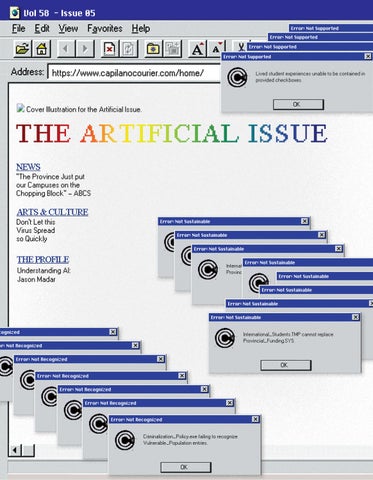
Vol 58 - Issue 05 Error: Not Supported Error: Not Supported Error: Not Supported Error: Not Supported
https://www.capilanocourier.com/home/
Lived student experienc provided checkboxes. Lived student experiences unable
provided checkboxes. Lived student experiences unable to be cont provided checkboxes. Lived student experiences unable to be contained in provided checkboxes.
Cover Illustration for the Artificial Issue.
NEWS
"The Province Just put our Campuses on the Chopping Block" - ABCS
ARTS & CULTURE
Don’t Let this Virus Spread so Quickly
THE PROFILE
Understanding AI: Jason Madar
cognized
Error: Not Sustainable
Error: Not Sustainable International_Students.TMP cannot replace Provincial_Funding.SYS. Error: Not Sustainable International_Students.TMP cannot replace Provincial_Funding.SYS. Error: Not Sustainable International_Students.TMP cannot replace Provincial_Funding.SYS. Error: Not Sustainable International_Students.TMP cannot replace Provincial_Funding.SYS. Error: Not Sustainable International_Students.TMP ca Provincial_Funding.SYS. Error: Not Sustainable International_Students.TMP cannot rep Provincial_Funding.SYS. Error: Not Sustainable International_Students.TMP cannot replace Provincial_Funding.SYS. International_Students.TMP cannot replace Provincial_Funding.SYS.
or: Not Recognized Criminalization_Policy.exe failing to recognize Vulnerable_Population entries. Error: Not Recognized Criminalization_Policy.exe failing to recognize Vulnerable_Population entries. Error: Not Recognized Criminalization_Policy.exe failing to recognize Vulnerable_Population entries. Error: Not Recognized Criminalization_Policy.exe failing to recognize Vulnerable_Population entries. Error: Not Recognized Criminalization_Policy.exe failing to recognize Vulnerable_Population entries. Error: Not Recognized Criminalization_Policy.exe failing to recognize Vulnerable_Population entries.
Criminalization_Policy.exe failing to recognize Vulnerable_Population entries.
Editor's Notes - The Artificial Issue
https://www.capilanocourier.com/editorsnotes/
Adam Stothard [ CO - EDITOR-IN-CHIEF ]
I like a bit of artificiality in my life. For example, I much prefer corn syrup with maple flavouring over the real maple syrup (dumb, I know). But when it comes to the artificiality of people’s opinions and thoughts, I can’t stand it. I’d rather people be honest to their own thoughts and say something that I vehemently disagree with rather than hold opinions based on peer pressure delivered via algorithm. There’s nothing worse than zealots. Be a little controversial, have thoughts, get into arguments. But make sure you’re trying to learn something and not just trying to confirm your biases. It’s hard to know yourself if you never have to confront why you hold the opinions you do, and it’s okay to change how you think about things. -Adam Stothard
EDITOR@CAPILANOCOURIER.COM
The illusion of limitless resources known as artificial abundance hides long‑term depletion behind short‑term convenience. Artificial scarcity, on the other hand, deliberately limits the availability of resources to inflate their value. These are just two examples to illustrate the versatility of artifices—human creations designed to deceive. Some definitions of artificiality use the word “imitation,” but what is an imitation if not a consensual deception? We know a piece of paper is not worth the same as a bag of groceries; still, currency is an artificial value we have all agreed to accept. The list of artificial creations shaping our reality is almost endless and often normalized, so we forget that they exist with our implicit consent. The Artificial Issue explores stereotypes, gender roles, borders, stigma, AI, and many other human creations. It questions how blurred the lines are between what is artificial and what is not, how certain artificial binaries can be harmful, and what these creations reveal about their creators. - Laura Morales
2
Laura Morales [ CO - EDITOR-IN-CHIEF ] EDITOR@CAPILANOCOURIER.COM
NEWS [6] [8] [10] [13] [14]
-
Orange Pilled "The Province just put our Campuses on the Chopping Block" - ABCS Who Will Fund Canadian Colleges and Universities if not Lower-Middle Income Countries? Major Win for CapU Student Workers DULF and the Case for Radical Harm Reduction
ARTS & CULTURE
[16] - The Impact of AI Within Crafting [18] - Algo-Rhythm [20] - Don’t Let This Virus Spread so Quickly
LETTERS [21] [22] [24] [26] -
Artificial Sunlight Smoking the Spice of Life. Fake Plastic Trees Gender Roles: The Artificial Concept that Shapes Societies
HUMOUR [28] [29] [30] [32] -
CRAN 4 Corporate Jargon I Walked Really, Really Far for the Cause. Creepy Coffee Orders
THE PROFILE
[34] - Understanding AI: Jason Madar
UPCOMING
[38] - We Won't Stand for Higher Tuition Rally, Metro Vancouver United for Palestine, & Local Music.
Meet the Crew/Contributors - The Artificial Issue
https://www.capilanocourier.com/meetthecrew/
Jasmine Garcha MANAGING EDITOR
Vlada Hayvoronska
DESIGN@CAPILANOCOURIER.COM
PRODUCTION@CAPILANOCOURIER.COM
MANAGING.EDITOR@CAPILANOCOURIER.COM
MEDIAMANAGER@CAPILANOCOURIER.COM
Kate Henderson ZINE MANAGER
Rachel Lu CREW ILLUSTRATOR
Sara & Avery CREW ADVISORS
ZINEMANAGER@CAPILANOCOURIER.COM
RACHEL@CAPILANOCOURIER.COM
Sandi Watson BOOKKEEPER BUSINESS@CAPILANOCOURIER.COM
NASH@CAPILANOCOURIER.COM
Mia Lancaster LETTERS EDITOR
Jordan Tomlinson HUMOUR EDITOR
LETTERS@CAPILANOCOURIER.COM
HUMOUR@CAPILANOCOURIER.COM
Theodore Abbott NEWS EDITOR & REPORTER
4
Cameron Skorulski
PRODUCTION MANAGER
Andy Poystila ART DIRECTOR
Anonda Canadien ARTS & CULTURE EDITOR
MEDIA MANAGER
NEWS@CAPILANOCOURIER.COM
ARTSANDCULTURE@CAPILANOCOURIER.COM
Cami Davila CREW WRITER
Ben Taylor CREW WRITER
Dimitri Katsionis CREW VIDEO EDITOR
Amy Ferguson VIDEOGRAPHER
CAMI@CAPILANOCOURIER.COM
BEN@CAPILANOCOURIER.COM
DIMITRI@CAPILANOCOURIER.COM
AMY@CAPILANOCOURIER.COM
WRITING CONTRIBUTORS Mayumi Izumi, Ren Zhang, M.S Diem, Jasmin Linton, Arland Sackville & Yasmine Elsayed.
VISUAL CONTRIBUTORS Caroline Zhang, Alex Baidanuta, Andrei Guecco, Yizhuo Li, Jasmin Linton, Keira Schick, Ryan Coomber, Emilyn Lai, Christina Williams, Lily Jones, Tin Raganit, Livvy Hung, Anna Dinh, Anya Ali Mulzet & Ren Zhang.
ADDITIONAL GRAPHICS Royalty Free 3D Computer Graphics library by KHN Corporation Japan, 1996 & Windows 95/XP
COVER ART Andy Poystila.
INTERESTED IN CONTRIBUTING? Email editor@capilanocourier.com for potential writers, and production@capilanocourier.com for interested visual artists and/or photographers. *Illustrators and Photographers are required to send a portfolio or sample(s) of their work.
5
NEWS
Vancouver Mayor Ken Sim’s Bitcoin Obsession In December 2024, Vancouver Mayor Ken Sim proposed a motion to make Vancouver a “bitcoin friendly city.” The motion outlined that this initiative would be put into action by “undertaking a comprehensive analysis of the potential to integrate Bitcoin into the City of Vancouver's financial strategies, such as but not limited to accepting taxes and fees in Bitcoin as well as the potential conversion of a portion of the City’s financial reserves into Bitcoin to preserve purchasing power and guard against the volatility, debasement and inflationary pressures of traditional currencies.” Essentially, getting Vancouver to run as much as possible on decentralized crypto-currencies to ‘future proof’ the city against the instability and fluctuationof the Canadian dollar. It is important to recognize just how radical this change would be, as this would mean using tax payer dollars to buy/invest in Bitcoin. No other major city in the world currently has any financial reserves held in Bitcoin except for Roswell, New Mexico,
6
Written by Ben Taylor (He/Him) // Crew Writer Visuals by Caroline Zhang (Any) & Alex Baidanuta (she/her) which has a population of less than 50,000 people. According to Coin Gecko, the value of their initial $3500 investment has fluctuated over $1500 dollars since the start of October, showing just how volatile this currency can be. Sim, in addition to advocating for Bitcoin as mayor, is also a major investor in various crypto currencies and related exchanges, as detailed in his financial statements. A firm believer in the future of crypto, Sim defended his motion in an interview with the CBC, stating that Bitcoin “is basically perfect money.” When asked about a potential conflict of interest due to his financial stake in the currency, he replied “No, not at all.” However, various critics disagree with Sim’s faith in the digital currency, claiming that a move to incorporate bitcoin into Vancouver’s finances would be a major mistake. Prominent Vancouver business person Frank Giustra referred to Sim’s crypto plan as being “incredibly reckless and stupid.”
THE ARTIFICIAL ISSUE
In another interview with the CBC, law professor Dan Rohde took issue with crypto's often capricious nature, stating, “It’s extremely risky to frankly have a bitcoin reserve,” warning of a scenario wherein public funds are diminished during a dip in Bitcoin’s value. Students of the Motion Picture Arts program (MOPA) here at Capilano University were also quite critical of the motion. One student responded, “it’s a baseless and aimless goal [...] because there’s so many other issues that need to be dealt with.” Another stated “it’s a hilariously bad idea,” and pointed out that Canada is the only G7 country that does not hold any of the federal reserve in gold. On this subject, Sim has argued, “There's a whole bunch of reasons why bitcoin is far superior to gold,” claiming, “Gold is basically an analog version of bitcoin.” Despite the motion ultimately passing, a representative from the Ministry of Housing and Municipal Affairs in B.C. clarified that under current law, “local governments, including the City of Vancouver, are not permitted to hold financial reserves in cryptocurrency.”
history with bitcoin, including being the world’s first city to open a Bitcoin atm back in 2013, indicating that the city has always been at the forefront of developments in digital currencies. He also reinforces Sim’s point about the safety of Bitcoin, and pointed out that –due to inflation– the Canadian dollar's value has dropped significantly in the last 30 years. Cole suggests that the mayor’s plan could work if implemented step by step, “Start small, use super-secure storage with regular audits, let people pay some fees in Bitcoin (with instant conversion to dollars if needed), and use BC’s extra clean hydropower for any mining.” While the motion was passed in December of 2024, since the provincial legislation prevents the holding of cryptocurrency in the city's reserves, there have been no further updates to the plan. Unless that changes, it is difficult to see any way for Sim to execute his plan. But, that doesn’t stop him from promoting the currency that he calls, “the greatest invention in human history.”
Cole Godwyn, a local Bitcoin proponent and head of business development at Coinos, believes that Sim’s plan is “a smart, forward-looking idea.” He points to Vancouver’s
7
NEWS
"THE PROVINCE JUST PUT OUR CAMPUSES
ON THE CHOPPING BLOCK"- ABCS Students and faculty across
the province are sounding the alarm Written by Laura Morales P. (she/her) // Co-EIC Visuals by Yizhou Li (he/him) // Contributor The Ministry of Post-Secondary Education and Future Skills launched a review “with a holistic approach to sector-wide sustainability,” on November 25, 2025. The purpose of this review is to stabilize B.C.’s public post-secondary institutions, given that 19 of the 25 institutions in B.C. are “forecasting at least one annual deficit and nine are in an accumulated operating deficit position.” However, the Alliance of BC Students (ABCS) described this review as a “farce,” given the short allocated time-frame of approximately six weeks, and classified the talk of sustainability and efficiency as a narrative to justify “tuition hikes, service reductions, and campus closures.” The BC Federation of Students (BCFS) and the Federation of Post-Secondary Educators of BC (FPSE) are also sounding the alarm. On Nov. 25, Herrera Lira, chairperson of the BCFS, stated that long-term sustainability cannot be discussed “without committing new funds alongside meaningful changes,” considering that the post-secondary education system has been “proven to be systemically underfunded.” Similarly, in a media release published on Nov. 26, the president of the FPSE pointed out how the B.C. government encouraged the recruitment of international students to compensate for funding gaps, and how disappointing it is for new funding to be off the table now that revenue from international tuition has dropped significantly. The ABCS warned, “raising tuition, closing schools, and laying off campus workers won't fix our public post-secondary education system, it will destroy it.” Another review was launched by the B.C. government in March 2022, but the findings were never released. At the time, the province recognized that the block-funding model it currently uses hasn’t been updated in over 20 years, which “has created constraints and inequities for some public post-secondary institutions.” The findings of this review were meant to be released in the fall of 2022, in a report called What We Heard. This report, however, was never released by the government and only recently did a freedom of information (FOI) request filed by the BCFS shed light on the contents. The Ministry indicated that the information collected during the 2022 review was never released because of the “dramatically changed landscape” produced by the 2024 federal policy changes. 8
THE ARTIFICIAL ISSUE
However, as revealed in a Castanet article from November 14, 2025, “The B.C. government had all the information it needed to fix problems in how public universities and colleges across the province are funded before federal policy changes caused a sector-wide financial crisis.” The FOI documents released by the BCFS contain three key takeaways: •
According to the lead consultant of the review, without a “material increase” of approximately $200 million—on top of current collective bargaining related increases—any benefits for one institution would mean a loss in funding for another.
•
In an information note sent to Minister Selina Robinson on Feb. 25, 2023, the lead consultant had prepared different options to move forward with the results of the review, depending on whether a material increase in post-secondary education funding was consistent with the government's 2-year agenda. Given that the review was shelved, it’s safe to assume that the answer was no.
•
The consultant described the current block funding method as a “zero-consequence funding approach.” For example, institutions are provided with a target number of how many students they should have, but there are “no penalties for under-delivery.” As a result, there’s a “management culture within many [institutions] of ‘don't manage, rather complain about inadequate funding.’’’
The Ministry doesn’t acknowledge the under-funding of postsecondary institutions in the announcement of their new review, and won’t release the 2022 What We Heard report that directly addresses how reliance on international studentrevenue is a direct, intentional and risky strategy to fill a gap created by provincial underfunding, or ‘prevailing fiscal conditions’ to use the report’s exact wording. Moreover, the Ministry states that it has supported the post-secondary sector with a funding increase of $1.2 billion since 2016-17, but it also acknowledges that this increase only addressed negotiated wageincreases and "targeted seats in high-demand areas.” On the other hand, according to a report published in March 2025 by the BC Federation of Students (BCFS), titled Building Resiliency: Stabilizing BC’s Post-Secondary Education System, funding from the government accounted for over 80 per cent of institutional revenue in the 1980s, 68 per cent in the early 2000s and today represents 40 per cent. Lastly, the recently announced review also attributes the financial pressure experienced by post-secondary institutions to declining domestic enrolment. This trend—according to the 2025 BCFS report—can be traced back to the tuition hike in the early 2000s. After a 10-year domestic tuition freeze came to an end in 2001, “undergraduate domestic tuition rose 92.6 per cent from $2,527 to $4,867,” until the two per cent cap for domestic tuition increases was put in place in 2005. Still, one of the expected outcomes of the new review process is to “review tuition policies.” The Courier asked Capilano University’s administration whether it supports the two per cent cap on domestic students, or if they would increase domestic tuition by more than two per cent (in line with inflation) if the cap was no longer in place. The administration responded, “CapU complies with the provincial policy that limits domestic tuition increases to two per cent annually. Any consideration of changes would require careful review, consultation with the university community, and approval through established governance processes.” The administration
didn’t confirm or deny if they support this cap, only that they comply with it, followed by a recap of the steps involved in the process to increase domestic tuition if the cap was no longer in place. According to Statistics Canada, the percentage of students in B.C. who owed debt at graduation in 2020 was 44 per cent, with half of them owing $25,000 or more. Moreover, the data obtained from the department of Institutional Research at CapU indicates that 82 per cent of domestic students are working while studying, from the 370 respondents of the survey conducted at the beginning of Fall 2025. Acknowledging that students are accessing campus food banks in record numbers and working multiple jobs, the ABCS argues that, “Asking this generation to pay even more is not ‘reform’—it’s cruelty.”
Comparative chart of the two reviews Characteristics
Funding formula Review (March 2022)
Sector-wide sustainability Review (November 2025)
Led by
Don Wright
Don Avison
Indicated reason
The block funding model currently used hasn’t been updated in over 20 years and “has created constraints and inequities for some public postsecondary institutions.”
Stabilize B.C.’s public post-secondary institutions, given that “19 of the 25 institutions in B.C. are forecasting at least one annual deficit.”
Engagement phase
April - August, 2022
Nov. 25, 2025 - Jan. 15, 2026
Scope
Included input from 25 public post-secondary institutions, sector organizations, business community in over 40 targeted engagement sessions, Indigenous partners, student, labour and sector associations.
Consultation and engagement with stakeholders (the terms of reference don’t specify which ones, but state it “should reflect input from those ultimately impacted.”)
Limitations
Focused on the “methodology for the block grant portion of the operating grant,” and didn’t review “collective bargaining issues, capital funding, and trades training funding.”
“A large injection of permanent, net new funding for the sector is not expected given the fiscal reality, which means other strategies will need to be explored.”
Priorities
Develop an updated, modern funding model that fairly distributes provincial financial resources, access to affordable, high-quality education and expanding key student supports.
“Labour market demands, government priorities, community needs, and resources needed for student supports.”
Expected outcomes
The design of an updated, modern block funding model, “which represents approximately 75 per cent of government operating grants.”
- Reduce programmatic duplication across institutions. - Improve the trades training and credit transfer systems. - Review tuition policies.
Report release date
Fall 2022 (What We Heard report; never released)
March 15, 2026 (including recommendations)
9
Who will fund Canadian colleges and universities if not lower-middle income countries? Post-secondary education at the intersection of austerity and greed
Written by Laura Morales P. (she/her) // Co-EIC. Visuals by Andrei Gueco (he/him), Jasmin Linton (she/her) & Laura Morales. Five years ago, former Minister of Immigration, Refugees and Citizenship Marco Mendicino stated, “Our message to international students and graduates is simple: we don’t just want you to study here, we want you to stay here.” Today, the gap between institutions’ operating costs and government funding, initially borne by thousands of families in the Global South who viewed tuition fees as an investment to obtain permanent residency, is now impacting colleges and universities across Canada. In a marketized higher education system, where international recruitment was far more profitable than domestic, institutions started tailoring their programs and scaling their operations to meet an artificial demand. This demand was fueled by recruitment efforts that targeted the desire for an immigration pathway more than the appeal of Canadian education itself. Although this inequitable system has been ongoing for decades, it was only after the recent drop in international enrolment that institutions and the B.C. government were forced to address it. Initially, the drop in international enrolment was attributed to the 2024 federal cap on student visas. However, instead of a limit, this number has become a target that is far from being met, revealing the government’s miscalculation of the impact that their 2024 policy changes and the narrative to justify them would have on new international student arrivals. Canada has received less than a third of their 2025 target number of new international student arrivals over the first nine months of 2025, which was set at 305,900. With the final quarter historically accounting for less than 15 per cent, even the sharply reduced 2026 target of 155,000 new internatioal students appears to be out of reach in 2025.
Although there are many similarities between the UK’s and Canada’s attempts to be more selective with the international students they receive, a key difference is how sensitive the demand is to price increases and changes in migration policies. According to the trends in international student mobility published in March, 2025 by the Organisation for Economic Co-operation and Development (OECD), Canada has one of the highest shares of students from low and lower-middle income countries among OECD members. In contrast, about two-thirds of the UK’s share comes from high and upper-middle income countries. As explained in Dr. Brunner’s policy brief, “expanded work and permanent residency opportunities in Canada increasingly attracted students from other countries with lower GDP per capita,” which led to a larger number of students from India, Nigeria and the Philippines. On the other hand, when the UK restricted post-study work opportunities, the number of students from India declined, but the number of students from China—driven more by credential value and China's economic growth than by immigration pathways—grew significantly. Meanwhile, as indicated in the policy brief, China was the top source country for Canada from 2001 to 2017, but “as China’s economy grew and living standards there rose, fewer Chinese students chose Canada.”
Now that the Canadian demographic is not able to keep up with the number of enrolment spots that have been created, the Courier reached out to Dr. Lisa Brunner—postdoctoral research fellow at the University of British Columbia Centrefor Migration Studies—and Capilano University’s Institutional Research Department to unpack critical questions about the future of post-secondary education in Canada and CapU.
If Canada is offering less, can international tuition increase more? As Mark Twain said, “History doesn’t repeat itself, but it often rhymes.” This rings true for the policies and narratives around international students being shifted when convenient, as seen in the UK over a decade ago, and in Canada today. In a 2010 BBC News article, the UK Immigration Minister at the time indicated that international students were arriving to live and work rather than study, and by being more selective they would “stop this abuse.” The UK’s crackdown included proposals to eliminate the post-study work route and other measures aimed at cutting net migration in half, even though the Institute for Public Policy Research argued that “cutting the numbers of foreign students would have a limited effect on net migration levels.” Over a decade later, the Canadian government began a consultation process about the International Student Program in 2023 which, according to Dr. Brunner, documented the government’s concern that international student recruitment had been focusing more on quantity instead of quality. “I find this very disturbing,” stated Brunner, questioning the metrics used to assess the quality of an individual person. “We can assume it’s about their economic contributions to Canada,” she said, referring not only to their contributions as students and workers, but also as potential immigrants. In line with this interpretation, by the beginning of 2024, the amount of money that applicants must demonstrate they have to qualify for a study permit more than doubled, from $10,000 to $20,635, and has continued to rise.
10
When it comes to international students at Capilano University, the average percentage of students in the last three years coming from India is 70.3 per cent, and the second most common country of origin is Iran, with an average of 4.4 per cent (Chart 1). Consequently, significant increases and decreases in the number of students from India, has the biggest impact on CapU’s finances. For instance, the budget for 2023-24 had a $3.3 million deficit, but at the end of the fiscal year it reported a $11.6 million surplus. In contrast, the university is expecting a $7.9 million deficit for 2025-26. According to Dr. Brunner, the government expected universities to play a filtering role, “to help select ‘high-quality’ immigrants for Canada.” Then—when international student enrolment at the college level and at less elite institutions expanded their operations far beyond what Canada’s own population needed—the government realized it couldn’t rely on a profit-driven education system to serve as a reliable filter for ‘high-quality’ immigrants. For example, the CapU’s internationalization plan published
in 2021 aimed to maintain international enrolment at “no less than 30%, and no more than 40% total enrolment FTE,” but the university reported a 51.3 per cent international FTE in 2023-24, and a 48.7 per cent in 202425 even after the impact of the 2024 federal changes. These unsustainable recruitment levels, as well as the political pressure to address negative public opinion around immigration, led to the 2024 federal cap on study permits. If the international student numbers received after the pandemic were not reflecting the actual demand for post-secondary education in Canada, what will be the new normal? The CSU forecasts that numbers will stabilize by 2028-29, with a 15-18 per cent reduction from 2024-25 revenue, which would be similar to their 2017-18 numbers. “We don't reasonably foresee that our funding levels are ever returning to what they were in the last two-three years," stated executive director Chris Girodat. However, he clarified that the CSU has always charged the same fees to domestic and international students. On the other hand, given that international tuition at CapU is 4.4 times higher on average—considering business, arts and science programs which are the most common among international students at CapU—than domestic tuition, the financial impact for the university will be greater. Another similarity that is likely to emerge—between the UK and Canada —is the abrupt increase in domestic tuition fees after reducing the international student population and receiving recommendations from a review of the sector. The drop in domestic student acceptances the UK experienced after their tuition increased in 2012 was back to normal in less than a year, mainly because their number of entrants to higher education has maintained an upward trend over the last three decades, and the number of applicants has been consistently higher than the number of acceptances. However, if Canada were to steal a page from the UK playbook, and increase domestic tuition fees, the subsequent drop in enrolment is unlikely to recover as quickly. The recently announced review of the public post-secondary education sector, which includes the “Review of tuition policy,” acknowledges that the financial pressure experienced by post-secondary institutions are in part due to declining domestic enrolment, and this trend, according to a 2025 BCFS report, can be traced back to tuition hikes in the early 2000s. On the other hand, since international tuition is not regulated, many institutions have already opted to further increase their tuition fees, including CapU. After the five per cent increase on international tuition for 2025-26—instead of two per cent in par with domestic tuition increase—“CapU executive is recommending a 5% increase for the 2026–27 academic year and a minimum of a 5% increase for the 2027–28 academic year,” as confirmed by the administration in an email exchange with the Courier.
The increase for next academic year was announced to students in a meeting with the university’s VP Finance and VP Strategic Planning on November 19. The VPs' presentation included the Tuition Impact Survey Outcomes, put together by the Capilano Students’ Union (CSU). Almost half of the 308 international respondents indicated that they would be “very likely to stop pursuing a post-secondary education” if the university were to approve a five per cent increase, which could be even higher. For the five per cent increase to represent a revenue gain for CapU— considering that the headcount of international students for 2025-26 is 2721—the maximum number of students they can afford to lose is less than 130. With the CSU survey sample alone (representing 11.3 per cent of all international students), the number who indicated they would leave (149) already surpasses this break-even threshold. Despite the likelihood of it resulting in a loss, the VPs are moving forward with the decision. Even though the province doesn’t regulate international tuition, they published the “International Student Enrolment Guidelines” in 2024. In this document, the BC government stated that public post-secondary institutions should provide “transparent tuition fee costs for the standard program requirements over the standard duration of the student’s study program, including any maximum expected increases in tuition.” Still, the disclaimer in CapU’s marketing brochures for international students stating, “Fees are subject to change without notice,” is the only form of transparency that the university has offered so far. The Courier asked CapU’s administration if the university had faced any kind of sanction from the B.C. government for not following the International Student Enrolment Guidelines. The administrations’ response was one word: No. The Courier also asked whether CapU has a plan to address international students’ financial uncertainty—not knowing what the full cost of their program will be—in the near future. The administration responded, “CapU is committed to supporting each student through their completion pathway. Services are available to help students assess their financial situation and advise on options, including scholarships, bursaries and emergency funding. We encourage students to reach out early to explore these resources.” In an article from 2023, the Courier found that from the 336 options displayed in CapU’s scholarships, bursaries and awards search interface, international students were allowed to apply to approximately seven per cent of these options, and about one per cent were exclusively for them. This previous data will help assess the new financial aid opportunities that may be available in a future article.
11
NEWS
Instead of measuring the quality of people, what if we measured the quality of life available to them? For over a decade, Canada has seen an increase in their international enrolment numbers —which peaked in the years after covid—seemingly unaffected by the growing gap between international and domestic tuition. However, now that the government has abruptly changed their “Study, Work and Stay in Canada” narrative, and adjusted their filters for ‘high-quality’ immigrants, international students are likely to be more critical of what they are getting for the same inflated price (let alone the additional increases being considered). To gauge what the living conditions have been for international students in the last three years, the Courier requested some responses from the Welcome Surveys collected by the Institutional Research department at CapU. Before the higher financial requirement and other federal changes put in place in 2024, the percentage of students who did not expect to work during the academic year was less than six per cent, while the majority expected to work between 16 and 30 hours per week, and 11 per cent more than 30 hours (Chart 2). According to the responses for 2025-26, after the increased financial requirement, 11 per cent expect not to work and 75 per cent expect to work from eight to 24 hours per week. When it comes to international students’ commute times to campus—considering exclusively one-way trips—only about 16 per cent commute for 30 minutes or less, whereas more than half indicated it takes them more than one hour (Chart 3). On the other hand, according to Dr. Brunner’s policy brief, international students have been disproportionately working in low-wage sectors, and had “worse employment outcomes than their domestic counterpart” after graduation. Moreover, international students were concentrated in fields of study that were not necessarily aligned with Canada’s labour market needs; for example, an average of 60 per cent of international students at CapU have been concentrated in business, arts and sciences programs in the last three years. Lastly, like most newcomers, international students have also reported discrimination and racism in the labour market. In 2022, Dr. Brunner published a scholarly article seeking “a more just Canadian education-migration system,” which viewed the disruption caused by the pandemic as “an opportunity to reimagine rather than to return.” Given that the 2024 federal policy changes have triggered a comparable disruption, Brunner reflected on this new opportunity to rebuild the system in a more sustainable way. “The first step is for anyone living in Canada,” she said, referring especially to those who work, study or benefit from higher education institutions, to recognize that “we all benefited from a form of exploitation of non-Canadian citizens.” According to Brunner, these benefits are often seen as something people are entitled to, rather than a set of privileges assigned randomly at birth and justified by colonial international borders. In Dr. Brunner’s view, “the belief in citizenship as a legitimate marker to separate us versus them” is one of the key components behind the current crisis in higher education. When it comes to the role of immigration in society, she questioned, “Is it really to select the ‘best of the best’ and exploit them as much as possible to benefit Canada?"
AN AUSTERITY SOLUTION FOR A GREED PROBLEM *The Courier supports critical analysis but does not necessarily endorse the views expressed in this segment. According to a 2025 BCFS report, “In the 1970s and 1980s, public funding made up over 80% of institutional revenue,” but a few decades of a neoliberal tax regime later, that figure is now just 40 per cent. As explored in a previous interview with Dr. Dale McCartney, Canada has massively reorganized its tax regime to benefit the wealthy and corporations since the 1980s. In other words, the insufficient government funding has less to do with the province actively reducing allocated funding, and more to do with the province having less money to distribute in the first place. It was already hard to justify a large-scale wealth transfer from the Global South to subsidize post-secondary education in countries of the Global North. However, if international student tuition is at an all-time high to maintain a tax regime that allows the wealthiest people in the province to hoard an even larger share of the province’s wealth, then the austerity solution that the province is considering— including the increase of domestic tuition—highlights the real problem: greed. For instance, on October 31, 2025, the BC Green Party published a media release titled “It’s time for the ultra-wealthy to pay their fair share.” According to their calculations, the province can raise approximately $1.5 billion in annual revenue by increasing “the current top two tax brackets by 1 point,” and by adding three new personal income tax brackets for the “ultra-wealthy.” With the new tax brackets, income over $350,000 would be taxed an additional 3.5
12
per cent, income over $500,000 an additional 6.5 per cent, and income over $1 million an additional 9.5 per cent, which would become the highest rate at 30 per cent. To put the annual $1.5 billion of additional revenue in context, $200 million was the amount identified as the “material increase” that would address systemic issues—such as the sector’s reliance on international tuition—in the 2022 provincial funding formula review report. Additionally, the gap between the cost of international education—the sum of all expenses involved in delivering it—and the price set by institutions is widening even more in a time when Canada is offering less. This price reflects what many students were willing to pay for a pathway to permanent residency. But, if Canadian institutions want to be chosen for the value of their credentials alone, then they must align their price with that educational value. Lastly, students in B.C. have organized multiple protests and rallies against tuition increases in the past, which have led to a 10-year tuition freeze (from 1991 to 2001) and the two per cent cap on tuition increases in 2005. However, protests have never led to a tuition decrease, not even after the 92.6% tuition increase between 2001 and 2005 that impacted the “once steady trend of annual increases in student numbers,” as indicated by the 2025 BCFS report. In other words, if the provincial review that is underway resulted in a steep increase of domestic tuition, it is very likely to become the new normal. Reverting it would require a lot more effort than keeping the two per cent cap in place. With the review results set for release in mid-March 2026, students, faculty, staff, and any B.C. resident concerned about shifting the burden of decades of unsustainability onto students have until then to get organized.
MAJOR WIN FOR CAPU STUDENT WORKERS
THE ARTIFICIAL ISSUE
New Student Employee Union Gets Wage Increase Written (she/her)//Contributor WrittenbybyMayumi Mizuki Izumi ()//Contributor Visuals by Rachel Lu (she/her)// Crew Illustrator Organizers at Capilano University have scored a major win for student employees after an eight-month long process of unionization. Previously, all students employed at CapU were earning B.C.’s minimum wage of $17.85. However, as of October 2025, seven months after student employees officially joined the union, MoveUp and the university have reached an agreement to increase their wages to $22.21. This agreement also means that student employees are now included under MoveUp’s Collective Agreement.
newly formed union, with research assistants (RAs) being left out. Teresa Aguirre is an RA for a new program called Writing Lives, who was initially excited to hear about the student wage increase, but is disappointed that they were not included, “We’re just trying to make a living as well and this makes it seem as if RA positions aren’t as important as other positions offered to students on campus.” But, she adds, “I really do enjoy my position as an RA even if the pay isn’t as much as other positions on campus.”
Former CSU Women Students Liaison and CapU Student Life employee, Niko Williamson first had the idea of forming a union towards the end of her student leadership term. At the time, Williamson was inspired by labour organizing taking place at SFU, and this motivated her to get the ball rolling. Unknowingly, Williamson and former CapU student Theodore Abbott worked separately on the same goal of unionising student employees. Courier Co-Editor-in-Chief, Laura Morales introduced them and the three students banded together to begin the almost year long journey to form a union.
Although student organizers wanted to have all student workers included in the collective agreement, Williamson explained that because research assistants work for faculty, there was a chance that the university would remove RAs from the list of employees covered. Union cards expire after six months and according to Williamson, they could not risk losing all the hard work that went into their card signing drive.
Career Development Centre employee Keshav Makker was one of the students who supported unionization. He was working for CapU Student Life for one year before the wage increase, and Makker says he struggled to pay for groceries and monthly expenses while trying to balance his studies. “I felt that the student employee wage didn’t reflect the amount of responsibility we carry or the value we bring to the campus community,” he shared, “It was difficult to manage rising living costs on a minimum-wage rate, and it often felt discouraging and unsustainable.” However, since the wage increase, Makker told the Courier that his quality of life has improved, and that he feels less stressed about monthly expenses. All but one group of student workers have been included in the
Williamson, who is now the student representative for the bargaining committee, emphasized that, “Every single card made a difference,” referring to the narrow margins upon which their union drive rested. At a time when higher-education in B.C. is defined by austerity budgets and belt-tightening, CapU’s student workers union is a bright spot within an otherwise bleak state of affairs. As indicated in the B.C. government’s recent post-secondary system review announcement, negotiated wage increases are one of the two factors that directly increases an institution’s provincial operating grant, meaning that wage increases don’t erode the university’s limited budget, but rather expand it. In the face of looming tuition hikes for both international and domestic students, it’s likely that the fight for higher wages is far from over. 13
NEWS
DULF
14
and the Case for Radical Harm Reduction
THE ARTIFICIAL ISSUE
While The Drug Users Liberation Front contends with legal battle, the need for safer supply continues Written by Ren Zhang (they/them) // Contributor Visuals by Cameron Skorulski (he/him) // Crew Illustrator
As deaths by toxic drug poisoning in B.C. continue to climb, there is growing consensus that the policies in place are not working. Declared a public health emergency in 2016, the toxic drug supply has claimed 13,000 lives in B.C. since April of that year up to September 2023. Recent reports from the BC Coroners Service show that, in the month of September 2025 alone, there was an average of 5.3 deaths per day caused by fatal drug poisoning. With the government failing to take meaningful action that could make the drug supply safer, drug users are forced to rely on a supply that contains unregulated substances that drive overdose deaths. While B.C. has dabbled in safer supply measures, these attempts to reduce overdose deaths have been overshadowed by a failure to provide the other essential pillars of harm reduction, such as housing and low-barrier treatment options. In Vancouver, the problem has also been compounded by a disproportionate funding of the Vancouver Police Department (VPD), while social services remain stretched for resources. B.C.'s human rights commissioner, Kasari Govender, says that treating the drug crisis as individual moral failings instead of a health issue fuels stigma and violates peoples' human rights. “We actually should be providing people with appropriate treatments and with access to a drug supply that isn’t going to kill them," she states, adding that safer supply programs are evidence based, being backed by advocates such as Lisa Lapointe, B.C.'s provincial health officer. This idea is not new; community members, activists and organizations such as VANDU (Vancouver Area Network of Drug Users) and DULF (Drug User Liberation Front) have been saying this for years. DULF, founded by Jeremy Kalicum and Eris Nyx, took this upon themselves and saved lives through their 'compassion club' safer supply model. The initiative provided a regulated supply of tested drugs and supervised consumption for drug users from August 2022 until they were raided by the Vancouver police in October 2023. Their community-led program saw no member deaths in the time they operated and non-fatal drug poisonings were cut in half. Other safe supply models in Canada have also proven successful in preventing deaths and reducing strain on the healthcare system. These models are often led by the people that are affected. Despite their work being previously tolerated by the VPD, DULF was raided in October 2023, leaving community members without an essential service and
vulnerable to death via the toxic drug supply. Kalicum and Nyx were charged with possession of drugs for the purposes of trafficking. DULF's legal battles are long and complicated, beginning with their denied application and appeals to get further exemptions to procure drugs from a legal source in 2021, their ongoing challenge to the Controlled Drugs and Substances Act (CDSA), and a trial for their charges spanning more than two years. In November, they were found guilty of three counts of possession for the purposes of trafficking by BC Supreme Court Justice Catherine Murray. However, in her ruling she ordered that their charges be stayed until a decision was made in DULF's constitutional challenge. In this bureaucratic fight, it's easy to miss the real casualties, including community members in Vancouver who have died since the shutdown of the club, and the thousands more that could have been prevented if policies were different. "Maybe the end goal is to not have any of us around anymore? And what else are we supposed to think? Drug users are being scapegoated for all the failures of our broken system. We’re low hanging fruit. It’s easy, you can always blame the drug user. Vilify, criminalize, stigmatize: Makes it so you want to crawl away and hide. These are lies. The public is being let down. We are a part of society - we work, we rent, we walk these streets, we love, we are everyone," a letter from five members of DULF's compassion club reads. In the wake of families, friends and loved ones losing their lives after the compassion club's shutdown, activists like Garth Mullins, the host of the Crackdown podcast, put a label to what the VPD, the healthcare system and policy makers have done, calling it 'social murder.' Coined by Friedrich Engels in 1845, this term originally came from his writings about the working and living conditions in England that brought about unnatural and premature death. Those in charge directly created, encouraged and profited off these conditions. At the heart of the DULF case lies a question of what people owe to each other. The lines of power can be traced in this story —the VPD's involvement, the politicians, Health Canada—and they have led to a crisis with no end in sight. As such, if a society is judged by how well it treats its most vulnerable members, then Vancouver's measuring stick might fall short. 15
ARTS & CULTURE
The Impact of AI Within Crafting Being a crafter in the age of AI
Written by M.S Diem (they/he/she) // Contributor Visuals by Keira Schick (she/her) // Contributor
With recent developments and implementations of generative artificial intelligence, the ability to ‘create’ has suddenly become far more accessible and profitable. Generative AI is consistently criticized for its inability to produce original creative works, instead relying on a wealth of knowledge and images fed to it by its frequent users, as well as from online databases and social media platforms. AI’s prevalence has grown to affect nearly every aspect of day-to-day life, though its effect on artistic careers is particularly criticized. The Courier spoke with Vancouver-based artists Murray (@pissed_off_portrait_ painter on Instagram) and Apsara (@acornwitch.art on Instagram) about the effects of AI-generated content, tangible art, jobs in creative industries and the doubt that comes along with the growing effect of AI on the world. Murray is a freelance 2D animator, working in both Clip Studio and Toon Boom to hand draw his frames on multiple projects ranging from commercials, music videos and other short-form content. In addition to animation, he also creates mixed-media pieces ranging from canvas to clothing. Murray finished his degree 16
from Vancouver Film School in 2D animation, only to find that the industry was in shambles before he could get his foot in the door. The implementation of generative AI in animation has severely limited the available jobs in the industry, like many other creative industries. “2D (hand drawn) animation does not really exist outside of independent productions anymore.” Murray discussed the difficulties in finding jobs during the rapid expansion of generative AI, lamenting, “Why pay anyone for anything anymore? If you have something for free that can do it for you almost as [well], why pay an artist?” Apsara is a third-year student in Capilano’s Idea school of Design after graduating from Langara's Design Formation Program. She’s primarily producing digital art, though lately has been experimenting with more tangible artforms, including linocut prints. “That's something I'd like to explore more,” Apsara remarks, “A lot of people will be looking for more handmade things, it's getting harder and harder to distinguish between AI art and regular digital art.” Recently, Apsara was able to participate in Capilano’s Student Craft Fair, her first opportunity to do any craft fair. She discussed the inaccessibility of typical craft fairs or markets, with the
THE ARTIFICIAL ISSUE price of purchasing a booth at such events making it difficult to justify for many artists. The expense of creating pieces to sell is also a huge factor in deterring many artists from participating in similar events. The creation of art can become expensive, with the cost of supplies, tools and time. Though producing inventory may still be an expense, using generative AI for craft markets eliminates other expenses like materials and time. Although initially intended to promote local artists and handmade goods, this combination of cost and labour raises concerns that artwork generated by AI will continue to saturate these craft fairs. While acknowledging its use in other areas of life, both Murray and Apsara expressed frustration with the sheer amount of AI content in the world around them. Murray himself admitted that he’s a “pretty big AI hater. Not because it exists, but because of what people use it for.” Though frustrated with generative AI and its effect on his industry, Murray still harbors a lot of love for art itself.
“I think that being human is making art and expressing yourself. And that's what's so beautiful about it. And I just don't get why you would have a robot do that for you.” Similarly, Apsara remains optimistic about AI in creative settings. “I did want to maybe encourage people not to feel hopeless about AI art. I think that we're coming to a point where it's getting really saturated and the generators are starting to feed themselves with their own slop, so to speak.” There are still spaces for handmade art and hands-on creation, and generative AI has encouraged these forms of art once again. “I mean, as much as I love digital art, I also see it as an opportunity for traditional mediums to make a comeback outside of the fine art world.”
17
ARTS & CULTURE
In a world plagued by
technological advancement,
what’s the impact for musicians?
18
THE ARTIFICIAL ISSUE
Written by Adam Stothard (he/him) Visuals by Emilyn Lai (she/her) & Ryan Coomber (he/him) This past November, the song ‘Walk My Walk’ by Breaking Rust in streaming. ‘Bands’ and ‘artists’ such as Breaking Rust or the hit no.1 on the Billboard Country Digital Song Sales chart. Normally Velvet Sundown have been popping up on playlists, not to mention the this wouldn’t be newsworthy, but the song––along with all the surrounding massive amount of artificially generated ‘calming piano music’ or ‘lofi visual artwork accompanying it—is entirely AI generated. beats’ highlighted on the platform. While some aren’t convinced the song succeeded on merit, the chart-topper nevertheless provoked a conversation about realism When it comes to music production itself, AI ‘tools’ have become within music and the nature of authenticity. But, what do local more normalized. Charlie Puth admitted he used the AI production musicians make of this? tool Replay to create background vocals for his song Changes. But, what’s interesting is the push for companies to rebrand pre-existing Sean Finan, a local Vancouver musician, filmmaker and journalist tools to be “AI-powered.” For example, the online music service remains hopeful about the music scene, not due to AI but in spite of it. In a LANDR has a tool that would master (a complicated production world where AI can pump out ready-made pop, Finan sees an opportunity process that readies your songs for being played across all for musicians. He asks, “The great thing about AI is it poses the question: devices and optimizes loudness) your music, a service I used myself What is the point of humans?” Finan recently starred in a satirical when I published my own album back in 2020. But since the proliferation short film titled ‘Braindead Fiends,’ which makes use of AI to display its of AI, they’ve begun to describe their mastering process as an inherent worthlessness. Finan offers, “If art is meant to be mindless “AI mastering algorithm.” It begs the question: what changed? entertainment, then that’s fine, but it’s not going to be what I consider the From what can be discerned, it does the same thing it did before it highest purpose of art, which is to cause a profound experience.” was branded as AI. Although Finan may make occasional use of AI to satirize those “There's been such a push for physical media. Everyone's Instagram who genuinely like it, he remains steadfast in his belief that AI cannot stories in my program are filled with almost daily encouragement produce anything artistically valid. “It comes back to the idea that to buy CDs and buy records and things like that, which I think is great.” art is supposed to be transformational.” He goes on to speak on the says Jewel Epp, a student in the music therapy program at ethical ramifications of it, noting, “You’re always going to want to choose Capilano University. The arguments for purchasing physical the more ethical option, and with how unethical AI is, even if the song is media are well documented, but furthermore, Jewel notes fine, you’re always going to choose the human option.” the aspect of live performance when talking about music.“ One of the biggest things we talk about going into our careers Furthermore, Finan takes aim at companies who’ve slyly integrated ar- is that music therapy is not just pressing play. It's bringing tificial intelligence into their platforms, such as the music streaming gi- the guitar to the hospital bedside and singing live to the ant Spotify. “What Spotify is doing is pumping AI music into playlists so person because there is something different. Scientifically, it is shown they don’t have to pay artists as much. It’s stuff that they’ve created, like pain relief, the parts of the brain that are used . . . when it's real, so they can push, like, sonic narratives that are tricking people. when it's a human.” It’s not explicitly said [that] it’s AI.” He speculates, “This is the straw being broken on the camel's back, in terms of Spotify,” referencing the So, where do we go from here? Many have pointed out that while exodus of popular alternative artists such as Hotline TNT, Massive At- AI may be infiltrating the streaming space, the transfer of energy tack, Xiu Xiu, King Gizzard & the Lizard Wizard, Deerhoof, Chad Vaan- between a performer and a crowd is harder to replace. While tech galen and many others pulling their music from the platform. companies may be profiting off of people being sequestered to their bedrooms, frying their dopamine, they have yet to completely While Spotify still remains the biggest music streaming service in the ruin concerts. So, if you’re worried about AI in music, the best way world, it’s been facing a growing backlash over the years for a litany to quell those anxieties is by going to a live performance, to feel the of reasons. Some examples include their low artist pay-per-stream vibrations in the room emanating from a live artist doing what they do rate, their CEO Daniel Ek’s investment in an AI military defense best. As it stands, witnessing a raw live performance is something company and allegations of purposefully pushing AI music in their yet to be taken away by an algorithm. curated playlists. Lately, artificial music has been going widespread 19
ARTS & CULTURE
Don’t let this virus spread so quickly
Without even noticing, we have been believing and spreading stereotypes about each other's countries. What are the most common ones among CapU students? What can we do to stop it? Written by Cami Davila (she/her) // Crew Writer Visuals by Jasmin Linton (she/her)// Contributor
Stereotypes act similar to a virus, they spread easily and cause a lot of damage. Once they spread, there is little people can do because most of the time they are already part of the problem. Stereotypes are a virus in every aspect of people’s lives. Through ideas that are conservative, traditional, poorly informed, heteronormative and rooted in patriarchy, these ideas create characteristics and sociocultural norms about how things should be. When someone} resists those directives, the “virus” of the stereotypes attacks with hate and violence to restore order. A stereotype is a fixed and oversimplified image of a particular person in this case. On a big scale, they create an entire narrative and set of characteristics about countries and, like a virus, spread this false information as widely as possible. Various major conflicts between countries are based on hate born from stereotypes. For example, during World War II, the Nazis believed that Jewish people were manipulative, corrupt, dishonest, immoral and especially that they were contaminating their society with their perceived racial inferiority as “non-Aryan.” As a result of this nationalism and hate, according to the United States Holocaust Memorial Museum (USHMM), approximately six million Jewish people were killed by the Nazis regime. Of course, we cannot overlook the fact that there are many more aspects that lead societies and countries to these major conflicts. However, the virus of stereotypes remains within people and inevitably grows, driving them to act according to misinformation.
Cultivating genuine curiosity, seeking information, reading, and asking questions are part of the solution in combatting stereotypes. As reported by Statistics Canada, 42.2 per cent of Vancouver’s population consisted of international residents in 2021. According to Capilano University's website, there are currently 3,838 international students from 92 different countries and from some students’ perspectives, there’s many stereotypes about their countries. “I wish people would take the time to research about other countries' history and culture, before assuming stereotypes without questioning what’s behind,” shares one first-year Business Administration student from Iran. The Courier spent one afternoon talking with CapU students about the most common stereotypes they have heard about their country of origin. “When I say I’m from Korea, people ask like 'Oh, North or South?' and it’s a genuine question like 8 times out of 10! Also, a lot of people think that when you’re from another country you have an accent so a lot of them said to me, 'Oh, you’re from Korea but you don’t have an accent.' I wish they knew that not everyone has accents and we can speak fluent English.” A student from Punjab said the most common stereotype is that people don't follow the rules. “I wish they knew about our big hearts and that we are really altruistic.” Nigerians are judged by being uneducated and egocentric. A student told us that every time someone finds out she is from Chile they ask her, “You guys don’t have internet or TV’s, do you?” “People have the stereotype that India is a poor country and that it’s messy and chaotic, like there are cows on the road. Some areas are like this, but not everywhere. My country is very rich in a lot of things, like diversity, culture and hospitality. I wish others knew about our many mathematicians and scientists. India is not a developed country, but there are so many resources,” from a third-year science student. A student from Austria mentioned that a common stereotype is that everyone likes schnitzel and goes skiing in the mountains, “which is not true because it’s actually expensive and not everyone can afford it.” Beside her, a German girl said people think they are unfriendly and direct, “We are actually nice and we like to have a good time!” “Latina women have the stereotype of being crazy and intense,” shared a thirdyear business administration student. “I am tired of being disrespected and called lazy when literally Latino people are so hardworking.” An Ecuadorian student said that people believe that their country is warm because it's near the equator, “they also think that we should have darker skin.” Sadly, stereotypes have become the easiest way to learn about others and other countries and we must work to avoid falling into this common trap. However, if we become aware of those stereotypes and recognize how hurtful they are, we can choose to respond thoughtfully rather than assume. Next time, we might pick a book about another culture or simply ask a friend about their home country and its history: a history that, fortunately, we as CapU international students can share with one another. Just like any virus, it has a cure. 20
THE ARTIFICIAL ISSUE LETTERS:
How I cope w ith SA D Written by Mayumi Izumi (she/her)// Contributor Visuals by Lily Jones (she/her) & Tin Raganit (they/them) Every autumn, daylight savings time comes to an end and we set our clocks back one hour. Many of us start our day by waking up early in the morning—when there is no sunlight to be seen—to then head home in the absence of light. Add Vancouver’s cloudy, rainy and moody weather to the darkness of the fall and winter months, and it equals SAD. Some may be unhappy with the change of season, but still find ways to cope with our daily routines without too much difficulty. However, there are people who suffer a condition known as Seasonal Affective Disorder (SAD). According to the Ontario Shores Centre for Mental Health Sciences, SAD typically starts around the same time every year and the people that it affects may be depressed beginning in the fall and throughout the winter. Severe Seasonal Affective Disorder affects two to three per cent of Canadians, while mild SAD affects approximately 15 per cent of Canadians. Optionsfor treatment include light therapy, psychotherapy and medication.
this can lead you to feeling isolated and alone. We can all be susceptible to depression, whether it is SAD or another form during the winters in Vancouver. But, we can all have ways to combat it; those who need support can reach out to friends, families or a professional to help you overcome it. Full-time (nine credits or more) CapU students have mental health and wellness benefits through the CSU’s provider, Studentcare, which provides counselling with a mental health practitioner in their network. There is also a 24/7 student assistance program called EmpowerMe. Find counselling and mental health services available to students at: capilanou.ca/health-services
In my past experiences with SAD, I tried Vitamin D supplements and had success with them. The winter blues that I experienced were the mild form of Seasonal Affective Disorder and was not a deep depression (I have experienced this too). The vitamins helped to eliminate SAD pretty quickly. Never having tried a SAD therapy lamp, I instead have two Himalayan salt lamps: one in my living room and the other in my bedroom. With the warm light they emit, I feel an instant mood shift, a softening of my emotions. When I turn my lamp on for days that feel stressful or edgy, the light makes me centered and relaxed. Even now, as I write this article and very cognizant of the deadline, I turn on my Himalayan salt lamp in the living room and I feel ahhh . . . calm and tranquil. Using the one in my bedroom before going to sleep helps me relax while I cozy up with a book at the end of a long day. The warm light of my lamps helps to keep the Pacific Northwest’s cold darkness outside my windows and doors. Inside my home, I am surrounded by a soft orange glow. Connecting with community and keeping active are other alternatives to combat SAD. Join a CSU Club or two, attend events on campus or reach out to your friends! When I came back to Capilano University, I decided that I wanted to become involved in all that the university and the students’ union offered us. I took part-time classes, worked full-time and joined Capilano Radio Club, Young Women in Business and the CSU Board of Directors as the Mature and Parent Students Liaison. Keeping busy truly helps in keeping the blues away. If you are attending classes, and going back home again without connecting with the campus community,
21
LETTERS
Smoking the Spice of Life My Disjoined Synthetic Weed Experience Written by Ben Taylor (He/Him) // Crew Writer Visuals by Cristina Williams (She/Her) // Contributor Who cares about the last day of ninth grade? Let’s have an adventure! I’m scheming on securing some joints and starting summer break the proper way. I wait for you at Wagg creek. When your mom drops you off, you pretend to head into class and we head to Lons. We skip getting McDonald's; it’s tradition to hit the BK downtown. Like when we bought our first vape and Harry freestyled on a G-Unit beat for a chicken fry. I’m still nervous even though this is the tenth time we’ve been to Planet Rock. We make as little eye contact as possible, and ask for two pre-rolls . . . please. The guy with the ponytail heads into the back room to grab ‘em. In the meantime, we try to look like we belong here and chat about bongs with the man who’s missing a tooth. Mission success! The bus takes us to the Chiba garden so we can finally get down to business. This weed tastes kinda funny. It must be good shit. Oh my god! Bohemian Rhapsody is the funniest song ever. We hit IGA to get some essential snacks. The ground breathes beneath my feet. It’s so difficult to balance. Hang on. I need a second. This three point stance seems to balance me like a tripod. You clutch up and get the snacks alone. I sit tight on the bench. Whew, I need a break. Everything is overly saturated and looks like when you accidentally put your TV on stretch res. Who’s this girl coming up to me? How does she know my name? Everyone else is just walking past us. Is she real? I’m just going to leave. This looks like a good tree! It’s still so hard to walk . . . I think I’ll just lay down here for a while. This tree is our safe haven now; hidden in plain sight from all the pedestrians on the overpass. You bust out the JBL Flip 3. The playlist is so amazing it takes us three hours to realize it’s just the same five songs on loop (‘So High,’ ‘Wish,’ ‘Poe Mans Dreams,’ ‘Keep Floatin’,’
22
THE ARTIFICIAL ISSUE ‘Black Thoughts’). Salt and vinegar seriously is the best flavour. We go to meet up with the squad thinking school must almost be over. No way, it’s only been an hour!? I could’ve sworn it had been six. Oh well, life is good under this tree. We get a move on towards the school. In our state it might take a while to walk, so we call the homie and tell him to meet us halfway on 8th and Chesterfield. Every ten steps I need to hit the tripod stance to ‘recalibrate.’ We only manage to make it to 1st. Luckily there’s another tree for me to lay under, and we just wait for him there. The homie finds us comatose in the shade of the pine. We start to walk to the bus but my stretch res vision persists, and the ground has only gotten more and more wobbly. He’s starting to get pissed at how long it’s taking me to make it down the sidewalk, and I unsuccessfully
try to explain my predicament. My head is pounding now. We’re on a busy street with cars honking and people taking wide arcs to avoid me every time I kneel down to the pavement. At the bus loop we run into some quay rats that I vaguely know. They strike up a conversation that I opt not to participate in. I have to lock in on trying to focus my vision and overcome my dizziness. Somehow, the bus cures my balance problems, and on the walk to my friends house I don’t pause even once. Now, around eight hours in, I’m coming down a bit, realizing that this can’t have been any ordinary weed. We shrug it off and come to the conclusion that Planet Rock must just possess the strongest weed of all time. What knowledge we might have missed in that final Spanish class, we surely obtained from beneath the trees.
23
LETTERS
FAKE PLASTIC T A u th e nt i cal l y Faking It Written by Jasmin Linton (she/her) // Contributor Visuals by Alex Baidanuta (she/her)// Contributor
Nestled in the charmingly cozy Edgemont Village is the family-owned business, Trims. Known for their beautiful artificial flower displays, Trims is deeply embedded in the neighborhood’s culture and has been a unique shopping location for locals since the 90s. The Courier spoke with the lovely flower-obsessed owner Marlene who has been in the industry for over 50 years. With experience at every stage in the real and artificial floral industry, she loves her work. “It’s been an amazing journey [...] from manufacturing to retailing, all the aspects,” she says, emphasizing the advantage her well-rounded involvement gave her business. Marlene has been distributing, designing and buying both fresh and artificial flowers for 15 years, passionately stating, “I started my career in the floral design industry a million years ago.” She was inspired to open her own store after seeing the high-quality manufacturing of artificial plants in the early stages of her career. The store’s original goal was to present artificial florals as an art form as opposed to mass-market decoration.
24
Since its opening, Trims has become a hub for the community, with its comforting, familiar atmosphere inviting customers back for years. “The babies that were coming in strollers are bringing their babies into the store,” Marlene said, talking about the longevity and emotional connection built through decades by investing in the community around them, and connecting with customers over generations. “The business is the community and vice versa,”she states, the two being one in the same in her eyes. With Edgemont Village’s high percentage of women -owned businesses shaping the culture, it's no surprise Marlene emphasized that the store is shaped not only by its products, but by the women who share
THE ARTIFICIAL ISSUE
TREES The quality of artificial flowers has always been excellent, with handpainting providing incredible detail. Marlene said through her years of experience, mass production has downgraded the detail to the florals, and it's for this reason Trims pays special attention to having the best quality product, saying, “everything in our store is handpicked and the best we can acquire.” With the pitfalls of mass production, also comes the positive advances in the industry including technological changes like laser cutting, and manufacturing techniques that help broaden access to artificial floral products.
their knowledge, experiences and word-of-mouth recommendations. “Women share, our business has been built on word of mouth.” On her thoughts on artificial vs fresh flowers, Marlene said, “One is not better than the other. It's like saying, should I buy an ornament of a dog to stand on my coffee table instead of a puppy, it's two separate things.” Marlene circled back to emphasize, “artificial flowers and duplication of nature is an art form. Whether that's done with food or painting or old fur . . .” She brings up that artificial vs. fresh isn’t an either/or situation; they serve entirely different emotional and practical purposes. Fresh flowers are ephemeral, good for emotional gifts, whereas artificial flowers work well as décor, having consistency, longevity. In this sense, sustainability depends on the purpose.
When asked about the inspiration behind her hard work and dedication to the community of Trims, Marlene didn’t waste a beat and said, “100 per cent inspiration for everything in my life is my mom,” citing her mother’s love of nature as inspiration and a shared interest. Her artistic eye was shaped while growing up and paying close attention to nature. This leads into Trims’ core customer-service philosophy: “treat every person who walks in the door as if it’s your mother.” Authenticity is the foundation of Marlene’s work and the shop's identity, stating, “you can't buy authenticity. It exists. I'm just tapping into it...serendipitously with artificial flowers.” Trims’ longevity isn’t just about artificial flowers; it’s about community, authenticity and human connection. The ‘artificial’ becomes meaningful through people, stories, and generational continuity.
25
LETTERS
Gender Roles: The Artificial Concept that Shapes Societies
Is it possible to raise children without enforcing them?
Written by Cami Davila (she/her) // Crew Writer Visuals by Livvy Hung (she/her) // Contributor Do you want kids? This question has been in my mind since I continue to progress over time, and things will keep moving was very young, mainly because society has imposed on us that it’s our duty as women. I’m still not sure what my answer is. I mean, I would love to be a mom, but I’m not sure it would be responsible to have a child in the world we live in today.
Among all the questions and concerns that I have about the lives of my future kids, recently I have been thinking over and over again about one day having kids. I am a queer woman. I have only ever fallen in love with women and my gender expression is not one that people expect women to have. I have always struggled with my identity, questioning which box of the gender binary I’m supposed to fit into. Fortunately, I have been surrounded by people who don't judge me, and I have had the pleasure to live in countries more open-minded than my own. Here’s the truth: we live in a world dominated by gender roles and binaries, and sometimes they are the only lens through which we understand the world. Hopefully, we will 26
forward little by little . . . But, will my child ever be free from the social standards of gender roles? Is it possible for new and future parents to raise their children without imposing gender roles? Matthew Arthur is an instructor in the Department of Women & Gender Studies at Capilano University. He has an MA in Indigenous and Inter-Religious Studies and is a PhD candidate in Gender, Sexuality and Women’s Studies. We spoke on the phone in late November, and I asked him for his perspective on the intersection between education and gender roles. What do we understand as gender roles? “When I teach about gender roles in 100-level Women’s and Gender Studies classes, we always start with
THE ARTIFICIAL ISSUE Judith Butler’s idea of gender performativity. Our actions, behaviors and the things we wear are all creating gender all the time,” he says, “What interests me about gender roles is how they are both a kind of attitude that people have, but they're also a material practice. I think about how you can walk into a supermarket and you can see products that are marketed toward different genders, and that have, in a way, built-in social expectations for how people should act, how they should look and so on.” Gender roles even begin before the baby is born, at gender reveal parties or at baby showers. “If I imagine myself as a parent, I think it would be very complicated,” said Arthur when asked the million-dollar question , “I would feel torn between the world as it is and the world in the way that I want it to be or I imagine it to be. For any parent, there's probably a lot of worry and uncertainty about not really knowing how to support gender differences or gender diversity in children.” There are small actions that parents can take at home to ‘resist’ these binary gender roles, starting by analyzing all the ways gender is constructed. What should they wear; how should they act; what toys should they have, what behaviors are ‘allowed?’ And, in that way “we can reimagine them.” “If I were a parent, that might look like really respecting the autonomy of my child. Respecting that my child has agency or the power to make decisions and create meaning for themselves. I would entail really carefully listening to what they're interested in and what they might want and letting them, in a way, take the lead on some of these things that are socially gendered,” claims the professor. But, gender roles aren’t learned only from parents; teachers also have an enormous influence. Parents can try to create a gender-free environment at home, but it doesn’t help much if children are learning things at school that reinforce gender stereotypes. Therefore, teachers also have a responsibility to challenge these stereotypes. Arthur has noticed that students and teachers in early childhood education programs at CapU care a lot about this topic and they are doing important work around gender. However, this is an uphill fight within the current socio-political context. “In British Columbia, we have SOGI education: that's Sexual Orientation and Gender Identity education built into K-12 education and there are lots of groups fighting to remove that from schools. I consider it important to acknowledge some of the really meaningful things that we're doing to challenge these gender roles are really under fire”. The current political situation in the United States presents a strong opposing influence on this issue. According to Arthur, whenever laws targeting LGBTQIA2+ communities or restricting abortion and reproductive autonomy are passed in the U.S., a wave of backlash follows in Canada. Although there are many factors we can’t individually control, there are actions that parents and educators can take to at least create a safer space for the future generation. Arthur makes it very clear: the social construction of gender it's not something we’re born with. It's a set of social practices. Therefore, if we created them collectively, then we can also eliminate them.
27
HUMOUR
CRAN4 A WARNING TO ALL THAT HOLD POWER, BIG RAISIN WANTS TO TAKE YOU DOWN FROM THE INSIDE.
Written by Jordan Tomlinson (he/him) // Humour Editor Visuals by Anna Dinh (she/her)// Contributor
It began with a snack. My favorite snack of over 25 years: a miniature box of Raisin’s Raised Boxed Raisins. I noticed it, but thought nothing of it. Just a change in behaviour. An increase in sweating, itchiness and yelling also. Those types of things happen with age. What’s the harm? It wasn’t until my wife packed up her things and told me she was staying at her sister’s so I could have some time to ‘figure out whether I want to be a part of this family or not’ that I began to suspect something was off. Why would she want to stay with her sister when she lives here? Concerned, I asked the kids. They both responded with something I didn’t listen to, because why would I? I was just too sweaty, itchy and yelling to understand. Clearly, this was affecting me but I had a feeling it was beginning to affect others. This suspicion was raised once again the next day when my boss pulled me aside to inform me that I was to be ‘let go’ due to ‘incompetence’ and ‘consistent harassment of coworkers.’ I could see in his eyes that he was dancing around his real problem with me: my sweating, itchiness and yelling. My ears filled with a ring, tuning out his vague excuses about ‘previous warnings’ and a ‘three strike policy,’ contemplating why everyone could be turning on me. First, my wife and kids, now this? Has the whole world gone bananas? All because of my sweat, itch and yelling? But, wait. Why have I been sweating, itching and yelling in the first place? Was it not just a symptom of life? People couldn’t possibly be turning on me for something I can’t control? Maybe something else wants to control me? With everything in my life dissolving without explanation, I turn to my only true comfort: A box of Raisin’s Raised Boxed Raisins. 28
While driving home from my former place of employment, I reach in the glove-box for a stash of my favorite treat. As I open the box, I notice the ingredients list. Interesting, as I thought they were simply raisins, boxed, of course. I took a long, hard look at this small-print list while changing lanes. Everything looked as it should. Sugar, raisins, box, but something stood out.
CRAN4. It was as though everyone around me was cheering me on, ‘You solved it!’ ‘Jackass, now you’ve done it!’ I knew I had something big. I entered my home in a flash and began research that would span vast amounts of minutes, roughly 40. Why would they want me to be sweaty, itchy and yelling? It’s because they know I know that they know about me. And, they don’t want to know what I could do if I tried to get them. If I tried to take them down. They want to keep me pinned to the ground by my own sweat, itch and yell. They knew that through my admin position at a local level packaging manufacturing plant, I’d have the power to destroy everything those bigwigs over at the Raisin factory had built. Well, this is it. I’ve been Raised Raisins free for two weeks and my brain has never been less yelling, I just know it. This is a warning to all. Don’t let CRAN 4 ruin your life like it did mine. Don’t become a victim to Big Raisin.
THE ARTIFICIAL ISSUE
CORPORATE JARGON A day in the life of an employee at
Data Compilation by Theodore Abbott (he/him) // News Editor Dramatic Visualization by Anya Ali-Mulzet (they/them)// Contributor The following excerpt was provided by a clinical psychologist whose research and professional practice focuses on corporate work culture. Their client—whose name has been redacted to protect their identity—participated in a 18 month journaling exercise which concluded shortly after their position at a large tech company was terminated. By publishing this journal entry, with permission from the client, our intention is to raise awareness about the growing phenomenon of corporate jargon. Dear diary, today was a rough day. I got news that our company is restructuring and our department has been designated for streamlining. The daily grind started off like any other. I was at my standing desk banging out some action items that had been flagged by Copilot during our Monday morning scrum. Nothing too crazy—certainly not reinventing the wheel—just some low hanging fruit that needed to get drilled down before our Wednesday afternoon touch base.
My job at Gemini is pretty straightforward: I’m a marketing coordinator who works primarily within stakeholder engagement. On a day-to-day basis, this means that I collaborate directly with our vast network of clients to optimize revenue pathways and implement data-driven success strategies. I think what makes me a major asset to the company is my ability to connect the dots, maximize interdepartmental synergy and consistently move the needle, quarter after quarter. This—among other value-adds—is why I’m confident that I won’t be let go from the Gemini family. In fact, just last week I was called into my bosses office for a quick huddle. Normally these sessions are meant to facilitate blue sky thinking and to make sure that all of our ducks are in a row, but this was different . . . I was being named employee of the month, a first for me, and a first for anyone in our team! My boss explained that I exemplify the ideal mindset, combining a goals-first approach by using clean AI insights and supporting talent cultivation across multiple teams. Among my core competencies, he continued, is my bandwidth for ‘leveraging KPIs’ and ‘juggling multiple projects at one time.’ Suffice to say, I was on cloud nine after receiving such praise. Today, after we got news of the restructuring, I reached out to my team leader to see if we could touch base about the streamlining. He told me this was a conversation he’d like to take off-line for now, but that we could 100 per cent stick a pin in it and circle back later in the week. This was a major red flag. I’ve seen my boss table discussions before, but never so obviously. Until next time, Steven M. 29
HUMOUR
I Walked Really, Really Far for the C ause . A social media guru/activist’s personal essay detailing his journey to raise awareness. When people hear the word ‘activist,’ they don’t imagine a jacked, six-foot-three guy driving a brand new BMW X3; they probably picture someone driving something shitty like a Nissan Altima. Not me. I'm what you would call ‘the real deal.’ I don’t joke around when it comes to bringing the issues to the people and raising awareness. Here’s what I mean: I walked really, really fucking far to raise awareness. Maybe farther than Terry Fox even ran, and he had that robot leg to help him. I put my money where my mouth is, and my mouth is on my feet. But, what’s on my mind? Raising awareness. I have over 1000 followers on instagram (that’s more people than there are in the United States Congress and Canadian Parliament combined) and to quote Batman, “with great power comes great responsibility.” So, I thought to myself, what can I do to raise awareness for stuff?
30
Written by Arland Sackville (he/him)//Contributor Visuals by Alex Baidanuta (she/her)//Contributor I settled on a long walk: like the movie The Long Walk, but without all the political stuff. Just good, clean, non-political activism. It started easy. I announced it on social media and immediately my followers-a lot of hot chicks because I’m tall and I work outjumped into my DMs to say how good of a thing I was doing. It was really validating. But, then the walk began. I woke up at 8 a.m. every day for almost a month, walked as far as I could and then got my girlfriend Bianca to come pick me up to take me home. I wasn’t, like, going anywhere. But, I was still walking, like, really fucking far, like, every day. I only ever stopped if I needed a monster energy, food (pizza :) ) or if I just felt like it. But, I still walked, like, a combined 900 kilometres or something and nobody seems to give a shit!
THE ARTIFICIAL ISSUE It pisses me off when people don’t recognize how important the issues are. For example, around 150,000 people die every day. Just think about what we could do if we raised more awareness to that. Or, another example, what we could do about all the politicians! We could make the world a utopia for everyone. But, if you ask me, things are feeling like a dystopia lately. And, that’s not ok with me, no siree bob. What has the world come to when a guy walks really far every day and doesn’t get the attention he deserves? I’ll tell you what it does: it makes me feel like this crazy place we call “Earth” is on the pretzel-piss of sucking major nards. It mayn’t occur to the unenlightened, but we need to be looking out for people that are too poor, dumb, sick or fat to look after themselves. Nobody seems to care that that’s what I be doin’ with the walk. They see me walking, they hatin’; they take one peep and say ‘just another thirst trap,’ but I’m more than just a piece of meat for ogling. This world is just so effing fucked up. It’s not at all like how it should be. If I was in charge, if everyone listened to me, then they’d see how we could make the world not only more aware of everything, but also better in every conceivable way. Like, money, for example, why doesn’t everyone have it? There’s enough for everyone to be rich. You know how people say, “He can talk the talk, but can he walk the walk?” Well, I walked the walk. So, now I talk talk but nobody listens to talking talk! They don’t even want to see a walking walk. It’s no wonder people are so vain. We need to be more aware of activists like me. Good, hard-working smart people trying to make our little country of China a better place. That’s right, I’m Chinese. I bet you didn’t see that coming. It’s because you’re racist. But, I applaud you nonetheless for reading my whole article. I hope I’ve done my part to raise awareness about those raising awareness and I hope you start paying closer attention to social media as a result. Consider yourself aware, you’re welcome.
31
HUMOUR
COMIC & ILLUSTRATION BY RACHEL LU 32
THE ARTIFICIAL ISSUE
33
THE PROFILE
34
THE ARTIFICIAL ISSUE
We all have our opinions on AI; it’s time to ask the experts Written by Yasmine Elsayed (she/her) Visuals by Ren Zhang (they/them) & Rachel Lu (she/her) // Crew Illustrator .:*~*:._.:*~*:._.:*~*:._.:*~*:._.:*~*:._.:*~*:._.:*~*:._.:*~*:._.:*~*:. AI (artificial intelligence) is advancing at a pace that challenges many things to do with how people learn, work and even interact with one another. The incorporation of AI in our daily lives might appear to have happened overnight; however, AI has been in the works for years. The topic of AI has been brought up countless times, especially in education. Institutions often struggle to keep up with rapidly changing technology, and the divide between what students are trying to learn versus what the educators are trying to teach can be taxing. Many educators introduce it as a helpful tool, while others refuse its use in their classrooms, but few educators take the direct approach to closing the gap like Jason Madar. As a former software developer at IBM and a CTO for many tech startups—now a computer science professor at Capilano University and a program coordinator at Langara College—Madar brings his field experience into the classroom, where he focuses on preparing students for a digital landscape that is evolving too fast to keep track of. In a LinkedIn post, he expressed, “AI writes a ton of the small stuff, but it doesn’t know your project goals, business logic, or system design. It won’t magically know the right comparisons, conditions or algorithms.” His courses experiment with open-source large language models (LLM), GitHub Codespaces and low-barrier cloud platforms that allow students to work with AI in real environments, even if they are operating on a low budget. Madar’s goal to make AI tools accessible is done through levelling the playing field by educating and helping
students distinguish between what he calls “What is real and what is hype.” While Big Tech companies like Open AI have a multitude of resources at their disposal, regular day-to-day people do not, unless they have a background in mathematics or computer science. This drove Madar to build a program that educates his students on what happens behind the AI curtain on which he comments, “Through a lot of research, I came up with a particular combination of technologies that I believe can indeed show my students how things work behind the scenes without a big budget.” Although unable to provide an exact rundown on the technology, he is able to provide a new angle from which to look at it. Outside of the classroom, Madar brings coding literacy to K-12 students. In 2017, he founded a tech company designed to create educational opportunities regarding computational fluency. Like any class in school, Madar believes coding does not have to be exclusive to a specific group; it should be foundational to provide students with the option to learn skills that can be pivotal to the after-school experience of modern society’s job market. Madar’s immense bank of information led him to be an expert witness on one of Canada’s earliest software-related copyright infringement cases. That experience challenged him by forcing him to explain something technical to a non-technical audience. As he puts it, “I was analyzing code, and I tried to translate that into language that the court can understand. I've always loved communicating technology to a general audience.” As AI’s growth accelerates each day, the judicial system is lacking in terms of regulating what AI can do and what data it collects. A question that is consistently on everyone’s 35
THE PROFILE
mind: Does AI violate copyright? “That’s a can of worms, right? I do teach this in my class, but the courts are all over the place right now,” Madar explains. The legal system is particularly struggling because copyright laws were not designed with AI in mind. On top of this, the Copyright Act is not being regularly updated, meaning that fair dealing allows a good amount of leeway; limited portions of specific content are allowed to be reused, while it is not specified what ‘limited’ means. This becomes increasingly complicated when considering that the Canadian Copyright Act focuses on “human expression” as the main form of authorship. As per the Supreme Court judgments on Intellectual Property, “an original work must be the product of an author’s exercise of skill and judgment. The exercising of skill and judgment required to produce the work must not be so trivial that it
36
could be characterized as a purely mechanical exercise.” This begs the question: would entering a prompt in ChatGPT be considered human expression? Or, can it be copyright-stricken? Prompts are protected under copyright laws, because they also fall under human expression. One cannot copyright strike an idea; the prompt you enter is original—hence protected —and cannot be copyright-stricken. Madar continuously emphasizes that the legal system is still working in a pre-AI world, forcing the discussion to either be this or that with no grey areas to explore. Madar expressed that the ambiguity of this is on a technical level. “After we train it, you can't 100 per cent say that this file was in there,” he explains, “If you think of it as a recall or a remix machine, all it does is remixes, but of course, if you're randomly remixing things, sometimes you'll get the original back.”
THE ARTIFICIAL ISSUE
In a LinkedIn article he wrote called ‘Why coding is still essential in an AI world,’ Madar encourages collaboration. However, it is more than just working alongside AI; he discusses how it needs human observation rather than simply leaving everything up to AI. It does not replace human agency, meaning that the coders get to optimize the data presented, filter it and “ensure the results align with their goals.” He later references how web designers have already adopted and adapted to this new path, adding that designers and developers usedto work in harmony. One mainly focused on visual creativity, while the other worked to “bring their designs to life.” By making AI-powered tools accessible to web designers to “transform wireframes into functional web artifacts, like HTML, CSS and JavaScript, with the click of a button” could be highly beneficial to web designers, this could also prove harmful in the sense that web designers now have to learn a new skill that was initially handled by developers: coding. Madar predicts, “As the industry evolves, designers who are proficient in both the visual and technical aspects of web design will become highly sought after, bridging the gap between creativity and functionality.”
Madar’s caution toward the uses of AI, as well as how big companies are utilizing it, is very grounded and unromanticized. AI is not just what we all see, but multilayered in how computer scientists train it. “There are actually two stages to training any AI model,” he explains, “There's the pre-training, and then there's the post-training. In the post-training stage, we give it the ability to converse. We give them the ability to pretend to be humans, this is where I think it's extremely irresponsible for these big companies to actually do that.” Despite the complexity of it all, the takeaway from Madar is that thinking and analysis matter. Whether in a class full of K-12 or university students, or even analyzing code for a court case, computational education is essential to understanding the new era that we are rapidly progressing into, with no guidance yet. Madar is passionate about technology and computer science, and his dedication shows through his work, especially in how he is trying to be an anchor that helps connect us to this new technology.
37
The End - The Artificial Issue
https://www.capilanocourier.com/upcomingevents/
METRO VANCOUVER UNITED FOR PALESTINE - MVUP WEEKLY RALLY @mvupalestine Rally Every Saturday: Vancouver Art Gallery (Georgia St Side) @ 12-4PM - JAN 3rd - JAN 10th - JAN 17th - JAN 24th - JAN 31st
@blueshoreatcapu Earthworks screens 'Society of Crows: The Art and Practice of Dr. Rob Butler, The Blueshore at CapU, Free event open to all! @ 6-7:30PM - JAN 22nd
SEXUAL VIOLENCE AWARENESS MONTH 2026: OPENING CEREMONY & RESOURCE FAIR
@themezzanine_yvr Adv $15, Door $20 The Mezzanine, 33 W 8th Avenue [Above Soundhouse] @ 7:30, Bands 8PM - JAN 9th
sexualviolenceprevention@capilanou.ca Capilano University Main Campus: Cafeteria Room, Birch Building @ 11-4PM - JAN 7th
WE WON'T STAND FOR HIGHER TUITION
@thebcfs The BC Federation of Students invites you to rally in efforts to defend accessible and affordable education! Where: Metro Vancouver, (Location TBD) @ 11:30AM-1:30PM - JAN 31st
38
SOCIETY OF CROWS: FILM SCREENING & CROW TALK
CHERRY PICK, OFTEN WRONG, LAND ASSEMBLY
TEN DAYS LATE, COP SHUVIT, NOBODY, THE HAIRY CHERRIES, STOLEN GOODS @greenautomusic Green Auto, 1822 Pandora St. $20 @ 7PM - JAN 17th
CISTERN, HOTEL DECOR, THE SPIAN @greenautomusic Green Auto, 1822 Pandora St.$15 Adv Adv $15, Door $20 @ 7:30, Bands 8PM - JAN 29th
FIND OUR ARCHIVE AND MORE ONLINE AT CAPILANOCOURIER.COM
CHECK OUT OUR MONTHLY ZINE, THE C.C. CRUMB!
39
ror: Generalization Error: Generalization Lived student experiences unable to be contained in provided checkboxes. Error: Generalization Lived student experiences unable to be contained in provided checkboxes. Error: Generalization Lived student experiences unable to be contained in provided checkboxes. Error: Generalization Lived student experiences unable to be contained in provided checkboxes. Error: Generalization Lived student experiences unable to be contained in provided checkboxes. Country_Data.exe overwritten by Single_Story.tmp. Error: Invalid Function Error: Invalid Function International_Students.TMP cannot replace Provincial_Funding.SYS. Error: Invalid Function International_Students.TMP cannot replace Provincial_Funding.SYS. Human_Experience.sys cannot be compressed into [Algorithm].
Error: Invalid Function Error: Invalid Function International_Students.TMP cannot replace Provincial_Funding.SYS. Error: Invalid Function International_Students.TMP cannot replace Provincial_Funding.SYS. Human_Experience.sys cannot be compressed into [Algorithm].
Error: Not Rec
Erro Network Error Connection to "Adequate_Funding" could not be established. Retry in 20 years? Network Error Vulnerable_Population entries. Connection to "Adequate_Funding" could not be Retry in 20 years? Networkestablished. Error Vulnerable_Population entries. Connection to "Adequate_Funding" could not be established. Retry in 20 years?