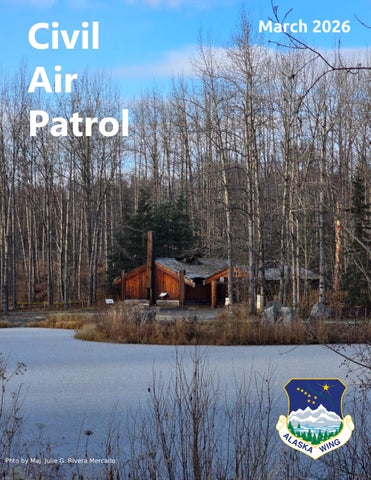
Civil Air Patrol


![]()


By. Maj. Julie G. Rivera Mercado AKWG CDI

The concept of fortitude goes well beyond merely not feeling afraid; it is about consciously confronting risks and enduring hardships. Instead of seeing fear as something to be fought against or a flaw to dismiss, this view acknowledges fear as an instinctive reaction that can enhance our abilities, uncover hidden threats, and highlight what matters most to us. By actively engaging with and reflecting on these inner feelings, people can cultivate the quality of bravery, which equips them to be afraid of appropriate things in the correct manner and at the right time. This change enables individuals to overcome fears that limit them and use their instincts to lead a life of excellence and reach their full capabilities.
Nurturing this quality demands striking a crucial balance between two detrimental extremes: excessive fear, known as cowardice, and total fearlessness, which is recklessness. Genuine bravery involves employing logic to foresee danger, similar to risk management strategies, thus enhancing one’s safety and quality of life. Since fear often stems from a deep affection for what we hold dear, gaining insight into our fears can serve as a valuable method for self-exploration and clarifying our fundamental values. Ultimately, by establishing a steady attitude of bravery, a person grows to be both more accountable and bolder, better equipped to tackle anticipated obstacles as well as unexpected threats.

1.Why do you need your CAP email?
A. Keeps cadets informed on what is happening.
B. Teaches cadets leadership and communication skills.
C. Helps communication from squadron level all the way to national level.
2.How do you get there?
By following the link below, you will learn step by step instructions for activating you cadet email. If you need any help contact C/ CMSgt Quinlan at 712069@akwg.cap.gov. https://homer.cap.gov/news/cap-googlegmail-acount-setup-83e40

Photo Alaska Encampment 2025
Keep in touch with fellow cadets from encampment! Setup your cadet email.
Lt Col David Briar, Commander

On 2 March 2026, Capt Harry White presented the Wright Brothers award to C/TSgt Kara Basye. Cadet Basye serves as the Flight Sergeant and Cadet Advisory Council representative for Tok Composite Squadron. During the ceremony, Capt White also presented Cadet Cayden Doucet with his Wright Brothers award and promoted Cadet Aiden Gross to C/SrA. Cadet Gross is now studying for his Wright Brothers exam so he can move into Phase II of the Cadet Program.
Tok Composite Squadron Aircraft parking area. The Tok Squadron has two large aircraft parking area at the Tok Airport. Temps this winter in Tok have dropped to the minus 70s F. And as Johnny Horton noted, "When its Spring Time In Alaska it is 40 below."
(photo by Capt H. White)

by C/SMSgt Rosson
Southeast Composite Squadron hosted its fourth Alaska Coastal training academy (ACTA)! ACTA is a three-day-long activity focused on bonding as a squadron and working towards their rocketry badge.

Cadets pose with their instructor showing off their model rockets.
Left to right: C/2d Lt Lotz, SM Dan Davis, C/CMSgt Rosson, C/CMSgt Israelson, C/2d Lt Regier, SM Andy Rosson, C/SSgt Wilson, C/CMSgt Alexander Davis, C/ Amn Twitchel, SM Melissa Davis, C/SSgt Dolan, C/1st Lt Fields, C/Amn Barry, C/ Amn Habeger, C/CMSgt Eleanor Davis, C/CMSgt Fields
Overall the weekend (Feb 14-16) was a huge success with more than ten cadets earning their rocketry badge! Everyone involved said they enjoyed ACTA and are looking forward to the next one.
Over the course of ACTA cadets completed the first three rocketry units in which they learned about the history of rockets, liquid and solid fuel engines, payload and much more. This knowledge was then demonstrated through the creation and launch of 5 rockets.

C/CMSgt Rosson bowling

C/2d Lt Lotz, C/CMSgt Rosson, C/ SMSgt Rosson, and C/CMSgt Israelson build their rockets.
Throughout the weekend cadets were kept busy with classes and rocket building, however, there was also a movie night, a trip to the bowling alley and basketball games.
By : Maj. Jan Bobek Photographer: C/1stLt Jacob Ries

Every Monday from 6:30 to 8:30 Kenai Cadets provide: Aerospace, Leadership, Health Fitness Zone/ Safety, and Character Development Presentations. The presentations are very informative . Public speaking is a fear that many people have, so working on it builds strength in all areas of life. Cadets practice to alleviate this universal fear. The Cadets are determined to work hard so that public speaking becomes something to look forward to. Senior members do appreciate and support Cadet progress. Cadets become more confident the more they practice public speaking. This process includes the CORE Values of Integrity, Volunteer Service, Excellence and Respect.
Cadets continue to advance in personal development. The Cadet Program magnifies the process of becoming the best person one can be. The Cadets even begin to enjoy the process as proven by the results, and they volunteer to speak in public much more. When they conquer their fears, they become stronger and more confident. Cadets realize that they can achieve just about anything! The process makes each cadet a stronger human being. Orientation flights are provided which helps to keep cadets involved in the cadet program. Flying builds confidence in all areas of their lives. They study and work very hard to meet their life goals. They become safe pilots and join the military or make aviation their life’s work. Senior members are proof of this. Learning to fly is an integral and crucial part of the Cadet Program. These Orientation flights were provided by the EAA Young Eagles Program. We’re very thankful for that program. Cadets participated in the Stop the
Bleed Program put on by trained professionals from our local hospital. American College of Surgeons: ACS, offers the premier bleeding control course and kits. Instructors empowered Cadets to become

immediate responders for a bleeding emergency before professional help arrives. Key components included identifying life-threatening bleeding and mastering three main techniques: applying direct pressure, packing wounds, and using a tourniquet. The Cadets learned the ABC’s: A- Alert 911: B- Bleeding: Identify the source of bleeding, and C-Compress: Stop the
Bleed by Direct Pressure, Packing or Tourniquet Application. They learned a lot at the stations provided.
Cadets worked very hard and passed many achievements recently.
Curry Award:
Cadet Cole Matthews
Cadet Shane Matthews
Cadet Gabriella Matthews
Achievement 2:
C/A1C Cheston Clark
Achievement 9:
C/2ndLt Noah Cole
Achievement 12: C/Capt Thomas Anthony.
We’re very proud of all the great effort to advance in the program.
Joining CAP makes a positive difference in our community. We’re proud to have these cadets in the Kenai Squadron. All cadets are working hard, setting a good example in our community, and supporting each other in continuing to practice the Core Values. The world is a much better place with these young cadets in it. Our cadets continue to make America stable and strong. They are trustworthy people. We are very proud of them.
By: Maj. Justin Baugh
When C/SSgt Alyssa Hansen first joined Civil Air Patrol, she knew she wanted to serve something greater than herself. What she did not yet know was how deeply CAP—specifically the Eielson 71st Composite Squadron—would shape her path toward that goal.

That journey recently reached a major milestone when Hansen received an appointment to the United States Military Academy at West Point, one of the most competitive and prestigious leadership institutions in the nation. The appointment represents years of dedication, discipline, and growth—much of it forged through Civil Air Patrol.
For Hansen, CAP provided introduction to military It created an environment mattered, accountability leadership was learned her earliest uniform inspections leadership roles within that professionalism is not about effort, discipline, and
One of the most formative CAP career was encampment. a cadet’s first taste of military challenged Hansen physically, emotionally. Long days, high expectations required and rely on teamwork.
“We arrived as individuals, cohesive unit,” Hansen inspections, and leadership learned the importance and shared responsibility—skills distinguish her among her
Her performance at encampment recognition as Honor Cadet, that reflected not just personal her ability to lead, support CAP’s core values. That a lesson she would carry earned through consistency, for the team.
provided more than an customs and courtesies. environment where standards accountability was expected, and learned through action. From inspections to taking on within her unit, she learned not about perfection, but and respect.
formative experiences of her encampment. Often described as military life, encampment physically, mentally, and constant evaluation, and required her to adapt quickly individuals, but we left as a reflected. Through drill, leadership scenarios, she of communication, trust, responsibility—skills that would later her peers.
encampment earned her Cadet, an achievement personal excellence, but support others, and embody That experience reinforced carry forward: leadership is consistency, integrity, and care
Back at the Eielson 71st Composite Squadron, Hansen applied those lessons as a Flight Commander. In that role, she learned that leadership extends beyond giving orders. It requires mentoring younger cadets, setting the example, and creating an environment where others can succeed.
Civil Air Patrol also instilled in her a deep respect for service—one that closely mirrors the expectations placed on cadets at West Point, where leadership is exercised daily and responsibility extends beyond oneself.
As Hansen prepares to join the Long Gray Line, she remains grateful for the foundation provided by Civil Air Patrol and the support of the Eielson 71st Composite Squadron. She credits CAP with giving her the confidence to step forward and pursue her calling.
To fellow Alaska Wing cadets who aspire to attend a service academy or serve in uniform, Hansen offers simple advice: fully engage in CAP. Embrace the challenges, learn from mistakes, and lead with integrity.
Her appointment to West Point stands as a proud moment not only for her family and squadron, but for the Alaska Wing—demonstrating the lasting impact Civil Air Patrol has in developing tomorrow’s leaders.
By 2d Lt Debbie Slater
SAREX: Feb 07–09, 2026 Ground Team Operations
Birchwood, Alaska
Phase 1: Preparation & Ground School
Our exercise kicked off with a deep dive into mission essentials. C/SSgt Genevieve Sperbeck anchored our logistics, managing communications and check-ins to ensure 100% accountability and safety from the start.
• Gear Inspection: We conducted a rigorous 24/72hour pack check. In the wilderness, "unnecessary" items become lifelines; as the team learned, you don't truly know you need an item until it’s gone.

• The Science of Survival: C/Lt Col Michael J. Porter led a session on body temperature management. We reviewed the progression of injuries from dehydration to hypothermia the modular 3–5 layer system. wicking synthetics or wool adjusting layers based learned to manage their "personal

• Hazards: C/Lt Col Kai potential hazards, ranging terrain like swamps, snow, local wildlife including moose, We also covered biological the importance of identifying parsnip and monkshood, for stings and allergens.
• Navigations: C/1st Lt technical session on pace skill for land navigation limited. By knowing how many 100 meters, a Ground Team distance traveled with surprising

hypothermia and the importance of system. By using moisturewool (never cotton) and on movement, cadets "personal thermostat."
Kai C. Halliburton reviewed ranging from treacherous snow, and rocky slopes to moose, bears, and wolves. biological threats, emphasizing identifying toxic plants like cow and carrying protection
Bennett also led several field classes such as how to use signal mirrors (coordinated with aircrew), ELT training, map/compass work, litter carries, and a few others.
Theory met reality as we trekked into the field. The team practiced "sharing the load" with litter carries and sleds, rotating every three minutes to maintain stamina. We even navigated a literal hurdle: a fence buried under 18 inches of snow. By redirecting to a safer crossing, we cleared the obstacle without incident.

Lt Keena L. Bennett led a pace counting, a fundamental when GPS or visibility is many paces it takes to cover Team member can track their surprising accuracy. C/1st Lt
• Fire & Shelter: GTA and GTB worked in tandem to clear snow. Despite the challenge of wet wood, the team established a sustainable fire through persistent care.

• The Spruce Bed: Cadets learned that a thermal break from the ground is the difference between sleeping and shivering. A fresh spruce bed topped with a mat proved to be the "fivestar" choice for insulation.

• Leave No Trace: By Following the core principles the forest looked as if we
Phase 3: High-Tech & After a well-earned breakfast Hangar, we shifted from modern search technology.
• Aerial Surveys: SM SrA Tyler Anthony Perry photogrammetry at Eagle showcased how 3D mapping damage and locates targets
• The "Real World" Twist: on a high note when a Locator Transmitter) was Airport. The team transitioned mission mode, successfully to a specific hangar. A "real-world perfect conclusion to our
Lessons from the Field
• Boot Care: Keep your or they will freeze by morning.
• Clarity: Anti-fog wipes glasses-wearers in the cold.
• Circulation: Ensure "wiggle room" for heavy flow.
• Morale: Roasted Spam replacement; marshmallows for sleep.
0700, we broke camp. principles of woodsmanship, we had never been there.
ELT breakfast at the Birchwood from primitive survival to technology.
Nicholas Perry and C/ Perry demonstrated drone Eagle River Bridge. They mapping identifies terrain targets from the air.
Twist: The exercise ended a real ELT (Emergency was activated at Birchwood transitioned instantly into successfully tracking the signal "real-world find" was the our training.
Field boots inside the shelter, morning.
wipes are a necessity for cold.
Ensure boots have enough socks to maintain blood
Spam is the ultimate salt marshmallows are magical fuel
• The Bottom Line: Fire is awesome.

• Layers: Your layers are like a thermostat. If you start to sweat while hiking, shed a layer immediately. If you stop to rest, put your "puffy" on before you feel the chill.
Special Thanks: Thank you to Capt Aaron D. Sperbeck and Capt Yuki A. Meaders for supporting the ground team at the mission base. We also appreciate Senior Member Steve Anderson for pulling the night shift watch. Thank you to everyone who made this SAREX a success!
Written by: SM Kathy Kenney, Assistant PAO
After a series of winter storms forced a pause at the end of January, Birchwood Squadron came back in full force this February. The month began with a long-awaited celebration of advancement, followed by critical Annual safety training, community outreach, and a rigorous weekend of search and rescue operations.
The month started with the much-anticipated Cadet promotion ceremony that was postponed from January due to inclement weather. The delay only heightened the excitement as members finally received their hard-earned advancements on the first Tuesday of the month.
From February 6 to 8, Birchwood supported the 2nd Quarter Alaska Wing SAREX, with multiple Birchwood members participating in various aspects of the exercise.

Air Operations Pilot and Dennis Eby provided a detailed high-tempo Saturday sorties:
Sortie 1: Eby joined SM Squadron) for a Mission exercise. The crew conducted two expanding square searches reported overdue on snowmachines Horn Lake and Alexander Lake.
2: Flying with C/Lt Col SM Pete Mullin (Mission Observer executed a creeping line search the Knik River to the Hunter for two overdue bike riders. not spotted, the crew successfully recreational activity throughout
Ground and Tech Teams On Slater and C/MSgt Charles extensively in survival training, necessary to operate in Simultaneously, SM Nicholas Perry demonstrated drone showcased how 3D mapping damage and locates targets
The squadron’s commitment Education was on full display Elementary STEAM Fair later Kenney, C/CMSgt Zachary Klayum represented Birchwood interactive booth. 1st Lt Rick Benedict's safety class.
Taken by Cadet 2d Lt James Wood
and Senior Member (SM) detailed account of the sorties:
SM Alan Sorum (Valdez Specialist (MS) training conducted a route search and searches for three people snowmachines between Flat Lake.
Col Kai C. Halliburton and Observer trainees), SM Eby search from the mouth of Hunter Creek airstrip, looking riders. While the targets were successfully monitored heavy throughout the area.
On the ground, 2d Lt Debbie Charles Slater participated training, honing the skills the Alaskan wilderness. Nicholas Perry and C/SrA Tyler drone photogrammetry and mapping identifies terrain targets from the air.
Generation: Chugiak STEAM
commitment to Aerospace display at the Chugiak later in the month. SM Kathy Kenney, and Cadet Cage Birchwood with a high-energy,
The main event featured two computer-based RC flight simulators, which were a massive draw for students. Cadets Kenney and Klayum demonstrated excellent leadership and instructional skills, guiding younger students through the basics of flight while effectively managing the high demand and limiting time so everyone could participate. The team also engaged students with a CAP Paper Airplane Project, teaching aerodynamics through hands-on design, and spoke with dozens of parents about the leadership opportunities available in the Cadet Program as well as on the Senior Member side.

A special thank you goes to Tiffany Kinder, a 3rd Grade Teacher at Chugiak Elementary, who served as the primary contact and coordinator for the fair. Her leadership, along with the staff at Chugiak Elementary, made for a wonderful event and a successful evening of community outreach.


Cadets participating in a Team Leadership Problem (TLP). Taken by Cadet 2d Lt James Wood


Northern Lights in Wasilla in February. Taken by SM Jon Large.

Turnagain Arm across from Hope. Taken by SM Jon Large.


Taken by 2d Lt Brian Slater.
Written by: C/2dLt James Wood, Cadet PAO
With extreme weather conditions that stopped us from having a promotion ceremony last month, Birchwood squadron started the month with a bang, where eleven people were promoted in our ceremony. Congratulations to the cadets who put their effort and hard work into their promotions! The promotion meeting also included a character development class and safety, so it was a busy night, but still a quite beneficial and enjoyable one.
Cadets that promoted:
Cadet Raphael Cato, Achievement 1 w/ Honor Credit
Cadet Ewan Sexson, Achievement 1
Cadet Jasmine Vanderlooven, Achievement 1 w/ Honor Credit
Cadet Jacob Foreman, Achievement 4, Cadet Charles Slater, Achievement 5 w/ Honor Credit
Cadet Zachary Kenney, Achievement 6 w/ Honor Credit and Achievement 7
Cadet Kaden Mattson, Achievement 8
Cadet Olivia Morgan, Achievement 8
Cadet Alana Morgan, Achievement 8
Cadet Jonathan Shelley, Achievement 8 w/ Honor Credit
Cadet Paxson Yelverton, Wright Bros
The second meeting of the month was quite informative
Cadets promoted

and fun as we had a special Bureau of Investigation (FBI). Mattson presented to the cadets bomb disposal with hands-on

FBI presenter and Cadets donning a bomb
Taken by Cadet 2d Lt
early February

special guest from the Federal (FBI). Special Agent Ben cadets on the FBI’s role in hands-on demonstrations of how to

with a Cadet bomb suit.
Lt James Wood
wear a bomb suit, a class on the basic circuits in the bombs that the Explosive Ordnance Disposal (EOD) technicians have to deal with, and a demonstration of the robot that these EOD technicians use. Cadets exuberantly learned so much and we hope to be able to have similar presentations sometime soon.
The next meeting of the month was a normal cadet fitness testing meeting, and watching the cadets inspire each other to push themselves to reach their goals in this testing shows what the Civil Air Patrol cadet side is about. Good job to all the cadets.

The last meeting of the month was a month for cadets to develop themselves in the area of drill and uniform standards. We had an excellent class on grooming standards and lots of time to practice drills. Watching the cadets and how much they improve on drill, and their hunger for more knowledge on top of their determination to get better, is quite inspiring, and an outstanding job by the cadet line staff for instilling that drive in their flights.
Article
and pictures by:
C/Amn Tobin Sobrepena
This month the Arcturus Squadron had a great time working towards greatness. During a meeting, C/Chief Frye taught the cadets about GSAR. The squadron is currently preparing for the upcoming SAREX and other upcoming activities. Cadets have also just finished their interviews for staff positions. Finally, the squadron had an excellent promotion night with Character Development.

From 2-6 March, Alaska Wing took part in Exercise Arctic Connect, an exercise run by Alaska Organized Militia. The AOM consists of Alaska Army National Guard, Alaska Air National Guard, and Alaska State Defense Force. In addition, the State of Alaska Division of Homeland Security and Emergency Management was also part of the exercise.

Photos are C/CMSgt Zachary Kenney (right) and Lt. Michele Bremer (left), taken by Maj. Michael Kenney, PCR-AK-076)
Guard joint staff director of communications and cyber, said, “Weather, space weather and propagation variability all play a role, especially in Alaska. Arctic Connect allowed us to identify those challenges, communicate through them and strengthen the network before we need it in a real-world event.”
Alaska Wing had 11 stations active in Arctic Connect, operated by 10 senior members and four cadets (one station was run by a home-schooled cadet operating solo). One station, using a portable HF kit, set up the station in less than 30 minutes, using a wire antenna placed along the top of the snow (which was 4’ deep, so snowshoes were used), simulating what could be done in a disaster.
Incident Command was run by a new Incident Commander, who ran the exercise virtually from his home, which happens to be 45 miles from the nearest road, and completely off grid. All Alaska Wing stations made contact with Midnight Sun 1, the AOM net control.
In a statement released by Alaska Army National Guard Public Affairs, “High-frequency communications are inherently influenced by environmental conditions, Lt. Col. Herbert Gladwill, Alaska National
Arctic Connect gave Alaska Wing members a great opportunity to serve our community, our state, and our nation.


By: Capt. Aaron Sperbeck
On February 26, 2026, Civil Air Patrol representatives from across the nation descended upon Washington D.C. to participate in the annual appropriations process, meeting with each State's congressional delegation to request "consideration" for the Air Force's FY27 – CAP funding line item budget of $87.1 million dollars in addition to providing the legally required "report to congress" regarding CAP’s FY25 accomplishments.
During these critical face-to-face meetings with our nation's legislative leaders, our CAP Cadets and Senior members proudly shared their personal stories of growth and experience from their time within CAP.
The Alaska Wing continued its long standing tradition of sending representatives who embody the CAP core values and promote these values within the many close knit Alaskan communities they serve. After successfully meeting with all three members of the Congressional delegation, Alaska Wing representatives had an opportunity to explore our nation's capital during this historic 250th year anniversary,
to include visiting the White House, the United States Capital, Arlington National Cemetery, Smithsonian’s Air and Space Museum, and many other

historic sites and monuments.
If you are interested in participating in this extraordinary opportunity next year, applications to attend will be posted in November 2026 with an anticipated travel to Washington D.C. in late February 2027.

Sperbeck, Col Tim Verrett, C/Maj George McCullins, C/TSgt Genevieve Sperbeck, Begich, C/2Lt Christian Yew and Col Derk MacPhearson.
From left to right:
Col Tim Verrett
Col Derk MacPhearson
C/TSgt Genevieve Sperbeck
C/2Lt Christian Yew
Sen. Dan Sullivan
C/Maj George McCullins
Capt Aaron Sperbeck


From left to right:
C/Maj George McCullins
C/TSgtGenevieve Sperbeck
Sen. Lisa Murkowski
C/2Lt Christian Yew
Col Derk MacPhearson
Capt Aaron Sperbeck
Col Tim Verrett
By: Alan Sorum
The Civil Air Patrol (CAP) supports the operation of very high frequency (VHF) and high frequency (HF) radio stations in an effort to maintain operational communications during emergencies. An event like an earthquake or wildfire can disrupt access to grid power and telephone services. Radio stations intended for use during emergency situations need to be able to operate “off the grid” and be available when other systems fail.
requires a power source. Typically, this is provided by a power supply operating from the grid producing around 12 volts direct current (DC) and 20+ amps (A) of current.
The simplest answer is to use a storage battery. There are many different battery chemistries

A backup power system can be developed for a radio station, starting with some basic components that can be built out in the future for a more versatile station. The radio transceiver
available, providing varying levels of cost and storage capacity. It is often possible to repurpose used lead-acid batteries for this use. Using a battery alone limits the radio to its charged condition. Backup power systems begin with the storage battery as a building block. The next step is to find ways to keep the battery charged.
Working on the system, starting with the storage battery, there needs to be a source of DC power. This can be provided by the station’s dedicated power supply, an inverter or a charge controller. There are several commercial solutions that provide all these functions in one package.
During a failure of the power grid, the backup power system will need an independent power input. Options can include the use of a power generator, solar panels or wind turbines. Each option has its own merits and problems. Fuel powered generators require maintenance, need fueling and can pose some safety hazards. To charge the battery with a generator also requires a battery charger. Solar panels have become more reliable and cost effective, but they need sunlight to work. The same holds true for wind generators, which need wind to work. The most dependable backup power system will use a combination of these inputs, along with robust storage battery capacity.
Senior Member Jonathan Crocker points out that “Many radio operators (especially those who are off-grid) use battery power as the only source for their radio stations. In these cases, a battery bank is usually fed by solar power, wind power, and/or a generator with a battery charger.”
A simplified diagram of such a system might look like this:

Backup power systems can start off simply and be built out as opportunity and budget allows. A battery backup module (DC UPS) is a good addition to the power system. A few options are shown below:
West Mountain Radio Epic PWRgate – A backup power system in a box. Acts as an uninterruptable power supply, its charger supports various battery types and has a charge controller to handle input from a solar array.
https://www.westmountainradio.com/product_info.php?products_ id=epic-pwrgate
SAMLEX BBM-1225 – This solid-state unit allows uninterrupted DC power using a power supply and battery. Transfer of the load from the power supply and battery is instantaneous. The unit also keeps the battery fully charged.
https://samlexamerica.com/products/battery-backup-module-1224v-25a-charger/
Paradan Radio DC Gate 40+ – This is a battery backup module that can provide output from the battery or power supply. During loss of grid current, the unit instantaneously transfers the radio load to the battery. https://paradanradio.com/shop/ols/products/dc-gate-40p
Another benefit to having a backup or alternative power system is the reduction of radio interference. Our modern homes now have many sources of radio frequency interference (RFI). While it’s not an option for everyone, turning off the grid and running on just a battery can reduce RFI and greatly improve receiver performance. A transceiver can operate for many hours in receive mode. Transmitting with the radio uses much more power and greatly reduces battery life. Overall
transmission time will ultimately depend on total battery capacity.
Developing effective backup power systems for the CAP’s radio network is another step we can take to be better prepared for future emergencies. Electrical power and cellular systems can and often fail during natural disasters and other crises. Understanding radio power systems is a skill that makes us better CAP communicators.
By: Alan Sorum
Previously we discussed the behavior of electromagnetic radio waves. These waves travel freely in the vacuum of space or through the air, displaying specific wavelengths based on their frequency. A wavelength is the distance a wave moving at the speed of light travels during one cycle.
A good way to think of antennas is to consider them an extension of the wavelength being emitted. Radio frequency (RF) energy is generated by a transmitter, travels along a coaxial cable and is radiated at the antenna. If the antenna length closely matches the wavelength in use, the signal will continue out into space. Receivers depend on the same conditions. A radio wave reaches another antenna. If the receiving antenna’s length matches the desired radio wave, it resonates and allows the receiver to decode the signal.
An example is the very high frequency (VHF) of 150 Megahertz (MHz) or 150 million cycles per second has a wavelength of about two meters. An effective antenna for 150 MHz will have a length of two meters or a specific fraction of that length. This fraction could be an antenna that is 1/4, 1/3 or 1/2 of a wavelength long. Antennas used for high frequency (HF) radio can
be much longer. The wavelength for 3.7 MHz would be 80 meters.
An effective antenna needs to be resonant for the radio frequency being used. Resonance can be compared to a swing. The length of a swing is its natural frequency, the number of times it cycles back and forth in a period of time. Once the swing is in motion, a slight input or push at the right time will reinforce its movement. This would be its resonant frequency. A harder push or one out of sync with the swing will disrupt its natural motion.

Figure 1- Pushing a person in a swing is a common example of resonance. The loaded swing, a pendulum, has a natural frequency of oscillation, its resonant frequency, and resists being pushed at a faster or slower rate.
Photo: Luiz Carlos.
The transmitted frequency fed to an antenna causes electrical charges to more back and forth like the swing. If the antenna length matches the radio frequency used, it will be resonant and radiate efficiently. The opposite is true, if the antenna’s length isn’t matched, it will perform radiate poorly.

High Frequency Antennas – Driven by their longer wavelengths, HF antennas are often built with wire, the most common being a half-wave dipole. These antennas consist of two resonant elements, just under a quarter wavelength long. A dipole antenna used for 3.7 MHz would be 40 meters in length. The CAP often uses terminated folded dipole (TFD) antennas that are capable of operating across a broad range of frequencies. A TFD is two dipole antennas mounted parallel to each other and connected at their ends.
Figure2-Thehelixallowstheantennatobeshorterthanthe lengthofanordinarywhipantenna,aquarter-wavelength,and stillberesonant.Photo:Shootthedevgru.
The Civil Air Patrol (CAP) operates radios in the VHF and HF spectrums, requiring antennas on much different lengths and constructions.
Very High Frequency Antennas- The CAP uses three basic VHF antennas, the “rubber ducky” found on handheld radios, small vertical whips used on vehicles and quarter-wave vertical antennas used with base stations.
"Rubber ducky” is a commonly used term for the short plastic-covered antennas used on handheld radios. Their more formal name is a normal-mode helix. The coiled or helical form wire of

the antenna allows it to be shorter for the wavelength required. The performance of these antennas is less than that of the quarter-wave vertical. Small whip vertical or monopole antennas are used with the radios the CAP has installed in its vehicles and aircraft. They can also be found in use with some portable equipment. The whip is typically a flexible spring steel rod, cut to the proper length for the wavelength being used.
Quarter-wave vertical – This is the simplest form of a vertical antenna. As the name implies, the vertical element of the antenna is a quarter wavelength long. These antennas provide good performance, are easy to build and provide an omnidirectional radiation pattern.
There are many other antennas used for radio communications. Some can be quite specialized. The design and construction of antennas is often a favorite pastime of radio operators, trying to get the best performance out of their equipment and location.


The Alaska Wing Chaplain Corps welcomes into our ranks of Character Development Instructors 2d Lt Shelley Hansen of Eielson, 2d Lt Sage Baugh of the Delta Junction Squadron, and 1st Lt Jarid Masiel of Fairbanks!
Counting all Chaplains & CDIs in Alaska Wing, we are now 25 strong.
Here is a current list:

QPR Update: NHQ encourages us to take the QPR Suicide Prevention training in ABSORB. Only 16 AKWG SMs have taken it so far. We encourage all CDIs, Chaplains, Commanders, and DCCs to take the training. This will increase the number of us who can speak a common language on this topic and be even better support for our members' mental health. Enroll in "TLC On-Demand" in Absorb. Then, when you take QPR, you'll also get credit for one of the TLC On-Demand modules.
Assignment to Multiple units: If a Squadron Commander would like a CDI or Chaplain assigned to them, the commander of the receiving squadron can complete a CAPF 2A following the instructions provided here: https:// www.gocivilairpatrol.com/members/cap-national-hq/new-chaplain-corpspage/general-chaplain-corps-information/ady
Stay safe and stay connected!

By: Maj. Julie G. Rivera Mercado, CAP AKWG Character Development Instructor
In the Civil Air Patrol, we learn to search the skies for lost planes and traverse challenging landscapes to save lives. Yet, some of the most significant rescue efforts occur not in the air or on steep paths; they take place among our own members. As leaders, our greatest resource is not our aircraft or equipment; it is the individuals who make up our team.
The act of preventing suicide transcends being just a healthcare protocol; it is an embodiment of Operational Readiness. In an organization centered on the fundamental principles of Integrity, Volunteer Service, Excellence, and Respect, nurturing a climate of psychological security represents the deepest service we can provide.
Through my journey studying human behavior and aiding those in crisis and mourning, I have learned that emotional pain often goes unspoken. In high performance settings like the CAP, members might feel compelled to appear "tough," which can lead to concealing their challenges. This is precisely where the QPR (Question, Persuade, Refer) model serves as a vital means of intervention.
As a Character Development Instructor, I perceive QPR not merely as a training obligation but as a toolkit of "Psychological First Aid. " Similar to CPR, one does not have to be an expert to save a life; one merely needs to identify signs of distress and possess the bravery to take action.
Awareness and action: The leader’s responsibility
The initial phase of prevention involves careful Observation. We need to be alert to changes in the typical behavior of our colleagues. In our squads, this could appear as a notable decline in participation, a disinterest in cadet progress, or a significant alteration in the professional attitude of a senior officer.
•Question: We need to overcome the anxiety of possibly "offending" someone. Directly asking about a person's state does not foster negativity; instead, it offers a crucial outlet for the pressure of silence.
•Persuade: This is where leadership intertwines with empathy. Our objective is to listen non-judgmentally, a skill rooted in compassion, and to instill hope by reminding them that while pain can feel overwhelming, the person themselves is
indispensable.
•Refer: True leadership involves recognizing when to pass the reins. Directing a member to seek professional assistance, such as a chaplain or crisis helpline, constitutes the final and decisive step in ensuring safety.
Working alongside those in crisis has taught me that prevention revolves around valuing life before it reaches a critical point. In the Alaska Wing and throughout the country, the geographical solitude can often reflect the emotional seclusion a member may experience. We must cultivate a "wingman culture," where checking in on one another becomes as commonplace as a pre-flight check. By fostering an atmosphere that reduces stigma and enhances support, we can guarantee that every individual feels appreciated not only for their contributions but for their very humanity.
Our dedication to "Semper Vigilans" should encompass the well-being of our comrades in service. By integrating organized QPR instruction with a caring, person-focused approach, we turn our
units into havens of strength.
When we support our teammates, we secure the future of our objectives. We educate, observe, and tune in because within the Civil Air Patrol, every member soars together, and no one is abandoned in the shadows.
Acquiring basic knowledge gives us the opportunity to act at the right moment. Therefore, we urge you to take an hour of your time and complete the QPR course available on ABSORB within the TLC On Demand.
Semper Vigilans


https://docs.google.com/forms/d/e/1FAIpQLSdfKKlebfP3LjIPCOBafIw8Mo7j8GAfwRuSGuyv6pewdmx9w/viewform?usp=header
By Laura Emerson
Enthusiasm for this summer’s UAS (unmanned aerial systems) training is high. The earliest registrations have come from squadrons outside the Anchorage Bowl, because our trainers are traveling to any squadron in the state that can assemble 6 or more trainees for the 2 – 4 day sessions. Special thanks to the squadrons that have offered to help our volunteers defray the cost of food and lodging, by offering a bed for the night or sandwiches or a casserole. Much appreciated.
Reminder: each trainee must complete several hours of on-line prerequisites before the first in-person class, so don’t procrastinate. One squadron has decided to dedicate several regular
meetings to help trainees complete these lessons before our trainers arrive.
Drones are a welcome addition to fulfill CAP’s missions, but may be especially valuable to squadrons that do not have a plane.
Below is a sample training scenario.
Story: Spring breakup causes an ice jam and localized flooding along a river (e.g., Yukon/Kuskokwim). State EMA asks for overhead recon of jam extent, erosion, and threatened infrastructure.

Training objectives
• Execute long route searches following a river corridor.
• Operate in cold, gusty conditions while managing batteries and icing risk.
• Provide clear situational awareness to emergency managers.
• Area: 3–5 km river segment or shoreline substitute.
• Simulate hazards: “blocked channel” markers, vulnerable levee/bridge points.
• Add a timed “tactical pause” to swap batteries in cold conditions.

• Cold-weather checklist: battery warming, reduced flight time planning, contingency RTL points.
• Corridor pattern: upstream/ downstream runs with sidelooking imagery.
• Data product: annotated stills and short clips showing jam edges + key landmarks.
• Crew management: maintaining tempo while preventing rushed launches/recoveries.
By: Maj. Julie G. Rivera Mercado, CAP AKWG E&T and PA Director
In the harsh terrain of the North, there is no room for mistakes. While search and rescue operations are fundamental to the Civil Air Patrol across the country, the volunteers in the Alaska Wing encounter a unique set of obstacles. Here, Emergency Services is not merely an area of expertise; it is essential for communities where the closest road could be many miles away. Spanning vast expanses of tundra, sharp mountains, and moving ice, the pilots and ground teams of the Alaska Wing function at the utmost limits of aviation capabilities.
Flying in Alaska demands more than having a pilot’s permit; it necessitates a deep comprehension of a changing landscape. Our aviators often deal with localized weather patterns where bright, clear skies can quickly shift to an overwhelming whiteout in just moments. The intricate task of flying in mountainous areas, maneuvering through perilous routes, and coping with unreliable downdrafts requires a level of flying skill developed through specialized instruction and extensive experience.
During the peak of winter, the risks increase significantly. Missions are carried out in freezing temperatures that challenge both the human body and machinery. Warming up engines in minus forty-degree weather and conducting gear checks for survival
are critical actions that can determine the success of a rescue versus encountering another emergency.
To navigate the vast expanses of the wilderness, the Alaska Wing employs an advanced technological framework. When an Emergency Locator Transmitter signal is picked up, our flight crews utilize Electronic Direction Finding to pinpoint the source of the signal. To meet these demands, the Alaska Wing utilizes aircraft specifically modified for the environment. Equipped with oversized "bush tires" for gravel bars or skis for frozen lakes, these planes are as rugged as the pilots who fly them, allowing CAP to land where no commercial airliner could ever reach.
Nevertheless, the use of technology in Alaska is not without its challenges. In deep canyons or under dense foliage, signals may reflect or be lost entirely. This is when the importance of human skills becomes vital. Pilots are required to blend traditional visual search techniques with cutting-edge thermal imaging tools to identify a flash of metal or plume of smoke in an environment that effectively conceals them.
Each operation carried out by the Alaska Wing showcases the personal dedication
of our volunteers. In contrast to the contiguous states, a mission in Alaska may extend over multiple days, necessitating that teams remain ready in remote areas or isolated camps.
The aviators who undertake these missions are community volunteers who temporarily leave their homes and jobs to navigate some of the most hazardous airspace in existence. Their dedication reaches beyond simply flying; it encompasses organizing efforts with the Alaska Air National Guard and local community leaders to maintain a continuous support network. Whether conducting medical evacuation operations or searching for a bush plane that has gone missing, the determination of each volunteer serves as the driving force behind our achievements.
The legacy of the Alaska Wing is chronicled in the records of pilots who were willing to operate in conditions that others avoided. This tradition of courage continues as we implement satellite monitoring and advanced communication technologies to render the wilderness slightly more accessible.
For the individuals in the Alaska Wing, the objective is straightforward, yet the implementation is significant. We take to the skies so that those who have vanished in the expansive North can be heard, and we prepare ourselves so that when the summons arises from the icy skyline, we are equipped to respond.
Semper Vigilans.


March
19 – WMIRS Class - 6:00 to 8:00 PM (Cadet and Seniors)
The WMIRS platform will be presented, explaining how it works and its areas.
22 - Level II Moderate Courses complete 5:00 to 7:00 PM - (Seniors only)
The moderate level II courses will be taught until they are completed on the dates indicated in the calendar.
April
9 – ICS Forms - 6:00 to 8:00 PM (Cadet and Seniors)
The forms used and how to complete them will be presented.
Maj. Julie G. RIvera Mercado
AKWG Education and Training Director Cel. 787-424-0560
Online Office Hours
Days: 1st. and 3rd. Wednesday of each month
Hours: 5:00 PM to 7:00 PM - AK Time
Link to connect to the office hours and clasess is: Time zone: America/Anchorage
Google Meet joining info
Video call link: https://meet.google.com/vzw-xnos-gtx


Ensure training for newly-appointed aerospace education officers. Develop and carry out the wing Plan of Action for aerospace education. Visit and communicate with subordinate units. Provide subordinate program support, as necessary and reasonable. Ensure members earning Yeager awards have such entered in eServices; issue certificates. Maintain continuous records of Wing AE activities for reporting purposes Support the AE program with a regular newsletter, or, include an AE column in the Wing newsletter. Ensure the dissemination to all subordinate AEOs of changes in programs, regulations, policies, and procedures relevant to aerospace education. Support external aerospace education outreach programs and activities requested of the Wing. Ensure nominations are made for AE awards by subordinate AEOs, and, at the Wing level- by due dates. Ensure unit AEOs are aware of AFA grant dates to support aerospace/ STEM activities. Contact Wing AEMs during the year to provide information about Teacher Orientation Program (TOP) flights; coordinate TOP flight requests with Wing DO.
Responsible for advising CAP commanders and units on the health, sanitation and hygiene of CAP members relevant to CAP activities. (See CAPR 160-1(I) for policy on emergency medical treatment).
Membership records and applications.
Organizational actions (charters, deactivations, etc.).
Awards and decorations.
Duty assignments.
The logistics officer advises the wing commander on the status of their respective property management programs and leads programs in accordance with CAPR 130-1 and wing supplements. They shall: Train and oversees subordinate unit property management officers Account for property assigned to the wing. Be responsible for real property management in accordance with CAPR 130-1
A webmaster, also known as a website administrator, is responsible for the maintenance and upkeep of an organization's websites and servers. Their responsibilities include site maintenance: Performing routine maintenance and updates to ensure sites are functional, current, and accessible. Webmasters should be able to work independently and with a team, meet deadlines, adapt quickly, and have good communication skills.
Within the Civil Air Patrol, we embrace the intelligent implementation of technology to enhance our efficiency and accuracy in operations. Similar to our dependence on GPS for guidance or radar to maintain situational awareness. This combined effort in technology is employed to confirm that the tone, format, and layout adhere to the utmost professional criteria for publication, guaranteeing that the essence of the message and the ownership of the content genuinely represent the dedication and fundamental principles of our organization. This online publication is designed to attract, inform and motivate readers through photographs, text and stories. We see and feel the four core values in the faces and body language of the cadets and senior members portrayed herein. Submissions are accepted through the 10th of each month. Be safe and live our core values!
And please, thank, congratulate, and mentor your fellow CAP members whenever possible. In any volunteer organization, the only form of compensation is saying “job well done; thank you.”

Maj. Julie G. Rivera Mercado, CAP Publisher and Editor
Alaska Wing PAO julie.rivera@akwg.cap.gov (M) 1 (787) 424-0560

Lt Col
Bryan Emerson, CAP Co - Editor
Alaska Wing PAO, Assistant bryan.emerson@akwg.cap.gov (M) 1 (907) 795-5586