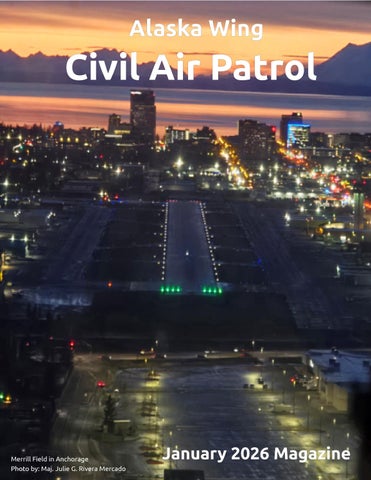
Alaska Wing Civil Air Patrol

January 2026 Magazine

![]()

January 2026 Magazine

By: Maj. Julie G. Rivera Mercado Clinical Thanatologist, M.S. in I/O
The statistics in our state are heavy: Alaska currently faces the highest suicide rate in the nation. While the Civil Air Patrol has launched a focused initiative to train our leaders, the truth is that crisis does not stop at the squadron doors. It can happen to anyone, a cadet, a fellow officer, a spouse, a coworker, or a friend.
By participating in this training, we aren't just improving our Wing; we are becoming a stronger frontline of defense for our entire community.
Recognizing the signals: What to look for Crisis rarely happens without warning. Whether you are at a CAP meeting or at home, these "red flags" are the same:
• Verbal clues: Listen to phrases like "I’m just a burden," "I can't see a way out," or "I’m tired of fighting." Even "joking" comments about not being around anymore should be taken seriously.
• Behavioral changes: Look for? a sudden loss of interest in hobbies, withdrawal from social circles, or giving away prized possessions.
• Emotional shifts: Unusual irritability,
extreme mood swings, or a sudden, eerie "calmness" after a period of deep depression (which can sometimes signal a person has decided).
Prevention: The power of connection
Suicide prevention isn’t just a medical task; it is a human one. It starts with the courage to connect.
• It can happen to anyone: Mental health struggles don't discriminate. High achieved, "strong" leaders, and happy-looking teenagers can all be fighting invisible battles.
• The importance of talking: We often fear that bringing up the subject will cause harm. Asking someone, "Are you thinking about hurting yourself?" provides a life-saving release valve. It shows them that you see their pain and you aren't afraid of it.
• Listening is direct action: You don’t need a degree in psychology to help. Being a non judgmental listener who simply stays present with someone in their darkness can be enough to get them through the next hour.
As senior members, we often focus so much on "The Mission" that we forget
to monitor our own "fuel gauges."
• Check on your peers: If a fellow member seems burnt out or "off," reach out.
• Take care of yourself: Recognizing when you need a listener is a sign of strength. We are a team, and teammates look out for one another’s well-being as much as their professional performance.
The Tool: What is QPR?
To support this culture, we are using QPR training (Question, Persuade, and Refer). Think of it as "CPR for the mind."
• Question the person about suicide.
• Persuade them to get help.
• Refer them to the proper resources. It is a one-hour, self-paced online course available in Absorb. The skills you learn in this 60- minute window apply to every area of your life—from the flight line to your own dinner table. The Mission: 25% by 2025
Our goal is to increase adult participation in this training by at least 25% monthly. By completing this course, you are helping to build a safety net that spans the entire state of Alaska.
Log into Absorb. If you would like TLC On-Demand Credit you MUST be enrolled in TLCOD before you take QPR
Once in Absorb Search “QPR” or click this link: bit.ly/AbsorbQPR Link works best if you are already logged into Absorb when you click. Takes just 1 hour!
One hour of your time could mean a lifetime for someone you love. Let’s lead by example— showing our community that in the Alaska Wing, no one stands alone.

By : Maj. Jan Bobek
Photographer: C/Amn Augustus Ensey
Every Monday 6:30 to 8:30 Kenai Cadets deliver Aerospace, Leadership, Health Fitness Zone/ Safety, and Character Development Presentations. The presentations are perfectly informative. Public speaking is a fear that many people have, so working on it builds strength in all areas of life. Cadets practice
includes the CORE Values of Integrity, Volunteer Service, Excellence and Respect. Cadets continue advancing in personal development. The Cadet Program supports the process of becoming the best person we all can be. The Cadets even begin to enjoy the process as proven by the results, and they volunteer much more.

to alleviate this universal fear. The Cadets are determined to work hard so that public speaking becomes something to look forward to. Senior members are present to appreciate and support Cadet progress. Cadets become more confident the more they practice public speaking. This process
When they conquer their fears, they become stronger and more confident. Cadets realize that they can achieve just about anything! The process is a proven one.
Orientation flights are provided which helps to keep cadets involved
in the cadet program. Flying builds confidence in just about all areas of their lives. They study and work very hard to meet their life goals. They become safe pilots and join the military or make aviation their life’s work. Senior members are proof of this. Learning to fly is an integral and crucial part of the Cadet Program.
On the December 20th weekend
Cadet Deputy Commander Luke Cole did lead the Great Start Weekend. It was for new cadets and their parents. The purpose was to orient the new cadets and their parents on how Civil Air Patrol works. The goal is to help new cadets achieve their first achievement as quickly as possible. The four basic areas of Leadership, Health Fitness Zone, Aerospace, and Character Development were described. These areas are covered in ALL AchievementLevels. Basic Drill was practiced. Cadets used their computers to pass required modules. They are also taught to: be an active participant, memorize the Cadet Oath, wear the proper uniform, and display Leadership qualities.
Great Start was successful for all attending Cadets and Parents. They achieved the Curry Award. C/1st Lt
Luke Cole did a fine job organizing and carrying out the Great Start Program.
Cadets worked very hard and passed many achievements recently.
Curry Award: C/Amn Peter Ufkin, C/ Amn Sequoia Joachim, C/Amn Camilla Roberts, C/Amn Porter Holladay, C/ Amn Everett Lewis, C/Amn Riley Lewis, C/Amn David Lipps, C/Amn Elizabeth Moyer.
Achievement 3: C/SrA Kael Madsen. Achievement 4: C/SSgt Gunnar Jensen. Achievement 7: C/CMSgt Elodie Frisk. Billy Mitchell: C/2nd Lt DeClan Cobb. Amelia Earhart: C/Capt. Thomas Anthony.
We’re very proud of all the excellent effort to advance in the program.
WELCOME to our new cadet: David Lipps. Joining CAP makes a positive difference in our community. We’re proud to have these cadets in the Kenai Squadron. All cadets are working hard, setting a good example in our community, and supporting each other in continuing to practice the Core Values. The world is a much better place with these young cadets in it. Our cadets continue to make America strong. We are very proud of them.
By C/2dLt Taylor
December, the month of cold wind and ice. The month of December was a quick one for the Valdez Squadron, but still productive!
To start the month off, we successfully accomplished multiple drill tests and C/2dLt Taylor gave a speech on the resume. He told all the cadets how important it is, plus what all to put on one to have the highest chances of landing a job; the very thought of that last word scared the cadets right out of their seats!
For aerospace, we had a jeopardy contest which turned out to be a great learning time for everyone, including the seniors.
The pictures on the walls of our
cadet room “definitely” were not of any use during the contest...
While planning the weekly agenda, it is sometimes difficult to always incorporate fun into activities, excluding the aerospace, since there are so many presentations/ lectures that just need to be accomplished each month. But fun is an attribute in Civil Air Patrol just like everything else, and that is why the Valdez Squadron makes it a point to set aside a day here and there explicitly for fun!
After taking a break for Christmas, Valdez Squadron decided to end the month with an exciting movie night where we watched the movie: Red Tails.

“Its a long road, and even the best are still learning where it leads…” -
Unknown


We are all a part of Recruitment and Retention and with that in mind the R&R officer is here to help. The R&R officer would put on courses and training to make sure everyone knows how to best present our squadron when trying to recruitment friends, family, and the general public.
The Public Affairs officer makes sure our squadron is seen and is being seen by:
1. Keeping the squadron web page up to date.
2. Taking photos, and making squadron articles; taking up
my position of writing this so Cadets like me can better their time in their other squadron positions.
The Public Affairs assistant helps the Public Affairs officer and in turn makes their job easier. They could be the one taking photos, putting up fliers around town, or simply just be another pair of eyes for their articles before there submitted.
The Supply Personnel makes sure the hanger and meeting room is in order, and that all inventory items are accounted for.

Valdez cadets check out a cadet that just walked in sporting the new uniform before the meeting start-ed.
Article and pictures by:
C/Amn Tobin Sobrepena

As Alaska’s winter season nears, the his Holiday season, the new Arcturus Squadron cadets had the chance to grow closer to one another by participating in the Holiday Party. Cadets also embraced their thoughtfulness by playing Secret

Santa and exchanging gifts and smiles. During the Holiday Party, the cadets who participated on the CyberPatriot team were awarded with a challenge coin for their outstanding efforts and performance this year.

Besides the Holiday Party, the Arcturus Squadron did not have the chance to meet for the normal meetings and CyberPatriot practice due to unsafe weather conditions.
by Capt Richard Dennis, PAO
085TH Tok Composite Squadron
This December the Tok Squadron changed command. Following 8 years leading the 085th, Capt Harry White passed the baton. Accepting the command is Lt Col David Briar.
The Change of Command ceremony took place on 15 December at Fast Eddie’s Restaurant here in Tok Alaska. Several Cadets and Senior Members were recognized for their contributions to the 085th. Outgoing Commander gave special
recognition to; SM Arron Atchley, SM Barbara Pine, SM Matt Basye, Capt Richard Dennis, and Col Briar. Each were commended for the significant contributions to the 085th.
Our new Squadron Commander, LtCol Briar; recognized Capt Harry White for his eight years of leadership, and promoted two cadets. These are now C/SSgt Kara Basye, and C/1stLt Richards.

CAP Command Transfer: In December the Command of the 085th changed hands following eight years under the Command of Capt Harry White. Lt Col David Briar assumed command at this ceremony on 15 Dec 2025 at Tok’s premier restaurant, Fast Eddies.

Cadet Presentation: Now C/ SSgt Kara Basye has just been promoted. This is the first Milestone Award within the Cadet Program.

CAP Aaron: SM Aaron Atchley gets special commendation from Capt. Harry White. Capt, White noted that SM Atchley is always willing to assist in any way possible; always positive and a good example to all. His attendance reflects possible one absence per year when he goes hunting.

Cadet Richards: Cadet Richards was promoted and is now C/1stLt Richards. This is a milestone towards becoming Captain.

In Tok at -25 below zero
by Capt. Richard Dennis, PAO
Photos by: Capt. Richard Dennis
With temperatures running 50, 60 and even 70 below zero the Tok Composite Squadron held its annual Wreaths Across America ceremony. This is a Ceremony to honor our veterans who have been laid to rest at the Tok Cemetery. This is the 6th year that the Tok Civil Air Patrol Squadron has recognized our veterans with this ceremony.
It all started years ago on the East Coast when a wreath company found they had a large number of unsold holiday wreaths. The owner recalled a trip from his youth to our nation’s capital. As a kid he’d won a newspaper contest. Part of that trip included a visit to Arlington National Cemetery. With that memory from his youth, he decided to donate those wreaths in the memory of veterans.
That program has grown exponentially to become a huge national event. It now stretches across our nation. These wreaths are placed coast to coast honoring our veterans and now as far North as here at Tok, Alaska. Last year an estimated 3.2 million wreaths were placed nationally. 74 wreaths were placed in the Tok Cemetery, along with a number of wreaths going to the small outlying Village of Tanacross.


The Wreath Across America ceremony at the Tok Cemetery took place on December 20th. That was Saturday morning at 11:00. While temperatures had been hitting 50, 60 and even 70 below zero we lucked out catching a heat wave at minus 25.


The Tok Cemetery Is neatly maintained There are a total of 74 veterans buried there and an additional 14 noted upon several memorial walls. Temperatures had been running down to the minus 50s and 60s, but were up to a minus 25 during the ceremony.
The Ceremony started at 1100hrs with C/SSgt Kara Basye, and C/A1C Aiden Gross reading the names of the Veterans who have been placed there at the Tok Cemetery. This was followed by the placement of a Christmas Wreath for each Veteran.
Written by: SM Kathy Kenney and C/2dLt James Wood PAO Assistants
December was a month of meaningful growth and community for the Birchwood Composite Squadron, combining essential survival training with the holiday spirit.
We kicked things off with a joint Senior and Cadet safety meeting focused on the realities of Alaskan winters. C/ CMSgt Cage Klayum led the session, breaking down the signs and treatments for frostbite and hypothermia. This knowledge is vital for our members' safety during winter missions and on the home front.
The highlight of the evening was a firsthand account from Senior Member Pete Mullins. Having served on CAP search and rescue (SAR) missions, SM Mullins provided a unique “survivor’s perspective,” highlighting the transition from rescuer to the rescued after breaking his foot while hunting in a remote boulder field on Kodiak island this past September. His story was a powerful reminder of how quickly things can change in the Alaskan wilderness. By sharing his "lessons learned" and what he would do differently next time, he gave our members practical survival insights

that you just can't get from a textbook. His presentation offered invaluable lessons on situational awareness, emergency signaling with rescuers (Coast Guard aircraft), and the importance of survival gear, directly translating mission concepts we are trained on into realworld applications.
As the month continued, the atmosphere at the hangar turned toward fellowship and holiday
party -

cheer. Between meetings, our cadets stayed busy preparing for our holiday party and even managed to have some fun decorating each other in the process! Even though the holiday spirit was taking over the hangar, the learning did not stop as C/SMSgt Zachary Kenney worked diligently to install and set up in our main space a flight simulator using the CAP Flight Simulator STEM kit, ultimately providing a hands-on aerospace experience for the unit.
Pete Mullins rescue talk early December 2025 2 - taken by Kathy Kenney
Cadets decorating for holiday - Taken by SM Sara Cole


Maj Mike Kenney and Cadet SMSgt Zachary Kenney using the CAP Flight Simulator STEM kit
Jan 6 2026 - Taken by 2d Lt Debbie Slater

Squadron Holiday Party on Dec 16, 2025Taken by Cadet 2dLt James Wood

On December 16, we hosted our squadron holiday party, which was a great success. It was a wonderful opportunity for parents, Senior Members, and Cadets to connect outside of regular drill. While the Cadets enjoyed their gift exchange and games, the Senior Members had a chance to get to know the families better, strengthening the community that makes our squadron work.
After a well-deserved break to relax with family over the holidays, we are feeling refreshed and ready for everything 2026 has in store.
Happy New Year, Alaska Wing!

Birchwood squadron had a short, but quite eventful month of December with a combined leadership and aerospace meeting, and then to end the month off with a Christmas party!
The first meeting of the month was quite simple and straightforward, with an Aerospace presentation and a team leadership problem (TLP) to help cadets develop their leadership and teamwork skills.
The final meeting of the month before Birchwood moved into the Christmas season was our Christmas Party. A recurring tradition that was missed last year, we finally brought it back to have a party with cadets, their friends and family celebrating Christmas together. The party started out with some fun games for the cadets and friends, with the rest of the evening moving into feasting and socializing. Thank you to everybody who brought food and refreshments!
Cadet Gift Exchange during holiday party on Dec 16 2025 - Take by Cadet 2d Lt James Wood


Spurr viewed from Eagle River on Jan 2 2026 - taken by

Morning in Eagle River Dec 5 2025 - taken by


By: C/2d Lt Christian Yew
The Alaska Wing Cadet Advisory Council (CAC) has established four committees for the 2025–2026 term, with leadership and goals identified. These committees are supported by the Wing Commander and are focused on cadet opportunities, flight training, qualifications, and wing communication.
During the CAC’s first meeting of the term, council members voted on which committees would be implemented. Of the proposals submitted, four committees were passed to the wing commander and approved for CAC discussion.

The Cadet Opportunities Committee, led by C/SMSgt Klayum, focuses on three main objectives, volunteer service, fundraising, and scholarship opportunities. Individuals in this committee are tasked with seeking out prospects, communicating them to other CAC representatives, and brainstorming different events that will aid individual squadrons and the wing. The Flight Programs Committee, led by C/Maj Clifton, is tasked with informing, directing, and assisting cadets pursuing training throughout CAP’s various aerospace professions. The committee will connect cadets to different training programs including orientation flights, National Cadet Special Activities (NCSAs), scholarships, and flight training leading toward certification.
The Cadet Program Awards and Qualifications Committee, led by C/1st Lt Bennet, is focused on helping cadets earn ratings and mastery awards available within Civil Air Patrol. Subgoals include connecting cadets with qualified instructors for task sign-offs, increasing awareness of available ratings and awards, and sharing information on wing-level training opportunities.
The Communications Committee, led by C/2d Lt Yew, is the only committee returning from the previous term. Its mission is to improve communication across the wing, with a particular focus on evaluating the Alaska Wing magazine’s reach and its impact on squadrons. The committee will also support other committees by assisting with information dissemination.
All committees are overseen by C/Lt Col Benedict, chairman of the Alaska Wing Cadet Advisory Council. Lt Col Benedict coordinates and directs council meetings via Google Meet, facilitates discussions, and provides guidance to support committee effectiveness. As the term continues, council members will develop and present proposals for improvements, systems, and strategies to be considered for implementation across the wing.

The Wing is signing up people already for summer UAS training. Join us! Below is a sample training scenario.
Story: After a significant quake or severe wind event in Southcentral Alaska, the EOC requests CAP to collect imagery of damaged structures and blocked roads for prioritizing response.
Training objectives
Fly a rapid “route recon” mission over built areas. Produce usable, well-labeled imagery for interagency customers. Practice airspace deconfliction and privacy-aware operations.
Setup
Area: small town grid or training village with pre-selected “damage targets.”
Include obstacles: powerlines, cranes, tall trees, controlled roadways. Simulate EOC tasking with changing priorities.
Tasks to evaluate
Pre-brief with customer: required angles, resolution, deliverable timeline.
Flight: safe standoff distances, obstacle avoidance, steady orbit shots. Data: consistent naming, time stamps, geo-tags; quick-look report. Crew roles: MP/UAS technician coordination and workload management.
Success standard
Complete target list within sortie time, zero safety deviations. Deliver imagery set + 1-page summary that an EOC can use immediately
Laura Emerson
Alaskauu1@gmail.com
1 907 795 5586 (tel)
https://www.amazon.com/Log-Cabin-Reflections-Off-Grid-Homesteadebook/dp/B0BZN1FZR9/ref=sr_1_1 (book)


LtCol. Tom “Polo” Palmer
LtCol. Kristin Freeman
During the first full week of January, eight of the aircraft in the Anchorage area had their radios programmed with the new code plug.
Those 24 words don’t describe what went in to making it happen!
The new code plug reflects a memorandum issued by NHQ on 26 March 2025, requiring CAP to end all use of analog VHF radio channels (except for CAP GUARD). The memorandum took effect on 1 May 2025.
Starting in December, LtCol. Tom Palmer and Maj. Caleb Newville checked all of the wing aircraft (except for the one in Juneau) to see if the radios in the aircraft had a connector that allows the aircraft radio to be reprogrammed without removing the radios from the front panel of the

Maj. Siebe connecting the programming cable to the plug in the aircraft.
LtCol. Freeman watching the progress of the code plug download.

have such a connector. They provided photos of the connectors to LtCol. Kristin Freeman.
Maj. Eric Freeman, of Idaho Wing, put together a channel plan (also called a code plug) for the Alaska Wing aircraft that is largely a copy of the national code plug, but with a few added channels that are specific to Alaska. Capt. Mark Sheets, of Colorado Wing, also assisted with developing the code plug. Both Maj. Freeman and
guidance to LtCol. Freeman in how to use the programming software.
Maj. Carl Siebe met LtCol. Freeman at the Lake Hood hangar on the 8th, 9th, and 10th of January. He accompanied LtCol. Freeman to each of the aircraft, powered up the front panel, and wriggled into position on one aircraft to attach the programming cable to the connector.
By: 2Lt Alan Sorum
Operators of Very High Frequency (VHF) and High Frequency (HF) radios should have some understanding of basic electronics. Not only does this information make for better communicators, it is also a key to ensuring the safe setup and operation of radios.
broken wire, is an open circuit and no current flows,
We are all familiar with the power source found in our homes. The electricity provided by the local power company is known as alternating current (AC). Household current cycles 60 time per second (60 Hertz or Hz), meaning it reverses 120 times per second (twice a cycle). Direct current (DC) is found in things like a flashlight or car battery. In a circuit that could light a bulb, DC current moves in only one direction from the positive source to a ground.

AC and DC Electrical Current. Current is the flow of electrons through a conductor like a copper wire. In a circuit, current flows from a power source to an appliance or device using the power and then back again to the source in a loop. If this loop is closed, the current will flow and if it stopped by switch or
Measuring Electricity. There are common measurements for the quality and quantity of power used or produced. First is the volt (V) that is the measure of electrical potential between two points. It can be compared to water flowing through a pipe. The faster a water pump turns, the higher the pressure it produces. A car battery typically is 12 volts, while most household current is 110 volts.
Using our water system analogy again, the ampere (A) is a measure of the current or flow of electrons traveling
through a wire. It can be thought of as the gallons per minute a hose delivers at the nozzle.
Electrical resistance or the restriction of electrons in a conductor is measured in ohms (Ω). Water moving from a larger to smaller pipe will see an increase in resistance.
Measuring Electrical Work. A related item that you will often see is the watt (W). A watt is a measurement of the electrical work performed when one amp flows across the electrical potential difference of one volt. This is an important concept in that it is critical to understand if an electrical load too much for a particular circuit. The simple formula is amps times volts equals watts. An electric heater that uses 3,000 watts of power would trip a circuit breaker rated for 20 amps (20A*110V=2,200W). Overloaded circuits can trip circuit breakers, start fires and harm electrical equipment.
Batteries. Batteries are evolving technologically every moment. Batteries can be disposable like the alkaline batteries that might be used in a flashlight and those that can store and later provide a source of power. Batteries have four main components, the cathode (positive) side of the
battery, anode (negative) side of the battery, a chemical solution or electrolyte and something to keep the anode and cathode separated. Storage batteries can be based on lead-acid designs as in a car battery or be something like the lithium-ion battery that could be found in a cell phone. A key safety factor to remember is that batteries do not like short circuits. Allowing a positive wire to contact a negative one can cause an explosion, fire or worse.
Understanding electrical fundamentals is important for a radio operator. Many HF radios require 20 amps of current at 12 volts to transmit, meaning the size of the power supply is essential to its operation. Transmission line (coax) comes with different levels of electrical resistance. Television coax is often 75 ohms, but coax for radios is mostly 50 ohms, so their use is not interchangeable. Understanding power demands, the wattage of a device, allows for the proper sizing of cables and circuit breakers or fuses.
This article is a brief introduction to basic electronics. Radio communicators with improve their skills and operating abilities as they learn more about electronics and the technology used to develop our CAP equipment.
By Laura Emerson
Over the years, our Wing’s squadrons have launched an impressive variety of fundraising activities.
If your squadron needs some inspiration to add to your coffers in 2026, consider some of these clever and effective ideas utilized by squadrons throughout the state, past and present:
Polaris: Carwashes
Arcturus: Soft drink machine
Juneau: Honorariums for color guard presentations at community events
Delta: Krispy Kreme donut sales
Bristol Bay: Walkin' Tacos (open Frito bag with meat/lettuce/tomato/cheese added) King Salmon: Building & selling birdhouses
Tok: Wreaths Across America CHAMPS!
Valdez: Donations from local United Way chapter
Kodiak: Carwashes, request community members for donations, submit grant requests, coordinating with local grocery store to stand in front of store and ask for donations
Lake Hood: Fred Meyer Community Rewards, Wreaths Across America, Swag bag stuffing for IDEA fair, serving meals at local VFW, coordinating with local grocery store to stand in
front of store and ask for donations, sharing proceeds for a day with local restaurants (e.g. Round Table Pizza, Pita Pit).
Some squadrons coordinate with employer match programs, Fred Meyer Community Rewards, CARES act, WalMart and other grants, Pick, Click, Give (from the PFD), and asking local organizations for donations in kind (like food, painting supplies, or exercise equipment) or financial.
Relatives and friends can make donations through the red heart button on your squadron’s website. What other ideas occur to you?
Please remember that any fundraiser needs prior approval of our Wing Commander after submitting Form 173-4. Also, if the activity involves the presence of cadets (vs online donations or grant proposals), attach a Deliberate Risk Assessment worksheet (CAPF 160).
For more information see (requires CAP Gmail login): https://sites. google.com/akwg.cap.gov/intranet/ programs-cadet/fundraising


If you have any questions relative to the NESA-MTT schedule. Please go to DOSI@capnhq.gov or call (480) 298-2603.


Office Hours
Days: 1st. and 3rd. Wednesday of each month
Hours: 5:00 PM to 7:00 PM - AK Time
Link to connect:
Time zone: America/Anchorage
Google Meet joining info
Video call link: https://meet.google.com/vzw-xnos-gtx
January
25 – Level I Onboarding Classes 5:00 to 7:00 PM - (Seniors only)
Members of Level I will be guided through the process via eservices to see what they need to complete it.
25 - Public Affairs Webinar 7:00-8:00 PM (Cadet and Seniors)
28 – Emergency Services How to create a FEMA Account - 6:00 to 8:00 PM (Cadet and Seniors)
Adult members and cadets will be assisted in creating a FEMA account so they can take the required courses for the various Emergency Service qualifications.
February
4 – Specialty Track Completion Class – Part 2 - 5:00 to 7:00 PM - (Seniors only)
We will be working to complete your specializations and will go through each task until it is finished. You will be assigned a mentor to help you in the process.
12 – Emergency Services GES 116 - 6:00 to 8:00 PM - 6:00 to 8:00 PM (Cadet and Seniors) I will be teaching the GES 116 course and then they will take the exam.
15 – Level II Moderate Courses Start 5:00 to 7:00 PM - (Seniors only)
The moderate level II courses will be taught until they are completed on the dates indicated in the calendar.
19 – 117 – Part 1 Course - 6:00 to 8:00 PM (Cadet and Seniors)
I will be teaching the 117 part - 1 course and then they will take the exam.
22 - Level II Moderate Courses continue 5:00 to 7:00 PM - (Seniors only)
The moderate level II courses will be taught until they are completed on the dates indicated in the calendar.
March
1 – Level II Moderate courses continues 5:00 to 7:00 PM - (Seniors only)
We will be working to complete your specializations and will go through each task until it is finished. You will be assigned a mentor to help you in the process.
12 – Aircraft Ground Handling - 6:00 to 8:00 PM (Cadet and Seniors)
Bring the course presentation and then they will take the exam.
15 – Level II Moderate courses continues 5:00 to 7:00 PM - (Seniors only)
The moderate level III courses will be taught until they are completed on the dates indicated in the calendar.
19 – WMIRS Class - 6:00 to 8:00 PM (Cadet and Seniors)
The WMIRS platform will be presented, explaining how it works and its areas.
22 - Level II Moderate Courses complete 5:00 to 7:00 PM - (Seniors only)
The moderate level II courses will be taught until they are completed on the dates indicated in the calendar.
April
9 – ICS Forms - 6:00 to 8:00 PM (Cadet and Seniors)
The forms used and how to complete them will be presented.
Maj. Julie G. RIvera Mercado
AKWG Education and
Training Director
Cel. 787-424-0560


Through Pick.Click.Give, Alaskans can choose to give a portion (or all) of their Permanent Fund Dividend (PFD) to charity. Thanks to generous donors from all over the state, Alaska Wing Civil Air Patrol Cadet Programs has used donations to support critical mission activities, including aerospace (and other STEM) education, emergency services, and cadet programs. When filling out your PFD application, please consider making a difference by contributing to the Alaska Wing Civil Air Patrol Cadet Programs (just “Search Organizaitons” for the name “Civil”)
Please forward this newsletter to your Alaskan neighbors, friends, coworkers, and family who may like to see what Civil Air Patrol does in Alaska and may like show their appreciation for the great work Civil


Helpful Links:
PFD Application Information: https://pfd.alaska.gov/
Pick.Click.Give General Information: https://www.pickclickgive.org/
Pick.Click.Give listing for Alaska Wing (AKWG) Civil Air Patrol (CAP) Cadet Programs: https://www.pickclickgive.org/index.cfm/pfdorgs.
info/Civil-Air-Patrol-AKWG-Cadet-Programs
Very Respectfully,
Maj. Karen L Padgett
Pacific Region Assistant Cadet Activities Officer
Alaska Wing Assistant Director of Cadet Programs Lake Hood Cadet Squadron, Anchorage, Alaska
Civil Air Patrol, U.S. Air Force Auxiliary
Ensure training for newly-appointed aerospace education officers. Develop and carry out the wing Plan of Action for aerospace education. Visit and communicate with subordinate units. Provide subordinate program support, as necessary and reasonable. Ensure members earning Yeager awards have such entered in eServices; issue certificates. Maintain continuous records of Wing AE activities for reporting purposes Support the AE program with a regular newsletter, or, include an AE column in the Wing newsletter. Ensure the dissemination to all subordinate AEOs of changes in programs, regulations, policies, and procedures relevant to aerospace education. Support external aerospace education outreach programs and activities requested of the Wing. Ensure nominations are made for AE awards by subordinate AEOs, and, at the Wing level- by due dates. Ensure unit AEOs are aware of AFA grant dates to support aerospace/ STEM activities. Contact Wing AEMs during the year to provide information about Teacher Orientation Program (TOP) flights; coordinate TOP flight requests with Wing DO.
Responsible for advising CAP commanders and units on the health, sanitation and hygiene of CAP members relevant to CAP activities. (See CAPR 160-1(I) for policy on emergency medical treatment).
Membership records and applications.
Organizational actions (charters, deactivations, etc.).
Awards and decorations.
Duty assignments.
The logistics officer advises the wing commander on the status of their respective property management programs and leads programs in accordance with CAPR 130-1 and wing supplements. They shall: Train and oversees subordinate unit property management officers Account for property assigned to the wing. Be responsible for real property management in accordance with CAPR 130-1
A webmaster, also known as a website administrator, is responsible for the maintenance and upkeep of an organization's websites and servers. Their responsibilities include site maintenance: Performing routine maintenance and updates to ensure sites are functional, current, and accessible. Webmasters should be able to work independently and with a team, meet deadlines, adapt quickly, and have good communication skills.
The year 2026 is here, and at Alaska Wing, we have many plans in the works. Training sessions, activities, seminars—lots of them. It promises to be a year of new and fun experiences, not only for cadets but also for seniors. Staying active is the challenge that will lead us to achieve new goals this year. This online publication is designed to attract, inform and motivate readers through photographs, text and stories. We see and feel the four core values in the faces and body language of the cadets and senior members portrayed herein. Submissions are accepted through the 10th of each month. Be safe and live our core values! And please, thank, congratulate, and mentor your fellow CAP members whenever possible. In any volunteer organization, the only form of compensation is saying “job well done; thank you.”

Maj. Julie G. Rivera Mercado, CAP Publisher and Editor
Alaska Wing PAO julie.rivera@akwg.cap.gov (M) 1 (787) 424-0560

Lt Col Bryan Emerson, CAP Co - Editor
Alaska Wing PAO, Assistant bryan.emerson@akwg.cap.gov (M) 1 (907) 795-5586