30,287 copies distributed monthly – to every rural mailbox in Canterbury and the West Coast for over 25 years
September 2026 Edition
INSIDE Canterbury to host THIS EDITION New show sponsors
p3 Industrial hemp
p17 Time to buy or sell
p25 Wood awards
p42
young farmer final
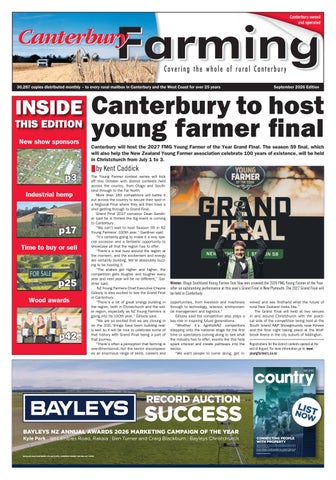
Canterbury will host the 2027 FMG Young Farmer of the Year Grand Final. The season 59 final, which will also help the New Zealand Young Farmer association celebrate 100 years of existence, will be held in Christchurch from July 1 to 3.
] by Kent Caddick The Young Farmer contest series will kick off this October with district contests held across the country, from Otago and Southland through to the Far North. More than 160 competitors will battle it out across the country to secure their spot in a Regional Final where they will then have a shot getting through to Grand Final. Grand Final 2027 convenor Dean Gardiner said he is thrilled the big event is coming to Canterbury. “We can’t wait to host Season 59 in NZ Young Farmers’ 100th year,” Gardiner said. “It’s certainly going to make it a very special occasion and a fantastic opportunity to showcase all that the region has to offer. “There’s a real buzz around the region at the moment, and the excitement and energy are certainly building. We’re absolutely buzzing to be hosting it. “The stakes get higher and higher, the competition gets tougher and tougher every year and next year will be no different,” Gardiner said. NZ Young Farmers Chief Executive Cheyne Gillooly is also excited to see the Grand Final in Canterbury. “There’s a lot of great energy building in the region, both in Christchurch and the wider region, especially as NZ Young Farmers is going into its 100th year,” Gillooly said. “We are so excited that we are closing in on the 100, things have been building really well so it will be nice to celebrate some of that history with Grand Final being a part of that journey, “There’s often a perception that farming is one-dimensional, but the sector encompasses an enormous range of skills, careers and
Winner: Otago Southland Young Farmer Tom Slee was crowned the 2026 FMG Young Farmer of the Year after an outstanding performance at this year’s Grand Final in New Plymouth. The 2027 Grand Final will be held in Canterbury. opportunities, from livestock and machinery through to technology, science, environmental management and logistics.” Gillooly said the competition also plays a key role in inspiring future generations. “Whether it’s AgriKidsNZ competitors stepping onto the national stage for the first time or spectators coming along to see what the industry has to offer, events like this help spark interest and create pathways into the sector. “We want people to come along, get in-
volved and see firsthand what the future of rural New Zealand looks like.” The Grand Final will held at two venues in and around Christchurch with the practical side of the competition being held at the South Island A&P Showgrounds near Kirwee and the final night taking place at the Wolfbrook Arena in the city suburb of Addington. Registrations for the district contests opened at the end of August. For more information go to: www. youngfarmers.co.nz
2026
RECORD AUCTION
SUCCESS
LIST NO W
BAYLEYS NZ ANNUAL AWARDS 2026 MARKETING CAMPAIGN OF THE YEAR
Kyle Park | 191 Lambies Road, Rakaia | Ben Turner and Craig Blackburn | Bayleys Christchurch
CONNECTING PEOPLE WITH PROPERTY Bayleys’ Country is New Zealand’s premier rural property portfolio showcasing quality farms, horticulture, viticulture, forestry and lifestyle properties for sale throughout New Zealand.
Be part of Bayleys’ Country campaign, New Zealand’s leading rural property portfolio and we will deliver an altogether better result.
bayleys.co.nz/country
WHALAN AND PARTNERS LTD, BAYLEYS, LICENSED UNDER THE REA ACT 2008
2 September 2026 CANTERBURY FARMING
FARMING NEWS
Intestacy rules and how they apply
Many people believe that if they die without leaving a valid Will, their spouse or partner will inherit the whole of their estate. That is so in limited circumstances and set out below are the scenarios which will arise when someone dies without leaving a valid Will or a Will which could be validated by the High Court.
Ronald W. Angland & Son LAWYERS
Property | Family | Wills Trusts | Estates | EPAs | Rural Business | Traffic | Employment Leeston (03) 324 3033 Email: lawyers@anglands.co.nz | www.anglands.co.nz
Solicitors of Selwyn since 1965
Bessie Paterson LLB ] with ] Ronald W Angland & Son
Where a deceased person has a surviving spouse or partner, but has no parents, children or grandchildren, the surviving spouse will inherit the whole of the residue of the estate. If the deceased person has no spouse or partner, but has a child or children, the residue is divided equally among the children. An only child will inherit the whole of the residue. The above paragraphs sets out what many people wish to happen but the ensuing paragraphs raise many issues
which most of us would prefer to avoid. If a deceased person has a spouse or partner and children, the spouse or partner receives all of the family chattels, interest calculated in accordance with Schedule 2 of the Interest on Money Claims Act 2016 and one third of the remaining residue (if any). The children receive the remaining two thirds of the residue. Where a spouse or partner and parents survive but the deceased has no children, the spouse or partner receives the family chattels, interest calculated in accordance with Schedule 2 of the Interest on Money Claims Act 2016 plus two thirds of any remaining residue. If there is no surviving spouse, and no children but the deceased’s parents survive, the parents inherit the estate. If there is no spouse or partner, no parents or children surviving, the deceased person’s brothers and sisters inherit the residue equally, but if any of them has died, their children will inherit their deceased parent’s share.
The remaining categories of people who may inherit in an intestacy are surviving grandparents and uncles/aunts. When this scenario arises half of the estate goes to the family of the deceased’s mother and the other half goes to the deceased’s father’s family. If there are no surviving relatives, the residue of the estate goes to the State and anyone who may have expected to have been included in the deceased’s Will may apply to the Government for a pay-out but I would not hold your breath on getting any pay-out from that source. The above rules are included in the Administration Act which imposes an obligation on the estate’s administrator to distribute the residue of the estate in accordance with the above paragraphs. Making a valid Will is essential to avoid any of those scenarios arising. This article has been prepared by Bessie Paterson, a partner at Ronald W Angland & Son, Lawyers, 2 Chapman Street, Leeston.
FARMING NEWS
CANTERBURY FARMING September 2026
3
Show time: This year’s Canterbury A&P Show has a new naming rights sponsor and a return to its Wednesday to Friday format.
Show secures naming right sponsor New sponsors and a return to its mid-week format for the Canterbury A&P Show to be held in Christchurch this November.
] by Kent Caddick Regarded as the largest A&P show in New Zealand the event will again be run at the Canterbury Agricultural Park. The Show (also known as the New Zealand Agricultural Show) attracts around 70,000 to 100,000 visitors, thousands of livestock entries, and hundreds of trade exhibitors over three days every November. There are two big changes for the 2026 Show with a new naming rights partner, and a return to its traditional Wednesday to Friday dates, with the Show being held from November 11 to 13. After two years of operating on a Thursday to Saturday run, the Show is returning to the mid-week format which has been
serving the Show for more than 160 years. Sir David Carter, Canterbury A&P Association board chair said it’s their goal to deliver a authentic A&P experience for both our rural and urban audiences to enjoy and the decision was made on the back of direct feedback from our audience. Meanwhile, farmer-owned co-operative Ravensdown has signed a two-year naming rights sponsorship of the Show, from 2026, and the event will be known as the Ravensdown Canterbury A&P Show. “Rural Canterbury has been inviting urban audiences to share in the Canterbury Show for more than 160 years, and we are excited Ravensdown is supporting that,” Carter said. Ravensdown Chief Executive Garry Diack said for generations, the Canterbury A&P
Show has celebrated the best of New Zealand farming. “As the new naming rights partner, Ravensdown is proud to help ensure that tradition continues for future generations,” Diack said. Also joining the Show sponsors line up is Golden Homes Canterbury who become the naming rights sponsor for the Village Green arena, to be known as the Golden Homes Village Green. For locally owned Golden Homes business owners Dean and Nicki McGuigan, the partnership is about much more than sponsorship, it’s about investing in the region they call home. “For us, building homes
and building communities go hand in hand,” Nicki McGuigan said. “The Canterbury A&P Show is one of the region’s great traditions, bringing together rural and urban Canterbury to celebrate what makes this part of New Zealand so special. We’re incredibly proud to become part of that story.” The new Golden Homes Village Green will provide a welcoming place for visitors to relax, connect and enjoy everything the Show has to offer.
4 September 2026 CANTERBURY FARMING
FARMING NEWS
Letting them get on with it
Todd McClay ] with ] Minister for Agriculture South Island farms are one of the great strengths of our economy. Canterbury is a big part of that. When the South Island does well, the whole country does well. The National Government gets that. It is why we have a plan for the South Island, and why backing rural people and rural businesses sits at the heart of it. So how do we do it? We start by backing farmers. That means not taxing your ute, your farm machinery, your land, or what you leave to your kids. Then we build the transport links the South Island needs, so people, goods and visitors can move reliably. That work has already started. The National Government has lifted spending across the South Island to record levels, and funding in Canterbury is up 50 per cent to $1.8 billion. It pays for projects like the SH1 Rolleston access improvements and the Woodend Bypass, a Road of National Significance. Next, we grow southern exports. The National Government is already reforming planning law to make life easier for farmers and growers. New water storage projects have been picked up by the Fast-track Approvals Act, including Klondyke Storage on the Rangitata Diversion Race, and the Balmoral water storage facility and fish screen on the Hurunui. That gives them one consenting pathway instead of a long queue of them. We’ve also put serious money into wilding pine control, with Canterbury one of the priority regions.
Our South Island plan commits to finishing the job on replacing the Resource Management Act. Farmers and growers need certainty before they will invest in food and fibre production. The new system swaps case by case litigation for clear national rules that apply the same way everywhere. Less money on process. More on production. We’ll also bring in new Crown pastoral land settings. There are 1.2 million hectares of Crown pastoral land carrying a lot of our food and fibre production, and high country farmers should be able to invest and diversify on it with confidence.
Exports do not grow on their own. They need strong communities behind them. So the plan also backs the frontline services those communities rely on health, education, and law and order. National will deliver the nearly 100 extra classrooms already committed across the South Island, and finish the redevelopment work underway at 14 schools. Families in fast growing places like Selwyn and Rolleston were promised those classrooms. They will get them on time. The National Government will finish fitting out Tower Three at Christchurch Hospital, so all 96 beds are ready for patients, rather than sitting empty while Canterbury grows.
That is real capacity added to the South Island’s biggest hospital. We’ve put more police on the beat and toughened the consequences for serious and repeat offenders, and we’re committed to completing Phase 1 of the Christchurch Men’s Prison redevelopment, with construction starting this year. The opportunity in front of us is big. Dairy, meat, wool, wine, seed, grain, horticulture and newer land uses can all earn more, so long as infrastructure keeps up and the rules reward results rather than paperwork. Backing farming does not mean picking the economy over the environment. Most of the lasting environmental gains I see are made by farmers who are doing well enough to afford better systems, and who are willing to try something new. Get the settings right and Canterbury farming stays at the heart of New Zealand’s food and fibre success. The right settings do not involve piling on taxes and red tape. The National Government’s job is to clear away the barriers that do not need to be there, get practical infrastructure built, back innovation, and then trust rural communities to do what they do best. They produce world class food and fibre from one of the most productive parts of the country. We should let them get on with it.
Kiwi workers and their clean hands You may well think that I state the obvious at times, but the old chestnut about immigrants verses local labour still rattles like a thunderstorm around the hills.
] with Rob Cope Williams What brings it all up again is the trade agreement with India and the possibility of immigrants coming in as part of it. No, I am not going to be sucked into a political discussion, but it does highlight the situation we have here in New Zealand. Look at the dairy industry and chat with anyone wanting staff. Most will say that one immigrant is worth two locals, and that is if you can find a local who wants the job. There are horrific stories about New Zealand workers getting the job, working for three weeks and then going onto ACC while still squatting in the farm workers’ house. They then move onto another farm and pull the same trick. Dairy farmers, please organise a reference system so you don’t continue to fall for it. I know of one chap who uses backpackers because he literally can’t find workers. Great workers, but certainly not a stable work force. It isn’t just farmers who have the same problem with Kiwis not wanting to get their hands dirty. Look at the people doing the work on our roads. Not the ones doing nothing, but those who are doing the work. Farming has become very computerised, and the machinery is huge compared to my
‘
It isn’t just farmers who have the same problem with Kiwis not wanting to get their hands dirty.
day, but there are some things that still need a set of hands to achieve the right result. My head is still spinning about herds being shifted from one area to another by the farmers opening gates and shutting them through their mobile phones, but even AI hasn’t replaced the dairy shed needs. I still snigger when I think of AI being artificial insemination as we thought it was. Yes, I do remember the automatic milking system of many years ago, but they really weren’t that great a success. Bottom line I suppose is simply that we must accept that we need immigrants, whether as residents or seasonal type people. The fruit industry still relies on hands rather than machines, and the dairy industry certainly does. Shame we have bred a generation of softies who don’t want to earn an honest day’s pay.
FARMING NEWS
CANTERBURY FARMING September 2026
5
Building a future in hill country farming Cameron Beck’s path into agriculture became clear while working alongside Hawke’s Bay farmers repairing fences and infrastructure damaged by Cyclone Gabrielle.
] by Kent Caddick The Lincoln University student is completing a Bachelor of Agriculture and is the recipient of Perrin Ag’s 2026 John Perrin Scholarship, receiving $6000 towards his studies. Perrin Ag awards the John Perrin Scholarship each year to support a promising student continuing their agriculture or horticulture studies at Lincoln, Massey or Waikato University. Beck grew up on a lifestyle block south of Rotorua. Although agriculture was part of his upbringing, he said he did not initially appreciate the breadth of career opportunities available within the sector. “Throughout high school, the law and business pathway was heavily encouraged, and there wasn’t a lot of information about the opportunities available in agriculture,” Beck said. After spending several years travelling, Beck returned to New Zealand and began reconsidering his future. He had nearly committed to studying law when he received a phone call offering him an opportunity to work on a Hawke’s Bay farm following Cyclone Gabrielle. His work included repairing fencing and other farm infrastructure, alongside the farm’s usual summer stock work. “With limited practical experience in the sector, it had been difficult to get my foot in the door,” Beck said. “Having someone recognise my drive and willingness to learn, and then give me the opportunity to do so, was exactly what I needed.” The experience confirmed his interest in
agriculture and prompted him to reconsider the career path he had previously thought he might follow. “Coming home after travelling gave me the chance to think again about my values and what I was genuinely passionate about,” he said. “I realised law wasn’t something I could see myself pursuing with the same passion, and that led me back to agriculture.” Since enrolling at Lincoln University, Cameron has embraced both his studies and the wider opportunities available within the sector. He was appointed Chairperson of Lincoln Young Farmers for 2026 and has received several academic awards, including the Sir James Wilson Prize and the Luisetti Seeds Award. Beck describes his involvement with Young Farmers as one of the most rewarding parts of his time at Lincoln. “There have already been countless moments this year that have made the work worthwhile. I get a real kick out of seeing people enjoy and make the most of the opportunities the club provides.” In his view, maintaining public confidence in farming and protecting New Zealand’s access to international markets will be two important challenges for the sector. “Negative perceptions of animal welfare could lead to customers or markets rejecting our products. That risk is greater than ever because of the reach of social media and the increasing influence of personal values on food choices.” Any loss of market access could have similarly serious consequences for farmers and the wider New Zealand economy.
Future farmer: Lincoln University student Cameron Beck is the recipient of this year’s John Perrin Scholarship. Looking ahead, Beck hopes to pursue a career in farm management and has a particular interest in hill country development. “I’m interested in the opportunity to improve both the physical and financial performance of hill country farms and contribute to food production as the global population continues to grow.” “For me, successful development means lifting production in a way that strengthens the viability of the farm business while also
supporting environmental performance and staff wellbeing.” Beck plans to continue his studies with a Master of Management in Agribusiness at Lincoln University. He said the scholarship will give him more time to focus on new projects and areas he wants to become involved in and learn more about. Information for this article was supplied by Perrin Ag. For more information on the and Perrin Ag go to: www. perrinag.net.nz
MIKE PRESTON No. 1 INDIVIDUAL SALESPERSON 2025/2026 BAYLEYS CANTERBURY
Mike Preston | Rural Specialist
027 430 7041 | mike.preston@bayleys.co.nz WHALAN AND PARTNERS LTD, BAYLEYS, LICENSED UNDER THE REA ACT 2008
6 September 2026 CANTERBURY FARMING
FARMING NEWS
Supporting hunters while taking deer management seriously There has been a lot of talk about pest management lately, spurred in part from ACT’s announcement of their policy that will transfer responsibility for managing game animals on conservation land from the Department of Conservation to the Game Animal Council, along with plans to designate even more Herds of Special Interest.
Jo Luxton ] with ] Labour spokesperson for Agriculture
This government has already established Herds of Special Interest this term, that will protect certain deer species on conservation land. That’s despite the data telling us that we can’t manage deer populations as it is. We have a really serious problem with game animals that are damaging our native plants and ecosystems. And this isn’t just a conservation issue. It’s a farming issue too. Deer don’t recognise property boundaries. They move between conservation land, farms and forestry blocks, and farmers bear the cost of the damage they cause. And it’s not just one or two rogue deer causing havoc on farm. During a recent study in the Hawke’s Bay, one landowner thought they had 50 deer on his property, but with thermal imaging found nearly 300. The study also showed that if 100 deer got half of their annual feed requirements from productive pasture, farmers would lose more than $10,000 per year. At these numbers, the impact on forage crops, natives, results in an enormous loss of productivity and profitability. The Department of Conservation has a role to protect biodiversity and manage deer, but this government has cut $100M from DOC in this term alone. If we are to be serious about deer management, DOC needs the
‘
We shouldn’t have to choose between supporting hunters, protecting our native biodiversity, and supporting farming productivity.
support and tools to do the job properly. Cuts don’t create the outcomes that we need. When it comes to game animals, we shouldn’t need to choose between valuing hunters, protecting native biodiversity, and supporting farming productivity. We want families who rely on hunting to be able to put food on the table, and we recognise the work that organisations such as the Waipiti Foundation do to get wild veni-
son into food banks. We also know the contribution that hunters make to conservation through predator control, track maintenance and looking after huts in the backcountry. None of that should change. But we do need a conservation estate that works for everyone. That means for hunters, farmers, iwi, environmental groups, recreational users and local communities. All of these voices matter, and they all need to be
part of the decision about how we manage public land. We can value the contribution hunters make while taking the impact of deer numbers on our conservation land seriously and recognising the cost they impose on farmers. We shouldn’t have to choose between supporting hunters, protecting our native biodiversity, and supporting farming productivity. We can, and should, do all three.
No tax on family house or farm If we want to have decent public services and infrastructure, we must find a way to pay for them.
Steve Abel ] with Green Party ] for AgricultureSpokesperson ]
The National-led government has run our hospitals into the ground while giving tax cuts to the wealthiest from borrowed money. While Luxon bellows against additional tax measures he fails to mention the important fact that the overwhelming majority of people will pay less tax under Green proposals. The Greens have a plan for a fairer tax system in which 96% of New Zealanders will pay less tax and the focus of the tax system will move away from work towards wealth. The super-rich will pay a wealth tax on assets above $10 million at a rate of 2.5%. In terms of farms that are not family owned this will impact only around two percent of the wealthiest farming businesses. We will also introduce an inheritance tax but the family home and family farm are exempt and the first $1 million of inheritance is tax-free. Both inheritance and wealth taxes will impact fewer than one percent of New Zealanders.
‘
96% of the public will pay less income tax and only the highest earners pay somewhat more.
Our adjustments to income tax make it more progressive by making the first $10,000 of income tax free. This means 96% of the public pay less income tax and only the highest earners pay somewhat more. The boosted public revenue means we can invest in our stressed health workforce, quality locally made school lunches, affordable, renewable energy and improving the public services we all rely on. You can read more about a fairer tax system for all of us on the Greens website: www.greens.org.nz
FARMING NEWS
CANTERBURY FARMING September 2026
7
Canterbury couple named Arable Farmers of the Year Methven couple John and Mel McCaw were named Arable Farmers of the Year at the 2026 Arable Awards.
] by Kent Caddick The awards are backed by Federated Farmers, the Foundation of Arable Research, United Wheat Growers and the Seed & Grain NZ Association. Held at the Air Force Museum in Christchurch the fourth annual awards night celebrated the innovators and leaders in the grain and seed industry, across seven award categories. The Arable Farmer of the Year is selected from winners of the Seed Grower of the Year (the McCaws), the Maize Grower of the Year (Mark Shera from Ashburton), the Cereal Grower of the Year (Andrew and Amy Darling, from Timaru) and the Positive Environmental Impact Grower of the Year (Lovett Family Farms). Judges said they were impressed by how the McCaws bring simplicity to their arable rotation, their understanding of crop performance, and their strategic integration of multiple arable crops and livestock classes. “Good profitability is achieved alongside sustainability, with use of trees, cover crops, and tillage practices beneficial to soil conservation.” Farming 560 hectares near Methven, the couple are involved in all aspects of the New Zealand seed industry. As well as specialising in herbage seed production (ryegrass and cocksfoot), the fam-
ily owns McCaw Seeds seed dressing plant. John McCaw contributes to the sector through various representative, community, governance and advisory roles, including chairing the Federated Farmers Herbage Seed Subsection for the last six years. Earlier this year he was named Federated Farmers Arable Advocate for the Year, with then Arable chair David Birkett calling his contribution “exceptional and hugely valuable”. “The intellect and the balanced approach he brings to advocacy is outstanding.” The award ceremony also saw three individuals and a couple join the Arable Hall of Fame: John Mckay, John McKenzie, Eric and Maxine Watson and (the late) Murray Kelly. Other 2026 Arable Award winners were: Working Together Award: The SCID Rebuild Team; Positive Environmental Impact Award: Lovett Family Farms; Agronomist of the Year: Sean Mulligan; United Wheat Growers Feed Wheat Award: Andrew and Amy Darling from Adar Farming Ltd; United Wheat Growers Milling Wheat Award: Dan and Tash White from Willowbank Ag; United Wheat Growers Premium Milling Wheat Award: Robin and Lisa Kingsbury from Tahuri Farm. Information for this article was supplied by Federated Farmers and the Foundation for Arable Research. For more go to: www.fedfarm.org.nz or www.far.org.nz. For more on the awards go to: www.arableawards.co.nz
Top team: Methven farmers John and Mel McCaw have taken out the Arable Farmers of the Year title at the 2026 Arable Awards.
8 September 2026 CANTERBURY FARMING
RURAL PROFESSIONALS
AI remains a major theme
AI-related investments produced some of the strongest and weakest returns in global share markets during the quarter, highlighting how quickly market sentiment can change.
Andrew Wyllie ] with ] Forsyth Barr
pronounced cycles of rapid growth and then slower activity. Earnings across the AI supply chain could Near-term spending plans remain strong, weaken if demand falls short of expectahowever, the scale and speed of this invest- tions, competition increases, anticipated rement also creates uncertainty. Technolo- turns do not eventuate, or companies scale gy spending has historically moved through back their investment plans. Investors should also be aware that major global share indices give greater Looking to create wealth weight to the largest companies. from off-farm investments? This means many headline indices are heavily conPlanning to diversify your assets? centrated in a relatively small group of technology and AIrelated businesses. A well-diversified portfolio may therefore look, and perform, quite differently from these indices.
Interest-rate outlook uncertain Andrew Wyllie
Melissa McCosh
Hamish McLean
Michael Coleman
Contact one of our Investment Advisers in confidence CHC6189-03 - April 2026
on (03) 966 6760.
Higher oil prices can add to inflation by increasing transport and production costs. The recent decline at the end of the quarter reduced some of the immediate pressure on inflation and interest rates. However, at the time of writing, oil prices remain above their pre-conflict lev-
el, and the risk of further supply disruptions means the outlook remains uncertain. In New Zealand, the Reserve Bank raised the Official Cash Rate from 2.25% to 2.50% on 8 July, its first increase since May 2023. It has indicated that further increases are likely, although their timing and extent of rate increases will depend on inflation, economic activity, and how businesses respond to higher costs. Australia is further along in the process of raising interest rates. The Reserve Bank of Australia has increased its cash rate three times this year, taking it to 4.35%, as it works to bring inflation under control. In the United States, interest rates are also expected to rise, although probably more gradually. Earlier increases in inflation and interestrate expectations pushed New Zealand corporate bond yields higher and bond prices lower, limiting recent returns. The latest fall in oil prices may ease some of this pressure, although bond markets are likely to remain sensitive to inflation data and developments in the Middle East. Higher yields also improve the income available from new bond investments and may support future returns. High-quality bonds continue to provide diversification and can help cushion a portfolio if economic growth slows, inflation eases, or investors become more cautious.
Why diversification matters more than ever This quarter has reinforced the importance of diversification. In May, the strongest returns came from US and Asian technology companies, with growth stocks comfortably leading the market. By July, that leadership had reversed sharply, with New Zealand and Australian equities, defensive sectors, and dividend-paying companies providing greater support. Maintaining a genuine mix of investments remains one of the most reliable ways to benefit from market gains without becoming too exposed to any single outcome. This includes bonds, listed property, infrastructure and shares across different markets and investment styles. If you would like to review your investments or discuss the market outlook in more detail, please get in touch. Andrew Wyllie is an Investment Adviser and Forsyth Barr’s Christchurch Manager. He can be contacted regarding portfolio management, fixed interest, or share investments on 0800 367 227 or andrew.wyllie@ forsythbarr.co.nz. This article was prepared as at 31 July 2026 and provides market commentary for the three-month period ending on that date. This article is general in nature, has been prepared in good faith based on information obtained from sources believed to be reliable and accurate, and should not be regarded as financial advice.
Make sure your money has a job For many farmers, the past couple of years have been a reminder of how quickly fortunes can change. Costs went up, interest rates hurt, and in some sectors returns were disappointing. Now, things are looking stronger.
Laura Wood ] by ] LGW Accounting MPI’s latest forecasts show strong returns across much of the primary sector, with dairy
and red meat in particular benefiting from good commodity prices. Sheep and beef farm profitability is also forecast to improve significantly. When there is finally a bit more money in the bank, the temptation is to catch up on everything that has been put off. A new implement, more fertiliser, some fencing, repairs, debt repayment – the list usually isn’t short.
PROFESSIONAL RURAL
REAL ESTATE ADVICE
Call Ben today for an altogether better approach to your rural real estate needs along with an up-to-date market overview.
Ben Turner 027 530 1400 03 375 4736
ben.turner@bayleys.co.nz
WHALAN & PARTNERS LTD, BAYLEYS, LICENSED UNDER THE REA ACT 2008
Residential / Commercial / Rural / Lifestyle
But a profitable year is also a good opportunity to stop and think about where that extra money will have the biggest impact on your farming business. Profit doesn’t necessarily mean spare cash. One of the biggest misunderstandings in farming businesses is the difference between profit and cash. You might have a good profit on paper, but that profit still needs to cover things such as tax, principal repayments on loans, drawings and capital purchases. By the time all of those are taken into account, there can be considerably less money available than the profit figure suggests. Before committing to a large purchase, it is worth asking a simple question: “If I spend this money, what does my bank account look like six months from now?” That doesn’t require a complicated 20-page budget. Even a basic cashflow forecast can give you a much clearer picture. Rather than simply spending because the money is available, think about what you want a good season to achieve. For one farm, reducing debt might be the priority. For another, it could be catching up on deferred maintenance, investing in pasture or infrastructure, or building up some cash reserves. There isn’t one answer that suits every farm. A useful approach is to divide available cash between three areas: strengthening the balance sheet, reinvesting in the farm, and keeping a buffer.
That buffer is particularly important in farming. Weather, commodity prices and unexpected repairs don’t tend to ask whether they fit into the budget. MPI is currently encouraging farmers to maintain realistic financial budgets and make early decisions as the country prepares for potential El Niño conditions. Don’t buy something just for the tax deduction Tax should certainly be considered when making business decisions, but it shouldn’t be the only reason for making them. Spending $100,000 to save some tax still means you have spent $100,000. If the investment improves production, reduces costs, saves labour or replaces something that genuinely needs replacing, it may make excellent business sense. The tax treatment is then an added consideration. The better question is: “Would I still want to make this investment if there wasn’t a tax benefit?” If the answer is no, it may be worth reconsidering. Good farm business management isn’t only about surviving the difficult years. It is also about making the most of the good ones. Strong returns provide an opportunity to strengthen the business so it is better prepared for whatever comes next. Before the extra cash quietly disappears into farm spending, sit down and work out what you want this year’s profit to achieve. Sometimes the best investment isn’t the newest piece of machinery in the shed, it’s putting the farm in a stronger financial position for the next five years.
CANTERBURY FARMING September 2026
RURAL PROFESSIONALS
9
Arms Act gets overhaul New Zealand’s firearms legislation has just undergone its most comprehensive update in more than four decades, with the Arms Act 2026 (Act) replacing the Arms Act 1983 and introducing a new regulatory system intended to make firearms regulation clearer, more modern and more focused on public safety.
Tyler Burgess ] with Helmores Lawyers ]
The new Act follows years of amendments to the 1983 legislation, which the Government says had become difficult to navigate. The Arms Bill received Royal Assent on 5 August 2026. Most of the new legislation will come into force on 23 September 2026, although several changes will be phased in later. The new rules for commercial ammunition sellers begin on 23 July 2027, while a number of other changes take effect from 23 February 2028. One of the most significant changes is who regulates firearms. From 23 September 2026, Firearms Safety and Education New Zealand (FSE) will replace the existing Firearms Safety Authority as the country’s firearms regulator. The new organisation will operate with an independent chief executive who reports to the responsible Minister, rather than firearms regulatory decisions sitting within Police. Police will retain responsibility for criminal enforcement, while FSE will concentrate on licensing, registration, education, compliance and regulatory decisions.
Some further changes include: Gang membership will explicitly disqualify a person from holding a firearms licence. The Act will strengthen informationsharing between FSE, Police and other government agencies where information raises concerns about whether a person remains fit and proper to possess firearms. The process for challeng-
ing licensing decisions will also change. A new Firearms Licensing Review Committee will provide an independent review mechanism for decisions such as refusing or revoking a licence, as well as conditions imposed on licences. The intention is to give licence holders a specialist review process outside the regulator itself and reduce the need for disputes to proceed directly to the District Court. The Act will change the rules governing firearms businesses. Compliant businesses will eventually be eligible for licences lasting five years, rather than the current 12-month dealer licences. The Act also gives greater flexibility in several areas. Storage requirements will be changed so licence holders have more flexibility to choose an appropriate secure location, provided firearms are protected against theft and unauthorised access. From February 2028, collectors with the relevant endorsements will also have greater flexibility around where vital firearm parts can be stored. Some of the changes are aimed particularly at specialist users. From February 2028, endorsements for restricted firearms used for biosecurity control will last five years, rather than the existing two years and six months. New multi-user agreements will also allow specified employees of biosecurity and pest-control organisations to share restricted firearms for short periods without requiring a separate permitto-possess or Registry update for every transfer of less than seven days.
The Act also introduces stronger enforcement tools. Penalties for firearms offences have been increased, while the regulator will eventually be able to issue infringement notices for lower-level non-compliance rather than treating every breach as a more serious offence. Taken together, the reforms are intended to strike a balance between public safety and legitimate firearms use. The Act represents a significant change to the framework that has governed firearms in New Zealand since 1983. These changes will affect all firearms users going forward, in one way or another. The challenge for the Government will be ensuring that the new system delivers the promised combination of tighter safeguards, clearer rules and a more practical system for responsible firearms users.
CHASING EXCELLENCE Peter Foley 021 754 737
Kevin Jenkins 027 577 4232
PETER FOLEY AND TEAM WHALAN AND PARTNERS LTD, BAYLEYS, LICENSED UNDER THE REA ACT 2008
10 September 2026 CANTERBURY FARMING
HEALTH ON THE FARM
Dealing with stress ] Article supplied by Farmstrong
How do you manage unhealthy stress? Awareness is key. The earlier you recognise the signs of unhealthy stress the better you’ll be able to manage them. Recovery periods are vital. Daily and weekly ‘down time’ is important as well as taking a holiday after really busy times. Secondly, come up with a plan. Instead of trying to do everything, it’s about asking yourself what are the one or two top things I need to work on right now? Focus on them and park everything else. Once you’re feeling back in charge and your stress levels go down, some of the other issues bugging you may disappear. A way to cope with lots of demands is by reducing or delegating them to others. A general rule of thumb that a person is under unhealthy stress, is when their daily functioning and relationships are being impacted. For example, if the person doesn’t seem themselves and shows ongoing changes in their normal behaviour and thinking patterns. When we just keep going without a break from the ongoing physical or mental de-
mands we are facing, our body finds it hard to keep up and the cracks begin to show. A catch-up with your GP, a local counsellor, Rural Support Trust worker or supportive friend, can give you some ideas or a plan to get things back on track. What is burnout and how do you know if you’ve got it? Burnout is essentially your body hitting the wall and saying, “I’ve had it. You should’ve given me a break and you haven’t.” Your body is letting you know that it’s mentally and physically exhausted.
Signs include: • low energy and motivation to do even normal everyday tasks • severe irritability where little things become highly frustrating • losing your temper easily and often • inefficiently tackling and completing tasks • feeling ineffective and that you’re not accomplishing enough. If some of these look familiar to you, then you may be experiencing burnout or heading towards it.
How do you prevent burnout? When people are under pressure the things
that disappear are often the things that keep us well and prevent us getting burnt out. Continue to: • socialise with other people • exercise regularly • eat well • continue to learn • contribute to the community • get off the farm and do something you enjoy with others.
Building in enjoyable activities is really important. Those are the things that give us more coping space and keep us feeling on top of things. For more on how to maintain your mental health wellbeing on the farm go to: www.farmstrong.co.nz. Canterbury Farming thanks Farmstrong for being able to reproduce this article.
Berberine Balance
A smarter way to take berberine Berberine has become one of the most talked-about natural ingredients for supporting healthy blood sugar balance, weight management and overall metabolic health. Unfortunately, traditional berberine extracts are poorly absorbed, often require high daily doses, and can cause digestive discomfort in some people.
Health House’s new Berberine Balance features Metaberine® Each capsule provides 200mg of Metaberine®, a new generation of berberine developed using patented BioSOLVE® technology (optimising water solubility). This advanced extract is designed to be absorbed more efficiently than standard berberine extracts, allowing a much lower daily dose.
Berberine Balance combines modern ingredient technology with one of the world's most researched botanical ingredients to provide a well-absorbed and well-tolerated option for everyday use.
Supports: Normal blood glucose metabolism Healthy fat metabolism Your body's natural metabolic balance Natural energy and general wellbeing Can interact with prescription medications for blood sugar management such as metformin, and certain blood thinners.
$69ea 60 capsules per bottle
Chromium Each capsule combines Metaberine® with chromium polynicotinate. Chromium is an essential trace mineral that also complements the benefits of berberine. Always read the label and use as directed. If symptoms persist see your healthcare professional.
Free delivery IN NEW ZEALAND
Call free on
0800 140 141
www.healthhouse.co.nz Health House | Private Bag 12029, Tauranga 3143, New Zealand Retail Store / Head Office | 1 Whakakake Street, Tauriko, Tauranga 3110
] with John Arts
Think Berberine, blood sugar Your body has finely tuned systems for turning food into usable energy. Carbohydrates are broken down into glucose, or blood sugar, which enters the bloodstream. The pancreas then releases insulin, the hormone that helps move glucose from the blood into cells, where it can be used for fuel. Too much blood sugar and cell insulin resistance can become a serious problem. Surplus glucose can attach to proteins and fats in the bloodstream forming harmful compounds causing inflammation and tissue damage. This damage is a real concern in prediabetes and Type 2 diabetes, particularly when it affects blood vessels and nerves. While we can store some blood sugar as glycogen, excess glucose (blood sugar) is converted into triglycerides, a type of fat, and released into the bloodstream to be stored as body fat. This is why weight gain and raised triglyceride levels can be signs of poor blood sugar control. The best way to support healthy blood sugar control is to follow a diet low in sugar and carbohydrates, while focusing on low-starch plant foods, healthy fats, and protein. For more information, contact
me for an email copy of my Healthy Eating Guide. Two supplements can be helpful while making these diet changes: a high-quality, water-soluble berberine extract and the mineral chromium polynicotinate. Berberine and chromium both play key roles in blood sugar metabolism. Berberine supports AMPK (AMP – activate protein kinase) often described as the body’s “energy switch”. AMPK helps maintain healthy blood sugar balance by reducing further glucose production and encouraging glucose to move out of the bloodstream and into cells for energy. Chromium supports insulin receptor function, helping cells take up glucose more effectively. Choose a water-soluble berberine extract where possible, as it may improve absorption and reduce the digestive discomfort sometimes associated with standard berberine extracts. John Arts (Adv.Dip.Nut.Med) is a qualified nutritional medicine practitioner. To read more by John and find out more about the Abundant Health products, visit www.healthhouse.co.nz, call 0800 140 141, or email john@healthhouse.co.nz.
CANTERBURY FARMING September 2026
11
A career built on getting the job done For Gary Carr, groundspreading has always been about more than moving product from A to B. It is about knowing the farms, understanding the job, looking after customers and doing the work properly. That approach shaped his business and reputation across North Canterbury.
] Article supplied by Groundspread NZ
Gary has spent decades in and around the industry, building a business and a reputation based on practical knowledge, personal service and a willingness to help others. He is the owner and operator of Spreading North Canterbury, a business he bought after working for a local transport company in Amberley for 31 years. Twenty years on, he remains hands-on, still drives regularly and works closely with his small team. That hands-on approach has helped build relationships across generations. Gary has worked on some farms for two or three generations, continuing relationships that began through his father’s work in local transport. For those customers, the relationship is built on trust and knowing the job will be done properly. It is a standard Gary applies beyond his own customer base. He is generous with his knowledge and readily shares practical advice with other operators, including younger people coming into the industry. Competition does not prevent collaboration, and Gary has great working relationships with other spreaders and is always willing to help when needed. Training and safety are important to him. He has supported industry training opportunities and sees value in giving operators practical knowledge that can make their work safer and more effective. He also recognises that equipment and technology continue to evolve. His own trucks are equipped with consistent technology, and he sees keeping up with new systems as essential. For Gary, being part of Groundspread NZ is about people and shared knowledge. He values the camaraderie of operators from different parts of the country and the opportunity to learn from people who approach challenges differently. He continues to attend branch meetings, training days and conferences and contributes when there is work to be done. That contribution has been recognised more than once. In 2023, Gary was nominated for Groundspread NZ’s Ballance Agri-Nutrients President’s Award by a client, a strong endorsement of the service and professionalism he brings to the farms he works on.
Top job: Gary Carr of Spreading North Canterbury has been recognised for his work receiving Groundspread NZ’s Ballance AgriNutrients President’s Award which is a strong endorsement of the service and professionalism he brings to the farms he works on.
Three years later, he was nominated again by a fellow groundspreader, and in 2026 was named a joint recipient of the award. The Ballance Agri-Nutrients President’s Award is one of Groundspread NZ’s Annual Industry Awards, recognising members who support the association and the wider industry through leadership, knowledge-sharing and positive contributions. Gary’s influence fits that description without him ever seeming to seek recognition. For him, this is simply how he works every day: sharing what he knows, supporting others, maintaining high standards and staying involved in the industry for the long term. His focus now extends to the future. Gary is keen to encourage younger people into the industry and help them develop their skills and confidence, seeing the value in giving the next generation an opportunity to build something of their own. Gary’s philosophy is straightforward: “The more you put into something, the more you get out of it.” It is reflected in the business he has built, the customers who trust him and the people across the industry who know they can turn to him for advice and support. At the 2026 Groundspread NZ Industry Awards, that approach earned Gary the Ballance Agri-Nutrients President’s Award. It is recognition not of one particular achievement, but of a career defined by doing the job well, contributing where he can and helping the industry around him move forward.
12 September 2026 CANTERBURY FARMING
CANTERBURY FARMING September 2026
13
Pre-emergence brassica weed control Weeds are the sworn enemy of young forage brassica crops. And, given the importance of forage brassica crop to the Central Canterbury area, protecting them takes something special. Or three.
] Advertorial supplied by UPL NZ Ltd
Dr Lauren Jones, UPL Regional Manager Central South Island, recommends not one active, but a three-pronged attack. “One active can’t do everything. The combination of three products with four actives, Merit, Monarch, and Major, gives you really good weed control pre-emergence and they’re compatible, which makes application easy and cost effective.” Monarch can also be used as a post emergence back-up – where needed. Weeds can vary from paddock to paddock. Lauren recommends checking the paddock history and talking to your technical advisor. Weed pressure, she says, can result in up to 60% yield losses. “Unfortunately, weeds can be more vigorous than the crops, and the weedier the crop the lower the yield. Once the crop canopy closes it’s usually fine but that takes 4-8 weeks.” However, the problem, she says, is bigger than that. “If weeds are unchecked, a weed seed bank build up in the soil, impacting the paddock’s productivity for years. You don’t want weeds dumping seeds that will impact the next rotations. Farmers always have to be looking a couple of years ahead or there
Effective pre-emergence weed control with UPL NZ’s programme helped this forage brassica crop get away cleanly. can be long-term negative production outcomes. “It’s also planning ahead for the crops that follow. Annual weeds such as black nightshade can produce several thousand seeds, with established plants producing up to 10,000 seeds per plant which can remain viable in the soil for decades.” The power of the three herbicides combined is firmly grounded in science. Merit (alachlor) controls a range of certain annual broadleaf and grass weeds in forage brassica. Proven and effective, Merit extends the weed spectrum in a pre-emergence application. Merit’s odour is also lower com-
pared to other herbicides on the market. Major (clomazone) is a residual preemergence herbicide controlling a wide range of annual broadleaf and grass weeds in forage brassica crops. It provides outstanding control of problem weeds such as Shepherd’s purse, chickweed and cleavers. A residual herbicide, Major is taken up through roots and emerging shoots of weed seeds. It has little effective contact action and must be applied before weeds and crops emerge. While Shepherd’s purse (Capsella bursapastoris), may seem relatively harmless, it is a host for clubroot. Clubroot is caused by a soil-borne fungus and affects all bras-
sica species, stimulating abnormal growth. The clubbed tissue significantly restricts growth and can also release spores. Within the soil, these spores can last over ten years, infecting any subsequent brassica crop in the rotation and is notoriously difficult to get rid of. Monarch (clopyralid and picloram) is a specially formulated herbicide for pre-emergence and post-emergence weed control and tread the balance between crop safety, efficacy, and affordability. Containing twice as much clopyralid compared to some other herbicides on the market it means there is no need to add extra clopyralid to your tank mix. Lauren says with a comparatively low rate of picloram in Monarch the potential for residual effects on clover is reduced. “That makes Monarch a highly flexible tool for pre-emergence weed control.” Lauren also recommends Unison as the adjuvant of choice with Major, Monarch and Merit for pre-emergence weed control. Trial work has consistently demonstrated improved efficacy when Unison is included. For more information on how to protect your forage brassica crops right from the start, contact your technical advisor or Lauren Jones, UPL NZ Regional Manager Central South Island, at 021 987 735.
M to the power of three Major, Monarch, and Merit – they will save the day for forage brassicas! Effective forage brassica pre-emergence control isn’t just for that valuable crop. It’s also for protecting the future of the paddock from lurking weed seed banks. Major, Monarch, and Merit combine four active ingredients to provide a powerful wide spectrum pre-emergence control programme.
Talk to your local merchant to find out more. Registered pursuant to ACVM Act 1997, No. P009584 (Major), No. P008319 (Monarch), No. P009486 (Merit). See www.foodsafety.govt.nz for registration conditions. Approved pursuant to HSNO Act 1996, No. HSR101381 (Major), No. HSR100032 (Monarch), No. HSR101602 (Merit). See www.epa.govt.nz for approval conditions. Registered trademarks.
14 September 2026 CANTERBURY FARMING
CANTERBURY FARMING September 2026
15
Seize the day as opportunities abound If there was ever a chance to set your farm up for a strong, profitable future, this spring is it.
] Advertorial supplied by Barenbrug
That’s the advice from a veteran Canterbury agronomist, who says solid farmgate returns create a rare opportunity to invest in proven pasture genetics for spring sowing. “The beauty of cultivars like Array, Maxsyn and 4front perennial ryegrass is that they generate years of improved productivity,” Graham Kerr from Barenbrug says. “The global commodity market will turn again; it always does. But now, while returns are strong for both dairy and red meat, it’s time to build a buffer against lower prices in the future.” Grown, grazed, re-grown and grazed again, high quality home-grown pasture keeps operating costs down and profits up. “It’s the heart of our industry’s success, and it’s remarkably cost-effective,” Graham says. “The better your pasture, the more resilient your system is in the face of all the variables, including weather, product prices and geopolitical uncertainties.” In fact, he says, certified proprietary pasture seed is one of the lowest-risk, highestreturn farm investments you can make. Top shelf perennial ryegrass cultivars are not only bred to provide measurable
gains in yield, seasonal growth and feed quality, they’re also stringently tested for quality and performance. Renewing with Array diploid ryegrass, for example, brings a unique mix of easy eating, very high total yield, and great cool season growth with persistency and the ability to extract more soil nitrogen. Similarly 4front, the country’s top selling tetraploid perennial, delivers unbeaten total yield for a tetraploid; enhances animal performance and is highly palatable. Graham says these are just two examples of the opportunities that present themselves this spring. If you’re looking for highly productive, shorter-term renewal options than perennial ryegrass, Forge tetraploid hybrid ryegrass offers a breakthrough in genetic gain, and is the New Zealand champion in three to five year pasture. “This season is also an ideal time to think really carefully about the value of white clover, both in terms of which cultivars you pick for pasture renewal, but also how it is sown. “Too often clover seed is sown too deep, jammed in the same row as ryegrass seed, and never fulfils its potential.”
A Barenbrug trial comparing different sowing methods for perennial ryegrass and white clover showed that in the 12 months after sowing, broadcasting clover seed gave twice the clover yield than that produced by drilling it in the same row as the ryegrass.
Because clover seed is tiny, it must be sown at shallower depth than ryegrass, and, if you want it thrive, needs its own space to establish well without being crowded out or shaded by ryegrass. Graham says with urea fertiliser prices up to 50% higher than this time last year, and no sign of certainty returning to the market, farmer interest in white clover is skyrocketing. A Barenbrug trial comparing different sowing methods for perennial ryegrass and
white clover showed that in the 12 months after sowing, broadcasting clover seed gave twice the clover yield than that produced by drilling it in the same row as the ryegrass. “The value of the extra clover grown over the year is equivalent to $50/ha of urea, plus another 2-3 times that in extra lamb growth or milksolids production” Seed for Array, Maxsyn, 4front and Forge ryegrasses is available now, along with Apex, Kotuku and Ruru white clovers. Order yours today from your seed merchant.
Certainty, by the bagful. There’s plenty on a New Zealand farm you can’t control. The weather. The markets. The summer that turns up late – or doesn’t arrive at all. Your pasture seed shouldn’t be one of them.
Stack the odds in your favour. Choose proven Barenbrug cultivars and grow with confidence. Learn more at barenbrug.co.nz
Scan the QR code to learn more.
Grow with Confidence
0800472 563 Palmer 0800 4 PALMER Agri Parts Direct Ltd .. . . ..... ... .,__... '"
Stockists for: • Chafer Adjustable Stream Bars for Liquid Fert applications. • Needham Ag JD750a Air Seeder wearing parts, Discs, Bush Kits, Boots, Springs, Gauge wheels and firming wheels. Driving on farm Profitability with high quality parts with proven performance.
Kverneland•Overum• Kuhn Lemken• Dowdeswell•Vogel & Noot•Gregoire Besson• Clough• Duncan •Terradisc• Maxitill•Yeoman•Vibroflex •Connershea•Goliath• IHC• Sunflower•Topdown•Salford• Kongskilde•Napier•Vaderstad We can also manufacture any point you need!
admin@palmeragriparts.co.nz I 34 Robinson Street, Riverside Industrial Park, Ashburton
0275 083 789 unearthag.com
Palmer Agri Parts Direct imports and manufactures quality parts that fit machines indicated. These parts are not sold as genuine parts.
Farmlands co-operative
16 September 2026 CANTERBURY FARMING
Protect your maize silage investment Despite the cost of growing a maize silage crop rising about 30 per cent in the last four years, growers should not be tempted to cut corners which could result in a reduced yield.
] Article supplied by FAR
That’s according to Corson Maize national research manager Mike Turner. “When you are growing a high-cost, highinput crop, doing the basics right is more important than ever,” Turner told a recent Foundation for Arable Research (FAR) maize winter workshop. From 2021-22 to 2025-26, his analysis shows that total maize silage costs, from spray out to covering the silage stack, rose from $4026 a hectare to $5143/ha. Fertiliser/lime and seed related inputs both recorded the biggest increase, at about 41 per cent. “When costs are going up you need to protect that investment and yield at harvest,” Turner said. Base fertiliser increased from $450/ha in 2022 modelling to $850/ha now. “In comparison, the cost of a soil test is very cheap. So, if you are getting your fertiliser spend wrong, either too much or too little, it can have a big impact on costs.” Turner said when growers get the basics right, a higher yield dilutes their costs. “For example, a 17 tonne of drymatter/ ha maize silage crop equates to 31.9 cents a kg of drymatter. At 25 tonnes/ha this falls to 21.7 cents/kg/DM and at 28 tonnes/ha 19.4 cents/kg/DM. “Yield spreads cost across more kg of feed. This is the strongest reason for grow-
Savings: FAR maize grain production trials show that the combination of reduced cultivation intensity and the use of Mineral N and PMN testing have the potential to save $300 or more per hectare.
ers to protect crop establishment and the basics. Most costs in a maize silage crop are fixed. So, the only real way to offset that is to get a good yield.” He said when choosing a CRM hybrid for silage, growers need to be aware that while silage yields increase for longer-maturing hybrids, so can the risk, especially in environments that can get dry and disease pressured.
Get the right advice on high yielding lucerne. HIGH YIELD
Well suited to both irrigated and non-irrigated land, lucerne is a versatile and high yielding perennial crop with excellent forage qualities. For expert, individual advice, give us a call. We’ll find the right match of seed to soil for the best results on your farm.
“Some growers are choosing a CRM out of habit. It is worth asking your seed supplier about what hybrid best suits your system. “Shorter CRM is not about giving up yield potential, it is about providing a more reliable return and a less risky yield. A crop that finishes cleanly, dries down, stands well and meets the harvest window usually protects margin better than a theoretical top-yield option.” Predictions of a super El Nino weather pattern producing hot, dry conditions later this season means it is recommended that growers without good moisture-holding soils shorten their CRM to get their crop well into grain fill or dry down phase before it comes under too much pressure. “Some hybrids can better cope with dry conditions later in the season. A lower plant population could also be considered,” Turner said. FAR senior maize researcher Rene van Tilburg said that growers need to factor soil nitrogen into their input calculations and if they are applying more nitrogen than what their crop can take up, they are wasting money. “Maximise your soil N; use it or lose it,” van Tilburg said. “Growers generally make some allowance for soil N, but often this is anecdotal and what they have always done, rather than being based on actual soil test results. In-
stead, growers should measure nitrogen supply rather than guess it and trust the result.” Growers are recommended to use a Mineral N test to determine soil N as well as a Potentially Mineralisable Nitrogen (PMN) test which indicates how much N may become available during the growing season. This allows side-dress N applications to be better matched to crop demand and soil N supply, improving profitability. In a FAR maize grain production trial at the Corson Research site at Newstead, near Hamilton, large differences in soil N supply between plots in 2024-25 resulted in sidedress N inputs ranging from just 75 kg to 360 kg SustaiN/ha. Soil testing showed the soil supplied from $599 to $1016 worth of N at a SustaiN price of $1400/tonne. “Growers, particularly on good-structured soils, can also consider their cultivation intensity, saving diesel and machinery costs and labour. FAR work shows no yield penalty moving to strip till or no-till on sites with highquality soil. “However, transitioning to strip-till or notill has its challenges and may not be practical for many growers,” van Tilburg said. “A key point when making any of these changes is to ensure a seed bed that will result in consistent seed depth and good seed to soil contact.”
Together we can save lives.
EXCELLENT FORAGE QUALITIES
DONATE ONLINE TODAY.
0800 PASTURE 7
2
7
8
www.specseed.co.nz
8
7
3
Every donation, whatever the size, is vital.
specialtyseeds N Z ’s I N D E P E N D E N T S E E D S U P P L I E R
SGS 1764
For the best advice call
www.airrescue.co.nz
Charities Services #CC23893
CANTERBURY FARMING September 2026
17
Planting a hemp seed For the first time in a century, everyday New Zealanders have the opportunity to grow industrial hemp, with the New Zealand Hemp Industries Association (NZHIA) launching its Seed Project for the 2026 growing season.
] by Kent Caddick Changes to New Zealand’s industrial hemp regulations in May 2026 removed the previous licensing barrier, allowing anyone to grow low-THC industrial hemp anywhere in New Zealand, subject to the applicable notification requirements. The NZHIA Seed Project has been created to put low-THC hemp seed into the hands of New Zealanders and encourage them to grow hemp, learn about the crop, experiment with it and explore the products and businesses that could develop from it. NZHIA Chair Richard Barge said the regulatory change has created the opportunity, now they need to grow the industry. “The regulations have opened the door, and now we need New Zealanders to walk through it,” Barge said. “We want people growing hemp and thinking about what they can make from it. More growers, more ideas and more products will help create the demand needed to build a successful New Zealand hemp industry.” Barge said industrial hemp is an extraordinarily versatile crop, but an industry needs more than a crop. It needs growers produc-
ing raw materials, entrepreneurs developing ideas, researchers testing applications, processors adding value, manufacturers making products and consumers creating demand. “For some participants, growing hemp may simply be about curiosity and experiencing this remarkable crop for the first time. For others, it could be the beginning of a cottage business, a new product idea, research project or pathway into commercial hemp production. A few plants grown today could inspire a new food, fibre or building product tomorrow. A successful small-scale experiment could lead to a larger crop, a new business or new demand for locally grown hemp. The Seed Project uses Kompolti, a European-bred industrial hemp cultivar with a track record in New Zealand growing conditions. The NZHIA will provide participants with practical information on sowing and growing conditions, grower obligations and pollen drift management. “When you buy seed through the project, you’re doing more than planting hemp,” Barge said. “You’re supporting the development of the industry and becoming part of a
Versatile: Globally, seed, fibre and all plant materials from industrial hemp have potential applications across food, fibre, textiles, paper, building and construction, health and wellness, animal products, horticulture, biomaterials, environmental applications and manufacturing. community exploring what hemp can contribute to New Zealand. “You don’t need to be a commercial farmer to participate. Home gardeners, lifestyle block owners, businesses, researchers, product developers and people who are simply curious about hemp can take part.” Globally, seed, fibre and all plant materials from industrial hemp have potential applications across food, fibre, textiles, paper, building and construction, health and wellness, animal products, horticulture, biomaterials, environmental applications and manufacturing. However, some of these hemp products are commercially restricted in Aotearoa New Zealand.
The Seed Project is also an NZHIA membership and fundraising initiative. After seed, packaging, administration, GST and project costs, funds generated through the project will contribute towards upgrading the NZHIA website and developing better information and resources for growers, businesses, members and the wider public. The New Zealand Hemp Industries Association (NZHIA) supports the development of a professional, well-regulated and commercially successful hemp sector, working with growers, processors, businesses, researchers and policymakers to develop the opportunities offered by industrial hemp. For more information go to: nzhia.com
Want to test your pasture and feed on hand? Preparing for spring fertiliser decisions? Or planning a new dairy conversion? Canterbury Feed Assessment and Soil Rx are both here to help. Get a complete picture of your farming system. CFA offers IANZ-accredited feed analysis and nutritional insights, Soil Rx provides detailed soil fertility analysis through grid mapping, and nutrient management planning. Make more informed decisions on feed and fertiliser Support productivity & profitability, and Boost long-term farm performance
Book Feed or Soil Testing Online C F A: cfa.nz Soil Rx: soilrx.co.nz
BARLEY
Phone 0800 232 522 (CFA LAB) Email office@cfa.nz Find Us on Facebook
OATS
KICK-OFF
BIO-STIMULANT SEED TREATMENT Applied at the point of cleaning and treating. Real on-farm trials — same seed, drilled the same day: untreated vs Kick-Off treated.
It all starts with a good root system.
JOHNNY 0274 583 250
|
johnny@jwneillholdings.co.nz
|
jwneillandson.co.nz
WHEAT
18 September 2026 CANTERBURY FARMING
FERTILISER
Clearing the runway for drones According to Federated Farmers the Government’s decision to cut red tape around agricultural drone use will unlock a technology with huge potential on Kiwi farms.
supplied by ] Article Federated Farmers ] “Farmers have been telling us for some time that the rules around agricultural drone use were getting in the way of innovation,” Federated Farmers transport spokesperson Chris Dillon said. “Under the current system, farmers wanting to use drones for applications such as spraying fertiliser or agrichemicals have faced the prospect of applying for a Part 102 certificate and potentially waiting years to find out whether they could get one. “For many farmers, that simply wasn’t worth the hassle – so they haven’t even bothered. “We’re really pleased the Government is now stepping in to make sensible changes that will make agricultural drone use much more accessible.” Dillon said drones have huge potential to improve the precision of agricultural applica-
Taking off: Federated Farmers says Government changes will make agricultural drone use much more accessible.
tions, while reducing the amount of product farmers need to use. “Drones can apply fertiliser and agrichemicals with incredible precision, targeting exactly where they’re needed rather than treating areas unnecessarily. “That means less product being used, which is good for farmers’ bottom lines and good for the environment.” He said the use of drones for routine farm tasks like mustering, checking crops and doing flood assessments is already high.
“That’s largely because operating small drones on farms hasn’t required the hassle of a Part 102 certificate. More and more farmers have started using drones after seeing them showcased at a farm discussion group, and they don’t cost a lot to buy. “It makes sense to remove unnecessary barriers stopping farmers from using them for spraying as well.” Dillon said Federated Farmers will now work with Government and officials to ensure the new rules are practical for farmers operating in real-world agricultural environments. “We want to make sure the final rules deliver the flexibility farmers need while maintaining appropriate safety protections.” The changes are due to come into effect in mid-2027.
‘
It makes sense to remove unnecessary barriers stopping farmers from using them for spraying as well. Chris Dillon Federated Farmers transport spokesperson
CANTERBURY FARMING September 2026
Why do we soil test? It’s a simple question, but one worth asking. Most farmers would answer, “To determine nutrient levels in the soil so we can apply the fertiliser needed to improve fertility.”
] Advertorial by Golden Bay Dolomite
Fair enough. But is that really what we’re achieving? For decades we’ve relied on soil tests, applied fertiliser accordingly, and expected healthier pastures, healthier stock and better production. Yet I regularly visit farms where the soil has been tested faithfully and NPK fertiliser applied year after year – sometimes for generations – and livestock are still showing signs of mineral deficiency.
So what’s missing? The answer may lie in what we’re actually measuring. Traditional quick soil tests are largely designed around the nutritional needs of the plant. Their benchmarks are based on growing acceptable pasture yields, not necessarily on producing nutrient-dense forage capable of meeting the requirements of the animals grazing it. Those are two very different objectives. Healthy soil should do more than grow
grass. It should grow grass that nourishes livestock. Take magnesium as an example. A soil test may indicate there is enough magnesium to prevent ryegrass from showing a visible deficiency. The pasture looks healthy, so we assume everything is fine. But that same pasture may still not contain enough magnesium to meet the needs of a high-producing dairy cow. The result? We find ourselves relying on magnesium supplements to compensate for what the pasture isn’t providing. In our experience, when soil magnesium is managed using the Albrecht base saturation approach, livestock – including dairy cows – can often obtain far more of this essential mineral directly from pasture, reducing the need for supplementation. The late Dr William A. Albrecht called this “hidden hunger.” He famously said: “Do not ask the seed’s pedigree to substitute for good nutrition.” It’s a quote that remains just as relevant today.
New Zealand’s finest Magnesium fertiliser - for when reliability is needed
Pasture can look lush and green. Crops can appear healthy. Vegetables can be picture perfect. But none of us can judge nutrient density by appearance alone. Good-looking feed isn’t necessarily nutritious feed. When pasture is only marginally adequate in minerals, livestock often have to consume more to satisfy their nutritional needs. Improve the mineral balance of the soil, and you improve the quality of the feed. Better-quality feed can support healthier, more efficient animals. The same principle applies beyond the farm gate. Much of the food produced today is selected for yield, appearance and shelf life. Nutrient density is rarely the headline. Perhaps we’ve become too focused on growing quantity and not enough on growing quality. That’s why I believe we need to rethink
Healthy soil should do more than grow grass, it should grow grass which nourishes livestock.
what “good” soil fertility actually means. Avoiding plant deficiencies should be the starting point – not the finish line. Our goal shouldn’t simply be to grow more grass. It should be to grow mineralrich pasture capable of supporting healthy, productive livestock with fewer interventions. That starts with asking better questions of our soil. For us, that means using Perry Agricultural Laboratory in Missouri alongside the Albrecht system of soil fertility. It has changed the way we view soil testing – not as a fertiliser recommendation, but as a blueprint for producing healthier soil, healthier plants and healthier animals. Perhaps it’s time we stopped asking whether the grass is growing and started asking whether it’s truly feeding the animals that depend on it.
“In a world of uncertainties ‘Local is Logical’, Golden Bay Dolomite has been supplying New Zealand’s finest Magnesium product for many years and will continue to do so for many more.”
The fundamental building blocks of our soils are Calcium and Magnesium. If you are looking at regenerative farming or just want to improve your soil quality, then Dolomite could be the answer. Calcium and Magnesium are the backbone of our soils influencing pH, stock health and soil structure. With the right pore space in the topsoil plants can increase root growth, biology can thrive and moisture holding capacity is optimised.
It’s on your doorstep. At Golden Bay Dolomite we have the ability to supply product across all of New Zealand, from the far north to the deep south, all year round. From as little as $50/Ha (based on maintenance rates) you can gain the benefits of a product that supplies both Calcium and Magnesium in one application, something other magnesium products cannot do.
What is Dolomite? Dolomite is a 59% Calcium and 39% Magnesium Carbonate occurring as a completely natural rock deposit found only at Mount Burnett, Golden Bay, New Zealand. An application of Golden Bay Dolomite will effectively build both calcium and magnesium base saturation in your soil.
Contact us today for a free soil consultation.
Phone (03) 525 9843 or 027 246 2114
www.goldenbaydolomite.co.nz
19
So when you think soil health think Golden Bay Dolomite and see the benefits.
Call one of the team at Golden Bay Dolomite for a no obligation recommendation.
Merv
Merv Solly MANAGING DIRECTOR Golden Bay Dolomite
20 September 2026 CANTERBURY FARMING
Pasture plantain programme reducing nitrogen losses New results from DairyNZ’s Plantain Potency and Practice programme provide further evidence that incorporating plantain into dairy pastures can help reduce nitrogen losses to freshwater while maintaining milk production and farm profitability.
] Article supplied by Dairy NZ
Final results from a four-year farmlet trial at Lincoln University Research Dairy Farm showed annual nitrate leaching was reduced by an average of 33 percent from 18 kg/ha/ year to 12 kg/ha/year in perennial ryegrass– white clover pastures containing an average of 17 percent plantain dry matter, compared with pastures without plantain. The Lincoln trial compared nitrogen leaching and production between farmlets with perennial ryegrass and white clover pastures sown with, or without, Ecotain plantain. The findings support those reported from the programme’s grazing trial at Massey University, several smaller component studies, and the aligned Low N Farmlet Trial, also at Lincoln University, that stacks plantain with other nitrogen mitigation options. DairyNZ Senior Project Manager Kate Fransen said milk production remained consistent across both treatments. Herbage production and silage use were also similar between treatments.
“The findings demonstrate that plantain can deliver environmental benefits without compromising farm performance.” Fransen said the nitrate leaching reductions achieved at Lincoln are more than double those predicted by current models which only account for the effect of plantain on reducing urinary nitrogen. “The high water content of plantain dilutes the concentration of cow urine, and the nutritional makeup of plantain also causes more nitrogen to be diverted to faeces and milk, and less into urine. “We are now gaining a better understanding of the effects of plantain on drainage and nitrogen cycling in soil which result in additional reductions in nitrogen leaching.” One of the key findings of the trial was that relatively low levels of plantain still delivered good reductions in nitrogen losses. “At the Lincoln site, we achieved consistent reductions in nitrate leaching over four years, despite plantain content plateauing to 10-15% in the final years of the trial.”
Reduction: A four-year farmlet trial at Lincoln University’s Research Dairy Farm has found significant reductions in nitrate leaching using plantain. DairyNZ modelling indicates that achieving similar reductions in nitrogen leaching without plantain would likely require substantial reductions in nitrogen fertiliser use, imported feed and stocking rates, or significant infrastructure investment, with greater impacts on farm profitability.
y n s i e s T rhou e w o P
Pelletised fertiliser, the perfect energy source for farming success. Every one delivers nutrients precisely while reducing waste. The little guys can also be tailored to your farm’s needs. Discover how potent pellets can fuel your soil at cplimesolutions.net.nz
“Farmers are looking for options that improve environmental outcomes while supporting productive and profitable farm businesses,” Fransen said. “The evidence continues to show that plantain can be an important part of that toolbox.”
CANTERBURY FARMING September 2026
21
Engineered to withstand the might of New Zealand’s harshest weather After a hard day’s work, your dogs deserve the comfort of warmth as much as we do and, at Southern Cross Dog Kennels, we pride ourselves on building strong, robust and practical kennels that are designed to last the lifetime of many dogs. supplied by ] Advertorial ] Southern Cross Products Our products are not light or made from minimal materials but engineered to withstand the might of New Zealand’s harshest weather, keeping dogs warm on those freezing nights and bringing strength, durability and comfort together to produce products the Southern Cross Dog Kennels team are proud of. Our range of products starts from the simple dog bed up to the large multi-bay motels for commercial use. We pride ourselves on being one of the very few on the market that produce dog kennels with fully insulated sleeping areas and we believe this is a great advantage to have over other products on the New Zealand market. The company also supplies Colorsteel as an option, along with the most popular insulation option, NZ Wool (Terra Lana) The birth of Southern Cross Dog Kennels originated from building custom design kennels and we continue to do so now, even
Choose from a classic multiple dog unit in wood or coloursteel, both with fully insulated sleeping areas. after developing set products, our custom designs can see all your unique needs met, commercial or domestic, and we can build a kennel system that suits your needs. We pride ourselves on supporting the hard working (and not-so-hard working) dogs
of New Zealand, in turn we reward them with warm, dry and comfortable housing. In recent times, Southern Cross Dog Kennels has branched out with a sister company, Homestead Products, which has started creating many different products to
suit urban and rural properties. The range of products extends from raised garden beds, rustic wooden gates, kitset sheds, chook houses and even kitset Maimais. In more recent times we have been supplying custom steel art and garden decor.
22 September 2026 CANTERBURY FARMING
SHEDS, SHELTERS & RURAL HOMES
The changing face of trade services The trade sector looks very different today than it did twenty years ago.
] Advertorial by Todd Mudie Group
Traditionally, most businesses specialised in a single trade. Painting companies painted, plasterers plastered, flooring companies installed flooring, and clients often found themselves coordinating several contractors to complete a single project. While those specialist businesses remain an important part of the industry, client expectations have continued to evolve. Increasingly, people are looking for simplicity. They want trusted businesses that can provide a wider range of services, clear communication, and the confidence that projects will be delivered efficiently and professionally. The focus is no longer solely on the trade itself, but on the overall experience. This shift has influenced the way many businesses have grown and developed over the past two decades. Todd Mudie Group is one example. What began more than 23 years ago as an interior plastering business has evolved into a multi-trade company with more than 50 skilled professionals, delivering painting, interior plastering, flooring, tiling, exterior plastering and specialist services across Mid Canterbury, South Canterbury, the Mackenzie District and North Otago. The expansion has been driven by a simple goal: making it easier for clients to get work completed. Rather than engaging multiple contractors for different stages of a project, clients can work with a single organisation capable of providing a range of services under one
roof. For property owners, facility managers and rural clients alike, that can create greater efficiency, clearer communication and a more streamlined experience. However, offering multiple services is only part of the equation. As businesses grow, so does the need for strong coordination. For a company operating across such a large geographic area, communication becomes increasingly important. Projects may be underway on the Canterbury Plains, in the Mackenzie Country and across North Otago at the same time. Ensuring teams, materials and information are where they need to be requires systems that support both efficiency and responsiveness. This is where many modern trade businesses are investing heavily behind the scenes. At Todd Mudie Group, that investment has taken the form of the Operations Hub, a central support function that helps coordinate projects, schedules, materials, resources and communication across the business. While clients may never see the day-today activity within the Operations Hub, they experience the benefits of it regularly. Information flows more efficiently. Teams are better supported. Scheduling becomes more responsive. Communication remains consistent. Most importantly, projects can be delivered with greater certainty. For clients, particularly those operating businesses of their own, certainty has become increasingly valuable. When opportunities arise to complete work, timeframes are often important.
Top tradie: The Todd Mudie Group has evolved into a multi-trade company with more than fifty skilled professionals, delivering painting, interior plastering, flooring, tiling, exterior plastering and specialist services across Mid and South Canterbury, Mackenzie District and North Otago. Whether it’s a property upgrade, maintenance programme, accommodation refresh, roof restoration or specialist coating project, clients want confidence that the right people can be mobilised, resources can be coordinated and work can be completed when required. That ability to respond efficiently is increasingly becoming a point of difference within the trade sector. As client expectations continue to rise, successful businesses are being judged not only on the quality of the work they produce, but also on how effectively they communi-
cate, coordinate and deliver their services. The trades themselves may not have changed dramatically over the years, but the way they are delivered certainly has. For businesses willing to invest in people, systems and communication, that evolution is creating new opportunities to provide greater value to clients while continuing to deliver the quality workmanship that remains at the heart of every successful project. Because while the finished result will always matter, how that result is delivered matters too.
SHEDS, SHELTERS & RURAL HOMES
CANTERBURY FARMING September 2026
23
Built in Canterbury, invested in Canterbury Building a home in rural Canterbury is about more than choosing a plan. It is about creating a home that responds to the land, suits the way your family lives and feels connected to the community around it. supplied by ] Advertorial ] Golden Homes Canterbury Every rural family, farm and lifestyle property is different. For some, the priority is a welcoming kitchen and living area with space for family and friends to gather. For others, it may be a practical mudroom, storage for workwear and equipment, a farm office, additional garaging or sheltered outdoor living that can be enjoyed throughout Canterbury’s changing seasons. Some families are replacing an older farmhouse with a warmer, more efficient home. Others are building for the next generation, creating staff accommodation or planning a smaller, low-maintenance home that allows them to remain close to the family farm and the community they know. Golden Homes Canterbury has been building across the region for more than 35 years. As a local team, we understand that building rurally brings its own considerations from site access, services and orientation to prevailing winds, shelter, sun and the relationship between the home and surrounding farm buildings. Our clients can choose from an extensive range of proven home designs, tailor an existing plan or work with our in-house drafting team to create a home specifically designed for their property and lifestyle. The focus is always on understanding how people genuinely live and creating a home that will work for them now and well into the future.
Golden Homes offers fixed-price contracts, providing greater clarity and confidence before construction begins. Every home is built using trusted products and materials, including the ZOG® steel framing system, with careful attention given to warmth, durability and performance in Canterbury conditions. For those considering a move from the farm, Golden Homes also offers House and Land opportunities in communities throughout Canterbury. These can provide an ideal way to enjoy a more manageable home while retaining the space, familiarity and community connection that matter. Being local also means contributing to the region beyond the homes we build. Golden Homes Canterbury is proud to support the people, organisations and events that bring our communities together. Our partnerships include the Crusaders, Le Race, Halswell Community Patrol, Avon Rowing and Mid Canterbury Rugby. We are also proud to support one of Canterbury’s longest standing and most loved traditions, the Canterbury A&P Show, as sponsor of the Golden Homes Village Green. It is a natural partnership for our team, bringing rural and urban Canterbury together to celebrate agriculture, local talent, family and community—a place where Canterbury feels at home. These partnerships reflect what being a Canterbury business means to us. We live here, we build here and we are committed
Directors of Golden Homes Canterbury Nicki and Dean McGuigan are invested in Canterbury. to supporting the communities that have supported us for more than three decades. Whether you are building on the farm, planning for the next generation, creating staff accommodation or looking for a new home closer to town, our local team is here to help. With 13 Golden Homes show homes across Canterbury, there are plenty of opportunities to experience our quality, design and attention to detail firsthand. Visit us in Lincoln, Rolleston, Ashburton, Kaiapoi, Riccarton Mall and central
Built Around The Way You Live Build on your own land or discover a House & Land package in one of Canterbury’s semi rural communities.
35 years building for Canterbury In-house design and draughting Fixed price certainty Build on your land or ours Locally owned and operated
Let’s talk about your next home goldenhomes.co.nz
0800 22 22 36
Christchurch, and look out for our newest show homes opening soon at 20 Strouts Drive and 21 Earlsbrook Boulevard, Earlsbrook, Lincoln. Come in, explore our homes and chat with your local Golden Homes team about what is possible for your land, lifestyle and future. Golden Homes Canterbury, Where Canterbury feels at home: goldenhomes.co.nz/canterbury or phone: 0800 22 22 36
24 September 2026 CANTERBURY FARMING
Smart shed positioning is key Building a new shed is a big investment, so where you place it on your property matters just as much as how it’s built.
supplied by ] Article ] The Shed Specialists Co.
Start with access
Smart shed positioning improves day-to-day function, makes access easier, and protects long-term value.
Good access is essential. Think about how vehicles, trailers, tractors, boats, or caravans will move in and out. Allow for wide turning circles and clear driveway approaches.
Get it right: Smart shed positioning improves day-to-day function, makes access easier, and protects long-term value.
Positioning your shed too close to boundaries, fences, or existing buildings can create daily frustration. A straight, well-formed driveway will make your shed far more functional over time.
Allow room to grow Future-proofing your shed means leaving space around it. You may want to add extra bays, lean-tos, or additional parking later. Avoid boxing your shed into a corner of the section. Giving it breathing room increases flexibility and resale appeal.
Consider sun, wind and drainage New Zealand’s conditions vary, so orientation matters. Position roller doors away from prevailing winds where possible to reduce weather exposure. Think about natural light as well. North-
Pole Sheds & Hybrid Pole Sheds! Hybrid sheds mix timber and steel components. 9.0 wide bays no problems! Clear span no issues!
Selwyn
Timaru Selwyn
15 Station Street, Leeston 7632
133A King Street, Kensington 7910
Email:info@buildlinkselwyn.co.nz
Email:timaru@buildlink.co.nz
Phone: 03 324 3385
Phone: 03 688 4944
www.buildlinkselwyn.co.nz
www.buildlinktimaru.co.nz
facing aspects can improve warmth and usability, especially if the shed may become a workshop. Proper site preparation and drainage planning will also protect your foundations and prevent water issues.
Think about visibility and property value A well-positioned shed complements your home and overall property layout. It shouldn’t dominate the entrance or block key views. When placed thoughtfully, a quality shed can add significant value to properties. Working with experienced shed builders like The Shed Specialists Co. team ensures your shed is positioned for maximum function today and strong value tomorrow. Build smart, and your shed will serve you well for years to come.
CANTERBURY FARMING September 2026
25
Window for rural sale and purchase opens With the financial year-end completed, farmers across New Zealand have a valuable window to prepare for property-related transactions before the start of a new season.
] Article supplied by Findex
That’s according to Findex accounting and business advisory partner Jarrod Godfrey, who said this period is ideal for those looking to grow their operations. “Buying a farm is a long-term strategic decision, and most who are in the market as buyers or sellers know that leaving the legwork until spring means you won’t be as prepared, things will get rushed, mistakes might happen, or you might be disappointed by missing out.” Godfrey said he’s detected a shift in how rural operators deal with major decisions compared with previous years. “Farmers have generally become much more sophisticated in their approach to business. They are taking more time to consider options and advice before making investment decisions, and that’s always good. “Having lived through milk price slumps (2015–2016) and periods of lower meat prices, many are now focused on debt repayment, capital allocation trade-offs, and family fairness. Some are weighing whether expanding the farming operation is the best use of capital versus off-farm investments that could benefit family members not working land.” From a buying perspective, Godfrey said Findex is seeing contract milkers and sharemilkers increasingly considering residential
property to build equity before securing finance for a herd. “Established farm owners are also considering a broader range of options, from debt reduction to residential or commercial property investments. Buyers are weighing potential returns against risks more carefully than in the past, and again, we’re seeing a strong shift to improved and extensive due diligence.” He said farming is demanding, no more so than in the calving/lambing and mating seasons, so the quieter times therefore provide room for strategic thinking over operational demands. “Many of the transactions associated with land exchanges involve considerable sums, and necessary activities such as financing and research into the target property often take longer than most expect. “Starting early improves your chances and also means nothing is rushed; from personal experience, rural advisors and accountants also have greater availability in these quieter periods to provide support.” He said that support includes scenario modelling, assessing and scoping borrowing capacity and risk tolerance, and approximating return on investment for any shifts in holdings. His advice is to think ahead and take action.
• Driveways • Earthquake Repairs • New Home Specialists • Patios & Paths
Smart window: Whether selling or buying now is the time to start planning.
“Prepare a status quo budget now, model that against a farm purchase scenario, and ask the hard questions: What is your borrowing capacity? Is the reward worth the risk? Are there options, and what are they? Asking the questions now, and even better, knowing the answers serves you in the long run. “Gone are the days of buying a farm based purely on a per hectare figure. If the cowshed needs work, it will be factored in. Same with effluent or water infrastructure. There is nothing worse than buying a farm and then realising the pipework is rusted out or the water system is leaking like a sieve.” He also strongly encourages preparation of supporting documentation including
a long-term cash budget based on current operations, scenario budgets modelling potential farm purchases or expansion, and a month-by-month cashflow forecast highlighting seasonal ‘pinch points and working capital needs. “Banks commonly review and take a threeyear average of your recent financial results,” Godfrey said. “Benchmarking your numbers against industry averages can highlight simple tweaks that improve profitability and strengthen your application. And if you’ve spotted an opportunity, having your ducks in a row means being ready to act decisively this coming spring, or, indeed, at any time of the year.”
26 September 2026 CANTERBURY FARMING
UltraHome by Russley Portables:
We simplify, we don’t compromise Practical, quality, transportable homes for farm staff, family, and rural living, built by the trusted team behind Russley Portables.
] Advertorial by Russley Portables
Good staff are hard to find, and worth holding onto. For many Canterbury farming businesses, providing warm, comfortable, practical accommodation can play an important part in attracting good people to rural roles – and encouraging them to stay. But adding another home to the farm does not have to mean committing to an expensive, fully customised build. Perhaps the old farm cottage has served generations of workers, but ongoing repairs and maintenance starting to add up. Maybe you need accommodation for a new staff member or manager, or you are looking to add another home to the property for family. That’s where UltraHome comes in. UltraHome is the value focused range from Russley Portables, offering farmers and rural property owners a practical, more affordable way to add quality housing to their property. Whether you are replacing ageing staff accommodation, housing a farm worker or manager, or creating another home for family, UltraHome provides the comfort and quality of a well-built home without the cost
and complexity of designing from scratch. We simplify, we don’t compromise. So, how do we keep the pricing down? Not by cutting corners. Every UltraHome is built by the same experienced team behind Russley Portables, using the same trusted construction methods, quality materials, and workmanship. Instead, we keep things simple. We have selected proven floor plans, practical specifications, and carefully considered finishes, reducing the time, complexity and cost that can come with designing and customizing everything from scratch. It means you are paying for the things that matter, a practical layout, quality materials, and good workmanship – without paying for the unnecessary extras.
Less disruption on the farm We construct our homes off-site by our experienced team, meaning much of the building work takes place away from your day-to – day farming operation. For a busy working farm, that offers another practical advantage, helping reduce
Every UltraHome is built by the same experienced team behind Russley Portables, using the same trusted construction methods, quality materials, and workmanship. the disruption associated with having a new home built on the property. From company staff accommodation through to larger homes suit to managers, couples, and families, the UltraHome range has been designed around practical living and making good us of every square meter.
Same workmanship. Same quality materials. Same experienced builders. Simply a smarter, more affordable way to add a quality home to the farm. Contact UltraHome at: 656 Wairakei Road, Burnside, Christchurch; info@russleyportables.co.nz; 027 931 2884.
CANTERBURY FARMING September 2026
27
Gravel management is about balance Recent discussion about proposed national standards for gravel extraction has elevated interest in the role gravel plays in our rivers and how we manage it. That conversation is a positive one.
Cr Ian Mackenzie ] by Environment Canterbury ] Canterbury’s rivers carry significant volumes of gravel from the mountains to the coast. Managing that gravel is an important part of reducing flood risk, protecting communities, and maintaining the performance of river systems. More than one million cubic metres of gravel is removed from Canterbury rivers every year as part of that work. But gravel management is more complex than simply extracting as much gravel as possible. Rivers are constantly changing. Gravel builds up over time, particularly after flood events, but removing too much can also create problems by destabilising river channels and changing river behaviour. What works in one catchment may not be appropriate in another. Canterbury’s rivers are incredibly diverse, and management approaches need to reflect local conditions and local knowledge.
One of the less understood challenges is that gravel extraction is often demand-driven. Ideally there’s a market for the material and it needs to be economic to extract and transport. In some areas, there is strong demand for gravel for roading, construction and infrastructure projects. In other locations, there can be more gravel available than local markets can realistically absorb. Gravel extraction is expensive and that cost can then fall back on ratepayers. As a council, we are tasked with balancing several important outcomes. We need to reduce flood risk and maintain resilient river systems while also protecting environmental values, river habitats and cultural interests. At the same time, communities need access to the gravel required for roads, infrastructure and flood recovery work. Those competing priorities mean river management is rarely as straightforward as it might appear from the outside. Our council has had discussions with members of the Government about some of the impediments within the current resource management system that can make gravel management more difficult than it needs to be.
We welcome the Government’s intent to review the rules around gravel extraction, but the opportunity goes beyond gravel alone. There is also value in considering how national settings can better enable the full range of flood resilience activities that communities rely on, including gravel management, river maintenance and other flood protection work The goal should not be to choose between flood protection and environmental protection. It should be to develop practical rules that enable both. Gravel extraction will never be the complete answer to flood risk, but it remains one of the most important tools available to river managers. If we can combine sound science, local knowledge and sensible regulation, we can continue to support resilient communities while protecting the rivers that are such a defining feature of Canterbury.
Quality buildings to perfectly match your needs
Cr Ian Mackenzie is Canterbury Regional Council’s (Environment Canterbury) Community Preparedness and Response to Hazards Core Service Lead.
Now’s the time to build a shed you’ll love, with Versatile Made with durable materials and expert craftsmanship, our custom-designed farm buildings are as tough and reliable as you.
Versatile North Canterbury
635 Lineside Road, Rangiora P: 03 313 4998
28 September 2026 CANTERBURY FARMING
ARABLE FARMING
MASTER YOUR WATER. MAXIMISE PERFORMANCE. pH
MITIGATE THE NEGATIVE EFFECTS OF HARD WATER AND pH z Built in anti-foam for convenience z Protect pesticides from alkaline hydrolysis and dissociation z Maintain hydrophilic pesticides such as glyphosate in a liquid state for longer z Bind with calcium, magnesium, iron and manganese cations to protect weak and medium acid pesticides ®Registered trademark. 260814
Contact the AgNova Technologies NZ Ltd team for more information: AgNova Technologies info@agnova.co.nz orders@agnova.co.nz 0800 500 599
agnova.co.nz
David Lingan
North Island Sales davidl@agnova.co.nz 022 555 7640
Innovation. Quality. Solutions.
Mike Goodwin
South Island Sales mikeg@agnova.co.nz 022 517 7757
David Chamberlin
Country Manager davidc@agnova.co.nz 021 966 945
ARABLE FARMING
CANTERBURY FARMING September 2026
29
Water quality can make or break spray performance Many growers spend plenty of time choosing the right herbicide, adjuvant and application timing, but one of the most important ingredients in the spray tank is often overlooked. Water quality can have a major impact on the effectiveness of pesticides, particularly herbicides such as glyphosate.
] Advertorial supplied by AgNova
AquaScope was developed in the United Kingdom to address two common problems that can reduce spray performance. Hard water and high pH levels can both interfere with pesticide activity, potentially reducing weed control and increasing the risk of herbicide tolerance or resistance developing over time. The challenge for growers is that water quality issues are not always obvious. Water that looks clean can still contain significant levels of dissolved minerals such as calcium, magnesium, iron and manganese. These minerals are positively charged and can quickly bind with negatively charged herbicides, reducing the amount of active ingredient available to control weeds. According to the AquaScope technical information, hard water can reduce the effectiveness of a range of weak acid herbicides, including glyphosate, glufosinate and several common broadleaf weed control products. Rather than allowing these minerals to react with the herbicide, AquaScope is designed to bind with the dissolved cations first, protecting the pesticide from deactivation. The product also addresses another important issue in spray water, namely pH. Many pesticides perform best in slightly acidic to neutral conditions. When spray water becomes too alkaline, active ingredients can begin to break down through a process known as alkaline hydrolysis. This means some of the chemistry can lose effectiveness before it even reaches the target weed. AquaScope works by buffering the spray solution to a more favourable pH, helping to protect susceptible pesticides from degradation. It can also help reduce the effects
of dissociation, another pH related process that can lower the effectiveness of certain herbicides. Water quality varies considerably between farms and even between different water sources on the same property. Seasonal conditions, changes in groundwater levels and storage methods can all influence hardness and pH.
Water stored in concrete tanks, corrugated iron tanks or delivered through irrigation systems may have different characteristics that affect spray outcomes. For that reason, AgNova encourages growers to test rather than guess. Measuring Total Dissolved Solids, commonly known as TDS, provides an indication of water hardness and can be done in
less than a minute using a handheld meter. Regular testing helps identify changes throughout the season and enables growers to adjust their water conditioning programme accordingly. The cost of ignoring water quality can be significant. The technical information notes that glyphosate performance can be reduced substantially in hard water conditions. Even relatively small losses in efficacy may contribute to poorer weed control and increase the risk of resistance development through unintended underdosing. Beyond water conditioning, AquaScope includes additional features aimed at improving spraying efficiency. The formulation contains humectant properties that help spray droplets remain in a liquid state for longer. This is particularly important for water soluble herbicides such as glyphosate, which require time on the leaf surface before they can be absorbed into the plant. Fast drying conditions can leave active ingredients stranded as crystals on the leaf surface, reducing uptake and overall performance. The product also incorporates an antifoam agent. Foam can slow filling operations, create handling issues and increase the potential for product wastage. By controlling foam formation in the tank, growers can fill more efficiently and maintain accurate spray concentrations. A key recommendation is to add AquaScope to the spray water before pesticides and other adjuvants. This allows the product to condition the water first and deliver its full benefits throughout the spray mix. Combined with regular testing and attention to water quality, the approach aims to help growers get the most from every litre applied.
Together we can save lives. DONATE ONLINE TODAY.
Every donation, whatever the size, is vital. www.airrescue.co.nz
Charities Services #CC23893
30 September 2026 CANTERBURY FARMING
ARABLE FARMING
Good seasons don’t wait. Neither should your fertiliser. You can’t control the weather but you can be ready for it. Lock in your fertiliser early and have confidence that when the season arrives, you’ll be ready to make the most of it. With quality products, reliable supply and local support from the Ravensdown team, you can get ahead and stay ahead.
Call 0800 100 123 or talk to your agri manager today.
CANTERBURY FARMING September 2026
31
Built to handle whatever the property can throw at it Whether it’s a raised garden bed, a set of farm gates or a custom steel weathervane, everything that leaves the Homestead Products workshop is built to work as hard as the property it goes on. supplied by ] Advertorial ] Homestead Products Homestead Products is based in Cave, South Canterbury. After years building heavy-duty, weatherproof structures tough enough for the worst a South Island winter can throw at them, we started getting asked for the same standard of workmanship on other jobs around the house, garden and farm. Homestead Products was the answer, the same materials, the same rural knowhow, turned to a much wider range of products for town and country properties alike. Our range covers raised garden beds, rustic wooden gates, kitset sheds and chook houses, custom steel art, and weathervanes. We also build tavern-style outdoor seating, bespoke braziers for the cooler nights, simple veggie and herb signs for the garden, and sturdy boot racks for the back porch. Everything is made from durable materials chosen to stand up to New Zealand
From farm gates to furniture and even metal art (pictured here), Homestead Products is the answer.
weather, from hot summers to hard frosts, and everything in between. We also supply commercial-grade outdoor furniture for pubs, restaurants and cafés, hard-wearing tables, chairs and picnic-style seating built to handle the daily wear and tear of a busy hospitality venue, indoors or out. We keep a set range of popular products ready to go, but we’re just as happy custom designing something to suit your exact needs, commercial or domestic. If you’ve got a job in mind that doesn’t quite fit the standard range, get in touch, chances are we can build it. Look us up at www.homesteadproductsnz.co.nz or www.southerncrossdogkennels.com
Homestead Products Suppling high quality Home & Garden Products for kiwi homes and lifestyle blocks Proud to locally build strong, robust and practical products that are designed to last a life time. Our range of product starts from Raised Beds to Rustic Timber Gates, Garden Furniture & everything in between. Also specialising in those more bespoke, custom projects you have in mind.
www.homesteadproductsnz.com
021 081 65922
1346 Pleasant Point - Cave Highway, RD13 Cave, 7983
homesteadproductsnz@gmail.com
Follow us on our Socials @homesteadproductsnz
32 September 2026 CANTERBURY FARMING
COUNTRY LIVING & LIFEST YLE
TAKE IT EASY
A lifestyle village for over-50’s. Homes from $355,000. A more rewarding, simpler way to live is just around the corner when you choose to buy at Ashburton Rivers lifestyle village for over-50’s, with architecturally designed, low-maintenance homes starting from $355,000. And with Freedom’s unique financial model, you can also benefit from any potential capital gains when the time comes.* Homes selling fast.
*Information, pricing and availability are subject to change. Images shown are representative of Freedom lifestyle villages and may vary by location. Capital gains are subject to a capped exit fee and market conditions at the time.
OR DON’T
Mon-Fri 10am-4pm, Sat & Sun 11am-3pm. 74 Trevors Road, Ashburton. 03 423 2430.
AshburtonRivers.co.nz
COUNTRY LIVING & LIFEST YLE
CANTERBURY FARMING September 2026
THINKING ABOUT A SWIMMING POOL ?
S S A L G E FIBR
S L O O P PREMIUM QUALITY
NZ MADE FIBREGLASS POOLS
Big Dreams Small Backyard? No problem.
ry Backyard A Pool to Fit Eve
LUXURY FOR EVERY BUDGET AND EVERY BACKYARD!
STRONG & DURABLE BUILT TO LAST
PERFECT FOR FAMILIES RELAX, PLAY, ENTERTAIN
LOW MAINTENANCE
MORE TIME TO ENJOY
GET A QUOTE TODAY!
& TRANSFORM YOUR BACKYARD INTO A PRIVATE HOLIDAY ESCAPE
28a Moorhouse Ave, Christchurch
03 365 6414
www.poolland.co.nz
33
34 September 2026 CANTERBURY FARMING
Farm mortgages drop on strong returns Many farmers are taking advantage of strong returns for meat and milk to pay down debt, the latest Federated Farmers Banking Survey and Reserve Bank of New Zealand (RBNZ) data shows. supplied by ] Article ] Federated Farmers According to the RBNZ total agricultural lending dropped $1.4 billion to $61.2 billion in the year to April 2026. “Strong dairy payouts, including a capital redistribution of $2 per share to Fonterra suppliers, combined with record beef and sheep farmgate prices, have likely allowed
farmers to meaningfully reduce loan principal,” Federated Farmers banking spokesperson Mark Hooper said. Responses from nearly 540 farmers to the Federated Farmers Banking survey in May also show falling farm mortgages and improved farmer-banker relationships. In the Feds survey, the number of respondents with mortgages under $2 million has risen to 41%, up from 38% six months earlier.
Motukārara Wholesale Conservation Nursery
Plant packages to help your property thrive 1,000 plants for $4,600 + GST Plan your property’s future by selecting one or more of our six plant packages: • Riparian / streamside / wetland • Banks Peninsula /Port Hills forest • Plains forest • Fire protection • Erosion protection • Dryland restoration
Toetoe. Photo: Jacque Bennett
Our nursery offers high-quality, eco-sourced Canterbury plants that will thrive in local conditions. Packages are grown to order – place your order now to secure your plants for 2027! 03 329 7846 | motukarara@doc.govt.nz doc.govt.nz/conservationnursery
Average mortgages for sharemilkers and for dairy and meat and wool farms all fell significantly between the November 2025 and May 2026 surveys. “The outlier is arable farms,” Hooper said. “That sector is in near-crisis mode, with weak grain prices, rising costs, tough growing conditions and competition from lower cost imports. “The arable farm median mortgage of $3.5 million is the highest of all farm types.” Other key survey results tracking the farmer-banker relationship continue an upward trend. Farmer satisfaction with banks reached 69% in May, the highest rate recorded in the last eight years of Federated Farmers’ twicea-year surveys. The survey shows banks have lifted their game on the communication front. Farmer satisfaction with their bank’s communication is at 69%, up from 61% in the November survey. Another positive is that the number of farmers who said they were feeling undue pressure from their bank came in at 10%, the lowest since 2018. The average mortgage rate was 5.49%, down from 5.78% in the November survey, and two out of five respondents to the May
‘
The arable farming sector is in near crisis mode but overall farmers are driving down debt. Mark Hooper Federated Farmers banking spokesperson
survey have over 75% of their loans on floating rates. “One finding that all banks should ponder: the single most consistent theme across more than 200 general comments added by farmers was that a knowledgeable, available bank manager outweighs factors such as loan rate competitiveness,” Hooper said. “Where communication from banks works, it tends to reflect a specific person rather than the bank system. Where it fails, the cause is usually the same. “One farmer’s comment states it plainly: ‘Never hear from our bank; don’t even know who our rural bank manager is. That’s concerning and disappointing if we need them’.”
CANTERBURY FARMING September 2026
35
Economics influences decisions, people make them When it comes to rural property, three key factors shape market sentiment: the cost of money, farm profitability, and the season. Right now, two of those three factors are providing strong support for the rural property market. supplied by ] Article ] PGG Wrightson Real Estate Rangiora Across Canterbury and Otago, quality dairy and pastoral farms remain tightly held. When premium properties do come to market, they attract multiple qualified buyers ready to act. Finance remains accessible, banks are lending, and improved farm incomes have strengthened balance sheets, giving many farmers the ability to invest, reduce debt, support succession plans, or purchase additional land. Commodity markets are also providing encouragement. Red meat fundamentals remain positive, with strong global demand for quality protein and constrained supply supporting prices. Sheep and beef farmers, who faced tough years not so long ago, are enjoying renewed confidence and improved profitability, reflected in strong buyer demand for quality pastoral farms. Dairy presents a more balanced picture. While milk prices remain historically attractive, abundant global supply, inflation, and rising production costs create some uncer-
tainty. However, we are certainly not seeing widespread negativity in the market. The seasonal outlook is perhaps the greatest unknown. Forecast El Niño conditions could bring prolonged dry periods to eastern regions, increasing feed costs and reducing production. Such challenges can quickly impact profitability across all farming sectors. Yet economics only tells part of the story. New Zealand farmers continue to age, but stronger profitability doesn’t automatically lead to retirement. For many, a farm is far more than an asset. It represents years of hard work, family history, community ties, lifestyle, and identity. That emotional connection helps explain why quality farms remain tightly held, even in favourable selling conditions. Today’s market is supported by a combination of limited supply, strong buyer demand, available finance, and generally favourable commodity prices. Against this are seasonal uncertainty, higher interest rates, and global economic volatility. No one can say with certainty where the market will be in two or three years’ time.
Living legacy: For many, a farm is far more than an asset, it represents years of hard work, family history, community ties, lifestyle, and identity. The best opportunities are often only obvious in hindsight. Whether you’re considering expansion, succession, restructuring, or simply exploring your options, the best outcomes usually come from planning ahead rather than reacting under pressure.
And if you’re thinking of selling, now is the time to have a conversation. Contact the expert and experienced team at PGG Wrightson Real Estate. Our rural sales specialists have the local knowledge, market insight, and proven track record to help you achieve the best possible result.
LOCAL EXPERTS. NATIONAL TEAM. RURAL RESULTS.
Local knowledge, hands-on rural experience, and proven connections to genuine buyers
Peter Crean M 027 434 4002
Mark Clyne M 027 531 2964
Kevin Rowe M 027 609 4227
Bruce Hoban M 027 588 8889
Robbie Lash M 027 438 4802
Dan van der Salm M 021 918 233
Mark Hanrahan M 027 432 4028
Jeff Donaldon M 027 265 1290
Canterbury
Canterbury
Canterbury
Canterbury
West Coast
Mid Canterbury
Mid Canterbury
Mid Canterbury
Simon Richards M 027 457 0990
Sam Richards M 027 722 0004
Calvin Leen M 027 453 0950
Tim Croskery M 027 256 0133
Lyz Palmer M 027 215 9813
John Sinnamon M 027 457 0710
Dave Heffernan M 027 215 8666
Barry Kingan M 027 229 5046
South Canterbury
South Canterbury
South Canterbury
South Canterbury
South Canterbury
North Otago
North Otago
North Otago
pggwre.co.nz
Call our team today.
PGG Wrightson Real Estate Limited, licensed under the REAA 2008.
36 September 2026 CANTERBURY FARMING
ADVERTORIAL
COUNTRY LIVING & LIFEST YLE
Building in Canterbury Just Got Easier A change to the consent process is good news for rural and lifestyle builds
Supplied by David Reid Homes Christchurch North For anyone who has been through a rural build, consents are often the part that causes the most headaches. Council processes, engineers, surveyors, and extra requirements around septic systems and stormwater can turn a straightforward project into a long wait. That’s about to improve. Christchurch City Council, Waimakariri District Council, and Selwyn District Council have signed an agreement to share building consent work across Greater Christchurch. The move is designed to cut processing times and create a more consistent experience for builders and homeowners, regardless of which district a property falls under. For rural and lifestyle block owners, this matters. Many properties sit close to district boundaries, and inconsistent processes between councils have long been a source of delay and frustration. “Anything that speeds up consenting is good news for our clients. Rural builds already come with enough moving parts between engineers, surveyors, and council requirements. Fewer delays means less stress and a faster path to a finished home.” — Carl Fordyce, Director, David Reid Homes Christchurch North
David Reid Homes Christchurch North works with clients across the north of the region, managing the full consenting process from start to finish. That means liaising directly with councils, ECAN, engineers, and surveyors, so clients don’t have to navigate it themselves. It’s a service that matters most on rural and lifestyle properties, where septic systems, stormwater, and land conditions all add extra layers most standard builds don’t face. “We’ve seen firsthand how consent delays can hold up a build for months. Anything that gets homeowners into their new home sooner is a win, especially for families who’ve been waiting through a Canterbury winter in a rental.” — Carl Fordyce With consent numbers rising across Canterbury and processing set to improve further, there has rarely been a better time to start planning a rural build.
Get in touch today Call Carl on 021 0272 8839 or visit our website: davidreidhomes.co.nz Our new showhome opens this September. Come meet us and see our work for yourself.
AWARD WINNING HOMES DESIGNED FOR RURAL LIVING As experienced design and build specialists, we combine the latest building technologies with our award winning expertise to create a home that reflects who you are and how you live, tailored to the conditions of rural Canterbury. The complete experience. Guaranteed.
davidreidhomes.co.nz
DAIRY
CANTERBURY FARMING September 2026
37
DairyNZ backs resource management reforms DairyNZ has welcomed significant improvements made to the Natural Environment Bill and Planning Bill through the select committee process, while saying further work is needed to ensure the new system enables practical on farm decision making.
] Article supplied by Dairy NZ
DairyNZ Chair Tracy Brown said the reportedback Bills showed the Government and select committee had listened to concerns raised by farmers and the wider agriculture sector. “The recognition of food and fibre production in the goals of the Natural Environment Bill is an important and welcome change,” Brown said. “New Zealand’s resource management system needs to protect and improve the environment while recognising the essential contribution food and fibre producers make to our economy and regional communities.” She said the select committee has also made significant changes to the framework for setting environmental limits. The reported-back Bill clarifies that limits can take a range of measurable forms, including narrative or outcome-based limits. It also requires decision-makers to consider environmental, social and economic expectations, existing resource use and activities, naturally occurring processes and levels, and cost-benefit analysis. “These are significant changes,” Brown said.
“Recognising food and fibre production, allowing measurable narrative limits, and requiring decision-makers to consider naturally occurring processes, existing resource use and cost-benefit analysis should support a more balanced and workable system. “They provide much stronger safeguards against unrealistic or purely aspirational limits being imposed without proper regard to what is achievable in a catchment or the consequences for farmers and communities. The focus should be on delivering the environmental outcomes our communities are looking to achieve, recognising what is practically achievable in individual catchments and given existing resource use.” DairyNZ also welcomed the removal of proposed comparative permitting and market-based tools for primary allocation, the restoration of controlled activities, and tighter safeguards around natural resource levies. “The removal of untested allocation mechanisms is a sensible decision,” Brown said. “Farmers need a system that provides certainty and supports investment, rather than introducing complex new tools before their impacts are properly understood,” Brown said.
Working on it: DairyNZ Chair Tracy Brown says improvements made to the Natural Environment Bill and Planning Bill through the select committee process are significant and show that constructive engagement can make the legislation more workable.
The select committee has also clarified that non-regulatory measures should be considered when decisions are made about how activities are classified.
DairyNZ would like to see Freshwater Farm Plans play a key role as a practical alternative considered through that process. “A key test of the new system will be whether Freshwater Farm Plans can reduce reliance on inefficient rules and repeated consenting, rather than becoming another layer of regulation.” Brown said they will continue pushing for the remaining changes needed to ensure the new system works on farm and delivers durable environmental outcomes.
38 September 2026 CANTERBURY FARMING
DAIRY
Blood urea in cows Your questions answered
With calving in full swing across Canterbury, here are the blood urea questions I get asked most often.
] with Dr Gordon Rajendram I’m a soil scientist. Why am I talking about blood tests in cows? What happens inside a cow’s rumen doesn’t stay there. It ends up back on the paddock, exactly what I track in the soil all year.
What actually is blood urea nitrogen? Rumen microbes break dietary protein down to ammonia. What they can’t use is converted to urea in the liver, circulating in blood and passing just as freely into milk. That’s why blood urea nitrogen (BUN) and milk urea nitrogen (MUN) track each other closely.
Why does this matter more at calving? Freshly calved cows are often pushed onto high-protein spring pasture before energy intake catches up, the classic recipe for elevated BUN. That excess nitrogen is excreted in urine, landing on the paddock in concentrated patches, the leaching risk I manage in the soil. It’s the same pattern I’ve watched with potassium and downer cows. Heavy nitrogen fertiliser on calving paddocks drives up pasture potassium, suppressing magnesium and setting up downer cow risk. Push too much N and you load the system twice: potassium-magnesium, and wasted protein. Holding off heavy N addresses both.
What’s a healthy milk urea reading? Most farmers aim for bulk milk urea around 20 to 30 mg/dL. A bulk sample mixes the whole vat, so a herd averaging 25 might have cows ranging 15 to 50.
New Zealand and Australian herds have recorded bulk milk urea between 8.5 and 37.2 mg/dL. Below 17 usually points to a protein shortfall; above 33, and especially 40, is where nitrogen loss risk climbs.
How closely does milk urea track what’s excreted?
Nairn Electrical, proudly supporting rural Canterbury since 1975.
www.nairnelectrical.co.nz
North Canterbury 03 313 6104 Leeston 03 324 3752
Electrical problems or maintenance? Use our unrivalled industrial electrical service for: • • • • •
Dairy sheds and irrigation Power reticulation Effluent control Dryers, conveyors and generators Switchboards and central supplies 7 day breakdown service
Very closely. Milk urea nitrogen strongly predicts daily urinary nitrogen output. The graph below shows this for a typical 500kg cow, using Kauffman and St-Pierre’s 2001 equation: urinary N
(g/day) = 0.0259 x bodyweight x MUN. As milk urea climbs from 15 to 50 mg/dL, urinary nitrogen more than triples, from around 194 to nearly 650g a day.
Research on noninfectious pregnancy loss has flagged elevated BUN as a signal that can threaten an established pregnancy.
Is there a fertility risk too, around November-December mating?
The takeaway
Elevated blood and milk urea is one of several metabolic markers worth watching in early pregnancy, alongside excessive ketone formation. For herds mated through October-November, the late embryonic and early fetal stage, roughly 30 to 60 days post-conception, falls right in that window.
Urea testing isn’t just a calving-time check. It’s an early indicator of nitrogen use efficiency on farm, with fertility implications into mating. Get the protein-to-energy balance right, and you set cows up for a better lactation while cutting the nitrogen load on your soil and protecting the pregnancies you’re about to establish.
CANTERBURY FARMING September 2026
DAIRY
39
Lime or phosphate this Spring?
Lime or phosphate this Spring was the question posed by a farmer recently. The answer depends on several issues and takes a little time to answer.
] with Peter Burton In the case of this particular property there has been a history of above maintenance phosphorus applications over the past ten years. A recent test showed Olsen P figures ranged from 34 to 50. With the Olsen test measuring immediately plant available phosphorus more of the same will not enhance pasture performance. The answer to the question of the accuracy of the Olsen test as a measure of the requirement for phosphorus is that a single figure cannot be relied on. It is trends over time along with knowledge of fertiliser history and the physical structure of the soil that removes guess work from the decisionmaking process. A Total Phosphorus test provides a useful indicator of past inputs. Based on an historic study soils throughout the country naturally contain around 500kgP/ha in the top 15cm and any measure above that indicates a history of above maintenance inputs. There was no Total P figure for this property, so we had to rely on the known history of phosphorus inputs along with pH figures and calcium as measured by Base Saturation. pH levels were generally below 6.1 with corresponding Calcium Base Saturation results below 50%. The reason for those measures being important is that when a pH of 6.3 is reached the phosphorus for plant uptake becomes increasingly available and a Ca Base Saturation of 60%+ is usually required. The short answer to the question of phosphorus or calcium was an application of lime is likely to provide the best bang for buck this season. The timing of the application is mid-October to early November because lime stimulates clover growth over summer. Grasses seldom contain more than 0.7% calci-
Answered: The short answer to the question of phosphorus or calcium was an application of lime is likely to provide the best bang for buck this season.
um while clovers often contain 1.2% or more depending on maturity. Extra calcium in the diet enhances milk production and growth of young animals – a valuable component to an animal’s diet. With extra clover in the sward more total pasture is produced as grasses develop a seed head usually early in November. Clover helps cover the soil reducing the loss of moisture and the baking of the soil surface over summer. Another advantage to a clover dense pasture over summer is that mature clover is highly digestible allowing for a genuine 30-day grazing interval to be achieved. Before it is claimed that the above argument is anti-phosphorus it is essential to acknowledge that phosphorus is an essential element contributing to both the growth of pasture and the formation of plant sugars.
Soluble sugars in pasture can be measured using a handheld refractometer. Grasses seldom contain 10% or more and when they do the feed is normally highly fibrous. However, clovers over summer often contain 15% soluble sugar, the reason that lambs fatten most rapidly on a clover rich diet and dairy cow production is maximised.
Golden Bay Dolomite NZ’s most loved magnesium.
call 0800 436 566 or visit www.dolomite.co.nz
For more information call Peter on 027 495 0041 or 0800 843 809.
Building Blocks To Good Calf Health
KEEP OUT OF REACH OF CHILDREN | FOR ANIMAL TREA
TMENT ONLY
Vetsan “Super” Concentrate A Concentrated Sanitiser, Biocide, Virucide, De-odouriser
Enerlect Electrolyte & Energy for Calves
Rotagen Combo
For prevention and treatment of calf scours caused by Rotavirus 6 &10, Cryptospordia. Rotagen Combo is anti-biotic FREE and GMO FREE.
Enerlect
Enerlect is a high energy source electrolyte that also supplies all the important electrolytes lost during diarrhoea casued by infectious agents or due to a nutritional imbalance.
Vetsan “Super” Concentrate
Virucide, biocide and deodoriser for all surfaces on farm including farm sheds and animal housing such as calf pens. Vetsan is active against all the important pathenogenic micro-organisms that can cause calf scours including Rotavirus, Cryptosporidia, Salmonella, E coli, Coronovirus and Mycoplasma Bovis. Enerlect and Rotagen Combo are registered pursuant to the ACVM Act 1997, Enerlect A9276, Rotagen Combo A9928
Talk to your animal health professional, your local veterinarian
40 September 2026 CANTERBURY FARMING
DAIRY
POWERTARPS ARE NEW ZEALAND’S LEADING RETRACTABLE TARP SUPPLIER We specialise in high quality, mesh and PVC covers to suit trucks, trailers and farm bunkers. All of our covers can be easily operated from the ground using a silky smooth cable system, eliminating health and safety risks.
South Island enquiries Please phone: 027 292 0927
sisales@powertarps.co.nz www.powertarps.co.nz
APPLYING YOUR EFFLUENT VIA PIVOTS? WANT TO USE IT MORE EFFECTIVELY? Direct injection, by span or by individual dropper... we have the solution! Onfarm Data gives you a simple, costeffective way to see exactly where your effluent has been applied — automatically. Covers every application method on pivots, direct injection, individual droppers (manual and automatic options) by individual and multiple spans. full remote valve options available. Manage your effluent distribution across multiple zones.
Andrew I 022 183 2018 I andrew@onfarmdata.com See our other services at www.onfarmdata.com
DDNZ26-Powertarps 2nd
IF YOU WANT A TARPING SYSTEM THAT IS SAFE AND STANDS THE TEST OF TIME, CALL US NOW
CANTERBURY FARMING September 2026
DAIRY
41
Protecting concrete surfaces on farm In a dairy farming environment, concrete floors work harder than almost any other surface on site. supplied by ] Advertorial ] Totalsite Supplies Daily exposure to moisture, effluent, cleaning chemicals, and constant hoof traffic quickly takes its toll, leading to cracks, erosion, and uneven surfaces that can compromise animal welfare and shed efficiency. That’s why Rockbond Mix & Pour has become a trusted repair solution for modern dairy operations. Designed specifically for harsh agricultural conditions, Mix & Pour is a high-performance, quick-setting concrete repair compound that delivers long-lasting results where standard patching products fall short. Its waterproof, acid and alkali-resistant formulation makes it ideal for dairy sheds, yards, and high-washdown areas where hygiene and durability are critical. Repairs can often be walked on within hours, allowing farmers to carry out maintenance between milkings with minimal disruption. Ease of use is another major advantage. Simply mix with water and pour into damaged areas, no specialist tools or contractors required. Once cured, the surface
Results: By maintaining smoother, safer concrete surfaces by using Rockbond Mix & Pour, farmers can protect livestock, reduce ongoing repair costs, and extend the life of existing infrastructure. bonds strongly to existing concrete, reducing further breakdown and helping prevent pooling, slips, and hoof injuries. By maintaining smoother, safer concrete surfaces, farmers can protect livestock, re-
duce ongoing repair costs, and extend the life of existing infrastructure. Rockbond Mix & Pour is a practical, farmer-focused solution that supports efficient, compliant, and well-maintained dairy operations, because
Mix and Pour is a high performance, quick setting floor screed designed specifically with maintaining dairy farm sheds and feedlots.
downtime in the dairy shed is never an option. Rockbond Mix & Pour is available through Totalsite Supplies, with locations in Christchurch and Timaru.
$250
Repair after the first milking and the surface will be ready to walk on for the second milking later the same day. AVAILABLE FROM TOTALSITE SUPPLIES | FREEPHONE 0508 88 5656 | WWW.TOTALSITESUPPLIES.CO.NZ
0
FOR ALL YOUR ELECTRICAL NEEDS RESIDENTIAL INDUSTRIAL COMMERCIAL AGRICULTURAL 0
8a McGregor Lane, Ashburton 7700 Phone: 03 3088049 • Email: office@yel.co.nz youngelectricalltd.co.nz
42 September 2026 CANTERBURY FARMING
FORESTRY & LOGGING
Celebrating growing success The Canterbury West Coast Wood Council celebrated excellence across the forestry and wood processing sector at its third Awards Night, held at the Te Pae Convention Centre in Christchurch recently.
] Article supplied by CWCWC
The sold-out event attracted over 450 guests from across the industry, bringing together people from every stage of the forestry supply chain. The CWCWC is unique in New Zealand for its broad and inclusive membership, which encompasses nursery growers, forestry companies, contractors, distributors, sawmillers, timber retailers, landscape suppliers and port businesses. With more than 50 members now, it is the largest wood council in New Zealand. In his opening address CWCWC Chair Glenn Moir highlighted forestry’s significant contribution to the Canterbury and West Coast regions, supporting thousands of jobs and local economies. A total of 57 nominations were received this year across 11 different award categories. The nominations were assessed by an independent judging panel comprising Dr Elizabeth Heeg, Mark Grover, and David Janett. The judges commended the exceptionally high standard of nominations received. The new Customer Service Excellence category proved especially popular, while Emerging Talent of the Year attracted 10 nominations and resulted in two joint winners. “The strong representation of younger people across the awards reflects the depth of emerging talent in the sector and gives confidence in the industry’s future.” Eleven women were also nominated across multiple categories this year, highlighting their growing contribution, leadership, and influence within the industry.
Women of wood: Eleven women were nominated across multiple categories in this year’s Canterbury West Coast Wood Council Awards night it was no surprise to see three step up to the podium. From left: Joint winner of the Emerging Talent of the Year Cass Hetherington (Port Blakely), Distribution Excellence Award: Nicole Neas (TrackIT) and Excellence in Environmental and Sustainability Award: Aimee Hyland (Ekos Kamahi Limited)
The 2026 Award Winners: Business Innovation Award: Qube Ports NZ, Timaru; Contractor of the Year: Gavin’s Logging; Harvesting Excellence Award: Jamie Youngman, Brand Logging; Wood Processing Excellence Award: Matt Stuart, Loburn Sawmill; Customer Service Excellence Award: Francois Smit, Rangiora Nursery; Distribution Excellence Award: Nicole Neas, TrackIT Logistics; Emerging Talent of the Year: Flynn Starkey, Brand Logging and Cass Hetherington, Port Blakely (joint winners); Forestry Excellence Award: Lauchie Weston, Native Solutions; Excellence in Environmental and Sustainability Award: Aimee Hyland, Ekos Kamahi Limited; Outstanding Health and Safety Management Award: Central Forestry Services Limited; Outstanding Contribution to the Forestry Industry Award: Phillip Taylor.
Forest Management LTD
With 25 years experience in the industry, the Forest Management Team offer services in: • Woodlot and shelterbelt harvesting • Timber sales to domestic and export markets • Forest establishment of harvested and greenfield sites • Forest valuation • Emission Trading Scheme advice and management • Trainer/Assessor in NZQA forestry related units Our highly experienced teams aim to ensure value optimisation in all aspects of forest management.
To find out more call us on 03 343 4101 or visit www.forestmanagement.co.nz
CANTERBURY FARMING September 2026
FORESTRY & LOGGING
43
Stability is the name of the game
The trends we have been seeing in log export markets over the last six months have been dominated by stability and price improvements over time.
Allan Laurie MNZF ] with Laurie Forestry Ltd ]
This continued in August with China improving by $1 to $3 per m3 at the wharf gate and India remaining steady at prices slightly ahead of China. I acknowledge none of this suggests it is time to dig out the dancing shoes or pop the top off a bottle of champers, but the great news story is stability. China selling prices improved to US$127 A grade shorts basis for most sellers for August. Total inventory across the eastern seaboard is at 2.47mill m3, a drop of 50,000 m3 from June. As at early August, port offtake has been running at 57-58,000 m3 per day. These are very good numbers for this time of year, heralding well for continuing improvement with manufacturing output numbers usually better during the cooler Autumn period. The wood use numbers and trends in China are even better considering the Purchasing Managers’ Index (PMI) which fell to 48.5 in July compared to 50.4 in June. The China economy grew 4.3% YOY, the slowest it has been in three years. When the national productivity indices have been worsening, wood use has been improving. This is encouraging news indeed. New Zealand supply across our breakbulk log exports has been at a lower ebb but this mostly relates to Gisborne port. The number of days available for vessels to load has been significantly impacted by severe swells. This has not allowed vessels to berth to start loading or has meant they have had to cease loading.
Meanwhile, our domestic sawmills continue to be shining beacons on the sea of tranquillity. I hear Canterbury mills are the brightest beacons of the lot. Demand is strong and prices are stable to firm. Some out of the ordinary log grade orders are also indicative of more vibrant usage. Long may that continue! It was fantastic to see the New Zealand Prime Minister open the new Cross Laminated Timber (CLT) plant near Rotorua recently with some glowing words about the forestry sector now poised to enable the regular building of multi-story high quality and high strength buildings. The prospect of milling more logs in New Zealand highly supported by the forestry sector. Research and innovation are the foundation stones of a dynamic change toward engineered wood products, whilst displacing the environmental nasties like steel and concrete. While some leaders have spoken ambi-
tiously about an increase in sawmills, the one outstanding feature of that opportunity is it will not be in standard dimension lumber and will need to include the likes of CLT. Last month I covered a little on the India market with a promise of more. Surrounding Kandla, as the one port to discharge New Zealand logs currently, there are about 2,500 sawmills. But an India sawmill is a little different to New Zealand. An India sawmill is typically 2 band saws. The first is horizontal, used to break the log down into flitches. The second is a vertical used to produce timber from the flitches. A sawmill will generally be 6 to 7 people, with the operation being highly manual There
are no electronics and the sawdust extraction systems typically include a wide mouth shovel. This description of an India sawmill is replicated many thousands of times over in China with the only difference being the break down saw is more typically vertical rather than horizontal. Worker pay rates in India and China are a fraction of New Zealand and the cost of doing business dynamically less. With minor niche market exceptions, there is no way a Kiwi sawmill can sell standard dimension lumber in China or India at anything other than as a loss-making fall down grade. Sea freight rates for New Zealand Log shipments have been like Donald Trump on a really good day. Unpredictable, changeable for no reason, with scant regard for actions and consequences. Indeed, shipping cost are the largest reason why forest owners are not enjoying a better return at present. The good news here is once the November primaries sort the Red one out, after 6 months of fixing a complete mess, oil supply and demand will hopefully be all back to a closer normal. As always, please remember the thoroughly important message. It remains fundamentally important, the only way forward for climate, country and the planet, is to get out there and plant more trees”.
Laurie Forestry Ltd the people & their trees company
... for over 45 years
Maximising the value of trees Domestic & International Markets
Harvesting & Log Sales Planning & Strategy
Planting & Silviculture
03 689 8333
Woodlot Marketing &Valuation
Consultancy
Carbon Sales
www.laurieforestry.co.nz
Safety, Transparency & Efficiency are our Priority
44 September 2026 CANTERBURY FARMING
WATER & IRRIGATION
The value of stored water A trip to town from a busy farming operation usually involves more than one job.
Stephen McNally ] by Principal ] IrrigationNZTechnical Advisor, ] There might be irrigation parts to collect ahead of annual maintenance, a financial year-end report waiting at the accountant’s office, trays of native plants ready for wetland restoration, and staples needed to finish a stock-exclusion fence. The children come along too, on the promise of an ice cream and time at the park. At the playground, they head for the seesaw. Before long, they are negotiating where each should sit, who should push off, and how to stop one side crashing to the ground. Balance is not achieved by one child winning. It comes from constant adjustment, cooperation and an understanding that both sides matter. That simple idea is relevant to New Zealand’s resource management reforms. Resource management is meant to balance environmental, economic and social outcomes. Over time, however, the system has increasingly operated as a hierarchy, with environmental protection placed ahead of other considerations. Decisions have therefore tended to become questions of “OR”. Environmental protection OR development; Healthy waterways OR productive land use; Infrastructure OR ecological values.
Store it: Stored water can reduce reliance on direct river takes during low-flow periods. IrrigationNZ’s interest is in water storage and distribution – particularly for irrigation. These are long-term investments that can support food production, regional employment, community resilience AND environmental outcomes. Stored water can reduce reliance on direct river takes during low-flow periods. It can provide more certainty through drought and increasingly variable weather. Depending on
™
BY LINDSAY
· IRRIGATION SYSTEMS
IRRIGATE WITH CONFIDENCE.
· REMOTE MANAGEMENT · PRECISION VRI
the project, it may also support drinking water, firefighting, environmental flows, hydroelectricity and recreation. The objective should be environmental improvement AND resilient infrastructure, not one or the other. That does not mean every project should proceed. Nor does it mean environmental limits should be weakened. It means decision-makers must consider benefits, effects, risks and mitigation together. Some people view ‘balance’ with suspicion, seeing it as an excuse for development or a smokescreen for exploitation. This does a real disservice to primary-sector effort. Farmers and growers are investing considerably in irrigation efficiency, riparian planting, wetlands, stock exclusion, monitoring and better management practices. There will always be exceptions, just as there are people who break speed limits. Laws are needed to establish clear boundaries and consequences, but rules should not impose unnecessary costs and restrictions on everyone because a minority may operate irresponsibly. The challenge is to set clear limits while allowing capable people to find practical ways of meeting them. Resource management legislation, nation-
al direction, regional plans and individual permits must avoid reducing complex decisions to a rigid sequence in which one consideration automatically overrides all others. We need adaptive management: clear outcomes and limits, supported by monitoring, review and adjustment as conditions, science and technology change. This is particularly important for strategic freshwater management. Water storage and distribution infrastructure may operate for generations. It requires long-term planning, investment certainty and the ability to adapt as knowledge improves. Resource management is fundamentally different from protection alone. Protection is sometimes necessary, particularly where values are vulnerable or irreplaceable. But management requires broader judgement: setting objectives, managing risks, weighing competing needs and adjusting course. Like children negotiating a seesaw, achieving balance is not easy and is never entirely static. New Zealand should not shy away from that difficulty. Mature resource management means recognising that the best answers are rarely binary. For freshwater, farming, communities and the environment, the answer must be more focused on AND rather than OR.
CANTERBURY FARMING September 2026
WATER & IRRIGATION
45
Is your farm operating as originally consented?
When was the last time you compared what your resource consent(s) say with what’s actually happening on your farm? Most farmers are focused on the day-to-day operations, keeping stock fed, crops irrigated and effluent systems running. But over time, systems change.
Bayley Pearce ] with Aqualinc ]
A new pump is installed, an irrigator is moved, a paddock is reconfigured, or water demand increases. Before long, what’s occurring on the ground may no longer align with what was originally consented. That’s where a Water and Effluent Consent Warrant of Fitness (WOF) can be valuable.
Ask yourself: • Is your dairy effluent system operating as it was designed/consented? • Has your irrigated area or effluent discharge area expanded over the years? • Are your storage facilities providing the capacity required by your consent? • Are your water meters working accurately and recording data as required? • Are you collecting the right data to prove compliance with consent conditions? • Are you staying within your consented abstraction rates and annual volumes? • Have any infrastructure changes been made since your consent was granted? • Are there consent conditions you’re finding difficult to comply with? For many farmers, the answer to at least one of these questions may be “I’m not sure.”
A practical check-up for your farm Think of a consent WOF as a health check for your water and effluent systems. It’s not about catching people out; it’s about making sure what’s happening on the farm still aligns with your consent conditions. A consent WOF can identify common issues such as: • Effluent or water being applied outside consented areas. • Existing farm activities not currently authorised by the consent (e.g. taking water for dairy shed use) • Water takes exceeding consented rates or volumes.
Check it: A Water and Effluent Consent Warrant of Fitness is valuable and acts as a health check for your water and effluent systems. • Non-functioning or inaccurate water measurement equipment. • Effluent storage volumes that no longer meet farm requirements. • Missing records or monitoring requirements. • Consent conditions that are unclear or impractical under current farm operations. Early identification of these issues allows farmers to address them before they become compliance problems.
What happens if things don’t line up? Finding a discrepancy doesn’t necessarily mean you’re facing compliance action. In many cases, it simply means your farm has evolved over time while the consent hasn’t kept pace.
A consenting consultant works with farmers to understand the gap between what’s consented and what’s occurring on the ground, then develops practical solutions to bring things back into alignment. Whether that involves amending consent conditions (which in many cases can be relatively straightforward), transferring water permits, updating consented areas, or modifying authorised abstraction rates or volumes, they can guide the process from start to finish. Not only can they prepare and lodge consent applications, but they also work alongside farmers to resolve compliance challenges, provide technical assessments, and develop management approaches that are both practical and environmentally sustainable. In addition to identifying potential compliance issues, a consent WOF can look ahead
to likely requirements for renewing the consent before the expiry date.
Peace of mind Ultimately, a Water and Effluent WOF is about certainty. It gives farmers confidence that their systems are compliant, helps identify risks before they become problems, demonstrates a commitment to environmental compliance and continual improvement. The question is simple: If a compliance officer arrived on your farm tomorrow, would what they see align with your resource consent? And if you decided to sell your farm, would any consent-related issues be identified during the purchaser’s due diligence process? If you’re not completely sure, it may be time for a consent WOF. To find out more get in contact with your consenting consultant.
0800 432 583 0800 GDC LTD
Thinking Development? Think GDC! FARM DEVELOPMENT
IRRIGATION DRAINAGE
DAIRY LANES + LIME CAPPING
TRENCHING
RUTBUSTING
POWER DESIGN + INSTALL
TREEWORK / MULCHING
SHINGLE SUPPLIES & SPREADING
LONG REACH DIGGER
HI-AB SERVICES
DEMOLITION
HYDROVAC
UNDERPASSES
MOLE PLOUGHING
(PATENTED TECHNOLOGY)
WATER / FIBRE
Your trusted team accross the Canterbury Region and beyond.
0800 GDC LTD
Email office@gdcgroup.nz
Web www.gdc.net.nz
RURAL, COMMERCIAL or RESIDENTIAL we do it all! Contact us today
0800 432 583
46 September 2026 CANTERBURY FARMING
LIVESTOCK
Preparing for the season ahead
Lambs running around are a happy reminder that another year on the farming calendar has begun, and we can look forward to continuing strong returns for our red meat exports.
Nicky Hyslop ] by Director, Beef+Lamb ] New Zealand ]
Beef+Lamb New Zealand has recently released its annual Stock Number Report and while this shows a continued decline in ewe numbers between 30 June 2025 and 30 June 2026, beef cattle numbers increased by an estimated 3.3 per cent to 3.96 million over that period. Total sheep numbers fell an estimated 2.0 per cent to 22.78 million, with reductions recorded in every region. However, the lamb crop is expected to be relatively steady at 19.75 million head (based on an estimated 132 percent lambing) down just 0.3 per cent, thanks to good scanning results around the country. The result will depend on conditions over lambing. This shift to cattle could be attributed to strong returns, feed availability, and farmers preferring trading and finishing cattle. This is entirely understandable given the reduced workload associated with cattle and the importance of cattle as an internal parasite management tool on sheep and deer farms. As we head into spring, I strongly encourage farmers to think about their drench programme for the up-coming season and either talk to their vet, attend a B+LNZ-funded Wormwise workshop or use the wealth of information and resources on the Wormwise website.
While drench resistance is widespread, there are a number of tools and management strategies farmers can adopt which will help them retain production while reducing their reliance on drenches. The forecast super El Nino event has certainly captured headlines and irrespective of whether this could be considered scaremongering; it is prudent to be preparing for a hot, dry summer. After all, we must be due for one. For many of us, the focus needs to be on making the best possible use of what soil moisture we have available now to drive feed supplies forward. The strategic use of nitrogen now can help drive pasture growth, lactation and pre-weaning growth rates or allow paddocks to be taken out for supplementary feed. Established before it gets too dry, sum-
mer forage crops could be an option for finishing lambs or more importantly, for feeding ewes in the lead up to mating if we are experiencing autumn drought conditions. We have learnt from previous droughts the importance of early decision-making and of protecting the performance of capital stock. This means the effects of droughts don’t linger into subsequent years. One of B+LNZ’s levy-funded programmes I strongly encourage farmers to engage with are B+LNZ’s regional Focus Groups. Held throughout the country, these topic specific small group learning environments give farmers the opportunity to learn from each other as well as subject matter experts. Run over two to three years, numbers are limited to just eight to ten farm businesses. Amongst the topics covered are animal production, lamb survival, beef cows, financial
‘
As we head into spring, I strongly encourage farmers to think about their drench programme for the up-coming season.
and business management and internal parasite management. We have had overwhelmingly positive feedback about the value of these groups, so keep a close eye on B+LNZ’s e-diary or the events page on the B+LNZ website to see what Focus Groups are coming up in your area. All the best for the spring ahead.
CANTERBURY FARMING September 2026
LIVESTOCK
47
Deer industry stabilises at home, expands its horizons
Deer farmers looking for the latest read on industry performance and prospects should look at DINZ’s State of the Industry: Mid-Year Update 2026, released at the end of August and available now on the Deer NZ website.
Cameron Frecklington ] with DINZ ]
The report highlights a welcome lift in hind mating numbers for 2025, the first increase in six years, and an encouraging sign that the national herd decline may be beginning to stabilise. The update also reviews the impact of the 2025-26 stag cull, a factor velvet producers should keep in mind as another velvet season gets underway. On the market front, the venison schedule remains stable and above pre-covid levels, while North American retail demand continues to build strongly through the industry’s North American Retail Accelerator (NARA) programme, now in its final year. The full report contains a detailed summary of these trends and more. While the industry’s current performance is encouraging, its long-term success will depend on continuing to develop new markets and diversify export opportunities. In that regard, the announcement of market access to Vietnam for both New Zealand farmed venison and deer velvet is particularly significant. Formally announced during the State visit of Vietnamese President To Lam, the agreement provides access to one of Southeast Asia’s fastest-growing economies and represents an important step forward for the New Zealand farmed deer industry. Negotiated by the Ministry for Primary Industries with Vietnamese authorities, the new access creates an additional destination for venison exports while opening what may prove to be a highly promising market for velvet. Vietnam’s longstanding consumer familiarity with traditional health and wellness products, together with cultural influences shared across the region, make it a natural fit for New Zealand velvet. Alongside established markets in South Korea and China, Vietnam offers an opportunity to broaden the industry’s export base and strengthen its resilience for future growth. “This is an important milestone for the deer industry,” says DINZ CEO Rhys Griffiths.
‘
The Vietnam offering is an important milestone for the deer industry. Rhys Griffiths. DINZ CEO
“Vietnam is an exciting new market with strong economic growth, an increasing number of affluent consumers, and an established understanding of the health and wellness attributes associated with deer velvet.” “For velvet in particular, this gives New Zealand another important leg to its export mix. Market diversification is critical to maintaining competitive tension across markets and creating greater resilience for farmers and exporters.” Closer to home, the future of the industry was on display at the recent NZDFA Next Generation event, jointly hosted by the Waikato and Bay of Plenty branches. Bringing together more than 40 young farmers, students and industry participants, the two-day programme showcased innovation and career opportunities across the deer value chain. Participants visited Gallagher Animal Management in Hamilton, gaining insight into technologies shaping modern livestock systems, including electronic identification, animal performance monitoring and virtual fencing. They also toured two very different deer farming operations, seeing firsthand how farmers are adapting to changing market signals while investing in productivity and environmental performance. The programme also provided valuable exposure to downstream sectors of the industry. Visits to two processing facilities in
and near Rotorua highlighted the technology, traceability and compliance systems underpinning New Zealand’s premium venison exports, while a stop at NZ Deer Supreme offered a fascinating look at the use of deer co-products in traditional health markets. Across every stop, attendees saw innovation in action through technology, farm system design, market development, and value-added product creation. Feedback from participants was overwhelmingly positive, with many highlighting the practical learning opportunities and industry connections made over the two days. At a time when the industry is expanding market opportunities offshore and continuing to innovate at home, initiatives like Next Generation are helping build the skills, connections and leadership
needed to support the deer industry’s longterm future.
STOCK FEED PELLETS
20kg bag
$20
+GST
ORDER NOW: orders@gladfieldmalt.co.nz Phone: 03 325 4447 Mobile: 027 259 9461
General purpose pelleted feed from Gladfield. Ideal for calves, pigs, horses, hens, sheep, goats and deer. Find us on Facebook Pick up available from Gladfield Malt, 721 Hororata Dunsandel Road, Dunsandel
48 September 2026 CANTERBURY FARMING
SAVE UP tO on select
FARM VEHICLES & MACHINERY
$3,000
*
Defender & Outlander Models
HURRY, LIMITED TIME OFFER *T&Cs apply.
©2026 Bombardier Recreational Products Inc. (BRP). All rights reserved.®, TM and the BRP logo are trademarks of BRP or its affiliates. BRP reserves the right to discontinue or change specifications, prices, designs, features, models or equipment without incurring obligation. Some models shown may include optional equipment. *Terms and conditions apply. Visit our website for full details.
ACTION POWER SPORTS CANAM NORTH CANTERBURY FILLY PLACE, 303 FLAXTON ROAD, YALDHURST RANGIORA PH: 03 943 5391 PH: 03 313 5977
EAST COAST POWERSPORTS 445 WEST STREET, ASHBURTON PH: 03 307 4846
EAST COAST POWERSPORTS 127 HILTON HIGHWAY, WASHDYKE, TIMARU PH: 03 688 7517
FARM VEHICLES & MACHINERY
CANTERBURY FARMING September 2026
49
Case IH launches next-gen Puma Case IH has unveiled fully redesigned next generation Puma series tractor models, offering significant improvements in connectivity, operator comfort, fuel efficiency and drivability for New Zealand farming operations.
] Article supplied by Case IH
Available with a standard wheelbase, the new Puma 155, 165 and 185 horsepower models have been engineered to deliver a better performance through improved transmission efficiency that offers best-in-class fuel consumption. The new Puma models also introduce the latest in Case IH precision technology and connectivity features. Optional ISOBUS and Tractor Implement Management (TIM) compatibility support seamless integration with modern implements, while the expandable electronic architecture provides the hardware, software and connectivity foundation for future technologies as they become available. Operators can also access the latest capabilities of Case IH FieldOps, enabling machine and agronomic data management while unlocking the benefits of Connected Services. “These new Puma models now offer all of the technology that previously only the higher horsepower models delivered,” Seamus McCarthy, Case IH Product & Portfolio Manager said. “So now customers can benefit from exceptional comfort, operational efficiency and performance in a smaller wheelbase machine.” “These next-generation Puma machines have also been independently tested by DLG for fuel consumption, with results of 243 g/ kW hr showing best-in-class performance. Combined with the efficiencies of the technology package and extended 750/1,500-hour service intervals, the operational savings and lower cost of ownership are significant for customers.” Operators can choose between the advanced 3x1 CVXDriveTM continuously variable transmission for improved efficiency, simplified operation and improved traction, or the ActiveDrive 8 dual-clutch transmission for uninterrupted torque, fast shuttle shifts and smart automations. Both options boost productivity and reduce operator fatigue, helping operators work more efficiently every day. The Puma design is compact and powerful, providing excellent manoeuvrability with a 20 per cent tighter turning radius. A new front axle ‘saddle’ suspension system improves high-speed transport safety and roll
Next gen: The all-new Puma series tractor, available in 155, 165 and 185 horsepower models. control, while enhanced braking responsiveness, updated linkage and hitch systems, and a revised transmission further improves drivability and implement control. The updated cab environment has been redesigned to maximise comfort and ease of operation. Improvements include revised interior styling, increased storage, upgraded in-cab displays and easier cab access. The new cab also features a Pro 1200 display, upgraded MultiController Armrest, better cab suspension and an optional semi-active seat designed to enhance comfort during extended operation. On the outside, the redesigned hood and lighting package improve forward visibility, while new LED fender taillights combine safety with a distinctive visual signature. “The versatility of the latest Puma series makes it well suited to livestock, broadacre and vegetable farming operations, while
contractors, municipalities and large fleet operators will also benefit from its perfor-
mance, efficiency and advanced technology integration.”
MACHINERY SALES & CONSULTANTS
We have the tools to be efficient, so you can get on and spend your time where its more important & effective.
Phone 0800 ALL AGRI
www.allagri.co.nz
50 September 2026 CANTERBURY FARMING
FARM VEHICLES & MACHINERY
A checklist for buying a tractor Here’s a quick checklist of things you may need to consider when buying that new, or used, tractor.
] by Kent Caddick Budget
Regardless of your budget, check the price of a new tractor, it’ll put the price of used machines into perspective, and you may be surprised by the affordability taking the benefits of owning new into account.
Horsepower Tractor power is expressed in horsepower, it’s good to have a horsepower figure for a tractor, but that doesn’t tell you what it’s capable of doing. Higher horsepower doesn’t always mean more useable power.
Tyres Tyres are one of the very important parts to look at when buying a tractor. They can be expensive to replace – so take tyre condition into account when you’re looking at buying a used tractor. It’s also an expensive exercise to change the tyres on a tractor from say – ag tread to turf tyres – you’re better off getting a tractor with the tyres you want already on it. There are three types of tyres suitable for utility tractors: R1 (ag or bar tread) tyres give you the best traction, but can cause the most ground damage; R3 (turf tread) tyres are ideal for jobs like mowing and have the least
traction; R4 (industrial-tread) tyres have excellent traction, and are a good compromise if you’re going to be using your tractor on the lawn as well as in the paddock.
Rear Linkage At the back of the tractor is a three-point hitch or linkage, which has three mounting points for implements – two draft arms and a top link. The draft/lift arms do the work of lifting the implement, the top link controls its angle relative to the ground. Most tractors that would be used on a lifestyle block would have a CAT1 or CAT2 hitch. This refers to the diameter of the holes on the draft/lift arms. You can fit a CAT1 implement onto CAT2 arms (using sleeves over the implement pins) but not vice-versa.
Rear Hydraulics If you’re planning on using hydraulic implements with your tractor, you’ll need rear SCVs (Selective Control Valves). Make sure the tractor you’re buying has got them, or can have them added – find out what the cost is to add them first – it isn’t that cheap. Rear SCVs are used to run hydraulic top links, post rammers, forklifts, log splitters, anything else that is operated hydraulically.
Accessories: Consider what extras your tractor, whether it be big or small, will need before buying.
NORWOOD IS PROUD TO BE YOUR LOCAL HOME FOR KUHN SALES, PARTS & SERVICE.
YOUR HOME OF
For over 50 years in New Zealand, Kuhn has been a leading equipment supplier for Hay and Harvest Equipment (mowers, rakes, tedders, balers and wrappers), Bedding and Feeding (mixer wagons), and Cultivation equipment (ploughs and power harrows).
IN CANTERBURY For genuine parts and service support, at your place or ours, contact your local Norwood today! NORWOOD CHRISTCHURCH
03 349 5089
NORWOOD ASHBURTON
03 307 8330
NORWOOD TIMARU
03 688 1133
230DUAL
TAIL PRICE GST, EX PDI)
$3,627.00
2.99
%
FREIGHT &P.A. PDI (EX GST)
CANTERBURY FARMING September 2026
FARM VEHICLES & MACHINERY
ctor, front carrier with bungee strap, all-new
Smart Farming, Smart Financing
PRICE STRUCTUR PRICE STRUCTUR
RIDE AWAY PRICE
(EX GST/ INC Finance over DIMENSIONS & WEIGHT POWER FREIGHT & PDI) & WEIGHT 24DIMENSIONS months Low 2.99% P.A withPOWER CFMOTO Finance over 24 months
Fuel System Fuel System
⅓ ⅓ ⅓
Price breakdown outlined below: Price breakdown UP outlined below: FRONT
MODEL NAME MODEL NAME
ON FEATURED MODELS
$273.90 $3,900 Length x Width x Height 2113mm x 855mm x 1190mm Length x Width x Height 2113mm x 855mm x 1190mm Wheelbase 1350mm Wheelbase 1350mm Handle Rake Bar protector 26° ebar protector, front carrier with bungee strap, Rake 26° all-new e box. Trail 107mm Trail 107mm Steering 42° Steering 42° Grade Ability 30° Grade Ability 30° Seat Height 840mm Seat Height 840mm Ground Clearance 265mm Ground Clearance 265mm Fuel Tank 12L Fuel Tank 12L Curb Weight 132kg Curb Weight 132kg
51
IN 12 MONTHS
25,490
Frame Frame ALL NEW Rear Fork Rear Fork Front Suspension Front Suspension Rear Supension Rear Supension Front/Rear Suspension Travel Front/Rear Suspension Travel
(EX
Carburetor Carburetor CFLITE 230 DUAL $3,10 229cc, single-cylinder inline, CFLITE 230 DUAL $3,1 229cc, single-cylinder inline, 4-stroke, air-cooled 4-stroke, air-cooled IN 24 67mm x 65mm Comes FullyMONTHS Equipped 67mm x 65mm Comes Fully Equipped The CFLITE 230 Dual will ship with th 10.5kW/7000rpm The carrier, CFLITE and 230 engine Dual will ship with 10.5kW/7000rpm rear protector - et 16.5Nm/7000rpm rear carrier, and engine protector - e 16.5Nm/7000rpm 8.7:1 8.7:1 Wet, multi-plate, manual clutch Wet, multi-plate, manual clutch International Rear carrier International
Engine Type Engine Type
Bore x Stroke Bore x Stroke Max Power Max Power Max Torque Max Torque Compression Ratio Compression Ratio Clutch Type Clutch Type Emission Emission
Rear Rea All New
Handle HandleBar Barprotector protector
CHASSIS/SUSPENSION/BRAKE CHASSIS/SUSPENSION/BRAKE
DEALER (EX G DEALE
ELECTRONIC ELECTRONIC
31,990
All Ne
20,750
Steel Tube Headlight LED + Halogen Steel Tube Headlight LED + Halogen ALL NEW % % % Double SwingarmP.A. DRL LED P.A. P.A. Double Swingarm DRL LED Finance Finance Finance 31mm Telescopic Fork Taillight Halogen 31mm Telescopic Fork Taillight Halogen Monoshock Turning Light Halogen Monoshock Turning Light Halogen 160mm/38mm Instrument Digital 160mm/38mm Instrument Digital T-Box N/A Single Disc, Floating MIDDLE WEIGHT arrier Front Brake T-Box N/A Single Disc,Caliper Floating Dual-piston 4 SEATER Front Brake gy Strap Dual-piston Caliper New Middleweight 4 seater 800cc V-Twin 63hp Push button auto All features of U10 PRO plus; Fully enclosed cabin- Full length doors NEW 3 Cylinder 90hp VVT motor Single Disc, Single-piston 680kg tow, 300kg Rear cargo 4500lb Winch NEW CFMOTO Heating/AirCon - Power windows Electric tilt-up glass windscreen Rear BrakeCVT - Smoother 454kg cargo power tray COLOUR Single Disc, Single-piston Front carrier Available in Twilight Blue Headling + roof mounted stereo Available in Bordeaux Red Forest Green 1134kg tow capacity Available - Caliper Rear Brake COLOUR Caliper *2.99% p.a. Spoke interest rate ��ed for the 24-month term wheel, WM1.85x21 I of the loan. An upfront deposit of 1/3 of the RRP, a $130 UDC establishment fee, a $10.35 PPSR fee, a monthly maintenance fee of $2 and a $300 Rim dealer origination fee apply. Two further payments of 1/3 of the RRP are to be paid on the 12-month loan anniversary and the 24-month loan anniversary. This o�er is only available on CFMOTO CFORCE Spoke wheel, WM1.85x21 I 600 EPS FARMSPEC, UFORCE 800XL, U10 PRO, & U10 PRO HIGHLAND models purchased between 27 May 2025 and 30 November 2025 (while MT2.5xl8 400 EPS, CFORCE 520 EPS, UFORCE 600 EPS, UFORCE Rim MT2.5xl8 stocks last). The loan is provided by UDC Finance Limited. UDC's lending criteria, standard terms and conditions apply. This o�er is available through Approved CFMOTO dealers only and cannot be used in conjunction with any otherM/C discounts Front Tyre 80/100-21 51Por o�ers. Front Tyre 80/100-21 M/C 51P Tundra Grey Rear Tyre 120/80-18 M/C 62P Tundra Grey Rear Tyre 120/80-18 M/C 62P ABS & CBS N/A ABS & CBS N/A TCS (Traction Control) N/A TCS (Traction Control) N/A
2.99
2.99
2.99
Front carrier
Engine proctector
With Bungy Strap
Engi Engi
Bold Design
The actual vehicle is subject to the mass production version. The actual vehicle is subject to the mass production version.
Sporty DNA Inspired by CFMOTO
19,750 $3,900 CFLITE 230 DUAL
$
9,490 EX GST
Aerodynamic Bodywork
Exquistie Styling$Beyond Price 15,990 10,490
$
EX GST
RIDE AWAY PRICE (EX GST/ INC FREIGHT & PDI)
Seat Height: 840mm Fuel 2.99 %
P.A.
Tank: 12L Finance
2.99
Curb Weight: 132kg
2.99
%
P.A.
Power: 10.5kW@7000 rpm Finance
Finance
%
P.A.
Finance
EPS Edition Power steer Alloy wheels 495cc engine, 38hp Power steer LED headlights LSD – rear limited slip di�erential Alloy wheels 2500lb Max Torque: 16.5Nm@5500 rpmwinch 5-inch display 3500lb winch Available in Velocity Grey 612kg tow capacity Handguards Force Red
Authorised Stockists;
EAST COAST POWERSPORTS 445 West Street, Ashburton Ph: 03 307 4846
2.99
Engine: 229cc Inline-Single, 4-stroke Max
%
P.A.
400cc engine, 30hp Power steer Factory �tted assisted auto-grade tilt windshield RoofPort kit Rear poly screen 250kg rear tray Selectable 4WD Alloy Standard wheels USB 3500lb winch 680kg tow Titanium Grey 2500lb winch Lava Orange
ACTION POWERSPORTS Filly Place, Yaldhurst Ph: 03 943 5391
EX GST
Light weight, yet Powerful
Reliable Quality
Ground Clearance: 265mm
Perfect Balance of Agility and Stability
EAST COAST POWERSPORTS 127 Hilton Highway, Washdyke, Timaru Ph: 03 688 7517
52 September 2026 CANTERBURY FARMING