30,287 copies distributed monthly – to every rural mailbox in Canterbury and the West Coast for over 25 years
October 2026 Edition
INSIDE
THIS EDITION Wheat awards
p3 Local A&P shows
p13
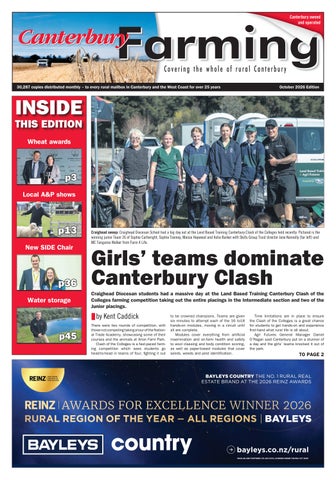
Craighead sweep: Craighead Diocesan School had a big day out at the Land Based Training Canterbury Clash of the Colleges held recently. Pictured is the winning junior Team 26 of Sophie Cartwright, Sophie Toomey, Maisie Haywood and Asha Barker with Skills Group Trust director Jane Kennelly (far left) and MC Tangaroa Walker from Farm 4 Life.
Girls’ teams dominate p36 Canterbury Clash
New SIDE Chair
Water storage
Craighead Diocesan students had a massive day at the Land Based Training Canterbury Clash of the Colleges farming competition taking out the entire placings in the Intermediate section and two of the Junior placings.
] by Kent Caddick p45
There were two rounds of competition, with those not competing taking a tour of the National Trade Academy, showcasing some of their courses and the animals at Arion Farm Park. Clash of the Colleges is a fast-paced farming competition which sees students go head-to-head in teams of four, fighting it out
to be crowned champions. Teams are given six minutes to attempt each of the 16 to18 hands-on modules, moving in a circuit until all are complete. Modules cover everything from artificial insemination and on-farm health and safety to wool classing and body condition scoring, as well as paper-based modules that cover seeds, weeds and pest identification.
Time limitations are in place to ensure the Clash of the Colleges is a great chance for students to get hands-on and experience first-hand what rural life is all about. Agri Futures General Manager Daniel O’Regan said Canterbury put on a stunner of a day and the girls’ teams knocked it out of the park.
TO PAGE 2
BAYLEYS COUNTRY THE NO. 1 RURAL REAL ESTATE BRAND AT THE 2026 REINZ AWARDS
RURAL REGION OF THE YEAR – ALL REGIONS | BAYLEYS bayleys.co.nz/rural WHALAN AND PARTNERS LTD, BAYLEYS, LICENSED UNDER THE REA ACT 2008
2 October 2026 CANTERBURY FARMING
FARMING NEWS
Gumboot throw steals the show Winning teams: FROM PAGE 1 “Since we started the Canterbury Clash of the Colleges five years ago, we’ve gone from boys’ teams dominating the podium to girls. Craighead usually place, but this time they dominated the intermediate and junior high school fields.” Just under 220 students took part in the competition, which was down on previous years due to Influenza A.
Attending schools included: Geraldine High School, Craighead Diocesan, Ashburton College, Christ’s College, St Bede’s, Rangi Ruru, Darfield High School, Rolleston College, Mt Hutt College, Seddon School, Woodend Primary, Papanui High School, Timaru Boys’, Christchurch Boy’s and Waihi School. The gumboot throwing competition was again one of the highlights of the day with St
Bedes College student Thomas Borcoskie taking out the senior boys’ title with a 26m throw while Bria Bosomworth from Craighead Diocesan with a 17m toss winning the senior girls’ competition.
Information for this article was supplied by Agri Futures. For more information on the Clash of the Colleges and other news go to: www.agrifutures.kiwi
Senior Championship: 1st: Team 54 from Geraldine High School with 150 points: Thomas Lamb, Milly Chapman, Tyler Coombs and Margaret Russell; 2nd: Team 71 from Ashburton College with 149 points: Miamh Hawe, Kayleigh Hawe, Tegan Hislop and Micaela Stimolo-Varela; 3rd: Team 63 from Rangi Ruru with 148 points: Tabitha White, Charlotte Slater, Libby Ginders and Penny Butterick. Junior Championship: 1st: Team 26 from Craighead Diocesan with 152 points: Sophie Toomey, Asha Barker, Sophie Cartwright and Maisie Haywood; 2nd: Team 48 from Rangi Ruru with 147.5 points: Leah Barnett, Maria Davidson, Eva Innes and Katie Rollinson; 3rd: Team 28 from Craighead Diocesan with 147 points: Charlee Schrider, Emily Hutton, Pippa Saywell and Stella Harley. Intermediate Championship: 1st: Team 6 from Craighead Diocesan with 143.5 points: Jaz Bay, Samantha Sullivan, Greta Waldie and Zara Horsley; 2nd: Team 5 from Craighead Diocesan with 143 points: Pippa Sullivan, Zoe Jackson, Charlotte Scholz and Annie Scott; 3rd: Team 8 from Craighead Diocesan with 142 points: Isla Forsythe, Charlotte Cartwright, Annabelle Portman and Zara Riley.
Geraldine take the senior crown: Winners of the senior competition Canterbury Clash of the Colleges competition were Team 54 from Geraldine High School with 150 points were Milly Chapman, Thomas Lamb, Tyler Coombs and Margaret Russell, pictured with Skills Group Trust director Jane Kennelly (far left) and MC Tangaroa Walker from Farm 4 Life.
Gumboot Throwing Championship: Senior Boys: Thomas Borcoskie with a 26m throw from St Bede’s College; Senior Girls: Bria Bosomworth with a 17m throw from Craighead Diocesan; Junior Boys: Izak Kuperus with a 21m throw from Timaru Boys’ High School; Junior Girls: Maria Davidson with a 16m throw from Rangi Ruru; Intermediate Boys: Ben Brown with a 21.3m throw from Waihi School; Intermediate Girls: Alyce Derring with a 14.2m throw from Darfield High.
Letter to the Editor Dear Sir, I do enjoy the views expressed by Todd McClay, Jo Luxton and Steve Abel on behalf of their respective parties. But at risking the wrath of many of your readers, I find it’s Steve Abel of the Green Party that consistently makes the most sense. ‘We’ve also put serious money into wilding pine control’ states Todd McClay. Well congratulations for that Todd but you have also put even more serious incentive into planting 718,360 hectares of pines for the ETS. An idiotic bipartisan policy that will end by going quite literally up in smoke.
The Greens tax policy is not what the wealthy want but favours those who really struggle to put food on the table for their families. I am a high net worth individual, the type of person whom the Nats would take the vote for granted, but I am not afraid of Green Party tax policy. Indeed, if the first $10,000 of earnings were to be tax free that I would be delighted to contribute to that. And now I’m really going to upset your readers. We are ‘not taxing your ute’ states McClay again. And all the ute owners say hooray and buy another new one every five years or so. These are relatively high emmisions vehicles.
Drive such a vehicle in London and it will cost you £12.50 per day under ULEZ (Ultralow Emmisions Zone) and in addition £18 congestion charge per day. And not withstanding that the annual road tax is tied to CO2 emissions band, plus luxury car tax, plus first year showroom tax which is up to £5000. London is leading the way here and New Zealand is miles behind. The city is now almost void of high emission vehicles. It has not gone bankrupt or even on strike for that matter. It has simply become a better, cleaner and greener place.
To put this cost into perspective, under Ardern’s much maligned ute tax, the $6900 charge over the 190,506 kilometres covered by my six year old four door ute would have been 0.036 cents per kilometre. An insignificant amount and yet it spawned a rabble howling their heads off in every city in the country. The Nats are barking in the past, Labour don’t seem to have much to say, apart from some boringly safe stuff about hunting. It seems to me that the Greens are stealing the show. Kind regards, Andrew Luddington, Lincoln
FARMING NEWS
CANTERBURY FARMING October 2026
3
Canterbury dominates wheat awards Canterbury growers dominated the 2026 United Wheat Grower Awards with some quality results achieved despite a challenging wet harvest.
] by Heather Chalmers The United Wheat Grower Awards were announced as part of the recent 2026 Arable Awards celebrations in Christchurch. United Wheat Growers’ chair Michael Tayler said the awards were established to recognise prowess in growing wheat while giving growers the opportunity to benchmark the quality and performance of their crops against the best in the industry. “From the outset, the UWG Awards were designed to be about more than simply recognising the highest yielding crop. They are also an opportunity to celebrate excellence and promote the quality of our wheat industry,” Tayler said. The premium milling wheat award was won by Robin and Lisa Kingsbury from Tahuri Farm, Dorie, Mid Canterbury, with a line of Aston that judges said, “ticked all the boxes required to make a lovely flour”. “This is an excellent result in what can only be described as a very challenging season,” the judges said. “While yield remains an important factor for premium milling wheat, quality and milling test results are key to producing top-quality New Zealand-grown flour. Runner-up was Scott Clemens of Barrhill, also with Aston wheat. Winners of the milling wheat award were Dan and Tash White, of Willowbank Ag, Flemington. “As well as yielding well, this Discovery wheat produced a line a flourmiller would be proud to use in their flour mix,” the judges said.
Top result: The 2026 UWG premium milling wheat winners were Robin and Lisa Kingsbury from Dorie in Mid Canterbury.
‘ For milling wheat, the visual quality of the wheat is judged in conjunction with milling test results. Runners-up were Andrew and Sonya Spencer, of Ashburton. The judging criteria is more yield driven for the feed wheat award, won by Andrew and Amy Darling, of Adar Farming, Timaru, with Skybolt wheat. Judges look for good bright
lines with low screenings and high yields of quality grain to feed the stock sectors of New Zealand. The Darlings also won Cereal Grower of the Year in the 2026 Arable Awards. Runners-up in the feed wheat award were Peter and Maree Hampton, Ashburton, with Kinetic wheat.
• Driveways • Earthquake Repairs • New Home Specialists • Patios & Paths
Mt Somers Excavation Ltd GENERAL FARM MAINTENANCE • ALKATHENE PIPE IRRIGATION MAINLAND TRENCHING • 8 & 20 TONNE DIGGERS TIP TRUCK & TRAILER • GRADER SCREEN SHINGLE SUPPLIES • TREE REMOVAL
Alistair Parris Owner/Operator • Ph: 027 434 7278 20 Hinds Gorge Rd RD8, Ashburton 7778 E: mtsomersexcavation@xtra.co.nz www.mtsomersexcavation.co.nz
This is an excellent result in what can only be described as a very challenging season. — Judges
2026 United Wheat Grower Awards
4 October 2026 CANTERBURY FARMING
FARMING NEWS
Party vote National for a strong ] with Todd McClay rural sector ] Minister for Agriculture
In November you get to choose who leads New Zealand for the next three years. This election is your chance to say who has the better plan for your land, your business and your community. When we came into government, farmers faced a methane tax, a ute tax, a fertiliser tax and an avalanche of rules from Wellington. We scrapped the ute tax in our first weeks. I scrapped He Waka Eke Noa and took agriculture out of the ETS. We cut red tape, fixed intensive winter grazing and stock exclusion rules, and delivered on our election promise to ban farm to forest conversions on our most productive farmland. Most of all we’ve treated farmers with respect. Farmers noticed. In late 2023, rural confidence in the Federated Farmers survey was at a record low of negative 66 per cent. Within two years it had climbed to positive 33 per cent, a record high. Labour’s war against farmers was over, and you were allowed to farm again. The sector has responded. Food and fibre exports are forecast to hit a record $64.3 billion this year. Our free trade agreement with India comes into force on 20 October, removing or cutting tariffs on 95 per cent of what we sell there. We’ve also concluded deals with the UAE and the six Gulf states. So, what can you expect from a Nationalled government? First, we’ll finish the job on regulation. We’ve replaced the RMA, and food and fibre production is now written into the new Natural Environment Act as a goal. Our changes will remove the need for up to 22,000 consents. That’s money farmers can put back into their businesses.
Farm plans will be based on risk. Around 8,000 smaller, lower-risk farms will no longer need a certified freshwater farm plan. Higher-risk farms will be audited on the parts of the operation that actually carry risk. Rules should protect what matters and still work on a farm. Second, lift productivity and profits. Our goal is to double the value of exports in ten years. We already have more market access than we can supply. Our land use flexibility policy will help farmers change how they use their land and produce more, while still meeting our environmental and climate commitments. Third, resilience. Farmers need reliable water, and nowhere more than in Canterbury. Here, irrigation projects are on the fast-track list. We’ve also made it simpler to consent on-farm water storage. Our new water storage and irrigation policy, out soon, will build on that and give farmers the certainty to invest. Arable growers are doing it tough. Margins are tight, returns are soft and costs keep climbing. Most of the country’s grain and seed is grown here. We won’t leave growers to carry this on their own. Mike Butterick is the first Associate Minister of Agriculture with responsibility for water security and arable. We’re setting up an Arable Sector Forum focused on farmgate returns. Investment Boost lets you deduct 20 per cent of the cost of new machinery, grain storage and irrigation upfront.
Faster approvals for crop protection products will help too. Conflict in the Middle East is pushing up fuel and fertiliser prices. El Niño could bring a dry summer. We’ll keep backing the Rural Support Trusts and Farmstrong for when it gets tough. What’s the alternative? Labour and their mates have up to nine new taxes lined up. A capital gains tax, a land tax, a wealth tax, a ute tax, a fertiliser tax, a methane tax and more? Every farmer knows you can’t tax your way to prosperity! With the Greens alongside Labour, the Maori Party and TOP, there’s every reason to think that’s where they’d head again. National sees farmers and growers as the backbone of this economy. We’ve shown that for three years and we want to keep going. I’m asking for your vote for National so we can finish the job.
‘
What’s the alternative? Labour and their mates have up to nine new taxes lined up. Every farmer knows you can’t tax your way to prosperity!
Daylight saving and rural fires Don’t you love the national media who have recently warned farmers as we change our clocks to fit in with daylight saving that they should prepare for summer fires. Yes, they did sort of mention the prediction of a long hot summer, but really?
] with Rob Cope Williams Anyway, the point was made we are heading into a fire prone summer so a double check on insurance policies. • Public Liability: Essential coverage for third-party property damage. • Forest & Rural Fires Extension: Usually capped at a default of $100,000 to $250,000, which is often too low for major firefighting operations. • Policy Review: Check limits with an insurance broker to ensure adequate fire-suppression cost coverage. From what I can see, the whole rural fire thing is a mine field. Granted there are few farmers who would light a fire, even to burn rubbish in a nor wester, but what I can glean is that power lines sparking can start a fire, and someone must be found to pay for the result.
Other things to think of are things like mowing long grass along a roadside, hit a stone causes a spark and all hell will break out. Plus, I know I don’t need to mention hot exhausts on dry grass. Thank goodness smoking cigarettes is now non-PC which reduces people throwing butts out of the car window. The advice about talking to your insurance broker is very wise. They will be able to outline more about having to pay if the fire on your property was moving towards your property so you must share the cost etc. I do want to mention the amazing job local rural fire brigades do. Raising funds so they can operate, the way they drop everything and rush to the aid of those in need, and all for the sake of the community. No glamour, no recognition, and certainly no financial gain. Amazing people doing an amazing job. Thank you.
FARMING NEWS
CANTERBURY FARMING October 2026
5
Wool Source CEO stepping down Wool Source chief executive Tom Hooper is stepping down from the role at the end of the year, as the strong wool bio-based products company prepares to move from pilot-scale activity into commercial-scale sales and production.
] by Kent Caddick Hooper, who has been CEO since Wool Source’s 2021 launch, said it had been a privilege to steer the organisation from research programme to late-stage commercial development with real-world applications and international engagement. “I have decided this is the right time to step aside as Wool Source moves into its next phase,” Hooper said. “The programme is well placed, with a high-performing team, strong support from the Ministry for Primary Industries and Crown funding secured to support the next stage of commercial development. “I am proud of how far the programme has come – from early-stage research to applied product development, including engagement with global brands and manufacturers and the first large-scale export shipment to Japan last year. “The next phase will require a long-term commitment to building the development facility, growing the entity and working through the international product adoption cycle. I believe this is the right point for a new chief executive to lead that work.” The Christchurch-based organisation, established by the Wool Research Organisation of New Zealand (WRONZ), has developed patent-protected technology to transform New Zealand strong wool into fine particles while retaining its inherent performance qualities in versatile, bio-based materials. Wool Source Manufacturing and the Government announced in June an $8 million partnership through the Primary Sector Growth Fund to support a $20 million manufacturing facility capable of producing up to 1
Change: Wool Source chief executive Tom Hooper is stepping down from the role at the strong wool bio-based products company.
million kilograms a year of wool-derived particles, powders and pigments. WRONZ chair Andrew Morrison said Hooper had made a valuable contribution to Wool Source and the sector. “Tom has played a critical role in helping move the programme from research into a stronger commercial position and he leaves with our best wishes. “The board will now focus on appointing the right leader for the next phase, as Wool Source continues to build opportunities for New Zealand wool and farmers.”
Hooper will remain in the role through to December and will be available in an advisory capacity to support the transition.
Bio-based: Wool Source has developed patentprotected technology to transform New Zealand strong wool into fine particles while retaining its inherent performance qualities in versatile, biobased materials.
6 October 2026 CANTERBURY FARMING
FARMING NEWS
Meeting our climate commitments By fixing the ETS, we can meet our climate commitments, protect productive farmland, and support our rural communities all at once.
Jo Luxton ] with spokesperson ] Labour ] for Agriculture
Our farmers are producing some of the world’s best food and fibre, as well as restoring waterways, protecting our biodiversity, investing in technology, creating jobs in our rural communities, and constantly adapting to meet new challenges. Labour supports that work and we recognise the effort, investment, and commitment that goes into farming every day. I want to thank the farmers and rural New Zealanders who have, over the last three years, welcomed Labour’s MPs onto their farms, invited us around their kitchen tables, met us at community events, and sat down with us in Parliament to share their experiences and challenge our thinking. Every conversation we’ve had with farmers and rural communities has helped shape our direction. We haven’t always agreed on everything, but we’ve more often than not shared the same goals: productive farms, strong rural communities, and a sustainable future. That’s why Labour is focused on practical policies that will provide that. Whether it’s reviewing the ETS, delivering our Solar Saver policy, backing Apprenticeship Boost, supporting small businesses, establishing the New Zealand Future Fund, and strengthening protections for sharemilkers, these policies show the direction we are taking. Above all, we will offer something that has been missing for too long: certainty. Certainty for farmers, certainty for businesses, and certainty for investors about the direction New Zealand is heading. Our plan to fix the Emissions Trading Scheme (ETS) is a good example. It was intended to help reduce New Zealand’s emissions alongside a full suite of climate
‘
Our focus is on working alongside farmers to accelerate the uptake of new technologies.
policies. But over the past three years, with many of Labour’s climate policies cancelled, the ETS is now the only real climate lever remaining. This government discontinued the GIDI Fund, returned hundreds of millions of dollars from the Climate Emergency Response Fund to the general fund, declined to adopt the Climate Change Commission’s recommendations on emissions targets, and more recently, weakened the approach to methane reduction without any notice. It’s a system that is now totally reliant on forestry offsets, and it rewards conversions of farmland into fast-growing pine forestry because it can be more profitable through the ETS than producing food. That doesn’t sit right with us. Farm-to-forestry conversions are happening at a rate that we can’t keep up with. That’s a problem for rural communities, because when farms are converted into carbon forests, jobs disappear.
Families move away, school rolls decline, local businesses struggle, and essential services come under pressure. Over time, our communities lose population, economic activity, and social connection. At the same time, the ETS system isn’t even working as it should to reduce emissions. Climate change remains one of the greatest challenges facing New Zealand. And it is our farmers who are the most exposed to the consequences of extreme weather. That is why Labour will not be including agriculture in the ETS. Instead, we’ll help farmers reduce emissions through other methods. Our focus is on working alongside farmers to accelerate the uptake of new technologies, improve on-farm practices, and support practical emissions reductions that strengthen long-term resilience. Labour will not abandon climate action, but we will create a credible ETS that can help us deliver cleaner and more affordable energy, provide businesses with the certainty
they need to invest, and strengthen New Zealand’s global reputation for sustainable food production. Labour will move quickly to restore confidence and credibility in the carbon market by reviewing the ETS scheme.
We will: • identify changes to incentivise genuine emissions reductions rather than relying on offsets, • reconsider the role of forestry in the ETS • ensure the ETS supports New Zealand’s Paris targets • develop new rules to prevent wholefarm conversions. • new forestry registrations in the ETS will be paused while this work is completed We can meet our climate commitments, protect productive farmland, and support strong rural communities. What we do need is an ETS that works as intended, and a government willing to provide the certainty that rural New Zealand needs.
Transparency questions move voters against Luxon Earlier this year, I spoke against a piece of legislation that extinguished the rights of all New Zealand citizens to take our biggest polluters to court for the harms caused by their climate emissions.
Steve Abel ] with Green Party Spokes] person for Agriculture ]
I dubbed the bill the “Fonterra citizen rights extinguishment bill” because it delivered on the demands of Fonterra, Z Energy, and other big polluters; that the government cancel an active court case brought by Mike Smith and prohibit tort law as a pathway for the public to hold major emitters accountable for damage caused by their emissions. This legislation infamously involved the Prime Minister’s senior political advisor receiving printed lobbying documents and correspondence to his personal email as a way to avoid information being on the public record.
At the second reading of the Bill, I said the government was answerable to accusations of corruption. That is not an accusation that should be made lightly, but when corporate lobbying appears so heavily in the development of legislation and key information is missing from the public record, these questions cannot be avoided. It is little surprise there is a growing perception of corruption given the extent of this government’s willingness to do the bidding of vested interests over protecting the public good. This term of parliament has been defined by the successful influence of the agricultural industry against freshwater and climate protections, the fishing industry against the protection of our oceans, the oil and gas industry in favour of an exceedingly expensive
and polluting LNG terminal, and the use of race as a constant distraction and weapon to divide our country. More so than I had previously imagined, the feedback on the streets is that the public don’t trust that the Luxon government is working in their best interests. People perceive the influence of big corporate lobbyists as a stain on Luxon’s legacy. Transparency International has noted in the past few years that New Zealand’s declining Corruption Perceptions Index (CPI) score signals growing risks to the country’s democratic integrity and global reputation. By 2025 New Zealand’s CPI score had fallen by two points for the fourth consecutive year—a 10% drop overall. While we still rank equal fourth with Norway, this continued
slide reflects diminishing confidence among business experts and international assessors in the integrity of the public sector. TINZ notes that core democratic values like transparency, accountability, and integrity are being progressively eroded. We once ranked first equal alongside Denmark as the “least corrupt” nation. It should be a point of principle and pride that we reclaim our good name as the least corrupt country. In amongst the difficulty of putting food on the table that defines the cost of living crisis, and record rates of unemployment and homelessness, the underlying disquiet around the trustworthiness of the coalition government will help tip them out of Parliament on November 7.
CANTERBURY FARMING October 2026
FARMING NEWS
7
Petition on agricultural drone deregulation launched The Aviation Industry Association of New Zealand has launched a petition calling on the Government to pause agricultural drone deregulation and consult with industry on risk-based reform that protects public safety.
] by Kent Caddick The Association (AIANZ) is concerned that replacing existing assurance requirements with notification alone would remove an important check that operators are competent, aircraft are properly maintained, and operational risks are managed. Simon Wallace, Chief Executive of AIANZ, said the Association strongly supports improving farmer access to agricultural drones, but it must not come at the expense of the safety of farmers, their families and communities, or other airspace users. “Agricultural drone operations are the fastest-growing sector in aviation and a significant enabler of productivity for farmers and growers. We want to ensure that happens safely.” Vice-President of AIANZ, Dr Isaac Henderson, said operating agricultural drones is an inherently high-risk activity, requiring safeguards to be in place. “Agricultural drones can exceed 100 kg, travel up to 72 km/h, and carry hazardous
chemicals. A loss of control could cause death, serious injury or property damage, while spray drift can damage neighbouring land and crops,” Henderson said. “Notification alone does not provide assurance that operators are competent, drones are properly maintained or risks are being properly managed. “We support reform and innovation, but certification or equivalent assurance must remain in place until licensing, fast-track approval, or national safety standards are established. “We’ve launched this petition because the Government needs to pause the proposed changes and listen to the industry. “We bring critical operational and safety expertise that can help shape practical reform which improves access to agricultural drones while protecting farmers, their families and communities, and other airspace users.” Information for this article was supplied by the Aviation Industry Association of New Zealand. For more go to: aianz.org.nz
Warning: The Aviation Industry Association of New Zealand is concerned new regulations governing the use of agricultural drones may cause safety issues.
RECENT RESULTS SPEAK FOR THEMSELVES SOLD
SOLD
SOLD
Westerfield 728 Valetta Westerfield Road
Winchmore 1824 Pole Road
Staveley Arundel Rakaia Gorge Road
SOLD
SOLD
SOLD
Fairlie 347 Butlers Road
Tinwald 197 Tinwald Westerfield Road
Mayfield 550 Barford Road
SOLD
WHALAN AND PARTNERS LTD, BAYLEYS, LICENSED UNDER THE REA ACT 2008
Fairlie Mowbray Road
PROUD TO SUPPORT
8 October 2026 CANTERBURY FARMING
RURAL PROFESSIONALS
Earnings resilient, outlooks cautious
The latest company results from New Zealand, Australia, and the United States were generally encouraging. However, results varied widely between countries and industries.
Andrew Wyllie ] with ] Forsyth Barr
CHC6189-03 - April 2026
good cash flows, control costs, and maintain healthy balance sheets. However, they were cautious about the year ahead. Higher interMany companies continued to generate est rates and uneven customer demand have made future earnings harder to predict. In New Zealand, more Looking to create wealth companies delivered betterthan-expected results than from off-farm investments? were disappointed. Although Planning to diversify your assets? the overall suggestion was that business conditions are stabilising, rather than improving strongly. Companies with reliable sources of income, such as regulated or contracted revenue, generally performed best. Results from businesses that rely heavily on consumer spendAndrew Melissa Hamish Michael ing were mixed. Dividends reWyllie McCosh McLean Coleman mained reasonably steady, but companies expect the Contact one of our Investment Advisers in confidence economic recovery to be on (03) 966 6760. gradual and remain concerned about inflation and borrowing costs. Australian company profits increased by 11.6% in the
2026 financial year. However, most of this growth came from energy and mining companies, helped by strong commodity prices. Only about 36% of companies exceeded expectations, showing that the improvement was not widespread. Businesses exposed to household spending continued to report cautious consumers and slower borrowing. Despite this, dividends and share buybacks remained relatively strong. The strongest results came from the United States. With nearly all S&P 500 companies having reported, 86% exceeded earnings expectations and 77% reported higher-thanexpected revenue. Reported earnings were 52% higher than a year earlier, although this was boosted by some large one-off investment gains. Excluding these gains, earnings still grew by a strong 33.8%. Technology and investment in artificial intelligence remained important, but earnings growth was also spread across other parts of the market. This suggests investors have opportunities beyond technology and AI.
Why diversification matters more than ever The past three months served up the same set of concerns repeatedly: an unresolved
conflict; volatile energy prices; inflation above target in most major economies; and central banks leaning towards higher rather than lower interest rates. Markets absorbed all of it and still finished the quarter higher. Returns were not evenly shared. New Zealand and Australian shares led, while the US market lagged after a very strong first half of the year. Leadership had run the other way only three months earlier. That rotation is the whole argument for diversification. A welldiversified portfolio, combined with a disciplined long-term approach, remains the most effective way to navigate an environment like this one. This article was prepared as at 31 August 2026 and provides market commentary for the three-month period ending on that date. This article is general in nature, has been prepared in good faith based on information obtained from sources believed to be reliable and accurate, and should not be regarded as financial advice. If you would like to review your investments or discuss the market outlook in more detail, please get in touch. Andrew Wyllie is a Senior Investment Adviser with Forsyth Barr Christchurch. He can be contacted regarding portfolio management, fixed interest, or share investments on 0800 367 227 or andrew.wyllie@ forsythbarr.co.nz
PROFESSIONAL RURAL
REAL ESTATE ADVICE
Call Ben today for an altogether better approach to your rural real estate needs along with an up-to-date market overview.
Ben Turner 027 530 1400 03 375 4736
ben.turner@bayleys.co.nz
WHALAN & PARTNERS LTD, BAYLEYS, LICENSED UNDER THE REA ACT 2008
Residential / Commercial / Rural / Lifestyle
HOW MUCH VALUE COULD SUBDIVISION UNLOCK? With decades of experience, we make rural subdivision easier.
Contact us today, to have a yarn about subdivision. 0800 787 775 | hello@survusrural.co.nz | www.survusrural.co.nz
CANTERBURY FARMING October 2026
RURAL PROFESSIONALS
9
Getting a handle on farm drawings
When you work on a farm, the line between business money and personal money can become pretty blurry.
Laura Wood ] with ] LGW Accounting
The farm might pay some household costs, the ute is used for both work and personal trips, and money gets transferred into the personal account whenever it is needed. For many farming families, this is simply how things have always been done. But from a business point of view, it can make it surprisingly difficult to answer a fairly basic question: how much money does your family actually take out of the farm each year? For most businesses, money taken from the business for personal use is generally treated as drawings. One of the common misconceptions around drawings is that they reduce the profit of the business in the same way as an ordinary farm expense would. They don’t. If a farm makes $150,000 of taxable prof-
it and the owners take $80,000 in drawings, the taxable profit doesn’t simply reduce to $70,000. Drawings are generally money taken out of the business by the owners rather than a deductible business expense. This is also one of the reasons a farm can show a healthy profit on paper while the bank account tells a very different story. The other issue is that drawings aren’t always obvious. Most people know roughly how much they regularly transfer into their personal account, but that might only be part of the picture. Personal insurance, household costs, private loan repayments and private portion of expenses may also be coming directly out of the farm account. None of this is necessarily a problem. The farm exists, after all, to provide an income for the people who own it. The important part is knowing how much it is providing. A simple way to get better control over
this is to decide on a regular amount that the household will receive from the farm. Instead of transferring different amounts throughout the month whenever money is needed, you could establish a regular weekly, fortnightly or monthly transfer. It doesn’t have to be perfect, and it doesn’t mean you can’t take additional drawings when necessary. What it does provide is some consistency. If the household needs $6,000 each month to cover normal living costs, that becomes $72,000 that needs to be allowed for in the farm’s annual cashflow. Then think about the less regular personal expenses. There might be a family holiday planned, home improvements, school costs or a personal vehicle that needs replacing. Suddenly, the amount the farm needs to provide the household with might be closer to $90,000 or $100,000 for the year.
Knowing that number can be incredibly useful when preparing a farm budget. It means you are not only budgeting for fertiliser, feed, repairs, wages and loan repayments, but also for the people who rely on the business. This isn’t about telling farming families they need to spend less. A profitable farm should provide a reasonable return to the people putting in the hours, carrying the risk and owning the capital. It is simply about understanding where the cash is going. When you next sit down to look at your farm’s financial performance, take a moment to look beyond the profit figure. Work out how much cash the business actually needs to provide your household each year and include it in your planning. Knowing what it costs to run the farm is important. Knowing what the farm needs to provide the family behind it is just as important.
Enduring Powers of Attorney Enduring powers of attorney (EPAS) have been part of our legal system since they were introduced in 1988.
Bessie Paterson LLB ] with ] Ronald W Angland & Son
capacity to deal with their own affairs. Everyone entering a care/rest home is required to have EPAs in place. If an individual loses capacity and does not have EPAs in place, an application to the Family Court would be required to appoint a welfare guardian and/or property manager. Most of us would prefer to have someone we choose to act on our behalf for welfare and property decisions if we are unable to attend to those matters ourselves. The Court process is time-consuming for everyone involved and applications to the Court are usually costly. There are ongoing obligations to provide an annual statement of assets and liabilities to the Court. The Court will review the order initially every 3 years and if satisfied it may only review the matter every 5 years. It is strongly recommended that everyone uses the Enduring Power of Attorney process before they lose capacity.
The major difference between EPAs and the powers of attorney which existed at the time was that EPAs continued to have effect if the donor lost their ability to deal with personal and financial matters due to illness or injury. There are two types of EPA, one for care and welfare and the other for property matters. The care and welfare EPA authorises the attorney to make sure that the donor’s care and welfare needs are met. The donor may only appoint one attorney, but a successor attorney may be appointed if the initial attorney is unable to act. The care and welfare EPA can only be invoked if a suitably qualified medical practitioner certifies that the donor is incapable of making decisions for themselves. The property EPA is different from the care and welfare EPA. The donor may appoint more than one attorney, and the attorneys This article has been prepared by Bessie Paterson, may be required to act jointly or jointly and a partner at Ronald W Angland & Son, Lawyers, 2 severally. There is no requirement for a med- Chapman Street, Leeston. ical certificate of incapacity. The attorneys are able to deal with all of the donor’s property including homes, company shares, bank acLAWYERS counts, antiques and other items of value. If a donor wishes to change their attorneys and still has capacity, they can revoke the appointments and sign replacement EPAs. The major advantage of Leeston (03) 324 3033 having EPAs is that someEmail: lawyers@anglands.co.nz | www.anglands.co.nz one of the donor’s choice is Solicitors of Selwyn since 1965 appointed should they lose
Ronald W. Angland & Son
Property | Family | Wills Trusts | Estates | EPAs | Rural Business | Traffic | Employment
CHASING EXCELLENCE Peter Foley 021 754 737
Kevin Jenkins 027 577 4232
PETER FOLEY AND TEAM WHALAN AND PARTNERS LTD, BAYLEYS, LICENSED UNDER THE REA ACT 2008
10 October 2026 CANTERBURY FARMING
HEALTH ON THE FARM
BEN TURNER AND TEAM
RURAL REGION OF THE YEAR – ALL REGIONS Bayleys
BAYLEYS CHRISTCHURCH
RURAL OFFICE OF THE YEAR – MEDIUM Country & Co in partnership with Bayleys
RURAL SALES PARTNERSHIP OF THE YEAR Tony Rasmussen & Chris Heenan, Bayleys Havelock North
BAYLEYS COUNTRY THE NO. 1 RURAL REAL ESTATE BRAND AT THE 2026 REINZ AWARDS Recognised with five out of seven rural awards and taking out every region in the REINZ Rural Region of the Year, Bayleys has once again been recognised as New Zealand’s most awarded rural real estate brand.
Speak to New Zealand’s No. 1 Rural Real Estate Brand bayleys.co.nz/rural
WHALAN AND PARTNERS LTD, BAYLEYS, LICENSED UNDER THE REA ACT 2008
CANTERBURY FARMING October 2026
HEALTH ON THE FARM
11
Berberine:
Supporting healthy blood sugar A concerning New Zealand health statistic is the number of people who have Type 2 diabetes. The 5% of us that have Type 2 diabetes is bad enough, but there are another 20% who have uncontrolled blood sugar.
] by John Arts The tragedy is that poor blood sugar control is treatable with a diet low in sugar and carbohydrates yet high in low – starch plants foods, good fats and protein. Please contact me if you would like an email copy of my Healthy Eating Guide. While diet is the priority, well formulated supplements can support blood sugar control. Two nutrients that have received growing attention in this area are berberine, derived from Indian Barberry and chromium polynicotinate, a vitamin B3 (niacin) form of the trace mineral chromium. Berberine is recognised for its influence on AMPK – an enzyme needed to enhance use of glucose, reduce over-production of insulin and to inhibit liver over-production of blood sugar (glucose). Helping balance glucose use and glucose production is central to blood sugar control. This often brings im-
‘
The best supplements have water soluble berberine combined with chromium polynicotinate. This combination is biologically
provements in long term blood sugar reflecting in better HbA1c levels – a blood test familiar with those with poorly controlled blood sugar.
Metaberine® Each capsule provides 200mg of Metaberine®, a new generation of berberine developed using patented BioSOLVE® technology (optimising water solubility). This advanced extract is designed to be absorbed more efficiently than standard berberine extracts, allowing a much lower daily dose.
John Arts (Adv.Dip.Nut.Med) is a qualified nutritional medicine practitioner. To read more by John and find out more about the Abundant Health products, visit www.healthhouse.co.nz, call 0800 140 141, or email john@healthhouse.co.nz
QUALITY DENTURES. PERSONAL SERVICE.
Better fit. Better comfort.
FLEXIBLE APPOINTMENTS We offer early and late appointments Monday to Friday.
WINZ PROVIDER
We are able to assist with free consults and quotes.
A smarter way to take berberine
Health House’s new Berberine Balance features
ment of blood sugar into cells, reducing cell insulin resistance. The combined use of berberine and chromium is therefore biologically beneficial, as berberine may support cellular energy regulation and chromium to insulin responsiveness.
beneficial.
Berberine Balance
Berberine has become one of the most talked-about natural ingredients for supporting healthy blood sugar balance, weight management and overall metabolic health. Unfortunately, traditional berberine extracts are poorly absorbed, often require high daily doses, and can cause digestive discomfort in some people.
There is however a significant problem with standard berberine supplements. Berberine is insoluble in water resulting in poor absorption and a high rate of digestive problems. Water soluble berberine overcomes these issues with high absorption with lower rates of digestive issues. The best supplements have water soluble berberine combined with chromium polynicotinate. Chromium polynicotinate has a different yet complementary action on blood sugar balance. It does this by supporting the move-
Berberine Balance combines modern ingredient technology with one of the world's most researched botanical ingredients to provide a well-absorbed and well-tolerated option for everyday use.
Supports: Normal blood glucose metabolism Healthy fat metabolism Your body's natural metabolic balance Natural energy and general wellbeing Can interact with prescription medications for blood sugar management such as metformin, and certain blood thinners.
TWO CONVENIENT LOCATIONS in Hornby and Avonhead Christchurch. www.betterdenture.co.nz
FREE ADVICE
60 capsules per bottle
Chromium Each capsule combines Metaberine® with chromium polynicotinate. Chromium is an essential trace mineral that also complements the benefits of berberine. Always read the label and use as directed. If symptoms persist see your healthcare professional.
Don’t let Varicose Veins slow you down No Surgery. No downtime. For the largest of veins. Expert care, experienced practitioners. Endovenous Laser Ablation or by Ultrasound Guided Sclerotherapy.
Book your FREE initial veins assessment today! Call 0800 256 654 www.transformclinic.co.nz
Free delivery IN NEW ZEALAND
Call free on
0800 140 141
www.healthhouse.co.nz Health House | Private Bag 12029, Tauranga 3143, New Zealand Retail Store / Head Office | 1 Whakakake Street, Tauriko, Tauranga 3110
03-349-5050
Call us today to book your free consultation and get expert advice from our friendly team.
Covered by most health insurers.
$69ea
NZ OWNED & OPERATED DENTURE CLINIC
Christchurch & Dunedin
12 October 2026 CANTERBURY FARMING
FARMING NEWS
Resource management shake-up raises rural questions The Government’s proposed replacement of the Resource Management Act (RMA) could have significant implications for Canterbury’s primary sector, as new planning and environmental laws reshape how land, water and natural resources are managed.
supplied by ] Article ] Canterbury Regional Council Canterbury Regional Council (Environment Canterbury) Chair Dr Deon Swiggs said the council is closely reviewing the Natural Environment Bill and Planning Bill, which the Environment Committee has recommended be passed with amendments following a majority decision. The Government says the reforms are designed to create a simpler, more consistent planning system that supports economic growth, infrastructure development and primary industries while still protecting the environment. Key proposals include regional spatial plans, greater national direction, and fewer regulatory controls on activities that have minimal off-site effects. For farmers, that could mean a planning framework that is easier to navigate when investing in infrastructure, diversifying land use or developing farm businesses, although much will depend on the detailed national direction and regulations. Swiggs said Environment Canterbury supports the objectives of a more efficient system and greater planning certainty. “Canterbury continues to experience population growth, increasing infrastructure demands and pressure on natural resources. Effective long-term regional planning will remain critical,” he said. However, he said important questions remain about how the reforms will work in practice.
Clarity needed: Canterbury Regional Council Chair Dr Deon Swiggs says Environment Canterbury supports the objectives of a more efficient system and greater planning certainty with changes to the RMA but says the potential cost and implementation implications for landowners and ratepayers remains unclear.
While greater national consistency may reduce some of the complexity that farmers and councils have experienced under the RMA, the proposed legislation would also shift significant decision-making powers from regions to central government. “Ministers would have greater influence over national priorities and how competing goals are balanced,” Chair Swiggs said.
“That raises important questions about the role of regional knowledge, local accountability and community participation.” Environmental protections are another key issue for Canterbury, where farming, freshwater management and biodiversity are closely linked. Chair Swiggs said provisions allowing the responsible Minister, subject to statutory
tests, to authorise some activities to breach environmental limits require careful examination. “Canterbury’s economy relies on a healthy environment and a strong primary sector. The new system needs to give farmers and rural communities confidence to invest while maintaining robust protections for freshwater, biodiversity, air quality and the wider environment.” The potential cost and implementation implications for landowners and ratepayers also remain unclear, particularly as much of the detail will be determined through national policy statements, standards and regulations that are yet to be developed. As the legislation progresses through Parliament, our focus will be on ensuring the final system works for Waitaha Canterbury, supports responsible rural and urban development, and protects the region’s natural resources for future generations. You can find more information at: www.ecan.govt.nz/ government-reforms
EINBOCK PNEUMATICSTAR TYNE AIRSEEDER
YOUR LOW COST, HIGH PERFORMANCE SEEDING INVESTMENT Lightweight, cost-efficient and easy to use. Choose the PneumaticStar Tyne Airseeder for your reseeding and discover the tyne advantage.
On display at AgFest 2026 & Ashburton A&P Show
farmchief.co.nz | 0800 327 624 Southland | Canterbury | Manawatu | Waikato
CANTERBURY FARMING October 2026
LOCAL A&P SHOWS
13
It’s A&P showtime again October means the start of the 2026 Agricultural and Pastoral show season for Canterbury.
] by Kent Caddick The season kicks off once again with the Ellesmere Agricultural & Pastoral Association show at the Ellesmere A&P Showgrounds in Leeston on October 17. It’s the Ellesmere A&P Association’s 155th annual Show. The theme of this year’s show is ‘Full Steam Ahead’ (Katoa te mamaoa i mua) and will celebrate the evolution of machinery in New Zealand agriculture, from the earliest steam-powered workhorses to today’s precision-engineered technology. In late October, the 149th Ashburton Show, the largest two-day event in the Mid Canterbury district, will be held with an eye to the future. Held at the Ashburton Showgrounds on October 30-31, people can expect fun, food and entertainment for kids and adults alike, with each year bringing more exciting activities and events that showcase everything the region has to offer. As well as getting the show set up for 2026 planning has begun for a massive celebration of 150 years of the Ashburton A&P Association in 2027. The Big 150 will be jam-packed focusing on the Ashburton farming industry throughout the years. Get ready for some fun ways to learn about practices of old, as the association looks forward to future farming in the region. Watch out for some commemorative souvenirs, centred around farming in the district and also a 150th celebration book, which will all be available on the lead-up to our Big 150th Show in 2027. Meanwhile regarded as the largest A&P show in New Zealand the event will again be run at the Canterbury Agricultural Park in November. The Show (also known as the New Zealand Agricultural Show) attracts around 70,000 to 100,000 visitors, thousands of livestock entries, and hundreds of trade exhibitors over three days every November. There are two big changes for the 2026 Show with a new naming rights partner, and
Show dates for 2026: October 17: Ellesmere Agricultural & Pastoral Association, Ellesmere A&P Showgrounds, 1650 Leeston Rd, Leeston. October 23-24: Northern Agricultural & Pastoral Association, Rangiora Showgrounds, 156 Ashley St, Rangiora. October 30-31: Ashburton Agricultural & Pastoral Association, Ashburton Showgrounds, 66 Brucefield Avenue, Ashburton. October 31: Amberley Agricultural & Pastoral Association, Amberley Domain, 6/50 Douglas Road, Amberley. November 7-8: Southern Canterbury Agricultural & Pastoral Association, Waimate A&P Showgrounds, 26 Hakataramea Highway, Waimate. November 11-13: Canterbury Agricultural & Pastoral Association, Ravensdown Canterbury A&P Show, Canterbury Agricultural Park, 102 Curletts Road, Christchurch.
Kickin’ off: Canterbury’s A&P associations show season begins this month. a return to its traditional Wednesday to Friday dates, with the Show being held from November 11 to 13. After two years on a Thursday to Saturday run, the Show is returning to the mid-week format which has served the Show for more than 160 years. Ravensdown has signed a two-year naming rights sponsorship of the Show, from 2026,
and the event will be known as the Ravensdown Canterbury A&P Show. Also joining the Show sponsors line up is Golden Homes Canterbury who are the naming rights sponsor for the Village Green arena, to be known as the Golden Homes Village Green.
ASHBURTON
SHOW A S S O C I AT I O N
Where Legacy Grows
OCT 30-31
$20 GATE ENTRY
A sh bu rt on ’s la rg es t an d lon ge st ru nn in g tw o da y ev en t!
sc ho ol ag e + un de r
KIDS
FREE!
IT’S OUR
SHOW! 2026
ASHBURTON A&P SHOWGROUNDS ASHBURTONSHOW.CO.NZ
FREE PARKING
RURAL RURAL AT M TERS MATTERS News and views that matter to rural people
14 October 2026 CANTERBURY FARMING
LIVESTOCK
Regional voices come together on deer industry priorities There was an engaged and engaging line-up at this year’s New Zealand Deer Farmers Association (NZDFA) Branch Chairs meeting in Wellington.
Cameron Frecklington ] with ] DINZ
From new initiatives and industry strategy to the burning issues of the day, there was plen-
ty for branch representatives to discuss and take back to their respective regions. One development to generate plenty of interest was a proposal for a new NZDFA-led Extension Programme, aimed at bridging the gap between research and farmer uptake. Loosely based on the Beef + Lamb New Zealand model, the proposal would use the existing DFA branch network to roll out a range of information-sharing forums, coordinated nationally by an Industry Extension Manager. The idea is to make better use of the branch network to get useful research, knowledge and information in front of farmers, and ultimately help turn that knowledge into action on farm. Initial feedback from around the table was supportive, with branch chairs asked to take the proposal back to their respective branches and gauge farmer support. Also attracting plenty of discussion was the Thrive 35 Accelerator programme, a market-led, science-driven
project that will help the industry’s ambitious goal of doubling deer industry export value to $660 million by 2035. Branch chairs were given an overview of the initiative and its three broad areas of focus: building premium product pathways; promoting the health and functional properties of deer products through evidence-based research; and strengthening the integrity and robustness of domestic supply chains. There was support for the direction of travel and the investment being made, while also a clear interest in ensuring the benefits ultimately make their way back behind the farm gate. With around 16 percent of grower levies going towards the initiative, the question posed around the table was a straightforward one: will the strategy deliver greater value for farmers? Given the time of year, velvet was always going to be high on the agenda. There was some nervousness about the 2026/27 season given the past two seasons and, while no one could guarantee a smooth selling period, the outlook presented to branch chairs included an expectation that prices would lift on last season. Farmers are encouraged to hold buyers to account this season by ensuring they are VelTrak Accredited Account Owners, or work for a company that is. The Branch Chairs meeting covered plenty of ground, reflecting the range of issues and opportunities currently in front of deer farmers around the country. But while Wellington provided the setting for the bigger-picture conversations, two upcoming events in Canterbury offer the chance to bring some of those themes back to the farm gate. First up is the return of the South Canterbury/North Otago DFA’s Young Deer Farmer Competition on 9 October. Following the success of the inaugural competition in 2024, young farmers will again put their knowledge and practical skills to the test across a range of challenges. Just as importantly, the event is about bringing generations of deer farmers togeth-
‘
The Branch Chairs meeting covered plenty of ground, reflecting the range of issues and opportunities currently in front of deer farmers around the country.
er, building connections, and giving younger people an opportunity to learn from those with years of industry experience. Several students from Geraldine High School’s Primary Industry Academy will also take part, providing another opportunity to showcase the skills and career pathways available in deer farming. Also coming up is the Environmental Awards field day at Raincliff Station in South Canterbury on 27 October, hosted by David Morgan and family. Raincliff was a standout at the 2025 Deer Industry Environmental Awards, taking home both the Premier Elworthy Environmental Award and the Streamlands Export Ltd Award for vision and management whilst mastering a demanding environment. The field day will give farmers the opportunity to see that award-winning operation first-hand and hear more about the Morgans’ approach to farm management, environmental stewardship, and succession. More information about either event can be found on the DeerNZ website.
CANTERBURY FARMING October 2026
15
Shaping the next generation After 18 years of dedicated service, Rex Smith is retiring as Rural College Lead at Darfield High School’s Tawera Rural College.
supplied by ] Advertorial ] Darfield High School An integral staff member, Rex has guided countless students into rewarding agricultural employment across Canterbury. As Rex steps into retirement, we are excited to welcome Aarrun Nicholls as our new lead. A Darfield High School alumnus with strong local roots and an extensive farming background, Aarrun brings expertise teaching Agricultural Commerce. Supported by Rural College teacher Vanessa Smith, the team looks forward to continuing our vision of inspiring students to get involved in the agricultural sector. Tawera Rural College provides Year 9 to 13 students with real-world farming skills and pathways straight into employment, alongside agricultural science and commerce
Planting futures: Year 12 Tawera Rural College Class students planting fruit trees at the school, part of its Orchards in Schools Programmes the school has initiated with the Canterbury Horticultural Society.
streams leading to Lincoln University. Theory and practical lessons are taught, ensuring learning remains grounded in current industry practices. Community connection drives our success. Our local farmers support our students through practical days, work experience, and Gateway placements. Students regularly test their skills in AgriKids, Clash of the Colleges, and interschool fencing competitions at Local A&P Shows. Popular events like our annual Bring a Tractor to School Day highlight the amazing connection between our students, whanau, and the wider rural community. Our trades academy launched in February 2023, partnering with the Primary Industry Training Organisation and also offering placements to students from neighbouring Rolleston College.
The academy targets Year 11 and 12 students with a genuine passion for the primary sector. By bridging classroom learning with hands-on experience, our aim is to supply work-ready young people and inspire future agricultural leaders and researchers.
We welcome local farmers and agribusinesses to partner with us in shaping the next generation. For more information about our Rural College programs or to register your interest, contact Pip Deans at rural@ darfield.school.nz
16 October 2026 CANTERBURY FARMING
ARABLE FARMING
Peace of mind, whatever the season brings. When the weather keeps you guessing, it’s good to have something you can count on. N-Protect’s smart coating helps more nitrogen get where it needs to go, giving you stronger growth and less waste. Together, we’ll help you grow the feed you need, and maybe a little extra.
Call 0800 100 123 or talk to your agri manager today.
CANTERBURY FARMING October 2026
ARABLE FARMING
17
Arable farming evolving, says Hall of Fame recipient The definition of what arable farming means is evolving as growers seek out their most profitable options.
] by Heather Chalmers That’s according to a leading figure in New Zealand’s pasture seed and forage industry John McKenzie, who retired in 2025 after 20 years as PGG Wrightson Seeds Oceania chief executive. McKenzie was one of four inductees to the Arable Hall of Fame at the recent 2026 Arable Awards. “We used to talk about the arable industry as one where we harvested crops with a combine. Now it’s an industry providing seed and fodder for other parts of the agricultural sector,” McKenzie said. “We shouldn’t be frightened about that change.” He said that 50 years ago when he first became involved in farming in Mid-Canterbury it was dryland farming and very few dairy farms. “Land use change is constant and for people to remain profitable you have to move to where the money is.” McKenzie said parts of the arable industry aren’t profitable, and mature conversa-
tions are needed to address this. “This is already occurring. The key thing is to work out how to go forward and have a strong, viable arable industry.” McKenzie said he was conflicted for most of his career, being both a farmer and a seed merchant. In the mid-1980s he recognised the opportunity to create a new proprietary forage seed business in New Zealand; this became Agricom which was sold to Pyne Gould Guinness in 2005. Following the sale, he played a central role in merging Agricom with other PGW seed businesses, going on to hold senior roles in PGW. In 2019, PGW Seeds was acquired by DLF and he took on the role of executive vice president and chief executive for Oceania. Across all these roles, McKenzie’s influence extended beyond seed sales into commercial plant breeding, research commercialisation, export-oriented agribusiness, integration of science and farming practice and the development of New Zealand forage genetics for global markets. The Hall of Fame honours individuals who
Recognised: Arable Hall of Fame 2026 inductees are (from left): Eric Watson, Maxine Watson, John McKay, John McKenzie, and Sherryn Kelly with John Foley (on behalf of the late Murray Kelly). have made a significant contribution to the arable industry. The three other inductees to the Arable Hall of Fame were South Pacific Seeds NZ managing director John McKay from Meth-
ven, former wheat yield world record holders growers Eric and Maxine Watson of Wakanui near Ashburton, and the late PGG Wrightson Seeds research agronomist Murray Kelly who died earlier this year.
Four Seasons Realty
375 Sharlands Road Dunsandel 7.7988ha
3
2
2
2
Bespoke Architecture, Breathtaking Alpine Views Framed by uninterrupted views of the Southern Alps, this exceptional lifestyle property offers a rare combination of bespoke build design, productive land and enjoyable country living capturing views of the alps. Fully equipped for energy efficiency and country living, it boasts a 36-panel solar system with inverter, private well with existing ability to irrigate, a 5-bay shed, and a boutique vineyard—all within an easy commute to Rolleston and Rakaia. This home offers an enviable lifestyle you will never want to leave.
Deadline Sale 13th October 2026, 2pm (Unless Sold Prior) View Contact Katie for viewing times or to book your private viewing.
KATIE HARRISON
021 135 0887 | 03 347 4711
Licensed Agent REAA 2008
katie.harrison@harcourts.co.nz
18 October 2026 CANTERBURY FARMING
CANTERBURY FARMING October 2026
19
Modelling highlights huge profit lift Fully renewing a Canterbury dairy farm in a mix of Array and 4front ryegrasses could lift profitability by more than $1,500/ha while cutting reliance on imported feed.
] Advertorial supplied by Barenbrug
That’s according to new FARMAX modelling commissioned by Barenbrug and carried out by Macfarlane Rural Business (MRB). The study modelled a typical 200 ha Canterbury dairy farm milking 3.4 cows/ha. It compared four pasture options, using Nui as the baseline against Governor AR37, Array NEA2 and an Array/4front mix. While all three newer pasture options delivered gains, Array and 4front produced the strongest results across physical, financial and environmental measures. Graham Kerr, Barenbrug pasture specialist, says the company commissioned the analysis to quantify benefits of its latest proprietary cultivars compared with old genetics. “We’re really excited by these results, which reinforce the massive value of producing extra high quality, homegrown feed in our pastoral dairy systems.” Key findings? “If you’re sowing a diploid perennial ryegrass Array is a standout. But if you want even more metabolisable energy (ME) with a diploid/tetraploid ryegrass mix, then move up to Array/4front.” With farmgate returns looking strong for the season ahead, spring is the ideal chance to use these findings to future-proof farm productivity, he says. The MRB modelling found the two biggest drivers of farm operating profit were growing
more dry matter (DM), and lifting feed quality through higher ME. “The surprising thing that came out of FARMAX was just how much of a difference higher ME can make,” Graham says. Moving from Governor to Array increased production by 56 kg MS/ha, which improved operating profit by $584/ha (to $7425) after costs. “The driver was Array’s extra ME. It’s about 0.5 units higher than Governor from November to February, because it is very late heading and extremely leafy through summer.
“Half a unit of ME might not sound a lot, but it significantly increases cow intakes.” Graham says Array is a great option for farmers seeking dense, persistent, diploid pasture. However, if they want to add a tetraploid to the mix, FARMAX showed sowing a 50:50 mix of Array and 4front improved EFS by another $253/ha (to $7678). Again, the dollar gain comes from higher pasture quality, in this case because 4front’s ME is very high year-round, Graham says. “Not everyone wants tetraploids, as they
are a bit less robust. But we have found the Array/4front mix works really well across many farms.” Environmental indicators also improved. Greenhouse gas emissions intensity (measured in kg CO2e/ t FPCM) fell with the new pasture cultivars, which is in line with Fonterra’s much publicised emphasis on the critical role of homegrown feed. “We asked Fonterra to model the different pastures, and going from Nui to Governor dropped emissions intensity 2%. Moving to Array it dropped another 2%. And Array/4front was best, dropping another 0.9%.”
Want to test your pasture and feed on hand? Preparing for spring fertiliser decisions? Or planning a new dairy conversion? Canterbury Feed Assessment and Soil Rx are both here to help. Get a complete picture of your farming system. CFA offers IANZ-accredited feed analysis and nutritional insights, Soil Rx provides detailed soil fertility analysis through grid mapping, and nutrient management planning. Make more informed decisions on feed and fertiliser Support productivity & profitability, and Boost long-term farm performance
Book Feed or Soil Testing Online C F A: cfa.nz Soil Rx: soilrx.co.nz
Phone 0800 232 522 (CFA LAB) Email office@cfa.nz Find Us on Facebook
20 October 2026 CANTERBURY FARMING
Progress on crop protection reforms Horticulture New Zealand says growers will welcome changes to improve access to safe and effective crop protection tools and is urging Parliament to pass the reforms before the general election.
] by Kent Caddick The Agricultural Compounds and Veterinary Medicines (ACVM) Amendment Bill, reported back from the Primary Production Select Committee last month. The report includes changes to reduce duplication in approvals and speed up access to safe and effective crop protection products. “Growers need timely access to safe and effective products so they can manage pest and disease pressures and keep supplying New Zealanders and global customers,” chief executive of HortNZ Kate Scott said. “These changes are a practical step toward reducing unnecessary duplication and delays, while ensuring decisions continue to protect people, the environment and trade.” Scott said a key improvement is that decision makers will be required to ‘take into account’ relevant international assessments of products, rather than only ‘having regard’ to them. “This sends a stronger signal that New Zealand should make effective use of robust assessments by trusted overseas regulators, supporting faster approvals without lowering standards,” Scott said. “Better use of trusted international assessments will help growers access newer and safer crop protection tools sooner, while maintaining country-specific requirements that matter for New Zealand.” She said HortNZ also welcomes steps by the Ministry for Primary Industries’ ACVM and
Protection: Horticulture New Zealand wants growers to have timely access to safe and effective products so they can manage pest and disease pressures.
the Australian Pesticides and Veterinary Medicines Authority to make greater use of each regulator’s assessments, with the aim of improving efficiency and timeliness of product assessments. “Effective crop protection is essential to managing pest and disease pressures, reducing crop losses, protecting quality and meeting domestic and export market expectations. “The Government and regulators should continue to prioritise applications that matter most for growers, use international harmoni-
sation where appropriate, and establish faster pathways for new crop protection tools, including biological and innovative products. “Horticulture is one of New Zealand’s fastest-growing and most valuable food-producing sectors. Growers need regulatory settings that support productivity, resilience and innovation. “The industry generates billions in value across domestic and export markets on less than 0.1 percent of the country’s land area.” She said HortNZ is encouraging all parties to support the ACVM Amendment Bill through its remaining stages and progress the companion Hazardous Substances and New Organisms Act reforms, so growers can benefit
from a more efficient, proportionate and internationally aligned regulatory system. “How the changes are implemented and operationalised will be critical, and we will continue working with relevant government agencies to help ensure the reforms deliver practical value for growers and the wider horticulture sector. “Passing these reforms will help ensure growers can continue supporting regional communities, strengthening food production and contributing to New Zealand’s export growth.” Information for this article was supplied by Horticulture New Zealand. For more go to: www.hortnz.co.nz
Get the right advice on high yielding lucerne. HIGH YIELD
0800472 563 Palmer 0800 4 PALMER Agri Parts Direct Ltd .. . . ..... ... .,__... '"
Well suited to both irrigated and non-irrigated land, lucerne is a versatile and high yielding perennial crop with excellent forage qualities. For expert, individual advice, give us a call. We’ll find the right match of seed to soil for the best results on your farm.
0800 PASTURE 7
2
7
8
www.specseed.co.nz
8
7
3
EXCELLENT FORAGE QUALITIES
We can also manufacture any point you need!
specialtyseeds
admin@palmeragriparts.co.nz I 34 Robinson Street, Riverside Industrial Park, Ashburton
N Z ’s I N D E P E N D E N T S E E D S U P P L I E R
SGS 1764
For the best advice call
Kverneland•Overum• Kuhn Lemken• Dowdeswell•Vogel & Noot•Gregoire Besson• Clough• Duncan •Terradisc• Maxitill•Yeoman•Vibroflex •Connershea•Goliath• IHC• Sunflower•Topdown•Salford• Kongskilde•Napier•Vaderstad
Palmer Agri Parts Direct imports and manufactures quality parts that fit machines indicated. These parts are not sold as genuine parts.
Farmlands co-operative
CANTERBURY FARMING October 2026
21
Flexibility and forage brassicas Forage brassicas are a great crop, no doubt about it. Farmers rely on them to help bridge feed deficits through autumn and winter when other feed sources can be short.
] Advertorial supplied by UPL NZ
But first, they’ve got to get established. The all-important canopy can take 4 to 8 weeks to close, giving weeds plenty of opportunity to compete for moisture, nutrients, light and space. In the upcoming El Niño season, that means a little extra planning may be required. Dr Lauren Jones, UPL Regional Manager Central South Island, says farmers are good at adapting to changing seasonal conditions, but when it comes to forage brassicas, early weed control remains critical. “If you don’t get on top of weeds, yield losses can be significant, with reductions of up to 60% possible in heavily infested crops,” Lauren says. And the effects can extend beyond the current season. “If weeds are unchecked, a weed seed bank can build up in the soil, impacting paddock productivity for years. Farmers always have to be looking a couple of years ahead or there can be long-term negative production outcomes. “Annual weeds such as black nightshade can produce several thousand seeds, with established plants producing up to 10,000 seeds per plant, which can remain viable in the soil for decades.” Lauren says highly effective pre-emergence crop protection programmes built
around Monarch®, Merit®, and Major® provide the best opportunity to minimise weed competition and protect crop establishment. These herbicides require approximately 13 mm of rainfall or irrigation within 10 days of application to achieve optimum performance and should be applied immediately after sowing and before the forage brassica crop emerges. “The earlier weeds are controlled, the less competition the crop faces during establishment,” Lauren says. The strength of the programme comes from the complementary activity of all three products. “One active ingredient is not necessarily the best way. All have their particular strengths. The combination of Merit for grasses, Monarch for fathen and black nightshade, and Major for a broad range of annual weeds gives really good pre-emergence weed control. They’re also compatible, which makes application straightforward and costeffective.” Merit (alachlor) controls a range of annual grass and selected broadleaf weeds in forage brassica crops, helping extend the weed spectrum when used as part of a pre-emergence programme. Major (clomazone) is a residual pre-emergence herbicide that controls a wide range of annual broadleaf and grass weeds, including
Start clean: Early weed control sets the foundation for successful canopy closure and a healthy forage brassica crop.
difficult species such as shepherd’s purse, chickweed and cleavers. Taken up through roots and emerging shoots, it must be applied before crops and weeds emerge to achieve the best results. However, seasonal conditions don’t always follow the plan. While irrigation may be an option for some growers, Lauren says Monarch can also provide valuable flexibility where post-emergence intervention is required. “It gives you flexibility. You’ve got a toolbox there for every situation.” Monarch (clopyralid and picloram) is specifically formulated for both pre-emergence and post-emergence weed control, balancing crop safety, efficacy and affordability. Containing twice as much clopyralid as
some alternative products, there is no need to add extra clopyralid to the tank mix. Lauren says Monarch’s comparatively low rate of picloram also reduces the potential for residual effects on clover. “It also has substantially shorter plantback advantages compared with other products.” When it comes to adjuvants, Lauren recommends including Unison® with Major, Monarch, and Merit for pre-emergence weed control. Trial work has shown improved efficacy when Unison is included. For postemergence applications with Monarch, her preferred adjuvant is Peptoil® or Sidekick® crop oil concentrate. Whether conditions favour a pre-emergence programme or require an early postemergence response, having multiple options available means farmers can adapt to the season while still protecting forage brassica establishment and yield potential. For more information on how to protect your forage brassica crops right from the start, contact Dr. Lauren Jones, UPL NZ Regional Manager Central South Island, at 021 987 735.
M to the power of three Major, Monarch, and Merit – they will save the day for forage brassicas! Effective forage brassica pre-emergence control isn’t just for that valuable crop. It’s also for protecting the future of the paddock from lurking weed seed banks. Major, Monarch, and Merit combine four active ingredients to provide a powerful wide spectrum pre-emergence control programme.
Talk to your local merchant to find out more. Registered pursuant to ACVM Act 1997, No. P009584 (Major), No. P008319 (Monarch), No. P009486 (Merit). See www.foodsafety.govt.nz for registration conditions. Approved pursuant to HSNO Act 1996, No. HSR101381 (Major), No. HSR100032 (Monarch), No. HSR101602 (Merit). See www.epa.govt.nz for approval conditions. Registered trademarks.
22 October 2026 CANTERBURY FARMING
CROP & PASTURE PREPARATION
Dairy sector could benefit from canola crushing expansion A major expansion of Australia’s canola crushing industry could create a significant new source of high-quality livestock feed for New Zealand’s dairy and beef sectors, according to new research from Rabobank.
] Article supplied by Rabobank
The report, ‘Feeding the Future: The coproduct that determines how far Australia can scale crushing’ finds New Zealand sits at the centre of the commercial equation underpinning future growth in Australian canola processing, due to the country’s large dairy sector, increasing reliance on imported feed ingredients and established feed-import infrastructure. Authored by Rabobank senior grains and oilseeds analyst Vítor Pistóia, the report argues that while growing demand for vegetable oil and biofuels is driving interest in expanding canola crushing capacity, the industry’s long-term viability depends equally on finding profitable markets for canola meal, the protein-rich feed ingredient produced during processing. “New Zealand is a key addressable market for Australian canola meal,” Pistóia said. “The country’s large dairy herd, structural dependence on imported feed ingredients and increasing use of more intensive farming systems make it one of the most attractive markets for additional canola meal production.” The report notes Australia (1 million tonnes) and New Zealand (1.3 million tonnes) together already import around 2.3 million tonnes of canola meal equivalent annually primarily through purchases of soybean meal and palm kernel expeller (PKE). Converted back into canola seed, that represents demand equivalent to approximately 4.1 million tonnes of canola crush.
According to the report, replacing a portion of these imported feed products with Australian-produced canola meal could support as much as two million tonnes of additional Australian canola crushing capacity, more than double Australia’s current installed crushing capacity of about 1.6 million tonnes. For New Zealand livestock producers, this could create greater access to a regionally sourced protein feed ingredient while reducing exposure to global feed supply disruptions and international freight costs. “The opportunity isn’t simply about building more crushing plants in Australia,” Mr Pistóia said. “It’s about creating a more integrated trans-Tasman supply chain that connects Australian canola production with demand from animal protein sectors in both Australia and New Zealand.” The report identifies New Zealand’s dairy industry as one of the strongest long-term demand outlets for canola meal. New Zealand’s dairy herd currently numbers around 4.7 million cows and the sector accounted for approximately 75 per cent of the country’s feed imports, consuming most of the 2.6 million tonnes of PKE and 0.6 million tonnes of distillers’ dried grains imported during the 2025 calendar year. “New Zealand’s dairy industry already has significant experience incorporating imported feed ingredients into production systems,” Pistóia said. “As barn-feeding systems become more
Key market: Rabobank senior grains and oilseeds analyst Vítor Pistóia says New Zealand is a key market for Australian canola meal. common and production systems become increasingly intensive, demand for reliable sources of high-quality protein feed is likely to grow.” The report finds canola meal compares favourably with a number of imported feed alternatives when assessed on a nutrient-value basis, particularly in dairy and beef production systems. While soybean meal remains the benchmark protein feed globally, canola meal offers strong protein value and nutritional characteristics that make it well suited to ruminant diets. Compared with PKE, canola meal provides higher nutritional density and more consist-
ent feed value across key nutritional measures, positioning it as a higher quality protein source for livestock producers. According to the report, the biggest challenge for Australian crushers will be ensuring canola meal remains competitive with imported alternatives on a delivered nutrient-value basis. “The commercial question is not whether canola meal can move across the Tasman, but whether it can do so profitably,” Pistóia said. “New Zealand already has sophisticated feed-import channels handling large volumes of PKE, soybean meal and other products. Those same supply chains could potentially support the distribution of significantly larger volumes of canola meal.” Pistóia said stronger trans-Tasman integration between Australia’s canola sector and New Zealand’s livestock industries could deliver benefits for both countries. “More crushing supports more stable demand for canola seed and can encourage greater canola production in Australia,” he said. “From a New Zealand perspective, dairy and beef producers are likely to remain among the most important drivers of future canola meal demand. “The scale of those industries and the country’s existing feed-import requirement make New Zealand potentially a critical part of the long-term growth story for Australia’s canola crushing sector.”
PHONE
06 280 2468
www.hooperag.co.nz
TRADITIONAL HARROWS SINCE 1928
• Economy Harrows • Covering Harrows • Round Ring Harrows
DOUGLAS HARROWS
FROM $1414.50 +GST
CANTERBURY FARMING October 2026
23
Further export growth predicted for New Zealand horticulture Horticulture New Zealand says a new report projecting further strong growth in horticulture export revenue underlines the increasing importance of the sector to the New Zealand economy.
] by Kent Caddick The Ministry for Primary Industries’ latest Situation and Outlook for Primary Industries (SOPI) report forecasts horticulture export revenue will increase seven percent to $9.5 billion in the year to 30 June 2026 and grow to more than $9.7 billion for the year to 30 June 2027. Kiwifruit export revenue is expected to grow 16 per cent to $4.8 billion in the year to 30 June 2026, with steady growth in production along with growing market demand. A record export volume of apples and pears is anticipated for the 2026 crop, due to favourable growing conditions and maturing orchards. Export revenue is forecast to rise six percent to $1.3 billion in the year to 30 June 2026. Vegetable exports are expected to ease three per cent to $710 million with a further decline in 2027 before recovery. A return to growth depends on input costs easing and processing capacity restored. HortNZ chief executive Kate Scott said the SOPI forecasts show the importance of the right policy settings being in place to en-
able the sector to continue providing quality fruit and vegetables for New Zealand and the world. “This outlook reinforces just how important horticulture is to New Zealand, both in feeding people well and in generating value across the economy,” Scott said. “The sector has set an ambitious target of doubling the farmgate value of horticulture production by 2035, and that will take a coordinated effort across Government, growers, Maori, researchers and the wider industry. “Reaching that goal will depend on practical decisions that make it easier to grow food and invest with confidence, from stronger biosecurity and access to crop protection tools, to reliable water, a capable workforce and the infrastructure the sector needs.” Scott said greater export gains do not necessarily translate into stronger profitability for growers when input costs such as fuel, freight and other essentials remain elevated, said Scott. “In particular vegetable growers are under pressure as high input costs and processing constraints weigh heavily on returns.
Valuable: HortNZ chief executive Kate Scott says the SOPI forecasts show how important horticulture is to New Zealand, both in feeding people well and in generating value across the economy. “That’s why it is so important growers have the right support and sensible regulatory settings so they can continue to strength-
Pole Sheds & Hybrid Pole Sheds! Hybrid sheds mix timber and steel components. 9.0 wide bays no problems! Clear span no issues!
Selwyn
Timaru Selwyn
15 Station Street, Leeston 7632
133A King Street, Kensington 7910
Email:info@buildlinkselwyn.co.nz
Email:timaru@buildlink.co.nz
Phone: 03 324 3385
Phone: 03 688 4944
www.buildlinkselwyn.co.nz
www.buildlinktimaru.co.nz
FREE DEMOS CANTERBURY WIDE. CALL US TODAY. 0800 503 555 | omcpowerequipment.co.nz
en regional economies, support domestic food supply and lift export performance over the long term.”
24 October 2026 CANTERBURY FARMING
CROP & PASTURE PREPARATION
CANTERBURY FARMING October 2026
CROP & PASTURE PREPARATION
25
Don’t leave next season’s feed to chance After a favourable pasture growing season across much of the South Island, many dairy farmers entered winter with good pasture covers and solid supplementary feed reserves. With those reserves now drawn down, and talk of summer dry, attention must now turn to securing enough feed for the season ahead, says Pioneer Farm Systems South Island Manager Grant Matthews.
] Supplied by Pioneer brand products
Most Canterbury dairy farmers have the option of growing maize silage on-farm or purchasing it in. Whichever path is chosen, Grant believes early planning is critical. “Farmers who leave feed decisions too late can find themselves paying more for supplementary feed or competing for limited supply. In a strong payout year, one of the costliest mistakes you can make is to run short of feed and lose days in milk.” With seasonal forecasts continuing to point to the possibility of drier, El Niño-influenced conditions, maize silage remains one of the most dependable tools available for managing feed risk. “We don’t know exactly what the season will throw at us, but having maize silage in the stack provides flexibility and confidence. It allows farmers to maintain production and protect pasture performance when conditions become challenging.”
Why maize silage stacks up
Maize is a simple way to renovate tired paddocks, returning them to strong pasture after harvest.
Maize silage has long been valued for delivering a consistent, high-energy feed source that complements pasture-based dairy systems. It also offers advantages that extend well beyond feed supply.
Greater water-use efficiency When moisture becomes limiting, maize has a significant advantage over pasture due to its more efficient photosynthetic pathway. Research shows maize can produce around 47 kg of drymatter per millimetre of water, compared with approximately 24 kgDM/mm for ryegrass. Its extensive root system also allows it to access moisture from deeper in the soil profile than pasture species. “In an El Niño year, water efficiency becomes incredibly important,” says Grant. “Maize is highly effective at converting available moisture into feed, which helps reduce the impact of dry summer conditions on the farm.”
Plan ahead: Grant’s message to farmers is simple: don’t leave feed planning until it’s too late.
‘
Reducing nitrogen losses Environmental performance is becoming increasingly important in modern Canterbury dairy systems, and maize can play a valuable role here too. “For most of the year, pasture contains more protein than a cow requires. That excess nitrogen is excreted in urine and can contribute to nitrogen losses from the system,” says Grant. “Maize silage is lower in protein and high in starch, which helps improve the utilisation of dietary nitrogen by the animal.” Research has shown that incorporating maize silage into dairy diets can reduce urinary nitrogen output by more than 70 percent compared with high-protein pasture-based feeds. Growing maize on farm is also environmentally beneficial. The maize plant has a deep root system capable of capturing nitrogen which has dropped beyond the reach of pasture roots, helping reduce the risk of nitrogen leaching while making use of nutrients already present in the soil profile.
With the potential for drier conditions ahead, securing feed early is a sensible risk-management strategy. Maize gives dairy farmers a water-efficient, environmentally responsible feed option, while Pioneer’s short-maturity hybrids allow
Feed security and production Maize silage provides a reliable source of supplementary feed regardless of what the weather delivers. Its consistent energy content helps fill feed deficits, maintain milk production, support body condition and extend lactation when pasture growth slows. Having a reserve of maize silage on hand also reduces grazing pressure on pastures during dry periods, helping maintain pasture quality and persistence. “Feed security is about more than having enough feed,” says Grant. “It’s about having options. When pasture growth drops away, the flexibility provided by maize silage can help keep production steady and protect farm performance.”
paddocks to get back into permanent pasture earlier. Grant Matthews South Island Manager, Pioneer Farm Systems
A valuable pasture renewal tool For many dairy farmers, maize silage is also an effective pasture renewal strategy. “Some of the lowest-performing paddocks on a dairy farm can be transformed through a maize crop,” says Grant. “Farmers can generate a high-yielding silage crop, improve weed control and then establish new, high-performing pasture.” Pioneer’s range of short-maturity maize hybrids offers additional advantages for
South Island dairy systems. These hybrids can be harvested earlier in autumn, allowing paddocks to be resown back into permanent pasture sooner. “That earlier harvest window is a real benefit,” says Grant. “It gives farmers the opportunity to establish permanent pasture while soil temperatures are still favourable, improving establishment and setting those paddocks up for strong performance the following spring.”
26 October 2026 CANTERBURY FARMING
FORESTRY & LOGGING
Funding boost to tackle wilding pines Federated Farmers are welcoming the Government’s new $1 million funding programme to support grassroots efforts to control wilding pines.
] by Kent Caddick Announced by Biosecurity Minister Andrew Hoggard, the fund will bolster community-led control projects on top of the Government’s $109M investment over the next three years. Federated Farmers meat and wool chair Richard Dawkins said the funding is a welcome boost for the people already putting in the hard yards to tackle wilding pines. “Wilding pines are a huge threat to productive farmland, our water catchments and native biodiversity, and we need to be throwing everything we can at getting on top of them,” Dawkins said. “National coordination and significant investment are important, but so is backing the people on the ground who know their own patch best. “Farmers, landowners, volunteers and community groups have been doing huge amounts of work to control wilding pines, often with limited resources.
“This funding will help turn more of those local efforts into action, which is a really positive step.” Dawkins said another weapon in the battle against wildings is the use of low-impact stock grazing on conservation land. “That costs absolutely no money to the taxpayer but actually works, as having sheep and cattle on that land keeps weeds and pests at bay, including wilding pines. “That’s why we’ve asked in our election platform for 500,000 hectares of Department of Conservation land to be restored to grazing. “Many Kiwis don’t see the scale of the wilding pine problem, but I can tell you that these destructive trees are rapidly spreading their way across good, productive land. “Now is the time to hit them hard with every tool in the toolbox.” Information for this article was supplied by Federated Farmers. For more go to: www.fedfarm.org.nz
Helping out: The Government has announced a new $1 million funding programme to support grassroots efforts to control wilding pines. Photo supplied by ECan
Forest Management LTD
With 25 years experience in the industry, the Forest Management Team offer services in: • Woodlot and shelterbelt harvesting • Timber sales to domestic and export markets • Forest establishment of harvested and greenfield sites • Forest valuation • Emission Trading Scheme advice and management • Trainer/Assessor in NZQA forestry related units Our highly experienced teams aim to ensure value optimisation in all aspects of forest management.
To find out more call us on 03 343 4101 or visit www.forestmanagement.co.nz
CANTERBURY FARMING October 2026
FORESTRY & LOGGING
27
Stagnant a preferred profile A recent commentator suggested the current China market was like a stagnant pond lacking life and vibrancy.
Allan Laurie MNZIF ] with Laurie Forestry Ltd ]
The commentator may have a short memory, given two years ago the pond was more like a raging unpredictable storm of highs and lows. I much prefer stagnant. Export log prices are just off the preferred pace making New Zealand forests greater than 100km to a port more challenging to yield good returns. But prices are stable. This remains an important feature of consistency and continuity which in turn creates efficiency and reduces costs. As reported last month, China continues to print good manufacturing numbers. The PMI has continued to lift, as at early September sitting at 50.4, similar to June but up on July and August. Despite the illustrious DT’s best tariff impositions, China exports are up, despite storms and high temperatures internally. A weaker RMB against the Green Back is also helping exporters. Some eye watering numbers out of China include industrial profits up close to 18% year on year with RMB4.58 trillion in earnings for the first seven months this year to date. How is that working for you now Donald? A recent visit to Queensland found box stores and building sites full of China made high quality LVL framing lumber, blowing Australia sawmill owners out of the water with prices well below what they can produce for. Protestations to the Australia Government
by the sawmill fraternity have fallen on deaf ears. One worries New Zealand’s turn could be just around the corner. September settlements in China have been around the $130 per m3 mark, largely unchanged despite a couple of exporters pushing as high as $134. A lack of customer interest quickly brought them to heel. Domestic prices in China have been increasing but the trading margin remains at a US$45/m3 gap which is very close to about right. Month to date usage numbers have been hovering around 55,000 to 60,000 m3 per day, again largely unchanged from August. Inventory is sitting at 2.4 million m3, down 90,000 m3 from July. This is low compared to two years ago, but the market appears comfortable at these levels. With the annual Golden two-week holiday in China coming up (1st to 7th October), inventory is expected to build but not alarmingly so. Many factory workers take extra days off for festive autumn events throughout the nation. India remains in the BAU department, albeit manufacturing and trading conditions are heading toward the negative. Selling prices are stable in Kandla and demand is just ok. The biggest challenge is shipping. Unlike the two-way fixtures which dominate our China trade, vessels for India have to ballast to New Zealand with a one-way cart only available. Hire rates are much higher as a consequence, currently running US$25/m3 above
China comparatives. Ships for NZ/India cargoes are limited, and getting them on time in New Zealand is another challenge as they typically divert to take on bunker on their way. The current selling price in India is US$26– $27/m3 above China meaning a better bottom line NZ if you can find a vessel at the right money and timing. With the FTA just now around the corner and trade levels likely to increase, shipping should be less of an issue going forward. Canterbury sawmills are continuing to experience strong sales and a nearly full forward order book. The loss of the Nelson and Northland CHH sawmills is certainly helping the local demand profile. Lumber prices remain stubbornly un-moving, but some are suggesting that desperately needs to change as extra costs continue to challenge the whole supply chain. And just in case there are readers out there who blame timber prices for the extra cost of building a house, I pointed out to one of our very important sawmill customers recently, log prices have not
moved since 2018. Perhaps this also needs to change. As always, please remember the thoroughly important message. It remains fundamentally important, the only way forward for climate, country and the planet, is to get out there and plant more trees”.
Laurie Forestry Ltd the people & their trees company
... for over 45 years
Maximising the value of trees Domestic & International Markets
Harvesting & Log Sales Planning & Strategy
Planting & Silviculture
03 689 8333
Woodlot Marketing &Valuation
Consultancy
Carbon Sales
www.laurieforestry.co.nz
Safety, Transparency & Efficiency are our Priority
28 October 2026 CANTERBURY FARMING
COUNTRY LIVING & LIFEST YLE
EXPERIENCE THE LUXURY OF A NEW SHOWHOME David Reid Homes is delighted to announce the opening of our new showhome at 2 Berryfields Ave, Highsted, Christchurch. This is a home designed to show you what’s possible when you build. Bold architectural lines. Soft, considered interiors. A bathroom that feels like a five star hotel. Award-winning home builders, proudly building in Christchurch and rural Canterbury.
TUE – FRI: 11am–12pm SUN: 1–3pm or by appointment 021 0272 8839 davidreidhomes.co.nz
CANTERBURY FARMING October 2026
29
Positive outlook for season ahead Spring is well and truly here and with the new crop of lambs and calves comes the vagaries of spring weather.
Nicky Hyslop ] by ] Director, Beef+Lamb New Zealand
The regular southerlies mean many of us have sufficient soil moisture, but there is some truth in that old adage that here in Canterbury we’re only ever two weeks from a drought, so keep a close eye on soil moisture levels and have plans in place to protect the performance of your capital stock if the forecast El Niño plays out as expected. Last year was an exceptional one with that rare combination of strong returns and favourable weather conditions and Beef + Lamb New Zealand’s recently released New Season Outlook continues to paint a positive picture. Global red meat supplies remain tight while demand remains steady. Farm-gate prices are forecast to ease in the year ahead but remain well above historical levels. At a forecast average of $267,200 per farm, farm profit continues to be well above the five-year average, but we all need to be aware of cost creep within our businesses to ensure we make the most of strong commodity prices. It is a good time to review our businesses, look at what’s working, what’s not and where there are opportunities for growth. Many of us will be sitting down with our farm accountants in the next couple of months, so I suggest using the time to review your short and long-term farming goals – encourage your accountant to provide critical objective feedback of your business performance trends. While we are currently enjoying strong prices, possible challenges to our otherwise thriving sector are events in international markets, such as the US investigation into lamb imports, and ongoing volatility in the Middle East. As farmers, we can’t influence the weather or geopolitics, but we can control our actions on farm and that’s where we need to focus our efforts. We now have so many tools and technologies that can support decision making and this includes choosing which genetics are
the best fit for our individual businesses and breeding objectives. Genetics are a long-term game and in the sheep industry, a focus on productive traits over the past 30 years, combined with management factors, has meant the carcase weight output per ewe has doubled. This has allowed us to maintain production despite a 46 percent fall in sheep numbers since 2000. We can also use genetics to help build resilience into our sheep flocks and include traits such as dags, internal parasite and facial eczema resistance in our selection criteria, along with methane production. As we head into ram buying season, B+LNZ’s levy-funded on-line tool nProve can help commercial breeders find both the rams and stud breeders that meet their individual objectives and the recently released nProve Tracker can help farmers track their genetic progress over time. Launched in May, nProve Tracker combines sire information with flock data to help farmers better understand how their ram buying decisions influence the future genetic performance of their flock. nProve Tracker allows users to create mating mob scenarios and assess the estimated merit of future progeny which helps take the guess work out of genetic buying and management decisions. nProve and nProve Tracker are just two of many tools and resources funded by B+LNZ levies to help farmers become more productive and profitable. Other examples include Wormwise, which has a wealth of information on maintaining production while reducing our reliance on
drenches, and Focus Groups – which give a small, closed group of farmers the opportunity to focus on one topic, (examples include animal production, lamb survival and financial management) for two years. But these are just scratching the surface. I strongly encourage all sheep and beef
Quality buildings to perfectly match your needs
farmers to engage withB+LNZ whether it be by attending field days, workshops, webinars or accessing podcasts, articles, interactive tools, and industry information. Jump on the website and see how, through your levies, B+LNZ can add value to your business.
Posts & Strainers
Against at tack
Generously Sized. Guaranteed. Processed locally. Competitively priced. We recommend that you use proven high strength Southern Tough posts
from inse cts
& fungi
Place your order with our experienced team now
Oamaru 434 8658
Timaru 688 2464 Ashburton 308 5304
Now’s the time to build a shed you’ll love, with Versatile Made with durable materials and expert craftsmanship, our custom-designed farm buildings are as tough and reliable as you.
Versatile North Canterbury
635 Lineside Road, Rangiora P: 03 313 4998
30 October 2026 CANTERBURY FARMING
COUNTRY LIVING & LIFEST YLE
Powering up Canterbury with solar Methven locals Jack Balloch and George Arscott are bringing home the solar skills and experience they developed with OPR Solar in Otago.
] Advertorial supplied by OPR Solar
Two Methven locals have returned home to bring the skills and experience they gained in Otago’s solar industry back to Canterbury. Jack Balloch has spent the past several years working with OPR Solar in Otago, designing and installing solar systems across farms, businesses and large-scale commercial sites. With George having earlier made the move home after working for the core industrial electrical business. Now the pair are back on familiar ground, helping establish OPR Solar’s new Canterbury operation from a base in Methven. For OPR Solar director Emeric Craft, the move north was a natural one. “Jack and George are both local boys and they’ve always understood the opportunity that exists here,” Craft says. “They knew the work we were doing in Otago would translate extremely well to Canterbury, particularly with the scale of farming and agriculture here. “Eventually the conversation became pretty simple, they wanted to come home and we wanted to bring the experience we’ve built in Otago to Canterbury.” Agriculture has long been the backbone of Canterbury, but rising electricity prices are placing increasing pressure on farm operating costs. At the same time, Craft says those rising costs are creating an opportunity for farmers to invest in infrastructure that can produce measurable returns year after year. “Farmers are used to investing in infra-
structure that makes their operation more productive or efficient. Solar is another piece of infrastructure, except it effectively produces energy every day.” For farms with large daytime electrical loads, particularly irrigation, pumping, dairy sheds and processing, solar generation can often be used directly on site as it is produced. That can reduce the amount of electricity purchased from the grid while also giving businesses greater protection from future electricity price increases. “The cost of energy continues to rise, and that is a cost farmers have very little control over,” Craft says. “A well-designed solar system gives them an opportunity to take back some of that control. “You’re building an asset on the farm that can generate a steady return for decades, while reducing one of your ongoing operating costs.” OPR Solar has operated throughout Otago for many years and has installed systems ranging from around 20kW through to large commercial installations approaching 1MW. That experience has included rooftop systems, large ground-mounted arrays, irrigation systems, battery storage and complex commercial electrical infrastructure. Craft says that experience is now being combined with Jack and George’s local knowledge to design systems specifically for Canterbury farms. “We don’t start by deciding how much solar we want to sell someone,” he says.
Team work: George Arscott (left), Jack Balloch (centre) and Emeric Craft (right) are bringing their solar energy skills to Canterbury. “We start by looking at how the farm actually uses electricity, when it is being used, where it is being used and what equipment is driving that demand. “From there we can design something that actually suits the operation.” Ground-mounted systems have already proven popular with Canterbury farmers. For large rural properties they offer flexibility around location, orientation and future expansion, while also allowing solar generation to be positioned near major electrical loads such as irrigation pumps or dairy sheds. OPR Solar also operates its own hydraulic piling equipment, allowing its team to install the steel foundations for large ground-mounted arrays themselves. Craft says having the specialised equipment and electrical capability within the same team makes a significant difference on rural projects. “We’ve spent years learning how to build these systems properly and efficiently in agricultural environments.
“Now Jack and George are bringing that experience home.” For Balloch and Arscott, the new Methven operation means an opportunity to build something in the community they grew up in while remaining part of the wider OPR Solar team. And for Craft, Canterbury represents an exciting next chapter. “Canterbury agriculture is enormous, and the farmers here have always been good at investing in infrastructure that improves their businesses. “With Jack and George back home and the experience OPR Solar has developed in Otago, we’re really excited to see what we can do for Canterbury farmers.”
OPR Solar will be at the Ashburton A&P Show at the end of October. Jack, George and the wider OPR Solar team would love to meet local farmers interested in discussing their energy use, reducing power costs, or simply finding out whether solar could work for their farm.
Solar
For Rural
New Zealand
Come see us at the Ashburton A&P show 31st Oct www.oprsolar.co.nz
CANTERBURY FARMING October 2026
31
Start early when selling Selling a rural property is about far more than putting a sign at the gate and waiting for the phone to ring. system? What infrastructure is already in place? Are there future costs they will need to budget for? And how productive is the land?
Dan van der Salm ] by ] PGG Wrightson Ashburton Because while location, market conditions and productivity remain key drivers of value, today’s buyers are looking deeper than ever before. They want information, confidence and a clear understanding of how a property will fit their goals. So, whether you’re considering selling a farm, grazing block or lifestyle property in the next year, ensuring you understand what buyers are looking for can help you maximise both buyer interest and your eventual sale price. A successful sale often comes down to a combination of preparation, presentation and providing buyers with all the information they need to make prompt informed decisions.
From the driveway to the front door, do first impressions influence buyer confidence? The overall presentation of infrastructure, housing and farm facilities can immediately influence how buyers perceive the property. As well-maintained fences, tidy races, functional gates and cared-for buildings all send a message that the property has been looked after. However, while appearance matters, rural buyers are still making a significant business or lifestyle decision. So, once they have a positive first impression, they quickly begin assessing whether the property meets their specific needs. The first thing buyers generally look at is how the property fits their farming requirements. They are often considering questions such as; will the property suit their farming
Water security and soil quality continue to shape purchasing decisions While presentation and infrastructure are important, some factors carry greater weight than others. Depending on the type of farming, water security and soil quality remain two of the most influential considerations when purchasing rural land and can heavily influence buyer decisions. When buyers are investing significant sums of money, they want confidence that the land can support future productivity and withstand changing conditions. Infrastructure issues can often be fixed over time. Soil limitations and water challenges are much harder, and often far more expensive, to overcome.
The role of due diligence in modern rural property transactions and building buyer confidence One of the biggest changes in the rural property market over the past decade is the amount of information buyers expect before making a decision, with today’s purchasers undertaking more due diligence than ever before. They want good access to pertinent and specific information so they and their professional advisers can make informed decisions. From production records to environmental compliance documentation, consents and operational data, it all plays an important role in the sales process.
Thinking about selling in 2027? Start preparing now
First impressions: Well-maintained fences, tidy races, functional gates and cared-for buildings all send a message that the property has been looked after. ance requirements, address maintenance issues and engage professional advisers well before the property goes to market. There is a lot of preparation that happens behind the scenes, and the more organised a vendor is, the smoother the process is likely to be. While every property and every market cycle is different, the fundamentals remain remarkably consistent, and that’s that a wellpresented property, supported by accurate
information, realistic pricing and effective marketing, will always attract stronger buyer interest. We’ve been selling rural properties for over 175 years. And with a nationwide team of experienced, knowledgeable real estate professionals, there’s no corner of New Zealand we can’t reach. Contact us today to find out how we can help you sell your property, or buy your next.
STOCK FEED PELLETS
For vendors considering a sale within the next 12 months, the advice is clear, start early. Gather documentation, review compli-
20kg bag
$20
+GST
ORDER NOW: orders@gladfieldmalt.co.nz Phone: 03 325 4447 Mobile: 027 259 9461
General purpose pelleted feed from Gladfield. Ideal for calves, pigs, horses, hens, sheep, goats and deer. Find us on Facebook Pick up available from Gladfield Malt, 721 Hororata Dunsandel Road, Dunsandel
32 October 2026 CANTERBURY FARMING
COUNTRY LIVING & LIFEST YLE
CANTERBURY FARMING October 2026
33
Built for Canterbury, built for the realities of rural life A rural home needs to do more than look good. It must stand up to Canterbury’s changing conditions, support the practical demands of life on the land and provide a warm, comfortable place to come home to at the end of a long day. supplied by ] Advertorial ] Golden Homes Canterbury Golden Homes Canterbury has established experience delivering quality homes and staff accommodation for farms and semi-rural properties across the region. These builds are designed around the way rural families and farm teams actually live and work, not simply adapted from an urban floor plan. “For rural families and farm teams, a home needs to provide comfort while making everyday life easier,” says Golden Homes Director Nicki McGuigan. “Taking the time to understand how people live and work on the property helps us design spaces that are practical, welcoming and genuinely fit for purpose.” For farm owners, providing well-designed on-site accommodation can be an important investment in the long-term success of the operation. Quality housing helps attract and retain good people, supports staff wellbeing and keeps key team members close to the farm when early starts, seasonal demands or changing weather require them. The design begins with understanding the site, its occupants and how the home needs to perform. Positioning is carefully considered to make the most of natural
light and views while providing protection from Canterbury’s prevailing winds, frost and seasonal extremes. Durable exterior materials, practical rooflines and low-maintenance finishes help create a home suited to its environment. Inside, the details make all the difference. A dedicated mudroom or entrance provides a practical transition between work and home, with space for wet-weather gear, gumboots and workwear. Hard-wearing flooring, generous storage and direct access to a laundry or bathroom help contain mud and mess before it reaches the main living areas. Other useful features can include covered entryways, external taps, walk-in pantries, additional freezer space and wellplanned laundries with room for drying gear. Open-plan kitchens and living areas provide comfortable shared spaces for staff or family life. For larger rural operations, accommodation can be designed as a standalone dwelling or as part of a considered group of buildings. Each home can provide privacy and independence while remaining conveniently positioned within the wider farm environment. Flexible plans allow owners to select the bedrooms, bathrooms and living
For larger rural operations, staff accommodation can be designed by Golden Homes Canterbury as a standalone dwelling or as part of a considered group of buildings. spaces that best suit their current and future requirements. “Rural builds require careful planning, durable materials and a clear understanding of the environment,” says Golden Homes Director Dean McGuigan. “Our focus is on delivering quality homes that will perform well, remain comfortable through Canterbury’s seasons and continue to serve the property for years to come.” Whether the requirement is a new design and build of a rural family home, a
Built Around The Way You Live Build on your own land or discover a House & Land package in one of Canterbury’s semi rural communities.
35 years building for Canterbury In-house design and draughting Fixed price certainty Build on your land or ours Locally owned and operated
Let’s talk about your next home goldenhomes.co.nz
0800 22 22 36
compact staff dwelling or several accommodation units, Golden Homes Canterbury can work with landowners to develop a solution around the site, budget and operational needs. With in-house design expertise, proven plans and the flexibility to customise, each home can be made practical, durable and genuinely fit for purpose. Because on a Canterbury farm, a better home is not simply part of the property, it is part of creating a stronger, more sustainable rural business.
34 October 2026 CANTERBURY FARMING
COUNTRY LIVING & LIFEST YLE
A simpler approach to solar Ask most people what uses the most electricity in their house and they’ll say the heat pump, or maybe the dryer. It’s neither. It’s the hot water cylinder in the cupboard, quietly drawing between 30 and 50 percent of a typical household’s power, every day of the year. supplied by ] Advertorial OneEnergy.nz ]
that’s 50 watts on a grey morning or 2,700 watts at midday, so nothing is wasted.
The reason is old technology. Inside your cylinder sits a 3,000 watt element that works exactly as it did in the 1950s – fully on, or fully off. Every time someone showers, cold water enters the tank and the element fires up. Usually that’s early morning and evening: the two moments of the day when there is no sun at all. Comparing this 3,000 watt element to a 5 watt light bulb, it’s enough to give you sleepless nights. Yes, 600 light bulbs on for 3-4 hours each day. Solar-electric hot water will give you peaceful nights. Solarelectric hot water turns that on its head.
How it works Four or six electric solar panels go on the roof. A cable runs down to a small Germanmade controller mounted beside your existing cylinder, and that controller feeds solar power straight into the water heating element you already have. No inverter. No plumbing. No new cylinder, and no battery – because your cylinder becomes the battery, storing the day’s sunshine as hot water for the evening and the following morning use. The controller uses whatever the sun is producing at any given moment, whether
Why it suits Canterbury There’s a common assumption that solar doesn’t achieve much down here in winter. Not so. We tracked a six-panel system in Canterbury right through June – the darkest month of the year – and it still covered most of that household’s hot water. The reason surprises people. Panels don’t run on warmth, they run on light, and they actually work better when they’re colder. Those clear, frosty Canterbury mornings are close to perfect conditions for them. On a good winter’s day, the system takes the cylinder past 60 degrees and up towards 70. That stored heat carries into the days that follow, so one wet day costs you nothing. Only after a genuine run of rainy, lowlight weather does the system top up briefly from mains power – automatically, so you’re never left without hot water. For rural properties there’s a further advantage. The system runs on sunlight rather than the grid, so when the power goes out, your water keeps heating.
What you don’t get No pumps. No fans. No moving parts, no noise and nothing to service. The panels are self-cleaning in the rain and carry a
25-year manufacturer’s warranty. The German-made controller won a German Design Award in 2025, has a super long design life and once installed, it’s a set and forget system.
The numbers A four-panel system is from $5,995 fully installed, and six panels $6,495. Installation takes three to four hours and uses your existing cylinder, element and wiring.
Most households see the system pay for itself in under five years, and it qualifies for green home loans from all major New Zealand banks. Cutting your single largest power user is the most sensible place to start with solar. Everything else can follow later. To find out more, call us on 0800 20 60 20 or visit OneEnergy.nz for Home & Dairy Solar-Electric Hot Water Solutions.
Cut Hot Water Costs
You don’t need a massive budget to go Solar. By using your existing cylinders and our award-winning tech, Homes and Dairy get the quickest return for the least outlay. Simple, Effective and Battery-Free.
To find out more, call us on 0800 20 60 20 or visit OneEnergy.nz
OneEnergy.nz Affordable Hot Water for all Kiwis
CANTERBURY FARMING October 2026
DAIRY
35
Internship programme opens doors for Maori researchers DairyNZ is inviting applications for its Maori Internship programme, offering rangatahi Maori the chance to gain paid, hands-on experience and explore meaningful careers in New Zealand’s dairy sector.
] Article supplied by DairyNZ
Now in its sixth year, the programme supports aspiring researchers, scientists, rural professionals and future agricultural leaders through summer internships that combine practical experience with mentoring, professional development and networking opportunities. DairyNZ Pou Arahi (Head of Maori Engagement & Partnerships) Julian Reti Kaukau said the programme is designed to help rangatahi discover multiple career pathways available within the primary and dairy sectors. “Our interns work alongside DairyNZ experts and industry partners, gaining valuable experience while building connections that can support their future careers,” he said. A highlight of the programme is an annual wananga, delivered in partnership with the Bioeconomy Science Institute Maiangi Taiao, where tauira connect with local kaitiaki and learn about iwi-led approaches to environmental stewardship. Eleven rangatahi Maori have been mentored under the Maori Internship programme. Amber Murfitt (Ngai Tahu), who participated in the 2025-26 summer programme, says one of the standout experiences was attending two noho marae at Maungatautari, where she saw firsthand how matauranga Maori and Western science can complement each other. “I was able to learn about different areas of the sector and connect with people who share similar interests,” Murfitt said. Her internship involved working alongside scientists, Maori advisors and environmental specialists, helping monitor catchment health through water quality testing and biodiversity surveys. “I’ve gained practical skills through fieldwork, including eDNA sampling and species monitoring, while learning how science and
Maori pathways: DairyNZ Head of Maori Engagement and Partnerships Julian Reti Kaukau said the internship programme is designed to help Maori discover multiple career pathways available within the primary and dairy sectors.
environmental management contribute to sustainable farming,” she said. Reti Kaukau said the programme reflects DairyNZ’s commitment to supporting more Maori into dairy careers while recognising the unique perspectives and values they bring. “We want to see more rangatahi Maori choosing careers in dairy. Their knowledge, skills and values will help shape the future of the sector and the opportunities ahead.” “Our goal is to help rangatahi discover
where they can make a difference and support the next generation of Maori leaders in dairy.” Applications are now open. More information is available on the DairyNZ website or by contacting DairyNZ Kaiakiaki – Maori Development Advisor Pounamu Anaru at pounamu.anaru@dairynz. co.nz
Nairn Electrical, proudly supporting rural Canterbury since 1975.
www.nairnelectrical.co.nz
North Canterbury 03 313 6104 Leeston 03 324 3752
Electrical problems or maintenance? Use our unrivalled industrial electrical service for: • • • • •
Dairy sheds and irrigation Power reticulation Effluent control Dryers, conveyors and generators Switchboards and central supplies 7 day breakdown service
36 October 2026 CANTERBURY FARMING
DAIRY
New chair appointed for SIDE 2027 As preparations ramp up for the 2027 South Island Dairy Event in Ashburton Jonathon Hoets has been appointed as Chair of the SIDE Governance Group.
] Article supplied by SIDE
Hoets takes over the role following the completion of Glenn Jones’ two-year term as Chair and brings a wealth of experience to the position. He has served on the SIDE Governance Group for the past five years and chaired the organising committee for the successful 2023 event at Lincoln, giving him a strong understanding of the conference and its importance to New Zealand’s dairy industry. With SIDE set to be hosted in Ashburton in June 2027, planning is already underway to deliver another high-quality event that brings together dairy farmers, industry professionals and rural businesses from across the South Island and beyond. Holding the event in Ashburton provides an exciting opportunity to showcase one of New Zealand’s leading dairy regions while continuing SIDE’s tradition of delivering practical learning, innovation and valuable industry connections. Hoets said he was honoured to be appointed chair at such an exciting time for the event. “SIDE has built a strong reputation for bringing the dairy industry together to learn, connect and share ideas,” Hoets said. “I’m looking forward to working with the Governance Group and organising committee as we prepare to welcome the industry to Ashburton in 2027 and deliver another outstanding event.” Outgoing Chair Glenn Jones has been acknowledged for his dedicated leadership over the past two years. During his tenure, he helped guide the strategic direction of SIDE and supported the event’s continued growth and success.
‘
I’m looking forward to working with the committee as we prepare to deliver another outstanding
New boss: Incoming SIDE Chair Jonathon Hoets and wife Stacey Hoets. With Ashburton set to host SIDE 2027, the event will bring a fresh Mid Canterbury experience while continuing to deliver the practical learning, networking and industry in-
sights that attendees have come to expect. Further announcements on the programme, speakers and registrations will be released in the coming months.
event. Jonathon Hoets SIDE Governance Group Chair
APPLYING YOUR EFFLUENT VIA PIVOTS? WANT TO USE IT MORE EFFECTIVELY? Direct injection, by span or by individual dropper... we have the solution! Onfarm Data gives you a simple, costeffective way to see exactly where your effluent has been applied — automatically. Covers every application method on pivots, direct injection, individual droppers (manual and automatic options) by individual and multiple spans. full remote valve options available. Manage your effluent distribution across multiple zones.
Andrew I 022 183 2018 I andrew@onfarmdata.com See our other services at www.onfarmdata.com
DAIRY
]
CANTERBURY FARMING October 2026
37
Why alternative technologies should be considered with Peter Burton A recent report indicated that the availability of sulphuric acid may become increasingly tight.
That matters to New Zealand farmers because when resource is constrained prices rise and the Single Superphosphate manufactured here is dependent on a steady and uninterrupted supply of acid. Typically, the Superphosphate produced here contains an equal amount of acid and phosphate rock with an analysis of 9% phosphate and 11% sulphur. It worked for this country because our soils were responsive to both phosphorus and sulphur. Phosphorus is necessary for both crop yield and energy formation while sulphur is a component of protein and therefore an essential input. From a pastoral perspective sulphur can be supplied in the immediately plant available sulphate form, or in the elemental form which breaks down in the soil to provide sulphate. The phosphorus situation is somewhat more nuanced. Soils naturally contain around 500kgP/ha in the top 15cm with many soils now containing twice that amount as a result of above maintenance inputs over several decades. The work by Dr Tim Jenkins when at Lincoln University showed that true maintenance on a well-managed sheep and beef property is between 4 and 8kgP/ha annually while dairy requires 12-16kgP/ha.
The models used by consultants and salespeople indicate inputs of four to five times that amount are required. While prices are low that works but with the costs likely in the next two years serious consideration should be given to reducing inputs and utilising some of the stored resource. The research undertaken by MAF comparing the difference in pasture growth provided by RPR (Reactive Phosphate Rock) and superphosphate to be negligible, particularly after the initial three years. RPR has the advantage of higher analysis so less tonnage is required. The rock contains much the same quantity of calcium as lime with each tonne having the liming effect of half a tonne of lime. Although the solubility of phosphate rock currently sold here indicates that it is not a genuine soft rock, over time it can provide maintenance requirements. The liming effect promotes beneficial soil biology with the most obvious one being surface working earthworms. Where earthworms proliferate so too do other useful fungi and bacteria. Functional Fertiliser makes two products, one based on high-quality limestone and another utilising the unique magnesium fertiliser Golden Bay dolomite.
Dairy laneways for cows with standards.
Whether you’re converting to dairy or upgrading infrastructure, we build durable, all-weather laneways designed for efficient farm access and long-term performance. Done Right, because your cows deserve better footing.
Request a quote today tarbotton.co.nz 03 307 7065
PROJECT MANAGED LOCAL MATERIALS BUILT TO LAST COST-EFFECTIVE DELIVERY
Happy worms: Where earthworms proliferate so too do other useful fungi and bacteria. fungi function best in situations where soluble phosphorus is not applied. There are multiple high performing properties in New Zealand that have exclusively used only phosphate rock as the provider of P and are in the top echelon of both animal and total farm performance. It’s fascinating that it may be an external force that provides the impetus necessary for more farmers to consider a change which provides genuine long-term benefits with no downsides.
Both products contain soft carbons inoculated with a wide range of beneficial soil microbes one of which is mycorrhizal fungi. These fungi occur naturally however the strains in the product are new and improved. They are Golden Bay Dolomite particularly beneficial as they NZ’s most loved magnesium. extend root zone of plants by up to 9 times and are adept at accessing both phosphorus and moisture from smaller spaces than root hairs can penetrate. call 0800 436 566 or visit Work by DSIR in Australwww.dolomite.co.nz ia indicates that mycorrhizal
38 October 2026 CANTERBURY FARMING
DAIRY
World’s largest single-country dairy exporter New Zealand remains the world’s largest single-country dairy exporter accounting for 22.1% of world dairy exports in 2025. That’s according to Rabobank’s recently released 2026 World Dairy Map.
] Article supplied by Rabobank
The new map and accompanying report, which examine key trends and trade flows in global dairy for the period 2017 to 2025, highlight global dairy trade grew by 11% across this time frame, increasing from around 91.1 billion kg in liquid milk equivalents (LME) in 2017 to 101.2 billion kg in 2025. Rabobank senior agricultural analyst Emma Higgins said the map and report highlight New Zealand’s consistent contribution to world dairy exports across this period. “If we look back across the last eight years, New Zealand’s contribution to global dairy exports has held remarkably steady, oscillating between a high of 23 billion kg (2019 & 2021) and a low of 21 billion kg (2017, 2018 & 2022). And since 2023, New Zealand’s contribution has held constant at 22 billion kg,” Higgins said. “With overall dairy trade having increased, New Zealand’s market share has dropped slightly, but it is still contributing well over a fifth of all global dairy exports.” The report says the EU bloc continues to be the world’s largest dairy exporter overall, accounting for 27% of world dairy exports in 2025, however their export share is also slowly eroding. “Back in 2017, the EU was responsible
for closer to 30% of all global dairy exports, but since then we’ve seen their overall share driven lower by falling exports into China.” Higgins said. “A major contributor to this fall is China’s liquid milk market, where imports have declined significantly in recent years. European exporters have borne much of that impact, while New Zealand has maintained stable export volumes and has become China’s largest supplier of imported liquid milk and cream since 2024.” The report says the US, the world’s next largest global dairy exporter behind the EU and New Zealand, has grown dairy exports across recent years. “Since 2017, we’ve seen the US build export growth momentum and they’ve expanded their share of global export volumes from 11.3% in 2017 to 13.5% in 2025,” Higgins said. “Smaller dairy players are also gaining export ground with Argentina and Uruguay combined now accounting for 4.3% of total dairy exports, up from 3% eight years ago,” she said. On the demand side, the report says, China remains the heavyweight importer, despite a steady downward trend in imports from a peak in 2021.
Number one: Rabobank senior agricultural analyst Emma Higgins said the 2026 World Dairy Map and report highlight New Zealand’s consistent contribution to world dairy exports across this period.
“The decline is particularly striking in key categories such as liquid milk, cream and milk powders, where imports have halved over the past four years on the back of strong domestic production and weaker demand,” Higgins said. “However, as China’s demand softens, other regions are stepping to fill the gap including markets in the Middle East, Southeast Asia and Brazil.” The report says there have been substantial differences in trade performance over recent year across dairy product categories, with cheese the undisputed engine of dairy trade across the last decade. “Since 2017, cheese has delivered consistent strong growth, cementing its position as the standout performer in the dairy complex. “By 2025, global cheese trade had reached 8.96 billion kg, an impressive 40% increase compared to 2017 with growth par-
ticularly strong across recent years.” Higgins said trade in milk powders, which makes up the lion’s share of New Zealand dairy export earnings, had been subdued. “Exports of skimmed milk powder (SMP) edged up by just 0.5% in 2025, a modest increase that falls short of the growth in milk availability across major exporting regions. This subdued performance is not new, rather, it reflects a longer-term pattern of restrained growth in global SMP trade. Within this landscape, the EU and the UK have managed to increase their share of global exports, supported by stronger milk supply,” she said. “The market for whole milk powder (WMP) mirrors this subdued pace of growth, but with a very different competitive structure. Here, New Zealand remains firmly at the centre, accounting for 56% of global exports in 2025, a share that has remained remarkably stable over time.”
DAIRY
CANTERBURY FARMING October 2026
39
Don’t waste a kilo
As Canterbury moves past September, the region is reaching the tail end of its highest risk period for nutrient loss.
] with Dr Gordon Rajendram The window between April and October is when nitrate leaching below the root zone typically occurs, and as a soil scientist working across New Zealand, this is exactly the point in the season when I want farmers reading their soil and pasture test results closely, rather than defaulting to last year’s fertiliser programme. At this point in the season, soil test results across Canterbury properties often show real variation between paddocks, particularly in Olsen P, sulphate sulphur levels and residual soil nitrate. A wet winter affects nutrient retention differently from paddock to paddock, which means a single farm-wide fertiliser plan can easily leave some areas short while oversupplying others. Soil testing alone, however, only tells half the story. In my view, pasture testing needs to sit alongside soil testing, not replace it. Soil results show what nutrient reserves sit in the ground, while pasture testing shows what the plant is actually taking up, and where deficiencies are already appearing in growth. Used together, the two give a far more accurate picture of where spring inputs will have the greatest effect and where spend would otherwise be wasted. That accuracy matters more this spring than most. Global fertiliser markets remain unsettled, with pricing tied closely to international energy costs and supply pressures rather than the steadier patterns farmers have relied on in past seasons. For Canterbury dairy farmers already working within the 190kg nitrogen per hectare cap, the priority is no longer simply how much nitrogen or phosphate goes on, but how precisely it is placed. My message for spring planning is straightforward. Rather than repeating last year’s application programme out of habit, use this year’s soil and pasture results to build a plan specific to current paddock conditions.
Test, don’t guess: Spring fertiliser plans should start with test results, not habit.
With fertiliser costs under pressure and nutrient loss limits tightening, the farms that get the most from every kilo applied this spring will be the ones basing decisions on current test data rather than routine. For Canterbury farmers finalising their spring fertiliser plans, I recommend completing both soil and pasture testing first, and letting those results, not last season’s invoice, set the programme.
Building Blocks To Good Calf Health
KEEP OUT OF REACH OF CHILDREN | FOR ANIMAL TREA
TMENT ONLY
Vetsan “Super” Concentrate A Concentrated Sanitiser, Biocide, Virucide, De-odouriser
Enerlect Electrolyte & Energy for Calves
Rotagen Combo
For prevention and treatment of calf scours caused by Rotavirus 6 &10, Cryptospordia. Rotagen Combo is anti-biotic FREE and GMO FREE.
Enerlect
Enerlect is a high energy source electrolyte that also supplies all the important electrolytes lost during diarrhoea casued by infectious agents or due to a nutritional imbalance.
Vetsan “Super” Concentrate
Virucide, biocide and deodoriser for all surfaces on farm including farm sheds and animal housing such as calf pens. Vetsan is active against all the important pathenogenic micro-organisms that can cause calf scours including Rotavirus, Cryptosporidia, Salmonella, E coli, Coronovirus and Mycoplasma Bovis. Enerlect and Rotagen Combo are registered pursuant to the ACVM Act 1997, Enerlect A9276, Rotagen Combo A9928
Talk to your animal health professional, your local veterinarian
40 October 2026 CANTERBURY FARMING
Installation tips and in-season maintenance When designing and installing a new irrigation system, it needs to fit your land, business and water restrictions. A well-designed system means efficient use of water, energy, labour and capital.
] Article supplied by Irrigation NZ
A new system is a major investment and should be thoroughly researched. Use a ‘Blue Tick’ accredited operator for installation work and advice. IrrigationNZ has a range of resources to help in the design and installation of a new irrigation system. When designing a new irrigation system, consider installing a soil moisture monitoring system. This will help with irrigation scheduling and allow you to irrigate efficiently. IrrigationNZ has information on soil moisture monitoring equipment and how to install it. When installing a new irrigation system or pump, make sure you get the performance specifications from the supplier which will be a benchmark for future checks and testing. Failures of pumps and irrigation equipment during the season can waste a lot of time, restrict pasture growth and create stress. Regular equipment checks and ongoing maintenance is vital in preventing breakdowns and reducing the chance of serious damage. Having a weekly or monthly and annual task list for irrigation maintenance, where you can check tasks off easily, ensures maintenance is kept up-to-date. Below is a summary of some essential maintenance procedures for most irrigation systems. For more detail specific to your system, contact the service provider. If you
install a new pump, ensure the supplier provides the specifications and a pump commissioning report. This will serve as benchmarks for future checks.
Maintenance checklist during irrigation season At the pump: • grease pump and motor • check flow readings, operating pressures and amp readings to compare with initial readings or specifications. At the irrigator: • check sprinklers for condition, rotation, blockage, nozzles not hooked up, wear and tear • check irrigation speed and operating pressure • check application depth and compare against design specifications • check hoses and pipes for damage or leaks • follow maintenance schedule for regular greasing of travelling irrigators During high winds: Have a plan to manage travelling irrigators in high winds. This may include: • turning water off but keeping the irrigator filled with water • parking the irrigator behind shelter or in the same direction as the wind to minimise the contact area • tie down rotary booms
Check it: Regular equipment checks and ongoing maintenance is vital in preventing breakdowns and reducing the chance of serious damage to your irrigation system. Problems which occur with irrigation systems can range from minor issues which still take time to fix, through to major problems that cost time, money and loss of pasture production (from delayed irrigation) or
loss of nutrients (through over watering). It is important that any irrigator problem is fixed quickly and the cause identified so it does not happen again and watering stays reliable.
TAKE A CLOSER LOOK... Discover the Zimmatic difference. Zimmatic pivot and lateral-move systems combine high-quality components with exclusive structural designs and innovative features for a long-lasting solution you can count on.
Contact your local Zimmatic dealer find out more. 0800 438 627
www.zimmaticanz.com
CANTERBURY FARMING October 2026
41
Summer outlook for groundwater Groundwater is one of Canterbury’s most important natural resources. It supports irrigation, stockwater, drinking water, spring-fed streams and wetlands.
Dr Andrew Dark ] with ] Aqualinc
As we approach another irrigation season, many rural water users may be asking: how are our groundwater resources looking, and what might summer bring? The answer depends on two key factors: how much recharge the groundwater system has received over the past winter, and what weather patterns are likely to develop in the months ahead. Much of Canterbury’s groundwater recharge occurs over the latter part of autumn and through winter. During this time, soil moisture levels are generally higher and evapotranspiration rates are lower, allowing a greater proportion of rainfall to move through the soil profile and replenish aquifers. This past winter, data from several Canterbury Plains rainfall stations with long (20+ year) records shows below-average rainfall, indicating that recharge to the groundwater system is also likely to have been below average. Groundwater levels vary considerably across Canterbury due to differences in geol-
ogy, rainfall patterns and proximity to rivers. Shallower aquifers typically respond more rapidly to recent rainfall and river flow changes, while deeper layers of the groundwater systems can take much longer to fully respond. For some consent-holders, groundwater levels at this time of the year influence supply reliability for the coming irrigation season. Resource consents with adaptive management conditions require an assessment of groundwater levels in designated monitoring bores before the season begins: supplies are partially or fully restricted if the groundwater level is below a defined trigger level. While surface water users are used to managing around restrictions when river flows are low, it is a less common situation for groundwater users to experience supply restrictions. Current data from a number of ECan’s monitoring bores across the region are showing levels that are below or around average for this time of year. We understand that some groundwater users with adaptive management conditions will not be able to take water this summer, or will have their supplies
restricted. This is in contrast to last summer, when the majority were unrestricted. The climate outlook from Earth Sciences NZ for the coming months suggests that Canterbury is likely to experience lower than normal rainfall and higher than normal temperatures and winds. The strong El Nino conditions that are developing do not guarantee a drought, but it increases the likelihood of one occurring. We can say with reasonably certainty that demand for water will be high, which is likely to put the groundwater system and connected surface waterbodies under pressure. The overall picture, considering winter rainfall, the current state of groundwater levels and the likelihood of high demand for water over summer, is less than ideal. As groundwater levels recede over summer, there is a risk of well performance issues, particularly for shallower wells or those with although limited available drawdown above the pump. This risk is a separate issue from any consent-related restrictions and depends on the depth and construction of wells. The likelihood of warm, dry conditions
Data tells: Current data from a number of ECan’s monitoring bores across the region are showing groundwater levels that are below or around average for this time of year. over the irrigation season also raises the prospect of irrigation water demand exceeding seasonal limits on resource consents. Seasonal volumes are typically set at a level that provides sufficient water to meet full demand in nine years out of ten on average. In a one-in-ten dry year, water is still available (subject to any supply restrictions) but may not be sufficient to fully meet demand. Managing to a volume limit over a dry summer requires paying careful attention to water use and soil moisture data. It is not too late to install soil moisture probes for the coming season.
42 October 2026 CANTERBURY FARMING
El Niño could push breakeven higher DairyNZ modelling shows a very strong El Niño could push farm working expenses to $6.78/kgMS and the national breakeven milk price to $9.07/kgMS, as farmers are urged to prepare for tighter margins and potential feed shortages.
] Article supplied by DairyNZ
The anticipated El Niño event adds a layer of uncertainty to a dairy season already marked by major global events and cost pressures, with the potential for drier conditions to affect pasture growth, feed supply and milk production. Earth Sciences New Zealand has confirmed El Niño conditions are developing in the tropical Pacific, with the event expected to strengthen through spring, peak in early summer and influence New Zealand’s weather into autumn 2027. DairyNZ Head of Economics Mark Storey said farmers are now facing the prospect of weather-related challenges on top of existing cost pressures. “Three months ago, our focus was on the Strait of Hormuz and the impact of higher fuel, fertiliser and feed costs on farm,” Storey said. “While those pressures remain, another challenge has emerged in the form of the strong El Niño. We now need to consider what the weather could mean for pasture growth and feed supply on farm.” Earth Sciences New Zealand Chief Scientist Chris Brandolino said it is shaping up to be a very strong El Niño, and more likely than not, the strongest on record. “When considering previous very strong El Niño events, as well as what long-range modelling is indicating, drier-than-usual con-
ditions are favoured over northern and eastern areas of New Zealand during spring and summer,” Brandolino said. “However, for western and lower parts of the South Island, spring and summer is likely to feature wetter than usual conditions. It’s important that people stay up-to-date and regularly check for the latest outlooks and forecasts, as things may change.” In its EconTracker Quarterly Update, DairyNZ has modelled two El Niño scenarios, Strong and Very Strong, comparing against a baseline season without significant El Niño impacts. The modelling shows national breakeven milk prices could increase from $8.62/kgMS under the baseline scenario, to $8.90/kgMS under a Strong El Niño, and $9.07/kgMS under a Very Strong El Niño. Farm working expenses are also modelled to increase from $6.18/kgMS under the baseline scenario to $6.57/kgMS under a Strong El Niño and $6.78/kgMS under a Very Strong El Niño. “Pasture will take the first hit, creating the biggest driver of the additional cost pressure, with national feed expenses modelled to increase from $1.56/kgMS under the baseline scenario to $2.02/kgMS under a Very Strong El Niño,” Storey said. “Milk production is also expected to dip, rather than collapse, with national production modelled to be around 2.1% lower under a
‘
While the effects are likely to vary considerably, modelling shows the North Island carries the greatest exposure. Mark Storey
Challenges ahead: DairyNZ Head of Economics Mark Storey says farmers are now facing the prospect of weather-related challenges on top of existing cost pressures. Strong El Niño and around 3.3% lower under a Very Strong El Niño. “While the effects are likely to vary considerably between regions and farms, modelling shows the North Island carries the greatest exposure and is likely to face the largest impacts, as they have a greater reliance on rainfall and purchased feed.” He said while the dairy sector is in a relatively strong financial position, and is experienced at managing volatility, farm expenses have increased significantly in recent sea-
DaryNZ Head of Economics
sons, with the national breakeven milk price already forecast at $8.62/kgMS before allowing for significant El Niño impacts. “We are not expecting these expenses to fall significantly in the 2027-28 season either. Profit margins are forecast to remain very tight as we look ahead.” The EconTracker is one of the DairyNZ tools funded by the Milksolids Levy.Explore the latest figures and analysis including the Quarterly Update at dairynz. co.nz/econtracker and farmers can visit dairynz.co.nz/ el-nino for practical farm systems tools and resources to support planning ahead of El Nino in their region.
ONFARM DATA CAN UPGRADE YOUR CURRENT OUTDATED 3G DATA LOGGER WITH THE LATEST TECHNOLOGY. Has your consent monitoring service provider advised you that your 3G device needs replacing as the 3G network is stopped this year? We can offer you a complete service for replacement hardware, installation and consent monitoring, along with automatically submitting your data to Ecan. • Hardware • Monitoring • Soil moisture monitoring with Aquaflex
Thinking about changing service providers for your flow meter compliance monitoring? Not happy with the level of technical support and service you are getting?
GIVE US A CALL TO DISCUSS OPTIONS
• Meter verifications
FOR A QUOTE CONTACT ANDREW 022 183 2018 andrew@onfarmdata.com
LYALL 021 223 8666 l.rarity@onfarmdata.com
See our other services at www.onfarmdata.com
IRRIGATION
CANTERBURY FARMING October 2026
43
Where does the food we consume actually come from? Having just returned from a tour around Northland, I was reminded that when you get your head above the narrative of freshwater policies and spend time talking with farmers and growers, food production is rarely as simple as it can appear to a consumer in a supermarket aisle or within a piece of draft legislation.
Stephen McNally ] by Principal ] IrrigationNZTechnical Advisor, ]
What stood out was the diversity of production across relatively small operations and quite different landscapes. There was pasture-based farming alongside horticulture and mixed land uses, with businesses supplying different products into different markets. The common thread through many of them was water. Where reliable irrigation was available it provided confidence around production and future investment, while those without that certainty were carrying a much greater level of seasonal risk. That got me thinking about a fairly basic question facing New Zealanders in this election year – where does the food we consume actually come from? For some of the population the immediate answer is probably quite simplistic – the supermarket; perhaps followed by a few more knowing a region or farm type if given time to think a little harder. But behind the apple, loaf of bread, bottle of milk or piece of meat sitting in front of us is a much longer chain involving soils, climate, people, skills, machinery, processing, transport and markets, and somewhere very close to the start of that chain is water. New Zealand has always been good at talking up how much food we produce and how many people we are capable of feeding, and there is good reason to be proud of the
contribution our farmers and growers make both here at home and to consumers around the world. Food security though, is not just about producing volume. It is also about providing access to a diverse range of affordable nutritious food, having that food available consistently, and having production systems resilient enough to keep operating when the weather or geopolitics don’t follow the script. That is where irrigation becomes much more strategic than simply being a way of increasing production. Reliable water gives us more options. Let’s look at different scenarios. For a pastoral farmer, reliable water may mean they can maintain pasture growth through a dry period and protect the investment already made in animals, nutrients and feed. For a horticulturalist, their water supply may be the difference between producing a crop of the quality the market requires or taking a hit if harvest timing is delayed. For an arable farmer, it may mean being able to apply water to plants at critical growth stages. Somewhere else water may provide the confidence to consider a different land use that better leverages the soils, climate and market opportunities available. Across New Zealand, irrigated land already supports a broad mix of food production. That diversity matters because there is no
Beyond yield: Irrigation is not simply about growing more, it also about giving farmers and growers choices, supporting diversity and helping keep New Zealand-grown food on our tables and in markets around the world.
single New Zealand food system with the balance changing markedly between regions. The challenge is that rainfall does not always arrive where or when we need it. New Zealand receives a large volume of freshwater overall, but much of it falls in winter or autumn when demand is relatively low, while food production demand for water is often highest through spring and summer. If we want a resilient and diverse food system, we need people who understand how to manage water well, design efficient water storage and irrigation systems and make good decisions about when and how our natural resources are used. There is another education challenge as well. As more of urbanised society becomes removed from the places where food is grown, we need to do a better job of helping all consumers understand the value of New Zealand-grown food and what sits behind it.
Farming and growing are not simply about turning land into products; they are about managing biological, environmental and business risks every season. So perhaps next time we talk about where our food comes from, those of us involved in growing food and the polices that support that, we should also think about the part we play in the wider narrative. It is not just about which farm or which region produced it, but how soils, knowledge, infrastructure and reliable water came together to make that food possible, and how well we explain that value to the people who ultimately buy and eat it. Because irrigation is not simply about growing more. Irrigation is about giving farmers and growers choices, supporting diversity and helping keep New Zealand-grown food on our tables and in markets around the world.
44 October 2026 CANTERBURY FARMING
IRRIGATION
Rural confidence net positive for ninth straight quarter
Strong prices for New Zealand’s key agri commodities continue to boost farmer confidence in the outlook for the broader agri economy.
] Article supplied by Rabobank
That’s according to the latest Rabobank Rural Confidence Survey which was completed between 17 August and 4 September. The survey found farmer sentiment was unchanged from June, at a net reading of +14%, with the latest result extending the run of net positive confidence readings to nine straight quarters. The quarter three survey found 30% of farmers were now expecting the performance of the broader agri economy to improve in the year ahead (up slightly from 29% in the previous quarter), while the number expecting conditions to worsen rose to 16% (from 15% previously). The remaining 52% of farmers expected conditions to stay the same (54% previously). Rabobank New Zealand CEO Todd Charteris said farmers remained broadly upbeat off the back of continued strong returns and positive pricing outlooks. “For the majority of farmers, the income side of the balance sheet remains robust and the prospects for pricing over the year ahead continue to be positive,” he said. “Slowing global dairy production growth and restrained global supply of beef and sheepmeat is expected to support firm pricing for New Zealand dairy and red meat products over the short-to-medium term, while the pricing outlook for key horticultural products is also optimistic.” “These continued positive pricing outlooks are helping to further shore up farmer balance sheets and have ensured farmers
have moved into spring in high spirits.” Charteris said the general positivity across the sector, came despite a growing list of farmer concerns. “While the income side of the business is looking healthy for most, elevated farm input costs are putting pressure on margins, and the recent escalation of hostilities in the Middle East will only have heightened farmer concerns over the price of fuel and fertiliser,” he said “Farmers with a negative outlook also expressed concerns about overseas markets, with this likely to be linked to general economic conditions in some of our key overseas markets and the ongoing willingness of consumers to pay elevated prices for New Zealand’s key agri exports. “On top of this, drought emerged as a rising concern for farmers in this survey, with the El Niño weather pattern expected to be the dominant driver of New Zealand’s spring weather and to potentially bring below-normal rainfall for some eastern and northern regions.” The survey found farmers remained upbeat about the prospects for their own businesses and marginally more so than in June with the net reading on this measure rising to +17% from +13% previously. While there was only moderate movement in the headline reading, Charteris said, there had been more pronounced change among the sector groupings. “In the last survey, sheep and beef farmers were the most optimistic about their
Tracking well: Rabobank New Zealand CEO Todd Charteris says farmers remained broadly upbeat off the back of continued strong returns and positive pricing outlooks.
own farm business performance (net reading of +34%) while horticulturalists were the least optimistic (net reading of – 7%), however, this quarter we’ve seen sheep and beef farmer confidence come back a bit while horticulturalists confidence strengthened, and they’ve now moved into top spot,” he said. “As a result, the net readings for growers, sheep and beef farmers, and dairy farmers are all now broadly similar at +23%, +19% and +13% respectively.” “Sheep and beef farmer confidence in their own businesses was very strong in June, with this quarter’s softer result likely reflecting some caution around shifting global trade dynamics in beef, and what they could
mean for competition in key export markets.” Charteris said this quarter’s survey asked farmers about the expected impact of the outcome of the upcoming general election on their farming businesses. “This question produced mixed results with just under half of farmers saying they expected the outcome would have a ‘significant’ or ‘very significant impact, while four in ten said the outcome would have ‘no’, ‘minor’ or ‘moderate’ impact. Conducted since 2003, the Rabobank Rural Confidence Survey is administered by independent research agency KANTAR, interviewing a panel of approximately 450 farmers each quarter.
™
BY LINDSAY
Bowden Environmental Resource Management Consultants
• Farm Environment Plans (FEP) • ECan Certified for Audits of FEP • Resource Consents • Groundwater • Surface Water
• Consents Compliance • Effluent Discharge & Storage • Seepage Tests • Overseer Modelling • Aquifer Testing • Due Diligence
92 Williams Street, Kaiapoi, 7630 www.bowden.co.nz
erin@bowden.co.nz Ph: 027 434 7438
· IRRIGATION SYSTEMS
IRRIGATE WITH CONFIDENCE.
· REMOTE MANAGEMENT · PRECISION VRI
IRRIGATION
CANTERBURY FARMING October 2026
45
What if New Zealand built water storage the way Tasmania does? New Zealand doesn’t have a shortage of water storage ideas, what we lack is a system for turning the best of those ideas into reality. Across the country, there are water storage and infrastructure projects at every stage of development, from Northland to Central Otago. by Richard Dawkins ] Opinion ] Federated Farmers Some are already operating, some are well advanced, and others are little more than concepts. That’s encouraging, but the problem is every community still seems to have to reinvent the wheel. They assemble their own team, find funding, commission studies, work through consenting and somehow maintain enough local enthusiasm to keep a project alive for years. When a project is finally finished, much of that knowledge and experience simply walks out the door. We should be much better at this by now because water storage isn’t a new challenge, we’ve been talking about it for decades. Many of the projects being discussed today have long histories, and the barriers are familiar: finance, consenting and finding people with enough time and determination to keep pushing them forward. I think we can learn a lot from the approach taken across the ditch in Tasmania. Rather than expecting every community to start from scratch, Tasmania has a dedicated entity with the people and expertise to assess projects, work alongside local communities and move viable schemes through development. If a project isn’t going to stack up, they establish that early and move on. If it does stack up, they use the same engineering, commercial and project development capability to turn it into something that’s ready for investment. Then the lessons learned are carried into the next project. It makes perfect sense, and IrrigationNZ has been looking closely at that model and advocating for a similar, more coordinated approach here. I’m not saying New Zealand needs to copy Tasmania line for line, but there’s plenty we could learn from the model. There’s also plenty of evidence here at home showing why storage is worth getting right. Take Opuha Dam in South Canterbury, where farming benefits from the water, but irrigation is only part of the story. Releases from the dam have historically prioritised environmental river flows, followed by domestic and stock water, then irrigation and electricity generation. The lake has also become an important recreational asset. It’s a useful reminder that water storage is about so much more than just putting more water on farmland.
On-farm storage: Richard Dawkins beside one of two dams on his farm in Marlborough’s Waihopai Valley. This dam holds 85,000 cubic metres and was built in 2020; the other one, built in 2016, holds 47,000 cubic metres. Together, the dams store 132,000 cubic metres of water for irrigating 135ha of grapes. Done well, water storage can support environmental flows, drinking water, recreation, groundwater recharge, productive land use and climate resilience. It helps both rural and urban communities manage longer dry periods and more variable rainfall. Reliable water also changes the decisions people are prepared to make. If farmers and growers know water will be available when they need it, they can invest with more confidence, use water more efficiently and consider different crops or highervalue land uses. That investment doesn’t stop at the farm gate; it flows into processing, jobs, service businesses and stronger regional economies. The Central Plains irrigation scheme is a good example. Federated Farmers’ 2026 election platform points to the scheme as contributing around $400 million to Canter-
bury’s GDP in 2025 and supporting more than 2,200 full-time jobs. None of this means every proposed dam should be built, or that taxpayers should be writing blank cheques. Water users should pay for the private benefits they receive, and projects still need to stack up commercially and environmentally. But there’s a clear role here for government in helping worthwhile projects through the difficult early stages and removing unnecessary barriers before good projects are killed by process. That’s why Federated Farmers is asking the next government to provide seed funding for new water storage projects. We also want faster approvals, resource management reform that properly enables community storage and managed aquifer recharge, and a national standard that makes sensible on-farm water storage much easier to build.
Fast-track consenting is already helping address the consenting challenge for some major projects, but consenting is only one part of the job. Someone still needs to identify the opportunities, test the engineering and economics, build local support, find the funding and turn a concept into something investors can actually back. This is where a more coordinated approach like Tasmania’s could make a real difference. We already have the projects, the expertise, and the successful examples showing what water storage can deliver. Now we need to build a system that turns our best water storage opportunities into reality.
Richard Dawkins is Federated Farmers water storage spokesperson and chair of its meat and wool section.
46 October 2026 CANTERBURY FARMING
Tips for efficient water use this summer Over summer many farmers will be looking for ways to be more efficient with their irrigation this season. supplied by ] Article Environment Canterbury ] Efficient irrigation significantly reduces the risk of nutrient leaching and saves money and water.
Watch your triggers
On schedule: Knowing your soils and how much water the soil type can hold is critical to irrigation scheduling.
Use soil moisture and temperature triggers to start the irrigation for the season. For soil temperature, 11oc is recommended. Note that the soil moisture trigger of around 50-60% of Profile Available Water (PAW) needs to be triggered as well. Irrigating when soil temperatures are too low will depress plant growth, as irrigation water will further cool the soil.
Photo by ECan
Maintain your system Plan your irrigation to start with a spring check of performance and equipment. Well performing systems save money and time and are more water efficient. Efficient irrigation delivers water at a rate and spread that reduces drainage and evaporation losses. Check your irrigator and fix problems before doing a ‘bucket test’. The Check-It app is easy to use and can be downloaded from app stores. It will test how much water you are applying and how evenly it is being applied and distributed.
If you do not have a commissioning test for your irrigator, get a professional to carry out a capability assessment. Regular daily, monthly and seasonal checks are essential.
Assess your soil moisture Knowing your soils and how much water the soil type can hold is critical to irrigation scheduling. Good soil moisture monitoring systems (tapes, probes) installed, calibrated and
used correctly are the most efficient way to measure soil moisture. If you do not have soil moisture monitoring, soil water budgets are a low-cost method used to schedule irrigation. They use inputs of rainfall, evaporation, weather forecasts and plant demand to produce a daily water budget. Aim to keep the soil moisture between the plants’ stress point (around 50% PAW) and the field capacity. Allow a gap of around 10 – 20% below field capacity to reduce drainage risk from rainfall after irrigation.
Keep good records Good records, kept over time, help you decide on daily, monthly and seasonal maintenance requirements. Record keeping also helps ensure all staff are aware of trends in the past and help inform decision-making going forward. Need more help? You can get in touch Environment Canterbury’s Land Management Advisors for free advice on 0800 324 636. Irrigation NZ also has some great resources at www.irrigationnz.co.nz.
CANTERBURY FARMING October 2026
47
JJ Limited hosts Merlo training for Antarctica bound maintenance crews JJ Limited hosted a full day of specialist training at its Christchurch branch for the fleet maintenance team responsible for keeping machinery running at Antarctica New Zealand’s Scott Base.
] Article supplied by JJ Limited
The training was delivered by Merlo’s own technical trainers in conjunction with JJ Limited and focused on the fleet of Merlo telehandlers which operate at Scott Base. These units are serviced, repaired and maintained on site, with JJ Limited providing ongoing parts, technical support, training and service information as the South Island’s Merlo distributor. A key part of the day covered the diagnostics for each machine, giving mechanics an idea of what’s happening inside a unit, a val-
uable capability when the nearest JJ Limited workshop and specialist technician is thousands of kilometres away. Mechanics posted to the ice typically serve for six to twelve months at a time. JJ Limited and Merlo run this training annually, as crews change, each new arrival is familiar with the fleet and is confident using the diagnostic tools they’ll depend on through the season. JJ Limited was pleased to support the delivery of specialist Merlo training for Antarctic New Zealand personnel responsible for main-
taining equipment operating at Scott Base. JJ Limited is a fourth generation, locally owned agricultural machinery dealership with 68 years in the industry. The business operates seven branches and an engineering division across Southland, Otago and Canterbury, in Invercargill, Gore, Mosgiel, Timaru, Ashburton, Christchurch and Cromwell, stocking 21 brands of tractors, machinery and imple-
ments and offering 24/7 customer support. Where the big corporates see a customer number, JJ Limited sees a neighbour.
Polar proven: With almost 70 years of experience in agricultural machinery JJ Limited is helping to keep Merlo telehandlers, which operate at Scott Base in Antarctica, running.
Safety, Agility and Efficiency A complete and specialised range of machines for agricultural and commercial applications. Now available across the South Island from your nearest JJ Ltd dealer
JJ LTD TIMARU
JJ LTD ASHBURTON
JJ LTD CHRISTCHURCH
280 HILTON HIGHWAY
135 ALFORD FOREST ROAD
726 MAIN SOUTH ROAD
TIMARU
ASHBURTON
CHRISTCHURCH
03 688 7401
03 307 6031
03 344 5645
48 October 2026 CANTERBURY FARMING
SAVE UP tO on select
FARM VEHICLES & MACHINERY
$3,000
*
Defender & Outlander Models
HURRY, LIMITED TIME OFFER *T&Cs apply.
©2026 Bombardier Recreational Products Inc. (BRP). All rights reserved.®, TM and the BRP logo are trademarks of BRP or its affiliates. BRP reserves the right to discontinue or change specifications, prices, designs, features, models or equipment without incurring obligation. Some models shown may include optional equipment. *Terms and conditions apply. Visit our website for full details.
ACTION POWER SPORTS CANAM NORTH CANTERBURY FILLY PLACE, 303 FLAXTON ROAD, YALDHURST RANGIORA PH: 03 943 5391 PH: 03 313 5977
EAST COAST POWERSPORTS 445 WEST STREET, ASHBURTON PH: 03 307 4846
EAST COAST POWERSPORTS 127 HILTON HIGHWAY, WASHDYKE, TIMARU PH: 03 688 7517
FARM VEHICLES & MACHINERY
CANTERBURY FARMING October 2026
49
Practical protection where it counts New Zealand’s rural roads and back-country tracks bring hazards city drivers may rarely think about. supplied by ] Advertorial Ironman 4x4 ] From animal strikes to deep ruts, scrub, and sudden river crossings, the risk of front-end damage is real. A bull bar is designed to absorb such impact, protect vital components, and give drivers a safer margin when conditions get unpredictable. At Ironman 4x4, we design bars specifically for Kiwi terrain and driving needs. Our focus is on safety compliance, durability, and integration, so when drivers choose a 4x4 bull bar, they know it’s fit for purpose and supported nationwide. Collisions with stock or wildlife can put a vehicle off the road quickly, often damaging radiators, headlights or bumpers beyond roadside repair. A properly fitted bull bar provides a strong buffer, helping protect low-mounted components and the cooling system. Off-roaders heading into forestry or farm country also know how easily scrub, branches and loose rock can dent panels or crack plastics. The right bar gives peace of mind by keeping critical areas shielded from these everyday impacts. Learn more about our bull bar category overview. Clearance is key in off-road driving. Factory bumpers can restrict approach angles, making climbs, drop-offs, or river entries more difficult. Our Raid Series bull bars are shaped to improve clearance, allowing smoother progress across rough tracks.
With nationwide dealer fitment support Ironman 4x4 has bull bars to fit most utes in New Zealand.
That extra room reduces the chance of bumper contact and helps drivers tackle challenging terrain with more control. Legality matters. NZ Transport Agency rules set strict standards for bull bar fitments, especially around airbag function and driver-assist technology. Our range is ADR compliant and built to integrate with systems like Toyota Safety Sense and the radar and camera packages fitted to modern Rangers. After installation, we recommend sensor checks to confirm everything is working correctly. With nationwide dealer fitment support, we help ensure drivers stay compliant while upgrading their vehicle’s protection.
A bull bar is most effective when part of a complete system. Ironman bars include winch cradles rated to 12,000 lbs, integrated skid plates, lighting mounts and provisions for rated recovery points. Pairing the bar with recovery gear kits provides safe anchor points, while winch compatibility ensures drivers can self-recover when tracks turn difficult. Added weight at the front can also affect handling. That’s why we offer suspension kits designed to manage the extra load, keeping vehicles balanced and stable. Complementary upgrades like side steps and rails or underbody protection round out a complete package.
Different driving needs call for different bar designs. The Raid Series offers a low-profile style with integrated protection, while the Apex and Premium Deluxe bars use triple hoops for more rugged coverage. Our fitments cover New Zealand’s most popular utes. For example, a Toyota Hilux bull bar from Ironman comes with a skid plate, winch readiness and light mounting options. For Rangers, the Raid bull bar for Ford Ranger 2022+ is designed with radar and camera placement in mind, ensuring safety systems remain fully functional. The right product needs the right installation. That’s why we back our bull bar range with a nationwide dealer network. Our installers check for airbag and sensor compliance, approach angle clearance, and correct recovery point alignment. For customers, that means confidence in both the product and the fitment. A bull bar is designed to do more than take the brunt of knocks on the track. It’s built to work as part of a system that prepares your vehicle for New Zealand conditions: protection up front, recovery options when needed, and compliance with safety standards. Our team ensures every bar is tested, model-specific and backed by installers across the country. That way, drivers can head into rural or off-road environments knowing their vehicle is ready for the terrain. To explore more, visit our website ironman4x4.co.nz or visit your nearest Ironman 4x4 store.
50 October 2026 CANTERBURY FARMING
FARM VEHICLES & MACHINERY
New AI tool for motorcyclists Phoenix Motorcycle Training has launched a cutting-edge Rider Mindset AI Coach for riders who need a boost of confidence, help with nerves, or tools to overcome mental barriers stopping them enjoying motorcycling to the full.
supplied by ] Article ] Phoenix Motorcycle Training Riding a motorcycle can be the most exhilarating thing you ever experience, but it can also fill you with self-doubt and anxiety if you feel like you’re not in control or doing it right. What is it that makes the difference between these two opposite experiences? It’s not just the skills and knowledge, it’s all about having the right mindset. Many people who have the skills and
knowledge to be a great rider still need work on their mindset to truly enjoy the ride. And now Phoenix Motorcycle Training has launched the Rider Mindset AI Coach, an innovative new online service designed specifically to help motorcycle riders manage nerves, build confidence and overcome the mental barriers that can affect riding performance and enjoyment. Developed using the motorcycle mindset coaching methodology of bestselling author and mindset coach Claire Jones, the Rider
Stockists for: • Chafer Adjustable Stream Bars for Liquid Fert applications. • Needham Ag JD750a Air Seeder wearing parts, Discs, Bush Kits, Boots, Springs, Gauge wheels and firming wheels. Driving on farm Profitability with high quality parts with proven performance.
0275 083 789 unearthag.com
FEATURES: High spindle speeds result in more cuts per forward metre of travel Stand on belt covers for easy access to rear of tractor Auto belt tensioners provide better drive to spindles in long grass
New breed: A new AI tool is helping to breed a new generation of confident motorcycle riders.
Mindset AI Coach provides riders with immediate, private and confidential access to support whenever they need it, whether they’re preparing for a CBT, Mod 1 or Mod 2 test, recovering from a confidence shake, or simply struggling with self-doubt before heading out for a ride. The system recognises its own limitations and does not attempt to replace qualified motorcycle instructors, professional coaching or healthcare services. Instead, it actively signposts users towards additional support when appropriate. Mark Jaffe, owner and chief instructor of Phoenix Motorcycle Training said their highest priority at Phoenix Motorcycle Training is to make riders safer. “This new tool gives us the opportunity to approach this task from a completely new direction, combining our high-quality practical and theory training with helping people better deal with the confidence and mental aspects of learning and riding.” Claire Jones, creator of the programme,
said the problem the new AI coach is helping to solve is surprisingly common. “Many riders know exactly what they should do but still find themselves imagining everything that could go wrong, replaying mistakes or questioning their ability,” said Joners who is also the author of the Amazon number 1 bestseller in the motorcycle reference category ‘Remember You’re a Rider: The Mindset Guide for New and Nervous Motorcycle Riders’. Jones said one of the particular strengths of the new tool is the immediacy of the support it provides. “Riders often need support at the moment a problem arises, not days or weeks later. The AI Coach gives them a safe, private place to talk through what is happening and consider practical next steps based on proven mindset principles.” The service is available whenever riders need it, providing support outside normal training hours and allowing users to work through concerns at their own pace.
CANTERBURY FARMING October 2026
FARM VEHICLES & MACHINERY
2.99
Smart Farming, Smart Financing
%
P.A.
Finance over 24 months
Low 2.99% P.A with CFMOTO Finance over 24 months
ON FEATURED MODELS
31,990
25,490
ALL NEW
2.99
%
UP FRONT
IN 12 MONTHS
IN 24 MONTHS
20,750
ALL NEW
2.99
P.A.
2.99
%
P.A.
%
P.A.
Finance
Finance
Finance
Push button auto NEW 3 Cylinder 90hp VVT motor NEW CFMOTO CVT - Smoother 454kg cargo power tray 1134kg tow capacity Available - Forest Green
⅓ ⅓ ⅓
51
MIDDLE WEIGHT 4 SEATER
New Middleweight 4 seater 800cc V-Twin 63hp 680kg tow, 300kg Rear cargo 4500lb Winch Available in Twilight Blue
All features of U10 PRO plus; Fully enclosed cabin- Full length doors Heating/AirCon - Power windows Electric tilt-up glass windscreen Headling + roof mounted stereo Available in Bordeaux Red
*2.99% p.a. interest rate ��ed for the 24-month term of the loan. An upfront deposit of 1/3 of the RRP, a $130 UDC establishment fee, a $10.35 PPSR fee, a monthly maintenance fee of $2 and a $300 dealer origination fee apply. Two further payments of 1/3 of the RRP are to be paid on the 12-month loan anniversary and the 24-month loan anniversary. This o�er is only available on CFMOTO CFORCE 400 EPS, CFORCE 520 EPS, UFORCE 600 EPS, UFORCE 600 EPS FARMSPEC, UFORCE 800XL, U10 PRO, & U10 PRO HIGHLAND models purchased between 27 May 2025 and 30 November 2025 (while stocks last). The loan is provided by UDC Finance Limited. UDC's lending criteria, standard terms and conditions apply. This o�er is available through Approved CFMOTO dealers only and cannot be used in conjunction with any other discounts or o�ers.
$
19,750
9,490 EX GST
2.99
15,990
$
EX GST
2.99
%
P.A.
Finance
$
%
P.A.
Finance
10,490 EX GST
2.99 Finance
%
P.A.
2.99
%
P.A.
Finance
400cc engine, 30hp Power steer EPS Edition Power steer Alloy wheels Factory �tted assisted auto-grade tilt windshield 495cc engine, 38hp Power steer LED headlights Roof kit Rear poly screen 250kg rear tray Selectable 4WD LSD – rear limited slip di�erential Alloy wheels 2500lb winch 5-inch display Alloy wheels *3.99% p.a. interest rate fixed for the 24-month term of the loan. An upfront deposit of 1/3 of the RRP, a $130 UDC establishment fee, a $10.35 PPSR fee, a monthly maintenance fee of $2. Two further payments of 1/3 of the RRP are to be paid on the 12-month loan anniversary Force Red 3500lb winch 680kg tow Titanium Grey 3500lb winch Available in Velocity Grey 2500lb winch Lava Orange capacity Handguards and the 24-month loan anniversary. This offer is only available on U10 Pro XL, U10 Pro Highland, U10 Pro SE, UFORCE 800XL, UFORCE 600 EPS Farmspec, UFORCE 600 EPS, CFORCE 400 EPS, CFORCE 520612kg EPS, C4 tow EPS, C5 EPS, C6 Pro SWB, C6 Pro LWB, UFORCE U6 EV, CFORCE 625 EPS SWB, CFORCE 625 EPS Touring LWB models. Offer ends 31st December 2026 (while stocks last). The loan is provided by UDC Finance Limited. UDC’s lending criteria, standard terms and conditions apply. This offer is available through Approved CFMOTO dealers only and cannot be used in onjunction with any other discounts.
Authorised Stockists;
ACTION POWERSPORTS Filly Place, Yaldhurst Ph: 03 943 5391
EAST COAST POWERSPORTS 445 West Street, Ashburton Ph: 03 307 4846
EAST COAST POWERSPORTS 127 Hilton Highway, Washdyke, Timaru Ph: 03 688 7517
52 October 2026 CANTERBURY FARMING