Year 10 student interviews with Mrs Braithwaite, Dr Dietrich, Ms Doughton, Mrs Jones, Mrs Partridge and Mrs Plenty.
Year 11 Information Night
All students and their parents will meet in the Hall. At 6.40pm they will move to Lower B Block classrooms to meet with Faculty staff and ask questions about subjects currently offered in Year 11. (See Map Page 20)
6pm Welcome
6.05pm The Senior Years—Curriculum, Philosophy and Culture
6.15pm
Pastoral Care
6.20pm Closing
6.40pm 8pm
Advice from Senior Student panel
Lindy Braithwaite Deputy Principal, Head of Senior School
Lisa Plenty Director of Senior School (Learning and Innovation)
Anna Partridge Director of Senior School (Student Care and Experience)
Jessica Dietrich Assistant Director of Academic Care
Terrie Jones Principal
Moving to B Block for Individual Subject Displays
Session closes
Creative Arts and Technologies
Do you need to have studied the subject before?
There are no prerequisites. All of our subjects, Digital, Design, Photography, Media and Visual Arts can be selected without having to have done them in the junior levels at school.
What is the BSSS Design course?
The Design Technologies course gives students the opportunity to use design thinking and creativity through structured, collaborative and projectbased learning to solve problems, develop practical skills and apply critical thinking in the development of new ideas through a range of materials. The course offers students a range of career pathways in design in fields such as environmental, architecture, product, fashion and communication design.
What kind of Photography does the course cover?
The course covers both traditional film photography and digital photography practices over the 2-year period. In Year 11 students study the fundamentals of photography in one of these two domains and gain experience with Adobe Creative Suite software such as Lightroom and Photoshop.
What is Media?
Media is a folio based subject exploring connection of cinematography, print, broadcast and journalism to develop both analytical and practical skills fundamental to core Media Production processes. Students utilise film and Adobe Premiere Pro and film editing software.
Can I study both Drama and Dance?
You can as they are two separate courses.
What performance opportunities are there in Drama?
There are performance opportunities in every semester of Drama. The senior co-curricular production is open to all students including Drama students.
Can I study Dance in the IBDP at CGGS?
Dance is not currently offered as an IBDP subject at CGGS. The Group 6 subjects we offer in the Creative Arts area are Visual Arts, Theatre and Music.
Can I study three folio subjects?
We recommend two as a maximum in folio subject areas and we advise you discuss this with your teacher if you are interested in more.
How do I know if Digital Technologies is the right fit for me?
In the Digital Technologies course, students apply design thinking and logical problem-solving to create digital solutions—whether that's a game, app, robot, website or something entirely new. This course suits students who enjoy building, experimenting, collaborating or want to understand how digital systems shape the world around them.
Is Digital Technologies more than just programming?
While coding is an important skill developed in the course, Digital Technologies is much more than programming. Students learn to tackle real-world challenges using creativity, logical thinking, design processes and collaboration. They gain practical, transferable skills that apply across many future pathways—not just software development.
English
All students are required to study an English course for the duration of Years 11 and 12. There are four options at CGGS.
What is English?
In English, you will explore a broad range of text types Literature. In addition to studies of some literary texts you may examine texts such as film, the news media, advertising and persuasive texts, and online communication. You will be expected to respond to texts in a range of ways, which may include analytical essays, creative writing, through creation of media texts, research essays and reports.
What is English Literature?
In English Literature, you will focus primarily on exploring literary texts - novels, literary non-fiction, poetry and drama. You may also examine other text types in relation to the literature you are studying, including visual texts. You will be expected to respond in a variety of ways, which may include analytical essays, various types of oral presentations, imaginative writing and other forms of prose.
What is Essential English (accredited level)?
In Essential English, you will explore a broad range of texts, which will typically be less challenging than in English or English Literature. Essential English is offered only as an accredited course.
Expectations of language usage, level of analysis and cognitive challenge are the same for BSSS courses.
What is a Major, Double Major or Major Minor?
Successfully completing English or English Literature each semester in Years 11 and 12 ensures that you complete a major by the end of Year 12. Double major students are required to study both English and English Literature. It is possible to ‘pick-up’ an additional course at the beginning of Semester 2 in Year 11, or at the start of Year 12 if you decide to pursue a major minor in English / English Literature.
What is IBDP English?
In the IBDP English: Language and Literature course, you will examine a broad range of texts including literature (fiction, prose non-fiction, drama and poetry), film, the news media, advertising and persuasive texts, and online communication. The course is divided into three parts which focus on readers, writers and texts, across time and space, and intertextuality. There is an emphasis throughout on the way texts reflect global issues. You will respond to texts through analytical text responses, close analysis of extracts from texts, the construction of your own texts and through oral tasks.
Humanities
What are the benefits of studying Humanities subjects?
Studying Humanities develops your ability to think critically, communicate effectively, and understand diverse perspectives. You’ll engage with complex social, cultural and ethical issues, preparing you to analyse evidence, construct arguments and appreciate the interconnectedness of local and global contexts.
Are there any prerequisites for Humanities subjects in Year 11?
There are no specific prerequisites for enrolling in Humanities subjects in Year 11, whether you are following the BSSS or IBDP pathway. A willingness to engage with new ideas and a curiosity about the world are all you need to get started.
Which Humanities subjects can I choose from?
Choose from History (Modern & Ancient), Legal Studies, Business Studies, Economics, Global Studies, Geography and ESS. Select subjects that match your interests and goals.
Can I study more than one Humanities subject?
Yes—many students choose to study multiple Humanities subjects. This broadens your skills in research, analysis and critical thinking, and allows you to draw connections across different fields of knowledge.
Can I complete a minor in a Humanities subject?
Yes. In the BSSS system, a minor is completed by studying a subject for one year, offering flexibility to explore different areas.
How do scaling groups work in the Humanities?
Subjects are grouped for moderation and scaling according to BSSS requirements, ensuring fair and comparable assessment.
What types of assessment will I complete in Humanities?
Assessment tasks include research essays and investigations, source analysis and document studies, fieldwork and practical activities (especially in Geography and Environmental Systems and Societies (ESS)), oral presentations and tests. All courses emphasise research, evaluation and clear communication.
Do I need to be good at Maths to study Business Studies or Economics?Basic numeracy is helpful, but you do not need advanced mathematical skills. Both courses will teach you the necessary concepts, such as interpreting data, analysing graphs and understanding financial calculations.
What is the difference between Economics and Business Studies?
Business Studies focuses on how organisations operate, including management, marketing and entrepreneurship. You’ll learn about business structures, strategies and the role of business in society. Economics examines how individuals, businesses and governments make choices about resource allocation. You’ll study economic theories, market behaviour and policy impacts at local, national and global levels.
What’s the difference between Global Studies, Geography, and ESS?
Global Studies examines globalisation, international relations and cultural issues.
Geography investigates physical and human environments, spatial patterns and sustainability.
ESS integrates scientific and social perspectives on environmental issues and sustainable solutions.
What future study or career options do Humanities subjects open up?
Humanities subjects prepare you for further study and careers in law, business, education, social sciences, archaeology, politics, international relations, environmental management, journalism and more. You’ll gain transferable skills valued in many professions.
Languages
Do you think I can achieve success in this subject?
If you are intending to study a continuing language, please have a discussion with your Year 10 teacher. If you are interested in BSSS Beginning Spanish or IBDP Spanish ab initio, please have a conversation with the Head of Languages if you feel this is necessary.
Can I study two languages?
Yes, for BSSS if they can fit into your timetable. Yes, for IBDP if you omit the Group 6 subjects.
Can I study Higher Level languages in the IBDP?
You should speak with your Year 10 language teacher and Head of Faculty to determine the appropriate level. Ideally, you should be obtaining an A grade this year and have some in-country experience, as a minimum entry requirement.
Do languages rank well for the BSSS route?
This depends from student to student and year to year.
Student quote:
“The reason that I currently study a language is because I am so fascinated by the culture and literature, I find it an intellectual challenge and I have been able to make new friends by speaking their language.”
Mathematics
If I study Mathematical Methods will I be disadvantaged because of scaling? The most important factor in your course score is that you are achieving well in your selected course. While it is true that on average the students in the Specialist course achieve a better course score than those in other Maths courses, it is because the top students are the ones who take this course.
If a student selects the wrong course, she will score a poorer course score than if she studies the course which is appropriate to her capabilities.
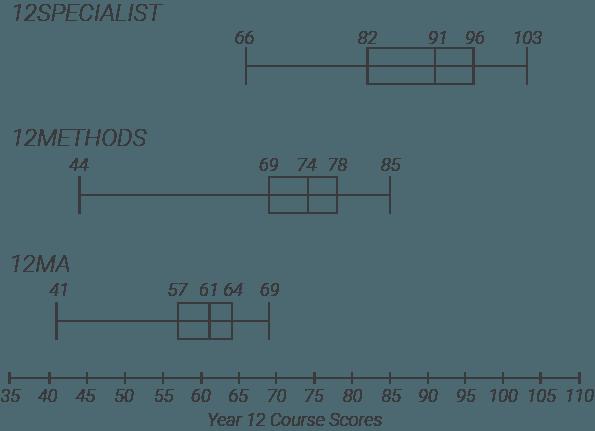
The graph below shows the course score range for each course, and highlights that for students in the bottom quartile of any course would achieve a better course score if they were in the top part of the course more suited to their ability level.
For example, the student with a course score of 66 in Specialist Mathematics is actually scoring a lower score than 75% of the students in Mathematical Methods. This student should have been in Mathematical Methods from the start.
Is it OK to start with a higher course and drop down if I find it too hard?
In the past, before the new iterations of the current courses, the answer would have been yes. However, there is now no overlap in most of the courses, and so it is extremely important that you are in the correct course as soon as possible. If you did change course, you would have to manage not only the new work, but also catch up on the topics which you have missed. In the past this has resulted in poor initial scores for a student, reducing their options. You will receive a recommendation from your Mathematics teacher for the course they believe you are best suited to at the end of Term 2. This recommendation is based on your current achievement, it will be reviewed in Term 4 and adjustments may be made if your performance in mathematics changes significantly.
Student quotes:
“Maths Methods is great for people who want more than just a basic foundation in Mathematics, but who are not considering a career in Mathematics.”
“I enjoy maths but I am not willing to put in many, many hours of work to keep up like in Specialist. I chose Methods because it was a perfect middle ground.”
“I chose Methods because my Year 10 teacher recommended it – I was thinking of Specialist but am glad I followed her advice.”
Music
Why
study music?
Music offers the best of both worlds as an academically creative subject. It especially develops confidence, communication skills, and the ability to be a creative, innovative and lateral thinker. Music as an Arts subject is highly sought after as a main area of study as well as giving balance and breadth to a learning program across all subjects.
What are the main aspects of music?
Music consists of performing, composing and musicology which involves the study of a broad range of music in context, incorporating theory and aural skills. The students undertake performances and compositions throughout the course as well as a variety of musicology tasks.
What level of performance and theory is needed to do the course?
Music can be studied through the BSSS as an Accredited or Tertiary Course, focusing on 4 semesters of assessment across the 2 years. Music can also be studied in the IBDP at both Standard or Higher level which involves internal and external assessment tasks to be completed towards the end of the 2-year program. There are no minimum performance or theory requirements for these courses. However, it is recommended that students are at least at an AMEB Grade 3 (or equivalent) level on their chosen instrument.
Student quotes:
“I like Music because it allows me to express my creativity through composing and performing.”
“I chose music because I have a background in playing the violin and piano, and I wanted to broaden my knowledge of musicology and composition. Music is a fun course which offers many performance opportunities.”
Health and Physical Education (HPE)
What is Exercise Science?
A tertiary or accredited based subject which deals with the science of sport and the application of human athletic performance. It requires a high level of theoretical knowledge, understanding and academic rigour together with practical based applications.
What pathways beyond school could Exercise Science currently offer?
Nursing, Sports Medicine, Physiotherapy, Para Medical, Sports Coaching, Applied Science, Sports Psychology, Sports Administration, Sports Studies, Teaching, Sports Training, Occupational Therapy, Nutrition/Dietetics, working with Elite Athletes or Sports Sociology to name just a few.
Can I do Exercise Science and Biology?
Yes, since the re-write of the BSSS Biology course, students are able to study both subject areas.
What do you study in Exercise Science?
The most popular units of study include anatomy and physiology, sports performance, sports nutrition, exercise physiology, sports medicine, biomechanics and sports psychology. There are a range of units detailed in the Guide to Courses.
What types of activities & assessment are included in Exercise Science?
A range of activities and tasks are used, from research laboratories, unit tests, essays, practical applications, oral presentations and research projects. Excursion and field work are also included.
Can you do a minor or a major in Exercise Science?
Yes, you can do both. Exercise Science can be taken for one year (minor in Year 11 or 12) & as a major (2 years of study in Years 11&12) – as a T or A course.
Do we do PE in Years 11 and 12?
Year 11 and 12 complete a Senior PE school based course recognised by the BSSS. Students participate in a range of recreational activities that they may wish to take up after school. The course provides students with a balanced approach to their academic studies and is mapped against our pastoral care program, promoting ongoing health and wellbeing.
Science
Can I study Physics and Chemistry at an Accredited level?
Physics and Chemistry are only offered at a tertiary level. Science subjects offered at both tertiary and accredited levels are Biology, Earth and Environmental Science and Psychology.
What level of Maths is recommended if I want to study Chemistry and Physics?
Mathematics underpins both Physics and Chemistry and students who choose these subjects must feel confident in manipulating mathematical formulae and performing graphical analysis, as well as being open to applying exponential and logarithmic equations.
What is Earth and Environmental Science (ESS)?
ESS encompasses the study of our planet and its environment, including the solid earth, its waters, its living things and the atmosphere. It aims to understand the earth's past, present and future, with applications ranging from predicting weather to understanding natural disasters. Key disciplines within ESS include geology, meteorology, oceanography, extracting and using resources, through mining and other means.
What areas of Biology are taught in this subject?
The course is a broad Biology course in which students develop their understanding of the relationship between structure and function in a range of biological systems, from single cells and multicellular organisms to ecosystems. They also learn about how biological systems, from organisms to populations, change over time. The course is organised into the broad areas of ecology, organisms and cells, evolution, genetics and homeostasis and disease.
Psychology at CGGS
Psychology falls under the BSSS Science Framework and is taught as a science at universities, including the ANU. The Psychology course focuses on credible and peer-reviewed research studies to support existing theories. The scientific method comprises a large component of the course and assessment includes experiments and lab reports. Psychology is considered a Group 3 subject in the IBDP (Individuals and Societies).
Library Services
How are the Library’s services different for senior students?
— Facilitation of membership to the National Library
— Use of the Library for study periods
— Access to the senior study rooms and private study carrels
— Access to the Library from 8am - 6pm
— More loans allowed
— Guidelines for essays, reports and assignments
— Additional research help and support
What support is available for assignments?
The Library website https://www.cggs.act.edu.au/teaching-learning/thestudent-journey/library/senior-school-library-resources is available on and off campus and provides tailored research guides for assignments, key resources and databases, links to the catalogue and eBook collections, and helpful documents.
The Teacher Librarians are available throughout the day to assist all students with research and assignment preparation.
How many loans can I have at once?
Six (increased from four for Junior students), all the textbooks you need for classes, and access to digital material, including some online textbooks.
Year 11 Information Night
International Baccalaureate Diploma Programme (IBDP)
How is the IBDP different to the BSSS?
The IBDP is a two-year program of study, students study six subjects and the Diploma Core. First Language, Mathematics and at least one other language subject are compulsory. At least three of the six subjects must be studied at Higher Level (more teaching hours, generally more breadth and depth of content and the remainder are studied at Standard Level.
The IBDP encourages international mindedness, critical thinking, breadth and depth of learning and for students to become confident and independent learners who are engaged in their community.
How is the IBDP assessed?
Formal assessment consists of Internal Assessments (which are marked by the teachers and moderated by IB examiners) and External Assessments consisting of a final set of examinations at the end of the two-year course of study. These examinations are marked externally.
All assessment is marked according to criterion and standard referencing and grade boundaries are applied. There is no ranking or scaling involved.
How is the IBDP recognised by universities?
“The University of Queensland welcomes IBDP students from Australasia and across the IB world. Our experience is that IBDP graduates are incredibly well prepared for university success. The program’s international flavour, academic rigour and emphasis on inquiry based learning means that IBDP students enter university with a global outlook, an excellent work ethic and the critical thinking skills to ensure they achieve.”
Margaret Fairman, Director, Office of Prospective Students and Scholarships University of Queensland, Australia.
“We find that IBDP students adapt more easily to university style of learning and become independent learners from an earlier stage compared to those from other backgrounds. IBDP students cope more easily with the wide range of subjects that each student is required to study from year 1. They are less focused on achieved marks, and value the education that we provide.”
Dr Lorraine Craig, admissions tutor, geophysics and engineering department, Imperial College, London, UK
“We are looking for students who specifically took academic challenges, who sought a rigorous curriculum. Our policy is to admit all IBDP students to the Honors Program, regardless of diploma attainment or attempt.”
Dr Christy Fox, director, Honors Program, Utah State University, USA
Why do students choose the IBDP?
“I decided to take the IBDP because I believe it provides students with a well rounded education which will in future open many doors and adequately prepare them for university.”
“I chose to do the IBDP because it gave me the opportunity to study a variety of fun, interesting subjects to a greater, more internationally-focused degree.”
“The IBDP stood out to me because it is an internationally recognized education system, as I plan to study overseas. I liked the way in which the program challenges and teaches you to become independent.”
“I chose the IBDP because it is different from regular school. I get more freedom to learn what interests me and I feel like I am going to be ready for anything when I leave school.”
“I’ve grown up internationally so it makes sense to finish in a program that reflects my upbringing, and will allow me to continue living an international lifestyle in the future.”